



Abstract
This study examined an insufficiently studied predictor of functional language, social motivation, in a group of 87 young children with autism spectrum disorder. Participants (age 14–31 months at the start of the study) were assessed at four times over 24 months. We tested total and indirect associations between early social motivation and later expressive language to understand the behavioral mechanisms by which social motivation might affect functional language development. Results from this study show that early social motivation predicts functional language 2 years later in young children with autism spectrum disorder. In addition, this positive longitudinal association is serially mediated by intentional communication and then receptive language. These findings are consistent with the elicited bootstrapping hypothesis which proposes that children with relatively stronger social motivation produce more intentional communication. This, in turn, elicits others’ linguistic input which impels receptive language development. This process eventually results in relatively increased expressive language development.
Lay abstract
About one-third of children with autism spectrum disorder never develop the language that they need in different day-to-day situations. Identifying potential factors that can predict later language development is crucial to understanding why some children with autism spectrum disorder successfully develop language while others do not. This study sought to investigate one of the understudied predictors of language development, social motivation, and to test theories for why this association may occur. Testing the theories requires that we measure children’s ability to deliberately and directly communicate with others (i.e. intentional communication) and children’s language understanding between the measures of social motivation and later expressive language. We tested 87 children with autism spectrum disorder, aged 14–31 months, at four times over 24 months. We found that children with relatively stronger social motivation had relatively better language use 2 years later. This positive link was partly due to a child’s ability to produce intentional communication and to understand language. Although we did not measure parents’ talking to their children, a theory that inspired this study suggests that children who use frequent intentional communication probably motivate others to talk with them frequently, which facilitates children’s language understanding which leads to the development of expressive language. This theory, if confirmed to be true, can provide guidance for parents who want to help their children learn to talk. Parents could look for intentional communication from their children and respond by talking to their children. Effective intervention on both parent and child targets will likely enhance treatment efficacy. Future work is needed to test these ideas.
Keywords
Children with autism spectrum disorder (ASD) display highly heterogeneous language abilities in addition to their complex behavioral phenotypes (Tager-Flusberg, 2016; Tager-Flusberg et al., 2005). On one end of the spectrum is a group of verbally fluent children with ASD who develop functional language with pragmatic language deficits and some residual structural language differences (Boucher, 2012). On the other end of the spectrum are the one-third of this clinical population who never achieve functional language (Tager-Flusberg et al., 2005; Tager-Flusberg & Kasari, 2013), defined as expressive language that may be used frequently, communicatively, and referentially (Yoder et al., 2015). It is critical to identify predictors of functional language because they may help understand the mechanisms underlying successful early language learning. Achievement of functional language by the end of pre-school years has been shown to associate with later academic, social, and vocational outcomes for individuals with ASD (Billstedt et al., 2005; DeMyer et al., 1973; Paul & Cohen, 1984). This study examines an insufficiently studied predictor of functional language, social motivation, and reasons for its association with functional language in children with ASD.
The need to understand the mechanisms by which early variables predict functional language in ASD
Many theories exist to explain language variability in children with ASD, including cognitive, social, motor, and transactional theories (cf. Yoder et al., 2015). Two of these theories are relevant to the topic of this article—social and transactional theories. Social-oriented theories consider language difficulties in children with ASD as secondary to social-related deficits. For example, atypical attention to social cues (e.g. child-directed speech, human face) has been cited as a source of variation in language abilities in children with ASD (Watson et al., 2010, 2012; Chawarska et al., 2012). Transactional theories consider child outcomes as a product of child characteristics and a child’s experience (Sameroff, 1975; Sameroff & MacKenzie, 2003), which highlights the bidirectional language exchanges that occur between a child and his or her caregivers (Camarata & Yoder, 2002). Key ingredients that have been discussed from a transactional perspective include the child’s intentional communication (Plumb & Wetherby, 2013; Yoder, 2006), the parent’s linguistic input (Edmunds et al., 2019), and the child’s ability to imitate and acquire language following the parent’s input (Siller & Sigman, 2008).
Despite a myriad of child- and parent-level predictors of spoken language development in children with ASD identified in the literature, we do not yet sufficiently understand the mechanisms by which predictors impact later functional language. Testing competing theories using mediation analysis can provide us with insights into ways one predictor brings about variation in later functional language development in children with ASD (Mackinnon et al., 2007). These insights are valuable for two reasons. For researchers, understanding the mechanisms by which functional language develops in children with ASD sheds light on the interplay between various predictors and helps us formulate more specific theories of spoken language development in children with ASD. For clinicians, these insights can inform the development of new treatment goals and the sequencing of goals to optimize spoken language development in young children with ASD.
Rationale for focusing on social motivation as a predictor of functional language
The notion that children with ASD are less motivated to engage in social communication because social information is less prioritized and social interaction is less intrinsically rewarded was first proposed approximately three decades ago (Dawson & Lewy, 1989; Mundy, 1995; Mundy & Markus, 1997; Stone et al., 1997). This model is referred to as the social orienting model in early literature or the social motivation theory in recent work (Chevallier et al., 2012; Mundy, 1995; Mundy & Crowson, 1997).
In recent years, motivational factors have increasingly become a target of autism research. In a review, Chevallier and colleagues reified the construction of social motivation by defining it as a three-tiered behavioral manifestation that includes (a) social orienting (i.e. social signals are prioritized during processing), (b) social seeking (i.e. one seeks social interactions because they are intrinsically rewarding), and (c) social maintaining (individuals have a desire to maintain social engagement; Chevallier et al., 2012). In this theoretical framework, diminished social motivation has cascading effects on a child’s social development because it deprives a child of early opportunities to engage in salient social exchanges in his or her learning environment. A significant body of literature has provided support for this account. Children and adults with ASD often display reduced attention to social stimuli compared to non-social stimuli (Chawarska et al., 2012; Chawarska & Shic, 2009; Kuhl et al., 2005; Rice et al., 2012; Sasson et al., 2008; Watson et al., 2010). Attenuated attention to social signal has also been found to associate with later deficits in social cognition understanding and social skills, including joint attention (Dawson et al., 1998, 2004), social reciprocity (Kuhl et al., 2005), and Theory of Mind understanding (Burnside et al., 2017).
Despite the amount of research on the impact of diminished social motivation on social outcomes, there is surprisingly little literature concerning its implications for language development in children with ASD. Diminished social motivation may also place children with ASD at a disadvantage for learning language (Camarata & Yoder, 2002; Tomasello, 2000; Tomasello et al., 2005). Only a few studies have examined associations between variation in some aspect of social motivation and variation in language ability in children with ASD and these findings are mixed. Kuhl et al. (2015) reported that a greater preference for non-social stimuli in a head-turn preferential paradigm was associated with decreased expressive language measured by the Vineland Adaptive Behavior Scales (VABS; Sparrow et al., 1984). Watson and colleagues (2012) found that sustained looks to social stimuli significantly associate with concurrent and longitudinal receptive and expressive language abilities. However, using other measures of language, no significant association was detected between orienting to social stimuli and communication or language abilities (Watson et al., 2012). It is important to note that all of the aforementioned studies measured only one aspect (i.e. social orienting) of social motivation as outlined by Chevallier et al. (2012). Yet, considering the dynamic and interactive nature of language learning, the other two aspects of social motivation (i.e. social seeking and social maintaining) are also theoretically indispensable to successful language development.
Three theoretically motivated paths between early social motivation and functional language
In this section, we elaborate on three theories that predict a positive association between early social motivation and the development of functional language in children with ASD. The theories differ according to which mechanism or mechanisms explain the aforementioned association (Figure 1). In this article, we use the term mechanisms to refer to psychological mechanisms that are measured through behavior.
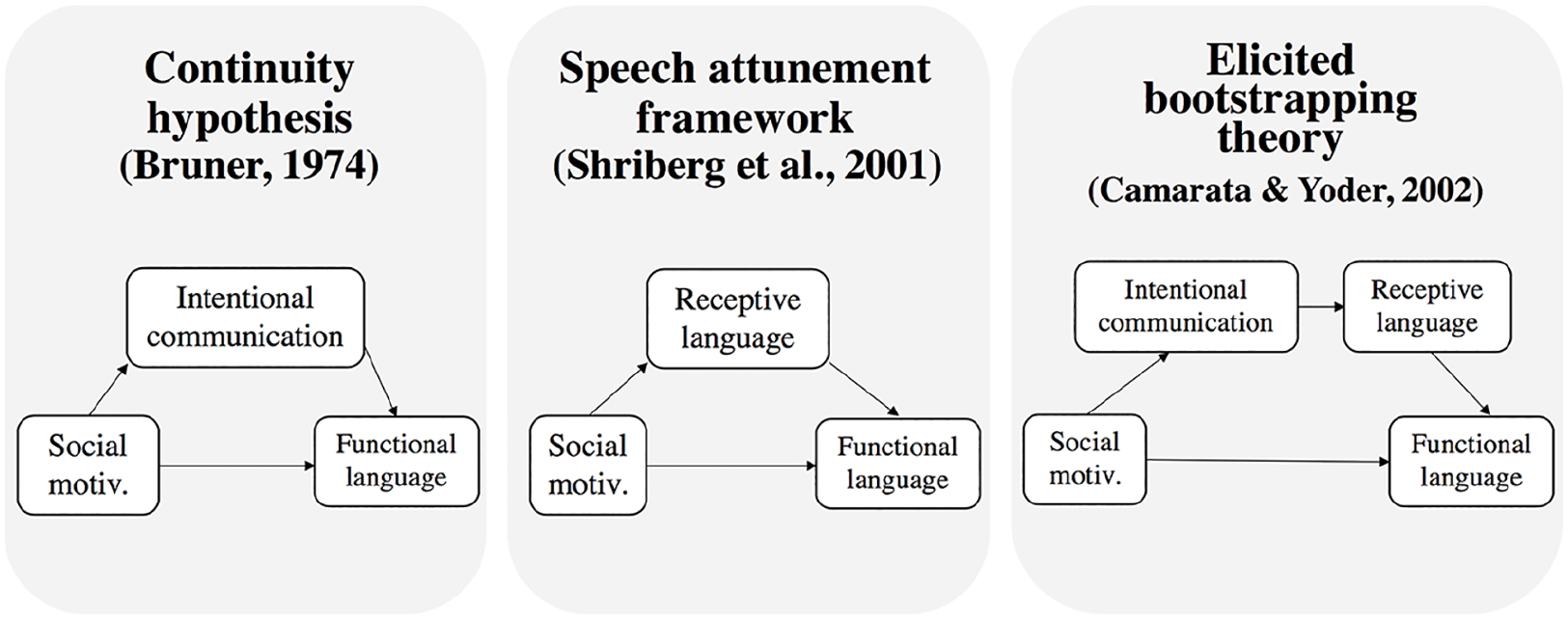
Hypothesized indirect effect of early social motivation on later functional language through (a) intentional communication, (b) receptive language, or (c) intentional communication and receptive language.
Continuity hypothesis
Regarding constituent skills relevant to language acquisition, Bruner (1974) argued for a continuity between prelinguistic communication and early language. More specifically, he suggested that prelinguistic forms of expression (i.e. intentional communication) provide a child with necessary semantic and pragmatic bases for later and more advanced linguistic form of expression (e.g. words and sentences). For example, prelinguistic communication behaviors such as gestures and vocalizations serve the same pragmatic functions as early words and utterances. A child who has previously achieved competence to use prelinguistic communication is better equipped to “crack the code” of lexical or linguistic expression (Bruner, 1974, p. 260).
Under the continuity hypothesis, prelinguistic communication is considered an essential precursor of early language because it shares similar pragmatic functions with early language. We apply the continuity hypothesis to predict that a child with ASD who displays stronger social motivation is more likely to produce more instances of intentional communication, which subsequently becomes a stepping stone to early language development. The continuity theory predicts that intentional communication is a mediator of the association between social motivation and expressive language.
Speech attunement framework
The speech attunement framework proposes that the remarkable feat of language acquisition requires a child to “tune in” (i.e. attend to) and “tune up” (i.e. match one’s production to various aspects of speech) to adults’ input in the environment (Shriberg et al., 2011). The “tuning in” aspect of this theory suggests that the ability to attend to and respond to linguistic input is a prerequisite for the subsequent “tuning up” aspect of language development. Under this theoretical framework, language delays or deficits in children with ASD stem from their limited ability to process sufficient meaningful input in their environment to master language.
Shriberg and colleagues briefly speculated that the “tuning in” deficit may reflect documented enhanced auditory perceptual abilities in children with ASD that they may exhibit a bias to process low-level acoustic–perceptual characteristics instead of high-level semantic–linguistic properties of input (Heaton et al., 2008; Järvinen-Pasley et al., 2008; Mottron et al., 2006). We argue that social motivation may account for the reduced ability to “tune in” in children with ASD. Social motivation may be relevant to variation in tuning in for two reasons. First, a child who is interested in others’ actions and speech may seek environments with more social and linguistic input. Second, in addition to simply being near more input, a child who is socially motivated is also more likely to pay more attention to and learn more from others’ speech. Cumulatively, more opportunities for processing others’ speech could lead to improved efficiency in the uptake of relevant information from linguistic input (Hurtado et al., 2008). Accordingly, this theoretical approach would hypothesize that a child with strong social motivation will seek and attend to more linguistic input, which then provides the necessary semantic basis for functional language development without any attention to intervening intentional communication. This tune-in theory predicts that receptive language is a mediator of the association between social motivation and expressive language.
Elicited bootstrapping hypothesis
The elicited bootstrapping hypothesis is a specification of the transactional model of language development (Camarata & Yoder, 2002; Sameroff, 2009; Sameroff & Chandler, 1975; Sameroff & MacKenzie, 2003; Yoder & Warren, 1993, 1999b). From a transactional perspective, Camarata and Yoder (2002) posited that child and parent behaviors mutually impact each other and contribute to language advances in the child. The essential idea within the elicited bootstrapping hypothesis is that as a result of high social motivation, children use frequent intentional communication, which elicits linguistic input from caregivers. The elicited caregiver linguistic input then propels receptive language growth and subsequently provides the semantic basis for expressive language (Yoder et al., 2015). We call this specification of the transactional model the “elicited bootstrapping theory” because it proposes that the child is actively engaged in social interactions that elicit highly processable linguistic input (i.e. bootstrapping) from adults in the environment. This theory assumes that parental language input is an important aspect of why social motivation would be associated with expressive language through intentional communication and receptive language. Unfortunately, the current study does not have a measure of parental input. Regardless, if intentional communication and receptive language are found to be mediators in serial, the data would be consistent with the elicited bootstrapping theory.
Research questions
To evaluate the extent to which social motivation predicts expressive language in a group of young children with ASD, we asked the following research questions:
Does social motivation predict functional language in a group of young children with ASD 2 years later?
Is the longitudinal association between early social motivation and functional language mediated by intentional communication only, receptive language only, or by intentional communication and receptive language in serial?
This is the first study that examines longitudinal correlational associations between social motivation and language outcomes using a measure that represents all three behavioral manifestations of social motivation as delineated by Chevallier et al. (2012). The second research question is an exploration of psychological mechanisms by which social motivation affects functional language development, which has clinical implications for targeting and sequencing treatment goals. Identifying key mechanisms may improve treatment efficiency by proposing preceding skills that could be monitored when the long-term goals is expressive language.
Methods
Participants
This study included 87 children (21 females, 66 males) who participated in a longitudinal multi-site randomized controlled trial treatment study (Rogers et al., 2020). The treatment study assessed the effect of 1-year in-home early intervention of varying intensity and delivery style for improving outcomes for young children with ASD. We tested whether treatment intensity or style influenced the associations of interest in both research questions and did not find any evidence suggesting any association of interest is conditional upon (i.e. moderated by) treatment group assignment. Specifically, we tested whether treatment intensity or style moderated three indirect paths that might link social motivation to expressive language (i.e. through intentional communication only, through receptive language only, and through both intentional communication and receptive language serially). The bias-corrected bootstrap confidence intervals (CI) for all three moderated mediation effects include zero (95% bias-corrected CI for treatment intensity moderating three paths were [−0.08, 0.25], [−0.36, 0.08], and [−0.01, 0.43] and for treatment style moderating three paths were, respectively [−0.24, 0.00], [−0.24, 0.30], and [−0.17, 0.40]). These results indicate that treatment assignment did not alter the associations of interest in this study. Thus, details of the treatment study were not elaborated in this report.
As part of the longitudinal treatment study, data were collected across four time points: study entry (Time 1), 6 months post entry (Time 2), 12 months post entry (Time 3), and 24 months post entry (Time 4). Treatment took place between Time 1 and Time 3. Caregiver consent was obtained from all participants prior to their participation. Twenty-seven participants had missing data for at least one variable in the mediation model implied in testing for research question two. We implemented full information maximum likelihood estimation in all our statistical models to handle missing data from these participants (Enders, 2010).
Inclusion criteria for the treatment study are as follows: (a) between 12 and 30 months of age at initial time of assessment; (b) ambulatory and without impairments affecting hand use; (c) meets criteria for ASD based on the Diagnostic and Statistical Manual- 5th revision criteria, the Autism Diagnostic Observation Schedule for Toddlers, and clinical consensus by two independent staff (including a licensed psychologist) based on observation as well as record review; (d) overall developmental quotient of >35 on Mullen Scales of Early Learning; and (e) normal hearing and vision screening.
At Time 1, the 87 included participants were between 14 and 31 months (M = 23 months, SD = 4 months). Caregivers reported 47 participants to be Caucasian, 9 to be Asian, 7 to be African American, 1 to be American Indian/Alaska Native, 1 to be Pacific Islander, and 20 to be more than one race. Caregivers of two participants did not report their child’s race. On average, participants had an expressive language age equivalence of 12 months at Time 1 and an age equivalence of 34 months at Time 4. Additional descriptive characteristics of the 87 participants at study entry are available in Table 1.
Participants’ descriptive characteristics at study entry.

ADOS-2: Autism Diagnostic Observation Schedule—Second Edition; MSEL: Mullen Scales of Early Learning; MB-CDI: Mac-Arthur Bates Communication Development Inventories.
Research design
Four variables from four measurement periods are relevant for this report (Table 2). Data used in this analysis include social motivation measured at Time 1, intentional communication measured at Time 2, receptive language measured at Time 3, and expressive language measured at Time 4. We first examined the longitudinal associations between social motivation at Time 1 and expressive language at Time 4 and then added the putative mediators, intentional communication at Time 2 and receptive language at Time 3, to test whether data are consistent with proposed theoretical models.
Mean, standard deviation, and range of variables for the sample of this study.
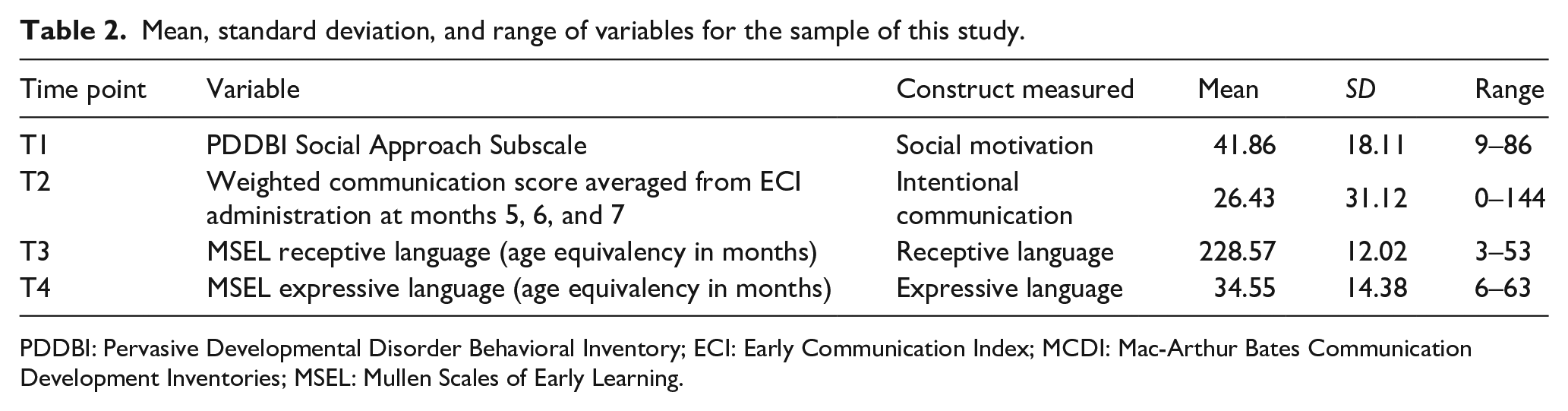
PDDBI: Pervasive Developmental Disorder Behavioral Inventory; ECI: Early Communication Index; MCDI: Mac-Arthur Bates Communication Development Inventories; MSEL: Mullen Scales of Early Learning.
The longitudinal sequential design offers some advantages over cross-sectional designs regarding whether the associations are causal because the temporal ordering of the four variables helps elucidate the directionality of the effects. However, the longitudinal sequential design, similar to all longitudinal correlational designs, does not eliminate all competing explanations for the associations of interest. Instead, mediation models using longitudinal sequential designs provide preliminary evidence that paves the way for future experimental studies designed to establish the causal nature of the relationships observed.
Measures and procedures
Social motivation
Social motivation at Time 1 was measured using raw scores from the Social Approach subscale from the Pervasive Developmental Disorder Behavioral Inventory (PDDBI; Cohen et al., 2003). The PDDBI is a parent rating scale designed to assess symptoms of ASD in children between 18 months and 12.5 years. It contains 176 items and instructs parents to rate each item as occurring never (0), rarely (1), sometimes/partially (2), or often/typically (3). The Social Approach subscale includes 36 items that represent all three behavioral manifestations of social motivation. For instance, items associated with social orienting behaviors include “looks when called or praised,” “pays attention to other’s face when given instructions or when asked questions,” and “watches others and plays near them.” Items representing social seeking include “moves arms/hands in beckoning motion to signal others to come to him or her,” “seeks affection from caregivers or siblings,” and “looks at others to seek feedback and/or praise.” Items that represent social maintaining include “engages in cooperative, helpful, turn-taking play where both partners work on a common goal or theme together,” “imitate peek-a-boo,” and “offers help when others are in need of assistance.” Previous studies using the PDDBI Social Approach subscale have reported good reliability and stability with a standardized alpha coefficient of 0.94 and a test–retest reliability coefficient of .93 over a 2-week interval (Cohen et al., 2003, 2009; Cohen & Sudhalter, 2005). In a factor analysis for the subscale that make up the PDDBI parent rating scale, the Social Approach subscale loaded on a factor with Social Pragmatic Problems, Semantic/Pragmatic Ability, Learning/Memory and Receptive Language, and Phonological Skills (Cohen et al., 2003). It did not load on a second factor that included Sensory/Perceptual Approach Behaviors, Specific Fears, Arousal Problems, and Aggressiveness. In addition, previous work has also provided evidence that the Social Approach subscale significantly correlated with the Socialization domain of the VABS-II (Sparrow et al., 2005) and the Behavioral Assessment of Social Interactions in Young Children (Callahan et al., 2011; Cohen & Sudhalter, 2005; Gillis et al., 2011) in children with ASD. These analysis results support the construct validity and criterion-related validity of this measure.
Intentional communication
Intentional communication at Time 2 was measured using the Early Communication Index (ECI), which is one of the Individual Growth and Development Inventories (IGDIs; Carta et al., 2010). The ECI is a 6-min play-based observational measure that uses a standard toy set in a research lab setting. It has been validated on a large participant group (N > 7000) that includes children from regionally (i.e. urban, suburban, rural) and racially diverse backgrounds, children from low-income families, bilingual Spanish-English children, and children with disability (Greenwood et al., 2006, 2010). As part of the larger longitudinal study, the ECI was administered monthly throughout the first 12 months. The current study coded communication from the ECI procedures administered at months 5, 6, and 7 following study entry, which resulted in a total of 18 mins of observation. One previous study has shown that using three ECI samples increased the stability of the coded variables compared to that from one ECI (McDaniel et al., 2019).
Four communicative behaviors, including gestures, vocalizations, single words, and multiple word utterances, were coded. A total weighted communication score was derived by adding the occurrences of these four behaviors and giving additional weight to each instance of single words (counted as 2) and multiple words (counted as 3). Gestures and vocalizations each counted as 1 per instance. A coding manual for this variable is available from the first author. Interobserver reliability for this variable was calculated using intraclass correlation coefficients (ICCs) in a two-way random model using absolute agreement for one measure (Yoder et al., 2018). A trained secondary coder independently coded a random sample of more than 20% of coded ECI sessions. The ICC for this variable was 0.98, which indicates very good reliability (S. Mitchell, 1979).
Language
Receptive language at Time 3 and expressive language at Time 4 were measured using the Mullen Scales of Early Learning (MSEL; Mullen, 1995) age equivalency scores. The MSEL is a standardized assessment normed for children from birth to 68 months.
Data analysis
To examine the association between social motivation at Time 1 and expressive language at Time 4, a Pearson correlation was performed. Subsequently, a mediation analysis using ordinary least squares estimation was conducted to examine whether intentional communication and/or receptive language mediate the association between social motivation and expressive language using procedures described in Hayes (2017). In a serially mediated model, we entered social motivation at Time 1 as the independent variable, expressive language at Time 4 as the dependent variable, and intentional communication and receptive language as two serial mediators at Time 2 and 3, respectively.
This mediation model tested all three indirect paths that might link social motivation to expressive language, including the indirect effect (a) through intentional communication only, (b) through receptive language only, and (c) through both intentional communication and receptive language serially. The coefficient for an indirect path is the product of each individual effect. For example, the indirect effect of social motivation on expressive language through intentional communication has two paths: one from social motivation to intentional communication (the “a1” path) and a second from intentional communication to expressive language (the “b1” path) (see Figure 2). Thus, the coefficient for the indirect effect of social motivation on expressive language through intentional communication is the product of the unstandardized coefficients for the a1 and b1 paths. All coefficients were estimated using full information maximum likelihood estimation. To test the significance of each indirect path, bias-corrected bootstrap CIs were calculated for each indirect path using 5000 bootstrapped samples. An indirect path is statistically significant when the calculated CI excludes zero. For all analyses, the assumptions for correlation and regression were tested and the data met assumptions of multivariate normality, heteroscedasticity, undue influence, and linearity. All analyses were completed in RStudio (RStudio Team, 2019).

Results for whether intentional communication at Time 2, receptive language at Time 3, or both in serial mediate the association between early social motivation at Time 1 and end-point functional language at Time 4.
Results
Mean, standard deviation, and range of all included variables for the sample of this study are shown in Table 2. A Pearson correlation showed that social motivation measured at study entry was positively associated with expressive language at Time 4 (r = 0.27, p = 0.04). Of the three indirect paths that might explain the association between Time 1 social motivation and Time 4 expressive language, only the positive indirect effect involving both intentional communication at Time 2 and receptive language at Time 3 (i.e. a1*d21*b2 in Figure 2) had a CI that excluded zero, standardized coefficient = 0.07, 95% bias-corrected CI = [0.01, 0.15]. Detailed coefficients, standard error, and effect size results are displayed in Table 3 and Figure 2. The significant indirect path involving both mediators remained significant even when Time 1 expressive language (standardized coefficient = 0.07, 95% bias-corrected CI = [0.01, 0.15]), gender (standardized coefficient = 0.05, 95% bias-corrected CI = [0.01, 0.15]), or age (standardized coefficient = 0.05, 95% bias-corrected CI = [0.01, 0.15]) was added as a covariate in the model.
Standardized coefficients, standard errors, and model summary information for the mediation analysis results depicted in Figure 2.

SE: standard error.
p < 0.05; ***p < 0.001; n.s. denotes non-significance.
The other two indirect paths that include either Time 2 intentional communication (i.e. a1*b1) or Time 3 receptive language (i.e. a2*b2) as a sole mediator of the association between social motivation and expressive language were not significant and both CIs included zero. The indirect effect of social motivation mediating expressive language only through intentional communication was estimated as 0.02, 95% CI = [−0.01, 0.08]. The indirect effect of social motivation mediating expressive language only through receptive language was estimated as 0.02, 95% CI = [−0.06, 0.11].
Discussion
This study tested the longitudinal associations between early social motivation and functional language 2 years later in a group of young children with ASD. Within a longitudinal correlation design, we tested three potential mechanisms by which social motivation might impact functional language development. We found that early social motivation predicted functional language 2 years later in children with ASD. In addition, this positive longitudinal association was mediated by both intentional communication and receptive language serially. These findings are consistent with the elicited bootstrapping hypothesis, which proposes that increased social motivation will result in more instances of child intentional communication which elicits linguistic input from the environment that, in turn, leads to growth in receptive language first and expressive language subsequently.
Limitations
Several limitations of this study should be acknowledged before we elaborate on the implications of our findings. First, even though we were able to eliminate the possibility that either expressive language at Time 1, gender, or age was a third variable explanation for the relations of interest, an intrinsic limitation of the longitudinal correlational design is that this design cannot eliminate all alternative explanations due to unmeasured and uncontrolled variables that may covary with all variables in the associations of interest (i.e. third variable explanations). Thus, current findings provide association-level evidence of the elicited bootstrapping hypothesis. Future studies are warranted to experimentally test the causal associations proposed by this theory. A second limitation of this study is that a key variable needed to fully test the elicited bootstrapping explanation for the association between social motivation and later expressive language—caregiver language input—was not measured in the larger study. According to this theoretical framework, child intentional communication would result in receptive language gains because intentional communication elicits input from adults in the environment. A third limitation is that the serially mediated results were conducted as a post hoc analysis. Therefore, the findings of this model should be interpreted as hypothesis generating. We tested three paths within one model in this study. Future work is warranted to directly compare across models to further elucidate the impact of child characteristics and input characteristics on language development in children with ASD.
The longitudinal sequential mediation model used in the current study is a reasonable compromise between a cross-sectional design (i.e. a design that uses data from a single time point) and full longitudinal design (i.e. a design that uses all available data from all time points; M. Mitchell & Maxwell, 2013). The longitudinal sequential design shares one advantage of the full longitudinal design over the cross-sectional design: the sequential design reflects the passage of time and specification of when the early measured variables are predicted to influence later variables. However, the sequential design does not allow modeling possible mediation effects over time lags and may provide biased estimates of parameters compared to full longitudinal mediation models (M. Mitchell & Maxwell, 2013). Given that the sample size of this study does not provide sufficient power for full longitudinal analyses that include all four constructs measured at all four time points, these exploratory findings call for future studies with larger sample sizes that allow testing of additional variations of the model specified in this article to confirm findings from this study.
Strengths and unique contributions
Several strengths are noteworthy in this study. This is the first study on the impact of social motivation on language development in children with ASD that used a measure that includes items representing all three behavioral manifestations of social motivations. Only social orienting was measured in previous studies that sought to understand the association between social motivation and language or social communication skills (Campbell et al., 2014; Chawarska et al., 2012; Paul et al., 2007; Watson et al., 2010, 2012).
Social orienting measures do not fully represent social motivation as a construct. Social seeking and social maintaining are two other important aspects of social motivation that are not captured by social orienting measures (Chevallier et al., 2012). Social seeking differs from social orienting in that social orienting measures how external social stimuli are processed, whereas social seeking emphasizes that even without external social stimuli, an individual exerts effort to engage in social interactions and prosocial behaviors for their social reward value (Chevallier et al., 2012; Rekers et al., 2011). Likewise, social maintaining differs from social orienting by emphasizing one’s desire to maintain social relationships over sustained periods of time and continue the interaction for additional rounds, thereby resulting in more learning opportunities and learning content involving social communication with the partner. Using the Social Approach Subtest from the PDDBI to measure social motivation provides better content validation than past studies investigating the link between social motivation and language because it includes items that reflect all three relevant aspects of social motivation.
Another limitation of past research involves the reliance on intermodal preferential looking paradigms (Golinkoff et al., 2013; Spelke, 1976) or head-turn preference paradigms (Nelson et al., 1995) to measure social orienting. These procedures present participants with competing social (e.g. face or child-directed speech) and non-social stimuli (e.g. objects or environmental sounds). Common variables derived from these paradigms include proportion of length of time in which a participant orients to each type of stimuli, initial orientation, latency to fixate on or orient to social stimuli, and fixation or perseveration time on a specific stimulus (Chita-Tegmark, 2016). A number of previous studies have shown that results from these measures of social orienting can be context-dependent. For example, Chawarska and colleagues have shown that the context in which a stimulus appears can affect social orienting responses in toddlers with ASD. Specifically, the authors found that although toddlers with ASD showed typical visual orientation to social stimuli in certain contexts (i.e. social scene without explicit social bids), they displayed significantly decreased attention to social stimuli when dyadic cues that consist of child-directed speech and eye contact were introduced in the context.
The presence and the type of non-social competing stimuli can also impact visual social orienting patterns in individuals with ASD. For instance, individuals with ASD fixated on social stimuli later when a social stimulus was paired with a high autism interest stimulus (Unruh et al., 2016). These findings suggest that social orienting behaviors in individuals with ASD can vary based on attributes of the measurement context. This is problematic because existing theory of social motivation in children with ASD conceptualizes social motivation as a generalized behavioral tendency, which should be stable across multiple valid measurement contexts (Yoder et al., 2018). The social motivation measure that we selected asked parents to rate what their child usually does in multiple natural environments and thus may increase the stability and the potential validity of the estimates.
Finally, findings from the current study offer additional insights into the mechanisms of the association between social motivation and expressive language. By including and testing various mediators that might explain the significant paths, we contribute additional support for the elicited bootstrapping hypothesis (Camarata & Yoder, 2002; Yoder & Warren, 1999a). Our finding that intentional communication and receptive language in serial but not in isolation mediate the association between early social motivation and later functional language development is consistent with transactional accounts of language development. These accounts consider parent-level, child-level, and dyadic sources of variation. Although parental input was not part of the tested model, the identification of intentional communication and receptive language as the mediators draws attention to the possibility that parental input is an important part of the implied causal chain of events that explains why social motivation variation affects expressive language variation in children with ASD.
Intentional communication and social motivation as two separate constructs
The current study identified intentional communication as one of the two mediators in the significant path from early social motivation and later functional language development. One important question to consider is whether intentional communication is a separate construct from social motivation or just one of the behavioral manifestations of social motivation. This question carries significant theoretical and clinical implications. If two constructs have been hypothesized and demonstrated empirically as distinct from each other, they would play different roles and interact with other psychological processes in distinctive ways (Smith et al., 2009). Such knowledge could shed light on clinical practice and provide more specific clinical recommendations regarding intervention targets.
We consider intentional communication and social motivation as two related yet distinct constructs. One observable behavioral convergence between these two constructs is social seeking behaviors. For example, a child showing a toy to an adult nearby is both an act of intentional communication and a behavioral manifestation of social motivation. In addition to social seeking behaviors, social orienting and social maintaining add two unique elements to the overall construct of social motivation (Chevallier et al., 2012). These two aspects are key components of social motivation that cannot be overlooked because previous findings have shown that children and adults with ASD may demonstrate significant disruptions in social orienting and social maintaining as well as social seeking (Chevallier et al., 2012; Hobson & Lee, 1998; Liebal et al., 2008).
In contrast to social motivation which refers to a drive to seek social attention and form social connections, intentional communication necessitates an understanding of the communicative purpose behind a communicative act and the effect of a communicative act on listeners (Bates, 1979; Yoder et al., 2001). Such an understanding relies on two cognitive achievements, namely means-end (i.e. desired items or goals can be achieved via indirect means) and social agency (i.e. a novel mean to a desired item or goal can be another person; Yoder & Warren, 2001). Thus, many ways to convey intentional communication require the use of coordinated attention between an object and a person. In addition, many forms of intentional communication use socially defined forms of communication (e.g. conventional gestures, spoken words, and sign language) and provide evidence of internalizing certain aspects of the child’s culture. Findings from this study suggest that children with ASD with stronger social motivation may be better able to master or more rapidly master means-end and social agency concepts and provide more frequent use of socially defined forms of communication, which indirectly impact their later receptive and expressive language development. Therefore, we consider the constructs of social motivation and intentional communication distinct but related constructs.
Our finding that intentional communication is one of the two key mediators of the association between social motivation and functional language converges with previous studies that have shown that intentional communication explains unique variations in later language development (Ingersoll & Wainer, 2013; Yoder et al., 2015). In addition, these findings add to the current evidence base that social motivation plays a distinct and important role in expressive language development in children with ASD.
Receptive language is not a sole mediator between social motivation and functional language
One interesting finding from this study is that receptive language in isolation does not mediate the path from social motivation to expressive language. This may be a surprising result because receptive language has been shown by previous studies to be a strong predictor for later expressive language in children with ASD (Luyster et al., 2007; Thurm et al., 2007; Wetherby et al., 2007). However, our findings are in accordance with other work that found that early receptive language fails to continue to predict expressive language gain after controlling for other predictors of expressive language that strongly covary with receptive language (Yoder et al., 2015). A recent study has also shown that when treated in the receptive modality solely in vocabulary intervention, children with ASD do not consistently generalize to expressive vocabulary gain (Su et al., 2019). Collectively, these findings suggest that the association between early receptive language and later expressive language may be explained by other predictors. Our findings also emphasize the need to understand the nature and magnitude of the way receptive language explains language outcomes in children with ASD.
Clinical implications and future directions
If a future treatment study confirms that the significant associations in the current study are causal, then prioritizing social motivation and intentional communication as treatment targets may be an effective strategy for improving expressive language. For children with ASD, targeting only word production without putting efforts into increasing children’s social motivation may be unproductive. This implication aligns with core principles from Naturalistic Developmental Behavioral Interventions (NDBI; Schreibman et al., 2015). For instance, many intervention approaches emphasize social motivation and incorporate strategies to promote social engagement, such as the SCERTS model (Prizant et al., 2003), the Early Start Denver Model (Dawson et al., 2010), and Pivotal Response Treatment (Koegel & Koegel, 2006).
Our findings also suggest that intentional communication may trigger parental input, a variable unmeasured in our study, thereby improving the child’s uptake of input and receptive language (i.e. the semantic basis for expressive language). If we solely tell parents of children with ASD and other developmental disabilities to “talk more” and “use richer language” without addressing children’s social motivation and intentional communication as treatment targets, parents may find it unrewarding to interact with the child frequently and children may not understand the parental input. This is not to say that parents should be excluded from intervention or that child communication should be the only target in intervention. Quite the reverse is true. Theoretically, if social motivation, intentional communication, and parental linguistic responses to child leads are all targeted, as is common in most NDBIs, then the treatment package is more likely to affect expressive language than if only one or two of these goals are addressed. A body of literature has shown that both child intentional communication and parental linguistic responses are malleable in treatment and intervention approaches that include these targets can lead to generalized child language improvement (Ingersoll & Wainer, 2013; Kasari et al., 2006; Mahoney & Perales, 2005; Siller et al., 2014). In addition, comprehensive treatment studies have also shown effects on receptive language in children with ASD (Dawson et al., 2010; Wetherby et al., 2014).
In addition, based on the elicited bootstrapping hypothesis, for a child’s intentional communication to successfully elicit additional linguistic input from caregivers and lead to subsequent receptive and expressive language gains, caregivers need to recognize and respond consistently to intentional communications. Thus, the current findings support practices in which clinicians consider the inclusion of a caregiver goal of improving the consistency of the recognition of and responses to child intentional communication.
Conclusion
In conclusion, this study is one of the first to demonstrate a strong positive relationship between social motivation, as defined by all three of its attributes, and later expressive language in a group of young children with ASD. This relationship was mediated by both intentional communication and receptive language serially. These patterns provide additional support for the eliciting bootstrapping specification of the transactional theory of language development and generate clinical implications on the selection of treatment goals when working with young children with ASD.
Footnotes
Acknowledgements
We thank all of the children and families who participated to make this work possible.
Funding
The author(s) disclosed receipt of the following financial support for the research, authorship, and/or publication of this article: This research was funded by the NIMH (R01MH100030; PI: Rogers).
