




Abstract
Autistic students experience strengths and challenges that can impact their full inclusion in higher education, including stigma. A participatory team of autistic and non-autistic scholars developed an autism and universal design (UD) training. This participatory approach centered the voices of autistic collaborators in training design and evaluation. Ninety-eight educators from 53 institutions across five countries completed assessments before training (pre-tests), 89 completed post-tests (after training), and 82 completed maintenance assessments (a month after post-test). Pre-test autism stigma was heightened among males, educators with less autism knowledge, and those who reported heightened social dominance orientation. Autism knowledge, autism stigma, and attitudes toward UD improved with training. Improvements remained apparent a month after post-test but were somewhat attenuated for knowledge and stigma. To the best of our knowledge, this is the first evidence of maintenance of benefits of an autism training over time. Participants’ main reason for enrolling in the study was to gain a better understanding about neurodiversity. Feedback indicates that this goal was reached by most with the added benefit of gaining understanding about UD. Results suggest that interest in one type of diversity (e.g. autism) can motivate faculty to learn UD-aligned teaching strategies that benefit diverse students more generally.
Lay abstract
Autistic university students have many strengths. They also go through difficulties that professors may not understand. Professors may not understand what college life is like for autistic students. They might judge autistic students. A team of autistic and non-autistic researchers made a training to help professors understand autistic students better. This training also gave professors ideas to help them teach all of their students. Ninety-eight professors did an online survey before the autism training. They shared how they felt about autism and teaching. Before our training, professors who knew more about autism appreciated autism more. Professors who thought people should be equal and women also appreciated autism more. Then, 89 of the professors did our training and another survey after the training. This helped us see what they learned from the training. They did one more survey a month later. This helped us see what they remembered. Our training helped professors understand and value autism. It also helped them understand how they can teach all students better. The professors remembered a lot of what we taught them. This study shows that a training that autistic people helped make can help professors understand their autistic students better.
Keywords
Autistic university students often experience academic strengths relative to their non-autistic peers, including heightened writing skills and intellectual self-confidence (Bakker et al., 2019; Gillespie-Lynch et al., 2020; Sturm & Kasari, 2019). However, they may also face challenges including stigma, isolation, executive functioning and self-advocacy difficulties, sensory overload, and/or mental health issues (Anderson et al., 2020; Cai & Richdale, 2016; Gelbar et al., 2015; Gurbuz et al., 2019; Jackson et al., 2018; McLeod et al., 2021; McMorris et al., 2019; Shmulsky et al., 2017; Stockwell et al., 2021). This constellation of differences, which varies as a function of individual and contextual factors (Brown & Coomes, 2016; Keen et al., 2016), can make it difficult for university teaching staff to understand and effectively support autistic students. Some university educators report that they would like to better support autistic students but do know how to do so (Zeedyk et al., 2019). Even some disability support staff lack autism understanding (Kim & Crowley, 2021). Autistic people and academic staff, including professors and administrators, report that university disability accommodations, which focus primarily on academic progress, often fail to adequately support autistic students in domains such as social connectedness, daily living, and mental health (Accardo et al., 2019; Anderson et al., 2017, 2018; Cai & Richdale, 2016; Sarrett, 2018; Scott & Sedgewick, 2021; Zeedyk et al., 2019).
Although specialized programs for autistic university students are increasingly common (Duerksen et al., 2021; Widman & Lopez-Reyna, 2020), such programs are not equitably distributed and often couple limited evidence of efficacy with high fees (Barnhill, 2016; Brown, 2017). In addition, many autistic university students do not identify to university staff as autistic due to concerns about the unpredictable consequences of sharing a stigmatized identity (Bolourian et al., 2018; Cai & Richdale, 2016; Frost et al., 2019). Although providing formal evidence of a diagnosis is needed to access accommodations from most universities, concerns about potential adverse consequences of disclosure are warranted (Thompson-Hodgetts et al., 2020). Autistic people and faculty report that some university teaching staff refuse to grant autistic students the accommodations to which they are legally entitled, questioning the veracity of diagnoses or claiming that accommodations constitute an “unfair advantage” (Austin & Peña, 2017; Sarrett, 2018; Zeedyk et al., 2019). Accommodations can also be delayed or denied due to red tape (e.g. difficulty obtaining required disability documentation) and/or the persistent underfunding of disability support services (Dolmage, 2017), which can make it difficult for disability support staff to engage in the sustained communication with educators that is often needed to ensure that autistic students receive appropriate accommodations (Kim & Crowley, 2021). Some autistic students are also unaware that they are autistic, as autism is underdiagnosed among less affluent people who are not white and/or male (Durkin et al., 2017; Happé & Frith, 2020).
Therefore, training is needed to help university teaching staff effectively support autistic and otherwise diverse students regardless of whether they have and/or disclose a diagnosis. Indeed, autistic students, faculty, and administrators have called for training to educate university educators (Accardo et al., 2019; Austin & Peña, 2017; Brown & Coomes, 2016; Cage & Howes, 2020; Dymond et al., 2017; Kim & Crowley, 2021; Sarrett, 2018; Scott & Sedgewick, 2021; Vincent, 2015; Zeedyk et al., 2019). Trainings have been used to improve autism understanding among university students (Gillespie-Lynch et al., 2015; Jones et al., 2021) as well as teachers and teachers in training (Saade et al., 2021). However, to the best of our knowledge, no peer-reviewed research has evaluated an autism training for post-secondary educators. In this study, autistic and non-autistic scholars co-developed, implemented, and evaluated an online autism training for university teaching staff.
Why take a participatory approach to autism training?
Online autism trainings have been used to improve explicit autism stigma (measured with a social distance scale, which assesses one’s willingness to engage with autistic people at varying levels of intimacy; adapted from Bogardus, 1933) and autism knowledge immediately after training among university students internationally (Gillespie-Lynch et al., 2015; Obeid et al., 2015; Someki et al., 2018). However, autistic representation in the design of earlier autism trainings was limited. While autistic people often express strong interest in knowledge about autism, their expertise has traditionally been overlooked in academic discourse (Gillespie-Lynch et al., 2017). Indeed, the very ways that autism knowledge is produced and shared may contribute to stigma by situating autism as “less than” some imagined ideal of normalcy (Botha et al., 2022; Gernsbacher et al., 2018; Sarrett, 2018). The importance of ensuring that autistic voices guide autism research and practice is increasingly recognized (Fletcher-Watson et al., 2019; Pellicano et al., 2018). Indeed, autistic students have suggested that autism trainings for university teaching staff should forefront the experiences of autistic people (Sarrett, 2018; Scott & Sedgewick, 2021). Fraser (2000) asserted that institutional inequalities in status, which situate some people as “normative” and others as “deficient,” can only be overcome through equal representation of those who have been disempowered (Vincent et al., 2022). This suggests that attempts to reduce autism stigma that do not make space for autistic people to challenge misrepresentations of autism directly may inadvertently contribute to stigma by framing autistic people as less than “normal.”
Consistent with this insight, autistic people have been involved in developing recent autism trainings for university students (Jones et al., 2021). Indeed, the first study to reveal improvements in implicit biases toward autism with training demonstrated that a participatory training, developed in collaboration with autistic university students, was more effective at improving autism stigma, knowledge, and attitudes toward inclusion among students than a non-participatory training (Gillespie-Lynch et al., in press). The current study builds on this work by focusing on training educators, by examining if benefits of training maintain over time (a key question that has not been examined, to the best of our knowledge, in prior anti-stigma work focused on autism), and by including a focus on universal design (UD; teaching strategies designed to be accessible and engaging for all forms of diversity).
Why include UD?
UD, or planning for diversity from the beginning of a design process to increase accessibility for as many people as possible, began in architecture in the 1950s and has since grown into an array of educational theories (Burgstahler & Russo-Gleicher, 2015; Roberts et al., 2011), including universal design for learning (Center for Applied Special Technology (CAST), 2018, commonly used in primary and secondary educational settings) and universal design for instruction (Burgstahler, 2009; Shaw et al., 2001, commonly used in post-secondary settings). Approaches to UD share a focus on providing multiple ways for learners to represent information, engage with learning opportunities, and demonstrate their knowledge and skills. When COVID-19 triggered a rapid shift to online learning, highlighting educational inequalities and the need for systemic change, interest in UD increased (Basham et al., 2020).
UD is consistent with Singer’s (2021) and Blume’s (1998) central insight when they coined the term neurodiversity in the late 1990s, that all human brains are unique. Indeed, autistic students,’ educators,’ and administrators’ recommendations to help universities better support autistic students often emphasize UD and/or principles consistent with UD, such as demonstrating that diversity is valued, ensuring that expectations are consistent yet flexible, providing options for communication and hands-on practice, scaffolding progress, minimizing distractions, building relationships, and adapting based on students’ interests and feedback (Accardo et al., 2019; Brown & Coomes, 2016; Bublitz et al., 2015; Burgstahler & Russo-Gleicher, 2015; Cai & Richdale, 2016; Cox et al., 2021; Gobbo & Shmulsky, 2014; Sarrett, 2018; Zeedyk et al., 2019). A study examining characteristics of nine faculty who were nominated as exceptionally supportive of autistic students echoed this focus on UD, further emphasizing the role that trusting relationships with faculty who are committed to social justice, believe in students’ potential, and adapt their teaching to build from students’ strengths plays in supporting the success of autistic students (Austin & Peña, 2017). Despite being nominated as exemplary faculty, participants indicated a desire for ongoing professional development about autism, involving sustained contact with autistic people and collaboration.
Although peer-reviewed research has not, to the best of our knowledge, examined trainings to help faculty support autistic university students in particular, research has focused on examining and improving faculty attitudes about UD (Schreffler et al., 2019). This work has revealed a clear legislation-to-practice gap. Many university educators have limited knowledge of legally mandated accommodations and UD (Carballo et al., 2021; Sniatecki et al., 2015; Westine et al., 2019). Yet, university educators often express strong interest in learning more about UD and disabilities, with particular interest in autism. Prior training about disabilities and/or UD has been associated with more positive attitudes toward and heightened implementation of UD (Li, 2020). Women, non-tenured faculty, and education faculty have expressed greater willingness to use UD than others. However, associations between academic discipline and attitudes toward UD are inconsistent, perhaps because discipline has been assessed idiosyncratically depending on the structure of each institution (e.g. arts and sciences was considered one group by Lombardi & Murray, 2011).
Research suggests benefits of prior UD trainings. However, evidence is limited (e.g. single-item measures of UD knowledge, positive ratings, and/or quotes; Carballo et al., 2021; Hromalik et al., 2020; Izzo et al., 2008). Studies with more robust evaluation approaches have tended to focus on relatively intensive UD trainings (Davies et al., 2013; Schelly et al., 2011; Utschig et al., 2011). Although some evidence of benefits of UD trainings for faculty has been obtained, it remains limited.
Present study: aims and hypotheses
To help university educators better support autistic students and students who are diverse in other ways, a participatory team of autistic and non-autistic scholars developed an online Autism and UD training for higher education teaching staff and associated hypotheses and measures. We pre-registered the following hypotheses on the open science framework:
Based on past work examining predictors of prejudice and stigma (Bäckström & Björklund, 2007; Gillespie-Lynch et al., 2021) and evidence that commitment to social justice is heightened among faculty who are strong advocates for autistic students (Austin & Peña, 2017), we expected pre-test autism stigma to be associated with heightened social dominance orientation (SDO), or the belief that inequalities favoring some groups over others are justified, even after accounting for common predictors of stigma (e.g. being male and having less autism knowledge).
Based on past research (Li, 2020), we expected female faculty/teaching staff and those with prior training about autism and/or UD to express more positive pre-test attitudes toward UD. We expected more positive pre-test attitudes toward UD to be associated with lower stigma.
Given that inconsistencies in associations between discipline and attitudes toward UD might be due to idiosyncratic and imprecise groupings, we expected university teaching staff in STEM fields without a helping component (e.g. computer science, engineering, math) to express less positive pre-test attitudes toward UD and more autism stigma than those in helping fields (e.g. education, psychology, nursing).
Primary hypothesis. Based on past work with college students (Gillespie-Lynch et al., in press), we expected participation in our training to be associated with improved autism knowledge, reduced autism stigma, and improved attitudes toward UD among educators.
Method
Community involvement
Eight autistic and seven non-autistic researchers co-developed our autism and UD training by extensively adapting autism trainings developed for students (Gillespie-Lynch et al., in press; Saade et al., 2021). From May until July 2020, the researchers collaboratively edited Google Docs to create the study design, research questions and hypotheses, assessments, and training. Data collection, led by the first author with guidance from the last author, occurred in the Fall of 2020. In 2021, the research team collaborated in analyzing qualitative and quantitative data, conducting a literature review (using their combined expertise about stigma toward autistic people, the neurodiversity movement, higher education, and UD to guide a comprehensive search of relevant literature), and writing this article (see author contributions for more detail about author roles). None of the authors of this article were paid for their contributions to this work due to a lack of available funding. Both autistic and non-autistic co-authors elected to join this research team to improve the lives of autistic university students by developing and evaluating an open-access autism and UD training and in exchange for authorship on this article.
Our team is not particularly racially/ethnically diverse. However, co-authors collectively represented multiple intersectionalities, including Black, Indigenous Pasifika, South East Asian, Asian, Nepalese, and LGBTQI + identities. Co-authors also experienced co-occurring medical realities including asthma, eczema, allergies, anxiety, memory challenges, gastro-esophageal reflux disease, respiratory infections, and spontaneous mutism among others.
Participants
We aimed to recruit 90 people teaching university-level courses, due to funding constraints. Ethical approval was granted by a university in the United Kingdom and a university in the United States. The research team members used snowball sampling to invite educators to participate in a study about autism and UD training that could help improve their teaching. Participants could have any role within their university, as long as it involved teaching students in the coming term. Potential participants were asked to confirm via email that they were teaching students in higher education and would be teaching in the next term. They also completed an institutional review board (IRB)-approved consent form online. We gave participants a unique ID number to enter at the beginning of each training module and assessment.
Participants enrolled in the study in early Fall 2020. They moved through the following five stages via Qualtrics: (1) a pre-test, (2) an autism training module, (3) a UD module, (4) a post-test, and (5) a maintenance questionnaire approximately 1 month after post-test. They were asked to complete each stage of the study within a week of beginning it. After data collection was complete, participants received a certificate of completion, a copy of the training materials, and US$50.
Ninety-eight participants (representing 53 institutions and five countries) completed the pre-test, 89 (90.8%) completed the training and post-test, and 82 (83.7% of the original sample) completed maintenance 1 month after post-test. We recruited eight more participants than planned due to attrition; attrition was not surprising given that this intensive training study occurred during the first year of the COVID-19 pandemic.
Measures
Participant characteristics
Demographics
We asked participants to share their gender, race/ethnicity, age (open-ended), education, academic position and discipline, institution, country, teaching experience, type and quality of past experiences with autistic people, and prior training about autism and/or UD. Participants selected between the following gender categories: male, female, or more (open-ended), and the following non-mutually exclusive race/ethnicity categories, native people/Indigenous heritage, Black/African heritage, Hispanic/Latino heritage, White, Asian heritage, Middle Eastern heritage, Pacific Islander heritage, and/or not listed, please specify.
We asked participants “What academic discipline do you teach in?” (open-ended) and “Which of the following do you consider the discipline you teach to be?” (select all that apply). Choices included: (1) science, technology, engineering, or math, (2) a helping profession, (3) liberal arts, and (4) other. To test our pre-registered hypothesis about potential differences between educators in non-helping STEM fields versus helping professions, participants’ responses to the discipline question were re-coded into three categories: helping professions, non-helping STEM, and other.
Social Dominance Orientation
Two items were selected from an 8-item measure of SDO (Ho et al., 2015): (1) “An ideal society requires some groups to be on top and others on the bottom” and (2) “We should work to give all groups an equal chance to succeed” (reverse-scored). We only included two items as some of our research team members were dubious that educators would report SDO. Participants rated each item on a 7-point scale from “strongly favour” to “strongly oppose.” Both items were highly skewed and had pronounced floor effects (most participants selected the rating indicating the lowest possible SDO for each item). Thus, the Pearson correlation between the two SDO items was relatively low, r = 0.178, CI95% [−0.021, 0.364]. However, the polychoric correlation between these items was moderate in size rpoly = 0.356, CI95% [0.169, 0.518], so we opted to pool the two items into a single measure of SDO (possible range: −6 to 6).
Pre-test, post-test, and maintenance measures
Participants completed the following measures at each time point.
Autism Acceptance Scale
The 8-item autism acceptance scale (AAS) used in this study was further adapted from an adaptation of Bogardus’s (1933) social distance scale that was developed in collaboration with autistic university students (Gillespie-Lynch et al., in press) to ask about autism appreciation rather than its inverse, unwillingness to engage with autistic people. We focused on positively framed questions due to concerns that negatively framed questions could potentially contribute to stigma. 1 For example, “I would NOT be willing to have an autistic person marry into my family” was changed to “I would welcome the opportunity to have an autistic person marry into my family.” The scale was adjusted to focus on educators (e.g. by asking about autistic students and TAs; Supplemental Appendix A). Each AAS item was rated on a 5-point scale (strongly agree to strongly disagree). Internal consistency was excellent (α = .91; possible range: 8–40). To facilitate comparisons with prior work examining autism stigma among university students, responses indicating higher acceptance were given lower scores, as higher scores typically reflect greater stigma.
Participatory Autism Knowledge-Measure)
This 29-item questionnaire evaluated participants’ autism knowledge (Gillespie-Lynch et al., in press). The questions were originally adapted by Gillespie-Lynch et al. (2015) from the autism awareness survey developed by Stone (1987). The version of the participatory autism knowledge measure (PAK-M) used in the current study was adapted from the initial version developed by Gillespie-Lynch et al. (2015) in collaboration with autistic university students (see Gillespie-Lynch et al., in press for the PAK-M items used in the current study). Participants rated each statement on a 5-point scale (strongly agree to strongly disagree; e.g. “Autistic people show affection.”). Nine items were reverse-scored (e.g. “Autistic children do not develop attachments, even to parents/caregivers”), so that higher scores always represent more accurate knowledge (possible range: 29–145). Internal consistency in our sample was good (α = .89).
Inclusive Teaching Strategies Inventory)
The Inclusive Teaching Strategies Inventory (ITSI) was designed to (1) assess attitudes toward inclusive education based on the principles of UD and (2) to assess participants’ knowledge about disabilities and associated legislation (Lombardi et al., 2015). The ITSI typically assesses both attitudes (e.g. “I believe it’s important to summarize key points throughout each class session”) and practices (e.g. “I do summarize key points throughout each class session”). To avoid overburdening participants, we focused on attitudes as practices are unlikely to shift immediately after training. After removing nine items to improve redundancy/clarity (e.g. items about specific accommodations were removed as there was an overarching question about accommodations), we included 30 of the original items in the scale, two of which assessed confidence (e.g. “I am confident in my understanding of Universal Design”). Each statement was rated on a 5-point Likert-type scale (strongly agree to strongly disagree; possible total ITSI score range: 30–150). Internal consistency was good (α = .88).
Open-ended questions
We asked the following open-ended questions, which we then coded using content analysis (see Supplemental Appendix B which includes all open-ended questions).
Why did you decide to enroll in this study?
What is autism? Please use your own words to share what you think autism is.
What strategies do you use to effectively teach and support your autistic students?
What did you learn from this training?
How can we improve this training for the future?
Autism and UD training
The training consisted of two PowerPoint-based online and asynchronous modules containing pictures, text, and videos, which were all integrated into Qualtrics. Videos featured autistic collaborators (e.g. university students, PhD candidates, and academics/researchers) sharing their insights about autism and UD. Attention checks, or closed-ended questions about topics just discussed, were interspersed throughout the training to promote engagement.
The autism module (1) provided key facts about autism, (2) critiqued common misconceptions about autism and neurodiversity (e.g. that autistic people lack empathy), and (3) provided specific teaching strategies that autistic scholars considered effective based on prior research and their lived experiences. It included 65 slides, containing seven videos, five attention checks, and one open-ended question asking participants to explore how they can overcome the double empathy problem in their teaching (Milton, 2012).
The UD module included (1) a definition of UD, (2) discussion of associated principles and strategies, and (3) highlighted how online teaching can be a powerful UD tool. It included 37 slides, containing five videos, four attention checks, and one open-ended question asking participants to consider how to apply an accessible syllabus resource (https://www.accessiblesyllabus.com/) to strengthen their own syllabus. The training is available here: bit.ly/AutismUDEd.
Analytic approach
As noted, we pre-registered our study (blinded for review). Pre-registered analyses used frequentist hypothesis tests with an alpha level of .005. On the advice of a co-author who is a statistician, we used a Bayesian approach to be able to quantify the robustness of the evidence for or against each hypothesis and test whether effects are practically significant. In the interests of transparency, we also address all hypotheses using the pre-registered frequentist approach in Supplemental Appendix C.
All hypotheses were examined using generalized (ordered-probit) linear mixed-effects models (GLMEMs) estimated within a Bayesian framework using the brms R package (Bürkner, 2017; see Supplemental Appendix D for details). Instead of predicting total scores on measures of autism stigma (AAS), autism knowledge (PAK-M), and attitudes toward UD (ITSI), these models predict scores on individual items, linking these scores to a latent normally distributed variable, such as “overall level of autism stigma” that is thought to underlie all items on the scale (Bürkner & Vuorre, 2019; Taylor et al., 2021). In all models, the maximal random-effects structure was used, with crossed random intercepts by participant and item and random slopes by item estimated for all predictors included as fixed effects (Barr et al., 2013).
When examining predictors of autism stigma (AAS) at pre-test (Hypotheses 1 and 3), we first fit a baseline model with fixed effects of male gender, prior autism training, STEM discipline, and helping discipline. We then fit a full model that included all predictors in the baseline model, as well as fixed effects of SDO (two-item SDO composite score) and autism knowledge (PAK-M total score). When examining predictors of attitudes toward UD (ITSI; Hypotheses 2 and 3), we fit a baseline model with fixed effects of male gender, prior autism training, prior UD training, STEM, and helping discipline, as well as a full model that included all baseline predictors plus a fixed effect of autism stigma (AAS total score). See Supplemental Appendix E for baseline models.
To assess training effects over time (Hypothesis 4), we fit GLMEMs that regressed AAS, PAK-M, or ITSI item scores onto a categorical “time” indicator with three levels (pre-test, post-test, and maintenance). While the variance of the latent outcome variable was fixed to 1 at pre-test, we allowed this value to vary at post-test and maintenance. All pairwise contrasts (post-test–pre-test; maintenance–pre-test; maintenance–post-test) were examined to test for improvement over the intervention period and maintenance of improvement.
To quantify the strength of associations between predictors and outcomes, we calculated standardized effect sizes for each predictor. Effects of binary predictors were calculated using the standardized mean difference (i.e. Cohen’s d), which in an ordered-probit model is equivalent to the unstandardized regression slope in latent variable standard deviation units. For models in which the variance was allowed to differ across time-points, values of d were standardized on the scale of the pre-test standard deviation. Continuous predictors were divided by two standard deviations so that their regression slope parameters (referred to as β2SD) were on the same scale as d, allowing for direct comparisons between categorical and continuous variables (Gelman, 2008). In accordance with Cohen’s (1992) effect size conventions, d/β2SD values of 0.2–0.5, 0.5–0.8, and > 0.8 were interpreted as “small,” “medium,” and “large,” respectively. All parameters were summarized using their posterior medians and 95% highest density credible intervals (CrI95%).
To rigorously evaluate the evidence for and against our hypotheses, we used Bayesian inference to examine whether parameters were large enough to be practically significant (Kirk, 1996). As the null hypothesis of a parameter being exactly zero is almost always false at the population level (Cohen, 1994), we instead tested the more plausible null hypothesis that a given effect is smaller than Cohen’s definition of a “small” effect size (i.e. within the range d [or β2SD] = [−0.2, 0.2]). The interval d = [−0.2, 0.2] was selected as the region of practical equivalence (ROPE; Kruschke, 2018), as it contains all effect sizes that we deemed a priori to be practically equivalent to zero. Evidence for or against the hypothesis that a given parameter value falls within the ROPE was quantified using the ROPE Bayes factor (BFROPE; Makowski et al., 2019), which directly compares hypotheses
Content analysis
Five teams of two co-authors each, which always included at least one autistic co-author, coded open-ended responses (blind to time point) after obtaining reliability of 80% or higher on 20% of the responses. We used content analysis to code responses (Hsieh & Shannon, 2005; Kondracki et al., 2002). Content analysis is a broad approach to deriving meaning that varies along two primary spectrums: manifest (or apparent on the surface) to latent (deeper implied meanings) themes and inductive (data-driven) to deductive (theory-driven). We focused on manifest meanings. Codes were developed primarily inductively through an independent review of the data by both members of a coding pair. However, some deductive knowledge (e.g. theories about UD, autism and neurodiversity) guided interpretation of patterns in the data.
Results
Who enrolled?
See Table 1 for demographics. Participants who dropped out did not significantly differ from those who completed the study in terms of age, gender, race/ethnicity, close relationships to autism, prior training, stigma, knowledge, or attitudes toward UD (all BF10 < 2.18, based on default Bayes factor tests for comparing means and contingency tables; Jamil et al., 2017; Rouder et al., 2009).
Demographic characteristics of participants who completed pre-test.
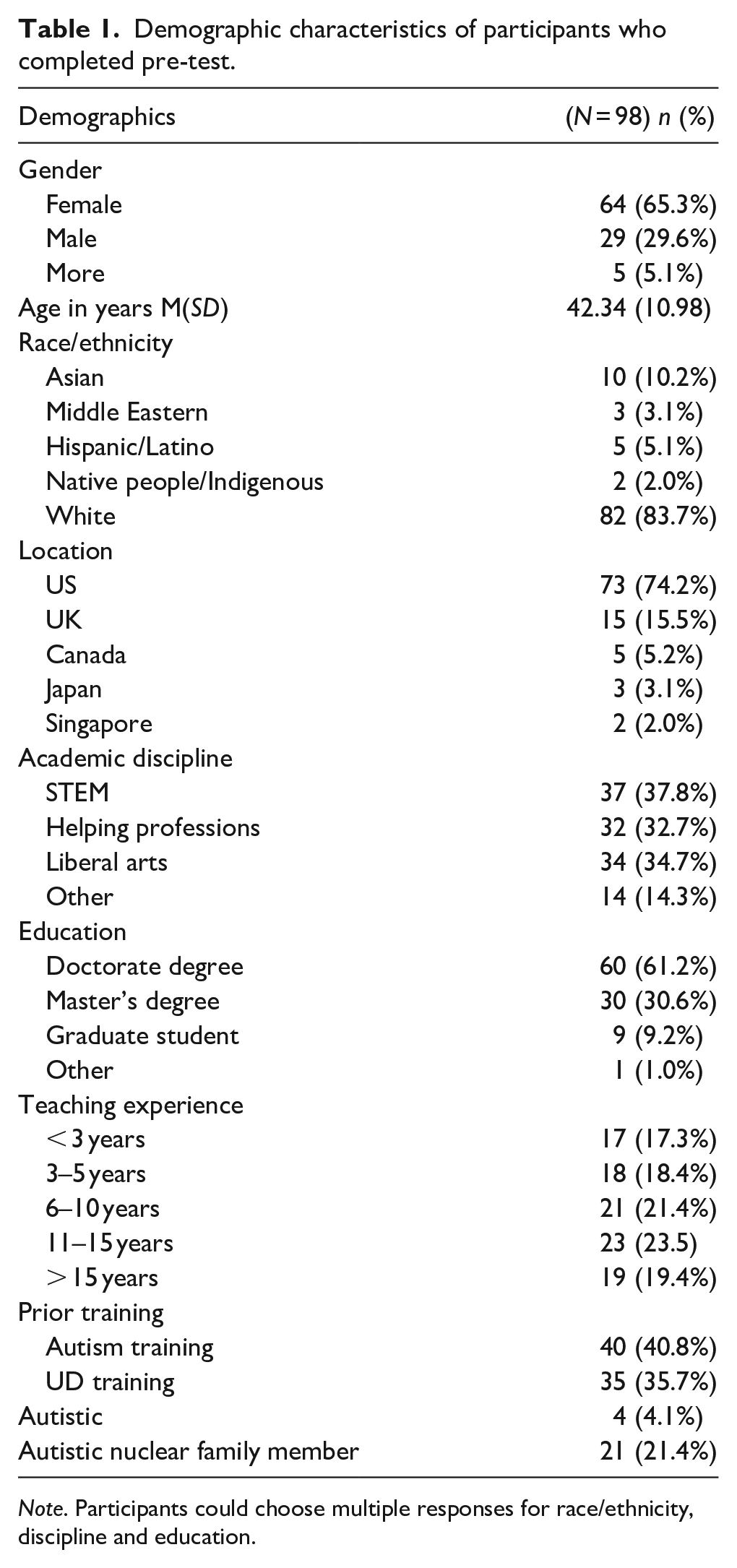
Note. Participants could choose multiple responses for race/ethnicity, discipline and education.
Hypotheses 1 and 3: what predicts pre-test autism stigma?
In the full regression model for pre-test stigma (AAS item scores), which included male gender, prior autism training, discipline (helping profession vs non-helping STEM vs other), SDO and autism knowledge, male gender predicted greater stigma (d = 1.096, CrI95% (0.386, 1.852), BFROPE = 21.36). Greater knowledge (higher PAK-M scores) was strongly associated with less stigma (β2SD = −0.908, CrI95% (−1.676, −0.146), BFROPE = 6.04). The effect of prior autism training (d = −0.828, CrI95% (−1.708, 0.059), BFROPE = 2.60) was reduced from the baseline model (Supplemental Appendix E) and no longer exceeded the threshold for practical significance. This means that, after accounting for other variables, any effect of having participated in a prior autism training on pre-test stigma became so small it was unlikely to be meaningful.
Evidence was inconclusive for the helping vs STEM contrast (d = 0.415, CrI95% [−0.356, 1.249], BFROPE = 0.610). As predicted, greater SDO was associated with higher stigma (β2SD = 0.794, CrI95% [0.150, 1.489], BFROPE = 4.76) after accounting for other predictors. Together, these findings mean that, once all potential predictors were considered in one model, being male, exhibiting lesser autism knowledge, and reporting greater belief that inequality is justified (SDO) were associated with higher pre-test stigma.
Hypotheses 2 and 3: what predicts pre-test attitudes toward UD?
The full regression model predicting pre-training attitudes toward UD (ITSI item scores) including male gender, prior autism or UD training, discipline, and pre-test stigma revealed a small-to-moderate negative effect of stigma on attitudes toward UD (β2SD = −0.482, CrI95% [−0.814, −0.158], BFROPE = 3.91). After accounting for stigma, the effect of male gender on attitudes toward UD was attenuated from the baseline model (Supplemental Appendix E), becoming practically equivalent to zero (d = −0.120, CrI95% [−0.475, 0.241], BFROPE = 0.109). These findings provided partial support for Hypothesis 2, although the effect of gender on attitudes toward UD appeared to be mediated by stigma. ROPE Bayes factors continued to demonstrate evidence against practically meaningful effects of prior autism or UD training (all|d|s < 0.229). As in the baseline model, there was insufficient evidence to suggest that participants in STEM disciplines reported less positive attitudes toward UD than those in helping professions (d = −0.285, CrI95% [−0.651, 0.082], BFROPE = 0.402). Together, these findings mean that only higher pre-test stigma was meaningfully associated with less positive pre-test attitudes toward UD once all potential predictors were accounted for.
Primary hypothesis: did autism and UD training impact knowledge and attitudes?
Autism knowledge improved substantially with training (see Figure 1), with latent scores increasing on average by nearly one full standard deviation at post-test (dPre-Post = 0.926, CrI95% [0.738, 1.118], BFROPE = 6.37 × 10⁶). This effect was largely maintained 1-month post-test (dPre-Maint = 0.662, CrI95% [0.505, 0.838], BFROPE = 4.33 × 10⁵). Although there was a clear decline in knowledge between post-test and maintenance, the ROPE Bayes factor value was inconclusive regarding the practical significance of this difference (dPost-Maint = −0.263 [−0.411, −0.118], BFROPE = 0.783). Together, these findings mean that participation in our training was associated with sustained improvements in autism knowledge. However, some knowledge appears to have been forgotten in the month between post-test and maintenance.
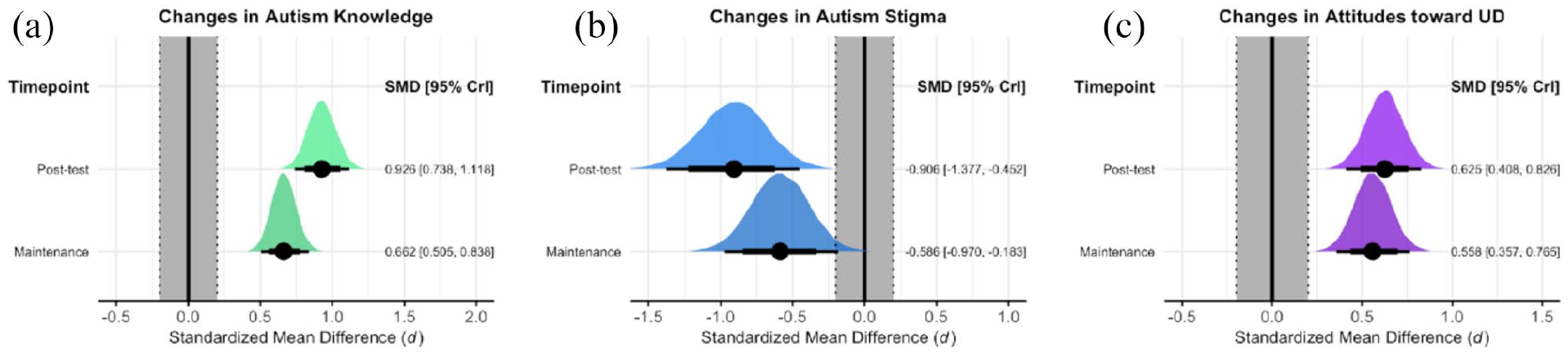
Changes in (a) autism knowledge, (b) stigma, and (c) attitudes toward UD at post-test and maintenance. Distributions represent the full posterior densities of change in each outcome (compared to pre-test), in pre-test standard deviation units (i.e. the standardized mean difference). The point, thick interval, and thin interval represent the posterior median, 80% highest-density credible interval (CrI), and 95% CrI for each distribution, respectively. Gray rectangles denote the region of practical equivalence (ROPE, i.e. interval null region), [−0.2, 0.2].
Autism stigma was substantially reduced from pre-test at both post-test (dPre-Post = −0.906, CrI95% [−1.377, −0.452], BFROPE = 126.6) and maintenance (dPre-Maint = −0.586, CrI95% [−0.970, −0.183], BFROPE = 7.20; Figure 1). Although there was a trend toward stigma increasing from post-test to maintenance (94.1% probability of nonzero positive effect; dPost-Maint = 0.322, CrI95% [−0.080, 0.752], BFROPE = 0.521), the 95% CrI overlapped zero, and evidence of practical significance was inconclusive. Together, these findings show that self-reported autism stigma improved with training. Stigma was meaningfully lower at both post-test and maintenance than it had been at pre-test. Although improvements in stigma remained evident over the course of this study, stigma probably increased again in the month between post-test and maintenance.
Participants reported moderately improved attitudes toward UD at post-test (dPre-Post = −0.625, CrI95% [0.408, 0.826], BFROPE = 2.02 × 10³) and maintenance (dPre-Maint = 0.558, CrI95% [0.357, 0.765], BFROPE = 685.6). A slight negative shift in attitudes over maintenance was practically insignificant (dPost-Maint = −0.066 [−0.213, 0.087], BFROPE = 0.008). 2 These findings mean that sustained improvements in positive attitudes toward UD were apparent at both post-test and a month later.
Participants’ perspectives
When asked why they enrolled in the study, most participants said they did so because they were interested in neurodiversity (69%). Fewer participants enrolled to learn about UD (34%) or because of a personal connection to an autistic person (7%).
When asked what they learned from the training, 70% of the participants described learning about UD (see Supplemental Appendix F). This means that far more participants learned about UD from our training than the 34% who enrolled in the training for that purpose. Indeed, 87% of participants reported using UD-aligned strategies to support autistic students during the maintenance assessment (see Supplemental Appendix G). Numerically, fewer participants indicated that they would use campus disability supports to support their autistic students at post-test (1%) relative to pre-test (10%).
When asked at post-test to provide two things they planned to do differently to create a more accepting environment for neurodivergent students, 80% of participants provided UD-aligned plans (see Supplemental Appendix H). When asked to reflect on whether they had actualized the planned changes at maintenance, 64% of participants described having implemented UD-aligned strategies. This finding suggests that many participants improved their teaching practices following training. However, some educators appeared to have encountered barriers implementing what they had learned and/or remembering what they had intended to change. When asked how the training could be improved, many participants (49%) highlighted positives and also suggested increasing interactivity, hands-on opportunities to practice applying practices, modalities, and diverse perspectives about autism (see Supplemental Appendix I).
Discussion
This study provides quasi-experimental evidence that online training, previously used to improve autism understanding and attitudes toward inclusion among university students (Gillespie-Lynch et al., in press), can also be used to improve understanding and appreciation of autism and UD among university teaching staff. To the best of our knowledge, the current study is the first to provide evidence that benefits of an autism training are maintained a month after post-test, although a slight reduction in improvements was observed. This attenuation aligns with recommendations that autism training should be an ongoing process that provides opportunities for faculty to build knowledge, develop tools and train others through sustained dialogue and reflection (Austin & Peña, 2017). Our training could serve as a foundation for this type of ongoing process.
As hypothesized, certain characteristics of our participants were associated with more stigma, which mirrors previous findings with students (Gillespie-Lynch et al., 2021)—these characteristics included heightened belief that inequality is justified (SDO), being male, and lower autism knowledge. More stigma was also associated with less appreciation of UD. Contrary to our hypothesis, academic discipline was unrelated to stigma or attitudes toward UD. 3 Nor were gender and prior training about autism or UD related to attitudes about UD. This may reflect selection biases, as our participants were mostly women who enrolled in an intensive study for limited compensation, primarily because they were interested in neurodiversity. Self-selection was also recognized as an issue in one of the few other studies examining faculty autism understanding (Zeedyk et al., 2019).
These findings suggest that SDO could be a key target of anti-stigma training. While SDO is often conceptualized as a stable individual difference, recent work suggests that it is shaped by experiences, growing more intense when competition is emphasized and decreasing through positive intergroup contact (Dhont et al., 2014). Future research should assess if trainings like ours, which provide digitally mediated intergroup contact, reduce SDO. Given that SDO is higher among people at the top of hierarchies (Levin, 2004), trainings that focus on improving SDO and neurodiversity appreciation among university staff in managerial positions may reduce pressures that nurture SDO in academia, while generating the institutional commitment that is needed for trainings like this to reach a critical mass of people.
How can we reach more people?
Participants’ primary motivation for enrolling in the study was to learn about neurodiversity. Feedback indicated that this goal was achieved by most participants. Although only 34% of participants indicated that they enrolled in the study to learn about UD, after training 70% of participants referred to UD terminology or principles when sharing what they had learned. When asked for strategies they use to effectively support their autistic students during the maintenance assessment, 87% of participants indicated that they were using UD-aligned principles. Together, these findings suggest that interest in enhancing understanding of a specific marginalized identity may serve as a “hook” to engage educators in learning strategies that also help them teach students who are diverse in other ways.
However, people often avoid those they are prejudiced against (e.g. Dhont et al., 2014). Therefore, advertising the topic of neurodiversity is unlikely to attract educators with stigmatizing perspectives about autism to join a training like ours. This is why training for senior level and administrative staff and direct advocacy are also needed. Indeed, a participant indicated, “I would appreciate a (training) module on advocacy for faculty in terms of how we can join our neurodiverse students in advocating for systemic change to post-secondary policy, pedagogy.” Although we highlighted the importance of supporting students in developing self-advocacy skills in our training, future training adaptations should also include specific advocacy techniques that educators can use to make institutions more supportive of neuro-minorities.
An autistic reviewer of this article suggested that autism and UD training modules, such as the one we evaluated in this study, should become a required part of university induction training for all staff. We heartily concur. It is important to note that institution-wide UD training should never become an excuse for further reducing the budgets of disability support offices or denying students legally mandated accommodations. However, UD may empower educators and students to co-create learning opportunities that are better tailored to students’ interests and strengths than disability accommodations often are.
Limitations and future directions
Although our findings are promising, this study is not without limitations. Non-speaking autistic people and those with intellectual disabilities (known as learning disabilities in the United Kingdom) were not represented in our participatory team. Nor were they well-represented in the training we developed, much as they have not been well-represented in prior research about UD (e.g. Rao et al., 2017; but see Courchesne et al., 2021 for a promising example of the use of UD principles to capture the perspectives of autistic youth with diverse cognitive and communicative skills). Therefore, our training failed to respond to growing calls from the autistic community that the voices of autistic people who have traditionally been left out of discourse about autism must be prioritized (e.g. Autistic Self Advocacy Network, 2021; Chapman & Veit, 2020; Dwyer et al., 2021). Future adaptations of trainings like ours should include meaningful leadership opportunities for autistic people who are marginalized in multiple ways. Given that authorship is less valuable outside of academia than it is for academics, efforts to include more diverse autistic people in training development should include opportunities for monetary compensation whenever possible. Systemic changes in how academic knowledge is produced and disseminated (e.g. changing the current publishing system so that authors receive some of the profits journals accrue and knowledge is not trapped behind paywalls; Larivière et al., 2015) could help support fair compensation of all collaborators while allowing educators to access up-to-date information about autism and UD.
Our sample is also not generalizable: Participants were primarily white women, many had close relationships with autistic people, and all were teaching in Westernized countries. They were willing to spend their limited time learning how to improve their teaching skills, during a pandemic no less. It is unlikely we reached faculty who were not already invested in teaching and already at least somewhat appreciative of neurodiversity. People who are passionate about teaching are also likely to be highly responsive to new information, as teaching is necessarily an iterative process. We do not know if this training would be as effective for educators who are unappreciative of neurodiversity or those less motivated to improve their teaching. Indeed, anti-racism training sometimes leads to backlash when foisted upon unwilling participants (Chow et al., 2021). To reach less motivated faculty and alleviate potential resentment, institutions must invest resources in compensating educators fairly for time they put into improving their teaching skills and understanding of their diverse students.
Furthermore, this study is not experimental, students’ perspectives were not obtained, and participants’ actual teaching was not observed. Positive attitudes toward UD do not always translate into actually implementing UD practices (Li, 2020); faculty may believe they are using more UD-aligned practices than students observe (Kennette & Wilson, 2019). Future training should include more hands-on practice and sustained dialogue to help faculty stay accountable, as noted by participants.
Indeed, UD itself is more of a work in progress than an “evidence-based practice.” UD research still lacks consistent operationalization of constructs and many of UD’s central tenets have not been well-tested, such as that modifying instruction for one group necessarily helps another (Boysen, 2021; Faggella-Luby et al., 2017; Murphy, 2021; Ok et al., 2017; Seale et al., 2022; Smith et al., 2019). These limitations do not negate UD as a useful approach. Rather, they mean that we need to keep learning. Please consider adding your own ideas about autism and UD to a collaborative working document developed by some of the authors of this article (http://bit.ly/ISUDENOUGH). The current study should be followed-up by an experimental evaluation of the training’s effects on both educators and students, with student data disaggregated by disability type, although such work would require substantial funding.
Conclusion
Faculty have the power to influence student success inside and outside the classroom. Faculty with stigmatizing attitudes toward autistic people and UD may hinder their students’ success. By providing foundational knowledge about autism and UD, we can support educators to better serve their increasingly diverse students. Participation in our training, developed by autistic and non-autistic collaborators, was associated with improvements in autism acceptance, autism understanding, and appreciation of UD which generally maintained over time. Our training is available open-access—we hope others will build upon this work by encouraging widespread adoption of such training, by adapting training materials, and by evaluating them in more diverse cultural contexts.
Supplemental Material
sj-docx-1-aut-10.1177_13623613221097207 – Supplemental material for Learning from the experts: Evaluating a participatory autism and universal design training for university educators
Supplemental material, sj-docx-1-aut-10.1177_13623613221097207 for Learning from the experts: Evaluating a participatory autism and universal design training for university educators by TC Waisman, Zachary J Williams, Eilidh Cage, Siva Priya Santhanam, Iliana Magiati, Patrick Dwyer, Kayden M Stockwell, Bella Kofner, Heather Brown, Denise Davidson, Jessye Herrell, Stephen M Shore, Dave Caudel, Emine Gurbuz and Kristen Gillespie-Lynch in Autism
Research Data
sj-sav-2-aut-10.1177_13623613221097207 – for Learning from the experts: Evaluating a participatory autism and universal design training for university educators
sj-sav-2-aut-10.1177_13623613221097207 for Learning from the experts: Evaluating a participatory autism and universal design training for university educators by TC Waisman, Zachary J Williams, Eilidh Cage, Siva Priya Santhanam, Iliana Magiati, Patrick Dwyer, Kayden M Stockwell, Bella Kofner, Heather Brown, Denise Davidson, Jessye Herrell, Stephen M Shore, Dave Caudel, Emine Gurbuz and Kristen Gillespie-Lynch in Autism
Footnotes
Acknowledgements
The authors would like to thank Brett Nachman for generously creating a powerful video for our training even though he was too busy to join the project as a collaborator. They would like to thank Scott Jackson.
Author contributions
T.C.W. contributed very substantially to training and assessment design, double-checked survey and training measures before data collection began, and led study recruitment by developing a website for recruitment, sending email reminders, responding to all queries from participants, working with participants to prioritize study during pandemic, collating recruitment data in files. T.C.W. also led communications with the participatory team, conducted qualitative coding with K.G.-L., and wrote multiple drafts of the introduction, methods, Table 1, and abstracts, and contributed to addressing reviewer feedback. Z.J.W. (https://orcid.org/0000-0001-7646-423X) developed the Bayesian statistical analysis plan, conducted the primary data analyses, contributed to the initial draft of the manuscript (e.g. wrote the analytic approach and results sections), reviewed/edited the final manuscript draft, and contributed to addressing reviewer feedback. E.C. edited training materials, contributed to study design (e.g. adapting social distance scale), led the development of ethics applications, assisted with recruitment, provided feedback on coding and edited the manuscript, and contributed substantially to addressing reviewer feedback. S.P.S. contributed to study design, created almost all of the initial training content focused on online teaching in particular, assisted with recruitment of a large number of participants within the United States, coded “What is autism” question, created a table for the manuscript about “what is autism?,” provided feedback and coding for other UD-based items, and edited the manuscript. I.M. provided very substantial input; contributing to the study design and to the development of the training materials and the questions in the survey. She also provided input and comments on the qualitative data coding analysis, edited the manuscript, and contributed substantially to addressing reviewer feedback. P.D. contributed to and edited training materials, coded qualitative data and provided feedback on coding schemes, reviewed literature, and edited and approved the manuscript, and contributed to addressing reviewer feedback. K.M.S. contributed to and edited training materials, coded qualitative data and provided feedback on coding schemes, provided T.C.W. with feedback on an initial draft of the manuscript, edited the final draft of the manuscript, and contributed to addressing reviewer feedback ( ). B.K. contributed to and edited training materials, coded the “What is Autism” question with S.P.S., coded the “What is Universal Design” question with D.D., coded the “two things differently” question with H.B., edited the manuscript, and contributed to addressing reviewer feedback. H.B. contributed substantially to training design and coded a qualitative question with B.K. D.D. provided input on study design and the development of the training materials. Helped create the coding protocol and code one open-ended question and wrote material for the literature review on universal design. J.H., S.M.S., D.C., and E.G. contributed to training and assessment development and coding schemes. As advising author, K.G.-L. developed the initial idea for this study, used a mini-grant from PSC-CUNY to compensate participants, played a leading role in designing the training and evaluation approach, guided the qualitative coding process and coded qualitative data with T.C.W., P.D., and K.M.S., wrote up the frequentist analyses and qualitative coding findings, provided T.C.W. and Z.J.W. with feedback on drafts of sections of the manuscript, conducted a comprehensive literature review, wrote the final draft of this manuscript (except the Bayesian analytic approach and results section, written by Z.J.W., which K.G.-L. just edited for accessibility), and contributed substantially to addressing reviewer feedback.
Declaration of conflicting interests
The author(s) declared no potential conflicts of interest with respect to the research, authorship, and/or publication of this article.
Funding
The author(s) received no financial support for the research, authorship, and/or publication of this article.
ORCID iDs
Supplemental material
Supplemental material for this article is available online.
Notes
References
Supplementary Material
Please find the following supplemental material available below.
For Open Access articles published under a Creative Commons License, all supplemental material carries the same license as the article it is associated with.
For non-Open Access articles published, all supplemental material carries a non-exclusive license, and permission requests for re-use of supplemental material or any part of supplemental material shall be sent directly to the copyright owner as specified in the copyright notice associated with the article.
