



Abstract
Since prior research has mostly focused on children, less is known about how autistic adults and adults with sub-clinical autistic traits interpret pragmatically complex social situations and the kind of narrative discourse they produce. 32 autistic young adults, 18 young adults with sub-clinical autistic traits and 34 non-autistic young adults participated this study. They were shown videos of social interactions which required complex pragmatic processing and were asked to freely narrate what they thought was occurring in each video. Their narratives were coded for aspects of social-pragmatic and narrative discourse. The results indicate that the autistic and sub-clinical groups differed from the comparison group in what they inferred as relevant video content. The narratives of the autistic group also differed from the comparison group in meaning, focus and emphasis on details. In addition, the comparison group produced more holistic narratives whereas the autistic and sub-clinical groups produced more atomistic narratives. Correlational findings indicated that perceptual reasoning has stronger associations with pragmatic inferencing in the autistic and sub-clinical groups than in the comparison group. This study suggests that autistic adults and adults with sub-clinical autistic traits differ from non-autistic adults in what they perceive to be relevant in their social world.
Lay Abstract
Previous social-pragmatic and narrative research involving autistic individuals has mostly focused on children. Little is known about how autistic adults and adults who have autistic traits but do not have a diagnosis of an autism spectrum disorder (ASD) interpret complex social situations and tell narratives about these situations. We asked 32 autistic young adults, 18 adults with autistic traits but no ASD diagnosis, and 34 non-autistic young adults to watch socially complex situations and freely tell narratives about what they thought was occurring in each situation. These narratives were analysed for how the participants had interpreted the situations and for the type of narratives they produced. We found that the groups had both similarities and differences. Regarding the differences, we found that the autistic adults and adults with autistic traits interpreted the situations differently from the non-autistic adults. The autistic adults found different aspects of the situations relevant, had different foci and placed greater importance on details than the non-autistic adults. The autistic adults and adults with autistic traits also differed from the non-autistic adults by having more detail- and event-focused narratives whereas the non-autistic adults were more likely to base their narratives on their own broad interpretations of the situations. Perceptual processing styles appeared to play a bigger role in interpreting the situations for the autistic adults and adults with autistic traits than the non-autistic adults. Our findings suggest that autistic adults and adults with autistic traits focus on different aspects in their social world than non-autistic adults.
Introduction
Social-pragmatic inferencing in autistic individuals
The interpretation of communication in social situations, referred to as social-pragmatic inferencing, is considered challenging for autistic individuals. 1 Broadly, social-pragmatic ability involves adapting to contextual demands of communication situations (Gibbs & Colston, 2012). Autistic people reportedly have difficulties in social communication, including difficulties in understanding gestures in communication and in adjusting behaviour in demanding communication situations (American Psychiatric Association, 2013). Language and social skills, including social-pragmatic processing vary greatly between autistic individuals (e.g. Loukusa, 2021; Loukusa, Leinonen, Kuusikko, et al., 2007; Tager-Flusberg & Kasari, 2013). While it is known that social-pragmatic skills develop with age (Loukusa, 2021) and are challenging for autistic individuals, the extent to which these challenges continue into adulthood is currently not well known.
A tendency to use and understand language literally is considered common for autistic people (Hobson, 2012). Autistic people differ from non-autistic 2 people in interpreting non-literal language, such as metaphors, irony (Deliens et al., 2018; Kalandadze et al., 2018; Wang et al., 2006; Wilson & Bishop, 2020) and humour (Emerich et al., 2003). Challenges in the use of context for pragmatic inferencing could partly explain these differences. For instance, Dindar et al. (2021) and Heavey et al. (2000) have shown that autistic adults differ from non-autistic adults by providing less contextually-rooted explanations for film characters’ mental states (also see Happé, 1994; Jolliffe & Baron-Cohen, 1999; Lönnqvist et al., 2017), which could be due to differences in perceptual processing styles. While autistic individuals tend to have strong visuospatial skills (e.g. Hessels et al., 2014), their processing style appears local. Such a detail-focused style, compared with the more global processing style in non-autistic individuals, could result in differences in the extent to which social cues are processed (e.g. Dindar et al., 2021; Grynszpan & Nadel, 2015; Jolliffe & Baron-Cohen, 2000; Lönnqvist et al., 2017; Murray et al., 2005; Van der Hallen et al., 2015). These findings suggest a need to better understand the role of perceptual reasoning, i.e. non-verbal reasoning ability (Wechsler, 2012), in social-pragmatic inferencing.
In addition, the role of core language skills, such as verbal comprehension, in pragmatic inferencing, is debated (e.g. Wilson & Bishop, 2020). In contrast to the pragmatic challenges considered universal in the autism spectrum (Tager-Flusberg et al., 2005), varying difficulties with core language may but do not necessarily occur (e.g. Eigsti et al., 2007; Holdnack et al., 2011; Tager-Flusberg et al., 2005; Wilson & Bishop, 2020). Yet, autistic adults have been found to have lower verbal comprehension skills as compared with non-autistic individuals (e.g. Holdnack et al., 2011). Difficulties with core language could therefore result in social-pragmatic challenges (e.g. Kalandadze et al., 2018; Whyte & Nelson, 2015, cf. Volden et al., 2009; Wilson & Bishop, 2020). Given the debate, it is valuable to further examine how verbal comprehension affects social-pragmatic inferencing.
Narrative discourse in autistic individuals
Narrative discourse refers to a presentation of series of events unfolding in time in relation to each other (Stirling et al., 2014). The ability to produce a logical, coherent, and informative narrative is considered to require cognitive, linguistic and social-pragmatic skills. Narrative discourse provides insight into how a narrator understands the events he or she narrates about, and therefore, has direct relevance for the study of social-pragmatic inferencing.
Research has shown that autistic adults’ narrative production differs from that of non-autistic adults. Geelhand et al. (2020) found that autistic and non-autistic adults’ narratives, based on a wordless picture book, had some similarities but also multiple differences. Although the groups were found to structure their stories similarly, the autistic adults produced more extraneous comments and their narratives were not organised around the gist events (Geelhand et al., 2020). In examining personal narratives and categorising narratives based on their macrostructure as a whole (e.g. one-event and chronological narrative macrostructures, see McCabe et al., 2013; Peterson & McCabe, 1983), McCabe et al. (2013) found that compared with non-autistic adults, autistic adults produced less complex narratives. In a film-viewing study, autistic adults wrote more detail-focused narratives about the complex scenes they had viewed and engaged less in inferring the broader meaning of the events (Barnes & Baron-Cohen, 2012). This could relate to autistic adults’ greater intolerance for uncertainty in interpreting pragmatically complex situations (Wilson & Bishop, 2020). The partially conflicting findings of these studies could be due to the different elicitation methods and types of narratives investigated. Studies examining freely produced narratives based on complex real-world situations are scarce (cf. Barnes & Baron-Cohen, 2012). Current evidence suggests that the differences between autistic and non-autistic individuals in narrative discourse are particularly evident in the pragmatic aspects of language use (e.g. Mäkinen et al., 2014). However, variation does exist in the findings involving both autistic adults (see, e.g. Colle et al., 2008) and children (e.g. Baixauli et al., 2016; Mäkinen et al., 2014), calling for additional research.
Social-pragmatic inferencing and narrative discourse in adults with sub-clinical autistic traits
Research has indicated that autistic traits also exist in the general population (‘broad autism phenotype’; Baron-Cohen et al., 2001; Bolton et al., 1994; Constantino & Todd, 2003; Landry & Chouinard, 2016). Only a few studies have examined social difficulties in individuals with sub-clinical autistic traits (i.e. individuals who do not meet the clinical threshold for an autism spectrum disorder (ASD) diagnosis). Studies have found that, in the general population, higher autistic traits are associated with difficulties in social relationships and social cognition and in interpreting nonverbal aspects of communication (Ingersoll, 2010; Jobe & White, 2007; Poljac et al., 2013; Sasson et al., 2013). However, beyond these studies, little is currently known about the social-pragmatic and narrative discourse skills of adults with sub-clinical autistic traits. The current study involving both autistic adults and adults with sub-clinical autistic traits has the potential to specify which processing features are unique to individuals with an actual ASD diagnosis (e.g. Landry & Chouinard, 2016; also see Sasson & Bottema-Beutel, 2021), and whether the possible associations between pragmatic skills, perceptual reasoning and verbal comprehension in adults with sub-clinical autistic traits are similar to those of autistic adults.
The current study
Research has commonly taken on the non-autistic social-pragmatic inferencing and narration as a frame of reference. However, recent research has argued that autistic individuals’ ‘mismatched’ understanding of the social world provides better explanations for the differences between autistic and non-autistic individuals than explanations based on autistic individuals’ ‘impaired’ understanding (e.g. Crompton et al., 2020; Morrison et al., 2020; Williams et al., 2021). In order to understand autistic social-pragmatic inferencing and narration from such a perspective, the current study examined the similarities and differences between autistic adults, adults with sub-clinical autistic traits and non-autistic adults. The aims of the study were to examine their freely produced film-based narratives and to investigate whether and how their narratives reflecting social-pragmatic inferencing are associated (within groups) with verbal comprehension and perceptual reasoning skills. Based on the literature reviewed above (e.g. Dindar et al., 2021; Geelhand et al., 2020; Grynszpan & Nadel, 2015; Heavey et al., 2000; Ingersoll 2010; McCabe et al., 2013; Volden et al., 2009), we hypothesised that 1) the autistic adults would show more ‘mismatch’ in social-pragmatic inferencing as compared with the non-autistic adults, and that 2) the performance of the adults with sub-clinical autistic traits would fall between that of the autistic and non-autistic adults, yet resembling more closely the performance of the autistic adults. We also hypothesised that in terms of the narrative discourse elements, the autistic adults 3) would show more uncertainty regarding their inferences and engage in more commenting as compared with the non-autistic adults, and 4) would differ from the non-autistic adults in narrative macrostructures used. We additionally hypothesised that 5) the adults with sub-clinical autistic traits would perform between the autistic and non-autistic adults, yet more closely resemble the autistic adults. In terms of the associations, we hypothesised that 6) both better verbal comprehension and perceptual reasoning skills would be associated with higher social pragmatic inferencing ability.
Materials and methods
Participants
Initially, 1) 34 young autistic adults diagnosed with ASD (the autistic group), 2) 19 young adults with autistic traits but no ASD diagnosis (the sub-clinical group), and 3) 36 non-autistic young adults (the comparison group) participated in the study. Participants in the autistic group originally participated in an epidemiological study in the Northern Ostrobothnia Hospital District area (Mattila, 2013; Mattila et al., 2007, 2011) or a clinic-based study conducted at the Oulu University Hospital (Kuusikko et al., 2008, 2009; Weiss et al., 2009), and participants in the sub-clinical group originally participated in the epidemiological study. The comparison group was selected from 1) the epidemiological study, 2) the audio-graphic study (Jansson-Verkasalo et al., 2005), and 3) the ASD and anxiety study (Kuusikko et al., 2008, 2009). In addition, two comparison group participants were later recruited to reduce gender bias.
The Wechsler Adult Intelligence Scale-IV (WAIS-IV, Wechsler, 2012) was used to assess the participants’ cognitive ability. The current study utilised information based on the Verbal Comprehension Index (VCI) and the Perceptual Reasoning Index (PRI). The VCI includes the Similarities, Vocabulary and Information core subtests and the PRI includes the Block Design, Matrix Reasoning, and Visual Puzzles core subtests. We also calculated the General Ability Index (GAI), which is based on the VCI and PRI, and therefore minimises the impact of working memory and processing speed. Standardised scores were used (Wechsler, 2012). Four participants with GAI ⩽ 70 were removed from the study (autistic group n = 2; sub-clinical group n = 1; comparison group n = 1). In addition, one comparison group participant withdrew after participation. The final sample comprised 32 participants in the autistic group (25 males, 7 females, age range = 19–33 years), 18 participants in the sub-clinical group (17 males, 1 female, age range = 22–23 years) and 34 participants in the comparison group (24 males, 10 females, age range = 19–29 years, see Table 1).
Participant characteristics for the comparison, sub-clinical and autistic group.

Note. SD: standard deviation; IQR: interquartile range; GAI: General Ability Index; VCI: Verbal Comprehension Index; PRI: Perceptual Processing Index as measured using the Wechsler Adult Intelligence Scale-IV (Wechsler, 2012).
During the time of the original recruiting, ASD diagnoses were set according to the ICD-10 criteria (World Health Organization, 1993) using the Autism Diagnostic Interview Revised (ADI-R; Lord et al., 1995), the Autism Diagnostic Observation Schedule (ADOS; Lord et al., 2000), and data from medical records.
The participants in the sub-clinical group had autistic traits in their childhood as assessed using the Autism Spectrum Screening Questionnaire (ASSQ), comprising the children in the epidemiological study (Mattila, 2013; Mattila et al., 2007, 2011) who in their childhood were assessed being 1) at ‘high risk’ for ASD with teacher-rated ASSQ scores of ⩾ 22 and/or parent-rated ASSQ scores of ⩾ 19 (Ehlers et al., 1999), or 2) at ‘medium risk’ for ASD with 1) teacher-rated ASSQ scores of 17–21 (Ehlers et al., 1999; Kadesjö et al., 1999) OR had 2) teacher-rated ASSQ scores of 9–16 and parent-rated ASSQ scores of 7–18 (Ehlers et al., 1999), but did not meet the diagnostic criteria for an ASD diagnosis.
Thirty participants in the comparison group did not have noticeable autistic traits in their childhood or adolescence, 1) 16 of them did not meet the above mentioned ‘high risk’ or ‘medium risk’ ASSQ score criteria for ASD in the epidemiological study (Mattila, 2013; Mattila et al., 2007, 2011) and reported not having prior suspected ASD diagnosis, and 2) 14 of them had parent-rated ASSQ scores below 7 in their childhood or adolescence (Kuusikko-Gauffin, 2011; Rahko et al., 2010), i.e. no suspicions of an ASD diagnosis. 3) Two recruited comparison participants from the ASD and anxiety study (Kuusikko-Gauffin, 2011) self-reported Autism Spectrum Quotient (AQ; Baron-Cohen et al., 2001) scores of 9 and 11 in the present study, being below the Finnish recommended cut-off score of 18 (Loukusa et al., 2021) and reported no prior suspicions of an ASD diagnosis. 4) The two participants who were recruited for reducing gender bias similarly self-reported below cut-off AQ scores of 11 and 14 and reported no prior suspicions of an ASD diagnosis.
The groups did not differ in terms of age (χ2 (2) = 3.04, p = 0.219, Kruskal–Wallis test), the General Ability Index (F(2, 81) = 1.14, p = 0.323, One-way ANOVA), the Verbal Comprehension Index (F(2, 81) = 1.54, p = 0.221, One-way ANOVA), or the Perceptual Reasoning Index (F(2, 81) = 0.57, p = 0.568, One-way ANOVA).
All the participants were Finnish, of Finno-Ugric origin and spoke Finnish as their mother tongue. Finnish citizens have an equal right to free basic education, health care and social security. Specific data on socioeconomic status and educational attainment levels are reported and analysed in a separate study in preparation.
Community members were not involved in the study. The study was approved by the Regional Ethics Committee of the Northern Ostrobothnia Hospital District and was conducted in accordance with the 1964 Declaration of Helsinki. Participants gave their written informed consent to participate in the study. The data were obtained under a non-disclosure agreement with restricted access.
Material
Video stimuli
Participants were shown seven video clips involving pragmatically complex social scenes. The clips were taken from a television soap produced by a Finnish commercial television station (MTV3) from 1990 to 1991. The duration of the clips ranged from 70 to 216 s (M = 117 s). The clips depicted real-world complex family relationships and social interactions that required contextual inference of meaning, such as deception, and they were selected based on their demands for contextual inferencing of multimodal social cues. See Appendix 1 for a detailed description of the clips.
Coding scheme
Narratives were analysed based on a coding scheme that was built both on the descriptions of the key pragmatic content of each of the video clips created by the research team (see Appendix 1) and on the results of a separate sub-study. In this sub-study, the seven clips were shown to 45 university students (40 females, 5 males, M = 24.1 years, SD = 5.4, range = 19–41) from several faculties (35 Humanities, 4 Science, 5 Information Technology and Electrical Engineering and 1 Business). The participants of the sub-study self-reported not being on the autism spectrum. After watching each clip, the participants were asked to write in brief what they thought the scene was about and what had particularly captured their attention. These were used to formulate ‘central ideas’ (similar to the study by Kenan et al., 2019) to capture what was typically considered relevant for each scene. The sub-study participants were also provided with seven multiple-choices depicting pragmatic elements of each clip and asked to rate them from one to three to indicate which of the alternatives they thought described each video the best. Building on the distribution of these ratings, two or three key pragmatic elements were assigned to each clip. The social-pragmatic inferencing of the participants of the current study was coded against the scheme, hence enabling examination of the similarity between the study participants’ inferencing and the coding scheme (i.e. key pragmatic element inferencing similarity, meaning- and setting-related mismatching inferences, mismatching focus, mismatching emphasis on details). The key pragmatic element inferencing similarity was coded from 0 to 2 based on how many elements were mentioned in a narrative. The other social-pragmatic inferencing variables were coded dichotomously as 0 or 1 based on whether the coded feature was present in a narrative or not (see Appendix 2 for details).
Narrative discourse elements that were chosen for the current study (i.e. meaning- and setting-related uncertainty and personal and stimulus-related commenting) were considered less researched than some other aspects of narrative discourse (e.g. mental state language). The coding for narrative macrostructures was based on the work by Peterson and McCabe (1983) and McCabe et al. (2013), but was modified to better fit the current study context. The narrative discourse elements were coded dichotomously as 0 or 1 based on whether the coded feature was present in a narrative or not whereas the narrative macrostructures were coded categorically (see Appendix 2 for details).
Procedure
During the data collection, the participants sat approximately 60 cm from a computer screen that was used to present the clips. A researcher (one at a time, three different females in total) sat behind the computer screen and was present throughout the data collection. The clips were shown as part of a larger social communication study. After watching each clip, the participants were asked to freely narrate what they thought was occurring in the clip. This question was designed to elicit their interpretation of the clips rather than to measure their ability to recall the content of the clips. The narratives were video-recorded and later transcribed.
Statistical analysis
Data transformations were tested for non-normally distributed data, but no transformation enabled transformation of all the variables into normal distribution. Therefore, parametric or non-parametric statistical tests were chosen depending on the data distribution. One-way ANOVA with Tukey post hoc tests was used to examine group differences in key pragmatic element similarity. Kruskal–Wallis tests with Dunn’s post hoc tests were used to examine group differences in the rest of the social-pragmatic and narrative discourse variables. Group differences in the categorical narrative macrostructures were examined by transforming the data into long data format and using chi-square tests with Bonferroni-corrected post hoc pairwise Z tests. Effect sizes were estimated using eta squared (η2) for a one-way ANOVA and a Kruskal–Wallis test, and Cramer’s V (φc) for a chi-square test. For η2, an effect size of 0.14 could be considered a large, above 0.06 a medium and above 0.01 a small effect. For φc, an effect size of 0.5 could be considered a large, 0.3 a medium and 0.1 a small effect.
Inter-rater reliability analysis
An independent coder coded approximately 15% of the data. The coder was blind to the diagnostic status of the participants. Krippendorff’s alpha values were computed for each variable. In general, alpha values ⩾ 0.80 are considered good, the lowest acceptable level suggested as ⩾ 0.67 (Krippendorff, 2019, pp. 353–354). One variable (‘Mismatching emphasis on filling in gaps’) was dropped from the analysis for low inter-rater reliability (see Table 2).
Krippendorff’s alpha values for the variables included in the analysis.

Results
Analysis of group differences in social-pragmatic inferencing
A one-way ANOVA showed that there was a statistically significant difference between the groups in key pragmatic element inferencing similarity (F(2, 81) = 5.56, p = 0.005, η2 = 0.12, see Figure 1) with a medium effect size. Tukey post hoc tests indicated that the comparison group scored higher than both the autistic group (p = 0.014) and the sub-clinical group (p = 0.022). The autistic group and the sub-clinical group did not differ from each other (p = 0.962).
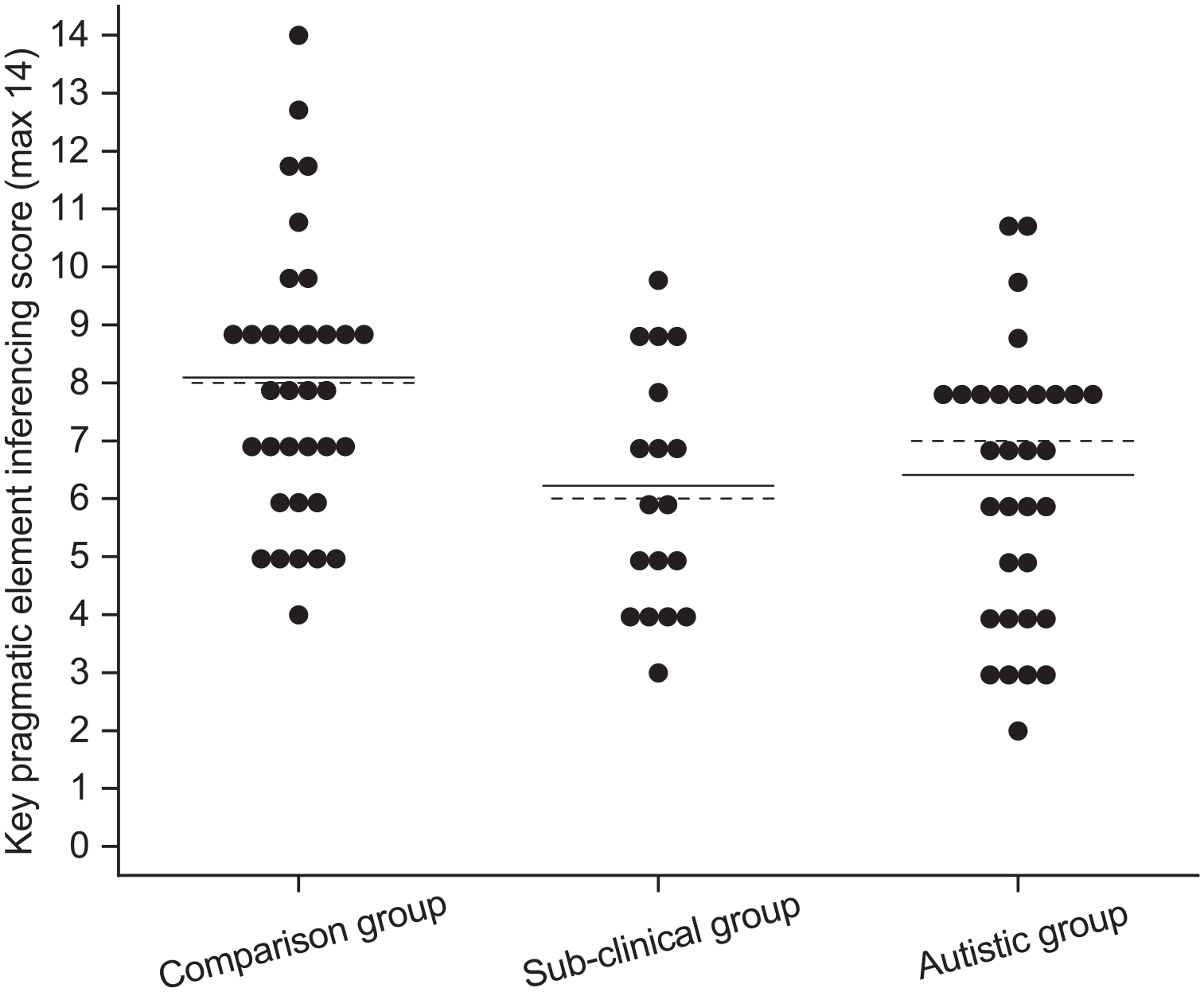
Key pragmatic element inferencing similarity scores in the comparison, sub-clinical and autistic groups.
There was a statistically significant difference between the groups in the percentage of narratives that involved meaning-related mismatching inferences (χ2 (2) = 8.84, p = 0.012, η2 = 0.11, see Figure 2) with a medium effect size. The comparison group had statistically significantly fewer narratives involving such mismatching inferences than the autistic group (p = 0.010). There were no statistically significant differences between the comparison group and the sub-clinical group (p = 0.308) or the sub-clinical group and the autistic group (p = 1.000).
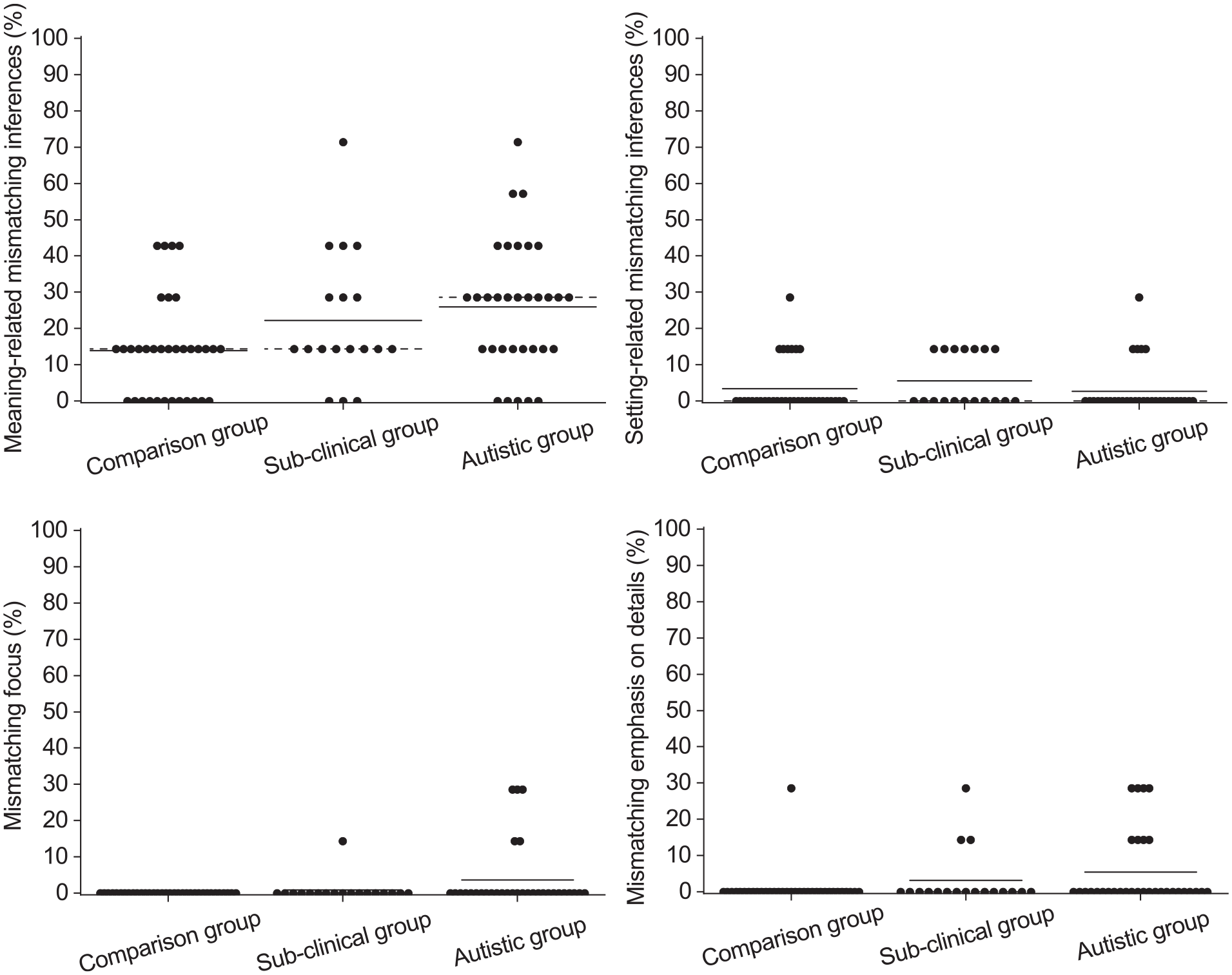
Percentage of narratives involving meaning- and setting-related mismatching inferences, mismatching focus, and mismatching emphasis on details in the comparison, sub-clinical and autistic groups.
There was no statistically significant difference between the groups in the percentage of narratives involving setting-related mismatching inferences (χ2 (2) = 3.24, p = 0.198, η2 = 0.04). The effect size was small. However, there was a statistically significant difference between the groups in the percentage of narratives that involved mismatching focus (χ2 (2) = 6.18, p = 0.045, η2 = 0.07) with a medium effect size. The autistic group had more narratives involving mismatching focus compared with the comparison group (p = 0.041). The comparison group and the sub-clinical group (p = 1.000) or the autistic and the sub-clinical group (p = 0.523) did not differ from each other. There was a statistically significant difference between the groups in the percentage of narratives that involved mismatching emphasis on details (χ2 (2) = 6.39, p = 0.041, η2 = 0.08) with a medium effect size. The autistic group had more narratives involving mismatching emphasis on details compared with the comparison group (p = 0.036). The comparison group and the sub-clinical group (p = 0.607) or the autistic and the sub-clinical group (p = 1.000) did not differ from each other.
Analysis of group differences in narrative discourse
There was no statistically significant difference between the groups in the percentage of narratives involving meaning-related uncertainty (χ2 (2) = 0.36, p = 0.834, η2 = 0.00, see Figure 3), in the percentage of narratives involving setting-related uncertainty (χ2 (2) = 2.79, p = 0.248, η2 = 0.03), in the percentage of narratives that involved personal commenting (χ2 (2) = 2.51, p = 0.284, η2 = 0.03) or in the percentage of narratives that involved stimulus-related commenting (χ2 (2) = 1.46, p = 0.483, η2 = 0.02). The effect sizes varied from small to non-significant.
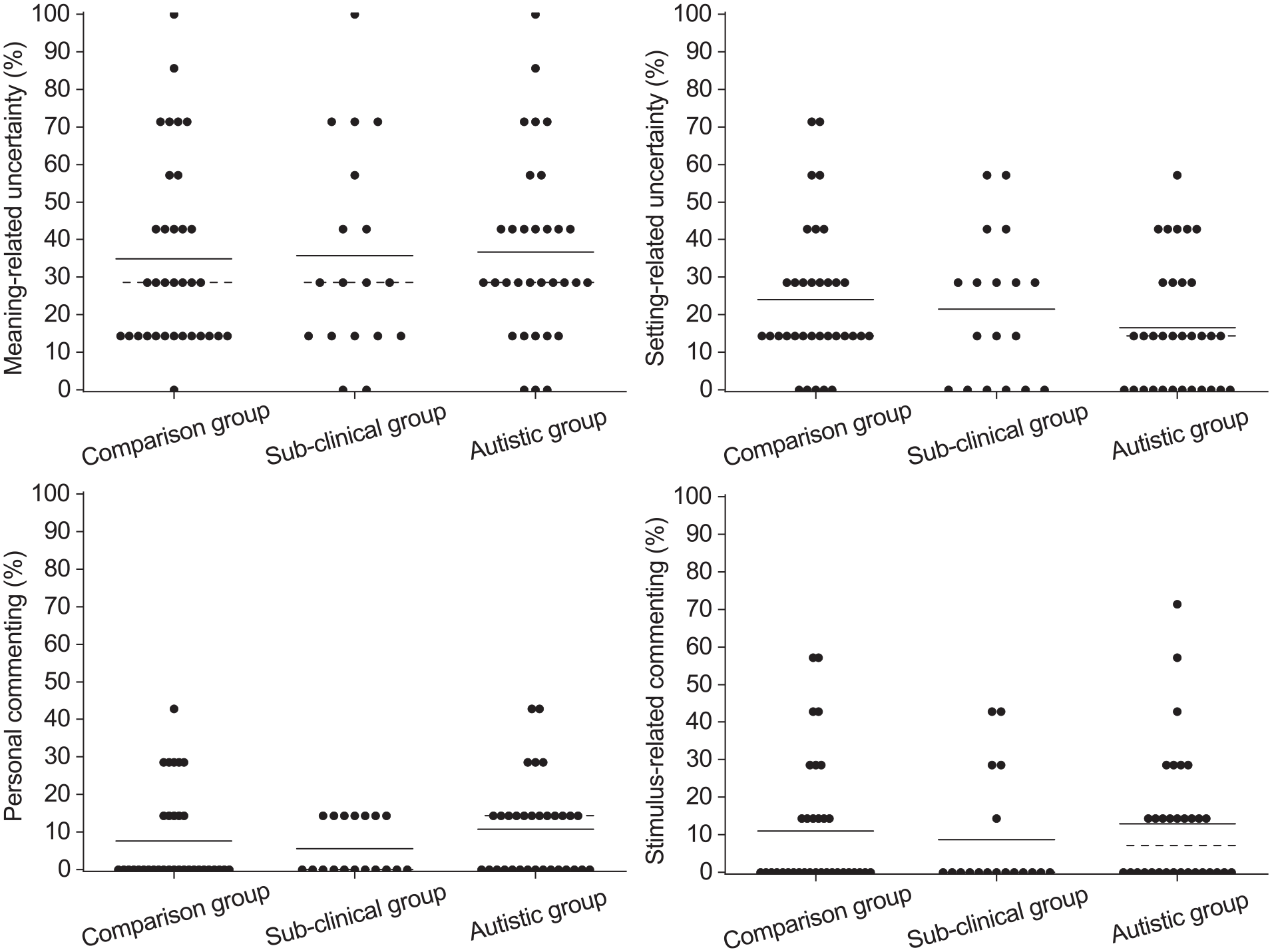
Percentage of narratives involving meaning- and setting-related uncertainty and personal and stimulus-related commenting in the comparison, sub-clinical and autistic groups.
Analysis of group differences in narrative macrostructure
All the groups most frequently produced chronological narratives. For the comparison group and the sub-clinical group, the second most frequent narrative macrostructure was interpretation-centred narrative, whereas for the autistic group, the leap-frog narrative was the second most frequent. For all the groups, one-event narrative was the least frequent (see Figure 4).
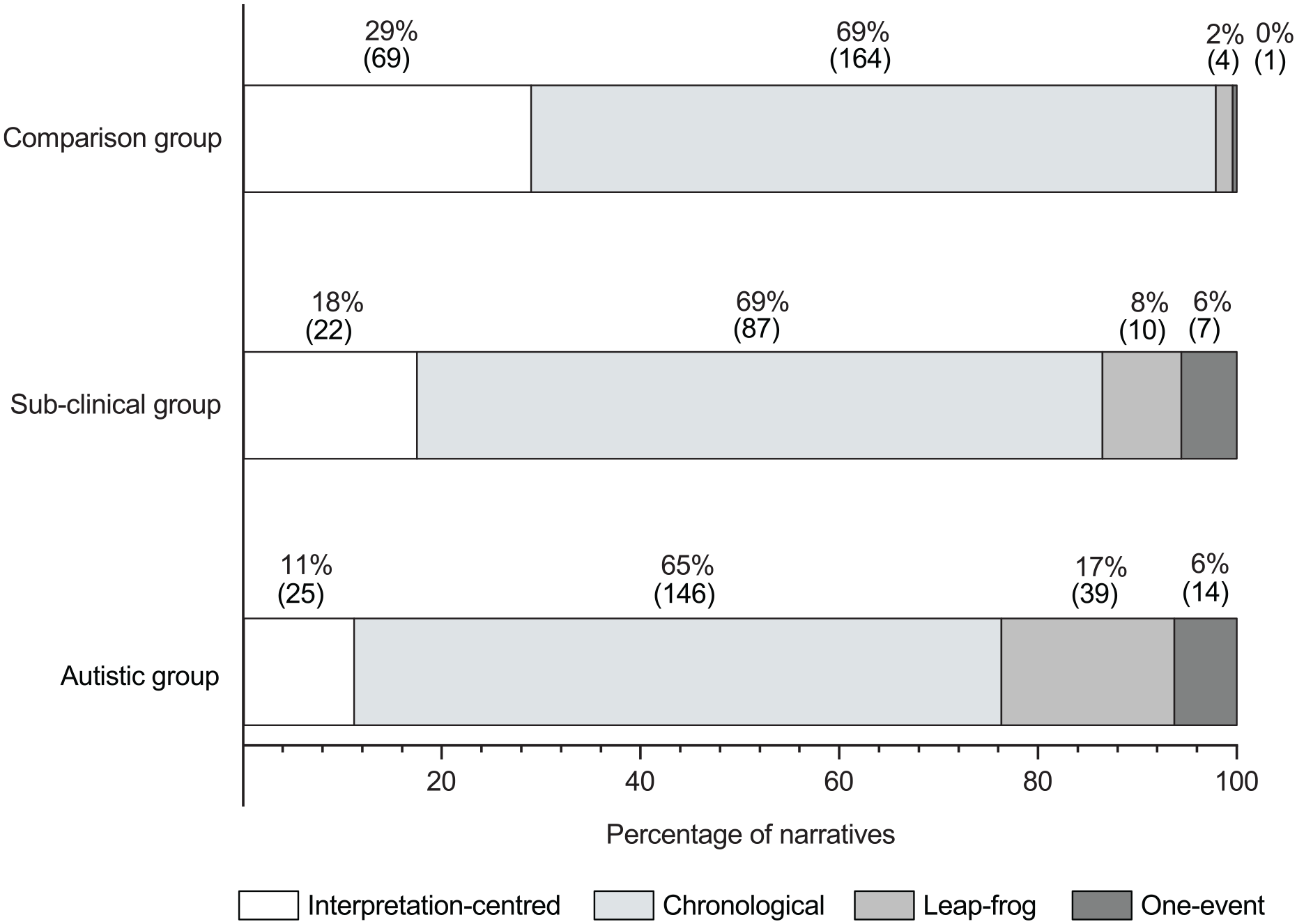
Narrative macrostructures in the comparison, sub-clinical and autistic groups represented as a percentage of the narratives.
Chi-square analysis showed that the groups differed in the distributions of their narrative macrostructures (χ² (6, N = 588) = 63.09, p < 0.001, φc = 0.23) with a small effect size. Chi-square post hoc pairwise Z tests with Bonferroni correction were conducted to examine which groups differed from one another. These analyses showed that the comparison group produced more interpretation-centred narratives than the autistic group and the sub-clinical group, whereas the autistic group and the sub-clinical group did not differ from each other in the proportion of interpretation-centred narratives produced. None of the groups differed from one another in the proportion of chronological narratives produced. The autistic group produced more leap-frog narratives than the sub-clinical and comparison groups. The sub-clinical group also produced more leap-frog narratives than the comparison group. Finally, the autistic group and the sub-clinical group produced more one-event narratives than the comparison group. The autistic group and the sub-clinical group did not differ from each other in the proportion of one-event narratives produced.
Associations between cognitive ability and social-pragmatic inferencing
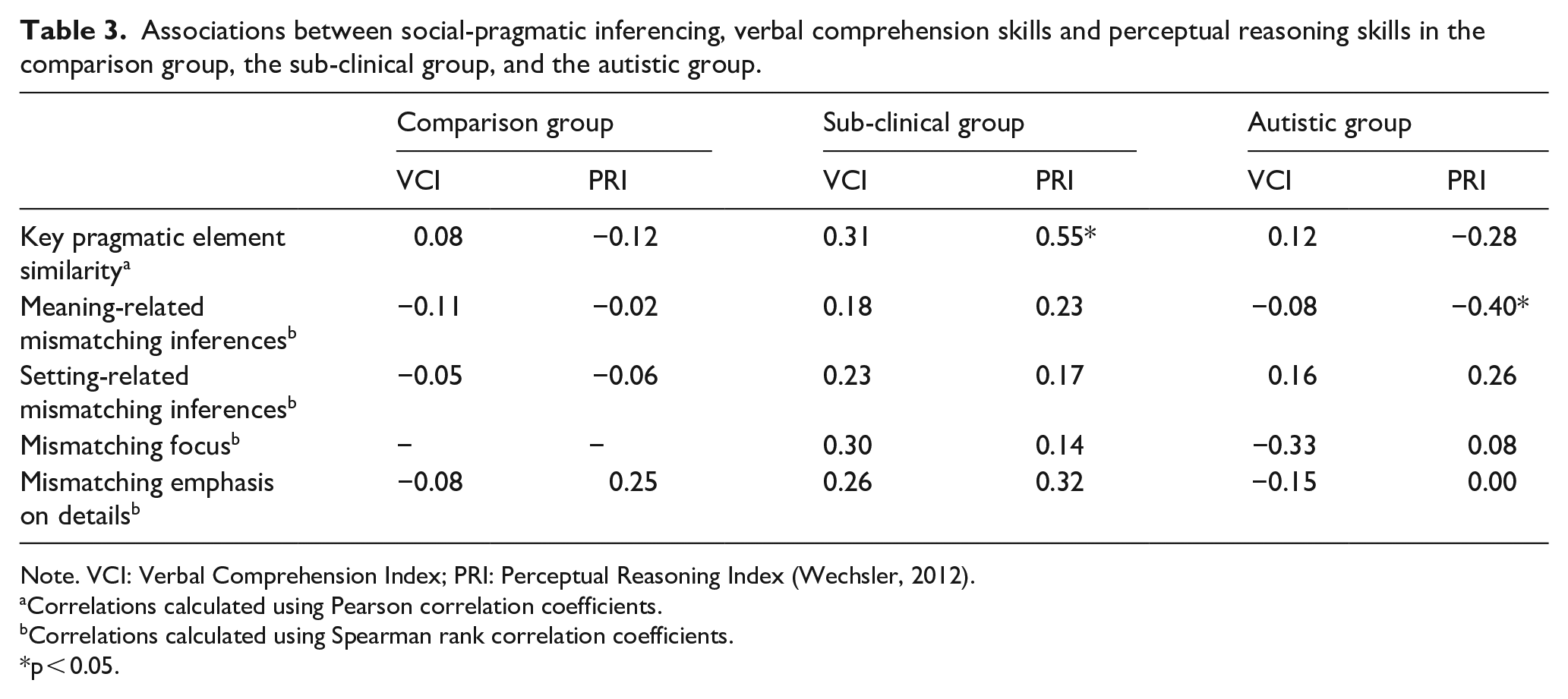
We examined whether participants’ social-pragmatic inferencing was associated with their Verbal Comprehension Index (VCI) and Perceptual Reasoning Index (PRI) scores (see Table 3).
Associations between social-pragmatic inferencing, verbal comprehension skills and perceptual reasoning skills in the comparison group, the sub-clinical group, and the autistic group.
Note. VCI: Verbal Comprehension Index; PRI: Perceptual Reasoning Index (Wechsler, 2012).
Correlations calculated using Pearson correlation coefficients.
Correlations calculated using Spearman rank correlation coefficients.
p < 0.05.
Regarding key pragmatic element inferencing similarity, a large and statistically significant correlation with PRI (p = 0.018) was observed in the sub-clinical group, but not in the other groups; that is the higher the sub-clinical group scored in PRI, the higher they scored in key pragmatic element inferencing similarity. Regarding meaning-related mismatching inferences, a negative, medium, statistically significant correlation with PRI (p = 0.022) was observed in the autistic group, but not in the other groups. That is, the higher the autistic group scored in PRI, the less they had meaning-related mismatching inferences.
Discussion
The findings of the current study show that autistic adults differ from non-autistic adults in social-pragmatic inferencing, supporting our hypothesis and prior research (e.g. Dindar et al., 2021; Happé, 1994; Heavey et al., 2000; Jolliffe & Baron-Cohen, 1999; Lönnqvist et al., 2017; Wilson & Bishop, 2020). In line with our hypothesis, the autistic group produced more mismatching meaning-related inferences than the comparison group. In some cases, such inferences could be described as misunderstandings, for instance, when the coding scheme indicated that a character was lying but an autistic participant inferred the opposite. These findings support prior research showing that autistic individuals tend to have a literal understanding of language (e.g. Emerich et al., 2003; Kalandadze et al., 2018; Wang et al., 2006). The study also showed that not only the autistic group but the sub-clinical group also differed from the comparison group in what they inferred as relevant. These findings add evidence to previous scarce literature suggesting associations between high autistic traits and difficulties with social relationships, social cognition and in interpreting nonverbal communication (e.g. Ingersoll, 2010; Jobe & White, 2007; Poljac et al., 2013; Sasson et al., 2013). It is therefore important to notice that also individuals with sub-clinical autistic traits who do not meet the threshold for a clinical diagnosis of ASD may find it challenging to navigate pragmatically complex social situations.
The autistic group also differed from the comparison group in producing more narratives with a mismatching focus, supporting our hypothesis. Previously, Loukusa, Leinonen, Jussila, et al. (2007) found that autistic children were more likely than non-autistic children to ‘drift’ to a topic considered irrelevant after having answered a researcher’s question correctly. In the current study, the mismatching focus was evident in some autistic adults’ focus on objects or the unfolding of the events perceived as illogical (also see Loukusa, 2021). For instance, one autistic adult focused a narrative about being in an elevator, being concerned that the characters were not spending ‘long enough’ in the elevator. He prioritised the being in the elevator over the interactions between the characters, unlike the non-autistic adults. Therefore, a tendency to focus on aspects of the video-clips that non-autistic individuals are less likely to focus on, appears a characteristic of autistic people. The results also resonate with the finding of Geelhand et al. (2020) that demonstrated autistic adults producing narratives that were less focused around the ‘gist events’. In addition, the findings are in line with research on visual social attention, showing that as compared with non-autistic individuals, autistic individuals tend to allocate more visual attention to the non-social aspects of stimuli (e.g. Chita-Tegmark, 2016).
Compared with the non-autistic adults, the autistic adults also produced more narratives with a mismatching emphasis on details, supporting our hypothesis and prior studies (Barnes & Baron-Cohen, 2012). However, unlike we hypothesised, the groups did not differ in setting-related mismatching inferences. Therefore, the findings suggest that autistic adults tend to be different particularly in inferring meaning. Since the percentage of narratives involving meaning- and setting-related mismatching inferences, mismatching focus and mismatching emphasis on details in the sub-clinical group was mostly between those of the autistic and comparison groups (as hypothesised), the adults with sub-clinical autistic traits appear to show social-pragmatic processing features that somewhat differ from the general population with low autistic traits. Since both the autistic and sub-clinical group differed from the comparison group in what they considered relevant, it could be that the processing features that produce these differences are somewhat different for the autistic and sub-clinical groups.
Our study did not find differences between the groups in most aspects of narrative discourse, that is, the groups did not differ in meaning- or setting-related uncertainty or personal or stimulus-related commenting, counter to what we hypothesised and what could be expected based on studies by Geelhand et al. (2020) and Wilson and Bishop (2020). Methodological differences may account for the different findings. For instance, we coded elements on a narrative level, while Geelhand et al. (2020) focused on the word level. It could also be that the autistic individuals’ preference for certainty, that Wilson and Bishop (2020) observed, does not appear as explicit expressions of uncertainty in freely produced narratives and could be reflected in our findings on autistic individuals’ tendency to focus on the concrete ‘world of objects’ rather than engage in interpreting meaning in fluctuating social situations. Methodological differences may also explain why the non-autistic individuals similarly engaged in personal and stimulus-related commenting in our study (cf. Geelhand et al., 2020). Extraneous commenting was not necessarily inappropriate in our study where the participants could relevantly joke, for instance, about the 1980s clothing style of the actors in the clips.
However, we did find between-group differences in the narrative macrostructures, supporting our hypothesis and some of the prior findings of Geelhand et al. (2020) and McCabe et al. (2013) (also see Barnes & Baron-Cohen, 2012). Specifically, the comparison group was more prone to produce interpretation-centred narratives than the autistic and sub-clinical group. On the other hand, these two groups produced more leap-frog and one-event narratives than the comparison group. Therefore, some non-autistic adults tend to have a holistic style in forming a personal interpretation of the events as a whole, whereas some autistic adults and adults with sub-clinical autistic traits have an atomistic style with a focus on specific events with less emphasis on tying the events together from a personal perspective. However, the distribution of macrostructures was nevertheless quite similar, and the chronological narratives were the most common for all the groups.
We also examined whether and how verbal comprehension and perceptual reasoning were associated with social-pragmatic inferencing. The findings show that the associations between perceptual reasoning and social-pragmatic inferencing were more evident in the autistic and sub-clinical groups compared with the comparison group. For the autistic group, better perceptual reasoning was associated with less meaning-related mismatching inferences, whereas for the sub-clinical group, better perceptual reasoning was associated with higher key pragmatic element inferencing similarity. This finding is in line with prior research (e.g. Dindar et al., 2021; Grynszpan & Nadel, 2015). Autistic adults’ local, detail-focused processing style could result in qualitatively and quantitatively different processing of social cues compared with non-autistic individuals with a more global processing style (e.g. Dindar et al., 2021; Grynszpan & Nadel, 2015; Jolliffe & Baron-Cohen, 2000; Lönnqvist et al., 2017; Murray et al., 2005; Van der Hallen et al., 2015). Our results further suggest that the processing style plays a role in social-pragmatic inferencing for individuals with sub-clinical autistic traits as well. Future research should therefore examine similarities and differences in the processing styles of autistic adults and adults with sub-clinical autistic traits using measures such as eye tracking. On the other hand, our study did not provide support for the hypothesis regarding associations between pragmatic inferencing and verbal comprehension, suggesting that core language skills do not alone account for pragmatic skills (also see e.g. Volden et al., 2009; Wilson & Bishop, 2020). However, verbal comprehension was measured using only the WAIS-IV (Wechsler, 2012) and the participants in our study had typical or above typical general cognitive ability with limited variation in the VCI scores, affecting the generalisability of our findings.
It should be noted that the current study was limited in not including autistic adults in the sub-study and therefore, their perspectives are not captured by the coding scheme. This forms an important direction for future research. Further, given that autistic females have a different profile of strengths than autistic males (e.g. Sturrock et al., 2021), another limitation concerns the differences in gender distribution between the sub-study and the main study samples. This study was also limited by a relatively small sample size and small effect sizes.
While autistic individuals tend to lack insight about non-autistic interpretations, we do not know to what extent lack of insight is also common for non-autistic individuals concerning autistic individuals’ interpretations (e.g. Milton, 2012) and how that would compare with the insight of individuals with sub-clinical autistic traits. Given the evidence that autistic individuals tend to have a better ‘match’ and mutual understanding with other autistic individuals (e.g. Crompton et al., 2020; Morrison et al., 2020; Williams et al., 2021), a focus on how to improve such mutual understanding between autistic people, people with sub-clinical autistic traits, and non-autistic people would provide a fruitful direction for future research.
Footnotes
Appendix
Coding definitions for the pragmatic and narrative discourse elements and narrative macrostructures.

| Pragmatic elements | Definition | Coding |
|---|---|---|
| Key pragmatic element inferencing similarity | The similarity between a participant’s key pragmatic element inferences and the coding scheme (based on sub-study participants’ typical inferencing) | Each narrative coded for 0 = no similar elements mentioned, 1 = one element mentioned, 2 = two elements mentioned |
| Meaning-related mismatching inferences | The inferred meaning of interactions, emotions or events does not match with the coding scheme (based on sub-study participants’ typical inferencing, e.g., it is inferred that a character is telling the truth when the coding scheme indicates that a character is lying) | Each narrative coded for 0 = not present; 1 = present. Percentage of narratives including the element is calculated |
| Setting-related mismatching inferences | The inferred character identity or the setting more broadly does not match with the coding scheme (based on sub-study participants’ typical inferencing, e.g., it is inferred that a character’s child is diagnosed with cancer when the coding scheme indicates that it is actually the character’s mother who is diagnosed) | Each narrative coded for 0 = not present; 1 = present. The percentage of narratives including the element is calculated |
| Mismatching focus | The focus in the narrative shifts to a side-track as compared with the coding scheme (based on sub-study participants’ typical inferencing, e.g., the participant extensively discusses an elevator that the characters in the clip use rather than the interaction between the characters) | Each narrative coded for 0 = not present; 1 = present. The percentage of narratives including the element is calculated |
| Mismatching emphasis on details | The narrative includes emphasis on details as compared to the coding scheme (based on sub-study participants’ typical inferencing, e.g., the participant discusses the patterns in a character’s jumper) | Each narrative coded for 0 = not present; 1 = present. The percentage of narratives including the element is calculated |
| Mismatching emphasis on filling in gaps (Note. This variable was dropped from the analysis for low inter-rater reliability.) | The narrative includes emphasis on filling in gaps in the story by providing one’s own suggestions for how the events might have developed or could unfold in the future (based on sub-study participants’ typical inferencing, e.g., the participant suggests that one of the characters may have had something to do with another character skipping school) | Each narrative coded for 0 = not present; 1 = present. The percentage of narratives including the element is calculated |
| Narrative elements | Definition | Coding |
| Meaning-related uncertainty | Explicit references to uncertainty concerning the meaning of interactions, emotions, or events (e.g., “I am not sure what this video clip is about”) | Each narrative coded for 0 = not present; 1 = present. The percentage of narratives including the element is calculated |
| Setting-related uncertainty | Explicit references to uncertainty concerning character identity or the setting more broadly (e.g., “I do not know who they are talking about”) | Each narrative coded for 0 = not present; 1 = present. The percentage of narratives including the element is calculated |
| Personal commenting | The narrative includes participant’s personal opinions or experiences, or mentions of world knowledge (e.g., the participant mentions that he has personal experience of the events presented in the clip) | Each narrative coded for 0 = not present; 1 = present. The percentage of narratives including the element is calculated |
| Stimulus-related commenting | The narrative includes comments about the experimental stimuli (e.g., the participant makes comments about the acting skills of the actors in a clip) | Each narrative coded for 0 = not present; 1 = present. The percentage of narratives including the element is calculated |
| Narrative macrostructure | Definition | Coding |
| Interpretation-centred narrative | The narrative is strongly built around the narrator’s interpretation of the meaning of the events and is independent of the chronological order of the presentation of the events in the video | Categorical coding |
| Chronological narrative | The narrative is a logically connected description of successive events that follows the chronological order in which the events were presented in the video. The narrative may or may not involve the narrator’s interpretation of the events | Categorical coding |
| Leap-frog narrative | The narrative involves two or more events that do not appear explicitly connected to each other. The narrator appears to jump around | Categorical coding |
| One event narrative | The narrator only recounts a single event without providing his/her interpretation of its meaning | Categorical coding |
Acknowledgements
The authors are thankful for the participants for taking part in the study. They are also thankful for MA Linda Lönnqvist and MA Antti Siipo for assisting in the data collection, and for MA student Minna Huikari for conducting the inter-rater reliability coding for the study. They further acknowledge the fruitful collaboration with the Oulu Autism Research Group. A section of the results concerning differences between the autistic and comparison group has been previously presented at the International Society for Autism Research 2021 conference as a poster presentation.
Declaration of conflicting interests
The author(s) declared no potential conflicts of interest with respect to the research, authorship, and/or publication of this article.
Funding
The author(s) disclosed receipt of the following financial support for the research, authorship, and/or publication of this article: This research was financially supported by the Academy of Finland (grant nos: 276578 and 333672), Eudaimonia Institute of the University of Oulu, Finland, the Alma and K. A. Snellman Foundation, Finland, and the Finnish Brain Foundation, Finland (earlier the Rinnekoti Research Foundation, Finland, and the Child Psychiatric Research Foundation, Finland).
