




Abstract
Autistic children from heritage-language-speaking homes in the United States are a growing group that would benefit from tailored support that honors their linguistic heritage. Bilingual autistic adults share benefits of their bilingualism abilities and report childhood learning environments as necessary for facilitating language learning or maintenance. Caregivers of young autistic children also report the desire to maintain their heritage languages but sometimes struggle to do so due to misconceptions and a lack of resources such as bilingual personnel. This study was the first to explore U.S.-based bilingual providers’ (N = 16) experiences and perceptions of providing bilingual care for autistic children. Data analysis was conducted using reflexive thematic analysis, and resulted in five themes, including (a) You Don’t Have to Change Who You Are: Experiences and Beliefs About Bilingualism, (b) Having the “Other” Perspective: Empathy and Intersectionality, (c) Services as a Gateway: Beliefs Rooted in Social Justice, (d) He Was Like a Different Child: Impacts of Receiving Heritage-Language Support, and (e) It Was Just Business: Impacts of Not Receiving Same Language Support. Findings from this study suggest that autistic children and their families benefit from heritage language care, and the recruitment and retention of a linguistically diverse workforce is recommended. Additional implications for research and practice are discussed.
Lay abstract
In the United States, many people have heritage languages they speak in their homes other than English, such as Chinese or Spanish. Autistic children whose families speak different languages could benefit from support and teaching in their heritage languages. Still, caregivers have reported that it is challenging to do so. Many autism professionals make suggestions that are not based on research. To date, researchers have not examined the perspectives of the small group of bilingual professionals in the United States who provide bilingual support for autistic children. Therefore, this study explored how bilingual autism providers in the United States talked about their work, bilingualism, and the impacts their bilingual work has on autistic children and families. The bilingual providers in this study reported many positive outcomes for autistic children when they can learn and use their heritage languages and some negative outcomes when providers cannot communicate in the same language. Recommendations from this study highlight the need to recruit more bilingual providers in the field of autism.
Keywords
Introduction
Language and culture are intertwined and help form our identity. The intergovernmental organization of the United Nations created the United Nations Committee on the Rights of the Child (UNCRC), an international human rights treaty that pertains to children worldwide. Article 30 of UNCRC (1989) asserts that children have the right to “enjoy [their] own culture, to profess and practice [their] own religion, or to use [their] own language.” Thus, the opportunity to maintain and practice one’s culture and language is considered a human right. This UNCRC Article exists in the context of a world where there are thousands of languages, up to 90% of which may go extinct within a century due to language shift, which is when “speakers cease to speak their own native tongue in favor of the language of what is usually a politically and/or economically dominant neighboring culture” (Grenoble, 2011, p. 27). Despite being a human right, language loss occurs within communities and individual families, particularly in immigrant communities. Heritage languages, defined as any language other than the dominant language in the social context (Kelleher, 2010), of immigrant families are likely to be lost within one or two generations due to assimilation; however, the language may live on in their place of origin (Grenoble, 2011). Most heritage-language-speaking families who have emigrated to the United States experience this loss, and these families raising a bilingual autistic child face additional challenges (Lim et al., 2021).
Bilingualism is defined hereafter as the ability to communicate in two or more languages or having regular exposure to two or more languages, which includes young autistic children regardless of their language abilities who are from heritage-language-speaking homes. This definition draws largely on the American Speech-Language-Hearing Association’s (n.d.) definition of bilingualism which stresses language skills are on a continuum, and also draws on the work of researchers supporting autistic bilingual emergent communicators (e.g. Lim & Charlop, 2018; Ohashi et al., 2012; Wang et al., 2018). Bilingual children with disabilities including autism are often described using deficit-focused language (Soto-Boykin et al., 2021, 2023). Regardless of communication abilities, the authors seek to portray bilingual autistic children as having a great strength worthy of celebration and cultivation. Bilingual autistic children are a growing population in the United States who would benefit from tailored support that includes their cultural and linguistic backgrounds (Trelles & Castro, 2019), and research in this area is needed (Davis et al., 2022). In non-autistic populations, researchers have demonstrated how bilingualism may confer benefits (Barac & Bialystok, 2012; Ware et al., 2020). Research exploring bilingual autistic child outcomes is growing, and thus far, evidence suggests that, like in non-autistic children, bilingualism has no known negative impacts, and may have some benefits (Conner et al., 2020; Gilhuber et al., 2023). For example, there are some reported benefits in executive functioning, language, and social skills (Beauchamp et al., 2020; Montgomery et al., 2021; Ratto et al., 2021; Sharaan et al., 2022; Siyambalapitiya et al., 2022; Zhou et al., 2019). Thus, researchers suggest that autistic children’s language skills and cognitive development may not be negatively impacted by bilingualism.
While the studies mentioned above focus on children, the experiences of autistic adults are also of great importance. Autistic adults have reported experiencing many positive outcomes due to their bilingualism, such as improved employment outcomes and social opportunities (Digard et al., 2020, 2022; Nolte et al., 2021). In addition, bilingual autistic adults also noted that their childhood environments were important for language learning (Digard et al., 2022). Thus, to promote learning environments for autistic children that support heritage-language learning, the perspectives and experiences of influential adults in autistic children’s lives are worth examining. The experiences of heritage-language-speaking caregivers of autistic children are well studied, but those of providers are less so. Both perspectives are explored below.
Caregivers’ reported experiences and perceptions of raising bilingual autistic children share many commonalities worldwide. One central theme reported is that caregivers place a high value on maintaining their heritage language with their children, but they often report receiving advice from service providers to limit the child’s exposure to only one language to avoid confusion and language delay (Drysdale et al., 2015; Durán et al., 2022; Howard et al., 2020; Kay-Raining Bird et al., 2012; Sher et al., 2022; Yu, 2013). Caregivers have also pointed to the lack of bilingual service providers as a significant influence when deciding whether to maintain their heritage language with their children (Papoudi et al., 2021; Stahmer et al., 2019). Furthermore, caregivers have reported facing stigma about bilingualism and difficulty accessing knowledge about autism and bilingualism broadly (Howard et al., 2020; Siyambalapitiya et al., 2022; Stahmer et al., 2019; Yu, 2013). Immigrant families, in particular, report that language barriers are a significant obstacle to accessing autism support for their children (Lim et al., 2021; Singh & Bunkyak, 2019).
Researchers have not studied disability providers’ experiences and perceptions of bilingualism as much as caregiver perspectives, and we were not able to find studies that focused specifically on providers who work with bilingual autistic children in the United States at the time of this writing. Existing accounts of disability and mental health providers’ experiences with working with bilingual autistic children around the world suggest that most providers value bilingualism (Davis et al., 2023; Howard et al., 2021; Marinova-Todd et al., 2016), but sometimes hold unfounded or discouraging beliefs, such as the misconception that bilingualism may confuse autistic children (Hay et al., 2021; Howard et al., 2021), or describing heritage-language speaking caregivers as “difficult” to work with (Tomczuk et al., 2022). Encouragingly, bilingual providers were found to be more empathetic toward and supportive of bilingualism than their monolingual counterparts (Howard et al., 2021; Sher et al., 2022). The current body of literature examines disability service providers’ experiences and perceptions of supporting bilingual children with and without disabilities across environments. Notably, most of the participating service providers in extant literature lived and worked outside of the United States (e.g. Hay et al., 2021; Howard et al., 2021; Sher et al., 2022), and the experiences of behavior analysts are currently absent from the literature.
Behavior analysts are graduate-level providers in Applied Behavior Analysis (ABA), a scientific approach to understanding and changing behavior. More than 160,000 behavior analysts support autistic populations (Behavior Analyst Certification Board [BACB], n.d.), making them an essential group to include when seeking to improve autism care in the United States. To date, the BACB (n.d.), the primary certifying body for behavior analysts, does not collect demographic information of certificants to determine how many behavior analysts are bilingual. We know that providing high-quality heritage-language support to children promotes positive outcomes (Meek et al., 2020), that autistic adults highly value bilingualism (Digard et al., 2020, 2022), and projections suggest that the number of families who speak languages other than English in the United States will continue to grow (Vespa et al., 2020). In addition, autistic children from heritage-language-speaking homes are more likely to be members of racially and ethnically minoritized groups, experience challenges accessing services (Cohen et al., 2023), and are often excluded from participating in autism research (Steinbrenner et al., 2022). Therefore, there is an urgent need to understand this area of practice to advance opportunities for autistic people to maintain or learn additional languages in childhood.
Method
This qualitative study used reflexive thematic analysis to understand the nature of bilingual autism providers’ experiences supporting autistic children from heritage-language-speaking homes (Braun & Clarke, 2006, 2022). The data included in this article are part of a larger study. Additional practitioner-focused findings can be found in Martin Loya and Meadan (2024) with attention to ethical challenges encountered by bilingual behavior analysts providing Spanish-language support in the United States. This study showcases findings that are relevant for a range of interested parties in autism care and highlight reported child- and family-level impacts of receiving and not receiving heritage language care. The following research question guided this study: What are the experiences of bilingual US-based behavior analysts who provide home-based support services for autistic children and their families?
Theoretical frameworks and research team reflexivity
This study was conceptualized, conducted, and reported using the guiding theoretical framework of Disability Critical Race Theory (DisCrit; Annamma et al., 2018) and operated under a social constructionism epistemological stance (Burr, 2015). DisCrit has been proposed as a valuable framework to understand and examine issues related to race and disability within early childhood special education and in ABA (Catrone et al., 2023; Love & Beneke, 2021). DisCrit has seven tenets that emphasize acknowledging the historical and contemporary ways that race and ability intersect and impact individuals, organizations, and society (Annamma et al., 2018). This study purposefully centers the marginalized in two ways. First, families who primarily speak a language other than English in the United States are often members of racial or ethnic minoritized groups who have historically experienced disproportionately adverse outcomes across environments such as education (Sturm et al., 2021) and health care (Chang, 2019). Second, bilingual behavior analysts are likely to be members of minoritized groups. This likelihood is assumed because there is currently no available data regarding languages spoken by service providers within ABA; however, we know that 73% of graduate-level behavior analysts identify as White (BACB, n.d.), and the majority of the US population are monolingual English speakers (US Census Bureau, n.d.). Therefore, it is reasonable to suspect that most behavior analysts are monolingual English speakers. The BACB’s neglect to capture adequate demographic data demonstrates how linguistic diversity is often an afterthought.
In alignment with the tenets of DisCrit, the composition of the research team was purposeful and consisted of three researchers with diverse backgrounds, personal and professional experiences related to autism, and languages spoken. All researchers had prior experience conducting, analyzing, and publishing qualitative research. The first author identifies as a bi-cultural Mexican American woman who is bilingual in English and Spanish, a Board-Certified Behavior Analyst (BCBA) with clinical experience in various United States and international contexts, a doctoral student, and a sibling to an autistic man with co-occurring conditions that result in him requiring significant daily support. The second author is a bilingual immigrant, a BCBA-D with clinical expertise in autism and social communication, and a faculty member. The third researcher was a graduate research assistant, a doctoral student who assisted with data analysis, is a bilingual Korean American woman who has experience as an autism therapist and researcher in clinical settings with a wide age range of autistic individuals. All research team members are part of a special education department at a large public university in the United States.
In alignment with social constructionism, we believe meaning and experiences are socially produced, and the research team’s experiences and biases impact and ultimately have enhanced our interpretation and analyses due to our diverse experiences within the world of autism care. In addition, the first author identifies as an “insider-outsider” to the participant population (Bukamal, 2022; Dwyer & Buckle, 2009). Specifically, she was a practicing bilingual ABA provider for 10 years prior to commencing her doctoral studies which established her status as an insider and positively impacted rapport and sharing of experiences. However, her current “outsider” position as a researcher could have created some separation and power differences between her and the participants, though this is not believed to have occurred.
Recruitment
This study was approved by the university Institutional Review Board in November 2021 and utilized purposeful and snowball sampling strategies to “yield insights and in-depth understanding rather than empirical generalizations” (Patton, 2015, p. 264). Recruitment fliers were shared via social media (e.g. Instagram and Twitter) to promote purposeful sampling. The first author shared the flyer and link to the Google screening form via her public professional social media accounts and encouraged colleagues to share on her behalf. Snowball sampling was also utilized; upon completing the interviews, all participants were encouraged to share the study flier with their colleagues and networks. Inclusion criteria for participants required they be (a) currently certified and in good standing as a BCBA or Board-Certified assistant Behavior Analyst (BCaBA) who lives and works in the United States, confirmed by searching the publicly available database hosted by the BACB, (b) self-identify as bilingual, and (c) provide ABA services in the home with at least one autistic child whose family primarily communicates in a language other than English. ABA services were defined as providing one-to-one support to autistic children, their caregivers, and/or providing case management and supervision for paraprofessionals who provide one-to-one support. The researchers focused on the experiences of providers who work closely with families in the home setting rather than those in school or clinical settings.
Participants
Sixteen bilingual participants completed interviews and are presented below using pseudonyms. The majority of participants were of Latino/Hispanic heritage (n = 13), followed by non-Latino/Hispanic Black Americans (n = 2) and Asian (n = 1). Most of the Hispanic/Latino participants were of Mexican heritage (n = 8), followed by Guatemalan (n = 2), Peruvian (n = 2), Cuban (n = 1), Puerto Rican (n = 1), and Salvadoran (n = 1). Participants mostly lived in states with more Latinos or Hispanics (e.g. California, Texas, and Florida). Participants included second generation in the United States (n = 7), first-generation in the United States (n = 6), and third generation (n = 1). Two participants reported that their generation in the United States was not applicable. All participants reported supporting several autistic children from heritage-language-speaking homes with an age range of early childhood to teenage years. Additional demographic information is available in Table 1.
Participant demographic information.
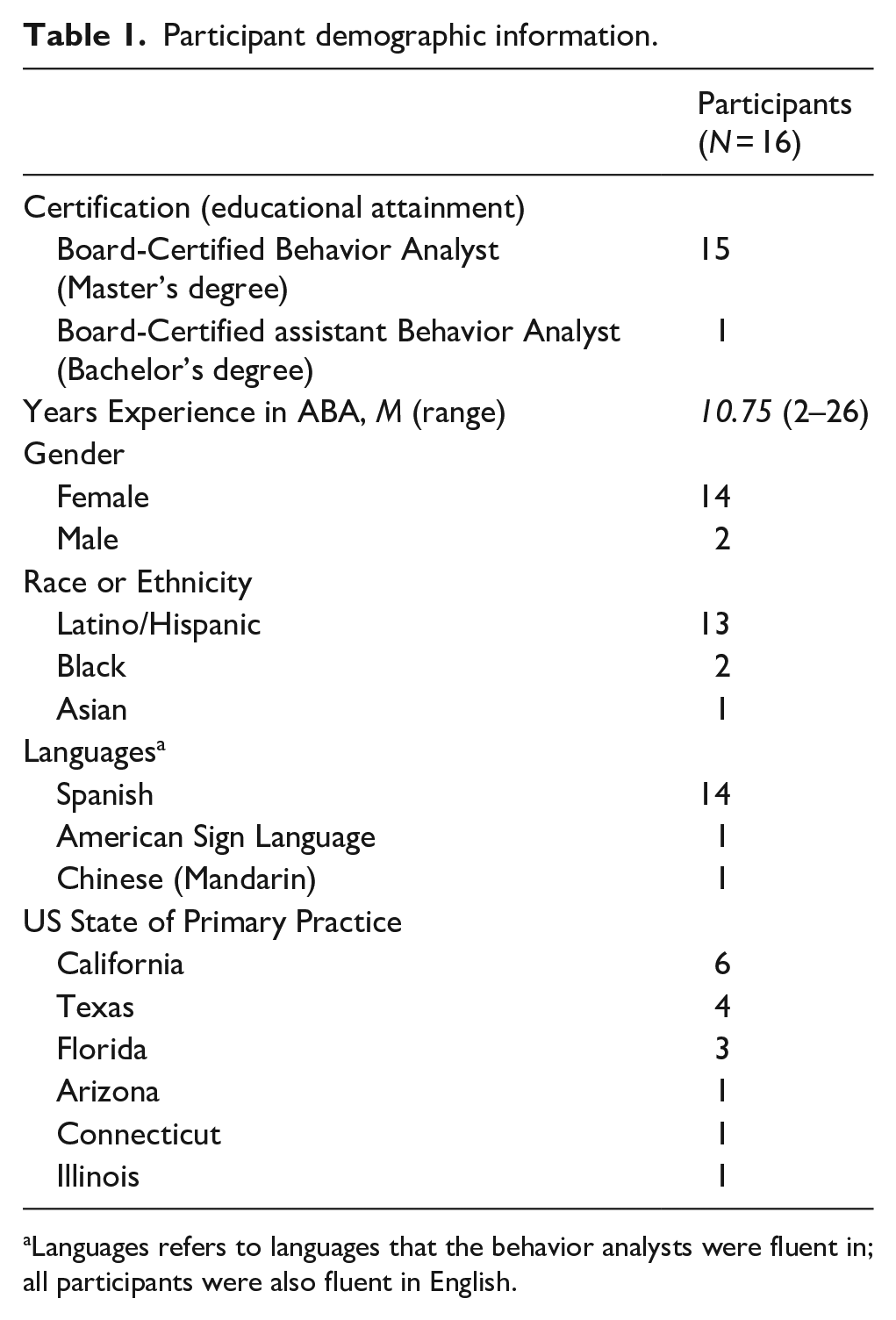
Languages refers to languages that the behavior analysts were fluent in; all participants were also fluent in English.
Data collection
A demographic questionnaire and a semi-structured interview were used in this study. The demographic questionnaire included questions related to general demographic information and two questions about their comfort level providing heritage-language services and what level of support, if any, was provided by their place of work for them to conduct quality heritage-language services. The interview protocol was semi-structured with open-ended questions to better understand providers’ experiences and perceptions of supporting autistic children and their families (see Supplemental Appendix A). The first author developed the protocol with revisions and feedback from faculty members and doctoral students who were also behavior analysts with experience in autism care, and one practicing bilingual behavior analyst who met inclusion criteria piloted the interview, resulting in no significant changes being made.
Procedures
The first author conducted all interviews in English over Zoom. The average interview length was 43 min, ranging from 18 to 75 min. The interviews were recorded and automatically transcribed in Zoom and then corrected by the first author. Member check summary emails were sent to all participants, which are described as the opportunity to “confirm the accuracy (or inaccuracy) of interview(s)” (Brantlinger et al., 2005, p. 201). No substantive corrections or adjustments were provided by the participants, who received a US$50 incentive as a token of appreciation for their participation.
Data analysis
The transcribed interviews were analyzed thematically using a systematic process (Braun & Clarke, 2006, 2022; Saldaña, 2021). Specifically, the research team followed the guidance of Braun and Clarke (2006, 2022) and conducted a reflexive thematic analysis using a data-driven inductive coding technique to identify and interpret patterns and themes in the data. This method was chosen to suit the exploratory nature of the research question and aim of the study to understand providers’ lived experiences. First, the research team consisting of both authors and the graduate research assistant independently familiarized themselves with the data by listening to the interviews and reviewing interview transcripts, taking notes of ideas that emerged from the interviews. Then, the team met to discuss their initial impressions. Next, the team members independently reviewed the transcripts and generated initial codes using the comment feature in Microsoft Word. Then, the research team met weekly to discuss, review, and come to coding consensus with each interview until no new codes were identified. Then, the first author began to generate themes by developing a visual organizer (i.e. a codebook) with all identified codes categorized under potential themes, operational descriptions of the themes and codes, and representative example quotes. The research team independently reviewed the codebook to assess cohesivity of the themes and example quotes and provided feedback and suggestions. The research team continued to meet and refine the codebook and themes until all research team members agreed the themes were an accurate interpretation and representation of the data. Then, the first author independently re-coded all interviews (N = 16) using the finalized codebook within Dedoose (2022) software. See Supplementary Materials for the finalized codebook with additional quotes.
Community involvement
The target community of this project is bilingual providers who support autistic children and their families in the home setting and monolingual providers who want to learn more about supporting autistic children from heritage-language speaking backgrounds. The demographic questionnaire and interview protocol were informed by the literature and the first authors’ professional and personal experiences as a BCBA and autism sibling from a bilingual home. All participants were encouraged to give feedback to the researchers during the data collection and analysis phases. While the first author and several participants identified as close family members, no autistic people were involved in creating materials, and participants were not asked about their disability status in this project. It is unknown if any of the participants identified as autistic.
Findings
Participants in this study shared their experiences and perceptions of supporting autistic children and their families who primarily speak heritage languages at home. Through reflexive thematic analysis, five themes were generated from the interviews: (a) You Don’t Have to Change Who You Are: Experiences and Beliefs About Bilingualism, (b) Having the “Other” Perspective: Empathy and Intersectionality, (c) Services as a Gateway: Beliefs Rooted in Social Justice, (d) He Was Like a Different Child: Impacts of Receiving Heritage-Language Support, and (e) It Was Just Business: Impacts of Not Receiving Same Language Support. These themes are summarized in the Table 2, and explored in detail below.
Theme summaries.

You don’t have to change who you are: experiences and beliefs about bilingualism
Participants frequently discussed language and bilingualism as an inextricable and important aspect of culture and identity. Álvaro, a BCBA who is first generation, summarized the sentiment of this theme, saying the ability to communicate in one’s heritage language is important and, “I think that it’s part of the culture. It’s part of the identity. And it’s something that we should not leave behind.” Indeed, all participants (N = 16) enthusiastically shared that they believe providing access to heritage-language support is very important for autistic children and their families. For example, Yenni, a BCaBA, stated, “It’s very important to adapt to the culture that’s in the home to just make everybody more comfortable. To make the [child] more comfortable. To make the parents more comfortable.” Participants described their communication with caregivers using words and phrases like buy-in, connection, rapport, and value. For example, Ana, a BCBA from a border community in Texas, shared, It would have been different had I not given [caregivers] a voice and a place to say, okay, you want to teach your kiddo Spanish? That’s fine! You want to interact in Spanish? That’s okay! You don’t have to change who you are! I think it gives a lot of value to families and for them to know that we’re there to support them too, not just English-speaking clients.
Participants also noted how communicating in families’ heritage languages helped them have meaningful conversations. For example, Rocio, a Spanish-speaking BCBA from California, described her experiences when working with Spanish-speaking families: I am able to establish that rapport real fast with Spanish speaking families . . . parents are a little bit more able to tell me their raw, honest opinion . . . As soon as a Spanish speaking family knows the clinical team is coming into the home that speaks Spanish, we’re able just to kind of really get into the hard, difficult questions without it seeming that we’re going too deep too quickly.
Overall, participants expressed positive feelings about being able to provide heritage-language services to families and how that results in stronger connections and rapport with the families they serve.
Having the “other” perspective: empathy and intersectionality
The majority of participants (n = 11) expressed clear sentiments of empathy with the families and children they supported, often making connections between the families and their own experiences as members of minoritized communities (e.g. describing this similarity as having shared experiences of being an “Other”). Notably, all first-generation (n = 6) participants shared statements of empathy toward the families. For example, Erica empathized with families about the experience of not being able to “communicate the nuances” and stated, Language is not just words, it’s a whole culture. And I don’t speak any other languages [besides English and Spanish], but I imagine that that’s the case with any language. It comes with its own culture, and its own rules, and its own traditions . . . So if we don’t, or if we’re not aware of that, or if we’re not able to provide that [heritage-language] support, then, what is it that we’re really doing? Because that’s the whole point, right?
Similarly, Sonia, another BCBA who is first generation, shared, I’ve been here for 20 years already, but I know that I have an accent still, and some words I cannot say. So, I think . . . just understanding that, and how that affects [the families] in their everyday life [is really important]. Understanding the lack of not knowing the language, especially when they’re trying to get services for their kids. A lot of places know only English, and everything is in English, and it takes forever to have [an interpreter]. So, knowing that they’re trying. They’re accepting that their kiddo has a disability, and on top of that, having all of these barriers just being plastered to them.
Participants also shared how this empathy extends to families with and without a shared language. For example, Rocio showed empathy and a desire to support a Vietnamese-speaking family: The same way that I make connections that seem very deep with my Spanish-speaking families . . . we’re both showing empathy and concern of how important it is for you to understand. To understand the [child’s support program] and how important it is for me to make sure you do understand. And me trying to the best of my abilities to use Vietnamese words . . . I think the connection is there across the board, in the sense of bilingual homes, we’re able to have that other perspective of being part of a bilingual home.
In describing their beliefs of empathy toward the families and children they serve, participants recognized and identified with the reality that families experience intersecting marginalized identities that impact their lives. For example, being immigrants, not speaking the dominant language, and raising an autistic child while navigating a complex and inequitable education and health care system.
Services as a gateway: beliefs rooted in social justice
Most participants across generations (n = 12) shared stories and beliefs about bilingualism rooted in concerns for advancing social justice. Social justice is defined here as “An ideal condition in which all members of a society have the same rights, protections, opportunities, obligations, and social benefits. Implicit in this concept is the notion that historical inequalities should be acknowledged and remedied” (emphasis added; Barker, 2014, p. 398). This is distinct from the previous theme (“Having the ‘Other’ Perspective . . .”) in that the previous theme required participants’ statements to show empathy and awareness of challenges arising from intersectionality, while the present theme necessitated action (or a clear intent to act) to remedy the inequities.
For example, Ana, described being barred from offering group parent training in Spanish at their place of employment due to corporate-level language policy against using a language other than English. She noted, “I might just [offer the training] and not tell anyone . . . that’s six families that would benefit from a [heritage-language] group family training!” Ana felt that offering heritage-language group services to families would provide such benefits that she was willing to act against policy. Manci, a BCBA who is second generation, described having numerous uncomfortable discussions with monolingual behavior analysts over their decisions not to support children’s heritage languages at home: [My monolingual colleagues would say], “No, you should just teach them English. It’s what they’re going to experience for the rest of their life, and we’re in the United States.” And that, I think, is erroneous for BCBAs to say. You have to look at what’s appropriate for the family, not appropriate for your conception of society. It’s really important to take a step back and take away your bias . . . It’s really important that the child can engage with [their community]! That’s social validity! I think that people push away social validity in lieu of what’s easier for them, and I think that’s dangerous in our field. I think that it definitely needs to change.
Gloria, a BCBA in California, shared a similar sentiment. She noted how, in her more than two decades as an ABA provider, she has observed the field shift toward being more equity-focused and how service providers must act purposefully to combat inequities: I’m watching this change [in ABA] and I think that it is imperative that as BCBAs and as responsible clinicians, that we are culturally responsive. In every capacity. And if we don’t have the skill set that’s okay. But it’s our job to bridge that gap. Because oftentimes . . . Our services are the gateway for inclusion. Our services are the gateway for equity. And I think if we’re not practicing cultural responsibility, then we’re doing a major disservice to the clients that we’re serving, and in the field as a whole.
Overall, most participants shared beliefs toward bilingualism rooted in desires to advance social justice within ABA practice. There was a general recognition that families from underserved backgrounds often go through additional barriers and “have to work extra hard to get services that an English-speaking family wouldn’t have to go through,” as stated by Lily, a BCBA who is second generation. Participants described how families’ intersecting marginalized identities required them as clinicians to provide additional tailored support to address many of the systemic challenges experienced by bilingual autistic children and their families.
He was like a different child: impacts of receiving heritage-language support
Participants described a range of positive impacts on families and children when they received support in their heritage language, including improved quality of life outcomes and communication with caregivers. Most (n = 9) participants described specific situations where receiving heritage-language support improved children’s quality of life, particularly in reducing dangerous behaviors such as aggression and self-injury and increasing communication and self-advocacy skills. For example, Natalia, a BCBA who is second generation, shared a story of supporting a new child on their caseload who previously had English-only providers. She noted that the child experienced many challenges before receiving heritage-language services, such as physical aggression toward others and self-injurious behaviors. Natalia changed all of the lesson plans into Spanish, the family’s heritage language, and noted the impact: [The child] started learning, acquiring, more skills at a higher rate! The [physically aggressive behaviors] decreased . . . The injuries of the staff also decreased . . . he was known as a different child. [Previously, the dangerous behaviors were happening because] he was not understanding whatever it was that [English-only speaking clinicians] were asking him. There was a lot of frustration on his end and on the family’s.
Similarly, Erica, a BCBA who is first generation, shared a story of one of her proudest moments as a clinician when she began supporting a young child who also experienced self-injurious behaviors. After 2 months of receiving bilingual care after previously receiving English-only care, she reported that the child stopped engaging in self-injurious behaviors and began to effectively self-advocate to family members and clinicians. Erica shared an example of working with the child on a self-care activity, noting: He was trying really hard [to button his shirt]. And we were like, “you can do it! You can do it!” . . . And he was really trying, and he just looked up and he went like, “Ya cállate!” [Shut up already!] And it was just so funny because, you know, I don’t think that people can say that that was their excellent moment, but to me, it was like he had gained independence, communication, self-advocating skills . . . that’s one of my proudest moments.
Natalia and Erica’s stories demonstrate improved quality of life outcomes when children and families receive support in their heritage languages and the potential dangers of not providing heritage-language care.
In addition to positive direct impacts for autistic children, most participants (n = 12) described how heritage language communication with caregivers positively impacted the therapeutic relationship and beyond. For example, Josh, a Mandarin speaker, described how receiving heritage-language support improved provider-caregiver communication and supported families’ understanding of autism and neurodiversity. He described, I did a parent training session with his mom and dad, and they were saying that they see the [communication increasing] at home and also in the community. So, they’re feeling great about it . . . But then, mom was having concerns like “I noticed my child is still having some [social] challenges with peers.” But dad is more responsive in terms of [learning about and accepting] the neurodiversity paradigm. Their child is just their child. That’s just who he is . . . So, I do think you need to be able to communicate that idea in [families’ heritage-languages], and I feel like that helps them to process that information about autism.
Participants also described how heritage-language support had impacts beyond the immediate provider-caregiver relationship. For example, Gloria noted that providing heritage-language support to families validates them and explains how receiving heritage-language care is a crucial component of culturally responsive practice that can have positive ripple effects on caregivers: When we’re working with indigenous communities, and underrepresented communities, and marginalized communities, so many of their environments don’t validate who they are . . . One person showing up and saying, “let’s do this work together,” positively impacts how they show up beyond us. How they’re able to interact within other environments and advocate for their needs.
Participants had overwhelmingly positive stories about improved quality-of-life outcomes for autistic children and their families when providing heritage-language care, and participants often juxtaposed positive impacts with the potential negative impacts of not providing heritage-language support.
It was just business: impacts of not receiving same language support
Participants shared stories of supporting families with whom they did not have a shared language. Not all participants had this type of experience. However, those who did (n = 10) reported they observed negative impacts on the families, such as not receiving the same level of care compared to families who did share a language with their providers. For example, Lucía, a BCBA who is second generation, described the communication barrier as decreasing the “value” of her clinical expertise: If the [child] really needs a lot of support, and I do not speak the family’s language, that’s really hard. Because no matter how simple we think we’re explaining it, the translation is never the same . . . I think the information is not really carried over the way it’s trying to be carried over. And you lose a lot of that, the value is gone.
Participants described scenarios where they attempted but struggled to bridge the language gap with the families under their care. Participants also shared stories about observing other providers and how they treated heritage-language-speaking families without warm, compassionate care. Reflecting on his time as a behavior technician working under the supervision of monolingual English-speaking behavior analysts, Álvaro recalls his supervisors being “cold” and not creating meaningful connections with families: [The BCBA supervisors] would behave different with other families. Usually these families that English is not the first language, . . . Families that are first generation here [who come] from a country where, I don’t know . . . They feel like [providers] are super experts! You know? In autism. And [they, the caregivers,] have to respect everything that [providers] say . . . I felt that difference especially [in] the connection. Like there was no relationship. It was just business.
Overall, the bilingual BCBAs with experience supporting families without a common shared language reported challenging impacts on children and families such as impaired provider-caregiver relationships and lower quality services.
Discussion
This study aimed to examine the experiences of bilingual providers who practiced in-home with autistic children from heritage-language-speaking families in the United States. Sixteen behavior analysts participated in this study, the majority of whom spoke English and Spanish (n = 14), were women (n = 14), and were Latino/Hispanic (n = 13) of Mexican heritage (n = 8). This study is the first to examine US-based bilingual autism providers’ perspectives. The findings align with current research and provide novel research and practice implications.
Participants overwhelmingly reported that they highly valued bilingualism and the opportunity to provide heritage-language care. They witnessed positive quality-of-life outcomes for children and families, and they observed improved connection and communication with caregivers when they could provide heritage-language care. Many of these sentiments have been shared by other bilingual autism providers (Davis et al., 2023; Hay et al., 2021; Howard et al., 2021; Marinova-Todd et al., 2016). Participants also shared stories that emphasized their understanding of intersectionalities. These findings are supported by the work of other researchers who have examined the experiences of bilingual allied providers, such as professionals in mental health (Teran et al., 2017) and social services (Drolet et al., 2014). Furthermore, the reported impacts on children and families demonstrate the potential benefits of providing culturally appropriate care and a more diverse workforce that is reflective of the communities they serve (Rosales et al., 2023; Slim & Celiberti, 2021), and illustrates the potential negative impacts on children and families when providers are unable to support culturally and linguistically diverse families.
The perspectives of bilingual providers working with families without a shared language (e.g. an English and Mandarin-speaking BCBA supporting a Spanish-speaking family) is a novel and significant contribution of this study. With their “Other” perspectives, participants in this study demonstrated a keen understanding of the intricacies of navigating sensitive and sometimes difficult conversations across languages and cultures. They lamented when they recognized their inability to provide the best care. Despite their challenges, they reported doing their best to meet the needs of heritage-language-speaking caregivers who are often excluded from receiving direct care from autism support providers (Tomczuk et al., 2022).
Another novel contribution of the present study is that all participants, even those who learned their second languages in adulthood, were members of racial or ethnic minoritized groups in the United States. This highlights the benefit of using an intersectional framework such as DisCrit to “center the margins” in research and practice. This intersectional analysis also highlighted how first-generation providers consistently empathized with the children and families they served. Empathy has been described as a necessary prerequisite for action toward social justice and equity (Barker, 2014; Segal, 2014). Participants also shared stories of social justice, another novel contribution of this study. Researchers should continue to include the voices of practitioners when designing, implementing, and evaluating justice-driven empirical research (Pritchett et al., 2022) and know that behavior analysts routinely read peer-reviewed articles for professional development (Kranak et al., 2023) and they may adjust their practices to align with innovations in autism research.
Limitations and implications
This study has several limitations and implications. One limitation of the present study is the overrepresentation of Spanish-speaking behavior analysts. While Spanish is the most common language in the United States besides English (US Census Bureau, n.d.), speakers of other languages’ experiences are also meaningful. This could be explored in future research examining autistic child and family outcomes of those from less represented linguistic backgrounds (i.e. heritage language speakers besides Spanish) to improve understanding and care for these populations, as well as understanding the experiences of monolingual providers in the United States who support autistic children from heritage-language-speaking homes. Leaders in research and practice should continue to recruit, promote, and retain culturally and linguistically diverse providers who are more reflective of their communities.
Another limitation is the lack of voices from additional parties interested in improving the quality-of-life and opportunities available for autistic children. This includes autistic self-advocates, behavior technicians or paraeducators, and caregivers of children receiving support. Also, findings from this study highlight the intersections of cultural identity and language within ABA care for autistic children; however, other aspects vital to one’s identity were not examined (e.g. disability status of the providers or family members). Overall, much work remains to be done in research and practice to support autistic children from heritage-language-speaking homes, who are underrepresented in research (Steinbrenner et al., 2022) and experience barriers in service access (Cohen et al., 2023).
Conclusion
Participants in the present study described providing valuable care for autistic children and their families from heritage-language-speaking homes, and their beliefs and experiences provide a new look at the on-the-ground realities of some of the most underserved autistic communities in the United States, specifically, those who predominantly communicate in heritage languages. Findings from this study highlight the potential positive impacts on children when receiving linguistically and culturally appropriate care, as well as cautionary tales when these services are not provided. Researchers, providers, and other interested parties are recommended to advocate for increased access to heritage-language care for autistic children and recruit, promote, and retain bilingual providers. We know bilingualism is a valued skill worldwide that can open doors for autistic people into adulthood (Digard et al., 2022; European Commission, n.d.; Nolte et al., 2021). Listening to the voices of bilingual providers and other bilingual parties, such as autistic self-advocates and caregivers, is vital to ensure the acceptability and feasibility of practices and research.
Supplemental Material
sj-docx-1-aut-10.1177_13623613241234413 – Supplemental material for It’s our job to bridge the gap: Perspectives of bilingual autism providers on heritage language care
Supplemental material, sj-docx-1-aut-10.1177_13623613241234413 for It’s our job to bridge the gap: Perspectives of bilingual autism providers on heritage language care by Melanie R Martin Loya and Hedda Meadan in Autism
Footnotes
Acknowledgements
The authors thank Christy Yoon for her excellent assistance with data analysis and all the participants for trusting us to share their stories.
Data statement
The data that support the findings of this study are not openly available due to reasons of sensitivity, but additional quotes can be found in the supplementary materials.
Declaration of conflicting interests
The author(s) declared the following potential conflicts of interest with respect to the research, authorship, and/or publication of this article: All authors are Board Certified Behavior Analysts who stand to gain from favorable public perception of ABA. The authors certify that they have no current affiliations with or involvement in any organization or entity with any financial interest in the subject matter or materials discussed in this manuscript.
Funding
The author(s) disclosed receipt of the following financial support for the research, authorship, and/or publication of this article: This study was supported in part by funding from the Office of Special Education Programs, US Department of Education, Project Co-LEAD (H325D190064). The views or opinions presented in this article are solely those of the authors and do not necessarily represent those of the funding agency.
Ethics approval
The Institutional Review Board at the University of Illinois Urbana-Champaign approved the methods and procedures of this project.

Supplemental material
Supplemental material for this article is available online.
References
Supplementary Material
Please find the following supplemental material available below.
For Open Access articles published under a Creative Commons License, all supplemental material carries the same license as the article it is associated with.
For non-Open Access articles published, all supplemental material carries a non-exclusive license, and permission requests for re-use of supplemental material or any part of supplemental material shall be sent directly to the copyright owner as specified in the copyright notice associated with the article.
