




Abstract
We examined the use of person- and identity-first language (PFL, IFL) in scholarly writing about autism by reviewing 12,962 journal abstracts from 11 autism research journals (mostly covering the years 2001–2022). We found a preference for PFL (64.68%) over IFL (15.83%) when considering aggregated, within-journal breakdowns (with abstracts using both representing 19.50%). However, when examining language use longitudinally, we observed a general trend toward increasing use of IFL after years of stable trends showing predominant use of PFL. These trends were not consistent across all reviewed journals, as some journals demonstrated preference for either PFL or IFL across all observed years. Notably, we highlight the Journal of Autism and Developmental Disorders as a special case that offers a 51-year perspective (1971–2022); here, IFL was predominant until the 1990s, when PFL became a stable majority, and in the late 2010s, IFL started to increase. Journal differences in aggregate breakdowns and longitudinal trends are discussed in line with recent policy changes, journal submission guidelines, and shifting perspectives in autism research. Implications for writing about autistic individuals and the role that language plays within the broader autism research scholarly community are discussed.
Lay Abstract
There are many ways to refer to an individual who is on the autism spectrum. A recommended approach has been to use person-first language (PFL), such as “person with autism.” A different approach is to use identity-first language (IFL), such as “autistic person.” Recent studies focused on different groups of people (e.g. autistic self-advocates, parents, and practitioners) show that some groups prefer PFL (practitioners) while others prefer IFL (autistic self-advocates). However, less is known about how researchers use PFL and IFL in academic writing (e.g. studies published in scientific journals) involving autistic research participants. Our study examined 12,962 journal abstracts (short summaries of scientific articles) from 11 academic journals that publish autism research findings. We wanted to know (a) about the use of PFL and IFL across abstracts, and (b) how PFL and IFL use has changed annually over time. We examined data for all journals individually and grouped together. Our findings showed that journal abstracts generally use PFL (65%) with some using either IFL (16%) or both PFL and IFL (20%). However, journals varied, with some showing a clear majority for PFL and a couple for IFL. Examining trends over time across journals showed that while PFL appeared to be the majority for most journals, IFL has steadily increased in the recent few years. Our study helps us understand how autism researchers write about autistic individuals and offers implications for helping researchers intentionally make choices about the language used in their autism research studies.
The creation of scientific knowledge occurs through “thought collectives”—research communities that are shaped by social interactions as well as cultural and historical practices (Fleck, 1979). The field of autism research is one such thought collective. The research efforts and goals of autism science continue to change (e.g. examining diversity rather than deficits, including and supporting autistic voices in research, identifying barriers that inhibit autistic growth; see Interagency Autism Coordinating Committee, 2023; Pellicano & den Houting, 2022), as do the outlets offered for disseminating findings to the scientific community. Accompanying these shifts in recent years, Pellicano and den Houting (2022) argued that the autism research scientific community is also changing from a focus solely on “normal science” to one focused on neurodiversity (or a shift from a predominant medical paradigm to one that values neurodiverse perspectives).
Language used to talk about autism
One issue central to understanding autism and supporting autistic individuals is the language used to talk about autism (Monk et al., 2022). Language use is dynamic among different communities of practice over time (Dunn & Andrews, 2015), and the language that stakeholders (including researchers, self-advocates, and parents) choose plays a role in the ever-evolving understanding of autistic individuals’ experiences (Botha & Cage, 2022; Keating et al., 2023; Monk et al., 2022). For example, as a diagnostic category, autism has been referred to or associated with an array of different labels over the last century (e.g. infantile autism, autistic psychopathy, Asperger’s syndrome/disorder, autistic disorder, pervasive developmental disorder-not otherwise specified [PDD-NOS] and childhood disintegrative disorder; Baron-Cohen, 2015; Rosen et al., 2021). However, our focus here is not on these labels themselves but on varying syntax used to apply the labels to individuals.
Specifically, there are two predominant ways that stakeholders talk about autistic individuals. Person-first language (PFL) places a noun referring to a person or persons before referring to a disability (e.g. person with autism and individual with autism). PFL was initially created as an equalizer that could be applied to everyone and came from the “People First” movement that occurred during the first self-advocacy conference held in the United States on 8 January 1974 (Crocker & Smith, 2019). PFL separates an individual from a diagnosis or their impairments, putting a decreased emphasis on the diagnosis and an increased emphasis on the person (Crocker & Smith, 2019). The Publication Manual of the American Psychological Association (APA Manual) formally advocated for the use of “non-handicapping” language in its 4th edition (APA, 1994), explicitly drawing attention to PFL as a neutral and preferred form of describing disabled individuals. Prior to the 4th edition, the APA Manual did not provide guidance on disability language (despite including sections on nonsexist language and avoiding ethnic bias; for example, APA, 1983). This position could be seen in the 5th and 6th editions as well where the APA Manual further advocated for the use of “non-handicapping” language to maintain the integrity of the individuals as human beings (which included avoiding language that equated people with their conditions; APA, 2001, 2010). The most recent edition of the American Medical Association style manual also advocates for the use of PFL as the preferred approach (JAMA Network Editors, 2020, p. 547).
In contrast, identity-first language (IFL) places the disability as an adjective that precedes the personhood-noun (e.g. autistic person and autistic individual). IFL was initially used not by individuals with disabilities but by medical professionals to describe various medical conditions (i.e. pathologizing-first language; see Dwyer et al., 2022). IFL draws on the structure of pathologizing-first language but changes the meaning to reflect a positive rather than a pathologizing component of an individual’s identity. The advocacy around IFL is directly related to the push from autistic and disabled individuals to increase the autonomy afforded to such populations (Botha et al., 2023; Dekker, 1999; Dunn & Andrews, 2015). The movement to adopt IFL in contrast to PFL can also be seen in the latest revision to the APA Manual. In the 7th edition, the APA Manual provides the longest section to date that overviews the function and use of PFL and IFL, and includes guidance to help authors decide between the two language forms (“Choosing Between Person-First and Identity-First Language,” APA, 2020, p. 137). This section advocates for the use of both and instructs authors to seek guidance from self-advocacy groups or stakeholders as well as study participants regarding preferences around PFL and IFL. The use of IFL further emphasizes autism as an inseparable identity from an individual (which falls in direct contrast to PFL promoting a separation between autism as a medical condition and the individual; Monk et al., 2022).
Existing research has focused on stakeholder group preferences for using PFL and IFL in their own daily lives. Over the last decade, studies have captured preferences regarding language use from various stakeholders (e.g. autistic and non-autistic practitioners, researchers, parents, and individuals). In a large sample of UK residents, Kenny et al. (2016) found differences in use of PFL and IFL based on stakeholder group membership. In a large sample of Dutch autistic adults and parents of autistic children, Buijsman et al. (2023) found that most autistic adults and parents demonstrated preferences for PFL. In a separate study focused on autism stakeholders (autistic adults, parents of autistic children, professionals, family members/friends, and people with limited experience with the autism community) within the United States, Taboas et al. (2023) reported that autistic adults overwhelmingly preferred IFL (87%) while professionals generally endorsed PFL; the authors suggested that some of these differences may be attributable to the prevalence of PFL in style guides common to professional stakeholder fields. In a sample of Australian autistic adults, Bury et al. (2023) found that adults rated IFL (“autistic person”) as being among the most preferred and least offensive terms overall (along with “autistic” and “person on the autism spectrum”), while “person on the autism spectrum” was the most preferred based on ranked means (but with no statistically significant difference from the other two categories). In a study of 654 English-speaking autistic adults across the globe, Keating et al. (2023) found that there is no universally accepted way to talk about autism. In their study, adults across countries varied in their level of endorsement but not in popularity of terms; across multiple countries, autistic adults tended to endorse IFL more (75%–90%) compared to PFL (25%–40%) when considering preferences for referring to autistic individuals. Recent studies have also begun to highlight the need to account for languages like French (Geelhand et al., 2023) that have a different language structure from English and other Germanic languages. The results from this emerging research highlight the complexity and the variability present when considering how stakeholders refer to autistic individuals.
From thought collectives to writing communities: a focus on scholarly writing
Less empirical attention has been placed on the scholarly writing practices of autism researchers. A common approach to disseminating knowledge among autism scientists is through scientific journal articles. Journal articles exist to advance scholarly conversations within disciplinary thought collectives and represent one genre within the broader writing community of autism research scientists. Writing communities exist as an interaction between the cognitive characteristics of the community’s writers as well as the contextual, sociocultural, historical, and political forces that shape the community (Graham, 2018). Writing communities are explicitly shaped by the collective histories of its members and the expectations put forth by the community that change over time. Through this lens, journal articles are shaped by the authors and by the journals’ guidelines and policies.
How autism researchers describe autistic populations in scientific publications can have broader implications than just the seemingly slight linguistic differences between PFL and IFL. Such language choices can play a prominent role in the broader societal and cultural understanding around individual populations (Dunn & Andrews, 2015). Vivanti (2020) argued that the distinctions between IFL and PFL can impact societal perceptions, public policy, clinical practice, and research directions (p. 691). He raised important concerns regarding the mixed messaging that reviewers often provide to journal authors when pushing toward either PFL or IFL. He further argued that a full shift away from PFL would be premature, and that the choice between PFL and IFL should depend on the context; the preferences of the participants described in each study; and consideration for the historical context, priorities, and experiences of different stakeholders within the autism community (p. 692). In response, Botha et al. (2023) commended Vivanti (2020) for raising an important issue but argued that the “linguistic framing, including the use of PFL, has material consequences for the autistic community, especially those who are non-speaking” (p. 875). In doing so, Botha et al. (2023) highlighted current limitations in the field’s understanding of language preference, including a lack of engagement with literature produced by autistic scholars. To understand more about how autism researchers think about autistic people and autism research, Botha and Cage (2022) conducted a survey of 195 autism researchers to learn how autism researchers talk about autistic people and autism research. Three takeaways are particularly important when thinking about the language used to describe autism. First, they found that including autistic people in the research process lowered the odds of ableist cues used by researchers. Second, among their sub-themes coded from their narrative data, they identified language being used as a tool of normalization (particularly when researchers opted to talk about the amorphous “autism” versus “autistic people”). Third, they identified a gap between the language participants personally preferred compared to the language they used in their research (with personal and professional preferences being for IFL and PFL, respectively). These findings collectively highlight the importance of language to understanding the conceptualization of autism and how autism researchers communicate (via spoken and written text) about autistic individuals.
Two recent studies highlight initial approaches to understanding the use of PFL and IFL in scholarly writing. In an editorial, Gernsbacher (2017) argued that the use of PFL may accentuate stigma in academic writing based on analyses of over 5 million books, 25 million abstracts, and 150 million articles. Her findings highlighted that PFL was most frequently used for comparisons of individual sample subgroups (e.g. children with disabilities vs those without, children with disabilities vs adults with disabilities, and children with the most stigmatized disabilities in general). She argued that the use of PFL is well intended but may increase rather than decrease stigma. To reduce linguistic bias, her recommendations included the need for better education about the core principles of PFL (in that everyone, not just children with disabilities, is a person first) and the need for scholarly writing stakeholders (authors, editors, professional organizations, and scholarly journals) to embrace IFL for both persons with and without disabilities (p. 861). In a study focused on autism research articles, Arnhart et al. (2022) examined the co-occurrence of stigmatizing language from a sample of 315 articles drawn from a random sample of 700 autism-focused articles (published between 2019 and 2020). They found that the quantity of PFL articles (84.1%) greatly outnumbered the quantity of IFL articles (20.3%), and a small subset of articles also included the phrasing “person on the [autism] spectrum” (8.6%). Their snapshot suggested that the variability present may be similar to autistic stakeholder studies, but their focus fell on a narrow window of potential sources (with approximately 50% of reviewed articles coming from three autism journals, and the remaining coming from 30 other non-autism-specific journals).
Current study
This study extends the small body of prior work on language use in scholarly writing on autism to examine differences and trends over time in language use in established and emerging autism research journals. The aim of this study was to conduct a systematic analysis of the use of PFL and IFL in autism research journal abstracts to examine overall aggregate estimates and long-term prevalence and trends (that take individual journals and years into account).
Method
We adopted a content analysis approach (DeJulio et al., 2021) to systematically identify and analyze texts that would be representative of the autism research field. We selected journals that publish research findings about autism by narrowing our focus to journals that explicitly included “autism” within the journal title but could include numerous subfields and interest areas (e.g. education, genetics, healthcare, adult development, neurobiology, epidemiology, and psychology). We selected the following 11 journals (see Supplemental Table 1 for more information): Advances in Autism (AdIA), Autism and Developmental Language Impairments (ADLI), Autism in Adulthood (AuIA), Autism: The International Journal of Research & Practice (Autism), Autism Research (AR), Education and Training in Autism and Developmental Disabilities (ETADD), Focus on Autism and Other Developmental Disabilities (Focus), Journal of Autism and Developmental Disorders (JADD), Molecular Autism (MA), Research in Autism Spectrum Disorders (RASD), and Review Journal of Autism and Developmental Disorders (RJADD). Arnhart et al. (2022) included 159 articles that were published in three of these journals: Autism (14), AR (18), and JADD (127). Therefore, we expected only very limited overlap in our exhaustive approach compared to their targeted, random selection process. Also, note that JADD was initially titled Journal of Autism and Childhood Schizophrenia (JACS) for its first 7 years (1971–1978) before changing its name to JADD (Schopler et al., 1979). We included abstracts from JACS separate from JADD, unless noted otherwise.
Article selection and inclusion criteria
We conducted all searches via the Web of Science Core Collection database (Clarivate, n.d.), which allowed for searching separately within each selected journal. We conducted a follow-up search through PsycINFO to ensure that all available articles were included from the respective journals and examined journal websites to confirm missing article or abstract data. All final searches were conducted in early 2023 to allow for published literature through 2022 to be included. Available date ranges varied by journal, given that journals have existed for different numbers of years. Inclusion criteria required an article to be published in one of the selected journals, have an accessible abstract available, and be categorized as either an empirical or a review article. We sought to include all possible articles for each of the selected journals from the earliest available date through 2022. Figure 1 provides a breakdown of the initial article numbers, exclusion numbers by rationale, and total included articles. In total, we identified 15,946 potential articles and included 12,962 journal abstracts.
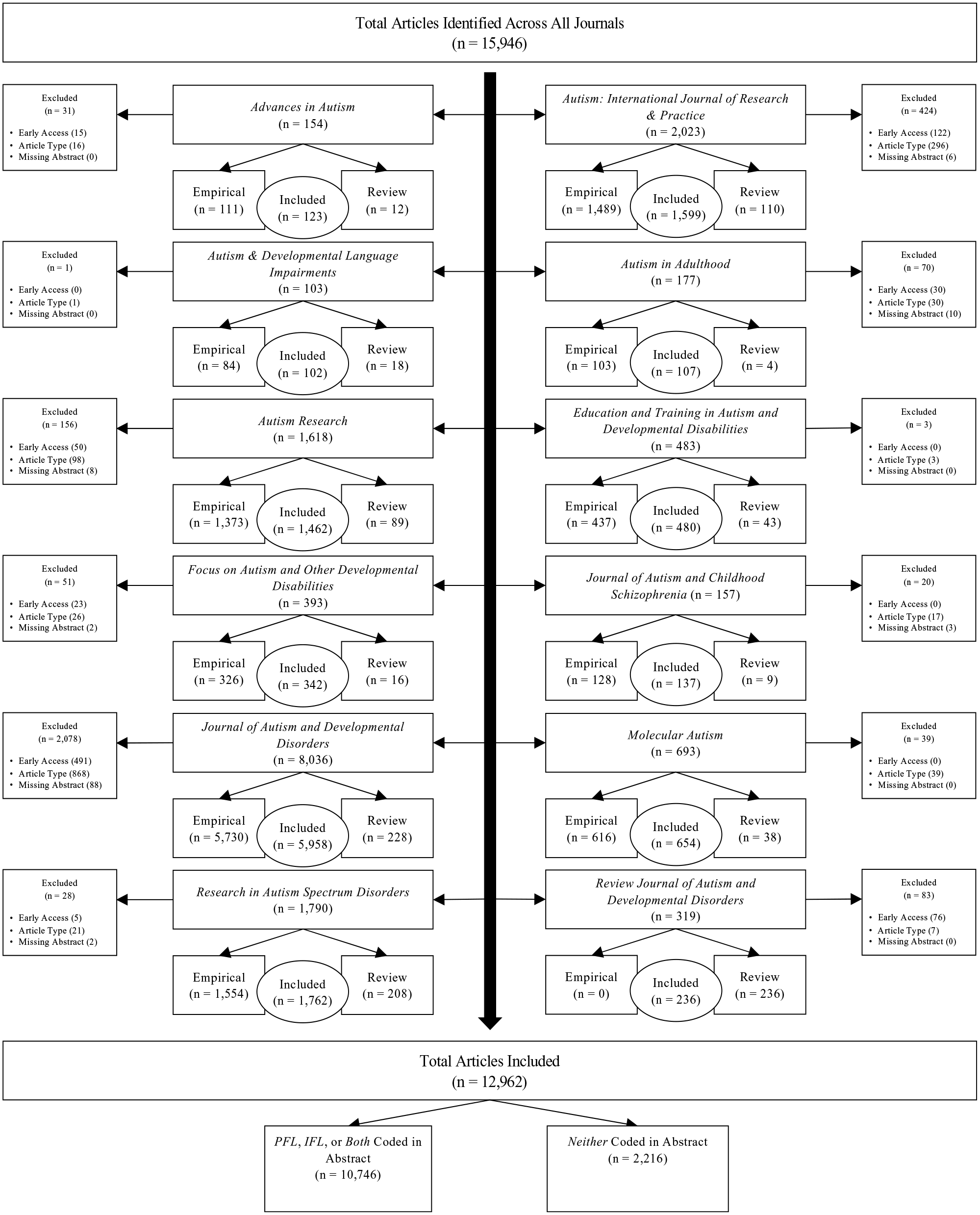
Overview of article search and abstract selection process by journal.
Identification of PFL and IFL terms
We used text string queries within Microsoft Excel to identify instances of PFL and IFL in all included abstracts. PFL search strings included commonly used phrases associated with PFL (e.g. “with autism,” “with Asperger’s syndrome/disorder”) with and without descriptive terms that commonly occurred with participant descriptions over the last few decades (e.g. “with low-functioning” and “with high-functioning”). IFL search strings included “autistic” in addition to common words for individuals taking part in a research study (e.g. participants, children, and students). A list of search terms used is provided in Supplemental Table 2.
Abstracts could fall into one of the four categories. PFL indicated at least one use of PFL and no IFL. IFL indicated at least one use of IFL and no PFL. Both indicated at least one use of IFL and PFL. Neither indicated no use of PFL nor IFL. All abstracts in PFL, IFL, and Both included use of PFL or IFL for only participants described as having autism or Asperger’s syndrome/disorder. Other uses of PFL or IFL to describe individuals from other disability categories (e.g. Fragile X, intellectual disability, PDD-NOS, and Williams syndrome) were coded as Neither. We also coded for the use of “on the [autism/autistic] spectrum” as a separate category, given its recommendation as a more neutral term to be used to describe autistic individuals when language preference is not known (Bottema-Beutel et al., 2021).
Following the first pass of abstract coding, we identified about 20% of the included abstracts were coded as Neither. We conducted a manual review to verify this code that led to an additional 54 IFL and 465 PFL abstracts identified, with an overlap of 46 abstracts. New PFL cases often included phrases like our initial search criteria but with new words added (e.g. “with idiopathic autism,” “with an autism spectrum disorder,” “with an extreme autism syndrome,” “with comorbid anxiety disorders and high functioning autism,” “with autism spectrum condition”). New IFL cases often included reference to the condition using “autism spectrum disorder,” “autism spectrum condition,” “Asperger’s syndrome,” and “Asperger’s disorder” before the noun (e.g. patients, subjects, individuals, and participants) or the inclusion of a specific noun (e.g. “autistic male” and “autistic female”). We then conducted a thorough search of the already coded abstracts using new search strings based on commonly used PFL and IFL phrases that we had found in the Neither abstracts. We recalculated all estimates based on these updated results. This recoding step decreased the number of PFL and Neither abstracts and increased the number of IFL and Both abstracts. The major shift between categories for both coding passes involved some abstracts originally coded as PFL being recoded as Both.
Data analysis
To examine aggregate averages across language categories, we summarized descriptive characteristics for each language category across all available years. We calculated an annual aggregate by averaging within-journal counts across language categories. To account for long-term prevalence and trends across language categories, we examined data across each year of a journal’s publication history. We also examined JACS/JADD as an isolated case given its 51 years’ worth of publication data.
All analyses included PFL, IFL, and Both. We removed abstracts coded as Neither given that journals differed in their rates of Neither coded abstracts. For example, ETADD had just over half of its abstracts coded as Neither (56.67%), followed by other journals like ADLI, MA, and RJADD as having around one-fifth of their abstracts in this category (23.53%, 22.63%, and 21.19%, respectively). Remaining journals ranged between 3.74% (AuIA) and 19.74% (JADD). Abstracts generally fell into Neither because they focused on basic scientific research with minimal reference to participants (e.g. genetic research), included disability groups other than autism and Asperger’s syndrome/disorder, and generally referenced participants without connecting autism to the participant description (e.g. referring to study participants with no reference to a disability group because it was specified elsewhere that the study focused on autism) such as within the context of measurement development and validation. Just over half of abstracts coded as Neither included mention of autism or Asperger’s syndrome/disorder (n = 1,232; 55.60%); other common terms included disabilities (n = 334; 15.07%), developmental disorder or disability (including PDD-NOS and Rett syndrome; n = 322; 14.53%), intellectual disability (including Fragile X; n = 234; 10.56%), schizophrenia (n = 75; 3.38%), and language disorder or impairment (n = 44; 1.99%). Further breakdowns by journal are provided in Supplemental Table 6. We also provide tables and figures for all analyses with Neither included in the Supplemental Material.
Results
Figure 1 provides a breakdown of the abstract selection process by journal. From an initial 15,946 abstracts, we included 12,962 as eligible for the review (80.41%). Just under half of the abstracts were from JADD (45.89%). Three additional journals collectively represented one-third of the reviewed abstracts (RASD, Autism, AR). All remaining journals accounted for fewer than 10% of the sample each (with three each representing less than 1% [AdIA, ADLI, AuIA]). Most of the reviewed abstracts were empirical articles (92.20%) with the remainder being review articles (7.80%).
Overall language use breakdown
Table 1 provides a breakdown of language categories by journal (with 2,216 abstracts removed that were coded as Neither). Given the unequal numbers of included abstracts (based on the publication periods and the publication rates of the included journals), percentages are more useful to compare than raw counts (though both are provided in Table 1). Across all abstracts, a little under two-thirds included PFL (64.68%) with the remaining including either Both (19.50%) or IFL (15.83%).
Descriptive statistics by journal by language category (excluding neither a ).

AdIA = Advances in Autism. ADLI = Autism and Developmental Language Impairments. AuIA = Autism in Adulthood. Autism = Autism: International Journal of Research & Practice. AR = Autism Research. ETADD = Education and Training in Autism and Developmental Disabilities. Focus = Focus on Autism and Other Developmental Disabilities. JACS = Journal of Autism and Childhood Schizophrenia. JADD = Journal of Autism and Developmental Disorders. MA = Molecular Autism. RASD = Research in Autism Spectrum Disorders. RJADD = Review Journal of Autism and Developmental Disorders. PFL = person-first language. IFL = identity-first language. WJ% = within-journal percentage. AJ% = across-journal percentage.
See Supplemental Materials for breakdown of Neither.
Journal-specific language use breakdown
Table 2 displays the raw counts, within-journal percentages, and minimum and maximum percentages for given years for each journal based on the language categories. Presented means can be interpreted as the number (or percentage) of articles within a given year that endorsed a particular language category. Figure 2 provides a visual for examining the average percentages per year across journals while accounting for the minimum and maximum values for the journals across all available years.
Descriptive statistics (raw counts, within-journal percentages, and minimum and maximum percentages) by journal per year (excluding neither).

AdIA = Advances in Autism. ADLI = Autism and Developmental Language Impairments. AuIA = Autism in Adulthood. Autism = Autism: International Journal of Research & Practice. AR = Autism Research. ETADD = Education and Training in Autism and Developmental Disabilities. Focus = Focus on Autism and Other Developmental Disabilities. JACS = Journal of Autism and Childhood Schizophrenia. JADD = Journal of Autism and Developmental Disorders. MA = Molecular Autism. RASD = Research in Autism Spectrum Disorders. RJADD = Review Journal of Autism and Developmental Disorders. PFL = person-first language. IFL = identity-first language. Yr = year. WJ% = within-journal percentage.
Multiple years (2020–2022).
Multiple years (1971–1974 and 1976–1978).
Multiple years (1981 and 1985).
Multiple years (1972–1974 and 1977–1978).
Multiple years (1972–1975 and 1977–1978).
Multiple years (1979 and 1982–1983).

Average-max-min charts: percentage of abstracts per year across journals per language category.
Abstracts greatly varied across language categories for each journal. Journals generally fell into four broad categories for categorizing within-journal percentages of PFL and IFL. The first category included journals with within-journal percentages of PFL in the middle range (25%–75%) and IFL in the low range (5%–35%). This included AdIA (56.56%, 22.33%), Autism (65.77%, 13.96%), ADLI (59.12%, 19.08%), AR (52.65%, 10.97%), MA (44.81%, 35.30%), and RASD (70.44%, 8.76%). The second category included journals with within-journal percentages of PFL in the very high range (>80%) and IFL in the very low range (<10%). This included ETADD (93.93%, 2.12%), Focus (95.44%, 1.72%), and RJADD (85.39%, 6.39%). The third category included journals with within-journal percentages of PFL in the extremely low range (< 5%) and IFL in the very high range (> 80%). This included AuIA (1.85%, 84.54%) and JACS (1.79%, 94.51%). The fourth category included JADD as an outlier from the rest. While its average values for PFL and IFL would place it into the first category (49.94%, 35.30%), it demonstrated a substantially larger standard deviation for both PFL and IFL compared to the rest of the first category journals and included observed estimates that spanned from 0% to 84% and 2.78% to 95.83% (for PFL and IFL, respectively; Table 2). All journals showed generally low averages (<40%) for Both with some noted variability. Some journals demonstrated very low overall averages (<10%; ETADD, Focus, JACS, and RJADD). Other journals demonstrated slightly higher but still generally low averages (<25%; AdIA, Autism, ADLI, AuIA, JADD, and RASD). Only two journals—MA and AR—demonstrated average use above 30% (32.80% and 36.39%, respectively).
Longitudinal trends in language use across journals
Figure 3 presents the percentage of abstracts across the coded language categories per year between 2001 and 2022 (when available). Each journal is described in more detail below.
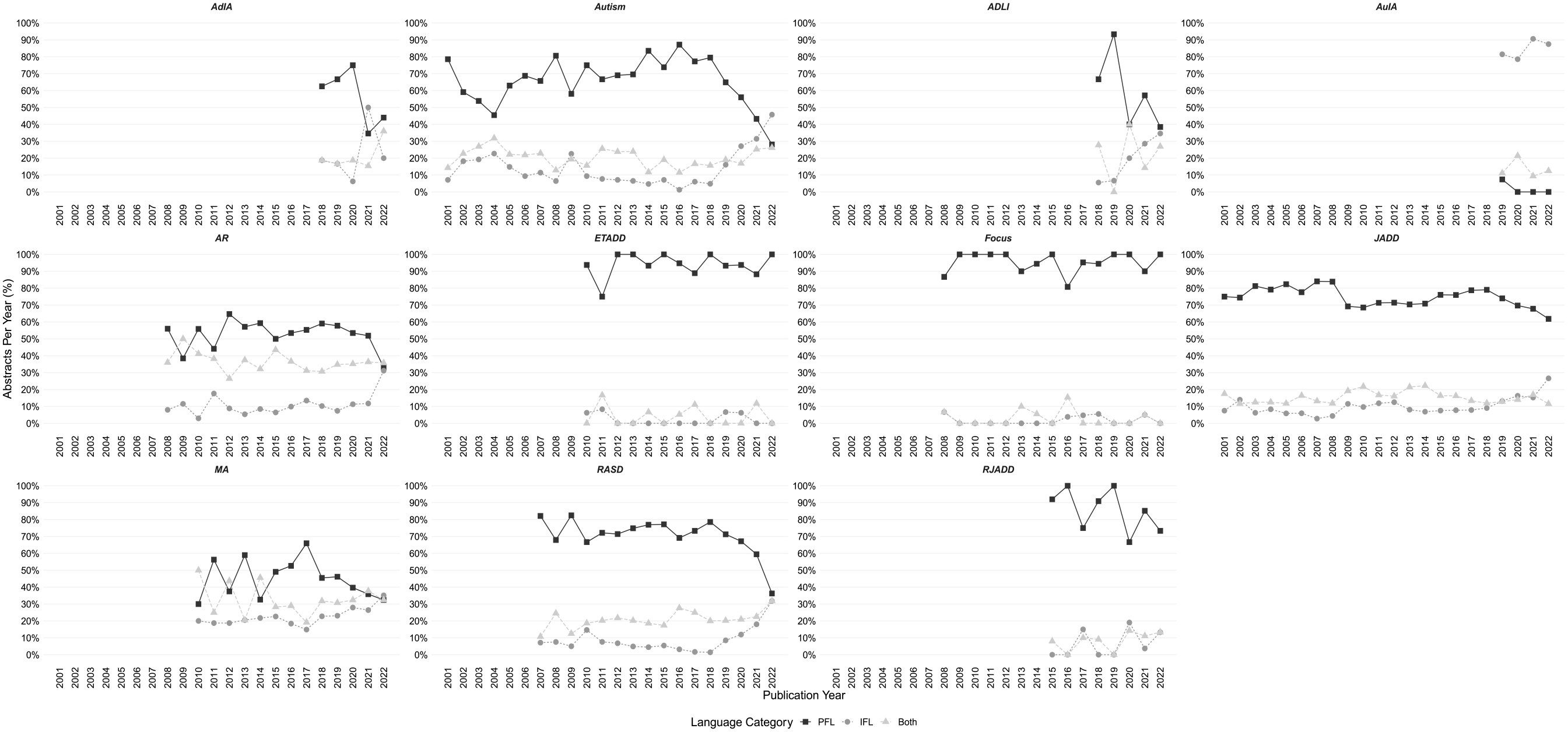
Language categories by year in abstracts across journals.
AdIA is characterized by an elevated PFL category that sharply decreases in 2021 (with a simultaneous increase in IFL for that year). However, there seemed to be an increase in PFL and a decrease in IFL in 2022.
Autism is characterized by a long-standing PFL trend generally above 50%, with all other categories generally below 30%. This appears to change, however, in 2019, where a decreasing PFL trend is observed with an increase in IFL and Both. In 2022, IFL represented a higher percentage of abstracts relative to all other categories.
ADLI is characterized by an initial sharp increase followed by a sharp decrease in PFL. IFL steadily increased over multiple years from 2018 through 2022. Both followed an inverse pattern of PFL.
AuIA is characterized by elevated IFL and limited PFL and Both. IFL increased between 2020 and 2021, with a simultaneous decrease in PFL.
AR is characterized by elevated PFL and Both across most years. PFL remained the highest category for all years except for 2009 (where Both was highest). In 2022, IFL experienced a sharp increase to overlap PFL and Both (with all around 30% each), which resulted in the collapsing of generally non-overlapping categories.
ETADD is characterized by elevated levels of PFL for all years (with the largest decrease occurring in 2011, though this was followed by a similar increase). IFL and Both remain very low at less than 10% each for most years (with only 1 year where Both reaches almost 20%). All categories (though especially IFL and Both) show limited fluctuation over the years.
Focus is characterized by elevated levels of PFL that remains consistently above 80%. IFL and Both remain very low at less than 10% each over the years (except for 1 year where Both grew to 15%).
JADD is characterized by general stability in a PFL majority across all years. Starting in 2001, PFL fluctuated between 60% and 90% while all other categories generally remained at or below 20%. However, beginning after 2018, PFL demonstrated a gradual yearly decrease, with a coinciding gradual increase in predominantly IFL. In 2022, there was a sharp decrease in Both with a simultaneous increase in IFL.
MA is not well characterized by any single category. While PFL demonstrated a small majority, Both was similar to PFL for most years between 2010 and 2014. PFL demonstrated an increase beginning in 2015 that occurred until 2019; during this time, Both appeared slightly higher than IFL. However, from 2019 through 2022, these category differences decreased, and all categories converged in 2022 to be approximately equal around 30% each.
RASD is characterized by a long-standing majority in PFL with a sharp decline in recent years. From 2007 until 2018, PFL appeared much higher than all other categories (with estimates generally above 60% for PFL and below 25% for other categories). However, from 2019 to 2021, PFL decreased (from 70% to 60%) with a gradual increase in Both and a steep increase in IFL. In 2022, PFL dropped 30% to be approximately tied with IFL and Both.
Finally, RJADD is characterized by elevated PFL and low, consistent percentages for IFL and Both. A staggered increase and decrease pattern shows a slow decrease in PFL over the recent years, though this is not as noticeable as what was observed in other journals.
Figure 4 highlights the overall trends across journals by displaying an aggregate overall average (calculated across included journals for each year) based on all representative data for a given year. For PFL, we observe a decreasing trend through the early 2000s before averages become relatively stable and fluctuate around 70%–80% for most of the first two decades. A notable shift occurs starting in 2019 where a consistent trend downward occurs going from 70% down to 50%. For IFL, we see the opposite effect: general stability and a low plateau from 2001 until 2018 with an increase occurring in 2019 that increases the average from 10% to 30%. For Both, we see a generally stable plateau from the late 2000s through 2022 that stays around 20%.

Overall averages for language categories in abstracts across journals by year.
JACS and JADD: examining language trends over five decades
Figure 5 highlights JACS and JADD longitudinal trends from 1971 to 2022. As the above results discuss JADD from 2001 through 2022, our focus here falls on the period from 1971 to 2000. The 1970s through the 1980s were characterized predominantly by IFL with very little use of either PFL or Both. The early 1990s saw a sharp decrease in the use of IFL in favor of PFL, with the 1990s characterized by similar usage of all three categories. A clear trend emerged in the early 2000s that endorsed PFL over IFL and Both.
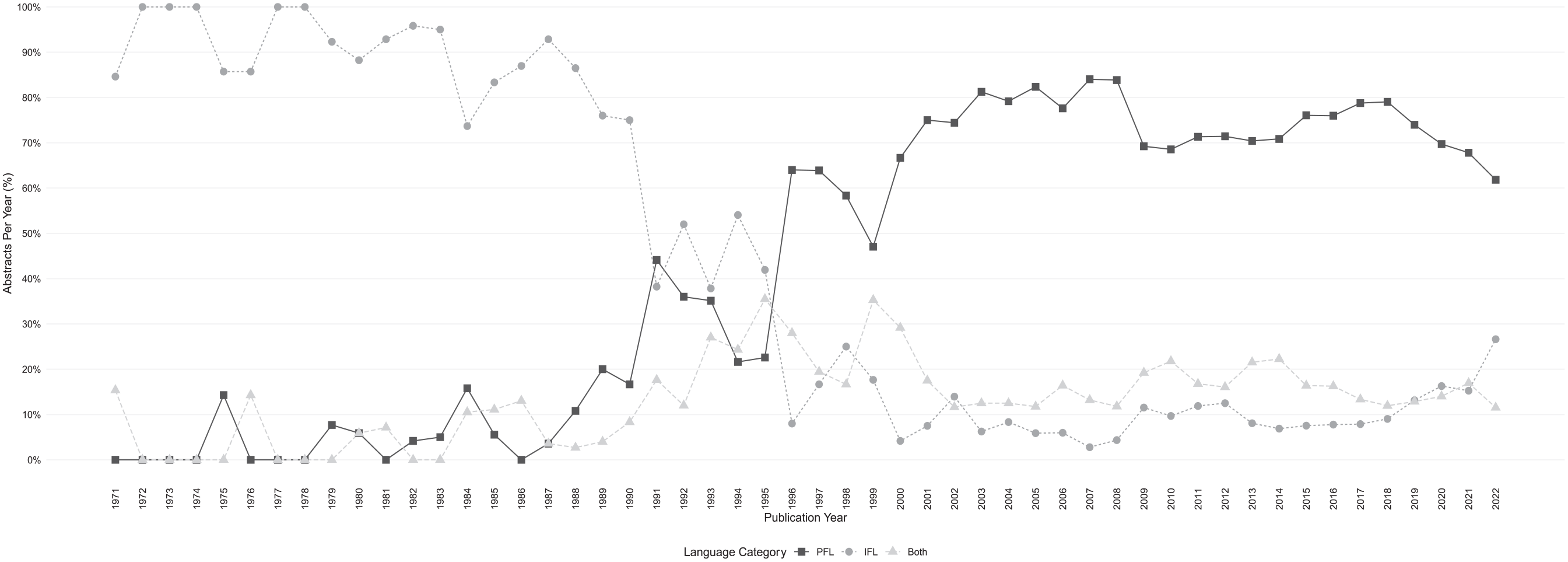
Language categories by year in abstracts for Journal of Autism and Childhood Schizophrenia (1971–1978) and Journal of Autism and Developmental Disorders (1979–2022).
“On the [autism/autistic] spectrum” occurrences
Approximately 2.22% of abstracts (n = 288) used the language “on the [autism/autistic] spectrum.” This includes 79 abstracts coded as Neither (as some abstracts could use this phrasing without other PFL or IFL usage). For most journals, the percentage of abstracts using this language was generally < 4% of included abstracts: Autism (n = 57; 3.56%), RJADD (n = 6; 2.54%), RASD (n = 44; 2.50%), AR (n = 35; 2.39%), JADD (n = 103; 1.73%), MA (n = 9; 1.38%), Focus (n = 4; 1.17%), and ETADD (n = 1; 0.21%). The phrasing did not appear in JACS abstracts. Three journals appeared as outliers with elevated use (compared to most journals): ADLI (n = 7; 6.86%), AdIA (n = 10; 8.13%), and AuIA (n = 12; 11.21%). Given that “on the [autism/autistic] spectrum” could be considered a form of PFL, we conducted a subsequent analysis that included this phrase as part of PFL. Differences appeared generally minimal overall with some small percentage-point changes (most between 0% and 3% with the maximum being a 6% difference) across journals (see Supplemental Table 7).
Discussion
This study characterizes the language used in scholarly writing to refer to autistic participants by analyzing the abstracts of 11 emerging and established autism research journals. Recent studies of stakeholders have highlighted different preferences exist among various stakeholder groups, generally finding that autistic stakeholders commonly endorse IFL while professional stakeholders commonly endorse PFL (Buijsman et al., 2023; Bury et al., 2023; Keating et al., 2023; Kenny et al., 2016; Taboas et al., 2023). Our approach examining the scholarly literature finds heterogeneity across journals with a trend toward an increase of IFL after years of stable trends showing preference for PFL. However, this trend is not observed in all journals, and outliers exist that go against this general trend.
Although all included journals focus on autism research, we find distinct journal differences in the aggregate breakdown and longitudinal trends of language usage. Most journals fall into a general “middle” category characterized by the following: (a) a wide min-max range for PFL (generally 30%–90%) with an average percentage between 40% and 70%, (b) a narrow min-max range for IFL (both values lower than 30%) with an average generally below 20%, and (c) a narrow min-max range for Both (both values lower than 40%) with an average below 30%. This characterizes approximately half of the included journals (AdIA, Autism, JADD, RASD, and RJADD). The remaining journals are distinct in at least one category. Four journals showed extremes for PFL in opposite directions, with AuIA and JACS being low and Focus and ETADD being high. Unsurprisingly, those four journals show extremes for IFL in opposite directions, with AuIA and JACS being high and Focus and ETADD being low. AR and MA show a slight deviation from the rest in terms of having higher estimates of Both.
Examining longitudinal trends shows that journals typically fell into a few distinct categories. First, the most prevalent pattern showcases a PFL majority in the earliest years with a more recent (<5 years) increasing IFL trend and decreasing PFL trend. Journals in this group include AdIA, Autism, ADLI, JADD, and RASD. Journals like Autism, JADD (with JACS), and RASD demonstrate the most observable pattern given the number of publication years available. AdIA and ADLI follow this pattern in a more compressed format given the fewer number of years available. Second, a small subset of journals shows a high prevalence of PFL and Both before demonstrating a more recent trend to IFL. Journals in this group include AR and MA. AR shows a long-standing PFL majority trend with Both sometimes surpassing PFL (i.e. 2009) or being approximately tied (i.e. 2011, 2015). Unlike the other category, the shift to IFL only occurs within the last year (2022), which highlights a sharp increase in IFL rather than a gradual increase (as observed in the first group). MA demonstrates a very similar longitudinal profile with PFL and Both often being the most prevalent category or being approximately equal (i.e. 2010–2015). We then observe a more gradual increase and eventual decrease of PFL before all three language categories become approximately equal in the final year of available data. Third, a small subset of journals fall at either of the two extreme ends of PFL and IFL across most years with little evidence for change. Journals in this group include AuIA for IFL and ETADD, Focus, and RJADD for PFL. Based on only 4 years of data, AuIA demonstrates a clear trend of using IFL with limited prevalence of either PFL or Both. The trend for the three journals endorsing PFL is a bit different, however. Two of the three journals have at least a decade worth of publication data (ETADD = 13 years, Focus = 15 years, RJADD = 8 years) with a clear trend of using PFL with limited prevalence of IFL or Both.
This small subset highlights some important trends not observed in other journals. The high prevalence of IFL in AuIA appears aligned to the journal’s policies surrounding language use, as the journal explicitly calls attention to its language policies and the debate surrounding PFL and IFL (AuIA, 2023). At the time of writing (December 2023), the journal explicitly recommends IFL or more neutral terms such as “person on the autism spectrum.” This supports our additional finding of AuIA also having the largest within-journal percentage of abstracts referencing participants using “on the [autism/autistic] spectrum.” In contrast, we found ETADD, Focus, and RJADD to publish predominantly articles with PFL. We examined the current author guidelines (as of writing) for each of these journals to see if we might learn more about why this might be the case. For Focus, the journal specifies that authors should follow guidelines from the APA Manual (2020) while also stating, “Authors are encouraged to write in a manner . . . to communicate that an individual with a disability is a person first” (Focus, 2022). For ETADD, the journal specifies to follow the APA Manual (2020) while also stating that authors should “please describe subjects (or any other references to persons with disabilities) with a people first orientation” (Division on Autism and Developmental Disabilities, n.d.). For RJADD, we did not find any specifics on the journal submission webpage regarding language use nor reference to a preferred stylistic guide for authors other than journal-specific guidelines (RJADD, n.d.). In each of these cases, the journal either provided explicit or minimal guidance regarding the use of language. (See Supplemental Table 1 for more information about publishing guidelines about language for all journals.) Our findings emphasize the important role that journal submission guidelines have on shaping the language used in submitted manuscripts. For example, inconsistent information such as requiring PFL while also requesting authors to abide by APA Manual recommendations may force authors to solely use PFL (as following such recommendations to use either PFL or IFL would be a contradiction and not be doable). For journals that do not provide guidance at all, a more explicit approach to providing authors with guidance about why language choices matter when writing about autistic participants is warranted (which might at minimum reference formal style manuals or provide relevant citations, such as provided by JADD, AR, and Autism). Expectation setting by journals is especially important given findings from Botha and Cage (2022) regarding the gap between how their participants described their personal preferences for language vs the language participants used in their research. While many of their participants personally preferred IFL, they used PFL in their research writing. Our findings show that the use of IFL in scientific writing does appear to be increasing across most journals in recent years, highlighting a substantial shift in expectations around solely using PFL in research writing (but this is potentially occurring because journals are providing authors with the opportunity to do so; Supplemental Table 1).
In circulation since the early 1970s, JADD abstracts show how language use has changed over the last five decades. The next few paragraphs present four distinct time periods apparent in JADD from 1971 through 2022, and we briefly contextualize each with reference to notable findings and important events during that period related to autistic culture and advocacy.
The first period begins during the initial years as JASC where the journal used predominantly IFL. During this time, the journal appears indistinguishable from AuIA. However, the intentionality behind this use was different, given that IFL appears to have been used primarily in a pathologizing way (see Dwyer et al., 2022). During this period in the late 1980s, the autistic rights movement was just beginning to take shape in the form of early advocacy by Jim Sinclair (Solomon, 2008).
The second period is defined by a major shift that occurred in the early 1990s and extended until 2000 where similar amounts of abstracts used IFL, PFL, or both forms simultaneously. This coincides with the timing around earlier-mentioned policy changes put forth by the APA Manual and by the “People First” movement (Crocker & Smith, 2019), though wide sweeping adoption of these policies did not appear to be systematic (at least for JADD). The 1990s also saw major strides in the autistic rights movement, including the founding of the Autism Network International and the publishing of “Don’t Mourn for Us” (Sinclair, 1993) that adopted an anti-cure perspective toward autism. These efforts and others led to an increasing recognition of autistic culture across the globe (Dekker, 1999). The language used to talk about autism is also of interest to early autistic advocates, as Dekker (1999) writes in the following: This author also does not subscribe to the concept of person-first language as it pertains to autistic people, because most autistic adults report that the condition affects their entire being, and therefore they would be someone completely different if they were not autistic (pp. 2–3)
Near the end of the 20th century, the term neurodiversity was introduced (Blume, 1998; Singer, 1998) to understand and celebrate neurological pluralism (i.e. diverse minds and brains exist).
The third period began during the early 2000s with a very sharp increase and more consistent adoption of PFL as well as little use of IFL. This increase coincided with the revisions for the 5th edition of the APA Manual promoting non-handicapping language (APA, 2001). The 2000s saw an increasing rise in autistic self-advocacy. The Autistic Self Advocacy Network (ASAN) was established in 2006 a non-profit organization focused on advancing the principles of the disability rights movement with regards to autistic individuals (ASAN, n.d.). Within the next few years, the ASAN would play a critical role in advocating against institutions that would aim to dehumanize and demean autistic individuals (Solomon, 2008). This period fostered more opportunities for autistic advocates, community leaders, and scholars to come together to have part in the conceptualization of autism and the policies that shape autistic individuals (Fletcher-Watson & Happé, 2019). Given its roots in the disability advocacy movement, it is not surprising to see the preference for IFL emerge among autistic advocates in contrast to the use of PFL among professionals (see Dunn and Andrews [2015] for further discussion about disability language use in general and Dwyer et al. [2022] for more about autism specifically). Important to autism and language in this context is the increasing scientific lens taken to the language different stakeholders use to talk about autistic individuals (e.g. Kenny et al., 2016).
The fourth period begins around 2019 and is marked by a steady, gradual decrease in the use of PFL with an increase in the use of IFL. This was most notable in the last year of the reviewed years where IFL usage increased by over 10% relative to the prior year (Figure 5). This final period also coincides with the widespread adoption of the 7th edition of the APA Manual that no longer advocated for the use of only PFL (APA, 2020). Importantly, this final period highlights that both authors and journals (at least JADD in this case but others as well as evidenced by Figure 3) are attending to the increasing awareness about language choice distinctions. At the time of writing, JADD also provides a short document for authors that calls attention to suggestions for inclusive language (JADD, n.d.). (AuIA, Autism, and RASD provide similar information; Supplemental Table 1.) But furthermore, this could also be due to the increasing awareness and space for formally understanding these issues as part of autism research. During this period, there has been increasing scientific awareness to the issue of language and autism among stakeholders (e.g. Buijsman et al., 2023; Bury et al., 2023; Geelhand et al., 2023; Keating et al., 2023; Monk et al., 2022) and the need to understand how autistic advocacy impacts scientific research involving autistic individuals (Botha & Cage, 2022; Pellicano & den Houting, 2022). Altogether, JADD highlights how variable the long-term trends are regarding language use in autism research publications and showcases the effects of potential external forces (e.g. social movements and publication policies) in both the rise of PFL as well as the current adoption of IFL to describe autistic participants in article abstracts.
Our findings highlight a shift in the language autism researchers use to write about autistic participants, particularly within the last few years. If we had conducted this review even five years earlier, our findings would have shown clear PFL dominance. There are many potential reasons for this trend to have emerged just within the last few years within the broader writing community of autism researchers. One is the change in the APA Manual guidelines from PFL only to endorsing both PFL and IFL (APA, 2010, 2020). Journals commonly cite these guidelines and others for authors to follow when preparing manuscripts for submission (see Supplemental Table 1). Furthermore, the increasing awareness of the neurodiversity movement and the impact of autistic voices in autism research has led to increased awareness for both researchers as well as practitioners about how language impacts autistic individuals (e.g. Botha & Cage, 2022; Brown, 2023; Dwyer et al., 2022; Monk et al., 2022).
Limitations and future research directions
When considering these takeaways, it is important to acknowledge a few limitations. First, many authors used more obscure phrases to describe their autistic participants (often to further characterize a sample). This made coding manuscripts initially challenging, given the large number of phrases that authors used. While we believe that we have accounted for most phrases, it is possible that obscure labels referring to autistic individuals were not identified. Second, our focus on abstracts allowed us to efficiently consider all potential articles across the journals, but in the full text of articles, authors may vary their terminology, which could lead to an increase in Both. However, given that abstracts present a unique genre where authors must be efficient in their wording to describe a study, and given that many readers only have time to read abstracts, they are of interest in their own right. Third, we focused on 11 journals that explicitly publish autism research. Many other journals exist in subfields outside of these journals. For example, searching the Web of Science using only the search terms “autis* OR asperger’s” returns 64,374 articles (after limiting search results to just empirical and review articles) in 200 journals. While our journals are highly ranked (in terms of quantity of published articles) in this list—five are within the top 10, five are within the top 60, and one falls just beyond the top 100—we are not characterizing the entirety of research on autistic individuals. Further research using our approaches with journals that frequently publish research related to autism is needed. Fourth, we examined academic journals that publish in English. As highlighted earlier, the structure of language differs in English and similar Germanic languages when compared to languages like French (see Geelhand et al., 2023). Additional research examining academic writing in journals that publish in languages other than English is needed to understand broader cross-linguistic trends.
Conclusion
Our findings demonstrate that autism researchers have begun to shift how they write about autistic individuals in recent years from a predominant use of PFL to an increasing use of IFL. The language used in scientific research communities changes due to many different influential factors. Within the last century, the conceptualization of autism, the priorities of autism research, and the needs of autistic individuals have changed quite frequently (Fletcher-Watson & Happé, 2019). With recent calls for the autism research community to prioritize neurodiversity perspectives and increase autistic individual involvement in research (Botha & Cage, 2022; Pellicano & den Houting, 2022), researchers must continually consider the intentionality and the audiences impacted by their research. This is particularly important for the language researchers use given that language impacts how findings are conveyed (e.g. Botha et al., 2023; Vivanti, 2020) and that there is no one single way to refer to autistic individuals (Botha et al., 2023; Keating et al., 2023). Researchers should reflect on their own language practices and consider the intentionality of their choices when writing about autistic individuals. Reviewing current recommendations (and rationales) from style guides (e.g. APA, 2020) and ongoing conversations about why language matters when talking and writing about disability (e.g. Botha et al., 2023; Dunn & Andrews, 2015; Keating et al., 2023; Vivanti, 2020) is a great place to start. Journal editors and editorial boards should review their current recommendations (or lack thereof) about intentional language use when writing about autistic individuals (especially as our review highlighted large variability in author guidance and recommendations). Increasing the intentional use of language by autism researchers contributes directly to ongoing efforts to improve the quality of the autism research community.
Supplemental Material
sj-docx-1-aut-10.1177_13623613241241202 – Supplemental material for Person- and identity-first language in autism research: A systematic analysis of abstracts from 11 autism journals
Supplemental material, sj-docx-1-aut-10.1177_13623613241241202 for Person- and identity-first language in autism research: A systematic analysis of abstracts from 11 autism journals by Matthew Carl Zajic and Juliette Gudknecht in Autism
Footnotes
Declaration of conflicting interests
The author(s) declared no potential conflicts of interest with respect to the research, authorship, and/or publication of this article.
Funding
The author(s) received no financial support for the research, authorship, and/or publication of this article.

Supplemental material
Supplemental material for this article is available online.
References
Supplementary Material
Please find the following supplemental material available below.
For Open Access articles published under a Creative Commons License, all supplemental material carries the same license as the article it is associated with.
For non-Open Access articles published, all supplemental material carries a non-exclusive license, and permission requests for re-use of supplemental material or any part of supplemental material shall be sent directly to the copyright owner as specified in the copyright notice associated with the article.
