




Abstract
In a global era of increased securitization of migration between the developed and developing world this article undertakes a gendered analysis of the ways women die irregularly crossing borders. Through an examination of datasets in Europe, the USA and Australia it finds women are more likely to die crossing borders at the harsh physical frontiers of nation-states rather than at increasingly policed ‘internal border’ sites. The reasons why women are dying are not clearly discernible from the data, yet based on the extant literature it is reasonable to conclude that gendered social practices within families, and within countries of origin and transit, as well as the practices of smuggling markets, are key contributing factors.
Introduction
The impact of increased border control on the deaths of irregular migrants is the focus of a growing body of multidisciplinary scholarship (Athwal and Bourne, 2007; Cornelius, 2001, 2005; Eschbach et al., 1999; Michalowski, 2007; Nevins, 2003; Spijkerboer, 2007). The fatalities of irregular border crossers raise serious questions concerning state obligations, at least in relation to the foreseeability of these deaths, if not also in connection to state culpability in and the legality of border control efforts that directly or indirectly result in deaths. The key concern of this nascent field is the human cost of border control measures aimed at sealing borders to irregular migrants in Australia, Europe and North America (Weber and Pickering, 2011). However, to date, relatively little attention has been paid to the gendered dimension of this human cost.
This article first examines the changing character of the border and the importance of including a range of border sites in our analysis of border-related deaths and considers the available literature on women and irregular border crossing, before turning to an analysis of the gendered aspects of border-related death in Australia, Europe and along the United States–Mexico border. It specifically examines where, how and why women die during irregular border crossing. Women are more likely to die crossing borders at the harsh physical frontiers of nation-states than at ‘internal border’ sites, such as immigration detention centres. This finding suggests that we need to pay greater attention to this issue as the existing, admittedly fragmentary, data indicate that the number of women irregularly crossing borders is increasing. The reasons why women are dying are not clearly discernible from the data, yet based on the extant literature it is reasonable to conclude that in addition to the role of state sponsored border control, gendered social practices within families, and within countries of origin and transit, as well as the practices of smuggling markets, are key contributing factors. The data analysed in this article concludes that women as a group face a higher risk of death at the physical frontier than at internal border sites during illegalized travel.
The border
The securitization of borders between the Global North and the Global South has fundamentally transformed the nature of the border internationally (Donnan and Wilson, 2010; Pickering and Weber, 2006; Vila, 2003; Wilson and Donnan, 1998). Borders are now widely regarded by theoreticians and practitioners alike as dynamic and fluid constructions, the enforcement of which works in symbiotic relationship with the very operations that attempt to subvert them (Andreas, 2000). Borders are increasingly selective and diversified, operating at a range of internal and external locales (Aas, 2007, 2011; Weber, 2006). Borders have become the site for the securitization of migration, even if the border has been effectively policed across time and space in ways previously unimagined (Bigo, 2005). Concerns around securing borders have relied on the production of a security threat without recourse to evidence (Bigo, 2005) and the processes by which they are secured have become effectively self-referential (Guild, 2009).
Bigo (2005: 52) uses the terminology of ‘frontiers’, defining borders not as a line of outside and inside but as a ‘Mobius ribbon where the perception of what is inside and what is outside varies depending on the position of the observer’. Bauman (2004) concludes that these frontiers operate in highly gendered, racialized and classed ways. The data presented in this article indicate that it is at the frontiers that the deaths of women are heavily clustered. ‘Frontiers’ in this sense acknowledges Bigo’s observations around the fluidity of what occurs at the political and legal edges of nation states but it is also used in a more geographic sense—the physical edges that are patrolled between the Global North and the Global South—the global lines of exclusion Green and Grewcock (2002) identified. So while a range of border sites, both internal and external to the nation-state, are conceptually important, the data analysed in this study reveal that we need to retain a focus on the physical territorial border to understand the patterns that define where, how and why women die crossing borders. Borders have been the focus of significant symbolic deterrent and material enforcement effort: in the European Union (EU), the USA and Australia the border is seen as the key site at which to repel unwanted migrants through various kinds of civil and military enforcement. Borders have also been the subject of significant political rhetoric advocating border protection as a key mechanism for changing patterns of irregular migration (Pickering, 2004). Moreover, governments have promoted border protection as a means of decreasing the number of deaths that occur at or near their borders, ironically often by enhancing the risk of death posed by crossing them. Such was the case under Operation Gatekeeper in the USA, when former President Bill Clinton sought to harness the harsh landscape to ‘funnel’ migrants into the most dangerous crossing routes in an attempt to dissuade them from crossing at all (Nevins, 2003).
For those deemed undesirable, borders remain a site for classification and exclusion that foreseeably results in harm, including death (Weber and Pickering, 2011). So at the very moment that borders become animated, enlivened through the way they are secured, arguably one of their defining features comes to the fore: the clustering of death around their irregular crossing. While borders are effectively disappearing for some people (and commercial goods)—indeed, often privileged travellers from the Global North are unaware that they have even crossed a border—for others, the risk of death clearly traces the firmly fixed reality of borders (Carling, 2007; Cornelius, 2001; Nevins, 2008; Wonders, 2006).
The understanding, definition and analysis of border deaths adopted in this article are informed by the concept of ‘functionally mobile borders’ (Weber, 2006), through which the late modern state expresses its sovereign and disciplinary power, both within and beyond its territorial limits. Moreover, border control is understood to comprise highly selective and complex performances of state power staged at multiple locations through technologies of selection, detention, deterrence, expulsion and pre-emption, involving a range of state and non-state actors. Border control is easily identified at militarized borders, such as the US–Mexico border and the eastern perimeter of the EU, but also exists at more bureaucratically controlled borders that are defended by means of electronic information and surveillance technologies (Aas, 2011). Although militarized borders and borderlands are most readily identifiable as zones of conflict, or at least zones of exclusion, Weber and Pickering (2011) have argued that the less visible controls that operate in the ‘informated spaces’ of embassies, detention centres, airports and other transit points are equally identifiable as processes that result in border-related deaths.
Individual borders have their own specific histories, with border control policies shaped by both local and global factors. At some locations, such as the US–Mexico border, these sites of dispersed and disputed border authority are captured in the idea of ‘borderlands’ (Donnan and Wilson, 1999). Borders are increasingly controlled through pre-emptive, non-arrival or remote control policies. In these contexts, sovereign power is usually expressed offshore, through processes of immobilization and interdiction that may at best sit uncomfortably with international legal obligations and at worst be direct attempts to subvert those obligations (Grewcock, 2009). These practices collectively transform the concept of the border and borderland as geographically fixed or cartographic line into the more geographically dispersed ‘transnational frontierlands’.
Following from these conceptualizations of the border, this study uses the definition of a border-related death deployed by Weber and Pickering (2011). This interpretation sees border-related deaths occurring at any of the functionally defined ‘border sites’: at the physical border (frontier); en route; in offshore or onshore detention; during deportation; on forced return to homeland; and even within the community as a result of hate crime, labour exploitation, withholding of subsistence, or the promotion of conditions of legal and social precariousness. This inclusionary account of border sites is necessary to address the key concern of this article, which is to understand better where and how women die during irregular border crossing.
Counting border-related deaths
The ‘apparent facticity’ of numbers can be seen to render governance both possible and judgeable (Rose, 1999), and to enable investigation into an issue previously overlooked. An alternative interpretation is that numbers can silence debate. It is understood that both what is selected to be measured and how it is measured are inherently political acts, as is the manner in which it is presented and interpreted.
Non-government organizations (NGOs) have become increasingly concerned with counting border-related deaths in their advocacy for migrant rights and their desire to reduce border-related harms (Fekete, 2003). To this extent, the counting of border-related deaths has promoted the need for both local and international action aimed at reducing the incidence of death (Amnesty International (AI), 2010; Coalición de Derechos Humanos, 2010; Fekete, 2003; Rubio-Goldsmith et al., 2007), as well as being important antidote to partial government counts of border-related deaths or the absence of publicly available official data on such deaths.
A range of methodologies have been used by government and non-government agencies to count the deaths of illegalized border crossers. Some counts depend on bodies found (see Anderson and Parks, 2008); some on reports of departures that have no corresponding arrival information (Coalición de Derechos Humanos, 2010; UNITED, 2011); some on bodies found and the conclusions reached about the cause of death by medical examiners (Sapkota et al., 2006), and whether or not such causes may reasonably be attributed to border enforcement (Spijkerboer, 2007); while others use complicated estimates of apprehensions, entries and the extrapolated estimates of border-related deaths (Carling, 2007; Cornelius, 2001). The counting of bodies is important because the border is considered, in one way or another, to contribute to those deaths. Yet the reasons why and how the death is attributable to the border are keenly disputed for both epistemological and political reasons. There is an implicit assumption in most scholarly studies that the numbers and basic details of such deaths will allow responsibility to be correctly attributed to the State, the migrant or the smuggler (Fekete, 2003). The data considered in this article are insufficient to assign individual responsibility for deaths. However its findings in relation to the physical border directly implicates border control policies fortifying the physical border that increasingly necessitate irregular border crossings. It is clear that as borders fortify the deaths of irregular migrants increase. In centrally locating the State and super state interests as the driver for this harm it does not negate the agency of individuals or the role of facilitators.
Commentators have pointed out that this vital function of counting the dead is inevitably affected by biases in both directions: on the one hand, by the increased attention given to border deaths by NGOs, which may have contributed to what they call the ‘explosion of the figures’; and on the other, by the significant number of fatalities that remain undetected, which range in estimates from three to 10 times the number of bodies recovered (Blanchard et al., 2008). This is particularly the case in the maritime environment where undercounting is regarded as especially acute.
In Europe, the NGO UNITED Against Racism and Fascism publishes an online ‘List of deaths’ that arise from border controls, which is regularly updated and openly available on its website. 1 The organization adopts an expansive view of border control that aligns closely with the notion of the ‘functional border’ noted earlier. Drowning and other causes of loss of life at sea dominate the list. However, deaths arising from the internal border are also included, such as suicide in detention, loss of life through lack of access to medical care, suffocation during clandestine crossing of land borders, death arising from dangerous work conditions directly associated with one’s illegal status and violent death during deportation or in other circumstances involving border control officials. It is acknowledged that no death count across these disparate contexts can ever hope to be complete.
As of 20 January 2011, the death count on the UNITED list stood at 14,037—the total since the collection began in 1993. In Australia, only one source of information on border-related deaths was available until recently. These data have been collected by a group of concerned individuals, who came together largely in response to the single greatest tragedy in the recent history of Australian border control: the sinking of the SIEV X 2 on 19 October 2001 in offshore Australian waters. It is believed that 146 children, 142 women and 65 men died that day, although many bodies have never been recovered. In the absence of any official recognition of these deaths, this group undertook to support the survivors and relatives of those who died, and protest the lack of an official response to the tragedy by establishing an online record of the names, nationalities, genders and ages of all known passengers, whether survivors or victims, and testimonies from the survivors. Weber and Pickering (2011) have since published a count of border-related deaths that occurred in Australia between 2000 and 2011, collected from a range of official, media and NGO sources, which records 673 deaths between December 2000 and March 2011.
In the USA, official Border Patrol (the US government agency with primary responsibility for the patrol and enforcement of the US–Mexico border) statistics record a total of 4375 deaths along the US–Mexico border from 1998 to 2009 (Anderson, 2010). The annual figures reflect a general upward trend from 263 in 1998 to 417 in 2009—a death toll of more than one person each day. A ‘unique and scientifically rigorous study’ by the Binational Migration Institute (BMI) 3 of all deaths of illegalized border crossers in Pima County, Arizona, sought to produce a ‘fine grained portrayal’ of such deaths by studying autopsy reports in Pima County (Rubio-Goldsmith et al., 2007). Noting the serious undercounting of deaths by the US Border Patrol, and the fact that possibly two-thirds of the deaths in Arizona are detected on the tribal lands of the Tohono O’odham nation which lie outside the designated Border Safety Initiative (BSI) zone in which the Border Patrol collects its statistics on border deaths, the BMI concludes that the ‘actual number of migrant deaths is, at present, unknowable’ (Rubio-Goldsmith et al., 2007: 4). Disparities in the numbers of deaths recorded have been linked primarily to the variability and reliability of sources utilized. Media outlets, such as the Arizona Daily Star, have often focused on recording the local costs of border control and migration for local communities, and responding to the fear generated by border deaths. 4 In the period from 2001 to 2011, the Arizona Star recorded 1990 deaths along the Arizona–Mexico border for arguably the most dangerous segment of the US–Mexico border. 5
There are of course implications resulting from the choice of process adopted to count and classify border-related deaths, or indeed the choice to undertake no count at all. We are particularly concerned with how knowledge is produced about border deaths and the political and legal contexts surrounding the processes of counting and classification utilized. These counts can promote or prevent a greater understanding of border deaths, and importantly of the relation between these deaths and border control processes. Counting deaths is an inherently political act that can both draw attention to the human cost of border control and be mobilized to argue for greater forms of control (Nevins, 2008). The simple act of counting can reveal how border enforcement strategies vary in nature and intensity, often at different sites on the same border (Nevins, 2008). Counting can implicitly or explicitly attribute cause and effect, and even reveal how different kinds of practices can result in different forms of harm or causes of death.
Undertaking a gendered analysis of existing data sets that record deaths at the borders of Australia and the EU, and along the Arizona–Mexico border, is an attempt to extend alternative approaches to accounting for border deaths. A richer picture of death at the border is needed if we are to overcome the socio-political processes that collectively normalize the deaths that occur but which remain officially unaccounted for. In attempting to move scholarly debate beyond the focus on body counts there is a noticeable desire among researchers to seek to understand those who die as more than mere entries in a list, but instead as individuals with liveable and indeed grievable lives (Weber and Pickering, 2011). However, in relation to gender, we are yet to make an initial count of how and where women die while irregularly crossing borders, or to identify the implications of border enforcement for women.
Gender and irregular border crossing
In as much as we historically regard gender as one of the most important explanatory factors of criminal offending, it is one of the most important explanatory factors of forced migration and in particular irregular border crossing. For the vast majority of the world’s women there is no opportunity for legal migration from the Global South to the Global North (Crawley, 2001; Indra, 1999; Palmary et al., 2010). Yet the absence of legal avenues for migration has not quelled the desire for mobility—women still move across borders for a range of reasons. Like many other forms of illegality and attempts to police them, extra-legal border crossing has significant gendered dimensions.
While popular images of refugees are often highly feminized (see Baines, 2004; Crawley, 2001; Rajaram, 2002), available historical evidence suggests that irregular mobility has been largely the remit of men (UNHCR, 2010). It is often cited that women make up just under 50 per cent of the total population of concern to the United Nations High Commissioner for Refugees (UNHCR), yet recent figures reveal they comprise only 40 per cent of asylum seekers—that is, those who irregularly cross borders to seek refugee protection—and women also comprise the majority of returnees (UNHCR, 2010). In most circumstances of conflict, extreme poverty or similar, men have forged exit from a country and entry to another, sometimes sending for women but often leaving them behind or in some transitory situation in a neighbouring country (Pittaway and Bartolemei, 2004). Such arrangements are often interminable, and as refugee studies scholarship has documented, formal and informal refugee camps are marked by the high concentration of women and pervasive sexualized violence (Khawaja and Barazi, 2005; Hynes and Lopes Cardozo, 2000). Due to a lack of financial and other resources, women are often unable to travel, especially alone (Pickering, 2011). The gendered contours of forced migration have been well canvassed; however, the official picture of women crossing borders extra-legally is complicated and partial. The collection, analysis and distribution of sex-disaggregated data on migration flows, including extra-legal flows, is not systematically undertaken by any international or regional institution or agency, and the UNHCR’s data remain patchy. Domestic data on women who cross borders extra-legally are also problematic because of definitional issues and the political issues associated with irregular migration. Furthermore, the act of counting, particularly of counting asylum seekers or refugees, is a morally hazardous task. As Harrell-Bond et al. (1992) have contended, such a count is as impossible as it is desirable—the easiest way to count refugees is to restrain them physically within confined spaces.
The extant literature on women’s irregular border crossing evidences significant issues not commonly considered in some of the important criminological considerations of the border and border control. For example, there are qualitative and notable anecdotal accounts that pregnancy is a feature of women who die by drowning while attempting to cross a border irregularly (Pickering, 2011). In cases where there have been survivors of boats sinking between Australia and Indonesia, eyewitness accounts have included references to foetuses floating in the water (Weber and Pickering, 2011). While the medical literature suggests that a stress response resulting in birth in a drowning situation is only likely to occur when women are late in their pregnancy and more likely for women for whom it is a second or later pregnancy, media reports of maritime incidents in the Mediterranean have included similar accounts (Bugeja Coster, 2008). However, the manner in which death by drowning occurs is also likely to be affected by the precise location of a woman on a vessel at the time of the incident—anecdotal reports indicate that during sea voyages women and children are more likely to be located in areas below deck where exposure to fumes, leaking water, and other hazards is likely. Academic and NGO studies have documented the prevalence of pregnancy in the stories of Somali and Eritrean women who had fled to Malta (AI, 2010; Gerard and Pickering, 2012). Research into the onset of domestic violence has identified pregnancy as an important biographical event both in relation to the onset of domestic violence but also for motivating new or renewed attempts to leave a violent relationship (Jasinski, 2004). The literature on refugee women suggests that pregnancy can also be a motivating factor for fleeing situations where there is a heightened risk of sexual violence, persecution or insecurity, but of course can also be a reason why women are unable to travel safely (Crawley, 2001).
In a groundbreaking study, Carling (2007) commented that an increasing number of pregnant women were making irregular border crossings into Europe suggesting this was a result of misunderstanding the protections women and their children are offered in European countries once they give birth. However, this assumes that a woman’s pregnancy always precedes her decision to travel illegally to Europe. In the USA, recent national debate has referred to a similar trend in relation to what conservative commentators have pejoratively labelled ‘anchor babies’, whereby children are seen by irregular migrants as a device for families to gain regularized migration status on the basis of jus soli (Kirkland, 2006).
Pregnancy during irregular border crossing is also inimically linked to heightened levels of sexual violence in borderland regions (Carpenter, 2006). AI (2010) has estimated that 60 per cent of women trying to cross into the USA through Mexico without legal protection experience sexual assault along the way. Previous work with women fleeing Somalia arriving in Malta has evidenced sexual violence as a form of dual purpose criminality, in that it often contains elements of opportunistic individual criminality and more organized collective deviance (Pickering and Gerard, 2010). The result has routinely been that women’s irregular border crossings out of Somalia are marked by repeated experiences of sexual violence, and for many women that onward journeys are made while they are pregnant. Research with Somali women in Malta found that most women who were detained in Malta were pregnant when they arrived or became pregnant while in detention (Pickering and Gerard, 2010).
Women as a group have been found to face a higher risk of death during illegalized travel in the US–Mexico borderlands. It is often reported that women and children are more likely to be left behind by guides if they cannot keep up. On the US–Mexico border the differential risks of illegalized travel for women and children include that:
women are 2.87 times more likely to die of exposure than men. Children are 3.4 times more likely to die in a motor vehicle accident than adults since families prefer paying smugglers the higher fees for transporting children in motor vehicles rather than exposing the children to the harsh conditions of the rugged terrain or deserts. Only with respect to homicide do women fare better than men. (Jimenez, 2009: no page number)
In addition to the elevated risks they face, there is also evidence that women are embarking on illegalized journeys in greater numbers. The US Government Accountability Office (GAO, 2006) has noted that the number of deaths of women during border crossing was consistently lower than the deaths of men, but increased from 9 per cent of all deaths in 1998 to 21 per cent in 2005, with a significant proportion of the increase centred around Tucson. The decision to undertake an illegalized border crossing is likely to be influenced by conditions in women’s home countries. Analysts have also identified specific changes in US immigration policies that have led more women and children to undertake dangerous journeys. Formerly, under the Bracero programme, migration from Mexico to the USA was highly ‘masculinized’, as single males and putative heads of households were constructed as the idealized labour migrant (Boehm, 2011). This regime encouraged the formation of transnational families maintained by frequent, legal border crossings. However, as Fan (2008: 708) has explained, border fortification ‘disrupted a formerly cyclical process of migration, causing migrants to remain in the United States and send for their families rather than risk the costly and dangerous journey back and forth across the border’ (see also Gonzalez and Fernandez, 2003). Other analysts agree that restrictive immigration policies that have closed avenues of legal entry based on reasons of ‘family unity’ are directly implicated in the increased numbers of women and children making dangerous, illegalized journeys (Jimenez, 2009).
In Australia, the introduction of Temporary Protection Visas (TPVs) shifted border-crossing demographics. TPVs were explicitly introduced as a deterrent against unauthorized boat arrivals. As of October 1999, asylum seekers arriving by sea without visas were ineligible for permanent refugee protection, and were offered, at best, only temporary protection visas with limited entitlements. Significantly, TPV holders were not eligible for family reunion. While the deterrent power of TPVs and other restrictive border controls is disputed, links have been drawn between the introduction of TPVs and the age and gender composition of passengers making risky voyages by boat to Australia. Information posted on the Department of Immigration, Multicultural and Indigenous Affairs website in 2000 acknowledged that there had been a change in the pattern of arrivals, but made no link between this trend and any particular policy. The unauthorized vessels were said to be larger than before, and transporting ‘complete family units, which have included pregnant women and young children’ (DIMIA, 2000).
The above literature on borders, and of gender and irregular migration, points to the need to not look at a single border site in isolation, but rather to consider borders operating both at the edges of, and internal to, the nation state. But in so doing, this research contends that the physical border is a more deadly border site for women than the multiple internal border sites identified in the literature. The concentration of women’s irregular border crossing deaths at the physical border implicates state driven border control focused on the physical frontier. Understanding the range of border sites, both internal and external to the nation state (functionally mobile borders) enables us to see at which border sites and how women die in greater concentrations. In short the burgeoning literature prepares us to ask which of these increasing number of border control sites are the deadliest for women?
Methodology
Drawing on available data in Europe and the USA collected over the past 10 years by the organization UNITED and by the Arizona Daily Star respectively, together with the Weber and Pickering (2011) database on Australian border-related deaths, we have been able to compile a quantitative picture of border deaths at these major border sites which have been subject to heightened levels of enforcement over this period. It is important to recognize that there is no official national or regional count of border-related deaths in Europe or Australia, and only spasmodic official data available in the USA. These three data sets have been used to consider the following hypothesis: the fortification of borders results in increased deaths and the physical border remains the site of greater concentrations of female deaths compared to other border sites and the size of these concentrations differ to those of men.
Sample
Europe
To put together the data set on border deaths in the EU, we utilized data gathered by UNITED (2011) from newspapers, journalists, NGOs, private researchers and government organizations. We compiled the following information based on the data on deaths (N = 14,037) that UNITED recorded for the period 1993 to 2011: sex (male, female (and pregnant), unknown), region of origin (Eastern Europe, Middle East, North Africa, Sub-Saharan Africa, Indian Continent/Asia, South/Central America, other, unknown) and on the decedent’s cause of death (arson attack, car accident, drowned/reportedly drowned/missing at sea, exposure/starvation/thirst/suffocation, minefield, murder/manslaughter/execution, flee/fear/terrified, suicide, missing, no medical treatment, poisoned, or unknown). Additionally, information was gathered on whether the migrant died while crossing the border (yes, no).
United States
To build the data set on deaths in the USA, we utilized a database compiled by the Arizona Daily Star (2011). The Arizona Star gathered its data from the offices of medical examiners in southern Arizonan counties, so it only covers border deaths along the Mexico–Arizona border. We collected the following information from data on the deaths (N = 1990) recorded by the Arizona Star from 2001 to 2011: sex (male, female (and pregnant), unknown), country of origin (Mexico, Dominican Republic, United States, El Salvador, Guatemala, Brazil, Honduras, Colombia, Ecuador, unknown) and cause of death (arson attack, car accident, drowned/reportedly drowned/missing at sea, exposure/starvation/thirst/suffocation, minefield, murder/manslaughter/execution, flee/fear/terrified, suicide, missing, no medical treatment, poisoned, or unknown).
Australia
We collected the following information from the data on deaths (N = 676) within Weber and Pickering’s (2011) database, recorded from 1989 to 2010. We compiled data on sex (male, female, unknown), on the death site (border crossing point, borderlands, en route, offshore detention, onshore detention, labour exploitation, hate crime, in destination/host country suicide/destitution, during apprehension/deportation, upon return) and the region of origin (Eastern Europe, Middle East, North Africa, Sub-Saharan Africa, Indian Continent/Asia, South/Central America, Western Europe, unknown). We also gathered information on the cause of death (drowning, exposure, asphyxiation, starvation, violence, accident, suicide, chased by authorities, lack of medical care, medical condition, unknown).
Results and discussion
One of the first commonalities that we noticed when analysing the data is that the identities of many of those who die remain unknown. The data we gathered on more than 70 per cent (EU: n = 10,494, AU: n = 484) of the deaths recorded in the EU and Australia lacked some basic information, such as the sex of the deceased (see Table 1). For the US data, the sex of the deceased was not recorded in only 3 per cent (n = 67) of cases. This is likely due to the fact that all of the data on deaths in the USA is based on remains that were found and analysed by a medical examiner’s office—hence, the bodies were recoverable, unlike so many who are lost at sea in the EU and Australian context.
Descriptive statistics for border deaths

Although the missing data could be viewed as a cause for concern, when we compared the unknown data to the known data across categories, including country of origin, border deaths and other variables such as mode of transport and organization type, we found that the unknown variables were dispersed in similar proportions to the known variables. This means that the missing data are unlikely to have skewed the results of our data analysis. We also examined several relationships, such as that between sex and dying in the borderlands or at an internal border site, without including the missing values, and found that the relationships were still statistically significant.
We identified another similarity when analysing the relationship between the cause of death and the sex of the deceased. In the case of both the EU and Australia, the most likely cause of border-related death for women and men was drowning at sea. When these figures were examined more closely, we found that even though women comprised a smaller proportion of the overall number of deaths than men (EU: m = 1774, f = 408; AU: m = 121, f = 93), of the known deaths the proportion of women who drowned was larger than the proportion of men who drowned (EU: m = 63 per cent, f = 74 per cent; AU: m = 68 per cent, f = 94 per cent). We compiled graphs in a proportional way in order to see clearly the very low numbers of pregnant women who would otherwise not be clearly discernible by other means of data presentation (see Figures 1, 2 and 3). Notably, the data on pregnancy among border crossers is not readily available for Australia, largely because most of the female deaths involve drownings where bodies are not recovered. Moreover, pregnancy is not easily identifiable and recorded because a woman’s pregnancy may not be visible unless she is late term, data recording practices may not routinely include questions about pregnancy and border-crossing women may seek to hide the fact that they are pregnant. Therefore, it is reasonable to expect the real numbers of pregnant women dying during irregular border crossing to be higher than the data suggest. Thus, our analysis can do little more than highlight the need for more robust reporting mechanisms and future concerted efforts to understand better this particularly vulnerable group undertaking to cross borders.
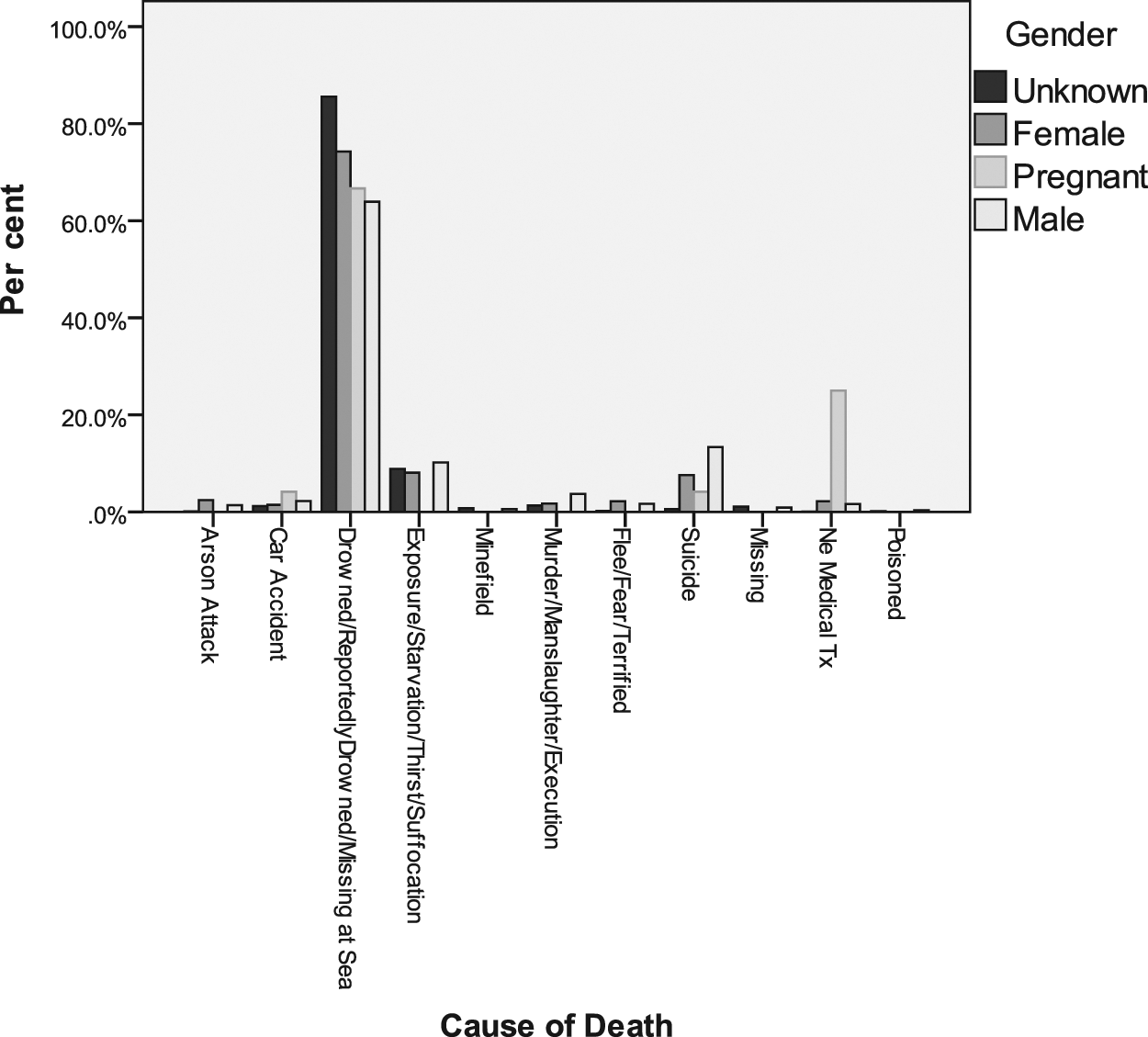
Cause of death by sex (European Union)

Cause of death by sex (United States)

Cause of death by sex (Australia)
Analysing the data from the USA, we found that the largest proportion of the deaths for both women and men was exposure (starvation and thirst). At this frontier, 86 per cent (n = 253) of women’s deaths occurred at the border compared to 75 per cent (n = 757) of men.
When comparing the regions of origin of the deceased, we found that the majority of the deaths recorded at the Australian border were from the Middle East (n = 519, or 77 per cent). On the other hand, the region most represented among the deaths at the EU border was North Africa (n = 5295, or 36 per cent). These data indicate that the group facing the greatest concentrations of death at the physical frontiers come from countries most likely rejected for lawful entry as part of pre-departure visa regimes governing lawful arrival (and in many cases most likely to gain refugee status post-arrival). Women from this targeted region die in greater numbers than women from other regions. When carrying out a chi-square test to determine the relationship between sex and country of origin of the deceased, we found the results to be statistically significant (p < .001).
In analysing the EU data, we found that 82 per cent (n = 388) of the sample of women died at the frontier (as a proportion of all female border-related deaths), compared to 77 per cent (n = 1607) of the sample of men. This figure for women may be regarded as conservative because, as previously discussed, many of the deaths recorded of people of unknown gender are likely to include higher proportions of women and children. The EU data also revealed that 97 per cent (n = 11,163) of those of unknown sex died while crossing the border. Pregnant women, although they comprised only a very small sample (n = 28), were found to be more likely to die at the border frontier (68 per cent, or n = 19) than at other border sites. When examining the Australian data on location of death, we found that 92 per cent (n = 78) of women died in at the frontier, compared to only 65 per cent (n = 70) of men.
As noted earlier, borders are effectively enforced prior to arrival at the physical/ territorial border (frontier) and post-arrival. Those who die post-arrival have been permitted entry, meaning that they would likely have a visa or have been permitted entry via some other arrangement, and that they die as a result of a range of conditions associated with having being rendered unlawful as a result of changed visa status. Visa regimes are ordinarily governed via a range of risk assessments, which are overwhelmingly shaped by nationality and ethnicity of the applicant. Therefore, what is notable about what we might call frontier deaths is that those who cross irregularly do so because they are unable to enter ‘lawfully’, comprising the category of high-risk groups that are unlikely to be granted a visa for lawful entry. Frontier deaths are therefore characterized not only by a greater concentration of women’s deaths in these sites (as a proportion of deaths across all border sites) but also less surprisingly by the migrant’s country of origin.
When we carried out a chi-square test on the EU data to evaluate our hypothesis, we found the results to be statistically significant (p < .001) in indicating a correlation between a death at the physical border (rather than at other border sites) and area of origin of the migrant. Africans died in greater concentrations at the frontier than others from different areas of origin: 95 per cent (n = 5019) of migrants from North Africa and 96 per cent (n = 2383) of migrants from Sub-Saharan Africa died in greater concentrations at the frontier rather than at a post-arrival border site. For those from Eastern Europe, the proportion who die at the frontier is around 82 per cent (n = 732) (see Table 2). The EU data reveals that those coming from ‘target-hardened’ countries (notably countries of North Africa and the Middle East) die in greater concentrations while crossing the frontier (than at other border sites). President Bill Clinton infamously referred to the harsh landscape of the deserts along the US–Mexico border as a natural ally in deterring irregular migration, and that the US administration relied on the high risk of death in these deserts to send a strong deterrent message to would-be migrants (Nevins, 2003).
Region of origin and border deaths (EU)
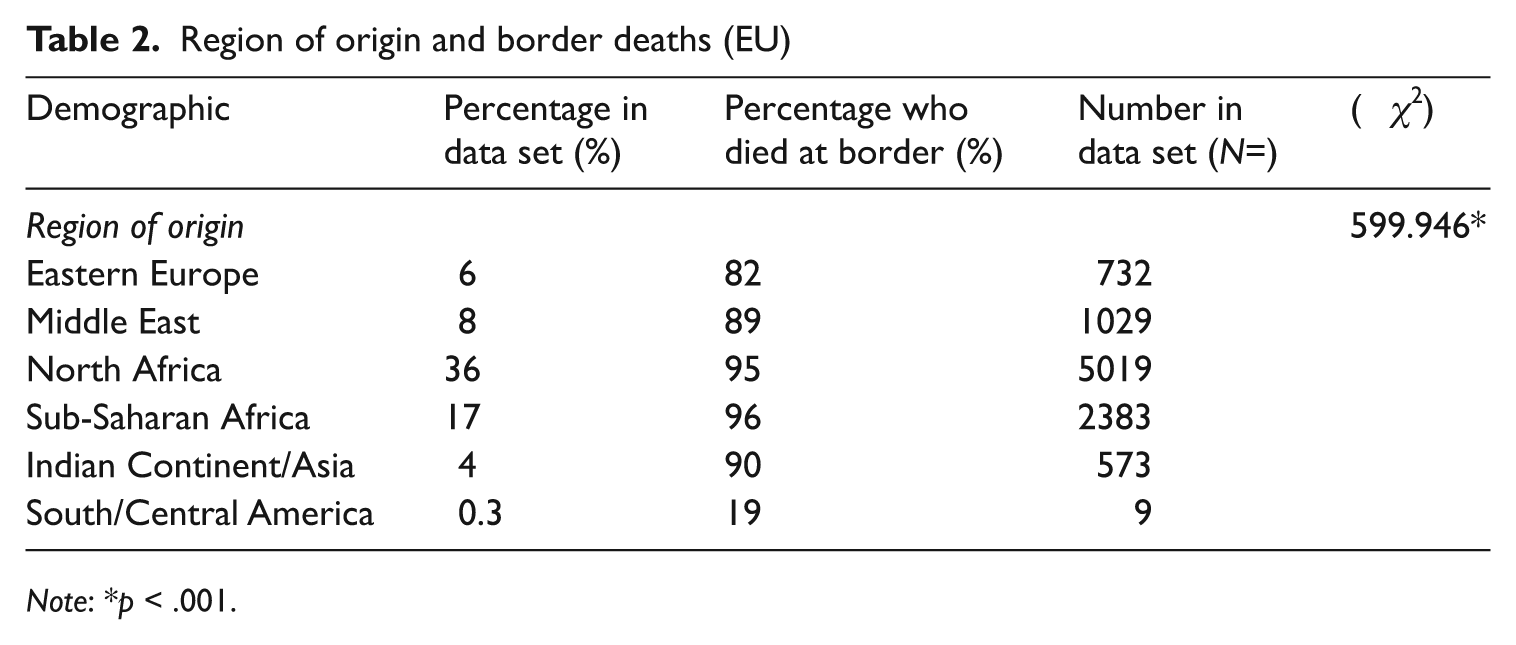
Note: *p < .001.
In Australia, the two major spikes evident in Figures 4 and 5 largely relate to specific incidents. Most notable among these is the sinking of the SIEV X, data for which include a relatively lower proportion of ‘unknown’ deaths than the data on more recent incidents. We contend that this is largely because the SIEV X has been the focus of considerable advocacy work which has uncovered the details of many of those who died, whose identities were initially recorded as ‘unknown’. The second spike, the Christmas Island shipwreck in December 2010 was subject to a Coronial inquiry which established the identities if the majority of passengers. Historically, women have not figured in our understanding of border-related deaths primarily because they are often in the ‘unknown’ category. Therefore, the more we can do to identify victims of drowning as individuals, the richer the analysis of irregular migration is likely to be. We have incomplete data for the 2011 year, which is why the graph takes a strong downturn.
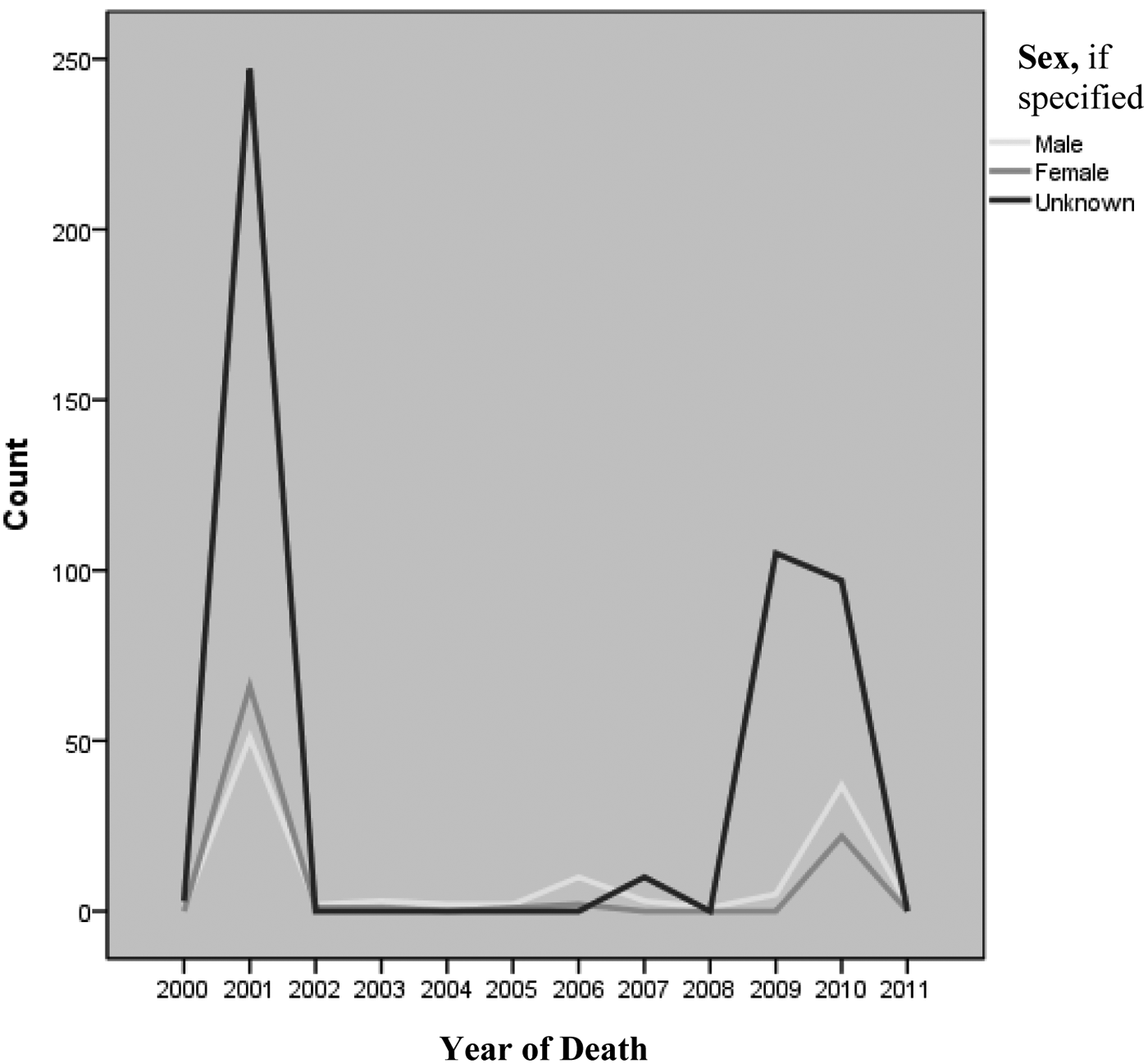
Overall deaths by year and sex (Australia)
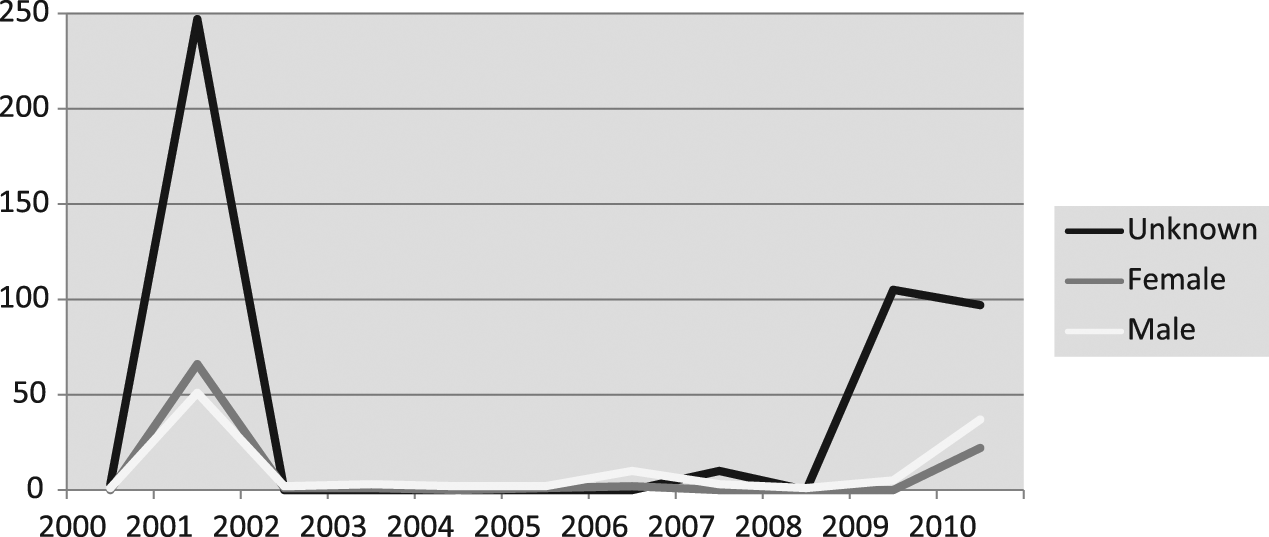
Drowning deaths by sex (Australia)
The data analysed above are without reference to how many people succeed in making an irregular crossing. However there are some incidents where this is known. For example, in examining the data on the ‘known’ deaths on the SIEV X, we found notable results regarding gender: 77 per cent (n = 65/85) of the men on board drowned, whereas 93 per cent (n = 142/152) of the women and 95 per cent (n = 146/155) of the children drowned during this disaster. Women and children are again seen to die in higher proportions than men in the recently uncovered Christmas Island data. We found that 36 per cent (n = 20/55) of the men on board drowned, 44 per cent (n = 15/34) of women perished, and 63 per cent (n = 15/24) of the children died in the shipwreck.
Why do women die in greater proportions at the frontier?
The data presented in this study indicate that women die in larger concentrations at the border frontier—that is, in those physical spaces that cover the territorial border (compared to other border sites). In the case of Australia and the EU these are vast maritime spaces, while on the Arizona–Mexico border this frontier is the desert.
It is reasonable to expect that as we further build our data sets over longer time periods we will be able to confirm that a significant proportion of drowning incidents have no survivors. However, for those incidents that are survived, epidemiological studies can assist by providing some insight into why women are more likely to drown than men. In a recent epidemiological study conducted in Aceh, Indonesia, following the 2004 Tsunami, researchers found that of people in villages who had been killed, most were either very young or very old, with one exception: women who were caring for a young child (Doocy et al., 2007). Even more telling is that women with two or more children had the lowest survival rates of all; in fact, no women with more than one child survived the deluge.
Limitations
There are several important limitations to the current data. As referenced above, the lack of basic information on those who have died is a serious weakness in the data sets. Globally there are no government or official source of data on border-related deaths. Such deaths therefore remain unrecorded and unrecognized by nation states and international organizations. Researchers are left to draw on piecemeal information on deaths from news outlets or NGOs, and while a valiant effort is made by these sources, the quality and quantity of information available is often limited. Moreover, the primary purpose of UNITED and the Arizona Star keeping such records is not to ensure a finely granulated examination; yet the data from these organizations is extensive and consistently reported in ways that enable at least a basic analysis such as that presented in this article. Arguably, these organizations are important resources for advancing the study of harms at the global frontier.
Additionally, the US data in particular present a limited perspective on border deaths. We have no information on deaths that occur at the US–Canada border or on those who arrive by boat to Florida from such countries as Haiti; there is also no comprehensive information about those whose remains are found by medical examiners outside the state of Arizona. The Australian data, especially for deaths at sea, are similarly very limited, particularly as much of Australian waters are unpatrolled so deaths may go uncounted and unrecorded.
Conclusion
Importantly borders have become a site for significant theoretical examination, especially within criminology and in the interdisciplinary milieu of criminology, international relations, migration studies and international law (Aas, 2011, 2012; Balibar, 2010; Bauman, 2004; Bigo, 1998, 2001, 2005; Donnan and Wilson, 2010). However the body of empirical work focused upon the border, especially from a criminological perspective has not kept pace with this theoretical interest meaning the interplay between theory and empirical studies has arguably not been as rich as it could be. Developing this interplay informed the development of this specific study and the broader study it was drawn from (Weber and Pickering, 2011).
The analysis of border-related deaths in the EU, USA and Australia reveals that women disproportionately die at what many refer to as the global frontier: the physical land and maritime borders between nations. The frontiers between the Global North and Global South are where significant political and material resources have been directed for the purposes of border protection and deterring irregular migration. Moreover, these frontiers are sites of significant symbolic power, denoting the patrolled edges of the nation that have become the subject of high-octane political and public debate. The findings also reveal that women die in far smaller proportions to men at what are regarded as internal borders—that is, border sites enacted post-arrival (for example, in immigration detention, by suicide or by fleeing apprehension).
Borders are of increasing significance to social science for both their coercive and ideological force. The noble journey from persecution to freedom has historically been recorded as a marker of modernization, as emblematic of the individual and collective vigour and ingenuity upon which entrepreneurial capitalism has thrived. Increasingly, however, this journey is not linear, and nor is it highly regarded. Rather, such journeys are frequently unsuccessful, and even result in death (Weber and Pickering, 2011).
Considering these findings and the limitations of the available data there is clearly a need for the deaths of those who irregularly cross borders to be recorded in a robust fashion. While the sources utilized in this article make an important contribution to this area of research, there is a need to establish an international database capable of recording aspects of local border environments as well as comparable details regarding the various kinds of irregular crossing and their outcomes. A more robust database can not only serve to document better the human cost of irregular border crossing, but importantly also to identify the commonalities and differences between different border zones and the relationship between border crossing and border control practices.
While the findings of this analysis have focused on the disproportionate numbers of women dying at global frontiers, there remain significant shortcomings in the recording of deaths at internal borders. For example, in Australia, while deaths in immigration custody may attract some media attention, they are not included in the National Deaths in Custody Monitoring Program funded by the federal government because they are deemed not to have taken place ‘in custody’. This is a serious anomaly in the documentation on deaths in custody in the Australian context, and one that urgently needs to be remedied.
Irregular migration has been regarded as testing the universality of citizenship (Aas, 2011). Hyndman (2000: 111) has termed this ‘supracitizens’ and ‘subcitizens’, categories that are linked but have ‘unequal identities’. By focusing on how this plays out at the frontier, often invisible and hard to reach places on the high seas or in isolated land crossings we can consider, as Aas (2011: 333) has recently highlighted, the continuing importance of sovereignty of individual nation states despite supranational arrangements. For privileged travellers the border is becoming indistinct; however, we may be able to locate borders firmly by tracing where border deaths occur. The most target-hardened areas of borders—those regarded as frontiers—are where the complex interplay of border control and social mores play out, and where women’s border-related deaths are concentrated. The most important symbolic sites of border defence are realized through the death of vulnerable groups. Perhaps it is in those deaths that we can define the current contours of our nation and the reliance on enforcement practices to inscribe their edges.