




Abstract
This article investigates the power/knowledge relations between contemporary penal government and criminological theory. Based on an analysis of the strategic case of the Netherlands, the emergence of what can be called neoliberal communitarianism is discussed. In relation to the ‘penal welfarism’ it succeeds, neoliberal communitarianism provides a rationale of governing that allows a greater amount of complexity precisely because it consists of a paradoxical set of doctrines, discourses and techniques. This involves an emphasis on both ‘individual responsibility’ and ‘community’, protecting market and community by tightening social control, law and order and the production of rational self-controlling individuals while excluding the cultural and biological ‘risk citizen’. The article illustrates the incorporation of criminological theories as policy underpinnings, and it explicates how criminological theories can be placed in the discursive space of neoliberal communitarianism.
Introduction: neoliberal communitarian crime politics
In the last decades of the 20th century, a regime of regulation best characterized as ‘welfarism’ came under attack. Various authors have seen neoliberalism as the successor of penal welfarism (see Lacey, 2013). However, neoliberalism is often considered in too monolithic terms, and it is often regarded as solely responsible for the harsher penal regime of the last few decades (Cavadino and Dignan, 2006; Wacquant, 2009). In this article, we illustrate one way in which neoliberalism operates in a combination with elements from other rationalities, notably communitarianism. Neoliberalism, we argue cannot be squarely opposed to communitarianism. Likewise, a harsher penal climate cannot be solely attributed to neoliberalism but can just as easily be compatible with what can be called a communitarian governmental rationality. In illustrating the existence of what we call a neoliberal communitarian strategy, we expand on Nicola Lacey’s illustration of the naïve acceptance of the ‘softer’ character of communitarian penality over against the ‘harshness’ often attributed to neoliberalism (Cavadino and Dignan, 2006; Currie, 1997; Feeley, 2003; Van Swaaningen, 1995; compare to Crawford, 1999; Hughes, 1996; Lacey, 2013: 265, 269). The Netherlands, which we take as our main case, is for instance considered as less communitarian than before by Cavadino and Dignan (2006: 116). However, we argue that the Netherlands can be considered in both the Mertonian and the Foucaultian sense, as a strategic case (Foucault, 2004; Merton, 1987) for the emergence of a paradoxical combination of neoliberalism and communitarianism that can be found elsewhere as well, such as in the UK. We argue that the duality between individualistic and communitarian approaches that goes back at least until Enlightenment debates about liberalism and in recent decades has fired up (Mulhall and Swift, 1992) is today reactualized in the form of neoliberal communitarianism. With Foucault, we argue that a European version of neoliberalism that goes back to Röppke, cannot be equated to Chicago School neoliberalism in the USA (Foucault, 2004). Rather, as we aim to illustrate, its insistence on ‘individual responsibility’ is very well compatible with communitarian approaches that foreground conceptions of ‘community’.
We thus scrutinize the ways neoliberalism and communitarianism combine in Dutch penal government, and we do so in a genealogical way (cf. Lacey, 2013: 278), looking at the ways penal government (power) is intertwined with criminological theories (knowledge) (cf. Cohen, 1985; Foucault, 2004). We bring together a wide variety of criminological theories and show how the core mechanisms and concepts they embody are related to neoliberal and communitarian rationalities and techniques of government. We project them into a two-dimensional space to illustrate how penal governing in terms of both prevention and punishment is informed both by neoliberal and communitarian theories, and by theories that in themselves combine neoliberal and communitarian elements (such as the broken windows and life-course perspectives). Before doing so, we highlight the trends in the governing of crime in the Netherlands in the period 1980–2010.
Trends in the governing of crime in the Netherlands (1980–2010): the rise of neoliberal communitarianism
Neoliberal communitarianism can be regarded as a paradoxical combination of an emphasis, in politics and policy, on both a market logic, individual responsibility and a community logic of attribution of causes and responsibilities (Schinkel and Van Houdt, 2010). In the governing of crime, this combination emerges for instance in a shift away from the socio-economic context of crime to the cultural background of individual perpetrators. We understand neoliberal communitarianism as a strategy of governmentality that combines the main features of neoliberal governmentality (Foucault, 2004) with those of governmental communitarianism (Delanty, 2003: 87; Rose, 1999: 179–196; cf. Adams and Hess, 2001: 13; Van Swaaningen, 2008). Neoliberal communitarianism consists of a combination of New Public Management and the outsourcing of responsibility. It furthermore combines scientific measurement and treatment of social problems with the stimulation of ‘active citizenship’, and the rational governing of community with a rhetoric of the spontaneous work of community. Active citizenship becomes newly defined as community involvement, and the identification of lack of active citizenship is at once the identification, made scientifically measurable, of the ‘risk citizen’. The ‘old’, that is, welfarist way of doing things is regarded as ‘bureaucratic’ on the one hand, and as ‘slackness’ and ‘gratuitousness’ (legacies from the 1960s and 1970s) on the other hand.
In order to illustrate how neoliberal and communitarian elements have combined in crime policies over the last decades, we first focus on three trends: (1) the prioritizing of crime; (2) the actuarialization of crime; (3) the institutional transformation of crime regulation.
The prioritization of crime and the intensification and pluralization of punishment
Since the 1980s crime has been high on the Dutch political-administrative agenda (Downes, 2007). One important indication is the intensification and pluralization of punishment in the Netherlands (cf. Downes and Van Swaaningen, 2007). This increasingly involves ‘incapacitation’, which is plural itself in that it focuses both on segregation and on reintegration (i.e. selective incapacitation and selective rehabilitation). Second, it entails a broader repertoire of possible forms of punishment, for example fines and re-integrative shaming. Third, it refers to a variety of tactics deployed to suppress ‘risky’ behavior as well as ‘risky’ characteristics of subjects selected through actuarial archives in the form of ‘prepression’ (Schinkel, 2011). And fourth, punishment becomes plural in the sense that it becomes a task that is both executed and conceived by a broader circle of actors and agencies than is traditionally the case (not only the sovereign state but also local governments and administrations).
The actuarialization of crime
In the causal analysis of crime, a debate existed in the 1960s and 1970s resulting in what Young (1988) has called ‘the etiological crisis’. In a sense, this crisis has been surpassed by circumventing the concept of causality and introducing the concept of risk. As a result, three factors have risen to prominence in the Netherlands since the 1980s: a transformation from the criminal subject as causally determined toward a criminal subject as a bundle of risk factors; a focus on choice; and the discovery of culture as a risk factor in crime.
Since the late 1980s risk has become a dominant frame in the field of crime regulation (O’Malley, 1992). Based on a business mentality and market principles, a ‘reinvented government’ (Osborne and Gaebler, 1993) uses measurable risks to increase the efficiency, effectiveness and legitimacy of public policy and interventions. This also affected the field of penology and justice, giving rise to what Feeley and Simon (1992) call the new penology and actuarial justice which are based on (selective) incapacitation, preventive detention and profiling. In the Netherlands, the classification of populations ‘at risk’ has become pivotal (cf. Wilson, 1983). This occurs in two dominant types: youth at risk and high risk offenders.
‘Youth at risk’ (e.g. Toward a Safer Society (TSS), 2002: 15–16, 21–22; cf. Safety Begins by Prevention (SBP), 2007) refers to youth who have not committed a crime but are argued to be on the path toward it and to so-called first offenders (cf. Cohen, 1985: 53, 60). This classification is based on a culmination of individual risk factors (biological, genetic, psychological), behavioral risk factors (not attending school regularly, using soft drugs, thrill seeking behavior or police contact), and more general social risk factors (risky families, unemployment, friends) (cf. Junger-Tas, 1996). The aim is to intervene as early as possible (SBP, 2007: 27–28).
The second dominant type is ‘society at risk’, considered a consequence of ‘the risk of recidivism by persistent or high risk offenders’. A new type of intervention was constructed, called the ‘Frequent Offender Institution’ (FOI) and has been in operation since 2004. Under FOI, frequent offenders can be incarcerated for two years because of ‘their habits’. A ‘frequent offender’ is: (1) (s)he who committed a serious crime; (2) a person convicted in the last five years for at least three other crimes; (3) a serious threat for the safety of persons and goods (Struijk, 2007: 350–354). The primary goal of measures aimed at such persons is ‘social defense’ (art. 38m sub. 2 Strafrecht; cf. Downes and Van Swaaningen, 2007; Struijk, 2007: 353). In addition to this a treatment can be added (art. 38m sub. 2 Strafrecht; cf. Struijk, 2007: 353). In the period 2004–2007 more than 1000 persons have been thus incarcerated (Tollenaar, 2007). Finally, risk plays a role in probation service, in which the ‘RISC’-instrument (recidive inschattings schalen) is used to differentiate between high risk and low risk persons. The current aim is to control every ‘high risk’ offender at least one year after release.
In addition to the risk-citizen, Dutch policy is aimed at the calculating citizen who deliberately chooses to commit crime in the context of valuable targets and the lack of capable guardians (Society and Crime (SAC), 1985). According to Law in Motion (LIM) (1990: 7) Dutch citizens rationally calculate to conform or violate the law. As a consequence several techniques aim to influence the rational citizen: e.g. by manipulating choice and opportunities, target hardening, activating guardianship by means of mobilizing ‘active citizenship’, preventive frisking in hot-spot zones but also increasing clearance rate, swift punishment, swift execution and tougher punishment to deter the calculating citizen from committing crime.
While a focus on both ‘risk’ and ‘choice’ are predominantly of neoliberal character, the related discovery of culture exhibits more of what we identify here as communitarian elements. In general, Dutch analysis is prominently based on an analysis of de-pillarization, the loss of informal social controls and bad socialization of youth (SAC, 1985; Junger-Tas, 1996). Therefore several policy documents aim at a remoralization of Dutch society through the penal. While it can be argued that welfarism was a governing through the social (Garland, 1985), nowadays there is a governing through the cultural. More specifically, in the wake of debates on immigrant integration (Schinkel, 2007; Schinkel and Van Houdt, 2010), the idea that the ‘culture’ of immigrants could be considered a problem in and of itself gradually took root. The 1997 Crime in Relation to the Integration of Ethnic Minorities policy paper (CRIEM, 1997) is of special importance.
CRIEM specifies for the first time the formal vision of the relation between crime and culture, specifically in the form of essentialist conceptions of ‘ethnicity’. It problematizes two categories in particular, which it considers to be ‘ethnic groups’: ‘Moroccans’ and ‘Antilleans’ (CRIEM, 1997: 1). The following quote can be taken as an illustration here: Crime is often caused by a complex of factors which can be summarized under the heading of inadequate bonding to society. This explains the crimes of both autochthonous citizens and, especially, crimes of ethnic minorities. Crime of the latter problematic group can only be repressed by tackling the underlying cultural sources (…). Our aim is to prevent crime. Preventing crime means integrating ethnic minorities in Dutch society: by raising the children, by education and with jobs.
Such a view of crime has been repeated since then by several programs. One of the more recent ‘action programs’ on ‘risk youth of ethnic origin’ (Action Program Targeting Risk Youth of Ethnic Origin (APRYEO), 2009) argues that special programs are needed for youth with a ‘Moroccan’ and ‘Antillean’ background because of their risk caused by their cultural lack, failed socialization and lack of integration. Here we witness the shift from a belief in resocialization (until the 1970s) to presocialization.
The institutional transformation of crime regulation
In the 1980s, penal welfarism came under attack for being ‘inefficient’ and ‘ineffective’ (SAC, 1985: 31). The state secretary of the Ministry of Justice argued in 1982 that ‘resocialization is an unrealistic ideal and expectations of it need to be tempered’ (Task and Future of the Dutch Prison System, 1982: 21). Moreover, SAC (1985) referred to JQ Wilson by arguing that interventions which try to deal with structural causes of crime are ineffective (SAC, 1985: 36). It argued instead for an ‘effective crime politics’ (SAC, 1985: 35). Elements of both neoliberal and communitarian governmentality have brought about an institutional transformation in the regulation of crime. This entails: (a) a disciplinarization of the state through managerial principles; (b) an extension of state competences and capacities; (c) a more encompassing responsibilization; and (d) an integralization of the institutional field of crime regulation.
Disciplinarization of the state through managerial principles
In order to make criminal justice both more ‘effective’ and ‘efficient’ a business model was introduced: the ‘criminal justice enterprise’ organized in serial related chains (police, the public prosecutor’s office, judges, and executioners’ office) (SAC, 1985: 51; cf. Feeley and Simon, 1994: 187–188; Garland, 1997; Steenhuis, 1984). Managerialism was introduced, which was reinforced after 1992 when principles of New Public Management became en vogue. Since this time, both national and local governments have been working with ‘contracts’ and ‘performance indicators’ (e.g. APRYEO, 2009: 11; TSS, 2002).
Extension of state competences and capacities
The critique of penal welfarism involved a targeting of society as a whole from a criminal justice perspective. Under the dual flag of prevention and repression the criminal justice system casts a wider net and thins its meshes (SAC, 1985: 35–37; cf. Cohen, 1979). Harsher punishment, new prisons, less tolerance and alternative punishments came to be ‘solutions’ for perpetrators and, additionally, deterring others (SAC, 1985: 36–38) while more (formal and informal) surveillance, bonding and intervention based on risk were selected as primary tools of prevention. This was backed by communitarian concerns over the lack of citizen involvement, an overemphasis on citizens’ rights and a waning of informal forms of community control. LIM (1990: 7) argued that an imbalance had grown between citizens and the state in favor of the citizens’ rights. It called for more law enforcement, more punishment and this included more personnel and possibilities of intervention and more efficacy (LIM, 1990: 23, 37).
Likewise, TSS (2002) repeated these concerns (‘Dutch society needs to be safer’; TSS, 2002: 4, 7, 13) and introduced ‘unorthodox’ measures to support them: (1) the introduction of ‘compulsory identification’ on Dutch soil for everyone (TSS, 2002: 36)—and as such ‘the border is everywhere’ (Feeley and Simon, 1994: 181); (2) the introduction of ‘local spaces of emergency’ dubbed ‘Hot Spot Zones’ which brings with it exceptional powers such as random body searches otherwise prohibited in the Netherlands (TSS, 2002: 34–35); and (3) the ‘Frequent Offenders Institution Order’, which allows for a maximum incarceration of two years for offenders or drug users deemed incorrigible (TSS, 2002: 20). There are also extra prosecutorial competences to enforce behavioral interventions (therapy or other treatment) even before the judge has sentenced a punishment (Action Program Fighting Nuisance (APFN), 2008: 11).
In the early years of 2000, extra administrative competences (primarily attributed to the city mayor) have moreover emerged to exclude persons or families from areas, to enforce social intervention in families and to demand information and cooperation of social care agencies (enforced ‘integralization’: see later) and there is an extension of possibilities for social care intervention and surveillance (extension of the possibilities of social surveillance of families: an increase from 6322 families under surveillance in 1998 to 33,164 in 2009: Berends et al., 2010: 15) and ‘outreaching care’ to intervene in the private sphere (e.g. the placement of a family coach and a research committee that investigates the possibility of enforcing care with financial threats: APFN, 2008: 26; APRYEO, 2009: 7, 16). Thus, on the one hand, law and justice are instrumentalized, while on the other hand, where the law gets in the way of government—for instance where issues of privacy are at stake—exceptional measures are taken to by-pass the law (cf. Schinkel and Van Den Berg, 2011), for instance by granting exceptional executive powers to local government (e.g. mayors).
Encompassing privatization and facilitative and repressive responsibilization
In 1985 the Dutch government acknowledged for the first time that it was not able to cope with crime alone and argued for the mobilization of ‘individual citizens and civil society, including local governments and the private sector, to fight the mass manifestation of crime’ (SAC, 1985: 37). This ‘responsibilization’ is one of the important mantras of Dutch crime policy from 1985 onward: time and again it is argued that a ‘reconfiguration of responsibilities’ is needed, which includes the need for an ‘active civil society’ as it is the ‘responsibility of citizens themselves to prevent crime’ (SAC, 1985: 40) and a ‘prime role of local governments’ (SAC, 1985: 15, 36–38, 43, 57, 103–105; see also SBP, 2007; TSS, 2002; cf. Rotterdam City Council, 2006).
In this context, the private security market in the Netherlands has grown from 10,000 persons employed in 1981 to 39,000 and its turnover grew from 1.07 billion in 2002 to 1.43 billion in 2008 (Brief van de Algemene Rekenkamer, 2009: 2). Another development in terms of privatization is the more communitarian oriented mobilization of ethnic communities to become more involved in crime prevention. For example, a 2009 action program urges ‘the Moroccan-Dutch community to get involved, to correct their own troublesome youth and families and to renounce troublesome behavior and cooperate with the authorities’ (APRYEO, 2009: 8).
While responsibilization has been noted before, a distinction is in order between facilitative responsibilization and repressive responsibilization (Schinkel and Van Houdt, 2010). Facilitative responsibilization assumes the pre-existing autonomous citizen, a citizen already properly socialized, only to be mobilized and called into active service. This is related to a more neoliberal approach of governing crime (Garland, 2001: 124). But when autonomy is seen not as pre-existing but lacking, responsibility is coercively learned in special programs focused on the underclass and ethnic families or in boot camps for ‘recalcitrant youth’ (cf. APFN, 2008; APRYEO, 2009). For example, ‘troublesome families’ are monitored and a variety of efforts exist as morally educating them in Dutch norms and values as a way of taking responsibility for their children and society (APFN, 2008; APRYEO, 2009; cf. Garland, 2001: 127). This is a form of repressive responsibilization, which is situated in the arena of ‘interventions’. These take place where ‘risky citizens’ are located, and involve active efforts at (re)socialization into ‘responsible citizens’ (APRYEO, 2009: 7; cf. Schinkel and Van Houdt, 2010). In practice, this involves mainly immigrant families (e.g. APRYEO, 2009). It may be concluded that we witness the shift from a belief in resocialization (until the 1970s) to a belief in presocialization. The weight of the safety-security enterprise has shifted toward the time before the crime. We regard this type as the more communitarian form of responsibilization.
Integralization of the institutional field of crime regulation
Integralization can be regarded as the institutional culmination of the other three developments mentioned here. Integralization points to a development toward a holistic, all-inclusive approach, in which the actors involved in the production and management of risk (from child care and health to welfare, police and criminal justice) are connected to each other. An important policy document to understand ‘integralization’ is the 1993 Safety Report (ISR, 1993), jointly drafted by several ministerial departments and the 1999 Integral Safety Program (ISP, 1999). Since 1993, the concept of crime has become semantically embedded in the concept of ‘safety’ or ‘security’ (veiligheid). As a consequence, crime became part of a safety-assemblage stretching from concepts such as nuisance, liveability, (immigrants) integration, subjective and objective safety, and risk (Van De Bunt and Van Swaaningen, 2004). This opened up the possibility for criminal justice to fight nuisance and for the civic administration apparatus to deal with crime (as such blurring the boundaries between maintaining order and fighting crime) (cf. Wilson and Kelling, 1982).
At the same time welfare agencies are linked to penal agencies, also because welfare interventions are increasingly backed by penal measures. An institutional ‘chain cooperation’ 1 was set up, meaning cooperation and sharing of information between social work, youth justice, teachers, health care officials, and police officers. Since 2007 the actors in the safety chain are physically brought together into an encompassing network of ‘Safety and Security Houses’ (‘veiligheidshuizen’: SBP, 2007: 24–29). Several interconnected electronic archive-systems have been constructed to store and share information (see Schinkel, 2011). The aim is to ‘intervene’ as early as possible (e.g. SBP, 2007: 27–28). Some of these archives gather information of children from 0–19 years, sometimes starting before birth, as prenatal care is also part of the chain.
‘Integral safety’ consists of several phases: ‘pro-action, prevention, preparation, repression and aftercare’ (ISR, 1993: 12). Some of these elements, especially prevention, repression, and aftercare are closely linked. In order to be taken seriously, it is for instance argued, prevention strategies are to be backed by repressive measures (e.g. CRIEM, 1997; ISP, 1999). The government of crime is transformed from a reactive to a combined pro- and reactive approach. The concept of ‘integral safety’ is further clarified in ISP (1999) as referring both to an ‘optimal synergy between preventive and repressive measures’ (ISP, 1999: 11) and to ‘partnership in safety’ (ISP, 1999 12). Therefore, ‘integral safety’ not only means cutting across compartments of the ‘bureaucratic field’ (ISP, 1999: 11). It is also used to cut across public–private distinctions as both public actors and private actors, including citizens, need to cooperate in a so called ‘safety chain’ (ISP, 1999: 2, 7, 11, 12, 13, 27, 28, 32; cf. SBP, 2007; TSS, 2002). Hereby, as suggested by Wacquant (2009), the left hand of the state is transformed as elements of the right hand, such as penalties, reliance of duties, and coercion, are introduced. This also transforms some preventive measures into ‘prepressive’ measures in which ‘prevention’ comes to stand for the repression of certain life-styles deemed ‘risky’ (Schinkel, 2011).
Locating criminological theory in the discursive space of crime regulation
(…) penal policies over the past two decades have been formed by regimes that amalgamate and combine rather contradictory governing rationalities. Unity between them is possible, as we have seen, because of certain shared values and assumptions [a shared focus on the market and hostility to welfarism] (…) However, these and many other points of overlap nevertheless disguise quite distinct and often contradictory positions.
Our main interest here is in the ways in which criminological theory informs the various programs and techniques operative within the field of neoliberal communitarianism. To do so, we look at the way power and knowledge are dynamically interrelated, and we focus on the ‘translation’ of ‘theories’ into policy. Our data consist of the main policy documents and some of the more detailed ‘action programs’ that together span the period of 1985–2010. In addition, we make use of recent policy documents related to the city of Rotterdam. As the major policy documents most often lack references to scientific literature we had to dig a little deeper for instance by looking for advisory reports influencing the policy. We interpret the variety of criminological perspectives in terms of their communitarian and/or neoliberal orientations. Such theories of course rarely explicitly adhere to either of these political rationalities. However, we believe it is possible to trace elements of both governmental rationalities in criminological approaches and we sketch where these can be found. We also outline those approaches which easily combine neoliberal and communitarian elements. Table 1 provides a general overview of policy documents, measures, and diagnoses in the field of crime regulation. Where applicable, it also mentions the specific ‘policy entrepreneurs’ (Hughes et al., 2002: 327) influential in establishing power-knowledge connections.
Overview of national policy documents and theoretical background (power–knowledge).

Note: Later documents often miss special references. Therefore, when a document explicitly refers to an author this is shown in column 3 by the author’s name, while a lack of explicit references is solved by our interpretation of the theoretical background.
Communitarian influences in the Dutch government of and through crime
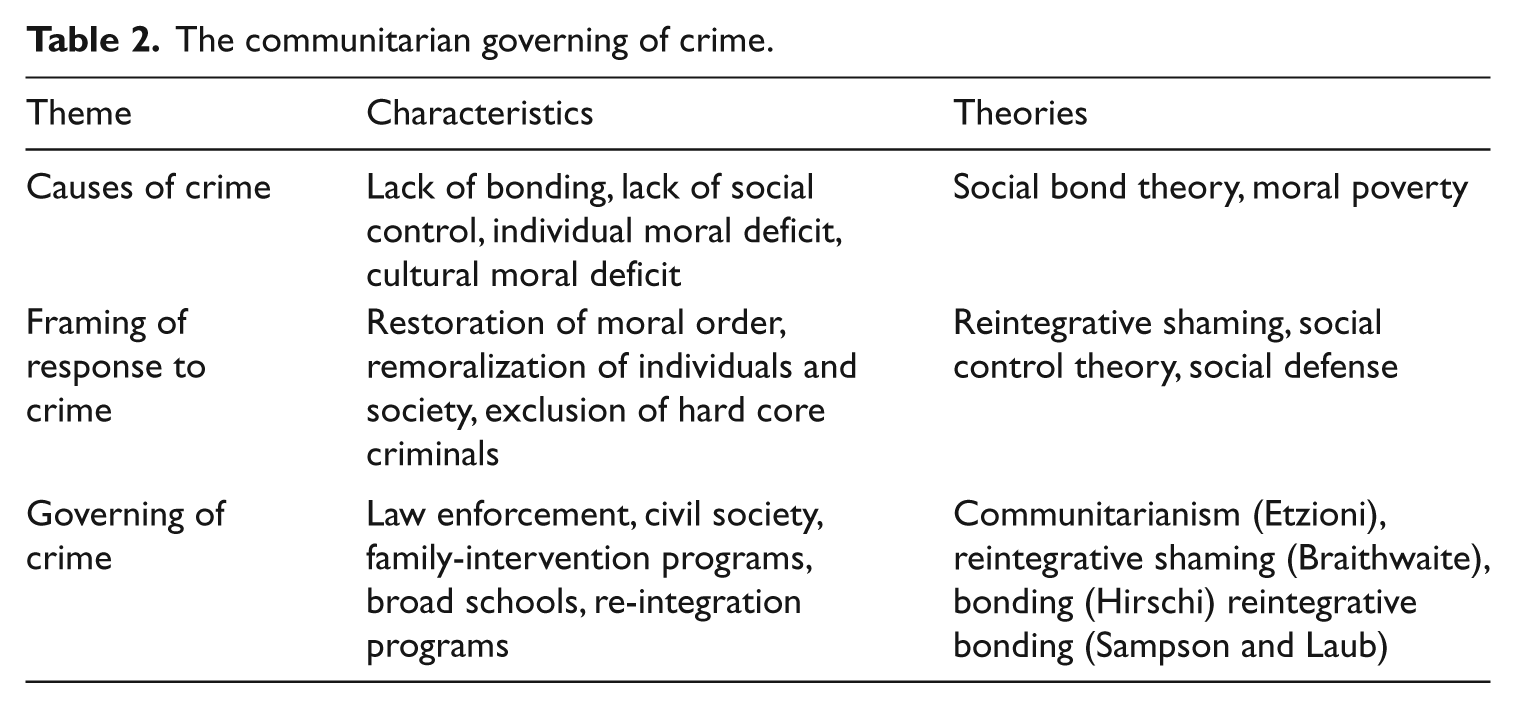
What does it mean to govern crime from a communitarian perspective? A possible answer can be found in Etzioni’s (1994) The Spirit of Community that was highly influential in the Netherlands. Following Etzioni very closely, his communitarian analysis of crime can be summarized as follows: (1) crime has risen in western nation-states while income has risen too; therefore, material conditions are not relevant for crime analysis; (2) the level of crime is influenced by the total community fabric defined as the combined effort of strong families, schools and intact communities which teach values; (3) the community needs to be defended against hard core psychopaths and criminals preferably by a strong state; and (4) as there are too many rights and too few responsibilities, the constitutional rights need to be reconsidered from the perspective of public safety, community needs and crime fighting, so as to allow more interference in citizens’ lives (Etzioni, 1994: 1–22, 163–191).
The communitarian impulse to restore moral order is at the same time translated in the governing of crime in the form of a communitywide responsibilization and moralization and an institutional cooperation in which civil society plays a key role. Etzioni presents nothing in relation to the government of the economy and the consequences of the structural organization of society and its impact on citizens, except an analysis of their moral deficit and the possibility of choice for everyone (see Etzioni, 1994: 65–66). It might be concluded that communitarianism is (1) a strategy of solely governing morality and takes economic government for granted, (2) needs to be seen as additional to more encompassing and economic rationalities or (3) as restoring strategies based on (neo)liberal logic. Several policy documents adhere to this communitarian perspective and diagnosis of crime and society. A good example of this ‘communitarian’ governmentality can be found in LIM (1990: 7, 18), which argues that what is lacking in Dutch society is ‘good citizenship’, meaning the individual’s civic duties toward other citizens and the community as a whole (‘society’). While rights have been strongly developed, it is argued, duties of and responsibilities for other citizens and the communities are neglected and citizens need to be reminded of their duties, for example by law enforcement (LIM, 1990: 7–8).
The communitarian perspective is put forward by criminologists as well. Most commentators suggest the work of John Braithwaite on ‘reintegrative shaming’ as typically informed by a communitarian perspective (cf. Hughes, 1996). This is put into practice in the Netherlands in the development of alternative forms of punishment such as the HALT-approach. Petty offenders at the age of 12–18 years get the choice whether their offence is prosecuted by the DA-office or by an alternative form of punishment in the community based on a program of education (including the parents) and reparation (material and relational). Beyond this, it is fruitful to consider the degree to which a variety of perspectives share a communitarian stance toward crime. A good example is Hirschi’s ‘social bond’ or ‘social control theory’. In his Causes of Delinquency, Travis Hirschi argues the importance of ‘the bond of the individual to society’ (Hirschi, 1969: 16, emphases in original). The weakness of such bonds is related to delinquency, and the way to prevent crime is by reinforcing the ties to the community (Hirschi, 1969). Hirschi (1986) argues that one aspect is crucial: ‘social control’, or the relational way in which norms and values are taught, conformity is monitored, and deviance is punished.
The influence of the ‘bonding’ or ‘social control’ approach to crime on Dutch policy has been significant and is related to the work of ‘policy entrepreneur’ Junger-Tas, who was director of the Dutch Scientific Research Committee ‘WODC’. As Dutch policy is often based on special advisory reports, this can be illustrated by two influential advisory reports in the 1980s and 1990s. First, in the 1980s a special committee (Committee Roethof, 1984) was set up to investigate the causes of the rising crime rates and to advice on the adequate reactions toward crime. This led to the formulation of SAC (1985) which influenced all the documents formulated since. Second, in the 1990s a special committee (Committee Van Montfrans, 1994) advised on how to deal with juvenile delinquency, which led to the focus of SPD (1995) on the relation between youth and crime. Both research reports refer several times to the ‘social control’ approach as explanatory frame (e.g. Committee Montfrans, 1994: 9–14; Committee Roethof, 1984: 27–28, 152–166). One example is the way the rising crime rates in the 1970s to 1980s are explained in the policy documents of this period: crime is seen as a consequence of the loss of social control which is triggered by the implosion of the Dutch pillarization structure (with the pacification between religious and ideological divisions politics) and the rise of egoistic-individualism (e.g. LIM, 1990; SAC, 1985). Proposed interventions are aimed at the restoration and introduction of more formal and informal control (e.g. SAC, 1985: 40). Since the 1990s it has been used to argue for the ‘remoralization’ of society through the penal (cf. LIM, 1990). Lastly, the bonding perspective is prominently visible in the governing of crime in relation to immigrant youth. Especially CRIEM (1997) can be seen as influenced by this perspective, relating lack of ‘bond to society’, interpreted as faulty ‘integration’, to crime by ‘ethnic youth’.
Another example of the communitarian inspiration is to be found in the ISP (1999: 17): ‘crime is the consequence of individualization and lesser attachment to each other and societal norms and values, in short: a fragmentation of society and lesser social cohesion’. In addition to this, while most commentators stress the communitarian emphasis on re-integration, however, communitarians like Etzioni (1994) also stress that ‘community must be defended’ (cf. Foucault, 1997) against hard core psychopaths and criminals preferably by a strong state, hereby mimicking neoliberal approaches of selective incapacitation. This is clearly visible in TSS (2002) that formalized the Frequent Offender Institution (see later).
This illustrates how a harsher penal climate can easily be compatible with what can be called a communitarian governmentality. Table 2 summarizes the communitarian governing of crime.
The communitarian governing of crime.
Neoliberal influences in the Dutch government of and through crime
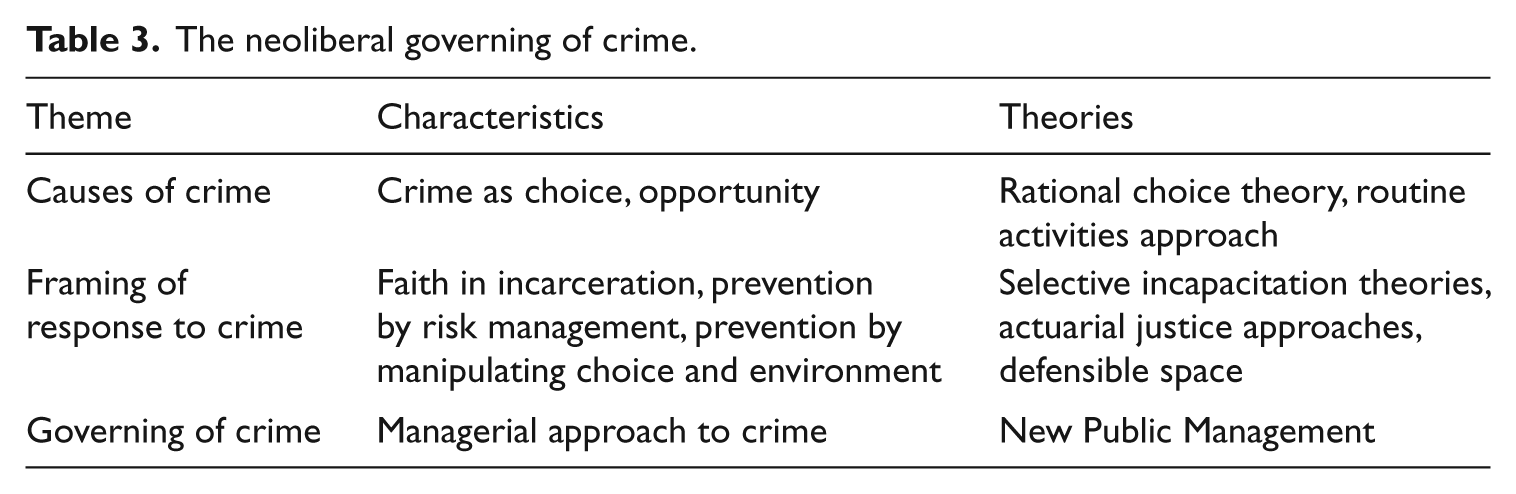
In addition to economic and social policies being influenced by neoliberal governmentality, since the 1970s this specific type of crime analysis has increasingly gained attention. One of the early proponents of the economic approach to crime and justice was Gary Becker (1968; cf. Foucault, 2004). In criminology most often ‘rational choice’ and ‘routine activities approach’ are seen as neoliberal approaches to crime. Dutch policy and advisory reports are often informed by a neoliberal governmentality (cf. Schuilenburg, 2008). For example, the Committee Roethof argues that several forms of crime can be explained simply because of the increased opportunities to crime: ‘Not poverty, not a personal deficit, but the opportunity makes a thief’ (Committee Roethof, 1984: 26; cf. Felson and Clarke, 1998). As primary sources, the report refers to Mayhew, Clarke, Sturman and Hough (1976), Cohen and Felson (1979), and Ron Clarke (1983): representing the influence of a specific economic approach to issues of crime and prevention, namely ‘routine activities’ and ‘rational choice’.
Both the ‘rational choice’ (e.g. Clarke, 1980) and ‘routine activities’ theory (cf. Cohen and Felson, 1979) reject ‘dispositional’ approaches to crime. Instead, according to Clarke, crime needs to be understood as the outcome of choice (Clarke, 1980: 138) and following this line of reasoning, crime rates can be controlled by reducing the opportunities for offending and increasing the chance of getting caught, for instance by increasing surveillance (CC, 2001; SAC, 1985; cf. Clarke, 1980: 139–143). Accordingly, we see in Dutch policy a huge emphasis on (a) informal and formal surveillance, (b) the responsibilization of individuals and communities for crime prevention, (c) the need for architects and urban developers to take into account the possibilities of crime prevention and community sur- and sousveillance, and (d) a strong focus on a variety of ‘risks’ and the development of crime management as risk management.
Next, it has been widely noticed how managerial techniques and models were introduced in the public sector and the penal sphere (Cavadino and Dignan, 2006; O’Malley, 1999). A good example is how criminal justice became represented and (re)modeled as a serial-chained production company focused on efficacy, efficiency and output measurement (SAC, 1985; cf. Steenhuis, 1984). This is connected to the dominance of New Public Management (NPM), and it remained the primary way of speaking about criminal justice (e.g. LIM, 1990; TSS, 2002). NPM also influenced the local level, which is indicated by the increasing use of ‘performance indicators’, ‘monitoring systems’, the ‘publication of outcomes’, and ‘accountability’ (e.g. Rotterdam City Council, 2002). At the same time this is one explanation for the dominance of efficiency over rights (e.g. Becker, 1993).
In this context, a renewed belief in imprisonment occurred as well as a transformation of the function of the prison from correction to the ‘storing’ of risky waste (cf. Simon, 2013: 76–77). On the one hand, from an economic perspective it is argued that increasing the costs of crime (by increasing punishment and the chance to get caught) will deter people of committing crimes. On the other hand, it is argued that selective incapacitation will rearrange the distribution of offenders in society and as such prevent inmates from crime for the time they are imprisoned (cf. Wilson, 1983). Increasing punishment for so called ‘career criminals’ is one of the leading principles of the Frequent Offender Institution. This renewed status of the prison and imprisonment resulted not only in an increased prison population. It also resulted in facilities for special convicts based on ‘selective incapacitation’. However, at the same time the renewed belief in punishment is said to be evidence based: special programs can be targeted at specific individuals to be identified based on ‘risk-indicators’ (CC, 2001: 40). In addition to this attribution of the harsher climate to neoliberalism, it should be noticed that there is also an ambiguity or tension within neoliberal governmentality: when the costs of the preventive-repressive apparatus become too high (e.g. financial costs, constraints of freedom) neoliberal rationality can be used to demand major cutbacks, to determine levels of tolerance and as rationalization of de-penalization (Foucault, 2004). Table 3 summarizes the neoliberal governing of crime.
The neoliberal governing of crime.
Neoliberal communitarian approaches
The discursive space opened up by neoliberal communitarianism thus allows for a number of combinations and a shifting combination of elements originating in a variety of theoretical research traditions. Figure 1 charts this space, using as main axes ‘neoliberalism–communitarianism’ and ‘prevention–repression’ while at the same time positioning the influential authors as referred to and relied on by Dutch policy. The center represents the space of ‘knowledge’ while at the margins the ‘techniques of power’ are represented. This Figure of the neoliberal communitarian power/knowledge nexus makes clear how crime is understood in the Netherlands in the period 1980–2010 and how power is based on a specific space of knowledge and vice versa. At the same time it makes clear which theories are placed outside the dominant order (e.g. strain-theories, labeling theories, i.e. all the theories demanding structural economic reform and critical theories of power).

The power/knowledge nexus of neoliberal communitarianism.
As pointed out by O’Malley (1999; cf. Garland, 2001), in policy and as techniques several approaches can be combined, complementing each other or simply being deployed next to each other. What this figure gives is a discursive space in which elements, however distantly situated, can be combined. The manipulation of the offender’s environment, for instance, is compatible with policies aimed at the presocialization of some and the exclusion of others (informed by the ‘defense of community’ argument). In such cases, it is possible to speak of the mixing of communitarianism and neoliberalism.
Merging neoliberalism and communitarianism
A merging of neoliberalism and communitarianism occurs as well. It is, for example, possible to identify the merging of neoliberal and communitarian in the hot-spots approach (e.g. Eck, 2005) or in the Communities That Care approach (e.g. Hawkins and Catalano, 1992). Another example is the ‘broken windows theory’, introduced by Wilson and Kelling in 1982, which later became ‘community policing’ and ‘problem oriented policing’ (Wilson and Kelling, 1989).
‘Broken windows’ merges a neoliberal focus on reducing the state to ‘maintaining order’, ‘punishment’, and a focus on ‘direct-intervention-causing-effect’ with a communitarian focus on ‘community needs’ and rebalancing rights and duties. Consider as example: (…) we have become accustomed to thinking of the law in essentially individualistic terms. The law defines my rights, punishes his behavior and is applied by that officer because of this harm. (…) It may be their greater sensitivity to communal as opposed to individual needs that explains why the residents of small communities are more satisfied with their police than are the residents of similar neighborhoods in big cities.
This comes very close to what LIM (1990) and the Municipality of Rotterdam (Rotterdam City Council, 2002, 2006) will argue later (cf. Etzioni, 1994). Another quote illustrates the instrumentalism of neoliberal communitarianism: (…) the link between order-maintenance and crime-prevention, so obvious to early generations, was forgotten. (…) over the past two decades, the shift of police from order-maintenance to law enforcement has brought them increasingly under the influence of legal restrictions, provoked by media complaints and enforced by court decisions and departmental orders. As a consequence, the order maintenance functions of the police are now governed by rules developed to control police relations with suspected criminals.
In the Netherlands, ‘broken windows’ is one of the primary influences of both national (e.g. APFN, 2008; ISR, 1993; SPD, 1995: 30) and local level policy documents (e.g. Rotterdam City Council, 2002). It can be understood on the one hand as broadening the assemblage of crime (linking concepts of crime to safety, public order, nuisance, fear, removing unpredictable people, and neighborhood conditions such as street lighting, playgrounds, and condition of the road) and as broadening the ‘crime chain’ (making other public and private actors responsible for crime fighting). On the other hand, it reduces crime approaches by disavowing social-structural factors, such as socio-economic inequalities which contrasts the neoliberal communitarian approach with general welfare programs of penal welfarism.
A second example of theoretical merging concerns the ‘life-course perspective’ (e.g. Farrington, 2000, 2003; Laub et al., 1995; Loeber, 1997; Sampson and Laub, 1992), which was taken aboard in Dutch policy as well. Although the editors (Donker et al., 2004: 322) of a special issue in the Dutch Criminological Journal dedicated to the life-course perspective complained of a lack of attention, the influence of this approach is already present in a 1996 policy document entitled ‘Youth and family: Crime prevention from a judicial perspective’ (Junger-Tas, 1996). However, it also influenced the more ‘repressive’ agenda of CC (2001) and TSS (2002) because of the heavy focus on ‘persistent offenders’ claimed to be responsible for the majority of crime which is the primary practical object of ‘life-course’ scholars (e.g. Loeber, 1997). Additionally, several projects based on the life-course perspective are financed by the Dutch government, 2 and it is one of the major themes of the leading ‘administrative criminologists’ working at the National Institute for the Study of Crime and Law Enforcement (NSCR). 3 As one of the leading scholars of the life-course perspective, David Farrington (2003: 221), puts it: ‘life-course criminology is concerned with three main issues: the development of offending and antisocial behaviour, risk factors at different ages, and the effects of life events on the course of development’. The policy implications of life-course criminology are specific and concrete: early detection of anti-social behavior and parent training programs in early childhood (varying from risk factors connected to individuals, the family, and the neighborhood); parenting programs; full-service-schools; and enhancing a stronger sense of community in the city and developing strong interpersonal ties (attachment) in marriage or work and the reintegration of offenders in society (Laub et al., 1995).
Conclusion: the recalibration of welfarism by neoliberal communitarianism
The governing of crime in the period 1980–2010 is comprised of a combination of neoliberal and communitarian elements, and these go together surprisingly well. Policies based on the mixing and merging of neoliberal and communitarian elements find in the competing approaches within criminological theory fertile ground to underpin and legitimate policy techniques. At the same time it is recalibrating ‘penal welfarism’ thereby blurring the supposedly stark contrast between neoliberalism and welfarism (summarized in Table 4). However, neoliberal communitarianism also signals a major political change in the Netherlands which has made possible, for example, the re-entry of (socio-)biological approaches to crime, unthinkable in the 1970s (Fijnaut, 1980). This can be expected to be one of the next subjects in the government of crime: the citizen genetically at risk (cf. Rose, 2000).
The recalibration of welfarism by neoliberal communitarianism.
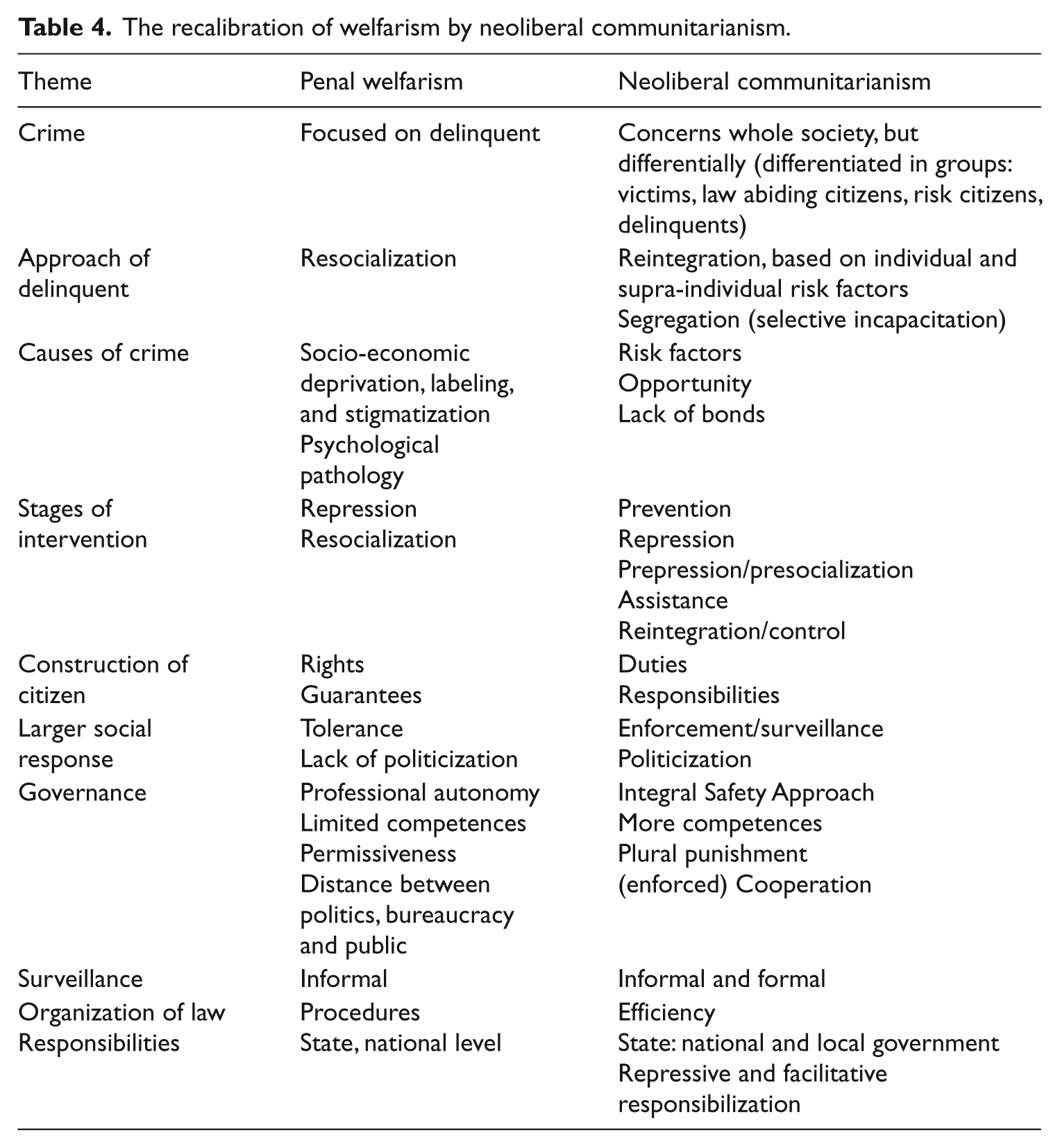
Contemporary Dutch government of crime involves a space of governing opened up between the opposites of neoliberalism and communitarianism. It may involve conflict, as communitarian-inspired actors may for instance oppose the managerialization of crime policies. Crucially, such contradictions are productive in shaping the field of crime and safety policies. A ‘rationale of governing’ can in this respect be seen as a complex reservoir of often contradictory yet practically compatible orderings, attributions, and legitimations. The strength of neoliberal communitarianism as such a rationale lies in its bridging of the field between the 19th-century opposition between individual and community. It therefore combines a wide array of criminological knowledge in the governing of crime. An equally wide range of policy problematizations, from individual to cultural community, is opened up, giving rise to often paradoxical combinations. It involves an often combined focus on community, social control, law and order, and the rational, biological, psychological, and self-controlling individual. And given its likely presence in the UK and France, neoliberal communitarianism may be considered as the typical European road to neoliberalism.
Footnotes
Acknowledgements
Thanks to Daniel Schinkel, Marguerite van den Berg, Hanna Becx, the anonymous referees, and to the editors for their valuable suggestions.