



Abstract
The growth in US incarcerated populations has produced unintended negative consequences for other justice system agencies. The community corrections field is faced with two related problems stemming from prison growth: (1) significant growth in populations under supervision and (2) populations with higher needs for service. I apply a theoretical framework adapted from organizational sociological research to address change and stasis as isomorphic processes. Criminologists rarely situate the community corrections field within broader theoretical perspectives. Instead, correctional researchers have studied the emergence, adjustment, and use of prisons in modern society, with community supervision considered a part of institutional corrections. I argue that contemporary explanations for correction policies need to be refined to account for specific trends within the community corrections field.
Keywords
Community corrections—also referred to as community sanctions, community penalties, or community-based punishments (Durnescu, 2008)—includes a host of criminal justice sanctions from pre-trial services, to probation, parole, and other forms of criminal justice supervision (McNeil, 2013). Remaining in the community, advocates suggest, assists individuals in avoiding the criminogenic elements of incarceration. It keeps them employed, and engaged with their families, friends, and communities (Petersilia, 2003).
Yet, there is surprisingly little known about community corrections populations. Whereas scholars, policymakers, and journalists have written at length about the causes and consequences of mass incarceration (Garland, 2001; Wacquant, 2000, 2005; Western, 2006), there has been little equivalent scrutiny of the dramatic and simultaneous growth in probation and parole (although see Durnescu, 2008; McNeil, 2013; Paparozzi and DeMichele, 2008; Van Kalmthout and Durnescu, 2008). Even less literature can be found on the organization and administration of community punishments and their links with incarceration (Phelps, 2013; Simon, 1993). In this article, I address these gaps in the literature, drawing on the work of organizational sociologists to make sense of the nature and development of community corrections and to suggest future research directions (DiMaggio and Powell, 1983; Hawley, 1968).
Organizational scholars use the term isomorphism to refer to three processes shaping an organizational field: imitation, professional norms, and coercion. Such factors, they say, shape the interconnections, shared meanings, goals, culture, and stakeholder expectations for a set of organizational units (DiMaggio and Powell, 1983). A field is held together through social networking, product developers and suppliers, consumers, regulatory bodies, and competition from other organizations.
Following Ryken Grattet and Valerie Jenness’ (2005: 895; Grattet et al., 1998) research on ‘how an entire field [i.e. law enforcement] of organizations responds to a larger public policy mandate’ in which the ‘unit of analysis is the field of organizations’, this article explores how evidence-based practices legislation, rhetoric, and informal movements are shaping the community corrections field. 1 By situating the broader evidence-based movement within existing neo-institutional theoretical frames (DiMaggio and Powell, 1983; Meyer and Rowan, 1977; Scott, 2001), I demonstrate how the evidence-based practices movement enables the community corrections field to compete as the legitimate location for the supervision of convicted individuals.
The community corrections profession competes for resources, power, and prestige with other potential locations for criminal offenders particularly prisons, jails, and mental health facilities. This rivalry occurs within a context in which corrections officials are not so much competing for ‘clients’—who are the endless flow of convicted individuals—but rather are struggling to be defined as the best solution to oversee them. In short, borrowing from the neo-institutional literature, I argue that the community corrections field is applying the evidence-based practices rhetoric to legitimate itself. First, however, I provide a brief description of the growth in carceral populations and in community corrections.
Community corrections growth: Not mass incarceration, but mass social control
Despite the limited attention paid to it by sociologists of punishment (for an exception, see Phelps, 2013), the numbers of people under supervision in the community far exceeds those held in prisons and jails. 2 In Germany, there were about 73,000 prisoners, in 2008, compared to 225,000 adults on community supervision (Morgenstern and Hecht, 2011). The situation in England and Wales is similar. In 2010, for instance, there were roughly 83,000 adults in prisons, and 240,000 on community sanctions (Ministry of Justice, 2010). As with most criminal justice patterns, the situation is more severe in the USA. Figure 1 depicts probation, parole, and prison rates per 100,000 from 1980 to 2010. Notice that probation rates have grown from about 500 per 100,000 to nearly 1500 per 100,000, prison has grown from about 200 per 100,000 to well over 500 per 100,000 and parole grew from about 100 per 100,000 to over 260 per 100,000. 3
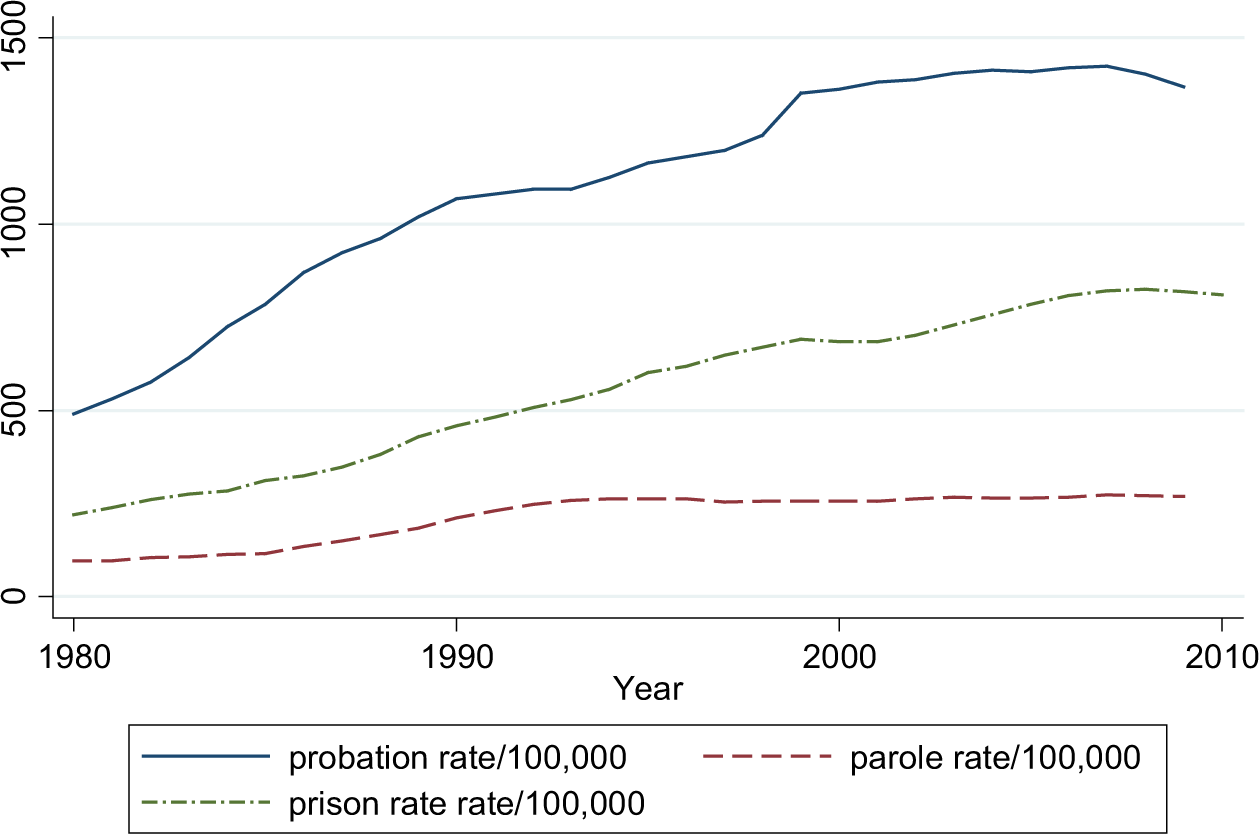
US criminal justice population rates, 1980–2010.
These rates reflect about 4 million, 2 million, and 1 million adults who are on probation, in prison, or released on parole, respectively (Maruschak and Bonczar, 2013). In other words, of 7 million adults under correctional control within the USA, 5 million or 70 percent are supervised within the community.
Indeed, according to Fergus McNeil (2013), academics, policymakers, and journalists, have been so preoccupied with incarceration that we have overlooked a parallel movement going on within our communities. Such an oversight, he argues, has fostered a shortsighted understanding of punishment that makes it difficult ‘to deliver the kinds of analyses that are now urgently required to engage with political, policy and practice communities grappling with the challenges of delivering justice efficiently and effectively in fiscally strained times’ (McNeil, 2013: 2). We are not only experiencing mass incarceration, but mass probation (Phelps, 2013), mass supervision (McNeil, 2013), or better still, mass social control 4 in which vast numbers of people are subject to productive and repressive technologies to encourage and enforce individuals to reconstitute themselves as ‘good citizens’.
While national and international variation makes a single all-encompassing definition difficult, typically those sentenced to a community penalty are required to observe a series of regulations or conditions—the violation of which could be cause for them to return to prison or jail, experience new or more extensive community conditions, and/or receive additional fines and fees. The mix of imposed conditions of supervision has been framed by several theorists as techniques of responsibilization provided through governance at-a-distance (Bosworth, 2007; Hannah-Moffat et al., 2009; Rose, 2000; Werth, 2012). Probationers and parolees thus live in the community where they ‘are expected to manage their own affairs, yet are subject to surveillance and extensive regulation’ (Werth, 2012: 331). Borrowing from Foucault’s (1991) notion of governmentality, community supervision inserts the state’s ability to employ technologies of the self and technologies of domination.
There is evidence that individuals on supervision experience their court ordered punishment as a social or generalized panopticon (Garland, 1990). Much like the prison inmates described by Foucault (1977), the men in a Philadelphia ghetto in Alice Goffman’s (2009) ethnography, lived under the constant threat of observation, invasion, and intrusion from police, outstanding warrants, and probation and parole officers. ‘On paper’ 5 these men curtailed their movements and were always aware of the potential threat of being stopped by police. Like prisoners, their constitutional protections were diminished, most notably their fourth amendment rights, allowing them to be stopped and searched at any time.
Despite the onerous conditions offenders endure, probation and parole continue to be considered by much of the public as a ‘soft’ option. Such a view stands in contrast to survey research suggesting that some offenders prefer to serve out their time in prison rather than on parole (Petersilia and Deschenes, 1994). Community penalties are not easy. In their study with offenders on electronic monitoring, for instance, Payne and Gainey (1998) documented numerous personal strains, weakened personal attachments, diminished employment opportunities, and everyday difficulties. Durnescu (2011) similarly described the ‘pains of probation’ in Romania including financial strains, reduced autonomy and privacy, and the constant threat of return to prison.
In the USA, the sheer diversity of conditions under which someone on supervision can be placed, opens convicted individuals to a number of punitive and rehabilitative controls that are so difficult to fulfill that revocations are likely (Lucken, 1997). Conditions of supervision vary widely, but they typically include electronic monitoring devices, scheduled and unscheduled home visits, drug tests, daily call-ins and a ban on associating with known felons. Many requirements are stipulated with little concern for the needs of the individual, developed instead as all-encompassing conditions for specific types of crimes (e.g. sex offender, domestic violence crimes, gang members) (Payne and DeMichele, 2011). In so doing, they reflect the ‘target intervention’ logic of evidence-based practice.
Evidence-based practices: From nothing works to what works?
Developed in response to the ‘nothing works’ agenda, associated with the 1974 article by Robert Martinson, 6 evidence-based practices seek to identify effective correctional programming and target interventions toward the offender’s conditions. Targeting interventions entails five elements: (1) risk principle; 7 (2) criminogenic need principle; (3) responsivity principle; (4) dosage; and (5) treatment. The risk principle is based on the belief that individuals present different levels of risk of failure on supervision, and agencies must target interventions accordingly (Andrews and Bonta, 2010). Risk, moreover, is contagious. Research has found that when low-risk individuals are placed in treatment services with high-risk individuals they perform worse (Lowenkamp and Latessa, 2002). Low-risk individuals manage relatively well on community supervision when their lives are interrupted the least, making them good candidates for the least intrusive interventions (Aos et al., 2006).
The criminogenic needs principle seeks to capture the changing or dynamic offender risk factors such as mental health, substance abuse, informal networks, employment, and other individualized factors related to psychosocial functioning (Taxman and Thanner, 2006). Whereas risk factors focus on past behaviors related to a person’s criminal history (i.e. characteristics that cannot be changed), the needs principle recognizes that characteristics such as ‘impulsivity, weak socialization, below average verbal intelligence, risk taking, weak problem solving and self-control skills … are directly related to the propensity to commit crime that can be changed in rehabilitation programs’ (MacKenzie, 2006: 59). Several proponents of evidence-based practices have used meta-analyses to show that rehabilitation programs can lower reoffending rates by addressing antisocial attitudes, temperament, personality, and criminal networks (Andrews and Bonta, 2010; Gendreau et al., 1996). Advocates demonstrate the ineffectiveness of purely punitive correctional responses that may have intuitive and popular appeal but do little to shape individuals’ behavior like boot camps.
Proponents of the responsivity principle argue that a variety of learning styles and approaches exist and that interventions should be assigned carefully to offenders according to their culture, gender, motivation levels, intelligence, and other areas (Andrews, 2006; Andrews et al., 1990). Treatment interventions are to be matched to each offender, and particular care should be taken to match style and methods of communication with an offender’s level of readiness to change behavior. 8 Mark Lipsey (1992) conducted a meta-analysis using 397 studies and found that treatment modality or the learning approach used to deliver the program had a significant impact on recidivism rates. Programs that used skill-based, behavioral-based, or some combination of these approaches to shape behavior had 20 to 40 percent lower recidivism rates compared to similar systems not using such learning approaches. In another meta-analysis of 443 studies, Losel (1995) also found skill and behavioral-based interventions reduced recidivism.
The dosage principle emphasizes the importance of the quantity of interventions. Providing either too many or too few services or structure to offenders’ lives may have a deleterious impact. Too much supervision or monitoring can lead to what Payne and Gainey (1998) referred to as the ‘brutalization effect’ and Lucken (1997) has named ‘sanction stacking.’ Payne and Gainey (1998) found that some offenders felt unfairly treated and frustrated by too many interventions or punishments, feeling that they cannot meet all of the conditions. When this happens they stop trying to change. Lucken (1997) argued that some community corrections agencies require a contradictory set of conditions that combine productive (i.e. rehabilitative) and repressive (i.e. punitive) techniques making it likely that individuals will fail.
Community corrections agencies seek to use officer time and resources efficiently. Some have moved large numbers of probationers from active supervision to administrative, banked, or unsupervised caseloads. In New York City, for example, nearly 70 percent of probation caseloads were moved to low intensity supervision reporting to an ATM-styled kiosk monthly to answer routine questions (e.g. residence, work compliance or treatment completion). In the case that any of these individuals were arrested, they would receive a message to meet with a probation officer, and individuals were selected for random drug testing. Other than these intermittent meetings with officers, individuals on the low-intensity caseloads would not report to an officer. Recidivism rates of those placed in this system did not change. While others, remaining on the higher-intensity caseloads, offended slightly less (Wilson et al., 2007). By reducing the amount of time with lower risk individuals, officers had more time to interact with higher-risk individuals.
This brief discussion of evidence-based practices sketches the contours of the movement underway within the community corrections field. Rather than demonstrate their efficacy, my purpose in this article is to demonstrate how the rhetoric associated with these strategies provides policymakers, administrators, and officers with a strategic response to the legitimacy crisis (Garland, 2001) facing correctional systems. As policymakers recognize that incarceration rates are exceeding budgetary capabilities, mass incarceration is proving unsustainable. But, the question remains: what to do with convicted individuals? The public does not want offenders to go free or to be unsupervised. The community corrections field could assume responsibility for many of them, but it needs adequate funding and legitimacy to do so. Evidence-based practices offer a familiar set of organizational routines used also in the medical, engineering, and business fields. It is this legitimacy and associated organizational practices that I examine below with DiMaggio and Powell’s (1983) theory of isomorphic institutionalization.
Organizational studies and community corrections
Institutions are durable yet malleable structures directing social action. They provide criminal justice actors with a ‘tool kit’ (Swidler, 1986) of sorts to reduce learning costs, increase efficiency, predictability in action, and establish self-reinforcing patterns over time. 9 As elsewhere, criminal justice practitioners navigate an institutional space that operates at variable levels of individual autonomy or discretion. As such, institutions offer organizational actors (e.g. bureaucrats, officers) ‘predetermined typifications’ of appropriate actions of the ‘specific ways’ decisions can be made and ‘under specific circumstances’ in which ‘specific types of individuals’ shall be punished (Berger and Luckman, 1966: 54). In this sense organizations provide what Anthony Giddens (1984) termed ‘structuration’. Rules and policies become institutionalized through a dual process in which organizational mandates shape the individuals within, while the organization itself is adjusted and reproduced by these same individual practitioners—‘the duality of social structure’.
In pursuit of legitimacy and prestige
Institutional theories often explain stability and change as adjustments to sources and definitions of legitimacy and prestige. Some organizational theorists account for change by arguing that fields work toward homogeneity or isomorphism as a way to reflect the structural nature and cultural sensibilities of the society in which they are embedded (DiMaggio and Powell, 1983; Grattet and Jenness, 2005; Scott, 2001). While the need for increased efficiency has homogenized many bureaucratic structures and organizations, DiMaggio and Powell (1983) remind us that structural change is driven less by competition or efficiency than it is by other factors. According to them, ‘bureaucratization and other forms of organizational change occur as the result of processes that make organizations more similar without necessarily making them more efficient’ (DiMaggio and Powell, 1983: 147). As organizations compete for resources, prestige, and legitimacy, their structure, culture, and tactics alter to emulate social rules and norms (Skaggs, 2009).
Definitions of prestige and legitimacy also shift over time. Consider Grattet and Jenness’ (2005) documentation of hate crime legislation. In their work, law enforcement officers, who had previously enforced racially biased laws, had to transform their behavior and world view when faced with the demands of hate crime legislation, or risk their legitimacy as a state agency. Similarly, in his ethnographic research in a parole agency, Simon (1993) documented that organizational goals redefined success toward lower revocation rates, leading officers to become more permissive in their recording of offender behavior. When revocation become a central metric of success, officers were no longer encouraged to ‘nail ’em, tail ’em, and jail ’em’.
The involvement of organizational leaders in broader spheres of influence also shapes matters of legitimacy and prestige. Organizational leaders—for example, agency heads, chiefs, directors, assistant chiefs and directors—operate within internal and external networks that condition the scope or reach of their social status. The degree to which leadership is involved with external professional networks relates to the implementation of evidence-based practices and rhetoric. A probation chief or judge, for instance, will hold a relatively high social ranking within his or her local community (internal network), but may be uninterested in participating in trade associations, statewide or regional trainings, or have little to do with those outside his or her local environment (external network). Other senior staff may be active in external social networks and seek out associational leadership positions, participate in national governmental panels, and dedicate resources to new research and training that may receive national coverage. These chiefs or judges participate in national debate about punishment and corrections and ‘have their stature reinforced by representation on the boards of organizations, participation in industry-wide or inter-industry councils, and consultation by agencies of government’ (DiMaggio and Powell, 1983: 153).
Coercive isomorphism
Organizational change is often involuntary. National governments can demand or incentivize lower-level state agencies to adopt specific practices, record particular information, and provide defined outcome results in standardized formats to protect their funding. Similarly, central state agencies or political bodies may require local jurisdictions to adopt specific practices, policies, or procedures. For instance, the National Conference of State Legislatures (2008) reported that six states (Alabama, Alaska, Illinois, Montana, Nevada, and New Hampshire) passed laws requiring corrections departments to ‘use evidence-based programs and policies that research has shown will reduce recidivism’ and shift the once-prison bound to community supervision. Other states passed laws mandating the risk and needs assessments to determine release dates for inmates (Arizona), program placement (California), and intake reentry planning (Washington) (National Conference of State Legislatures, 2008), and several states require community corrections agencies to conduct periodic workload assessments (e.g. Colorado, North Carolina, Oregon). And, national professional associations aid public agencies to respond to legislative calls with a predefined and standardized form of rhetoric and system of definitions of offender performance, such as the American Probation and Parole Association’s National Branding Initiative and Media Tool Kits (https://www.appa-net.org/).
In the community corrections field, coercive forces include pressures from central federal, regional, or state entities, criminal justice authorities, and political bodies. In this view, coercive isomorphism is a constraining force pressuring agencies to adopt a specific organizational structure or face potential cuts in resources. Agency values, beliefs, and meaning systems are shaped by forces outside of the control of any one organization and ‘depend on other organizations for the provision of vital resources, and this dependence is often reciprocal’ (Drees and Heugens, 2013: 1667). Power imbalances are met by managing mutual dependencies between more powerful and less powerful organizations (Drees and Heugens, 2013; Pfeffer and Salancik, 1978).
Although community supervision is centralized within national administrative bodies in many European countries, in the USA there are multiple administrative forms that are more decentralized. Parole and other post-incarceration forms of supervision are typically centralized at the state level and a separate administrative unit operates federal parole supervision. Probation, on the other hand, is more diversified, with services administered at the state or county level and further split according to misdemeanor and felony convictions. The US Bureau of Justice Statistics (BJS) has collected administrative data on probation and parole populations since the late 1970s, and their respondent list provides some insight about how probation and parole are administered within the USA. Parole data are collected from 55 respondents that include 50 central state reporters, the District of Columbia, the federal system, and two reporters in Alabama and California (Maruschak and Bonczar, 2013). The BJS relied on 468 respondents for the 2012 Annual Probation Survey, which included 33 central state reporters and 435 separate state, county, or court-level respondents. Probation is administered at either local or state judicial or executive levels with more than 2000 agencies across the country without any formal national structure to supervision practices (Abadinsky, 1997; Petersilia, 1998). Initially, probation was developed mostly through local county-level courts, but this has shifted to a more centralized framework administered by the executive branch, with about one-quarter of the states administering adult probation through the judicial branch (Petersilia, 1998).
Following DiMaggio and Powell, we would expect that greater centralization would foster increased coercive isomorphism, in this case, leading to the increased adoption of evidence-based practices. The decentralized nature of probation requires administrators to follow state laws and general guidelines, but they have broad discretion regarding their agency’s philosophy, mission, and agenda. With such an organizational structure, there is a greater likelihood for decoupling of the agency mission from that of the central state, and hence greater potential for resistance to evidence-based practices.
In jurisdictions where probation is administered at the county level there can be little centralized direction regarding what policies, programs, and practices will be used. State-based criminal justice authorities may wish to develop and implement a new risk–need assessment instrument, but county chiefs have broad discretion about how instruments are actually used in practice. This is not to suggest that chiefs have carte blanche. They, of course, do not. However, given the decentralized nature of probation administration, they have more scope to ignore evidence-based policies (Hubbard et al., 2001).
Changes coming from centralized authorities are all too easily framed as overreaching local authority. In those cases in which the changes are mandatory, they may be implemented in form more than substance. Risk assessments may be completed as a matter of bureaucratic necessity as all items will be checked-off, scores tallied, and forms filed, but the officer–offender interaction will not revolve around the information contained in the assessments (Bonta et al., 2004; Lowenkamp et al., 2006). Danielle Rudes (2011) using frame analysis in her three-year ethnographic study in California demonstrated how middle managers were to ‘sell’ a series of statewide policy directives to street-level parole agents, known as the New Parole Model. She found that middle managers used principled morality frames to support parole agents, but despite these efforts Rudes (2011) found that several agents were doing the bare minimum in order to appease upper management. For instance, agents lacked support for a new requirement to send parolees to drug treatment, and some officers were merely meeting the minimum requirements by referring one parolee per month. One officer told Rudes (2011: 17) ‘as long as each agent in her unit sends one parolee a month to fill the treatment beds, Sacramento will stay off our backs’.
Community corrections practices are often determined by external forces. Legislation frequently creates specific penalties for entire classes or groups of offenders. These mandates include an assortment of restrictions for sex offenders, GPS for domestic violence offenders, and intensive supervision for those identified as a gang member. Scholars have routinely shown that criminal justice policies are influenced by the media transformation of crimes into moral panics in which lawmakers respond with dramatic knee-jerk policies that often ignore the realities of the crime and realistic reduction strategies (Beckett, 1997). In the community corrections field, this means that actors are required to respond to certain crimes. Coercive isomorphic changes in the community corrections field tend to come from politicians responding to sensationalized criminal events in which potentially unanticipated consequences are ignored (Payne and DeMichele, 2011). The push for legislation around electronic supervision technologies especially for sex offenders provides a prime example of coercive isomorphism. Many states have passed legislation forcing community corrections agencies to purchase, install, and maintain electronic supervision technologies for sex offenders and other offense categories. Button, DeMichele, and Payne (2009) conducted a content analysis of legal statutes in the United States and found that 94 percent (n = 47) of states had specific legislation stipulating the use of electronic supervision technologies with convicted individuals. Of these states with such legislation, 19 states required electronic monitoring of sex offenders and in some states sex offenders are to be on community supervision for the remainder of the individual’s life (Button et al., 2009). These decisions, although popular at the ballot box, have potentially unintended consequences for community corrections agencies due to ‘increased workloads …, the need for expansive training, and increased, and perhaps unrealistic, expectations’ (Button et al., 2009: 433).
The community corrections field is situated within a broader criminal justice and legal apparatus in which these larger bureaucratic structures have the authority to demand the adoption of evidence-based practices. Probation and parole officers, after all, work in conjunction with law enforcement, the judiciary, and prison and jail officials. The further embedded the community corrections system is, within the criminal justice system we would expect to find a greater likelihood of coercive isomorphism. Community corrections agencies must follow statutorily defined practices, legislative mandates, and legal procedures. In some ways, then, community corrections agencies occupy a central spot within a broader criminal enforcement and punishment bureaucratic machinery. The community corrections field has struggled to find a clear role identity, situated between law enforcement and social work (Clear and Latessa, 1990). 10 These agencies occupy a nuanced terrain, required to enforce and facilitate, supervise yet motivate, and hold offenders accountable while simultaneously modeling pro-social behavior.
Unlike the uniform and weapons of law enforcement, or the barbed-wire fences, observation towers and walls of prison, community corrections arguably lacks familiar symbolic power. Agents also lack the political and administrative power to drive definitions of successful supervision practices. Instead, the community corrections field is widely considered the lower ranking arm of a larger criminal justice apparatus. Community corrections agencies have responded to this legitimacy competition by highlighting their ability to be effective at something law enforcement and institutional corrections have yet to achieve – rehabilitation measured as lower recidivism.
Mimetic isomorphism
Isomorphic processes do not only flow from coercion. Many agencies rely on forms of mimetic institutionalization to resolve issues of uncertainty in goals, processes, and expectations. DiMaggio and Powell (1983: 151) demonstrate that there are advantages for organizations to model behavior of focal agencies or those agencies defined as ‘successful’, ‘innovative’, or early-adopters especially when facing ‘problems with ambiguous causes or unclear solutions’. Lack of goal consensus can become a powerful source motivating imitation as modeling is an efficient and inexpensive approach to organizational structure. The community corrections field, nearly since its founding in the late 19th century, has lacked clear goal directives (Linder and Savarese, 1984).
The balancing act between rehabilitation and punishment facing the community corrections field is amplified within the current context of mass supervision or mass social control. Agencies are struggling to figure out how they can remain publically viable and fiscally affordable as more inmates are being released onto probation and parole during tight economic times (Paparozzi and DeMichele, 2008). What is the goal of community supervision? Are these organizations to protect, prevent, rehabilitate, or punish? How are officers to accomplish their goal(s)? Should probation and parole officers carry firearms, make arrests, and conduct searches? Regarding expectations, what is the right amount of recidivism, and how should it be operationalized? Evidence-based practices rhetoric suggests that community corrections supervision can deliver retributive punishments and facilitate rehabilitation. This rhetoric is not entirely new, Linder and Savarese (1984) demonstrated in their review of the legal infrastructure that probation at the turn of the 20th century was a confluence of social worker and law enforcement techniques, personnel, and administrative structures.
Mimesis occurs through several processes including workforce spillover, uniformity in state and national training entities, and external realities that motivate organizations to imitate other organizations perceived as successful. ‘The ubiquity of certain kinds of structural arrangements,’ DiMaggio and Powell (1983: 152) write, ‘can more likely be credited to the universality of mimetic processes than to any concrete evidence that the adopted models enhance efficiency.’ Higher levels of spillover foster increased mimesis as leaders cross geographic and governmental boundaries, transitioning between different agencies. A well-known example of mimesis can be found in the manner in which Compstat and similar policing models spread throughout the country when specific enforcement executives were transferred across the country.
Similar examples exist in the community corrections field. Prominent leaders move across state and provincial boundaries, flow between state and national positions, and transition between government and non-governmental positions—even working as consultants or contractors upon retirement. The policy transfer literature is helpful to understand how ideas, policies, and administrative arrangements can shift from one location to another. Mimetic isomorphic institutionalization is most closely related to ‘emulation as the strongest form of transfer, entailing borrowing a policy model more or less intact from another jurisdiction (inevitably there will be adaptation to accommodate contextual differences)’ (Bulmer and Padgett, 2004: 106). Some years ago, Tim Newburn (2002) argued that US style crime control tactics have crossed the Atlantic and pervaded British policy debates and realities. Few, however, have recognized how similar processes of modeling, emulation, and mimicry take place within a single national context. Yet as evidence-based practices rhetoric becomes defined as the ‘right way’ to supervise individuals in the community—backed up by an administrative legal force—agencies will seek out individuals able to speak this language, implement these practices, and provide the justifications and credentials needed to demonstrate their capabilities.
An important element of mimesis in the community corrections field can be found in the manner in which it fits within governmental policy regime structures. Katherine Beckett and Bruce Western (2001) in the USA and Michael Cavadino and Paul Dignan (2006) in the UK have demonstrated that governments have relatively consistent incarceration and welfare policies as an overall strategic response to social marginality. More recently, I have argued elsewhere that the western countries follow three primary punishment regime types according to their levels of adversarialism, discretion, and public punitivism (DeMichele, 2013). Community corrections in more inclusive jurisdictions seem to be quicker to implement evidence-based changes. While policy regime research is only beginning to investigate how community corrections fits into an overall control framework (see Phelps, 2013), scholarship on US and comparative incarceration trends suggests that probation and parole practices fit within an overall governance control agenda.
Normative isomorphism
Finally, normative isomorphism results from the training, socialization, and interaction involved in professionalization. For DiMaggio and Powell (1983: 151–152) professionalization is ‘the collective struggle of members of an occupation to define the conditions and methods of their work to control the production of producers, and to establish a cognitive base and legitimation for their occupational autonomy’. Professional standards and credentials utilize formal systems of training and education to provide certain knowledge, skills, and beliefs. Formal training systems provide employees with a cognitive framework filled with appropriate action sequences for various potential interactions needed to perform official functions, similar to Bourdieu’s (1977) notion of habitus. Those in an organizational field experience a particular socialization about the acceptable expectations for personal behavior, style of dress, and language including allowable methods of speaking, joking, or addressing others (DiMaggio and Powell, 1983).
The professionalization of community corrections administrators and officers ‘tends to create a particular world view of appropriate organizational behavior’ (Fligstein, 1985: 380). DiMaggio and Powell (1983) and other organizational scholars show that professional world views are developed and transmitted by trade associations, researchers, academics, and informal interactions among staff. How do community corrections officers know how to interact with offenders, how to respond to violations, or when to schedule drug tests? The nature and frequency of some tasks are clearly defined by procedural mandates (i.e. workload standards), but the more subtle effects of professionalization results in a cultured-cognitive apparatus that officers use to filter their daily experiences. During the late 1970s, the criminal justice system experienced a cultural transformation that embraced the death of rehabilitation (Allen, 1981) and the acceptance of nothing works (Martinson, 1974). Many criminologists have written about the nothing works era (see Cullen, 2005) that was solidified into public consciousness with Martinson’s 60 Minutes interview in which he clearly stated that criminal treatment approaches have ‘no fundamental effect on recidivism’ (Martinson’s quote found in Cullen, 2005: 9). The criminal justice system was accepting a new world view that focused on harsh treatment of law violators.
Accepted crime control practices were moving away from rehabilitation, indeterminate sentences, and treatment strategies to reduce reoffending. Martinson is not to blame for the punitive turn. In fact, David Garland (2001) demonstrated that conservative (Wilson, 1975) and liberal scholars were questioning rehabilitation and correctional treatment. Rehabilitation became either a way to coddle criminals or a form of net widening. During an era of nothing works and mass incarceration, the community corrections field needed to appear more enforcement-oriented, and agencies relied on surveillance, enforcement, and accountability. In such contexts, officers were rewarded for higher recidivism rates to demonstrate they were ferreting out technical violations, positive drug tests, and new infractions (Simon, 1993). Recidivism and definitions of offender success or failure are fluid and allow agencies to adjust the definitions of these terms depending on broader social movements.
As a response to the nothing works message, criminologists studied the potential for structured treatment and less punitive methods to shape offender behavior (Cullen, 2005). Ted Palmer (1978) reanalyzed Martinson’s data and found that nearly half of the programs studied had a positive impact on offenders’ lives. Don Andrews and James Bonta, two Canadian applied scientists, developed a correctional treatment theory known as the principles of effective intervention (Cullen, 2005). Joan Petersilia and Susan Turner (1993) found that intensive supervision programs increased offender violations and had little impact on new crimes. Doris MacKenzie et al. (2001) argued that boot camps and shock probation were ineffective at reducing recidivism as they relied on military style harsh treatment of mostly poor young men. Together academics were clear, ‘deterrence-style programs were likely theoretically flawed and, in practice, ineffective’ (Cullen, 2005: 21).
These research findings challenged the dominant crime control paradigm that had shaped corrections policies from the late 1970s until the early 2000s. To change practitioners’ viewpoints required no less than a major shift in the training, professionalization, and accreditation system. Thus, the US Department of Justice funded training and technical assistance projects to inform practitioners about the potential of evidence-based practices. The National Institute of Corrections and the Bureau of Justice Assistance financially supported treatment-oriented programs and program evaluations, sending trainers to jurisdictions, while maintaining a cadre of office-based consultants to provide technical assistance. Many of these government initiatives provide partial support for academic research centers such as George Mason University’s Center for Advancing Correctional Excellence or University of Cincinnati’s Corrections Institute. These centers, in turn, train practitioners to run workshops and offer technical assistance providers, key note speakers, and evaluators.
The evidence-based practices movement emphasizes such practitioner–researcher collaborations. The collaborations are necessary for researchers to collect data and study justice practices. They also provide a direct opportunity to spread evidence-based practices through normative isomorphic institutionalization processes. In other words, a central component of evidence-based practices is to educate the community corrections field about structured interventions with convicted individuals. While there is diversity among community corrections organizations, there is also similarity in the roles and expectations for officers across the country. Normative standards move among jurisdictions, similar to the processes of mimetic change except normative change identifies the changes in actual culture and an acceptance of organizational meanings for employees.
Conclusion
The sociology of punishment has overlooked numerous changes occurring within the community corrections field. This article sets out some initial thoughts about how and why the community corrections field is adapting to broader social and organizational changes. The evidence-based practices agenda was framed as a response to a legitimacy crisis in which the community corrections field is positioning itself as the primary location for the supervision of convicted individuals as a response to mass incarceration. Some agencies are embracing evidence-based practices as an effective and efficient alternative to incarceration. Others are engaged in the rhetoric of change, but are unsuccessful in altering how individuals experience community supervision. Still other agencies are uninterested or refusing to shift.
Community corrections reflects social structures that integrate responsibilization along with repressive technologies to shape and punish actors (Foucault, 1991; Hannah-Moffat, 2005; Werth, 2013). 11 There is overwhelming research demonstrating the deleterious effects that the criminal justice system has on the poor, the uneducated, and minorities (Wacquant, 2009; Western, 2006). Scholars from different backgrounds need to work together to identify supervision practices that, instead of exacerbating such structural disadvantages as blocked citizenship rights (e.g. felony voting restrictions), blocked employment opportunities, and reduced welfare provisions, scholars should seek to identify ways in which community supervision can assist convicted individuals to navigate through society despite carrying the conviction stigma.
The sociology of punishment has for many years concentrated on the nature, effects, and causes of mass incarceration. Recently, prison overcrowding, collateral consequences, and resource issues have shifted the political attention toward ways to reduce incarceration. While some commentators are looking to evidence-based practices to shift offenders from institutional to community punishments, probation and parole systems have been used to unprecedented levels as well, leaving little room for any additional community supervision. We are left then, at an impasse. In this article, I hope to have motivated others to use the full spectrum of social science methods to investigate the social structuring, cultural frameworks, and pragmatic approaches to community corrections.
Footnotes
Acknowledgements
I thank Michelle Phelps, two anonymous reviewers, and Mary Bosworth for helpful comments on earlier drafts of this article.