



Abstract
This article brings the concept of incorporation as used in studies of citizenship into the analysis of the reception of ex-prisoners by non-governmental organizations (NGOs). I introduce the concept of ‘prisoner incorporation’ to illustrate the ways in which NGOs, tasked with reentry work through devolution policies, include ex-prisoners as citizens. I use data from policy and organizational documents, interviews with staff at 18 NGOs, and program observations to demonstrate that incorporation varies by religious and political orientation and the receipt of Department of Corrections (DOC) funding. I distinguish between NGOs focused on ‘classic reentry’, which emphasizes treatment and work-focused economic incorporation, and those focused on ‘broader incorporation’, in which domestic labor, culture, religion, and politics warrant the inclusion of ex-prisoners as citizens in particular communities. Based on the results, I reconsider arguments that NGOs have a limited ability to shape the citizenship of criminalized people.
As states have withdrawn from direct service provision, they have increasingly called on non-governmental organizations (NGOs) to serve and care for ex-prisoners. In what is often called the ‘prisoner reentry’ or ‘prisoner reintegration’ industry, NGOs run voluntary and mandatory programming for the growing number of released prisoners in the United States, a population that a preliminary estimate placed at a minimum of 7.7 million individuals (Shannon et al., 2011: 13). Both policy-makers and practitioners have sought to use these programs to modify ex-prisoners’ cognitive processes, skills, resources, opportunities, rights, and group memberships (Haney, 2010; McKim, 2008; McRoberts, 2002: 10; Miller, 2014). Reentry programming includes topics as diverse as job readiness, addiction recovery, and Bible study.
Borrowing the concept of incorporation from the literature on migration and citizenship, I examine prisoner reentry as an institutional process that is structured by state policy and occurs primarily in the NGO sector. Using data from Wisconsin, I analyze the reception of released prisoners in terms of what I call ‘prisoner incorporation’: the practices through which NGOs intervene into the lives of ex-prisoners. The results illustrate that NGOs involved in work with formerly incarcerated people significantly differ. Two primary types of organizations emerged in the results: ‘classic reentry’ NGOs align with state correctional policy, have neutral political beliefs, are rarely faith based, and have a conditional view of prisoner citizenship, while ‘broader incorporation’ NGOs are guided by either progressive politics or the politics of the religious right and tend to view ex-prisoners as having an ongoing claim to resources and participation in communities. Based on the results, I reconsider the significance of the NGO sector for prisoner reentry and conclude that NGOs may have more agency to diverge from the goals of state reentry policy than many previous researchers have recognized.
Prisoner reentry
A growing number of policy-makers support the idea of facilitating a ‘second chance’ for ex-prisoners via spending on post-release services. A movement emerged in the late 1990s in the United States to promote ‘prisoner reentry’, or ‘activities that prepare ex-convicts to return safely to the community and to live as law-abiding citizens’ (Petersilia, 2003: 3; Toney, 2007: 233; Travis, 2000, 2007). Even as this movement gained strength, however, governments distanced themselves from taking responsibility for service provision for this growing population. State policies influence two processes that crucially shape the reception of prisoners: first, the re-articulation of the importance of community and the responsibilization of specific community actors, and second, the privatization of work through the formation of contractual agreements with these non-state actors.
First, state policies that re-conceptualize correctional work as the purview of the community have shaped the reception of prisoners. At the inception of the modern nation-state, western governments took dramatic measures to monopolize the power to punish (Spierenburg, 1995). However, officials and NGOs now jointly manage the administration of punishment and social services. The language of partnerships and private–public collaborations now dominates policy discussions of punishment (Garland, 1996; Haney, 2010; Miller, 2014; Myrda and Cullen, 1998). This re-articulation means individuals are increasingly governed through their relationships to communities, which also shape the individuals within them in terms of morality and ideas about what makes a ‘competent citizen’ (Rose, 1996: 331). Further, states have responsibilized specific community actors, particularly individuals and NGOs (Garland, 1996; Haney, 2004). Thus, in and beyond the United States, states are ‘shaping the powers and wills of autonomous entities’ to do what the state will not do (Hannah-Moffat, 2000: 163).
Second, states’ reliance on formal privatization has shaped the reception of ex-prisoners in the United States. From defense to social services, government agencies increasingly pay non-state entities (non-profit or for profit) to provide goods or services rather than providing them directly (DeHoog, 1996; Milward and Provan, 1993). States now route released prisoners away from state offices and to NGOs for direct services via contract.
As a result of these changes, NGOs have begun to play an increasingly important role in shaping the ways that released prisoners are socially included. For example, governmentality scholars have found that NGOs work to align participants’ behavior with the state’s aims, communicate social and moral rules, and encourage behavior changes (Moore, 2007; Singh, 2012). The widening of the type and number of actors delegated to do this work means, in Lynne Haney’s terms, the state becomes less bounded. As this pool of actors expands, it is likely that ‘institutional practices and agendas’ will diversify and tools will multiply (Haney, 2010: 19). In this article, I draw attention to variation in the incorporation work of NGOs that serve ex-prisoners, which though all working amid the processes of responsibilization and privatization, engage in quite different types of outreach.
Prisoner incorporation
Incorporation is the process of extending citizenship to newly recognized members of a society, such as immigrants and new political constituents (Berkovitch, 1999; Soysal, 1994). Research on incorporation examines the inclusion of these members into communities that make possible the practice of rights (Marshall, 1964; Yuval-Davis, 1997). Incorporation research builds on the work of TH Marshall, who identified citizenship as a claim to acceptance as a full member of a society—not only a legal status that accords rights and benefits, but also the opportunity to participate politically, economically, and civically, and to be recognized as belonging (Bloemraad, 2006; Bloemraad et al., 2008). Following Marshall’s approach, I understand citizenship as a condition based on the recognition of people as members of communities, and views communities as creating the social conditions within which citizens exercise their rights (Benhabib, 2004; Bloemraad, 2006; Glenn, 2002; Marshall, 1964).
The institutionalized ways in which officials and front-line workers talk about and work with newly recognized members are focal for incorporation researchers. Incorporation researchers assert that the reception structures used by states and the non-state sector have more influence over the societal involvement of new members than the members’ cultural characteristics and individual traits (Soysal, 1994). This body of work especially emphasizes practices of incorporation, particularly those enacted by officials.
I extend this literature by applying the concept of incorporation to research on the penal state; specifically, I use incorporation as a conceptual tool to illuminate the ways in which institutional actors (especially NGOs) target, process, and route ex-prisoners to prepare them for citizenship. I uncover multiple dimensions and forms of what I call ‘prisoner incorporation’, which are the concrete practices used to socially include former prisoners in communities that intervene in the life of the individual to prepare him or her for life as a full member.
My approach emphasizes the process through which former prisoners are socially included and recognized as societal members. This process occurs within communities (Glenn, 2002), defined as groups that are organized around common values or place, and offer affiliation in the form of a common sense of origin or destiny. I examine specific practices—including preparation for employment, democratic participation, civic engagement, and participation in faith-related activities—that enable the enactment of these rights within these communities.
The concept of prisoner incorporation provides advantages over the presently used concepts of reentry and reintegration. Authors have critiqued the idea of ‘reentry’ for the assumption of symmetry implied by the ‘re’ prefix. One of the ways the concept of ‘reentry’ inaccurately reflects actual social processes is assuming previous inclusion—many marginalized people were not included in institutions providing these forms of membership prior to incarceration (Shantz et al., 2009). Discussing incorporation recognizes the importance of organizations in reducing inequalities in access to resources for criminalized people (Brayne, 2014; Castellano, 2005: 238). The concept moves beyond a problematic and limited understanding of the benefits of organizational outreach in terms of merely providing ‘prosocial adult activity’ that will reduce recidivism.
Unlike rehabilitation, prisoner incorporation describes work on the ground that seeks to do more than just change individuals’ medical states or skills. Incorporation moves the focus to group settings where organized actors interface with former prisoners to provide programming and resources, teaching and offering means to practice citizenship. Incorporation also means something different than reintegration: rather than recognition on a symbolic and social psychological level, the emphasis in incorporation is on civic inclusion in activities. I deliberately move into language of incorporation, citizenship and belonging in order to speak more directly to the ways institutions include formerly incarcerated people as citizens.
Previous research on prisoner reentry work
The extant research includes two types of arguments about the significance of reentry work in the NGO sector in the context of the penal state. The first type, which I call contain-and-control, asserts that the prohibitive aspects of the penal state have become all-encompassing and diminish citizenship for all. Techniques to control risk extend far beyond correctional institutions or criminalized people (Barker, 2009; Simon, 2007). Authors particularly recognize the ways in which a risk or waste management approach treats criminalized people as waste that must be contained (Feeley and Simon, 1992; Simon, 1993, 2007; also see Lynch, 1998). Loïc Wacquant (2010a: 214) observes that the ‘invasive, expansive, and expensive penal state’ extends to new social and physical spaces, punitively containing the urban poor. Decentralized penal programs thus facilitate the state’s ability to control and contain the bodies of the criminalized poor and undermine citizenship for all (Thompkins et al., 2010). The contain-and-control argument presumes collaboration and collusion between the state and NGOs. Writing on surveillance by organizations not typically associated with crime control, Sarah Brayne (2014: 367) describes many kinds of organizations as engaging in the ‘collection and analysis of information about populations in order to govern their activity’.
The second type of argument, which I call co-opted productivity, emphasizes the ways in which NGOs encourage personal transformation at decentralized sites. In this view, NGOs work to impact criminalized participants’ citizenship in constrained ways; they produce citizens only as narrowly defined by the interests of the state or market (Goodkind, 2009; McKim, 2008; Rose, 1996; Thompkins, 2010). For example, NGOs satisfy specific policy directives such as preparing job-ready graduates (Goodkind, 2009; Miller, 2014; Wacquant, 2010b). Lynne Haney (2010) has written that decentralized interventions in the age of neoliberalism and recision of welfare rights orient program participants toward low-wage work and away from a relationship with the welfare state.
Employing these perspectives, most studies of NGO-sponsored prisoner reentry programs have maintained that NGOs’ activities align closely with state policy guidelines and goals, or that NGOs have little agency to develop and implement their own specific objectives. However, research by Ursula Castellano (2011) and Nicole Marwell (2004) on non-profit activity in the closely related areas of social services and diversionary sentencing has revealed a range of goals and practices among NGOs. These authors’ work on variation in how NGOs understand and interact with the state, along with Brayne’s (2014) research, suggests the importance of examining variation in how organizations understand and encourage practices with program participants. The current study extends this project of understanding such variation to NGOs involved in prisoner reentry in the state of Wisconsin. I show that the forms of prisoner incorporation that NGOs implement are more diverse and divergent from state policy than prior work has described.
Wisconsin’s reentry policy
The state of Wisconsin launched its first ‘reentry initiative’ in 2005 when the United States Department of Justice selected the Wisconsin Department of Corrections (DOC) to undergo specialized staff training on reentry (Frank, 2005). The federal Prisoner Reentry Initiative (PRI), which allocated these funds, advocated community partnerships that ‘harness[ed] the resources and experience of faith-based and community organizations in providing newly released prisoners with job training and placement services’ (US Department of Justice, 2008). PRI responsibilized NGOs to shape ex-prisoners as citizens through programs ‘designed to give ex-offenders a second chance to become productive citizens’ (US Department of Justice, 2008). This federal policy defined citizenship in the limited sense of ex-prisoners’ law-abidingness and labor market productivity.
Mirroring the federal PRI, subsequent reentry initiatives in Wisconsin have articulated the importance of community and have encouraged community responsibilization. DOC policy has repeatedly asked the community at large to ‘partner’ with the agency. A DOC press release from 2005 describes partnerships in which government and organizations jointly seek to ‘promote successful prisoner reentry programs’ (Frank, 2005: 2). A 2008 policy report asserted that ‘one agency cannot accomplish community safety on its own’ (Raemisch, 2008: 12). Although policies articulate that the community is responsible for shaping former prisoners as citizens (Lang, 2010: 3), these broad policy statements do not delineate the characteristics of the particular communities doing the work.
The state DOC’s move to a formal reentry policy further mirrors the PRI by engaging limited ideas about what prisoners’ citizenship means. The state’s first reentry director used the term citizen to refer to a compliant individual when she concluded that it ‘makes all of us safer’ when people receive ‘services and tools so that when they get out they can be law-abiding citizens’ (Hall, 2011). DOC administrators use this phrasing frequently, suggesting that the DOC views the ideal program as providing something ex-prisoners lack (i.e. services or tools) in order to create compliant supervisees. Law-abidingness is an important component of this definition of citizenship.
Officials have articulated the goal of reentry as ‘offenders’ leading ‘successful, crime-free lives’ once released (Frank, 2005: 1). Shaping ex-prisoners to fit the definition of a law-abiding citizen is a vital part of this goal. The DOC (2012: 11) maintains that ‘the singular goal [of reentry] is to change behavior so offenders adopt law-abiding lifestyles’. Policy-makers contend that meeting this goal will lead to a reduction in taxpayer expenditures, fewer new crimes and victims, and lower rates of recidivism. In general, these reentry initiatives have focused on those who have committed lower-level offenses.
Policies that seek to privatize post-release services reveal more specific ideas about how these services should shape ex-prisoners. Wisconsin has been a national leader among state and county governments in devolving public services, particularly social services, to non-state actors via formal privatization agreements (Mayer, 2007: 241). State and national officials have made informal requests for community participation in community-based correctional service delivery. In addition, the DOC oversees a competitive process to award contracts to the lowest responsible bidder or the highest scoring proposer (State Bureau of Procurement, 2011). 1 NGOs cannot rely only on DOC funds, however, because a small number are granted most of the contracts; organizations receive funds from many other governmental and private funding sources, as well.
These DOC funds cover limited areas of prisoner incorporation work. I identified two modes of prisoner incorporation for which major funds have been allocated. First, funds are allocated for treatment or counseling-based work that seeks to improve mental health and address addiction. Second, funds are allocated for economic interventions that prepare clients for labor market engagement. 2 These two types of work are among the areas ‘that evidence has shown to be successful and to reduce recidivism’ (Lang, 2010: 2).
The department’s requests for bids and proposals illustrate the ways in which the DOC further mirrors the PRI’s limited visions of prisoners’ citizenship. Documents do not specifically identify the communities in which they want prisoners to participate on a long-term basis. For example, in 2010, the DOC requested bids for a program that would ‘increase the involvement of natural support systems (family members, community mentors, etc.) in the delivery of services to offenders’ (Department of Corrections, 2010). Rather than envision long-term integration in specific communities, the documents emphasize short-term treatment teams.
Wisconsin’s DOC acknowledges and works with religious organizations, but is cautious when state funding is involved. Federal law stipulates that the DOC and other agencies must not require clients to be served in faith-based settings. There is a long history of church involvement with prisoners in Wisconsin, and as reentry policy has developed, the DOC has stated that the agency is open to ‘working with’ faith-based ‘partners’ (Schneider, 2003). The DOC’s requests for bids continue to specify that faith-based organizations are eligible bidders, with stipulations (Department of Corrections, 2008). 3
The development of Wisconsin’s reentry initiative, including requests to partner with community agencies, an increase in formal privatization agreements, and the dispersal of state funds to NGOs serving ex-prisoners, illustrates the expanding influence of privatization and responsibilization. These dual processes of privatization and responsibilization shape the landscape in which NGOs work with formerly incarcerated people, at times overtly through the provision of funding, and at times indirectly through communicating expectations that the community at large will assist the state by working with the unprecedented numbers of ex-prisoners.
Data and methods
To understand the various ways in which NGOs shape criminalized people’s prospects for citizenship as members in communities, I analyzed prisoner incorporation at 18 NGOs in two counties in Wisconsin. I collected data from 2009 through 2013 as part of a larger project on formerly incarcerated women’s contact with NGOs in Wisconsin. Like other states, Wisconsin has passed tough-on-crime and mandatory sentencing laws, resulting in a sharp rise in its prison population (Oliver, 2009). A preliminary estimate indicated that 70,200 ex-prisoners lived in Wisconsin at the end of 2010 (Shannon et al., 2011: 13).
The analysis relies heavily on documentary data. I examined official reports, training and recruitment materials (i.e. Cavanaugh and Lopez, 2013), news articles, state budgets, administrative forms, legislative hearings records, and procurement records for the DOC’s Division of Community Corrections. I also collected documents pertaining to the work of 18 NGOs in the two counties (Milwaukee and Dane) to which most prisoners in Wisconsin return. 4 I included organizations that focus on ex-prisoners, ran groups for ex-prisoners, and were willing to work with women. 5 For each NGO, I examined organizational documents, including descriptions of the mission from websites, newsletters, bylaws filed with the Wisconsin Department of Financial Institutions, and program directory summaries. I also examined funding records using 990 tax forms, the state’s purchasing website, VendorNet, and directories of non-profits (Center for Self-Sufficiency, 2010; Foundations Center, 2011; Taft Group, 2009).
In addition, I conducted formal and informal interviews with 26 state government employees, mainly DOC staff, as well as 64 staff members and directors at NGOs. Interviews with NGO staff focused on organizational goals, history, clientele, and programs. I also collected observational data during interview visits. 6 Finally, I directly observed at least one program session at each of seven focal organizations (Table 1).
Features of organizations, sorted by programming activities.
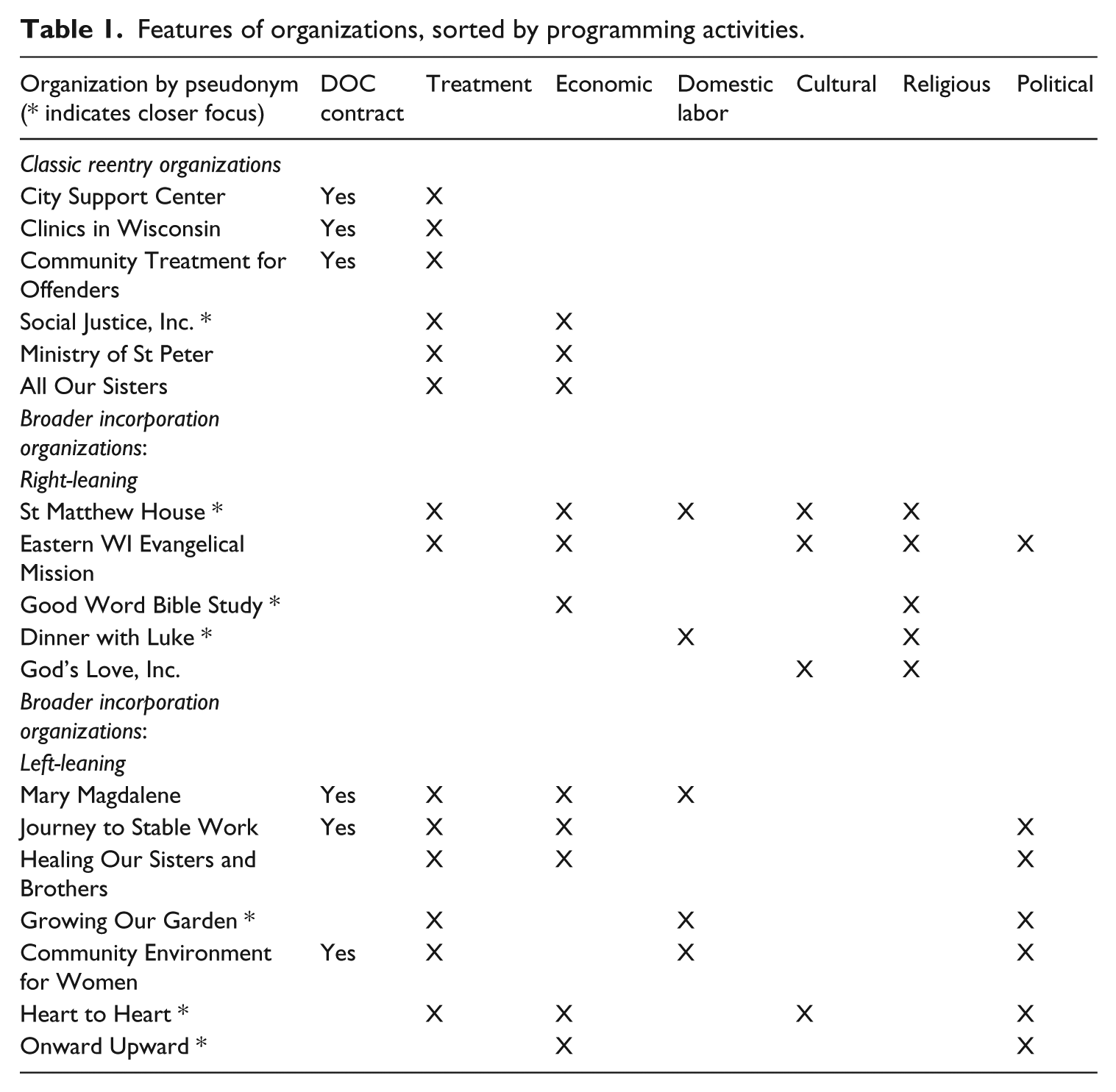
I classified modes of incorporation based on my observations of NGO practices during visits and based on activities described during interviews. I identified patterns (e.g. a focus on encouraging an appreciation of domestic labor) as I hand-coded field notes. The analysis of modes of incorporation allowed me to distinguish between two types of NGOs: ‘classic reentry’ organizations, which incorporate prisoners using exclusively the state-preferred emphasis on work and treatment, and ‘broader incorporation’ organizations, which engage in additional forms of prisoner incorporation.
Further, I analyzed discourse in NGO documents to support my classification of incorporation activities. Using NVivo, I conducted term searches for keywords identified with themes in organizational documents (brochures, mission statements, program description, etc.). By dividing the raw number of occurrences of these terms by the total number of words in the documents, I developed an indicator of how frequently these topics were discussed in organizational documents. These word frequency patterns allowed me to identify similar characteristics across NGOs. 7
Results
Modes of prisoner incorporation
The state’s invitation has generated a wide range of providers and practices. I identified six non-exclusive modes of prisoner incorporation (or sets of activities) adopted by these providers: treatment; domestic labor; and economic, cultural, religious, and political incorporation (Table 1). State reentry policy has officially endorsed some of these activities, but others have not been specifically addressed by the state. First, I identify two sets of activities that more closely align with state policy: treatment and economic incorporation. These activities address attributes or skills that ex-prisoners are identified as lacking, and do not offer lasting membership in communities. Next, I identify four sets of activities that diverge from state policy: domestic labor, and cultural, religious, and political incorporation. NGOs use these activities to incorporate ex-prisoners into particular communities.
Incorporation modes aligned with state policy
State reentry policy prioritizes treatment; this mode of prisoner incorporation is the most common one among the providers I studied, whether or not they receive direct DOC funding. Fourteen organizations engage in treatment by addressing an identified condition, such as addiction or trauma (Table 1). This approach extends to parenting classes at some organizations, although more frequently it focuses on substance abuse, dual diagnosis (e.g. concurrent mental illness and substance abuse), and sex offender treatment. Incorporation through treatment addresses participants as patients or clients who must work to overcome problems. Such programs often require sobriety, medication and individual or group counseling for a mental health condition. Programs provide participants with a delineated result, such as acquiring skills to cope with past trauma.
A typical treatment-oriented NGO is Mary Magdalene (MM), which was originally founded within the Catholic Worker Movement. This NGO has received DOC funds for its community-based work. A service provider directory describes their alcohol and drug addiction program as employing a harm reduction model and principles of women’s relational psychology. Although few other organizations apply a gender-based philosophy or curriculum, MM’s approach is typical in its use of individual and group treatment interventions. The program helps women ‘recover from the physical, sexual, and emotional traumas that they have endured from early childhood to the present’. MM addresses participants’ treatment needs by generating what the organization sees as previously absent coping skills.
The next most common mode also converges with state policy: economic incorporation helps ex-prisoners enter labor markets via training in soft skills such as typing, dressing for a job, and talking to an employer. Eleven organizations adopt this mode of incorporation, often in conjunction with treatment-focused work. Providers encourage the transformation of clients’ attitudes and skills to help them become responsible workers and handlers of finances.
A common lesson taught by NGOs engaging economic incorporation is how ex-prisoners can convince employers to grant them job interviews. For example, I observed a group session of the Onward Upward job readiness program at Achieve, a national NGO that has a mission focused on anti-racism and anti-sexism and that does not receive DOC funds for its community-based programming in this area. Kate, the facilitator, discussed applying for work with a criminal record and how to obtain a job interview. She told the class: ‘You can’t make them [employers] understand, but you can work on being the best possible worker you can be.’ Kate recommended that participants offer a narrative of personal transformation: ‘I do have some charges … at the time I was having some health issues. There have been no new charges.’ Kate also suggested that class members could say they had been changed through the program: ‘I’ve been in Onward Upward and I’ve been volunteering. I’ve been focused on my goals.’ Reflecting the DOC’s vision of reentry, the economic incorporation interventions are geared toward obtaining a job interview or developing a plan for interacting with prospective employers. The approach assumes that programs provide certain information that participants lacked upon entry.
Economic incorporation also resembles the DOC’s limited construction of citizenship in that it is not necessarily tied to ongoing membership in concrete, organic communities. At Onward Upward, once participants have completed a certain number of classes, their time in the program ends. The other classic reentry NGOs also adopted approaches that did not focus on community involvement. Clinics in Wisconsin (CIW), a secular, for-profit agency that receives DOC funds for its community-based work, understood community solely in terms of the geographical area in which a person lives. In their intake form, CIW identified the focal community as Milwaukee, rather than a group of individuals with a common interest, identity, or goal. CIW employs support teams composed of family members as well as case workers from multiple agencies (including W-2 and the DOC); this approach does not appear to be concerned with the particular community infrastructure of any of the neighborhoods in which their program participants live.
Incorporation modes that diverge from state policy
Other NGO practices diverge from the state’s reentry policy; this divergence occurs among both NGOs that receive DOC funding and those that do not. These practices seek to include ex-prisoners in lasting communities, such as sports fans or congregants at an ‘ex-offender friendly’ church, via domestic labor and cultural, religious, and political incorporation. These modes of incorporation do not necessarily treat ex-prisoners as needing correcting and controlling, but rather provide models of including people in broader communities. Incorporation through domestic labor involves teaching participants to become responsible for chores and to foster health-conscious habits. Five organizations employed this mode, including St Matthew House (SMH), a residential facility emphasizing alcohol and drug sobriety and Christian fellowship, which does not receive DOC funds for its community-based work. The director explained, ‘You need your house to be organized before anything else.’ All residents must do chores and pass room checks to remain in the house. The screening process to apply for SMH residence even includes specifying the kind of chore the applicant prefers—dishes or toilets.
The significance of keeping one’s living space clean is clear in an SMH newsletter article describing Jenelle’s experience. The article states that before rehab, ‘The only way to survive was sleeping on the couch of a roach and rodent infested apartment trading herself for her precious crack. Scratching her skin raw from the bugs and mice, she felt she was literally living in hell.’ The newsletter features a recent picture of Jenelle with a vacuum in a main hallway, thus using a commitment to hygiene to symbolize the striking contrast between her life before and after her participation in rehab and then the SMH program.
Cultural incorporation falls even more clearly outside state policy. Creating arts enthusiasts and sports fans or confident speakers is not the state’s reentry-policy goal. Four organizations adopted this mode, in which participants are encouraged to become part of a broader community. Striking examples occurred at two events I attended at the invitation of Leon, the leader of the loosely faith-based organization Heart to Heart (HTH), which does not receive DOC funds for its community-based services. In 2011, HTH hosted actors from a nearby university to perform two skits about reentry at a local church. The performance involved breakout sessions for mixed groups composed of HTH members, their families, people at the university, and church members. In 2012, HTH support group participants attended a forum on Black playwrights. HTH participants were encouraged to talk about art’s connection to life as a way of talking about overcoming adversity and becoming literate about theater in the process. These activities also broadened the communities (e.g. university, church) in which the ex-prisoners could participate.
Moving further from state policy, five organizations employed religious incorporation by calling for a change of religious orientation on the part of individual participants. NGOs adopting religious incorporation offered membership in religious communities: ‘ex-offender friendly’ churches as well as the afterlife. For example, two NGOs are part of a larger network of conservative Protestant ministries called the Knapsack Network. Network volunteers greet people as they are released from the county facility at 12:01 a.m. in Milwaukee, offering each a certificate 8 that can be used to pick up a knapsack containing a Bible, a bus pass, and hygienic materials at a designated Bible study. The certificate is thus an invitation to join a church-based Bible study; state policy certainly does not endorse these activities.
Lastly, reentry practices that focus on political incorporation diverge significantly from state policy. Seven organizations practice this mode, in which providers approach participants as deserving members of a larger political body who should cultivate an awareness of politics and rights. This approach offers membership in a wider political body in which ex-prisoners have standing (e.g. mothers who have rights or political constituents). Political incorporation may involve NGOs guiding members to speak directly to authority figures. For example, Community Environment for Women (CEW) is an organization supported in part through DOC funding; CEW offers halfway houses and specialized day programs for criminalized women. A CEW social worker described coaching a client to advocate for more visitations with her children in a meeting with her correctional agent. In such interactions, CEW staff members recognized women as people who have rights, the ability to engage in self-advocacy, and special standing to make claims as mothers.
The state’s invitation to ‘the community’ to become involved in prisoner reentry has encouraged a wide range of incorporation activities that surpass those encouraged in state policy. These results suggest that responsibilization is occurring as actors who are not compensated by the DOC participate in this work. These results also suggest that privatization is occurring: six organizations have received DOC funds for their community-based work, and some of these NGOs have embraced practices beyond those encouraged in state policy (i.e. beyond treatment and job-readiness work). Yet the privatization process remains incomplete, and does not fully explain how organizations approach their program participants.
These results suggest that organizations’ work can be more accurately understood in terms of whether or not their incorporation practices align with state policy goals than in terms of their DOC funding status. I refer to NGOs specializing in the state’s preferred policy areas (i.e. treatment and economic incorporation) as classic reentry organizations; I contrast these groups with NGOs that use other forms of incorporation (i.e. domestic work and cultural, religious, and political incorporation), which I refer to as broader incorporation organizations. Making this distinction allows me to contrast NGOs in terms of their views of citizenship and the communities into which they invite former prisoners.
Classic reentry organizations
Six of the 18 NGOs performed classic reentry work. Classic reentry NGOs assume participants need treatment for addiction and/or training in soft skills. Many specialized in treatment-focused incorporation, including programs for parenting as a form of treatment. To support my coding of treatment incorporation practices, I conducted analysis of terms in NGO documents. Relative to broader incorporation organizations, classic reentry organizations used both terms related to treatment and economic terms more frequently in their documents.
The average age since founding is six years older for classic reentry NGOs than for their broader incorporation counterparts, suggesting that, as a group, classic reentry NGOs have had more experience negotiating with the state as a potential funder. These organizations are generally better endowed than broader incorporation organizations; the few classic reentry NGOs that received DOC contracts received the majority of DOC funds.
For example, Community Treatment for Offenders (CTO) is a secular agency that provides both residential beds and therapeutic treatment groups across Wisconsin. CTO received seven DOC contracts for post-release work from 2008 to 2011. One contract granted $130,000 annually for aftercare and relapse prevention groups. Other NGOs have become aware of CTO’s closeness to the DOC. Leon at Heart to Heart jokingly called CTO ‘minimum minimum’. The joke references the security levels of the state’s prisons (maximum, medium, minimum), facetiously suggesting that CTO is part of the state prison system with an even lower security level. Leon’s observation reflected the practical difficulty of distinguishing between the DOC and CTO from the vantage point of an NGO with greater distance from the state.
The City Support Center (CSC) typifies classic reentry NGOs in two ways. CSC offers treatment and although the group had a loose affiliation with Islam under its previous director, it is open to working with people of any or no faith affiliation. CSC received a $19,000 annual contract from the DOC to run three regular groups on relapse prevention and psychological intervention, but relies more heavily on other funding sources including Medicaid. Classic reentry NGOs such as CSC are not strongly concerned with faith practices. The other classic reentry NGOs in the sample were secular, interfaith, or affiliated with mainline Protestant churches or the Church of God in Christ. These providers rarely mentioned God and never mentioned the Bible in their documents. In addition, classic reentry NGOs do not focus on politics. For example, CSC’s clinical director stressed that to protect his professional role, he does not call himself an advocate.
Classic reentry NGOs run programs that facilitate inclusion as a citizen by providing resources and skills and enforcing changes in individuals. For example, CIW describes program participants as offenders (the state’s preferred term) who have the potential to be citizens. 9 In its program guide, CIW describes a philosophy that allows offenders to become ‘citizens’ by tapping into their own abilities and capacities: ‘Each offender has strengths that can help them be productive, law-abiding citizens.’ This philosophy characterizes participants as works in progress who can gain reinforcement from teams who will share responsibility for working to ‘meet offender needs’. This orientation suggests convergence with state policy, which frames programs as providing social control. By engaging short-term teams, CIW and its peer organizations are working to create compliant, law-abiding ex-prisoners who can begin to be considered potential citizens. In general, the classic reentry approach offers limited visions of the citizenship and community membership of clients.
Broader incorporation organizations
Twelve organizations diverged from state policy and worked toward prisoner incorporation in ways that went beyond treatment provision and economic incorporation. NGOs in this category used two to five modes of prisoner incorporation. All but two provided treatment or job readiness intervention; however, broader incorporation organizations also engaged in a variety of activities and issues beyond those described in state policy. For example, groups that provided treatment often addressed domestic violence and sexual abuse. Documents from broader incorporation NGOs used religious terms three times more frequently than those from classic reentry organizations; many of these specific terms were completely absent from classic reentry NGO documents.
NGOs doing broader incorporation work had widely varying funding situations. Generally, DOC contracts were less common among this group than among classic reentry NGOs. Many relied on private grants and donations, and facilitators were not necessarily compensated for their work. A prime example is Growing Our Garden, an arts therapy organization for women whose leader was not compensated for her work. The greater financial independence of these agencies reflects the state’s call to responsibilization: the organizations use their own time and resources to facilitate the community inclusion of criminalized people.
Even those broader incorporation organizations that had public contracts struggled financially. Healing our Sisters and Brothers (HSB) is an anti-violence organization that has received multiple state and federal contracts from several agencies besides DOC. In a provider directory, HSB described itself as ‘a spiritually-based, client and family-centered agency that specializes in working with many African American populations in a culturally responsive manner’. Despite their government contracts, the agency has very limited finances. The director explained that HSB closed its welfare-to-work training site because they could no longer afford to repair building damage due to thefts.
HSB exemplifies another feature that distinguishes broader incorporation NGOs: recognizing and responding to particular features of clients, such as economic marginality, gender violence, and/or racial oppression. HSB’s goal of creating ‘productive, taxpaying citizens’ who are home owners, employed, mentors, and free of ‘drug addictions’ and ‘criminal involvements’ converges with state descriptions of ideal citizens. However, the way in which HSB recognizes participants as members of concrete communities is a crucial distinction. HSB seeks to use its location on the main corridor of a heavily impoverished, majority Black neighborhood to welcome pedestrians. HSB ‘is located in the heart of the community it was created to serve’, as the mission statement emphasizes, as the director explained, and as I observed during my visit.
Broader incorporation NGOs like HSB also surpassed the goals of state policy through their political orientations and concern about integrating participants into concrete communities. I demonstrate this divergence by NGOs that fall both to the right (Dinner with Luke) and to the left (Heart to Heart) of state policy.
Right-leaning broader incorporation organizations
Staff and leaders at five evangelical and conservative Protestant organizations in Milwaukee were affiliated with movements of the religious right. Some were located within churches while others were stand-alone missions. Their divergence from state policy was possible in part because of funding independence—none of the right-leaning broader incorporation NGOs received DOC contracts (see Table 1).
These organizations expressed the view that ex-prisoners need not join programs to prove their worthiness as citizens. Dinner with Luke (DWL) is a Bible study in the Knapsack Network and is held at a conservative Protestant church that does not receive DOC funds. DWL represented many providers to the right of state policy. DWL used the phrase ‘returning citizens’ to signify their view that ex-prisoners already belong. DWL emphasized transformation into fullness. A church newsletter explained that participants could become spiritually full as they found ‘the precious blood of Christ’ that would fill the ‘the emptiness in our lives… with Christian Fellowship’. Thus, DWL hoped that citizens could change their state of spiritual emptiness by joining a community of believers within the church community. Members treated ex-prisoners as welcome because of a prior, unconditional promise of inclusion that members explain was assured by Jesus. Other broader incorporation NGOs also promoted the idea of ‘returning citizens’. This focus on membership in a conservative Protestant community is certainly not part of DOC policy.
Left-leaning broader incorporation organizations
Another subset of broader incorporation providers was identifiably left leaning. These groups emphasized ‘dignity’ and ‘respect’ for people whom they asserted should be treated as if they already belong. This view does not align with the state’s vision of ex-prisoners as only worthy of inclusion once they display certain conduct and are law abiding, in treatment, and job ready. Left-leaning broader incorporation NGOs tended to prefer political incorporation over religious incorporation. Of the few that were faith-based, their denominations were mainline Protestant or interfaith. Staff members at four NGOs visibly advocated for progressive policy issues at the state and national levels; they supported causes such as ‘ban the box’ bills, culturally appropriate domestic violence interventions, gender-specific treatment for criminalized women, ending the ‘prison industrial complex’, and correcting the moral injustice of ‘racial disparities’.
Heart to Heart (HTH) represents a typical view of ex-prisoners as having a prior claim to the conditions of citizenship. As the HTH mission states, ‘Once [an] individual has committed to change, they must have an opportunity within that community to live out that change.’ Rather than framing programming around deficiency, HTH framed their work around the ‘opportunity’ of committed individuals to live the free life to which they are entitled. The efforts of the director, Leon, to include group members in wider political communities reflect this view. Leon began the inclusion by encouraging members to prepare a five-minute life narrative to share with the weekly support group. Participants then moved on to more public settings, such as university classrooms. These public-speaking skills became especially useful when Leon, together with the participants, appealed to the DOC and legislative authorities in both formal and informal settings on behalf of released prisoners.
HTH’s inclusion of members in broader political communities was especially evident when Leon convened a town hall meeting focused on a participant named Lavar, whose DOC agent had incarcerated him so many times for supervision violations that his work and health were impacted. HTH, as well as a local reporter and prisoner advocates believed that tracking equipment malfunctions, rather than actual violations of supervision, had spurred the incarcerations, and thus the actions of Lavar’s DOC agent were unwarranted and excessive. Leon explained that the meeting was meant to show the agent that she could count on the community around Lavar to ‘hold him accountable’. HTH was successful in changing the DOC personnel assigned to Lavar’s case. In a broader sense, this work to support Lavar activated the political community that enabled all group members to exercise citizenship. HTH members used their speaking skills to present direct critiques of decisions to state officials. In the process, HTH also communicated to an audience beyond the organization that Lavar and all other HTH members deserve to be treated like citizens.
Through efforts such as those of HTH, left-leaning NGOs offer incorporation into particular communities, although different ones than conservative Christian missions. Broader incorporation NGOs view the preexisting citizenship claims of released prisoners as making them deserving of immediate inclusion in actual communities and entitled to respectfully delivered services. This perspective contrasts with the view of citizenship adopted by the state and classic reentry organizations that reentry programs should offer services that create citizens by correcting ex-prisoners’ deficits.
These results show that the state’s focus on responsibilization and privatization has brought strikingly diverse organizational actors into the field of post-release services. Reentry NGOs vary in the degree to which they emphasize solely the activities that state policy encourages. Although a subset of NGOs (classical reentry organizations) reflect state policy and receive the majority of DOC contracts, the process of engaging ex-prisoners in organizational settings is also undertaken by a wider set of providers who view themselves and ex-prisoners as already belonging to a community (broader incorporations organizations). The majority of providers adopt a focus beyond the state’s idea of what ex-prisoners should do and be. These NGOs include ex-prisoners in ongoing religious and political communities and engage ex-prisoners in forms of action in which the DOC has no explicit interest, from domestic labor and the arts to Bible study and lobbying.
Most striking is how the NGOs’ diverse visions of ex-prisoners’ citizenship relate to the types of prisoner incorporation they provide. NGOs that closely reflect state policy goals emphasize their role as social control agents and frame citizenship as a condition toward which an ‘offender’ can progress via program completion and good conduct. NGOs that move beyond the state’s policy goals treat prisoners unconditionally as members of church or political communities with entitlement to rights. These agencies communicate that ex-prisoners are citizens who already deserve membership in their organizations.
Significance of prisoner incorporation
The work typically called reentry is not uniform, is institutionally patterned, and includes quite varied assumptions among NGOs about the nature of community and formerly incarcerated people’s relationship to citizenship. The incorporation approach reveals that NGOs not only perform the kinds of work that are officially preferred, as co-opted productivity arguments in the literature suggest, but also receive ex-prisoners into existing communities in ways that vary across providers’ religious and political orientations and corresponding funding sources. Policy-makers tolerate and even encourage this diversity because it enables them to transfer responsibility for the provision of care and services for ex-prisoners to ‘the community’ while directly paying only select, larger NGOs.
The concept of prisoner incorporation also draws attention to key processes encouraged by state policy. I have offered evidence that privatization is occurring, albeit incompletely. However, the observation that the categories of DOC-funded NGOs and classic reentry organizations did not completely overlap suggests that funding does not completely explain incorporation activities. A contain-and-control approach might be promoted in settings such as CTO (‘minimum minimum’). However, that reading of state policy overlooks the involvement of less professionalized, smaller NGOs that interpret demand for services in a decentralized way.
The state’s broad calls to ‘responsibilize’ community actors has shaped the diversity of NGOs, their activities and the communities into which they invite formerly incarcerated people. Some NGOs have diverged farther from policy than co-opted productivity readings might predict; many diverge from and surpass the official state policy goals of generating law-abiding, mentally healthy citizen-workers. Many responsibilized organizations are in communities where incarceration is prominent—many staff members are former prisoners or have friends, neighbors, or family members who have been incarcerated; these individuals are involved because they know that if they do not intervene in ways they view as beneficial to ex-prisoners, no one else will.
Having diverse providers that reflect a range of communities is itself a public good. Indeed, the full expansion of state sponsorship in this field could encourage the kinds of consequences warned of by authors writing about ‘contain and control’ and ‘co-opted productivity’. Wider receipt of public funds could encourage the displacement of goals, homogenize activities around the state’s focus on a limited approach to citizenship, and divert staff resources to meeting the state’s goals. Thus, the decentralized aspect of the arrangement in itself is a good, although a limited one, because the lack of substantial support undermines the potential of these NGOs to continue their ‘broader incorporation’ work.
As NGOs continue working in this devolved policy field characterized by a retreating state presence, researchers and policy-makers should not underestimate innovation in NGO prisoner incorporation work. In our current moment, heavy investments in the penal state are not uniformly sapping the country’s innovation and democracy (Simon, 2007); to the contrary, prisoner incorporation reveals the creativity NGOs exercise in response to the desperation and extreme exclusions in the lives of former prisoners. Prisoner incorporation is both structured by and yet remains peripheral to the penal state. NGO work at the margins of the penal state offers experiences of citizenship to those whom the state deems in need of further preparation to become citizens. Agencies with broader visions of inclusion are also practicing democracy, as expressed in both the diversity of their programs and the fuller participation they offer to ex-prisoners.
Footnotes
Funding
The author would like to acknowledge funding from National Science Foundation that made this research possible (Doctoral Dissertation Improvement Grant in Law and Social Science #1227846).