



Abstract
Beckett and Murakawa conceptualize the ‘shadow carceral state’ as institutions deriving their authority from administrative and civil law that dole out punishment in conjunction with the penal state. This concept enriches criminological inquiry by expanding the boundaries of what punishment work entails. Left unexplored are the contributions of memory institutions such as penitentiary, prison and jail museums intersecting with the penal state that bolster the latter’s power to deprive liberty and inflict pain. Based on an analysis of three Canadian penal history museums, we illustrate how Correctional Service Canada mobilizes federal prison labour and other involuntary prisoner contributions, as well as agency staffing and resources to naturalize punishment. After examining this symbiosis between punishment and its memorialization, we argue for a conception of the shadow carceral state that includes cultural entities and processes which reproduce state control as a dominant way of responding to criminalized conflicts and harms.
Introduction
According to Beckett and Murakawa (2012: 222), the ‘shadow carceral state’ is comprised of institutions that operate alongside and often serve as entry points into the ‘penal state’. The former inflicts punishment—whether recognized as such or not (e.g. immigration detention)—through legal capacities and institutions deriving their authority from administrative and civil law without the due process protections of the penal system. In light of these emerging ‘pathways’ of exclusion and longstanding ones that ‘have expanded so significantly in recent years’ targeting marginalized populations, it is argued that punishment scholars need to widen their analytical gaze to better ‘map the development and operation of carceral state power’ (Beckett and Murakawa, 2012: 223).
Beckett and Murakawa’s (2012) analysis, along with previous (e.g. Zedner, 2007) and subsequent (e.g. Velloso, 2013) efforts, expand the conception of what punishment work entails beyond boundaries that are often taken-for-granted (Hannah-Moffat and Lynch, 2012: 119). Contributing to literature on the shadow carceral state (Baer and Ravneberg, 2008; Beckett and Murakawa, 2012; Gottschalk, 2008; Weaver and Lerman, 2010), the purpose of this article is to extend the scope of this concept.
One domain where the penal state intersects with other entities traditionally conceived as being distinct from the punishment apparatus is the development of incarceration-themed museums, often located in decommissioned carceral facilities (Ross, 2012; Walby and Piché, 2015a). When prison agencies are involved in this form of penal tourism (Welch, 2015), ‘the blurring of boundaries between punishment as state practice and as popular entertainment’ (Lynch, 2004: 256) can be observed. Prisons, whether operational, repurposed as museums or both (Barton and Brown, 2011), can shape ‘our very capacities to perceive this particular coercive constellation of state power, especially in its historical and spatial contingencies’ (Schept, 2014: 201–202). We argue for a refined conception of the shadow carceral state that includes cultural institutions and processes of representation that reproduce punishment as the way of responding to criminalized conflicts and harms. Such theorization is warranted when cultural entities like penal history museums have material connections to repressive state agencies, and operate in concert with them to naturalize the deprivation of liberty.
To demonstrate the need for an extended definition of the shadow carceral state, we examine how Correctional Service Canada (CSC) is engaged in punishment memorialization by providing material support to three Canadian penal history museums: the Keillor House Museum (Dorchester, New Brunswick); the Federal Penitentiary Museum (Kingston, Ontario); and the Rotary Museum of Police and Corrections (Prince-Albert, Saskatchewan). This federal department, which is the central node in the Canadian penal state responsible for incarcerating individuals serving prison sentences of two-years-plus-a-day, shapes representations of its activities by: (1) occasionally participating in the establishment of penal history sites near federal penitentiaries; (2) providing staff resources to develop texts and images of penality for public consumption; and (3) creating prison labour programmes to maintain museum grounds and produce trinkets sold in gift shops. Our analysis adds to literature on how the carceral state extends itself through cultural representations such as those found in museums (Welch, 2015; Welch and Macuare, 2011). These CSC efforts to shape how ‘their story’ is depicted to audiences render invisible many of the injustices the agency creates, along with elements of its history that trouble its narrative of ‘progress’ and self-styled status as a ‘world leader in corrections’ (e.g. Wiebe, 2000). Penal history museums offer CSC another venue where they attempt to reproduce the idea that imprisonment is a necessary part of Canadian life. Applying Beckett and Murakawa’s (2012) notion of the shadow carceral state to penitentiary, prison and jail museums, we suggest that punishment memorialization sites contribute to the rationalization and legitimization of imprisonment and penality, particularly in cases where state agencies provide resources which shape the cultural representations that visitors encounter.
While our analysis focuses on Canadian examples, a number of prison agencies around the globe financially support penal history museums, and are involved in the donation of relics and/or site curation. There are several examples from the United States. For instance, the Arkansas Department of Corrections donated relics to the Old State House Museum for an exhibition on imprisonment and ‘criminal justice’ comprised of over 900 artifacts. 1 The Michigan Department of Corrections partnered with a local historical society to open a prison museum inside an unoccupied cellblock of an operational prison. 2 Louisiana State Penitentiary operates a similar site on its grounds, 3 inviting guests to tour the museum, the operational facility and then a gift shop (Schrift, 2004). The Idaho Department of Correction advertises a prison museum that depicts the history of punishment and ‘criminal justice’ in that state. 4 Beyond US borders, other examples include the operation of the Correctional Services Museum 5 by the Department of Correctional Services for the Republic of South Africa that offers a more prison-friendly message than Robben Island (Strange and Kempa, 2003). Such examples illustrate that the symbiotic relationship between penal history museums and agencies responsible for operating carceral facilities is pervasive. Yet little research has addressed how the boundary between contemporary practices and representations of penality blur.
Below, we begin by reviewing literature on state involvement in museums and the tourism industry, along with penal tourism, to highlight the lines of inquiry that inform our theorization of the shadow carceral state. Following a note on method, we analyse the spatial characteristics of the facilities chosen for our case studies, along with the aesthetics and narratives of penality on display. We then analyse CSC’s involvement in the cultural work that these sites perform by mobilizing resources to establish penal history museums, as well as by providing staffing and prison labour to sustain them that show how these sites operate in the shadow of the penal state. We conclude by discussing links between the expansion of CSC’s capacity to punish and their efforts to frame what is publicly known about what occurs behind the walls of penitentiaries they operate to highlight the implications of state involvement in punishment memorialization.
Memorialization, museums, tourism and the carceral state
Museums are an important subject of inquiry in the humanities and social sciences not only because of their capacity to shape memory, but also for their ideological, political and educational functions (Crane, 2000). For example, Pécoil (2004) explores the metaphor of the museum as prison, a disciplinary institution that regulates citizens on behalf of the state. Bennett (1990: 41) contends that museums and prisons regulate individual conduct in different ways, with the museum reserved as a space for the public display of power, as ‘the exhibition of past regimes of punishment became, and remains, a major museological trope’. As such, museums may shape citizen understandings of society into one of a progressive history of civilization (Bennett, 1997).
Penal history museums construct how punishment is to be remembered (Welch, 2015). These ‘dark tourism’ sites where human suffering is on display (Lennon and Foley, 2000) have the potential to reinforce punitiveness when social distance between ‘penal spectators’ who are the authors of punishment and prisoners is produced by (a) conveying dominant understandings of the criminalized as wicked and dangerous (Brown, 2009: 8) or (b) depicting penality through a lens of civilized progression that presents current penal practices as more humane than those of the past (Walby and Piché, 2011). However, these museums can foster solidarity in ways that challenge punishment when the role of penality is critically interrogated. Such cultural work emphasizes the plight of prisoners by incorporating their accounts in museum narratives (Fiander et al., 2015) or highlights the connections between political dissent and confinement as is done at Robben Island where Nelson Mandela was imprisoned (Golding, 2009; Strange and Kempa, 2003). These discursive strategies are part of how penal history museums ‘perform the carceral past in the present’ (Turner and Peters, 2015: 75). Thus, as Crane (2000: 12) notes, ‘[m]useums are more than cultural institutions and showplaces of accumulated objects: they are the sites of interaction between personal and collective identities, between memory and history, between information and knowledge production’.
Jasiewicz (2015: 1573) describes how the past ‘permeates into contemporary daily politics’, manipulated to support social movements or gain legitimacy for a government (also see Gigliotti, 2014). This process can be observed in the memorialization of a specific site or event, where organizations and states dispute what occurred, who can give accounts, and how they should be represented to present and future generations. Collective memory of a past atrocity can echo in a country’s legal system (Savelsberg and King, 2005, 2007). Like other types of commemoration, punishment memorialization entails memory politics, as the staging of former imprisonment sites for public audiences varies depending ‘on the form and content of the narratives that are foregrounded; and that in turn depends on the attitudes and motivation of the individuals or groups empowered to collect, select and interpret those narratives’ (Wilson, 2011: 567; also see Walby and Piché, 2015b).
The actors involved in the establishment of a tourist site and the choices they make in framing the past are laced with cultural and political motives, including how state entities want their actions to be perceived or the families of those depicted want their loved ones to be remembered (Violi, 2012). Wyndham and Read (2014) note how state agents responsible for the operation of Londres 38, a memorial museum in Santiago, Chile previously used by the Pinochet regime for the torture and murder of political prisoners, exhibit a reluctance to represent the horrors that occurred in the building. In censoring knowledge of human rights abuses, Wyndham and Read contend that the state’s control of the museum’s operations and narrative is a means of increasing governability in the unstable post-Pinochet and post-conflict reconciliation process.
Several scholars have interpreted museums and tourism as a possibility for the state to re-create images of itself, both for local and foreign audiences (Yan and Bramwell, 2008). Hollinshead (2009) argues the ‘Tourist State’ governs the culture and identity of a locale, shaping the image of a given region. While creating a desirable image of the nation for visitors, the state endeavours to encourage economic development through tourism. By rebranding the nation through promotional tourism materials, differentiating between its ‘past’ and ‘present’, foreign audiences learn that appropriate reforms have occurred in a country (Saidi, 2008). As a result, such jurisdictions may become more economically and politically attractive (Dahles, 2002). In China, for example, the Chinese Communist Party is involved in the development and operation of ‘red tourism’ sites promoting the nation-state’s communist heritage to foster support for the ruling party (Li et al., 2010).
State involvement in tourism practices and cultural representation is often marked by the omission or reconstruction of narratives that do not comply with official ideologies (Kelso and Eglitis, 2014). Wong’s (2013) study on tourism practices in Macau, a Portuguese colony located in China, suggests many tour guides omit the colonial history of the region for Chinese visitors to make the experience more palatable and marketable for this group of tourists. Similarly, the state-sanctioned selection of particular folklore narratives and characters to be featured in traditional carnival festivals in Caribbean nations suggests these states control their national cultural identity and ‘traditional knowledge’ through tourism by omitting the aspects of their history deemed unworthy of celebration (Scher, 2011). The silencing of alternative views, Schept (2014) notes, allows the official stories selected by the state to overshadow other narratives about a site.
Drawing on the works of Strange (2000) and Young (1993), Strange and Kempa (2003: 397) note that ‘[s]tate heritage agencies are rarely the prime shapers of dark tourism, a field most governments prefer to avoid’. Yet, as mentioned above, several state agencies, including those involved in imprisonment, support some penal history museums in Canada and elsewhere. What is perhaps most significant about when the penal state is involved in punishment memorialization is its role in the manipulation of cultural representations of penality that tend to present the nation-state, along with past and present representations of imprisonment, in a benevolent light (Wilson, 2011). For example, Welch (2012) discusses how the influence of the Argentinean Federal Penitentiary Service at the Argentine Penitentiary Museum has resulted in a narrative that sanitizes representations of imprisonment, insofar as the historical site fails to recognize much of the country’s dark history in penality characterized by atrocities. In the Australian context, Wilson (2011) finds that former prison staff who are hired as historical advisers or tour guides at their former workplace euphemize the lived reality of incarceration and/or the narratives of former prisoners of the decommissioned site, while some aspects of prison life, such as self-harm, are rarely mentioned, if at all. Omitting the lived realities of the incarcerated within penal tourism allows aspects of the prison to remain ‘invisible’, while appearing open and amenable to the public (Schept, 2014).
Penal imagery and technologies of penality are a means of cultural expression (Lynch, 2000, 2001; Smith, 2003). Given the cultural and instructive roles that punishment plays, particularly in demonstrating the power of the state to its citizens (Hynd, 2008; BK Smith, 2000; P Smith, 1996), penal history museums help produce forms of social order and echo specific narratives regarding the role of penality in contemporary society (Welch, 2012). The integration of past and present state agencies and their actors in the operation of penal history museums not only has the potential to remove the events of state-inflicted pain from societal memory, but can also neutralize attempts to challenge current penal practices.
Rather than focusing on the content of museums, Bennett (1990: 50) contends that we should instead direct our analysis to their ‘processes of showing, who takes part in those processes and their consequences for the relations they establish between the museum and the visitor’. Similarly, Savelsberg and King (2005: 611) call for research on how collective memory (Halbwachs, 1992) is used to legitimize or undermine practices of control such as imprisonment. Below, we examine how state agencies are involved in punishment memorialization, in addition to how such relationships bleed into present-day practices and hegemonic understandings of penality. Revealing the ways in which CSC is implicated in penal history museums also helps demonstrate the import of refining the shadow carceral state concept (Beckett and Murakawa, 2012) to include cultural institutions and processes. 6
Case studies
Our observations on how Canada’s penal state intersects with punishment memorialization emerge from a five-year qualitative study investigating cultural representations of penality at 45 penal history museums. Our purpose is to provide a conceptual contribution that is integrated with ‘attention to localized on-the-ground processes’ (Hannah-Moffat and Lynch, 2012: 120). Rather than drawing out what narratives emerge from these museums generally, which we do elsewhere (e.g. Walby and Piché, 2015a), in this article we present case studies of three sites where displays and performances of penality illustrate the involvement of CSC in the framing of representations of past and contemporary penal practices. These three sites are the Federal Penitentiary Museum (FPM), the Keillor House Museum (KHM) and the Rotary Museum of Police and Corrections (RMPC). Both the KHM and the RMPC are examples of hybrid penal history museums whereby the prison museum itself may not be the primary focus of the facility, but operates with at least one additional entity such as another museum space dedicated to another topic (e.g. policing) or an archive (Walby and Piché, 2015a: 486). The FPM is a fully dedicated prison museum where the memorialization of incarceration is the main focus within the decommissioned carceral site (Walby and Piché, 2015a: 484).
Members of the research team collected data from penal history museums using multiple, sequential methods. All three museums were visited by at least one member of the research team, who documented their observations through pictures and/or videos of the displays while on-site. In addition to recording observations of staff operations and displays of artefacts, the researcher(s) included in their field notes the narratives conveyed during the visit through tours given by staff where provided, along with informal discussions between visitors and staff at the site. A member of the research team then carried out semi-structured interviews with staff from the RMPC and the KHM. Questions were posed about how each museum was established and the elements that influence the site’s operation, configuration and promotion. The RMPC also provided a tour script for the museum. In contrast to this openness, a staff member from the FPM—who was an employee of CSC at the time of this study’s recruitment—instructed the principal investigator for the broader study to file an application to conduct an interview with him through the Research Branch located at National Headquarters. This query was not made because an application to interview CSC staff about another research topic submitted in April 2011 had not yet been processed. 7 To investigate the origins and marketing of these penal spectacles, document research was also undertaken, including reviewing website content and publications promoting the museums.
How the Canadian penal state informed the operations of museums became apparent following our fieldwork, particularly in the three cases examined here. A content analysis of data generated from these three sites revealed several prominent themes highlighting the imposition of a Canadian penal state agency (i.e. CSC) in the administration and operation of these museums. Photographs are used to connect the reader with not only the representations found therein, but to provide additional context that raises problems emerging from the intersection between CSC and heritage sites that convey meanings about the work of federal penitentiaries in Canada. Before we analyse our findings, the following section provides a description of the three sites, including the physical layout of the buildings and an overview of the representations of punishment communicated to visitors during our fieldwork.
Keillor House Museum
Located next to the former County Jail that is now privately owned, and approximately one kilometre down the road from Dorchester Penitentiary and Westmorland Institution, the KHM (no date) consists of several buildings with displays and archival holdings. Among them is a white one-story building called the Coach House, whose sign looming over a double-door opening announces that it houses the ‘Penitentiary Exhibit’ (Figure 1).
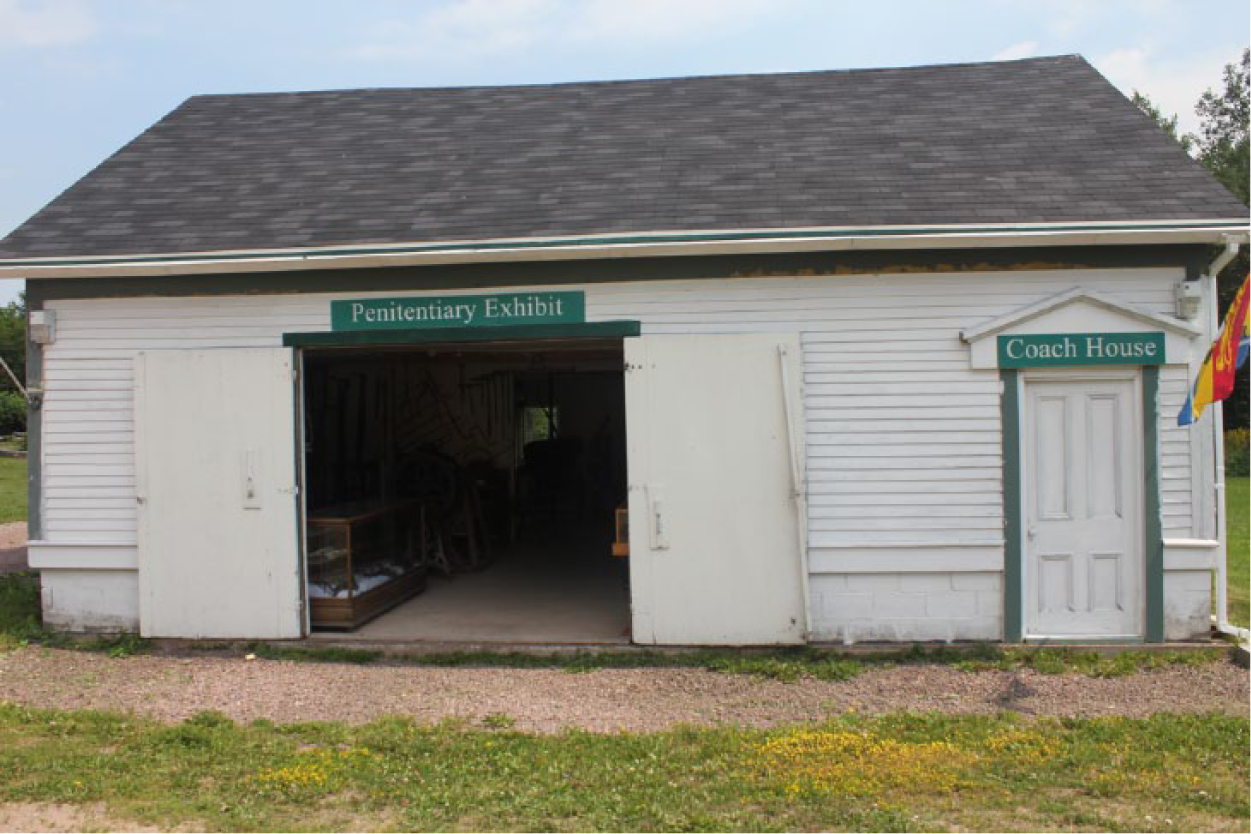
Photo by Jonathan Côté of the ‘Penitentiary Exhibit’ building at the KHM.
A museum manager, as well as many other staff members and volunteers help operate the museum from Tuesday to Sunday throughout the year. Their stated objective is to provide an accurate account of local penal history at the site. As visitors enter the large garage-sized room, they can gaze upon dozens of objects and displays. Examples include a model of Dorchester Penitentiary, tools used by prisoners as part of their labour and farming activities, a display case containing memorabilia from penitentiary staff, several pictures of guards, officials and prison cells, clippings from news stories about prison deaths (Figure 2), a display case containing contraband and weapons taken from prisoners, a ‘History of Crime and Punishment’ display board, punishment and restraint devices (Figure 3) and a mock penitentiary cell.
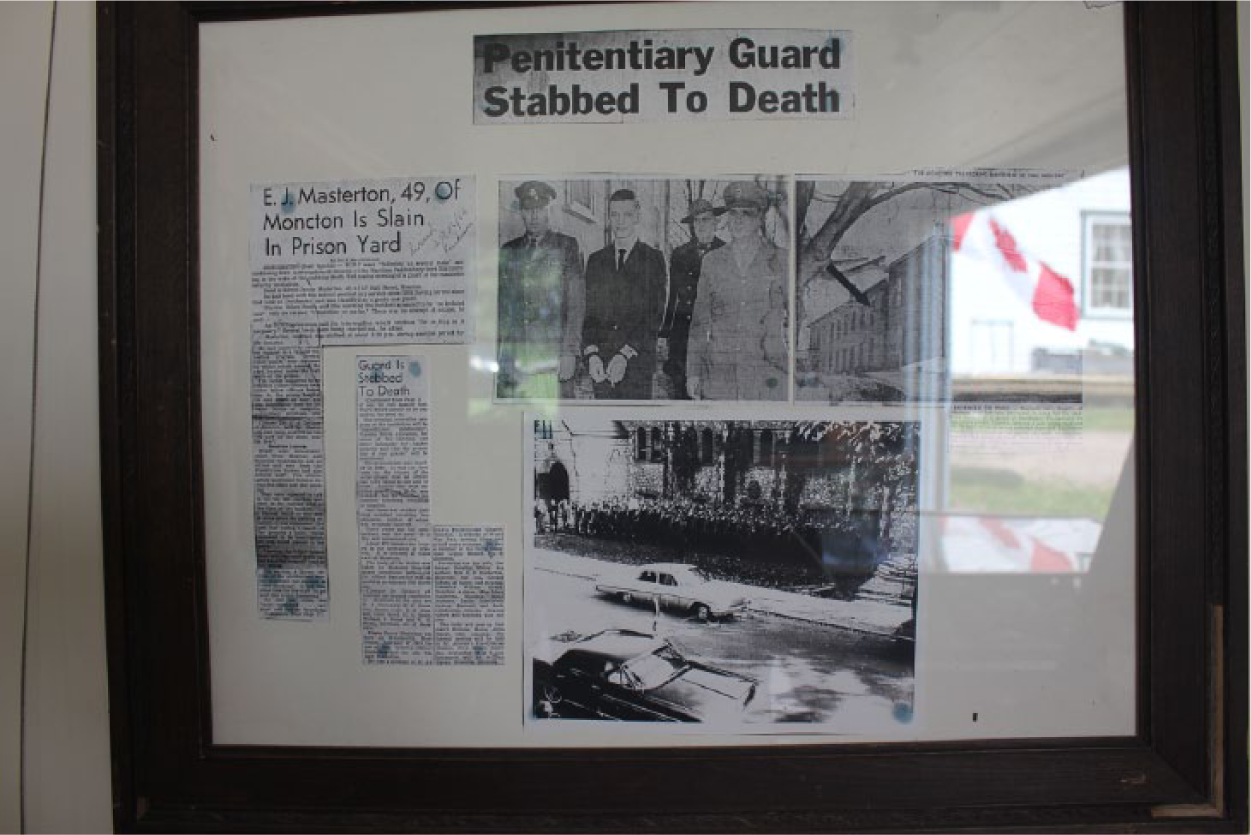
Photo by Jonathan Côté of a news article entitled ‘Penitentiary Guard Stabbed To Death’ displayed at KHM.
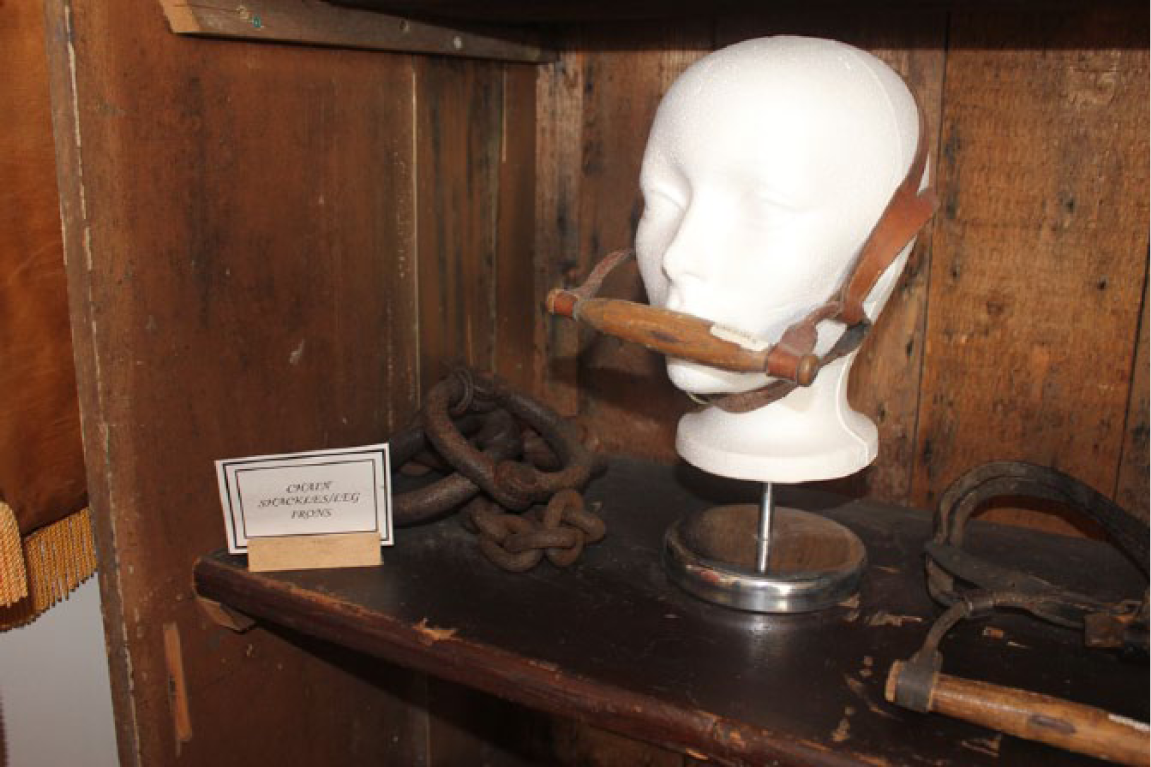
Photo by Jonathan Côté of a prisoner restraint device displayed at KHM.
While prison staff are commemorated for their public service, prisoners are presented as dangerous, thus necessitating the deprivation of liberty. Save for the photos of old prison cells and the mock cell that offers a fleeting glimpse into what incarceration was and is like in the Dorchester area, few of the representations available to visitors allow them to critically engage with penality. This is common at many of the penal history sites where we conducted field research across Canada (Walby and Piché, 2015a), which can foster distance between the penal spectator and those that experience the pains of imprisonment inflicted on their behalf (Brown, 2009).
Federal Penitentiary Museum
Located across the street from the now decommissioned Kingston Penitentiary (see Ferguson et al., 2014), the FPM is located in the building that previously served as the official warden’s house from 1873 to 1933 (Figure 4). Also known as ‘Cedarhedge’ for the cedar hedges that at one time lined the driveway of the building (Friends of the Penitentiary Museum Inc., no date), the museum features two levels of exhibits.
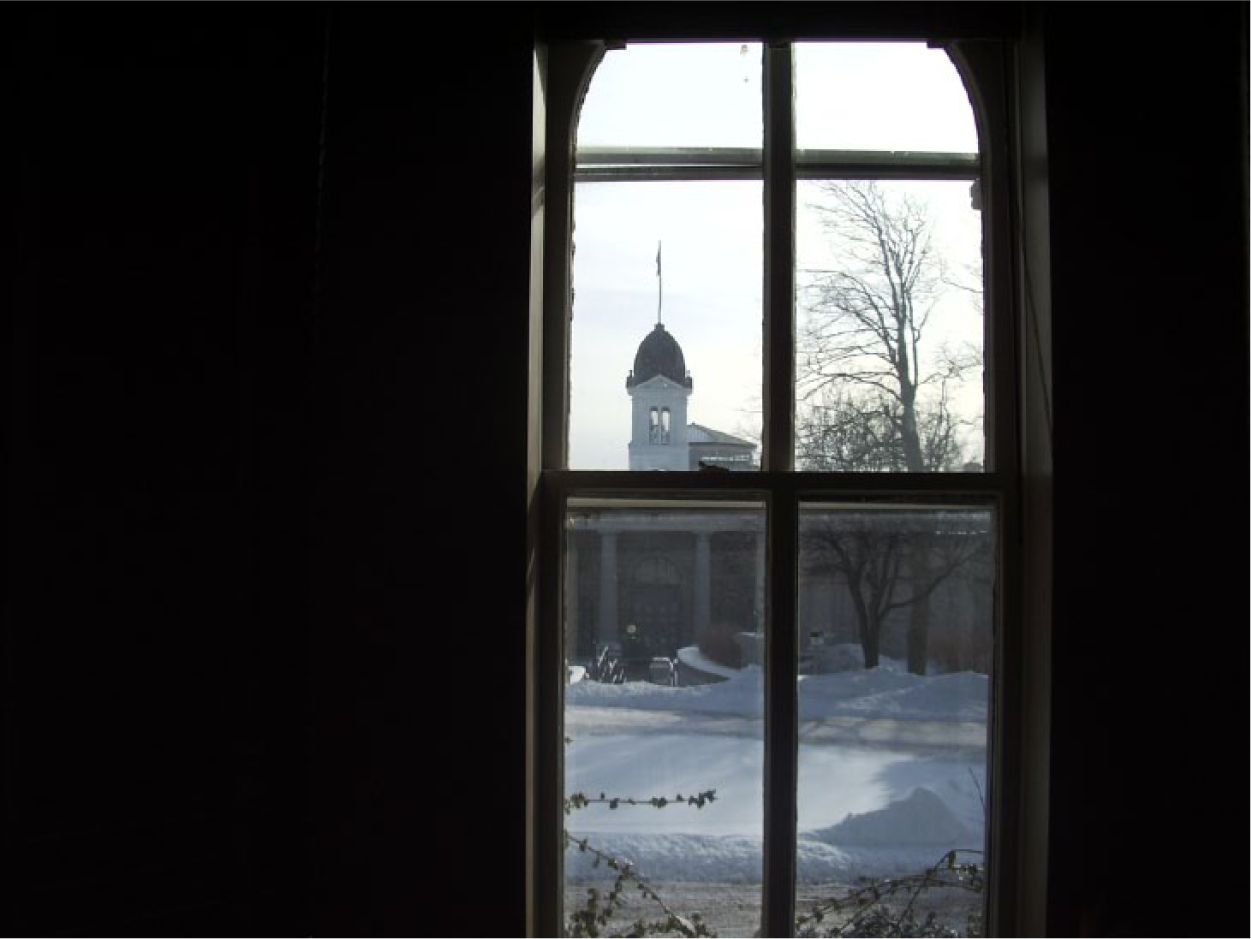
Photo taken by Justin Piché inside the FPM of Kingston Penitentiary located across the street.
Upon entering the museum, visitors are often acknowledged by a museum attendant who explains to tourists that visits are self-guided. Although not required to pay an entrance fee, visitors can make a donation to the Friends of the Penitentiary Museum, which uses these funds to continue operating the site. The museum itself consists of four display rooms and a gift shop on the first floor and another three display rooms on the second floor of the building. In the foyer of the large residence, visitors can head left to one of the front rooms that contains the bell that was broken during the 1971 riot at Kingston Penitentiary (see Culhane, 1991: 100).
After venturing back to the foyer, visitors can head left again where they will find a room full of corporal punishment and restraint devices, as well as a large canvas with pictures of two heavily tattooed prisoners that recount their histories of violence (Figure 5). In the back portion of the first floor visitors pass through a hallway with a barred mirror where tourists can see what they would look like behind bars. Once in the back room, they will find two mock cells representing the space and amenities that characterized the life of federal prisoners held at Kingston Penitentiary, one representing the past and the other depicting a more contemporary era of incarceration.
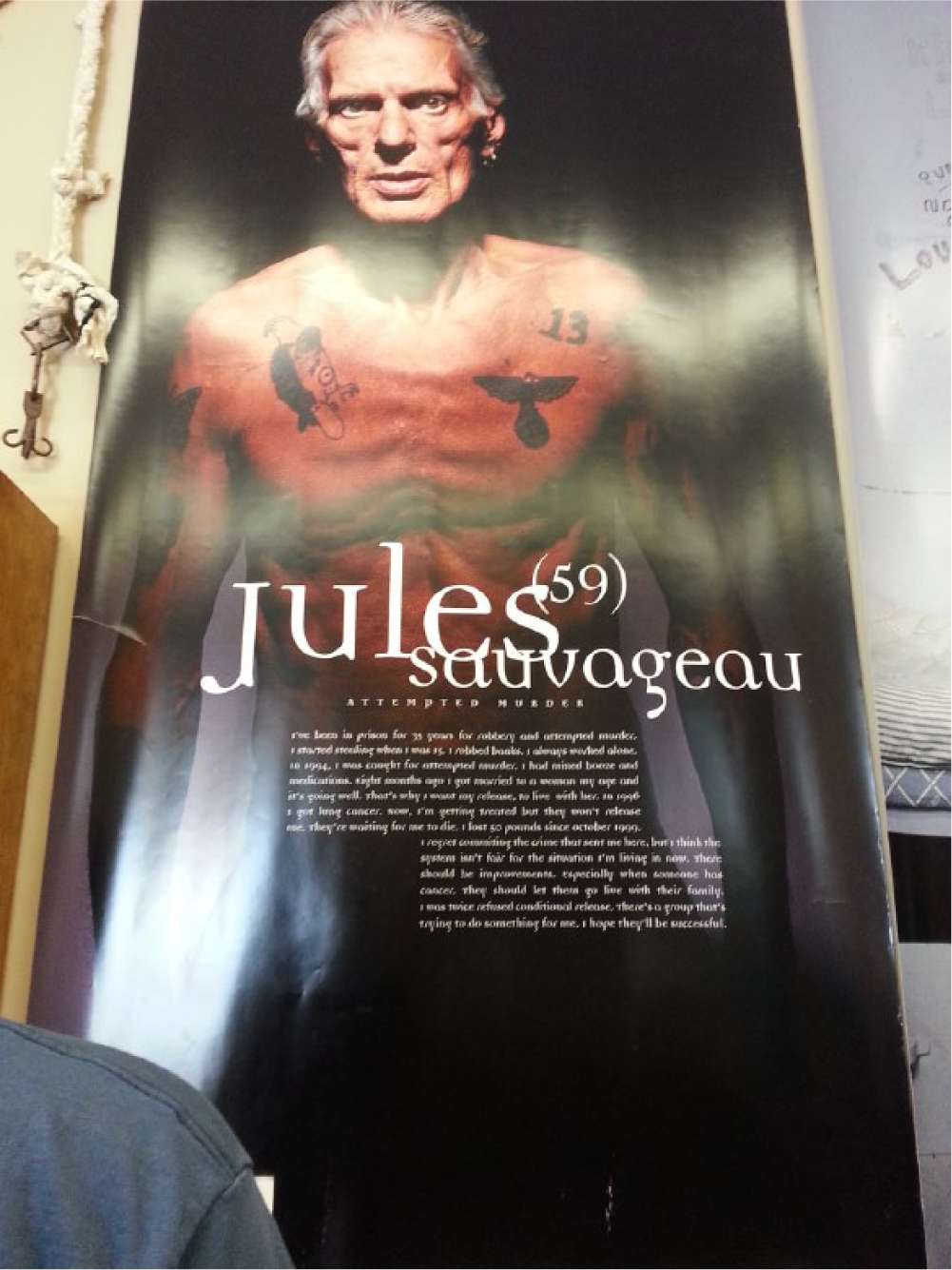
Photo by Sarah Fiander of a poster at FPM featuring Jules Sauvageau, a federal prisoner.
Back to the foyer visitors can move to the right side of the first floor to view a display room full of products manufactured by prison labour, a CSC Institutional Emergency Response Team mannequin (Figure 6), as well as contraband and weapons. There, patrons can also find the ‘Keeper’s Cache’, a gift shop consisting of a small counter, shelf and cabinet displaying goods available for purchase, which include mugs, bookmarks, books, clothing, key chains and other items. Tourists can also climb a large staircase in the centre of the residence, where they may enter into a room featuring relics and displays about Kingston Penitentiary and the Prison for Women, another room featuring ‘survenirs’ (Muecke and Wergin, 2014) or memorabilia donated by prison officials and staff from Canada and other countries who have visited the museum, as well as a room featuring art by prisoners (Figure 7).
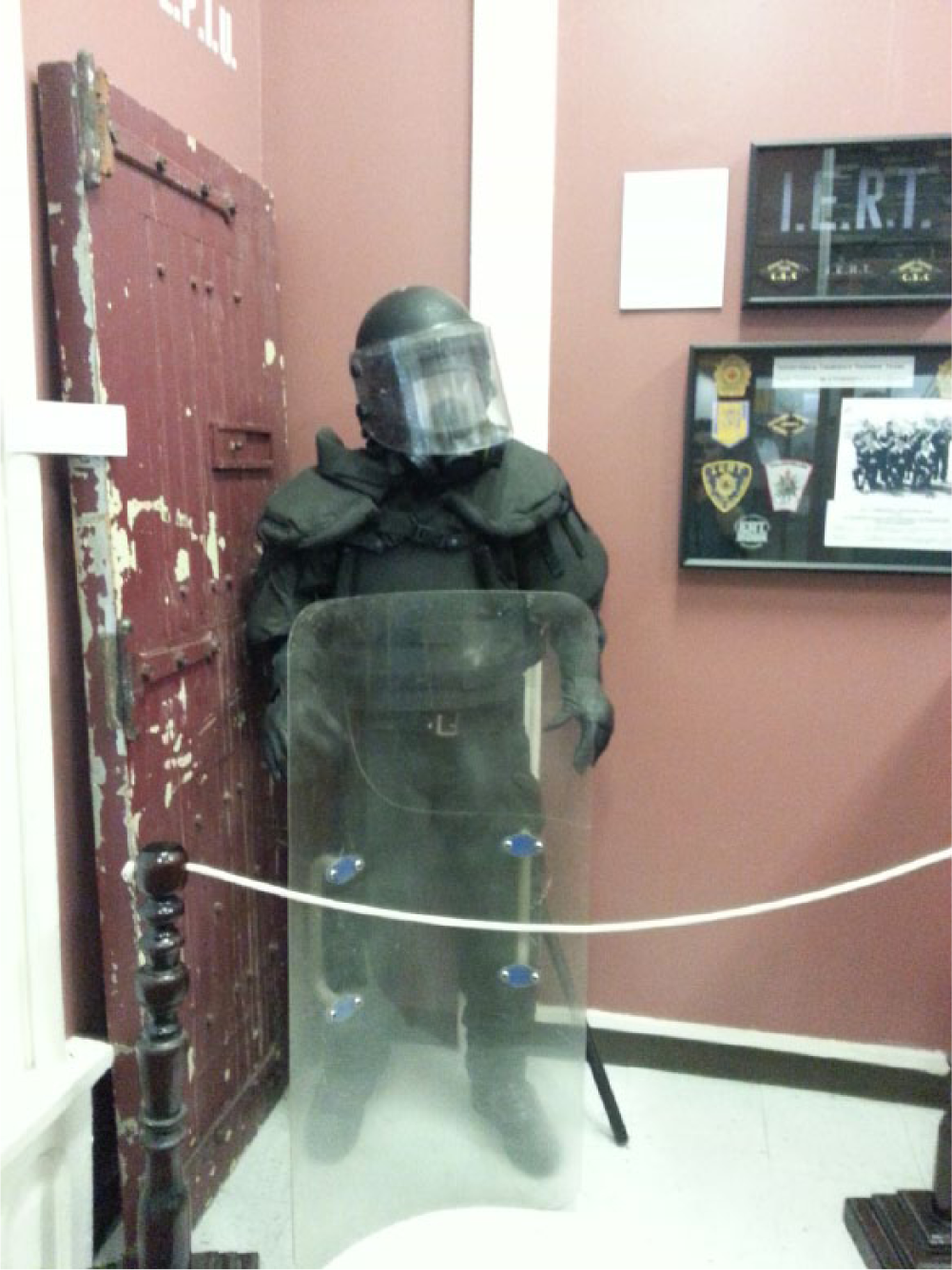
Photo by Sarah Fiander of a FPM mannequin dressed as a member of a CSC Institutional Emergency Response Team.
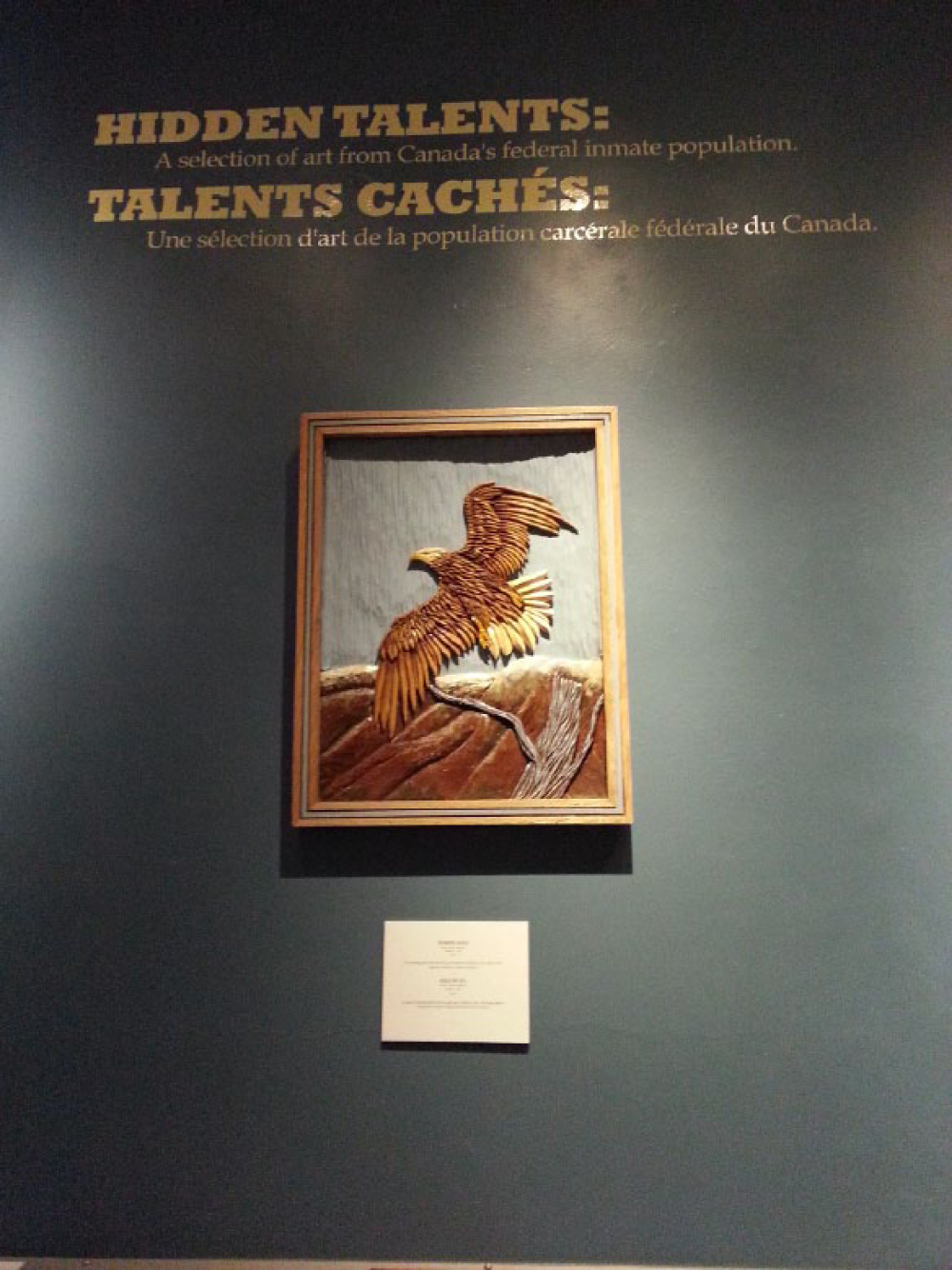
Photo by Sarah Fiander of artwork by a prisoner displayed in the ‘Hidden Talents’ exhibit at the FPM.
Similar to the framing at the KHM and most other Canadian penal history sites, the FPM memorializes the contributions of those who have worked in Canada’s penitentiaries, while generally positioning prisoners as menacing ‘others’. Although there is a discourse of reformation present, as is made visible through the transformative potential of and ‘hidden talents’ found in prisoners’ art on display within the former warden’s residence, the reform that this site is focused on is that of the federal penitentiary system itself. Its frequent references to the progressive humanization of incarceration are evidenced by exhibits like the mock cells that contrast past to current practices with little consideration of the persisting brutalities of penality. As in other sites (Brown, 2009), tourists visiting this museum are confronted with a framing and depiction that distances them from prisoners and contemporary prison realities in ways that foster penal spectatorship (Walby and Piché, 2011).
Rotary Museum of Police and Corrections
Operating in conjunction with the Prince Albert Historical Society, the RMPC is located in the original guard room for the F Division of the North West Mounted Police (NWMP), and is home to a range of artefacts and archival documents which the public can view daily during the summer months and by appointment for the remaining seasons (Rotary Museum, no date). Created in 1985 by local police officers and prison staff, the museum contains bars and other original features stemming from when the building operated as a NWMP facility. The tour guides are trained to answer questions from visitors and deliver the tour script, which is provided by staff working for the Prince Albert Historical Society and the Prince Albert & District tourism office. Staff members also make decisions about which relics to display and how to describe them.
The one-room museum is split into two sections. On the left hand side of the building are the displays dedicated to federal imprisonment and federal police. On the right hand side of the building are displays pertaining to provincial imprisonment, as well as provincial and municipal police. Both sides contain dozens of relics. In the displays dedicated to the federal penitentiary system, there are many materials donated or on loan from Saskatchewan Penitentiary, which is located on the outskirts of the city. Items on display include the warden’s chair, a locking device for the range, staff uniforms, contraband, riot gear, along with punishment devices such as a whip and accompanying rack (Figure 8), as well as a paddling table and paddle.
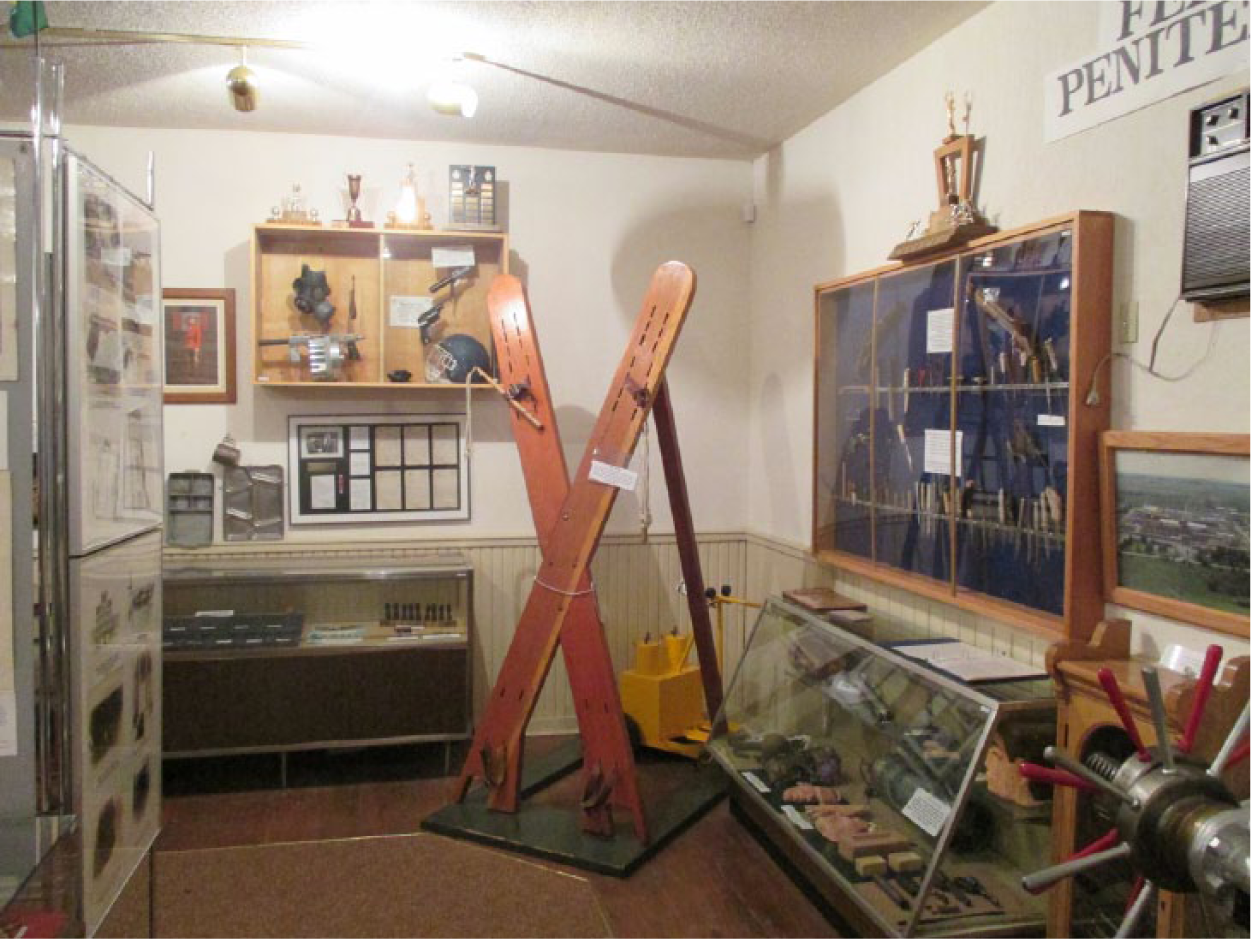
Photo by Kevin Walby of The Rack donated by Saskatchewan Penitentiary to the RMPC.
In the displays dedicated to provincial incarceration, there are pictures and historical records pertaining to two jails that have been decommissioned and demolished. Ropes used and black flags flown during 18 hangings in the area are also featured (Figure 9). There is no gift shop attached to the building, though across a laneway visitors can find the Prince Albert & District tourism office, which offers pamphlets about the museum. At the tourism office, patrons can also purchase a small pin made by CSC to commemorate the 100 year anniversary of the main tower at the Saskatchewan Penitentiary. As is the case at the FPM, those visiting the RMPC encounter favourable depictions of staff, degrading representations of the incarcerated and a version of penal history steeped in an appreciation for the ‘progress’ that has been made over the years.
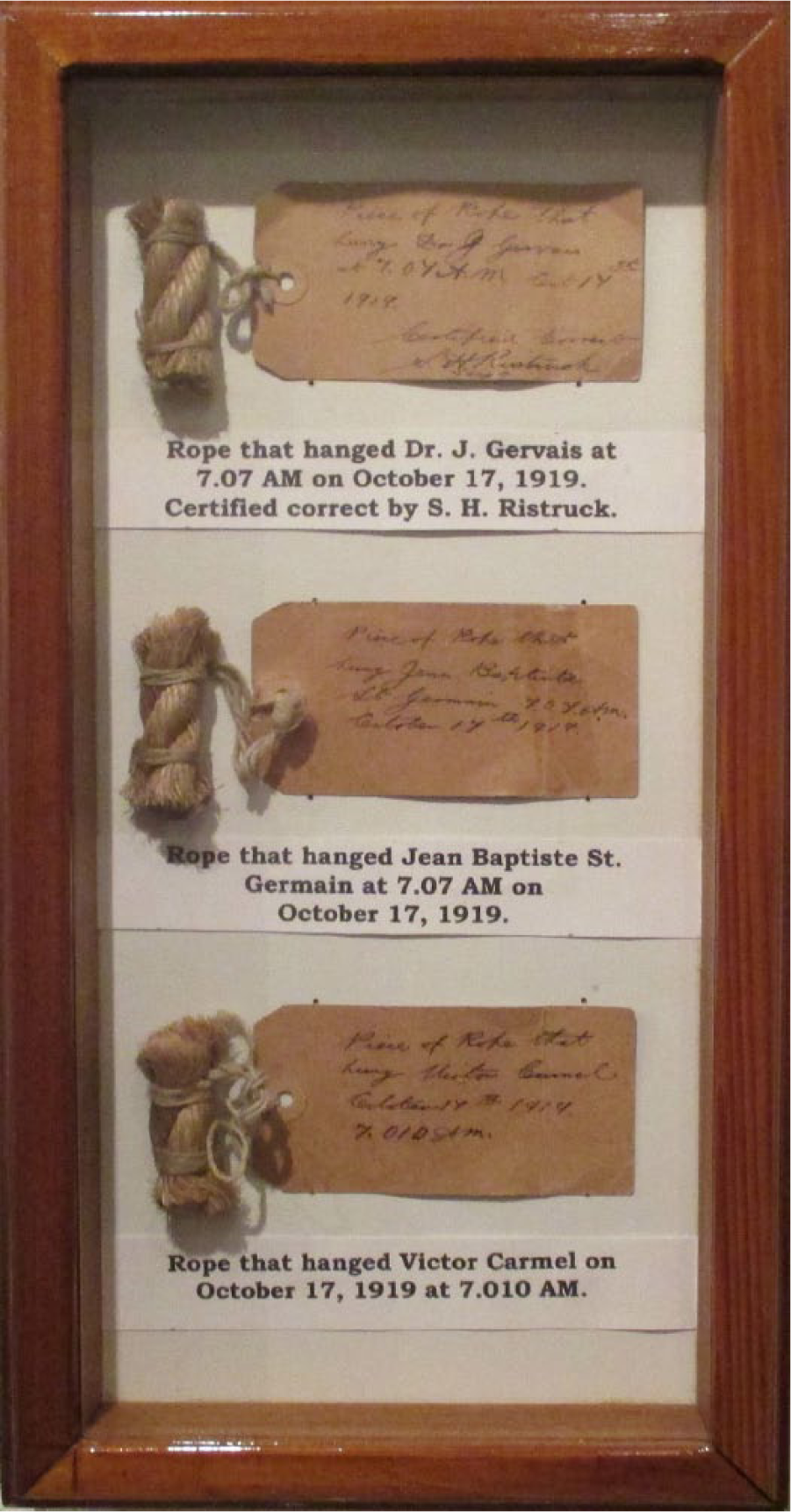
Photo by Kevin Walby of the ropes from hangings at the first provincial jail in Prince Albert.
Blurred boundaries in Canadian punishment and its memorialization
In a previous examination of representations of imprisonment and punishment in penal history museums in Ontario, Canada, Walby and Piché (2011) observe that such sites position their displays and artefacts as relics of a past, less humane penal system, while simultaneously suggesting the current carceral system is characterized by reform and benevolence. Below, we highlight how this framing is informed by the relationship of these sites with CSC, obscuring the distinction between state-sanctioned punishment and its memorialization. Our analysis on this facet of Canada’s shadow carceral state focuses on three themes that highlight this lack of separation: (1) the involvement of the Canadian federal penitentiary system in the development of penal history museums; (2) the contributions of CSC staff and how these shape meanings of penality communicated within these sites; and (3) the use of federal prison labour and other involuntary contributions from prisoners in these historical settings.
Penal state development of punishment memorialization sites
Individuals representing penitentiary, prison or other penal state agencies were involved in establishing and/or further developing all three penal history museums examined in this article. The RMPC in Prince Albert was opened in 1985 following the efforts of staff from Saskatchewan Penitentiary and various law enforcement organizations. Today, a local association of former guards and police officers operate as a quasi-steering committee for the museum, offering advice on displays and tours, donating items (e.g. a week before we conducted fieldwork at the site someone donated an old CSC uniform) and promoting the entity.
In a similar manner, a photo of a display board entitled ‘A History of Crime and Punishment’ taken by a member of the research team notes that the opening of KHM’s Penitentiary Exhibit in the 1960s was initiated by Dorchester Penitentiary’s then prison personnel officer Byron Duffy (Figure 10). Duffy campaigned for a space designated to store and preserve items collected during his career, from which the exhibit emerged.

Photo by Jonathan Côté of the panel detailing the founding of the KHM by Byron Duffy.
Although opened as part of the commemoration of Canada’s centennial year in 1967 (MacLean, 2009), the FPM developed in large part thanks to individuals affiliated with what was then called the Canadian Penitentiary Service. As proclaimed on its website, the Friends of the Penitentiary Museum Inc. (no date) was initiated in the 1990s on the appeal of CSC to continue operating the museum through the collection and management of funds. The original steering committee and first elected board included active CSC employees such as Monty Burke, who was the warden of Warkworth Institution at the time. The existence and/or development of these penal history museums thus required the involvement of Canadian penal state employees and management.
CSC staff contributions to museum relics and narratives
In addition to the contributions of the penal state to the emergence and continued existence of punishment memorialization sites, each of the three museums examined here received items collected and donated by staff from various penitentiaries and prisons across the country gathered in their line of work (e.g. confiscated weapons). Many of the relics within the RMPC were donated or on loan from CSC.
One such item was a paddling table on display with two accompanying paddles. Shortly after it went on display, a former guard visiting the RMPC described to museum staff how he would use it and when, as well as the ensuing responses of prisoners. This information became part of the script for the tour. Tours of the RMPC also include other anecdotes of current or former CSC guards at Prince Albert’s two federal penitentiaries, some of whom are friends or relatives of museum staff. Examples of such anecdotes that show up in the tour script for museum guides include narratives about past wardens, which were incorporated as a result of previous CSC employees commenting on the displays such as the donated warden’s chair and a time clock that was once in the now closed warden’s house (Figure 11). A staff member at the KHM noted similar relationships during an interview, ‘[t]hey [staff members who donate items] give history and if there was any story that goes along with it at that moment’. These examples demonstrate the influence of Canadian penal state actors on the relics and narratives encountered by visitors at these museums, since what guards and CSC staff choose to share (or not) plays a role in constructing what imprisonment does, and does not, look and sound like.
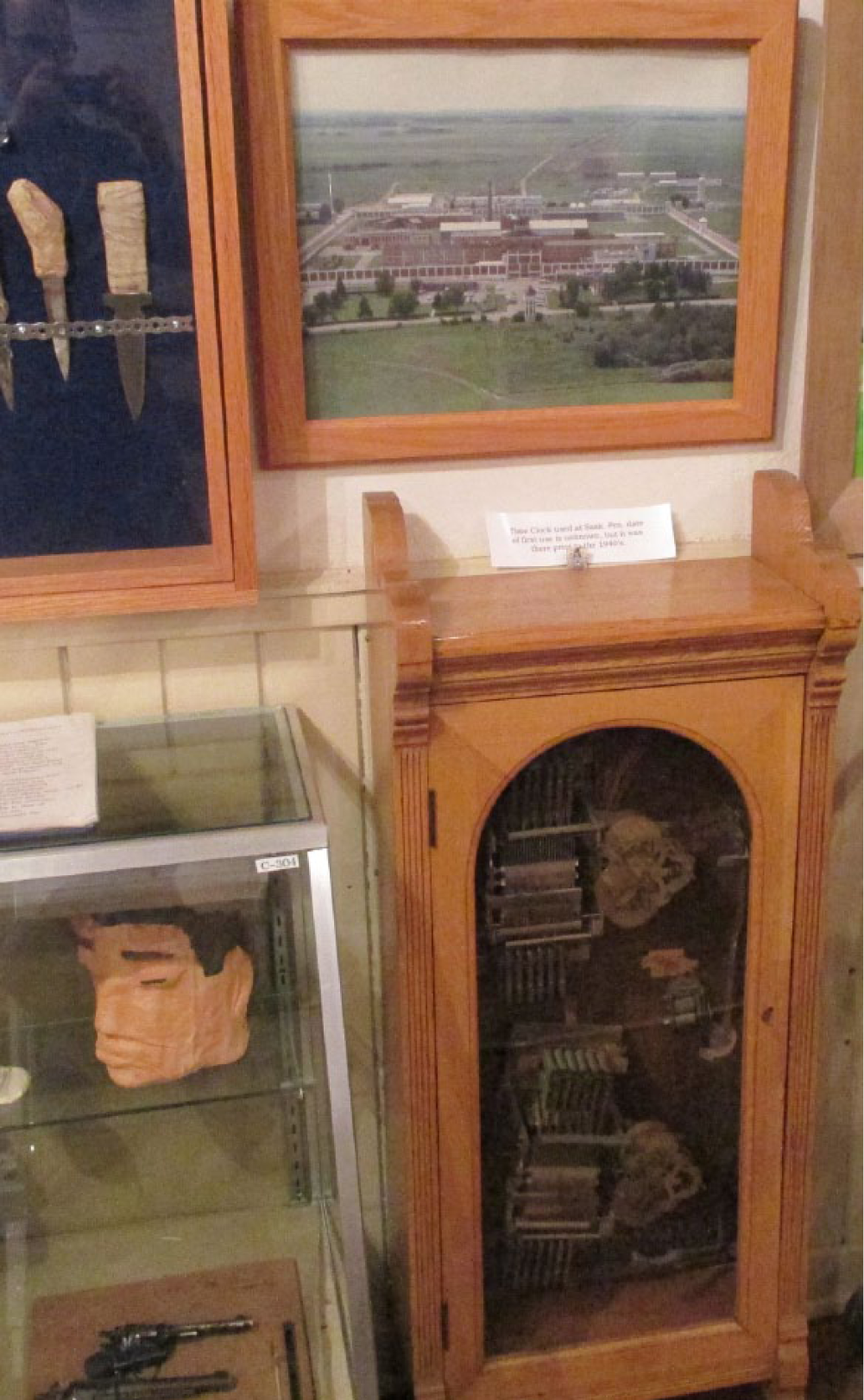
Photo by Kevin Walby of the time clock donated by Saskatchewan Penitentiary to the RMPC.
An added way that the boundaries between CSC and punishment memorialization are blurred is through the staffing practices of the three museums. Not only does the FPM retain retired prison officers as volunteers during the summer months to answer questions and inquiries from visitors (Friends of the Penitentiary Museum Inc., no date), but at the time of our fieldwork the museum was also operated by a historian employed by CSC (also see MacLean, 2009). Additionally, this historian and other CSC employees serve as a point of contact for staff at both the KHM and the RMPC when they have questions or inquiries regarding their respective museum’s artefacts. As a museum staff member put it in Prince Albert, ‘I have to contact the CSC museum in Kingston and they’ve contacted us for a few things or Sask Pen has contacted us for a few things but most of our contact on that stuff is directly with CSC.’
Strange and Kempa (2003) argue that tourist visitors to these sites may not grasp the same meaning from exhibits as their curators seek to convey. However, the contributions of current and former staff members affiliated with CSC and other penal state agencies to the narratives of punishment memorialization communicated at these sites (see case studies above) provide a particular framing of confinement and penality upon which the survival of the Canadian penal state relies.
Federal prison labour and other (in)voluntary contributions
In Canada today, prisoners in federal penitentiaries can participate in labour assignments, including through CSC’s ‘rehabilitation’ and work programme CORCAN, as well as other initiatives. Besides producing prisoner uniforms and office supplies for government departments, prison labour is also implicated in the operation of a few penal history museums, which we explore below.
Dressed in civilian clothes, a handful of federal prisoners make a trip to the KHM two days a week to maintain the property and buildings, including mowing the lawn. These individuals are not paid, but work as ‘volunteers’ through a partnership between the museum and CSC, which according to one of the non-imprisoned volunteer staff members ‘probably saved us between $100,000 to $200,000 in labour work’. Despite their contribution to the museum’s operation, these individuals are disappeared through the staff’s resistance to disclosing their identity as prisoners to patrons, which at best protects them from the stigma of criminalization or at worst reinforces their ‘othered’ status as non-entities unworthy of acknowledgement. Staff members discussed how the prisoners are discouraged from talking to visitors and participating or contributing to the tour of the exhibits. As one of them noted, ‘[w]e don’t mention that they’re inmates [to visitors], we say they are volunteers’. This is an example of the ‘purification’ (Welch and Macuare, 2011) or ‘sanitization’ (Huey, 2011) of penal tourism narratives and scenes, as prisoners are literally removed before visitors arrive or go unnamed and unmentioned as they toil tidying up the penal state’s image of itself.
At the FPM in Kingston, prison labour is visibly displayed in the ‘Keeper’s Cache’. Even the website promoting the site boasts that ‘[m]any [gift shop] items are made by inmates through established programs’ (Friends of the Penitentiary Museum Inc., no date). One initiative that produces memorabilia for the gift shop is CORCAN’s Fur and Shearling programme located at Warkworth Institution, which employs Indigenous prisoners to produce ‘authentic Aboriginal’ goods such as mittens (Figure 12). Absent in the official narratives about these souvenirs is any mention of how the Canadian penal state has been mobilized as a primary tool to assimilate Indigenous peoples as part of its broader colonization project (Luscombe et al., 2015; also see Martel et al., 2011).
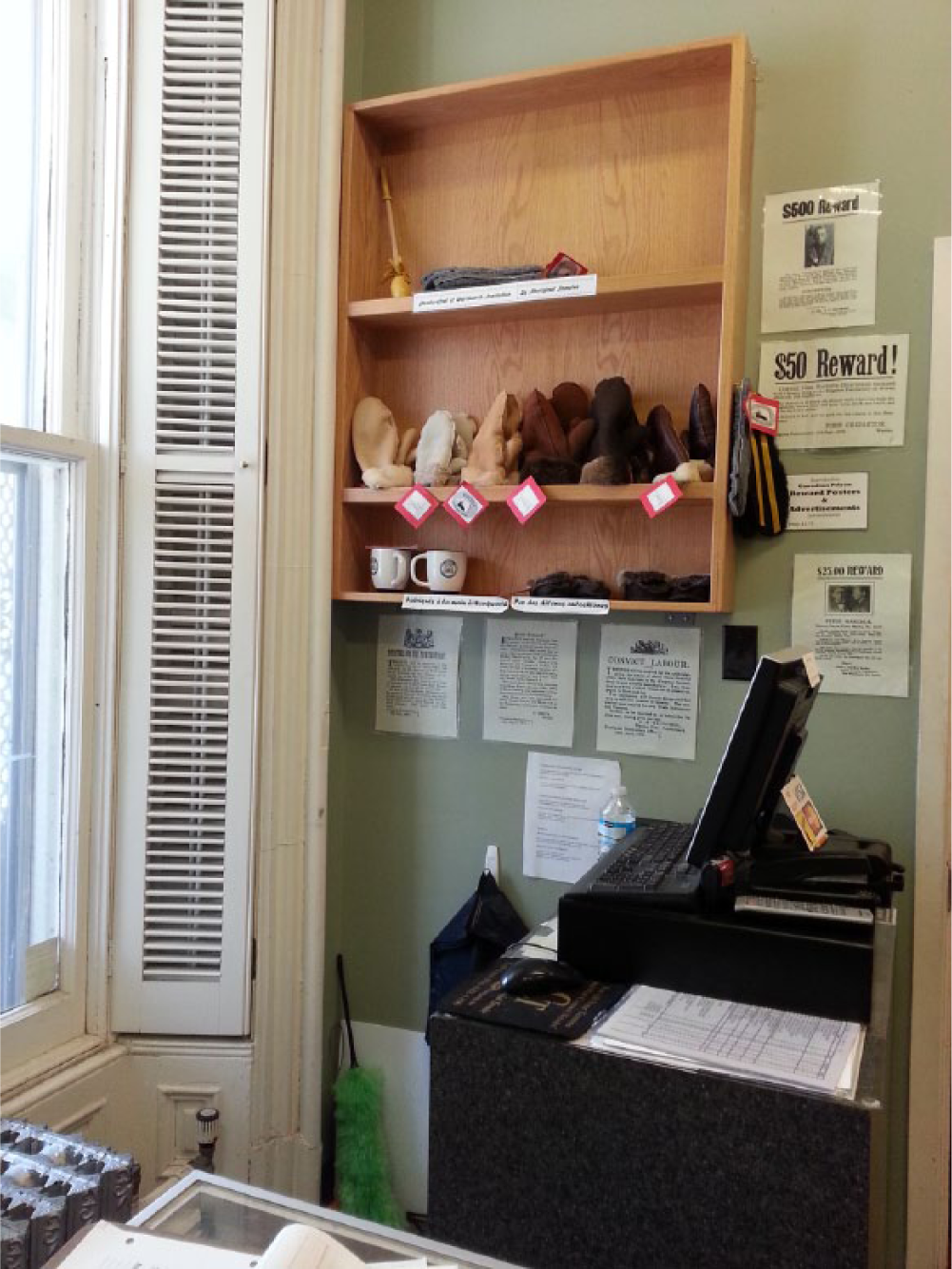
Photo by Sarah Fiander of an FPM gift shop shelving unit that includes a label promoting items for sale which reads ‘Handcrafted at Warkworth Institution by Aboriginal Inmates’.
In addition to the aforementioned products of prison labour, other goods made by Canadian federal prisoners were often highlighted in displays, including contraband items confiscated from them, which are featured in each of the three museums. For example, displays of prisoner-made contraband items confiscated less than 20 years ago from within the now decommissioned Kingston Penitentiary donated by CSC occupy almost a full room within the FPM (Figure 13). Many cabinets exhibiting artefacts and other museum materials were also made by prisoners, including a display case built at Leclerc Institution that currently exhibits a relic shoe made by prison labour (Walby and Piché, 2011).

Photo by Sarah Fiander of prisoner-made contraband at the FPM.
Survey boxes, display cabinets and stands made by prisoners at Dorchester Penitentiary are also on display at the KHM. Another example is the construction and painting of a mock cell by a prisoner for the ‘Penitentiary Exhibit’ at the museum (Figure 14). Discussing visitors’ desire to have an authentic experience when touring the museum, one staff member noted, I asked the inmate how he knew what size to make [the cell that he built for the museum] and he said well if a grown man stands in the room and put his arms out like that that’s where the cell [would be].
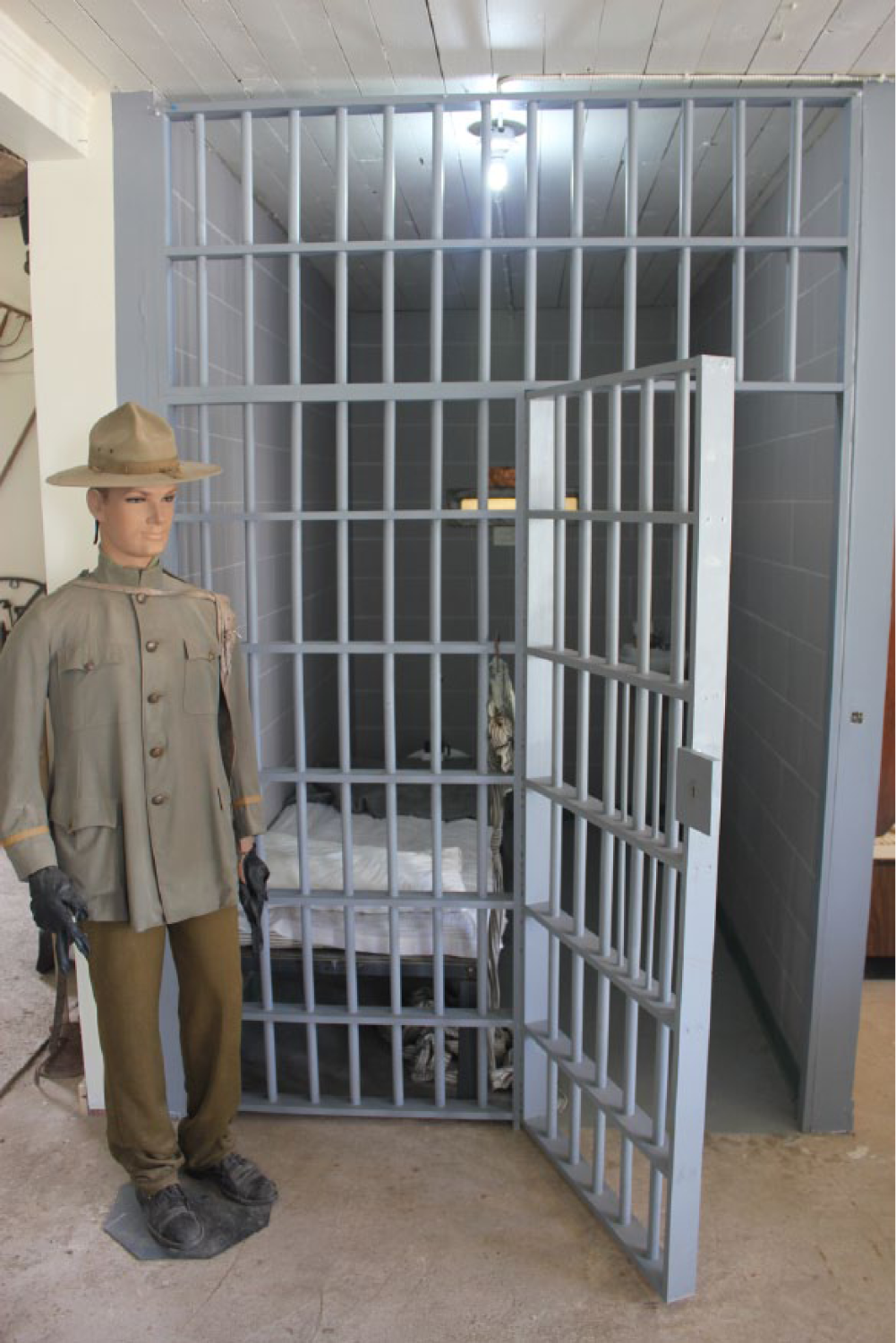
Photo by Jonathan Côté of a mock prison cell at the KHM created by a ‘volunteer’ prisoner.
At the RMPC there is an original locking device on display once used for several decades at the facility to close the range, which was designed by a prisoner at Kingston Penitentiary. The tour guide interviewed noted, ‘we were told he got early parole for it too’. Also at the RMPC is the penitentiary’s coat of arms that was hand carved by a prisoner, which was originally displayed over the entrance at the Saskatchewan Penitentiary until a new facility entrance was built. Paintings and other items created by prisoners are also on display, such as bricks and soap made in a long since abandoned prison workhouse.
The use of prison labour by the three penal history sites and the display of items created by prisoners demonstrate the reliance of these sites on contributions from prisoners who participate in work programmes or those whose possessions have been confiscated. Prisoners are relied upon not only for their likenesses that inform narratives and some of the objects displayed in these sites, but also for labour and commodities that sustain museum operations.
Discussion and conclusion
Writing about the visibility of prisons past and present, Schept (2014: 206) observes ‘the only images we have are those that are officially sanctioned’. As we have shown in this article, sometimes these official images are communicated in collaboration with penal history museums like the FPM who ‘are working hard to assist the Correctional Service of Canada with the preservation of Canada’s correctional story’ (Friends of the Penitentiary Museum Inc., no date). The cases studies and examples investigated above demonstrate the nature of the partnership between CSC and some Canadian penal history museums, and indicate what type of ‘correctional story’ both deem acceptable for penal spectators to consume. The agency’s role in museum development and assigning prison labour, and the influence of prison staff on museum tours and exhibits, belies the blurred boundary between contemporary practices of punishment and their representations (Lynch, 2004). Such work facilitates a narrative implying that prisons are necessary to protect communities from prisoners, a notion which lends support to initiatives such as CSC’s recent construction of new units and the addition of double bunks in some cells originally designed for one prisoner under successive Conservative federal governments (2006–2008, 2008–2011, 2011–2015) who made getting ‘tough on crime’ among their key priorities (Piché, 2014: para. 73).
Whether visitors enter these museums to acquaint themselves with the realities of incarceration or to be entertained, when the penal state has a role in narrating its own dark history there is a risk of ‘fully supplanting the understanding of punishment as the very real pain administered by the state upon the bodies and souls of contemporary prisoners’ (Lynch, 2004: 266). In the cases we examined, the idea of incarceration as a necessary institution and of CSC as an essential state entity is perpetuated, to the exclusion of discourses that expose contemporary imprisonment as a practice of oppression and pain. As Savelsberg and King (2005, 2007) observe, the collective memory of a nation with regard to its past wrongdoing is reflected in how such commemorations are institutionalized in a legal system. By choosing what memories are acknowledged or left out of museum display cases, the Canadian penal state runs the risk of extending its past human rights abuses such as the deaths of prisoners like 19-year-old Ashley Smith in segregation cells under the watchful eyes of guards into the future (Collins, 2008).
Beckett and Murakawa (2012: 223–224) suggest that our understanding of ‘carceral state power must be as capacious, complex, and adaptive as the policies and institutions involved in it’. Showing how state punishment agencies cast their own shadows by collaborating with cultural institutions, including museums, is a key part of such an analysis. Museums as ‘exhibitionary apparatuses’ (Bennett, 1995: 80) have long been treated by the state as instruments ‘that could be enlisted in new ways for new tasks of social management’ (Bennett, 1995: 6), and we have shown how penal history museums today are used by one prison agency to promote favourable visions of their practices.
The fact that penal history museums have links to prison agencies not only shows how museums sometimes buttress state projects, but would also seem to bring these historical sites into disrepute since what is ‘at stake is the trustworthiness of the museum as a memory institution’ (Crane, 1997: 45). If prison agencies are shaping the memories that make up punishment memorialization in Canada and elsewhere, this raises the spectre of carceral-friendly distortion that further legitimizes state punishment in symbolic and material culture. Such a focus invites more research on the forms of communication and symbolism that support the penal state; we contend that studying penal history museums as an element of the shadow carceral state achieves this.
Footnotes
Acknowledgements
We thank Jonathan Côté and Sarah Fiander for their assistance with data collection during the course of this study. We also thank the anonymous reviewers for their insightful comments.
Funding
The project was funded by the Social Sciences and Humanities Research Council of Canada [grant number 430-2012-0447].
Notes
Author biographies
 ).
).