



Abstract
In this article I offer a discourse analysis of Tiziano Ferro coming out in a regulatory Italian context. The critical texts for analysis come from the first page of the entertainment section of two Italian newspapers, Corriere della Sera and La Repubblica, where Ferro, an Italian pop star, came out of the closet in as public a way as possible. The pages contain a letter from the singer, other articles (editorial and comments), an interview and images. I present a discourse analysis of these newspaper pages, highlighting how the construction of this narration of coming out, with its ideology-laden and rhetorical discourse, combined visual aspects and written texts. In this way I deconstruct the narrative of coming out; I discuss the intertwining of the regulatory discourses so that homosexuality is made acceptable in the Italian social landscape, and the consequences of this coming out.
Tiziano Ferro comes out of the closet and slams the door behind him
On 6 October 2010 Tiziano Ferro very publicly joined a group of celebrity musicians who have revealed their homosexuality, including George Michael, Ricky Martin and Michael Stipe. Ferro’s coming out was marketed thus: he wrote a letter to Corriere della Sera and gave an interview to La Repubblica on 6 October; on 13 October he gave an interview to Vanity Fair; and on 20 October he published an autobiography, Trent’anni e una chiacchierata con papà (thirty years and a chat with my dad) in which he recounted the last 15 years of his life. Within one day of his original announcement, by 7 October, most Italian newspapers and some TV stations had picked up the story. Ferro also announced that he was returning ‘from exile’ to his home in Italy after four years in Manchester, UK. Ferro is a very famous singer in Italy and beyond. Since his first CD in 2001, he has achieved national and international fame, performing in Italian, Spanish, English and French. His success has contributed to the construction of a narrative of stardom, giving his audience a point of reference and his record company (EMI) huge commercial success.
In these pages I present a discourse analysis of Ferro’s coming out. The material comes from the first pages of the entertainment section of Corriere della Sera and La Repubblica, where the singer published an autobiographical letter and gave an interview. I examine this letter, the other articles and the interview, together with the accompanying images. I deconstruct the page, highlighting how the text and images shape Ferro’s coming out, with its ideology-laden and rhetorical discourse.
Before continuing the article, two premises are important. First, I do not want to devalue Ferro’s coming out story. I want to make it abundantly clear that Italy is a country where anti-lesbian and anti-gay prejudices colour the social and political landscape. Politicians openly and publicly devalue gay people, as comments by ex-Prime Minister Berlusconi show: ‘My passion for women is better than being gay’ (Squires, 2010). In Italy the Catholic Church has a very strong power base in all political parties and a powerful grip on the popular imagination. This grip is so strong that several proposals for laws benefiting gay and lesbian people have been rejected (e.g. for legalization of civil unions in 2007, and against homophobia in 2011). In Italy there are thus no laws against homophobia, and no general legislation on civil partnerships. This does not necessarily mean that LGBTQ-centred cultural production is absent; the number of books, novels, films, gay characters in television, websites and comments in newspapers has increased in the last 10 years – but there is no equivalent to Stonewall, no Italian Harvey Milk or Peter Tatchell – two figures who led strong collective movements in the USA and UK respectively, which struggled powerfully and effectively for LGBTQ rights.
Secondly, I want to clarify that I am not speaking about the persona of Tiziano Ferro but about the performance and representation of coming out, about how a positive image of a gay man is built and justified rhetorically, and about the consequences of this rhetoric. I do not intend to examine what Ferro and the journalists ‘really think’ so that I ‘reduce the things that are said to what … [they] really mean, and, worse, [speculate] about what psychological processes or personality characteristics might explain why they said what they said’ (Parker, 2005: 101). I have analysed the texts and images to understand how they are constructed and to explore what discourses of coming out they communicate. I consider Tiziano Ferro a celebrity – someone who over the years has fabricated a sellable and buyable image, a capitalist or economic identity (McGee, 2010: 57) – who owns/has a discursive power, whose voice rises above other voices and is diffused widely and made significant and legitimate by the media. What a celebrity writes may be its own creature, just fiction, but what is relevant here is that a celebrity’s narrative is shaped by and above all shapes the socio-cultural context. So Tiziano Ferro’s images and texts contribute to the fabrication of a regulatory discourse of coming out, and at a more general level a discourse about what is and what should be the ‘legitimate’ homosexual, the valued gay subject (Roy, 2012). His image has economic value but is also a cultural text whose ‘floating signifiers … are continually invested with libidinal energies, social longings, and … political aspirations’ (Coombe, 2006: 722).
Through the analysis, discussion and conclusion I try to answer the following questions. If Jolly’s contention that ‘coming out is a western formula not simply transferable to other contexts’ (2001: 490) is true, which discourses characterize Ferro’s coming out so that homosexuality is made acceptable in the Italian context? Are there peculiarities to this story compared with other celebrities’ coming out discourses and, more generally, with discourses that have created the ‘coming out of the closet’ formula? And finally, what risks and individualistic or collective consequences are implied by this coming out story? Since my review of the literature revealed no studies comparing coming out stories of different celebrities from different cultures, the comparisons drawn here constitute an original contribution to this field, and are of international significance.
I choose to limit my research to the two newspaper pages alone. Not only did Ferro decide to come out first in these publications, but they also enjoy a mass circulation: the Corriere della Sera and La Repubblica are the most widely read newspapers in Italy. Millions of their readers are highly unlikely to read Ferro’s autobiography or the interview with Vanity Fair, a more exclusive magazine. The newspaper coverage therefore serves to convey the most important messages justifying Ferro’s homosexuality, and conveys them to a much wider audience, far beyond that of Ferro’s fans or the homosexual community.
Linguistic borrowing: Coming out comes to Italian popular and academic culture
Before moving on to this analysis, I will consider how the slang of the LGBTQ community and the expression ‘coming out of the closet’ has been translated in Italian popular culture, and how this has been studied in the Italian academic context. ‘Coming out’ ‘gives expression to the dramatic quality of privately and publicly coming to terms with a contested social identity’ (Seidman et al., 1999: 9). The closet represents gay people as hiding their sexual behaviour, in a world dominated by explicit and open heterosexual patterns. ‘Coming out [of the closet]’ has migrated, nomad-like, from English to Italian, in the original English words – that is, without translation – as have the terms ‘gay’, ‘camp’, ‘LGBTQ’ and ‘AIDS’. This migration is not accidental, but is part of a broader process of globalization related to the spread of lesbian and gay categories, itself linked to the emergence of North American capitalism (Shahani, 2008 in Henniker, 2010). Words and images of gay culture circulate all around the world (through internet, films, TV series, advertisements and political discourses) and are also sold to the general (gay and straight) audience (Cruz-Malavé and Manalansan, 2002).
Knowledge of the words of LGBTQ culture in Italy is more restricted than in their place of origin. The words have undergone change: sometimes semantic (in Italian ‘camp’ refers mostly to flamboyant, showy celebrity women such as Madonna, rather than to men); sometimes phonetic (the English acronym AIDS is preferred to the Italian SIDA, but pronounced/aIdz/); sometimes syntactic (e.g. the verb ‘to out’ is transitive in English, but is used intransitively in Italian, where ‘he outed’, means ‘he has come out’). Ferro has never used the phrase ‘coming out’, but the Italian media used ‘coming out’ and ‘outing’, fostering the ambiguities and misunderstandings associated with these expressions. The English translation of Ferro’s interview with Vanity Fair, published on the singer’s official website, used ‘coming out’.
In Italian culture the metaphor of ‘coming out’ is now beginning to be used more frequently. Here we must distinguish popular and academic culture. Within Italian popular culture there are two Anglo-Italian ways to define the moment in which somebody reveals his or her LGBTQ identity:
Outing (sometimes also ‘outing out’) was the first way to speak about coming out. I have recorded expressions such as: ‘Tiziano Ferro ha fatto outing’ (literally, Tiziano Ferro has done his outing meaning Tiziano Ferro has come out); Coming out is little by little emerging and replacing ‘outing’. However, ‘coming out’ could still be unclear even to an LGBTQ person.
In Italian academic culture ‘coming out’ is not translated into Italian, and is used in its original Anglo-Saxon form. However, in the last five years, it appears that only one article with an Italian context has been published in an international journal (Gusmano, 2008). Italian research has investigated coming out within the family (Barbagli and Colombo, 2001; Bertone and Franchi, 2008) or in the workplace (Gusmano, 2008), but there are no studies concerning celebrities coming out in the media. The majority of the Italian studies conceive coming out as a process or sequence of phases whereby a person’s identity is unveiled to parents, friends and colleagues. They emphasize the unveiling trajectories, factors facilitating or impeding coming out, the decision to come out (or not), and the coping strategies. In this article I employ a different conception and theoretical framework of coming out, explained next.
Theorizing and analysing coming out discourses
‘Coming out’ is an established field of scholarly investigation in several disciplines: linguistics (Chirrey, 2003); philosophy (Sedgwick, 1990); psychology (Clarke and Peel, 2007; Hegna, 2007); sociology (Seidman et al., 1999); and cultural studies (Gross, 2002; Ringer, 1994; Vasquez del Aguila, 2012). It has been studied from many perspectives including the classic historical reconstruction of struggles of gays and lesbians fighting for recognition of their rights (Weeks, 1990) and the narrative analysis of coming out stories (Plummer, 1995). Individual studies also differ in terms of their focus on the audience for whom coming out is performed: parents and friends (Adams, 2011; Borheck, 1993; Ravel and Rail, 2008), colleagues in the workplace (Gusmano; 2008; Ward, 2008), or big audiences in popular television series (Chambers, 2003; Herman, 2003, 2005; Shugart, 2003).
Around this metaphor, personal and political meanings are coagulated/condensed/concentrated (Herman, 2005). Within coming out discourses, personal meanings (e.g. what it means to be gay, to have a gay identity) mingle with political meanings (e.g. what it means to belong to a community). Indeed ‘coming out of the closet’ is a metaphor that has played an important role for LGBTQ communities; and the Gay Liberation Movement (Weeks, 1990), born in the USA after the well-known events at Stonewall, had a political and cultural impact (Seidman et al., 1999) which was constructed on a rhetoric of the transformative power of coming out (Sullivan, 2003).
In my effort to analyse what discourses shape Tiziano Ferro’s coming out, the theoretical framework is informed by discourse analysis and poststructural theory (Britzman, 2000; Butler, 1990, 1997; Foucault, 1976; Parker, 2005; Roy, 2012) and by studies of celebrities coming out (Dow, 2001; Herman, 2005; Kooijman, 2004; McGee, 2010). My approach conceives coming out as one of ‘the most momentous act[s] in the life of any lesbian and or gay person’ (Plummer, 1995: 82), and as disciplined by regulatory discourses that at the same time condition identity formation (Butler, 1997). According to Britzman, such discourses: … authorize what can and cannot be said; they produce relations of power and communities of consent and dissent, and thus discursive boundaries are always being redrawn around what constitutes the desirable and undesirable and around what it is that makes possible particular structures of intelligibility and unintelligibility. (Britzman, 2000: 36 in MacLure et al., 2011: 2)
For Tiziano Ferro to legitimate and make understandable his homosexuality invokes and constructs some communities of consent. He speaks from a privileged position so that his voice is (literally and symbolically) above others: he occupies a public space, he appears in the newspapers and on TV channels. Therefore his voice contributes in a significant way to building and legitimizing a discourse on homosexuality; at the same time this identity, this idea of homosexual that he promotes, is disciplined by other social and institutional discourses already present in the global and social context. In western countries, for example, the rhetoric of coming out (Sullivan, 2003) has been characterized with the discourse of pride, that is, the propaganda in favour of saying proudly ‘I am what I am’ and there is nothing wrong (bad or abnormal) in being homosexual; authenticity, exemplified through statements such as ‘ “I’m just being true to myself” and “being gay is the real me” ’ (Holt and Griffin, 2003: 405); the idea that sexual orientation is a free choice; liberation because to achieve sexual freedom people have to transform society and the traditional notion of gender and sexuality. These discourses aim to de-criminalize and de-pathologize homosexuality against those discourses suggested by institutions – the dissent communities – that devalued (and in some cases still devalue) gay people. For the Church they were (and remain) immoral, for the law they were criminals and for the medical world they were perverse or psychopathic (Darsey, 1994; Lingiardi, 2007).
Anglo-Saxon countries have had their famous celebrity cases, such as Ellen DeGeneres, Shirley Swoopes and George Michael, 2 which contributed to the fabrication of a coming out rhetoric. An emblematic exemplar has been Ellen DeGeneres (playing Ellen Morgan in the TV series Ellen). Dow (2001) argued that Ellen’s coming out represented the beginning of a disciplinary discourse on sexuality in the USA, that influenced the representation of homosexuality in the media and in the TV, centred on the rhetoric of authenticity. Dow showed that Ellen’s coming out logic revolved around some keywords such as confession, freedom and authenticity. According to such logic, the moment in which a person reveals his or her identity or sexuality follows the confession paradigm (Foucault, 1976). Confession is attractive because it is tied to the belief that to tell somebody something makes the subject free from the obstacles, weight and resistances that he has to deal with to say those words and to find the courage to speak about his sexuality and his ‘true’ self. Another exemplar has been that of Sheryl Swoopes, where coming out is coloured with discourses of race, gender and sexual orientation but above all, McGee (2010) argues, with capitalist discourses. In 2005 Sheryl Swoopes declared that during the last six years of her life she had been living with a woman, and at the same time signed a six-figure endorsement with a lesbian cruise line. Coming out in this case is connected with a capitalistic and economic identity (McGee, 2010). Following the thread of capitalism, we also arrive at George Michael’s forced coming out, which helped both to fabricate the star’s identity and at the same time to assure commercial success. This is the instrumental implication of the ways in which coming out and sexuality were used to reinvent identity, reawaken audience and guarantee commercial success all around the world and to his record company (Kooijman, 2004).
This introduction was necessary to present the ideological discourses that surround coming out. As mentioned earlier, these discourses are central to the identity formation of the subject (Butler, 1990, 1997). According to Butler, subjectivity is something that we do rather than something that we acquire and it requires constant repeated acts. Butler writes: ‘acts, gestures, enactments, generally construed, are performative in the sense that the essence or identity that they otherwise purport to express are fabrications manufactured and sustained through corporeal signs and other discursive means’ (Butler, 1990: 173). And a few pages later Butler continues to argue that gender is an act that ‘requires a performance that is repeated. This repetition is at once a re-enactment and re-experiencing of a set of meanings already socially established: and it is the mundane and ritualized form of their legitimation’ (1990: 178).
In other words, when Tiziano Ferro claims ‘I am homosexual’, he declares something but at the same time he does something (he is what he does) embedded within a context: a newspaper which is addressed to an Italian audience. When he states ‘I am gay’, he certainly discloses something, but he also fabricates a gay public self that did not exist before the coming out started. According to Butler, the formation of the subjectivity (gender, sex and sexualities) occurs through the repetition of social practice: performativity is not a singular act, but is a reiterative and citational practice. Repetition in Ferro’s case is in his letter, book, interviews, comments that tell about him and is also in my speaking and writing about him and in the reader reading what he and I wrote. In other words, homosexuality is the result of performative acts, disciplined by regulatory discourses, repeated through time and performed within a context. Repetition makes this act normal and natural: it is the act of repetition that makes it conform to the rules.
When Tiziano Ferro states ‘I am homosexual’, he positions himself as non-straight and seems to challenge the hegemonic rules (heteronormativity); however his performance – as I will argue later – is shaped by regulatory discourses that could have the same strength as norms and are not necessarily in opposition to them. Homosexual revelation is only apparently disruptive against the rules; in reality it takes place according to the requirements of power and norms that could be defined by other actors within the context.
Discourse analysis is a possible methodology for investigating how the ideology-laden and rhetorical discourses of coming out are constructed and used in public contexts. 3 In this article I pay particular attention to Parker (2005), some of whose elements of discourse analysis orientate my deconstruction. The first element Parker calls the multivoicedness of language. Therefore, I have asked myself how this specific definition is based on and relates to antonyms and synonyms. A definition compels everyone who define themselves in this way both to fit into that category and at the same time to distinguish themselves from other categories (for example heterosexual or lesbian). Another key element is semiotic, which focuses on how the text is constructed from an amalgamation of words and pictures, recalling the hegemonic discourses present in the social, cultural and political context, and which are difficult to control. The example set by Tiziano Ferro is interesting in this sense because the two newspapers’ pages are composed of written word and visual images. Discourse analysis claims that these types of intersection, between written word and visual images, which colour the social landscape and which drive meaning, are out of our control and restrict the expression of our subjectivity and potentiality. I do not conceptualize discourse as deterministic: within it there will be always the likelihood that different readers will take different meanings from a text. This is an important point for my discussion, which I deal with in the conclusion. I also look at the power relations to which this story gives rise. Does telling Ferro’s coming out story, such as that of ‘thirty years of success’ or ‘a son who returns to his father’, say something new or leave intact our understanding of the world and the representation of power enclosed within it? Finally, the last element is the idea that ‘ “discourse” is a chain of words and images’ (Parker, 2005: 90). A chain makes social connections between people but at the same excludes others. In a game of inclusion and exclusion, discourses function as an ideology that defines the boundaries within which some behaviours are ‘normal’ and allowed, and others, vice versa, are deviant. For example religious discourse defines virtue and sin, and medical discourse defines healthy and sick. The construction of boundaries implies the definition of power relations because certain discourses are in favour of some groups and against others. Taking into account all these dimensions, I analyse the text and images in detail.
Corriere della Sera: The counter criminal discourse and the merciful father discourse
On 6 October 2010 Tiziano Ferro literally made the headlines on the front page of Corriere della Sera: Tiziano Ferro ‘Letter from the singer. I, gay. My father always close to me. I was ready to quit music’ (Figure 1). A headline like this was particularly intriguing as the Corriere della Sera is quite conservative, comparable to The Times (UK) or The New York Times. From the first page I was led to the entertainment section (Figure 2).
Corriere della Sera, 6 October 2011: 1. First page entertainment section of Corriere della Sera, 6 October 2011: 45.

The page shown in Figure 2 comprises: [1] the autobiographical letter by the singer: ‘It was dad who persuaded me I could do it’; [2] an editorial comment opposite the letter: ‘Tiziano Ferro: I thought being homosexual was a sentence to serve’; [3A and 3B] two short comments at the bottom centre of the page. [3A], right, is the Italian actor Pier Francesco Favino’s report of his relationship with a man. [3B], left, reports statements by Daniel Radcliffe (‘Harry Potter’) against homophobia and bullying. Five pictures complete the page: [1P] the singer is located in the centre; [2P] on the middle right is Giulia Bongiorno, a female lawyer and active member of a right-centre Italian political party, also quoted within Ferro’s letter; [3P] Pier Francesco Favino appears near Radcliffe [4P] on the lower right; finally, on the upper left, Tiziano Ferro reappears with another Italian singer Laura Pausini [5P].
I downloaded the English version of the letter [1] by Tiziano Ferro and the editorial [2] by Elia De Pasquale, which can be read in the following extract, in an attempt to discover how Ferro’s coming out had been reported on the singer’s official site, at the same time as the Ferro story broke. The translations are those of the singer’s official website from December 2010 and I therefore consider them official translations. CORRIERE DELLA SERA – 6 October 2010: 45 It was Dad who persuaded me I could do it by Tiziano Ferro After so many years marred by attempts, restraint, excruciating expectation, efforts and bereavement, I was ready to stop singing. I was ready to throw away all the sacrifices I had made; my tears of hope, and my tears of joy, no longer meant anything. Even the satisfactions of my job and my dreams were overshadowed. What I heard in my head was: ‘If I’m homosexual, I can’t live in this world’. I felt like a child who had fallen to the ground, abandoned by his mother, defeated, who awaits his fate crying in despair. Music has always been the greatest hope for me, yet faced with my inability to find a way out, I was determined to let it go. Consciously and regretfully. At that point I talked about it to my father, who said: ‘Listen, your life is special, because you are special. Learn to have respect for yourself. Your relief is my relief as well’. That was the final encouragement I needed to go all the way in a final attempt: I set out along a path on which I patiently learned to tackle obstacles, rather than to avoid dangers. I’m grateful to my father. Grateful to him and to all those who have stuck by me to this day. Then I went to see Giulia Bongiorno, one of Italy’s leading lawyers, for an opinion, help, advice, maybe just a word of encouragement. Subconsciously, I had turned to a criminal lawyer! As if my behaviours and thoughts were incriminating. As if my condition were a crime. And such a serious crime that it needed to be punished with the toughest sentence of all: to stop singing. When I got to Ms Bongiorno’s office I was nerve-racked, after a long sleepless night. I have admired her unconditionally for years, and all of a sudden she opened up an whole new world for me by saying, in a firm tone and with a frank expression on her face: ‘There’s nothing better than to turn to a criminal lawyer when you don’t need one!’ I smiled at that. But not with my lips, or at least not only. I smiled inside: after so long, I felt a weight had lifted off my shoulders at last. I felt understood, supported. Maybe even protected, in some ways. Protected after so many years spent alone, in the trenches, trying to fathom where the enemy was hiding, only to reach the conclusion that I myself was my only enemy, caught in the cruel unawareness with which I was stubbornly taking on life. There is a time for everything: a time to talk, a time to be silent. Silence is precious, and now I want this book to do the talking for me.
The narrative of coming out and the interplay between the writing and the visuals in Corriere della Sera give voice to two intertwined discourses which I have called the counter criminal discourse and the merciful father discourse, both designed to justify, legitimize and defend homosexuality. It is useful to start with the letter by the singer. It is interesting to consider the metaphor Ferro uses. At the end of the letter he compares himself to a criminal: ‘I went to see Giulia Bongiorno, one of Italy’s leading lawyers … Subconsciously, I had turned to a criminal lawyer! As if my behaviour and thoughts were incriminating. As if my condition were a crime.’
The entire page of the newspaper is constructed in such a way that Tiziano Ferro is not accused of a crime; instead he is shown to be innocent, not guilty. The whole narrative structure of this page aims to legitimize and to protect him, to decriminalize his homosexuality. On the one hand the letter re-evokes and tries to oppose Lombroso’s (1906) 19th-century idea of homosexual as homo criminalis 4 and, on the other, it plays on a reference to the meaning of the opposite of ‘criminal’, i.e. ‘innocent’ (not guilty) that even led me to connect the text to Catholic rhetoric. Innocent is he who has committed no sins and is therefore free from guilt. Guilt and sin are two typical terms of the Catholic system of rhetoric, and the Catholic Church continues to hold homosexual acts to be sinful and at the same time to invite gay people not to practise any homosexual behaviour. 5 In the Catholic Church, guilt is used to describe the feeling of remorse or conflict that can occur when a person has engaged in some type of behaviour and practices associated with sexuality such as abortion, premarital sex, extramarital sex, masturbation, homosexuality, and using birth control. Other sources of guilt may include divorce and not going to church on Sunday. As a person who grew up in a Catholic society, I received very clear messages about which types of practices are wrong and which are not.
The text constitutes the singer as innocent, with no guilt to atone for. It is as if this page of the newspaper has come alive with many voices, all in support of Ferro. There are two actors positioned at the heart of this story against the criminalization of homosexuality: the father and the lawyer. The first central voice is the merciful father. He welcomes, celebrates, forgives and fabricates Tiziano’s celebrity (‘Listen, your life is special, because you are special.’). This image evokes the parable of the prodigal son in the Gospel of Luke, which some Bible interpreters prefer to call the parable of the merciful father. What I would like to affirm is that the discourse of the merciful father justifies Ferro’s coming out, recalling both the importance of the traditional patriarchal Italian family, and the values of a profoundly Catholic context.
So, Tiziano Ferro returns home after achieving huge success. The discourse is connected with the capitalistic logic of the self-made, middle-class man who becomes upper class: it is a re-enactment of Jesus’ parable in neo-liberal terms. And in this neo-liberal logic, success requires sacrifice, something must be renounced to gain it: affect for example. In this way the story recalls the capitalistic ideal of the white man who sacrifices himself, who burns himself out at work: learning foreign languages (English, Spanish and French), writing and composing lyrics and performing all around the world. Marshall claims that ‘… the expansion of celebrity status in contemporary culture is dependent on its association with capitalism and is an effective means for the commodification of the self’ (Marshall, 1997: 25–26 cited in MacGee, 2010: 70). So on the one hand, celebrity status is totally linked to capitalism and the commodification of the self and, on the other hand, the rhetoric of neo-liberalism is one of freedom. Yet freedom, including sexual freedom, in these terms is merely legalistic: it is individualized, unequal, accessible only to those who have the capital to exercise it (Balibar, 1994; McMurtry, 1998). Following this line of thought, Ferro’s case could be read as an example of new neo-liberal sexual politics (or new homonormativity) produced to make homosexuality acceptable. New neo-liberal homonormativity has been identified as a politics that ‘does not contest dominant heteronormative assumptions and institutions but upholds and sustains them while promising the possibility of a demobilized gay constituency and a privatized, depoliticized gay culture anchored in domesticity and consumption’ (Duggan, 2002: 622).
Giulia Bongiorno is the second to position herself centrally as a protector of the singer. In addition to the family and the Church, two additional forces now take the field to decriminalize homosexuality: the legal and the political systems. She is right that ‘there’s nothing better than to turn to a criminal lawyer when you don’t need one’, because sodomy was permanently decriminalized in the north of Italy in 1861 and by a new penal code across the whole country in 1889 (Barbagli and Colombo, 2001). In Italy, homosexuality is ‘criminalized’ not by the law but by the dominant (Catholic) morality.
Ferro closes by quoting a biblical text from Ecclesiastes: ‘There is a time for everything: a time to talk, a time to be silent.’ But this silence is full of countless additional voices. I was very struck by how the text and images construct the two discourses, by how the text and images give voice to other characters. In fact, if one moves away from the written text and looks at the entire page it is easy to see how many other people are called upon to make their voices heard, to fill the silence, to pronounce the verdict that the singer is innocent.
On this page Ferro is located centre stage: a simple, honest and happy guy, surrounded by several advocates for the defence who proclaim his innocence. Clockwise from right, he is surrounded and protected by the following:
Right-centre lawyer Giulia Bongiorno. Recently she took an important role in the organization of a public event named ‘Se non ora quando?’ (If not now when?) dedicated to the respect and dignity of women. Actor Pier Francesco Favino, described as ‘one of the most virile actors in Italian cinema’, who confesses that in an insecure earlier phase in his life, he attempted to have a relationship with a man. This article [3A], apparently neither connected to nor contradicting the messages hidden in this entertainment section, reports that Favino claims to have voted for the openly gay, left wing Nichi Vendola and now might also vote for Gian Franco Fini (a right-centre politician). Here it is the political system that is defending homosexuality. Harry Potter actor Daniel Radcliffe, casting his spell against homophobia and other forms of discrimination. Radcliffe and Favino, both male actors, give voice to two completely different contexts. Radcliffe connects Ferro’s coming out to an international environment whereas Favino gives voice to the Italian political context and the Italian male stereotype. Both the ‘virile actor’ and the maghetto (in Italy Harry Potter is the ‘little wizard’) cast a knowing wink at Tiziano. Ferro’s friend Laura Pausini [5P], an apparently heterosexual Italian popular singer. Throughout their careers they have often worked together. The photo shows Tiziano with Laura, suggesting that gay men can be good friends with women, but also hinting at a heterosexual relationship. Some research has shown how the relation between heterosexual woman and gay man in the media is coded as romantic to naturalize heteronormativity (Shugart, 2003).
All these actors, supposedly straight, proclaim Ferro’s innocence. At the same time, as well as defending the singer, they also create a hierarchical relationship between heterosexuals (who give approbation) and homosexuals. One could even interpret the ‘papà’ from Tiziano’s title as a suggestion that the highest Catholic authority had given its blessing: minus its accent, papà (dad) becomes Papa (Pope), so the title could be read as Trent’anni e una chiacchierata con il Papa (‘Thirty years and a chat with the Pope’). This defensive chorus also gives voice to the political, social and cultural context of Italy. What I mean here is that the Italian context is not in the singer’s letter, but it speaks through the other voices and texts present on the page of the newspaper.
So, Ferro speaks about his anguish. However, he does not explain why he feels this anguish, and the context, which perhaps explains his anxiety, is implicit in his letter. But Ferro does not exactly rant. The job of lashing out more explicitly against the Italian context is left to the other voices on the page and to the editorial transcribed in the following extract. CORRIERE DELLA SERA – 6 October 2010: 45 Tiziano Ferro: I thought being homosexual was a sentence to serve ‘I was ready to quit music’ Editorial by Elia Pasquale MILAN – More than a confession, a liberation. From hypocrisy, conventions, forcedly worn masks, from the damage he would do to himself. And saying that he has ‘come out’ would simply be an understatement. Because it’s as if Tiziano Ferro had stepped out of the blinding light of notoriety to delve into the darkest corner of his life, in order to at last find his personal North Star in the sky above him. He has found it, and during his troubled search he found help in his diary (as well as in two years of therapy), which he began writing when he was fifteen years old … He is convinced that in Italy, if you hate someone, you ask them if they’re gay, just so that you can label them, considering that in this country the issue is still a hotly-debated one. What’s more, the singer observes, the Church is no help at all … ‘A chat with Dad’ was all it took to take a look at himself from the outside and see himself ‘for what I was: a lonely man eternally in conflict with himself, who blamed himself for something he always carried as a huge burden, smothering any doubts that it was nothing to be ashamed of. There was nothing I could do, I just thought of it as some kind of sin’. But it wasn’t just his sexual persona that flung into despair a successful artist, capable of selling millions of albums but unable to be happy. Tiziano also had to fend off another beast: bulimia, ‘one of the innumerable, sad consequences of this ‘image-obsessed world’, one of the many, sad gifts the 21st Century has brought us’. Ferro even wrote a song … on the so-called eating disorder … He now has two aims: ‘To tell anyone who is suffering not to be afraid, to take time to look for answers in their past’, but above all to love who they want to love. ‘I am dishonest in my pretence of cheer’, Tiziano Ferro used to sing. From now on, he may no longer need to pretend.
This editorial, even though it claims that to say Tiziano Ferro has come out ‘would simply be an understatement’, is carefully constructed using all the rhetorical devices of coming out of the closet. The counter-criminal discourse is intertwined with a narrative imbued with sadness and bitterness, mixed with relief. Here, as I mentioned, the context is evident and underlines how homosexuality in Italy is stigmatized and ‘the Church is no help at all’ – this reference to the lack of help from the Church establishes a juxtaposition and contradiction with the merciful father figure that characterizes the singer’s letter and has the effect of emphasizing the merciful father (who is more forgiving than the Church). One can see a subversive possibility in the father that becomes more merciful than the Church: if Jesus came to save the world and to welcome sinners, why does the Church lash out so severely against gay people, to the point where over the years this symbolic violence has increased, above all in Italy (Rigliano et al., 2012)? However, even if the father contradicts the Church, at the same time his presence brought Tiziano Ferro’s story into the confessional cliché (I will come back to this point in the analysis of La Repubblica’s coverage).
Even the classic rhetoric of coming out returns when this performance is described as an act of liberation, a resurrection, the start of a new life, a new world. It falls to the rhetoric of coming out to describe the stories of people who lead a double life, who suffer as they are stigmatized by society and retreat into isolation, into exile. The representation of coming out as a kind of liberation, a revolution in one’s personal and professional life has its limits because it assigns to the performance a magical transformative power, as if coming out is miraculous. This magical formula will also be discussed alongside the La Repubblica interview. In all events, I hope this will be real for the singer – that the transformation occurs and does not lose its miraculous energy – but I must ask what legacy will remain for those who, even after coming out, cannot share in Ferro’s new-found ecstasy, and continue to feel sad and ashamed; and what about those that do not share the same cushioned relationship with their father?
In this editorial the counter-criminal discourse meets another typical theme of coming out: the pathologizing of homosexuality. Homosexuality is described in connection with existential disease, sadness, bulimia and psychotherapy. The end of Ferro’s diary – and here I am also referring to his autobiography – is a letter to an unspecified friend, written on the day on which Ferro had decided to commit suicide, before changing his mind. Of all the texts I have read, the beginning of this editorial, the letter to the Corriere della Sera and this letter at the end of his book, are the most dramatized description of his ‘personal’ life.
The discourses that I have described constitute the singer as the obedient son, the good friend of women and the good gay who made it. Here we have a confessional individualized narrative, an illustrated editorial, to legitimize homosexuality with normative discourses (the patriarchal family, the Catholic Church, the legal and political systems). Counter-criminal discourse and the merciful father discourse constitute the singer as the unthreatening good gay. The audience cannot be scared either of Ferro himself or homosexuality in general: there is nothing wrong, no sin, no crime in being homosexual. Ferro is not a dissolute libertine, he is not ‘the mafia’. At the end it seems as if no one reading and looking at this page could criticize his homosexuality. But at the end of the day none of the actors strongly and unwaveringly lash out against the Italian context. I will come back to this point.
La Repubblica: Authenticity discourse and again the merciful father
On the same day, 6 October 2010, Ferro made headlines also in the centre-left newspaper La Repubblica. From the first page I was invited to read the entertainment section shown in Figure 3.
First page entertainment section of La Repubblica, 6 October 2011: 62.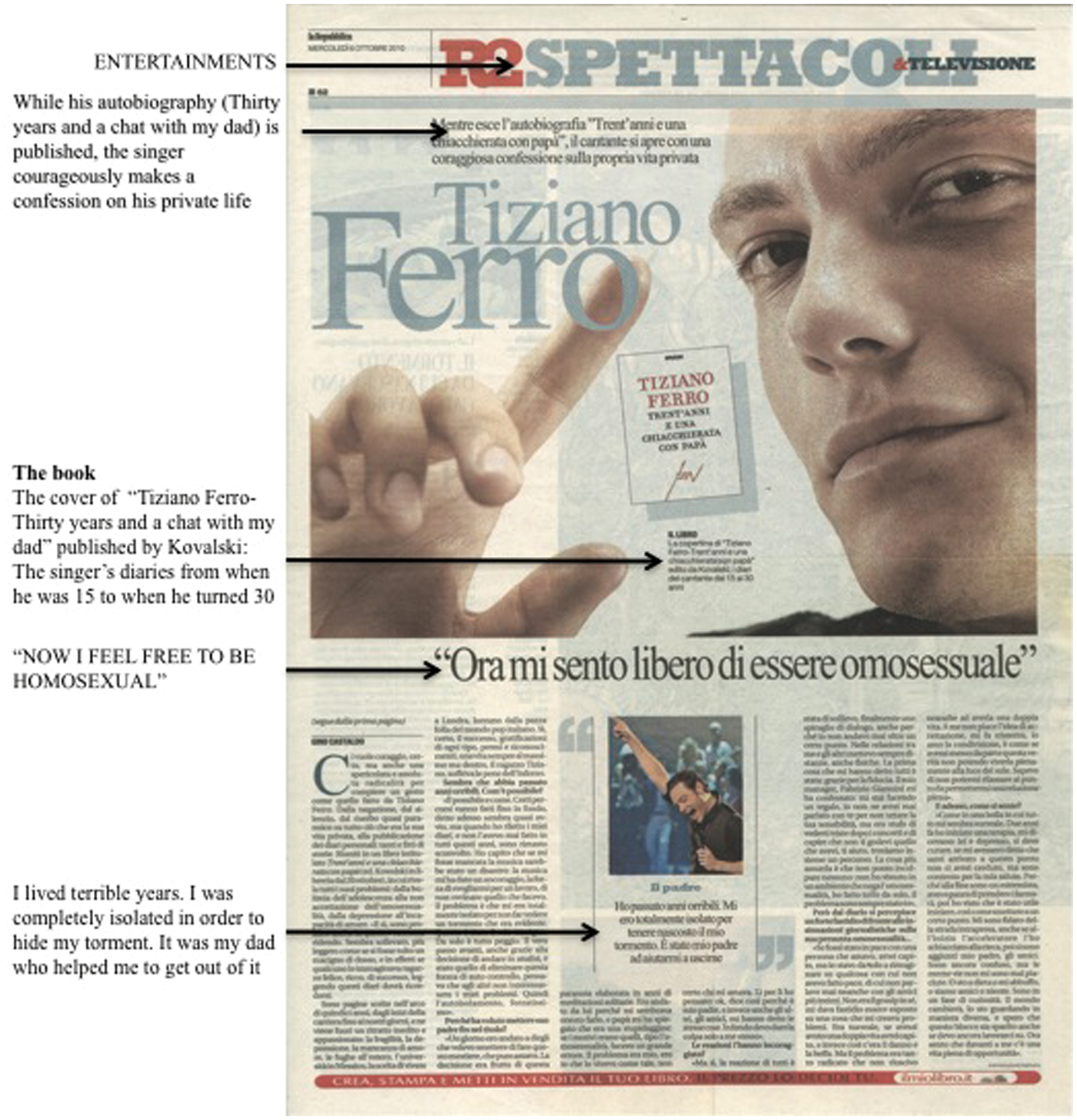
The structure of the page is different from that in the Corriere: halfway up is a picture of the singer, who smiles at the reader as he presents his book. Here a strategy of promoting his autobiography is more explicit. A small picture of the singer on stage makes a connection between the top half of the page and the bottom half, where there is an interview. Starting from the title (‘Tiziano Ferro’s truth’) and the subtitle (‘Free to be homosexual’), the text connects Ferro’s coming out to the classic discourses of authenticity and liberation already found in the Corriere editorial. Ferro’s story is presented according to the cliché of the coming out narratives of the last century ‘which speak initially of a deep pain, a frustration, an anguish … They speak of a silence and a secrecy which may need to be broken … These are always stories of significant transformations’ (Plummer, 1995: 50). These narratives are built on a series of binary oppositions – before/after, shame/pride, secrecy/visibility, hell/heaven, hypocrisy/truth, repression/liberation – where the second term is always more positive then the first. In the following I present significant interview extracts, the English version of which I downloaded from Ferro's official website in December 2010. LA REPUBBLICA – 6 October 2010: 62 Now I feel free to be homosexual. ‘The greatest sense of liberation was being able to talk with the people who are closest to me, with my father, my family and friends, the rest came natural’. The rest being the most honest revelation ever made by a pop star, at least in Italy. From denial, silence, and an almost paranoid protection of his personal life, to the publication of his personal diaries … in which he lays bare all his problems: from bulimia as an adolescent to the non-acceptance of his homosexuality, from depression to his inability to love … He seems relieved, lighter-hearted, as if freed from a huge burden … [W]hat emerges from them is a passionate and unexpected portrayal: fragility, depression, yearning for love, escapes abroad … You’ve lived through terrible years, it seems. But how could that be possible? ‘They really were terrible years. Some paths have to be trodden to the very end, that seems quite obvious to me now … The problem was that I was in total reclusion, hiding something that was tormenting me … My truly decisive step, in many ways made possible by my decision to go into therapy, was to remove this form of restraint: I thought other people weren’t interested in my problems, so I isolated myself. Totally’. Why do you mention your father right in the title of the book? ‘One day I went to see him to tell him that I wanted to quit music, despite all my love for it. My decision was the result of a paranoia I had built up over years of solitary reflection. I wanted to tell him because it seemed the honest thing to do, and Dad explained to me that I was being daft: if the reasons were, say, my homosexuality, I was making a big mistake. It was my problem, something I was experiencing as such, but not those who loved me. At the time I said to myself: okay, he’s saying this because he’s my Dad, but then everyone else, all my friends, said the same thing. Ultimately, I only have myself to blame’. Did you draw support from these reactions? ‘Yes, I did. Everyone seemed relieved: we could all talk honestly at last, because until then I wouldn’t really go beyond a certain point … My manager … said to me: I consider this a big gift from you, I would never have spoken to you about it out of respect for your sensitivity, but I was sick and tired of seeing you so sad after concerts, of knowing that you weren’t enjoying what you had. I want to help you, we’ll find a way together. The most absurd thing is that I have no one to blame: I didn’t grow up in an environment where homosexuality is denied, it was all my doing, the problem has always been me’ … And how do you feel now? ‘As if I were in a bubble, in which everything seems surreal. Two years ago I went into therapy, and they told me: you have depression, you need help. Had they told me I would be able to come so far, I wouldn’t have believed them, but I’m glad for my health … I’m living through a phase of great curiosity. The world will change, I’m looking at it with different eyes, and I hope this block has disappeared, although I still need to work on it. Now I feel that a life full of opportunity is out there waiting for me’.
In La Repubblica the counter-criminal discourse disappears. This difference could be explained if we take into account that the Corriere della Sera is a more conservative newspaper than the centre-left La Repubblica. The ritual of confession (Duff, 2010; Foucault, 1976) is used to made homosexuality acceptable. This idea evokes the biblical passage from John 8:32 ‘And you shall know the truth, and the truth shall make you free’. The homosexuality revelation (revelation of the true) to family members, friends and his own manager frees Ferro from the weight of the past. This story recalls Ellen DeGeneres (Dow, 2001) where the confession (simply through being a confession) has the effect of empowering the subject. The declaration to an audience – to a confessor – purifies, dispenses, redeems and frees the subject from their fault, but this freedom is only apparent because at the same time it delivers the subject into the hands of the listener/confessor (in this case, the father and manager). And yet, in order to come out, Ferro still needed the help of a therapist: ‘My truly decisive step, in many ways made possible by my decision to go into therapy, was to remove this form of restraint’.
When Ferro blames himself, makes himself feel guilty, both in the letter and in the interview (‘it was all my doing, the problem has always been me’), he lost an opportunity to interpret the malevolence towards himself as an effect of the context – an effect of disciplinary heterosexuality or heteronormativity (Chambers, 2003, 2007). The interview and its images reinforce the merciful father and increase the number of people giving love, comprehension, support, protection and welcome. After the first coming out with his father – and thanks to that – as if in a chain reaction, Ferro comes out to the lawyer, to friends and to his manager, until he finally comes out to the big public audience, and potentially he has to continue ad infinitum. We see in these scenes Sedgwick’s point that gay people are never completely in or out: ‘ “Closetedness” itself is a performance initiated as such by the speech acts of silence – not a particular silence, but a silence that accrues particularity by fits and starts, in relation to the discourse that surrounds and differentially constitutes it’ (Sedgwick, 1990: 3). This means that because of the disciplinary heterosexuality, even a celebrity who has come out to the big audience, is never completely out: even for a celebrity, the closet is a liminal condition, and coming out is a never-ending story.
The two pages from the two newspapers diverge on the images. In La Repubblica, the singer is alone apart from his dad (evoked through the book title’s reinforcement of the hierarchy between father and son). The little picture with the raised hand suggests that Ferro has succeeded: he did it! This raised hand toward the sky is also an individualistic gesture: Ferro is alone and completely focused on himself. In the end, in this ‘coming out of the credenza’ everything is resolved in an individualistic act that combines love and understanding from father, friends, lawyer and manager, but without a reference to an LGBTQ world. This observation takes us toward the conclusion.
Tiziano Ferro has thrown open the door of the closet, so what next?
I pointed out at the beginning of the article that ‘coming out of the closet’ is a nomadic expression, wending its way from English to Italian. During this pilgrimage, what has changed? What are the consequences and risks implied in this coming out frame? What price has to be paid to obtain visibility and what kind of visibility is achieved? Some typical discourses from the coming out formula can be traced in the singer’s story: for example, discourses related to victimization, pathologization and decriminalization against homosexuality and the belief in the transforming and liberating power of the performance. But what is different? In this story what comes into play as something unexpected and new, so that homosexuality is made ‘suitable’ and acceptable for the Italian context, is the merciful father discourse. Here I argue that, during the migration from the Anglo-Saxon to the Italian world, the classic discourses of coming out formula in Ferro’s case reappeared together with different hegemonic discourses so that gay identity is made acceptable. Above all, the declaration of homosexuality reinforces traditional Italian conservative values. There are typical discourses: religious and patriarchal family discourses, inflected in a neo-liberal version. In view of this story some could argue that, as acceptability of homosexuality is not a mainstream position in Italy, this ‘queer strategy’ is perfectly appropriate in challenging lesbian and gay displacement. 6 This position suggests that Tiziano Ferro’s coming out is better than nothing.
However I would argue that within this coming out story there are consequences and risks. In relation to this I would like to consider Althusser’s idea (1971) of interpellation. This enables us to view the singer and his audience as constituted and created – interpellated – via ideological systems operating silently and taken for granted. The consequence of this view is that both the singer and the reader have the illusion of being able to create their subjectivities, to be the author of themselves. Following this perspective, author and reader are imprisoned in the discourses that embody them. Discourses, according to Foucault (1976), act as mechanisms that regulate, normalize, classify and monitor the individuals in their expressions of their subjectivity: ‘These mechanisms … work silently and invisibly because they operate at the level of the micro-power … Individuals essentially become “docile”: that is, they incorporate the knowledge and discourses about them and “discipline” themselves’ (Baez, 2002: 49).
Therefore, what risks are Tiziano and the reader taking? As we become used to this idea of coming out of the closet, to what do we become docile, blind and indifferent? There is the risk that we will remain limited by the strength of these hegemonic discourses, that we become sensitive only to the personal meaning of Ferro’s coming out and so we lose sight of the political and social context that constitutes the premise of that story. Discourses of authenticity and liberation (flavoured with emotional torment) made Ferro’s coming out an individualistic moment, something that concerns only Tiziano Ferro, and is set apart from its political importance and relevance. Through the newspaper pages all the characters are called up to defend Ferro, not to position themselves against the context (apart from one weak reference to the Church). This dynamic reduces coming out to an acceptance by others and to an empowering effect for the singer. Ultimately it does not undermine the conservative discourses that surround homosexuality in Italy. Ferro in this story does not openly take a stand against sexual discrimination or inequality; he does not argue in favour of civil unions, or for gay couples’ right to undertake adoptions. A romantic relationship with somebody, other gay people, gay and lesbian friends – all these are totally absent: his coming out is individualistic, personal, something that concerns only him and his story.
In other words the prevailing personal and individualistic meaning of this coming out reinforces the position of an audience that loves and protects Tiziano Ferro but is de-sensitized to political instances and demands. I like Tiziano Ferro’s songs; but telling us his personal truth, discussing the love that he received from his father doesn’t go far enough to change the conditions of Italian heterosexism and homophobia. So for Tiziano Ferro, being able to declare publicly that he is gay is a victory; but there is the risk that this individualistic victory fails to challenge the Italian status quo, and instead reinforces traditional discourses and inequalities.
And finally, what about the particular image of homosexual that he suggests? Tiziano Ferro has given interviews, written a book, and appeared in newspapers, magazines and on TV, so he has promoted repeatedly his image of the good son, the good friend and the happy gay. There is a risk that this image of a homosexual continues indefinitely this singular type of homosexual. And what about the other people who are not like this ‘proper, valued and licit white gay male’? What about fluid identities or variant sexuality people? They do not find the right of citizenship in this story.
However, this Althusserian view itself presents a risk: it offers an over-deterministic picture of both the singer and the audience. This is why I want to stress that Ferro’s coming out, even if undertaken from a privileged position and in deference to traditional values, represents a case of possible disruption for the interpellation of other ways of being: no norms – no hegemonic discourse – are ever secure and there is always room for disruption and challenges to regulatory systems. The definition of the ‘normal’ and ‘proper’ gay happens in interactions with all the other actors (Ferro and his readers, audience and listeners) who interpret, understand, categorize, position and reposition themselves, and redefine their identities. Subjectivity is disciplined by regulatory discourses and is the result of repetition but it is never completely predetermined, fixed or rigid. The repetition is a risk that must be taken, according to Butler (1997), if we want to disrupt or interrupt the terms and discourses through which performative acts are usually done. Here I want to recall Butler’s idea of gender identity as a kind of ‘improvisation within a scene of constraint’ (Butler, 2004: 1), which helps me read this story in a less oppressive way. The construction of the Ferro narrative – imbued with traditional Italian value and regulatory discourses – constrains the possibilities of gender improvisations available to the different actors in the field: gender and sexuality are effects of regulatory forces and norms. Nevertheless, within this schema Butler opens the possibility for individuals to perform gendered acts without necessarily enacting the traditional model. Sexuality according to Butler is never reducible to an effect of regulatory power: it ‘emerges precisely as an improvisational possibility within a field of constraints … it is extinguished by constraints, but also mobilized and incited by constraints, even sometimes requiring them to be produced again and again’ (Butler, 2004: 15).
To conclude, I ask if there are still potential conflicts, and hence potential for disruption – for readers at least – in the unholy alliance of hegemonic discourses such as Church or State, with homosexual practices. One could imagine, for instance, that other religious figures or politicians might at some later date resist such ‘normalization’ of homosexuality. And perhaps, in the future, will other homosexual popular singers, with all their associations of frivolity, bizarreness and creativity, have the potential to unsettle stereotypical notions of the ‘good’ homosexual and homonormativity?
As I write these pages, this symbiosis between individual and media continues. After a year of silence since the publication of his book, on 28 November 2011, Ferro has released a new CD: L’amore é una cosa semplice (love is a simple thing). At the same time, he has announced in an interview with Vanity Fair that he is in love with a man. So, what is new in these texts? He claims that over Christmas 2010, two months after coming out of his personal credenza, he found ‘a special person’ and that ‘this experience made me confront the limits that I had thought insurmountable, [such as] simple things like tidying up, doing the washing, sharing spaces’ (Brocardo, 2011). Throughout this text the relationship with the unnamed and unknown ‘him’ is only hinted at, and the few clues there are give an impression of homonormativity. Here I read a good example of privacy and domesticity making homosexuality acceptable. This new big announcement, this ‘happy coincidence’, also reminds us, that celebrities are inextricably matched with the need to reinvent identity, reawaken audiences and guarantee commercial success: as in the cases of George Michael and Sheryl Swoopes, here it seems that the commercial agenda is at play.
It will be interesting to continue this research in the future and follow how homosexual discourse will evolve in the public life of the singer. But also it would be worth investigating how gay discourses will evolve within the Corriere della Sera, which is quite a conservative newspaper: perhaps there is somebody here that has an agenda to change the representation of homosexuality in Italy. Moreover, having analysed the case of Tiziano Ferro, more might be learned through a comparative study of Tiziano Ferro’s and Ricky Martin’s respective comings out: they are both celebrities from Latin countries, so what are the similarities or differences both between them and with other Anglo-Saxon celebrities? This article, in the end, is not a conclusion, but raises a significant research agenda for the future.
Footnotes
Acknowledgements
My thanks are due to the Education and Social Research Institute of Manchester Metropolitan University for a Visiting Research Fellowship (September 2010 to February 2012). I am grateful to Janet Batsleer, Francesco Bilotta, Erica Burman, Neil Carey, Helen Colley, Nigel Hall, Maggie MacLure, Ilana Mountian, Karen Nairn, Ian Parker, Maria Chiara Pizzorno and Harry Torrance, for their precious advice and for the discussions that fuelled and accompanied the creation of these pages. I am also indebted to Huw Bell, who helped me express my ideas in a language that is not my mother tongue. Finally I am also appreciative of the critical feedback received from the three anonymous reviewers of Sexualities.
Funding
I acknowledge the University of Valle d'Aosta that financed my research project on coming out of the closet.