



Abstract
Despite a progressive Constitution and affirming legislation, sexual and gender minorities experience discrimination in South Africa. This reflects the ongoing impact of heteronormativity, ‘culture’ arguments and violence in suppressing non-normative sexual and gender identities. In the present study we conducted interviews with eight young, lesbian women and gay men in eThekwini municipality in KwaZulu-Natal province. Three major themes emerged: Language and constructions of gender and sexuality; Experiences of homophobia; and Challenging ‘culture’ arguments. Participants tended to replicate heteronormativity and traditional understandings of gender in their lives; they experienced homophobia and homophobic violence; and they challenged homophobic ‘culture’ arguments.
Introduction
In South Africa non-normative sexual and gender minorities have received increasing research and media attention in recent years. For example, there has been a focus on the high levels of violence against these communities (Human Rights Watch, 2011) including the rape and murder of lesbian women in the townships (Dana, 2012) and the killing of gay men (John, 2012). Racial tensions have also come to the fore at ‘Gay Pride’ in Johannesburg (Schutte, 2012), the National House of Traditional Leaders has attempted to remove gay rights protections from the Constitution (Mail & Guardian, 2012) and there is a small but growing body of research on homophobia in South African schools (Bhana, 2012; Francis and Msibi, 2011). Politicians and prominent leaders have also been taken to task as a result of their ambivalent, if not homophobic, attitudes towards sexual and gender minorities (Mail & Guardian, 2006; Smith, 2010). This all occurs against a backdrop of constitutional protections for sexual orientation, the introduction of same-sex marriage and generally affirming legislation and policy.
A number of factors impact the lives of non-normative sexual and gender minorities in South Africa. These include homophobic ‘culture’ arguments, heteronormativity, and intersectionality between multiple identities of class, race and geographical location. For example, Bhana, Morrell, Hearn and Moletsane (2007) point out that the concept of ‘culture’ is regularly employed to determine what is ‘normal’ and acceptable, including in the area of sexuality. They argue that the oppressive notion of culture as static and untouchable needs to be disrupted so that people may construct and perform their sexualities with greater freedom. There are also ongoing tensions between ‘African’ and ‘Western’ understandings of sexuality and gender (Epprecht, 2009; Gevisser and Cameron, 1994) and the ‘homosexuality is unAfrican’ argument continues to be widespread both in South Africa and across the continent. In KwaZulu-Natal province Hunter (2010) explores the prevalence of HIV/AIDS and the ‘materiality of sex’ in Mandeni, a township characterised by skewed resource allocations, rapid urbanisation, the legacy of apartheid urban design, increasing levels of poverty, unemployment and capital-led globalisation. Hunter (2010) presents the ways in which apartheid and then chronic unemployment have become central to understandings of masculinity, femininity, love and sex in KwaZulu-Natal.
Bhana et al. (2007) point out that in South Africa, in contrast with the progressive Constitution, heteronormative and patriarchal discourses and practices continue to silence female sexuality and to negate homosexuality as ‘unAfrican’ and against religion. The pervasiveness of this ‘homosexuality is unAfrican’ argument is evident in the comments of public figures. For example, President Jacob Zuma has said: ‘When I was growing up an ungqingili [a gay person] would not have stood in front of me. I would knock him out’. He also said that same-sex marriages are ‘a disgrace to the nation and to God’ (Mail & Guardian, 2006). Minister for Arts and Culture Lulu Xingwana walked out of an exhibition that included photographs of nude lesbian couples saying the exhibition was ‘immoral, offensive and going against nation-building’ (Smith, 2010).
Constructions of gender in traditional South African society are closely tied to heteronormativity and traditional, hegemonic understandings of gender play out in same-sex relationships. For example, Kheswa and Wieringa (2005) describe the ‘butch-femme’ dynamic among lesbian women in Johannesburg, whereby the ‘butch’ partner takes on the traditional role of the male partner in heterosexual relationships, particularly in terms of finances, domestic work and sexual encounters. The ‘femme’ partner inhabits a more ‘passive’ role sexually and typically takes care of the household. Butch women generally look for femmes and appear to reify heteronormativity and patriarchy within the context of these same-sex relationships. A similar dynamic is evident in the ‘skesana-injonga’ dynamic in gay male relationships (McLean & Ngcobo, 1994) where the skesana, the passive partner in the sexual relationship, is generally understood and treated as a female. The injonga, who takes on the active penetrative role in homosexual sex, is associated with the power that men in heterosexual relationships embody. Rankhotha (2005) found that a group of self-identified skesanas described themselves as clean, tidy, fashionable, beautiful and presentable and that their flamboyancy and appearances expressed this. In same-sex relationships such as these, that reify heteronormativity, the injonga partner may also often have a girlfriend and lead the life of a heterosexual male.
Barnard (2001: 130) argues that race, nation, gender and sexuality are not separate axes of identity but are rather systems of meaning that define one another. Race does not exist separately from sexuality (and vice versa) in that race is sexualised just as sexuality is nationalised. For example, the experience of an older, white, middle class, gay man in Cape Town’s De Waterkant ‘gay village’ may be a world away from the experiences of a young, isiZulu-speaking, lesbian woman in the townships of KwaZulu-Natal province. In this sense the literature points to an ongoing racial separation in black and white gay social spaces (Visser, 2003, 2008) and these diverse realities render problematic sweeping generalistions about same-sex desire and gender non-normativity across the country, including in the city of Durban.
Durban is located in the eThekwini municipality in the province of KwaZulu-Natal, where isiZulu is the most widely spoken language. Notions of ‘Zulu identity’ are highly contested in the postmodern space in which are implicated ideas of ‘tradition’ and ‘culture’ (Carton, Laband and Sithole, 2008). For example, the terms used to describe ‘Zulu’ people vary and include ‘isiZulu-speaking Africans’, ‘amaZulu’ and ‘isiZulu-speakers’ and there is ongoing debate about who and what defines ‘Zuluness’ (Carton et al., 2008: xxi). These tensions between postmodernity and tradition are closely tied to histories of colonialism and to the ongoing legacy of apartheid. Within this space, discourses around non-normative sexual and gender identities and the manner in which these identities are constructed and represented presents another layer of complexity. For example, in response to Zulu King Zwelithini’s argument that homosexuals confuse children and betray Zulu ‘culture’ and society, the director of the Durban Lesbian and Gay Community and Health Centre replied: Zulu lesbian and gay people are women and men, they were born Zulu and would die Zulu. King Zwelithini can never take that away from them even if he wanted to. Being Zulu is part of their identity. I am a proud, black, lesbian Zulu woman. I am fundamentally in tune with my culture. I do not need prayer or an Inyanga to heal me. I am healthy, intelligent and beautiful. My family, partner and community are proud of me. (Nonhlanhla Mkhize, quoted in Rudwick, 2010: 117)
Aims
Despite the challenges faced by non-normative sexual and gender minorities in KwaZulu-Natal, there continues to be a dearth of research in this area. Therefore with the present study we aimed to explore the intersectionality of heteronormativity, homophobic violence, language, and notions of ‘culture’ (including religion) in the lives of a sample of young people in Durban. Given that the majority population in KwaZulu-Natal is isiZulu-speaking, we were also cognizant of the ways in which Zulu ‘culture’, language and gender norms might intersect with these other factors. Given the ongoing racial divisions in gay social spaces we also hoped to include some racial diversity in the sample.
Method
We used a case study approach and interviewed a sample of young lesbian- and gay-identified people in Durban. The study received ethical approval from the Ethics Committee at the School of International Training, Durban in October 2011. We conducted an initial observational study by visiting two sites in Durban city that are known as lesbian and gay social spaces. The first site was a nightclub in central Durban frequented predominantly by a young, isiZulu-speaking clientele of diverse class backgrounds who came mostly from urban and peri-urban (township) locations in eThekwini. The second site was a nightclub in a more affluent neighbourhood of the city frequented by a more Indian and white clientele with a wider age range coming largely from middle-class backgrounds.
The second author returned to these two sites, approached patrons, explained the study to them and asked if they would be interested in participating. These initial contacts subsequently acted as gatekeepers for the study and we employed snowball sampling. This introduction to the lesbian and gay ‘scene’ was particularly important given that the second author is both white and American and therefore an ‘outsider’ in many respects. However she is also queer-identified and experienced the tensions inherent in embodying both ‘insider’ and ‘outsider’ status during the course of the study. She was aware of her limitations in not speaking isiZulu and was cognizant that English was a second language for some of the participants in the study. Our convenience sample eventually expanded to include eight self-identified young lesbians and gay men, interviews lasted approximately 30 to 45 minutes and they took place throughout the month of November 2011. Interviews took place in informal settings such as cafés or in the offices of the Durban Lesbian and Gay Community Health Centre.
During the interviews participants were asked to talk about their lives because life stories allow researchers to access the influence of cultural and political shifts (Vincent and Camminga, 2009). In this sense the personal narratives of historically ‘defiled’ groups (Riessman, 2001) may cast light on both individual biography as well as the social context in which individuals’ lives are played out. The interview schedule consisted of questions that focused on participants’ understandings of gender and sexuality as well as on their experiences of homophobia. The interview schedule guided participants to engage with the following questions: How do you identify in terms of your sexuality? What do you do in your daily life that shows you are a gay man or woman? How do other people know that you’re gay? Did parents or family ever accuse you of not acting like a proper girl/boy? How do you define gender? How have you lived your gender? What are your experiences of being a butch woman or an effeminate guy in a conservative society? and What do you think of the disjuncture between South Africa’s liberal laws and pervasive homophobia? We also felt that it was important to engage with differences of experience based on class and/or race and therefore we included two non-isiZulu speaking participants in the study.
After transcription the second author read through each transcript and began a broad thematic analysis of the data, analysing transcripts for recurring themes or concepts and for any ideas or information that she thought particularly salient. She began to look for recurring ideas both within each case and across cases and these recurring themes are presented in the Results section below and are supported with verbatim quotes from participants. We took an idiographic approach to the thematic analysis, looking for what was common across cases as well as that which was unique to each case, thereby hoping to highlight both commonality of experience as well as participants’ unique voices. The interview schedule influenced both the direction of the interviews with participants as well as the analysis of the raw data. Finally, we do not propose that our interpretation is the only interpretation of the data but rather hope to have developed themes that are grounded in these raw data and in our own observations about ‘LGBTI’ life in KwaZulu-Natal.
Results
Participant demographics.
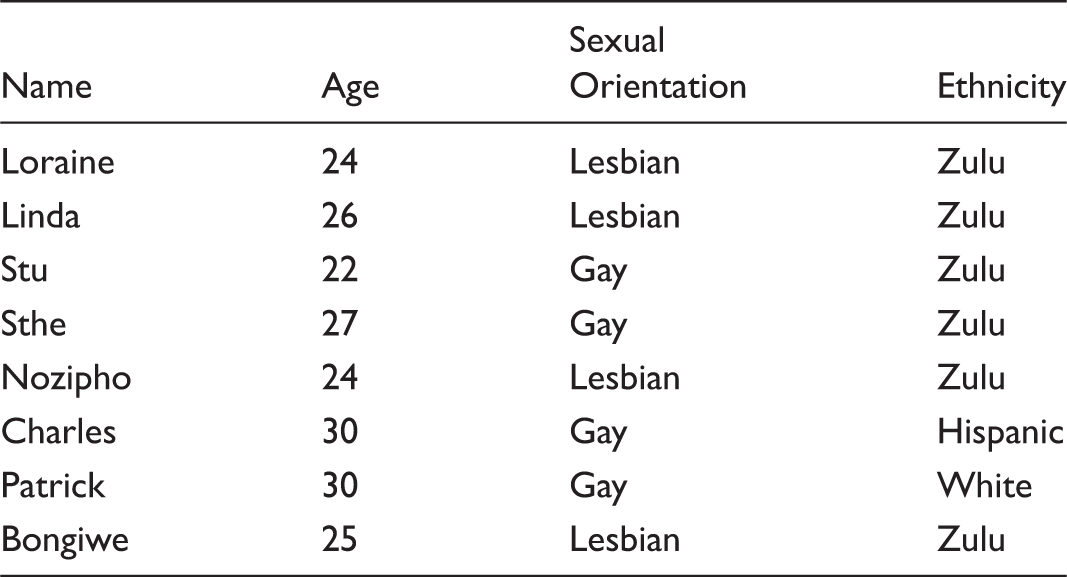
The isiZulu-speaking participants came from the first site in central Durban and the white and Hispanic participants from the second, middle-class site. While some of the clientele at the first site are professionals, the participants in our study came from working class backgrounds. We present the findings from our study in three overarching themes: Language and the construction of gender and sexuality; Experiences of homophobia; and Challenging ‘culture’ arguments. These themes explore: constructions of gender and sexuality among participants; participants’ concerns about their personal safety and their experiences of homophobia; and the ways in which they challenged homophobic ‘culture’ arguments. We present these themes below, comment on them, link them to the literature and contextualise them.
Language and the construction of gender and sexuality
Participants constructed their sexual identities in traditionally gendered terms and we argue that in so doing they reified heteronormativity in their same-sex relationships. For example, lesbian participants often constructed their identities by modelling their behaviour and sense of self on a heterosexual, male norm and conversely gay male participants aligned their sense of self and gender role with those traditionally ascribed to women. In this sense our findings are strikingly similar to those of McLean and Ngcobo (1994), Rankhotha (2005), Msibi (2013) and Reid (2013) regarding the replication of heteronormative gender roles in same-sex relationships in South Africa. Our participants’ reports also pointed towards the pervasive conflation of gender and sexuality in South Africa to the extent that it is often presumed that lesbians and gay men want to be – or are also – the opposite sex. A linguistic example of this is the isiZulu term isitabane (which we present cautiously here given its often homophobic connotations) that refers to a gay male but also to a person with both sexes (in effect an intersex reference).
The butch–femme dynamic described by Kheswa and Wieringa (2005) was evident in the reports of the participants in our study. For example, Bongiwe often thought about what it would be like to be a boy and desired the power to impregnate a woman because she would never want to carry a baby herself. She referenced her own gender behaviour and dress code by saying that she grew up ‘dressed like a little boy’: … my aunt, every time she addressed to me, she’d be like ‘boy, boy, boy, boy’ all the time. A lipstick lesbian is a lesbian whereby she’s very ladyish. You don’t ever see her acting all butch-up.
However Bongiwe and Linda’s reification of heteronormativity was not absolute. For example, while the second author did not perceive Linda as performing gender in a way that overtly challenged patriarchal norms, Linda reported that her (non-normative) lesbian identity had been enough to disrupt the comfort of her teachers, school principal and family members. Bongiwe herself problematised the construct of ‘gender’ and through her own reflexive process was aware of its limitations, insisting that she would rather not engage with the construct at all: I’d rather not have [gender]. I wish that I could just be me with no sexual orientation, no gender, just me … but I know I’m female. [But] everything I do doesn’t resemble being female … my genitals, that’s probably the only thing that resembles that I’m female.
During the course of the interviews we critically engaged with the ‘agency versus tradition’ debate in terms of participants’ sexual and gendered lives. While not all participants in the study were isiZulu-speaking, the majority were and so we looked to Zulu customs and ‘culture’. We found, for example, that two participants in a previous study by Rudwick (2010: 123) desired to change sex but believed that they would not out of respect for Zulu ‘culture’ and the elders: The behavior of these individuals which is based on the Zulu laws of inhlonipho [respect] indicates that in this particular instance their cultural and ethnic identity rates higher than their sexual identity as transgendered and gay men. (Rudwick, 2010: 123)
The different ways in which non-normative sexual and gender identities are linguistically coded also became apparent in the course of the study. For example, while interviews took place in English, participants never used the acronym ‘LGBTI’ but rather used the English terms ‘gay’ or ‘lesbian’ or made reference to the isiZulu terms isitabane and skesana, which have problematic and homophobic connotations in isiZulu. We therefore began to problematise the ways in which terms such as ‘LGBTI’ are used in South Africa. We realised that the acronym ‘LGBTI’ is generally used by activist/community organisations and among some academics and researchers working in the area. For example, the Durban Lesbian and Gay Community and Health Centre, where interviews for the study took place, uses the LGBTI acronym extensively and: … offers a safe and secure space for the … a centre for
As Msibi (2013) points out, postmodernist and post-structuralist scholars warn about the risk of using identity categories such as ‘gay’, which suggest immutable, static sexualities that end up being ‘instruments of regulatory regimes’ (Butler, 1993: 308). In the African context feminist scholars such as Kendall (1998) have found that women in Lesotho who engage in sex acts with other women do not necessarily claim lesbian identities. Matebeni (2009: 114) also suggests that people who engage in same-sex relations define themselves in varying ways, which may or may not include the category of lesbian. Furthermore, Reid’s (2013) work on sexuality in small town South Africa points to the complex ways in which ‘gay’ is performed. In this context effeminate men, ‘the ladies’, engage in sex with ‘gents’. While the ‘ladies’ do not generally engage in sex with each other, the ‘gents’ engage in male same-sex sex acts for both pleasure and for financial reasons, often returning to married life with women. Msibi (2013) also found problematic mimicking of heteronormative power relations among male, same-sex partners in his study. In short, the complexities of same-sex desire in the (South) African context are noteworthy and raise questions about the relevance of Western identification categories.
Following Matebeni (2008) we believe that knowledge creation can contribute to the transformation of injustice. Therefore we felt that during the course of the study it was also important to not lose sight of the real world relevance of this research and we were constantly reminded by our participants of the social justice and human rights issues at stake. We could not ignore the violence that our participants faced in response to their perceived gendered and sexual identities, however these were understood and whatever terms were used. We argue that it behoves researchers working in this field in South Africa to be aware of the ‘real world’ applications of their research and caution against such research becoming simply a depoliticised research exercise, especially given the extreme levels of violence against sexual and gender minorities across the country (Human Rights Watch, 2011). In this sense, all the participants in our study believed that Durban was a homophobic place, had experienced violence and assault or expressed concerns over their personal safety.
Experiences of homophobia
Potgieter (2006: 7) points out that ‘although the laws regulating same-sex relationships have been radically transformed in South Africa, homophobia nevertheless remains an everyday reality and more so if normative masculinities are challenged in the process’. As a result, the full implementation of institutionalised rights for sexual and gender minorities remains incomplete. In our study Loraine, who worked at the Durban Lesbian and Gay Community and Health Centre, felt that while this protective legislation was beneficial there was still a chasm between the Constitution and the level of intolerance in South African society more generally: I think tolerance and acceptance … should have been created first before they put in place legislation that everybody else sees as just a piece of paper … society is still the problem … it seemed like the process happened backwards. If I’m in my hood, in the townships, I’ll deny it [being gay] … but when I’m out here in town [Durban city centre] … I’m openly gay here, because I haven’t come out at home yet.
Overall, families, the social sphere and the workplace all gave participants in our study cause for concern in terms of their personal safety. The marginalisation of ‘LGBTI’ people in South Africa extends to the work environment and Hattingh (2005: 197) found that gays and lesbians in the workplace purposefully render themselves invisible as a survival tactic. Participants in our study had somewhat divergent experiences of feeling safe in the workplace. While some participants talked about the challenges of being ‘out’, others did not find that this was an issue for their co-workers. Stu’s experiences pointed to a more subtle form of homophobia in which there was a fascination with the gay ‘other’. In Stu’s workplace co-workers knew about his sexual orientation but were so focused on his sex life that this often dominated workplace conversations. Linda also reported that, while she had been out at school, her current co-workers were only ‘kind of’ aware because ‘you don’t want them to know because you’re not sure how they’ll react’. Linda and Stu’s reports point to the ongoing disjuncture in South Africa between policy and practice, as outlined more generally by Perumal (2006), and particularly in terms of sexual and gender minority rights. Nel and Judge (2008) argue that the institutionalisation of LGBTI rights leads to a dichotomy between expected equality and the reality of homophobia with intolerance making it difficult for many ‘LGBTI’ people in South Africa to feel comfortable in their own communities.
The two sites in our study – one in downtown Durban and one in a more affluent middle-class area – were frequented by different racial groups. These ‘LGBTI’ racial divides mirror the broader socio-economic picture in South Africa which is characterised by incomplete transformation in the post-apartheid context and leads to widely diverging life experiences including in relation to poverty, unemployment and safety. We included two non-isiZulu participants in the study and, perhaps unsurprisingly, they had a somewhat different experience of personal safety compared to the other participants. For example, Charles was proud of South Africa’s progressive legislation and Patrick, the only white participant in the study, talked about the freedom to be oneself: That’s why our gay flag is rainbow: because it’s broken up into sections but we’re all one thing … you know, just be you.
Challenging ‘culture’ arguments
Understandings of ‘culture’ and ‘tradition’ in relation to sexuality and gender are highly contested in South Africa. For example, Bhana et al. (2007) argue that in South Africa the emotive power of ‘culture’ functions as an obstacle in challenging heteronormative understandings of sexuality. Burns (2007: 263) indicates that much recent research on sexuality and gender roles points to the weakness of ‘tradition claims’ because what is often understood as ‘traditional’ may in fact be rather ‘new’ and ‘inter-cultural’. Given the challenges that gay men and lesbians face with these cultural and social norms we anticipated that notions of ‘culture’ and religion would be challenging sites for participants in the study. What we found was that participants challenged hegemonic and homophobic constructions of ‘Africanness’ and ‘reclaimed’ religious belief from homophobic dogma.
Participants reported that the rejection and violence faced by gay people resulted from the widespread belief that homosexuality was ‘unAfrican’. In contrast, participants argued that the meaning of ‘Africanness’ was an evolving notion that needed to change to include lesbian and gay identities. For example, Bongiwe felt that the meaning of ‘Africanness’ changed over time: I’ve done work in the rural areas and I see a chief sitting next to his Mercedes with a cell phone in his hand. Now for me, that could be a perfect picture of what is unAfrican twenty, thirty, even a hundred years ago but now it is part of where we are at developmentally.
In terms of religion, Potgieter and Reygan (2011) have explored the challenges of LGBT people in South Africa grappling with homophobic religious traditions. In particular, LGBT people have ‘reclaimed’ religion in different ways to make it more ‘gay-friendly’. Participants in our study challenged the use of religion as a tool of homophobia and spoke rather of the important role of religion in their lives, believing that God had created them lesbian or gay. For example, Stu felt that his sexuality and his religious beliefs were intertwined: ‘Your gender is a spiritual thing as well. Your identity is a spiritual thing’. Spirituality was central to Stu’s understanding of self and helped him come to terms with his sexuality. He believed that an individual could not come to a full understanding of self without the concept of a higher being and that all parts of himself, including his sexuality, came from God: If you go deep enough into anything, it becomes theological … it goes back to God and that’s why I’m interested in God. … if God wants me to be like this right now then I’ll be like this … this other life of being lesbian doesn’t mean that you’re not an auntie, not a sister, not a mom … I’m okay like this. Perhaps it is very nice living this life. Trust me.
Conclusions
South Africa has a particular history of colonialism, power and domination and presents unique contemporary challenges. While it is one of the few countries in the world to enshrine gay rights in its Constitution, was an early embracer of same-sex marriage and has world-leading equality legislation and policy, the realities on the ground for ‘LGBTI’ people often do not reflect this picture. Therefore any conversation around non-normative sexual and gender minorities needs to be informed by these realities and to critically engage both with traditional, ‘African’ understandings of sexuality and gender as well as interrogate the usefulness, relevance, and ethics of the contemporary LGBTI/gay rights discourse in the South African context. Here we caution that the emergence of non-normative sexual and gender minorities globally in recent years should not be seen as a teleological process, unfolding towards some Western ideal, but rather developing from local histories and contexts mindful also of points of intersection with the steady march of the global ‘gay rights’ movement.
There is an ongoing attempt to erase non-normative sexual and gender identities from (South) African ‘culture’ and this ‘homosexuality is unAfrican’ discourse is particularly pernicious given the violence against sexual and gender minorities across the country. While participants in this study appreciated the presence of institutionalized rights, they were mostly critical of the lack of implementation of these rights. This played out in particularly stark ways in their lives including in both the threat and the reality of homophobic hate crime and a lack of formal support from the police. This attempted erasure of non-normative sexual and gender identities contrasts with the long history of non-normative sexual and gender identities in Zulu society, including same-sex marriage ceremonies in the area of Cato Manor in the 1950s and the existence of a number of related isiZulu terms such as isitabane, skesana and injonga that, while problematic, speak to histories of non-normative sexual practices and identities in KwaZulu-Natal.
In conclusion, we found that the expression of non-normative sexual and gender identities may not always be as emancipatory as we had thought. In fact, participants appeared to unreflexively live out heteronormative and ‘traditional’ notions of gender in their lives and relationships. Nevertheless there was potential for change as some began to critically engage with the heteronormativity of the societies in which they lived. We also emphasise here the complexities of the linguistic coding of non-normative sexual and gender identities in South Africa. We problematise the simple ascription of the ‘LGBTI’ label to what are in effect complex and diverse expressions and understandings of sexuality and gender. We argue for the importance of grounding any theorising of sexuality and gender in local contexts, thereby more effectively challenging the use of ‘culture’ arguments to deny agency, rights and full participation to sexual and gender minorities in KwaZulu-Natal and across South Africa.
Footnotes
Funding
This research received no specific grant from any funding agency in the public, commercial, or not-for-profit sectors.
Acknowledgements
The authors would like to thank all the participants who took the time to participate in the study and to talk about their lives.