



Abstract
This article discusses how seven young people born to lesbian mothers and conceived using donor insemination negotiate positions with their donor figuration. ‘Negotiation’ here refers to processes in which the donor figure, his offspring or both are in motion, and in which the motion physically and relationally positions them in relation to each other. The article illuminates the differences in negotiations between the donor being an anonymous figuration and a ‘negotiated absence’ (Donovan, 2000), or a known and physical present figure. However, the analyses show that the positions between the donor figure and his offspring are constantly in motion, irrespective of the donors’ anonymity or not. This indicates that the anonymous/known dichotomy is not entirely useful in explaining the different ways in which donors are configured in planned lesbian families.
Introduction
New reproductive technologies like donor insemination and surrogacy challenge the dualistic thinking between nature and culture, in which nature is seen as essential and a given that generally cannot be changed, while culture is seen as consisting of human practices and everyday interactions, as something in constant motion (Strathern, 1992). The technologies destabilize biological ‘facts’ (Carsten, 2004), and consequently question legal, political and normative ideas about how children can and/or should be conceived, and the meaning of kinship, biology, family and parentage in particular. In this article I will discuss the accounts of donor offspring and how they perceive the donor. Specifically, I will discuss how they negotiate positions with a donor figuration. According to Braidotti, a figuration is not merely a concept or abstraction but a living reality, ‘a living map, a transformative account of the self – it is no metaphor’ (2002: 3). In other words, a figuration is a living subject and actor who can think, act and resist, and who is in continuous motion and production as a subject. Haraway (1991) claims that we can describe figurations as phenomena that exist at the border between fact and fiction – between living reality and fictions. Understanding donors as figurations in continuous motion, enables new perspectives that question dominant conceptualizations of parenting, fatherhood and the importance of blood ties.
The use of alternative technologies is seen as challenging the primacy of biology and blood ties over social relationships. There appears to be a strong conception that knowledge of continuity and unbroken lineage is of vital importance (Fjell, 2003). This is perhaps most clearly expressed in dialogues Becker et al. (2005) refer to as ‘resemblance talk’, where the outward physical similarities between parents and children or between children and other biological family members, are emphasized. Resemblance talk reinforces the assumed natural order of things, which supports the idea of the primacy of biology and blood ties over social relationships. However, Strathern (1995) argues that ‘making visible the detachment of the procreative act from the way the family produces a child, adds new possibilities to the conceptualization of intimacy in relationships’ (1995: 353). In other words, the new technologies also create opportunities to negotiate new positions and relationships between subjects. This is what Lie (2002) discusses when she suggests that science itself can symbolically appear as the creator, or ‘the new father’. She writes: ‘… science has extended its influence over the reproduction process, from the periods of pregnancy to birth, to the moment of conception and can symbolically appear as the creator, or the new father’ (2002: 394). Referring to science as symbolically the ‘new father’ may be perceived as a failure to see the relational processes that take place between parents and children. However, especially in cases where the donor is an anonymous, abstract figure who is not a living present, it may be argued that science and technology is the agentive actor, rather than the anonymous donor.
Donovan (2000) claims that it is in planned lesbian families that some of the most radical explorations of fatherhood are going on. This raises a number of questions: how important are blood ties for children and young people who are conceived with the use of donor sperm? Which positions can the anonymous and known donor have? For example, is the donor part of the family? Is he a father and/or a parent? Based on a conceptualization of the donor as a figuration in continuous motion (Braidotti, 1994), I discuss different negotiations between the donor and his offspring.
Theoretical background
Although the new reproductive technologies challenge the dominant perception that emphasizes the importance of blood ties, family and parenthood, they can also retain this primacy. When one of the women in a lesbian couple has her eggs fertilized by the use of donor sperm, a biological bond between the mother and the child is created. This may lead to what Ehrensaft (2008) refers to as ‘a genetic asymmetry’ in the family, and challenges the mothers in their performance of parenthood (Gabb 2004; Ehrensaft 2008). Likewise, Jones (2005) claims that in general one cannot argue that planned lesbian families challenge heteronormative notions of family and parenthood. For example, some lesbian couples want the donor to look similar to the non-biological mother, so that the child can be seen as having a biological relationship to both mothers (Becker et al., 2005; Jones, 2005; Nordquist, 2010). Franklin et al. (2000) argue that lesbian couples who choose the donor from the perspective of wanting a biological similarity between the donor and the mother(s), are seeking access to the culture’s dominant beliefs about the ‘natural’ family and ‘natural’ parenthood. Access to donor insemination has provided increasing numbers of lesbian couples with the option of orienting themselves towards what can be described as a heteronormative family constellation, consisting of two parents and children (Spilker, 2007).
Previous studies of children and young people in lesbian families and born into planned lesbian families, are predominantly based in psychology. These studies are also mainly comparative, which means that in most contexts they compare factors such as the psychological well-being, school outcomes, stigmatization and self-esteem of these children as compared to children raised in heterosexual families (see e.g. Bos and Hakvoort, 2007; Brewaeys et al. 1997; Flaks et al., 1995; Gartrell and Bos, 2010; Patterson, 1992; Scheib et al., 2005; Tasker, 2005; Tasker and Golombok, 1995, 1997; Vanfraussen et al., 2002; van Gelderen et al., 2012; Wainright et al., 2004). The studies that focus on children in lesbian and planned lesbian families generally reach the same conclusions: children who have been raised from birth in lesbian families demonstrate an equally healthy psychological adjustment compared to those who have been raised in heterosexual families. Moreover, they do not generally appear to be vulnerable to peer relationship difficulties (see e.g. Bos and Gartrell, 2010; Chan et al., 1998; Fulcher et al., 2008; Gartrell and Bos, 2010; Golombok et al., 2003; MacCallum and Golombok, 2004; Patterson, 2005; Tasker and Patterson, 2007; Vanfraussen et al., 2002, 2003).
These comparative studies may have contributed to disproving myths and stereotypes about lesbian parents and their children, and thereby strengthened the position of these families. However, the comparative focus and normalizing tone of these studies may also have contributed to strengthening heteronormative and homonegative conceptualizations of gender, sexuality and family, however unintentionally. By more or less ‘proving’ that children and young people in lesbian and planned lesbian families are as well-functioning as children and young people in heterosexual families, these studies simultaneously convey a message that ‘the abnormal’ do just as well as ‘the normal’. However, it is important to note that the strong position heteronormativity holds in several countries, may have necessitated the comparison of lesbian families to heterosexual families in order to confirm or deny the similarities or differences (Stacey and Biblarz, 2001).
Because many of the studies lack a social science perspective, they only question to a limited extent the adaptations lesbian and planned lesbian families make to dominant, heteronormative conceptualizations of family life, and none of them discuss the donor as a figuration, regardless of whether he is anonymous or known. Additionally, there are only a few studies in which young people who have grown up in lesbian and planned lesbian families are themselves given a voice. 1 Tasker and Patterson (2007) write that there are few studies in which the young people’s own voices are the focus of the analysis. They state that, ‘most of the collected data derive from parental reports supplemented by the psychometric testing for children’ (2007: 26), and the perspectives I put forward in this article – the negotiations between the donor figuration and his offspring – have previously only been discussed to a very limited extent.
The donor: An ‘anonymous progenitor’ or a ‘known father’?
Decisions about whether a donor should be anonymous or known can be described in terms of what Sullivan (2004) calls ‘a stream of subsequent considerations that lesbian parents face in defining their families’ (2004: 192), or in the words of Chabot and Ames (2004), ‘Decision making is an integral part of the process that lesbian couples use as they negotiate their path to parenthood, and the decision to parent is multilayered and complex’ (2004: 348). The decisions that lesbian couples make are partly influenced by discussions of the expected role of the father – discussions that have become extremely politically important in recent decades – and by cultural norms and discourses about the significance of knowing your blood ties and biological heritage. This is what Spilker (2007) calls an ideology of origins: either lesbian couples who plan to have children see it as important that their child knows their origins, or this knowledge is seen as very important within their social context and the larger society. Haimes and Weiner (2000) point out that the mothers who want to tell their children about how they were conceived also want to provide the children with information and knowledge that may prevent them from feeling ashamed about their mothers and/or their family.
Arguments that support ideas that the donor should be anonymous focus on the parental couple, thereby avoiding interference by a third party who may complicate the child’s upbringing. In her study of planned lesbian families in Ireland and Sweden who had children by self-insemination (SI), Ryan-Flood (2005) found that the couples chose this solution because they wanted their children to have the possibility to identify their father. She states that having the donor as a third party requires negotiations: ‘Parenting with donor involvement necessitated an enormous amount of communication, negotiation and discussion. Participants who did not choose an involved donor avoided the compromizes it necessitated’ (2005: 198). Choosing an anonymous donor is thus also to choose the stability and security of providing the child with one home and two parents (Donovan and Wilson, 2008; Folgerø, 2008; Vanfraussen et al., 2003). Sullivan (2004) suggests that the anonymous donor nevertheless has a connection to the family. She makes this argument by distinguishing between the donor’s identity as a man and the donor’s identity as a donor, or what she calls ‘his sperm identity’ (2004: 200). A donor’s sperm identity may be made available to the children once they have reached a specific age, which contributes to the anonymous donor’s genetic material always representing a potential for recognition and comparison. Fjell (2003) shows that for lesbian mothers, this is about degrees of closing genetic gaps. The mothers receive what little information is available about the donor, which at a later stage enables their children to use this information in building their biographies, should the children wish to do so. Donovan (2000) also argues that an anonymous donor having an identity only as ‘donor’, may be explained as a ‘“negotiated absence”, unknown and unidentifiable as “father”’ (2000: 154). She further argues that lesbian families, regardless of whether the donor is anonymous or known, have to negotiate the donor as an absent presence, thus still illustrating the centrality of genetic fatherhood in these families (Donovan, 2006). In other words, regardless of the donor’s anonymity, continuous negotiations between him, his offspring and the lesbian mothers are required.
According to Folgerø (2008), there are two lines of argument that support the idea that the donor should be known. One focuses on anonymity making it impossible to receive medical information that may be important for the child, while the other argument focuses on identity and questions about blood, biological family and kinship – in other words, on the child’s right to know their biological origins. Ryan-Flood (2005) also claims that the rationale for the lesbian mothers in her study who wanted the donor to be known, had to do with giving the children the possibility of knowing their biological father. However, there was variation between the lesbian couples about whether they wanted the donor to be involved in their family’s everyday life or not. This may be due to the different political and cultural conditions regarding family and parenthood in Ireland and Sweden, but also to the broader legal, social and political discourses circulating about family, the positions of the father and the use of reproductive technologies (Ryan-Flood, 2005). For example, in Denmark it is possible for lesbian couples to choose whether to use an anonymous or known donor, while in Norway the donor has to be known. 2
Sullivan (2004) presents three different perspectives that discuss known donors’ different positions in relation to the child and family. The first perspective focuses on the donor as a symbolic father. The child gives the donor the sign – or the term – ‘father’, but the donor is not expected to be a parent. Sullivan describes this as, ‘a known donor who is a symbolic father is simply someone the family can hang the label “dad” on – an embodied human referent that the child may identify as his or her progenitor’ (2004: 50). Here, Sullivan makes reference to the fact that the concept of ‘father’ only appears as a sign and a semiotic arrangement, and that known donors who are symbolic fathers are fathers in name only but in the person of the donor. The second perspective Sullivan discusses is what she calls ‘flexible arrangements’. In these arrangements, the child has a relationship with the donor, but the donor is not required or expected to assume a position as a parent. The third perspective is what Sullivan calls a quasi-multi parenting arrangement. In these, the donor is an actively participating parent with social rights and responsibilities, but without legal rights. Ryan-Flood (2005) uses the terms ‘known, involved donor’ and ‘known, uninvolved donor’ about the known donor. She further relates the term ‘donor-father’ to the known and involved donor, since these men usually play an active caretaking position in the children’s lives.
Previous studies have generally not concluded that children conceived by donor insemination look for a father in their donor (see Hewitt, 2002; Shanner et al., 2002). A study by Scheib et al. (2005) shows that even when the young people in their study called their donor ‘father’, few tied ‘father’ to a father–child relation. However, this raises the question of what it means to be a father. What are the dominant discourses through which fathers are produced, and which negotiations do fathers participate in? Hobson and Morgan (2002) use three different explanations of the ‘father’ position, and describe these as ‘father’, ‘fatherhood’ and ‘fathering’, all of which are related but can also be conceptualized separately. The ‘father’ concept is about the individual father and the division between a social and biological father, in which the position of the biological father is privileged. ‘Fatherhood’ describes the interaction between family members and cultural codes that transform men into fathers; it focuses on such issues as rights, obligations and responsibility for the family. ‘Fathering’ is about ‘doing fathering’ rather than ‘being father’, or, as Hobson and Morgan write, it describes the difference ‘between a status or identity and a set of practices’ (2002: 11). ‘Fathering’ takes place in negotiations about responsibility for the provision of care and for household chores within the family, and implies a process in which the father does not have a pre-determined ‘father role’, but appears as an actor who negotiates positions and relationships with the other family members.
Methodological considerations
This article is based on data from a larger study titled Regnbuefamiliers døtre og sønner (‘The daughters and sons of rainbow families’ 3 ). The study is based on qualitative semi-structured interviews, written autobiographies and selected political documents about partnerships, rainbow families and the best interest of children in relation to family and parentage. The participants are 25 Danes and Norwegians who have grown up in very different rainbow families. 4 Clarke and Kitzinger (2005) write that children and young people who have experience of growing up in rainbow families ‘are often the focus of the debate and of people’s concerns and fears about lesbian and gay parenting, thus they speak from a position of significant experiential authority’ (2005: 149).
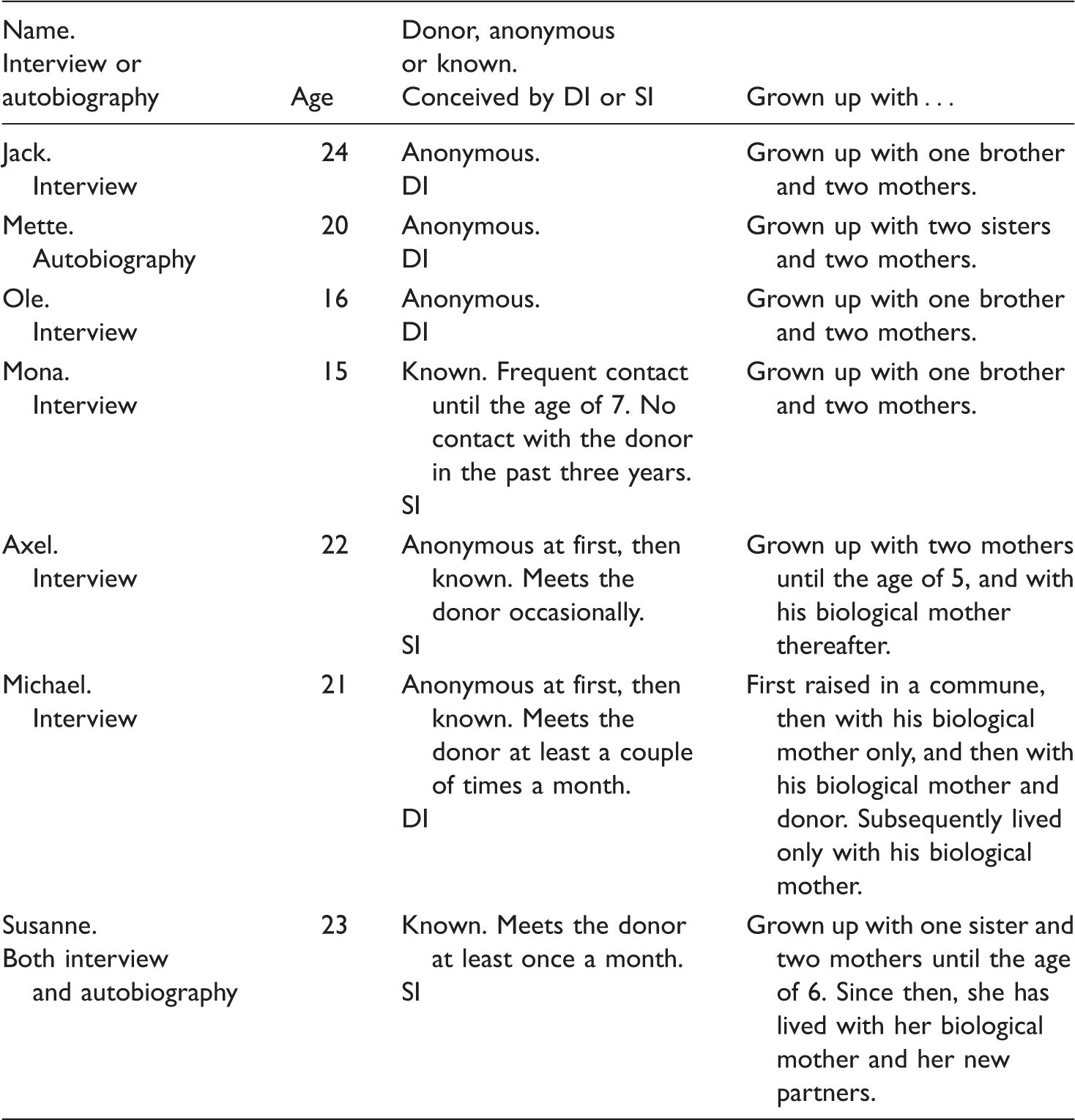
Information about the participants.
Using semi-structured interviews and autobiographies as methodological approaches
An interview is not merely an exchange of words, opinions and attitudes, but a social and contextual action where actors construct identities, create social realities and produce meaning (Holstein and Gubrium, 2004). I asked the participants whether they preferred to be interviewed or to write their autobiography. Of the seven participants, Jack, Ole, Mona, Michael and Axel were interviewed. Mette chose to write her autobiography and Susanne chose both to write an autobiography and to be interviewed.
The interviews and the autobiographies mainly concentrated on three themes: (a) my family now and then, (b) stigmatization/problems, and (c) what is my life like/who am I? 5 My primary concern was to create a context where the participants had the opportunity to talk and/or write about what they found important in relation to issues of family, parenthood and their parents’ sexual orientation.
While an interview creates meaning through the interaction between two or more actors, an autobiography consists of written accounts where researchers ask the participants to write down their life experiences and/or reflect on specific themes. Plummer (2005) divides the term autobiography into three components, described as; ‘ Autobiographical writing aims to capture this self-reflexive process, to know it through consciousness, to ultimately understand the flow of this particular life. Part of the philosophy of autobiography, then, concerns this self-reflective debate and the streams of consciousness it provokes. (2005: 87)
Since the author is not ‘disturbed’ by the researcher during the writing process, the position of the researcher is marginal during this process. The influence of the researcher occurs in the initial phase, that is, when the researcher puts forward her expectations, topics and questions for the study. Then the participant/author is on his/her own, while the researcher’s position is again activated when the story is to be interpreted and analyzed.
I see autobiographies as a supplementary methodological resource within qualitative research. Therefore, in my study the interviews and the autobiographies supplemented each other as data and they have contributed differently to the production of knowledge.
To negotiate positions with a donor figuration
As subjects, we are not only determined by the dominant structural and cultural discourses. We are also actors and active participants in the processes that affect our lives, and our practices and choices are in continuous negotiation with cultural discourses and the interactions in which we participate. We are, according to Braidotti (2006), ‘nomadic subjects’; physical subjects always in motion and ‘nomadic becomings’ who confirm ‘… the unalterably positive structure of difference, meant as a multiple and complex process of transformation, a flux of multiple becomings, the play of complexity, or the principle of not-One’ (Braidotti, 2006: 145). In the ‘becoming process’, new subjectivities who can think, act, resist and who are in continuous motion, emerge (Braidotti, 2002).
Negotiations situate us in our everyday life and position us in relation to each other, and are also in constant motion. These changing processes contribute to the positions sometimes appearing to be stable and relatively unchanging, and at other times appearing dynamic and in motion. The positions that are being negotiated and how as subjects we position ourselves in relation to each other, thus relates to both the framework provided by the dominant cultural discourses and each actor’s contributions to these negotiations. The young people in this study negotiate positions with the donor figuration through the ways in which they talk about him, what they call him and which relationships they describe having created with him.
According to the foregoing concepts, the donor is a figuration: a living reality, a ‘nomadic subject’ and a phenomenon that exists between fact and fiction. Therefore, the donor figuration is both a vision and a physical reality in the encounter between nature and culture, and he also creates himself as a subject in the negotiations with his offspring and the lesbian mothers.
Negotiations with an anonymous donor figuration
At first glance, the heading may seem contradictory. Is it possible to negotiate positions with someone who is anonymous – with shadow actors and absent-present subjects? If so, which forms may the negotiations take, and what can the negotiations tell us about identity constructions and relationships? In this study, three of the seven participants (Ole 16, Jack 25 and Mette, 20) have an anonymous donor and all three were conceived by anonymous DI. This means that they do not know the donor’s name or his genetic history. However, he is a person – or a figuration – to whom all three refer in their interviews or autobiographies. Ole (16), the youngest of the three, says that he does not want to know who the donor is and has no desire whatsoever to meet him. He says: ‘I have never wanted to do that. I have to say it has never interested me. I have my two parents.’ Here, Ole positions the donor outside his family, which suggests that he does not want to negotiate this positioning differently. In other words, the donor will likely have a position as an anonymous shadow actor who has only contributed to Ole’s conception. Ole states that he has two parents, and clearly shows that he does not consider the donor to be either a father figure or a parental figure.
In the following discussion, I focus on Jack’s (24) and Mette’s (20) histories. Prior to the interview with Jack, I knew he was conceived by donor insemination, but not that the donor was anonymous. Relatively early on in the interview I asked Jack to talk about his family, and he talked about his mothers, siblings and grandparents, but not about a present father. This led me to ask him whether he knew his father,
6
which resulted in the following dialogue: I: Do you have any ideas about who your father is? Jack: No, I do not know my father, and I have no need to find my father. And that is probably what it is about. Helga [his mother] has asked if I want to know who my father is. I: So she has asked you? Jack: Yes, and she has said she can phone Nina [from the clinic] – who did the insemination – and try to search for the donor, but I feel no need for it. I have two well-functioning parents, and, well, what do I need a father who I have not known for 24 years and who has not seen me for? I: How long is it since she asked you? Jack: It was when I was a teenager – in my late teens, maybe four or five year ago, when I was 19–20. She probably asked me earlier, when I was 12 or 15, but I cannot remember that. I: But if you wanted to find your father, she would have helped you? Jack: Yes, precisely // … //. It is difficult to say what a father is, but I have never missed a father. I have never said ‘wah-wah, I want to have a father like everyone else’. Not ever. It has always been natural for me to have two mothers. They are my parents.
A different aspect of this excerpt is that despite the fact that the donor is anonymous to Jack, he is not necessarily anonymous to his mother. That is, apparently Jack’s mother may be able to find the donor if she – or Jack later on – should find it relevant. This is suggestive of how ‘anonymity’ moves and is negotiated, and that being an anonymous donor is not necessarily a fixed position.
Mette (20) also has an anonymous donor. In her autobiography, she writes that she has never felt any need to know who he is and that her two mothers have always been her parents. Mette also writes that in recent years she has changed the way she talks about the donor. Until a few years ago, she called him ‘father’, but then she realized that he was not her father. She writes: ‘Just because he was half of my biological origins did not mean that he was my father – some participation is necessary in order to deserve that title. Now, I call him “my donor”’. That Mette changes how she refers to her donor figuration is indicative of a clarification and specification of how she sees the donor’s position: he has contributed to her conception and half of her biological dispositions, and is her progenitor, but not her father. By specifying this division, she suggests that being a ‘father’ is produced relationally through social interaction and emotional connections between parents and children. In other words, while ‘father’ is about closeness in a relationship, the anonymous ‘donor’ is about distance and remoteness. Mette positions the donor at a distance when she writes about how she has changed the way she refers to him. She also writes that she has always known how she was conceived: I have never been in doubt about how I came to be. I have never been in doubt that it was uncommon, but at the same time – or maybe because of this – I have also never been in doubt that I was a wanted child, and I think in some ways that has given me self-confidence.
Here, Mette focuses on how her mothers’ choice of having a child with an anonymous donor has made it clear to her how wanted she was, and how her mothers’ choices and the actions they took to have a ‘wanted child’ may have given her strength in her everyday life. In this way, the anonymous donor has always been part of Mette’s upbringing, though he has never appeared as a living presence. He has figured in almost imaginary ways and as an absent presence, and it is in this context that their positions and relationships have been negotiated.
Ole, Jack and Mette all state that their anonymous donor figure has contributed to their conception but that he is not their parent or ‘father’. He has always been an anonymous and distant figure they have negotiated with – negotiations that highlight that he is positioned at a distance, far from themselves and their families.
Negotiations with a known donor figuration
What about when the donor is a known figure? Four of the seven participants know the donor; three of them were conceived by self insemination (SI) and one was conceived by anonymous donor insemination (DI). When a lesbian couple decides to use SI, the donor is known, and this may result in continuous negotiations both between him and his offspring and between him and the lesbian mothers (see Donovan, 2000; Ryan-Flood, 2005).
The negotiations between these four participants and their donors can be described on a continuum. Mona (15) is at one end of the continuum. In the interview, she says that she had regular contact with the donor until she was seven, that they then had irregular contact for a few years, and that in the past three years they have had no contact. However, Mona says she is happy to know who he is, ‘because if I did not know, I would probably be thinking about it more, and then I would never have been able to meet him and know who he was’. Axel (22) is further along the continuum. He says that he has had a bit of contact with his donor, who initially was to be anonymous and only to ‘donate a blob of sperm’, as Axel describes it. Nevertheless, Axel got to know his donor early on, and they have met occasionally throughout Axel’s childhood and youth. Axel refers to his donor as ‘my father’. He says that he can remember that when he was young and visiting his father, his father wanted to act like a parent. However, as they did not see each other very often, ‘he could not do much’, according to Axel. In this comment, Axel implies that raising a child requires closeness and contact. This suggests that Axel and his donor are negotiating from different standpoints. In other words, Axel has not accepted his donor’s attempts to negotiate a position as a father. The donor has never had the donor-father position (Ryan-Flood, 2005) in Axel’s life.
Michael (21) and Susanne (23) are at the other end of the continuum. Both have been in regular contact with their donor figure throughout their childhood and youth, and still meet him regularly – Michael meets his donor somewhat more frequently than Susanne meets hers. Michael says that his donor was initially anonymous, but for various reasons his donor wanted to get in touch with Michael and his mother. Michael puts it this way: ‘It was in connection with the great AIDS epidemic, and many of my father’s friends died – most of them, in fact – // … // eh, I think he needed some affirmation of life’. Michael’s statement suggests that the donor’s search for Michael seemed important to the donor because of his daily life in which there was a thin line between life and death. Dempsey (2012) shows that the HIV/AIDS epidemic contributed to a high death rate among gay men, and that their children came to be representatives of ‘hope, renewal and a sense of the future’ (Dempsey, 2012: 159). While daughters or sons usually search for their anonymous biological origins, in this context the opposite is true: the anonymous donor searches for his biological children and thus breaches the requirement or desire for anonymity. This suggests that the principle of anonymity can be challenged and tested by individual actors and thereby contribute to the destabilization of the positions. In other words, the anonymous donor shows how anonymity is not a fixed position.
When Michael was about five years old, his father came to the farm where he and his mother lived, but he did not move in with them. Instead he lived in a small house on the farm. In the interview, Michael says that he, his father and his mother shared meals and that his father used to take him to kindergarten. The following excerpt is from the interview: I: From initially being an anonymous donor, he entered your life – how did that go? Michael: It went well – totally fine. We moved into a new house, and he came along. It was an idyllic family life. I: Is that how you remember it? Michael: Yes, it was a wonderful time. // … // It lasted for three to four years, and then he moved back to the city. Not because it was not working with the three of us, but because he missed the city.
While the position of Michael’s donor changed from being an anonymous and imaginary figure to a living reality and present subject, Susanne’s (23) situation was different. She says that she has always known who her donor was, and that her mothers spent three years looking for him. Susanne explains it in this way: My mothers actually spent three years looking for a guy who wanted to participate in this. He was to not have any rights, and he was to be prepared to create my sister and me – he had to be prepared to create two, and he had to be prepared to have no rights to see us, unless we wanted to. Everything was to take place on our and our mothers’ initiative. To me, he is not my father. He is a very, very good friend. I do not picture him as my father, and he is not someone I phone when I am upset or have problems, but he is someone I enjoy spending time with, and I have really enjoyed being able to sit with him and see some characteristics in him that I share. We have the same laugh, the same facial expressions, the same way of feeling our way to things, and seeing that I have some things from my mother and some things from my father has given me an incredible sense of security. I am very thankful for having him in my life and that I have always known who he is – because I have always known that.
For Susanne, this is also related to the significance of connecting her own bodily presentation to her biological parents, and to see herself in the light of the biological similarities – or dissimilarities – between herself and her parents. The importance of biology that Susanne refers to here, is about resemblance and the outward, bodily expression of biological relationships (Becker et al., 2005). The biological similarities ‘place’ her in a special position both in relation to her biological parents and to other kinships, and situate her not only socially, but also historically and biologically. According to Schneider (1968), in our Western world, kinship is about the significance of blood ties. This means that kinship can be linearly traced backwards in time, and will continue through the children and thus enable a possible future for the line of descent. This is due to Nelkin’s (2006) ideas about physical resemblance indicating a biological connection that represents duration and predictability.
Based on the foregoing quotations, Susanne positions the donor on the one hand as ‘a friend’ and thus negotiates new representations of the ‘father’ concept. On the other hand, he has a significant position in her life by being her biological progenitor who she compares herself to physically. Susanne is the participant in this study who places the greatest emphasis on children knowing who their donor is, and she explains why in the following excerpt: If friends came to me and said they wanted to have a child with an unknown donor, I would advise against it. Perhaps to them the most important thing is to bring a child into the world – because that is what they want to do – to love the child and give the child security and stability and all of that. But I would prefer for the child to have the opportunity to know their father, because that has meant a lot to me.
Conclusion
To be conceived by the use of an anonymous or known donor, born to a lesbian mother and growing up with parents who are both women is, in part, about handling dilemmas related to cultural and heteronormative discourses about reproduction and sexuality, as well as gendered assumptions about parenting. In a society that continues to see heterosexuality and heterosexual family organization as the rule, this means that these young people constantly have to clarify and explain their family situation (Hanssen, 2012). Haimes and Weiner (2000) claim that the ‘absence of a father’ is not a fixed characteristic of lesbian families, but that family members discuss, redefine and negotiate what should apply to their family. In this study the negotiations between the donor, his offspring and the lesbian mothers destabilize heteronormative assumptions about parenthood and fatherhood. The negotiations between them move and give different meanings seemingly depending on whether the donor is an anonymous or known figuration.
When it comes to anonymity, however, this is not necessarily a fixed position. This analysis shows that despite the fact that the donor is an anonymous figure for some of the participants, anonymity can be negotiated and moved. In Jack’s story his mother said she could try to find the anonymous donor, and in Michael’s story, the anonymous donor searched for and found his son. This indicates that the anonymous/known dichotomy is not a stable one; consequently we may question how useful it is for explaining the different ways in which donors are configured in planned lesbian families, as well as the variety of positions and relations that are negotiated between the donor and his offspring.
However, for the three young people who were conceived by anonymous donor insemination, the donor has always been anonymous and an imaginary figure who has only contributed to their conception, and this is the position they want to keep him in. They appear to have no interest in inheritance and filling genetic gaps (Fjell, 2003). The negotiations with the donor figure do not appear to be prominent or central in their everyday lives. To them he is a shadow figure negotiated as an ‘absent presence’ (Donovan, 2006); a figuration they occasionally negotiate with. They see themselves as participants in families in which two mothers are their parents, and the donor is seen as irrelevant as a parent or father. Spilker (2007) claims that in heteronormative cultural directives, families that consist of two mothers – or what she refers to as ‘a dual monogamy’ – cannot be combined with the norm that a child must know their genetic heritage. Donovan (2000) also claims that for many lesbians, parenting does not necessarily require biological fathers. The resistance to the idea of bringing a donor closer to the family can indicate a sense that this may be disruptive and destabilize the family’s established order and stability (Vanfraussen et al., 2003).
The stories of the four who know their donor show how the two-parent family is challenged in that the donor becomes a third ‘parental actor’ with whom the mothers and young people must actively negotiate. Their stories present a multitude of negotiated positions, which indicates that in planned lesbian families with known donors there is an opportunity to negotiate positions and relations without these necessarily adhering to normative cultural directives. In other words, the negotiations between the young people, their mothers and the donors contribute to shifting dominant perceptions about fathering and parenting. In turn, this shift challenges established perceptions about what a father is and what he can or should be. He can be a known figuration positioned at distance, a close father figure given a ‘fathering’ position or he can occupy a position as a ‘very, very good friend’. These four participants appear to be happy to know their donor, which indicates that knowing him matters in a positive way.
When analyzing the donor as a figuration and a nomadic, living subject always in motion, a range of negotiations, positions and relationships will emerge, regardless of whether the donor is anonymous or known. This is suggestive of a fruitful approach to understanding the proximity or remoteness in positions and relations between the donor, his offspring and the lesbian mothers.