




Abstract
This article describes patterns of interpretation and practice of same-sex desires pre- and post-migration among self-identified gay and bisexual Mexican immigrant men to the USA. Drawing on in-depth interviews with 80 such men, we argue that, contrary to stereotypes, their pre-migration interpretations and practices are considerably diverse and not solely informed by highly gendered understandings and styles of sexual interaction between men. After migration, some shift their interpretations and practices considerably, while others retain those that informed their sexualities pre-migration, either adapting them to their new sexual contexts or resisting any changes. These findings, which reveal the complexity and diversity of sexual interpretations among immigrant gay and bisexual men, pose a challenge to proposed systems of classifying same-sex desires as well as to conventional understandings of the impact of international migration on gay sexuality.
Introduction
[San Diego] has helped me a lot, because it’s helped me live my sexuality as I wanted … It’s changed me because it’s helped me be more open, accept my homosexuality more, and realize that I am not doing anything wrong as long as I am not harming anyone … The notion that I had in Mexico [is] that it [homosexuality] is something sinful, something bad, something seen badly by society, and simply not accepted.
Linked to these ideas is a sense that LGBT immigrants’ understandings of same-sex desires, sexual identities, and sexual practices also change after migration. Indeed, the popular discourse on LGBT immigrants from the so-called global south tends to assume that they consistently acquired supposedly “pre-modern” interpretations of same-sex desires in their home countries—interpretations that treat gender difference, and not the heterosexual/homosexual binary, as the organizing principle of sexual life, thus inhibiting the development of LGBT identities, communities, and rights. 2 These immigrants are then expected to shift post-migration toward more “modern” or “global” interpretations deemed to be prevalent within American urban LGBT cultures. In the case of Latin America, some studies have confirmed this idea. Working respectively with Peruvian and Dominican male immigrants, Vasquez del Aguila (2012) and Decena (2011) found that their participants uniformly adopted in their home countries interpretations sustained by secrecy and/or informed by a highly gendered model of male homosexuality commonly known as the “pasivo/activo” model. As we will see in more detail later, this model dichotomizes men who engage in sex with other men into effeminate, socially-stigmatized pasivos, and their stereotypically masculine partners, or activos. These authors conclude that their participants were exposed to gay identity models only after migrating to the USA.
By contrast, other studies characterized immigrant gay men’s pre-migration interpretations of same-sex desires as more diverse (Cantú Jr., 2009; Thing, 2010), a finding that is consistent with the results of recent studies of male same-sex desires conducted in Mexico (Carrillo, 2002; Gallego Montes, 2010; Laguarda, 2011; List, 2005; Nuñez Noriega, 2007). For instance, among Cantú’s (2009: 155) participants, several recognized the pasivo/activo labels but “explained that the terms were somewhat archaic, especially as identity labels, and that one might ask a prospective sexual partner what ‘they liked’ but that they expected a partner in a committed relationship to be more versatile in his sexual repertoire.” Yet, despite their important insight that challenged reigning stereotypes, Cantú’s and Thing’s studies were limited by their small sample sizes, which inhibited systematic analyses of intragroup diversity pre- and post-migration.
Beyond a general sense that LGBT immigrants’ sexualities change after relocation, what those changes specifically entail has not been systematically investigated. Bianchi et al. (2007: 512) succinctly note that immigrants “reported exposure to sexual practices that they had not encountered in their countries of origin,” which “were added to the sexual repertoire of the participants.” Similarly Vasquez del Aguila (2012) describes immigrants who became more open to having a steady male lover or to recognize that they may be bisexual. However, detail on the post-migration sexual changes of Latin American gay immigrants is scant.
Based on in-depth interviews with 80 men who moved from Mexico to San Diego, we build on previous research and provide a systematic analysis of pre-and post-migration patterns of interpretation of same-sex desires. We find that these immigrant men are diverse in terms of their interpretations and practices pre-migration. We also find that while some experience profound shifts in sexual interpretations and practices post-migration, others more superficially adapt pre-migration interpretations to their new sexual contexts, and still others resist changing styles of sexual interaction that they learned and experienced in Mexico. We argue that these findings, which reveal the complexity and diversity of sexual interpretations among immigrant gay and bisexual men, pose a challenge to proposed systems of classifying same-sex desires as well as to conventional understandings of the impact of international migration on gay sexuality.
Patterns of interpretation and practice of same-sex desires
Our approach synthesizes separate developments in comparative studies of same-sex desires, as well as in the study of global gay identities. We consider published descriptions of various patterns of sexual categorization and interpretation; overlaps and continuities among them; and cultural, social, historical, and geographic factors that may influence detected variations. A central tenet of cross-cultural analyses of homosexuality has been the perception that interpretations of same-sex desires vary across time and location, albeit within a limited range of possibilities that make comparisons across cultural groups or historical moments possible (Adam, 1986; Murray, 1995). The difficulty, however, is that such comparisons often presuppose the existence of a stable set of interpretations and practices that can be applied to characterize a whole cultural group, region, or nation. Such assumptions have resulted in “models” of homosexuality that have become somewhat reified, which, as Murray (2002) has observed, comes at the cost of our developing more dynamic analyses that attend to difference and change both within and between nations. 3
In relation to Latin America, in spite of marked achievements in LGBT rights in the region, a popular sense prevails that interpretations of male same-sex desires remain primarily informed by the highly gendered pasivo/activo model. This model was first identified by American anthropologists working in Mexico in the late 1960s and 1970s (Carrier, 1972; Taylor, 1978), and was later adopted by other scholars (Almaguer, 1991; Murray, 1995; Vidal-Ortiz et al., 2010). According to this model, men who engage in sex with men are strictly dichotomized into two groups: (1) those who are socially stigmatized because they are perceived as effeminate and assumed to be the receptive partners during anal intercourse (the pasivos); and (2) those assumed to be masculine and the insertive partners, who avoid social stigma by maintaining identities as “regular” or “normal” men (the activos). 4
These highly gendered interpretations are perceived as contrasting greatly with less gendered and more egalitarian interpretations and practices assumed to inform American and global gay identities (Adam, 1986; Murray, 1995), which are often labeled ‘object-choice’ (a borrowing from psychoanalytic theory). According to object-choice or gay interpretations, all men who engage exclusively in sex with men are presumed to be ‘gay’ or ‘homosexual’ regardless of their femininity or masculinity, or whether they are receptive or insertive during anal intercourse. These interpretations are often also characterized as containing expectations of sexual versatility and reciprocity between sexual partners.
The applicability of the pasivo/activo model as the only one appropriate for explaining Latino/Latin American male homosexualities has rightly been challenged, however, as several scholars have highlighted the adoption and adaptation of so-called global or gay interpretations in Latin American countries (Cantú Jr., 2009; Carrillo, 1999, 2002; Fontdevila, 2012; Guzmán, 2006; Parker, 1991, 1999; Vidal-Ortiz et al., 2010). A third form of interpretation has also been identified—labeled ‘homosocial’ or ‘homoerotic’—which involves sexual encounters between non-gay-identified men that occur without the highly gendered interpretations of the pasivo/activo model (Nuñez Noriega, 1999 [1994], 2007). This form of interpretation, which also emerges in our data, has not been explicitly incorporated into analyses of same-sex desires among Latino LGBT immigrants.
Moreover, rather than treating these various forms of interpretation and practice of same-sex desires as discrete and incompatible, in our analysis we consider flexibilities that allow individuals to adapt different interpretations of same-sex desires to their own social realities—according to specific sexual situations and contexts—and even to move back and forth across them. In this sense, our analysis extends to the realm of LGBT migration what some of the literature, not only about Latin America, has recognized in terms of the co-existence, and sometimes seamless blending, of different forms of interpretation and practice of same-sex desires in specific locations (Binnie, 2011; Boellstorff, 2005; Carrillo, 2002; Heaphy, 2011; Parker, 1991, 1999; Valocchi, 1999). Carrillo (1999, 2002) has called this ‘sexual hybridity,’ and Boellstorff (2005) labels it ‘dubbing culture.’
Finally, our analysis attends to a general sense provided by the scholarship on global gay identities that variations of interpretation of same-sex desires are influenced by factors such as social class position and urban/rural origin. In this view, the adoption of gay interpretations is perceived as being favored by a middle-class position that is coupled with an urban origin (Binnie, 2011; Heaphy, 2011; Valocchi, 1999). As we will see, our findings partially confirm this perception, but also challenge it by noting that rural and working-class Mexican men have adopted gay interpretations prior to migrating to the USA.
Thus by comparison to existing scholarship, we argue for recognition of even greater flexibility and fluidity in how same-sex desires are understood and acted upon. And we therefore emphasize the limits of classification schemes, even as we describe distinctive patterns of interpretation and practice that our own participants demonstrated but also moved between and sometimes combined. We also argue that the process of migration provides a particularly helpful lens for understanding such sexual variation because of the abruptness of the change in sexual contexts that migration often brings about. We now turn to presenting our findings, following a short description of our study and methods.
Methods
Our analysis is based on in-depth, semi-structured interviews with 80 men who were born or raised in Mexico, 5 and who had migrated to the USA within 10 years. 6 These men participated in a larger study of the sexualities and HIV risk of Mexican gay and bisexual immigrant men living in the USA. 7
We recruited our interviewees in a variety of gay and non-gay venues throughout the San Diego metropolitan area, both in person and through a promotional card distribution service. Potential participants were screened onsite or when they called a toll-free number that appeared in our promotional materials. For Mexican men to qualify, they had to be 18 or older; be born or raised in Mexico; self-identify as gay, homosexual, or bisexual; and have had sex with men in the previous six months.
Our sample is quite diverse in terms of the participants’ origins: they came from 15 of the 31 Mexican states, and the Federal District (Mexico City); some grew up in large urban areas, others in medium-sized cities, and still others in small towns and in rural areas (rancherías); and they vary in terms of their social class position, education, and skin color shade and ethnic features. Mexican participants ranged in age from 20 to 57, although most were in their 20s (N = 33) and 30s (N = 34).
On average the interviews lasted 2.5 hours. All interviews were transcribed verbatim, analyzed and summarized as individual cases, and then systematically coded and analyzed across the whole sample using QSR N6.0, a qualitative software package. The core research team created a comprehensive codebook for this purpose, which was refined in sequential iterations in the early stages of the analysis. The bulk of the coding was conducted by seven graduate students under the supervision of the core team. We assessed and achieved a high level of inter-coder reliability (81% on average, calculated based on the number of times that all coders assigned the same codes to a selection of random pages of interview material previously coded by the researchers. Miles and Huberman (1994). For this article we examined codes related to the immigrants’ sexualities, identities, and sexual experiences before and after migration.
Interpretations and practices pre-migration
Our analysis yielded three distinct pre-migration patterns of interpretation and practice of same-sex desires, which roughly correspond to the three patterns identified by the literature on Mexican sexualities. As shorthand, we have labeled the three patterns “highly gendered,” “homosocial,” and “object choice/gay.” As we will see, however, a considerable number of participants cannot be neatly located in any single pattern, and this has important implications for the study of diversity among gay men and the potential fluidity of their sexual experiences. We must also clarify that this typology is not meant to represent universally applicable types of homosexuality (as suggested by Adam, 1986), nor a set of terms used by the men we interviewed, nor merely a cluster of sexual behaviors. Rather, it represents distinctive analytically derived patterns of meaning and practices (“sexualities” for want of a better term) that emerge in our interviewees’ narratives. Regardless of their interpretations and practices, most participants self-identified as “homosexuales,” “gay,” or “bisexuales” while living in Mexico, meaning that they managed to match these identities to the logics of interpretation and practice within all three patterns.
Highly gendered interpretations and practices pre-migration
Before migrating, the interpretations and enactments of same-sex desires on the part of 12 participants (15%)
8
can be described as conforming to the highly gendered pasivo/activo model (see Figure 1, left column).
9
These participants describe interpretations and forms of sexual interaction between men that seem informed by what Risman (2009: 82) alternatively calls “traditional gender scripts” and “doing gender traditionally” (see also West and Zimmerman, 1987). Most had sexual (and even some romantic) relations with straight-identified men whom they regarded as masculine,
10
who Mexican gay men often call “mayates.” These partners commonly enforced highly gendered expectations during sex. For instance, Emilio, a 24-year-old from a small town in Nayarit, described his partners as men who “don’t really like to suck [perform oral sex]… they like only to get sucked. And when you finish sucking them off, they bend you over [in English in the original] and they want to stick it in.” Our participants typically adopted a receptive role with these partners. They were also often labeled with derogatory terms such as maricón or joto (both roughly equivalent to “fag”), which marked them as effeminate.
11
All but one grew up in small towns or rural areas or in working-class urban neighborhoods.
Patterns of interpretation and practice of same-sex desires pre- and post-migration.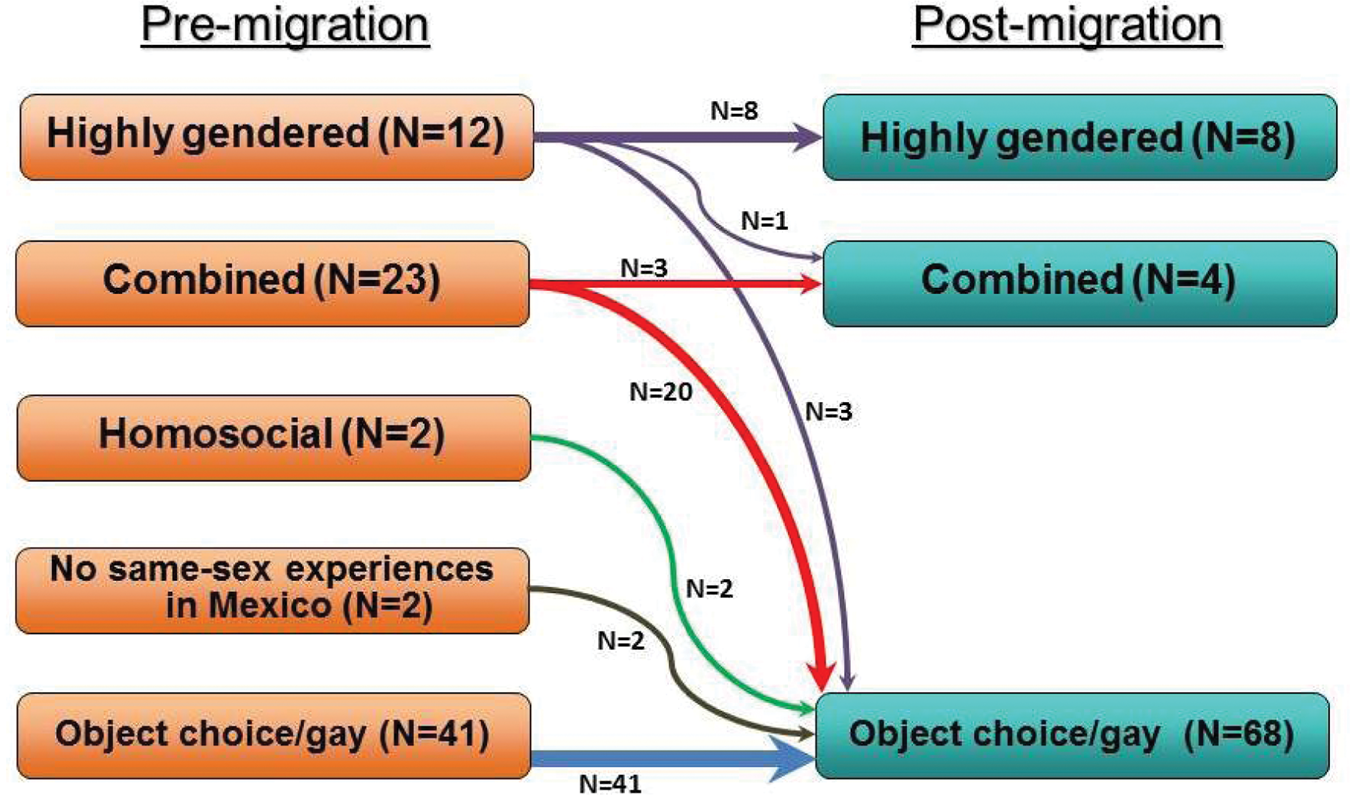
Object-choice/gay interpretations and practices pre-migration
In contrast with the previous pattern, the interpretations and practices of 41 participants (51%) are consistent with contemporary views of Mexican gay identities, which we label “object-choice/gay” for short. Their sexual/romantic interactions in Mexico involved other men who identified as gay or homosexual (both Spanish-language terms). These men attended a constellation of above-ground and underground gay venues. 12 Although some report that they or their partners had specific preferences penetrating or being penetrated, they generally thought of those roles as a choice and their relationships often operated with expectations of reciprocity and versatility. Some in fact strongly rejected highly gendered interpretations and saw them as old-fashioned. For example, Raimundo, a 36-year-old from Sonora, stressed that “I was never one to go to cantinas [straight bars]… I always was more gay.” Here cantinas represent working-class spaces where straight-identified men seek sex with effeminized men.
Most of these men lived in urban areas, primarily, although not exclusively, in Mexico’s largest cities. Contrary to the stereotype, however, not all are middle class. For instance, Marcelo, a working-class 34-year-old from Mexico City, discovered gay sex and cruising in the Metro, Mexico City’s subway system. Contact with gay men there led him to other gay spaces; and participation in leftist organizing led him to becoming a gay activist. Marcelo recalls: [An activist] who … realized that I was gay—I don’t know how—invited me to … the 1988 [Mexico City gay] march, and I agreed to go for the first time … and also to join a [gay] group that no longer exists.
Around the same time, he was also defining his whole life around his gay identity: That was the beginning of my social gay life and of my farewell from a straight social life, because in the ‘90s my life centered completely on gay society … Even the jobs that I got … little by little were more with people from the gay ghetto. [My] last job … was in a gay friend’s art gallery.
Homosocial interpretations and practices pre-migration
By the time they left Mexico, only two men (2.5%) exclusively expressed their same-sex desires in ways that are consistent with the “homosocial” pattern. Both were teenagers when they left. As we will see in the next section, others relied on homosocial practices in some sexual situations, and on highly gendered or object-choice/gay ones in others.
As we have reported elsewhere, the homosocial pattern was common at the time of our participants’ sexual initiation, which typically took place during their adolescence, as they were exploring same-sex desires with neighborhood friends (Carrillo and Fontdevila, 2011). 13 Indeed, 38 Mexican men in the sample experienced homosocial sexual initiations. Most among them, however, later acquired identities as “gays” or “homosexuales,” aligning their interpretations and practices with those of the object-choice/gay pattern.
A combined pattern of interpretations and practices pre-migration
Finally, 23 participants (29%) cannot be classified discretely into any one of the three patterns described. Their interpretations and enactment of same-sex desires varied according to specific sexual contexts, situations, or sexual partners. Most typically, they shifted back and forth between the highly gendered pattern and one of the other two (homosocial or object-choice/gay), or among all three. We have labeled this subgroup “combined.” The ability of these participants to seamlessly move back and forth from one pattern to another suggests that participation in the Mexican gay world allows considerable fluidity and flexibility of interpretation and practice.
Justo, a 32-year-old from a town in Jalisco, initially engaged in both homosocial and highly gendered relations. He participated in sexual games with cousins and neighbors, and later had a highly gendered relationship with a straight-identified man. This man had a girlfriend, whom he eventually married. Except for one occasion, Justo’s boyfriend was the one who penetrated during anal intercourse. Justo also accessed a local network of gay-identified men in his town, who in turn introduced him to the well-developed urban gay life of nearby Guadalajara. In Guadalajara he fulfilled his dream of dating a gay man, and he also started having casual sexual encounters with gay men.
Interpretations and practices post-migration
After migrating, practically all participants came into contact with San Diego’s visible gay community, whose geographical point of reference is the middle-class Hillcrest neighborhood. (This is not surprising, given that we recruited men who self-identified as gay or bisexual and we did not seek out non-gay-identified men who have sex with men). At the time of their interviews, the interpretations and practices of 68 (85%) aligned with the “object-choice/gay” pattern, eight (10%) exclusively retained interpretations consistent with the “highly gendered” pattern, and 4 (5%) remained in the “combined” pattern (see Figure 1, right column). Several moved into Hillcrest or into adjacent, more affordable areas. How long it took them to discover gay venues in San Diego varied considerably (from no time to years), depending on their prior knowledge about San Diego’s gay community. Their sources of information included friends, co-workers, acquaintances, neighbors, the internet, local service agencies, adult bookstores, and gay magazines.
At first glance, our data indicate an overall post-migration shift toward interpretations and practices that are consistent with American, urban, gay lifestyles. However, the changes that these men experienced after migrating are not uniform. After migrating, our participants’ lives took different paths: (1) Some underwent profound shifts in interpretation as a result of contextual shifts from Mexico to the USA, and they moved altogether from one pattern of interpretation to another (e.g. from the highly gendered to the object-choice/gay pattern). (2) Others stayed within the same pattern of interpretations that informed their same-sex desires in Mexico, but underwent a contextual shift in practices (e.g. they remained in the object-choice/gay pattern but adopted new sexual repertoires post-migration). (3) Finally, some stayed within the same pattern that informed their same-sex desires in Mexico, and resisted the contextual pressures to redefine their interpretations or practices post-migration (e.g. some kept highly gendered interpretations and practices post-migration, or gay scripts of sexual interaction that they had learned in Mexico). In the sections that follow, we describe how change—and the absence of change—plays out within each of the patterns of interpretation that we identified.
Object-choice/gay interpretations and practices post-migration
The 68 participants whom we classified in this pattern include the 41 who previously adopted object-choice/gay interpretations while in Mexico, 20 who shifted from the combined pattern, three who shifted from the highly gendered pattern, two who shifted from the homosocial pattern, and two who previously had no same-sex experiences in Mexico (see Figure 1). Among these men, change was typically more pronounced for participants who shifted to the object-choice/gay pattern from other patterns. The others—those who arrived with and retained object-choice/gay interpretations and practices—either adapted them to their new context or maintained them unchanged.
Participants who shifted to the object-choice/gay pattern
Several participants abandoned highly gendered interpretations and practices upon arrival in San Diego, including Armando, a 21-year-old from rural Oaxaca. In his hometown his sexual life had gravitated around highly gendered sexual encounters with straight-identified men. “For most [such men, sex with men] is just a pastime, something temporary,” said Armando. “They’re always heterosexual in their own eyes.” Armando had been involved in an 11-year relationship with a neighbor that ended when the man married. In San Diego, a friend took Armando to Hillcrest and he started attending gay bars and having sex with gay men (although one partner turned out to be married to a woman). Armando also began seeking sex in gay bathhouses. Cases such as Armando’s suggest that shifts in sexual contexts sometimes produce significant changes in sexual interpretations, practices, and desires, particularly when international migration involves moving between two very different local sexual cultures (for instance from a rural to an urban sexual culture).
Some of these men expressed that their change was motivated by a profound dissatisfaction with the highly gendered encounters they had experienced in Mexico. They described those encounters as sordid or clandestine, and their partners as rough and uninterested in expressing emotions during sex. These men assess that American (mostly meaning “white”) gay men are comparatively more affectionate, caring, and respectful. For that reason, in San Diego they tend to seek sex with white gay men.
For example, Plutarco, a 29-year-old from Oaxaca, typically was penetrated by straight-identified men while in Mexico. When asked why he liked American men, he responded: Why? I feel they are more tender, more passionate, and more considerate. Mexicans are rougher and tend not to kiss you or touch you. Well, I lived that with many Mexicans who didn’t touch me or kiss me … Americans are tender … when they penetrate you, they don’t hurt you. Mexicans don’t care. Whether they are hurting you or not, they keep doing it. And [Americans] don’t, [they ask you] “are you OK”?
Plutarco went on to say that his white American boyfriend possessed everything he ever looked for in a man, and that there is not a day in which his partner “will not bring me a glass of juice in bed in the morning, and he even opens and closes the door for me. Listen, I‘ve been delighted!” While highly gendered encounters could be intensely erotic to some of our participants (as we will see later), they were dissatisfying to those who, like Plutarco, sought overt expressions of affection.
Participants who adapted their object-choice interpretations and practices
Other participants who had previously adopted exclusively object-choice/gay interpretations and practices in Mexico retained them, but they also experienced significant changes after migration. They discovered that gay life in San Diego differed considerably from what they had known in Mexico—that being gay in Mexico and being gay in San Diego was not quite the same thing. Many were previously unfamiliar with the notion of American gay neighborhoods or with the existence of institutionalized gay bathhouses where sex between men is not clandestine, unlike some urban steam baths in Mexico (Teutle López, 2007). They were particularly surprised by the sexual directness of American, middle-class gay men, and by their sexual adventurousness, to which they often alluded by referring to kink, BDSM, and the use of sex toys. For example, Leopoldo, a 36-year-old from Sonora, said: Mexico is more about one-on-one sex, sex without much variation … Here it’s more about toys and other things, no?—fetishes and that sort of thing that people here like more. It’s a great difference that I see—it’s not all, I am not generalizing … but here you come across it and in Mexico it’s harder to find.
In San Diego, some of these gay Mexicans eagerly adopted forms of sexual interaction that were either new to them or that they had craved before migrating. Some had also previously fantasized about having sex with American white men. They also perceived Mexicans as less sexually adventurous, and their sexual repertoires as more limited. Thus, they preferred to seek sexual partners within so-called mainstream American gay venues, which in San Diego tend to be primarily white.
Raimundo, whom we quoted before, expressed liking American-style sexual experimentation and sex toys, including leather fetishes and fisting. He claims that “Latinos have a lot of hang-ups about that,” and therefore he typically associates with white American gay men who share his desires. He adds, “I am more into whites… What I don’t like about Latinos is that we are still very repressed. So I came fleeing from that. To come and do the same; I don’t see the point of that.”
Raimundo found himself fitting nicely into the new gay sexual cultures that he accessed, but for other Mexicans it took some effort to adapt to what they saw as unconventional sexual practices with more exploratory American gay partners. Gerardo, a 32-year-old from Tijuana, described how difficult it was for him to comply with his white boyfriend’s request to open their monogamous relationship: “I’m not good at going to bed and then goodbye. So at first it was difficult. But I’ve overcome that [laughter]. Now I’ll almost become an expert in that…” Ultimately, Mexican men who adopted new practices that they saw as more American viewed them as a welcome diversification of their own sexual repertoires.
Participants who resisted altering their object-choice interpretations and practices
Other men, however, disliked what they saw as American gay practices and resisted changing forms of gay interaction that they favored in Mexico. Instead of shifting their practices, they sought to meet men who would agree with them, often within Latino gay venues. In Mexico, they had learned that sex between gay men, including casual sex, should be about deep communication, passion, and surrender. Upon arrival they became critical of the forms of sexual interaction that they perceived are common among American gay men, which they considered “mechanical” and “cold,” like just going through the motions. For instance, Gonzalo, a 44-year-old from Sinaloa, remarked: The American is more open. He addresses you directly, and some are very practical. They tell you: … “I’m such and such. Are you a top or a bottom? I’m a top. Let’s go to my house.” They leave you cold. In Mexico one doesn’t do that … To go and say, “Are you activo or pasivo? Let’s go home,” would be synonymous with prostitution. It’s really offensive … [Americans] are colder, not really romantic, and we are more romantic, corny [cursis].
These opinions about American gay men contrast greatly with those of participants such as Plutarco, quoted earlier, who viewed American gay men as more affectionate than Mexican men. The difference is that men like Plutarco had participated in highly gendered encounters, where they felt that their straight-identified partners sought only their own pleasure and were uninterested in them as people. In other words, these opposing opinions about whether American gay men are more or less affectionate reflect different points of reference for making cross-cultural comparisons.
Some of the Mexican men who saw American white gay men as less affectionate were nonetheless physically attracted to those men, experiencing as a result some tension between their sexual attraction and the realities of sex with those partners. Efraín, a 37-year-old from Mexicali, said: I like whites … but only to look at, because Latinos are hotter … They touch you and they know where to touch you. They kiss you and they know where to kiss you. They tell you things; and whites are colder. They just do what they came for, you know? … For sex, Latinos; as eye candy, whites. That’s the truth [laughter]. They are very pretty and very handsome, but they are very cold.
Finally, challenging the perception that the urban gay cultures of large US cities are by definition “on the cutting edge” of so-called global gay cultures, some men from large cities in Mexico found San Diego’s gay life provincial by comparison. That was the case of Marcelo, whom we quoted before. Having participated extensively in Mexico City’s gay life, he felt that San Diego’s gay community lacked the size or visibility that he desired. For that reason, he sometimes goes to gay clubs in Los Angeles, which he finds more exciting, or Tijuana, where he feels he understands the cruising rituals better.
Highly gendered interpretations and practices post-migration
After migrating, no participants shifted to the highly gendered pattern from other patterns. However, eight (67%) retained highly gendered interpretations and practices in San Diego (see Figure 1). Their cases raise questions about the common assumption that all gay Latino immigrant men shift toward object-choice (gay) sexualities post-migration.
These men generally felt a strong sexual attraction for “real men,” as they themselves put it, and dismissed American gay men as effeminate. They felt comfortable about their experiences with straight-identified Mexicans and did not think of them as abusive. Some even experienced romantic feelings toward straight-identified partners, but did not expect the latter to fall in love with them. In contrast, again, with men such as Plutarco, this category includes men who enjoyed the highly gendered encounters that they experienced in Mexico, most commonly within urban working-class neighborhoods or in rural Mexico. After migrating, they sought straight-identified Mexican men in local neighborhood bars (cantinas) or crossed the border into Tijuana to meet such partners. They might socialize with gay men, but could not imagine having sex with them. In fact, they could not fathom how sex was possible between two gay-identified men.
For example, Ubaldo, a 57-year-old from Ensenada, had a difficult time connecting with American gay men. He had tried, but also recognized that: The system here … I don’t like it … because both are jotos … You have to penetrate him … That’s not for me. I mean, I can’t understand it. Maybe I’m wrong. But no … I don’t like them to ask me to penetrate them … Since I was young I became used to always play the part of the woman … I feel protected [protegida, in the feminine form of the word], I feel like a woman. But, of course, I’m not a woman.
Similarly, Humberto, a 29-year-old from Nayarit, remarked: Here in the disco … most are gay. They’re gay because they like to be penetrated … And they behave very effeminately. I don’t like to have sex with these men. Sometimes I meet them and they seem so formal [seriecitos, implying masculine], but when I try … Oh, no! They disappoint me.
Finally, Ezequiel, a 33-year-old from a small town in Nayarit struggled between his desire for “güero” (blond) Americans and his perception that they are effeminate. He said: I don’t have many preferences, but my dream has been [to be with] an American. But American men are more women than us [nosotras, in the feminine form of the word]. ¡Qué horror! Latinos are more men than Americans; always.
Ezequiel’s gay friends in San Diego encouraged him to meet Americans and avoid the dilemmas of falling in love with straight-identified men. However, as his comment suggests, he perceived American gay men as lacking in essential masculinity.
While these men continue to demonstrate highly gendered interpretations and practices, that does not mean that their sexual lives in San Diego were unchanged. Indeed, some started taking an insertive role during anal intercourse, which is indicative of an interesting adaptation that they implement post-migration: They realize that within the complex equations of masculinity/femininity they may not always be the ones on the “more feminine” side. Ezequiel, for instance, likes straight men “because they give me my pleasure,” meaning that they penetrate him. However, in San Diego gay bars, “I always end up with someone who is more of a woman than me… more joto than me.” He explains: “When I am with a man, I behave like a woman for him. I assume my place. But if it’s [with] someone like me, who wants me to be the man, then I am always the man.”
This change could be interpreted as a shift toward the expected versatility of object choice/gay interpretations. However, for participants such as Ezequiel, highly gendered dichotomizations remain unchallenged. At the same time, that does not necessarily mean that rigid gender performances remain intact: These participants may be reflectively “undoing gender” (Risman, 2009) by transforming highly gendered expectations in the context of sex between men into a choice and a preference—one among several options within the broader gay world.
Combined interpretations and practices post-migration
Four men are included in this pattern post-migration: Three of the original 23 participants in the combined pattern pre-migration, plus one who shifted from the highly gendered to the combined pattern. Among them, the case of Prado, a 31-year-old from a medium-sized city in Sonora who later moved to Tijuana, is especially interesting: In San Diego Prado seamlessly moves back and forth between a gay world and a world of Mexican straight-identified men who seek sex with men. Prado has a strong preference for socializing with gay men and attending gay clubs. However, when it comes to sex, his predilection is to seduce straight men in Mexican cantinas (“bares de mayates,” as he calls them). Prado provides the most graphic description of the seduction strategies in these venues: You sit at the bar, order a beer, a sangría or whatever you want to drink … I start doing like this [he demonstrates pulling his hair back in a feminized manner], even if I don’t have long hair. You get it? How many men have you seen who would do that? None. I pull my little hair and things like that. Then, casually, when he goes to the bathroom, you put on an act and suddenly you also need to use the bathroom. So you follow him … While you’re washing your hands, you start with whatever: “How’s your evening so far?” or “Are you drunk already?” … Simple things. Then they answer you or they don’t.
By participating in San Diego’s gay life, Prado discovered that gays need not be effeminate. “I saw… that they were different. They didn’t have to look gay; because in Tijuana you had to look gay.” Having been called names in Mexico for being effeminate, in San Diego he realized he could act in ways that he considered more masculine and was also inspired to be insertive if he assessed that a mayate partner was “medio gay” (“half gay,” meaning “not completely masculine”). He now enjoys his acquired versatility and the ability to pass as a chacal (“a jackal,” a Mexican term for working-class young men who are perceived as masculine). Prado thus takes advantage of the flexibilities afforded by back and forth movement across different patterns of interpretation and practice and, like other participants, has also adapted those interpretations and practices to specific contexts and situations in the USA.
Conclusion
Our findings challenge the common perception that LGBT immigrants from Latin American countries are homogeneous in terms of their interpretations of same-sex desires. On the contrary, our participants’ understandings before migration are diverse, and our data suggest that their diversity is related to a variety of interpretations that are available in Mexico even among people of the same social class or from the same kinds of geographic backgrounds. Our findings further confirm that LGBT immigrants often experience changes in relation to their interpretations of same-sex desires, practices, sexual lifestyles, and partners post-migration. However, contrary to what is often assumed, those changes are by no means uniform or even consistent for the same individuals.
We thus find it crucial to avoid viewing LGBT immigrants from countries such as Mexico as a monolithic group, in terms of either their sexualities pre-migration or the changes that they experience after migrating. Our conclusion has important social policy implications. For instance, in relation to HIV prevention programs, our findings suggest that a one-model-fits-all approach may have very limited success in addressing the needs of a group as diverse as this one.
Similarly, it is imperative to avoid the common perception that, as a result of migration to the USA, all LGBT migrants from Latin America or the so-called global south consistently shift from “pre-modern” forms of homosexuality to the “global” gay interpretations and practices assumed to inform same-sex sexualities in rich countries. Those assumptions wrongly impose a static conception of their countries of origin, within which same-sex sexualities may already take complex hybrid forms. They also indirectly contribute to the problematic notion that, by definition, the USA and other rich countries are more sexually enlightened than the immigrants’ countries of origin (Cantú Jr. et al., 2005; Carrillo, 2010). From a social policy standpoint, the danger of relying on such notions—for example in LGBT asylum adjudication—is that advocates then have no way of responding to the growing recognition that social change is occurring in those countries of origin, albeit unevenly (Cantú Jr. et al., 2005; Carrillo, 2010; Howe, 2007; Parrini et al., 2011).
By avoiding such characterization, we may be in a better position to understand the LGBT immigrants’ own perception that migration does change them in terms of their sexuality. In some ways that should not be surprising since individuals who move from one social context to another inevitably encounter different forms of social and sexual interaction, and are exposed to new sexual institutions that differ from those in their home countries. What they do about their new possibilities post-migration seems to depend, at least in part, on their own preferences—what they want to keep or change in relation to what they knew before. Our findings thus point to the need to further investigate how pre-migration experience, and the nature and extent of the perceived gap between pre- and post-migration contexts, influence the post-migration outcomes for individuals, in part by structuring the set of preferences among which those individuals choose and act upon.
Finally, the overlaps across the analytical patterns of interpretation and practice that we identified, as well as the difficulties of classifying individuals who rely on more than one pattern according to specific sexual situations and partners, lend additional support to the growing scholarly emphasis on the fluidity and hybridity of sexual interpretations and the critique of static, formalized categorization systems. Given that migration often forces immigrants to abruptly change their social and sexual contexts, exposing them to varying sexual interpretations and practices, analyzing their experiences provides a unique opportunity to further explore and theorize these issues and rethink conventional understandings of sexual classification.
Footnotes
Acknowledgements
Our special thanks go to our study participants. Other research team members who contributed to the collection and analysis of data are Jaweer Brown, Victoria González-Rivera, Carlos Hermosillo, Vicente Mendivil, and Stephen Scott. We are also grateful to Steven Epstein, the editors of this special issue, and two anonymous reviewers for their insightful comments and suggestions.
Funding
This work was supported by the National Institute of Child Health and Human Development (NICHD), award number R01HD042919. The content is solely the responsibility of the authors and does not necessarily represent the official views of NICHD or the National Institutes of Health.