



Abstract
The media is filled with tales of careers and lives derailed by extramarital affairs often depicting such affairs in organizational/occupational terms: affairs begin in and/or upend organizational life and certain occupations are rife with cheaters. Yet, organizational science has been relatively silent on the topic. A review of literature from psychology, sociology, and economics provides an opening for the organizational researcher through the concepts of structural and cultural opportunity. Employing insights from organizational research on occupations and ethics, it is the intention of this article to develop models of structural and cultural (ethical) climate antecedents of extramarital affair opportunity.
Introduction
Practically every season the public is treated to tales of careers, families, and lives derailed by the (either existence, or exposure, of an) extramarital affair 1 and the popular press often depicts such affairs in organizational/occupational terms: affairs begin in and/or upend organizations and certain occupations are rife with cheaters. Researchers studying workplace romance have been particularly concerned about negative individual, familial, organizational, and societal consequences of office sexual liaisons involving married employees. Given possible negative organizational outcomes including compromised productivity, potential sexual harassment, breaches of privacy, and charges of favoritism (Lickey et al., 2009), risk-averse organizational actors may find value in assaying the likelihood of such extramarital sexual activity; yet organizational science and business ethics have been relatively silent on the topic. While economists, sociologists, and psychologists have dominated the scholarly model-building, news commentators wring their hands over the ‘four-star general,’ ‘the politician,’ or the ‘athletes behaving badly.’ Academic research in organizations, occupations, and business ethics has not kept pace with either the popular press (internet included) or the other social sciences in modeling affair behavior. Organizational actors ignore the phenomena at potential risk to institutional sustainability.
For, it seems to matter whether one is a military officer, a politician, a professional athlete, or a whole host of other occupational titles, when answers to questions about affairs are sought. The focus of this paper, then, is just what is it about certain occupations that opens up structural and cultural (specifically, ethical) opportunities to perpetuate extramarital affairs. On the path to model-building around the occupational antecedents of opportunities for affairs, the article first reviews the broader social science literature on antecedents of affairs to demonstrate how both structural and cultural framings isolate the concept that repeatedly shows the most promising explanatory value: opportunity. The paper then makes the case for occupational level variables as predictors of opportunity by drawing upon nineteenth century sociology, occupational cultures and the gendering of occupations as well as occupational classifications literatures. Yet, for extramarital affairs, while opportunity may be necessary, it is not necessarily sufficient. The paper then argues that sufficiency may be enabled through occupational cultural and, specifically, ethical climate (following, amongst others, Victor and Cullen, 1987, 1988). After a review of the few studies (scholarly and not) that link occupations directly to affairs the article posits models of the occupational antecedents of structural and ethical opportunities for extramarital affairs.
Using social science’s structure and culture to understand extramarital sexual activity
Affairs, like marriage, are socially constructed. However, while marriage is most often (though not always) constructed as a societal good, affairs are often, if not roundly, constructed as disruptive, risky, or potentially evil, especially in the organizational context (see, e.g. Schneider, 1985). Social scientists, interested in prediction, have therefore been intrigued by the variation in affair incidents and support.
Broadly speaking, social scientists have come up with two main, and often complementary, schools of thought to help explain such social constructions. It is our intention to tease out the structural and cultural explanations from influential research on affairs to help us specifically model extramarital activity facilitation through these two frames. The structural school focuses on conditions, situations, and organizations, whereas the cultural school focuses on values, norms, and beliefs (Blau and Blau, 1982). While the cultural school includes a broad array of normative and legitimating forces, we will be focused mostly on ethical climate as a lever that might more easily be influenced by organizational actors. We review the historical trajectory of the use of both structure and culture to understand extramarital sexual activity.
In one of the earliest social science reckonings of antecedents of extramarital sexual involvement, social worker Johnson (1970a: 279) lamented that ‘[r]ealistically, however, the topic of extramarital sexuality has received scant attention and either has been omitted from family analyses, treated as a pathologically based anomaly, or only polemically discussed.’ Johnson suggested that this was the case because researchers had, up until that point, been skeptical about replicating the watershed 1940s Kinsey studies (i.e. Kinsey et al., 1948) and worried about the generalizability of the populations to which social science researchers had access. Determined not to let the Kinsey studies represent the latest offerings in the field, Johnson sought to bring new data to questions about extramarital affairs.
In his first empirical foray, Johnson (1970b) traced the notion of opportunity as a predictor variable of extramarital affairs directly to Kinsey (1953) who suggested that opportunity was all that stood between many virgins’ desires to engage and actual engagement in coitus. Johnson traced the use of the opportunity concept through Neubeck (1969) who, literally, wrote the book on extramarital relations. In that edited volume, Neubeck (1969: 20) raised the structural point that: ‘Opportunities which bring one together alone with a nonspouse are almost expected to produce an extramarital sexual involvement.’ As such, Johnson (1970b: 453) motivated his own research with the admonition: ‘projective methods which tap the respondents potential for extramarital sexual involvement should be considered essential in any assessment of extramarital sexuality.’ Using interviews of Midwestern U.S. middle class couples as his data, Johnson found the strongest support for perceived structural opportunity (as ascertained by the interview question, ‘Have you ever been in a position where you could easily have had sexual relations with someone other than your spouse?’) as a predictor of extent of extramarital coitus. In his concluding remarks Johnson underscored the predictive strength of the opportunity variable but suggested that future research further specifically explore whether occupations with specific characteristics have a higher propensity and opportunity for extramarital involvement, even suggesting that certain (and certainly, gendered) occupational relationships (secretary–boss and intern–nurse) presented opportunities for repeated exposure to opportunity.
A spate of studies in the mid-1970s attempted to further the empirical challenge that Johnson set. In 1975 sociologists Bell, Turner, and Rosen presented a multivariate analysis of female extramarital coitus using a convenience sample and Automatic Interaction Detection methodology. Without an explanatory theory to guide them, the sociologists mixed demographic (structural), behavioral, and attitudinal (cultural) variables to see which ones would win in competition with other variables. With only 25% of the variance explained, they noted that opportunity might well have played a role in explaining the other 75%. In 1976, Maykovich compared middle class Japanese and American women’s attitudes toward and behavior in extramarital sexual relations and determined that American women were more likely than their Japanese counterparts to both approve of extramarital relations (a cultural variable) and perceive opportunities for it. Maykovich emphasized the point that opportunities for extramarital relations were more readily available for women working outside of the home – a structural variable. Reviewing the studies of the 1960s and 1970s, Sprenkle and Weis, in 1978, bemoaned the conceptual miasma in the field that was created by too many explanatory variables as well as the questionable empirical basis stemming from biased samples and respondent distortions and anxiety.
At the same time that Sprenkle and Weis were calling for more conceptual clarity, economist Ray Fair was trying to deliver just that. Fair (1978) did not include any citations to previous work on extramarital affairs, but, instead based his work on Becker’s (1973) economic (structural) theory of marriage. Fair was also limited by his dataset, a convenience (and, as he admits, likely non-representative) sample from surveys by the magazines Psychology Today and Redbook, which he called ‘far from ideal for testing the model’ (Fair, 1978: 46). The inadequacy of his sample did not daunt Fair because his goal (similar to this paper) was to present, rather than test, a model of the determinants of extra-familial leisure time spent with ‘paramours’ [sic]. To that end, he developed a model of time spent with paramour as a function of the person’s wage rate, the price level, the person’s nonlabor income, the time spent by the spouse in the marriage, the value of goods supplied by the spouse to the marriage, the time spent by the paramour in the affair, the value of goods supplied by the paramour to the affair, and any other variables that have an effect on the utility received from the marriage or on the utility received from the affair. (Fair, 1978: 46)
By 1983, sex researcher Anthony P. Thompson believed that despite the relative paucity of research, the nascent field of extramarital affairs was ripe for a literature review. Thompson’s review of the research literature on extramarital affairs for The Journal of Sex Research started with the forebear of most sex research – Kinsey et al., 1948 – and could only identify 11 empirical studies on extramarital affairs until 1983 (including Johnson, 1970b and Maykovich, 1976, but not Fair, 1978). Thompson’s discussion suggested that while the measurement of incidence rates would likely remain problematic from both a validity and generalizability perspective, promising future research lay in empirical and theoretical studies of antecedents of extramarital affairs. To that end, Thompson categorized the extant literature into four groups based on the nature of independent variables considered: social background characteristics, characteristics of the marriage, personal readiness characteristics, and sex and gender differences. His meta-analysis revealed that characteristics of the marriage and personal readiness characteristics bore the strongest relationships to extramarital sex. For Thompson, ‘personal readiness’ included variables that ranged from personality to opportunity factors to changes in value systems, to impact of referent groups – a mix of structural and cultural variables. As we shall argue, the social construction of occupational life may enable both a sequence of changes in personal values (as suggested by Whitehurst, 1969) through ethical climate (cultural variables) as well as the structural opportunity to socialize with those who are predisposed to affair readiness (Atwater, 1979, 1982). In any event, Thompson, like Johnson (1970a, 1970b) before him, recommended more rigorous study of the perceived opportunity concept.
Still, two years later, Pestrak et al. (1985: 107) cited Medora and Burton (1981), noting, ‘[i]nitially, one notes the paucity of research evidence in the area.’ Pestrak et al. attributed this paucity to the fact that evaluation of the phenomenon remained difficult due to its near universal condemnation. That, however, did not stop a few researchers from publishing books in the late 1980s and early 1990s that either centered or highlighted extramarital affairs. Sociologists Blumstein and Schwartz (1983) used data from 3574 married couples to examine money, work, and sex. Remembered for their values-neutral treatment of extramarital relations, they claimed that couples who led more separate lives (structurally, speaking) had more opportunities to have secondary sex partners. With a greater normative slant, Lawson’s 1988 book on adultery stressed the idea that the workplace was a prime provider of opportunity to access potential extra-marital partners. Studying sexual patterns in Great Britain, Wellings et al. (1994) operationalized the structural opportunity for affairs that arose in the workplace by inculpating jobs requiring overnight travel. Even through the book-length treatments of the affair, the variable of opportunity retained its explanatory allure. Indeed, also in 1994, sociologist and religious scholar, Andrew Greeley used the concept of opportunity to explain why gender no longer acted as a predictor variable of affair incidence. Greeley (1994) argued that as women’s presence in the workforce came to equal men’s, their rate of affair incidence also came to resemble men’s. For Greeley, as women left their houses for workplaces (a structural variable), their opportunities to engage in extramarital affairs increased.
The research machinery picked up steam at the turn of the millennium. Træen and Stigum (1998), writing in the Norwegian context, used a nationally representative sample to focus on three domains of affair antecedents: personal values (presumably drawn from culture), opportunities for extramarital sex (the structural variable), and the couple’s relationship. The latter domain has provided fodder for a growing therapeutic literature on the subject (see, e.g. Glass and Wright, 1988; Atkins et al., 2005; and even Fincham et al., 2010), which remains tangential to our structural model-building. The first two domains, however, are central to our understanding of the influences of occupations’ ethical/cultural climates and opportunity structures. Træen and Stigum’s (1998) research echoed the earlier Wellings et al. study by first operationalizing ‘possibility factors’ as number of traveling days and then finding that the prevalence of extramarital affairs was directly related to this structural variable.
Then, in 2000, Treas and Giesen integrated the three well-established strains of explanatory variables – personal values, sexual opportunities, and quality of marital relationships – with factors informing sexual decision making and demographic risk factors. Also using a nationally representative sample and a multivariate model, they lent further support to the affair antecedent of sexual opportunity. Treas and Giesen (2000: 50) extrapolated the following hypothesis from previous research on how social context determines opportunities: ‘A job requiring personal contact with potential sex partners is associated with greater likelihood of infidelity.’ They operationalized the workplace opportunity variable with a ‘four point summated scale based on three items: 1) frequently alone with clients, customers, or co-workers; 2) job requires touching clients, customers, or coworkers; 3) requires discussing the personal concerns to clients, customers, or coworkers. No job or no opportunities = 0.’ Data analysis using the timeframe of previous 12 months yielded a positive relationship between workplace structural opportunities and infidelity.
Opportunity as predictor received even more intensive coverage in the Atkins, Baucom, and Jacobson correlation study in 2001. Atkins et al. employed two structural opportunity variables – respondent’s income (a variable that had given Fair a fair amount of consternation) and work status, which they operationalized in assortative terms. For Atkins et al. it was the difference in work statuses of both spouses that would predict opportunity for affairs – one spouse working and the other staying home was predicted to afford the most opportunity for infidelity. They hypothesized that income would be positively correlated with extramarital sex because a) keeping a relationship clandestine would entail financial means, and b) the equating of money with power would be aphrodisiacal. Both their income and workplace status variables were significantly related to infidelity – a finding that eluded the economist Fair.
In 2002, Chernozhukov and Hong revisited economist Fair’s dataset to determine if a more nuanced model could account for the poor showing of Fair’s income and wage variables. However, the heavy ‘censoring’ of the dataset (68.5% of respondents reported no extramarital affairs) confounded their study as well. Writing in the same year, Cameron (2002) noted that work following in Fair’s footsteps was not great in volume. In fact, Cameron claimed that the literature in economics on extramarital affairs ‘consists of only the paper by Fair (1978)’ (2002: 196; emphasis added). Cameron then used what he argued was the ‘best sex survey in the world’ to present an econometric (structural) model that showed strong effects for, first, opportunity in predicting the likelihood of ever having been sexually unfaithful to a partner. By 2008, Elmslie and Tebaldi were still wondering, why, given the importance of the topic, ‘[t]o our knowledge, Fair (1978) and Cameron (2002) are the only complete economic models of infidelity’ (2008: 391). Adding to this very sparse literature, Elmslie and Tebaldi underscored the notion that economic theory can add explanatory value, through cost/benefit analysis, to understanding extramarital behavior. From our organizational/occupational perspective, they add the notion (derived from looking at the variable of religion) that ‘institutions’ may be more or less effective in increasing subjects’ expected cost of infidelity.
Also, strengthening the argument for affairs as social constructions, Ellingson and colleagues published The Theory of Sex Markets in 2005. Presaging our two-fold modeling, Ellingson et al. outlined both structural themes such as the construction of venues, and cultural themes, including the roles of groups and community norms, in explaining how sexual behavior and matching are limited and channeled. Citing the earlier work of Laumann (1994), they underscored the importance of networks, organizations, and neighborhoods in providing the proximity (and either sanction or support) for sexual-partnering (writ large) behavior.
Meanwhile, the cultural framework was being honed through ethnographically-inspired field studies outside of the United States. The mid-2000s work of Hirsch (2003) and colleagues (Hirsch, Meneses, Thompson et al., 2007; Hirsch, Wardlow, Smith et al., 2009) in Mexico, Sub-Saharan Africa, and beyond, introduced the concept of ‘extramarital opportunity structures.’ This construct, brought together the structural (economic and social) and cultural forces that shaped the constraints and options for extramarital activity in a host of different settings. Hirsch et al.’s (2009) peer networks and labor related migration and mobility might be construed as structural variables, while their forms of socializing and gendered organization of familial life might be more cultural. Villarreal’s (2010) ethnographic research of Mexican bus drivers suggests that affairs arise out of a gendered dimension of class struggle exemplified by the collusion of male bus drivers and their female lovers to defraud the male bus company managers and owners. Although confined to one occupation, the Villarreal study underscores the alternative data collection methodology of ethnography as well as the usefulness in considering how the gendering of occupations might play a role in structuring opportunities for affairs. Despite the richness of these ethnographic studies, the data mining of social surveys still remains the predominant template.
In 2011, Mark et al. brought the economists’ income and occupation variables back together when they noted that high income individuals might be more likely to engage in extramarital affairs because their professional (occupational) lives afforded them more opportunities to do so. Indeed, these last few observations linking infidelity to occupation with high income and power seem to signal a new direction in the literature. A recent entrant in the affair antecedents literature posits a direct relationship between power and infidelity. Lammers et al. (2011) used an internet survey among 1561 Dutch professional readers of Intermediair magazine to support their claim that the powerful engage more in extramarital affairs. Of course, Fox’s (2009) dissertation on the underlying causes of HIV in Sub-Saharan Africa had already laid out the (economic-structural) argument that richer men had more resources to attract multiple partners.
As recently as 2012, Ian Smith was also revisiting Fair’s ‘seminal study’ of extramarital affairs, in this case testing the model with data sets from the United States, Germany, and the United Kingdom (2012: 319). Adding specifically to our concern with opportunity variables, Smith found that occupation (measured by the International Socio-Economic Index of Occupational Status [ISEI-08] as constructed by Ganzeboom et al., 1992; Ganzeboom and Treiman, 2011) and education are related to frequency and form of affairs. Smith (2012: 338) concluded, ‘It is those in higher occupational groups who are most able to attract and retain parallel lovers.’ Finally, and quite instructively for our purposes, in 2013, Brooks and Monaco used data from the General Social Survey to model the probability of engaging in extramarital affairs by focusing on assortative mating variables. To that end, they found that couples who are more alike in religious beliefs, levels of education, and importantly for us, employment status, are less likely to cheat.
In sum, a long line of research beginning with Kinsey et al. in the 1940s and through the current era has consistently posited a large explanatory role for structural, and to some degree, cultural opportunity in explaining likelihood to engage in extramarital affairs. Empirical research of varying reliability and generalizability has generally backed up a wide range of opportunity variables. Amongst the most promising, yet least theorized, leads has been the role of occupation in providing for both structural and cultural opportunities for extramarital relations. Because such a disparate yet consistent research record has all pointed towards the importance of such a variable, it is the intention of this paper to flesh it out using concepts and classifications gleaned from the organizational science and business ethics literatures. Specifically, the next step is to understand the mechanisms that account for the influence of occupation writ large. The two main (and often intertwined) avenues are reviewed: occupations as determining structures and occupations as cultural/ethical climates.
What is known about influences of occupations?
In her 1977 opus, Men and Women of the Corporation, Rosabeth Moss Kanter introduced one of her major contributions to the sociology of organizations with the claim that, The most distinguished advocate and the most distinguished critic of modern capitalism were in agreement on one essential point: the job makes the person. Adam Smith and Karl Marx both recognized the extent to which people’s attitudes and behaviors take shape out of the experiences they have in their work. (1977: 3)
Not that Durkheim coined the phrase. In 1987 Victor and Cullen defined the ethical climate of organizations as ‘the shared perceptions of what is ethically correct behavior and how ethical issues should be handled’ (Victor and Cullen, 1987: 51). They created a typology to analyze different organizational ethical climates based on crossing three bases of moral judgment (egoism, benevolence, and principle) with three loci of analysis (individual, local/organizational, and cosmopolitan/external organization context). In 2006, Martin and Cullen called for more conceptual work and specifically pointed to the ‘external organization context’ construct as deserving of further inquiry. It is here where it is suggested that the notion of ‘occupation as ethical climate’ comes into play. Given Durkheim’s original conception of occupations as a moral basis of advanced society, it may be posited that occupation may well be one of the most influential external organization contexts influencing ethical climate and conduct of organizational members.
Occupation as independent variable
If Durkheim is to be considered to be a father of the notion of occupation as ethical climate, he may also be thought of as the father first of multivariate antecedent analysis and then of occupation as independent variable. His classic study of suicide (1897) first famously eschewed a study of motives as causes of suicide. He argued instead that the ‘only effective method is to discover how the suicide-rate varies in terms of different social concomitants’ (Durkheim, 1897/1951: 401). The similarity to the state of knowledge of extramarital affairs should be obvious. As well, after Durkheim had dismissed the society of faith, of family, and of politics as antidote to suicide, he empowered, instead, the occupational group as a source of cohesion. This then, may perhaps be one of the first social science hypotheses to utilize occupation as an independent variable.
Since Durkheim, of course, sociology in particular has privileged (though not necessarily systematically) occupation (often as a stand-in for socioeconomic [SES] status) as an independent variable, influencing behavior both within and without the confines of worklife. A vast literature in sociology, psychology, and the health sciences posits relationships between occupations and a host of mental and physical health indicators (for a classic review see, e.g., Cooper and Marshall, 1976). Amongst the most influential proponents of viewing organizational life through an occupational lens have been Van Maanen and Barley (1984) and Trice (1993). As Trice (1993: 145) explains, ‘occupational cultures socialize persons into specific ways of performing a series of task, as well as into the values, attitudes, interests, skills, and knowledge that accompany and justify them.’ Here is a way to answer Martin and Cullen’s (2006) call for conceptualizing the external organizational context of ethical climate.
Another promising avenue for considering occupation as an independent variable has come out of the occupational sex segregation literature (see, e.g. Reskin, 1984; Hartmann and Reskin, 1986) and the concomitant notion that occupations can be gendered. In a 1997 review essay, Wright traces the notion of gendered occupations from Kanter’s (1977) pivotal study of men and women of the corporation through Acker’s (1990) gendered organization notion. Wright explains that An occupation held by men may be said to have an occupational masculinity when these elements [of masculinity] are relatively unique to and dominant in the culture of an occupation, as well as reinforce the dominance of men in that occupation … [c]onversely, occupations traditionally held by women can be said to have an occupational femininity – relatively unique and culturally dominant material and discursive features which are related more to women than men and which reinforce the subordination of women in that occupation. Together, occupational masculinities and femininities define occupational gender. (1997: 438)
In sum, occupations have cultures that instill values, influencing life within and without the organization. In 2008, Brinkmann and Henriksen specifically called for more research and theory-building on the role of vocations (the term that they used interchangeably with occupation) and vocational training in ethical behavior in organizations. Such further research would be greatly aided by advances in systematizing occupation as a variable.
Systematizing occupation through classification systems
One of the most enduring methods for operationalizing occupation for use in empirical testing has been to order occupations into prestige scales. Rossi and Inkeles (1956) suggested that studies of occupational ranking may be traced to efforts by Bendix and Lipsett (1953) in the post-war years. Work on ranking the status of occupations continues apace as the recent publications of Ganzeboom and Treiman (2011) attest. Even Fair (1978) used an occupational ranking regime as a way to separate out wage rate from socioeconomic status arguing that the Hollingshead (1957) classification, upon which he depended, was more a measure of social position than financial means.
Although scholars might quibble about the differences between conceptions of power and occupational prestige, such a debate is beside the point of trying to determine how both the structure and ethical climate of occupations work their magic on the opportunity structure for infidelity. For, in the end, it is not the goal to collapse occupational categories in order to rank them for ease in testing, but rather to highlight that which might be explanatory within and across occupations as regards providing opportunities for extramarital affairs. No less an authority on culture from an organizational perspective than Geert Hofstede (2011: 3), has lamented, ‘A relatively unexplored field is the culture of occupations (for instance, of engineers versus accountants, or of academics from different disciplines).’
Further exploration of cultures and structures of occupations as antecedents of behaviors must, of course, at least acknowledge the occupational literature debate between the primacy of social causation versus social selection (Link et al., 1993). Here, as well, is an opening to consider the ethical climates of different occupations. For grappling with issues of the extent to which personality determines occupation choice or occupation choice influences personality raises the issue of the intersection of personality and personal morality.
Data in the public domain
Judgment about “Sex with person other than spouse” by Broad Occupational Category
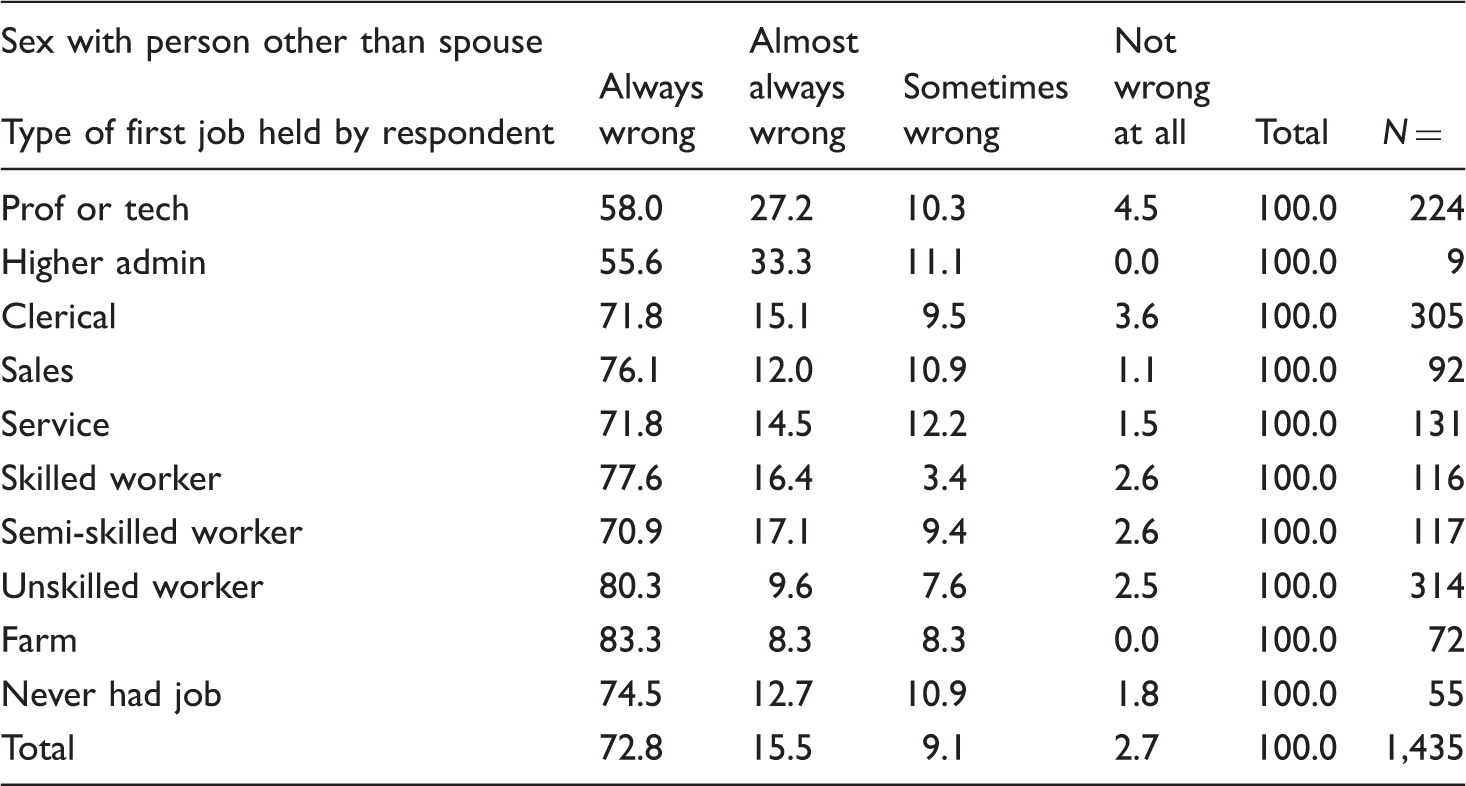
That differences across occupational categories in receptiveness to infidelity exist, seems clear from Table 1. We conducted a Chi-Square test of independence to ascertain the significance of these differences. The Chi-Square statistic of 30.22 was significant at p < .001, confirming significant differences in receptiveness to ‘sex with other than spouse’ by broad occupational category. Why these differences exist is less clear.
An alternative datum, with immediately suspect validity, yet immediately enviable visibility, is the much-trumpeted results of a study by the online ‘dating site for married people looking to have affairs’, AshleyMadison.com. 2 A June 2012 story that ran on the Huffington Post told of a survey of 11,453 fathers/AshleyMadison subscribers seeking to reveal the ‘occupations that harbor the most cheating husbands.’ The top five, in order, were IT/Engineer, Financial Industry, Education, Doctors, and Lawyers. Corresponding data from 2865 female site visitors earlier in 2012 revealed the top three occupations of teacher, stay-at-home mom, and medical industry. 3 Although one can immediately dismiss the non-representative nature of the survey (wouldn’t IT professionals also be most likely to use the internet to enable extramarital affairs?), one should at least note the contribution the survey makes in terms of reporting occupational results categorically rather than as a measure of social prestige.
On the other side of the sample size coin, we again note the growing ethnographic work by Fox (2009) and Hirsch et al. (2003; 2007), which seeks to understand the broader institutional arrangements that support or demonize extramarital sexual activity in specific cultural (geographic, familial, organizational, national, etc.) spaces.
Once again there are tantalizing data, but a dearth of model(s) to help make sense of what is seen. That becomes the paper’s next endeavor.
Building models of the influence of occupational structure and culture/ethical climate on opportunity for extramarital affairs
Dependent variables: Almost every study reviewed above shares a common characteristic: vexation at the state of the dependent variable: incidence of extramarital affairs. As noted above, this anxiety results from, at least, non-representative samples (leading to generalizability and reliability concerns) and response bias (leading to validity issues). Because many researchers are not convinced that past or present sampling (or even survey) techniques yield valid, reliable results about a phenomenon so private and ‘illicit’ (see, e.g. Dare and Cleland, 1994; Herold and Way, 1988; Maddox, 1989), this paper chooses instead to model the antecedents of the variable most uniformly associated with infidelity incidence – opportunity for extramarital affairs. A model of opportunity may be empirically tested without the tribulation of testing incidence. Opportunity is broken down into two component parts based on the literature: 1) occupational structural opportunity, arising from the variable structures of occupations and 2) occupational cultural/ethical climate opportunity, arising from the variable moral bases that occupations provide and encapsulate. Each is introduced, in turn.
Occupational structural opportunities for affairs
Power/status: The modeling begins where so many models of extramarital affairs have begun before: with occupational status or power. It will be curious to see if this variable holds up when other occupational structural variables are specifically added into the mix. The model suggests: Hypothesis 1: If a person has/is perceived to have status/power via their occupation then they will be afforded more opportunities for extramarital affairs. Hypothesis 2: If a person has greater income/financial means via their occupation then they will be afforded more opportunities for extramarital affairs. Hypothesis 3a: If a person’s occupation allows for greater periods of unbilled and/or unmonitored time, then they will be afforded more opportunities for extramarital affairs. Hypothesis 3b: If a person’s occupation is characterized by greater numbers of travel days, then they will be afforded more opportunities for extramarital affairs. Hypothesis 4a: If a person’s occupation expects numerous off-sites, retreats, and/or conventions, then they will be afforded more opportunities for extramarital affairs. Hypothesis 4b: If a person’s occupation exposes them to dependent client populations, then they will be afforded more opportunities for extramarital affairs. Model of antecedents of occupational structural opportunities for extramarital affairs.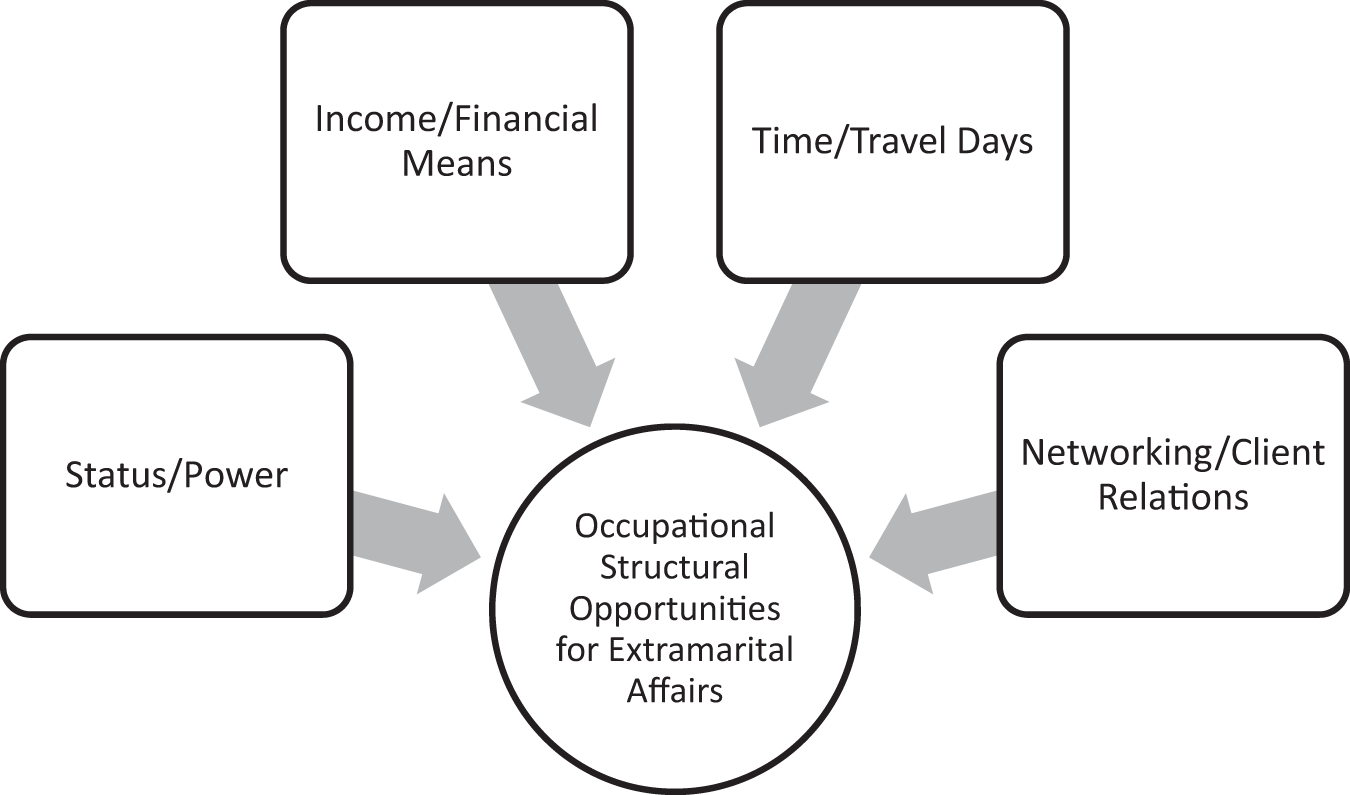
Occupational ethical climate opportunities for affairs
Just as the structure of an occupation can open up opportunities for extramarital affairs, the culture and ethical climate of an occupation can impose norms that raise or lower the perceived costs of having an affair. The gendering of occupations may infuse some interactions with heterosexist norms and expectations. The ethical climate of organizations and occupations may influence an occupant’s decision to take advantage of a structural opportunity – providing sufficient cultural impetus over and beyond the necessity of opportunity. It is argued below that occupational cultures can, themselves, demand certain kinds of comportment from adherents. This would be especially true of gendered occupations. As such, the dependent variable is modified slightly in recognition that occupational ethical climate will influence an occupant’s qualms and reservations about, or support for, acting upon the structural opportunities provided by the first model.
Focusing the cultural antecedent discussion more directly on the ethical climate literature, as prefaced above, the model also introduces variations in occupations’ expectations of ethical behavior. Expecting that occupations differ in their adherence to the ethical theories of egoism, benevolence, and principle, for instance, one can hypothesize ways that occupations’ enactment of ethics influences the nonwork activities of employees. The model suggests: Hypothesis 5: If a person’s occupation is dominated by an egoistic (as opposed to benevolent or principle) moral basis, then they will have fewer ethical qualms about acting upon opportunities for extramarital affairs. Hypothesis 6: If a person’s occupation is guided by a code of conduct/ethics that covers interpersonal behavior, then they will have greater ethical qualms about acting upon opportunities for extramarital affairs.
We have focused on the ethical climate of occupations as cultural predictors of opportunity (or readiness) to engage in extramarital sexual activity, yet the culture of occupations reflects and affords wider cultural influences as well. Indeed, while occupations may variably supply documented codes of ethics/conduct, they almost all will supply role models. The extent to which these role models are chosen for their ethical (as opposed to occupational competence) behavior will also likely vary. Falkenberg and Herremans’ (1995: 139) empirical work specifically finds that ‘role models are the major determinant of the level of the ethical or unethical behaviours in an organization.’ Occupational (as opposed to simply organizational) adherents may be influenced by the role models of their occupations that they see both within and without the organizations in which they work. Therefore: Hypothesis 7: If a person’s occupation is dominated in the public view by well-publicized ‘cheaters’, then they will have fewer ethical qualms about acting upon opportunities for extramarital affairs. Hypothesis 8: If a person’s occupation is culturally portrayed as condoning extramarital activity, then they will have fewer ethical qualms about acting upon opportunities for extramarital affairs. Model of antecedents of occupational ethical climate (cultural) qualms about acting upon opportunities for extramarital affairs.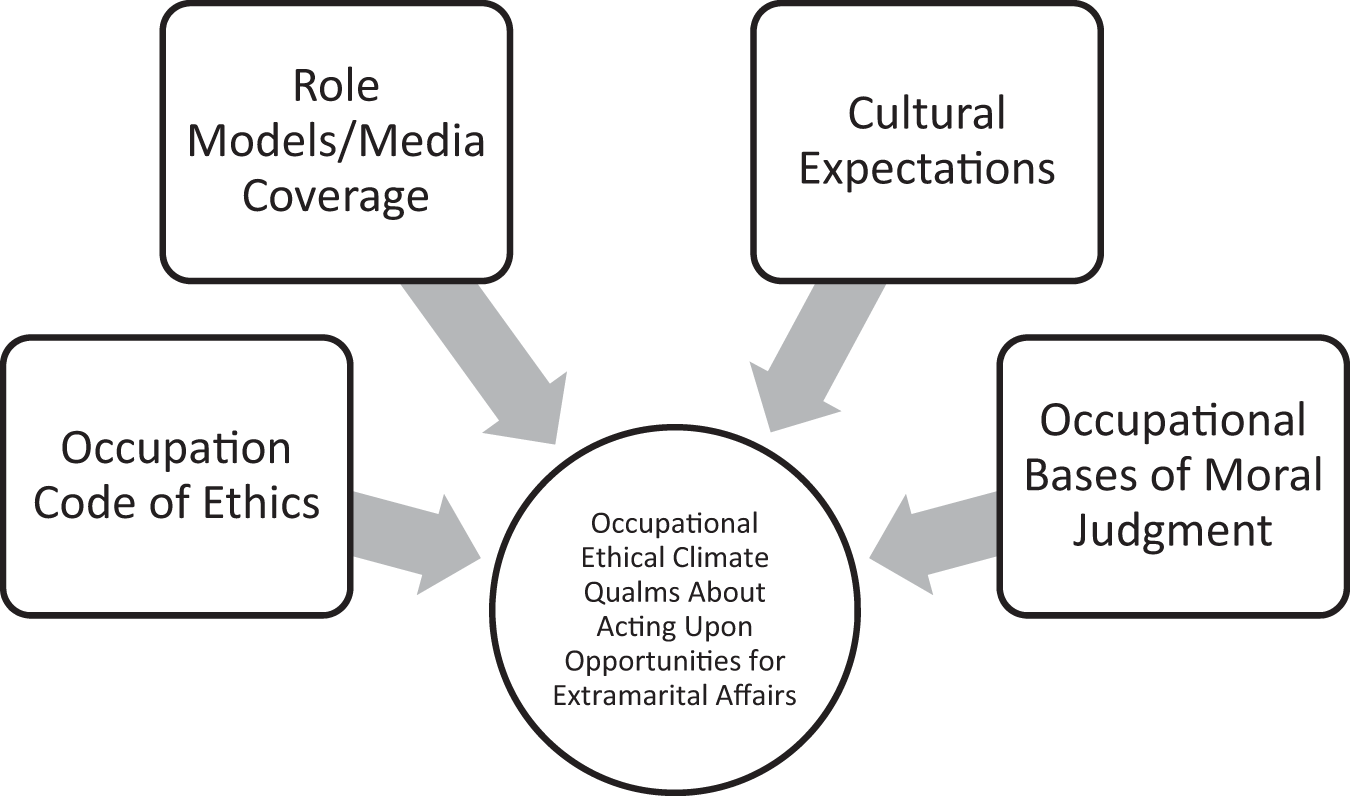
Next steps
Based on an extensive review of available literature across the social sciences, this paper has presented two complementary models of occupational antecedents of opportunities for extramarital affairs. These models have incorporated both structural and cultural/ethical climate dimensions that distinguish amongst occupations. The dependent variable of opportunities for affairs has been conceptualized to allow for numerous operationalizations through survey, archival, and perhaps, observational study. As well, the independent variables should allow for operationalization as categorical, rank, or in some cases continuous variables. Data to test these models may be derived from nationally representative surveys, popular culture audits, case studies, etc. Ethnographies by Hirsch et al. (2003; 2007) and Fox (2009) could also be mined for cross-occupational and cross-national comparisons of the structural and cultural variables that predict extramarital sexual activity opportunity. In all, this exercise will have proved worthwhile to the extent that it brings business ethicists, and organizational scientists into conversations about the influence of occupations and the structural and cultural occupational antecedents of extramarital affairs as well as more general worklife (ethical or not) behavior.
Footnotes
Funding
This research received no specific grant from any funding agency in the public, commercial, or not-for-profit sectors.