



Abstract
Tel Aviv’s Gay-Center is unique in Israel for being sponsored, managed and controlled by the municipality. This article focuses on the Gay-Center as a material, symbolic and discursive space in order to clarify the relationship between LGBT individuals and the nation. Based on an ethnographic study, we show that since its establishment the Gay-Center has undergone centralization processes as a result of being located in central Tel Aviv and by striving for LGBT mainstreaming, thereby accelerating the achievement of sexual citizenship and urban belonging. However, the expansion of sexual citizenship, which is always based on processes of inclusion and exclusion, reveals homonational practices and homonormative discourses. Since being in the city is the easiest and, at times, the only way to earn sexual citizenship, we argue that LGBT urban citizenship is an indication, a marker and thus a prerequisite of homonationalism.
Being [in] the center: Sexual citizenship and homonationalism at Tel Aviv’s Gay-Center1
In a demonstration protesting against the national-religious party’s (Habayit Hayehudi) veto of pro-lesbian, gay, bisexual and transsexual (LGBT) legislation, Reut Guy, a leading LGBT activist working with marginal LGBT youth, said in her speech: In recent years our community has become so varied, there are so many voices and so many colors … we thought it would be right to go back and join forces, and establish the LGBT task force that we formed this week, eight serious (women) social activists, each one and her issues, you know that lesbians love to fight for a cause […] This week we had the first meeting of the task force, around 80 people came, and every one of them said they wanted to help, and suddenly we saw that there were in the room parliamentary aides, ministers’ aides, parliament members, all of them from the community, gays, lesbians, which is to say that they are not all straights out there, it is us, we just need to make the knowledge that we have accumulated accessible to the community, to share that knowledge, to cooperate. […] We pledge that one piece of legislation will not come at the expense of another community, we pledge to examine the proposed legislation and if we need to support it then we will not be embarrassed to do so, and if we need to object we also won’t be embarrassed to do so […]. We do not share the thought that now is a time of crisis. It is not a time of crisis, it is a good time, it is a good government in that we have a window of opportunity to pass legislation that is good for us.
This article focuses on the Gay-Center, established in 2008 and funded by the Tel Aviv Municipality. We probe how the center, its practices and its meanings reflect ‘the relationship between the state, capitalism, and sexuality’ (Puar, 2013: 337) in Israel and examine what kind of politics is manifested at the Gay-Center. More particularly, we explore the production and achievement of sexual citizenship by analyzing the spatial inclusion and exclusion practices and the Gay-Center’s functioning as a homonational space and its implications.
We refer to space as both a place (a territory) and an indicator of power relations, a site of unequal interactions. Elden argues that space ‘is about interaction, determination, and control’ (2009: 267); therefore, space is about power and power is about space. The study looks at the Gay-Center as an urban space, an actual place, as well as a performance of power relations. As Probyn concludes, ‘space is a pressing matter, and it matters which bodies, where and how, press against it’ (1995: 81).
In Hebrew, the word Merkaz is used to signify both the mainstream and the center. In this paper we use the term centralization as a signifier of this conflation between processes of institutionalization, normalization and mainstreaming. Centralization thus constitutes a spatial formation of assimilation and integration into the mainstream. Consequently, not only does Tel Aviv’s Gay-Center represent a place in the center, it also symbolizes the mainstreaming of the LGBT community and the homonational processes occurring within it.
We argue that inclusion and exclusion processes, which are at the foundation of sexual citizenship, reveal homonational and homonormative discourses based on municipal symbolic, spatial and material control. The Gay-Center, which is a location-space that bolsters a fantasy about being in the center, i.e. a fantasy of becoming part of the national hegemony, sets normative boundaries of social/political belonging and imposes an explicit and implicit homonational discourse.
The paper opens with an analytic description of the field of LGBT activism in Israel, which led to the establishment of the Gay-Center. Following a theoretical review of the concepts of sexual citizenship and homonationalism, we proceed to analyze the LGBT centralization discourse. We explore inclusion and exclusion practices and their implications for symbolic, spatial and performative boundary construction for LGBT activists in order to analyze the production of homonationalism at Tel Aviv’s Gay-Center.
Tel Aviv – The formation of a gay heaven in the Middle East
The crystallization of Israeli LGBT activism can be traced to the establishment of the National Association of LGBT in Israel (better known as the Aguda, meaning ‘the association’) in 1975, followed by the foundation of Alef (an acronym for Lesbian-Feminist Organization) in 1978. These organizations struggled, first and foremost, against the law that criminalized homosexuality in Israel. New legislation in 1988 changed the political opportunity structure and enabled the emergence of new advocacy, support groups and social organizations in addition to ongoing legal and political work, emphasizing a politics of assimilation (Kama, 2011). Four years later, amendments preventing discrimination on the basis of sexual orientation in the labor market were added to the law. Additional organizations, such as the Lesbian-Feminist Association and the Jerusalem Open House, were established during the 1980s and 1990s.
The turn of the century signified the emergence of radical anti-assimilationist and queer Israeli politics. This new politics integrated more discourses (transsexual, bisexual, queer, disability, economic, ethnic, nationalist, etc.) with an anti-occupation agenda (Ziv, 2010). Nevertheless, Kama (2011) argues that these radical groups and queer politics were of minor significance and did not influence mainstream gay-lesbian politics.
The continuation and growth of LGBT organizations and social movements and the essential change in public opinion towards the LGBT community, followed by many legal achievements, mark the last decade (Gross, 2010). For instance, in 2004, the Supreme Court ruled that a gay man can inherit his deceased spouse’s assets; since 2005, the state recognizes same-sex parental adoption of non-biological children; and in 2006, a Supreme Court verdict enabled the formal registration of same-sex marriages conducted abroad in the population registry. The foundation of the Gay-Center in downtown Tel Aviv is one of the most significant achievements of this process.
Despite the fact that Tel Aviv, the largest urban area in Israel, does not have a gay neighborhood, the city, like many other urban areas (Weston, 1995), is perceived as the natural and only home for the Israeli LGBT community. The Tel Aviv Gay-Center was founded in 2008 by the Tel Aviv Municipality via its financial investment. This process was mobilized by gay (Jewish) men, who were already integrated into mainstream municipal politics. They lobbied for the establishment of the center and called for a municipal survey examining the needs of the local LGBT community and in particular the necessity of a local community LGBT center (see Pizmony-Levy, 2005). Therefore, the Gay-Center differs from other pride centers around the world: it is not run by an LGBT organization or a social movement but is sponsored and controlled by municipal leadership. Adi Moreno (2011) claims that by means of control of the physical space and decision-making regarding the budget, the Gay-Center enables national and municipal regulation of the LGBT community space.
Home to several LGBT organizations, the center draws a heterogeneous mix of activists from a diverse range of ethnic, political, age and sexual backgrounds. The center operates a commercial café at the entrance and runs community events, group activities, self-help gatherings, a health clinic, an information center, a theater and the local pride parade. The three-floor, 1000 square meter renovated building is located in downtown Tel Aviv, where real estate is very expensive, in a former municipal building inside a park. While 10% of the budget does come from municipal funding, the Gay-Center’s budget is mainly based on revenues from its activities and donations (see Figure 1).
The first Israeli pride event took place in Tel Aviv in June 1998. Pride events have long been considered a major factor in the construction and presence of LGBT identity, politics and social movements in public space (Gamson, 1995; Jenness, 2013). Since 1999, Tel Aviv pride events have been partly sponsored by the municipality and the Aguda was the organizer of the pride parade until 2006. In 2007, due to inability to meet the high security costs, production was transferred to the municipality and specifically to city council member Yaniv Weizman, who is also the mayor’s advisor on issues relating to the LGBT community. Transferring the responsibility for pride events to the municipality was a long and complicated process, resulting, among other reasons, from the privatization of internal security in Israel and capitalist pressures against public protest by burdening it with high costs. As a result, since its establishment the Gay-Center and its administration have played a focal role in the organization of pride events and all organizing meetings have been held there.
Nevertheless, the violence towards LGBT individuals has not stopped. In addition to ongoing harassment against LGBT individuals in the public sphere, two major incidents have occurred in the last decade: a man was stabbed during the 2005 Jerusalem Pride Parade, and two people were killed and 14 injured in a shooting at the Bar-Noar, the youth meetings of the Aguda, in August 2009. Aeyal Gross (2010) argues that one of the paradoxical effects of these murders, which traumatized the Israeli LGBT community, was that it allowed politicians from across the political spectrum to show their support for the mourning community and it created opportunities to speak out for gay rights. This was surely a turning point, as Gross argues: This change allowed the cementing of an unwritten deal that had long been in the works, between Israeli established homonormative politics and the new Israeli homonationalism. The mass rally in Tel Aviv a week after the murder, at which two senior right-wing cabinet ministers spoke, was a significant moment in this process. Although it did include critical and dissident voices, it also brought the homonormative and homonationalist politics together as has never happened before and was thus crucial for the ‘deal’. Its terms are that ‘we’ will be good, normative and Zionist gays, who are willing to partake in the discourse of Israel as a liberal democracy and collaborate, directly and indirectly, in the state’s use of gay rights as a fig leaf for Israeli democracy, and in return we will get sympathy and some support from the state. (2010: para. 9)
The ‘deal’ between the state and the LGBT community is vividly exemplified by state encouragement of gay tourism. The Gay-Center partakes in the Gay-Tourism campaign, which is a byproduct of the Brand Israel campaign, directed by the Ministry of Foreign Affairs, the Prime Minister’s Office and the Israeli Treasury. Launched in 2005, the campaign’s goal is to replace Israel’s image as a Middle Eastern, religious and militaristic desert state with an image of Israel as a modern cutting-edge Western liberal country (in particular in contrast to Palestine and other Arab countries).
In 2010 the Tel Aviv Municipality’s Department of Tourism, in conjunction with the Aguda, initiated ‘Tel Aviv Gay Vibe’, to promote European gay tourism to Israel, specifically to Tel Aviv.2 Most of the project’s funding originated from the Tourism Ministry and the municipality. The substantial investment was perceived as potentially lucrative and an indicator that gay issues are part of a strategy for changing public opinion of Israel worldwide – otherwise known as ‘pinkwashing’. During the summer of 2012, approximately 25,000 gay tourists descended on the city, spending about $50 million, a 20% increase over spending the previous summer.3 The tourism project seems to be in some way recompense to the municipality for the Gay-Center, its budget and the tolerance it receives. Hence, LGBT individuals are not only supposed to be grateful for their inclusion, they must give back to the state by attracting gay tourists. Tourism integrates consumerism and modern citizenship (Bell, 1995) and the gay tourism campaign added a whiff of nationalism.
As the Gay-Center constitutes a mediator of municipal logics and practices, it is an illustration of a neoliberal process of private consumption that transforms bureaucratic positions into political capital, instilling municipal and national governmentality (Moreno, 2011). The Gay-Center is very influential in local LGBT politics. It sets normative boundaries of belonging, constructing socially, culturally and symbolically a place for LGBT politics and community. We focus on these spatial politics and map new configurations of sexual citizenship and homonationalism that lead to the formation of LGBT belonging and consequently to the creation of nodes of resistance.
Theoretical framework: LGBT national belonging – sexual citizenship and homonationalism
As an ‘incorporations regime’ (Soysal, 1994), citizenship is an ensemble of institutional practices and cultural norms which define groups’ and individuals’ belonging to a political collective. The theory that links citizenship to sexuality argues that citizenship has always been associated with heterosexuality (Richardson, 1998; Bell and Binnie, 2000). Although citizenship represents unity and equality, in many countries gays and lesbians are not eligible for equal civic rights as heterosexuals. In other neoliberal states, LGBT individuals’ citizenship has been perceived as unsettled since they are not inherently seen as part of the nation but are not unequivocally excluded from it either. Indeed, while not formally denied the right to vote or participate in politics, the power of LGBT individuals to exercise political influence has been circumscribed (Cossman, 2010).
The concept of sexual citizenship is contested. Its contours mark sexuality becoming part of citizenship and employing citizenship as a locus for sexual identities and practices (Bell and Binnie, 2006). That is, the concept of sexual citizenship calls to extend citizenship to include the rights of LGBT individuals. Expansion of sexual citizenship occurs both through juridical enfranchisement and via ‘symbolic incorporation into a national community’ (Seidman, 2001: 323, Richardson, 2000) in the public sphere. To achieve that, sexual citizenship entails changing heteronormative cultural and social norms (such as family formations and the welfare state’s organizing principles).
However, sexual citizenship does not only signify a struggle for inclusion but, as critical scholars argue, it is also an attempt at normalization, discipline and the promotion of gay commodification and marketization (Evans, 1993; Phelan, 2001). Cossman (2010) argues that what makes the struggle for sexual citizenship, which is basically a struggle for inclusion and purification, particularly successful is that it does not fundamentally challenge hegemony. Similarly, Seidman asserts that ‘gays have claimed not only to be normal, but to exhibit valued civil qualities such as discipline, rationality, respect for the law and family values, and national pride’ (2001: 323). Normalization thus neutralizes sexual difference and renders it an exception that does not prove the rule, portraying LGBT individuals as ideal citizens, who exhibit national pride and normativity, replicating heteronormativity (Stychin, 2001).
The discursive and material spaces from which claims are articulated are key issues regarding the production of ‘a modality of sexual citizenship that is privatized, de-radicalized, de-eroticized and confined in all senses of the word: kept in place, policed, limited’ (Bell and Binnie, 2000: 3, original italics). Bell and Binnie (2004) conclude that sexual citizenship produces a particular kind of sexual space, to the exclusion of others.
Still, Weeks (1998) argues that making demands on a culture that denies you is a radical act in itself. Indeed, the demands for normalization of sexual citizenship never fully materialize, as apparent in queer subversion. Citizenship is clearly a disciplinary discourse and, accordingly, any desire to reiterate heterosexual citizenship is characterized both by struggles for belonging and subversion.
Here, we employ the concept of sexual citizenship precisely because of its dual meaning – extending civic rights and a sense of belonging, on the one hand, and normalizing LGBT identities and spaces, on the other – as both are pertinent to the analysis of the Tel Aviv Gay-Center. To augment the critical approach of sexual citizenship, we utilize Jasbir Puar’s (2013, 2007) concept of homonationalism, which should be understood not as an identity or a positionality but as a disciplining ideology and regulatory regime within the structure of citizenship. Homonationalism is an assemblage of political, social and economic forces: Homonationalism, thus, is not simply a synonym for gay racism, or another way to mark how gay and lesbian identities became available to conservative political imaginaries; it is not another identity politics, not another way of distinguishing good queers from bad queers, not an accusation, and not a position. It is rather a facet of modernity and a historical shift marked by the entrance of (some) homosexual bodies as worthy of protection by nation-states […] Part of the increased recourse to domestication and privatization of neoliberal economies and within queer communities, homonationalism is fundamentally a deep critique of lesbian and gay liberal rights discourses and how those rights discourses produce narratives of progress and modernity that continue to accord some populations access to citizenship – cultural and legal – at the expense of the delimitation and expulsion of other populations. (Puar, 2013: 337)
Zanghellini (2012: 358) warns that the imprecise use or overuse of homonationalism as a master narrative may lead to ‘inappropriate rhetorical moves and inaccurate or unsubstantiated claims, and to project structural undercurrents of racism onto certain texts or events, rather than unearthing such structures from them’. In the same vein, Ritchie (2014: 6) asserts that ‘Homonationalism has morphed from an argument about the tentative and incomplete incorporation of some (white/citizen) queers by the neoliberal nation-state in a specific time and place […] into a totalizing framework that depends on a dangerously simplistic construction of reality’. Yet Ritchie contends that it is the oversimplifications of the concept of homonationalism which make it tenable, popular and to some extent universal. Taking these cautionary calls under consideration, we use the term homonationalism in this article as a marker of concrete and situated power relations describing ‘the complex and unpredictable ways space is organized, difference is enforced, and some bodies in some places are allowed to move more freely than others’ (Ritchie, 2014: 17). Thus we unearth influential power structures in order to demonstrate the limits of national integration as a means to achieve LGBT rights.
In sum, while the concept of sexual citizenship is an effective tool to analyze the establishment of the Gay-Center as a reflection of a dual process of inclusion and exclusion, homonationalism reveals these processes’ consequences on the broader social level. Building on Puar’s conceptualization, this article specifically focuses on the formation of the Tel Aviv Gay-Center as an assemblage, a performance of homonational politics in the local Israeli arena.
Methodological note
This article, which focuses on the Tel Aviv Gay-Center, is based on a larger queer ethnographic research study, exploring the politics of pride and shame in four Israeli LGBT spaces in central and peripheral areas, carried out by the first author.4 The Tel Aviv part of the research included participant observations at the Gay-Center that took place between October 2011 and October 2012, and 16 open-ended interviews with the Gay-Center’s staff and key activists. The participants can be roughly divided into two categories: having a peripheral, marginal or queer perspective and having a central or hegemonic perspective. The decision to interview both central activists and marginalized ones allowed us to study not only how each of these perspectives is formulated but also the interactions between them.
The interviews, which took place from October 2011 to January 2012, lasted from two to five hours, were recorded, transcribed and transcriptions were sent to the participants for approval. Although this is unusual, all participants gave written consent for the use of their real names in the article, as they are all well-known local public figures, who wanted credit for their statements. Also, the activist LGBT community in Israel is small – most of the activists are acquainted and likely meet often. Since almost all of the key local activists were interviewed, their statements are recognizable and there is no point in trying to disguise their names. The interviews were thematically analyzed, revealing main concepts and subjects. The central analysis questions referred to the social assumptions concerning LGBT spaces, activism and affects as well as to the stability of spatial and affective politics, manifestation of conflicts and power relations and the way these are narrated, justified and maintained.
The fantasy – Centralization and belonging to the center
There is no doubt that the establishment of the Gay-Center was significant for the process of centralization and inclusion of the LGBT community in Tel Aviv and Israeli society in general. Avi, a veteran leading activist, described the politics of mutual interests between the community and the municipality, while expressing his enthusiasm for the Gay-Center’s establishment: Adir [an LGBT activist, senior official at the Tel Aviv Municipality] asked [for a space for the gay community], the mayor said ‘Ok, we will arrange for a room in some municipal building,’ […] I think they gave it to him to silence him, it never occurred to them [how successful the space would become …]. They said ‘give him this dump,’ he’ll shut up; otherwise we’ll never get rid of him. You know they invested millions in the renovation […] During the renovation I would walk by every day […] I said I need to see this, because there’s no way that they could be investing municipal funds in the gay community. In my eyes, the Gay-Center is nothing short of a miracle. People from all over the world come to see this miracle. That the municipality invested millions on this building that is worth tens of millions [today] […] We [the center’s director] and I met several times, we hosted Huldai [the mayor], and he said to us: ‘Do you think that if I had known that it would become this I would have given it to you? It never crossed anyone’s mind.’ […] Even the café, at the beginning, it was: ‘OK, we’ll bring two gays and an espresso machine and they’ll serve coffee to few more gays.’ When they opened 300 people came. They themselves couldn’t believe it.
Yoav, a city councilman from the opposition party, described the politics behind the Gay-Center: The person who runs the center today […] is a municipal employee. They [he and his deputy …] have the same kind of politics of the ‘Strong Community’. [It] means that we’re already strong enough, that we no longer need to point out or emphasize the margins […] we don’t need to cry all the time that we’re discriminated against … But rather, we’re a source of pride for the city, we are a source of income for the city, […] love us, we bring in money for the city.
One example of such processes is the formation of a new platform for LGBT NGOs. Nowadays, the offices of Tehila (parents of LGBT persons), IGY (NGO for LGBT youth), and Hoshen (an organization working in public schools to fight sexual and gender stereotypes) are right next to each other in the Gay-Center, leading to joint activities and collective fund raising. New economic, spatial and organizational possibilities were realized which stabilized and enlarged these organizations. Mike, former chairman of the Aguda, emphasized that although the Aguda has its own space in central Tel Aviv, it rented an additional office at the Gay-Center, because: ‘in the atmosphere created by the foundation of the Center – that was the place to be.’
The large building enabled the extension of the centralization discourse and amplified the political, cultural and economic scope of activities. Eventually, LGBT individuals dominated an attractive and expansive space that draws heterosexuals as well, as Avi points out: Now, what it does, which in my eyes is wonderful, is that it draws straight people. The building and its activities are so amazing and magnificent that suddenly […] we are not AIDS … those who cannot be worked with and who should be sitting in some dark hole somewhere. Today we have the nicest café in Tel Aviv.
This perceptual change signals a change in values, marking the place as respectable, a family and community space, a high culture public space and, contrary to common stereotypes about LGBT individuals, not one of erupting sexuality. The respectability enables the Gay-Center to become ever more mainstream and establish the ‘correct’ visibility – a foundation for belonging within the bounds of nationality, the structuring of sexual citizenship and homonationalism.
Boundaries of LGBT belonging
Achieving a mainstream position is often accompanied by or even depends upon practices of exclusion or marginalization, which reveal the inner workings of power politics. Thus, even previously marginalized groups such as LGBT groups and organizations develop exclusionary practices, based on demarcating clear boundaries separating ‘inside’ from ‘outside’. Three such boundaries were identified at the Gay-Center: power relations, sexuality boundaries and political boundaries.
Power relations at the Gay-Center
Reut, an activist who works with transgender women in various forms of prostitution, reveals the first type of boundary. She describes how the architecture of the Gay-Center makes it difficult for the people she works with to belong: I never felt comfortable there. I never felt like it was a home, never felt like I liked it there. There was something very alienating and very imposing and spotless. […] I thought of all of those youth, who were queer and marginalized, that don’t pass … […] They felt anomalous there. […] youth whose gender is not entirely clear, transgenders who work in prostitution – then the shame is double or tripled. […] If they had events at the center, they invited the youth from Beit Dror [a temporary safe house for LGBT youth], and it was always clear that these are the youth from Beit Dror. That we [i.e. marginalized queers] shouldn’t mix with the cream of the crop [i.e. the ‘strong community’].
Taylor (2011: 180) highlights the importance of class to spatiality and sexuality: ‘Class, as with sexualities, is geographically produced and privilege, as well as marginalization, needs to be explored.’ Although Seidman (2011: 38) disagrees and suggests that ‘class has not been a central axis of difference and division in post-Stonewall queer life’,5 we find class and the stratification it causes to be an important aspect of the Gay-Center becoming a homonational space.
Class differences and divisions are apparent throughout the discourse surrounding the spatiality of the Gay-Center. Clearly, the exclusion/inclusion mechanisms of the center leave out lower-class LGBT individuals, as articulated by Reut, who emphasizes class differences (‘the cream of the crop’). Pointing to transgenders in prostitution as an example of those uncomfortable within the Gay-Center, she portrays the center as one designed solely for privileged LGBT individuals.
The café at the entrance to the center serves as an illustration of these class orientations, as it is not a locally operated low-cost service and disciplines the normative behavior of its clientele. Gila Goldstein, a well-known transgender prostitute and actress, who was awarded the ‘sweetheart of the community’ award in 2003, is known for her extrovert and vulgar attitude. Gila is prohibited by the Gay-Center’s café manager from entering the café, with the excuse that ‘she cannot behave herself’, thus excluding the uncultivated woman from the quiet and polite space of the café, and ‘preventing’ her from ruining the atmosphere (and the profit).
Shiri, a bisexual activist, describes economic boundaries constructed by the Gay-Center’s administration: From the beginning I was treated rather disrespectfully [at the Gay-Center]. I requested the admission fee [for the bisexual activities] to be 10 NIS or a sliding scale fee […]. They [the Gay-Center’s staff] disagreed and insisted the fee would be 20 NIS, which is the Gay-Center’s fee for all activities. They claim that bisexuals are not a disadvantaged group. […] In the two years that the activities were at the Gay-Center, people always complained that it was expensive and that they couldn’t afford 20 NIS at the entrance. Eventually people just stopped participating.
By describing how boundaries overlapped and crossed momentarily on the night of the Bar-Noar shooting, Reut reveals the way power is manifested in space, focusing on questions such as where, how and by whom decisions are taken: The night of the murder the Gay-Center’s director […] was in Denmark. […] I came to the Gay-Center and said: ‘OK, is there an office here? I need a telephone. Wonderful, the director is abroad.’ I sat in his office and then a few representatives arrived, little by little they saw that I was beginning [to manage], I had started an opinion piece and we started to make phone calls, tours, press releases. The press arrived and youth arrived and I’m doing all this from the director’s chair. A ton of volunteers came, the center was packed. […] Before there was any formal response, there were 24 hours where he was in Denmark and his chair was free. I remember that even one of my exes came […] and said to me: ‘How can I help?’ I told her: ‘Can you maybe just make me a cup of coffee?’ She made me coffee. I said this looks really bad … I’m in the director’s chair and she’s making me coffee. […] I knew that he was returning and with that the story would end […] it’s also high up, on the third floor, that’s significant. […] from the moment he returned to Israel of course I was thrown out of there and I couldn’t be there. […] And then essentially, I did my work from the outside, I went around with the ELEM, [an organization that gives assistance to youth at risk] outreach van. […] from the moment he returned to claim his seat, I went to work in the street.
Baruch, the chair of Six Colors, a group that offers an alternative to the Gay-Center’s implicit ‘strong community’ politics, recounts another example of exclusion. Baruch describes how boundaries are concretely structured within the Gay-Center: There was a room in the local community center that Six Colors rented, but they changed the locks and they didn’t give me the new key and I had to ask for it every time, as opposed to other organizations. […] After that we were told that we couldn’t continue to rent the room because we needed insurance coverage for our activities […]. It was as if we were expelled from the Gay Community Center […]. I wrote a rather harsh post [on Facebook] about how, in my opinion, the Gay-Center is not the Gay-Center, it’s the local community center and whoever calls it the Gay-Center is doing a disservice to the community and there are people who are paying the price for this linguistic change; primarily people who don’t live close to the center or people in the periphery. […] 12 hours after I posted the blog I got an Email from the Gay-Center’s director: ‘Under no circumstances can you be housed in the Gay-Center’.
Baruch maintained that he and his organization were excluded from the Gay-Center since they did not identify with the centralization narrative that the center endorses. Evidently, the organization was punished for not accepting the presumption of the center to represent the wide and diverse community.
Enforcing normative LGBT sexuality
A second type of boundary is created when the ‘management’ tries to associate the Gay-Center with a clean, normative sexuality. Heteronormative discourses symbolically frame the public space as asexual, where sexuality is moderated or normalized. As a result, queer spaces are constructed as hyper-sexual (Berlant and Warner, 1998). Outlining sexuality as a contingent site of negotiation, queer theory has offered a critical perspective, focusing on the subversive potential of queer sexuality and performances in the public sphere (Butler, 1993). Moreover, much of the research concerning sexuality and sex in public spaces centers on safety, visibility and the private-public division (see Dangerous Bedfellows, 1996; Berlant and Warner, 1998; Delany, 1999; Bell and Binnie, 2004). The politics of the Gay-Center, on the contrary, does not involve sexuality per se but rather is anchored in the discourse of sexual (in)visibility and normative imperatives. This kind of politics attempts to consolidate a normative visibility, regulating sex and producing homonormative formations of space that exclude sexual expressions.7
In order to accentuate LGBT identity and not sexuality, the Gay-Center limits the sexual performativity that it allows within the space. Pnina, a queer BDSM activist, says: I wanted to do the BDSM stand [before the pride parade]. […] I requested permission from the director and he told me no. That there was no place for it, […] that everyone is free to march, but only organizations that work with the Gay-Center get stands, and at first I didn’t understand the meaning of this response. I wrote to him: ‘What do you mean?’ And then he told me something like: ‘The Gay-Center is about more than just sexuality.’
In the same vein, Gal Uchovsky, a well-known media personality and a leading gay activist, called on a popular website for holding a ‘serious discussion about the exaggerated sexual promiscuity’ within the LGBT community (Uchovsky, 2013: para.7) and thus reestablished the identification of the community with normative LGBT identity.
These spatial norms shape the boundaries of power and influence, define who can wield power and who will be excluded. Such divisions serve the third and probably the most crucial type of boundaries, the political boundaries that produce and reproduce homonational discourses at the Gay-Center.
Maintaining political boundaries
The process of homonationalism is vividly demonstrated through the politics underlying Tel Aviv’s multiple pride parades. In June 2010, three pride parades took place. The municipal parade, the largest annual parade in Israel, which has been running since 1998 (see Figure 4); the radical parade, nicknamed ‘Just Before Pride: Alternative Radical Queer March’ (see Figure 3); and ‘The Community Parade’ (see Figure 2), which protested against the municipality’s dictation of the central parade’s agenda.
Outside Tel Aviv Gay-Center (photograph: Adi Moreno). The community parade (photograph: Adi Moreno). The radical parade: ‘Just Before Pride: Alternative Radical Queer March’ (photograph: Aviv Maoz). The Tel-Aviv municipal pride parade (photograph: Meir Jacob).8 A poster from the 2012 Tel-Aviv pride campaign: ‘The Whole Country is Covered in Flags’ (photograh: Ziv Sade, design: Imri Kalmann, production: Yoni Meisler. Originally published by Tel Aviv Municipality and the Gay-Center. Reproduced with permission of the designer and the photographer of the campaign).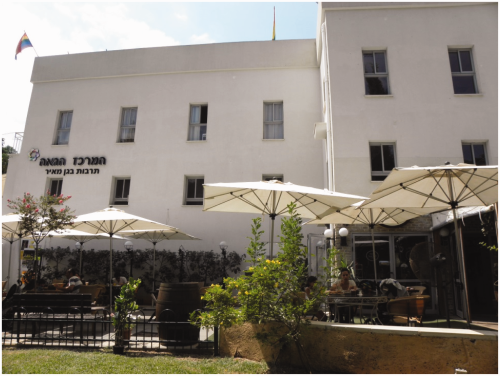
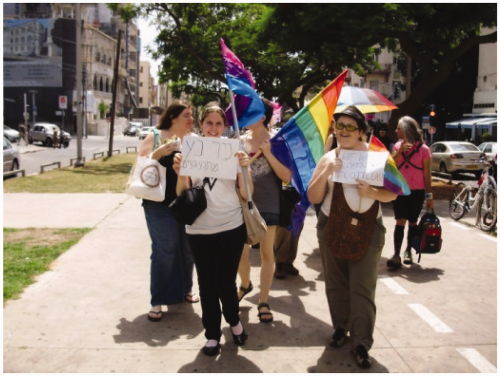
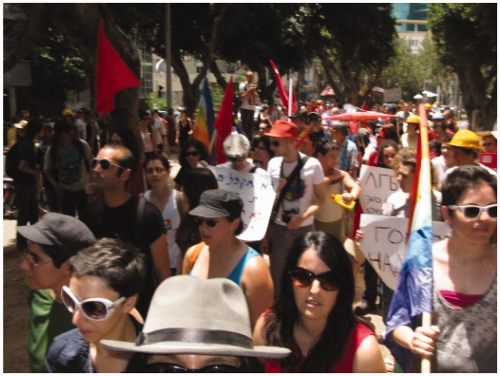
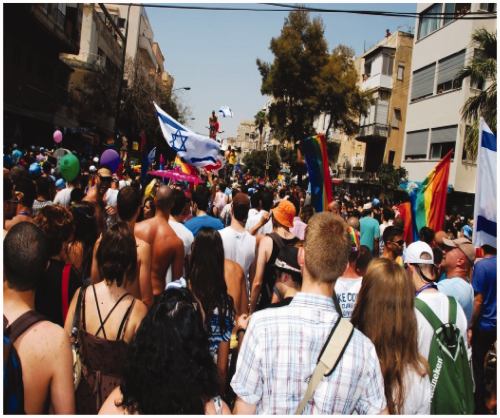
On the night between 30 and 31 May 2010, ten days before the Tel Aviv pride parade, the Israeli military (IDF) intercepted six Turkish ships bound for Gaza. Boarding the sixth, the Mavi-Marmara, resulted in a violent confrontation between IDF soldiers and the ship’s passengers. This event intensified the politicization of the parades. Radical LGBT groups condemned the IDF’s violent attack on peace activists. In response, a key figure in the Gay-Center wrote on his Facebook page: ‘The radicals are going to come with the Turkish flag and take over the parade, we must stop them.’ To ensure a visible Zionist presence at the municipal parade, Israeli flags and rainbow flags with a Star of David, the ultimate symbol of Zionism, were distributed. The day of the parades, the ‘radical parade’ marched on a parallel street, prior to the municipal parade. Activists carried rainbow flags and Turkish and Palestinian flags in visible opposition to the IDF’s actions and mainstream LGBT homonational politics.
It is important to note that there has always been internal criticism of bringing national, economic or environmental politics into the LGBT discourse, whose sole purpose, many perceive, is to advance LGBT rights (for elaboration on this dissociation of LGBT issues from ‘the conflict’, i.e. political issues, see Ritchie, 2010: 561; 2014: 11). The radical parade intensified this debate and some alleged it undermined the national legitimacy of the LGBT community.
In 2012 the municipality launched a pride campaign entitled ‘The Whole Country is Covered in Flags’ (quoting a famous line from a children’s Independence Day song), which purposely sought to represent all factions of the LGBT community, not just gay men (see Figure 5). The intention behind the motto was explained in an article in City Mouse, a local newspaper: ‘Although the main parade is in Tel Aviv, pride is found throughout the land’ (Erlich, 2012: para.3). The campaign’s title reflects a two-fold desire for general representation, expressed in both identity and space: representation of the whole community and representation of all of Israel. Tel Aviv is presented as the Israeli LGBT center from which pride is dispersed to all Israeli LGBT people, who all come together to march in the Tel Aviv parade.
The campaign’s linkage between sexual and national identity was implied by associating the rainbow flag with national symbols – the Israeli flag and Independence Day. This connection was legitimated by seemingly casual pictures of LGBT people as fun, successful, family-oriented, monogamous and normative. The images, perceived as socially and nationally acceptable, served to create rigid boundaries of belonging, excluding those who did not fit the normative and the national models.
There are many other examples how homonational practices shape the Gay-Center. A paradoxical example was when Al-Qaeda hacktivists crashed the Gay-Center’s website at the beginning of the Gaza War of 2012 (Zack, 2012). The targeting of an LGBT website by Al-Qaeda reveals, in an ironic way, the success of homonational efforts and LGBT national belonging.
One outcome of homonational processes is the proliferation of LGBT sections in most central political parties, including right-wing parties like Benjamin Netanyahu’s Likud party. This demonstrates both the expansion of sexual citizenship and the increase in LGBT political power and the normalization and centralization of LGBT politics, which now not only reflects a desire to belong within the national boundaries but also to work at its very center.
The Gay-Center, a safe space of acceptance and inclusion, created a new opportunity that was not just manifested in belonging to the community or the city but by belonging to the (Jewish) nation. The physical space located in Meir Park symbolizes Tel Aviv Municipality’s recognition of LGBT people not just as part of the city or the establishment but as equal citizens in the national Zionist project. The Gay-Center is presented as the ‘implementation’ of good citizenship, one which is not marginalized and is in itself the performance of the LGBT belonging to the nation.
Concluding remarks
As we have shown, the Gay-Center’s establishment crystallized processes of belonging and specifically national belonging. In this case, the discourse of belonging focused not just on a place-space or home for the LGBT community but on civil rights, mainly the right to occupy urban space and forge a spatially-fixed LGBT visibility. Currently, the Gay-Center is the infrastructure underpinning the LGBT community and the potential for LGBT success, prosperity and growth both individually and organization-wise. It is perceived as a space of convergence, the foundation stone through which LGBT belonging is formed.
We have argued that centralization processes of mainstreaming and integration into the establishment and its spatial formation accelerated the achievement of sexual citizenship. The Gay-Center embodies municipal and state recognition of LGBT individuals as citizens who not only belong but are equal in the national sense. It is a signifier of mainstream citizenship, a citizenship that is not merely sexual, intimate or private, but is an indication of homonationalism.
Expanding citizens’ rights and inclusion in the nation entails adopting proper citizenship and excluding those who are ‘not proper’. Two intertwined processes of appropriation occurred: the LGBT community appropriated the urban space but was in turn appropriated by both the city and the state to serve their own interests (see Gross, 2013). Hence, the acquisition of a space of its own served two goals: it gave the community positive visibility, expanded their urban citizenship and, at the same time, associated the LGBT community with Tel Aviv, presenting it as the only ‘right place’ for LGBT individuals and organizations.
This analysis highlights the importance of space for understanding homonationalism as an assemblage. Since homonationalism is neither an identity nor a subject position, we focus the analysis on a specific space that reveals the mechanisms of hegemony. Bell and Binnie claim that ‘how we conceive of and theorize “the city” and city-spaces will have consequences for how we think through citizenship’ (2004: 1808). The way LGBT individuals feel in the city reflects their belonging to the nation. Thus, in a sense, LGBT urban citizenship is a means for homonationalism. Urban citizenship becomes the easiest and, at times, only way to earn sexual citizenship, and those who are not there are ineligible in the same way to belong to the city and the nation. As an indicator of homonationalism, space can elucidate the relations between LGBT individuals and the nation.
Browne and Bakshi (2013) and Misgav (2015) suggest a different analysis of state and LGBT activists’ relations. Browne and Bakshi (2013: 235) perceive the state and its actors as ‘constantly becoming, spatially contingent assemblages’, leading to a situation where ‘cooption, deradicalisation and loss of activism are not always, or necessarily, the result of working within and with the state’. The power structure is complex and can generate incoherence and flexibility, thus revealing diverse possibilities of becoming for activists. Indeed, this diversity creates enclaves of resistance within the Gay-Center, which encompasses radical-queer and subversive activities and groups working to create autonomous niches within the municipally regulated space. The Gay-Center and its staff enabled limited activities that are not homonormative, such as several of the trans in the center activities (Misgav, forthcoming). Misgav (2015) argues that even though the (semi) hegemonic sides of the municipal gay representatives attempt to blur the power differences between the center’s establishment and a radical queer group operating within the center, thus framing the center as an inclusive and tolerant space, there are obvious power differences between the two sides. Misgav argues that the duality of the center’s management enables the space to facilitate and bolster (queer) activism, while serving as a gatekeeper of this activism, maintaining the power structure and discursive normative frames.9
Hence, although there can be subversive spaces within the Gay-Center, the imperatives of homonationalism are here to stay. We described the beginning of the LGBT community’s amalgamation process into national-urban discourses. LGBT individuals’ inclusion within national boundaries is always accompanied by an adoption of nationalistic discourse and continuous marking of internal boundaries of belonging. These boundaries signify who is a good homo-citizen and who is not. In Israel, national boundaries, sometimes manifested as gender or sexual power relations, tear the community apart. While in many Western countries the LGBT struggle revolves around familial homonormative discourses vs. queer futures, in Israel all LGBT struggles are loaded with nationalistic meanings. The nationalistic essence of the struggle has become so ubiquitous that it is camouflaged and almost hidden; however, there is no LGBT project that can be divested, today, from nationalistic sentiments, be they for or against the state. Since 2010, there are more and more national flags being posted at pride parades alongside the rainbow flags and commercial banners. This is not a one-time reaction to a specific event; rather, the Israeli LGBT struggle for expanding civil rights is tainted by the national agenda and attendant practices.
Many things have changed in the dynamics of the LGBT community since the establishment of the Gay-Center in Tel Aviv: some leaders left and others took their place, some organizations have been revitalized and new organizations have emerged (especially transgender organizations), but all of them have to face the transformation of LGBT spaces into homonational ones.