




Abstract
I look at several depictions of birth in popular culture that seem to be breaking ‘Hollywood’s last taboo’ against showing graphic representations of the birthing body. I offer four illustrations of this relatively recent departure from conventional birth imagery and discuss (1) the 2006 sculpture of Britney Spears birthing on a bearskin rug, (2) the crowning scene in the 2007 movie Knocked Up, (3) a 2012 birth scene depicted in the HBO show Game of Thrones, and (4) a birth montage from an episode of the Netflix show Sense8, to suggest that representations of birth no longer solely depict asexual bodies. I consider the consequences that these sexualized representations of the birthing body might have for women’s embodied experience of birth and evaluate this sexy birth imagery in light of a cultural shift towards an increasingly (hetero)sexualized femininity. In particular, I am interested to explore how normative (hetero)sexualized femininity may align with the growing medical management of childbirth and the uptick in surgical delivery. I investigate whether graphic depictions of birth leave us with increased sexual objectification or the possibility for a new sexual subjecthood. I close by offering a queer reading of the birth depictions in the Netflix drama Sense8 and consider how its non-normative depictions of women’s laboring bodies may unsettle the powerful norms that constitute (hetero)sexualized femininity and refigure women’s experiences of childbirth.
Preface: Britney laid bare on the bearskin rug
In the spring of 2006, artist Daniel Edwards unveiled ‘A Monument to Pro-Life: The Birth of Sean Preston’. The life-size sculpture portrays Britney Spears laboring on elbows and knees, with hands clenching the face of the bearskin rug upon which she delivers. The initial press release drew attention to the artist’s depiction of Britney’s ‘lactiferous breasts and protruding naval’ [sic] and remarked on the ‘posterior view that depicts widened hips for birthing and reveals the crowning of baby Sean’s head.’ 1 The clay sculpture, (Figure 1) which was on display for a month at a Brooklyn gallery (Capla Kesting Fine Art), generated public outcry, with the gallery reportedly receiving over 1000 pieces of hate mail in a single day. 2 The Connecticut artist modeled the sculpture after a Madame Tussauds pole-dancing wax figure of Spears, and wanted to ‘depict her as she depicted herself – seductively.’ 3 Spears’ actual birth (a planned cesarean) was likely less seductive, involving a scalpel rather than a pelt, and yet what Edwards offered us is an artifact emblematic of the contemporary discourse on women’s bodies, their sexuality, and popular depictions of birth. In particular, Britney’s bearskin rug and her hairless vagina 4 are clear homages to sex and – more specifically – pornography, suggesting that even during childbirth, Britney’s cultural status as a sex icon does not waver.
Fox News characterized the sculpture as sexy, 5 while Salon deemed it porny, 6 and therein lies the question – what are we to make of graphic depictions of birthing women? Is Britney alone; are birthing bodies now being depicted in sexually explicit ways? Certainly this would turn the tables on a longstanding cultural reticence to sexualize birthing women. Referred to as ‘Hollywood’s last taboo’, 7 portrayals of birth and birthing bodies have largely remained obscured rather than explicit. Until recently, birth has happened off-screen or has been depicted as happening below the sheet, with the bodies of laboring and delivering women draped in medical gowns or otherwise obscured. Decidedly unsexy and asexual, birth scenes have largely focused on narratives of humor 8 or dramatic tension. 9 I suggest that that taboo may be showing signs of fracture as the birthing body plays a new, more sexualized role.
Introduction
I consider graphic depictions of childbirth in popular culture as the latest outpost in popular culture’s (hetero)sexualized depiction of women’s bodies. My aim is first to underline some important contact points between pornography and popular culture before exploring how a woman’s experience of labor and delivery may be influenced by discourses of normative (hetero)sexualized femininity. Using the concept of normative (hetero)sexualized femininity brings attention to how popular understandings of what it means to be a woman in society have been infused with a heightened attention to (hetero)sexuality, and specifically a pornografied version of sexuality, and I explore what (hetero)sexualized femininity portends for women’s relationships to their own bodies during birth. I share four popular culture artifacts that depart from convention in that they depict a graphic representation of childbirth. 10 I juxtapose a discussion of these four artifacts with an exploration of current trends in the medicalization of childbirth to suggest that both valorize a normative (hetero)sexualized femininity that constructs a woman’s body as ornamental. I posit that a popular culture which encourages a woman to invest in and gather reward from the ornamental value of her body (i.e. her appearance) obscures her capacity to see value in other (non(hetero)sexual) bodily abilities. Normative (hetero)sexualized femininity has numerous implications, and I discuss specifically how it dovetails with a medicalized, and increasingly surgical, approach to labor and delivery.
Drawing on both sides of the ongoing debate about women’s growing sexual objectification and their emergent sexual agency, I argue that childbirth provides us with a unique vantage point from which to discuss a particular instance of how discourses shape bodies. I briefly review work done by feminist sexuality scholars who have considered whether pornography has offered a new, more liberatory sexual politics. I find that while sexy birth may have held the possibility of responding to the asexuality associated with conventional birth imagery, it instead forecloses that potential in favor of a heightened body surveillance that fuses an aesthetic of pornography to conventional (hetero)normative femininity. I argue that the normative power of (hetero)sexualized femininity interferes with a woman’s ability to physically engage her body in the work of labor and delivery. Particularly during childbirth, a woman needs the freedom to relate to her bodily ability in ways that need not always be sexual. I offer a queer reading of the non-normative depiction of birth that appeared in Netflix’s Sense8 to conclude that women should also have the freedom from a sexy birth imaginary that aligns with a culture of normative (hetero)sexualized femininity to relentlessly reduce her body to a (pornographic) ornament. A wider representation of graphic birth imagery offers the potential to unsettle the powerful norms that constitute (hetero)sexualized femininity and refigure the choices women make and the experiences that women have in childbirth.
Pornography’s slow creep into popular culture
In this section, I begin with a brief analysis of the childbirth scene in the hit movie Knocked Up not as evidence of a widespread trend, per se, but simply as a point of interest to sexuality scholars. I ask whether this depiction of childbirth, along with the few others of which I am aware, is the result of conventional hetero porn’s slow seepage into popular culture. More generally, I explore whether a hyper-sexualized aesthetic has become an obligatory component of normative femininity, and discuss whether those normative tentacles reach all the way into the delivery room. I use the term (hetero)sexualized femininity to draw attention to the mounting pressure women face to live and discipline their bodies in accordance with the prescriptions of heterosexuality (Lee, 1994), and argue that these normative prescriptions are now drawn directly from the realm of conventional heterosexual pornography. The pervasiveness of non-feminist hetero porn makes it difficult for women not to integrate the language, practices, and the sensibility of it into different aspects of their daily lives. Certainly this is an uneven transfer, but I argue that the power of this imagery is no less normative for being inconsistently implemented in practice. (Berlant and Warner, 1998) My primary goal is to investigate whether we should see graphic representations of childbirth as the latest outpost in popular culture’s (hetero)sexualized, and indeed pornografied, depiction of women’s bodies and to discuss how that may impact a woman’s experience of birth. To do this, I consider the consequence of a narrow definition of normative femininity that privileges the ornamental value of a woman’s body over her physical ability during the physically taxing moment of childbirth. I use birth as a point of inquiry not to align with a hetero-patriarchal narrative that solely values procreation nor to essentialize women’s reproductive labor, but instead to posit that bodies are primary and one of the many ways that women use their bodies is to create, gestate, and deliver new bodies. If we are to improve women’s bodily existence, we might begin by considering the cultural environments and situations that affect their bodies and, reciprocally, explore how their bodies and their habits may have the potential to dramatically shift our social world. (Sullivan, 2001)
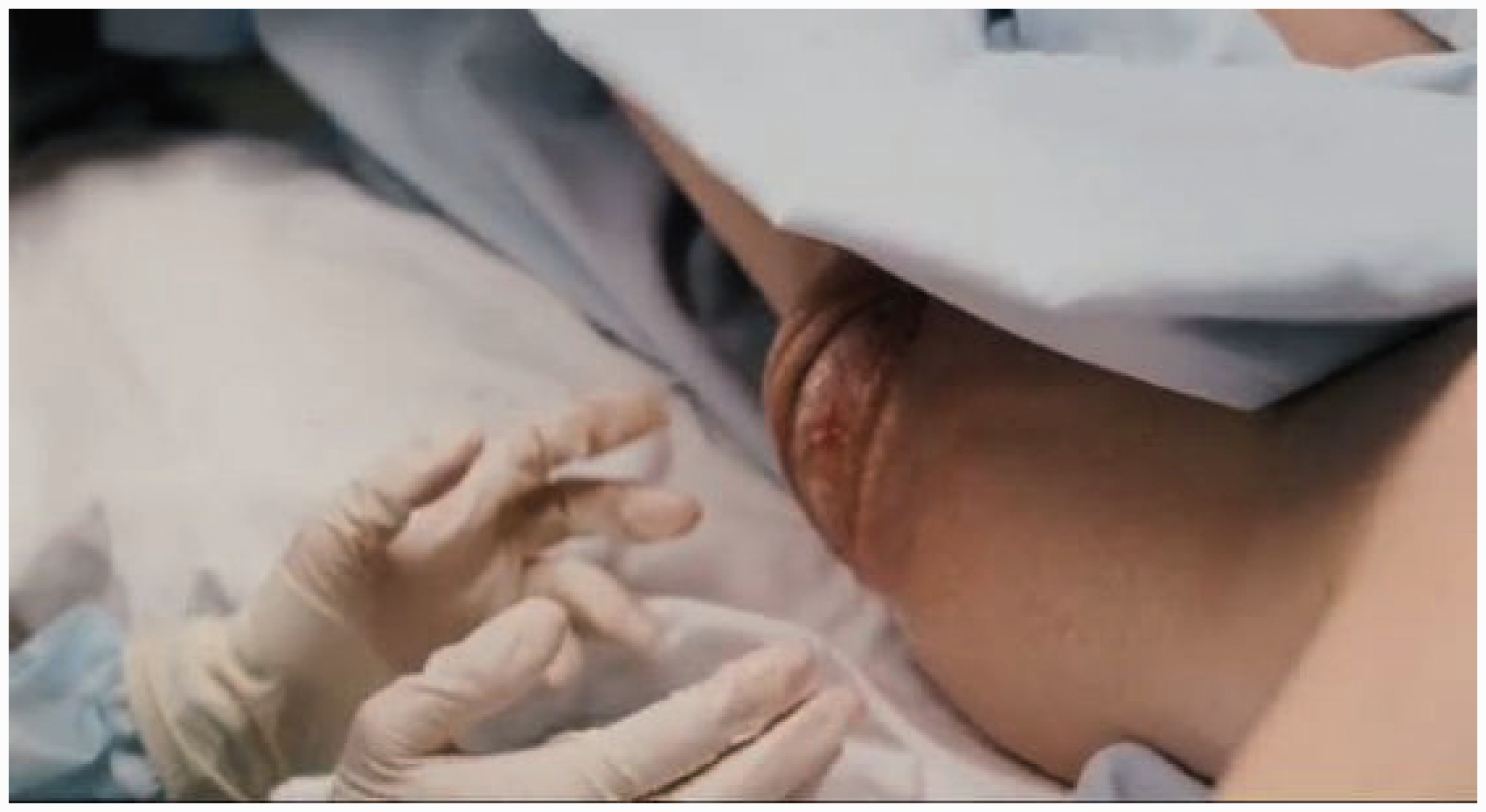
Originally intending to depict a live birth, director Judd Apatow ended up offering his audience the next best thing: he used a prosthetic vagina during the pivotal birth scene of his popular 2007 movie Knocked Up (Figure 2). Apatow reported wanting to ‘do something that hadn’t been done before,’ given that birth is ‘the most intense moment in people’s lives.’ 11 To achieve that, Apatow offered a close-up shot of a crowning head, explaining that he ‘just want[ed] it to seem real.’ 12 And real it was, with the camera returning a total of three times in quick succession to the explicit footage of the vaginal delivery, causing audience members to wonder if it was indeed Katherine Heigl’s vagina that they were seeing. 13 In particular, the hairless vagina – certainly an emblem of the zeitgeist – is indicative of the increasing crossover from pornography to popular culture. (Dines, 2010: 26) That these depictions represent young, thin, white, able-bodied women is of consequence, and further entrenches this particular intersection of identities as normative.
Nearly all (87.7%) young women in the USA today (18–24 years old) report maintaining full to partial genital hairlessness (SM Butler, et al., 2015; Herbenick et al., 2010: 3325). We should not be surprised, then, that a growing number of women (40% in the USA) are reporting to their healthcare practitioner (including their midwife or obstetrician) with highly groomed and increasingly hairless genitals (Rowen et al., 2016) despite substantial evidence that casts the practice as medically contraindicated (SM Butler et al., 2015; DeMaria et al., 2014; Glass et al., 2012; Jolly, 2017; Khandker et al., 2013; Veraldi et al., 2016) Britney’s bearskin rug and both women’s hairless vaginas suggest that graphic depictions of birth may have begun to import the trappings of conventional hetero pornography.
Media scholars argue that (hetero)pornography has become almost invisible by virtue of its very ubiquity. The debate is robust, and I offer only the most cursory synopsis of that conversation here. Most agree that popular culture has become raunch (Levy, 2005) or pornified (Attwood, 2006; Paul, 2006), referring to the ‘relatively wide range of highly (hetero)sexualized visual representational practices and products across popular culture, encompassing more or less explicit representations of bodies, and sexuality in advertising, music videos and mainstream entertainments’ (Mulholland, 2015: 2). Consequently, women and men don’t need to look at porn to be profoundly impacted by it; images, representations, and messages from porn are now directly delivered to them via pop culture (Dines, 2010: 100). The hairless vaginas depicted in the Britney monument and in the Knocked Up delivery answer the question that many sexuality scholars have considered; ‘if porn stars have become more like us, how have we in turn become like porn stars?’ (Sarracino and Scott, 2008: 3). Critiques of this sexualized culture abound (Dines, 2010; Paul, 2006) and many agree that a caricature of (hetero)sexual desire is everywhere, making it an ‘obligatory’ component of femininity (Griffin, 2004).
The foreclosure of diversified female sexuality arises as one of the primary concerns with (hetero)porn’s slow creep into popular culture. ‘The freedom to be sexually provocative or promiscuous is not enough freedom,’ writes Ariel Levy. ‘If we are really going to be sexually liberated, we need to make room for a range of emotions as wide as the variety of human desire. We need to allow ourselves the freedom to figure out what we internally want from sex instead of mimicking whatever popular culture holds up to us as sexy. That would be liberation.’(Levy, 2005) It becomes difficult to recognize what alternative versions of female sexual desire might look like when (hetero)sexual objectified passivity becomes the primary depiction of female sexuality in popular culture. From pole-dancing exercise classes to anal bleaching sessions at the day-spa, narratives of (hetero)sexualized femininity are now importing the language, the practices, and the optics of pornography. So pervasive is (hetero)sexualized femininity that it is increasingly difficult to find evidence of cultural moments not irrigated by the norms of (hetero)pornography.
Until recently, however, birth had remained one site where women did not exist solely as a (hetero)sexual entity. Women in birth were asexual: they were funny, frumpy, selfish, petty, hard-working, brave, emotional, scared, and everything in between, however a (hetero)sexualized representation of femininity did not feature in conventional depictions of childbirth. The sexualizing gaze to which women are increasingly subjected was momentarily averted during scenes of labor and delivery, offering a rare reprieve. We have been introduced to the knocked-up knock-out, the yummy mummy, the momshell, the MILF: all of which suggest that the (hetero)sexualization of the pregnant body and the maternal body now has firm cultural footing. (Ames and Burcon, 2016; Feasey, 2012; Oliver, 2012) Conventional childbirth imagery was unique in this regard, though I argue that the graphic depictions I discuss here suggest that even childbirth may be taking a turn towards the sexual. Sexy birth, while unrecognizable against the landscape of conventional birth scenes, would indeed be quite legible within the context of a popular culture influenced by elements of heteropornography. It evidences (hetero)porn’s reach; even in childbirth women can be subjected to the norms of a (hetero)sexualized representation of femininity.
Normalizing (hetero)sexualized femininity
(Hetero)sexualized femininity now imports a number of elements from pornography, and at its center lies the realization that there is widespread cultural support for the heightened (hetero)sexual objectification of women’s bodies. And while there are certainly multiple consequences of this hyper-sexual objectification, its most profound effect is that women observe their bodies from a third-person perspective and focus on observable traits—‘How do I look?’—rather than see themselves from a first person perspective—‘How do I feel?’ or ‘What am I capable of?’(Andrist, 2008: 555). Deciphering the costs associated with internalizing these norms and self-surveilling in order to comply with social expectations continues to be of interest to feminist scholars. (Brubaker and Dillaway, 2009; Martin, 2003; Sha and Kirkman, 2009; Smolak and Murnen, 2011) If sexy birth depictions become more common, one consequence may be the normalization of a more (hetero)sexually objectified identity where women are encouraged to adopt a third-person perspective and to value an ornamental body over a capable body during their birth experiences.
Stuart Hall reminds us, ‘how we ‘see’ ourselves and our social relations matters, because it enters into and informs our actions and practices’ (Hall, 2000: 272). How might an identity shaped by normative (hetero)sexualized femininity impact the actions and practices of birthing women? At its heart, sexy birth serves to index the more general fact that ‘hotness’ is women’s most valuable currency. Even during childbirth, this graphic birth imagery now suggests that the value associated with the female body comes from its perceived (hetero)sexual desirability rather than from its ability to labor and deliver. And this state of mind has real, material consequences for how women experience childbirth (Jolly, 2014). So while we may conceive of the birthing body as natural, biological, or somehow beyond the reach of culture, the birthing woman is already always socially interpellated: shot through with the prevailing norms of the day. (Hetero)sexualized femininity shapes women, body and mind (Jolly, 2015). Birth is a ‘socially embedded experience’ (Behruzi et al., 2013: 206) meaning that women do not leave normative (hetero)sexualized femininity behind when they enter the delivery room. Childbirth is ‘internally consistent and mutually dependent [on] practices and beliefs that exist around it’(Jordan and Davis-Floyd, 1993). I argue that the normative power of (hetero)sexualized femininity is likely already impacting a woman’s bodily experience of childbirth.
Bringing (hetero)sexualized femininity into the delivery room
If normative (hetero)sexualized femininity influences how women see their bodies, their birth experiences themselves will be constituted by and structured through this discourse of objectification. Martin (2003) established that even birthing women are subjected to the tyranny of nice and kind that is part and parcel of normative femininity. Women do not leave their selfless, caring, polite selves—their gendered selves—outside of the delivery room, and instead bring all the power of normative femininity into their labor. So as women continue to steep in a popular culture that fixates on the (p)ornamental value of their bodies, so too will they. Conceiving of one’s body as an ornament proves antithetical to using it as an instrument and to appreciating its functionality (Rubin and Steinberg, 2011) during labor and delivery. Therein lies the paradox: ‘Do [women] embark on the messy, intense, possibly painful and decidedly physically exertive experience of labor and vaginal delivery, or do they adhere more closely to the politics of passivity prescribed by normative [(hetero)sexualized] femininity?’(Jolly, 2015). How do women birth in a culture of (hetero)sexualized femininity?
The growing appeal of medicalized delivery (Anderson, 2004; Klein, 2006; Taffel et al., 1987) may suggest that women are maintaining their commitment to normative (hetero)sexualized femininity during childbirth. Technologies such as surgical delivery and other medicalized interventions into childbirth seem in perfect sympathy with a (hetero)sexualized femininity: neither attach much value to the profound bodily achievement of a woman’s birthing body. A rising cesarean rate (cesarean section delivery has risen 60% in the USA in the last 15 years) 14 and an escalation in medicalized birth intervention implies that these technologies have widespread appeal. One-third of all labors are induced (Declercq et al., 2014), and a similar number of women have their labor contractions amplified using synthetic hormones (Jolly, 2010). Of those who deliver vaginally, the vast majority of women (83%) have used some type of pain relief for at least a portion of their labor (Declercq et al., 2014). Attempts to explain the growing appeal of medicalized birth, primarily with the goal of reducing medical intervention, have called for ‘a more comprehensive and frank debate about the ethical issues related to the role of doctors, preferences of patients, and informed consent’ (Anderson, 2004: 697) but have largely overlooked the role that normative (hetero)sexualized femininity may play in shaping women’s birth choices and their experiences of labor and delivery. Might we already see evidence of the norms of (hetero)sexualized femininity aligning hand in glove with modern medical intervention to decrease the appeal of a physically herculean—and possibly ugly—experience of childbirth?
Indeed, the rise of tokophobia, a clinical fear of vaginal childbirth that now complicates pregnancy and delivery (Hofberg and Brookington, 2000; Saisto and Halmesmäki, 2003), may be a harbinger of where normative (hetero)sexualized femininity may lead with regards to childbirth. At minimum, it sheds light on why women ‘described being ‘mortified’ at the thought of natural [i.e. vaginal] birth, which left them with a sense of ‘sheer terror’’(Fenwick et al., 2009: 396). That women might see pain, work, and the indignities of vaginal birth as distasteful and unfeminine should be of little surprise in a culture of (hetero)sexualized femininity that inoculates women against a sense of body- and self-confidence (Jolly, 2015). From menstruation to menopause, women are left with the perception of female physiology as inherently flawed (Moloney, 2010; Robinson, 2005). Within this cultural milieu, women become fluent in the knowledge of bodily objectification, and childbirth becomes yet another moment where that bodily objectification metastasizes to the point of undermining a woman’s confidence in her body’s ability (Jolly, 2016). Certainly the fraught relationship that women have with their bodies (both during childbirth and beyond) will likely be exacerbated by an imagery of sexy birth, in that it would further normalize a discourse of (hetero)sexualized femininity in valuing the objectified, ornamental body over a capable, laboring body.
My aim is not to valorize an unmedicated vaginal birth over a medicated or surgical delivery, nor is it to foment an arms race over how much pain a woman can or should endure, nor how hard a woman ought to have to work to deliver her child. Instead, I hope to surface the underlying sociocultural topography that creates an environment where medicated and/or surgical birth has such wide appeal. The way that childbirth is visualized in popular culture has normative consequences for how women experience birth. If the imagery of sexy birth suggests that the hairlessness of a woman’s vagina is its most salient feature, if a woman’s most significant labor is the work she does on hands and knees atop a bearskin rug, then the optics of childbirth have come to mean more than the act itself. So when we are cautioned by the World Health Organization about a high rate of cesarean section (WHO, 2015) or when we try to answer why rates of medicalization in childbirth spiral ever upward (Malacrida and Boulton, 2014), we must keep in our sights the normative power of (hetero)sexualized femininity. As feminist scholars have long admonished, normative compliance is not entirely voluntary (Bordo, 1993; J Butler, 1999). While not exactly a fait accompli, it is hard to ignore the social capital afforded to women who embody (hetero)sexualized femininity (Bordo, 1993). If sexy birth, in perfect sympathy with normative (hetero)sexualized femininity, continues to gain cultural traction, women will increasingly find themselves encouraged to value their birthing body as a sexual object rather than as a capable subject.
Game of Thrones as a sex positive response?
Before we put sexy birth imagery to bed, so to speak, sex-positive feminists would caution us to consider whether all is not lost in sexualizing the birthing body. Might sexy birth also respond to—and reject—the asexuality of conventional birth imagery? Staunchly devoid of sexuality, traditional depictions of childbirth did not allow for the graphically explicit nature evident in the two birth depictions previously discussed. It’s been only two decades since Susie Bright remarked, ‘It’s an awesome feat of American Puritanism to convince us that sex and pregnancy do not mix. It’s the ultimate virgin/whore distinction. For those nine months, please don’t mention how we got this way—we’re Mary now’ (Bright, 1995). Certainly sexy birth could become an effective apercu: a shrewd retort to such asexuality. It was not that long ago when a woman was counseled to return to marital sex 10 days after delivery, and not be upset if she failed to achieve orgasm (Malinowski, 1978). A generation ago, her pleasure was not what was at stake. It is no doubt time to challenge such stale notions of female (a)sexuality and so I consider whether sexy birth may be a potential way to accomplish this. To do this, I offer a scene from Game of Thrones as a third instance of what we might think of as sexy birth imagery, though one that may suggest a latent liberatory potential inherent in these explicit representations of birth.
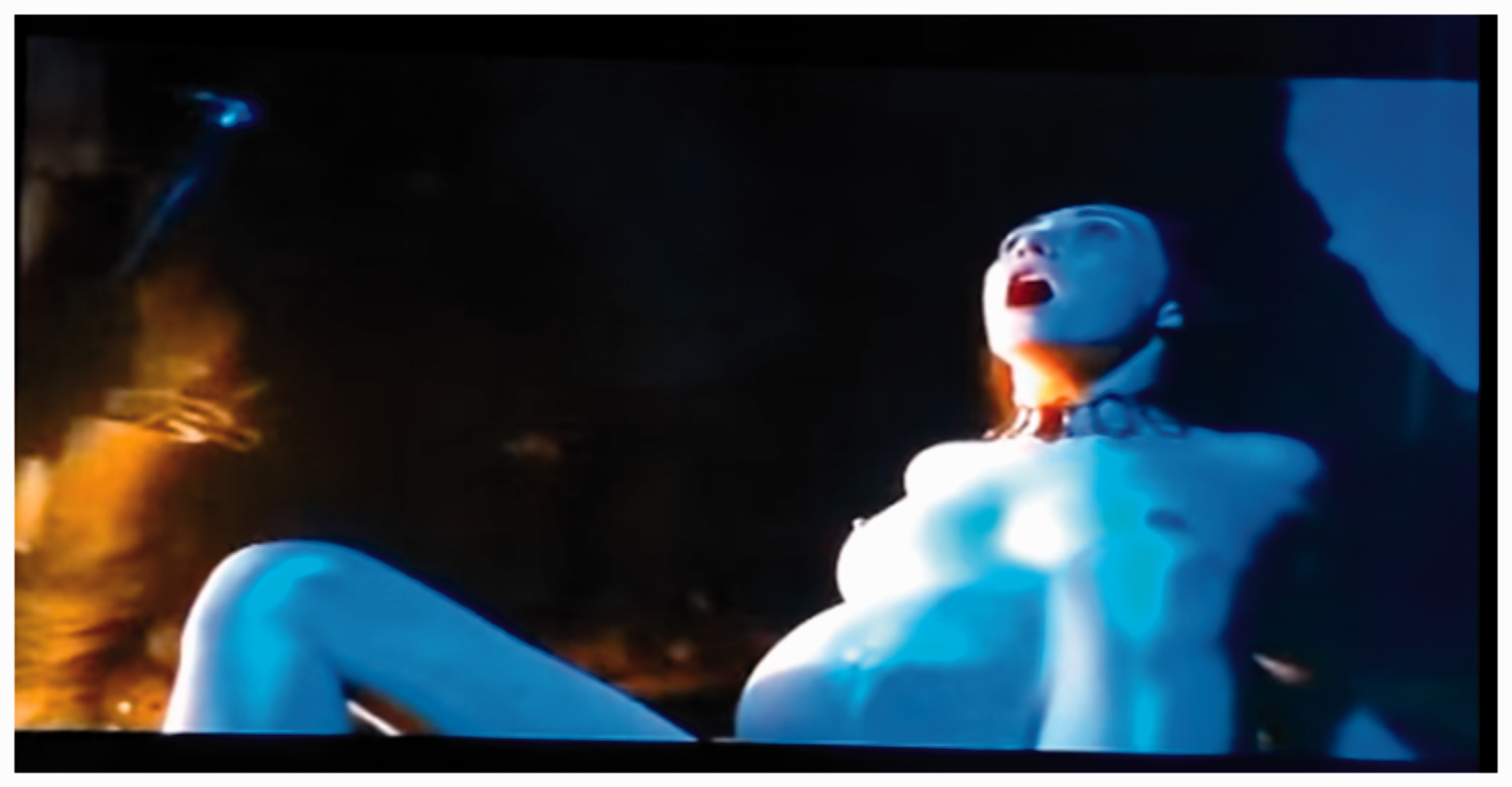
Game of Thrones, a wildly popular 15 HBO dramatic fantasy series that premiered in 2011, has—now in its sixth season—continued to make waves, both for its compelling storytelling and its explicit female nudity and extensive heterosex on display. Some viewers and critics have asked HBO to ‘put all the tits away’, 16 but others have defended the nudity not as prurient, but as an essential plot component. 17 It’s not surprising, then, that the sexual nature of the show would percolate through to even depictions of childbirth. Just before one of the show’s central characters (Melisandre) delivers, 18 she proclaims, ‘You want to see what’s beneath this robe. And you will.’ She opens her cloak to the viewer, displaying her naked pregnant body before settling herself on top of her robe, legs spread provocatively, throwing her head back seductively (Figure 3). As in conventional (hetero)pornography, we are invited to watch Melisandre’s body from above as she tilts her head back in what is easily recognizable as orgasmic pleasure. The camera focuses on her moaning mouth before panning down her naked body, lingering on her breasts and her pregnant belly. The audience is invited to watch from between her parted knees while she continues to perform her overtly (hetero)sexualized simulation of labor. The view changes again and we watch through her bent knee as her baby (or, more precisely, her shadow creature) emerges and then evaporates behind the cave grating while she reclines contentedly. It is easy to read the (hetero)sexualization in the way that Melisandre’s birthing body is offered to us as viewers, but does her orgasmic caricature of sexy birth recuperate a more expansive understanding of female sexuality during childbirth?
I find useful the Foucauldian concept of subjectivication, by which we understand women to be both constituted by discourse and also as able to fashion a sense of self by actively positioning themselves in discourses (Foucault, 1977). Certainly the normative power of (hetero)sexualized femininity can be read as a constraint on women’s ability to achieve fully realized lives. But it also suggests the possibility for women to find a position of agency through their sexuality; and particularly during birth, their sexual bodies no longer need to be rendered invisible behind the white sheet of conventional birth depictions. Lifting the sheet on the idealized asexuality of birthing women brings a new agentic sexuality to them. Such a reading reminds us that women are not vulnerable victims, passively consuming (hetero)sexualized media unreflectively; they do not need protection from pop culture imagery. Instead sexy birth imagery may eventually constitute a ‘democratization of desire’, a way to ‘change the world, or at least some of the things in it’ (McNair, 2002: 11) and may even result in a more diverse and pluralistic sexual culture than we have traditionally seen under the conventions of patriarchal capitalism.
My treatment here of women’s sexual agency in an era of commodified (hetero)sexuality offers only thin gruel in comparison to the rich ongoing debate. Some (Attwood, 2006; Bishop, 2012; Duits and van Zoonen, 2007; Musial, 2014) have suggested that there is a true conflict between the academic discussion of (hetero)sexualization that largely denies women’s agency, and these women’s very self-image of being capable women with a strong sense of self. Perhaps, as McNair (2013) has suggested, pornography has changed the world and made it a better place by exposing women and men to myriad, often contradictory, images and discourses of sexuality. Because of their fluency in the language of (hetero)sexualized femininity, ‘most young women have more agency, power, sexual and experiential knowledge with which to negotiate sex and interpret popular (even contradictory) cultural discourses’ (Bishop, 2012: 824) than their counterparts a generation ago. Indeed the notion that women enjoy and desire sex, even sex that may be considered retrograde, sexist, objectified, or degrading, is still quite new and may never have bubbled up if not for the stiff little finger of pornography prodding it upward. Women’s sexual desires take shape within the culture they inhabit; they do not develop their ideas about pleasure in a vacuum. The norms of (hetero)sexualized femininity in which they are now steeped will certainly serve as the architecture of their sexual lives: it will tincture their passions, their loves, their bodily wants and lusts. This could be, then, a positive potential of (hetero)sexualized discourses of femininity: it fosters ‘women’s ability to actively select particular, constitutive elements of these multiple gender narratives and weave them together into a more personalized interpretation—one that coheres more closely with their sense of self-identity’ (Bishop, 2012: 831).
Certainly, in that regard, graphic birth depictions may nod towards the promise of women’s increased sexual subjecthood, given ‘Hollywood’s last taboo’ and the asexuality of conventional portrayals of childbirth. Might sexy birth offer a more ‘mature fantasy rather than [an] invitation to sexualize teen girls?’ (Musial, 2014: 407). The hairless vagina, the (hetero)sexualized positions, and the objectified gaze seem to suggest that these early depictions of sexy birth do not make good on its promise to deliver a new, more liberatory sexuality. Women are not ‘finding pleasure and sexual agency in areas where this was previously denied, erased or silenced’ (Musial, 2014: 408) but are instead encouraged to caricature (hetero)sexual desirability in moments from which they had previously enjoyed a brief reprieve. Sexy birth imagery may soon illustrate porn’s reach into popular culture and evidence the durability of (hetero)sexualized femininity. Now more than ever, women’s bodies exist as (p)ornamental objects.
Queering sexy birth depictions
I offer a final point of discussion in the birth sequence from the Netflix series Sense8 as an example of a rare non-heteronormatively feminine depiction of graphic childbirth. I suggest that this representation of childbirth has the potential to queer the more normative depictions of (hetero)sexualized femininity displayed in the three previously-discussed portrayals. I employ a broad definition of queering, and focus here on actions and representations that ‘disturb the order of things’ and that—in making things oblique—open up other ways to inhabit those forms (Ahmed, 2006). Queer theory addresses both the ways that we become ‘constituted as socially viable beings’ (J Butler, 2004: 2) and the many ways that we are denied that social viability through the discursive construction of identities that often function more as cages than descriptors (Shannon and Willis, 2010). Certainly graphic birth imagery, and the normative assumptions about (hetero)sexualized femininity that it indexes, serves to constrain our understanding of appropriate female embodiment. Would the disruption of these norms, through an unvarnished depiction of childbirth that markedly departs from the dangerous fantasy of sexy birth, open up alternative worlds of bodily experience?
Sense8 follows the intertwined lives of eight different sensates, members of an ubermensch species with the ability to connect telepathically and physically inhabit one another’s body. The show is directed by the Wachowski siblings (known both for their innovative directing in movies such as The Matrix and for their recent announcement of gender transition from men to women). The panoply of images in Figure 4 captures moments during a 6-minute long birth montage (taken from episode 10: We are all human) wherein each character experiences his/her own birth. These birth depictions can be read as a queering of sexy birth, and offer a puissant retort to the (hetero)sexualized femininity on display in the sexy birth imagery discussed earlier. This unflinching look at women’s laboring bodies offers vaginal blood instead of sanitized hairlessness, portrays the bodies of black and brown women instead of stylized depictions of white women, presents unmedicated, midwife-attended homebirth and even water birth as normal and safe, depicts surgical delivery as concerning, and—most profound for this argument—shows women enduring through and succeeding at the grueling physicality of unmedicated childbirth. Despite the nakedness of the female genitalia on display, the audience is not asked to see these bodies as (hetero)sexually desirable—indeed one scene offers nude thighs and the upturned hem of a skirt only to follow with a gush of amniotic fluid as a woman euphorically guides the head of her baby out while alone in a car (Figure 4, last image, top row). We are asked to watch as women enjoy an ecstatic, orgasmic moment that is not explicitly sexual. Their militant nonconformity to the norms of conventional (hetero)sexualized femininity (see the images on the bottom row of Figure 4) offer a queering of the graphic birth imagery discussed earlier, and alludes to the true liberatory potential of (queer)sexualized femininities.
Life sized resin sculpture of Britney Spears' birth, as imagined by Daniel Edwards. The prosthetic used to simulate Katherine Heigl's delivery in Knocked Up. Game of Thrones character Melisandre gives birth, Season 2 Episode 4. Depictions of childbirth on Sense8, Season 1, Episode 10.

In a statement about her gender transition, Lilly Watchowski quotes Jose Munoz, saying, ‘Queerness is essentially about the rejection of a here and now and an insistence on potentiality for another world.’ 19 The Watchowskis’ depict a brave new world of childbirth: one where women’s bodies are remarkable for their ability rather than for their appearance. Depictions of childbirth that do not align with the pervading norms of (hetero)sexualized femininity may foster the possibility of new bodily contexts. The physically dexterous female body, the physically accomplished female body, the physically ugly and grotesque female body, these are bodies that we rarely glimpse in popular culture. Perhaps a greater familiarity with those bodies would disrupt the absurd pageantry of (hetero)sexualized femininity and carbonate women with a new body confidence, specifically one that allows for a revaluation of the bodily accomplishment of labor and delivery.
The pornographic veneer of graphic birth imagery will likely manage to veil the pharaonic potential that representations of active, messy, ugly, embodied childbirth have for challenging normative (hetero)sexualized femininity. In childbirth, how a woman looks, whether she is pretty or hot or has heterosex appeal; all of the things that increasingly coalesce to form the measure of a woman’s life have the potential to dim momentarily and allow something else to come to the fore. Whatever a woman might have cared about (or have been compelled to care about) before giving birth, should not matter; labor should offer a way for her to inhabit her body in a non-ornamental capacity. Sexy birth, and other depictions of childbirth, reflect our experience of life in a given time and place, but they also constitute it and shape it. So while these may be fictionalized accounts, their significance cannot be overlooked. We are susceptible to the definitions of reality, the value systems, and the power structures that are depicted again and again in our entertainment, even as we recognize their fictitious nature (Harter and Japp, 2001). Popular media artifacts such as sexy birth can be polysemic and the women watching can be polyvalent, but popular culture does tend to be ‘closed’ in such a way that one reading is strongly preferred over others (O’Sullivan et al., 1994 cited in Kline, 2007). Women’s experience of birth does not arise ex nihilo, and will remain animated by the popular imagery that depicts it.
Drawing conclusions about sexy birth
Vaginal labor and delivery requires a bodily capacity diametrically opposed to that heralded by normative (hetero)sexualized femininity. Through the imagery of sexy birth and its seamless alignment with the discourse of normative (hetero)sexualized femininity more generally, women are encouraged to find value in their body as (p)ornament. Bodily capacity—specifically the physical ability to labor and vaginally deliver—has little value within the metrics of (hetero)sexualized femininity, and this has material consequences during childbirth. Before we can understand a woman’s attraction to a medically managed and increasingly surgical delivery, or her growing fear of childbirth altogether, we need to appreciate how her birth experiences are intricately woven into broader narratives of normative (hetero)sexualized femininity.
The white hospital sheet once hid our cultural anxiety about the implicit sexuality of women’s birthing bodies; mum was the word about the bump under the blanket. Certainly this allowed the sex that happened nine months before to go unmentioned, but it also cast the laboring woman’s body as asexual. I argue that graphic depictions of birth may have dramatically lifted that white hospital sheet to reveal a sexuality that feminist scholars may find equally stifling. So while sexy birth may yet respond to the asexuality associated with conventional birth imagery, these initial depictions seem to foreclose that possibility in favor of a heightened body surveillance that fuses an aesthetic of pornography to (hetero)sexualized femininity. A queering of sexy birth imagery has already opened space for greater diversity in depictions of women’s birthing bodies and made a mess of the sanitized deliveries we have come to expect from Hollywood. Its presence may help us recognize the consequences of the progressively more (porno)graphic nature of popular depictions of birth.
The debates that animate the field of sexuality studies have been tethered to bodily realities: to real people’s lives and experiences, and sexuality scholars have long demonstrated the utility of sexuality as a category of analysis, agitation, and refunctioning (Berlant and Warner, 1998). What I show here is how scholarship on sexuality has the potential to offer new ways to understand current trends in women’s reproductive health. Midwives, doctors, and other health practitioners, who are attempting to stem the tide of rising medical intervention in childbirth, may find utility in the extant work being done in the field of sexuality studies. Similarly, scholars interested in sexuality: its history, its economics, its politics, its culture, may add childbirth as a potential site of inquiry to continue the conversation about how our bodies are influenced and affected by social practices.
Footnotes
Acknowledgements
I am grateful to Matt Kelley and Josh Tenenberg for their comments on early drafts of this work, and for the generous feedback from my reviewers.