




Abstract
International film festivals (IFFs) are increasingly taking an interest in offering programs that target LGBT audiences. Since this practice can be understood as an emancipatory and commercial strategy, this article examines the implications of this ambiguity within an IFF’s politics of representation. Drawing on the results from a textual and contextual analysis of the films and programming strategies of the 2014 Film Fest Gent in Belgium, this article argues that an IFF has the potential to engage in moderately queer programming. By offering an identity-based program that makes room for alternative and critical negotiations of identity and intimacy and that looks for ways to offer LGBT content to diverse audiences in various settings, this festival demonstrates how programming LGBT content can be a critical and commercial success without having to rely on homonormative tropes and practices.
Keywords
Introduction
Within the emerging field of film festival studies (De Valck, 2007), particular attention has been devoted to LGBT film festivals (Gamson, 1996; Loist, 2012; McWilliam, 2007; Rich, 2013). Historically, these film festivals were organized by grassroots organizations and activists who aimed to provide an underserved audience with LGBT imagery and give a stage to young LGBT filmmakers who experienced difficulties in exhibiting their work (Loist and Zielinski, 2012). Today, LGBT film festivals are thriving and have developed into international and profitable events (Rhyne, 2006). Not surprisingly, established international film festivals (IFFs) are engaging in identity-based programming to cater to LGBT audiences and to promote themselves as socially inclusive festivals. This trend can be understood as the result of a willingness to participate in and contribute to the emancipatory and political project that formed the basic motive for the organization of LGBT film festivals. Yet identity-based programming is also a commercial strategy, as catering to the so-called ‘pink market’ is considered lucrative.
Since LGBT film festivals often create counterpublics to heteronormative society by featuring resistant representations of the everyday life of LGBT individuals (Loist and Zielinksi, 2012), this study is interested in the politics of representation that are articulated in the practice of programming LGBT-themed films at an established IFF. Taking into account that heteronormativity has an ambiguous relation with both processes of emancipation and commercialization, the study aims to understand the representational politics of an IFF. Particularly, a textual and contextual analysis of the ‘LGBT trail’ of Film Fest Gent is conducted. The Belgian international film festival is an exemplary case as it has a relatively long tradition of programming LGBT-themed films and explicitly acknowledging LGBT individuals as one of its target audiences. This study zooms in on the trail of the 2014 event, which featured 15 LGBT-themed films, thereby outnumbering previous festivals in terms of LGBT content. By drawing on a queer theoretical and critical media studies perspective, this case study contributes to our understanding of the ambiguous position of identity-based programming of IFFs.
LGBT film festivals and LGBT representations
To thoroughly assess the representational politics of programming LGBT-themed films at an IFF, the article starts by discussing the specific dynamics of lesbian and gay film festivals. Marijke De Valck (2007) notes that the politically heated atmosphere of the 1960s and 1970s stimulated activists to organize film festivals as independent stages for political commentary. For the gay and lesbian movements, a need was felt to abandon the assimilationist politics that emphasized masking one’s sexuality in exchange for acceptance into mainstream society. Instead, they started propagating the celebration of sexual differences (Jagose, 1996). The discourse of pride and celebration was fertile ground for the organization of lesbian- and gay-themed film festivals. Yet, as Loist (2012) points out, while the many film festivals that emerged from the 1970s onwards may share the same intent—representing the LGBT community—their approach and conceptualization of identity differ significantly. Whereas the first generation did little to include lesbian-themed films, later generations were more aware of the diversity within the community and changed their names and programming strategies to assure lesbian, bisexual, and transgender identities were represented. Similarly, many festivals around the globe are using ‘queer’ as a marker of identity even though its conceptualizations vary from being an umbrella term that includes different sexual orientations and gender identities to acting as a critical and resistant figure of anti-essentialist identity politics.
The differing views on identity politics cannot be dismissed when thinking about LGBT film festivals. Loist and Zielinski (2012) underscore how the first lesbian and gay film festivals were founded by grassroots organizations and political activists who organized them from the ground up. They defied the absence of positive, intersectional, and rounded imagery of gender and sexual diversity, created opportunities for LGBT filmmakers to show their films, and brought LGBT individuals together in and around the cinema to form a temporary counterpublic. Yet the increase in successful LGBT film festivals, the success of new queer cinema in the 1990s, and a growing awareness of LGBT individuals as a niche and international market have complicated the political and activist ambitions of festivals as the political aims have become more intertwined with commercial goals (Gamson, 1996; Rastegar, 2009; Rhyne, 2006; Rich, 2013). Roya Rastegar (2009) stresses that processes of commodification have produced marketable gay and lesbian identities. For a film festival invested in the market, it has become difficult to resist the established, normative images of LGBTs. Joshua Gamson (1996) goes even further by stressing that the viability of certain LGBT film festivals demands the programming of films that ensure a huge audience even when it threatens the representation of, for instance, racial diversity or the questioning of shared norms and values within the LGBT community.
B Ruby Rich (2013) explains that the mainstreaming of LGBT identities at LGBT film festivals can also be attributed to LGBT audiences. If these festivals act like a temporary community in which diverse LGBTs come together, many individuals may end up disappointed, as they are not necessarily interested in artistic and ideological disruptions and aesthetic experiments, which were often the main programming strategies of the first lesbian and gay film festivals. Instead these audiences crave: films of validation and a culture of affirmation: work that can reinforce identity, visualize respectability, combat injustice, and bolster social status. They want a little something new, but not too new; sexy, sure, but with the emphasis on romance; stylish, but reliably realistic and not too demanding; nothing downbeat or too revelatory; and happy endings, of course. (Rich, 2013: 41)
Besides having long-running LGBT film festivals grow into established institutions, A-list IFFs have started to show interest in LGBT-themed films. Loist and Zielinski (2012) point out that certain A-list IFFs, such as The International Berlin Film Festival and Cannes Film Festival, promote themselves as LGBT-friendly, featuring a significant number of LGBT-themed films and facilitating network and scouting opportunities. Yet, having IFFs target LGBT audiences has raised questions regarding the role of an LGBT film festival. Rich (2006) anticipates certain criticisms many minority communities have had when becoming more integrated into mainstream society. She stresses that some might wonder if LGBT film festivals are still needed since mainstream film and television are increasingly representing LGBT individuals; further, the confluence of digitization, media convergence, and the acknowledgment of LGBTs as an international niche market have multiplied the distribution possibilities of LGBT-themed content. Yet she refutes these criticisms by stressing the necessity of a recurrent forum that goes beyond marketable and mainstreamed representations of LGBTs and that shows experimental and critical films focusing on what is otherwise underrepresented. Further, as Kelly McWilliam (2007) demonstrates, LGBT film festivals remain important counterpublics where LGBT and queer individuals may come to watch non-heteronormative content together. This experience, she argues, is significantly different from watching the same content in heterosexual or heteronormative environments such as regular movie theatres. Implied in her argument is the idea that an IFF may also be considered a heteronormative spatial context. Rich (2006) points out how, in discourses surrounding LGBT-themed films programmed at IFFs, the films’ aesthetic value is discussed and praised rather than the films’ identity politics. However, IFFs that program LGBT-themed sections or sidebars do not seem to de-emphasize gender and sexual diversity over authorship and artistic qualities. It nevertheless seems valid to inquire into the politics of representation that are embedded in these sections or sidebars.
Within critical media studies, scholars working on the politics of LGBT representation in popular media culture (e.g. Benshoff and Griffin, 2004; Chambers, 2009; Dhaenens, 2013; Shugart, 2003) have demonstrated how LGBT representations are often a negotiation of heteronormativity. On the one hand, they point out how the hegemonic position of heteronormativity in contemporary western societies nudges cultural industries to reiterate heteronormative discourse as the neoliberal logic dictates that audiences should easily be able to connect to the produced content. Media businesses fare well by reiterating heteronormative content that depicts a flawless society that is predominantly populated by white, able-bodied, middle-class heterosexuals who act in gender-appropriate ways. This does not exclude the incorporation of emancipatory discourses of minority identities. Liberal audiences even demand more ‘authentic’ representations of contemporary society by, for instance, including lesbian and gay characters (Becker, 2006). Yet, this inclusion does not necessarily imply that traditional norms or values need to be abandoned. Because of its omnipresence, LGBT individuals are confronted with heteronormative desires, norms and values. To safeguard the heteronormal, LGBT individuals are allowed to take part, to some extent, in certain heteronormative institutions and practices. Lisa Duggan (2002) dubs these aspirations and practices as ‘homonormative’. She stresses that certain privileges (e.g. same-sex marriage) are granted as long as LGBT people adhere to heteronormativity, de-sexualize their identities in public, pass as either male or female and support neoliberal politics. Having homonormative representations of LGBTs ensures that the heteronormal hegemony is not threatened. LGBTs are represented as well-behaved citizens whose struggle with their sexual orientation and gender identity is individual and de-politicized, as people who find comfort in the thought that their identity is fixed and innate—even when born in the body of the other sex.
This emphasis on homonormativity resonates with how Loist (2012) speaks of how certain LGBT film festivals choose for ‘LGBT programming’. These strategies are mainly aimed at showing positive, non-stereotypical imagery considered lacking in mainstream popular culture and ensuring that not only gay men are represented but also lesbians, bisexuals, and transgender individuals. A pernicious consequence is the creation of niche programs for minority groups within the LGBT community (e.g. queers of color, transgender men) while having the main programs at these festivals ‘cater to a mainstream, homonormative, sponsorship-friendly group—an imagined white, affluent homosexual (male) middle-class’ (Loist, 2012: 164). Loist’s argument echoes both Rich’s (2013) criticism of LGBT cinema as serving audiences with de-politicized and romanticized entertainment and Zielinski’s remark (2012: 3) that some LGBT film festivals ‘sequester the spectators according to gender, generally presupposing that the boys will want to see boy films, the girls girl films’.
Yet, as Samuel A Chambers (2009) and Dhaenens (2013) demonstrate, popular media culture is increasingly incorporating representations that subversively challenge both heteronormative and neoliberal practices and that commit to deconstructing and rethinking the oppressive mechanisms that nudge people into fixed and marketable identity positions. For Loist (2012), these resistant practices resonate with the way some LGBT film festivals choose for ‘queer programming strategies’. These strategies are concerned with the creation of ‘a truly inclusive and diverse counterpublic’ (Loist, 2012: 165). A key strategy is to offer mixed programs; as such, the separation and constriction of identities is avoided while intercommunal contacts are made possible in and around the venues. Further, mixed programming strategies allow organizers to group films around themes rather than around identity axes. Another strategy discussed by Loist (2012) is the programming of work that can be seen as queer without featuring LGBT-identified characters or themes. This strategy could be applied to films made by LGBT directors that do not tackle gender and sexual diversity or to films that become queer in the reading practices of the audiences. Rich (2013) seems to agree with these strategies, as she emphasizes the necessity to program world cinema with non-marketable identities in which identity is approached as intersectional and complex. Similarly, Barbara Mennel (2012) points to the importance of producing films with experimental aesthetics as queerness should not only imply a detachment of heteronormative identities but also of cinematic and aesthetic conventions that shape the mainstream films featuring these identities.
Film Fest Gent and LGBT people
The question remains how IFFs deal with LGBT content. To this end, I turn to Film Fest Gent. The film festival profiles itself as an IFF, established in 1974 as a student’s film festival in Ghent and grown into a mid-range film festival, attracting around 130,000 visitors each year. 1 Programmer Wim De Witte (personal communication, 28 April 2015) stresses that the festival is different from other European IFFs because it focuses on film music. As mentioned in the introduction, the festival boasts having LGBTs as one of its target audiences. Taking into account that the film festival is situated within Belgium, this attention does not raise a stir. Belgium is generally considered a politically progressive and socially inclusive country regarding LGBT identity politics. The country opened up civil marriage to same-sex couples in 2001, implemented an anti-discrimination law in 2003 and made adoption by same-sex couples legal in 2006 (Borghs and Eeckhout, 2010). Even though LGBTs may face homophobia and transphobia, the majority of Belgian society supports LGBT rights (Borghs, 2015). Furthermore, LGBT representations are not rare in Belgium’s popular culture, and the country has several LGBT film festivals (e.g. Holebifilmfestival Vlaams-Brabant, Pink Screens FilmFestival), one of which – Pinx – is organized in Ghent as well. However, Film Fest Gent differentiates itself from these LGBT film festivals by being primarily interested in establishing a program that features films that have been selected because of their ‘esthetic accomplishments’ (Peranson, 2008: 38). Whereas the Belgian LGBT film festivals use LGBT themes as a starting point, Film Fest Gent looks for films that meet the festival’s standards of quality. According to De Witte (personal communication, 28 April 2015), the festival programs LGBT-themed films as long as these films have high production value and/or distinguish themselves for being original in terms of style, narratives or aesthetics.
Since its formation, the film festival has included films with a ‘pink’ theme. For instance, an inquiry into the 1992 festival showed that Derek Jarman’s Edward II (1991) and Tom Kalin’s Swoon (1992) were being screened. Yet, in 2003, the film festival targeted, for the first time, lesbian, gay, and bisexual audiences 2 by providing its audiences with additional information on the lesbian, gay, and bisexual content in the full program brochure. A similar communication strategy was used for the 2005 and 2006 brochure. From 2010 onwards, this communication strategy became a standard practice. The explicit attention to LGBTs was coupled with a steady presence of, on average, six LGBT-themed films each year. The 2006 festival was especially noteworthy, with nine LGBT films in the regular sections and a thematic program that focused on five queer films by avant-garde documentary maker William E Jones.
The 2012 event modified the former communication and programming strategy by setting out a trail for lesbian, gay, and bisexual audiences, which the organizers labeled as the ‘gay scene’ trail. Even though the festival has long worked with sections and sidebars (e.g. the official competition section, global cinema, galas, specials and a thematic section that changes each year), it has insisted on simultaneously providing trails in its various forms of communication (brochures, website) that bundle films from the various sections and sidebars thematically (e.g. a trail with documentaries) or that are aimed at a specific target group (e.g. a trail with films for children). Films belonging to the ‘gay scene’ trail of 2012 and 2013 were described as targeting gay, lesbian, and bisexual audiences, having a predominantly ‘pink’ theme or sensibility, featuring homosexual side characters or motives prominently, or showing the (lack of) progress society was making in tolerating and accepting gays. The 2014 festival has kept this motivation for the LGBT trail unaltered but has renamed the trail from ‘gay scene’ to ‘LGBT’. Remarkably, the unaltered mission statement in Dutch and French—which are two main national languages in Belgium—continues to refer to the festival’s target audiences as gay, lesbian, and bisexual, whereas the English version speaks of the LGBT audience. Even though this might be a late translation error, it nonetheless reveals how the letter ‘T’ in ‘LGBT’ often acts as an empty signifier. Yet, at least, renaming the program ‘LGBT’ does reveal some awareness about the need to include transgender identities at some level, and, as demonstrated later in this article, quite a few films deal with transgender themes.
Films of the LGBT trail at Film Fest Gent.
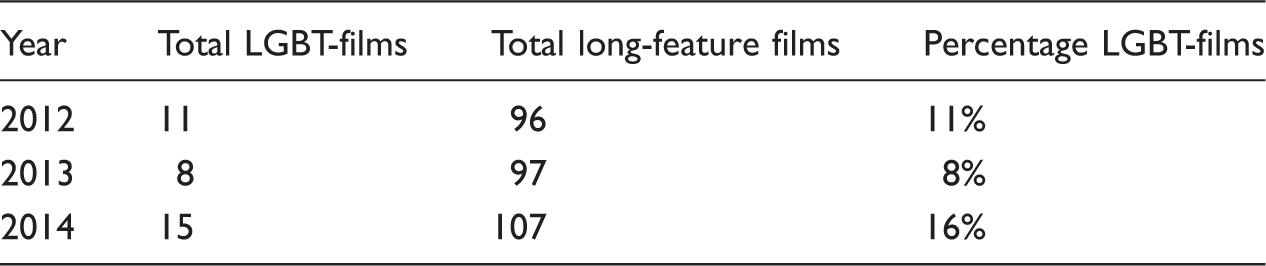
For this study, representational politics were established by means of a thematic analysis of each film. The following films were analyzed: 52 Tuesdays (Sophie Hyde 2013), Dog Day Afternoon (Sidney Lumet 1975), Gore Vidal: The United States of Amnesia (Nicholas D Wrathall 2013), I am the Happiness on Earth (Yo soy la felicidad de este mundo, Julián Hernández 2014), Je Suis à Toi (David Lambert 2014), Land of Storms (Viharsarok, Ádám Császi 2014), Love is Strange (Ira Sachs 2014), Pasolini (Abel Ferrara 2014), Predestination (Michael Spierig and Peter Spierig 2014), Pride (Matthew Warchus 2014), Regarding Susan Sontag (Nancy D Kates 2014), The Dog (Allison Berg and François Keraudren 2013), The Way He Looks (Hoje Eu Quero Voltar Sozinho Daniel Ribeiro 2014), Une Nouvelle Amie (François Ozon 2014), and Xenia (Panos H Koutros2014). Specifically, I inquired how the films represent their LGBT characters and how they deal with heteronormativity: Do these films represent homonormative subjects and tropes and/or do they offer a critically queer representation of LGBT identities and desires? Second, I conducted an analysis of contextual elements (program slots, time schedules, exhibition venues, official communication) to inquire whether the way the festival programmed these films could be understood as hegemonic and/or critical practices. These elements were retrieved from the official program brochure, the festival’s website, a conversation with programmer Wim De Witte and personal participation in the festival.
Moderately queer films
In 2014 more LGBT-themed films were featured than in any previous Film Fest Gent. However, it is important to note that a significant amount of LGBT content does not imply that the content is diverse and/or critical. Hence, this section discusses the representational politics present in each of the 15 films of the 2014 LGBT trail.
The first aim of the textual analysis was to map the trail’s gender and sexual diversity as a means to assess which LGBT audiences may be reached with the selected films. As stressed earlier, the film festival’s ambiguous mission statement does raise some questions about how it conceives its ‘LGBT’ audiences. Without claiming that LGBT audiences only attend films most attuned to their own gender and sexual identities, they nonetheless desire to see representations of their own specific, diverse identities within the LGBT community (Gamson, 1996; Rich, 2013). Of the 15 films, 11 feature one or more main characters who are cisgender men who identify as gay and/or experience sexual desire for men. Three out of these 11 films also represent men who desire both men and women, even though the films do not explicitly label them as bisexual. In other words, the program seems to match the abundance of male characters generally found at LGBT film festivals. Even though this imbalance has long been contested (Loist, 2012), the program offers only a few films with cisgender female characters who experience same-sex desire and/or identify as lesbian (one film), cisgender female characters who desire men and women (three films), transgender male characters (one film), transgender female characters (three films), and intersex characters (one film). The disproportion between male and female characters resonates with the fact that only three female directors were involved compared to 14 male directors. Although seven of all the directors self-identify as LGBT and/or queer, the gender disparity before and behind the camera overshadows the spectrum of gender and sexual identities the festival intends to represent.
However, in contrast to mainstream representations of LGBTs that circulate in popular culture (Shugart, 2003) and even at LGBT film festivals (Loist, 2012), the films within the trail are notably lacking in heteronormative storytelling. Based on the textual analysis, I argue that many of the films engage in representational practices that challenge the hegemonic position of representing LGBT people as desexualized and homonormative subjects. It is crucial to stress that the films do not represent LGBT themes and identities in a radically transgressive way. This is underscored in their reliance on mainstream genres within popular and independent cinema. Except from a couple of films that qualify as queer art films (I Am the Happiness on Earth and Pasolini), the trail offers films that are classical in narrative structure and cinematographic style. However, such a reliance on mainstream genres does not imply a submission to a heteronormative mainstream society or a dismissal of art cinema as a site to articulate queerness. Rather, I argue that the films in this trail employ representational practices that I dub as moderately queer. The films rely on narratives, style and aesthetics that resonate with the everyday life of ordinary people while inserting subversive storylines, plot elements or audiovisual interventions that subtly unsettle heteronormativity.
First, a recurring strategy partly explains why it is so difficult to categorize the main characters. Many of the films do not attempt to fix the sexual or gender identity of the LGBT character. For instance, in films like the Australian 52 Tuesdays and the French Une Nouvelle Amie, same-sex desire between women is explored without ‘forcing’ its female characters to embody a rigid and unified lesbian identity. 52 Tuesdays introduces us to Billie, a teenage girl who experiments sexually with a boy and a girl and who develops a complex attachment to the girl. Even though the festival brochure implies that the film is mainly concerned with Billie coming to terms with her mother’s transition to male, Billie’s sexual and emotional explorations are equally important to the film’s politics of representation. By the end of the film, neither of the characters have found resolution in a fixed identity but have made peace with the ongoing processes of identity making and, most all, with the renegotiated parent–child relationship. The French film Une Nouvelle Amie follows a similar pattern, with a young woman named Claire falling in love with David, her deceased best friend’s partner who secretly loves to dress up as a woman named Virginia. Neither character can be labeled or are bothered with being labeled. They both go through a struggle of dealing with new emotions that are caused by desires that are not easily categorized. David becomes Virginia, without feeling the need to transition to female whereas Claire feels the desire for David/Virginia as someone who is both male and female. What these (and other) films in the trail demonstrate is the continuous necessity to challenge categories imposed by heteronormativity and to see the emotional implications heteronormativity holds for those who ‘fail’ to embody a sexual identity category such as ‘bisexual’, ‘lesbian’ or ‘transgender man’.
Second, most of the films steer clear of clichéd storylines that reaffirm LGBT individuals as ‘other’ within contemporary societies. As such, few characters go through an identity struggle or come out of the closet (with a little help from their hetero friends). Instead of representing these tropes—albeit still loved by the LGBT community (Rich, 2013)—many of the LGBT characters display no issue with their sexual identity. The documentaries in the trail particularly strengthen this image. Gore Vidal: The United States of Amnesia, an American–Italian co-production, portrays writer Gore Vidal as a self-conscious queer man. The documentary does not label his identity, zooming in on the media storm his novel The City and the Pillar (1948) caused by its descriptions of sex between men and his public defense of the homosexual content at the time and letting him reflect on his own homosexual behavior and relations. Likewise, the American documentary The Dog’s retelling of the infamous hold-up of a Chase Manhattan bank by John Wojtowicz—who needed money to finance gender reassignment surgery for his lover—displays John as a man who was confident about his bisexual desires. He was an active member in the Gay Activists Alliance in the 1960s and had relationships with both women and men. Even though Gore Vidal and John Wojtowicz are significantly different in terms of class, ethnic background, and life story, they were both open and frank about their sexuality at a time when LGBTs faced much more political-legal and socio-cultural issues than today. As such, the documentaries represent individuals who do not experience their nonnormative sexuality as a burden. Further, by not exclusively focusing on sexual identity, the documentaries treat sexuality as only one of the many meaningful facets of a person’s identity.
This aspect of treating sexuality as one aspect of identity is further explored in a third theme that is dominant within the trail: intersectionality. The trail implies that sexuality cannot be approached as an identity in isolation but needs to be understood in relation to other identity axes. As such, the trail explores sexuality in relation to diasporic identities (e.g. Xenia and Je Suis à Toi), disability (e.g. The Way He Looks) class (e.g. The Dog, Pride), or age (e.g. Gore Vidal: The United States of Amnesia and Love is Strange). An intersectional approach has the potential to offer a more nuanced representation of issues encountered with identity. For instance, in the Brazilian film The Way He Looks, Leonardo is a blind teenage boy who falls in love with Gabriel, his new classmate. The film treats Leonardo’s homosexuality and disability in similar ways. It does not avoid representing the societal limitations that disabled or LGBT characters face, but it rejects representing Leonardo as a struggling victim. Leonardo is more worried about whether Gabriel has feelings for him than about his own visual impairment or sexual identity.
Fourth, some films go further than simply representing LGBTs as self-confident subjects who are beyond self-pity and victimhood, investing in discourses of pride and public defiance. They represent LGBT individuals who stand up against homophobia in both rural and urban contexts while not choosing to act straight in contexts that generally nudge LGBTs into low-key, asexual, and gender-normative behavior (e.g. Land of Storms, Pride and Xenia). The Greek-Belgian-French coproduction Xenia, in particular, features a seemingly carefree Albanian-Greek teenager named Dany whose body language and dress distinguishes him from men who embody normative masculinity. When being verbally harassed by Albanian boys who assume he is Greek, he faces up to their homophobic slur by underscoring his own Albanian identity without denying his queer identity. Despite this resulting in a fight where Dany shoots one of the boys in the leg, he does not go back into the closet or express fear or shame. Instead, he keeps on ‘performing’ his queer identity in public.
A fifth and final queer aspect that is prominent is the way these films handle sex. Many characters are represented as active sexual subjects (e.g. 52 Tuesdays, I Am the Happiness on Earth, Je Suis à Toi and Une Nouvelle Amie). An exemplar is the Hungarian-German drama Land of Storms in which the same-sex attraction between the three male leads is rarely spoken of but instead acted out. In a rural Hungarian village, young Szabo decides to renovate the farm of his deceased grandfather after quitting a professional German football team. He meets Aron, a local young man who failed to steal Szabo’s moped and who, out of shame, offers to help Szabo with the house. After a drunken hand job, an intimate bond is created that nonetheless creates conflict in Aron, one of the few characters in the LGBT trail who is struggling with his sexuality. The situation becomes more charged upon the arrival of Bernard, a former German teammate of Szabo who expresses his love for Szabo. The ménage à trois is experienced as unsatisfying for all parties, but it is not resolved through dialogue. Rather, the men deal with the situation through intimate cuddles, sharing the same bed for sleeping, and a fight that turns into sex after a naked swim. As such, the film emphasizes the essential position of sex in one’s sexual identity and allows its characters to explore their connections to one another in a physical way. Yet, sex also assumes a different role in the film. The film also features a full frontal shot of a naked, well-built Szabo washing himself in the open air and plenty of scenes of sunlit bare torsos, injecting plenty of gay sexual fantasies into heteronormative and assumed homophobic contexts (e.g. football club, rural eastern European village, religious community). Even though these tropes are common in gay porn, they work in this loaded social drama to expose the presence of men and women with same-sex desires in rural and heteronormative environments.
These five themes illustrate how the trail consists of moderately queer representations. Yet at the same time, it must be underscored that not every aspect that typifies a heteronormative society and its homonormative ideals for LGBT individuals is challenged. For instance, many scenes that deal with intimacy and attachment are infused by romantic notions of love, and although monogamy is not demanded, it is still implicitly preferred. Further, the political dimensions of many harsh realities for LGBT individuals are rarely exposed or challenged. Also, despite featuring genderqueer and transgender characters, cisgender characters dominate the LGBT trail. A film like Land of Storms even reiterates hypermasculinity as being necessary to survive as a gay subject in a rural context. Last, many characters are born in middle-class or upper-class communities and in regions where same-sex relationships are accepted or at least tolerated.
Moderately queer programming
Having a program that is moderately queer does not imply that the programming strategies behind it can be described as critical. As Loist (2012) points out, there are two ways of programming LGBT content. Even though her differentiation between LGBT and queer programming strategies was based on LGBT film festivals, they help us to see how Film Fest Gent deals with LGBT films and audiences. I argue that the festival navigates between both types of strategies. Evidently, the film festival does not consider LGBT people its prime audience, as it profiles itself as a festival for all audiences interested in popular, independent, (moderately) artistic, and global cinema. Yet, besides three age-based trails (i.e. aimed respectively at children, youth, and seniors), LGBT identities are the only other identity category given a trail. Other IFFs that feature LGBT-themed films often downplay or minimize the program’s LGBT themes, a practice criticized by Rich (2006). For Film Fest Gent, the aesthetic accomplishments of its selected films are equally essential, but it does treat the LGBT themes on a par with the films’ aesthetics. In the festival brochure and on the website, the LGBT themes are highlighted. Further, the practice of inviting guests (e.g. directors, actors) for a Q&A session to introduce the films helps give the LGBT themes more public and press attention. The increased attention does not imply a more commercial and mainstream program that privileges homonormative representations of LGBT individuals. As demonstrated in this article, the 2014 festival features few homonormative tropes and offers various moderately queer narratives.
Another aspect that is carefully negotiated is the way these films are grouped and scheduled in the full program. Zielinski (2012) reminded us of the gender segmentation often employed at LGBT film festivals, a practice that reiterates traditional gender binaries and hampers inclusive community building. Film Fest Gent avoids creating a separate section or evening of LGBT-themed films and, as pointed out earlier, sets out an LGBT trail. In other words, LGBT-tagged films can be found in the official competition section (e.g. Je Suis à Toi), the global cinema section (e.g. Land of Storms), or the classics section (Dog Day Afternoon). Consequently, these films can be watched in the different venues of the film festival. As the festival cooperates with many venues in the city of Ghent, the films are thereby screened at the city’s art house venues Sphinx and Studio Skoop, a film theatre associated with the School of Arts Gent (KASK Cinema), and the city’s multiplex Kinepolis Gent. What is thus created is a viewing experience that diverges from a regular viewing experience since the target audiences of these films—art house and cinema viewers and/or LGBT(-friendly) audiences—are seldom able to watch these films in a multiplex. By further programming these films at time slots throughout the day, film festival organizers also avoid considering LGBT content to be precarious content best shown in the graveyard slot.
These strategies do not, by definition, result in new audiences for these films. As these films are explicitly labeled as ‘LGBT’, certain audiences might skip a movie they otherwise could have checked out. One of the reasons may be that audiences—both LGBTs and cisgender, heterosexual individuals—assume that these films were primarily created to include LGBT people rather than to be an artistic product and/or assume that they will not (be able to) relate to the content and represented identities. From this perspective, it is interesting to wonder about the decision not to tag Gregg Araki’s White Bird in a Blizzard (2014) in the LGBT trail. Araki is a key filmmaker within the new queer cinema, and his latest film is included in the ‘Gala premieres and special events’ section and was placed in the youth-oriented Explore Zone trail at the festival. Yet, the film would have fitted perfectly within the LGBT trail. Following the disappearance of her mother, 17-year-old Kat is trying to understand what happened. One of the elements that might solve the mystery is Kat’s growing suspicion that her ex-boyfriend Phil—who showed little interest in having sex with her—may have had an affair with her mother. At the end of the film, we discover, by means of a flashback, how her mother caught her father in bed with Phil, which is followed by a melodramatic murder scene caused by the mother’s refusal to stop laughing at her husband. The film’s representational politics are as moderately queer as the films in the LGBT trail. It depicts how heteronormativity takes its toll, particularly by showing how two closeted gay characters are forced by their partners and peers to embody a heterosexual and traditionally masculine identity. As homosexuality functions as a surprise plot twist, its ‘exclusion’ from the LGBT trail might be interpreted as a decision to safeguard the full cinematic experience that such a plot-driven film demands. At the same time, it may hold up a mirror to audiences who did not question the male characters’ heterosexuality. The twist in the end makes the pervasiveness of heteronormativity much more tangible, as it is likely that LGBT audiences may well presume the heterosexuality of the main characters. Last, the choice of not including it in the trail shows how an IFF’s (political) engagement with LGBT themes should not be constrained to a sidebar or trail. The film’s exclusion from the trail and the suppression of its gay theme in the festival brochure may have helped in bringing a gay storyline to an audience who might otherwise dismiss this film if it belonged to the LGBT trail.
To conclude, however, I want to emphasize that the LGBT trail is not a niche affair. The films have been popular in the past—both with festival juries and audiences. Regarding the former, the festival has programmed several films with LGBT characters and/or themes in the official selection of the festival. This resulted in an LGBT-themed winner in 2009, when the Israeli drama film Eyes Wide Open (Einayim Petukhoth, Haim Tabakman 2009) was awarded the grand prix for best film. Regarding audiences, I point out that the Port of Ghent Public Choice Award of the 2014 Film Fest Gent was awarded to Pride. Even though this social comedy is one of the more mainstream LGBT-themed film in the trail, it shows that this particular film follows in the steps of Brokeback Mountain (Ang Lee 2005), among other films, to attract broader audiences beyond the LGBT audience without ‘hetero-normalizing’ its main characters.
Conclusion
Loist (2012) warns not to mistake visibility as critical and political. Instead of contributing to the further social and political emancipation of LGBTs, LGBT film festivals that settle for mere visibility often create homogenized and essentialized audiences with easy, marketable LGBT representations. When used as a commercial practice to cater to LGBT audiences—whether by LGBT film festivals or IFFs—this practice most likely sets out to reinforce heteronormativity, as the LGBT community has increasingly adapted the heteronormative way of life into various homonormative ideals and practices. However, this inquiry into the LGBT trail of Film Fest Gent has resulted in a more complex reading of an IFF’s politics of representation and its programming strategies. Even though the commercial strategy is apparent in its consistent catering to LGBTs, its program and programming strategies do not definitively affirm the heteronormal as one might have expected. Rather, both the films in the LGBT trail and the way they were programmed can be described as moderately queer. Regarding the films, it needs to be stressed that male and cisgender characters dominate the program, while few films represent explicit political critiques on contemporary identity politics, which are often shaped by heteronormativity. On the other hand, few of the films’ main characters can be described as homonormative and, rather, embody intersexual and complex identities. Further, many films explore LGBT identities in relation to underrepresented temporal and spatial contexts, while avoiding the implication that contemporary, urban, middle-class environments are the preferred places to embody an LGBT identity. The same moderate queerness can be attributed to the festival’s programming strategies. The festival acknowledges LGBT audiences as a target audience but resists putting them in one single section by using a trail that crosscuts all sections and thus all kinds of audiences. Further, by highlighting its LGBT films and makers and, from time to time, rewarding them for their artistic and social qualities without exclusively relating the award to the films’ central LGBT themes, the film festival does not mask or favor the LGBT community.
To conclude, this inquiry demonstrated that an IFF like Film Fest Gent—an exemplary organization that aims to align its commercial goals with its artistic mission—has found a way to offer an identity-based program that only partially follows the safe and predictable path (e.g. abundance of gay male content). In making room for alternative and critical negotiations of identity and intimacy and looking for ways to offer LGBT content to diverse audiences in various settings, this festival shows how an LGBT program can be emancipatory and a commercial success without having to rely on homonormative subjects and tropes. As such, the festival helps in circulating queer notions and ideas in settings other than the confined space of queer film festivals.
Footnotes
Acknowledgments
I want to thank programmer Wim De Witte for granting me access to the archive of Film Fest Gent and for providing contextual information regarding the film festival’s history.