



Abstract
In this article, we examine definitions tied to the term heteronormativity. Taking a random sample of articles from Gender Studies and SociIndex, and a purposive sample of articles from various journals with the highest citation count and relevancy to the field, we analyze how meanings of heteronormativity transformed from the time of its conception until the present. We find that the word has deviated from its original meanings, with subsequently published articles relying on different theoretical frames. We delineate the different uses of heteronormativity into four discrete categories that each follow differing threads of theory, from that of Foucault and Warner/Seidman, Rich, Butler, and Rubin. To encourage clarification in future scholarship, we provide prefixes for each use of heteronormativity, which correspond to each theoretical trend: heterosexist-heteronormativity, gendered-heteronormativity, hegemonic-heteronormativity, and cisnormative-heteronormativity. This new language will allow researchers to continue to expose and unveil heteronormativity and foster clear dialogue on its multidimensional properties.
Introduction
In academic LGBTQ discourse, heteronormativity is often used to describe a variety of social policing activities along gender and sexuality categories (Chambers, 2003). 1 Yet, what does heteronormativity actually mean? Since its introduction by Warner and Seidman in 1991, there has been a proliferation of literature that uses the term heteronormativity. Although there may be assumptions about what the actual meaning is, there is no study, to our knowledge, that examines whether definitions, uses, and understandings are consistent with one another. The goal of this study is to understand how heteronormativity is used, to disentangle and clarify the debates surrounding heteronormativity, and to provide new language for the use of heteronormativity in future scholarship. Such clarification is important given the many perspectives that social scientists and cultural theorists have in regards to the mechanisms and causes of heteronormativity, social stratification, and oppression. This new language will allow researchers to more clearly expose and unveil heteronormativity. If explicit meanings of heteronormativity are not disentangled, discursive clarity on its multidimensional contexts is unlikely.
Drawing on a random sample of articles from 1991 to 2014 that contain the term heteronormativity, we use content analysis to determine the predominant themes that emerge from the texts to establish meanings of the word, and whether or not they diverge from one another. We supplement this with a purposive sample of 12 articles from Google Scholar to be certain to include articles with the highest citation count and relevancy, and to capture the most nuanced understandings of the term heteronormativity representing the field. Both approaches help us capture, through different means, how definitions of heteronormativity proliferated within academic scholarship.
We begin by chronicling the emergence of the term heteronormativity prior to its first use, and the debates in which it is implicated. Next we describe how the term was first used by Warner and Seidman in 1991, and research directly following it. After discussing this literature, we describe our methodology and findings from the random and purposive sample. We find four main themes that emerge from the texts that correspond with early theoretical articulations of heteronormativity. We then provide new language that organizes these theoretical perspectives to encourage clarity in future scholarship. We aim to theorize the discourse needed to identify and unveil the various forms of heteronormativity.
Background
In order to determine how the term heteronormativity has developed over time, we trace its lineage from the forerunners of queer and feminist scholarship. These early theorists frame how sexuality, or more precisely, heterosexuality, is embedded within power and oppression—in some cases focusing on sexuality separately (like with Foucault, and later Warner and Seidman), and in some cases combining gender and sexuality (like with Rich, Butler, and Rubin).
The origins of heteronormativity
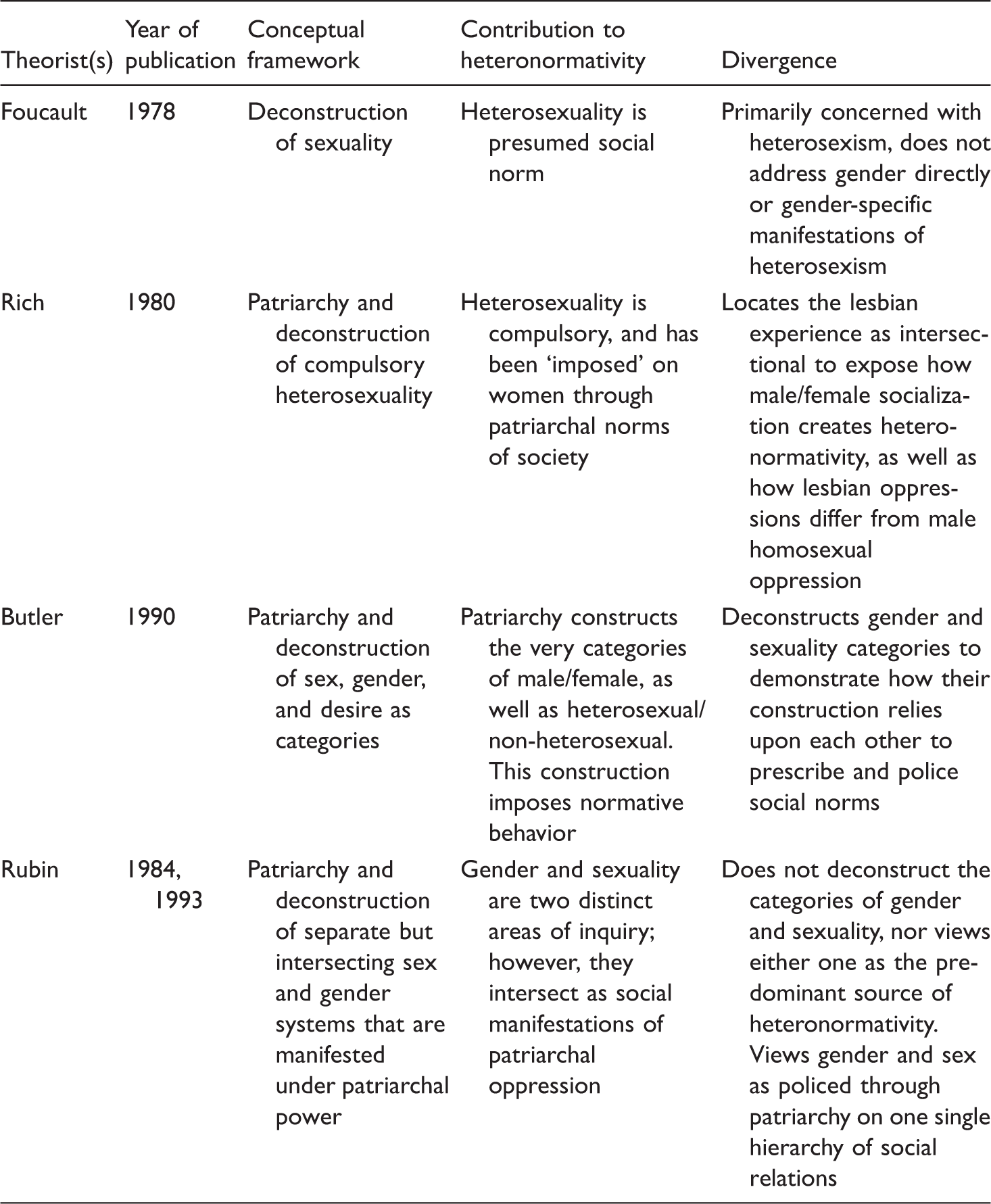
While Warner and Seidman in the Social Text ‘Fear of a queer planet’ popularized the concept of heteronormativity in 1991, it can be contextualized alongside Warner’s contemporaries as an attempt to capture the implications of enforced normativity amongst queer people. Though its root can be traced back to the much earlier work of Foucault (1978) on the various oppressions homosexuals face, the term’s emergence coincided with articulations and attempts to illustrate LGBTQ-based oppression, such as Rich’s (1980) notion of compulsory heterosexuality, Rubin’s (1984) sex/gender system, and more recently, Butler’s (1990) concept of presumptive heterosexuality. Tracing this lineage shows that, on the one hand, scholars argue that sexuality should be examined separately from gender in order to not conflate the two—as with Foucault, Warner, and Seidman. On the other hand, scholars also argue that you cannot separate gender from sexuality completely because they are intertwined, as described by Butler, Rich, and Rubin. 2 Such contention is likely due to the intersectional lens of lesbian-feminist scholarship which seeks to address both gender and sexuality discrimination simultaneously, as opposed to as separate phenomena. These different understandings appear to create a divide, leading to multiple understandings of the term heteronormativity. Before getting into the first introduction of the term heteronormativity, we describe Foucault’s contribution to current understandings of the term, then turn to feminist analyses of Rich, Butler, and Rubin that further engaged and set the groundwork for this term.
The earliest roots of heteronormativity, which deconstructs ideas about the oppressions of homosexuality, was first presented in Michel Foucault’s (1978) History of Sexuality. Foucault’s observations around the social significance of homosexuality became foundational for queer theory. Noticing that the concept of homosexuality was historically contingent, and perpetuated by emergent frameworks in 19th century Western sexuality, Foucault (1978) deconstructs the idea of an apparent innate sexuality. Through doing so, he claims that the creation of “the homosexual” isolated homosexuals from their heterosexual counterparts and subsequently marginalized them (Foucault, 1978: 43). For example, Foucault writes: homosexuality appears as one of the forms of sexuality when it was transposed from the practice of sodomy onto a kind of interior androgyny, a hermaphroditism of the soul. The sodomite had been a temporary aberration; the homosexual was now a species. (Foucault, 1978: 43)
Thus, an early idea of heteronormativity, as a dialectic of values and impositions of power structures, is seen in this work. For example, Foucault writes of heteronormativity: “A policing of sex: that is, not the rigor of a taboo, but the necessity of regulating sex through useful and public discourses” (Foucault, 1978: 24–25). Foucault’s writing relates the construction and policing of sexuality to biopolitics, wherein power relations determine proper sexual relations and repress relations they deem improper. He writes: if repression has indeed been the fundamental link between power, knowledge, and sexuality since the classical age, it stands to reason that we will not be able to free ourselves from it except at a considerable cost … a whole new economy in the mechanisms of power will be required. (Foucault, 1978: 5)
Foucault’s work explicitly looks at sexuality, but the influence of his work extends to gender scholars. The exploration and deconstruction of what Foucault dubbed the “artificial” and “fictitious unity” of sexual identity was soon applied by gender theorists interested in deconstructing gender (Foucault, 1978: 154). Foucault’s influence on queer studies in the 1990s is particularly strong because of his pioneering of these key tenets of queer theory, even as lesbian-feminist scholarship diverges from his in key ways.
Tracing the lineage forward from Foucault, we can see that writers like Rich and Butler begin to look critically at identities of gender and sexuality and the discourses of power that construct them. Adrienne Rich (1980) pioneered her idea of “compulsory heterosexuality” in her essay entitled “Compulsory heterosexuality and lesbian existence,” which was later reprinted in her work Blood, Bread, and Poetry: Selected Prose 1979–1985 (Rich, 1986). Though she does not directly cite Foucault, Rich’s deconstruction of “natural” and “biological” orientations appear to be influenced by Foucault’s deconstructionist writings. While Rich’s work naturally extends from Foucault through her focus on what is considered natural and normal for each gender, she departs from Foucault by focusing on how “heterosexist privilege” is deeply embedded in gender. Moreover, Rich is generally speaking to straight feminists who tend to fail to address the specificity of the lesbian experience, which highlights heterosexist privilege to further unveil assumptions of heterosexuality. The notion that “women are [apparently] ‘innately’ sexually oriented toward men” is thus, according to Rich, two-fold as both a process of gender and sexual normativity (Rich, 1980: 200). Rich argues that the lesbian experience is thus policed in two ways because it violates both gender and sexual norms; both a violation of heterosexual pairing but also of women’s supposed natural subservience or dependence on men.
For Rich (1980), present notions of heteronormativity ultimately are driven by the denial of women’s sexuality by patriarchal forces, to further subjugate women. It is in this sense that sexual oppression emerges from gender hierarchies: as women are constructed as subservient and docile, they are further placated by the construction of their apparent “innate” orientation toward men. Although Rich does not contend that the construction of sexual orientation is a derivative of gender, she does suggest that compulsory heterosexuality is embedded in the construction of gender and emerges from it. For example, in the context of explaining how heterosexuality is not innate or natural, and that this construction stems from the dominance of men over women, Rich writes: But when we turn the lens of vision and consider the degree to which and the methods whereby heterosexual ‘preference’ has actually been imposed on women, not only can we understand differently the meaning of individual lives and work, but we can begin to recognize a central fact of women’s history: that women have always resisted male tyranny. (Rich, 1980: 212)
Similar to Foucault, Judith Butler (1990) takes a deconstructionist approach; though, like Rich, she focuses on sexuality and gender (Burkitt, 1998). Butler views gender and sexuality as headed by the “power regimes of heterosexism and phallogocentrism,” which construct concepts of proper gender and proper sexuality alongside one another (Butler, 1990). Her seminal work Gender Trouble (Butler, 1990) is seen as a forerunner of heteronormativity’s concepts in queer discourse. Gender Trouble analyzes the ways in which dominant culture renders certain gender expressions as deviant. For example, gender performances other than hegemonic masculinity and idealized femininity are considered abnormal under the patriarchy, which constructs these norms (Butler, 1990). Like Foucault (1978), Butler questions the “continuities” 3 of sex, but also of gender and desire. She argues that it is the constructed framework of essentialism that leads to interpretations of certain behaviors as signifiers of apparent innate deviance, which is almost identical to Foucault’s understanding that the essence of sexuality is relational (Butler, 1990). Butler supplements Foucault’s analysis, introducing gender and desire more explicitly by being attentive to the relationship between heterosexism and sexism. However, like Foucault, Butler locates this very categorization as a symptom of power structures that interpret gender, sexuality, and desire in ways that establish normative frameworks according to social categories. Thus, to Butler, the normative roles and essentializing of both gender and sexuality rely on one another within a patriarchal and heterosexist system to make sense of one another. Their mutual implication calls for nuanced analyses of not just the similarities or differences between them, but also of the complex social relationship between these constructs (Richardson, 2007). Moreover, unlike Foucault, Butler pays closer attention to gender discrimination by analyzing patriarchy as an integral component of the socially inherited framework to heterosexism. However, unlike Rich, Butler does not attribute any essential intersectionality to the lesbian experience itself, since she views the very construction of gender and sexuality as part of an overarching discursive process rather than as a by-product of male/female gender role socialization.
Gayle Rubin’s (1984) work deviates from that of Rich and Butler (and Foucault) through her analysis of sexuality and gender as two distinct areas of inquiry; however, like Rich and Butler, she comes to the conclusion that gender and sexuality are linked together within patriarchy. Rubin’s “sex/gender” system, first articulated in her 1984 essay “Thinking sex: Notes for a radical theory of the politics of sexuality,” looks at sex and gender through a feminist lens. By 1993, Rubin was most interested in patriarchy as the formative influence on how we do sex and gender. She does not use the term heteronormativity, but did posit that: “Gender affects the operation of the sexual[ity] system, and the sexual[ity] system has had gender-specific manifestations. But although sex[uality] and gender are related, they are not the same thing, and they form two distinct areas of social practice” (Rubin, 1993: 308). Though Rubin engages in some of the deconstruction of social identities pioneered by Foucault and Butler, she differs by viewing patriarchy as the primary organizing principle of sex and gender. Though both Rubin and Butler acknowledge patriarchy as a key organizing principle in gender and sexual repression, Rubin’s analysis differentiates itself from Butler’s by adding emphasis on the active repression of sex and sexuality under patriarchal power, in contrast to Butler’s position that these categories themselves are constructed by the discursive practices of patriarchy. Additionally, though her sex/gender system holds similar sentiments to Rich’s “compulsory heterosexuality” and intersectional analysis, her work suggests that gender and sexuality are different in practice even as they intersect as social manifestations of patriarchy. In contrast to Rich, who viewed gender as the overarching force that represses sexuality, Rubin viewed patriarchy as the key principle of both gendered and sexual repression, which she considered separate, though related, sites of patriarchal oppression. Rubin’s sex/gender system defined this oppression as “the set of arrangements by which a society transforms biological sexuality into products of human activity,” in order to differentiate it from a system organized solely around gender (Rubin, 1993: 159). In sum, to Rubin, gender and sexuality mutually construct heterosexual and gender privilege.
Theorists and conceptual framework summary.
Source: See references section.
The first use of the term heteronormativity
In the wake of Foucault’s seminal works on sexuality, theorists began exploring how power-laden normativity affects “queer” individuals. Warner and Seidman, who present the first use of the term heteronormativity in Warner’s (1991) edited volume, tend to draw directly on Foucault’s understandings of sexuality, and leave gender out of the debate entirely. Like Foucault, Warner and Seidman consider heterosexuality as the focal point of normative sexuality in order to understand how those of different sexualities are oppressed.
Warner and Seidman, two of the founders of queer theory, do not clearly define their linguistic contribution that has become so important to queer theory and queer studies in general. However, what they do leave behind are major bodies of work to help academics understand what heteronormativity as a concept and as a term is intended to unveil. Warner’s edited Social Text, ‘Fear of a queer planet’, is unarguably a monumental text in queer theory. Although queer theory as a term is not introduced until much later, it is clear that one of Warner’s main intentions, as he was editing Social Text, was to establish a deviation from Feminist theory, not because of disagreement or because of misunderstanding, but rather because Warner and Seidman thought that in order to more clearly understand sexual oppression, it needed to undergo an inquiry separate from gender, thus their separation of gender and sexuality is more stringent than Butler, Rubin, and Rich’s.
Seidman (1991) provides a clear framework for the term heteronormativity. His essay in the section ‘The New Queer Politics’ in Warner’s (1991) book draws on Foucault’s (1978) History of Sexuality, and argues that heterosexuality “is built on the exclusion, repression and repudiation” of homosexuality, and therefore these “terms form an interdependent, hierarchical relation of significance” which creates the subordinated other—the homosexual (Seidman, 1991: 130). He describes this process using the word heteronormativity: The social productivity of identity is purchased at the price of a logic of hierarchy, normalization, and exclusion. Furthermore, gay identity constructions reinforce the dominant hetero/homo sexual code with its heteronormativity. If homosexuality and heterosexuality are a coupling in which each presupposes the other, each being present in the invocation of the other, and in which this coupling assumes hierarchical forms, then the epistemic and political project of identifying a gay subject reinforces and reproduces this hierarchical figure. (Seidman, 1991: 130)
Many essays in Warner’s book address the need for unpacking this divide, and suggest that queer politics are moving from a frame of gender to a focus on sexuality exclusion and the repercussions of heterosexual domination towards the homosexual minority. This inclusion is explicitly reflected in his introduction. Warner makes this agenda very clear in the beginning of his introduction to ‘Fear of a queer planet’: This special section of Social Text has two purposes. The first is to suggest that much social theory could be usefully revised by taking gay politics as a starting point. The second is to urge that lesbian and gay intellectuals find a new engagement with various traditions of social theory in order to articulate their aims. Both interventions have been made necessary by a new style of “queer” politics that, no longer content to carve out a buffer zone for a minoritized and protected subculture, has begun to challenge the pervasive and often invisible heteronormativity of modern societies. (Warner, 1991: 3). Social theory, moreover, must begin to do more than occasionally acknowledge the gay movement because so much of heterosexual privilege lies in heterosexual culture’s exclusive ability to interpret itself as society. Even when coupled with a toleration of minority sexualities, heteronormativity has a totalizing tendency that can only be overcome by actively imagining a necessarily and desirably queer world. (Warner, 1991: 8)
Along with fighting the oppression of heteronormativity, this Social Text also addresses the political positioning of queer people. Warner states, “sexuality defines—for most modern societies—a political interest-constituency unlike even those of gender or race. Queer people are a kind of social group fundamentally unlike others, a status group only insofar as they are not a class” (Warner, 1991: 15). Rethinking queer people as a separate category of interest reinforces how theorists must grapple with “the way the ascribed trait of a sexually-defined group is itself a mode of sociability” (Warner, 1991: 15). This mode of sociability can be understood as a subordinated position when the social world is heteronormative. To reveal this sexuality oppression, Warner recommends queer theorists “confront the default heteronormativity of modern culture” (Warner, 1991: 16). It is clear that the default heteronormativity refers to how heterosexuality is taken as the norm.
From Warner and Seidman’s uses of the term heteronormativity, five main dimensions emerge. Heteronormativity: 1) reinforces the dominant heterosexual code with its hierarchy, normalization, and exclusion; 2) is a pervasive system that needs to be addressed, questioned, and challenged in terms of sexuality; 3) is the privileging of heterosexuality; 4) is linked to the oppression of LGBTQ people; and 5) is inherent in heterosexual institutions and social codes. Likewise, Warner seems to be positioning the term heteronormativity to be the backbone of his contribution to queer theory, as they both aim to unveil the sexual oppression that queer people face living in a society where heterosexuality is dominant and the norm.
Difference in heteronormativity
Although Warner’s intention for the word for queer social theory seems fairly irrefutable, articles closely following Warner’s book use heteronormativity to describe both gender and sexuality (Duggan, 1994; Hennessey, 1993). It is unclear as to whether or not these authors are unconvinced by the intended separation of gender and sexuality, or if they just are not able to fully pull away from the separation the theorists before them intended when conducting their analyses. 4 It is most likely that these authors have a different understanding of the word heteronormativity, or are following Feminist theory in expressing the value of intersectionality. For example, Hennessey (1993) uses “heteronormativity” to describe gay and lesbian assimilation to gendered stereotypes, and Duggan (1994) is concerned with the social dismantling of heteronormativity in political issues such as abortion. Duggan claims to borrow the term from Warner, but her use of the word is not clear, as her focus is on using it for “deconstructing,” “disestablishing,” and “destabilizing” legislation, and does not focus on sexuality.
The use of heteronormativity to describe gendered forms of exclusion persisted despite Chambers’ (2003) series of articles that attempted to reestablish heteronormativity as a concept that unveils societal constraints from the normalization of heterosexuality. Alongside Warner, Seidman, and Foucault, he claims that heterosexuality is presupposed by heteronormativity, whereby the default is heterosexuality and everything else is othered (Chambers, 2005).
The aforementioned key pieces suggest that, from the beginning, meanings of heteronormativity were not clearly articulated and subsequently diverged. Therefore, we find two competing arguments in relation to heteronormativity, one that uses heteronormativity to describe sexual oppression (Chambers, 2003; Ingraham, 1994; Seidman, 1991; Warner, 1991), and another, primarily based within feminist literature, that uses heteronormativity as a process of oppression that describes gender and sexuality (Butler, 1990; Rich, 1980; Rubin, 1984, 1993). However, some early work does not fit into these two categories seamlessly (Duggan, 1994; Hennessey, 1993). In our analysis of a larger body of texts, we therefore expect to find usages that reflect the above debate, but also a diverse range of uses and understandings of heteronormativity.
Methods
To explore the evolution of the term heteronormativity beyond a few early articles, we collected two samples of articles. First, we collected a random sample of articles from the most relevant search engines used in the discipline of the sociology of gender and sexuality, Gender Studies and SocIndex, to determine the main definitions within these disciplines. 5 We specified our search terms to find a range of articles addressing the topic of heteronormativity. We performed an advanced search in these databases for peer reviewed scholarly articles that included “heteronormativity” and its forms (heteronormative, heteronormatively) within the body of the article. SocIndex returned 812 articles (which ranged from 1994 to 2014) and Gender Studies returned 190 articles (which ranged from 1993 to 2014). To reduce our sample, we sorted the articles by journal, then rank ordered the journals that addressed this term by article volume. We found that the top three journals for SocIndex were Signs: Journal of Women in Culture and Society (39), Gender and Education (37), and Hypatia (28). The top three journals for Gender Studies were Journal of Homosexuality (23), Journal of Lesbian Studies (20), and Gender and Society (15)—a total of 162 articles. To further reduce our sample size we collected the earliest article for each journal and the last article for each journal for each year in our search so that we were certain that we included how heteronormativity was first introduced and how it was last used each year, for each journal. We also randomly selected a month (June) to choose one article per year. When there was no article for June, we choose an article that was closest to the month of June. This procedure reduced our sample size of SocIndex to 37 articles and Gender Studies to 21 articles.
Gender Studies and SociIndex articles in random sample broken down into five main themes.

Source: See references section.
To supplement our random sample, we also collected the most relevant and cited peer reviewed scholarly articles that focus on heteronormativity. We found it necessary to include the articles that are most relevant to heteronormativity scholars in the literature, which cannot be generated in a random sample. To do so, we searched “heteronormativity” in Google Scholar. Google Scholar includes a feature that indicates the number of citations an article has. This feature is helpful in identifying what articles are read and used most by academics. 6 These searches automatically sort the articles in order of relevance and citation count to the terms we specify. We chose to gather the purposive sample in this way because it encompasses articles that use heteronormativity frequently, and therefore are primarily about heteronormativity. 7 The number of citations and the relevance of the articles coincided. We determined our cut off for articles included by a steep natural fall off in the number of citations. There were no duplicate articles from our random sample in the purposive sample.
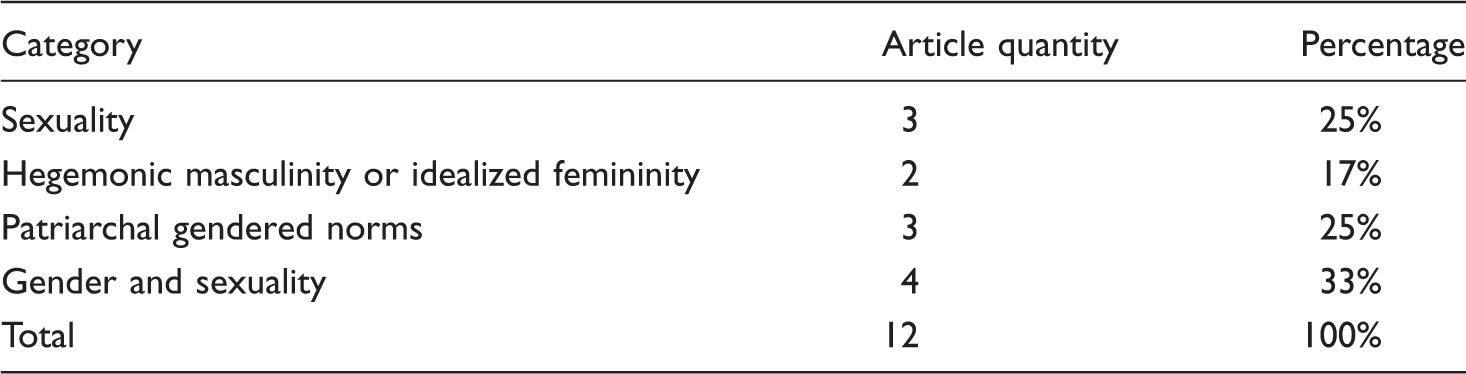
Our search yielded 12 articles, from 12 different journals. 8 These articles range from 1998 to 2010. As in the above analysis, we separated these articles into themes based on how they use and define the term heteronormativity. We found four of the five themes from our random sample. The categories sexuality, patriarchal gendered norms, hegemonic masculinity or idealized femininity, and gender and sexuality emerged from the text.
Findings
Part 1: Random sample
The 58 articles in our random sample followed five main mutually exclusive themes: sexuality, patriarchal gendered norms, hegemonic masculinity or idealized femininity, gender and sexuality, and power matrix. These five main themes can be found in Table 2. Below we present the findings, provide specific examples from the articles, and explain how they do or do not fit within the themes identified in the literature review.
Sexuality
The first theme, “sexuality,” links heteronormativity directly to sexuality. These articles vary in topic and scope, but when discussing heteronormativity they use the framework developed by Warner and Seidman. These articles seldom credit this source, although they operate with the understanding that heteronormativity is about sexuality, and its positioning of other sexualities as invisible or deviant. For example, Slagle writes: “Queer theorists challenge the notion of heteronormativity. This challenge is made against the assumption that heterosexuality is the only ‘normal’ or ‘valid’ sexual identity” (Slagle, 2006: 313). Slagle’s article involves personal explanation and deep theoretical musings to show the tensions between queer theory and LGBT theorists. Therefore, his purpose for focusing on sexuality and the use of heteronormativity is directly tied to how LGBT theorists and queer theorists (Warner and Seidman) 9 have unpacked the concept of sexuality and the normalization of heterosexuality.
Patriarchal gendered norms
The second theme, “patriarchal gendered norms,” involves authors using the term heteronormativity and not explicitly defining it, but using it as if it emerges from gender and gendered norms. These articles differ in topic, but use Rich’s framework to discuss heteronormativity. Within these articles, the context implies that heteronormativity is the result of gender roles that stem from the patriarchy and from male/female socialization. These articles do not credit Rich, although they convey that heteronormativity is something that emerges from gendered norms created by the patriarchy, which is then modified by the oppression of sexuality in accordance with these norms. For example, Mann (2013) discusses how family planning centers for Latina women encourage contraception use. She writes: this appraisal reflects a bourgeois heteronormative script that includes an emphasis on women’s personal responsibility to engage in family planning by delaying childbearing until the completion of education, entry into marriage, and achievement of financial independence (or dependence on a breadwinning husband). (Mann, 2013: 689)
Hegemonic masculinity or idealized femininity
The second theme, “hegemonic masculinity or idealized femininity,” involves authors using the term heteronormativity; not defining it, but linking it to gender role formation such as hegemonic masculinity or idealized femininity. These gendered typologies are linked to expression of both gender and sexuality. Although these articles focus on different areas when discussing heteronormativity, they use a framework most similar to Butler. These articles tend to reference Butler, and operate with her understanding that the persistence of heterosexual sexuality as the norm is implicated in the construction of gender and desire, rendering them normative or non-normative within a patriarchal system. Along with Butler, these articles suggest that idealized femininity or hegemonic masculinity privilege heterosexuality. They work in accordance with Butler’s theory that these categories emerge in dialectical relation to one another, and thus implicate one another in how they are constructed and policed.
For example, Mora (2013) uses an example of an interaction between two boys having an arm wrestling contest to describe how heteronormativity is embedded in boys’ homosocial peer groups. Mora writes: with a homophobic slur commonly used in the boys’ social worlds to stress the heteronormativity underpinning their gender practices, Ignacio jokingly implied that Albert’s poor physical display suggested that Albert’s father was a homosexual who had passed on his physical weakness to his son. (Mora, 2013: 348)
Gender and sexuality
The fourth theme, “gender and sexuality,” includes articles that reference the term heteronormativity, though it is not defined. Yet, its usage implies that it is related to a complex intersection of gender and sexuality. These articles are mostly concerned with how gender affects the sexuality system, and how the sexuality system affects gender-specific manifestations. The articles’ usage of heteronormativity most clearly relates to the sex/gender system developed by Rubin. The articles in this theme show both that heteronormativity has gender-specific manifestations and that gender related oppressions embody heteronormativity. They relate the oppression of gender and sexuality as linked through patriarchal norms, though unlike Butler they do not view their very construction as a patriarchal imposition, or view either as necessary to interpret the other. Furthermore, unlike Rich, they do not believe sexuality is subsumed or secondary to gender relations, or to male/female socialization.
For example, Kimport (2012: 875) writes: “Heteronormativity has very real material consequences (e.g., the gendered division of labor, the social invisibility of children of same-sex couples), and it also actively operates at the level of the symbolic, conditioning individual presentation”. Kimport’s article deconstructs the modern wedding, and claims it is a principal site for the construction of heteronormativity. Moreover, Kimport uses the term heteronormativity to try to understand what gendered expectations couples have to conform to and present when marrying. Her purpose in focusing on gender specific manifestations of heteronormativity is most closely tied to Rubin’s framework of the sex/gender system. This is because in marriage, sexuality and gender are intertwined in various symbols (for example, a white dress versus a suit), which culminate to a gendered expression of heterosexuality. “Traditional” marriage then, shows how deeply intertwined sexuality is in gender performance. For Rubin, these gendered practices can be embodied within heteronormativity.
Power matrix
The fifth theme, “power matrix,” incorporates articles that use the term heteronormativity to relate to a myriad of systematic oppressions such as race, class, gender, and sexuality. These articles focus on a topic unconnected to heteronormativity, and use it to describe a process that leads to oppression. For example, Harding (2006) uses the term in an article to address philosophical ways to engage with systematic ignorance. While exploring different avenues in which philosophers can find insight into social normalizations, she writes: “values and interests such as androcentrism, white supremacy, Eurocentrism, heteronormativity, and ableism have highly shaped what have been regarded as the very best, most highly confirmed theories in the disciplines” (Harding, 2006: 25). Harding uses these words to show how various disciplines try to unveil the oppression that ignorance can cause.
Definitions of heteronormativity

Source: See references section.
Part 2: Purposive sample
Articles in purposive sample broken down into four main themes.
Source: See Appendix.
Sexuality
Identical to the random sample, articles with this theme vary in topic and scope, but when discussing heteronormativity they use the framework developed by Warner and Seidman. Articles in the purposive sample often credit this source, and are clearly operating with the understanding that heteronormativity is about sexuality, and attach heteronormativity to stigma against non-heterosexual intimacy and desire. For example, while analyzing traditional race scholarship, Hutchinson (1999: 19) writes: Homophobic violence thus executes (or “enforces”) the political, social and ideological institution of heterosexism; it punishes non-heterosexual practice, and it aims to prevent future challenges to heteronormativity by employing the threat of violence to attach fear and stigma to non-heterosexual intimacy and desire.
Patriarchal gendered norms
The second theme we identify in the purposive sample follows the same pattern as the second theme in the random sample. These articles do not credit Rich, although they convey that heteronormativity emerges from patriarchal policing of gender and male/female socialization. For example, Yep (2003) describes the violence of heteronormativity as something that forces one to enact socially produced restrictions and actions, such as gender performance. He writes: “In sum, heteronormativity impels heterosexual men into a lifelong labor of ‘proving’ their manhood and concealing, if not banishing, a range of sexual possibilities, gender performances, and pleasures” (Yep, 2003: 21). Yep argues that heteronormativity sustains and requires specific types of manhood that are socially produced, and that become visible in the reproduction of gender norms. Yep’s purpose is to reveal how the socialization of men precludes them from specific gendered expressions, including homosexuality. Due to strict gender socialization, Yep’s notion of heteronormativity is akin to Rich’s understanding of heteronormativity because it locates the stringent socialization that separates men and women as the mechanism by which heteronormativity is produced and sustained.
Hegemonic masculinity or idealized femininity
Like the theme from the random sample, these articles focus on different areas, but use a framework most similar to Butler. These articles tend to reference Butler, and clearly operate with her understanding that the construction of heteronormativity emanates from patriarchal logic, rendering gender and sexuality normative or non-normative. Along with Butler, these articles suggest that idealized femininity or hegemonic masculinity are socially constructed alongside sexuality and thus are necessarily mutually implicated in their conception. For example, Nielsen, Walden, and Kunkel (2000) analyze how gender norm violations problematize heterosexuality. They describe how their students react to defying gender norms in public, writing: We show that routinely unquestioned heteronormative expectations and proscriptions that exist as background context in contemporary culture come to the fore when traditional gender boundaries are crossed. Further, we show that heteronormativity itself is gendered via the homosexualization of disruptive men and heterosexualization of disruptive women. (Nielsen et al., 2000: 283)
Gender and sexuality
Almost identical to the theme in the random sample, these articles follow the framework of Rubin. The articles in this theme operate with the understanding that heteronormativity has gender-specific manifestations, and that patriarchal systems enforce and police both categories. For example, Schilt and Westbrook (2009) argue, while examining interactions between non-transgender and transgender people, that gender and sexuality are “inextricably tied together,” and that the processes of “doing gender” are difficult to separate from the maintenance of heteronormativity (Schilt and Westbrook, 2009: 440). They write: Our case studies show that doing gender in a way that does not reflect biological sex can be perceived as a threat to heterosexuality. Cisgender men and women attempt to repair these potential ruptures through the deployment of normatively gendered tactics that reify gender and sexual difference. These tactics simultaneously negate the authenticity of [trans men] and [trans women’s] gender and sexual identities and reaffirm the heteronormative assumption that only “opposite sex” attraction between two differently sexed and gendered bodies is normal, natural, and desirable. (Schilt and Westbrook, 2009: 442).
Discussion and analysis
Differences and similarities in our samples
There were a few differences between our two samples. First, one sample is randomized and the second sample is purposefully selected on highest citation count and relevancy. Second, our first sample is expansive and our second is narrow. Due to this difference, the randomized sample has slightly more variation in its usage of heteronormativity and includes the category “power matrix,” which is not found in the purposeful sample. 11 Additionally, the “sexuality” category has a higher frequency (25 percent compared to 10.3 percent) in the purposeful sample due to authors (more often) citing the original work by Warner.
Our samples were similar in that they both show a fairly wide variation in the usages of the term, ostensibly showing that heteronormativity is employed in at least four ways dependent on the author’s understanding and theoretical framework. Notably, the ways the term is used are quite varied in both samples, indicating there has been no clear common or consistent usage of heteronormativity since Warner’s original definition. 12
We believe the uses of the word are fairly evenly spread out temporally due to the persistence of the legacies of different queer and gender scholars who approach non-heterosexual oppression in different ways. However, why do these scholars explain the marginalization of queer people in diverse ways? We believe this is because queer people face complex and dynamic oppressions, stemming from many different sources, physical manifestations, social practices, and contexts. For example, non-heterosexuals face discrimination in work, are stereotyped based on gender performance, and are marginalized from social celebrations such as marriage due to its normalization of monogamy and gendered practices. In other words, there are multiple ways in which researchers can uncover the oppression of queer people, and in which their identities intersect with socially constructed categories (i.e. race, gender, class). Therefore, the term’s inconsistent usage may not highlight a lack of academic unity, but instead show the many ways non-heterosexuals are oppressed within our social world. The four theoretical strands identified document this marginalization. As demonstrated by our analysis, over the years there have been similarities in the theoretical lens applied to heteronormativity, but the researchers in our samples each view the social world differently and consequently find a different manifestation of heteronormativity.
The complexity of non-heterosexual oppression in our social world helps explain why no one usage has dominated scholarship over the past few decades. In both samples, however, “gender and sexuality” is the most frequent category, indicating that most authors followed Rubin’s sex/gender system in defining heteronormativity. We think this is because Rubin’s sex/gender system can encompass more of the ways heteronormativity appears in the social world than the other theoretical frameworks and is a more malleable framework. For example, those that use Rubin’s framework find that ‘traditional’ social events and practices such as marriage show how deeply intertwined sexuality is in gender performance. Rubin’s followers find that the deep connection between sexuality and gender embodies heteronormativity even as they are separate. Because the connections between gender performance and sexuality run so deep, perhaps it is difficult for researchers to look at the world and not see their categories as inextricably linked and mutually reinforcing. The other theoretical frameworks may not be as accessible to researchers. For example, Foucault, Warner, and Seidman’s focus on sexuality leaves gender out of the social equation, which may leave researchers sensitive to gender unable to locate themselves within this theoretical perspective. Moreover, researchers may not experience sexuality oppression as patriarchal gendered norms (Rich), or as hegemonic masculinity or idealized Femininity (Butler), but instead as a mutually constructing process where one cannot locate an origin point or discrete connection.
Uses of “heteronormativity” and theoretical framework.
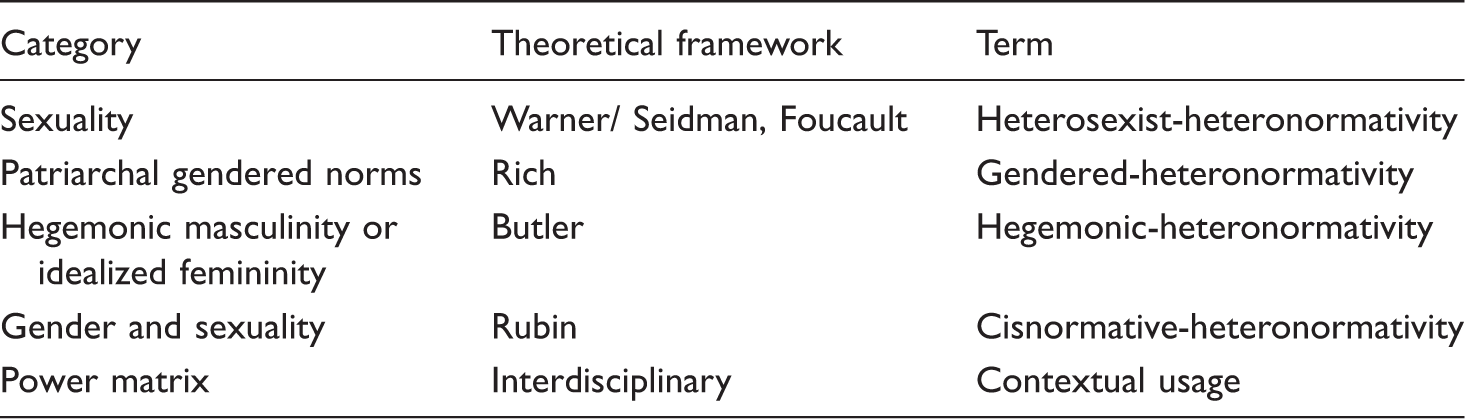
We posit that these new terms will helpfully disaggregate and give new possibility to discussions of “heteronormativity.” The terms are adapted from the literature, placed within their theoretical framework, and used to address understandings of heteronormativity. For example, heterosexist-heteronormativity emerges from the facet of heteronormativity that acknowledges the implicit privilege of heterosexuality in society. The prefix heterosexist clarifies that the enforced norm it is interested in is heterosexuality. This follows from the aforementioned concepts found in Foucault’s (1978) History of Sexuality that deal with how society is organized by heterosexual privilege and policing. For example, Hutchinson’s (1999) articulation of heteronormativity within race scholarship finds that non-heterosexuals are policed through the threat of violence. This homophobic violence can more clearly be described as heterosexist-heteronormativity.
Gendered-heteronormativity extends from Rich’s views on how gender shapes the experiences of homosexuality. Because Rich locates the lesbian experience as a unique type of social stigma, which is different from the general experience of heterosexism, gendered-heteronormativity acknowledges how heteronormativity emerges from gender and male/female social relations. For example, Yep (2003) describes how heteronormativity sustains and requires that many men reaffirm their gender through violence. Therefore, gendered-heteronormativity more directly describes the phenomenon Yep exposed.
Hegemonic-heteronormativity extends from Butler’s ideas of simultaneous constructed social norms. Butler does not merely acknowledge heterosexism, nor gendered experiences, but locates heteronormativity as one of the many constructed norms that reproduce each other within patriarchy. Hegemonic-heteronormativity acknowledges that hegemonic ideals seek to reproduce and shape each other, and that this mutual construction is an effect of power relations that inform one another. For example, Butler’s followers find heteronormativity to encompass hegemonic masculinity or idealized femininity in that the persistence of heteronormativity contributes to constructions of gender categories, and often creates the framework to interpret gender and desire, rendering them normative or non-normative. This is most clearly represented in Nielsen, Walden, and Kunkel’s (2000) analysis that describes how students found the crossing of traditional gender boundaries to be disruptive. Hegemonic-heteronormativity further specifies this relationship between hegemonic ideals and heteronormativity.
Cisnormative-heteronormativity similarly stems from Rubin’s sex/gender system. Because Rubin views sex and gender as simultaneously policed norms under patriarchy that place one within a hierarchy of stratification, cisnormative-heteronormativity views heteronormativity as not just an intersection of gender and sexuality, but actually of the same social field that determines one’s placement within the sex/gender system. We use cisnormative-heteronormativity to delineate understandings of heteronormativity that are based on a perceived “mismatch” between gender performance and biological sex (Worthen and Dirks, 2015: 279). Though Rubin herself did not write extensively on transgender individuals, her conception of a sex/gender system holds influence for contemporary understandings of cisgender privilege that are rooted in the policing of biological sex categories. This terminology compliments Schilt and Westbrook’s (2009) work on how, in interactions between non-transgender and transgender people, gender and sexuality are tied together, which makes it difficult to separate gender performance from the maintenance of heteronormativity.
Power matrix stands apart from the examples above since it does not have a singular usage and thus does not allow for a singular term to modify how heteronormativity is used. Authors who use heteronormativity in this fashion are difficult to locate as falling within a particular framework, and thus can benefit from using one of the aforementioned modifiers.
These prefixes provide the context within which scholars can use heteronormativity in useful ways. They allow scholars of gender and sexuality to: 1) situate their research within a broader school of thought, scholarly tradition, or theoretical framework; 2) provide context to how heteronormativity is being used, given the diverse usage with scholarship; 3) specify the social factors they are addressing; and 4) contribute to the larger discourse around the term by having identified and recognized its multiplicity.
Such clarification is important given the many perspectives that social scientists and cultural theorists have towards the mechanisms and causes of heteronormativity, social stratification, and oppression. We find that, rather than reducing the conceptual frameworks to one term, allowing these perspectives to co-exist while being disaggregated via new prefixes can allow scholarship using the term to continue along multiple perspectives, without having to select one “correct” framework.
Conclusion
We have unraveled heteronormativity as a term with multiple uses and definitions. We also traced these uses to their respective sources, and delineated categories of past scholarship. In addition, we provide new language to highlight the differences between each use of heteronormativity. Furthermore, given the debate and discourse around the respective meanings, we conclude that these definitions have their own discrete places and meanings within the broader scholarship. We hope our contribution to the literature encourages scholars to explicate the genealogy of their uses of “heteronormativity,” either by defining it or by using the above prefixes for clarification. We imagine that these new insights concerning heteronormativity will help researchers explore and express the oppressions of those inside and outside of the LGBTQ community. It is only with proper identification of the forms of heteronormativity that we can engender clear discussion on the subject matter by facilitating clarity and transparency regarding theoretical standpoints and the social problems they seek to analyze.
Footnotes
Acknowledgements
We thank Kathleen M Fallon for constant detailed suggestions and unwavering support throughout the entire process of writing this article. The article also benefitted from feedback gathered from Robert Cserni, Kent Henderson, Rose Sayre, Andrew Hargrove, and the anonymous reviewers.