



Abstract
Multiple sexual partnerships can be viewed as networks in order to assess the nature of links between lovers and metamours (lover’s lovers) as well as the larger population. In such non-monogamous networks, where participants share sex, friendship, ideas, and economic resources, there exists a vast web of nodes connected in much more intimate and complex ways than one finds in the mono-normative landscape. This study explored gender dynamics in network centrality on a sample of 62 polyamorists in Paris, France using participant-observation, informal and structured interviews, and social network analysis. Though evolutionary psychology and pornographic film tend to reinforce heteronormative stereotypes of males as central social actors with multiple sexual partners and women as sexually passive, feminist theorists have argued for a more “agentic female sexual subjectivity”. My data showed that cis- and trans-women, with a strong sense of family and skills in interpersonal communication, score highest on network metrics of density/degree, homophily, indirectedness, and transitivity. The network data also indicate high modularity and endogamy with clustering tendencies for both cis-men and cis- and trans-women linked to kink, atypical intelligence, sexual and gender non-conformity, and mitigating factors of socioeconomic advantage and racial privilege.
Objectives and literature
This paper offers a framework for conceptualizing polyamory through a variety of social network analysis (SNA) metrics (density, homophily, and transitivity) applied to a subset of 62 individuals. It also introduces a new centrality measure, “indirectedness,” referring to the unique adjacent or bridging links poly individuals have through their metamours. There are two essential questions addressed in this paper: (1) How does SNA shed light on the nature of polyamory structures and interactions? (2) Who are those with the highest levels of centrality, males or females? 1
Firstly, SNA is not actually a theory, but a set of methods to examine social structures through the use of networks and graphs (Otte and Rousseau, 2002). It has been applied to consumer behavior (Birke, 2013), kinship studies (Hage, 1971; Widmer, 2017), social media (Grandjean, 2016) and the transmission of sexual diseases (Liljeros et al., 2003), but has yet to be applied to the complex relationship dynamics found in polyamory. Polyamory is consensual non-monogamy where individuals in multiple loving relationships manage jealousies through the philosophy of open love, honesty, integrity, equality, and open communication (Anapol, 2012; Combessie, 2013; Sheff, 2016). Though no one yet has applied SNA to such relationships, a philosophic tree model of proximity was mapped by graduate student J. Iwanowska (2018) of a small subset of polyamorists, testing the strength of metamour connections. There was also a limited graph (tree) application of kingdom building in Mormon polygamy (Bennion, 2012) and M. Burton’s (1981) analysis of polygamy and agriculture, using a log/linear analysis, a multivariate technique that tests for bivariate relationships among culture, polygyny, and female labor participation. In the non-scholarly world, there was a fictive lesbian poly network mapped by the makers of the television series, the L Word, and a self-designed program created by two members of the Paris polyamory group, called Rhizome, depicting the varied links of sex, love, childcare, and BDSM, among 78 participants.
Secondly, who are those with the strongest centrality in polyamory, men or women? Aside from network centrality metrics, which will follow, there are two conceptual aspects to this query: interconnections with others (sexual, social, and economic) and the relative strength of the individual in their attachments with others within the community. How do these notions of success apply to people in polyamory?
According to evolutionary psychology, men, more than women, have a long history of having multiple partners throughout the lifespan. Mitchell et al. (2019) found that men have 14.14 sexual partners and women have half that amount (7.12). This abundance of lovers is largely due to men’s need to reproduce more viable offspring (Buss, 1998; Fisher, 1983; Schmidt, 2015). Men uniformly seek multiple, exogamous partners for sexuality variety, preferably who are much younger than themselves (Eagle, 2017; LeVine, 2003; Symons, 1981). These same polygynous men control not only the sexual playing field, but the social and economic arena—all as part and parcel of their fitness prerogative (Wade, 2011; Tiger, 1969). Women, on the other hand, are portrayed as passive, virtually sexless, monogamous beings and LGBT+ people are rarely mentioned at all (Levy, 1994). 2
Anthropologists and sociologists have long questioned the veracity of the evolutionary psychology narrative, especially as applied to polyamory. As early as 1856, Morgan found that among the Iroquois, the notion of family and community was largely based on a network of polyamorous relationships and gender egalitarianism. Engels (1884) also found that indigenous primitive socialism was associated with polyamory and female empowerment. Additional ethnographic evidence suggests that polyandry (women with more than one husband) is much more common than previously thought (Starkweather and Hames, 2012) and some Amazonian tribes require polyamorous sex by women to provide the sperm of many males to help the child grow (Beckerman and Valentine, 2002). Such interconnections in sexuality and economics allowed for greater survival of the entire community, strengthening cohesion and stability (Ryan and Jetha, 2012).
According to Sheff, success in poly is defined as having more of one’s emotional and physical needs satisfied by a variety of partners and being connected to people in a way that provides longevity and stability (2005, 2016). Women have the ability to juggle multiple relationships in a caring way at the same time. In this regard, poly may be seen as female-driven (Dahlberg, 2009). Labriola (2003) writes that women are more capable at plural relationships because they are self-aware, socialized to be skillful at interpersonal and emotive communication. They often seek sexual partners that enhance feelings of intimacy, attachment, and longevity. Often, she writes, these partners are selected from within the community because of trust and safety issues, increasing the endogamous bonds formed by women in the network. Thus, in the spirit of consilience, I would argue for a broader, interdisciplinary approach to the question of success in polyamory, where it is not just the question of quantity of partners, but the quality of bonds that leads to power and influence in the network.
Hypothesis
It is predicted, due to cultural constraints and its small size, the Paris polyamory group will exhibit high network modularity and endogamy1 and that those with the greatest network density and centrality will be predominantly middle-class, white cis-women.
Methodologies and data
I was introduced to the polyamory group on 12 January 2019, through my friendship with Paris filmmaker, Isabelle Broue, who I had met at several non-monogamy conferences. As de facto leader of the Paris poly group, Broue facilitated my entrance into the group, often letting me stay in her Montparnasse apartment which she shares with her primary partner. As I was also practicing poly at the time of my research, I was able to build a rapport with other members, having a partner in Paris and in Vermont. My initial connection with members was through FB messenger where I asked general questions about poly lifestyle and attempted to build strong enough connections to schedule a series of informal café interviews. I conducted participant-observation during poly meetups to gain a sense of the nature of the poly subculture.
After a few short weeks, I began to frame the Paris polyamory group as its own quasi-ethnic, counter-culture entity, finding polyamory itself to function like a glue, bonding people together in ways monogamous communities do not. I found that being poly is highly stigmatized and marginalized in Paris. This outside stigma and shaming resulted in a tight-knit, protective, solidarity subculture made up of folks who eschew any and all conventional labels, tending towards anarchist, progressive, democratic socialist philosophies, as well as a strong penchant for queerness and sexual exploration. Those that belong to the Paris poly community originally signed up on two Facebook sites (Polyamour/Polyamorie Paris, Café Poly Paris) to introduce themselves to others in the community and form social and sexual connections. These two cafes provided a “queer space,” a safe haven for open discourse (Halberstam, 2005). At the time of my research, the group numbered 350 to 400 individuals, all adhering to the liberal principles of ethical non-monogamy, sexual liberation, consent, body and sex positivity, and the acceptance of all forms of diversity. These principles were reiterated often in workshops, poly meetups, and night clubbing circles, where members were free to push the boundaries of cultural appropriateness and mainstream French conventionality, similar to what Mikesell, in her analysis of the Florida Burner poly group, calls “playing with fire” (2015: 23). The meetups, a great source of data, were held biweekly in predominantly two Paris locations: the Marais, at the Café L’Imprevu, and Café de Paris on rue Oberkampf. Attendees to the meetings were predominantly white, middle-class individuals with a penchant for eclectic dressing and intense, honest, conversation. Most members are gainfully employed in a variety of métiers including art, computer work, engineering, sales, and academia. In spite of these middle-class jobs, members are drawn to Burning Man-style communalism and anti-capitalist sentiments. Personal and spiritual growth and acceptance of the “Other” is highly favored. Though families are important, few members have children. Childcare is shared among partners and their metamours, and most say they practice a very open form of poly where everyone in the polycule knows everyone else’s intimate details. They also practice an inflated form of compersion (taking pleasure in sharing your lover with someone else). According to an in-house Polyamour/Polyamorie Facebook survey (Nicolas Lala, 2019) 3 of 108 individuals, the Paris poly group is drawn to or associated with sexual kink and bondage (97), gender/sexual/romantic minorities (LGBT+) (90), feminism (90), sexual role play (78), libertinage 4 (74), non-violent communication (65), vegetarianism 45), love of nature (39), love of literature (38), spirituality (34), climate activism (27), organic cuisine (27), higher education (24), video gaming (23), atypical intellect (high IQ, “zebre” 5 ) (23), shamanism (18), Burning Man (14), computer work (10), Aspergers (7), and intuitive dance (6). In spite of these cultural eccentricities, my initial observations of this group were that of a definitive subculture, operating in the shadows of mainstream Paris society.
After a brief hiatus back in Vermont, I returned to Paris mid-February through March 5 to continue gathering data via café interviews and observing the lived poly experiences of group members. In April, I conducted more formal surveys from a subset of 48 members of the larger group. I sought to compare my results with the internal survey by Lala (above) and other poly tendencies in the literature. The subjects were initially selected via convenience sampling from the Polymour/Polyamorie Facebook group. 6 A chain method of sampling expanded this initial group through lovers and metamours to 62 individuals. Subjects were recruited through contact with the leaders of the FB group, who extended an invitation to contact me. Network members were eligible to participate if they were 18 years or older and who felt comfortable discussing their sex lives. Anonymity and confidentiality were insured, as well as the promise to change names to numbers on the network graphics. After gathering demographic data, such as age, gender, and socio-economic data, subjects were interviewed using open-ended questions relating to their current polyamory structure and how they became attracted to poly. Implicit in the first question were details about their lovers and their metamours and the style of poly (kitchen-table, parallel-poly, solo-poly, quad, triad, anarchist, or hierarchical, and so on). 7 Because of the accelerated turnover in the poly community, where partners and friendships often change every few months to every few years, I asked participants how many sexual partners they had during the last four years. 8 The second question was designed to examine the factors contributing to their entrance into the poly world, such as an early natural predilection for non-exclusivity, their partner fell in love with someone else, or they were in a long-distance relationship and wanted a nearby lover.
My findings agreed with the in-house FB/Lala survey. All 62 subjects were involved in concurrent partnerships, with 48 reporting that they had a main partner with whom they had been with for longer than six months. The average age among the 62 subjects was 30 with 42% cis-females, 44% cis-males, 13% gender non-conforming (gender-fluid, queer, trans, or non-binary). The subset was predominantly white (85.5% white, 2.5% black, 12.5% other) with a relatively high income level (58% middle to upper class, 29%, middle to lower; 13% lower income). Twelve percent were married; eight percent had children. Of those who had children, there was a tendency to find childcare within the polycule and with others in the poly community, rather than pay for childcare outside the group. This is true of what I found in polygamy groups, as well, where women would rely on each other to babysit their children while they ran errands, attended college classes, or worked part-time (Bennion, 2012). 9 Education levels were also above average (66% highly educated (graduate level degree), 22% undergraduate, 12% high school), suggesting, especially among the cis-gendered whites, that class privilege is indeed correlated to polyamory (Klesse, 2013).
The data set also showed a strong inclination towards nonconformity in politics, sexuality, and religion. Thirty-three percent claimed to be relationship anarchists, 38% were hierarchical, 10 29% neutral. Eighteen percent adopted kitchen table poly, with more following a parallel poly (non-inclusive) form (82%). In terms of religion, every subject had left a structured religion behind (Catholic, Methodist, etc.) in favor of a spiritual path incorporating Eastern mysticism, paganism, circular ideologies, and so on. On the subject of politics, there seemed to be a divide–some (65%) adopted the philosophy of queering anarchism (Shannon and Willis, 2010) which abolishes all forms of structured and institutionalized domination, coercion, and control in love and in governance–while others (13%) adopted a more traditional, gemeinschaft philosophy of care in their politics. Still others (12%) favored moderate, yet progressive, politics that allowed for entrepreneurship, industry, and material well-being. Though most were drawn to poly values early on (69%), others came into it much later (31%), adopting poly because of practical reasons, either to build a family and provide childcare and financial support, or to help pay the rent or deal with distance relationships. Among the latter group were those that found poly to be a haven from the toxicity they experienced in previous monogamous relationships.
The Paris poly group showed immediate signs of practicing insular, endogamous sexual patterns which involves selecting partners from within, rather than attempt to convince a reluctant outsider to adopt radical values and face an enormous stigma from the French mainstream. Seventy-four percent of the sexual connections were made between people inside the FB polyamory group. This insularity may be explained by the history of French aristocracy which allows for clandestine adultery but not open poly (McDougall, 2014). This same history applauds patriarchal poly (where men step out on their partners, but women mustn’t do so) with a demand for attempted discretion and dishonesty to “safe face” and family honor. Thus, those that adopt poly are instantly marginalized because they actively pursue consensual non-monogamy, honesty, open communication, and compersion. According to Pitagora (2016) such marginalized poly groups often also adopt a persona of Otherness to cope with the fact that the outside world doesn’t accept them (this is especially true among women, transgendered people, and pansexuals). The Otherness includes, among other things, sexual non-conventions, including kink, BDSM, swinging, sex-clubbing, slow-love, orgasmic meditation. It is the quality and diversity of these common non-conventional traits that truly bonds people to each other (Golbeck, 2013). Thus, the more multiplex the ties, the greater the influence and power people experience in the poly network.
In Figure 1, I provide a Periodic Table of Polyamory depicting the various modes of exchanges and types of relationships in the Paris group. Though sex and friendship are self-explanatory, other terms in the legend much be explained. Each participant is a node; two people in a relationship is a dyad. Note that money is the exchange of anything of monetary value such as cash, childcare, and housing. Triads are three people that share love (typically a heterosexual couple and a bisexual man or woman). A quad is two couples that swing together. Solo poly is the tendency to collect several lovers without a hierarchical arrangements. Anarchist star is an extension of that tendency. Mono poly is where one partner practices monogamy and the other practices poly. Other terms are explained in the glossary.
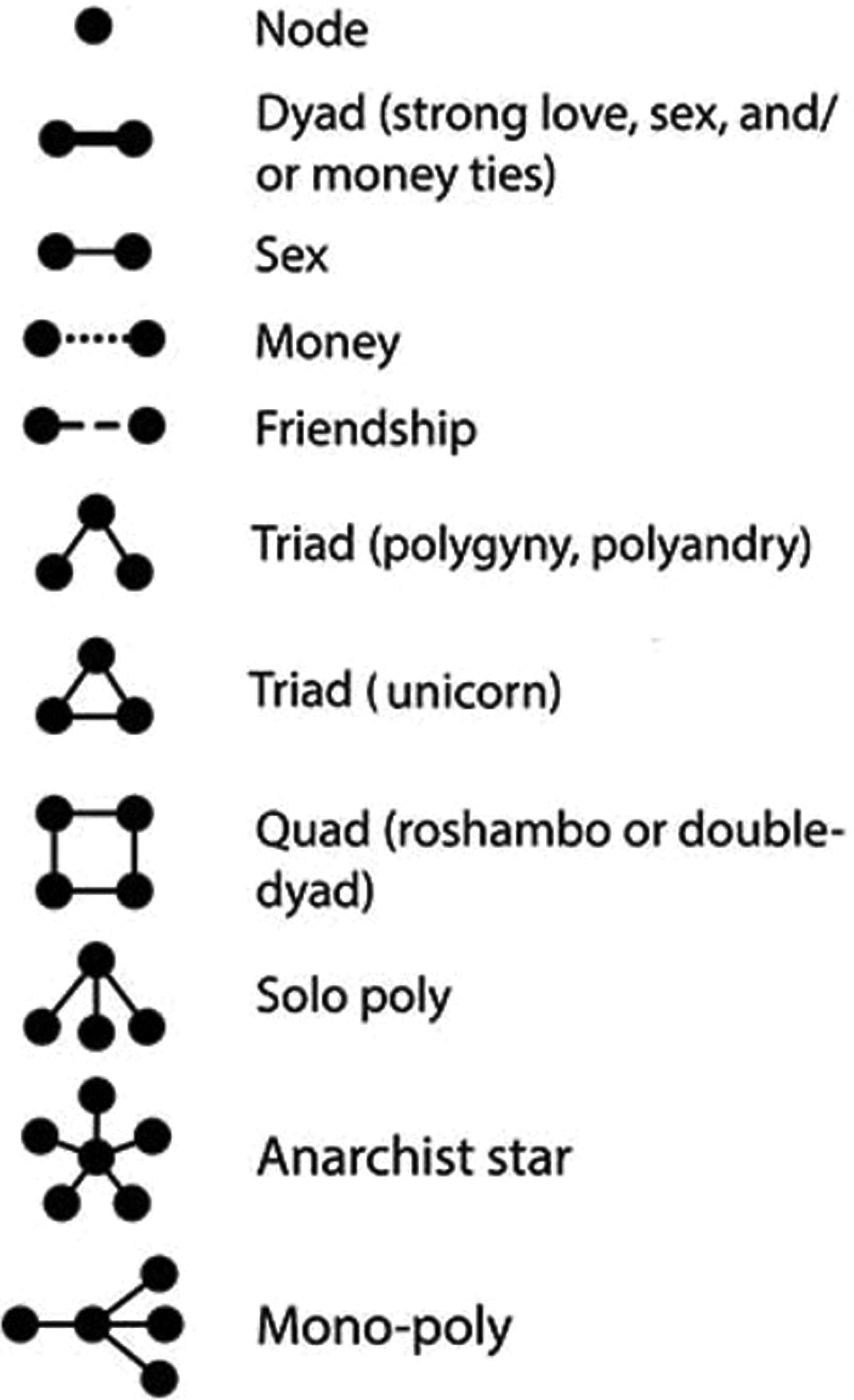
The Periodic Table of Polyamory (modification of reddit user u/aprilarcus’ work).
In sum, Paris polyamory is an endogamous, extremely sexually-fluid 11 network with high levels of homophily (trait clusters). Links are formed between those who embrace feminism, veganism, and love anarchy, who are predominately white, liberal, socialist, geeky/gamers, ecologically aware, highly educated, upper middle-class but who come from parents who are lower class. They have similar psychological profiles of atypical intelligence and are zealous supporters of the same poly ideals, eschewing any conventional labels.
Social network analysis
My next step was to explore the potential of social network analysis as a tool to examine polyamory relationships and the overarching structural properties of the network. SNA is also useful in identifying particularly powerful individuals. Though no scholar has yet applied SNA to polyamory, it seems the perfect device for illustrating the deep-seated bonds of the unique Paris poly community, showing exactly how people connect and shedding light on the nature of these connections. The drawback to SNA is the lack of standardization in the literature, e.g. different terms used for same concepts and different rules of measurement related to each term. After viewing the fictive network drawing created for the L Word television series, I decided to focus on those involved heavily in the Facebook gatherings to be able to discuss fully the nature of their interest in polyamory.
In the beginning of the SNA application, in May of 2019, I created a hand-written visual map of the polyamory structure which I then put into a computerized diagram, using Adobe Illustrator. This map contains clusters of individuals (nodes) that collect themselves around centralized, influential players in each polycule. 12 The links between people (edges) depict exchanges of sex, friendship, and/or economic sharing. Participants provided the first name of individuals they were linked to sexually, or in other ways, including flat sharing, childcare, friendship, or other characteristics that they shared in common with others. Figure 2 shows the conceptualized polyamory network of 62 nodes, with their sexual, friendship, and economic edges (T=198). This graphic is drawn from qualitative data of participants’ location in the network, their ties to each other, and the nature of those ties, representing an etic attempt to present the types of links people say they have with others. Be aware that this drawing depicts non-directional edges, assuming a reciprocal relationship between nodes.
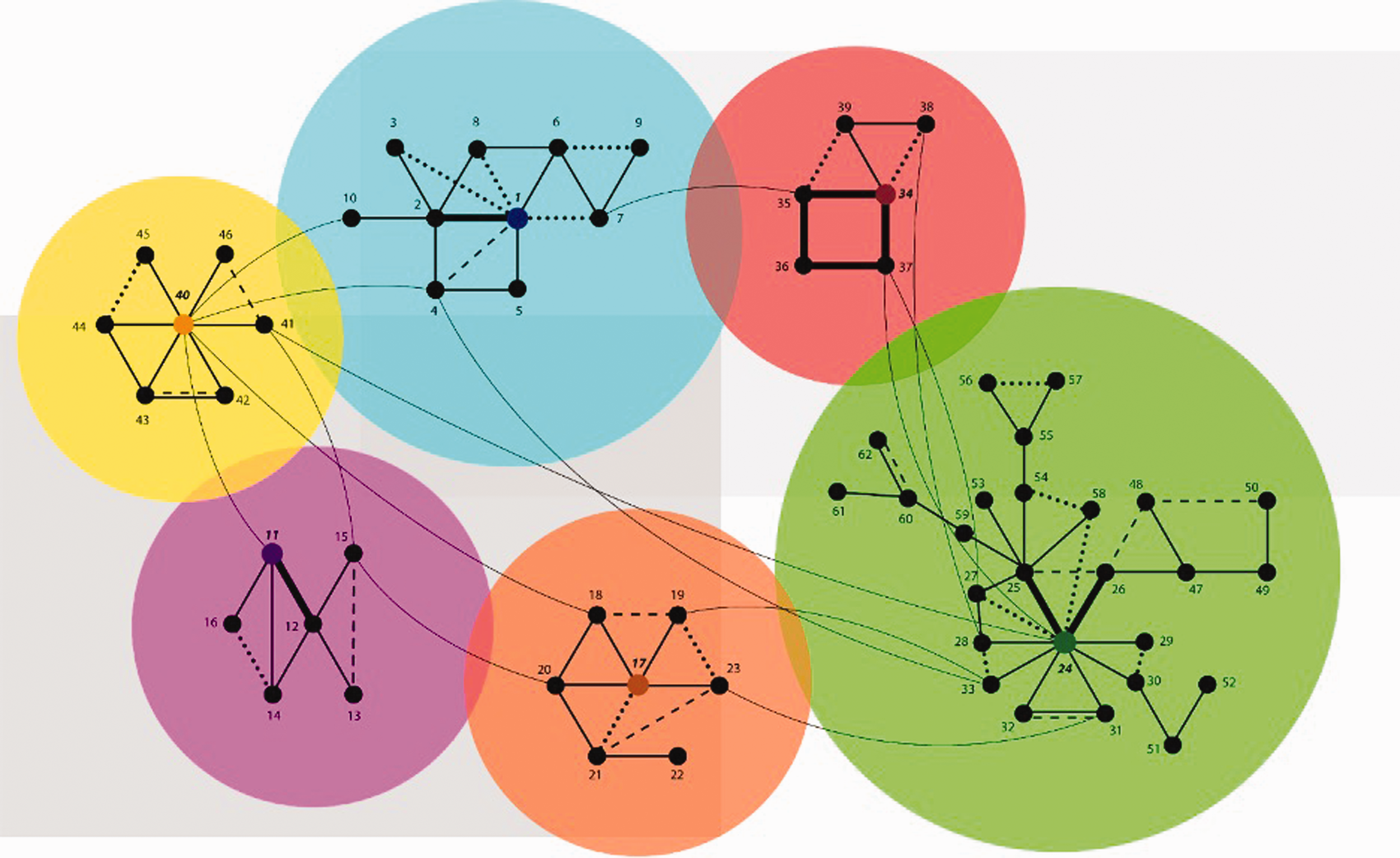
Conceptual poly network of 62 participants into six polycules.
The Paris group has a tendency to cluster (high modularity) with dense connections between the nodes within polycules but fewer connections between nodes in different modules. Much of the clustering is due to the fact that most people draw their sexual partners from the same FB polyamory pool (145 out of 198 links). If the line between individuals in the network is thick it is a multiplex link indicating a strong romantic/intimate/sexual relationship, such as between 1 and 2; 11 and 12, 24 and her two partners, 25 and 26, and the quad 34–37. These relations are hierarchical (ranked) and have lasted from 7–11 years. Star constellations reveal strong tendencies toward non-hierarchical (un-ranked) relationship anarchy such as found with 40 and 17, and 24 and 25.
Note that people seem to align themselves into six distinct polycules made up of lovers and metamours with several lines of connections to other polycules in the larger network. The green polycule is especially active, establishing a mini empire of numerous lovers stemming out from three individuals: #24, her partner #25, who also has many lovers, and her other partner #26. This polycule has 42 vertices, only seven of which are connected to other polycules, making it a highly modularized cluster. One can see that nodes #24, #40, and #1 are quite centralized with numerous connections to others in the network.
Quantitative measures and the use of Gephi software
In mid-May of 2019, after spending a few months gathering data on people’s links to others in the network and the dominant personal traits they shared in common with others, I returned to Vermont to examine ways to best display my polyamory network data, from an etic perspective. 13 I first coded the qualitative (emic) data drawn from interviews and surveys into an Excel document, 14 listing the adjacent edges of each node and node traits, and then used the network software program Gephi 9.2 to generate a graph (Figure 3). Note the same tendencies to cluster into separate polycules exist in both graphs (six versus nine clusters) but in Figure 3 one can see that the shape of the network indicates a higher level of integration and modularity with centrality strengths for nodes 24, 1, 40, and 17. Whereas Figure 2 shows how people described to me their understanding of connections and my own subjective interpretation of those connections using Adobe software, in Figure 3 one sees the actual, mathematical graphic depiction of the Excel documentation using Gephi 9.2. 15 Note that Figure 3 is an undirected graph with each node’s identifying number being entered to help visualize the tendency to cluster; no algorithmic formula was used. Figure 4, by contrast, presents a directed graph, using the modularity community detection method to compute the modules, and the force directed algorithm for the layout. 16 In this final Gephi graph, the same nodes are shown to exhibit modular strength: #24 is the purple cluster, #40 is the blue cluster, and #1 is the orange cluster. And, in both Gephi graphs, cis- and trans-females seem to hold key positions of influence. 17 One can also see that sexual selection is primarily endogamous; in other words, people select partners from within the group, not from the mainstream.
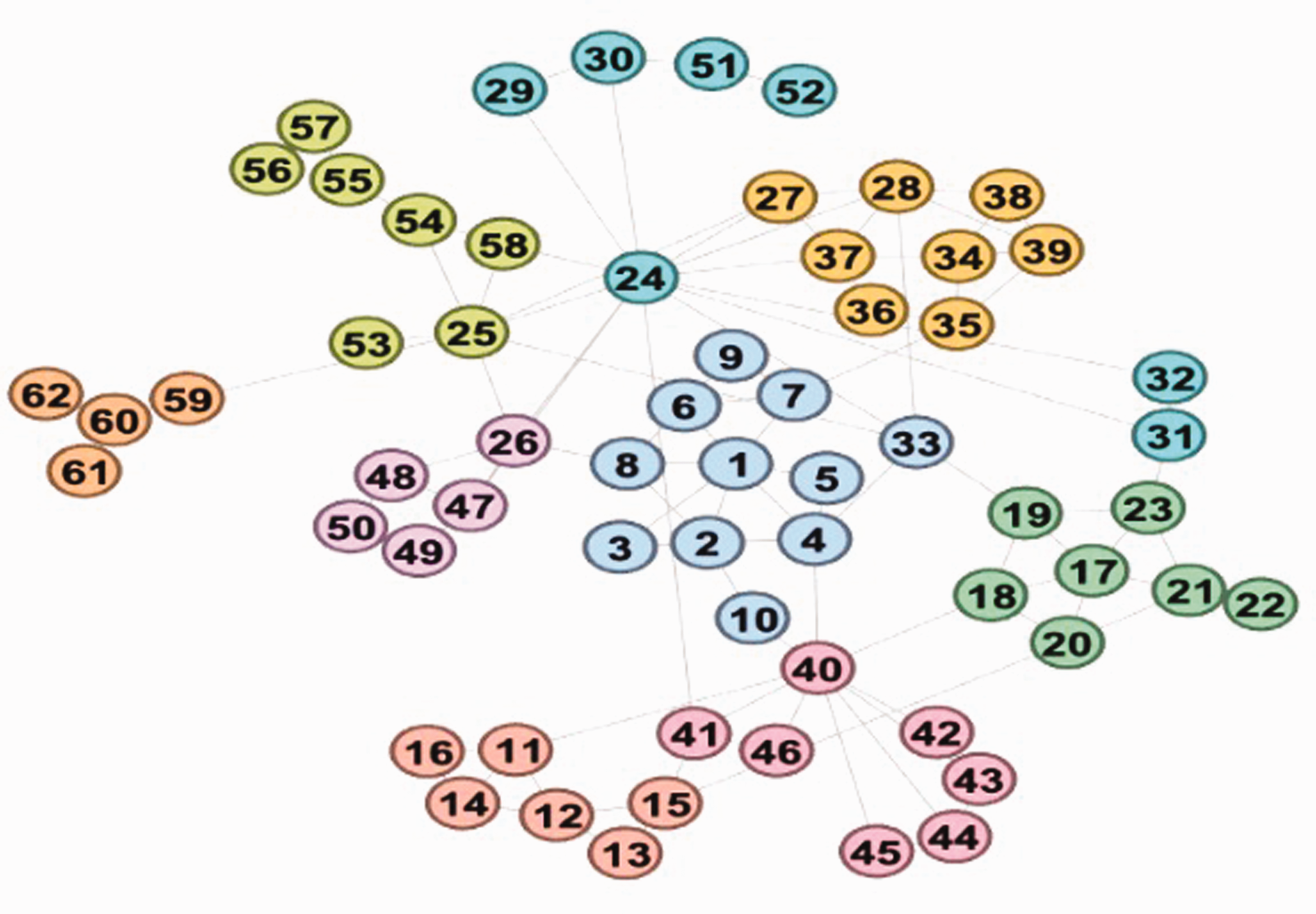
Undirected graph of Excel data using Gephi 9.2 poly network of 62 participants.
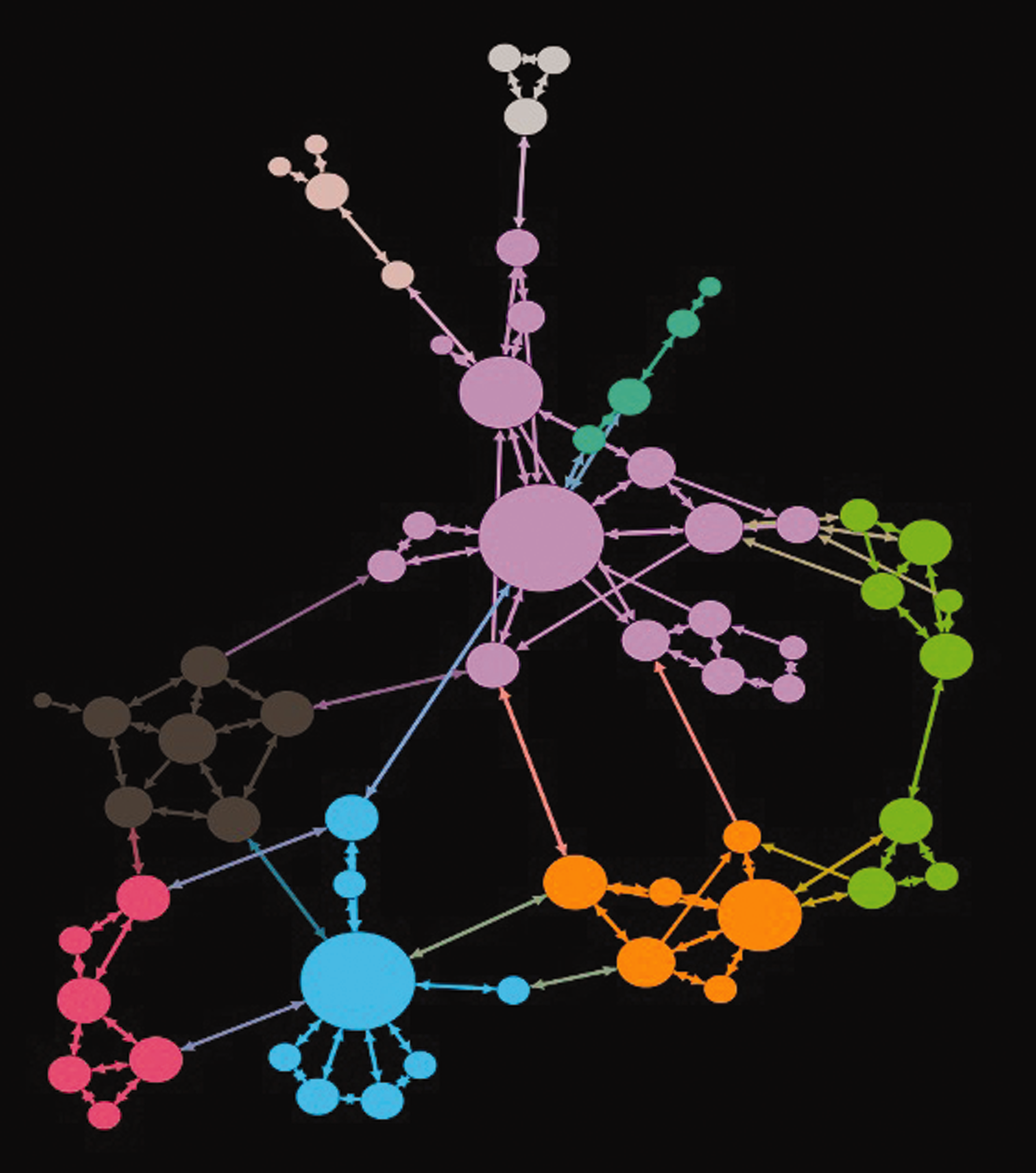
Directed graph of Excel data using Gephi 9.2 poly network of 62 participants.
The next step was to use the following network metrics to assess individual node strength: (1) density/degree, (2) indirectedness, (3) transitivity, and (4) homophily. Be aware that in SNA there is little agreement on the exact definitions and rules relating to network metrics. To avoid confusion, I present my definitions, rules and formulas, and unique process, below. Future research is needed to standardize metrics as well as pave the way for new, innovative metrics, such as the “indirectedness” measure I introduce in this work.
Density/degree
One of the goals of the current study was to identify the nodes with greatest influence and power (Burt, 1987; Hage, 1979; Podolny, 1997). Nodes with high density have a greater capacity to influence others in the network. To measure density, I counted the number of edges for each node and divided this number by the total possible number of edges per Laat’s guidelines (2007). 18
Indirect ties/indirectedness
Density alone does not tell the whole story. According to Granovetter (1973), bridging or indirect ties are more useful to acquire novel information, allowing individuals to reach their full potential in networking by acquiring social capital. This approach is appropriate to polyamory, where people attend a variety of poly meet-ups and become acquainted with someone new, experiencing new relationship energy (NRE) with an indirect tie (a friend of a friend, or someone new to polyamory). According to Rogers (2010) and Rice (2011), this process allows crucial data to be obtained through ties with associates (non-friends and non-lovers).With the poly ethic of free love-sharing and relationship anarchy, 19 it is quite normal for individuals to create quick bonds with strangers and those they meet tangentially. Individuals with high betweenness links (the shortest path between nodes) are often referred to as “brokers” because they connect otherwise isolated clusters of a network (Freeman, 1977). Though betweenness is valuable, I suggest a different, adjacent, strategy that uses indirect ties as measure of one’s central position in the network, which calculates the number of links one’s direct link has with others, following the logic and value system of compersion. 20
Transitivity
Another important measure of influence and central location in the network is the number of direct and indirect ties that form a triangle, or mini polycule (Holland et al., 1971). Triangles/triads indicate a wider range of possible sets of relations by one extra person, with additional types of exchanges, such as sex, friendship, and possibly economic sharing and childcare. One is linked to a lover, as well as to that lover’s lover (metamour). In the case of Node#1, her partner tends to sleep with her friends, which made her the “between” tie that connected her friends with her partner in a unique triad (#1, #2, and the cis-woman that is linked to both of them through sex and friendship). This tendency to bond with one’s metamour is what Iwanowska (2018) found vital to the stability of the network, where metamour connections are more vital to one’s success than are connections to lovers.
Table 1 presents the participants with the three highest density/degree, number of indirect ties, and transitivity scores, showing that two cis-females and one trans-female exhibit the highest scores. Using Laat’s formula for measuring density/degree, I calculated the number of connections a participant has, divided by the total possible connections a participant could have, which is 61 (with 62 subjects). Thus, if N is node edges, T is total possible connections, and D is degree/density, then N ÷ T = D. For indirect ties, as shown in Figure 3, I counted the number of edges connected to each of a node’s direct ties. So, for #24, we can see that by connecting to her partner #28, that also connects her other valuable nodes (#27, 37, and 39). Transitivity is computed by simply counting the number of triangles each node has in the network, such as where #24 creates a triangle between #58 and #25, forming a bond with a lover and her metamour.
Node density/degree, indirectedness, and transitivity high scorers.
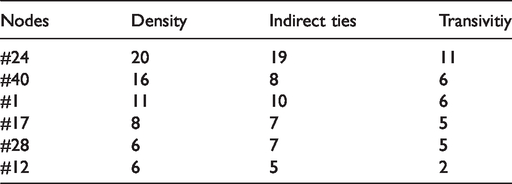
Note that node #24 has a density of 20 (12 direct ties divided by 61), 19 indirect ties, and 11 triangles. She also exhibits multiple-trait strength in the areas of bisexuality, caregiving, kink, and “family.” Node #40 also shows high density of 16 (10 div. by 61, with 8 indirect ties and 6 bridging ties). This individual is a trans-female, zebra, kink, who is politically and economically well connected. Node #1 is also highly connected, having founded the group. She is a bisexual cis-woman with a density of 11 (7 div. by 61, with 10 indirect and 6 bridging ties). In 4th, 5th, and 6th place, were nodes #17, a bisexual cis-woman, #28, a bisexual cis-woman, and #12, a straight cis-male. Triads were also calculated using Gephi 9.2 21 with high scores for #24 (11), #1 (6), #17 (5), #28 (5), #25 (5), #40 (4), and #27 (4). Thus, with a single exception (#12), individuals with positions of power in the Paris polyamory network tend to be women who had (1) high numbers of sexual and intellectual/emotive ties to others across polycules, (2) more indirect ties, and interestingly, (3) a strong sense of family, created through inclusive, triadic bonds of lovers and metamours.
Homophily
Another measure of position strength used in the current study was homophily which is a measure of common traits of nodes in the network (McPherson et al., 2001). Both men and women exhibited relatively the same number of multiplex connections in common with others in the network, with a slight, non-significant, advantage to women. To explain homophily in the Paris poly context, people's personal networks are homogeneous with regard to many sociodemographic, behavioral, and intrapersonal characteristics. For example, they are drawn to kink and progressive politics, to organic localvore cuisine and global warming demonstrations. They love the same movies attend similar sex clubs and swing parties. Having many traits concurrently, in addition to sharing sexual partners, childcare, and an interest in the same poly values, strengthens the connections between nodes and provides cohesion to the network. Paris polyamorists are drawn to others like them who also practice nonconventional sexuality (K kink), 22 gender/sexual non-conformity (Q queer), 23 have atypical intelligence (Z zebra), and a relatively high IQ (which I call “B” for brainy). In a tally of clustered traits among the initial 45 interviewed subjects, cis-females (ZBQK 7% and ZQK 7%) surpassed both males (ZBQK 4% and ZQK 1%) and “other” (ZBQK 4% and ZQK 1%). 24 I would argue that this slight advantage in clustered traits relates directly to Dahlberg’s (2009) premise that women are better equipped to juggle multiple concerns within multiple relationships.
Yet, in applying the Excel data of gender (cis- or trans-male=1, cis- or trans-female=2, and non-binary=3), and the four key variables, it appears that male–female difference may be only a mitigating factor. The data were first analyzed using within-sample paired t-tests to assess whether there was any significant difference within and between the four variables (HIQ or “B,” kink, queer, and zebra). The differences between each pair of the variables were not statistically significant, except that kinkiness was significantly higher when compared with queerness by a mean difference of 0.155 points (see Table 2).With a medium effect size (ES) of 0.40, it can be concluded that this finding is of practical significance. 25
Overall mean difference between kink and queer.

*p < 0.05.
A one-way ANOVA analyses did not reveal any overall difference across all examined variables, suggesting no differences across gender, except for gender and queer that is marginally significant, F (2,42) = 3.31, p < 0.05 (see Table 3). It is interesting to note that cis- and trans-women (M = 0.316, std = 0.478) had a slightly higher mean of Q (gender and sexual non-conformity) when compared to men (M = 0.300, std = 0.470), suggesting that women had a slightly higher disposition for queerness than men by 0.016 points. In other words, the cis-gendered females of the group (12 individuals) were interested in moving beyond heteronormativity to explore relations with another female, even in some cases, with their metamour (their male partner’s lover). By contract, in a group of 64 subjects, only two cis-males stated a bisexual orientation.
A one-way ANOVA analysis comparing gender and queer.
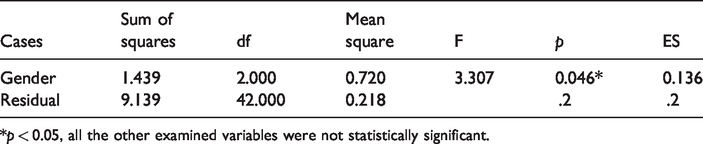
*p < 0.05, all the other examined variables were not statistically significant.
There are reasons, however, to remain critical with the multivariate analysis of shared traits, as the sample size is small and more data points are required, particularly, in the case for gender “other” category. This problem is illustrated in Figure 5, through the use of IBM SPSS analysis, examining possible links between gender (as defined earlier) and queerness, kink, and atypical intellect (zebra). This figure shows no strong gender significance (0.369), which suggests that there is virtually no difference between men and women in their trait clusters. Further, where only two women (#24 cis-female and #40 trans-female) have more multiplex ties, the rest seem to exhibit no gender differences.
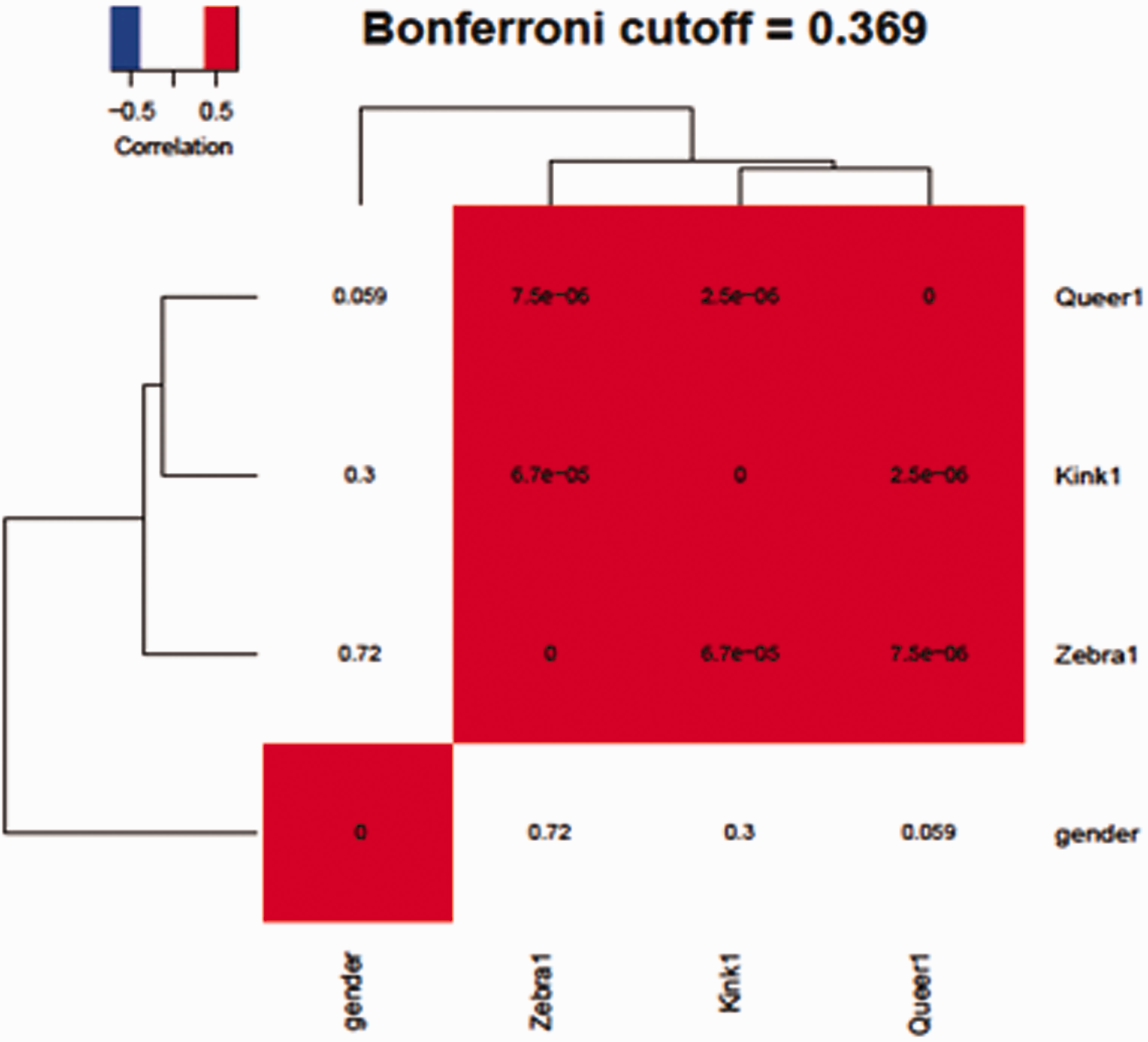
Excel multivariate analyses of queerness, kink, and zebra measured against gender.
Discussion and conclusion
The current research provides the first application of network theory to ethnographic data on a polyamory community, showing the uniqueness of structure and interconnections within the tiny Paris poly community. The results show high endogamous modularity and a strong feminine core in the network (with five of the six top scores of density/degree, indirectedness, and transitivity being cis- and trans-females). And although no significant gender differences were found in measures of homophily (Bonferroni cutoff of 0.369 and p value of .046), the tally of traits within the earlier dataset of 45 subjects indicates female strength in trait clusters of queerness, atypical intellect, and kink (7% cis- and trans-females compared to 5% for cis-males). This can be explained by many factors. Firstly, there is persistent feminist drive at the core of poly philosophy for individual fulfillment and gender equality (see Copeland’s (2012) apt review of the woman-friendly roots of polyamory). This translates into a comfortable forum for female libidinousness and sexual exploration. Secondly, females are more likely to adopt hierarchical dyadic and triadic bonds with two-to-four lovers, whereas males were more likely to adopt non-hierarchical anarchist star configurations with four-to-seven partners. This suggests that females are striving for a family-centric model, creating more intimate, long-lasting bonds of sex and friendship that also include childcare. 26 Thirdly, women have been trained to excel at interpersonal communication and tend to be the center of the web of domestic activity, with a strong focus on relationships, care of others, and multi-tasking. This has been extensively studied (Eagly and Carli, 2007; Gilligan, 1982). 27 Button (2019) found this to be true among UK polyamorists where women were 17% more likely than their male partners to initiate communication. Fourthly, cis-females seem to experience greater sexual fluidity than cis-males do (see the Table 3 one-way ANOVA showing women’s higher disposition for queerness than men), embracing bisexuality, pansexuality, and establishing connections of friends who are lovers (les amireux). This may be due to the stigma towards gay, bisexual, pansexual men and the greater freedom of expression for cis-females in Paris, which approves and erotizes the bisexual/pansexual explorations of women, as long as they keep it clandestine. This deeply rooted contempt for non-heteronormative males is also found in the U.S. (Bostwick et al., 2014). 28 According to Klesse (2006), Kolesar (2011), and Sheff (2005), bisexuality, especially among cis-women, is highly correlated with polyamory. It is especially advantageous in small, stigmatized populations, where women adaptively secure centralized positions in the network to access resources. As for mitigating factors of race and class, the top six scorers were white, with the exception of #17 who is of African descent, highly educated, with a middle- to upper-class income.
In sum, women have the highest density, indirectedness, transitivity, and homophily scores in the Paris poly network. These results also show endogamous tendencies where individuals form tight clusters with an extremely small set of friends and lovers who are drawn from the same FB polyamory group. These clusters are formed among those who are certain that their interactions with each other are safe, among those who share the same values and who often feel equally marginalized in the larger, mono-normative French mainstream which sees cheating as a more preferred strategy than polyamory. It also mirrors the findings of Balzarini et al. (2019), that poly is female-driven, where participants seek nurturance and inclusion within their network while simultaneously experiencing erotica with secondary and tertiary partners. This suggests that wide-spread “sleeping around” without attachment is less common in polyamory than one would think. The results also indicate mitigating factors of socioeconomic advantage, racial privilege, and queerness (non-conforming sexual orientations and gender identities). 29
Limitations and future considerations
Despite the strengths of this preliminary analysis, there are some features of the sample and methods that may limit generalizability. Firstly, subjects were not randomly selected, but were drawn from a small, convenience sample. The results, therefore, may only represent the FB poly group of 300 active, more extrovert members, who attend monthly meet-ups and BDSM functions, not the wider more introvert, suburban and rural polyamorists who do not belong to the same circles. It is likely there are others who don’t use Facebook, who are in lower social classes and/or queer poly circles, not frequenting the cafes. Secondly, network strength does not necessarily translate into satisfaction. Many highly influential, well-positioned participants remarked that being at the center of the networks is time consuming and demanding. 30 Thirdly, and most importantly, there were serious differences in how individuals choose to define a loving relationship. I recorded all sexual exchanges between nodes for the last four years, but found that not everyone defined these exchanges as legitimate relationships. Some just saw them as acts of sex. In some cases, a participant would identify another as a sex partner, but the later would not reciprocate, as shown in Figure 4 where a handful of nodes have directed arrows, not two-way arrows. In short, the definition of love, what constitutes a relationship, and exactly who is linked to whom is subjective and inconsistent. In order to assess the discrepancies between my understanding of the connections between people and the subjects’ perception of their polycules, I presented my conceptualized network to several key leaders of the polygroup via FB Messenger and in a CRI June forum in Paris. Most of the men said that I had counted too few of their actual lovers and asked me to expand the number of vertices in their polycules, while the women said that I counted too many of their lovers and that they only wanted those who they really cared about to be a part of their polycule. This seems to parallel the findings of David Buss’ (1998) conclusion that men are drawn to many, non-intimate partners, whereas women seek loving relationships in their sexual partners. Two subjects said since my last visit they had time to reflect, and they remembered many more lovers, as many as 50 in the last few years, that they had failed to mention before. Two other “families” began drawing their networks and found 10–15 additional vertices each, indicating a much more complicated and abundant polycule than was presented to me in earlier interviews.
Future work should assess network measures of centrality, homophily, and sexual selection criteria among a much larger, representative sample, including those unaffiliated with the FB groups and city environments. These metrics can include the use of algorithmic formulas for density and homophily, which are absent in this current study. Research should be conducted on comparisons with other small European poly communities (Berlin perhaps) and larger communities (San Francisco), to assess how size of group and culture informs network differences. 31 Continued research is needed to examine gender as a mitigating factor in polyamory, seeking data on whether polyamory’s pro-feminist ideology and sexually-fluid atmosphere is succeeding in creating a gender-blind atmosphere. Future studies should create user-friendly Likert-scale surveys and attached game software allowing polyamorists to self-design their polycule with updated classifications such as “sexual partners,” “romantic partners,” “amireux,” “childcare,” and “flat-sharing.” This form of citizen- or participatory-science will yield higher data results than an etic interpretation of what constitutes a loving relationship for each node. Further, longitudinal studies should be conducted, assessing how the network has evolved over the last 5–10 years. Sheff’s (2016) work is a good example of such research.
Glossary
(Some terms were explained to me from the Paris poly group; others, I obtained from the More Than Two site: https://www.morethantwo.com/polyglossary.html?fbclid=IwAR3dMNXO-MnFqMp4h0ufxguEDbpXZ32XU2rF-bX_71QeR2w2o5WW6YRwzCg
Polyamory: Consensual non-monogamy where individuals have multiple loves.
Compersion: The opposite of jealousy; the feelings of happiness that your lover(s) are also loving and being loved by other lovers.
Non-hierarchical polyamory (aka relationship anarchy): Multiperson relationship where all have equal ties to the other.
New Relationship Energy (NRE): The lovely euphoria you experience when you become involved with a new love.
Kitchen table/parallel poly: Inclusive family-style poly/“don’t ask, don’t tell” poly.
Amireux: A friend lover “quelque chose” situation.
Triad: A multiple partnered relationship with three people. Can also be a V shape where one person loves two people or a true triad where all three love each other equally.
Quad: A multiple partnered relationship with four members
Solo Poly: Where one person has several lovers that don’t live with them.
Metamour: A non-romantic bond between persons x and z, who are both romantic partners of person y.
Unicorn: A bisexual person (usually though not always female) who is willing to join an existing couple, often with the presumption that this person will date and become sexually involved with both members of that couple, and not demand anything or do anything which might cause problems or inconvenience to that couple.
Mono-poly: Where a monogamist is in love with a polygamist/polyamorist
Poly saturation: This refers to taking the time to figure out how much time, energy, love, and other resources you have available to spread across your relationships; it is also related to being unwilling to add new partners to your polycule.
Supplemental Material
sj-xlsx-1-sex-10.1177_1363460720975328 - Supplemental material for Polyamory in Paris: A social network theory application
Supplemental material, sj-xlsx-1-sex-10.1177_1363460720975328 for Polyamory in Paris: A social network theory application by Janet Bennion in Sexualities
Supplemental Material
sj-pdf-2-sex-10.1177_1363460720975328 - Supplemental material for Polyamory in Paris: A social network theory application
Supplemental material, sj-pdf-2-sex-10.1177_1363460720975328 for Polyamory in Paris: A social network theory application by Janet Bennion in Sexualities
Supplemental Material
sj-pdf-3-sex-10.1177_1363460720975328 - Supplemental material for Polyamory in Paris: A social network theory application
Supplemental material, sj-pdf-3-sex-10.1177_1363460720975328 for Polyamory in Paris: A social network theory application by Janet Bennion in Sexualities
Footnotes
Declaration of conflicting interests
The author(s) declared no potential conflicts of interest with respect to the research, authorship, and/or publication of this article.
Funding
The author(s) received no financial support for the research, authorship, and/or publication of this article.

Supplemental material
Supplemental material for this article is available online.
Notes
References
Supplementary Material
Please find the following supplemental material available below.
For Open Access articles published under a Creative Commons License, all supplemental material carries the same license as the article it is associated with.
For non-Open Access articles published, all supplemental material carries a non-exclusive license, and permission requests for re-use of supplemental material or any part of supplemental material shall be sent directly to the copyright owner as specified in the copyright notice associated with the article.
