



Abstract
Being Between Binary is a visual critical auto-ethnography, combining collage, cartoon, narrative and photomontage in the form of a four-page A2 scrapbook. Conceptually and materially, the design combines map and memoir, placing Massey’s concept of power geometry into dialogue with personal experiences of sexuality and gender. The piece explores binaries and geographies of here/there, Global North/South, through a lens of borderlands, boundaries and crossings, modelling dissemination as a fluid space of continuing enquiry. This visual essay first contextualizes the making of the piece as creative fieldwork, matching ‘a synthesis of shattered fragments’, and then presents images of the work with brief commentary.
Introduction
Being Between Binary is a visual critical auto-ethnography. (Davis 2008: 250) I use visual methodology as ‘not only a contemplation of the self but also an examination of systems, cultures, discourses and institutions that privilege some and marginalize others’ (Lipton and Crimmins 2019: 229). This auto-ethnography juxtaposes personal biography with global inequalities, re-storying a trajectory of gender and sexuality through metaphors and materialities of mapping, place and space. The piece combines cartoon, narrative, photomontage and collage in the form of a four-page A2 scrapbook (Figure 1). It presents an experiment in data revisualization, ‘that is transforming research data, visual or otherwise into new multimodal creative outputs’ (Mannay, 2019: 659). I created Being Between Binary in response to the call for contributions to the conference Here versus There: Beyond Comparison in Queer and Sexuality Politics, held at Maynooth University in June 2019. The conference theme addressed binaries of here/there, Global North/Global South, in terms of sexual and gender politics, legalities and geographies. This Special Issue has emerged from the conference, the themes of which are further discussed in the Contexts section of this visual essay. Being between binary cover page. The ‘scrapbook’.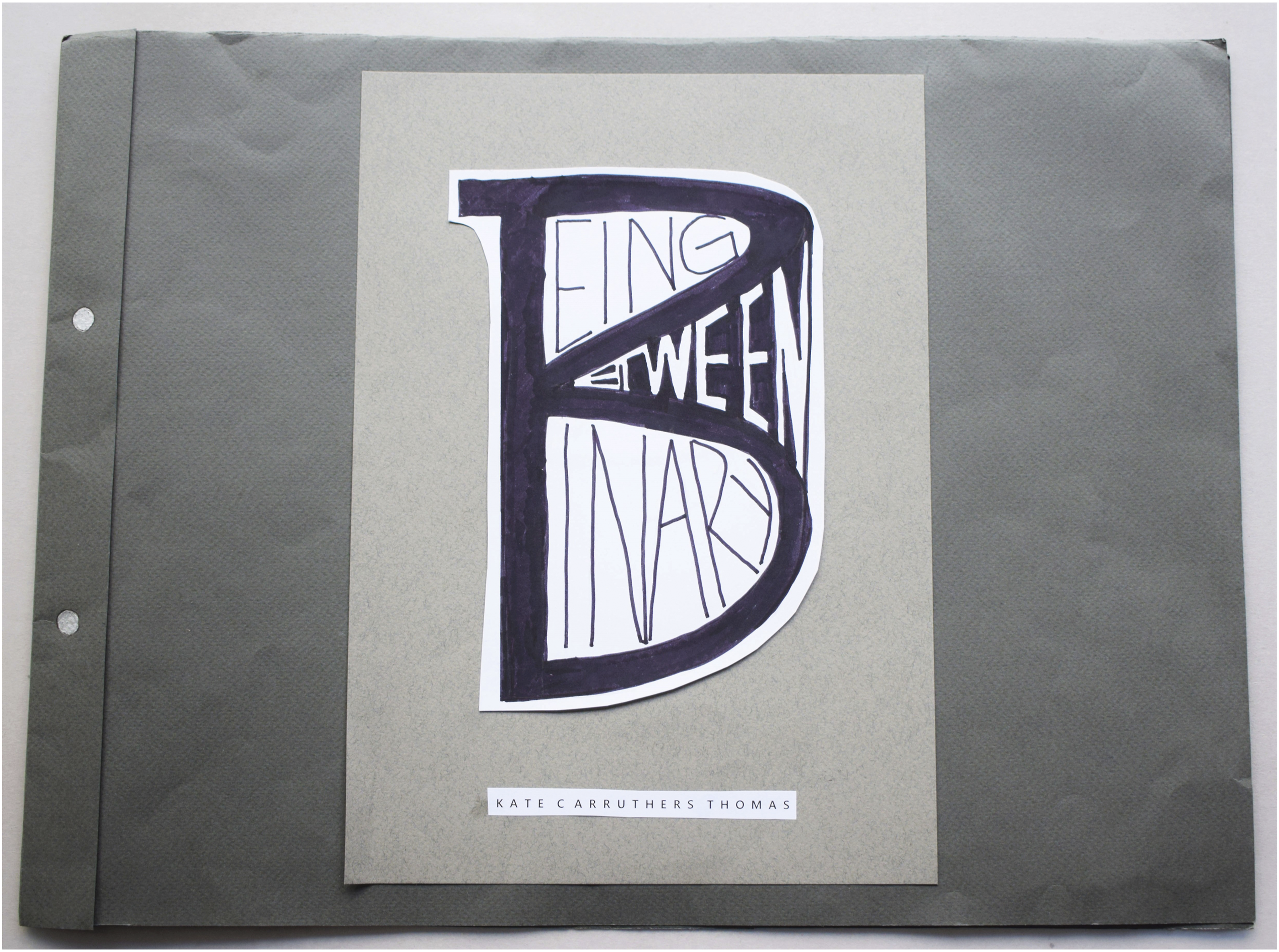
While the piece was created for exhibition and discussion at the conference, here I present it again, in a visual essay: a ‘combination of images and textual parts thoughtfully laid out to create a synergy out of their distinct contributing modes of expression’ (Pauwels, 2010). In the next section, I follow Heng’s (2019) practice in creating a context for the reader, to assist their appreciation of the visual nuances of the images that follow. I discuss ways in which the piece addresses gender and sexualities scholarship through lenses of power geometry (Massey, 2007) and borderlands (Anzaldúa, 1987), using re-storying and creative methodologies to create new engagements with issues of power, space, gender and sexuality. Crucially, the work presented here invites the viewer to consider the power geometries at both global and embodied scales. These two scales are intimately linked and held in tension in order to conceptualize a ‘third space’, one that is full of queer and fluid possibilities.
Contexts
The call for contributions to Here versus There invited critiques of problematic boundaries between Global North and Global South, including binaries of sexual and gender politics, geographies and legalities. Global North and Global South are contested terms: the Global South normatively defined by a Global North perspective, positioning the Global North as a place of progress, while ‘elsewhere is (re)produced as the space of legal and political violence that has yet to progress’ (Lalor and Browne, 2018: 208). Brown et al. challenge this dynamic by understanding Global South as ‘a relational term that emphasizes a diversity of uneven and unequal geopolitical power relations, both historically and in the temporary period’ (2010: 1568). These debates have been energized by vibrant bodies of literature addressing geographies of sexualities and queer geographies (Bell et al., 1994; Binnie, 1997; Browne and Nash, 2010; Browne et al., 2009; Elder, 2002; Hubbard, 2002; Halberstam, 2005; Valentine, 1996, inter alia). It is important to note, however, that this literature has also been critiqued for an Anglo-American focus (Kulpa and Silva, 2016).
My research tends to focus on investigating the ways in which gender operates as a geography of power in the spaces of higher education (HE), exploring dynamics of borderlands, boundaries and crossings within the institution. As an academic employed by a UK university and my research on gender and higher education, my work is a version of insider research; ‘a blend of the academic and the couldn’t-be-more-personal’ (Singh, 2019). My research is interdisciplinary, drawing on theoretical and methodological concepts of education, sociology and geography. I also experiment with creative research and dissemination practices including graphic social science (Carrigan, 2019). I do not claim to be a scholar of sexualities or the law. In responding to the conference call, I was myself pushing boundaries and crossing borders.
In Being Between Binary, I maintain a focus on space and power but shift my focus from the institutional to the personal, placing stories of my life within stories of the social context(s) in which they occur (Humphreys, 2005; Reed-Danahay, 1997). It is this connecting of the personal to the cultural (Ellis and Bochner, 2000) which is at the core of auto-ethnography. Using both process and product, auto-ethnography combines elements of autobiography (using hindsight to write retroactively and selectively about past experiences) and ethnography (studying cultural beliefs and practices through being a participant observer) to facilitate understanding of that culture for insiders and outsiders (Ellis et al., 2011: 274). An auto-ethnographic approach ‘acknowledges and accommodates subjectivity, emotionality and the researcher’s influence on research, rather than hiding from these matters or assuming they don’t exist’ (Ellis et al., 2011: 274). In Being Between Binary, I (literally) draw connections between space and power and my personal biography of sexuality and between experiences shaped by binaries and oppositions. My ‘self is the research tool and thus intimately connected to the methods I deploy as I re-present experiences through different media’ (Cousin, 2010: 10).
Being Between Binary brings theorists into dialogue with one another through a borderland analysis: ‘the principle of which is to … straddle multiple theories using ideas from each to portray a more complete picture … a new theoretical space’ (Abes, 2012: 190). The dialogue takes place in visual terms, between feminist thinkers offering critical reflection on spaces between binaries: Ahmed (2016), Anzaldua (1987), Brah (1996) and Massey (1993). Massey is a key theorist in my analyses of gender and higher education; a white British geographer who brings her understanding of space ‘as social relations shaped by power’ (2005: 9) to regional development, globalization, political economy and divisions of labour. Through the concept of power geometry, Massey articulates groups’ and individuals’ differential capacities in relation to flows of capital, colonialism, migration, social relationships and culture. ‘Power geometry does not imply any specific form (any specific geometry). It is a concept through which to analyse the world … an instrument of potential critique’ (Massey, 2007: 321). In Being Between Binary, power geometry offers an instrument with which to interrogate binaries and geographies of here/there and Global North/Global South. It is presented here in dialogue with borderlands theory (Anzaldúa 1987) and diaspora (Brah 1996). Anzaldúa, a Chicana scholar, writing in postcolonial, feminist and queer contexts, challenges the binaries of Western thinking, calling for a ‘new mestiza’, an individual aware of conflicting and meshing identities. Her work gives shape to a third space, ‘a new location where individuals fluctuate between two discrete worlds, participating in both and wholly belonging to neither’ (Abes, 2009: 258). Brah’s conceptualization of diaspora and diaspora space allows opportunities for transformation and reconstitutions ‘via a multitude of border crossings… territorial, political, economic, cultural and psychological’ (1996: 206). Ahmed, too, explores ways in which bodies are situated in, inhabit and resist space and time (2017, 2014, 2012, 2006 inter alia). A lesbian feminist of colour, Ahmed’s feminism is explicitly intersectional. She proposes that queerness disrupts and reorders the spatial arrangement of social relations (2006).
The acknowledgement and problematizing of positionality are central to a critique of unequal power relations: between Global North and Global South, the binaries of sexual and gender politics. As a white, cisgender British female, living in a northern UK city, working in a super diverse UK city, my positionality shapes – and biases – the questions I ask and the work I produce as a result. Yet, individual identities are “a shared positional space [that] should not be viewed as simply a process of “racial and gender matching” [but incorporating] the dynamism of individual identities’ (Mullings, 1999: 341). Creating Being Between Binary involved reaching back in time, through memories and artefacts, deploying hindsight to trace an identity in flux, a multiplicity of positionalities, a fluid negotiated view of positional space. Being white, being cis-female, places me in the majority categories of the UK population – yet I have always felt ‘different’.
My formative years were shaped by the homophobic and sexist sexual climate of 1970s and 1980s Britain and limited exposure to other cultures and ways of being. While heteronormative scripts of stereotypical femininity, marriage and motherhood offered no reflections of my own desires, there were few legitimate alternatives on offer in a pre-internet, semi-rural, small English town in South West England. I primarily railed against my perceived limitations of being female (Renold, 2008; Reay, 2001). I wore my hair short and was labelled a ‘tomboy’, an identity I performed and embraced with enthusiasm in my pre-teen years, with no conscious understanding of the ways it allowed me to queer gender dualisms and navigate borders. In my teenage years and early twenties, the tomboy identity became more problematic as puberty and peer pressure kicked in, leading to determined but ultimately unsuccessful experiments with heterofemininity.
In re-thinking and re-presenting my experiences of gradually acknowledging my lesbian sexuality, I found myself engaging in a familiar metaphorical architecture of geographical queer semiotics (Zebracki and Milani, 2017: 433): coming out, coming home. However, there is no final destination, instead a move into a third space, a concept that resonates with the idea of queer ‘that challenges us to think beyond and through process of normalization … queer not as a simplistically appropriated identity category, but as a fluid set of possibilities and contestations’ (Browne, 2006: 888). I now live openly in a civil partnership, self-identifying as a gay woman, my sexuality and primary relationship recognized by the UK legal system, but I still live in ‘a slant-wise relation to a straight world’ (Ahmed, 2016). Waves of resistance and legislative change over decades have led to an apparently more tolerant cultural environment for sexual and gender politics in certain communities, but homophobic and transphobic prejudice and hate crimes persist. I continue to be othered even while my colour, ethnicity, class and Global North positionality privilege my trajectory.
Creative fieldwork
As an academic, I collect and analyse, distil and present data. In my practice as a graphic social scientist (Carrigan, 2019), I distil data through marks, materials and text as a means of communicating research and meanings on the page, board, screen or wall. Each piece I create develops my nascent understanding of the potential of graphic forms, conventions and multimodalities. A previous piece My Brilliant Career? An Investigation (Carruthers Thomas, 2018) took the form of a graphic essay: a large-scale, hand-drawn comic strip, reporting research findings into the interplay of gender, work and career. Data had been collected through interview and mapping exercises, and the graphic essay was structured according to the conventions of an academic paper. Data collection for Being Between Binary was quite different. Lengthy, laborious and solitary, it involved plotting of narrative, thematic and visual arcs in my sketchbook before beginning to gather materials. The evolution of the piece was inspired by the graphic memoir Heimat (Krug, 2019) in which the author uses ‘drawings, photographs and writing to make sense of her family’s past and her own German identity’ (Mouly, 2018). I too, was drawn to experiment with a multimodality as a means of reflexively exploring my personal narrative in its social context.
The design of Being Between Binary combines the structuring metaphor of the map with the physical format of a scrapbook or photo album, both artefacts which construct, commemorate and annotate the historical and the momentary. The practice of collage, in its simplest form a process of cutting and sticking. However, long before I used scissors or glue, I gathered family and personal photographs, cuttings, swatches of colour, textures and design over many weeks. Collage is also ‘a reflective process, a form of elicitation and a way of conceptualising ideas’ (Butler-Kisber and Poldma, 2010). In this piece, collage underpins and synthesizes techniques of photomontage, cartoon, mapping and narrative, a ‘textual-visual montage of imaginative associations’ which ‘underscores the transformative value of more-than-text-language dedicated geographical endeavour (Zebracki, 2017: 605–6).
I created a ‘canvas’ for each of the four pages and constructed it through matching ‘a synthesis of shattered fragments’ (Davis, 2008: 250). Repeated photocopying of each canvas constituted a continuous remaking, altering relationships between fragments and layers (Figures 2 and 3). Once satisfied with each canvas, I built up multilayered narratives, combining the visual and the textual. Canvas for page two: Work in progress I. Canvas for page two: Work in progress II.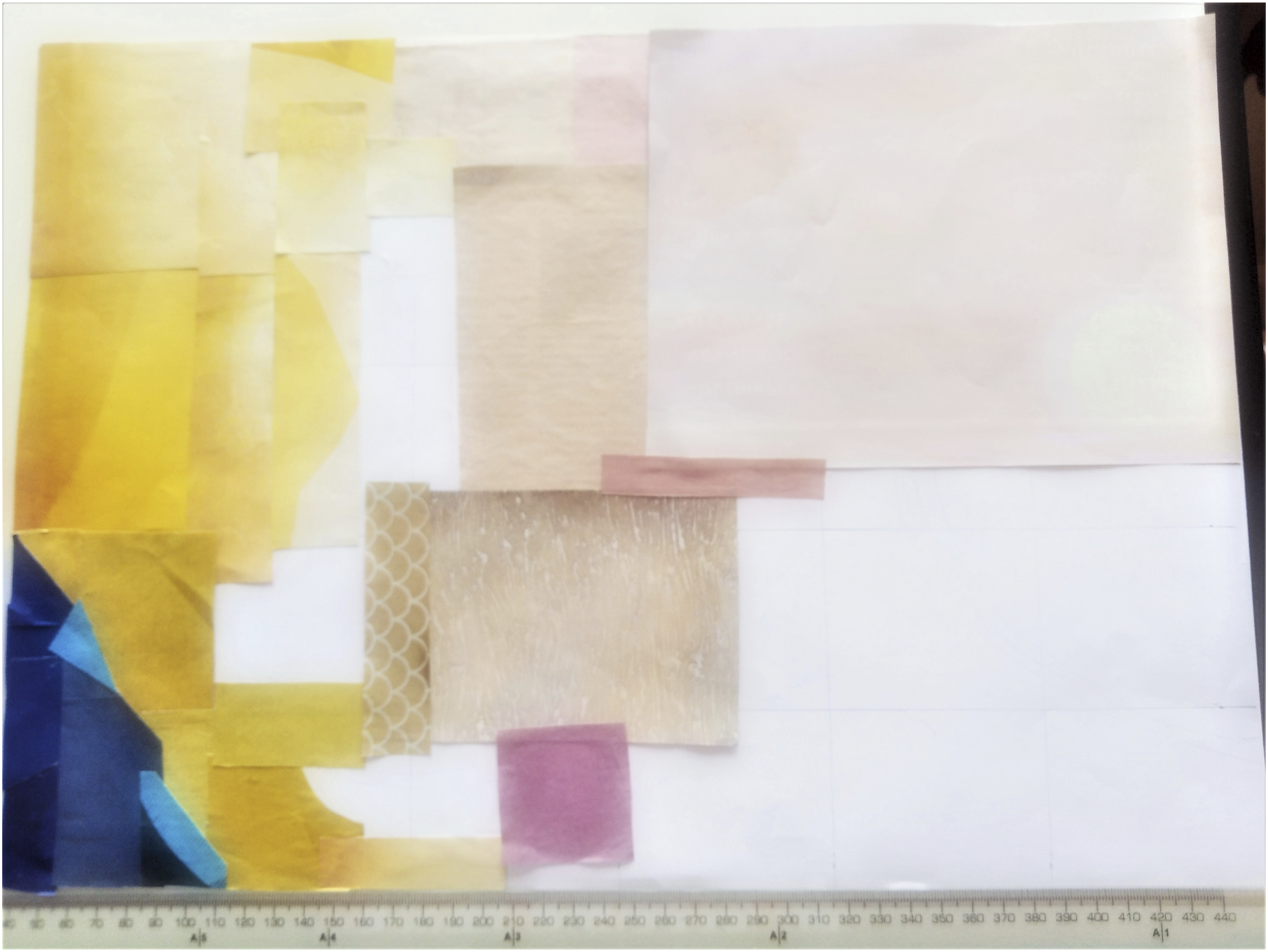
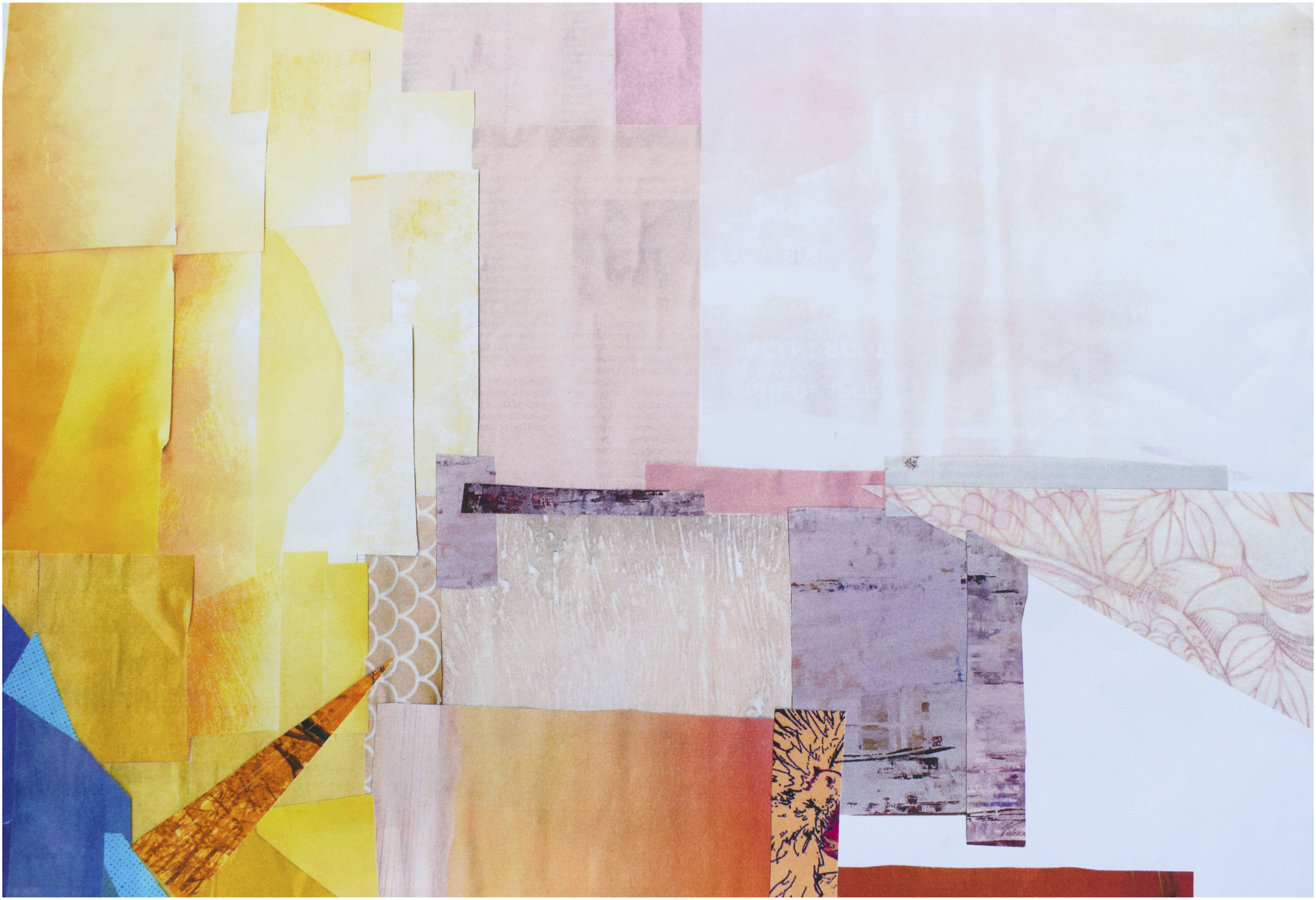
Each of the four pages is both self-contained and part of the whole. The Global North and Global South are represented by two halves of the globe on the first and last pages. Cultural, political and social scripts are represented across the pages by lines of longitude which flex as they encounter and are juxtaposed with waves of resistance and legislative change. As author, artist, maker and subject, I am literally at the centre of the piece, recovering and recounting heteronormative and homophobic scripts of my childhood and teenage years, social change and identity. Graduations of colour and texture convey progression from, and links between, one page to another. Being Between Binary models dissemination as a fluid space of continuing enquiry, rather than conclusion or closure. Presenting the piece at the June conference was yet another stage in a continuum of making, in which making constituted creative fieldwork and the ‘final’ artefact, a work in progress.
Reading the pages
One
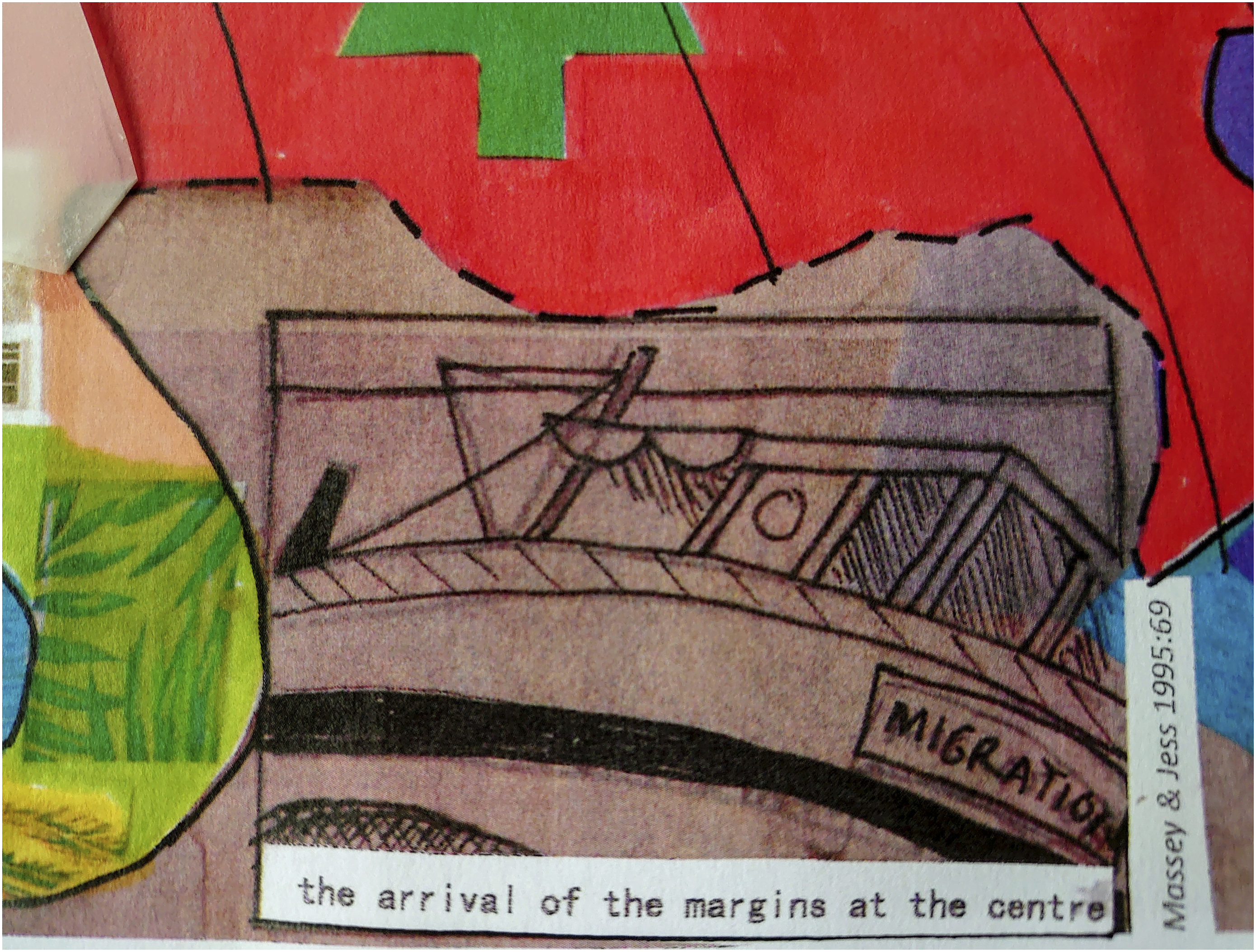
The first and last pages of the piece feature two halves of a divided globe. On Page One (Figure 4.) a cartographically stylized ‘Global North’ is represented as greedy and monstrous, hinting at early maps in which unknown territories were populated by mythical creatures. The colours are bold and rich, and continents are marked with symbols of political power: national flags, Trump, the ‘red’ swathe of the Russian Federation. An upright flag planted in the south east of England marks ‘here’, an assertion of centrality and certainty. In place of Turkey and its borders with Syria, Iraq and Iran, translucent paper can be lifted to reveal a cut-out of a beached boat named Migration and the words ‘the arrival of the margins at the centre’ (Massey and Jess, 1995: 69) (Figure 5). Mass migrations are a consequence of stark power inequalities across the globe. Page one: Global north – HERE. Page one: The boat MIGRATION.
At the top left is an inset of heteronormative family life: weddings, Christmas, motherhood and a small girl (me) proudly posing in ballet clothes. The framing text ‘a child is asked to aspire to the happy family photographs – not only traces of where she has been but suggestions of where she may go’ (Ahmed, 2017) prefigures a focus on norms, scripts and living between binaries in later pages. Page One also features a depiction of Doreen Massey alongside her definition of ‘power geometry’. This is the first of five ‘talking heads’, a technique of making female theorists and thinkers literally visible.
Two
The bold colours of the previous page begin to fade and fragment on the second page (Figure 6). Lines of longitude reappear but flex as norms and scripts conditioning ideas and understandings of sexuality and gender in the Global North are changed by resistance movements and events. The page references Women’s Lib, Stonewall, Section 28 and AIDS, juxtaposing them with gay stereotypes prevalent in my childhood and teenage years and pop icon Freddie Mercury whose biography became entwined with the AIDS epidemic. The words ‘pouf’, ‘dyke’ and ‘queer’ punctuate the page. The personal photographs show me experimenting with identity and appearance against the grain of stereotypical femininity in a ‘third space’ echoed by the second talking head, Gloria Anzaldúa, and a quote from her poem To Live in the Borderlands: ‘you’re a burra, buey, scapegoat / forerunner of a new race / half and half – both woman and man, neither / a new gender’ (1987). Page two: Anzaldua and third spaces.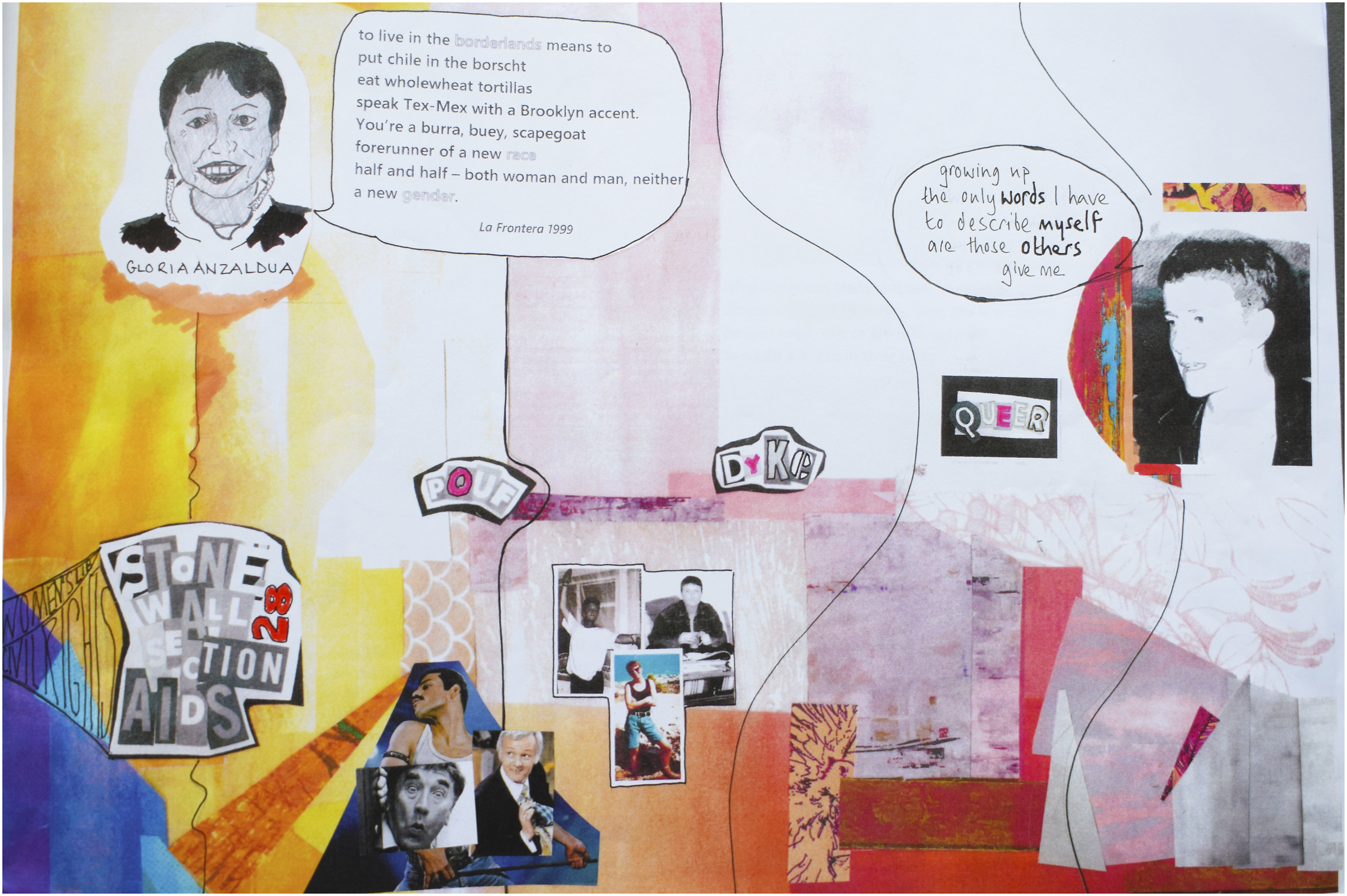
Three
Colours continue to blend and bleach on Page Three (Figure 7), the visual reflecting the possibility of oppositions dissolving into flow. Lines of longitude flex further, but also act as threads connecting the contrasting status of Global North and South in terms of the standing of same-sex relationships. The legalization of civil partnerships and same-sex marriages in parts of the Global North contrasts with continuing criminalization in some parts of the Global South. A WANTED board hints at dangerous territory, perceived as ‘the space of legal and political violence that has yet to progress’ (Lalor and Browne, 2018). Sara Ahmed’s ‘talking head’ offers respite from the homophobic insults on Page Two, reclaiming ‘queer’: ‘a word that has been flung like a stone; picked up and hurled at us’ … ‘a word we can claim for us’ (2016). Meanwhile, the words of Mckay (2019) hint at broader emerging dialogues of sexuality and identity. Page three: Oppositions into flow.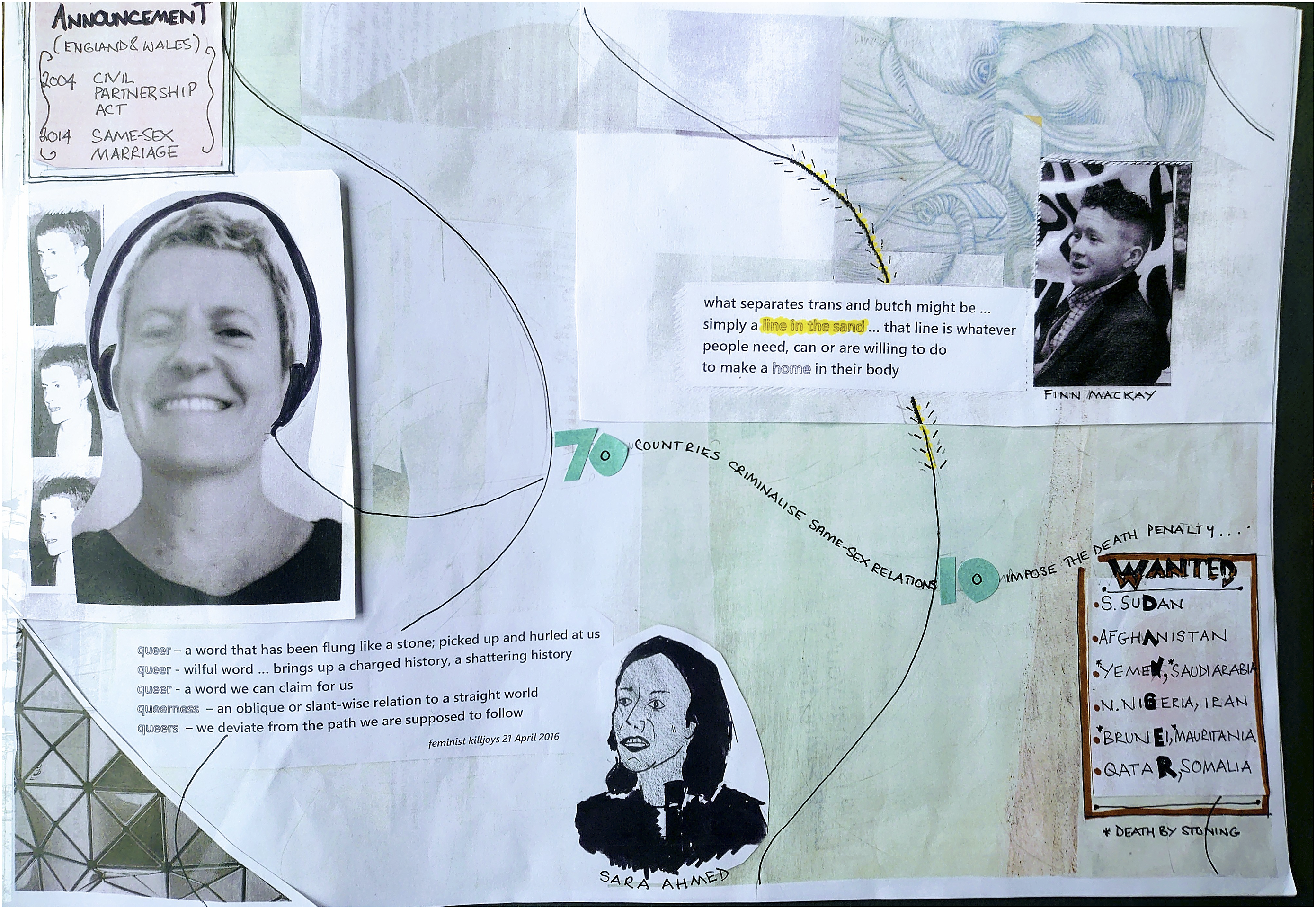
Four
On the final page, the ‘Global South’, the ‘other half’ of the globe, is depicted on a smaller scale than the ‘Global North’ (Figure 8). Another flag, reading THERE, is planted upside down in the continent of Africa. Both reflect perceptions of the Global South by a dominant North. In another mobile section, a serpent, bearing the quote: ‘colonialism: the centre installed at the heart of the periphery’ (Massey and Jess, 1995: 69), represents uneven power relationships then and now and recalls the migrant boat on Page One. The bold colours are back, but lines of longitude continue to flex across the page. In the final talking head of the piece, Avtar Brah’s concept of diaspora space offers the potential for re-thinking and re-inscribing multiple binaries. The page and the piece conclude with Massey’s phrase ‘“space time” as always under construction, never finished’ (2005). Page four: Global south – THERE.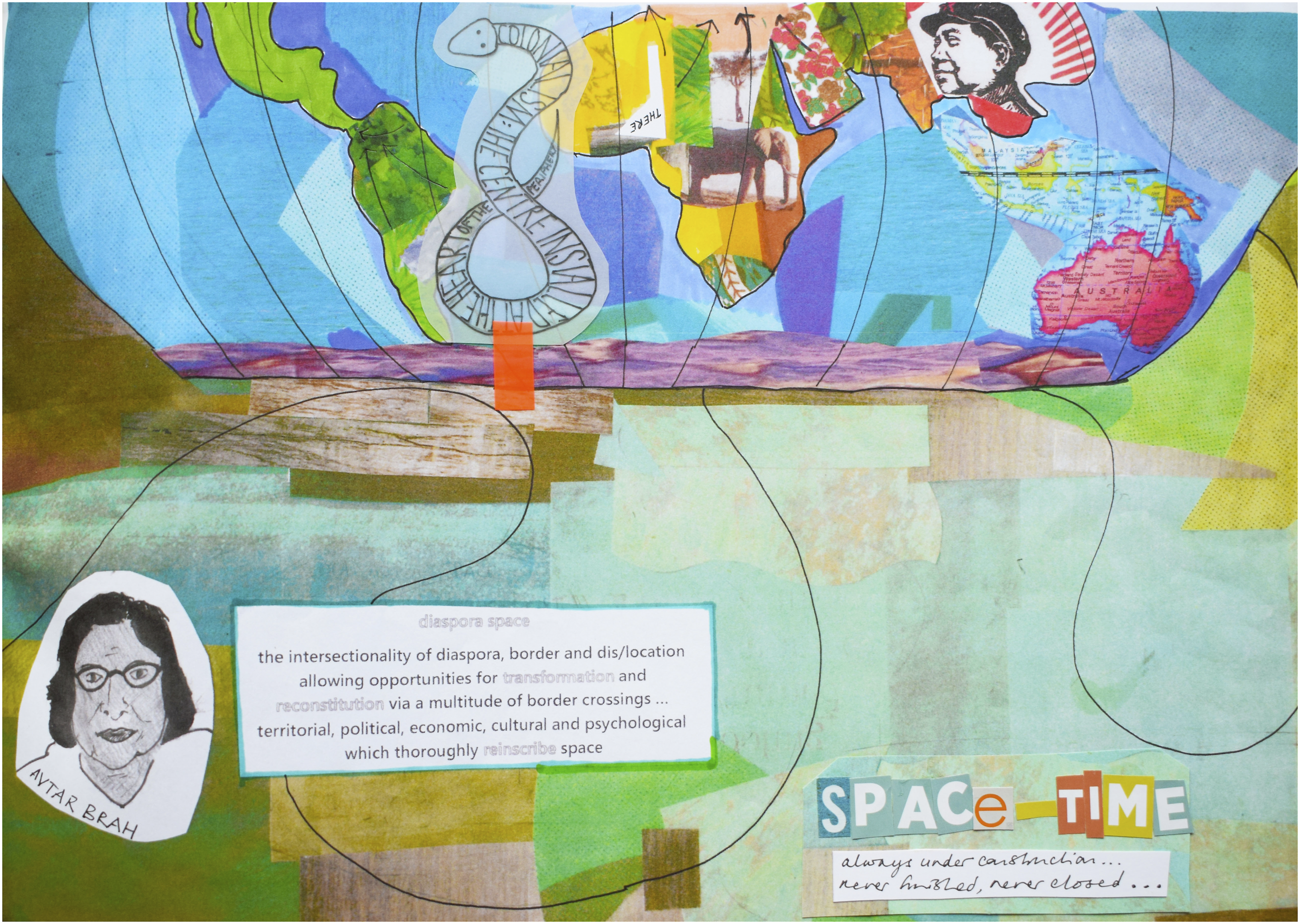
To conclude
Being Between Binary is a visual critical auto-ethnography exploring the connections of the personal to the cultural, spatial and political in the context of sexuality. It offers Massey’s concept of power geometry as an instrument of theoretical analysis and visual metaphor; it experiments with depictions of power inequalities and differential positionalities. The piece also explores the significance of a third space, in which we are ‘half in and half out of identities, subject positions and having the courage to be fluid in a world relentlessly searching for stability and certainty’ (Adams and Holman Jones, 2011: 114). As a contribution to this Special Issue, I propose that it extends possibilities for putting visual methods in dialogue with scholarship and crossing disciplinary, methodological and theoretical boundaries.
Footnotes
Declaration of conflicting interests
The author(s) declared no potential conflicts of interest with respect to the research, authorship and/or publication of this article.
Funding
The author(s) received no financial support for the research, authorship and/or publication of this article.
