




Abstract
Existing conceptualizations and measures of good sex are varied and inconclusive. Additionally, few studies have defined good sex from the margins, thus definitions are primarily informed from privileged perspectives. People with marginalized racial, gender, and sexual identities can offer culturally informed definitions of good sex that may expand current definitions. This study fills that gap by identifying factors that constitute good sex among Black people with diverse sexual and gender identities. Data were collected from 448 Black individuals who participated in an online Qualtrics survey with demographic, open-ended, and scaled questions. Results indicate a range of descriptors that align with existing sexual wellness literature and include the top 20 words to describe good sex as well as the top 10 words for demographics of interest. Differences in most frequent descriptors based on gender and sexual identities are reported. These results provide a foundation for sexual health practitioners, educators, and therapists to improve societal knowledge about what constitutes good sex among Black people.
Good sex is an act of self-care, reclamation of power, and allows Black people to shed the decades of oppressive views about their sexualities by focusing on what brings them pleasure. Therefore, being able to define what good sex is in the middle of a double pandemic is a reclamation of power because it requires Black people to prioritize their wants, needs, and desires despite environmental stressors (Meadows-Fernandez, 2019). Afrosexology, the online sex education resource centered on the sexual liberation of Afro-descended people, posits “we often ask Black folks, If you don’t have agency over your own body, how do you plan to have political, social, and economic agency?” (see Afrosexology.com). It is necessary to construct good sex to facilitate Black people’s ability to reclaim their time, their bodies, their agency and ultimately, their joy.
Defining good sex has been elusive. Several sexologists have operationalized related concepts and components, including good-enough sex (Metz and McCarthy, 2003, 2004), magnificent sex (Kleinplatz and Ménard, 2020), sexual pleasure (Fahs and Plante, 2016), and sexual satisfaction (Pascoal et al., 2014). The good-enough–sex model seeks to explicate realistic expectations of sex in heterosexual (cishet) relationships, based on a couple’s daily life and unique sexual styles (Metz and McCarthy, 2007). This model concludes that although good sex is not always achievable, good-enough sex is an option. Contrarily, the concept of magnificent sex suggests that good sex can be better. Magnificent sex is conceptualized as optimal sexual experiences that are better than good-enough sex, good sex, and very good sex, that facilitate extraordinary erotic intimacy (Kleinplatz and Ménard, 2020). Definitions of sexual pleasure have ranged from being measured by orgasm frequency (Barrientos & Páez, 2006; Fugl-Meyer et al., 2006) and intensity (Opperman et al., 2014), to ratings of how pleasurable people found their last sexual encounters (Hargons et al., 2018; Townes et al., 2021), whereas sexual satisfaction is often equated to positive affective responses to sex (Lawrance and Byers, 1995). These varied definitions have emerged from theoretical papers (Nash, 2020), clinical practice (Byers, 1999), and a few qualitative studies where participants have been asked to define these constructs (Fahs, 2014; Ware et al., 2020). Additionally, pleasure, sexual satisfaction, and orgasm are often used interchangeably to represent the umbrella construct of good sex in research, which creates complexities around what researchers are actually measuring.
Although there are numerous scales to measure sexual satisfaction and pleasure, none exist for good sex. Further, no scales of good sex or related concepts have been developed with Black samples. In fact, few scholars have defined good sex from the margins, meaning from the perspectives of people with marginalized racial, gender, and sexual identities. Most published studies have an overrepresentation of White people in their samples (more than the 60.1% of non-Hispanic White people identified by the 2019 US Census), even as concerted efforts have been made to diversify samples by other social locations, such as sexual identity (Holt et al., 2021; Fahs and Swank, 2011). As meaning-making is culturally informed, critical sexuality frameworks have indicated that abject bodies should be invited to expand existing definitions of words we currently take for granted (Erel et al., 2010; Fahs and McClelland, 2016).
Black people have historically and currently been misrepresented as abject bodies, minimizing or altogether ignoring their humanity and holistic sexual lives. Under a #HotGirlScience paradigm (Hargons and Thorpe, 2022), a liberatory philosophy of science emerging from multifaceted Black feminisms (Collins, 2000, 2004; Morgan, 2017; Nash, 2012), hip hop culture (Cooper et al., 2017; Jennings, 2020; Morgan, 2017), and pleasure politics (Morgan, 2015), examining the sex-positive aspects of Black sexual lives is a necessary contribution to the current sexology canon that all too frequently presents a deficit view of Black sexualities (Bowleg et al., 2017; Hargons et al., 2020). This study seeks to fill that gap by constructing factors that constitute good sex among Black people with diverse sexual and gender identities. Holt et al. (2021) suggest the factors or components of sexual satisfaction differ based on sexual identity among women. We sought to determine if the components or descriptions of good sex differ among Black people by sexual and gender identity.
Specifically, we hypothesized that constructs such as sexual pleasure and satisfaction are components of good sex, but they are not the totality of it. Black people, who make up a heterogenous population of gender and sexual diversity, have only recently been included in the sex-positive literature that examines pleasure and satisfaction (Hargons et al., 2018, 2020; Thorpe et al., 2022; Townes, 2021; Ware et al., 2020), despite calls to action inviting representation of Black sexual pleasure occurring for decades. According to the World Association for Sexual Health, good and pleasurable sex is a sexual health right (WAS, 2019). Thus, to better facilitate the assessment of and intervention development to enhance good sex, we must first learn how Black people describe it. Understanding concepts related to good sex provides a starting point.
Related concepts to good sex
Although there is limited research on good sex explicitly, there has been research on magnificent sex and good-enough sex. Over the last 15 years Kleinplatz and Mernard (2020) have researched optimal sex experiences or what they now call “magnificent sex”. In their most recent book, Magnificent Sex: Lessons from Extraordinary Lovers, they interviewed individuals and couples who experienced great, remarkable, and memorable sex which included 30 men and women over age 60 that had been in relationships for longer than 25 years, 25 individuals who self-described as sexual minorities, and 20 sex therapists (race and ethnicity unknown). From these interviews they found that there were eight fundamental components of magnificent sex: 1) being present and absorbed, 2) connection to their partner, 3) sexual and erotic intimacy, 4) extraordinary communication and empathy, 5) being genuine and authentic, 6) being vulnerable and letting go, 7) risk taking and fun, and 8) transcending. They highlight that magnificent sex is less about sexual techniques and positions and more about connection, intimacy, and vulnerability. Similar results are present in the good-enough–sex model for couples (Metz and McCarthy, 2007).
The good-enough sex model requires that each person is responsible for their own sexuality and works together as an intimate team, or “erotic friends,” to develop a comfortable and functional sexual style based on their relationship dynamics (Metz and McCarthy, 2007). The model focuses on sex beyond penetration, by emphasizing flexibility in sexual activities and emotional intimacy as an approach to sexual pleasure, rather than orgasm and perfect intercourse performance (Metz and McCarthy, 2007). This model was initially created for heterosexual (cishet) couples, however, omitting people who identify as transgender and gender non-binary, as well as those who are not heterosexual (e.g., queer, pansexual, bisexual, demisexual, lesbian, gay, etc.). Moreover, while the good-enough–sex model may be useful for those engaging in consistent, relationship sex, it may be ultimately less useful when applied to casual, one-time or non-intimate sexual activity, solo sex, or non-traditional sex encounters (e.g., group sex, swingers). Finally, neither model accounts for cultural barriers and stressors that may impact Black people’s ability to access good sex, such as racism/racialization, sociopolitical, and financial stressors (Bowleg et al., 2017; Gilbert, 2021; McGruder, 2009; Ware et al., 2019). Thus, a more comprehensive model and approach to good sex is needed to investigate Black people’s perspectives.
Sexual passion may be another key component of good sex. Frederick et al. (2017) describes passion as a component of sexual satisfaction for heterosexual people in their nationally representative study of sexual satisfaction correlates. Sexual passion is a stable motivation of sex varying in intensity from person to person that can lead to engagement in various kinds of partnered and non-partnered sexual behaviors. Thus, it does not rely on sexual desire for one’s partner (Phillippe et al., 2019). Although only 2% of Frederick and colleagues’ (2017) sample was Black, passion may remain a stable correlate of sexual satisfaction among Black people. Passion is also a consistent correlate of sexual satisfaction in research restricted to certain genders. For example, Bridges and colleagues (2004) explored feelings women associate with satisfying sexual experiences. In this national sample (only 5.7% Black) women’s top 10 feelings were 1) loved, 2) passionate, 3) happy, 4) wonderful, 5) aroused, 6) erotic, 7) pleasured, 8) ecstasy, 9) sensual, and 10) loving (Bridges et al., 2004). However, these participants were not able to express their own feelings, as they were forced to choose five feelings from a prewritten list of 57, which leaves little room to construct their own meanings of sexual satisfaction and account for cultural differences. Results of focus groups and interviews with Black collegiates showed that men often defined sexual pleasure as intimacy, orgasm, feeling good mentally, physically, and emotionally, reciprocity and assuring that their female partner was pleased (Hargons et al., 2018; Ware et al., 2019). From these studies, we can see that sexual satisfaction and pleasure are often correlated with mental, physical, and emotional dimensions as well as partner-centered outcomes such as reciprocity and passion; however, there is no research on passion as a component of good sex.
The importance of good sex for Black people
In 2019, prior to the peak of the double pandemic of racial injustice, police brutality and COVID-19, Glamour magazine released an article entitled “Why Is Good Sex Important to Black Women” (Meadows-Fernandez, 2019). In this article, the author states that orgasms provide a mental and emotional release from the daily microaggressions, systemic racism, and negative mental health outcomes such as anxiety and depression that Black women face. Intersectionality is a framework for understanding the cumulative impact of interlocking systems of oppression like racism, sexism, and homophobia on Black people (Crenshaw, 2018), and provides context to the responses detailed by Meadows-Fernandez (2019). Gendered racial microaggressions, anti-Blackness, and cis-heteronormativity are a few of many barriers to good sex that Black people face (for more information on barriers, see Collins, 2000, 2004; hooks, 2001). These barriers are grounded in “White supremacist capitalist patriarchal imperialist society” (Evans-Winters, 2019: p. 18; hooks, 2001), which has historically used power and dominance to colonize racially/ethnically marginalized groups, including their sexualities (hooks, 2001) For example, Black sexualities have been othered, pathologized, and placed in a nonexistent or hypersexualized dichotomy through overt oppressive acts and controlling images that may be internalized (Collins, 2000, 2004). Yet, according to Black feminists and sexuality scholars (Butts, 1977; Gilbert, 2021; Hargons et al., 2020; Lorde, 1984; Morgan, 2015; Nash, 2012; Thorpe et al., 2022), good sex is a liberatory tool for resisting all “matrices of domination” (Collins, 2000: p. 18) imposed on Black people. Choosing an explicit focus on constructions of good sex for Black people rather than barriers to it uniquely positions this study to be intersectionally informed and sex-positive.
Systemic racism and anti-blackness combined with the rise of the COVID-19 pandemic served to heighten Black people’s risk of anxiety, depression, anger, insomnia, social isolation and death—a measure that continues at present (Shim and Starks, 2021). During this transformative time people’s quality of sex decreased, but there was a boost in sexual activities to increase sexual pleasure which is a restorative self-care practice. (Balzarini et al., 2021; Lehmiller et al., 2021). In the midst of such political and public health upheaval, it is liberatory and radical for Black people to conceptualize, pursue, and engage in good sex. Data in the current study were collected during the double pandemic in early 2021. We propose that constructing good sex is a small step that allows Black people to resist daily racist stressors and microaggressions.
Current study
Within a larger study investigating the sexual experiences of Black people, we asked our sample of 448 Black people to describe good sex in three words. The survey was comprised of 95 questions with “Describe good sex in three words,” appearing in the first fifth of questions. Participants were welcome to use any words they wanted even if they were not English words. We sought to determine the top 20 words participants used to describe good sex as a total sample and compare differences in top 10 good sex descriptions among Black cisgender men, cisgender women, and TGE people. We also sought to compare differences in good sex descriptions among Black heterosexual and LGBQ+ people, so that we could effectively forward an operationalization of good sex that accounted for intersectional experiences across the totality of the sample. Our research questions were: how do Black people describe good sex? Do their descriptions differ by sexual orientation and gender identity?
Methods
The Big Sex Study is a tri-phasic, mixed-methods, #HotGirlScience (Hargons and Thorpe, 2022) participatory action research project (Fine et al., 2021). Thus, in addition to the research team members at the University of Kentucky, eight community partners with expertise in Black sex education and sexology joined our team in one of two capacities: research team member or consultant. Two community partners chose to join the research team and attend weekly meetings. The remaining community partners opted to be project consultants. These roles were self-selected by the community partners, based on their time and capacity to commit to each part of the research project. For example, in the research conceptualization stage, all community partners were invited to our team’s research meeting to facilitate introductions, discuss questions for the surveys and protocols, and suggest potential outlets for dissemination of findings at each phase of the project.
Once the institutional review board approved the study, community partners shared the flyer and survey link with their respective networks to promote participant recruitment. Additionally, once we concluded Phase One of data collection, community partners were invited back to the research team meeting, where the two primary investigators presented preliminary findings. Community partners provided feedback about the preliminary findings, along with feedback on the paper topics we planned to write, and additional paper topics/other suggested uses for these data. Community partners were also invited to serve as co-authors on any of the manuscripts of interest or use the data for their sex education workshops.
In Phase One, from which this manuscript’s data were drawn, 512 Black people participated in an online Qualtrics survey with demographic, open-ended, and scaled questions during February and March of 2021. For the purposes of this study, answers to the prompt “describe good sex in three words” were used for analysis, along with demographic information on sexual and gender identities.
Data analysis and trustworthiness
This thematic analysis used a post-positivist paradigm on short form data. A post-positivist paradigm holds that multiple realities exist, yet these realities can never be fully understood and therefore only approximated (Ponterotto, 2005). The structured tabular approach by Robinson (2021) was employed. An excel file was created for each demographic of interest, such that there were All Participants, Cis Men, Cis Women, Trans/Genderqueer, Heterosexual, and LGBQ spreadsheets. The spreadsheets included five column headings: all three words or more, first word, second word, and third word, additional words/phrases. Each word received its own cell, with most participants representing one row with four cells. Some participants included more than three words, so they received a fifth cell to include additional words or phrases. The first word, second word, and third word columns were alphabetized, and then frequency for each word was calculated. Some words were combined with other words to form a category, based on either a shared word stem (i.e., satisfied and satisfying) or a related meaning (i.e., satisfying and gratifying). Since coding involved some interpretation and analysis by the co-authors, interanalyst reliability scores were calculated.
To establish interanalyst reliability, we underwent three rounds of coding and analysis. In the first round, each co-author coded the data individually, determining whether the words should stand alone or should be combined into categories based on similar or complementary meaning. For example, some co-authors initially combined the words “satisfying” and “gratifying” into one category. Once each co-author established their top 10 through their initial coding, co-authors were paired with another co-author from the team to determine the first round of interanalyst reliability by marking “1” for each word/category that matched in ranking of their top 10. Initial interanalyst reliability was low (0–40%), so the team engaged in discussion to explain their decisions on which words were collapsed into categories. Through these discussions, an initial codebook was drafted by the first author. The co-authors then used this codebook to code and analyze the data for a second round. Secondary interanalyst reliability was moderate (30–70%), mostly due to misunderstandings in how to apply the codebook’s framework. The use of the codebook was further explained. Additionally, co-authors were invited to again articulate their rationale for combining words into categories. Rationales included dictionary and research-based definitions of the words, as well as co-author meanings and lived experience. The codebook was refined once more, and then a third round of coding occurred. In the third round, with a refined, co-constructed codebook, interanalyst reliability was 100%.
Each demographic received a top 10 list, with the exception of the TGE group due to the small sample size. The TGE group consists of people that identified as transgender men, genderqueer, genderfluid, and gender non-binary. This group was collapsed together due to the small sample size; however, we acknowledge that this group is not a monolith and they have different experiences of good sex, but there is limited sex-positive research on TGE people. A top 20 list was created for the full sample, to ascertain where the words that made the top 10 for some demographics and not others fell for the total sample. We also determined which words were exclusive to the top 10 of some demographics, which allowed us to determine which aspects of good sex were prioritized by each demographic. We present these lists and frequencies in the results section, followed by a discussion of the shared and diverse ways Black people describe good sex based on their gender and sexual social locations.
Results
Sample demographics (N = 448).
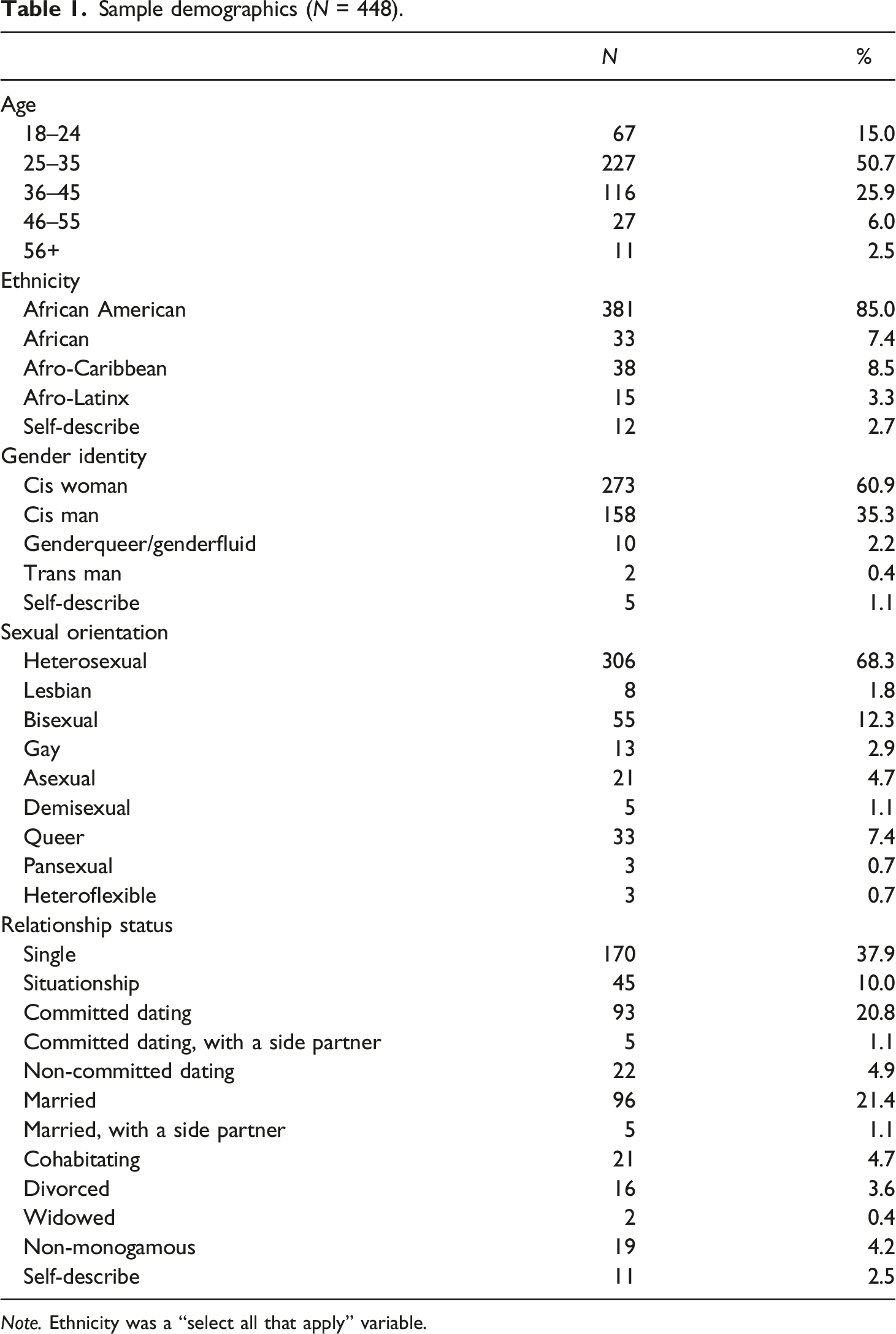
Note. Ethnicity was a “select all that apply” variable.
Top 20 words for entire sample (N = 448).

Word rankings and frequencies by gender identity and sexual orientation.
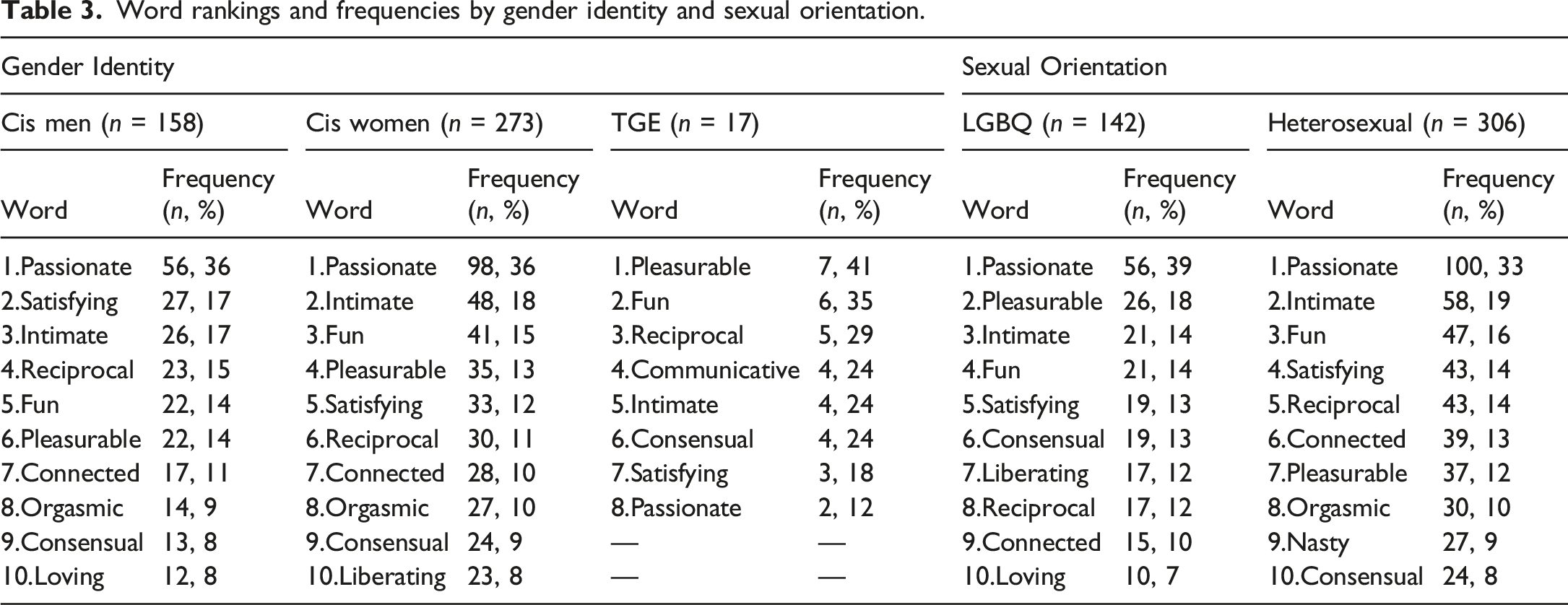
Words exclusive to specific demographics’ top 10 lists were few. “Communicative” was exclusive to the TGE group (n = 4; 24%), and “loving” was exclusive to the cis men (n = 12; 8%) and LGBQ (n = 10; 7%) groups. Cis women (n = 23; 8%) and LGBQ people (n = 17; 12%) were the only two groups to have “liberating” rank in their top 10. TGE people were the only group without “orgasmic” and “connected” in their top 8.
Although most groups shared most of their descriptors, the order in which they were ranked and the frequency at which they appeared differed. For example, “passionate” ranked last for TGE people (n = 2; 12%), although it ranked first for cis men (n = 56; 36%), cis women (n = 98; 36%), LGBQ people (n = 56; 39%), and heterosexual people (n = 100; 33%). “Pleasurable,” which ranked first (n = 7; 41%) for TGE people, ranked sixth for cis men (n = 22; 14%), fourth for cis women (n = 35; 13%), second for LGBQ people (n = 26; 18%), and seventh for heterosexual people (n = 37; 12%).
Discussion
According to the full sample of Black people, good sex is passionate, intimate, and fun, where all participants are satisfied through reciprocally giving and receiving pleasure. Through consensual sex acts that lead to orgasms, participants feel connected to their partners and/or themselves, excited by the intense experience, and liberated. Good sex can be nasty/kinky, loving, spiritual, and/or sensual, with a special emphasis on wet. Through sexual communication, participants enjoy safety and comfort, followed by relaxation. Broadly speaking, these themes were essential for good sex across gender and sexual identities. Narrowing the scope of good sex based on identity however, cis men and LGBQ participants emphasized intensity in good sex, whereas cis women and LGBQ people tended to emphasize liberation. TGE people emphasized that good sex includes communication, while heterosexual people emphasized that good sex is loving.
Many of these descriptors align with existing sexual wellness literature, including those related to sexual satisfaction and pleasure. Similar to Pascoal et al.’s (2014) study on lay definitions of sexual satisfaction, this study included aspects of pleasure, reciprocity—referred to there as mutuality—and liberation, referred to there as sexual openness, orgasms, and intimacy. Diverging from their findings, satisfaction was identified as a component of good sex for our sample, rather than the umbrella term. Additionally, the frequency of sex, although extant in our sample, was not among the top 20 descriptors. These descriptors also expand overarching perspectives on sexual satisfaction laid out by McClelland (2014), including emotional and masculine, relational and feminine, partner focused, and orgasm focused. Similar to McClelland’s findings, orgasm was not a significant descriptor of sexual satisfaction, nor was it a descriptor of good sex in the current study among LGBQ and TGE participants. However, our findings suggest that emotional and relational intimacy and connection are not limited by gender and introduce the importance of sexual passion.
Most interesting in our findings was the frequency at which passionate was reported as a component of good sex. Whereas passionate was identified by over 1/3 of the sample, the other terms represented between 2.7% and 17.9% of the sample. This was a large difference. It begs the question, what is so important about passion in good sex? Further, what do Black people mean when they say passionate? Existing research on passionate sex is emerging, with dualistic and tri-phasic models articulated by various authors. For example, Leonhardt and colleagues (2020) introduced the constructs of harmonious v. obsessive sexual passion, and Hanna-Walker and Busby (2021) introduced the inhibited sexual passion type to the former dualistic model. Research has found that sexual passion correlates with sexual satisfaction, sexual communication, having sex more frequently, sexual variety, and more consistent orgasms (Frederick et al., 2017), with the different forms of sexual passion positively or negatively correlating to other good sex components reported by our sample. Future research should ask Black people to define what they mean by sexual passion and other salient aspects of good sex to further clarify why and how they make it good.
A final note worthy of mention was the use of the term “nasty” as a descriptor of good sex, which landed at the Number 10 spot on the list of terms cited most often across groups. Though the association of such terminology to sexual behavior is not limited to Black people, it is worth noting its prominence here, particularly given the historical stigmatization of Black sexuality over the course of history, and the ways that Black people have been socialized to feel morally inferior about their sexual behaviors—both real and fabricated. Simmons (2015) cites, as one example, ways that the term “nasty” was used by parents of Black women in 1940s North Carolina as a way of codifying discussions of sexuality and sexual behavior, while expounding thoroughly on the ways these same women used knowledge gained through their sex and marriage education classes to reject shame and embrace sexual agency as a human norm. In her paper Simmons cites Evelyn Higginbotham (1993), most notably known for shedding light on the “politics of respectability” that have served to police Black women’s and queer people’s sexualities over the last century, predominantly with the intention of achieving White American social acceptance. Given its considerable use in the present study, future researchers may find benefit in exploring the salience and significance of the term “nasty” among Black people—particularly as a pleasure-affirming characteristic of good sex, and as a potential form of resistance to historically repressive norms.
Implications
Broadly, these findings further the research surrounding what “good sex” is and how it is defined. The novel findings presented in this paper are the first to investigate how Black people subjectively define good sex. This approach centers the positive and liberating sexual experiences of a diverse sample of Black people, despite these experiences being historically neglected in sexology research (Bowleg et al., 2017; Hargons et al., 2020), and actively contrasting previous deficits-based sex research. These findings may inform future scale development regarding experiences of good sex and how this relates to related constructs in sexuality research, such as sexual passion, satisfaction, and pleasure. Future research should also ask Black people to define what they mean by sexual passion and other salient aspects of good sex to further clarify why and how they make it good. Further, this study may inform anti-racist, sex-positive approaches to sex education for Black children and adolescents, which has predominantly equated enjoyable and pleasurable sex with danger and immorality (Froyum, 2010) and centered heteronormativity.
The definitions gathered from this study may inform holistic approaches to sex therapy. For instance, clinicians should center their clients’ definitions of what constitutes as good sex and consider how these definitions or sexual agency to pursue good sex may be impacted by interlocking racial, gender, and sexual identities (Chmielewski et al., 2020). Lastly, these findings may inform how sexual wellbeing and positive sexual experiences are assessed therapeutically. For instance, sex therapy assessments and outcomes are generally measured with scaled measures of sexual function, satisfaction, or quality of sex (Tabatabaie, 2014). However, many validated scales were constructed within predominantly White, cisgender, heterosexual samples, and do not allow for personal meaning-making to be included.
Limitations
None of the descriptors represented the majority of participants in any category. The most frequent word for most groups still represented less than a third of participants. Thus, as previous authors defining words adjacent to good sex have found, despite common themes, there is no one way that everyone describes good sex. The prompt used to gather this data, “describe good sex in three words,” may have contributed to the plethora of descriptors used by participants. A prompt eliciting a single word or one without a required word count may have garnered different results. Moreover, it is possible that some of the questions on the survey itself such as questions about orgasms, desire, consent, etc. may have influenced participants’ thoughts and responses. Additionally, this study was limited by its small sample of TGE and predominantly heterosexual participants. Future studies should consider the possibility of using a sample stratified by sexual and gender identity in the future to address this limitation. Additionally, using social media influencers for targeted recruitment could be essential. We also acknowledge that people who identify as transgender, gender non-binary, gender fluid, and gender expansive may not have the same sexual experiences therefore one limitation is the collapsing of these groups. However, we felt that it was important to share their stories.
Conclusion
The landscape of sexology with the Black population has been fraught with racist stereotypes and dehumanizing deficit focused studies (Bowleg et al., 2017; Hargons et al., 2020), when they were included at all. Sexology has only recently begun to include Black populations in sex-positive research. Existent models of good sex ignore culturally informed meaning-making, fail to account for differing ideas of sex, cultural barriers and stressors. Fun, sex-positive aspects of Black sex lives are crucial acts of radical and liberatory healing, contributing to not just bodily agency, but political, social, and economic agency as well. The construction of good sex in this way provides a blueprint of constructs sexologists may further investigate if they are interested in research with Black samples. Good sex for Black people represents the ability to resist the effects of ever-growing racial trauma and microaggressions, the resiliency and humanity of the Black population. Fostering an understanding of good sex for Black people and the creation of culturally responsive models of good sex is an anti-racist act of resistance and liberation. Good sex is revolutionary and an act of resistance in a world that stereotypes and dehumanizes Black bodies and sexuality. Black people deserve good sex.
Footnotes
Acknowledgments
The RISE2 Research Team would like to acknowledge our community partners for their commitment and assistance during Phase one of the Big Sex Study: Tanya Bass, MEd, PhD, CHES, CSE, Robin Wilson Beattie, M. Nicole Coleman, PhD, Yarneccia Dyson, PhD, MSW, Tracie Gilbert, PhD, Jasmine Johnson, MSW, MA, LCSW, and Omisade Burney-Scott, and Marla Renee Stewart, MSW.
Declaration of conflicting interests
The author(s) declared no potential conflicts of interest with respect to the research, authorship, and/or publication of this article.
Funding
The author(s) received no financial support for the research, authorship, and/or publication of this article.
