




Abstract
I present a sensory ethnography of doing sex at three men-only play parties at an Amsterdam-based nightclub. I refer to sex as sexual acts and use doing to highlight these acts as embodied practices. Through the curation of sensorially stimulating experiences, characterized as feel-, sound-, smell-, and viewscape, bodies are aroused and oriented toward each other and engage in sexual practices differently. Using participant sensation, an ethnographic method featuring multisensory observation, and queer phenomenological analysis, I show distinct ways of doing sex enabled by and mediated through varied sensory experiences. This ethnography responds to the lack of attention and methodology in addressing sensuality in the discursive analysis of sex. It foregrounds a sensory body that situates a discursive body in its flesh and senses.
Introduction
After the COVID-19 curfew was lifted and Amsterdam’s gay nightlife resumed in the late summer of 2021, I became a bartender at Club Church, or ‘Church’, as it is popularly called. Located on the Kerkstraat (translated as Churchstreet), it is a renowned nightclub combining queer clubbing with gay cruising and BDSM/fetish cultures. It was established in 2008 by a group of sex-positive gay activists who organized itinerant festivals and sex parties in town. In the job interview, the manager asked me, ‘Could you handle people having sex on the bar?’ I said, ‘yes’. I did not fully grasp what that ‘yes’ meant sensorially and sensually until I witnessed and experienced the explicit display of sex throughout the club, from the changing room to the dance floor to the darkroom. Church does not host regular club nights but theme parties, such as Naked Bar for naked cruisers, Ladz for sportswear fetishists, Furball for bigger and hairy gay men (‘bears’), and Blue, a dance party with drag performances.
The majority of Church’s parties remain exclusive to men, among which the colloquially called ‘play parties’ feature the organizers’ serious and humorous attitude toward gay male sexual fantasies and plays at best. Johan Huizinga (1955: 13) summarizes that a play ‘proceeds within its own proper boundaries of time and space according to fixed rules and in an orderly manner’. Players seriously practice rituals and avoid being a spoilsport who ‘robs play of its illusion’ (Huizinga, 1955: 11). For instance, at Oil Party, where an inflatable oil pool lies in the middle of the dance floor, men are poured with warm oil and cruise without clothing and shoes. At Spank! spankers and spankees use impact toys like whips and paddles to play with each other. At Meat Market, men adhere to two sets of rules: In the care of party volunteers, bottoms (the receptive side in anal sex), or ‘meat’, are naked, sedentary, and blindfolded in hoods; tops (the penetrative side) may move freely and do whatever they want with the meat as long as they respect the rules. Owing to the seriousness and intensity of the plays, these parties attract a relatively loyal and committed clientele who anticipates earnest engagement.
My experience at Church as a bartender, partygoer, and ethnographer enables me to examine doing sex. I refer to sex as sexual acts and use doing to highlight these acts as embodied practices (Bosman et al., 2019; Spronk, 2014). Through the curation of sensorially stimulating experiences, characterized as feel-, sound-, smell-, and viewscape, bodies are aroused and oriented toward each other and engage in sexual practices differently. By offering a sensory study of sex, I foreground sensuality as the urgent subject matter of sexuality studies, which often concern what sex stands for in meaning-making and scene-making (Dean, 2009; Drysdale, 2023; Drysdale et al., 2024; Orne, 2020) and how sex is mediated through moral, juridical, medical, and political discourses (Berlant and Warner, 1998; Foucault, 1976; Herdt, 2009; Plummer, 1995; Race, 2011).
The sensory experience of doing sex is curated at the parties by both organizers and guests. Studies of sex spaces show that the decorations, spatial layouts, and house rules direct the styles of sensorial bodily interaction in clubbing and cruising (Cattan and Vanolo, 2014; Jones, 2023; Rubin, 2011: 230; Tolentino et al., 2018; Van Lieshout, 1995). While the venues are structured in certain ways to create sensations, guests are not necessarily aware of the venue owners’ intentions in arranging facilities and sensory elements because they spend more time reflecting on their connections with others than assessing the environments (Richters, 2007). Church’s curation invites guests to certain experiences of play, such as in oil, with toys, or blindfolded. Yet, guests bring spontaneity into the parties and curate new sensory experiences, such as cruising by sound at Spank! and heavily using poppers at Meat Market.
I extend Sara Ahmed’s (2006, 2014) discussions of queer phenomenology by combining it with a sensory ethnography. I ask: How do curated sensory experiences of feel-, sound-, smell-, and viewscape orient bodies toward each other and enable them to do sex differently? I use participant sensation, an ethnographic method featuring multisensory observation (Howes, 2019), to capture the orientation of bodies in the party scenes. Since it is often difficult to grasp sensuality by using post hoc interview data, I intend to highlight the potential of participant sensation in future studies of sex. I acknowledge that my textual presentation of multisensory data limits the application of this method. I invite readers to view my research as an ethnographic exploration conditioned by conventional academic writing.
From the discursive analysis of sex to the sensory study of doing sex
From the late 1970s to the early 1990s, Gayle Rubin’s (2011) works, compiled in Deviations, made significant advances in theorizing sex. From The Traffic in Women to Thinking Sex, Rubin (2011: 61, 149), first, extends the analysis of sex from a critique of ‘sex/gender systems’ to a critique of ‘hierarchical system[s] of sexual value’. This analytic shift recognizes sex as an independent domain of behaviors and desires and pays more attention to sexual acts categorized as misconduct outside of the charmed circle of sexual value, such as public sex, promiscuous sex, and sadomasochism (Rubin, 2011: 152). In The Catacombs, accentuating ‘the body and its capacities for sensory experience’, Rubin (2011: 239) emphasizes the embodied experience of sexual practice rather than the discursive construction of sexual identity. By offering sensory accounts, such as the Crisco lube coating the furniture surfaces, walls, and bodies and the soundtracks changing from relaxing songs, to high-energy disco, to moodier electronic music, Rubin’s (2011) study of the San Francisco-based sex underground for fist-fucking parties counteracts the inaccessibility of a body’s sensory capability in Western societies.
As Rubin (2011) further indicates in Studying Sexual Subcultures, gay urban ethnographies after the Second World War were mainly designed to dismantle stigma and deviance associated with gay populations; in the fashion of social constructionism from the 1970s, ethnographers focused more on structural and discursive interventions in destabilizing heteronormativity, such as the emerging gay communities, cultures, and politics. Partly due to the institutionalization of queer studies, a closer examination of sensory experience of doing sex was sidetracked by urgent calls to interrupt discursive configurations of normativity (Wiegman and Wilson, 2015). The profound impact of this research trend is that ‘antinormativity has come to govern the queer theoretical project’ and sexuality studies shifted toward critical discourse analysis as its key focus (Wiegman and Wilson, 2015: 6). Judith Butler (1993) suggests that, to debunk sexual norms that constitutively constrain a body and render it (un)intelligible, the discursive analysis of power exercised upon the body is necessary. This insight echoes Michel Foucault’s (1976) articulation: A body cannot escape from the capillaries of discursive power; such power is immanent in and conducive to bodily relations, whereby a body is always the relay of discourse, thus, a discursive body.
However, in the two interviews in Foucault’s (1997a, 1997b) late years, he gave more nuanced accounts of body based on his experience of sadomasochism. S&M participants ‘are inventing new possibilities of pleasure with strange parts of their body – through the eroticization of the body’ (Foucault, 1997a: 165). By recentering sexual acts in their own terms rather than treating them as relays of discourse, Foucault (1997b) suggests a body, especially in S&M plays, that is able to sense and be sensed erotically – a sensory body. The insufficiency of a discursive analysis of sex is also implied in Lauren Berlant and Michael Warner’s (1998) Sex in Public: For most of their text, sexual practices are examined through a discursive lens as incubators of nonheteronormative cultures and politics; at the end of their text, when analyzing a BDSM show in a bar where a top poured milk and food down a bottom’s throat and fingered it, leading him to vomiting, Berlant and Warner suggest a sensorial reading of ‘the scene of intimacy and display, control and abandon, ferocity and abjection’ (565), which eludes a discursive analysis.
Henning Bech (1998) pinpoints that due to a culturalist tendency in the social science and textual discipline in the humanities, sensuality has been subsumed under the dominant subjects of sexuality studies, including discourses, identities, and ideologies. By offering a pornographic tale of lust in public, Bech (1998) highlights a sensory body that is actively turned on and off by urban spaces; he also criticizes that a discursive analysis often deprives this body of carnality or quickly concludes it as a discursive phenomenon. Over the last two decades, ethnographers have invested in the sensory aspects of doing sex, where a discursive analysis reaches its limit: for example, Tim Dean’s (2009) research on bodily relations and sensations in gay barebacking (condomless sex), Rachel Spronk’s (2012) focus on sensoriality of sexual pleasure and desire among young professionals in Nairobi, Susanna Paasonen’s (2018) study of sexual plays and sensory capacity, and Myra Bosman and colleagues’ (2019) mapping of Dutch heterosexual couples’ bodily sensations. In this article, my investment in the sensory study of doing sex does not deny the entanglement of the body and discursive structures that define it; I seek to emphasize the sensory capacity of a discursive body and situates it in flesh and senses.
Body and relationality: A queer phenomenological approach to the sensory experience of sex
As Sara Ahmed (2006: 2) points out, phenomenology studies ‘lived experience of inhabiting a body’ and ‘orientation’ of this body toward other bodies and objects. How a body feels through bodily contact is not an ‘inside out’ psychological reaction to the outside world or an ‘outside in’ social construction of what society makes one feel (Ahmed, 2014: 9–10). When bodies make contact, bodily impressions – bodies being pushed back and forth, trespassed, expanded, or dissolved – come into being, whereby the bodily surface and boundary and the body itself are sensed (Ahmed, 2014). The sensations bestowed by bodily contact, in turn, generate the orientations that move a body toward or away from other bodies and objects (Ahmed, 2006: 2); these sensations configure bodily proximity, tension, or even proximity with tension.
The sensations serve as ‘orientation devices’ whereby a body is extended into the space that was peculiar or distant and then becomes inhabitable (Ahmed, 2006: 11). For example, the sensory experience of a ‘dark, warm’ and ‘cozy’ dance floor with ‘the sheer density of bodies’ at the Loft parties in New York City in the early 1970s was an orientation device, which diminished the desire of individual dancers ‘for independence and separation’ and dissolved them ‘into the amorphous whole’ (Lawrence, 2004: 25). The sensations from ‘experiencing the pleasures of deviation’ can also be ‘disorientation device[s]’ whereby a body does not ‘pledge allegiance to the familiar’ (Ahmed, 2006: 177) but experiments with relationality previously unimaginable. In a sensual burlesque performance at the First Annual National People of Color Cabaret, a masculine Indigenous U.S. Border Patrol agent stopped a Mexican border crosser and stripped her in exchange for her entry (Rodríguez, 2011). The erotic experience sensed by some Latina audience created disorientation and a moment to critically reimagine contact and proximity in the ‘brown-on-brown interface of erotic power’ (Rodríguez, 2011: 344).
The phenomenological understanding of body spurs questions about queer relationality: ‘[W]hat could be shared across bodies that touch through language, memory, trace, or gesture’ (Rodríguez, 2011: 339) and, specifically in my research, through feel, sound, smell, and (lack of) sight. Here, the context of relationality is sex-oriented play parties, sites where ‘networked forms of connecting and relating’ unfold (Bem and Paasonen, 2023: 809). The guests may attend the parties to pursue individual pleasure, but, arguably, they get involved in or seek forms of sociality they desire through the sensory experience of sexual play. Kerryn Drysdale et al. (2024: 488) frame ‘the desire to connect with others through sex’ as sex-based sociality. Drysdale (2018: 649) shows that, at Sydney’s drag king events, sex-based sociality is animated sensorially in the sense that ‘you can smell it in the air’. In the case of gay barebacking, the roulette parties, where HIV-negative bottoms take semen from HIV-positive or -negative tops whose serostatus is unknown to the bottoms, offer the thrilling sensations of playing with the virus and for ‘breeding’ new bodily bonds, whereby queer sociality emerges (Dean, 2009: 73).
Participant sensation in the nightclub setting
Since the 1990s, the sensory turn in ethnography has called attention to how human beings make sense of the world and how senses as ways of knowing mediate and transform practices (Classen, 1993; Howes, 1991, 2019, 2021; Pink, 2009). Unfortunately, sensory ethnography in anthropology has astonishingly ignored human sexual experience, and sexuality studies have hardly practiced sensory ethnography. Continuing the long tradition of practicing ethnography to understand gay sex spaces and sexual practices (Rubin, 2011; also see Drysdale, 2018), my research adopts sensory ethnography as exploratory methodology.
Myra Bosman et al. (2019: 411) write, ‘Embodied experiences are strongly felt, but hard to communicate or verbalize’. As an embodied experience in which a body feels other bodies through touch, sound, smell, and taste, sex often becomes vague and obscure through interviews. Sensory ethnography emphasizes researchers’ immersive experiences and values sensing in ethnographic data collection, which David Howes (2021) calls a methodological shift from participant observation to participant sensation. The latter inherits the main tenets of participant observation, which Alpa Shah (2017: 51) defines as ‘a long-term intimate engagement with a group of people that were once strangers to us in order to know and experience the world through their perspectives and actions in as holistic a way as possible’. Participant sensation enriches this definition by seeking creative and sensorial ways of knowing to capture on-site experiences (Howes, 2019), for instance, by touring with local residents to sensorially attune an ethnographer’s body to the rhythm of the Slow Food Movement (Pink, 2008), walking with research participants to smell ethnic enclaves to sense the racialization of olfaction (Low, 2015), or integrating ‘audiovisual affordances of contemporary media’ into fieldwork and ethnography (Howes, 2019: 21).
I was born and raised in China and moved to Amsterdam in 2020. As a nightlife worker who has been working at Church since October 2021, I am not a stranger to the scene. This access to the field integrates the perspective of party curation into my participant sensation. Instead of focusing on how guests feel, I draw attention to how they are encouraged to feel, sense, and do sex given the sensory experience a party curates. My sensory ethnography does not rely on data from post hoc interviews but on-site sensations of guests’ interactions with the party settings.
Specifically, I conducted participant sensation as a staff member and party guest at Oil Party, Spank! and Meat Market from 2022 to 2025. This period includes preliminary field visits to delineate the goal and range of my research, 10 months of intensive fieldwork to collect data, and regular returns to the field to capture developments. I attended Oil Party, which is hosted annually in October, as a party guest who engaged in plays. I attended Spank! which is hosted bimonthly, as a guest who cruised and mainly watched and listened to the BDSM sessions. I worked as a bartender for the monthly Meat Market parties. Due to the concern that taking notes in front of guests was intrusive and impractical, I went to the staff-only area (e.g. the cloakroom) to type down memos on my phone, composed of key words and short sentences. Upon arriving home, I expanded the memos into elaborate scene descriptions. I usually completed a coherent fieldnote with 500 to 1,500 words the next day.
Church’s owners and manager all gave signed informed consent for my research and were informed of the potential impact of its publication. I did not anonymize the club and parties for their contextual significance. I acknowledge the risk in doing so, such as media distortion and attack considering the continuing sexual panics (Herdt, 2009). To reduce the potential harm, I anonymized all fieldnote data involving human subjects to protect their identities, especially by omitting the description of specific party guests’ age, race/ethnicity, and facial characteristics. Moreover, by not mentioning the dates of the vignettes, I intend to minimize the identification of particular individuals attending the parties and to shift readers’ attention from who-did-what-and-when to accounts of the curation of sensory experience in three distinct party settings.
Oil, tactility, and orientation of proximity at Oil Party
Attracting 250 guests on average, Oil Party was launched by the club owners in the first year of Church. The notion of play-in-oil stemmed from their experience of mud parties at Vagevuur (1986–2008), a fetish club initiated by gay activists in Eindhoven in the south of the Netherlands. The playfulness of naked men frolicking in the mud inspired them, but they thought that ‘the problem is it’s very cold; you can’t warm up the mud’. They then reinvented the sensations of mud play by offering warmed oil instead to care for the guests.
Guests must leave clothing and footwear outside the play area, which consisted only of the dance floor and a hallway in the basement. In the middle of the dance floor was an inflatable pool where guests must lie down to play (Figure 1). The mezzanine above the dance floor where guests usually cruised was closed for storing extra baggage; the darkroom downstairs was closed to reduce cleaning work. Before the party, the staff used carpets to cover the wooden floor to prevent guests from slipping and to ensure the oil would not damage it. The plastic sheets and carpets enveloping the room for hygiene created a novel spatial-acoustic experience: The materials built a sound chamber absorbing much of the reverberation and high-frequency noise in the music played on the lofty dance floor. When I touched the slightly coarse carpets with my bare soles and inhaled warm indoor air, so different from Amsterdam’s wet and chilly weather in October, this chamber amplified a sense of cocooning, wrapping around the incoming naked bodies. The setup of the dance floor and oil pool in 2022. The oil was not poured into the pool until the guests started to play inside. Photo taken by the author half an hour before the party.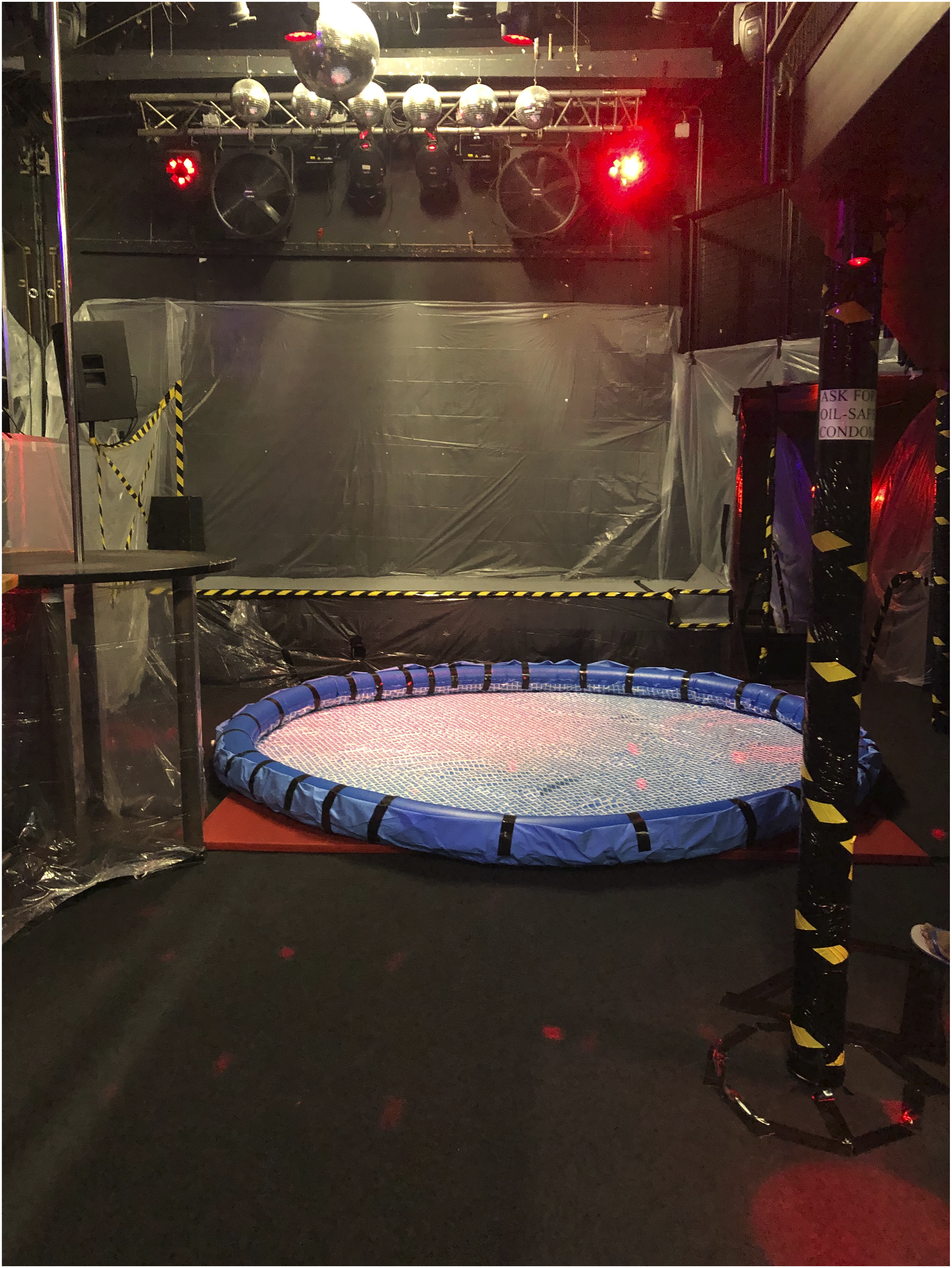
At midnight, bathed in the slowly spinning red light, the play area was teeming with more than 150 guests. The reduction of the size of the space propelled them to stand and chat much closer to one another. In the euphoric and psychedelic trance music at 122 bpm (beats per minute) and later, when another DJ took over, moody and melodic techno music at 125 bpm, almost half of the guests touched, kissed, or penetrated each other around the pool and in front of the bar, many swaying their body to the music, and a few sitting onstage rubbing their penis. The pathway to the staircase was packed with men frolicking, which slowed down the entire movement on the dance floor and created a viscous resistance against quick motion.
Holding a jug filled with olive oil, two naked party volunteers were pouring oil onto the bodies. As they caught me, still dry and acting like an observer, they persuaded me to join the crowd by pouring oil over my shoulders. It felt warmer than my flesh. My torso tingled as the oil slowly trickled down my back until it embraced my body and covered my skin with a new layer reducing the friction. When I slid through the greasy bodies into the crowd, the mild scent of oil mingled with sweat emanating from them. The differences of nudity including body size, cellulite, hairiness, and temperature were felt. While a few guests held and covered their penis while squeezing across the bodies, others willingly let their penis get touched by the hands, thighs, bellies, and buttocks that either casually passed by or intentionally initiated contact. As the night pressed on, the greasiness became more of an amalgamation of oil, sweat, saliva, pre-ejaculate, and semen.
In the pool, 10 to 15 men, mostly in their 40s, 50s, and 60s, lay on their backs and over each other with torsos and limbs entangled, their greasy skin reflecting the red light. They smeared oil over each other’s bodies and massaged it reciprocally and slowly. A man crawled onto and sat on another torso, first smoothly rubbing his penis against the other’s belly, then slowly rubbing the other’s penis with his lower back. His anus slid onto the penis as if he was riding the body in a slow-motion scene. The pool was packed, and newcomers could not step in until the ones inside crawled out. Most tended to stay more than 15 minutes. Since the slippery bottom made it impractical to stand, those in the pool sat, crawled, and lay down to keep balance; they often glided onto their neighbors and rolled over them to move to the other side.
As an ‘orientation device’ (Ahmed, 2006: 3), Oil Party’s packed space renders the physical distance between the bodies collapsing. Julie Tolentino et al. (2018: 469) write about the Clit Club (1990–2002), a women-led dance club in New York City, where sexual play was curated ‘in its tiny, hot, crowded spaces of intense proximity’. Oil Party also curates proximity in a small play area where cruisers gather and dense crowds impede easy and quick movements. Bodies sensorially arouse each other through frequent, inevitable, and (un)intentional touches.
The warm olive oil encourages smooth bodily contact among a welter of excited strangers. It functions the same way as Crisco did in the Catacombs, the sex club Rubin (2011: 230) depicts: ‘Crisco greased the asshole. It greased whole bodies. It greased the walls. It greased the way for smooth and easy contact’. Through greasing, dry bodies as spectators aware of the friction are transformed into oily bodies as players willing to initiate and accept invitations of intense contact. Phenomenologically, this transformation is made possible by the new layer of skin facilitating a playful experience of touching. The oil does not dissolve the bodily boundary but changes its topology: The oily skin is no longer where a body ends but where a body extends (i.e. turning others greasy) and where bodies of engaged players proliferate (i.e. turning others on). As an orientation device, the oil fosters a new incentive for bodies to connect with others and thus enables a feelscape of sex-based sociality (Drysdale et al., 2024). Instead of erasing bodily differences in color, shape, and texture, this feelscape temporarily replaces the friction caused by differences with the relatedness enabled by shared greasiness.
The sensations in the oil pool can be interpreted as a ‘disorientation device’ (Ahmed, 2006: 177). From a queer phenomenological viewpoint, the establishment of ‘alternative lines’ in orienting bodily proximity allows one to be ‘knocked off course’ and arrive at a world where they have never been (Ahmed, 2006: 19–20). The need to remain horizontal in the pool routes men away ‘from the paths they are supposed to follow’ (Ahmed, 2006: 20) and the proximity typically entailed when cruising in Church’s darkroom and thus has a disorienting effect. As a well-trodden path of cruising in the darkroom, men often observe and wait in the corners and hallway, or move past one another without full-body contact, instead swiftly tapping the penis, hand, arm, or back to incite a quick response. The pool does not allow this distance and transience; instead, one needs to sit or lie down and move slowly. This transfers and merges cruising movements onto a slippery and jammed two-dimensional surface that affords intensive full-body contact. The playground outside of the pool offers cruisers ample opportunities to not engage with sexual invitations after being touched (e.g. by simply not responding), whereas the pool appeals to cruisers who accept sexual invitations regardless of who initiates them. Since the lingering touch is inescapable, the cruisers lying and moving in the pool learn to contact each other and enjoy this contact as long as possible. Their doing of sex is further enabled not only by the smoothness of touching but also by its prolongation and intensity.
Impact toys, acoustic map, and orientation of tension at Spank!
Spank! was initiated in 2005 by one of Church’s owners for celebrating Amsterdam Leather Pride and incorporated into Church’s programme after its founding. Over the years, it gained a loyal clientele of BDSM practitioners who address themselves as spankers (or ‘Doms’, ‘Sirs’, ‘Masters’) and spankees (or ‘subs’, ‘boys’, ‘slaves’). Marketed as a playground for ‘spanking, caning, otk (over the knee), flogging and other types of corporal punishment’ (Club Church, nd-b), it attracted approximately 50 guests in their 30s to 70s every time.
When greeting the cloakroom attendant responsible for selling entrance tickets and checking in guests’ baggage, I noticed a rack of impact toys hanging up behind him, including paddles, a whip, a flogger, a crop, and a wand, all of which suggested that bodily contact at Spank! would orient around the toys and tensions they entail. Guests could borrow the toys, but most brought their own. The porn screens above the bar played a video portraying a customer in a pub seeking sex with a male stripper without paying enough money; in response, the stripper spanked him and forced him to drink urine and give the bartender fellatio. As the guests spread out into the darkroom and on the mezzanine, the dance floor was mostly empty except for a few wanderers and a man in a shirt and jeans perching on the stage, wearing, on his belt, a key ring with more than five impact toys, and awaiting spankees. According to the party’s curator, Spank! used to attract more guests like him, who were into school-teacher fantasy, resembling corporal punishment in British schools in the last century.
The party did not book live DJs but played pre-recorded techno music with steady beats, at a decibel quieter than Church’s typical club scenes. Yet, it was not quiet at all given the auditory experience enabled by the toys and BDSM sessions. In the basement near the toilet, a man knelt; two men sitting in front of him took turns to slap his buttocks. With the slaps producing a percussive rhythm, the man’s buttocks turned red quickly with his anus tightly hidden beneath gluteal muscles. The echoes of slapping bounced between the concrete ceiling and ceramic tiles in the hallway leading to the darkroom. A few men left the quieter darkroom and gathered next to the toilet to watch this session. An audience member commented, ‘Like a drum’.
In the corner of the mezzanine away from the staircase, the commencement of a string of whipping sounds drew a handful of cruisers walking from the dance floor and other side of the mezzanine where they could not see what happened there. They masturbated and watched a Dom in riding boots whip a sub and use him as a footstool. He then picked a man closest to him, pinned him against the nearby garbage bin, and started whipping his butt. Another session began on the other bench in the same area. The spankee lay on his belly across the spanker’s lap. The spanker gently pulled the spankee’s shorts down, stroked his calves, and then used a fan paddle to spank his buttocks. His spanking rhythm was adjusted to synchronize with the beats of the music and the whipping rhythm of the session next to them.
Owing to the music with low volume and impact toys with great force, the sounds curated by the guests overpowered the music and merged into an intense soundscape of spanking. Crisp, sharp, and short were the sounds of slapping by hands. Flatter and duller were the sounds of spanking with a paddle. The sounds of a flogger striking flesh started with a sharp crack and ended with a looser tail note. The spankees groaned, roared, or grunted, pulsing with the impact sounds. Since each sound corresponded to a strike, an intense auditory experience translated the tactile sensations of forceful strikes committed by the spankers and taken by the spankees.
Near the end of the party, the impact sounds waned. A few guests gathered at the bar, showed off and tried out each other’s toys, and chatted about varied techniques for inflicting pain. Hearing remaining strikes, I walked down to the basement and saw, at the end of the hallway where the rest of the guests in the basement were drawn to, a naked sub handcuffed to a cross that glowed with purple light, resembling a crucifix. The Dom holding a leather whip kissed him long. Eyes closed, the sub sensed the Dom’s arm moving in the air and adjusted his standing position to cushion the strike. The Dom saw it and feinted the strike; a few seconds later, he delivered the real one, leaving a crisp echo.
Spank! showcases a variety of BDSM practices, such as corporal punishment, bondage and restraint, and Dom/sub play. As BDSM studies show, power performance (Newmahr, 2011) or power exchange (Bauer, 2014) – the negotiation of erotic power and dynamics of bodily tension – is a constitutive element in BDSM practitioners’ engagement in sexual plays. Eroticizing intense physical and mental sensations, such as pain and humiliation, BDSM practices adopt a different economy of pleasures and produce new notions of what is considered sensual (Simula, 2019a; 2019b). Here, I situate my analysis of BDSM practices in a sensorially stimulating party setting. The orientation devices, particularly the toys and auditory experience, extend ‘bodies into spaces that create new folds’ (Ahmed, 2006: 11) and ways of doing sex.
When the guests enter Spank! they are incentivized to participate in plays involving bodily tension through a series of cues, such as the display of impact toys and sleazy pornography, the common appearance of leather uniform and riding boots, and Church’s crucifixion setup that was rarely used at other parties. Unlike the oil greasing and extending bodily boundaries, these objects guard and sustain the tension between a body that awaits being toyed and a body that carries out acts of subjugation and dominance, such as spanking, trampling, and restraining.
Specifically, the impact toys enhance the awareness of bodily boundaries between spankers and spankees. A spanker wields the toys to make contact at will and ‘perform a demonstration’ that testifies to their omnipotence (Deleuze, 1991: 19). A spankee’s body feels the intensity, velocity, and temperature of the toys and hears the collision on the skin. Even when the strikes are delivered by hand, whereby a spankee senses the warmth of another body, the quick, forceful, repetitive impacts and sharp sounds overwhelm the senses, turning hands into objects, thereby dehumanizing the sensation of bodily contact.
On the other hand, the variations in toy choice, ways of wielding them, and combinations of inventive play plots (e.g. pinning, stroking, kissing, and feinting) make the sensation of bodily contact not mechanical but humane, saturated with spankers’ care. The spankers do not play in a monotone; they are expected by their counterparts and willing to attentively create intense auditory and tactile experiences for them. The bodies of spankers and spankees are thus oriented to do sex facilitated by attentively curated and sensorially tangible bodily tension.
The impact sounds permit the bodies in different sessions to relate to each other without physical contact. Spankers synchronize their pace with other spankers’ strikes, while spankees, even from afar, hear other spankees’ moans and feel the pain or pleasure in pain they might be feeling. This soundscape of spanking further provides an acoustic map for cruising in this large playground with a sparse crowd. When spankers and spankees are not bonded by the sessions, they are freely moving cruisers. They navigate the space by recognizing the variation of sounds. As multiple sessions take place concurrently at different spots across the playground, bodies are directed toward where the sounds become intense, such as bursting high-volume screams and roars, or engrossing when the clustering of impact sounds resonates with the music beats. By drawing bodies toward sessions, the soundscape relates dispersed cruisers to spankers and spankees’ doing of sex. While watching, their bodies are aroused by multisensory experiences of tension, which is seen on the reddened skin, heard in the moans and impact sounds, and felt after they are invited to join the sessions. In short, doing sex at Spank! is mediated through the tension enabled by the impact toys and through the acoustic map oriented by the impact sounds.
Hoods, poppers, and orientation of otherness at Meat Market
Splitting its guests into bottoms and tops, Meat Market was inspired by a Germany-based party called Fickstutenmarkt, or The Horse Fair in English, for ‘mares’ and ‘stallions’. The name of Meat Market initiates a two-fold parody: positioning meat markets in a pornographic scene and emphasizing bottom/top roles in gay anal sex in a more objectified sense. Featuring anonymous anal sex, it attracted an average of 120 guests, ranging in age between 30 and 80.
One hour before the tops entered the party, the bottoms stripped down and chose a white or red hood for blocking sight. A white hood meant sex with a condom; red left the decision to the tops’ discretion, which always resulted in barebacking sex. The hoods were like sacks that could be cinched at the neck; some had an opening near the mouth for bottoms to give fellatio without having to remove the hood. While waiting for the tops, the bottoms did not need to wear the hood. They ordered drinks, chatted with acquaintances, and sought their desired spot. The darkroom was closed. On the dance floor and mezzanine, they stationed themselves at the meat stalls assembled with benches, beds, and moveable stage modules (Figure 2). They lay on the mattresses and in the slings, crawled on the benches, or leaned on the mezzanine railings. After an audio instruction announced the party’s commencement, they put on the hood. One of them opened a bottle of poppers, sniffed for 5 seconds, closed the cap, held the bottle in his hand, and gently swayed his body. The guests here commonly used poppers, composed of alkyl nitrites as inhaled vasodilators to increase heart rate and relax smooth muscle tissues (Schwartz et al., 2020). They colloquially described using poppers as ‘giving you a rush’. A sketch of the spatial layout of Meat Market (2023). The circles represent bottoms, and the crosses represent volunteers. The number of symbols does not reflect the number of people at the party. The sketch was drawn by the author during fieldwork.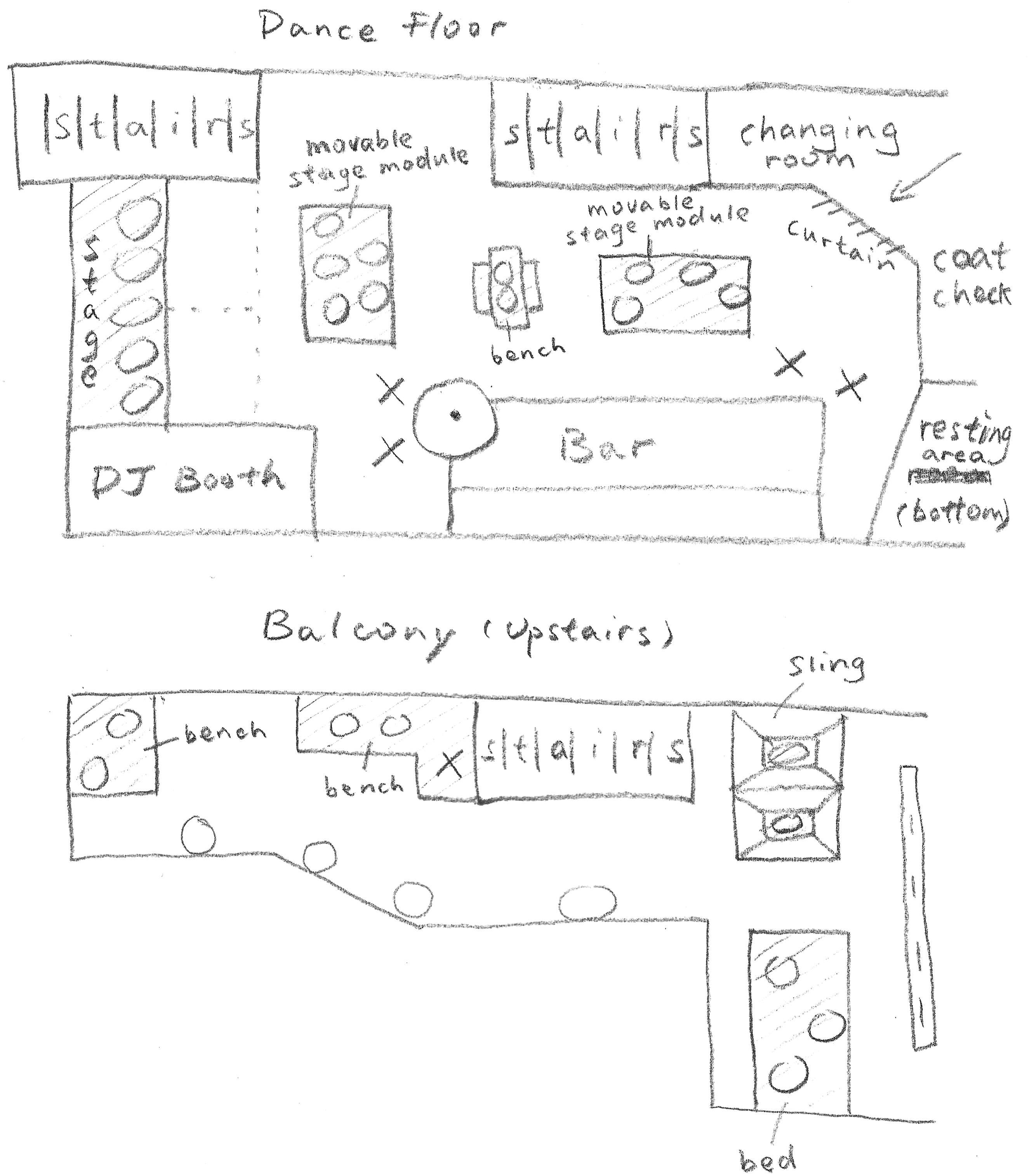
At 5 p.m., the tops entered, most of them dressed only in underwear. There were usually one-and-a-half to two times as many tops as bottoms. According to the rule (Club Church, nd-a), bottoms ‘may not refuse a top but must allow himself to be fucked or felt up’. Almost all the bottoms chose not to break the fantasy by selecting tops. They were encouraged by the party volunteers to touch the tops to check their use of condoms. They could take off their hood and leave the party at will. Six to eight volunteers helped bottoms who raised their hand to order drinks or escort them to the resting area; they wrote tally marks on bottoms’ backs every time they got anal penetration by a different top. Most bottoms finished the party with a score higher than 5; a handful reached higher than 30.
In the first hour after the tops’ entrance, they usually toured the stalls, examined the bottoms by hood color, and initiated anal or oral sex with their picks. Some eschewed sex with bottoms and instead stood and watched the hectic scene solemnly while masturbating. A top’s fingertips brushed across the buttocks of a bottom in white lying face down near the leather curtain separating the dance floor and changing room. In response, the bottom shook his butt for attention and further action, though the top had left. Another top pushed a standing bottom onto a bench nearby and thrust his penis into his anus. Without seeing who the top was, the bottom cooperatively bent over and moved his butt to synchronize with the top’s rhythm, conveyed in part by the top moving his hands up and down the bottom’s back. Half an hour later, the slightly sweet yet sharp and pungent scent of poppers crept in from all around and soon turned into a muskier and heavier odor after mingling with semen, sweat, and flatulence. One top buried his nostril in a popper bottle while pounding a bottom’s anus; without closing the cap, he left the solvent vaporizing. In the second hour, like a wave, the tops gathered at the bar to order drinks and quickly returned to the meat stalls. At the time, I could no longer smell the poppers. It was as though my entire body melted into the smellscape of poppers and forgot what a space without them smelled like.
Compared with Spank! where bodies may be temporarily restrained in the periodic BDSM sessions, Meat Market more intensively curates a scene of immobile bodies being displayed and penetrated at the stalls. For tops as freely moving consumers, bottoms are objectified meat waiting to serve as penetrable orifices like anuses and mouths. For bottoms as consumers, tops are also objectified as meat coming to satisfy them as penetrating objects and gainable scores.
To sustain this fantasy of objectification – fucking and being fucked by strangers, the hoods maximize the sensation of erotically contacting and accessing the flesh of face-less strangers. While the sessions at Spank! occasionally involve blindfolds, participants can chat with their counterparts and see their faces beforehand or afterward to know the persons they played with. Here, the bottoms can only sense some flesh making contact, feeling its penetrative force, body odor, or penis taste. Although the tops see the flesh of bottoms and obtain more information about their flesh, such as body size and skin color, they cannot facially identify the persons they contact. Hence, the hoods and their deprivation of sight orient the bodies toward doing sex while facilitating objectification and eroticizing otherness.
The smellscape of poppers also mediates a sense of proximity without eliminating otherness. The lingering odor of poppers affords a way of sensing beyond seeing and touching. As poppers permeate the air, bottoms who cannot see what is happening elsewhere are able to smell others’ desire to have ‘a rush’ before penetrative initiation and their (un)intentionality to let others have ‘a rush’ by vaporizing the solvent. The shifting note of odors from sharpness toward muddiness signals the increasing density of bodies and intensity of sex, whereby not only are poppers heavily used but sweat and flatulence are also quickly released by other bodies. Odors enveloping the bodies replace direct skin-to-skin contact with untargeted and disoriented bodily contact via releasing, smelling, and mixing the odors curated by unknown bodies who enjoy each other somewhere in the same playground.
As a ‘disorientation device’ (Ahmed, 2006: 177), the sensation of otherness in doing sex deactivates everyday sociality. In contemporary life, seeing a person and their face becomes a mandatory foundation for knowing their identity, avoiding ‘suspicion and sometimes outright hostility’ (Dean, 2009: 178), and fostering affinity or intimacy. Such sociality circulates, for example, through ‘meaningful glances and gazes’ in gay flirting (Mandell and Hecht, 2023: 129) or through the ‘has face pics’ profile filter on the hookup app Grindr. In contrast, disorientation enabled by the hoods and poppers amplifies anonymity in gay cruising and possesses queer potential for bodies to desire and experience proximate contact without eliminating ‘otherness’ (Dean, 2009: 180) – a situation of others being face-less flesh, or bodies-as-bodies.
Conclusion
This article presents a sensory ethnography of doing sex at three men-only play parties at Club Church. My focus on sensory experiences derives from the tension between the sensory study of doing sex and discursive analysis of sex, which often subsumes sensuality and sensoriality into discourse. I acknowledge that a body is entangled with the discourses that constitute and structure its lived experience of sex, considering that the marketing of the parties relies on the social construction of sexual desire and fantasy, such as spanking and anonymous anal sex. By focusing on a sensory study of doing sex, I emphasize the ‘experiential and sensorial aspects of sexuality’ (Spronk, 2012: 3).
As an analytical approach to a body’s experience of the environment and other bodies and to the queer effects such experience brings out, queer phenomenology (Ahmed, 2006, 2014) inspires my examination of the sensory experience of doing sex. That Church is marketed as a playground for sex does not mean that the strangers coming to the club automatically sexually engage with each other. Bodily differences, such as body type, skin color, hairiness, scar, and tattoo, arguably create the distinction of desirability at the parties where bodies are shirtless or naked. I highlight that the unique rules and setups of the play parties render these differences temporarily less salient or even invisible, for instance, for the bottoms at Meat Market. The curation presents new possibilities of sociality and invites bodies to engage in particular forms of play. These plays enact a variety of sensory experiences, such as tactility, auditory, olfaction, and (lack of) sight. Working as orientation and disorientation devices, the sensory experiences mediate configurations of bodily relationality – proximity, tension, and otherness – whereby bodies are aroused and enacted to do sex differently.
Doing sex at Church’s play parties further resonates with what Tim Dean (2009: 176) calls ‘promiscuous relationality’: This form of queer sociality refuses one-to-one correspondence in doing sex and envisions an orientation of proximity among strangers who are encouraged to daringly approach and sensually feel each other. This encouragement is made possible by the curation of sensory experiences. Gay sex spaces sustain a long history of dedicated curation for sensuality and sensoriality (Berlant and Warner, 1998; Jones, 2023; Orne, 2020; Race, 2011; Rubin, 2011). As Rubin’s (2011: 239) case in the 1970s shows, ‘The Catacombs expressed a very deep love for the physical body. A place that could facilitate so much anal pleasure could make any part of the body feel happy’. In the more recent development in the gay urban spaces, Kane Race (2011) offers a nuanced account of drugs modulating discursive constraints on gay sociality and enabling a sensory space for sexual practices. The sex-oriented play parties I present here are integral to this history and knowledge of carnal desire and sensory pleasure. In the current climate of identity politics, unpacking the curation of play parties and their facilitation of sensations carves a new way forward in thinking with queer sociality. Rather than issuing an imperative to know and speak about who we, as queers, must identify with, these parties invite us to sense who we, as sexual beings, bodily feel proximate to.
Despite the theoretical and methodological contributions, this article is conditioned by my ‘partial perspective’ (Haraway, 1988) and textual presentation. First, my analysis relies on a single-person narration (i.e. researcher’s participant sensation) of how sensory experiences were curated. While repeated visits to the parties and attentiveness to un-expectations in the field help enrich my sensory accounts, I cannot fully unpack the sensory experience without being able to know how certain curations precisely make guests feel. For example, I have never been a guest, either as top or bottom, at Meat Market. I only observed hooded bottoms’ interactions with tops instead of wearing a hood and getting penetrated to sense its disorientation. At Spank! while I participated in cruising, I did not have comprehensive sexual experiences of spanking. This tilts my analysis toward auditory experience rather than tactile one, which could have offered more insight into the body and relationality at the party. At Oil Party, I had the privilege to access the staff-only areas, such as the cloakroom and mezzanine. It allowed me to escape from the party from time to time, whereas the guests had to be proximate to each other all the time because there was no resting area for them. In the follow-up visits in 2024 and 2025, I limited my movements to the play area to fully experience cruising and frolicking in oil as a guest.
Second, I acknowledge that my readers cannot sense like I did the warmth of a cocooning space, greasiness of oil, impact sounds, and permeating smell of poppers and sweat. This multisensory ethnography becomes readable by a discursive invitation from me to readers, who can only imagine these senses based on my narration. The textual access to the senses and scenes may also lead to divergent interpretations due to readers’ varied embodied experiences. My exploration with sensory ethnography does not offer a definitive answer to how to study doing sex and present its multisensory richness effectively. I call for continuous reimagination and practice of academic knowledge production that foregrounds a sensory body that situates a discursive body in its flesh and senses.
Footnotes
Acknowledgements
I am grateful to Club Church’s owners, manager, and staff members for bestowing trust upon me, allowing me to conduct fieldwork freely. I appreciate Rachel Spronk, Willemijn Krebbekx, Sam van der Lugt, René Nissen, and Kaue Felipe Nogarotto Crima Bellini, Mattijs van de Port, Erin Martineau, and two anonymous reviewers who generously gave me inspiring feedback on writing and editing.
Declaration of conflicting interests
The authors declared no potential conflicts of interest with respect to the research, authorship, and/or publication of this article.
Funding
The authors received no financial support for the research, authorship, and/or publication of this article.
Ethical considerations
The study was approved by the Ethics Advisory Board, Amsterdam Institute for Social Science Research (AISSR), University of Amsterdam (2022-AISSR-15719) on 24 January 2023.
Consent to participate
The owners and manager of Club Church gave written informed consent to the author before his participation observation in the club. All data gained from observation and casual conversations during the fieldwork has been de-identified. The interlocutors participating in semi-structured interviews gave verbal informed consent to the author before recording and conducting interviews; their identities have been anonymized in this article.
Consent for publication
The author gives consent to publishing his photo and drawing used in the article.
Data Availability Statement
The datasets regarding the rules of play parties, generated during and/or analyzed during the current study, are available via https://www.clubchurch.nl/pdf/meat-market-rules-en.pdf and  . The data that support the findings of this study are derived from the fieldnotes written and archived by the author, which are not publicly available due to the confidentiality that the club owners and author have agreed upon and due to the protection of observed subjects’ and research participants’ identities.