



Abstract
“Sivulirijat aksururnaqtukkuurnikugijangat aktuiniqaqsimaninga kinguvaanginnut” translates as “the trauma experienced by generations past having an effect in their descendants.” The legacy of the history of colonialism is starting to take narrative shape as Inuit give voice to the past and its manifestations in the present through public commissions such as the federal Truth and Reconciliation Commission and the Inuit-led Qikiqtani Truth Commission. However, an examination of other discursive contexts reveals a collective narrative of the colonial past that is at times silent, incomplete or seemingly inconsistent. Reading the political narrative through the Nunavut Land Claims Agreement, and the proceedings of the Legislative Assembly of Nunavut since its formation on April 1, 1999, exposes an almost complete silence about this history. Oral histories, an important form for the preservation and transmission of traditional cultural knowledge, do narrate aspects of this experience of contact, but in accounts that can appear highly individual, fragmented, even contradictory. In contrast, one domain that does seem to register and engage with the impacts of this history of colonialism is Inuit art, specifically visual art and film. In some cases these artistic narratives pre-date the historical trauma narratives of the commissions, which began with the Royal Commission on Aboriginal Peoples (RCAP) in the mid-1990s. This paper examines these narrative alternatives for recounting historic trauma in Nunavut, while also considering the implications of understanding historical trauma as narrative.
We can’t go back to the old ways. The new system is not working. We are in limbo. Our youth are killing themselves. Zacharias Kunuk
1
Walking both sides of an invisible border It is never easy Walking with an invisible border Separating my left and right foot … I did not ask to be born an Inuk Nor did I ask to be forced To learn an alien culture With an alien language … So I am left to fend for myself Walking in two different worlds Trying my best to make sense Of two opposing cultures Which are unable to integrate Lest they swallow one another whole Alootook Ipellie (as cited in Kennedy, 1996)
These words by Inuit filmmaker Zacharias Kunuk, and the late poet Alootook Ipellie, bring the old ways and the new, Inuit and Canadian culture, into uneasy relation. Both, using spatial metaphors of limbo, borders, and worlds, link the past with the too frequently harsh realities of the present. Both indicate uncertainty about how to reconcile or integrate each side of the divide. Through my work as a psychiatrist, a recent clinical encounter with a youth, presenting for psychiatric assessment in a Nunavut community, with visual hallucinations of “shadow people,” left me with the same sense of an incomplete narrative, which may have made sense within her lived reality, but was irreconcilable and psychotic within a clinical framework. Her story of unresolved loss and grief was clearly linked to her own suicidality, and less explicitly linked to parallel family and community loss and disruption. In little more than fifty years Inuit people in the north of Canada have experienced sudden and sweeping change to their traditional way of life and culture. Compounding this rapid change, many of the pressures to accommodate to modern Canadian life and governance were prodded by policies and actions that have since been deemed an abuse of rights, autonomy, and dignity.
The linked concepts of collective trauma and historical trauma (HT) have been employed to describe the experiences of communities and ethnic groups exposed to large scale or repeated traumatic events and accompanying stresses, and may provide a useful framework for understanding the cultural changes undergone by Inuit communities, and how this may be related to contemporary social suffering. When asked about HT, Alexina Kublu, Languages Commissioner of Nunavut, stated that the idea of HT was not something that people a few generations ago had to deal with, although the oral histories frequently describe the intervention of elders when people felt they needed to talk or receive counsel. She did indicate that the notion of intergenerational impacts may be captured in the phrase “sivulirijat aksururnaqtukkuurnikugijangat aktuiniqaqsimaninga kinguvaanginnut” (translated as “the trauma experienced by generations past having an effect in their descendants”). 2
Although there does not seem to be a ready-made “traditional” approach for dealing with collective trauma, the concept does seem to have been taken up at the level of community mental health groups using “Inuit-specific approaches,” particularly those groups that have been influenced by education and mentorship through the Aboriginal Healing Foundation, 3 such as the Ottawa-based Mamisarvik Healing Centre, and Qauma, a now closed mobile program for residential school survivors, that aimed, “to represent all of the survivors from Nunavut” (Mamisarniq Conference Proceedings, 2007, p. 12). Approaches to healing often involve cathartic sharing of stories in talking or healing circles, or without the explicit sharing of stories, but through shared land-based and traditional activities (see, e.g., Fletcher & Denham, 2008).
Focusing on the geographic region of my own clinical work, the Qikiqtani region of Nunavut (formerly known as the Baffin region), I look to multiple sites of contemporary political, artistic, and social discourse, looking for traces of how Inuit have narrated this individual and collective experience of repeated trauma and loss as part of the colonial encounter, and consider ways in which HT may be a useful explanatory framework, and ways in which HT, as it is currently conceptualized, is problematic.
The narrative features of the HT concept have been insufficiently examined, at least as the idea of HT is deployed in a clinical context. It is essentially through narrative organization and emplotment that the present is understood in light of the past. In trying to understand the narrative dimensions of “an” Inuit social history of contact and colonization, as it is expressed across these political, historical, clinical, and artistic registers, I attempt to explore some of the consequences of treating historical trauma as narrative, or with preconceived narrative expectations. This paper asks: what can the tools of narrative, or the field of narratology, offer for an understanding of the way historical trauma is expressed and represented in the Inuit context, and more broadly?
The historical trauma concept
Over the last three decades, trauma has emerged as a mode for organizing and representing our relationship to the past. As a clinical and social concept it has the potential to bring together considerations of both the individual and the collective, particularly when groups are subjected to collective trauma. Collective violence has been experienced by social groups, including: the Jewish experience of the Holocaust, African American experience of slavery, Hiroshima, apartheid in South Africa, and numerous other historic and contemporary examples. On an individual level, the invention of posttraumatic stress disorder (PTSD), introduced in 1980 (see Fassin & Rechtman, 2009, p. 77), allowed the traumatic experience of the individual to be given credence, both clinically and politically. There was also the parallel emergence of the idea of shared traumatic memory, arising from the group experience: Collective memory is articulated as a traumatic relationship with the past in which the group identifies itself as a victim through its recognition of a shared experience of violence. Not withstanding the different contexts, the moral framework that emerges is the same: suffering establishes grounds for a cause; the event demands a reinterpretation of history. (Fassin & Rechtman, 2009, pp. 15–16)
In 1995, Maria Yellow Horse Brave Heart (1998, 2003) applied this idea of collective suffering, memory, and trauma to the historical trauma experienced by American Aboriginals, specifically the Lakota, over the course of colonial conquest and attempts at assimilation. These traumatic losses included theft and removal from homelands; violence against indigenous peoples; assimilation through residential schools, and suppression of language, ceremonies and spirituality, leading to an erosion of culture; and destablization of the social order through loss of roles and destruction of indigenous family systems. In the same year, Duran and Duran similarly proposed that the effects of this cumulative trauma, and the accompanying sense of grief, affect the very core of Aboriginal identity and cultural cohesion, creating a “soul wound” (Duran & Duran, 1995). Brave Heart (2003) has catalogued “the historical trauma response” as manifesting as a complex of behaviors, including depression, anxiety, low self-esteem, anger, alexithymia, difficulty modulating affect, somatic symptoms, suicidal behaviors, often in the form of wishes to join the dead, identification with the dead, “survivor guilt,” the development of a “victim identity,” and the frequent use of substances as a means of emotional numbing and avoidance.
The historical trauma framework has great descriptive power, particularly in contrast to the notion of posttraumatic stress disorder (PTSD), which emphasizes the effect on the individual, rather that on the family and community, and which tends to ahistoricize the traumatic incident, treating all traumatic stressors as essentially equal. In contrast to PTSD, the key features of the HT concept extend beyond the individual, and assert the complex nature of HT. The antecedents or traumatic events that lead to HT are theorized to be collective, inflicted upon a group that has a shared identity or affiliation by outsiders with destructive intent; widespread, affecting many members of the group; result in contemporary collective distress or mourning; and this distress is both psychological and social, affecting multiple levels of the individual, family, and community (Evans-Campbell, 2008). Recent work has focused on distinguishing PTSD from HT, and on understanding the interplay between the two forms (see Walters et al., 2011). Another key feature of HT is its cumulative nature, which is theorized to be passed along to other members of the group and to future members through intergenerational transmission, through means such as epigenetics, disrupted child-rearing practices, and through ruptures at the community level and to the integrity of cultural tradition (Walters et al., 2011).
Despite the explanatory power of the concept, however, inconsistencies and limitations have also been identified. Walters et al. (2011), attempt to untangle the multiple pathways and processes subsumed under the “historical trauma model,” noting that the concept of HT is variously understood as an etiological factor; an outcome, such as a response or syndrome; a mechanism for transfer across generations; and as a diathesis that interacts with contemporary stressors. Kirmayer, Simpson, and Cargo (2003) caution that too great an emphasis on historical factors can detract attention from real and present contemporary social inequities. Others, such as Denham (2008), have alluded to the unspoken assumption that exposure to historical traumas leads de facto to a traumatized response and community, rather than to strength and resilience, assumptions that can be further stigmatizing.
Historical trauma as narrative
Undergirding the historical trauma concept is the centrality of narrative and narrative features. The prominence of narrative is not surprising; first, given both the importance of narrative as a vehicle for culture, and for its presumed role in the creation of an “autobiographical self.” Narrative simultaneously contributes to an elaboration of group and individual identity, and to the communication of this identity across groups and time. Garro (2003), reformulating Hallowell, proposes that this transaction between the individual and collective occurs through narrative as “an active and constructive mode” (p. 6). Narrative, the means whereby “troubling experiences” enter the social arena, is constructed through “jointly cultural, social and cognitive processes” (p. 6), which offer potentialities (and constraints) for making sense of one’s experience. In turn, at a collective level, hearing about others’ experience recounted in narrative, can fashion, confirm or modify related cultural or collective understandings.
Second, the centrality of narrative to HT is also supported by the historical importance of narrative to the theorizing of trauma, particularly in the genesis of the field of trauma studies through Holocaust studies. A full exploration of this relationship is outside of the scope of this paper, but certainly it is relevant that literary theory has played a central role in trauma studies, through the work of Cathy Caruth, Geoffrey Hartman, and Dori Laub, among others. In part, this relates to the urgency with which Holocaust narratives were gathered and archived as survivors aged, and as a means to preserve and witness history and memory. Trauma narratives frequently take the form of life writing, or of testimony, which have in turn become literary genres in their own right.
Herein lies one of the greatest paradoxes of trauma studies, one that has particular relevance for thinking about HT. Trauma narratives are often interpreted as resisting representation, leading to ellipses, narrative ruptures, and fragmented temporalities. This unrepresentability is both symptom of, and testimony to, the trauma (see, e.g., Laub, 2005). Much as confusion exists as to whether HT represents an etiology, an outcome, or a process, there is lack of consensus as to whether narrative representations of trauma are by definition disrupted or disordered narratives. Such narrative resistance, however, is antithetical to the understanding that narrative coherence, and the assimilation of trauma, is also seen as key to recovery (see Neimeyer & Stewart, 1996) For this and other political motivations, postcolonial trauma studies (e.g., Craps & Buelens, 2008) recently challenged trauma studies. These authors reject the subject position of the “voiceless” victim, and prompt the rewriting of the received genres and forms that have previously articulated traumatic subjectivity and collectivity as rupture.
At the same time, in keeping with a process-oriented way of understanding HT, there is reason to be concerned about “disrupted” narratives. Trauma can disrupt many of the dimensions that typically make experience intelligible to oneself and to others, particularly its temporal organization. In a now oft-quoted phrase, Cathy Caruth (1996) described trauma as “a break in the mind’s experience of time” (p. 61). This break can result in temporal rupture or as “belatedness” (p. 4), where trauma is not recognized as such until it revisits the person’s mind. At a societal level this is often thought to translate to belated processing of traumatic experience, often generations later. Thus, leaving a narrative (or traumatic experience) disorganized or unresolved, may help explain how it can become cumulative in its impact, exerting its influence even into successive generations. In its extreme unresolved form, the absence of narrative, or the inability or unwillingness of survivors to pass on their stories to future generations, the so-called “conspiracy of silence” (Danieli, 1998), can result in intergenerational impacts.
There is also clinical reason to be attentive to narrative disorganization. Much work, conducted mainly with Holocaust survivors, has tied unresolved narratives to higher levels of psychological distress, and suggests that unresolved narratives (mediated through concomitant atypical behavior of caregivers towards their children) are a marker for attachment disorganization in subsequent generations, a likely link for the intergenerational transmission of trauma (see work by Lyons-Ruth et al., 2005; Sagi-Schwartz et al., 2003, for example). 4
In the remainder of the paper, a survey of narrative forms, in the broadest possible sense, from divergent social contexts in Nunavut, including testimony and governmental reports from territorial and federal commissions; proceedings from the Legislative Assembly of Nunavut; oral histories; and visual art, traces the genealogy of the term trauma in the Inuit context. Sampling these forms and genres reveals unevenness in the extent to which history is figured as traumatic, and an only nascent voicing of the connections between the history of colonialism and the present, in the Inuit context.
Historical trauma in the Inuit context
Within Canada, the framework of historical trauma has been used to understand the experience of First Nations people and communities (Adelson, 2001; Bombay, Matheson, & Anisman, 2009; Wesley-Esquimaux & Smolewski, 2004). The Royal Commission on Aboriginal Peoples (RCAP) outlines the historical trajectory of contact of Aboriginal societies with non-Aboriginal societies, through the first contact with Europeans in the 15th century and the first written treaty of 1624, through progressively intrusive and disruptive processes of displacement and assimilation. The RCAP concluded that non-Aboriginal settlers, in order to further their own economic and political aims, used their power to purposefully destroy Aboriginal ways of life for their own ends.
The history of transition of Inuit from a nomadic, self-reliant and self-governing people, into coerced settlement into government towns, is a history that recapitulates the history of numerous indigenous communities across Canada, although elements of the Inuit experience are quite unique. The most obvious difference is the fact that this contact and the process of assimilation is much more recent, occurring with great rapidity over the last 50 years. The history of the Canadian government’s relations with the Inuit is addressed in the RCAP, which accepted submissions by Inuit Tapirisat of Canada (ITC) (1994) and Nunavut Tunngavik (1993). The RCAP acknowledged the distinctness of the Inuit from other Aboriginal people in Canada.
In 1953 and 1955 the government of Canada relocated Inuit families from Northern Québec 2,000 kilometres north to the High Arctic (the communities known today as Resolute Bay and Grise Fiord). Having been promised abundant hunting opportunities, these Inuit found themselves in a harsh environment that had little in common with the more temperate region where they had grown up. Promises made by federal police that they could return home after 2 years if they were unhappy in the High Arctic were not kept, and as a result families remained separated for many years. The RCAP’s special hearings and resulting report (Dussault & Erasmus, 1994), and subsequent final report (Royal Commission on Aboriginal Peoples, 1996), concluded that the relocations constituted an “abuse” by the government toward the Inuit people involved. The RCAP report also documents additional impacts of contact and colonialism, including: settlement; residential schooling; loss of traditional belief systems; loss of traditional relationship with the land; and language. The RCAP makes an explicit link between these historic abuses and present-day social suffering. It also importantly acknowledges the possibility of cross-generational impacts. As one elder testified: “our children are living in deep despair of sorts, because we as adults have not healed from the pain of growing up in a destructive and dysfunctional environment” (1996).
Inuit historical trauma narratives and the Qikiqtani Truth Commission (QTC)
In 2007, the Qikiqtani Truth Commission (QTC) was established by the Qikiqtani Inuit Association (the representative organization of the Inuit of the Qikiqtani region), which felt that its requests for an investigation were being stonewalled by the Royal Canadian Mounted Police. The mandate of the QTC was to investigate the events “surrounding the alleged ‘dog slaughter,’ relocations and other decisions made by the Canadian government from 1950 to 1975 that dramatically affected Inuit culture, their economy and their way of life.”
5
The QTC makes even more explicit use of the terminology of trauma, its historical roots, and its impact across generations, than the RCAP. Testimony was heard from Inuit across Nunavut, who also use the language of trauma, such as this description by Jaykolasie Killiktee who describes the impacts of his grandmother’s treatment in a southern sanatorium, and eventual death: In those days, when my grandmother left on the ship, I think my whole clan—especially our grandfather—was going through stressful times. The only time we could see our grandmother was the next year, or as long as it took to heal. There were no airplanes, no means of mail, no means of telephone, no means of communication with our loved ones. I remember them crying, especially the old ones. It was very traumatic and it had a profound impact on our people … When my grandmother passed away, we were never told if she passed away, or where she passed away. Since World War Two, the Canadian government has initiated profound social, economic and cultural changes in the North that have had a far-reaching, negative and continuing influence on the lives of Qikiqtani Inuit. The vast majority of these decisions were made without consulting Inuit and the consequences are still felt today.
As a narrative of historical trauma, the QTC process and report is an exemplar. The Commission set out to “listen to the words of Inuit witnesses,” hearing from approximately 350 people across the Qikiqtani region. The Commission places a strong emphasis on the legal status of testimony, asking “all witnesses to affirm that they would tell the truth to the best of their knowledge” (QTC, 2010, p. 6). The report is written in this nonfiction genre, amassing individual accounts into a collective; the individual testimony was “used to write histories of each of the 13 Qikiqtani communities (most have not previously been the subject of such detailed histories)” (QTC, 2010, p. 7). These collective stories of widespread events, present a complex view of cumulative traumatic events and losses, resulting in psychological and social distress, which has continued to exert its impact across individuals, families and communities across generations. Perhaps most consonant with the HT framework, giving voice to these historical experiences of individual experience and suffering creates a causal model to explain contemporary distress. “For many years now, Inuit elders in the Qikiqtani region have been haunted by a deep sense of loss, shame and puzzlement” (QTC, 2010: p. 8), a puzzlement that is resolved through explaining the present in light of the past.
Inuit historical trauma narratives in political context
In contrast to the discourse of the RCAP and the QTC, the Nunavut Land Claims Agreement 6 is striking in its lack of attention to social impacts on the people of the land. Early efforts resulted in the submission of a land claim proposal by Inuit Tapirisat of Canada (ITC) in 1976. This lack of mention of the peoples on the land, and their history, differs from the initial overture in 1973 by Tagak Curley of ITC to bring the Inuit Use and Occupancy Study to the table with the government of Canada. A history of the land claim process and the move toward self-government (Hicks & White, 2000) reveals that, early on, Inuit identified the protection of Inuit language, culture and social well-being as fundamental motivators for pursuing a land claim and the creation of an independent Nunavut. Inuit leaders were concerned by both the fear of nonrenewable resource development with associated incursions into the land in the name of development, and with the threat of Inuit culture not surviving into the future, including loss of language and the cultural disintegration that was likely to occur as a result of impeded access to traditional lands and land uses. However, federal land claims policy, which was not developed for the purposes of such cultural and social provisions, did not allow for a nuanced discussion of the social and cultural patterns of land use and discussion of culture and heritage as part of the land. As a result, the language of the land claim is constrained and limited to a discussion of land, access, animal preservation, and economic development. In practical terms, the constraints of the federal land claims policy suppressed the expression of a social discourse around land use, resulting in an inability to explicitly tie this movement to the social ills of the past. 7
Perhaps because of this relative silencing of the social dimensions in the unfolding of the land claim, there has also been a notable silence around the historical disruptions and trauma of the colonial past in the Legislative Assembly. In a search of the over 32,000 pages of accumulated Hansard, spanning the 13 years of Nunavut, using the terms “trauma” “historic(al) trauma” “intergenerational” “colonial” there are very few references to trauma, particularly in the early period. 8
In March 2010 there was, one might argue belatedly, an extended discussion about the psychological trauma arising from these sequelae of the colonial experience, in the context of a motion by the Legislative Assembly of Nunavut to call “on the Government of Canada to fully reinstate the funding to the programs and services provided under the Aboriginal Healing Foundation which support Nunavummiut.” 9
If the political discourse of the land claim process and the proceedings of the Legislative Assembly of Nunavut are a kind of historical trauma narrative, then one must note the profound silence around the topic of historical trauma generally. In Danieli’s (1998) term, a “conspiracy of silence,” or absence of narrative is the most striking narrative feature.
Inuit historical trauma narratives in oral histories
Oral history projects, aimed at preserving the experiences and traditional knowledge of Inuit elders, have now been undertaken in Igloolik, Baker Lake, Pangnirtung, and through the Interviewing Elders program at Nunavut Arctic College, among others. This oral history has become not only a source of cultural memory, but has gained political importance. Oral history formed an important source of data for the land claim, such as the 1976 ITC-commissioned Inuit Land Use and Occupancy Project. Oral history also has a central role in current governmental policy, forming the basis for Inuit Qaujimajatuqangit (IQ), which the government of Nunavut has committed to incorporate at all levels. IQ, gleaned through consultation with elders, is understood as “a set of teachings on practical truisms about society, human nature and experience passed on orally (traditionally) from one generation to the next” (Arnakak, as cited in Martin, 2009, pp. 185–186).
As a narrative form, the oral histories present certain challenges when approached by non-Inuit (and perhaps by some Inuit). Although the value of elder testimony is enshrined in Territorial politics, allowing Inuit a vehicle for telling their own version of history, the oral histories underscore differences in Inuit and non-Inuit epistemologies and knowledge production. While Western thought prizes objectivity and abstracted knowledge, the oral histories are “holistic, dynamic and cumulative” (Arnakak as cited in Martin, 2009, p. 186). The narratives retain their singularity, rather than providing a communal record, and may read as fragmentary, if such coherence is sought.
The existing histories form a complex web of references to early contact and related experiences such as conversion to Christianity and associated losses of culture. A common question: “Do you remember your first encounter with a quallunat?” often invokes memories that speak to the potentially traumatic nature of this contact. In searching the Igloolik Oral History Project (IOHP) narratives, for example, the term “fear” proved to be a rich search term in this context. In the following case, fear of police power, an internalized sense of being monitored, and constrained behavior is recalled: Certainly there were some that really feared the white people. Before my time, my older brother MAMATTIAQ once told a story about their childhood years. They have heard that police had established their station at MITTIMATALIK, so they went there once and also have heard that these police had radios, and they also heard that police can arrest INUIT, they knew that these police hunt INUIT so if anyone did something wrong they could be taken by the police. … They were afraid that should they act irrationally they were liable to be heard by the police with their radio so they tried and behave as much as they could. That was the story that he told. (Ijjanqiaq, 1993) Victor: I did not see many qallunaat around when I was a child. There was one we saw when we travelled by boat. When we got off the boat there was a little wooden house. When we got to the shore there was an incident that I remember. The first qallunaat I saw picked me up, and I was really scared because I thought he was going to adopt me. (as cited in Oosten & Laugrand, 2012, p. 65)
Obviously the content of the oral histories, which are prompted through a semistructured interview format, are somewhat dependent on questions asked. But references to early contact are often incomplete, leave gaps, contain inconsistencies, and even disavowals, thwarting the notion of a single, coherent historical (trauma) narrative. In Victor Tungilik’s narrative, for example, in his discussion of the transition to Christianity from Shamanism, he alternates between describing shamanism as a helping tradition and associating it with evil. He also oscillates between describing his Christian life as preferable to his life before Christianity and honoring the old (pre-Christian experiences): Before I knew about Christianity, I was satisfied with the life I had. After I learned about Christianity I stared seeing things that were not right. I considered the way of life that I followed to be powerful and strong. Because I did not know how to read and because I did not know about the Bible, I never thought of it. I believed the life I led was strong and true. (as cited in Oosten & Laugrand, 2012, p. 79) When you turned to Christianity, was it your own free will or was it because of someone else? This was my own free will as I said already. If I tried to remain an angakkuq [shaman] I would go to the eternal fire that never goes out. (as cited in Oosten & Laugrand, 2012, p. 80) Have other people besides ourselves asked these questions? Have you ever told your children about having been an angakkuq? No, I have never told them about it. I don’t want them to hear about it. I don’t want them to hear bad things. It will not be of help to anybody. It is not going to bring anybody to heaven. (as cited in Oosten & Laugrand, 2012, p. 113)
The oral histories provide a useful example of the transcultural perils of “reading” variable narrative forms—such as inconsistency, temporal irregularity—as evidence of disrupted or traumatic narratives. If one used the kinds of textual practices performed by literary trauma studies, one would risk understanding these narratives of early contact as unresolved or disorganized. However, as these examples of Inuit oral history attest, narrative meaning is often attained through more than one temporal vector. In oral histories, for example, attention is often drawn to the fact that time, particularly the past, is not necessarily remembered according to current standards. “I can’t remember what year it was. I regret that I can’t, but I didn’t know what years were back then,” cautions Rachel Uyarasuk when providing her history (as cited in Oosten & Laugrand, 2012, p. 28). Victor Tungilik, when asked “were you a young person, or were you an adult?” similarly states, “I did not think of dates. I did not think of calendars at all” (as cited in Oosten & Laugrand, 2012, p. 58). Within the oral histories, temporal distinctions are made between unikkaat, or life stories, which occur within the memorable past in a readily communicable linear sequence, versus unikkaaqtuat, or myths, that extend beyond individual memory and exist in a temporal present/presence of mythological time (see Martin, 2009). If one goes to the oral histories hoping to find a linear, causal relation between the events of the past and current suffering then these multiple dimensions of time need to be considered.
Historical trauma narratives in Inuit art
Inuit art, particularly visual art and film, demonstrates an engagement with the traumatic past that predates other discursive contexts, though it is rarely understood or discussed within a framework of historical trauma. 11 Filmmaker Zacharias Kunuk, who still remembers camp life and settlement, has attempted to capture Inuit precontact history in Atanarjuat (2001), and the early history of contact in The Journals of Knud Rasmussen (2006), along with the documentary work produced by his production company Isuma films, based in Igloolik.
Inuit visual art can, in fact, be understood as a genre in its own right, though it may take different forms, such as carving and printmaking. A largely southern audience and art market has an appetite for its iconographic content of animals and shamanic figures, its bold, repetitive graphics, and the themes of traditional life, mythology, and spirituality. Even within these confining expectations, hints of the traumatic past may be found. Working within these expectations one can find narratives that express what has been lost within the culture, but also what one may, through art and memory, recover. In Myra Kukiiyaut’s work (see Figure 1), for example, a narrative of the past takes shape. Her drawing, “Things that should not be lost or forgotten,” creates a history that is spatialized through a narrative constructed of images and words in combination. Temporal complexity is conferred by this spatial dimension; visual representations of temporality can differ greatly from oral and prose temporal organizations. The tension of the spatial in conjunction with the temporal, and the use of the visual as a mode of storytelling, is not easily “read” or interpreted within the current framework for talking about HT. The inclusion of Inuktitut syllabics in Kukiiyaut’s piece also impedes its easy generic assimilation into recognizable elements by those outside of the culture.
Things that should not be lost or forgotten. Gathering of People at Chesterfield Inlet. Myra Kukiiyaut, Baker Lake, 2004. Permission to reproduce granted by the estate of Myra Kukiiyaut.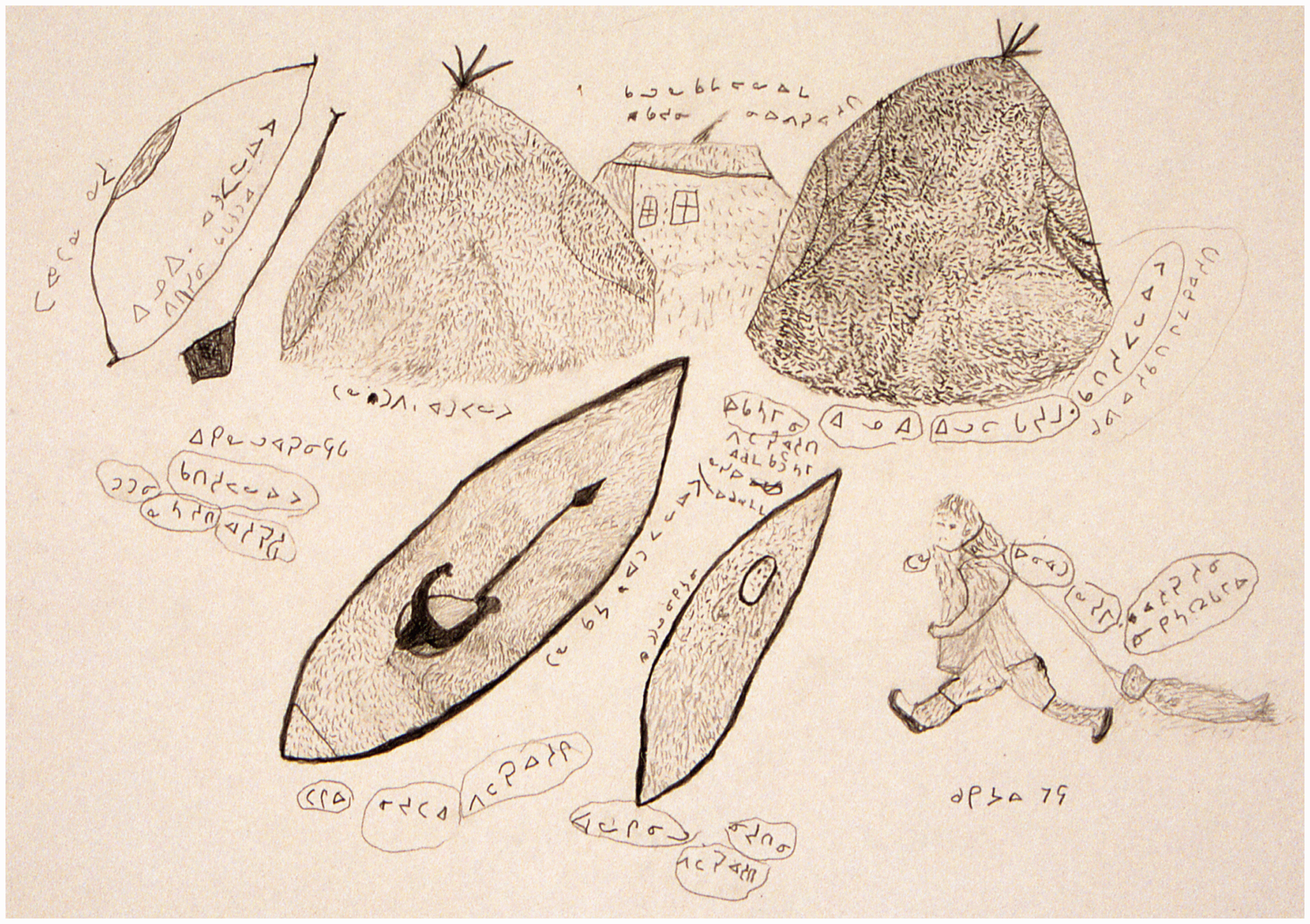
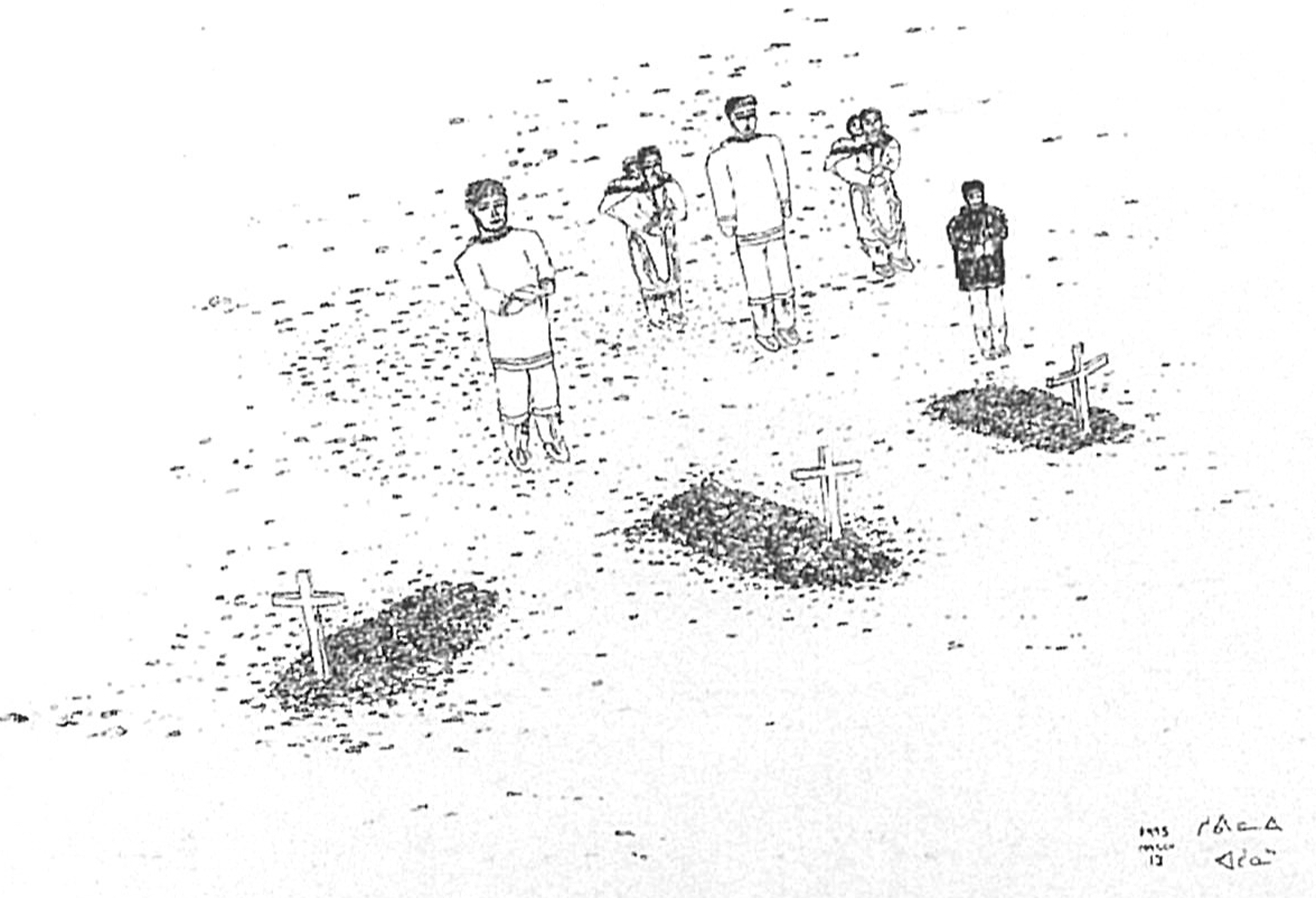
Some examples of Inuit visual art also occasionally seem to offer an intergenerational “dialogue” across families and communities, such as the work of Jessie Onark and her son William Noah in Baker Lake, or the three generations of women artists, Pitseolak Ashoona, Napatchie Pootoogook, Annie Pootoogook, and Shuvinai Ashoona in Cape Dorset. Further complexity is created by the fact that this “historical” narrative is very recent and continues to unfold across generations and across members of the community in ways that still may not be legible. This unfolding may be read in the multigenerational work of Pitseolak Ashoona, who moved from camp life into settlement and began drawing in her 60 s; her daughter Napatchie Pootoogook; Annie Pootoogook, Pitseolak’s granddaughter, and Napatchie’s daughter; and Shuvinai Ashoona also granddaughter to Pitseolak (and cousin to Annie Pootoogook). Their prints and drawings, (see Figures 2 to 4), show, through a visiting of similar themes, a dialogue about violence, both in the history of presettlement, such as in the drawing of a woman being attacked by Piseolak Ashoona (see Figure 2), to a suicide that occurred during camp life in a igloo, by Napatchie Ashoona (see Figure 3), to the drawings of recent graves by Shuvinai Ashoona (see Figure 4), documenting more contemporary suicides.
They Are Throwing Stones At Her. Pitseolak Ashoona, Cape Dorset, 1978. Reproduced with the permission of Dorset Fine Arts. Suicide. Napatchie Pootoogook, Cape Dorset, 1997-8. Reproduced with the permission of Dorset Fine Arts. By the Graves. Shuvinai Ashoona, Cape Dorset, 1995. Reproduced with the permission of Dorset Fine Arts.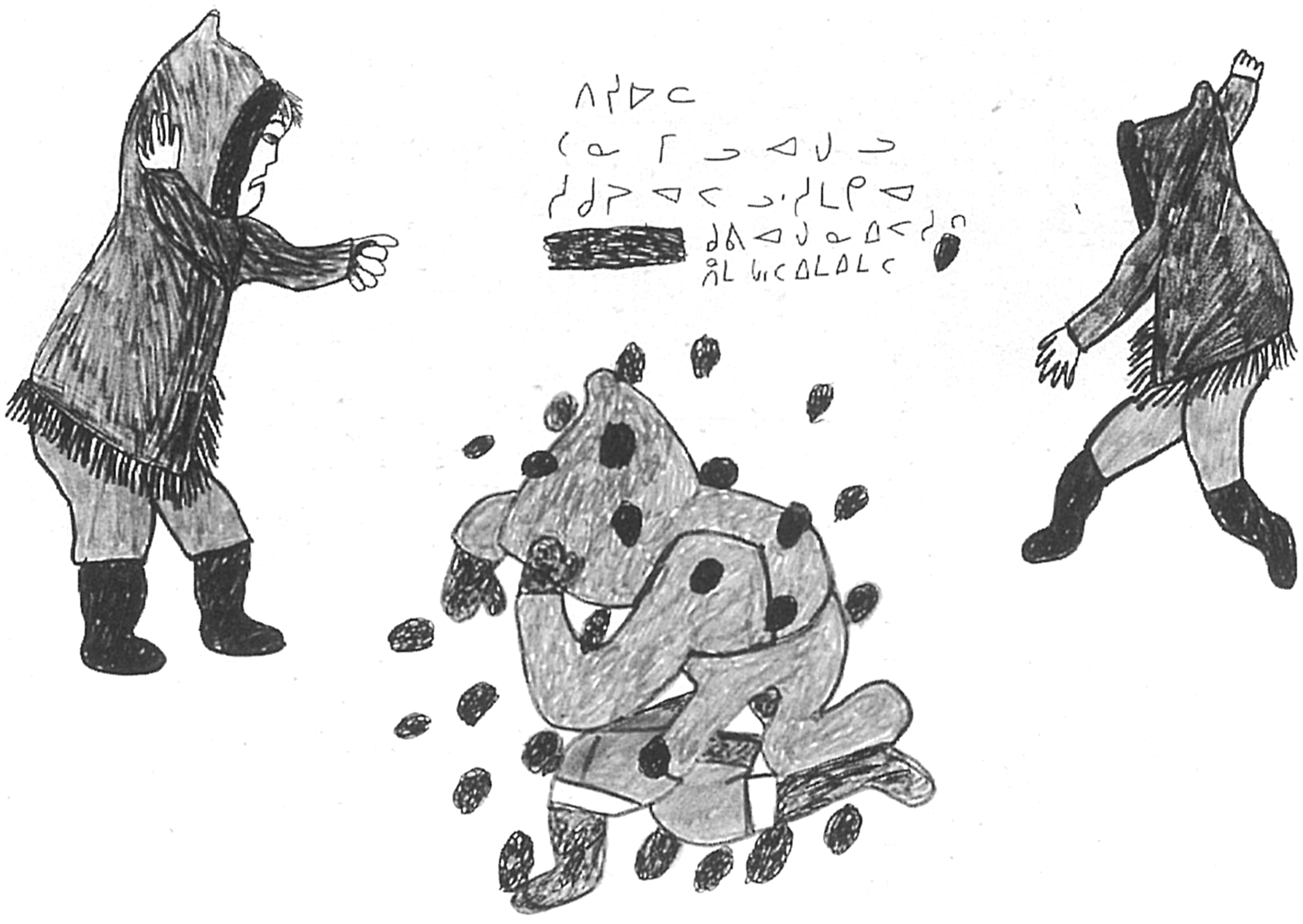

The drawings by Pitseolak and Napatchie provide an interesting complication in the HT context, through the association of trauma with traditional camp life. Some of their drawings are scenes of violence against women, such as women being taken against their will into marriage, which occurred as part of the precontact (or at least presettlement) past. Because they do not conform to a timeline where the traumatic past starts with assaults by colonialists, they complicate the linear and causal emplotment suggested by the HT narrative framework.
An explicit representation of contemporary social suffering is taken up particularly by Annie Pootoogook. Her approach to history and contemporary social life transgresses the constraints of “traditional”
12
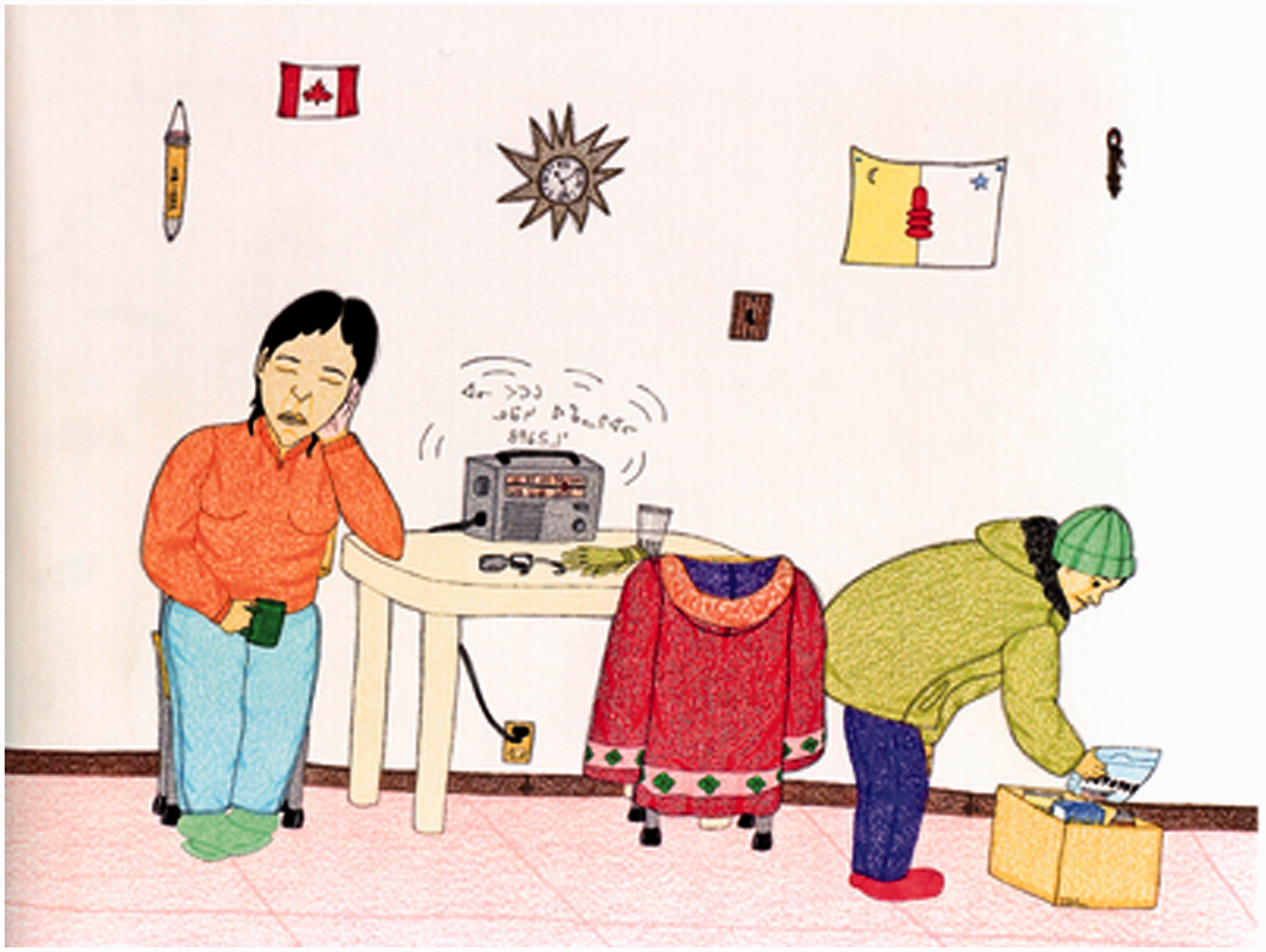
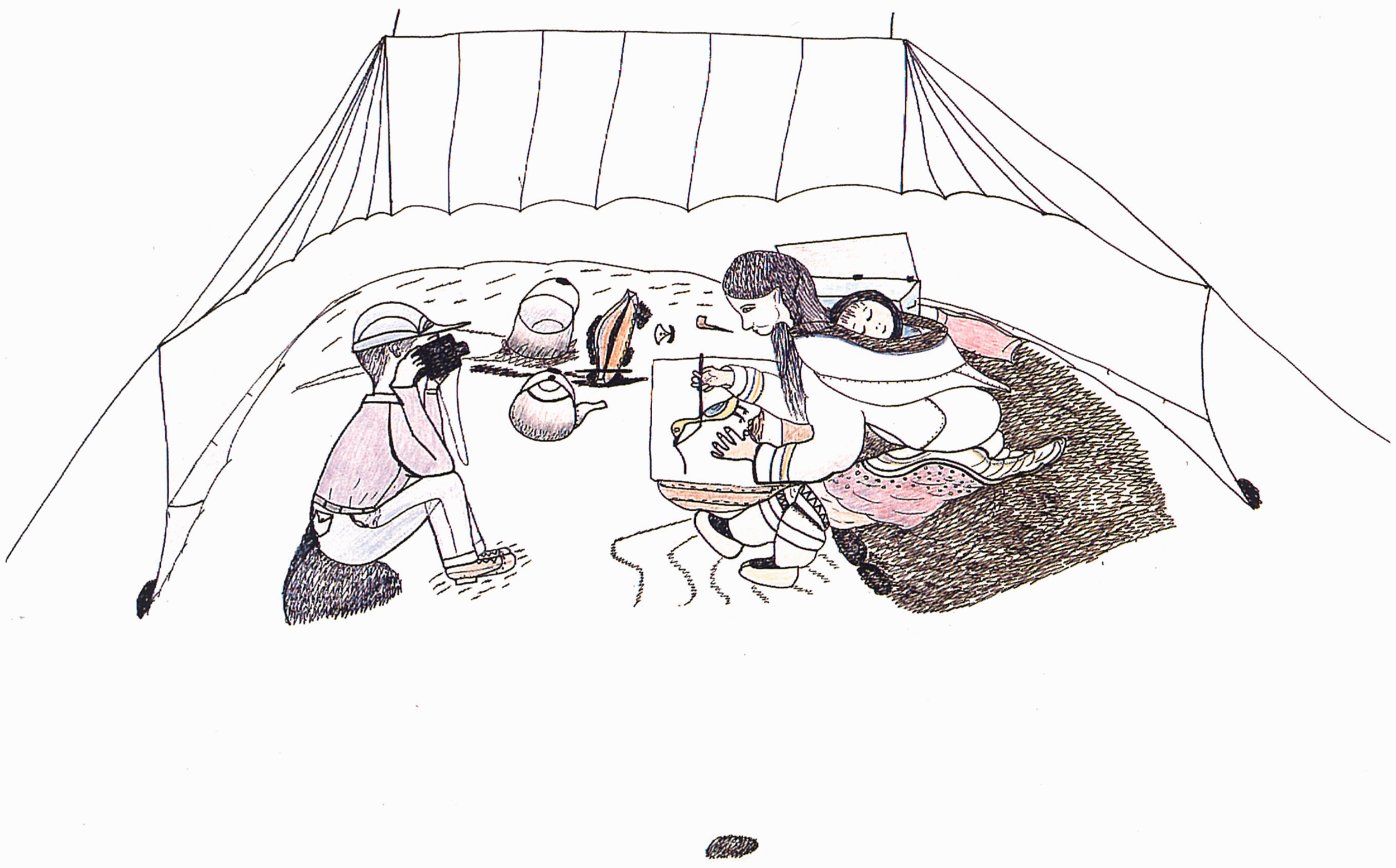
printmaking iconography and thematic content, displaying at times an ironic, and at others a playful or humorous engagement, to create a unique and unexpected record of historical trauma. Figure 5, Memory of My Life: Breaking Bottles (2001), and Figure 6, Calling Annie (2004–2005), depict scenes of contemporary community life in which Pootoogook dispenses with the expected stock of Inuit art images. Her figures live within the confines of their community “matchbox” houses, and deal with contemporary issues such as drinking. These “memories” of breaking bottles are at odds with more nostalgic notions of memory that are typically invoked in Inuit art, of a timeless, traditional, authentic, unmarred past that would coincide with the ideals that southern Canadians might associate with the north. Pootoogook’s simple drawings challenge the viewer to make sense of many of the contradictions of this life; the Canadian and Nunavut flags, for example, float on the wall above the figures, the Canadian flag higher, but smaller than the Nunavut one. Objects that would be familiar to a non-Inuit viewer, such as the clock, hang alongside unidentifiable objects. The seemingly ordinary kitchen scene contains familiar table, chairs, groceries and radio, but also traditional clothing, and the radio’s orality is captured textually only in Inuktitut. Like her daughter, Napatchie Pootoogook (see Figure 7) also defies expectations through her treatment of the Inuit experience of contact with irony, as in her drawing Tourist Photographing Woman Drawing (1999).
Memory of My Life: Breaking Bottles. Annie Pootoogook, Cape Dorset, 2001. Reproduced with the permission of Dorset Fine Arts. Calling Annie. Annie Pootoogook, Cape Dorset, 2004-5. Reproduced with the permission of Dorset Fine Arts. Tourist Photographing Woman Drawing. Napatchie Pootoogook, Cape Dorset, 1999. Reproduced with the permission of Dorset Fine Arts.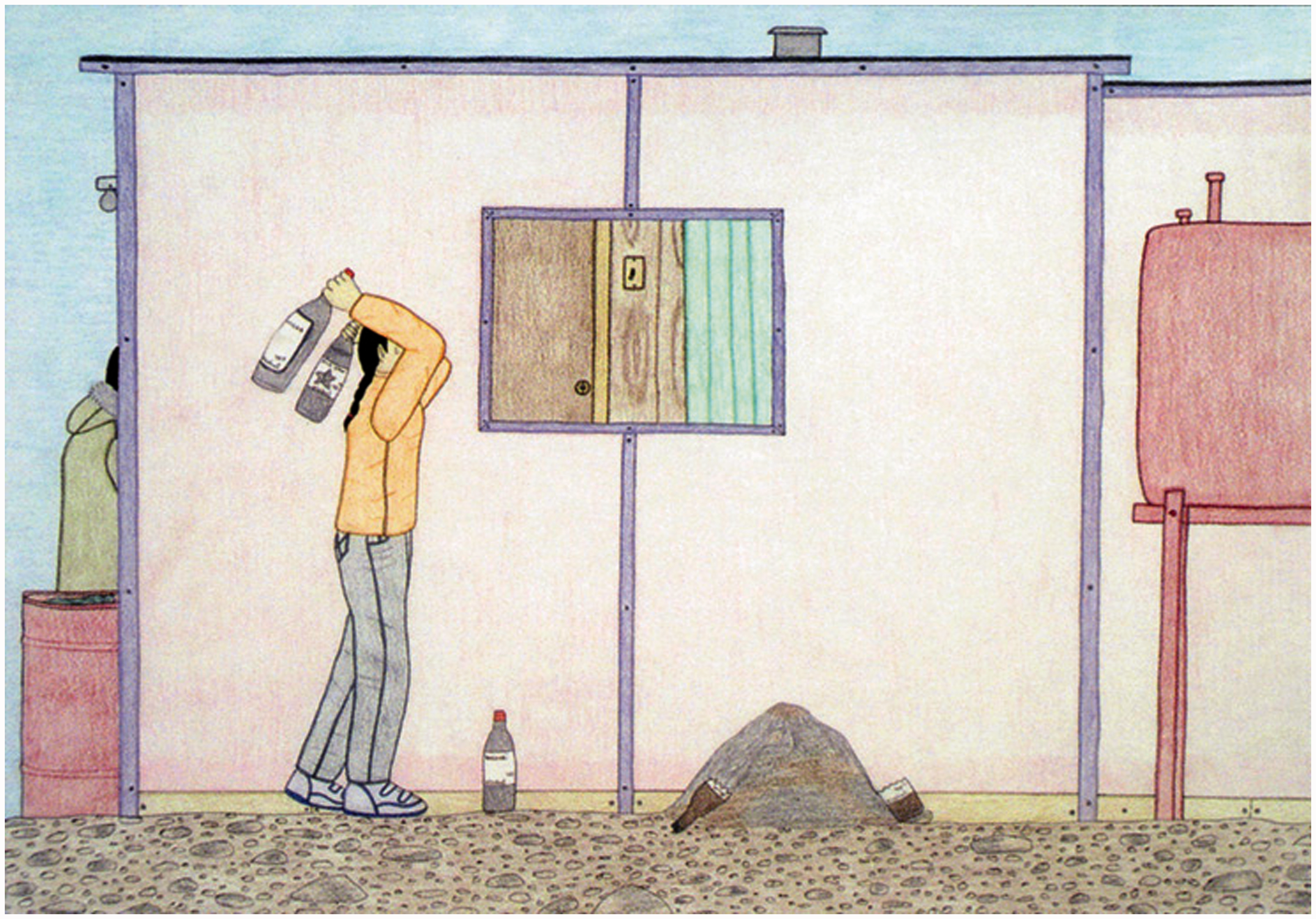
Shuvinai Ashoona has also, at times, used her drawings to explore violent and traumatic aspects of contemporary life. In a recent interview with me, she described the image in Figure 4: “There was a time there was a lot of graves being dug. They began having accidents or dying too soon. The suicidals are close by where I used to draw. People I know.” When I suggested this idea of a dialogue across time with her grandmother and aunt exploring similar ideas, she gave a complex answer: I still remember my grandmother [Pitseolak Ashoona] drawing. Maybe birds. I never drew like that. Last night I drew those dots [showing me her chin, like the markings of a traditional tattoo]. Sometimes when I touch the paper it’s like touching the skin of the paper, a skin like a tent, and it just comes out all those old things. The paper is telling me what to do. It’s like a ghost paper. [AC] A ghost paper? Tell me more about that. The mylar paper it’s a ghost paper. By rethinking of the past they used to have. Sometimes I get that they’re going to scold me for thinking about them.
13
The ways that these Inuit visual artists approach the past, the present, and the potentially traumatic, challenges the notion of the historic trauma narrative. The varied approach, even in this small sampling, to genre and form, visual narrative, temporality, and spatiality lead to disorientation with the familiar and evoke a narrative mood of dis-ease that communicates aspects of the contemporary Inuit experience. At the same time, other elements of these visual narratives, such as the use of humor and irony are a vivid reminder of the possibility of alternate subject positions for those who live in groups affected by historical traumatic events. Narratives do not need to include only “traumatized” (passive, speechless, horror-struck) victims in dialectical relation to colonialists, but can themselves be both stories of and vehicles for adaptation and strength, in the vein of what Gerald Vizenor (1998, p. 15) has termed “survivance”—a combination of survival and endurance. Interestingly, this engagement with the past/history as traumatic does not, to date, appear to take written literary forms such as prose narratives.
Narrative theory as a resource for thinking about (the representation of) historical trauma
If narrative is, as I am suggesting, central to the way that we conceptualize HT, as in trauma theory more broadly, then we should think about what would be considered the quintessential historical trauma narrative. Or, put another way, how does HT theory predict that an “authentic” historical trauma narrative would be constructed? An HT narrative would, in the most concrete terms, contain the elements of what is theorized to be constitutive of HT. In other words, it would be complex and represent cumulative losses; somehow represent the collective; be widespread (shared by many); and represent contemporary collective distress or mourning. Most importantly it would have a temporal structure that causally links the suffering of the present to past events, emploting a trajectory of trauma and loss from the past through to the present, and perhaps even to an imagined future. Recent work by Myhra (2011) makes concrete this tendency, when using historical trauma in a clinical context, to create a linear temporal history (Figure 8).
14
L.L. Myhra (2011). “It runs in the family”: Intergenerational transmission of historical trauma among urban American Indians and Alaska Natives in culturally specific sobriety maintenance programs. American Indian and Alaska Native Mental Health Research, Vol. 18(2), 17–40. Reprinted with the permission of the Centers for American Indian and Alaska Native Health.
Furthermore, the “past” events, in order to qualify as HT in some definitions, would have to have been perpetrated by an outsider to the collective, casting certain possibilities for the story’s characters (victims, villains, colonialists, settlers, etc.). One critique of “trauma culture” raised by Fassin and Rechtman (2009, p. 14) is that the homogenizing umbrella of “trauma” can obscure legitimate distinctions between victims and perpetrators when they belong to the same group, for example in the situation of domestic abuse when both abuser and victim are understood as suffering from HT, thus creating a very different moral order.
Although this is an oversimplification, it makes obvious certain problems, which I think can be framed through the lens of narratology. The narrative contexts of Inuit versions of historical trauma, described above, provide examples that challenge notions of genre and form, temporality, causality, spatiality, etc. Narratology, a term coined by Gérard Genette (1980), is concerned with these formal elements of narrative that contribute to a narrative’s organization, coherence, and impact on the reader. Although an in-depth summary of the elements important to narrative study is beyond the scope of this paper, some relevant features are as follows.
Form and genre
The forms and materials used to convey narrative—pictures, text, film, drama, etc.—and recognizable genres within that narrative, shape meaning and to some extent provide a container for stories that would otherwise struggle to find voice. A genre is “a conventional function of language, a particular relation to the world which serves as norm or expectation to guide the reader in his encounter with the text” (Culler, 2002, p.159). 15 Markets too affect the perpetuation of genres, as different kinds of stories create a market, and then are created by artists to fill that market. Life-writing and memoir have become just such a market, with a rapidly growing market to be found in the exoticized world of transcultural literature, markets that are driven by an appetite for trauma narratives (Dawes, 2009). These appetites and expectations, as much as they help a story gain narrative voice, can also constrain what can be told (and heard) about a subject.
Within contemporary Inuit culture, narratives of historical trauma can be found in many forms and genres. Visual, filmic, and oral (often transcribed) forms are most prevalent. And within the culture certain expectations are emerging about the form that these narratives will take. Oral history, for example, has become the form of traditional knowledge, and has been afforded venues of legitimacy, including within governmental policy. Other forms, such as sculpture and printmaking have been adopted from Western traditions and external markets and pressures participate in their perpetuation. And, in fact, some forms like Inuit printmaking have an almost exclusively non-Inuit audience, although this is changing. I think it is challenging to ask as researchers, clinicians, politicians, community members, what genres have “written” our very understanding of HT, and do we have any expectation of what genres we expect to encounter historical trauma through?
Temporality
Temporal structures are central to narrative, and in fact time and narrative have often been described as cocreating each other. Paul Ricoeur (1984) in Time and Narrative, writes: between the activity of narrating a story and the temporal character of human experience there exists a correlation that is not merely accidental but that presents a transcultural form of necessity. To put it another way, time becomes human to the extent that it is articulated through a narrative mode, and narrative attains its full meaning when it becomes a condition of temporal existence. (Vol. 1, p. 52)
Causality/emplotment
A feature of narrative that depends on temporal organization is its structures of causality. A grouping of events is a story, but when tied to causal explanations or motivations becomes plot. E. M. Forster (1985) succinctly demonstrates the difference between story and plot as: “The king died and then the queen died is story. The king died and then the queen died of grief, is a plot” (p. 86). This emplotment satisfies our urge to make sense, imagine connections, read motive or cause into events. It should be readily observable that this move is something undertaken by the historical trauma narrative, and in fact may be the key feature necessary for the historical trauma narrative. The events of the past are emploted to explain the outcomes evident in the present. The difference might be something like, “Inuit were coerced into settlements; today Inuit society is afflicted with boredom” (story), versus “Inuit were coerced into settlements, resulting in the loss of culturally meaningful activity, such that today Inuit society is afflicted with boredom” (plot). The “Inuit Power Curve” (see Figure 9), developed as an educational tool by Nunavut Sivuniksavut, emplots different phases of Inuit history along such a linear, causal, explanatory line.
Unifying the Inuit story/stories. Reproduced with the permission of Nunavut Sivuniksavut.
However, the same past events can be woven together to form different meanings and conclusions. This is aptly presented by Denham (2008) in his work around understanding potential emplotments of historical trauma that lead to narratives of strong cultural identity and resilience, rather than concluding in trauma and despair.
These counternarrative perspectives are important because, as Arthur Danto (1985) has commented, what we observe is often shaped by the conceptual organization that we bring to our observations: “observation is (if I may borrow a locution from Derrida) ‘always already’ permeated by theory to the point that observers with different theories will interpret even retinally indiscriminable observations differently” (p. xi). In other words, if we come to hear a “story,” whether in a clinical setting, political assembly, or through art, if we have a theory, such as historical trauma, this will nudge us toward a kind of emplotment that matches and verifies our expectations of plot.
The urge to emplot is also strongly closely connected to narrative closure, which occurs “when a narrative ends in such a way as to satisfy the expectations and answer the questions that it has raised” (Abbott, 2008, p. 230). Our desire to draw conclusions, to generalize and to abstract has profound implications for our willingness to suspend our emplotments, and to remain open to stories that have as yet indeterminate endings and conclusions.
Spatiality
As the visual narratives explored above point to, spatiality is an often underappreciated facet of narrative. This neglect of space may be attributable to our own cultural emphasis on verbal narrative, oral and written (see Abbott, 2008, p. 160). And yet, the representation of space can result in a fuller sense of time, as literary theorist Mikhail Bakhtin recognized when he proposed the idea of a time (chronos)–space (topos) compression, which he called the chronotope. This seems of particular relevance to the Inuit context, where experiences relate as much to the land, as they do to historical time.
Focalization and point of view (and the singular–collective dichotomy)
Gerard Genette used the term focalization to denote the position or consciousness through which we “see” the narrative (see Abbott, 2008, p. 233); point-of-view refers to a similar concept. Do we have hierarchies of who offers the most legitimate or exact points of view on historical and contemporary events in the HT context? Is the narrative viewed as more “collective” if heard from a number of narrators, or through the lenses of various points of view (from various witnesses)? Which points of view do we deem to be reliable?
Genette (1980) also claimed that no story (or l’histoire) represents any other story, reserving a special role for the story’s form, because a story cannot be retold in a different form and be the same story. And yet, part of the impetus for recognizing historical trauma is to unite people’s experience with a larger collective experience in order to provide further context or shared meaning. This collective understanding is often very politically tied to action and calls for social change and reparation. 16 Taiaiake Alfred (2009) argues, for example, that to focus on the individual, whether in individual testimony to the Truth and Reconciliation Commission or in clinical frameworks and interventions, represents the final stage in colonialism. He understands it as a denial of the collective, and the collective nature of colonial trauma.
And yet, the collective perspective must be balanced with the individual’s quest to narrate their own experience. This is seen quite clearly in the oral histories where singularity, the everyday accounts of individual lives, rather than an attempt to articulate “the” culture, is an important part of the genre. Such idiosyncrasy may make the narrative less intelligible, but without it important sources of memory are erased in the process of collectivization. At the level of individual suffering, attention to the collective may distract from this fact. A poignant example of this is the visual artist Annie Pootoogook who herself suffers from poverty, homelessness, and addictions, even while her art depicting community conditions continue to sell in southern Canada. 17
Metaphor
Metaphor is another narrative dimension that can provide a framework for understanding through associations. It speaks to another kind of time-scape, with a vector of condensation that can cut through (or across) texts. To identify images that are fleeting in the narrative, or that recur within or across texts can help to orient the reader towards the text’s figurative meaning, meaning that often overflows the bounds of the text’s plot. This seems to be a little-explored dimension of historical trauma narratives within the clinical domain. How do individuals and groups figure the past? Are Kunnuk’s metaphor of “limbo,” Ipellie’s “borders,” Shuvinai’s “ghost paper,” noted when we listen for historical trauma narratives. Interestingly, many of these metaphors are again spatial rather than temporal.
Critically, metaphor is not just figurative speech, but is also part of lived social reality. Metaphor shapes all aspects of our thinking (see Lakoff & Johnson, 2003), but also shapes action. The rhetoric of social movements can be shaped by metaphor (Benford & Snow, 2000), with real (and sometimes unintended) consequences. Taiaiake Alfred (2009) has called attention to this by looking at the way, through the federal Truth and Reconciliation Commission process, that historical trauma has taken up association with metaphors that link “truth” with “reconciliation” and “forgiveness.”
Although such formalist approaches to narrative originally aimed to create a universal or grand theory of narrative, this has been subject to a critical turn towards an acknowledgement of the role of power and identity politics in the construction and reception of narratives, and the existence of multiple narrative possibilities. As is evident in the wide variety of Inuit narratives explored above, narratives may also be deployed differently and in different forms across contexts. The same features in one context can have an altered meaning in another.
Conclusion: Reading historical trauma narratives in medicine and psychiatry
Medical culture has its own narratives, and the clinical narrative that is extracted from an encounter between clinician and patient, has also been understood as a genre (Hunter, 1993), in which certain kinds and forms of information are elicited and legible, and others fall outside of the expectable parameters of narrative. One might ask to what extent introducing a historical trauma narrative framework (or genre?) might act as a counterpoint to this clinical genre, or become incorporated into it. The future of the HT narrative in the medical or psychiatric context remains uncertain. If the debate surrounding PTSD is any indication, it is likely to be contentious. There are those within mainstream psychiatry that continue to disavow PTSD as a construct (see, in particular, Summerfield, 2001); trauma diagnosis and treatment have remained on the margins of the mainstream. From another perspective, some decry the fact that the construct has reorganized and homogenized the understanding of suffering globally, obliterating local and cultural distinctions. The trauma narrative and the HT narrative can become, in Rita Felski’s term, “mutually enabling fictions,” where the narrative naturalizes and verifies the concept, while the concept helps to form the narratives that are told. Rechtman (2002) has explored how the trauma narrative creates an alignment between human suffering and PTSD. Is “the” HT narrative creating new forms of alignment between the historical experiences of a group and the concept of HT?
Notwithstanding these concerns, consideration of Inuit social history, and the history of colonization, at least allows the possibility that the clinician may understand the story within its larger social and intergenerational context. Provided we use caution (and collaboration) when undertaking to elaborate incomplete or emergent narratives, with awareness of the kinds of temporal and causal trajectories suggested by the narrative framework of HT, we will hopefully avoid wielding our interpretive power, that unchecked can recapitulate the abuses of the past. 18
As I reflect back on this paper, after a process of revision and engagement with reviewers, I remain struck by one reviewer’s discomfort that the paper left him/her with the impression of holding an “empty box” and with insufficient conclusions. The accompanying revelation that the reviewer is Aboriginal and “intimately know[s] the devastation that has been compounded in different communities by indifferent commentary,” made me question the way I have positioned myself in this inquiry. Perhaps my attempt to inhabit a respectful vantage has unwittingly left too much of myself outside of the narrative, seemingly “indifferent.” I hope to convey that I bring a carefulness to my encounter with (all) people’s stories and lives. As Emmanuel Lévinas articulates, if we absorb the other he/she is no longer other: “if one could possess, grasp and know the other, it would not be the other. Possessing, knowing and grasping are synonyms of power” (1987, p. 90). We need to take care that our own bids to lend coherence are not the impulses of our own narrative desire. I have held off on trying to draw decisive conclusions. The story in Nunavut is very much a multiplicity of as yet unfolding stories.
This paper is my attempt to make explicit and transparent the expectations that we bring to our encounter with people’s storied lives, which includes expectations about the formal shape these narratives will take, and an awareness of how historical, political, and clinical contexts often construct the possibilities for narrating and listening. I want to read, listen, and look differently. Although it is difficult to “get outside” of the narratives we use to construct or support our ways of seeing the world, it is more likely that being aware of these narrative influences will allow us to remain open to multiple narrative possibilities and perspectives. As Naomi Adelson (2003) warns, “I would caution that the choices people make and the ways in which individuals come to understand, live and narrate their cultural selves is … complexly linked to a wider political and cultural history of being ‘Native’ in North America” (p. 46). And, particularly for people engaging with these narrations from outside of the community, perhaps bringing an empty vessel to hold these stories for reflection, without expectations as to what shape the container should take, is a good start.
Funding
This research received no specific grant from any funding agency in the public, commercial, or not-for-profit sectors.