



Abstract
Yee (2006) found three motivational factors—achievement, social, and immersion—underlying play in massively multiplayer online role-playing games (“MMORPGs” or “MMOs” for short). Subsequent work has suggested that these factors foster problematic or addictive forms of play in online worlds. In the current study, we used an online survey of respondents (N = 252), constructed and also interpreted in reference to ethnography and interviews, to examine problematic play in the World of Warcraft (WoW; Blizzard Entertainment, 2004–2013). We relied on tools from psychological anthropology to reconceptualize each of Yee’s three motivational factors in order to test for the possible role of culture in problematic MMO play: (a) For achievement, we examined how “cultural consonance” with normative understandings of success might structure problematic forms of play; (b) for social, we analyzed the possibility that developing overvalued virtual relationships that are cutoff from offline social interactions might further exacerbate problematic play; and (c) in relation to immersion, we examined how “dissociative” blurring of actual- and virtual-world identities and experiences might contribute to problematic patterns. Our results confirmed that compared to Yee’s original motivational factors, these culturally sensitive measures better predict problematic forms of play, pointing to the important role of sociocultural factors in structuring online play.
Introduction
There is growing popular concern that online videogame play is addictive and escapist, with even players acknowledging that they can overvalue their gaming in ways that produce distressful conflicts between offline and online lives. Academic researchers have also begun to speak of “problematic” online gaming, sometimes termed “overuse,” “excessive or pathological play,” and “toxic immersion” (Caplan, Williams, & Yee, 2009; Castronova, 2005; Holden, 2001; Mitchell, 2000; Snodgrass, Dengah, Lacy, & Fagan, 2011; Snodgrass, Dengah, Lacy, Fagan, & Most, 2011; Snodgrass, Lacy, Dengah, & Fagan, 2011; Snodgrass et al., 2012; Turkle, 2011; Yee, 2002, 2007; Yellowlees & Marks, 2007). Indeed, some researchers liken distressful online play to substance and behavioral “addictions” such as those associated with alcohol and gambling (Bai, Lin, & Chen, 2001; Clark & Scott, 2009; Holden, 2001; Mitchell, 2000; Young, 1998, 2004, 2009; Young & Rogers, 1998).
One line of research has sought to explain patterns of problematic Internet usage in reference to individual personality. These studies find associations between distressful online activity and psychological factors like self-efficacy (Jeong & Kim, 2011), sensation seeking and self-control (Mehroof & Griffiths, 2010), actual–ideal self-discrepancies (D. Li, Liau, & Khoo, 2011), and extraversion and impulsivity (Mottram & Fleming, 2009). Central to these psychological theories are concepts of motivation: illuminating what motivates individual players in either offline or online pursuits may also clarify the role of players’ personalities in the drive toward excessive gaming (Wan & Chiou, 2006). In a particularly influential account, Yee (2006, 2007) builds on foundational work by Bartle (1996, 2003) to document three motivational factors—achievement, social, and immersion—underlying play in massively multiplayer online role-playing games (“MMORPGs” or “MMOs” for short). Moreover, researchers such as Charlton and Danforth (2007) suggest that it is these factors that foster problematic play in online worlds. Following this line of analysis, it is suggested that MMO rewards are distributed in such a way—for example, one task following another in an endless succession, in-game status and power to be won through hours of pursuing rare treasures and “gear”—that players drawn to the achievement dimensions of these games find themselves spending more time online than they might wish. Likewise, social players risk getting drawn into communities and collaborations that demand increasing amounts of time; immersive play may lead gamers to not only temporarily escape, but also to more persistently and maladaptively avoid actual-world problems.
The research reported here further explores the relation of Yee’s three motivational factors to problematic and distressful play among (predominantly) North American players of the MMO World of Warcraft (WoW). To refine the explanatory power of individual motivation theories of problematic online play, we drew from a growing body of anthropological and interdisciplinary research showing that online worlds such as WoW form communities and cultures (Bainbridge, 2010; Boellstorff, 2008; Castronova, 2005; Corneliussen & Rettberg, 2008; Golub, 2010; Malaby, 2009; Nardi, 2010; Pearce & Artemesia, 2009; Taylor, 2006). Guided by this work, we adapted Yee’s (2007) three-factor motivational framework for MMO play to account for the impact of culture, in the sense of socially learned thought and practice, on distressful WoW play.
Though inspired by qualitative and interpretive work, we draw explicitly on formal anthropological approaches such as cultural consensus and consonance analysis (e.g., Dressler & Bindon, 2000; Dressler, Borges, Balieiro, & Dos Santos, 2005). We use these perspectives to operationalize Yee’s (2007) MMO gamer motivations—achievement, social, and immersion—in ways that might capture how the motivations of individual gamers are situated within socially transmitted and shared frameworks of meaning, practice, and experience. The formal anthropological techniques drawn from psychological and medical anthropology that inform our study rely on quantifiable methods. These methods allow us to speak directly to quantitative psychological investigations of problematic MMO play such as Yee’s (2007). As such, our cultural anthropological critique and partial reformulation of such research might be heard by scholars from both within and outside anthropology.
As a set of interrelated research questions, we anticipate that individuals who display little consonance with the cultural norms of achievement (e.g., of their offline culture, here, broadly, U.S. mainstream culture), who play WoW more exclusively with strangers as opposed to real-life social acquaintances, and who too fully dissociate into WoW’s immersive landscapes will be more likely to report playing WoW problematically. Distressful MMO play can arise, we believe, from the erosion of boundaries separating offline and online worlds. Players who use in-game WoW accomplishments and social interactions to escape from, rather than to build up, actual-world selves are more vulnerable to distressful play. By contrast, players who use WoW play to enhance and strengthen rather than compete or interfere with actual-world persons are less likely to experience distressful gaming. We expect that using culturally sensitive measures of Yee’s (2007) three gamer motivations will allow us to more effectively explain these psychological structures’ relationship to problematic online gaming, clarifying relationships between psychological motivations and distress.
We hope that research such as ours might inform debates within transcultural psychiatry related to emerging forms of technologically mediated sociality and psychological distress (American Psychiatric Association, 2013). Psychological and psychiatric anthropological studies situating individual distress within offline and online social contexts are critical to understanding phenomena related to compulsive play. Understanding the causes and consequences of distressful online gaming might provide the first steps to treating new technologically mediated problems sometimes framed as “mental disorders,” a goal of increasing interest to cultural psychiatrists. 1
Setting: The persistent and immersive World of Warcraft
WoW now has approximately 10 million monthly subscribers, making it one of the largest subscription-based MMOs and virtual communities in the West, with significant play populations in other parts of the world such as East Asia. Central to this online reality is its quality of persistence: thousands of users interact in a world that persists independently of any particular player. Any individual player may log off his or her computer. Nevertheless, players continue to compete and interact in ways that advance and change the contours of the game-space. WoW’s massively multiple play spaces are also immersive. Sophisticated software with powerful 3D graphics creates spaces that feel virtually real. The response to commands of the player’s avatar, or visual representation of the character-self, enhances this sensation, as do the mentally and emotionally absorbing quests and plotlines.
There is no single way to play WoW, nor any single goal. WoW offers gamers a range of tasks. Some are quests with goals given by computer-controlled nonplayer characters (“NPCs”). In completing these, players advance in levels. Each level acquired bestows additional power and ability on a character, allowing them to complete more difficult game challenges, which in turn allows them to advance even further. After completing the game’s highest level, currently Level 90, players compete in challenging in-game content such as multiplayer instances like dungeons or raids, requiring cooperation between players with groups balanced between different character classes. Typically, the most fearsome monsters are faced and most valuable treasures are won in these contexts, though comparable challenges can be found in PVP (player-vs.-player) arena and battleground competitions.
Theoretical background
Scholars point to “structural characteristics” of online games like WoW as key to their compulsive power and thus ultimately to how they lead gamers into distressful play. Caplan et al. (2009) found that gaming variables such as using voice-over-Internet (VOIP) technology in MMOs “contributed a substantively small, if statistically significant amount of explained variance” (p. 1312) to predicting gamers’ levels of self-reported distress related to online play. Research has also shown how computer-mediated play and communication are associated with perceived advantages over face-to-face interaction—like greater anonymity, decreased need to conform to dominant social norms, and increased control over one’s activities and relationships—that can lead to distressful play (e.g., Caplan, 2003, 2005; Leung, 2004). Yee (2002) speaks of “attraction” factors inherent to MMOs, including elaborate reward cycles of ever-increasing complexity, networks of in-game social relationships, and immersive computer technologies and absorptive story-lines that make players feel as if they are actually in the game. Clark (2006) points to the importance of player-vs.-player combat systems and the structure of in-game guilds as being associated with compulsive play and MMO engagement.
Many scholars now refer to “Internet addiction,” implicitly comparing out-of-control online behaviors to substance abuse (Bai et al., 2001; Clark & Scott, 2009; Holden, 2001; Mitchell, 2000; Young, 1998, 2004, 2009; Young & Rogers, 1998). In such discourse, the structural characteristics of MMOs are equivalent to a drug or substance of abuse. Significantly, Internet addiction and videogame addiction are not recognized in the American Psychiatric Association’s (APA, 2000) current Diagnostic and Statistical Manual of Mental Disorders (DSM-IV-TR), although proposed revisions to this manual would include such phenomena in an appendix (APA, 2013). While Internet addiction has thus not yet been classified as a full-fledged addiction disorder, researchers using the construct have generally modeled it on compulsive gambling (Young, 1998, 2004, 2009; Young & Rogers, 1998).
In this contested frame, many scholars prefer the term “problematic Internet usage” (PIU) to “Internet addiction” (Yellowlees & Marks, 2007). Such scholars still associate PIU with symptoms resembling those associated with substance addictions, such as compulsion to stay online, cognitive preoccupation with online activity, maladaptive use of the Internet to regulate mood, experiences of withdrawal when unable to use the Internet, preference for online to offline interactions, spending excessive time online, and experiencing disruptions to work and relationships because of online activity (e.g., Caplan et al., 2009; Yee, 2002, 2007). However, the term “PIU” has the benefit of not connoting drug abuse, an association which, to some researchers, signals the “moral panics” often associated with illicit substance use (Golub & Lingley, 2008). Indeed, describing Internet use or video gaming as “addiction” seems to attribute to technologies a chemical-like structure that propels players into compulsive play and dependency, a set of assumptions that have yet to be demonstrated (Holden, 2001; Seay & Kraut, 2007; Widyanto & Griffiths, 2006; Yee, 2002). Instead, scholars researching PIU focus on negative personal and interpersonal consequences associated with Internet use, such as conflicts between online and offline life, damage to school, work, and relationships, and personality factors like loneliness, depression, social anxiety, and tendency toward aggression (Caplan, 2007; Caplan et al., 2009; Lo, Wang, & Fang, 2005; Morahan-Martin & Schumacher, 2000).
Yee (2002), too, sees problems with equating problematic play and chemical dependency, and instead examines how gamers’ psychological motivations, such as the drive to feel strong and competent, might underlie personalities driven to play excessively online. In fact, much recent work on gamer personality focuses on the role of player motivations in MMO addiction. Studies confirm that players driven particularly by achievement rewards more commonly engage in excessive and even compulsive MMO play (e.g., Charlton & Danforth, 2007; Clark & Scott, 2009; Deci, Koestner, & Ryan, 1999; Kelly, 2004; Snodgrass, Dengah, Lacy, & Fagan, 2011; Snodgrass et al., 2012; Yee, 2006, 2007). Such a motivation can lead to distressful MMO play, given the need to grind through in-game content in order to experience rare moments of exhilarating success. Other research shows how social motivations like the drive to affiliate and collaborate with others may link to problematic MMO usage (Ducheneaut, Yee, Nickell, & Moore, 2006; S. M. Li & Chung, 2006; Ng & Wiemer-Hastings, 2005; Pisan, 2007; Snodgrass, Lacy, et al., 2011; Snodgrass et al., 2012; Song, Larose, Eastin, & Lin, 2004; Wolf, 2007). Still further studies of online games like WoW show that players’ motivations to explore, discover, and immerse themselves in an MMO predicts problematic usage (Caplan et al., 2009; Charlton & Danforth, 2007; Chou & Ting, 2003; Smahel, Blinka, & Ledabyl, 2008; Snodgrass, Dengah, Lacy, & Fagan, 2011; Snodgrass, Dengah, Lacy, Fagan, & Most, 2011; Snodgrass, Lacy, et al., 2011; Snodgrass et al., 2012; Yee, 2006, 2007).
While Yee’s (2006, 2007) psychological motivation approach to problematic play forms the foundation for our analysis, we believe that anthropological approaches to compulsive behaviors and addictions (e.g., Lende, 2005) suggest that further insight into distressful MMO play can also come with closer attention to the way sociocultural contexts shape player motivations. Drawing from contemporary psychological and medical anthropology, we recast each of Yee’s psychological factors to account for such group structures and processes
Culture and achievement
Our orientation to achievement draws on theories and methods employed in psychological and medical anthropological investigations of relationships between cultural models and health (Kirmayer & Sartorius, 2007; Kirmayer & Young, 1998; Kleinman, 1981, 1988). Cultural models, as opposed to idiosyncratic or personal models, are understood to be mental representations of the world that are socially transmitted and widely shared within a group (D’Andrade, 1995; Ross, 2006). Of particular interest here is the way Dressler and his collaborators (e.g., Dressler & Bindon, 2000; Dressler et al., 2005) have explored how individuals’ fit with culturally normative models of success and idealized life-style can produce stress, manifested in negative health outcomes. We use Dressler’s perspective as the basis of our examination of how WoW players’ success or failure in relation to cultural ideals may channel gamers’ behavior and experience in patterned ways, some of which can become problematic. For example, we anticipate that individuals less “consonant” with normative understandings of success, as culturally defined in the largely U.S. and North American contexts where our research unfolded, are more vulnerable to problematic play, as they pursue success in WoW to compensate for perceived real-life failings.
Social play and conflicts between offline and online worlds
Reworking Yee’s (2006) construct of social motivation, we hypothesize that whether WoW players game problematically depends on online and offline social commitments and relationships. Following the MMO literature and our own previous research (Clark, 2006; Snodgrass, Lacy, et al., 2011), we explore how playing WoW with actual-world friends (as opposed to strangers or in-game-only friends) determines whether gamers find their play to be positive or negative. We hypothesize that playing with actual-world friends might temper WoW gamers’ tendencies to excessively value online relationships that are not integrated with players’ offline lives. Cultural consonance can also add to the analysis of the role of social motivations. We suspect that the (mental) health impacts of lack of consonance with culturally normative models depend also on the structure and composition of actors’ social networks (Gravlee & Dressler, 2005; Gravlee, Dressler, & Bernard, 2005; Gravlee & McCarty, 2007). This forms the basis for our own hypotheses related to the potentially positive mental health impacts that WoW gamers experience by playing with actual-world friends, which brings together online and offline social networks for potentially therapeutic benefit.
Immersion
In regard to immersion, we frame our research from the perspective of anthropological studies of “dissociation” (Krippner, 1997; Luhrmann, 2005; Luhrmann, Nusbaum, & Thisted, 2010; Lynn, 2005; Seligman, 2005a, 2005b; Seligman & Kirmayer, 2008). “Immersed” players are so concentrated in the richness of the game-world that they “lose themselves.” To a certain extent, they feel like they really are in the game and sometimes actually they are their avatar-character (Bartle, 2003; Yee, 2007). We suggest that some players lose themselves so fully in the game—or “dissociate”— that they become unaware of events happening around them in the rooms where they play and feel fully identified with their characters as a kind of second self. In our study, we explore how players’ health might depend on the extent to which they dissociate into WoW’s virtual landscapes and social-scapes, blurring boundaries between actual and virtual worlds.
Hypotheses
Overall, we explore how problematic MMO play might result from particular forms of interaction between actual and virtual worlds: WoW players’ striving for in-game successes to compensate for self-perceived actual-world shortcomings; gamers’ overvaluing virtual relationships that are disconnected from offline social interactions; and players’ too-deep dissociation potentially blurring boundaries between actual- and virtual-world identities and experiences. We state these in the form of the following four interrelated hypotheses:
H1: Self-perceived online success within WoW will be positively associated with reporting problematic or distressful WoW play experiences. Here, we predict that the attraction of WoW accomplishment becomes so important to certain players as to propel them into patterns of overuse and consequent distress. H2: Self-perceived offline or “real-life” success will be negatively associated with reporting problematic WoW play experiences. Gamers with low levels of offline success will use WoW play and success to compensate for their perceived offline failures, and these positive experiences from WoW success will make them more likely to play excessively. Conversely, players with higher offline success will need WoW less, making them less likely to overplay. H3: More frequent interaction with actual-world friends and relations within WoW will be negatively associated with reporting problematic play experiences. Here, we anticipate that those who play with people they know offline will better avoid distress from excessive WoW play and will use the game to enhance rather than escape offline commitments. By contrast, those who do not play with such actual-world acquaintances are more likely to be drawn too deeply into WoW’s virtual environment, reporting higher levels of problematic and distressful play. H4: High levels of dissociative experience while playing WoW will be positively associated with problematic play experiences. We think that players who control their dissociation, and indeed who manage to keep it linked to richer actual-world achievements and relationships, are less likely to experience their WoW trance-like states in negative terms. By contrast, those who dissociate too fully into WoW, losing themselves too fully in this imagined virtual world, risk blurring too fully boundaries between their off- and online existences, which can produce distress.
Method
Sampling and procedures
The work rests on both qualitative and quantitative data collection. In the interests of brevity, we summarize our procedures in broad outline here, referring interested readers to more detailed descriptions elsewhere (Snodgrass, Dengah, Lacy, & Fagan, 2011; Snodgrass, Dengah, Lacy, Fagan, & Most, 2011; Snodgrass, Lacy, et al., 2011). We began online, conducting participant-observation in World of Warcraft. Three of the paper’s coauthors, Snodgrass, Dengah, and Fagan, played WoW extensively and maintained field journals detailing their online interactions and experiences. Members of our research team also conducted informal in-game interviews with players. Field experiences guided the construction of more specific sets of questions, from which we conducted 30 “semi-structured” interviews (Bernard, 2006). This was followed by small sample surveys utilizing “free-lists” and rating tasks to understand cultural conceptualizations of success and well-being in both real life as well as in the game-world. 2 Our data collection culminated with a formal Web-based questionnaire, posted on WoW blogs and gamer sites, to which we also extended invitations through our own play networks.
Measures
As part of the Web survey, we developed four psychocultural scales to measure players’ level of involvement in and with the game. These scales’ individual items are detailed in the Appendix.
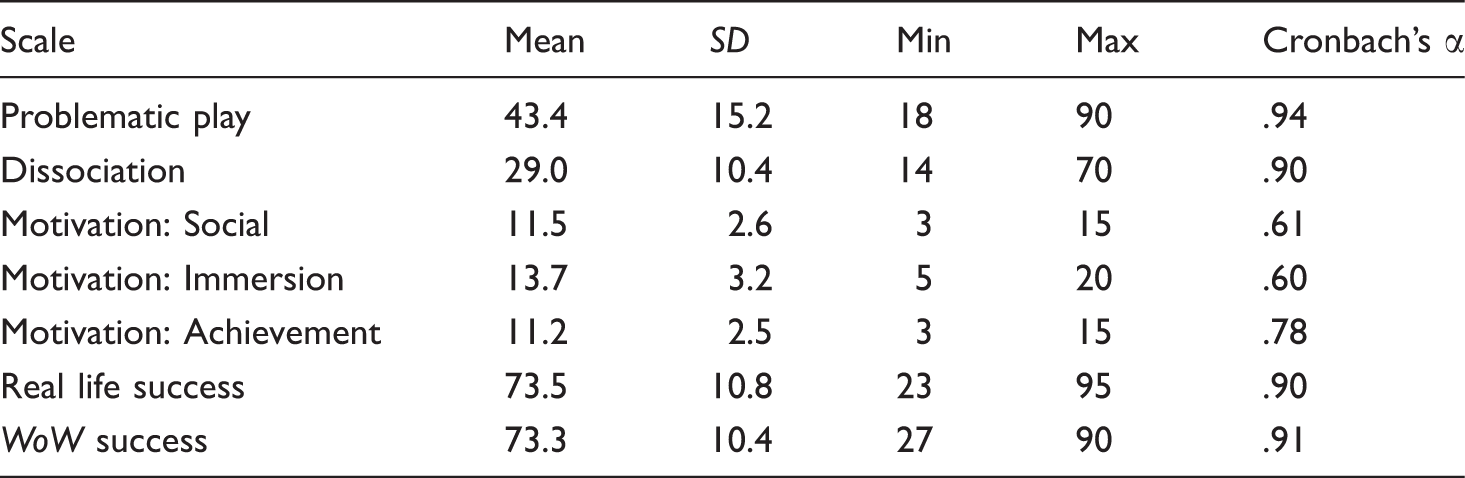
Problematic WoW play was measured with a 19-item adapted from Young’s (1998, 2004, 2009; Young & Rogers, 1998) commonly used Internet Addiction Test (IAT). Items in this scale involve experiences of playing compulsively in ways that negatively affect other dimensions of gamers’ lives, such as jobs and relationships. In addition, questions in this scale asked about experiences of compulsive play, cognitive preoccupation with the game, maladaptive use of the game to regulate mood, symptoms of withdrawal when unable to play, preferences of for game world over actual-world interactions, and play of excessive duration. Each item asked how frequently the respondent experienced the behavior, rated on a 5-point scale, from 1 = Never to 5 = Always. This scale had a high reliability with a Cronbach’s α of .94. 3
In the second measure, we adapted two scales commonly used in psychological anthropology to assess absorptive and dissociative experiences—the Tellegen Absorption Scale and the Dissociative Experiences Scale (DES; Bernstein & Putnam, 1986; Tellegen & Atkinson, 1974)—to create our own WOW-specific measure of “absorptive-immersion-dissociation.” Here, gamers were asked to respond to WOW-specific questions related to the extent to which their play elicited distortions of perception, memory, and identity typical of absorption and dissociation in other contexts. For example, players were asked about their levels of imaginative identification with their characters, as well as the extent to which WOW play led them to become unaware of events happening around them in the real world, leading them to, for example, ignore the demands and discomforts of their real-world bodies, lose track of actual-world time, and so forth. This scale was also very reliable (Cronbach’s α = .90).
Third, the WoW Consonance Scale, measured the degree to which individual players view themselves as exemplifying the ideal cultural model of a successful WoW player. Scores were obtained by summing players’ self-ratings, on a 5-point scale, of the extent to which they agreed that each of the WoW success model items characterized them personally. In parallel, and fourth, a Real-Life Consonance Scale was constructed (using our respondents’ “in real life” concept), derived by summing players’ responses when rating themselves relative to each of the real-life success model items. 4 Following routines outlined by Dressler et al. (2005), these two measures allowed us to gauge each respondent’s level of individual “consonance” with the potentially culturally shared model of success. Judging how much individual players were consonant with dominant expectations regarding success and achievement serves as a proxy for the level of one kind of stress and distress in their lives, which might in turn predict their risk of playing WoW problematically. Both of these scales (WoW success and RL success) had high reliability (Cronbach’s α .90 and .91, respectively).
Motivations were measured using 10 items capturing Yee’s (2007) three-factor, 10-subfactor framework. A principal components factor analysis of these 10 items, reported in detail in Snodgrass et al. (2012), supported Yee’s work, showing three components that accounted for 56% of the total variance. The analysis showed a simple structure, with three items (socializing, relationships, and teamwork) loading strongly on the first social component; four items (discovery, role-playing, customization, and escape) loading on a second immersion component; and three items (advancement, mechanics, and competition) loading on achievement. None of the items were cross-loaded, using a zero-loading threshold of 0.4. We used these item groups to create measures of motivation corresponding to each of these components resulting in three scales that closely mirror Yee’s results. The achievement scale had the best reliability (α = .78), social was next (α = .61), followed by immersion (α = .60).
We also asked questions regarding each respondent’s real- and virtual-world social life as well as how much the two worlds overlap. The first question asks how many of the people the respondent regularly plays within WoW, s/he knows in real life. The second asks how frequently the respondent associates within the game with people they have never met before. The third question is a control that assesses the respondents’ feeling towards their own social life. All three questions are coded using 5-point Likert scales.
Finally, basic demographic data (e.g., gender, education, employment, and relationship status), degree of WoW usage and accomplishment within the game, motivation and styles of game-play, social interactions in the game, and numerous other topics were also included in the survey.
Data analysis
Ethnographic experiences and observations, documented in field-notes, provided the basis for self-reflexive discussions among members of our research team about how our motivations to play and also the cultural context of those motivations impacted our own WoW experiences. The 30 formal interviews with participants were digitally recorded, transcribed, and coded for common themes. Code-maps were developed and represented graphically, demonstrating, for example, relationships between gamers’ motivations (including achievement) and their positive and negative WoW experiences. Transcripts and codes were managed with ATLAS.ti (v5.2; Scientific Software Development GmbH, 2002–2010), a qualitative data management and analysis program.
Cultural consensus analysis was used to assess the cultural nature of in-game and real-life success models (Romney, Weller, & Batchelder, 1986; Ross, 2006; Weller, 2007)
The core of our survey analysis rests on linear regression models, in which we used survey scales and individual items as predictors of problematic play. The controls presented in our regressions resulted from exploring various models with different demographic indicators and picking for inclusion in further analysis only the three strongest predictors (as determined by hypothesis tests on the overall model), thus helping to avoid an excessive number of predictor variables in relation to the modest (N = 252) sample size. Demographic controls turned out to have limited predictive value here, so the restriction to three should not present a problem. In the presentation of our analysis of WoW problematic play, we begin first with a model containing only control variables. Then, we offer successively models that include controls plus different key predictor variables presented one at a time (motivation, dissociation, consonance, and playing with real-life friends). We next present a model that includes dissociation, one of our most effective predictors, along with motivation variables that follow from Yee’s work (2006). Next, we offer a complete model that combines all control and substantive variables together in a single analysis. We conclude by including the original controls along with predictor variables showing statistical significance in previous models to form a more parsimonious model of problematic MMO play.
Results
Cultural models of online and offline success: Free-lists and rating tasks
After collapsing related terms from the WoW success free-list into the same category in order to account for redundancy, the WoW Success Scale, which we might think of as an achievement “model” or “frame,” contained 17 items. Top items in the free-lists included having knowledge of one’s character class and its related skills and abilities (listed 98 times), possessing good gear and in-game wealth (38 times), and being a dedicated goal-oriented player (also 38). Social relational items also were prominent, with being a cooperative and adaptable player (33) and having positive personality traits (23) both commonly listed. We similarly elicited from WoW players a real-life success model, which contained 19 items. Having positive personality traits was mentioned most frequently (41 times), followed by being involved with friends and family (36), having a high income and being wealthy (36), working hard at a good job (31), and being happy (28).
Examining these free-lists related to success, we are struck by the overlap in actual- and virtual-world models, represented schematically in Figure 1. There, we draw readers’ attention to how having good gear in the virtual world corresponds to being wealthy in the real world, being dedicated and hard-working in the game corresponds to working hard at one’s real-life job, and having positive personality traits and being socially active and adaptable feature prominently in both lists.
Correspondence between WoW and real-life success models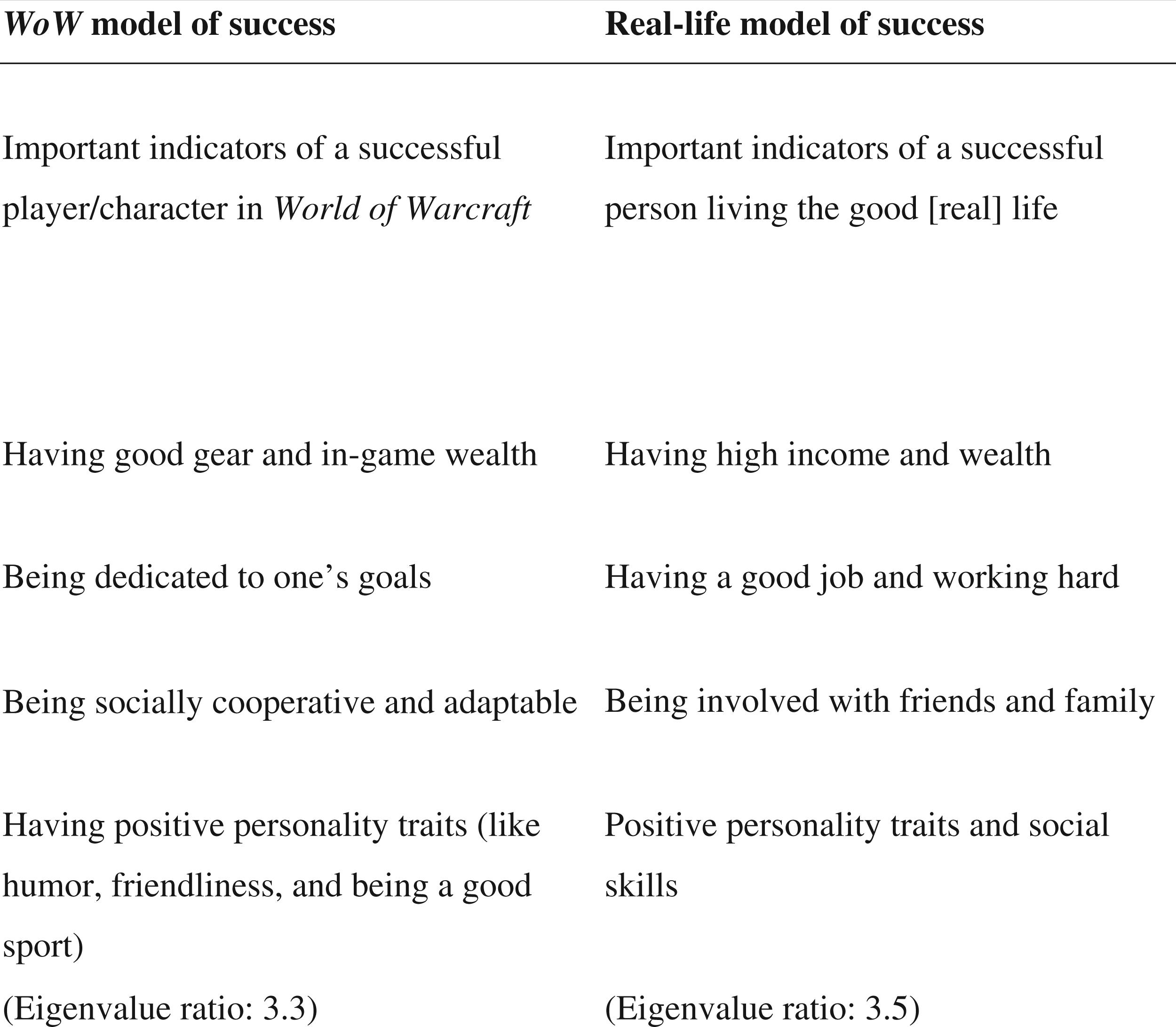
A cultural consensus analysis of the WoW success model items (using UCINET; (Borgatti et al., 2002) gave a first to second eigenvalue ratio of 3.3 and an average competency score of 0.49. 5 Despite there being three negative competence scores, we felt the eigenvalue results in particular demonstrate that these gamers substantially share a normative understanding of a gamer model of successful play. The three negative-loading individuals might be thought of as outliers who did not share knowledge and values related to this dimension of gamer culture. The consensus analysis of the offline or “real-life” success model generated a first to second eigenvalue ratio of 3.5, an average competence score of 0.56, and no negative values. In the consensus framework, this showed substantial cultural sharing of knowledge and values related to this domain. The fact that these models were culturally shared gave us confidence to include these items on our Web survey as a potential way to measure the levels of individual “consonance” with these shared models of WoW and real-life success. (The Appendix, which lists the individual items of these scales, also shows the “answer keys” or culturally “correct” responses for each scale item.)
Web survey
There were 252 complete responses to the survey. One respondent with a number of questionable responses and a standardized residual of -5.7 (on one of our regression models) was removed from analysis as an outlier. Demographically, the mean respondent was 26.6 years old (9.0 SD), male (n = 195, 78%), in a relationship at the time of the survey (54%), and a student (53%). In addition, about one third of respondents were unemployed (30%) and 36 (14%) of the participants did not classify themselves as White or Caucasian. There were 30 (12%) participants who played WoW for 40 or more hours per week, and about half said they played WoW for more than 8-10 hours continuously “often” or “sometimes.” Likewise, 73% of our respondents reported having one or more maximum-level characters. In all, 72% of survey respondents were residents of the United States, and 81% played on North American servers.
Psychometric properties of scales (N = 252)
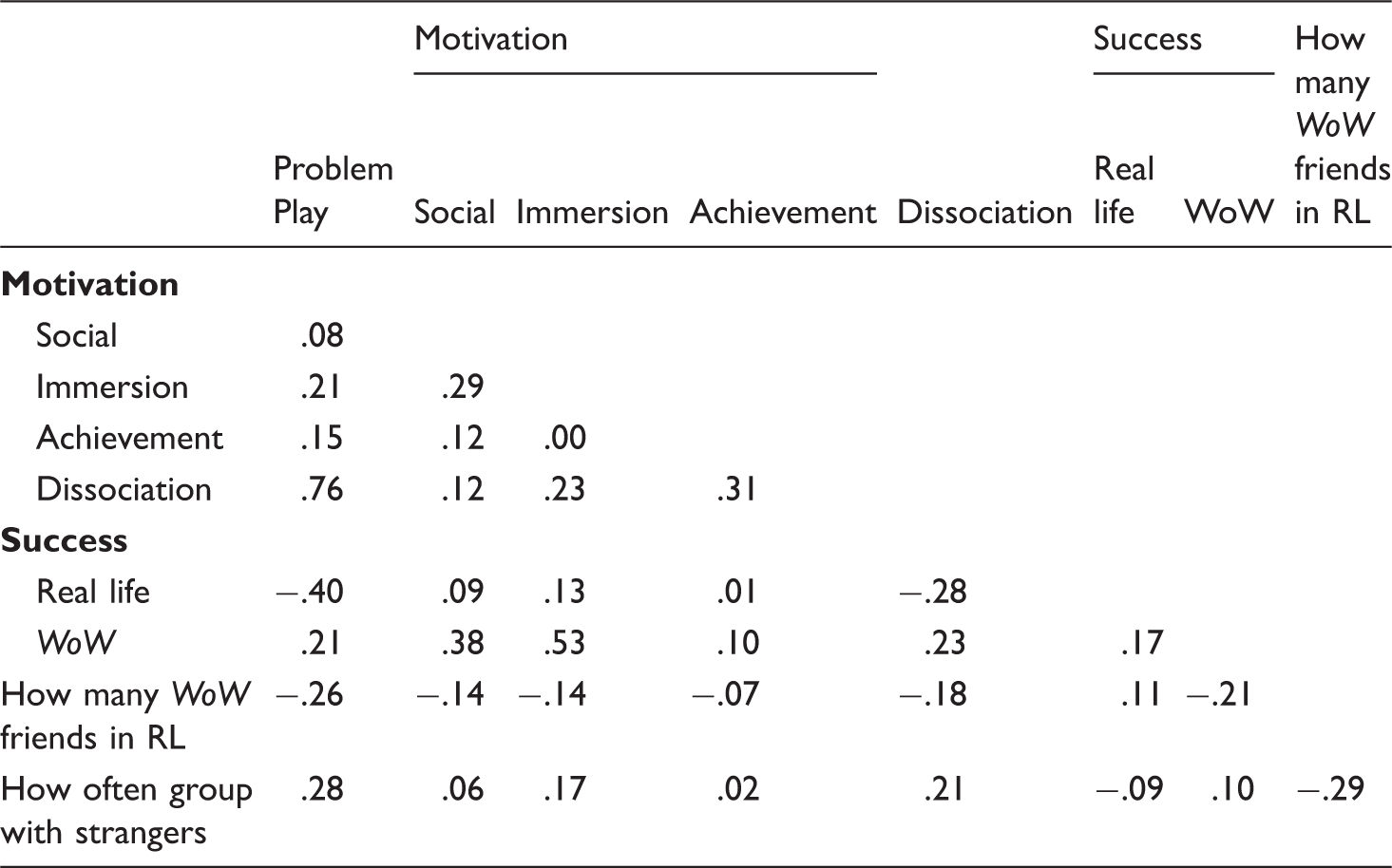
Bivariate correlation matrix of problematic play and predictor variables
Additive OLS regression model of WoW problematic play
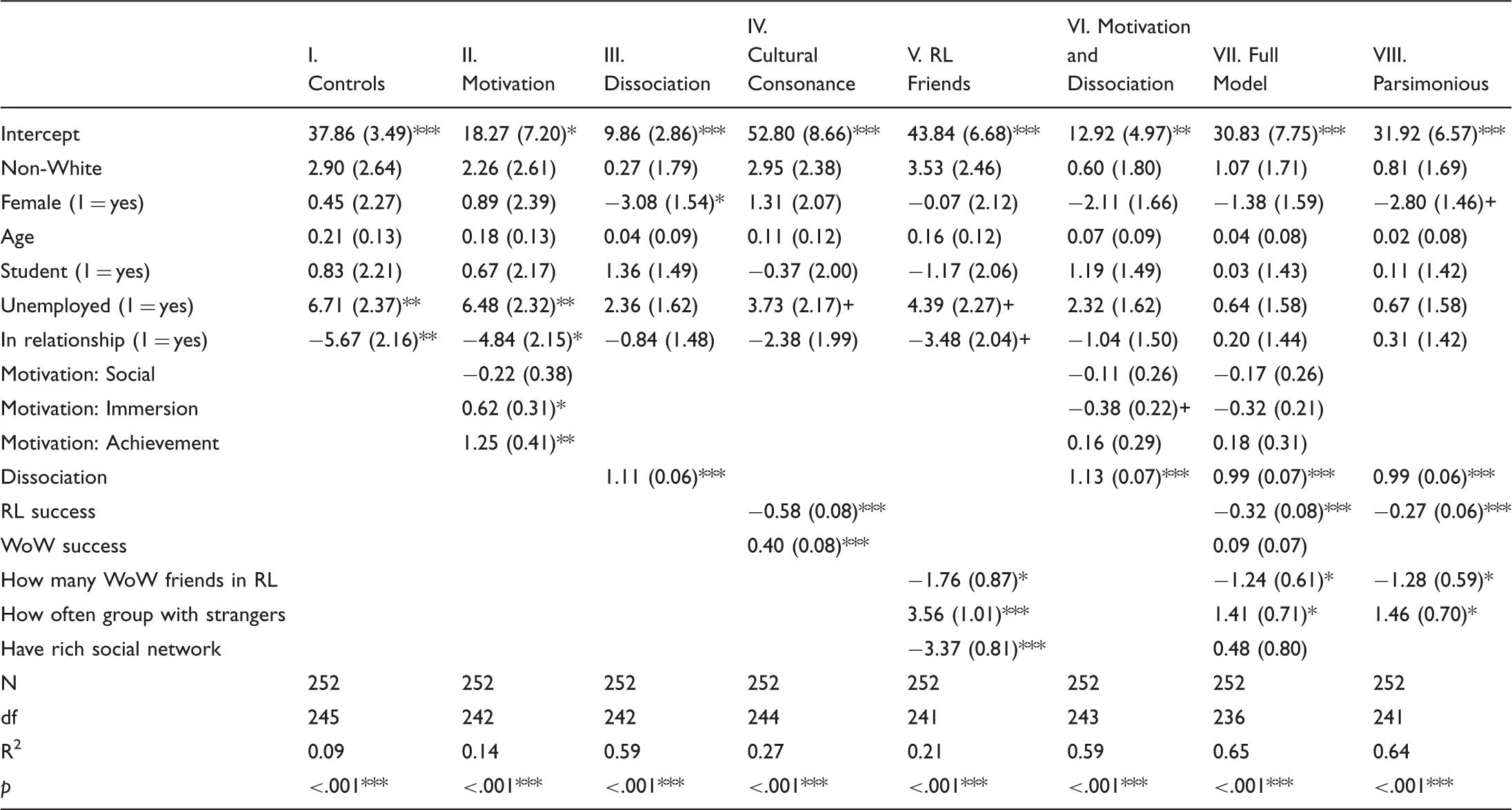
In Model II we use Yee’s (2006) three primary classifications of gamer motivation to predict the WoW problematic play score. The results in this model (as in the demographic analysis of Model I presented above) are preliminary and prior to our formal hypotheses, where we are interested to understand relationships between culturally salient indicators and WoW problematic play. Achievement was the strongest motivational predictor. Its slope coefficient would translate to a standardized slope of about 0.2. Immersion was also significant and positive, with a standardized effect of about 0.13. The motivation for social interaction had a small but nonsignificant negative relationship with problematic WoW play. This model accounts for a modest amount of the variance in problematic play scores. The two control variables that were significant in Model I remain almost unchanged in Model II suggesting they are unrelated to motivation for play.
In Model III we used our scale for dissociation to predict problematic play, analysis of direct relevance to Hypothesis 4 above. The effect of dissociation on problematic play is profound. As hypothesized, we found a strong positive relationship (standardized slope = 0.75) between a respondent’s reported level of dissociation and absorption into the game and reported frequency of negative addictive behaviors.
Our scales for real-life (RL) and WoW success consonance are used to predict problematic play in Model IV, results which are important in relation to Hypotheses H1 and H2 from above. Both theoretical predictors were found to be strongly statistically as well as practically significant. As we hypothesized in H2, players with a strong consonance with general U.S. or Western cultural values (real life success) demonstrate a much lower problematic play score (standardized slope of -0.58). On the other hand, also as we anticipated in H1, having a strong consonance with the perceived WoW culture results in a higher predicted problematic play score, about 0.27 in standardized terms.
In Model V we examine the role real-life friends and grouping with strangers has on distressful WoW play, in line with Hypothesis 3. The number of in-game friends that a player knows in real life (rated on a 5-point Likert scale from 1 = None to 5 = All) has a moderate negative effect on problematic play. If all of a player’s in-game friends are also known to the player in the real world the problematic play score is, on average, about 7 points lower, or roughly half a standard deviation, compared to players who know none of their game friends in the real world. The frequency with which a player interacts and groups with complete strangers is also significant, but has a much stronger positive effect on the problematic play score. If a player groups with strangers all the time, their problematic play score is expected to be, on average, almost a full standard deviation higher than someone who never groups with strangers. Finally, the degree to which the player believes they have a rich social network of friends and support was added as a control in this model and Model VII. This was also found to be significant and, consistent with results for the RL consonance scale, has a strong negative effect on problematic play.
The next regression Model VI tests Yee’s (2006) motivations against our dissociation scale. When controlling for our dissociation scale only the immersion motivation had a slight statistical significance let alone a practical significance. The dissociation scale is still statistically and practically significant.
In the last two steps in our regression analyses, we add all of our predictors and controls into a single model then keep only those that had a reasonable statistical significance. In Model VII (our full model) four of our theoretically informed predictors were found to be significant. The two predictors with a positive effect were dissociation and the frequency with which players group with (i.e., formally collaborate in invited groups) strangers. Dissociation maintained a strong relationship with problematic play even when controlling for all other predictors. The two negative predictors were RL success and the number of in-game friends the player knew in the real world. The effect of the RL success scale was moderately reduced when controlling for the other predictors while the in-game friends predictor was only slightly affected. Notably, gamer motivations appear to have no effect on problematic play when controlling for other predictors. Also, consonance with WoW gamer culture also appears to have no effect at all in the presence of other predictors.
In the final model, Model VIII, the original controls and the significant predictors from the full model were used. There was only a very slight reduction in the R2 and only slight changes in the coefficients for the significant theoretical predictors as compared to the full model suggesting there was little issue with multicollinearity.
Discussion
Culture, motivation, and MMO problematic play
Our free-lists, rating tasks, and consensus analyses led us to two cultural models or frames of success, one connected to the virtual and the other to the actual world of mainstream U.S. culture. Our research demonstrates that, on some level, players do in WoW more or less what they do in real life, striving to achieve and also pursuing meaningful social interactions and relationships. WoW cultural models of success, then, mirror certain important dimensions of mainstream dreams of success and the good life. This resemblance to offline goals and commitments enables WoW achievements to symbolically substitute for offline success.
Overall, our survey data support our first hypothesis (H1), pointing to how WoW achievement is associated with gamers’ reports that their play can be a source of distress in their lives. Specifically, we find significant associations between the extent to which players achieve in-game success—that is, the extent to which they are culturally “consonant” with shared models of WoW success—and gamers’ reports of distress related to their play. We also find support for Hypothesis 2 (H2) in our survey results. Players with less satisfying real lives as defined by the dominant offline culture—that is, who are less “consonant” with mainstream U.S. cultural models of offline success—are more likely to have adverse consequences associated with their gaming. This may show how in-game successes compensate such individuals for their perceived offline failures. In-game rewards received by less conventionally successful individuals make them more likely to play excessively, with unwanted personal consequences. By contrast, players with higher offline success need WoW less, making them less likely to need the positive feedback from successful WoW play.
Also, we find that whether WoW is experienced as wondrously restorative adventure or, by contrast, as highly addictive and thus disruptive to gamers’ lives, depends critically on the extent to which players achieve and also successfully negotiate normative models of success, situated in potentially competing virtual- and actual-world moral universes and social networks. In support of Hypothesis 3 (H3), our study suggests that it is not only whether WoW players seek meaningful social interactions that is determinant of whether this game becomes distressful, but more specifically how players interact with others and with whom (real-world friends or not) in these online game-worlds. To explain these results, consider that WoW players become heroes, defeating evil and rescuing friends even when the odds are against them. While this may lead some gamers to excessive play in this haven from actual life, for others, the transfer of in-game accomplishments and status to real-life networks enhances relations with friends and family and thus a sense of well-being.
Further, our survey analysis and statistical models point to a strong positive association between rates of dissociation and problematic play, supporting Hypothesis 4 (H4). Players who dissociate too fully into WoW, losing themselves more completely in this imagined virtual world, risk problematically blurring boundaries between their off- and online existences. In the terminology of cultural psychiatry, they are more likely to get lost “ghost-like” in WoW—separated too fully from their real-world selves. By contrast, those who control their dissociation, and indeed who manage to keep it linked to richer actual-world achievements and relationships, are more likely to experience their WoW trance-like states as akin to invigorating and empowering shamanic magical flights.
Finally, our final two regression models (VII and VIII) show that our socioculturally sensitive measures of achievement (consonance with real-life models of success), social (whether one plays with friends known offline or only with strangers), and immersion (“dissociative” experiences) remain significant, while Yee’s motivational factors do not, suggesting the potentially greater predictive power in this analysis of these constructs drawn from formal anthropological perspectives. Accounting for the role of culture and society in these play contexts thus further enhances Yee’s (2007) and others’ already persuasive analytical models.
Results in relation to the problematic online play literature
The “addiction” frame does not do justice to our respondents’ WoW play experiences. 6 Nevertheless, our research shows that some WoW players find their play distressingly compulsive and “problematic.” We thus see merit in connecting our research to work such as Lende’s (2005) on the cultural dimensions of “addiction” and substance abuse. Likewise, we see similarities between our study and “psychosocial” approaches to problematic MMO play (e.g., Caplan et al., 2009), in that individuals’ motivations to play MMOs, and thus their problematic patterns of play within game-worlds, emerge from an intersection of psychological propensities and social contexts. 7 While we find these perspectives useful, we nevertheless suggest that more attention can be placed on the role of “culture” in the sense of socially shared and transmitted cognitions, social networks, and frameworks for interpreting experience. Rather than speaking simply of society as a neutral space or context where individuals interact with others, researchers might focus on the manner that such spaces are shaped by traditions of local knowledge and practice, which vary across cultures and subcultures. Cognitions like “I am worthless offline, but in the online game world I am someone” (Davis, 2001, p. 191)—or even achievement motivations or a preference for online as compared to offline interaction—are socially learned and thus likely to be more prevalent in some cultures than others.
Limitations of research
Our sample of survey and interview respondents was relatively small, nonrandomly selected, and limited to WoW players drawn almost exclusively from the USA and overrepresenting more serious gamers. It is thus difficult to generalize beyond our sample to the WoW or MMO population as a whole. In defense of our methodological choices, we would suggest that focusing on one online game-world, comprised of North American gamers, allowed us to understand that virtual reality in enough detail to ask meaningful interview and survey questions and also to convincingly interpret these responses. Further, in the absence of longitudinal data, we cannot definitely establish the causal direction of the mechanisms we describe. Additionally, while we have analytically separated cultural frames, social networks, and psychocultural experiences, we recognize that each of these affects the other: for example, socially shared and transmitted frames about whether losing oneself absorptively in WoW is a good or bad thing probably influence the positive or negative tenor of gamers’ social and dissociative experiences.
Conclusion
This study has explored the perils of certain forms of Internet gaming activity, in an attempt to add the insights of psychological anthropology to our understandings of the problematic dimensions of online play. We do recognize the hesitation by anthropologists and others to label cultural behavior such as that described in this article “addictive” or even “problematic” (Boellstorff, 2008; Castronova, 2005, 2007; Golub & Lingley, 2008; Nardi, 2010). In the anthropological case, such a move would seem to go against our famous dictum of cultural relativism and mandate to capture the “native’s point of view” (Geertz, 1974). Still, a growing body of research, typically structured by an individual personality and motivation framework, points to the link between Internet use (and MMO play in particular) and psychological distress (Bai et al., 2001; Clark & Scott, 2009; Holden, 2001; Mitchell, 2000; Turkle, 2011; Young, 1998, 2004, 2009; Young & Rogers, 1998). Anthropologists and cultural psychiatrists can bring new perspectives to the debates on these pressing public health issues.
Our research shares much in common with previous studies of problematic Internet use, but shows how attention to shared cultural patterns of thought and practice—related specifically to the manner that players respond to cultural norms of success, situate themselves in social networks of play, and experience states of consciousness that more or less lead them to blur boundaries between real- and actual-world identities and places—can refine our understanding of players’ abilities to immerse themselves healthfully, rather than problematically, in WoW. As such, we hope that studies such as ours will enable cultural psychiatrists to engage meaningfully in recent debates regarding the identification and eventual treatment of problematic online play increasingly framed by mainstream psychiatrists as online or gaming “addiction.” Determining whether and when such a label is appropriate requires more research like that profiled in the present article.
Footnotes
Notes
Funding
This research received no specific grant from any funding agency in the public, commercial, or not-for-profit sectors.
References
Supplementary Material
Please find the following supplemental material available below.
For Open Access articles published under a Creative Commons License, all supplemental material carries the same license as the article it is associated with.
For non-Open Access articles published, all supplemental material carries a non-exclusive license, and permission requests for re-use of supplemental material or any part of supplemental material shall be sent directly to the copyright owner as specified in the copyright notice associated with the article.
