



Abstract
This cross-cultural study compared explanations of sleep paralysis (SP) in two countries and two groups with different levels of education in one country. Comparisons were made between individuals having experienced SP at least once in a lifetime from Cairo, Egypt (n = 89), Copenhagen, Denmark (n = 59), and the American University in Cairo, Egypt (n = 44). As hypothesized, participants from the general Egyptian population were more likely to endorse supernatural causal explanation of their SP compared to participants from Denmark; participants from the American University in Cairo were less likely to endorse supernatural causes of their SP compared to participants from the general Egyptian population. Moreover, participants from the American University in Cairo were marginally significantly more likely to endorse supernatural causes of their SP compared to participants from Denmark. Additionally, we explored which culturally bound explanations and beliefs about SP existed in Egypt and Denmark. We found that nearly half (48%) of the participants from the general Egyptian population believed their SP to be caused by the Jinn, a spirit-like creature with roots in Islamic tradition, which constitutes a culturally bound interpretation of the phenomenology of SP in this region of the world. Case studies are presented to illustrate these findings.
Sleep paralysis (SP) occurs either when a person is about to enter or awaken from rapid eye movement (REM) sleep (Hobson, 1995; Paradis et al., 2009). During SP the individual experiences a brief period of bodily paralysis, which may last from a few seconds to minutes (Hinton, Hufford, & Kirmayer, 2005). While SP occurs and the person is unable to move, the person is aware of his or her surroundings. On occasions, the perceptual activity of dreaming may become activated during SP leading the person to experience auditory and visual hallucinations (Cheyne, Newby-Clark, & Rueffer, 1999).
SP displays great similarities in the way the experience is manifested across cultures, which results from the neurological roots of the experience (Wing, Chiu, Leung, & Ng, 1999). Hufford (1982) was the first to outline, in detail, common features of SP such as the subjective experience of “sensing a terrifying presence,” hearing footsteps, and/or seeing an amorphous “intimidating” figure or shape approach the body during SP. However, in spite of these similar cross-cultural symptoms, there are a variety of culture-related interpretations driven by the robust phenomenology of SP (Hinton, Hufford, et al., 2005; Hufford, 2005). Some examples include “the Old Hag” in Newfoundland (Hufford, 1982), kanashibari among the Japanese (Arikawa, Templer, Brown, Cannon, & Thomas-Dodson, 1999), “ghost oppression” among Chinese (Wing, Lee, & Chen, 1994), “the ghost pushes you down” among Cambodians (Hinton, Pich, Chhean, & Pollack, 2005), and alien abduction among some populations in the United States (e.g., McNally & Clancy, 2005).
Many cultures give supernatural explanations for SP (Hinton, et al., 2005; Hufford, 2005). In particular, much research on causal explanations for SP in non-Western 1 cultures indicates that these cultures preeminently interpret the phenomenology of SP in a spiritual framework. One study, however, contrary to expectations, found that psychiatric patients in China were not more likely to subscribe to supernatural causal explanations of SP compared to Chinese patients residing in the US (Yeung, Xu, & Chang, 2005). On the other hand, supernatural explanations have been found among highly educated Chinese patients: Wing et al. (1994) found that 16% of Hong Kong Chinese college students attributed SP to supernatural causes.
To the best of our knowledge, no studies to date have looked at causal and culturally bound interpretations of SP in Egypt or Denmark. In the current study, we wanted to address the following questions: Are individuals from Egypt more likely to ascribe supernatural causes to their SP compared to individuals from Denmark? Moreover, we wanted to examine whether Egyptians from the general Egyptian population were more likely to endorse supernatural causal explanations for their SP compared to Egyptian undergraduate students from the American University in Cairo, an American-style liberal arts university attended primarily by middle- and upper middle-class Egyptians. 2 Finally, we also sought to explore to what extent the phenomenology of SP has generated culturally bound interpretations and beliefs in Egypt and Denmark.
While Egypt has experienced a rise in religious conservatism since the 1980s, an increasing number of Egyptians have adopted Islam as the cornerstone of their identity (Abdo, 2000). Scandinavia, on the other hand, is often portrayed as one of the most secular regions of the world, where people score the lowest on measures of religiosity (Zuckerman, 2008). In this respect, we hypothesized that individuals from Egypt would be more likely to ascribe supernatural causes of their SP compared to individuals from Denmark. Moreover, due to the influence of secular and Western-style education, we hypothesized that students from the American University in Cairo would be less likely than Egyptians in general to endorse supernatural causes of SP. For the same reason stated above, we hypothesized that individuals from the American University in Cairo and Denmark would be equally likely to endorse supernatural causes of their SP.
Method
Participants
Demographic characteristics of sample.

Note. In the Danish sample, two participants were Norwegian nationals, and one a Swedish national, but as they were currently residing in Denmark they were not excluded from the analyses. RNG = range.
p < .05; **p < .01.
Instruments
The unpublished Sleep Paralysis Questionnaire designed by Devon E. Hinton has previously been used in studies in the US, where it was administered orally to research participants (e.g., Yeung et al., 2005). The questionnaire consists of 13 open- and closed-ended items and is rendered in simple English. The questionnaire includes questions on the frequency of SP (e.g., lifetime, past year, and past month), duration, and emotional reactions to the experience. Other items include the nature of the hallucinatory experiences accompanying SP, causal explanations of SP, and measures taken to prevent further episodes.
The questionnaire items were carefully examined during the preliminary stages of the study. The first author (who is fluent in English, Danish, and Arabic) consulted native speakers in all three languages, and conducted pilot interviews at both sites. In light of this, it was decided that questionnaire items be formulated in simplified English so that they could be easily administered in both Arabic (Egyptian dialect) and Danish, without modification.
The first item on the questionnaire reads, “Upon going to sleep or awakening, have you ever had the experience of wishing to move or speak but being unable to do so?” To ensure that participants had experienced a genuine episode of SP and to avoid false positives they were asked to briefly elaborate on their SP episode. An open-ended item asks participants what they believe is causing their SP. Thus, participants can provide more than one causal explanation for their SP. Two independent raters scored these answers and consensus was reached about which ones constituted spiritual causal explanations and which ones did not fall into this category. Participants did not provide both a supernatural and nonsupernatural explanations as the primary cause of SP in any of the cases.
Procedures
Participants from the general Egyptian population and from Denmark were recruited through referrals by colleagues and acquaintances, as well as announcements in community settings. Our announcement, based on the first item of the Sleep Paralysis Questionnaire read, “Upon going to sleep or awakening, have you ever had the experience of wishing to move or speak but being unable to do so?” While we initially ended up with a larger pool of individuals who believed that they might have experienced SP, upon administering the Sleep Paralysis Questionnaire, non-SP experiencers were disqualified from the study (e.g., individuals who misinterpreted SP for immobility during dreams, etc.). At the American University in Cairo, recruitment was initiated by an online advertisement targeting students taking an introductory psychology course. This course draws students from different academic majors who take it as a core requirement in the social sciences department. After administering the Sleep Paralysis Questionnaire to student participants, non-SP experiencers were eliminated from the sample.
For all three samples, a nonrandom convenience sampling technique known as “snowballing” or chain referral was subsequently used to increase sample sizes. This was done by asking participants to refer other individuals to our study (e.g., family, friends, student colleagues, etc.), who had also experienced SP at least once in a lifetime. Data were collected at the three sites during the study period (January 1 to June 1, 2011). Participants were informed about the nature of the study and then asked to participate. Upon consent, participants were interviewed by either the first or third author, at each research site. The Sleep Paralysis Questionnaire (e.g., Yeung et al., 2005) was administered orally to the participants. Participants recruited in Cairo, Egypt, were interviewed in Arabic (Egyptian dialect), individuals from Copenhagen, Denmark, in Danish, and students from the American University in Cairo, in English. While students at the American University in Cairo are native Arabic speakers, we found during the pilot stages of the study that these participants preferred the interview to be carried out in English. (This is not surprising given the university’s emphasis on the English language. Moreover, these students often socialize in English.) Though student participants had the option of being interviewed in Arabic, none of them expressed an interest in this option.
Data analyses
The demographic characteristics of participants from Denmark, the general Egyptian population, and from the American University in Cairo were compared using a one-way ANOVA test and the chi-squared test. The chi-squared test was used to compare the frequency of supernatural causal explanations of SP across the three samples.
Results
Comparison of causal explanations
As anticipated, participants from the general Egyptian population were more likely to endorse supernatural causes of their SP compared to participants from Denmark (71% vs. 5%, χ2 [1, n = 148] = 74.7, p < .01). Moreover, as hypothesized, participants from the American University in Cairo were less likely to ascribe supernatural causes to their SP compared to participants from the general Egyptian population (11% vs. 71%, χ2 [1, n = 133] = 48.6, p < .01). However, contrary to our expectations, we found that participants from the American University in Cairo were marginally significantly more likely to endorse supernatural causes of their SP compared to participants from Denmark (11% vs. 5%, χ2 [1, n = 103] = 7.0, p = .07).
Pronounced causal explanations across the three samples
As for the participants from Denmark, almost half reported that their SP episodes were caused by physiological factors, without wishing to elaborate on their answer (46%). Other commonly cited causes for SP among participants from Denmark included the brain and the nervous system (e.g., “brain malfunctioning,” “excessive neural firing,” and “reduced blood flow in the brain”; 12%), “sleep problems” (such as “sleeping the wrong way,” as one participant explained) and nightmares (12%), and stress (8%).
As for participants from the general Egyptian population, nearly half (48%) attributed their SP to Jinn 3 assaults (e.g., the Jinn would be holding the individual down thus not allowing him/her to move, and in some cases strangling the person). A little more than one fifth (22%) of participants disclosed that they thought their SP was caused by the Shaitan 4 (i.e., evil spirits or demons). Around one tenth (11%) of participants from the general Egyptian population believed SP to be caused by psychological mechanisms, without elaborating upon their answer.
Among participants recruited from the American University in Cairo, stress was commonly (25%) cited as an explanation for SP. Other causal explanations mentioned included psychological factors (20%) and physiological factors (11%), without specific details being provided in the answers. Moreover, fatigue was often (14%) cited as a cause of SP. Among participants from the American University in Cairo, around one tenth (11%) attributed their SP to Jinn assaults (See Table 2).
Beliefs about the Jinn and sleep paralysis among the general Egyptian population
Of the 43 (48%) participants from the general Egyptian population who thought their SP was caused by Jinn assaults, 41 (95%) would recite verses they had memorized from the Qur’an (the central religious text of Islam) during SP as a means of protecting themselves from the Jinn, and in order to prevent future assaults. In addition to reciting verses from the Qur’an, 4 (9%) of those who attributed their SP to the Jinn would increase the number of prayers (or salah, 5 in Arabic) they performed on a daily basis; and 2 (4%) would place the Qur’an under their pillow prior to going to sleep to prevent assaults by the Jinn. Moreover, among these participants, 11 (26%) would consult the local Muslim priest (referred to as Sheikh, in Arabic) for advice about their SP episode. In 10 out of 11 cases (90%), participants related that Muslim priests would say (or confirm) that SP was caused by Jinn assaults, and in 10 out of 11 cases (90%), participants related that Muslim priests recommended Qur’anic recitation as a means of protecting themselves from the Jinn; in six out of 11 cases (55%), Muslim priests also recommended SP sufferers adhere to the performance of the five daily prayers, as prescribed by the Muslim faith, to keep the Jinn at bay and ensure divine protection from future assaults.
Of the 43 participants who attributed their SP to the Jinn, 16 (37%) mentioned that their SP episodes were accompanied by either hypnopompic or hypnagogic hallucinations; of these, nine (56%) felt the presence of the Jinn, and seven (44%) reported visual hallucinations. In the seven cases in which visual hallucinations were reported, six (86%) participants mentioned seeing a shapeless or shadow-like figure. One participant specifically mentioned seeing a Jinn, manifested as a one-eyed evil-looking creature, appearing from the bedroom window and slowly approaching him. In 12 out of 16 cases (75%), persons with the hallucinoid experiences noted that the Jinn had a malevolent nature and sought to either scare or harm them. One participant mentioned that the Jinn had attempted to kill him. None of the participants referred to the Jinn as benevolent creatures.
Case Example 1: Salma’s sleep paralysis episode as a spiritual experience
Salma, a 20-year-old psychology major at the American University in Cairo, was fluent in English and came from an affluent household in Cairo, Egypt. She had experienced SP several times, but one episode stood out in her memory as particularly frightening. During this episode, she initially felt the presence of an intruder in her bedroom, and suddenly, out of nowhere, as she described it, she saw a creature that looked like “something out of a horror movie,” with fangs and a face stained with blood, standing next to her bed. Her immediate reaction was to recite verses from the Qur’an. During the SP episode, she also had an out-of-body experience, during which at one point she felt that she was floating outside her body and seeing herself lying in bed, terrified.
After this event, Salma learned about SP on the Internet. 6 The fact that SP usually occurred when she was exhausted and/or sleep deprived, initially made her consider a scientific explanation of the phenomenon. However, for Salma, the subjective experience of being completely paralyzed, the encounter with the bizarre-looking “bedroom intruder” and the out-of-body experience were just too strange and peculiar to be products of the brain. Moreover, she explained that the longer she engaged in Qur’anic recitation during SP episodes, the more she felt a tightening in her chest to the point that she sometimes felt that she was suffocating. For Salma, this was another indication that SP is a spiritual experience. As a Muslim, she had been told since childhood that the Jinn exist. Therefore, she rationalized that it was natural for her to conclude that a Jinn was somehow involved in her SP episodes. The 6–8 times that Salma experienced SP, she always had a strong feeling that a Jinn was present in her bedroom. Salma also believed that the frightening creature she saw during one particular episode of SP might have been a manifestation or projection of a Jinn.
Case Example 2: Ahmad’s reconciliation of beliefs
Ahmad was 28 years old and previously was a student in the English Department of the American University in Cairo. 7 Ahmad comes from a middle-income household and lives with his mother in downtown Cairo.
Ahmad frequently experienced SP, often accompanied by hallucinoid experiences, both when falling asleep and upon awakening. His most severe episodes of SP occurred when he was a college student, and during certain periods he experienced SP nearly every day—particularly around exam time when he was both highly anxious and his sleeping pattern was disrupted. The hypnopompic and hypnagogic hallucinations that accompanied Ahmad’s SP episodes included out-of-body experiences, sensing an evil presence, auditory hallucinations, such as hearing frightening voices calling his name and footsteps, and visual hallucinations, such as seeing “ugly” and intimidating humanoid figures hovering over him.
When Ahmad was around 20, he experienced his most frightening episode of SP, during the holy month of Ramadan: 8 it was 6:00 a.m. and he had just come home from congregational prayer at the local mosque, when he decided to take a nap. After falling asleep, he felt a heavy weight on his chest. When he opened his eyes, he felt as if something was holding both of his arms down and pressing heavily on his throat. Ahmad, believing that he was being attacked by the Jinn, tried to recite verses from the Qur’an, but was unable to do so. He also felt as if his legs were swirling in the air, being pulled up and down by an invisible force while simultaneously having the sensation of being sexually molested to the point of ejaculation. 9 A few minutes into the episode, Ahmad was finally able to recite a few Qur’anic verses, and was instantly able to move, and return to a normal state of wakefulness.
Ahmad was in shock and overwhelmed with disbelief over what had happened to him. He was certain that he had been attacked by the Jinn, but could not understand how that was possible during the holy month of Ramadan (i.e., Islam teaches that the malevolent Jinn are “chained up” during Ramadan and are thus unable to harm humans 10 ). Eager to find out why he had been attacked, he decided to visit a large mosque known to host Muslim priests and scholars from the famous Al-Azhar University 11 in Cairo. There, he consulted a Muslim priest about his experience. The priest explained that although the most malevolent type of Jinn (also known as Maarid 12 ) are unable to harm humans during the month of Ramadan, other types of “less-evil” Jinn are still able to attack humans. He also advised Ahmad that he should engage in Qur’anic recitation to keep the Jinn away, and stressed the importance of engaging in acts of worship such as regular prayer and frequent supplication.
Several years later, having read scientific literature on the topic of SP on the Internet, Ahmad no longer believes that SP is caused by Jinn attacks. Instead he believes that SP occurs as a result of “neurological factors at the level of the brain.” However, consistent with the teachings of Islam, he also believes that sleep 13 itself is a gateway to the spiritual world where the soul 14 is temporarily disconnected from the body and projected into another realm of existence (a spiritual realm inhabited by other souls, angels, and the Jinn). Thus, while SP is caused by neurological triggers, the experience of being “partially awake and partially asleep,” as Ahmad put it, may constitute an alternative state of being where there is no longer a clear line between the material world and the spiritual world. This, for example, explains his out-of-body experiences during SP (i.e., he is supposedly observing his body from the perspective of his soul). For Ahmad, thinking about SP in this way enabled to reconcile the strange nature of his SP, his Islamic beliefs about sleep, and his growing understanding of the scientific literature on the topic.
Case Example 3: Sulaiman the believer
Sulaiman was 30 years old and lived with his family in a poor neighborhood in the Giza area of Cairo. He worked as an Imam 15 in a nearby mosque. Sulaiman earned around US$80.00 a month, making it difficult for him to provide for his wife and son. He described himself as a firm believer in the Islamic faith and had memorized the entire Qur’an from beginning to end.
When Sulaiman was 19, he was imprisoned for 4 years, accused of being affiliated with a militant organization working to overthrow the former Egyptian government. During the first few months in prison, he was kept blindfolded in a dark, dirty, and poorly ventilated room and was frequently beaten and subjected to electric shock and other means of torture. This experience took a toll on Sulaiman and, after his release. To this day, he experiences recurrent flashbacks and nightmares of the events and becomes highly distressed and fearful when confronted with cues that remind him of his traumatic experience (e.g., police officers and dark rooms etc.).
In prison, Sulaiman began to experience frequent episodes of SP; that is, while he had experienced SP only a few times before being imprisoned, he believed he might have had up to 200 episodes of SP during his prison years alone (i.e., roughly 50 episodes a year).
Sulaiman believed that SP is most likely caused by an attack by the Jinn and that the shadow-like figure he sometimes saw approaching his body during SP was the Jinn itself. When SP occurred without the presence of this shadow-like figure, it simply meant that the Jinn was appearing in its original invisible form (i.e., as a spirit). Sulaiman’s SP episodes mostly occurred when he was fearful or distressed. He was aware that this was consistent with the teachings of many Islamic scholars who note that the Jinn are more likely to attack humans when they are in a state of excessive fear, distress, or anger (Ash-Shahawi, 2009).
As prevention against SP, Sulaiman always recited a specific verse from the Qur’an, 16 which eventually made the attacks subside, enabling him to move freely again. Sulaiman once consulted a Muslim priest about his SP who advised him to recite Qur’anic verses over a bucket of water, then pour the water over his body as protection against the Jinn. (This traditional Islamic practice is known as Ruquah and is usually used when someone is believed to be under a spell or affected by black magic17) Sulaiman abandoned this practice when he felt that it did not help prevent SP.
While Sulaiman was not aware of any Islamic literature teaching that SP is caused by the Jinn, given his personal experience of the phenomenon, this was the causal interpretation he believed to be closest to the truth. However, Sulaiman (who was not familiar with the English language) acknowledged that he had not yet come across any other causal explanation for SP. By contrast, the few times he mentioned SP to his friends and family, they too confirmed that they thought the phenomenon was caused by the Jinn.
Discussion
As hypothesized, we found that participants from the general Egyptian population were more likely to endorse supernatural causes of SP compared to participants from Denmark. Likewise, Wing et al. (1994) found that 16% of Chinese college students in Hong Kong attributed SP to supernatural causes. However, Yeung et al. (2005) found that psychiatric patients from China were not more likely to subscribe to supernatural causal explanations of SP compared to Chinese psychiatric patients residing in the US. Yeung et al. (2005) argued that this finding might stem from globalization effects, modernization, and Westernization (see also, Tamney & Chang, 2002). Cairo is a cosmopolitan city visited by many tourists every year, and similarly to China, Egypt is experiencing rapid globalization (Kuppinger, 2005). In this respect, one possible explanation for the widespread persistence of supernatural explanations of SP in Cairo, Egypt, could be the resurgence of religious thought sweeping through Egyptian society over the last three decades (Abdo, 2000), providing preconceived ideas about the world and shaping sociocultural and cognitive frameworks. However, a more likely explanation, according to Yeung et al.’s (2005) findings, is that the psychiatric patients included in the study were interviewed by psychiatrists. Under such circumstances, patients may not disclose or admit to supernatural explanations, whereas they may be more likely to espouse such views in a different setting (Yeung et al., 2005).
As expected, student participants from the American University in Cairo were less likely to endorse supernatural causes of their SP than were participants from the general Egyptian population. This finding is not surprising considering that students from the American University in Cairo are under the influence of secular and Western-style education, are instructed in English and have more exposure to Western culture, and may have more training in scientific inquiry than the general population. In the present study, several student participants explained that initially they were unsure about the cause of their SP but after searching the Internet, they adopted a more scientific view of SP. However, several student participants did not abandon their supernatural causal explanation of the phenomenon (e.g., as being caused by Jinn assaults). These participants argued that the subjective experience during SP was too “real” and “bizarre” to be explained by a physiological event. This trend has also been found in Western cultures. For example, Hufford (2005) reported that many SP sufferers in the US do not find it difficult to reconcile scientific explanations of SP with their spiritual interpretation of the phenomenon.
While participants from the American University in Cairo were less likely to ascribe supernatural causes to their SP compared to participants from the general Egyptian population, they were marginally significantly more likely to endorse supernatural causes of SP compared to participants from Denmark. This suggests that while students from the American University in Cairo might be more prone to adopt a Western and secular attitude towards SP compared to Egyptians from the general population, they are still influenced by the sociocultural framework of greater Egyptian society. For instance, while Egyptian students chiefly held that SP was caused by stress (25%), fatigue (14%), and other psychological (20%) and physiological factors (11%), the most frequent spiritual causal explanation provided by students from the American University in Cairo, similarly to participants from the general Egyptian population, was the Jinn (11%).
Perhaps the most striking finding was that as many as 48% of participants from the general Egyptian population believed their SP to be caused by Jinn assaults. This culturally related interpretation of SP is salient in this region of the world and is likely to be associated with the tendency, since the 1980s, of many Egyptians to identify with traditional Islamic thought (Abdo, 2000). In this respect, it is noteworthy that the belief in the Jinn is well-ensconced within Islamic cultural heritage (Al-Ashqar, 2005), its roots reaching back to early Islamic literature and tradition. For instance, the sacred text of Islam, the Qur’an, has an entire chapter dedicated to the topic of the Jinn (Soraah al-Jinn, or in English, the chapter of the Jinn). Similarly, the earliest adherents to the Muslim faith are said to have exorcised people possessed by the malevolent Jinn; in Islamic literature, there are many detailed descriptions of the Prophet Muhammad exorcizing individuals believed to be possessed by the Jinn, for instance, by reciting verses from the Qur’an over the afflicted individual (Philips, 1989).
However, that being said, it is also important to note that there are no Qur’anic verses or prophetic narrations that specifically link Jinn attacks to SP (i.e., being paralyzed upon falling or awaking from sleep). By contrast, many of the participants from both Egyptian samples would often remark that despite the fact that such attacks are not mentioned in religious texts, SP is precipitated by the Jinn. They found themselves compelled to believe that this was due to the subjective nature of their experience, even prior to consulting others about their SP, and, as mentioned, in some cases even after reading scientific explanations of SP on the Internet. In fact, as has been found in Western cultures (Hufford, 2005), experiencing SP became a reason for many Egyptian participants to strengthen their faith in Islam.
One manifestation of this religious conviction was the tendency to resort to traditional Islamic healing practices as prevention from “Jinn attacks.” For example, the vast majority of participants (95%) who thought their SP was caused by the Jinn would engage in Qur’anic recitation during SP to protect themselves from these assaults. In Islamic tradition, it is a well-known custom to recite verses from the Qur’an as a means of protecting oneself from the evil and malevolent Jinn (Al-Ashqar, 2005). As one classic Muslim scholar notes, “The best means which help may be sought against a jinn … is remembrance of God [i.e., prayer] and recitation of the Qur’an” (Al-Ashqar, 2005, p. 205). This well-established religious tradition may thus help explain why the local Muslim priests so frequently (90%) would advise SP sufferers to recite verses from the Qur’an during SP as a means of protection from the Jinn.
The Muslim priest would, in many cases (55%), counsel the SP sufferer to perform the five daily prayers prescribed by the Muslim faith, as a way of protecting oneself from the Jinn. This view is also consistent with the teachings of many classic and contemporary Muslim scholars (Al-Ashqar, 2005; Philips, 1989), who argue that one way to ensure divine protection against attacks from the spirit world and the Jinn, is adherence to religious practices as formulated in the Qur’an. The most important of the practices is prayer (the second pillar of the Muslim faith). On the contrary, it is held that Muslims who are not practicing the tenets of their faith, for instance by abandoning prayer, are particularly vulnerable to attacks by the Jinn. In light of this, it is interesting that several participants mentioned that their SP only occurred on nights when they were so exhausted after returning from work that they failed to pray before going to sleep. While it is well known that fatigue can contribute to the occurrence of SP (Fukuda, Miyasita, Inugami, & Ishihara, 1987), for an individual lacking scientific understanding of SP, the fact that episodes usually occurred when he/she has not prayed might be interpreted as evidence that the failure to pray had made him/her vulnerable to Jinn attacks. Experiences such as these are likely to contribute to the maintenance of religiously based interpretations of SP among Egyptians.
It is also worth noting that participants who thought SP was caused by the Jinn, and likewise experienced hypnopompic or hypnagogic hallucinations, would in the majority of cases (75%) explicitly report that the Jinn had a malevolent nature. This suggests that SP, similarly to what has been found in other cultures, is chiefly an unpleasant experience and a source of distress for the sufferer (Hinton, Pich, et al., 2005; Hufford, 2005). In addition, 22% of participants from the general Egyptian population attributed SP to the Shaitan (demons). While the Shaitan, in Islamic literature, are often understood to be synonymous with the evil-natured or malevolent Jinn (Philips, 1989), it was unclear whether any of the participants in our study referred to the two supernatural beings synonymously; when several participants were asked whether the Shaitan were equivalent to the Jinn, they responded that they were not sure.
Finally, several participants in this study (four participants in the sample from Denmark and one participant from the general Egyptian population) believed that although SP is primarily a physiological event caused by mechanisms in the brain, stress or fatigue, etcetera, it still might have some supernatural quality attached to it (e.g., as manifested in symptoms such as out-of-body experiences, and/or “a threatening presence”). An example of such a dual interpretation of SP is provided in the second case example. In this case, the individual abandoned his spiritual causal explanation of SP as Jinn attacks after reading about SP on the Internet, but still maintained that SP was a gateway to a spiritual realm. This observation is consistent with the findings of Hufford (2005), who likewise noticed how some SP sufferers in the US attempted to reconcile scientific and spiritual explanations of SP, often by incorporating scientific explanations into their already established supernatural beliefs about the experience.
Common causal explanation of SP across three sites.
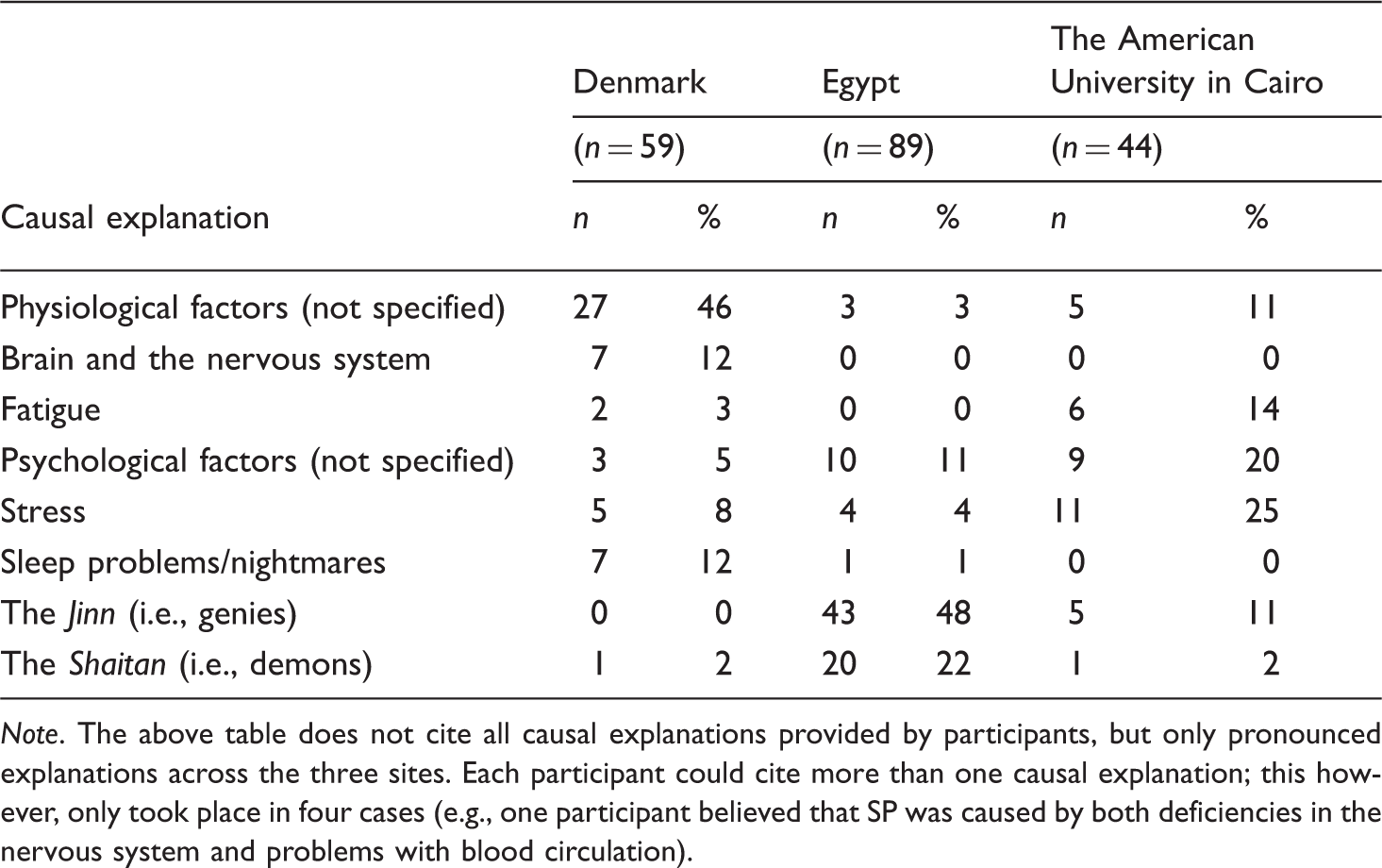
Note. The above table does not cite all causal explanations provided by participants, but only pronounced explanations across the three sites. Each participant could cite more than one causal explanation; this however, only took place in four cases (e.g., one participant believed that SP was caused by both deficiencies in the nervous system and problems with blood circulation).
Footnotes
Funding
This research received no specific grant from any funding agency in the public commercial, or not-for-profit sectors.