



Abstract
Extending classic anthropological “idioms of distress” research, we argue that intensive online videogame involvement is better conceptualized as a new global idiom, not only of distress but also of wellness, especially for emerging adults (late teens through the 20s). Drawing on cognitive anthropological cultural domain interviews conducted with a small sample of U.S. gamers (N = 26 free-list and 34 pile-sort respondents) (Study 1) and a large sample of survey data on gaming experience (N = 3629) (Study 2), we discuss the cultural meaning and social context of this new cultural idiom of wellness and distress. Our analysis suggests that the “addiction” frame provides a means for gamers to communicate their passion and commitment to online play, even furthering their enthusiasm for the hobby and community in the process, but also a way for players to express and even resolve life distress such as depression and loneliness. The American Psychiatric Association (APA) has recently included “Internet gaming disorder” (IGD) as a possible behavioral addiction, akin to gambling, warranting further consideration for eventual formal inclusion in the next iteration of the Diagnostic and Statistical Manual of Mental Disorders (DSM-5). Our study leads us to suggest that clinicians only sparingly use IGD as a clinical category, given that medical and gamer understandings of “addictive” play differ so markedly. This includes better distinguishing positive online gaming involvement—also sometimes framed by gamers as “addictive”—from other play patterns more clearly entailing distress and dysfunction.
Keywords
Introduction
Online gaming is now a global phenomenon, with some popular games counting millions of subscribers, well-developed fandoms, and even substantial e-sports leagues with million dollar payoffs (Taylor, 2012). Research conducted by our collaborative ethnographic lab over the past decade shows that such games are not just good fun, but that play in online worlds reflects and also powerfully impacts gamers' emotional and social lives (Snodgrass, 2016). On the one hand, “hardcore” gamers (a cultural insider term for being heavily involved in gaming) express their passion for life and commitment to in-game achievement through their intensive gaming and long hours (Charlton & Danforth, 2007; Snodgrass et al., 2017). Other gamers, on the other hand, go online to escape dysphoric moods and problematic relationships (Billieux, Schimmenti, Khazaal, Maurage, & Heeren, 2015; Kardefelt-Winther, 2014b; Snodgrass et al., 2016; Snodgrass, Dengah, & Lacy, 2014; Snodgrass, Lacy, et al., 2014).
Researchers agree that a small percentage of videogame players (∼2–5%) experience serious gaming-related problems (Pontes, Király, Demetrovics, & Griffiths, 2014), which can produce functional impairment and psychological distress (Aarseth et al., 2016; Petry et al., 2014). The 5th edition of the American Psychiatric Association's (APA) Diagnostic and Statistical Manual of Mental Disorders (DSM-5) describes so-called “Internet gaming disorder” as a possible behavioral addiction, akin to gambling (American Psychiatric Association, 2013; Petry & O'Brien, 2013), with a similar disorder being considered for the next (11th) edition of the World Health Organization's (WHO) International Classification of Diseases (ICD) (World Health Organization, 2017). The sometimes uncomfortably close relationship between online gaming and gambling is revealed in the manner in which the online “shooter” game Counterstrike has spawned a multibillion dollar world of online casino gambling, with the main currency of exchange being in-game “skins” (decorative coverings for virtual weapons) worth hundreds and even thousands of dollars (Assael, 2017; Snodgrass et al., 2019). Not surprisingly, the relationship between online gaming and gambling is receiving increasing attention among researchers and policy makers, for example, during an academic symposium at Concordia University (“Summer Interactive Symposium,” 2015) and among governmental regulatory agencies in China, Japan, Australia, Belgium, and elsewhere (Crecente, 2017).
Nevertheless, researchers are unable to consistently distinguish “problem” online play from healthy “engagement” and interest in gaming as a hobby, with the former potentially highly correlated with the latter but nonetheless distinct (Charlton & Danforth, 2007; Griffiths et al., 2015). Some scholars question whether Western mental illness categories manualized in the DSM and ICD—in our case, “Internet gaming disorder” or IGD (Griffiths et al., 2015; Petry & O'Brien, 2013; Petry et al., 2014; Snodgrass et al., 2018a)—possess validity when extended to non-Western contexts (Kirmayer & Pedersen, 2014; Snodgrass et al., 2018b; Summerfield, 2012). Thus, scholars critique the premise that problem online gaming manifests itself in the same universal way as other addictions, and suggest reflecting on the unique passions and pressures of internet play. That is, intensive videogame involvement might be importantly inflected by either the shared and learned cultures of particular online communities, or by the national or regional cultures characteristic of the Americas, Europe, and East Asia (Griffiths et al., 2015; Schiano, Nardi, Debeauvais, Ducheneaut, & Yee, 2011, 2014; Snodgrass et al., 2017; Snodgrass et al., 2018a), where these games are played and developed.
Extending classic anthropological “idioms of distress” research (Nichter, 1981, 2010), we argue that intensive online videogame involvement is better conceptualized as a new global idiom not only of distress but also of wellness. In his work in Karnataka, Nichter showed how Havik Brahmin women framed their emotional distress in locally salient “idioms of distress” (Nichter, 1981), which are “socially and culturally resonant means of experiencing and expressing distress in local worlds” (Nichter, 2010, p. 405). Specifically, high status Indian women framed their distress linguistically in distinctive local illness categories such as tali bisi (hot head), dristhi (evil eye), and bili hoguvudu (“white going,” for vaginal discharge) (Nichter, 1981). Related, these Brahmin women communicated their anger and dissatisfaction to husbands and other family members in behavioral idioms such as food refusal and burning spouses' and family members' dinners (Nichter, 1981). Following Nichter, we show how “addictive” videogaming—a term commonly used by gamers themselves—is also a culturally salient linguistic and behavioral idiom for communicating distress to friends and family. But we emphasize how gamers also communicate via videogaming their zest for living to important people in their lives, both linguistically through the “addictive” gaming frame, and behaviorally through intensive involvement in online worlds—thus our reference to “idioms of wellness.” And we add the term “global” to highlight how this idiom crosses local cultural boundaries via the internet.
More specifically, in the idioms of distress case at hand, gamers use “addiction” as a linguistic frame of reference to communicate to friends and family dysphoric moods and life distress, in particular linked to depression and felt loneliness. In these contexts, we will show that gamers mean by “addiction” something not too different from medical usage: i.e., play characterized by classic addiction symptomology such as loss of control, cognitive preoccupation, withdrawal, and tolerance (Snodgrass et al., 2018b). Describing one's gaming as “addictive” can signal to others that one is suffering in certain ways, such as from depression or loneliness, which leads to seeking solace in gaming. Here, our analysis engages a now robust literature suggesting that problem internet use might be a response to poor mental health and a lack of meaningful social relations and support, with online gamers, for example, looking to virtual communities to compensate for preexisting psychosocial problems (Kardefelt-Winther, 2014a; Kraut et al., 1998; Lee & Stapinski, 2012; Longman, O'Connor, & Obst, 2009; Snodgrass et al., 2018b; Snodgrass, Dengah, et al., 2014; Snodgrass, Lacy, et al., 2014).
But in addition to this discursive usage, we also show how intensive videogame activity can also be a behavioral idiom that effectively communicates to friends and family felt distress, again often related to dysphoric moods and social isolation. For example, playing online videogames intensively can signal to family and friends a rejection of the offline world, which is no longer experienced as meaningful or satisfying. In cases such as this, we suggest that gamers often find it easier to express themselves through intensive gaming behavior, rather than talking explicitly about their mental health or social struggles, because doing so may be embarrassing or stigmatizing, an idea concordant with broader research on addiction and mental health stigma (Hammer et al., 2013; Link, Cullen, Struening, Shrout, & Dohrenwend, 1989). Of note in these distressful gaming contexts, the mechanics of many contemporary videogames include random and intermittent rewards and opportunities for socialization (much like a slot machine or checking email or social media), which create so-called “ludic loops,” pleasurable and satisfying feedback loops that compel repetitive behaviors (Alter, 2017; Heaven, 2014; Schüll, 2012). As such, gamers' very attempts to communicate to others and even resolve their distress may actually further their life problems with newly created conflicts between online and offline existence (Kardefelt-Winther, 2014a, 2014b; Snodgrass, Dengah, et al., 2014; Snodgrass, Lacy, et al., 2014).
In this article's analytical focus on idioms of wellness, so-called “hardcore” gamers also linguistically frame their play as “addictive.” But here, we show how they mean something quite different than what was described above, in that they refer to the well-constructed nature of their preferred games, which ensnare them in pleasurable cycles of play, from which they find it difficult to escape. Loosely, an “addictive” game in our respondents' usage is also an enjoyable and well-made one (Nardi, 2010). And describing one's play to others as “addictive” can play the role of communicating to others one's enjoyment and enthusiasm for videogames, and even for life itself.
Further, intensive videogaming as a behavior can also play those positive communicative functions, signaling to family and friends a person's passion for and commitment to a life of play and pleasure. Here, more specifically, gamers cultivate in their play positive states of flow, immersion, and euphoria, create culture-game identities and communities with likeminded individuals, and communicate competency, skill, and status with these important social others, but not necessarily in order to avoid or resolve life problems (Csikszentmihalyi, 2008; Snodgrass et al., 2016; Snodgrass, Dengah, Lacy, & Fagan, 2013; Snodgrass, Lacy, Dengah, Fagan, & Most, 2011). Thus, games and play are integral to passion projects meant to cultivate the good life (Desjarlais, 2011; Robbins, 2013), which we signal in this context with our newly coined “idioms of wellness” phrase, thus linking but also contrasting our work with classic psychiatric anthropological research on distress idioms.
In developing the notion of “idiom of wellness,” we connect Nichter's and our own research to what Desjarlais, in the context of his ethnographic study of chess, has called an “anthropology of passion” (Desjarlais, 2011). There, as in our case, it is clear how passionate play and engagement with one's hobby are closely aligned with obsession, the two not easily distinguishable. More broadly, our idiom of wellness concept echoes what has been called an “anthropology of the good” (Robbins, 2013). Like the current study, such research helps to move psychiatric anthropology beyond its focus on suffering alone, with the idea that much can be learned about human health and well-being by examining the good things in life alongside the bad, an idea concordant with recent psychological turns toward studying the positive rather than only the pathological (Seligman, 2004; Seligman & Csikszentmihalyi, 2014). Key to our alignment with these other approaches is an emphasis on the way that the good and bad things in life are often closely connected, which necessitates studying them together in potential balance or conflict with each other (Snodgrass et al., 2012; Snodgrass et al., 2017; Snodgrass, Lacy, & Upadhyay, 2017).
To build our idioms of distress and wellness argument, we examine the experiences of “emerging adult” gamers in particular, which encompasses a period of development from the late teens through the 20s (Arnett, 2000). Emerging adults are drawn in a potent manner to online places (Subrahmanyam, Reich, Waechter, & Espinoza, 2008), which makes sense given how virtual worlds provide fertile ground for role exploration and identity development, key themes in this stage of development (Arnett, 2000; Bessière, Seay, & Kiesler, 2007; Turkle, 2011). Specifically, we first present cognitive anthropological “cultural domain” analysis, based on free-list and pile-sort data (Johnson, Weller, & Brewer, 2002; Weller & Romney, 1988), on gamers' perceptions of the causes of “addictive” videogame play, collected from a small sample of emerging adult U.S. gamers (Study 1). 1 We use the cultural domain analysis to show how gamers employ linguistically an “addiction” frame to communicate to friends and family, seemingly contradictorily, their suffering related to depression and loneliness, and also their passion and enthusiasm for videogaming as a hobby. In the Study 1 cultural domain analysis, gamers also described to us their reasoning about the various causes of “addictive” play, and who was most vulnerable to those play patterns and why. We also use qualitative interview data from that cultural domain analysis to further clarify the opposed distress and wellness meanings behind “addictive” gaming, as well as to point to the audiences, typically close friends and family, to whom gamers hope to communicate their gaming-related distress and pleasures. Finally, in a second analysis, we examine survey data to show in particular the global nature of “addictive” gaming as an idiom of distress and wellness, which is not just limited to our small sample of U.S. respondents (Study 2).
Overall, we suggest in this article that a cultural experiential and social dis/connection model, rather than a psychiatric disease frame, is more appropriate for explaining most forms of intensive online gaming involvement considered in our analysis (Kirmayer, 2005; Kleinman, 1988; Nichter, 1981, 2010). Related to these ideas, as stated earlier, prominent medical organizations such as the APA and WHO have proposed including variations of “Internet gaming disorder” (IGD) as formal psychiatric diagnoses in their diagnostic manuals (American Psychiatric Association, 2013; World Health Organization, n.d.). However, researchers have emphasized the need to delineate both a clear operational definition of behavioral additions such as IGD, 2 as well as exclusion criteria, in order to better distinguish between, for example, positively engaged and problem online gaming, and to avoid stigmatizing common behaviors (Billieux et al., 2015; Kardefelt-Winther et al., 2017; Szablewicz, 2010). Drawing from medical and cognitive/psychological anthropology, our idioms of distress and wellness perspective on online gaming also suggests the need to distinguish between online gaming behaviors that serve positive wellness functions (as in sometimes stressful, but nevertheless intentional and often highly rewarding, professional e-sports play) and those that are more straightforwardly distressful (such as compulsive play that is no longer enjoyable, rewarding, or even largely intentional).
Research methods
Research design and objectives
Our study draws on two datasets. In Study 1, we aimed to clarify the distinctive idioms North American gamers employed to conceptualize and communicate via gaming their wellness and distress. Our ethnographic experience and others' previously published research led us to anticipate that gamers would use the “addiction” frame to reference both the pleasures and perils of gaming (e.g., see Nardi, 2010). To elicit these dual frames of reference, we first asked Utah State University students to free-list items they understood to be linked to causes of internet addiction, as part of a longer interview. Then, we asked a second group of Utah students to sort (individually, not in a group) the most salient items from the free-lists into similar piles. (It is standard in cultural domain research to link free-list and pile-sort interviews in this way; Johnson et al., 2002; Weller & Romney, 1988.) In each case, respondents were asked to describe their thinking out-loud, and the two linked interviews were recorded and transcribed. Though the two activities yielded additional information, we focus our analysis on the causes of addiction. As a group, we formulated the research and its protocols, though Dengah carried out the interviews with the help of students in his Utah State University methods class (for more detail on the cultural domain interview protocols, see Appendix A: Interview and Survey Instruments, available as online Supplemental Material).
In Study 2, we wanted to better understand the way that gaming as an idiom of wellness and distress was expressed globally in distinctive play experiences and practices. To do so, we drew from a global gaming survey featuring in an ongoing project of ours, which we describe fully elsewhere (Snodgrass et al., 2018b). In the analysis presented here, we anticipated that both positive and negative social factors—specifically, social connectedness and loneliness—might be associated with reports of intensive and even “addictive” gaming experiences. The aim in this second analysis, as in Study 1, was again to better understand the potentially dual nature of gaming as a linguistic and also a behavioral idiom of both wellness and distress (see again Appendix A for further detail on our survey instrument, with our full online survey found here: https://goo.gl/forms/1GHMklOHsdnecwR33).
Detailed methodology
Study 1: Cultural domain analysis and interviews: Utah
In order to understand the content of online gaming “addiction” as a domain of understanding, we asked 26 emerging adult gamers in one-on-one, face-to-face interviews to list terms they associated with “addictive” gaming's causes. Importantly, we left “addictive” gaming undefined, allowing respondents to decide if that meant a well-built and compelling game (one of the ways we commonly heard gamers use the term) or, by contrast, uncontrolled “problem” gaming that is pathological in nature much like substance abuse (another common use).
Subsequently, to further explore the structure of this cultural domain, we had 34 different respondents (18–28 years old) sort into piles the top items based on similarity. Items were written on index cards, allowing respondents to decide on the number of piles, with the constraint that they had to make at least two.
Alongside the free-list and pile-sort exercises, we also prompted respondents to explain the logic of their thinking, with responses digitally recorded and transcribed. Specifically, we asked respondents to explain what groups of people they saw as particularly at risk for videogame addiction, and why. And we also asked them to explain what factors they saw as making people vulnerable to addictive play, and why.
Our interviewees were recruited from Utah State University, snowballing from an initial small sample of gamers who Dengah knew from Utah State University in his classes and in an online gaming club. Purposively, we aimed to sample both gamers who self-identified as “hardcore” (e.g., members of the online gaming club) and also as more “casual,” who additionally experienced a range of overall positive, negative, or mixed positive/negative play experiences. Further, we also sampled respondents who played a range of online games and game genres, eliciting responses from those who commonly played MMOs (massively multiplayer online games) like World of Warcraft, MOBA (multiplayer online battle arena) “e-sports” games such as League of Legends, and also popular “shooter” games like Counterstrike, all of which now have an important social interaction and well-developed community component.
Using Visual Anthropac for all free-list and pile-sort analyses, closely related items were combined into overarching categories to aid in interpretation and analysis (Borgatti, 1996). Subsequently, free-list item categories were assessed for cultural saliency in terms of their frequency, average rank in respondents' lists, and a saliency metric combining the two. We used multidimensional scaling (MDS) to visually represent in two dimensions the pattern of proximities in our pile-sort data, with MDS's stress metric indicating how well this visualization captured our data (Sturrock & Rocha, 2000). We then conducted a cluster analysis on our pile-sort data, with the aim of understanding how sorted items might combine into meaningful online gaming “addiction” sub-domains of understanding. Further, drawing from accompanying interviews, we present illustrative quotes to show the alternating positive and negative meanings of “addiction” informing these lists, thus clarifying how intensive videogame play can be both an idiom of wellness and also distress.
Study 2: Web survey: Global
Our cultural domain analysis was accompanied by a web survey to better understand the global social context of heavily involved yet still positive gaming and also problem play. Specifically, we tracked associations between gamers' psychosocial well-being and their involved/problem play. We reasoned that identifying links between gamers' well-being and their online play experiences might clarify how gaming was used as a behavioral idiom in particular to communicate life wellness and distress, with us thinking that gamers would further hope, via their intensive online play, to magnify and expand the positives and minimize and resolve the negatives in their lives.
In order to assess gamers' well-being we focused on our respondents' experiences of social distress and support. The social distress indicator was a previously validated 3-item loneliness scale asking how often our respondents felt a lack of companionship, left out of events, or isolated, wording the items to explicitly ask about “offline” contexts (Hughes, Waite, Hawkley, & Cacioppo, 2004). To assess social connection, we were interested to see if our gamer respondents, even the “offline lonely” ones, might find greater acceptance and support online in play and other communities. For this purpose, we adapted a 4-item version of a previously validated “Interpersonal Support Evaluation List” (ISEL), asking respondents if they had people they could turn to online for help with their problems, for advice, conversation, or with whom they simply enjoyed spending time (Cohen & Hoberman, 1983). To assess our respondents' online gaming “involvement,” we employed a 15-item ethnographically validated scale, based in part on Yee's tripartite motivational framework (Yee, 2006) (i.e., achievement, social, and immersion motivations), whose development we report in detail elsewhere (Snodgrass et al., 2017). For problem gaming experiences, we used a 9-item Internet Gaming Disorder scale (Pontes & Griffiths, 2015). (These items are shown in Appendix A.)
Along with demographics and control variables, we used Google Forms to post our survey online, distributing its link to our own play and research networks as well as on Reddit gaming forums. We received 3629 responses from gamers around the globe, mostly from Europe and North America, but with responses from South America, North Africa and the Middle East, East Asia, and other parts of the world as well. The core of our survey analysis relies on linear regressions. Our key predictors were loneliness and online social support, and our outcomes were involved or disordered online gaming experiences. The latter were proxies for how gaming can be used as a behavioral idiom to articulate wellness and distress, this article's focus. (Again, see Appendix A for key survey measures.)
Results
Study 1: Cultural domain analysis: Free-lists and pile-sorts
Causes of videogame “addiction” (U.S. sample: N = 26).
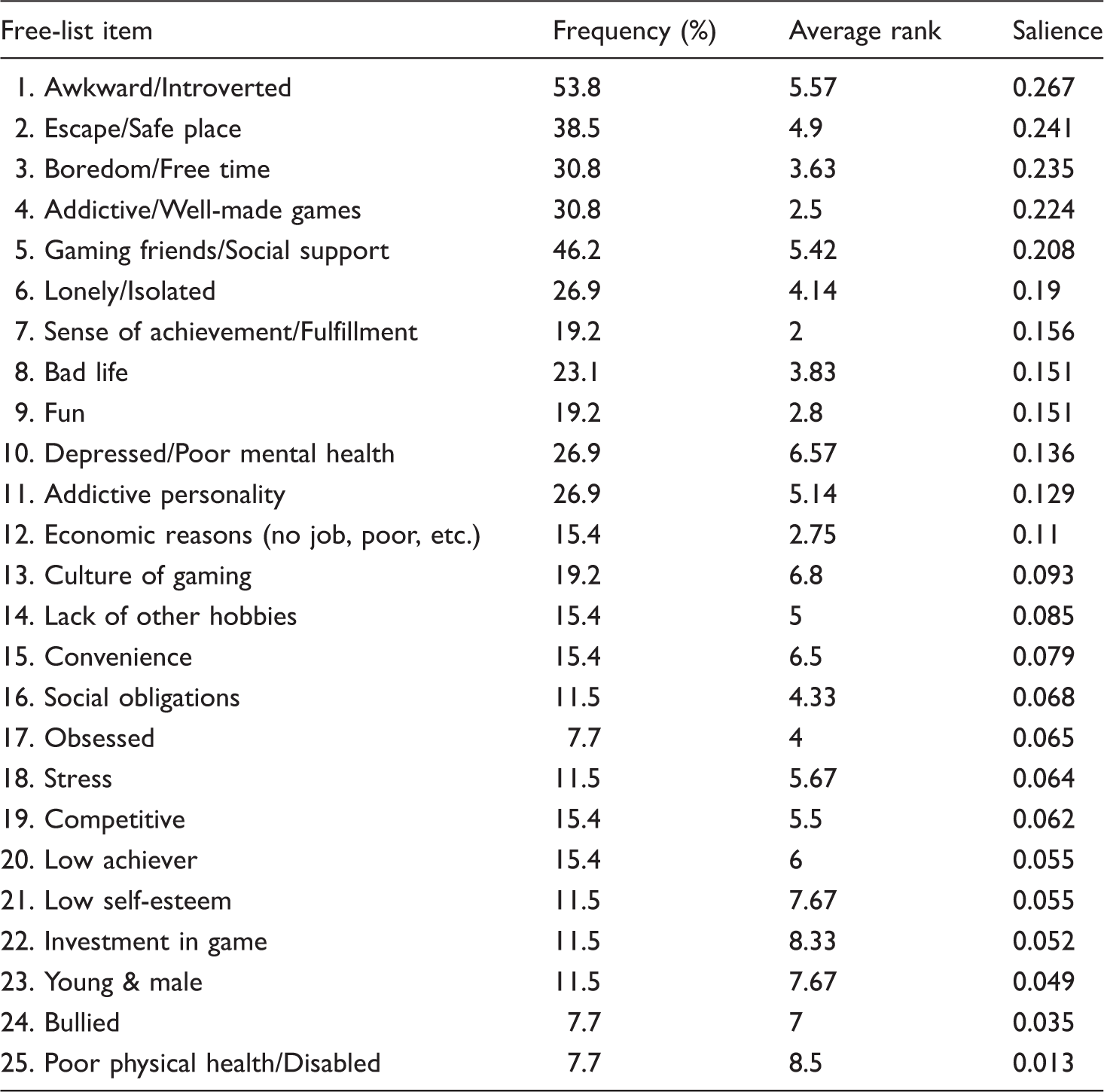
In our respondents' understandings, the cultural domain of the causes of videogame “addiction” contains both negative and positive factors. On the negative side, our respondents reported that they perceived so-called “addicted” gamers to be generally socially awkward, lonely, bored, low achieving, and depressed individuals with low self-esteem and little else in their lives, who further suffer from stress, bullying, poor health, and bad and broken lives. By contrast, on the positive side, respondents perceived “addicted” gamers to find videogames compellingly well-made, fulfilling, fun, thrillingly competitive, socially stimulating, and culturally familiar, which explains their large investment in games. Revealing a potential link between these negative and positive factors, according to our respondents, “addicted” gamers find a safe form of escape in videogames (free-list category 2; see Table 1), which, we might imagine, could push distressed and suffering individuals to overplay in an attempt to flee their less than satisfying offline lives, or as a therapeutic release offering temporary respite from daily stressors.
Similar to our free-list respondents, our pile-sorters were also typically male (79%), Caucasian (88%), students (88%), and in their early 20s (mean of 21.4 and range of 17–28 years old). We originally had our respondents sort 39 salient cultural categories related to the online gaming addiction domain of understanding. However, only about half of those categories were related to the addiction “causes” sub-domain of understanding, with the others associated with symptoms and cures. Here, we limited our analysis to only the 19 most salient addiction causes categories, which corresponded more closely to the free-list data presented in Table 1. We focus here on causes, as respondents' answers to those questions highlight the alternately positive and negative forms of “addictive” gaming, depending on life circumstances.
Figure 1 shows the results of MDS and cluster analysis on our pile-sort data (mean competence = 0.62; eigenratio = 7.89; stress = 0.142). As seen in Figure 1, and echoing our free-list analysis, we found one large negative sub-domain containing 12 “distress” items, such as social awkwardness, loneliness, low achievement motivation, boredom, and poor mental and physical health. Further, we found a second generally positive “wellness” sub-domain with five items, which were having gaming friends, being invested in the game, and finding games enjoyable, fulfilling, and well-designed. Finally, a third two-item sub-domain potentially mediates between the first two, as we also saw in our free-list analysis: i.e., distressed gamers might find in videogame involvement an important source of escape and stress relief.
Multidimensional scaling and cluster analysis visualization of addiction causes pile-sort data. Stress = 0.142. Sub-domain 1: Prioritizing the game over other activities and relationships; Poor mental health; Poor physical health; Loneliness; Addictive personality; Socially awkward; Life conflict; Low motivation to achieve; Non-stimulating offline life; Boredom; Obsessing on the game; Needing gaming to feel good. Sub-domain 2: Having many gaming friends; Heavily invested in gaming; Feeling fulfilled by gaming; Well-designed (“addictive”) games; Enjoying gaming. Sub-domain 3: Playing to escape life problems; Gaming minimizes life stress.
Excerpts from free-list and pile-sort interviews
Interviews conducted with our free-list respondents were dominated by themes related to escape and psychosocial compensation, not so different than that just presented. As one interviewee, Kyle (all names are pseudonyms), put it, speaking of his own gaming experiences: It's another world. And just like in normal addictions, it provides a stimulus, a way to escape. I know that what causes problems for me is I'm not 100 percent satisfied with my life. In a game, I can make up for what I lack in my everyday life. My life is the stuff I have to suffer through, and then the game can easily become the escape, the place I go to actually spend my life, and enjoy it. First year of high school, I got a girlfriend, and that turned out very poorly. So I turned more heavily towards videogames than I ever had before, mostly because I wanted to get away from people. I wanted to avoid contact with things that could possibly hurt me, and videogames were always a good way to escape reality.
Another interviewee, Carl, speaking first of gamers that he has observed and then of his own experiences, also explicitly links gaming “addiction” to depression, pointing to the way that quick videogame rewards can importantly lift one's mood: I think one of the most common things about internet addiction is probably depression. You are going to see a lot more people interacting on the internet, and I don't think that a lot of them are going to say, “I have depression.” Part of that is because of the rewards system, you see people (online) with less serotonin, or when they produce serotonin it breaks down faster, and so essentially it's harder to feel good. I mean that's more or less what depression is, right? So videogames have a very tangible rewards system, and so with a tangible rewards system you get that feedback quickly and frequently enough that if you're one of those people whose serotonin is breaking down fast, you can re-trigger that serotonin over and over again, unlike real life, where you make progress only every so often. People with depression need that. Videogame addiction is where you're more invested in videogames than you are in actual life. It leads to your relationships online being stronger than your in-person ones, your family relationships, or your other relationships. I think there's a lot more sluggishness. Generally, when I felt more invested in videogames, I feel a lot colder, my body isn't producing as much heat. A lot of shaking, a lot of disconnection from reality. It's not like you're crazy, but it's noticeable. You feel less engaged with things around you than things that you see on a screen. But I also think it's easier to be more impatient, agitated, because videogames reward a lot more immediately than actual life does. So like a lot of times you might withdraw into more of a shell, and develop social anxiety. You feel less comfortable, you forget how to engage with people and kind of build a crutch on interacting with people online, where there's not as much responsibility or risk; you're not putting yourself out there as much as when you're actually out there in a public meeting place. I have gone a week without League of Legends before, and I legitimately had physical withdrawal symptoms, because with all that pent up aggression I was getting out through the videogames comes chemicals from the brain and the body. The body reacts when you're not able to get the endorphins you're addicted to—endorphins, endorphins, endorphins, everyone is always taking about those, but it is true. Rastafarians, people who smoke ganja every day, it's part of their culture. And if you asked them if it was an addiction, they'd say it was culture or a lifestyle. And that's really what it was. Videogames were part of my culture and lifestyle. I mean according to the gaming community “addiction” means being good at the game. A lot of the gaming community can be viewed as people who are so-called “addicted.” Honestly, in a very positive way, if you look at a lot of online community, these people often form the core of these organizations, the centerpiece. They are on a lot, they're good at the game, they understand how the mechanics work, all these different elements. Those are the players who are viewed the highest, who aspire to be at the highest echelons. For a lot of these people, gaming is their pastime of choice. But unlike soccer and football, there is no physical barrier of entry to a videogame. There's no “I have to be a certain height or weight,” or, “I have to have a certain physical prowess,” or what have you. There is no barrier of entry and anyone can do it. Think about it this way, if you honestly believe as a football fan that dedicating yourself to studying football tactics would mean you could get on the field with the New England Patriots, like you would 100% sink all that time into it. Because videogames have no barrier, everyone is welcome. So it's not so much that it's a job as much as it's a hobby and pastime and a passion. The stereotype of the “addicted” player is this fat, ugly person, who just doesn't take care of themselves. They don't do anything. They have no social skills. That's what people typically think. But once you get more into the gamer community, there is a lot of people who are really good gamers who game all the time, who function really well outside of the virtual society. They're considered attractive people. They care about their health, but they game like 12 hours a day. And they have the money to do it. They actually get paid (professionally and through scholarships) to play that videogame that much. Researcher (R): Has your gaming ever affected the way you look at life in general? N: Yeah! A good way to put it is: I'm always getting friends and family to play. My nieces and my nephews. I sucker them in. It's a good time. R: So is that a bond to a relationship for you? N: Yeah, I feel like it helps them understand me a little bit more. Because to me, when I was communicating with, for example, my dad, unless we talk about tech stuff, there's not really common ground. [Drumming his thumbs.] I'm kind of the weird one in the family. So when people talk about games or even technology and stuff like that, it gives me the common ground, and I can talk to people. It's how I communicate with people very easily. Because I can talk to people, “How's it going?,” “How's your day?,” that kind of stuff. But when I really get animated, as you can tell right here in the interview, when I am talking about games, and when I'm talking about technology, and talking about you know the best way to do this, or the best way to do that, it's really fun to connect to them that way. Then I kind of have that connection.
Study 2: Web survey
Descriptive survey statistics (global sample: N = 3629).
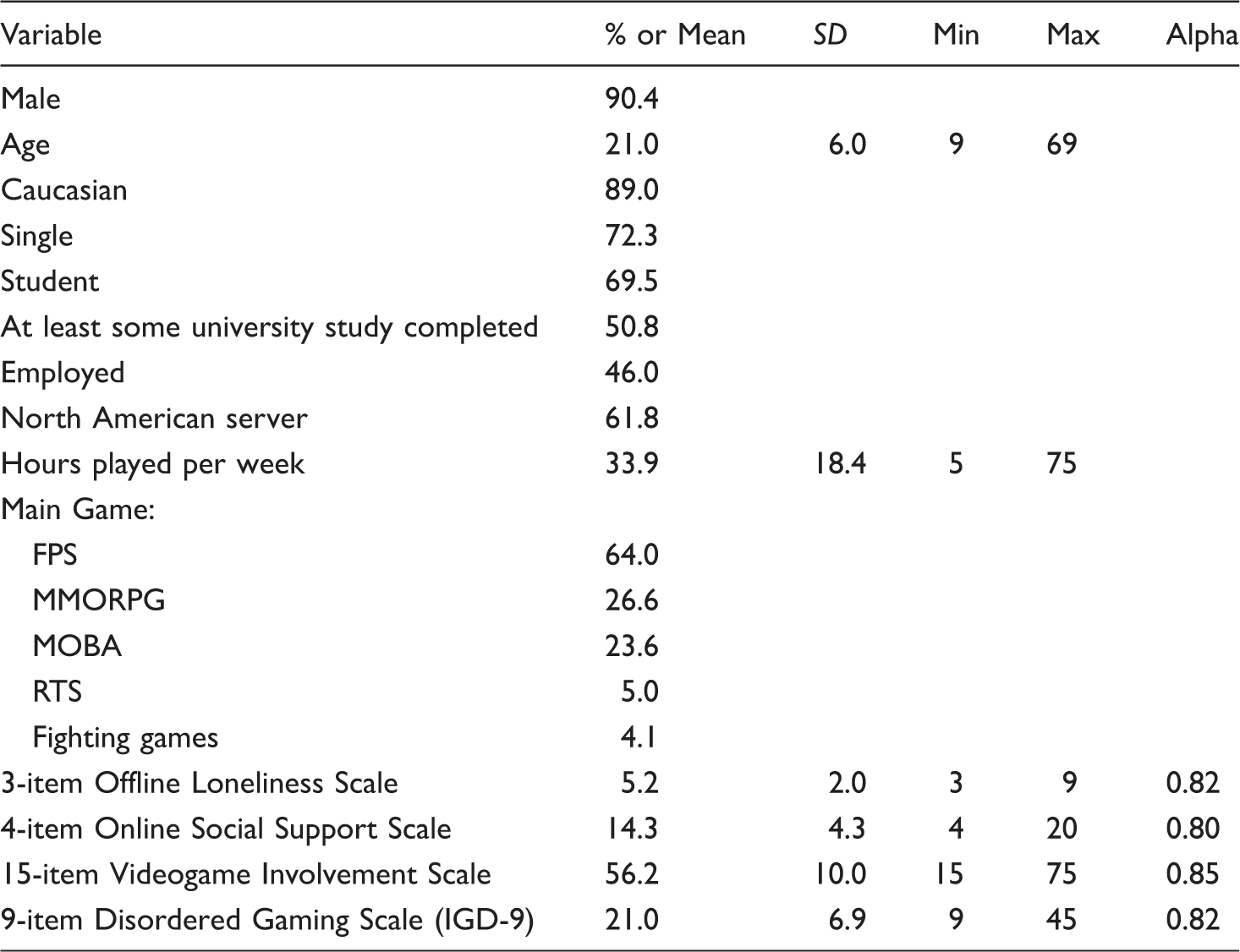
As also seen in Table 2, respondents to our survey typically played about 34 hours per week, or almost five hours a day. Our respondents' relative intensive level of play is not surprising given that our sample was drawn from gaming websites, where more “hardcore” players of various online gaming genres tend to congregate. A mean of 5.2 on our 3-item loneliness scale shows that a typical respondent averaged about 1.7 on each 3-point item, or just below a response of “2,” meaning that on average they experienced each loneliness item less than “some of the time.” Similarly, the 14.3 mean on the 4-item social support scale shows that our survey respondents typically experience online social support: i.e., a typical respondent averaged about 3.6 on each 5-point item, meaning they were generally between “3: neutral” and “4: agree” in their responses about such support. Our sample tended to be heavily “involved” with videogames, with a mean of 56.2 on the 15-item measure indicating that respondents reported an average of 3.8 on each of the items, close to a response of “4” out of 5 and thus “agreeing” that they were involved in each of those ways. Of note, respondents less commonly reported experiencing disordered gaming symptomology, with that scale's mean of 21.0 meaning that respondents averaged a 2.3 on each item, just above a “2: disagree” response on each IGD-9 “addiction” symptom.
Correlation matrix, key predictor and outcome variables in regression analysis (N = 3629).

**p < .01.
Regression of involved and disordered gaming on demographic and offline/online social support (N = 3629).
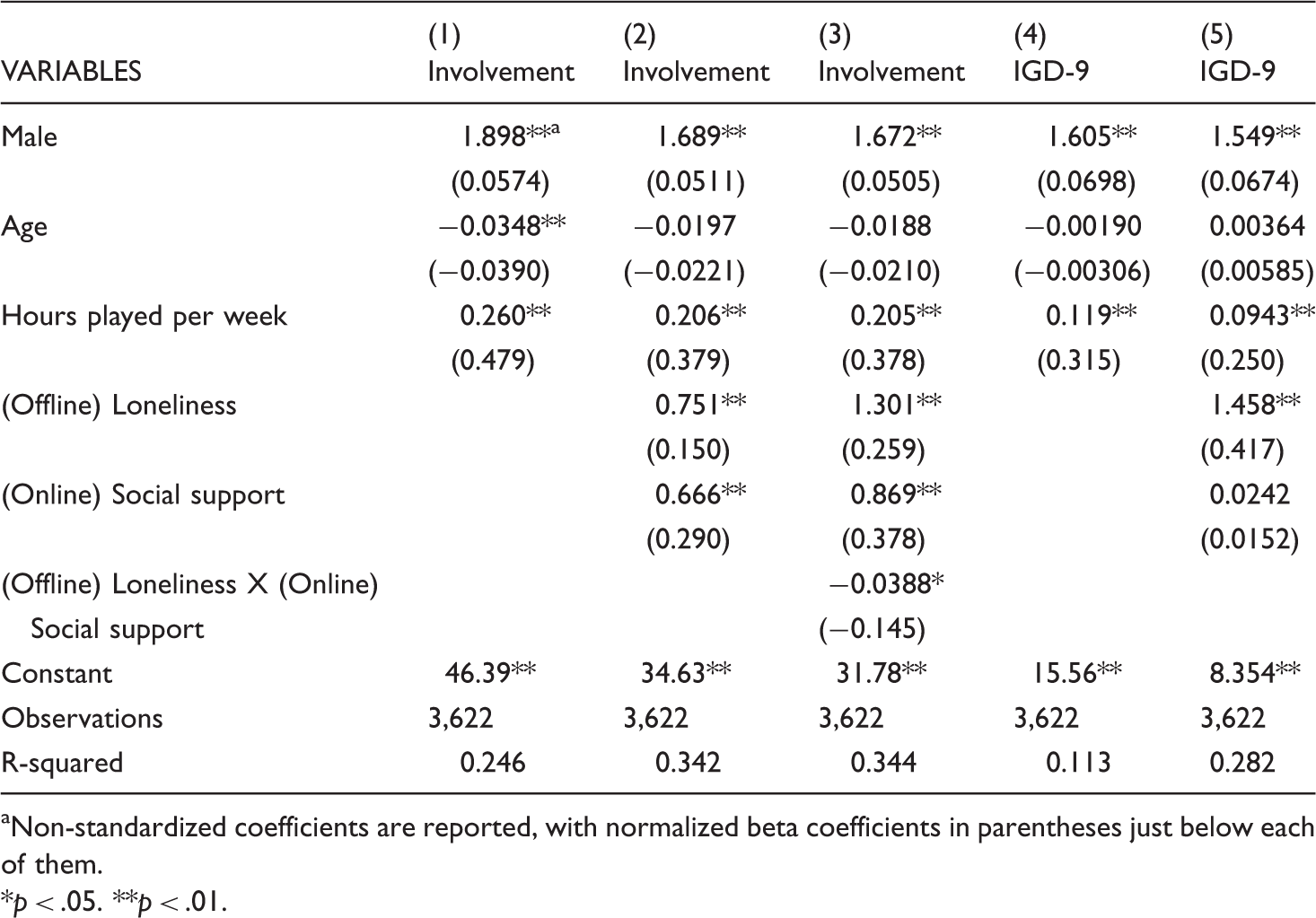
Non-standardized coefficients are reported, with normalized beta coefficients in parentheses just below each of them.
*p < .05. **p < .01.
More central to our analysis, offline loneliness is moderately associated with videogame involvement (β = 0.150, p < .001, which means that moving up one standard deviation (SD) on the 3-item loneliness scale is associated with a 0.150 SD increase on the 15-item involvement scale). And we find an even stronger association between loneliness and disordered gaming (β = 0.417, p < .001). Likewise, greater online social support is substantially associated with videogame involvement (β = 0.290, p < .001). Finally, we find a moderate negative interaction effect between offline loneliness and online social support in relationship to involvement treated as an outcome (β = −0.145, p < .05), with two interesting implications: first, this model shows that the relationship between loneliness and involved gaming is weakened for players with greater online social support; second, the effect of online social support on involved gaming is smaller for lonely gamers. We found no such interaction effect between offline loneliness and online social support in relation to disordered problem gaming (IGD-9).
Discussion
Our research confirms that online gaming can be used as an idiom to articulate and communicate distress in culturally salient ways (Nichter, 1981, 2010). In Study 1, we used cultural domain analysis to trace the underlying conceptual content and structure of that idiom from the point of view of cultural insiders (Weller & Romney, 1988), who, in our Utah sample, were all gamers themselves. The free-list analysis showed that so-called online gaming “addiction” was used to articulate a variety of forms of life distress. As seen in Table 1, key salient distress items, understood to be causes of addictive play, were social in nature: i.e., being socially awkward and introverted, lonely and isolated, having social obligations to gaming friends, or being bullied. But general life challenges of other kinds, stress, poor physical health, and pre-existing mental health issues related to depression, addictive personalities, low achievement motivation, low self-esteem, and other causes such as boredom and simple convenience were also understood by our respondents to propel some gamers into “addictive” patterns of online play.
Our Study 1 interviews confirmed that online gaming provided a means to articulate, express, and even try to resolve life distress. For example, for Kyle, online gaming offered a means to build a more satisfying life, compensating for his perceived shortcomings in other areas. Articulated in a language of folk neuroscience, Carl specifically told us that it was depression that propelled him to over-play online games, which, at least in the short term, provided him with quickly-won rewards that improved his mood (Alter, 2017; Heaven, 2014). He suggested that stigma made it difficult for gamers such as himself to speak of their depression—“I don't think that a lot of them are going to say, ‘I have depression’”— implicitly making videogaming a more attractive behavioral “idiom” to articulate and communicate his problems. He also noted that as his life improved, he did not tend to manifest his problems in this technological way, playing instead “like an hour a day.” Finally, Alfred told us that videogame “addiction” is a symptom of a larger pattern of becoming more detached from the actual-world. In his explanation, Alfred articulates specific psychobodily symptoms like coldness, shaking, agitation, and anxiety, which, while not experienced by all intensively involved or problem gamers, do echo things that members of our research team have heard in interviews or even experienced first-hand. Alfred additionally suggests that playing online videogames intensively in an attempt to resolve life problems might instead exacerbate those issues by creating a dangerous “shell” around oneself. As he put it near the end of the long quote we cited, “You feel less comfortable, you forget how to engage with people and kind of build a crutch on interacting with people online.”
Nevertheless, connecting our study to recent anthropologies of passion and the good life (Desjarlais, 2011; Robbins, 2013), our research also suggests that intensive videogame involvement can provide a way to express and potentially magnify the positives in one's life, rather than to relieve the distress—what we are calling videogaming as a new technological “idiom of wellness.” For example, in our free-lists, we find that many positive factors can propel gamers into intensive and even “addictive”—in this instance, in the sense of compelling and enjoyable, from the point of view of cultural insiders—patterns of play. These positive factors again include social ones, touching on research by Yee, ourselves, and others (Snodgrass et al., 2013; Steinkuehler & Williams, 2006; Yee, 2006). Indeed, many gamers, such as Nick, speak of the shared experiences of online gaming in terms reminiscent of communitas (Turner, 1969), where common trials and tribulations forge a sense of fellowship with others (Whitehouse, 2005). Turning again to Table 1, videogame communities provide friends and social support, which can have deep roots in the way gamers were raised, and thus building upon deep psychological, social, and also cultural “investments” in certain games or in the culture of gaming as a whole. But videogames are also compellingly and thus “addictively” made, providing players with achievement opportunities, fun, and satisfying competition (Deterding, Dixon, Khaled, & Nacke, 2011; Hamari, Koivisto, & Sarsa, 2014; Nardi, 2010; Snodgrass et al., 2016).
Once again, our Study 1 interviews enhanced our understanding of this “idioms of wellness” side of videogame involvement. William tunes us into the positive side of “addictive gaming” by telling us that in the gaming community the phrase also means simply “being good at the game,” with so-called “addictive” gamers providing the necessary social glue for many online play communities, which, unlike offline sports, are more welcoming and accessible to participants. Mickey expands on this idea by pointing to the way e-athlete pro gamers, well-adjusted and ambitious persons, can parlay their intensive play into even higher levels of life success, playing before nationally televised audiences and winning academic scholarships and in some cases even millions of dollars. Finally, in the most explicit support of gaming being an idiom of communication, Nick describes how games and technology more generally provide him with ways to express his uniquely “weird” interests and in the process connect better with his nephews, nieces, and other important persons in his life. For Nick, videogames provide him and other gamers with a common language to communicate their shared passions and unique worldview.
Though divided in the manner described, our free-list analysis also presents a potential resolution to the distress and wellness side of gaming: distressed individuals find escape in their online play, which in some cases alleviates their distress, but, if promoting life avoidance rather than temporary escape, might instead magnify it (Snodgrass et al., 2011). Our pile-sort analysis echoed this tripartite structure of the cultural domain of online gaming addiction. Of note, in both the free-list and pile-sort instance, the negative life distress sub-domain is bigger—that is, richer in its semantic content—than either the positive or mediating sub-domains, pointing to a potentially larger idiom of distress compared to wellness function of online videogames. That is, more gamers turn to online play to help them express and even resolve their life problems, rather than to build upon their life successes, though the former does not entirely eclipse the latter.
Our Study 2 survey analysis allowed us to expand our findings beyond Utah and the U.S. to a global sample of gamers. Given the importance of social factors—loneliness, online gaming friends, etc.—in our cultural domain analysis, we featured those factors in our regression analysis. As expected, and as shown in Table 4, we found associations between life distress in the form of loneliness and both involved and problem play. This supports the idea that videogame involvement in this global sample might also serve as an idiom for distressed (in this instance, lonely) individuals to articulate, communicate, and even aim to work through their life problems. In some instances, they find positive fulfillment in their gaming (involvement), but at other times they instead magnify their problems (seen in an increase in IGD-9 symptomology). Also, we found that gamers who are more socially supported in online contexts tended to play more intensively. This suggests that gaming can serve as an idiom of wellness, where the socially more connected magnify their online pleasures in even more enjoyable forms of intensive play.
The statistical interaction effect between offline loneliness and online social support in relationship to our involved gaming outcome alludes to potential processes connecting pre-existing life distress and certain patterns of internet play. For example, the statistical interaction model shows that the relationship between online social support and involved gaming is weakened for lonely players (see Table 4, Model 3). This points to potential psychosocial “poor-get-poorer” and “rich-get richer” effects: i.e., offline lonely people are less able to parlay online social capital into enjoyably involved gaming, while less lonely and thus psychosocially “rich” people more readily multiply online social connections into new involved gaming ones (Kraut et al., 1998; Snodgrass, Lacy, et al., 2014). This statistical interaction effect also means that the relationship between loneliness and involved gaming is weakened for players with greater online social support. This could imply a similar kind of process, i.e., that more socially connected gamers see a fall in the relationship between offline loneliness and involved play.
Overall, our linked Study 1 and 2 analyses lead us to frame most forms of intensive online videogame involvement we have encountered as idioms of distress and wellness that can be used by emerging adults in particular to express for themselves and others, and even to work through and in some cases resolve, various forms of emotional distress and wellness, especially social ones, rather than being a clearly bounded psychiatric condition (Nichter, 1981, 2010). We are thus skeptical of the utility of the clinical category “Internet gaming disorder” for many of the cases described in our study, as intensive online play often presents solutions to life's problems, or at least a movement toward resolution, rather than being itself the source of such problems, with the latter often implied in studies of online gaming addiction (Griffiths et al., 2015; Snodgrass et al., 2017). As revealed in our study, far from being a disease or illness, online gaming is more typically a socially learned and flexible idiom for expressing well-being—the good and bad in one's life—which adapts to the needs of individual gamers.
Analyses such as ours help ensure that engaging in common hobbies like online gaming is not treated as a mental disorder, especially when performed in ways that are healthy, controlled, and intermittently therapeutic overall, even if such activities involve some degree of stress and distress (Billieux et al., 2017; Billieux et al., 2015; Kardefelt-Winther et al., 2017; Szablewicz, 2010). As an expressive idiom used by our respondents, “addictive” gaming more typically captures these wellness and distress processes, rather than clinical symptoms of a behavioral problem. And we do not see the benefit of labeling as “disease” coping strategies that actually help to minimize suffering. 3
Study limits
Our study's cross-sectional designs (in both Study 1 and 2) do not allow us to trace causal pathways between certain patterns of involved gaming and psychosocial well-being. In-depth clinical case studies with a longitudinal component would help to further clarify the etiology of gamers' life suffering, and how intensifying their internet play might alternately contribute to, or help relieve, such suffering. Further, our studies' convenience sampling limits our ability to generalize our results to other populations, and our reliance on self-reports makes it challenging to speak of actual patterns of behavior. Finally, future research focusing on different genres of online games and their specific gameplay elements will help with understanding the role of game structure in the cultural expression of wellness and/or distress.
Conclusion
Individuals around the world express their wellness and adversity in longstanding traditional idioms of distress such as food refusal (Lester, 2007; Nichter, 1981). But it is not surprising that contemporary internet communication technologies provide new ways to express wellness and distress. As our research shows, for emerging adults and many others around the globe, this idiom is a technological and ludic one, with online media now used to articulate and voice contemporary risks and pleasures linked particularly to social isolation and connection.
Our research confirms the idioms of distress perspective: i.e., that videogame involvement has become a “socially and culturally resonant means of experiencing and expressing distress in local worlds” (Nichter, 2010, p. 405). However, as importantly, “hardcore,” professional, and other committed gamers express deep passion and commitment through their online play (Nardi, 2010). In these cases, online gaming resembles an idiom of wellness—a way to communicate and build on the good things in life—rather than a means of addressing and potentially resolving life problems. Ignoring the positive sides of intensive online videogame involvement risks both pathologizing everyday life, a point to which we and other games studies scholars in particular are attuned (Billieux et al., 2015; Schiano et al., 2014; Snodgrass et al., 2018b; Snodgrass et al., 2017), and also misunderstanding the distress, given the manner in which positive and negative play are often importantly intertwined (Snodgrass et al., 2018b; Snodgrass et al., 2017). Medical and psychological anthropological approaches to idioms of distress, if properly expanded to also encompass idioms of wellness, provide a compelling theoretical and empirical framework for illuminating our understanding of human adversity in these play contexts. And paying attention to intertwined distress and wellness is especially important in these ludic environments, given that such an approach is less likely to stigmatize the very behaviors that can help minimize gamers' suffering.
Supplemental Material
Supplemental material for Intensive online videogame involvement: A new global idiom of wellness and distress
Supplemental Material for Intensive online videogame involvement: A new global idiom of wellness and distress by Jeffrey G. Snodgrass Colorado State University H. J. François Dengah II Utah State University Polzer Evan University of Colorado Robert Else in Transcultural Psychiatry
Footnotes
Acknowledgments
We would like to thank the Colorado State University and Utah State University students who helped us with our research, and also the study participants who generously shared their time and impressed us with their gaming passion and expertise. The research described in this article, including the use of appropriate informed consent procedures, has been reviewed and approved by the Colorado State University Institutional Review Board (IRB) for the protection of human subjects.
Declaration of Conflicting Interests
The author(s) declared no potential conflicts of interest with respect to the research, authorship, and/or publication of this article.
Funding
The author(s) disclosed receipt of the following financial support for the research, authorship, and/or publication of this article: We acknowledge support from the U.S. National Science Foundation (Snodgrass, J. G., & Dengah II, H. F. (2015). NSF Award #1600448 – EAGER: A Biocultural Study of the Functional Genomics of Intensive Internet Use).
Notes
References
Supplementary Material
Please find the following supplemental material available below.
For Open Access articles published under a Creative Commons License, all supplemental material carries the same license as the article it is associated with.
For non-Open Access articles published, all supplemental material carries a non-exclusive license, and permission requests for re-use of supplemental material or any part of supplemental material shall be sent directly to the copyright owner as specified in the copyright notice associated with the article.
