




Abstract
Researchers and policymakers have supported a public health approach to countering violent extremism throughout the War on Terror. However, barriers to obtaining primary data include concerns from minority groups about stigmatization, the ethics of harming research subjects by exposing them to violent content, and restrictions on researchers from institutions and governments. Textual analyses of declassified documents from government agencies may overcome these barriers. This article contributes a method for analyzing the predisposing, precipitating, and perpetuating factors of terrorism through open source texts. This method is applied to FBI interrogation summaries of Al Qaeda terrorist Umar Farouk Abdulmutallab who attempted an attack aboard an airplane in 2009. This analysis shows that consuming militant content online led him to narrow his social relationships offline to extremists and foster identifications with subjugated Muslims around the world. After deciding to wage militancy, loyalty to Al Qaeda members, swearing allegiance to and obeying group leaders, and interpreting religious texts militantly perpetuated violent activities. Such work can advance empirical work on militant behavior to develop interventions.
Introduction
Terrorism has been defined as the real or threatened use of violence against civilians for ideological reasons, often committed by non-state actors (Horgan, 2005). A decade after the September 11, 2001 terrorist attacks, the U.S. government increasingly began promoting a public health approach to countering/preventing violent extremism (C/PVE) that involved members of minority communities (Selim, 2016). The hope was to identify political, social, economic, and historical forces behind terrorist attacks—that could be amenable to intervention—rather than treating attacks as isolated, individual behaviors (National Academies of Sciences, Engineering, and Medicine, 2017). Researchers have welcomed this approach for stimulating community partnerships across the education, faith, and health sectors; facilitating access to health services; channeling help for people with mental illnesses heading toward criminality; and developing theory-based interventions for testing and evaluation (Alcalá et al., 2017; Weine et al., 2017). Violence prevention models have been extended to C/PVE initiatives as primary prevention for those showing no signs of militancy; secondary prevention for those supporting militancy without acting violently; and tertiary prevention for those with violent behaviors (Bhui et al., 2012; Harris-Hogan et al., 2016).
However, critics have challenged public health approaches to C/PVE. Governments have enlisted clinicians to screen for signs of violent extremism, which has diminished trust among minority patients who worry that any statement they make about violence, no matter how minor, will be reported to state officials (Heath-Kelly, 2017). Civil rights organizations in North America and Europe have cautioned that Muslims are disproportionately referred to law enforcement agencies for screening despite government proclamations that violent extremism is not exclusive to any ideology or religious group (Aggarwal, 2019). Researchers who have tried to test theories of violent extremism in real-world conditions by examining media persuasion have reported that their institutions forbade them from (1) showing violent videos out of ethical obligations to not harm research subjects, (2) publicizing their studies to avoid accusations of illegally disseminating terrorist propaganda, or (3) profiling communities such as Muslims who would be the obvious target of Islamist justifications to commit violence (Cottee & Cunliffe, in press; Shortland et al., in press).
These challenges raise questions of how to design studies that engage with public health theories while avoiding barriers to data collection. Terrorist groups typically distrust outsiders as potential government informants (Altier et al., 2012), precluding participant observation. Although some recommend interviewing terrorists through online platforms such as WhatsApp and Facebook Messenger (Horgan, 2012), governments have prosecuted researchers after interviews for violating national security laws (Bhui et al., 2012). Faced with restrictions on human subjects research, psychiatrists and psychologists have called for using open-source texts as data (Horgan, 2012; Aggarwal, 2015).
This article proposes analyzing declassified interrogation summaries from the American Federal Bureau of Investigation (FBI) as a method for identifying predisposing, precipitating, and perpetuating factors of violent extremism. Psychologists understand militancy as an evolution in which individuals accept cognitive and emotional justifications for violence that lead to violent behaviors (Horgan, 2010). Declassified texts from intelligence, law enforcement, and military agencies can be used as primary sources to study this evolution into militancy, recognizing a potential bias toward state interests (González, 2012). In February 2017, after a two-year legal fight, the New York Times gained access to the FBI’s interrogation summaries of a 23-year old Nigerian named Umar Farouk Abdulmutallab under the Freedom of Information Act (FOIA), providing a rare, unparalleled glimpse into the motivations of a high-profile, confirmed militant (Shane, 2017). On December 25, 2009, Abdulmutallab attempted to explode a bomb aboard a plane from Amsterdam to Detroit. One passenger observed a fire in Abdulmutallab’s seat, and the plane landed safely as passengers restrained him (O’Connor & Schmitt, 2009; Shane & Lipton, 2009). The FBI briefed reporters that Abdulmutallab obtained explosives and a syringe sewn in his underwear from an Al Qaeda bomb maker in Yemen (Schmitt & Lipton, 2009). Although he initially pleaded not guilty in January 2010 to six charges, including attempted murder on an airplane and attempted use of a weapon of mass destruction (Bunkley & Robbins, 2010), FBI agents contacted his relatives who convinced him to cooperate with authorities (Zeleny & Savage, 2010). In 2011, one day into his trial in federal court, he pleaded guilty (Davey, 2011) and was sentenced to life imprisonment after expressing no remorse (Bunkley, 2012). Interrogation summaries enable us to explore his trajectory into militancy.
It is important to clarify the weaknesses and strengths of this method from the outset. First, interrogation summaries are not transcripts, so we do not know how freely Abdulmutallab spoke. Unlike other law enforcement agencies, the FBI instructs investigators to establish empathy with suspects and discourages stress interviews (Vessel, 1998). Because the FBI insisted on following the American Constitution and guidelines to protect criminal suspects within the Federal Bureau of Prisons after the 9/11 attacks, President George Bush (2010) detained terrorism suspects as “enemy combatants” at Guantanamo Bay for interrogations through other agencies. Second, textual analysis departs from cultural psychiatry’s emphasis on person-centered interviewing (Hollan, 1997). Still, bioethicists and forensic researchers justify the analysis of court transcripts, legal motions, juridical decisions, and interviews to advance knowledge provided that they are legally in the public domain (Kapoor et al., 2011; Johnson et al., 2016). The declassification of FBI interrogation summaries fulfills these ethical conditions.
Nonetheless, an engagement with interrogation summaries could interest cultural psychiatrists. Speech can be understood as transactions of interpersonal communication whereby people with distinct social positions respond to each other; the meaning of such speech acts depends on their function within society (Kirmayer, 2006). Officials have used the speech of prisoners to determine risk and rehabilitation; for example, in assessing if sex offenders can manage arousal before a parole board (Lacombe, 2013) or if violent criminals interpret the need for pathological respect as cognitive distortions in psychotherapy (Laursen & Laws, 2017). Interrogation summaries can disclose how Abdulmutallab socially positioned himself and others to justify his actions, especially since he chose not to use his speech to show remorse for his actions.
Methods
The PDF file of all FBI summaries was downloaded from the New York Times website (https://www.nytimes.com/interactive/2017/02/22/world/document-Umar-Farouk-Abdulmutallab-Documents.html). Each page was checked for a FOIA assignation number to confirm the authenticity of declassified government documents (McNamara, 2007). The page numbers of quotations below refer to this file.
Because this study explored if public health theories could be applied to the interrogation summaries of single individuals, an influential case sampling strategy was used since Abdulmutallab is a confirmed militant. This sampling strategy applies theories to data that are expected to fit a model (Seawright & Gerring, 2008). The study assumed that Abdulmutallab’s interrogation summaries would reveal individual-level factors of militancy since he confessed to a terrorist attack. Interrogation summaries of individuals who have maintained their innocence were excluded to avoid presumptions about any individual’s involvement in militancy. Since the coding team was not sure that interrogations and summaries were similar in other contexts to justify a multiple case study approach, a single case was analyzed.
A research team of three individuals analyzed the data. The author led the team and is a research psychiatrist with a Master’s degree in South Asian Studies. The second member is a research psychiatrist with a Master’s degree in anthropology. The third has a Master’s degree in clinical psychology and resolved coding conflicts. Each member has at least five years of qualitative research experience. The team first conducted a deductive content analysis of all FBI summaries. Content analysis is a systematic, objective method to describe phenomena through replicable, valid inferences from data to context (Krippendorff, 2013). Deductive content analysis involves coding data through a codebook of mutually exclusive categories based on extant theories (Elo & Kyngäs, 2008). In qualitative research, coders may draw different interpretations from the same text, so the team selected each individual interrogation summary as the unit of analysis and each meaning unit to be the words or sentences that relate to each other through context and content (Graneheim & Lundman, 2004). The team decided that a meaning unit should be longer than a word, but not than a paragraph so that all text would be coded accurately and with mutual exclusivity. Because the interrogation summaries are in indirect speech, not verbatim, content analysis was preferred over other approaches assuming that language is reflective of inner experience, such as critical discourse analysis (Fairclough, 2013) or narrative analysis (Groleau et al., 2006).
Deductive content analysis enables theories to be supported, refuted, and extended. The author searched the literature for theoretical frameworks that could be converted into codebooks (Hsieh & Shannon, 2005). A codebook was created from McGilloway et al.’s (2015) systematic review on pathways and processes associated with violent extremism in Europe and the United States for two reasons. First, the topic addresses violent extremism in minority populations, which has face validity for Abdulmutallab who contacted militants as an international student in London. Second, this publication was the only systematic review on violent extremism at the time of this study. Compared to individual studies, systematic reviews transparently aggregate known evidence on a topic (Harbour & Miller, 2001).
McGilloway et al.’s (2015) systematic review makes a distinction between predisposing, precipitating, and perpetuating factors of violent extremism. This distinction comes from public health, in which predisposing factors are an individual’s vulnerability to violent extremism, precipitating factors trigger extremist behaviors, and perpetuating factors maintain the individual’s involvement in militancy (Bhui et al., 2012). The author created a codebook with definitions for codes and examples from the systematic review. All team members read the first 19 pages (∼10% of the dataset) independently for content familiarity (Hsieh & Shannon, 2005). New codes were added when original codes did not match themes in the text, following a process of iterative revisions with all team members. The team discussed concordance between codes and concepts, inviting challenges to initial interpretations. Descriptive memos were drafted to specify code definitions and parameters (appropriate and inappropriate use) through data examples. Independent coding continued for two rounds until no new information produced changes to coding categories. The author then uploaded and coded all summaries into NVivo (QSR International, 2012). Queries were generated for major codes to explore patterns. Rigor was ensured through memos, meeting notes, and peer-debriefing sessions (Hsieh & Shannon 2005).
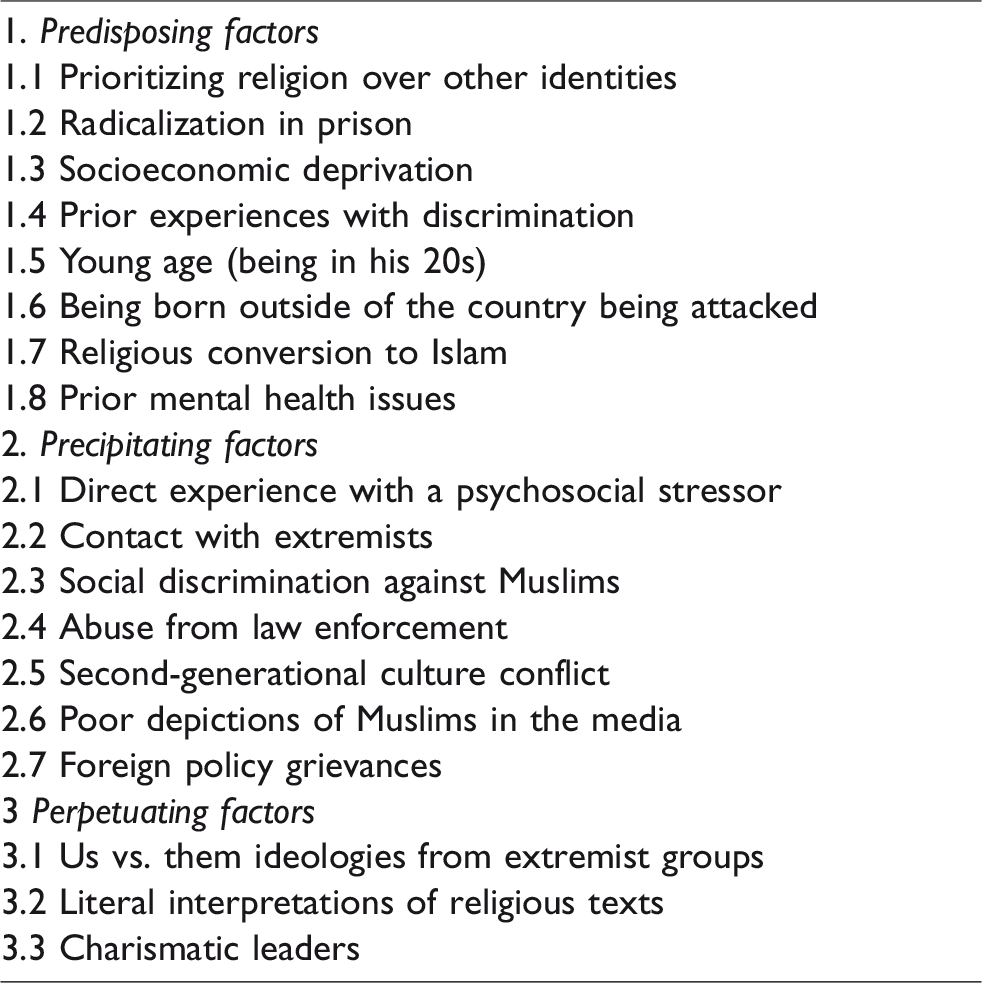
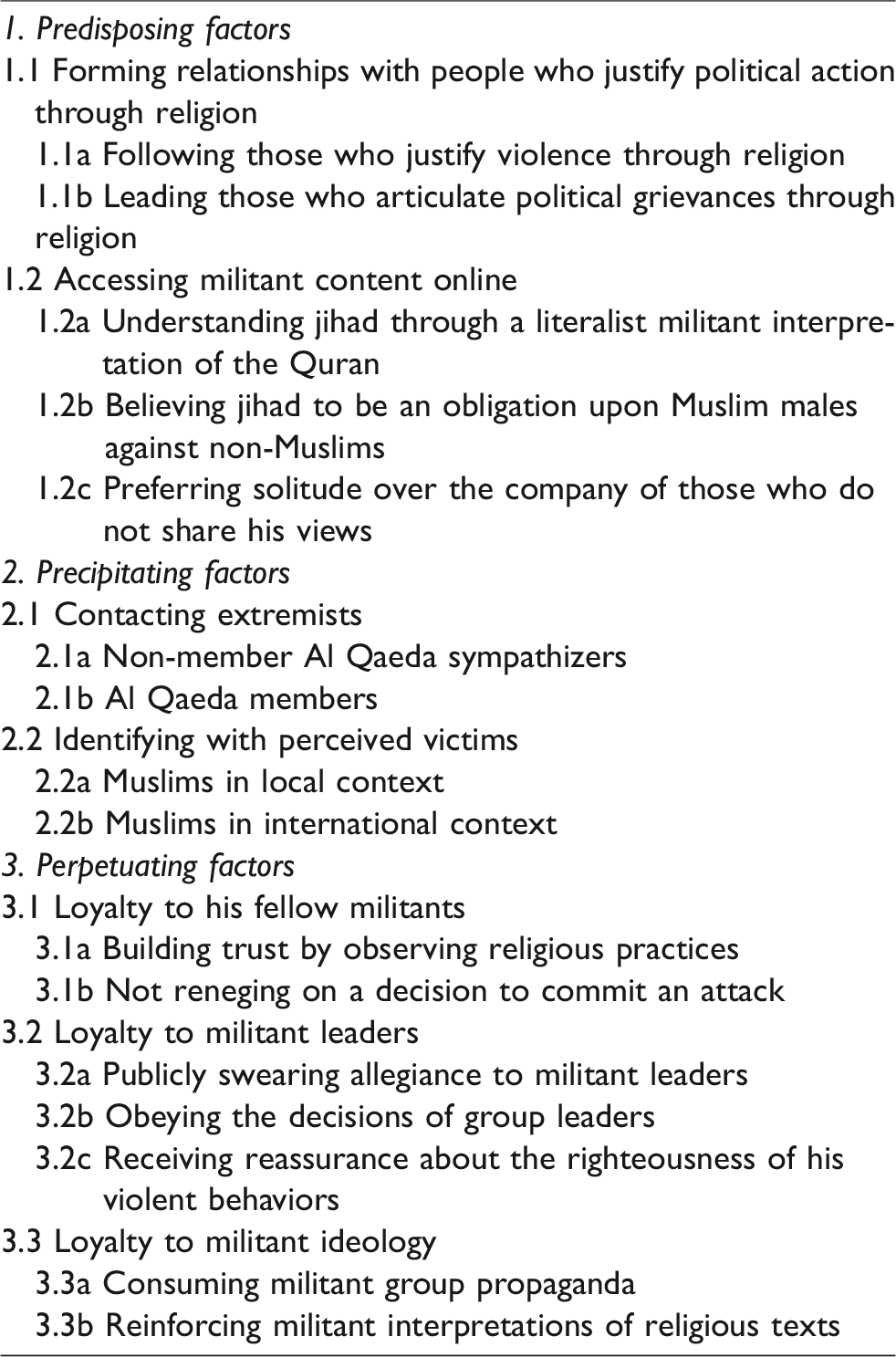
A method was needed to relate old and new codes. The team wanted to preserve the predisposing, precipitating, and perpetuating factors classification while retaining the flexibility to create new codes that match textual content. Hence, template analysis was used to organize all codes thematically. Template analysis refers to a group of techniques for exploring relationships between themes by developing coding hierarchies from an initial coding template that is revised as preexisting codes are not found and new codes are created (King, 2004; Brooks et al., 2015). A transparent list of initial codes is modified based on how codes capture textual data (King, 2004). Initial and final coding templates are presented with quotes to justify textual interpretations (King, 2004; Brooks et al., 2015). McGilloway et al.’s (2015) systematic review served as the initial coding template. New and old codes were modified into a final hierarchy through team discussions that compared code clusters (Brooks et al., 2015). The author recoded the entire dataset to ensure that the final template captured all relevant themes, debriefing with team members once after creating the final coding hierarchy and once after the final round of coding for consensus on textual interpretations.
Results
The FBI summaries begin on December 25, 2009 and end on June 29, 2010. Each summary lists the interview date and location, the identities and affiliations of all parties present, and the transcription date. Figure 1 is a reproduction of the first page of the first summary. The summaries comprise 188 pages covering all 21 of Abdulmutallab’s interrogations.

An image of the first page of the first FBI interrogation summary for Abdulmutallab. Redactions are indicated with white squares over text.
The FBI summaries use variants of names that are now standardized in English. For example, the name of the American-born Al Qaeda cleric “Anwar Al-Awlaki” (1971–2011) is used here even though the summaries list him as “Aulaqi.” The summaries use “Al Qa’ida” for the more common “Al Qaeda.” Both variants are maintained in direct quotations. The term “UM” refers to Umar Farouk by his initials, and “Mutallab” is shorthand for his last name.
The results are presented in order of predisposing, precipitating, and perpetuating factors rather than their order of appearance in the summaries. This presentation facilitates a chronological glimpse into Abdulmutallab’s evolution as a militant. Tables 1 and 2 present the initial and final coding templates, respectively.
The initial coding template.
The final coding template.
Predisposing factors
Two factors capture Abdulmutallab’s vulnerability to militancy: forming relationships with people who justify political action through religion and accessing militant content online.
Forming relationships with people who justify political action through religion
Abdulmutallab formed relationships with people who justify political action through religion in two ways: (1) following those who justify violence through religion, and (2) leading those who articulate political grievances through religion.
Abdulmutallab first sought to follow someone who justified violence through religion as a 15-year old student in Nigeria. The summaries state: UM first met [REDACTED] in 2001 to 2003 in an Islamic bookstore in Kaduna, Nigeria. UM noticed that [REDACTED] was debating another person about various Islamic scholars and this interested UM. UM joined the conversation and introduced himself to [REDACTED]. (p. 49) From the time he first met [REDACTED] UM contacted him one to three times per year. However, beginning in approximately 2005, UM and [REDACTED] became closer, increased the frequency of their contact and found a mutual interest in religious topics. UM and [REDACTED] shared similar religious beliefs in 2005. [REDACTED] spoke favorably about jihad in 2005, but UM was less sure. (p. 49)
For the 2004–2005 academic year, Abdulmutallab attended the Sana’a Institute for the Arabic Language (SIAL) in Yemen where he met Anwar Al-Awlaki. The summaries state: UM first met Aulaqi at SIAL in 2005. Aulaqi was invited to SIAL to give a brief lecture in the courtyard of the school and receive greetings from the students. Many attendees of the lecture introduced themselves to Aulaqi after his brief remarks, but Aulaqi was not well and left early … The Headmaster of SIAL indicated that he wanted his students to meet this famous English speaking Islamic scholar. It was during this first meeting that UM began to develop an interest in Aulaqi’s teachings. (p. 83)
Abdulmutallab also led a student religious organization while attending the University College of London (UCL) from September 2005 to June 2008. His organization protested perceived political injustices: “Immediately during his first year at UCL, Mutallab became a member of the university Islamic Society (ISOC) … Members of ISOC were concerned with spreading the message of Islam and supporting human rights causes” (p. 143). His involvement grew over time: “He attended weekly ISOC meetings, but preparations for ISOC events often required daily attention as events neared. His free time was divided among listening to Islamic lectures, attending Islamic events, exercising or playing soccer” (p. 143). In his second year at UCL, Mutallab became president: “In this role as ISOC President, Mutallab organized events, chaired weekly meetings and conducted Friday prayer services” (p. 144). He gave examples of articulating political grievances through his religious organization: Mutallab did not recall ISOC sponsoring events for the children of martyrs, but recalled a fund raising event in 2007 for Palestinian and Afghanistan orphans … He also attended various demonstrations in the UK concerning support of Palestine, as well as protests against the Lebanese-Israeli war, the Danish cartoons and failed terror raids in London. (p. 144) In 2007 and 2008, UM and [REDACTED] attended lectures by [REDACTED] as often as three times per week during certain times of the year. UM’s contacts with [REDACTED] were limited mostly to the summer or times when UM was home from school and [REDACTED] was in Nigeria. They would also meet privately with [REDACTED] to seek advice on various issues such as marriage, fasting, and other Islamic topics. (p. 68)
Accessing militant content online
Abdulmutallab’s consumption of militant content online affected him in three ways: (1) understanding jihad through a militant interpretation of the Quran, (2) believing jihad to be an obligation upon Muslim males against non-Muslims, and (3) preferring solitude over the company of those with different views. The interrogation summaries focus on Al-Awlaki’s video lectures, which were later found in the possession of militants who committed attacks in the U.S. in 2009, 2010, 2013, 2015, and 2016 (Conway, 2012; Shane, 2015). Abdulmutallab accessed Al-Awlaki’s lectures after their 2005 meeting at SIAL (p. 95). These lectures appear to have influenced Abdulmutallab by framing jihad through a militant interpretation of the Quran as an obligation of Muslim men against non-Muslims: Mutallab advised that the most influential of Aulaqi’s lectures was “the Constants of Jihad.” He added, however, that many of Aulaqi’s lectures contained similar content and conveyed a similar message. While listening to Aulaqi’s lectures, Mutallab realized the lectures aligned with references to jihad in the Quran. His interpretation of these messages revealed jihad as an obligation to all Muslim males. Mutallab supported Aulaqi’s viewpoint because he opposed the western world rather than supporting it as did most others who interpreted the Quran. Mutallab advised, per the Quran, jihad is viewed as a very black-and-white issue. (p. 131)
The decision to go beyond consuming Al-Awlaki’s lectures to participating in jihad occurred while Abdulmutallab was studying at the Dubai branch of the University of Wollongong from January to July 2009 after he graduated from UCL (McGinley, 2009). The lectures appeared to change his behaviors, as he preferred the world online to relationships offline: UM began to listen to Aulaqi’s many lectures on jihad and Islamic topics and viewed them as influential and correct. UM had few classes to attend at Wollongong in Dubai and did so sporadically. He spent most of his time alone in contemplation and interacted only with a few fellow students in his residential area. (p. 55) Mutallab does not believe his family has the religious authority to change his mind. Mutallab advised it would have required a command from a powerful religious authority associated with jihad, such as Aulaqi, to dissuade him from completing his mission. (p. 123) When, in the summer of 2009, UM was facing a two-month break from his course work in Dubai, he viewed it as a sign from God that he should take the opportunity to travel to Yemen, seek Aulaqi and participate in jihad … It was not until the last week of July 2009 that UM finally decided he was going to participate in jihad. (p. 55)
Precipitating factors
Two factors capture how his behaviors reflect a turn toward violent extremism: contacting extremists and identifying with perceived victims such that jihad becomes an act of self-defense.
Contacting extremists
Abdulmutallab contacted two types of extremists: (1) non-member Al Qaeda sympathizers, and (2) Al Qaeda members.
Al Qaeda sympathizers connected Abdulmutallab to Al-Awlaki after Abdulmutallab decided to travel to Yemen for jihad in August 2009: UM came to Yemen with the desire to meet Aulaqi to discuss opportunities to participate in jihad. UM went to Al Iman University on or about 08/05/09 hoping to meet people who could direct him to Aulaqi. While there, UM read an article on the Internet which mentioned an association between Sheikh Zindani, the head of Al Iman University, and Aulaqi. UM also read a Wikipedia webpage which mentioned that Aulaqi was Sheikh Zindani’s protegé. UM resolved to visit Zindani’s house in an attempt to find a means to locate Aulaqi. (p. 7)
Abdulmutallab went to an Al Qaeda safe house in October 2009 after six weeks of waiting. The interrogation summaries redact how Al Qaeda members contacted him, but illustrate the importance of social bonds within the group: “UM remained at [REDACTED] house for about two weeks, approximately between 10/19/09 and 11/7/09. When not at camp, the fighters just ‘chilled out.’ UM did not see Aulaqi during this two week visit to [REDACTED] house” (p. 17). The summaries do not detail what it meant for fighters to “chill out,” but suggest that fighters stayed in each other’s presence even when not training for an attack.
One individual selected Abdulmutallab for a suicide mission: “In early November 2009, [REDACTED] directly asked UM if UM would consider a martyrdom mission. UM told [REDACTED] that he was interested and would consider it” (p. 18). This individual informed Al-Awlaki: “[REDACTED] stated to Aulaqi that UM was ready for the operation. [REDACTED] and others observed UM’s piety, specifically his fasting, prayers, and commitment to the cause” (p. 22). These quotes suggest that Al Qaeda’s leadership had been observing Abdulmutallab’s religious practices to determine his suitability for a suicide attack. Abdulmutallab seemed drawn to Al Qaeda’s militant interpretations of jihad, which corresponded to his views at the end of college: UM stated later that he talked to [REDACTED] in the jihadi camp, where [REDACTED] gave lectures on the topic of why he chose to follow Al Qa’ida. [REDACTED] in support of his decisions, cited verses in the Qur’an. [REDACTED] was already a member of Al Qa’ida and seemed like a typical al-Qa’ida member. (p. 19)
Identifying with perceived victims
Abdulmutallab stated that he identified with subjugated Muslims, motivating him to conduct violence. He named two groups of people that he believed were unfairly treated: (1) Muslims in his local context of Nigeria, and (2) Muslims around the world.
Abdulmutallab told interrogators that the Nigerian government’s treatment of the militant group Boko Haram upset him: In the summer of 2009, right around the time UM was leaving Dubai and going to Yemen, he heard of the Nigerian Government crack-down on Boko Haram. UM heard that the Nigerian government killed some leaders and other members of Boko Haram for the religious views they held. UM viewed this action as harsh and unjustified. (p. 79)
He also clarified that the U.S.’s treatment of Muslims swayed him toward jihad: Agents inquired whether any specific act or event by the U.S. motivated Mutallab to conduct jihad. He replied that his motivation was the religious obligation to conduct jihad, not hatred toward the U.S. … Civilian casualties caused by U.S. attacks were more of a justification for action as opposed to a motivation to commit jihad. He did admit that the events in Gaza did infuriate him. When asked specifically about Abu Ghraib and Guantanamo (GTMO), he advised these did not infuriate him but were influential in his decision to pursue jihad. (p. 173) Al Qa’ida fights the way they do because of the disparity in the weaponry used against Muslims. UM was influenced by the treatment of Palestinians in Gaza to persuade him to participate in violent jihad. Osama bin Laden stated that Muslims will never live in peace until Gaza is at peace. After seeing the treatment of the Palestinians and other Muslims generally UM felt that Muslims were not doing enough to defend themselves. So, he changed his definition of jihad to one of violence. (p. 88)
Perpetuating factors
Three factors maintained his involvement in militancy: loyalty to his fellow militants, loyalty to militant leaders, and loyalty to his violent ideology.
Loyalty to fellow militants
Loyalty to fellow militants appeared in two ways: (1) building trust by observing religious practices, and (2) not reneging on his decision to commit an attack.
Al Qaeda’s militants forged bonds through trust, which accrued from performing religious practices: The matter of trust was very sensitive. The members of the group were very spiritual about it. They would pray for guidance on the trustworthiness of an individual and they did this in UM’s case. They would pray until they received a signal or sign that that the selected individual would actually perform the mission. After receiving this signal, they developed the requisite trust. (p. 60)
Abdulmutallab recognized that loyalty to others in the group perpetuated his involvement in militant activities: UM doubted that Al Qa’ida would track down an individual sent on a martyrdom mission who decided against it at the last moment. That person would not likely be punished too harshly. UM felt that if someone did that the decision would have been based solely on prayer and guidance from Allah. However, there is an element of loyalty to the group who sends the person on a martyrdom mission; the would-be martyr would be betraying a trust placed in him by the group. (p. 98)
Loyalty to militant leaders
Loyalty to militant leaders occurred in three ways: (1) publicly swearing allegiance to militant leaders, (2) obeying the decisions of group leaders, (3) receiving reassurance about the righteousness of his violent behaviors.
Before he was selected for a mission, Abdulmutallab swore allegiance to Al Qaeda’s leaders: “On approximately 11/14/09, UM swore ‘bayat’ to [REDACTED]. UM swore allegiance to [REDACTED] Al Qa’ida in Yemen’s Emir, [REDACTED] and Usama bin Laden. UM said that it was religiously significant to pledge allegiance to each individual Al Qa’ida leader” (p. 21). Although swearing bayat is supposed to be a voluntary oath of loyalty to another person, Al Qaeda’s leaders have used it to exert subtle peer pressure (Bergen, 2006).
After swearing allegiance, militants obeyed Al Qaeda’s leaders in conducting attacks. Abdulmutallab explained: “There is no latitude within Al Qa’ida to commit acts of jihad on your own without receiving an order from a leader. The person committing jihad should and will receive specific instructions on the attack desired by the group” (p. 96). Allegiance seems to have compelled Abdulmutallab to carry out his attack: Whatever his leaders said was acceptable jihad was what UM was willing to do. If the leaders said to do it, then the act was justified and was good jihad. There is nothing UM would consider to be beyond the limits of justifiable jihad; even beheadings he was aware of must have been justified. If UM’s leaders asked him to commit an act in the name of jihad, then UM would not ask why and would not question it. UM’s personal opinion of right and wrong would not and did not factor into his decision on whether to do it. When UM decided that his definition of jihad required him to fight was when he decided [he] would do anything his leaders asked him to do. (p. 88) UM never thought about changing his mind; he had already decided that he would commit the attack before boarding the plane. UM was resolved to killing innocent people and considered them to be “collateral damage.” UM had already worked through all these issues with Aulaqi’s guidance. UM believed in the righteousness of the attack. (p. 47)
Loyalty to his violent ideology
Loyalty to his violent ideology manifested in two ways: (1) consuming militant group propaganda, and (2) reinforcing militant interpretations of religious texts.
Once Abdulmutallab decided to participate in jihad, Al Qaeda members showed him militant propaganda: “During his time at [REDACTED] house, UM watched videos on [REDACTED] These videos contained jihadi themes, to include combat and martyrdom missions” (p. 20).
He also spent five days at a training camp for physical and mental conditioning. Al Qaeda’s leaders justified violence through militant interpretations of religious texts: At the camp, UM trained in shooting skills and tactical scenarios such as building entries and battlefield maneuvers. UM conducted physical training as well. UM was not aware of any explosives training conducted at the camp … While at the camp, UM heard lectures and speeches from his instructors. [REDACTED] gave lectures concerning Al Qa’ida. Those lectures recited Qur’anic verses which justified Al Qa’ida’s activities. In [REDACTED] opinion, Al Qa’ida was following the Qur’an faithfully, practicing the true Islam. (p. 24) Mutallab believed if one survives a mission due to mechanical failure, as in his situation, he has still fulfilled his mission for jihad. He believes fate or destiny determines the outcome of the mission and it is in God’s hands. One takes an action and expects a particular outcome. When something else occurs, this is viewed as a test of patience from God. (p. 162) A failed martyrdom mission can be the result of God wanting to purify an individual. A specific sin may have prevented the success of his particular operation. Mutallab also believes jihadis that have been incarcerated are being tested by God. (p. 162)
Discussion
This article has used declassified interrogation summaries to identify predisposing, precipitating, and perpetuating factors of militancy through qualitative analytical approaches, as reported by a confirmed terrorist. This methodology offers advantages: availability of primary source data, engagement with public health theories, a way to avoid screening innocent minority groups which breeds distrust, and a transparent process of refining codes to capture textual themes. These summaries illustrate how Abdulmutallab presented his militant trajectory to interrogators. A predisposition to forming relationships with those who justified political action through religion led to behaviors of consuming militant content online which portrayed jihad as a scriptural obligation of violence against non-Muslims. Consuming this content led him to narrow his relationships offline to extremists and fostered identifications with subjugated Muslims around the world. In Yemen, loyalty to fellow Al Qaeda members, swearing allegiance to and obeying group leaders, and interpreting religious texts militantly perpetuated his violent activities. We can trace a reduction in the scope of his relationships from those who broadly viewed religious identity as a way of expressing political beliefs to those who viewed jihad as a religious obligation of militancy, such that even his relatives could not have dissuaded him from pursuing martyrdom.
Certain trends from contemporary scholarship appear in Abdulmutallab’s case. For example, social isolation from online activity may predispose individuals to joining militant communities offline if there are no countering relationships in one’s surroundings (Torok, 2013). This seems to be the case with Abdulmutallab, who discussed his growing solitude and tried to connect with Al-Awlaki. The Internet enables individuals to transcend local geography and create kinship with others, allowing for new identities and self-expression (Kirmayer et al., 2013). Abdulmutallab portrayed himself as a martyr to his interrogators and expressed solidarity with Muslims whom he saw as oppressed in Nigeria, Palestine, and Guantanamo. Terrorist groups seek to persuade individuals by creating groupings of “us” versus “them” based on adherence to specific beliefs, values, and orientations—i.e., what is commonly thought of as “group culture”—which dehumanize enemies and excuse violence against civilians (Bhui & Ibrahim, 2013). In Yemen, Al Qaeda’s militants reassured him about the righteousness of his actions, exposed him to militant propaganda, and helped him resolve doubts over killing civilians.
Abdulmutallab’s trajectory can be compared and contrasted with other types of terrorism. A case study of the 2002 Bali bombings that killed over 200 people has shown that militants followed religious leaders who polarized identities by distinguishing “us” Muslims from “them” non-Muslims (Milla et al., 2013). Omar Shafik Hammami (1984v2013), born to a Christian mother and Muslim father, lived in the U.S., explored his Muslim roots as a teenager, moved to Canada, married a Somali woman, and relocated to Egypt where he spent hours online debating others before joining the Somali militant group Al-Shabaab (Mastors & Siers, 2014). There are parallels between Abdulmutallab and Hammami: leaving home, becoming socially isolated offline after consuming militant content online, and traveling for jihad as online ties to militants are converted into the primary social group offline. There are also clear differences with so-called “lone wolf terrorists,” defined as militants who commit attacks outside of an organization’s command structure (Spaaij, 2010). The “lone wolf” Anders Behring Breivik subscribed to an anti-Muslim nationalist ideology; in 2011, he committed two attacks in Norway that killed 77 people, informing authorities that he had consumed anti-Muslim media without belonging to any militant group (Berntzen & Sandberg, 2014). In each case, an “us-versus-them” cognitive process motivated attacks against civilians without social relationships offline that could challenge this polarized identity.
Indeed, challenging this cognitive process may be one way for social and behavioral scientists to contribute to counter-messaging strategies. Some propose disrupting the false “us versus them” binary that pits Muslims against non-Muslims by disseminating a counter-message that rejecting militant jihad does not make one a “bad Muslim” since most of the world’s Muslims are not violent (Braddock & Horgan, 2016). Abdulmutallab’s interrogations occurred before the U.S. State Department developed counter-messaging strategies against the Islamic State in 2016, but the same attempt to collapse a false binary pitting Muslims against non-Muslims still orients the U.S. government’s Global Engagement Center (Aggarwal, 2017). Psychologists posit that all humans divide the world into ingroups and outgroups to define self and other identities (Côté & Levine, 2002). One agenda for cultural psychiatry and psychology could be to scrutinize how militant media divides the world into ingroups and outgroups through cultural values, orientations, practices, and sources of authority for counter-messaging.
This study has several limitations. As with all research, this dataset may be biased. It is unknown whether certain factors were not found in Abdulmutallab’s interrogations because he did not experience them or did not report them: some factors such as radicalization in prison or religious conversion are not relevant based on what is known of his biography, but he may have concealed other themes such as social discrimination depending on how he viewed himself vis-à-vis his interrogators. Nonetheless, biases exist in all data: interviews that rely on individual self-report depend on the interviewee’s accuracy (Turner, 2010), and participant-observation is successful only if informants allow researchers access into their daily lives (Kawulich, 2005). The advantage of declassified documents is their availability for independent scholarly verification. Second, textual analysis relies on interpretation, which can differ across researchers. We conducted a transparent process of data triangulation through cross-checking activities and have been explicit about analyses here. We have also engaged with disconfirming case studies such as Anders Behring Breivik’s example to situate our findings for credibility. Third, our findings may not be generalizable as we focused on a single influential case. Terrorist attacks have low base rates, with recent estimates of about 0.019 cases per 100,000 people, making predictions about terrorist behavior difficult (Roberts & Horgan, 2008). Nonetheless, the data source and analytical approaches used here are reproducible and build on existing research. Also, the summaries cover 21 interrogations of 188 pages, presenting us with a sizable corpus of text to theorize within the case.
Conclusion
This single case study based on textual analysis of the FBI interrogation of Al Qaeda terrorist Abdulmutallab gives clues about the process of radicalization to violence. Despite methodological limitations, this work contributes to practical research on the psychology of terrorism and points to the value of systematic case studies with archival data. First, the creation of a new coding template to address the lack of data captured from the initial template indicates that public health models based on population studies may not fit individual-level data. For example, predisposing themes such as radicalization in prison, socioeconomic deprivation, or religious conversion to Islam were not found in Abdulmutallab’s interrogation summaries, as he was raised in a wealthy Muslim household. For maximal effectiveness, C/PVE models must account for multiple pathways into terrorism rather than assume a “one size fits all” approach. Second, the initial template from public health does not include exposure to violent social media, which influenced Abdulmutallab. This may be an artifact of earlier studies that were designed without examining the effects of the Internet on individual behaviors. How individuals replace offline relationships with those from their online worlds remains a focus for future study. Third, the final coding template used here can be applied to other interrogation summaries with confessed terrorists to isolate common predisposing, precipitating, and perpetuating factors of terrorism. Researchers have pointed to the value of case studies in identifying mechanisms of action that result in behavioral changes, which can be used to develop interventions that are refined in case series and clinical trials before implementation in public health settings (Rounsaville et al., 2001; Onken et al., 2014). C/PVE intervention developers have acknowledged an inability to identify discrete mechanisms of action for violence whose behaviors can be modified through public health interventions (Bhui & Jones, 2017; Weine et al., 2017). Our project contributes to C/PVE. research by introducing a methodology and coding template that can be explored and tested in case series and clinical trials. An abiding research agenda in cultural psychiatry has been how to develop mental health services and policies that enlist, rather than estrange, minority groups in multicultural societies (Kirmayer, 2007; Aggarwal, 2015). Public health interventions to counter terrorism, despite good intentions, may stigmatize minorities by overvaluing their membership in a social group rather than correctly identifying those with violent behaviors. Our work offers a counterexample by examining interrogations from confessed terrorists to identify factors along their pathway of militancy.
Footnotes
Acknowledgements
I thank the other members of my data analytical team: Ravi Desilva, M.D., M.A. and Kryst Cedeño, B.A.
Declaration of conflicting interests
The author(s) declared no potential conflicts of interest with respect to the research, authorship, and/or publication of this article.
Funding
The author(s) received no financial support for the research, authorship, and/or publication of this article.
