




Abstract
Jean Raspail’s controversial 1973 novel The camp of the saints predicts mass migration to Europe that will destroy European civilization. Decades later, the book has accurately predicted the hundreds of thousands of refugees arriving in Europe annually, prompting a continent-wide crisis. From Lesbos and Lampedusa to the Canary Islands and Calais, no one seems to know how to stem the flow of humanity. Borders are being resurrected, despite Schengen and European Union (EU) agreements, in an effort to control the movement of populations. European governments disagree on how to proceed and some are suggesting that the EU could be torn apart by differing approaches to the problem. But does this have to be the response to the migration crisis? This paper compares the predictions of The camp of the saints to events in Europe today and critiques the book’s conclusions with regard to what is an ancient phenomenon: movements of migrants from surplus to deficit labor settings. The paper will also evaluate the response to migrants in the United States under its populist president, Donald Trump, and will review related issues in other parts of the world: Turkey, Russia, and Canada. Contrary to Raspail’s predictions, world leaders will need to accept what has already become a de facto reality: large scale admission of migrants and refugees to the EU and North America, as full citizens, will be the only realistic way to preserve prosperity in the years to come.
Introduction
Modern Euro-American societies are founded upon profoundly racist paradigms that derive from the colonial era. Affluence enables stable, democratic societies and has come to be expected by those who call Western Europe or North America home; but in reality, the privileges of affluence have been built upon the exploitation of disadvantaged parts of the world. Self-serving narratives (tropes, predictions) justify the status quo and support the hierarchy of privilege that has kept the world economic order relatively stable for the last 200 years (despite destructive wars and cyclical depressions).
One such reactionary narrative that has gained notoriety over the last half century is Jean Raspail’s 1973 novel The camp of the saints. The book predicts that mass migration will destroy European civilization. Almost 50 years after its publication, the book seems to hold some truth, as waves of refugees arrive in Europe annually prompting a continent-wide crisis: 1,321,560 total arrivals in 2015 (BBC, 2016), approximately 362,000 by sea in 2016 and over 170,000 in 2017 (UNHCR, 2018). In an effort to reduce the movement of populations, borders are being secured, despite Schengen and European Union (EU) agreements. European governments disagree about how to proceed, spurring Brexit and raising the possibility that the EU could fragment over differing approaches to the problem. More ominously, the issue has sunk deeply into the consciousness of ordinary Europeans, with a rise in populist, nationalist, and anti-immigrant sentiment and a recrudescence of the political right in virtually every European country. Furthermore, in the United States, the furor over migration has intensified with the policies of the Trump administration: separating children from migrant parents, threatening to end Deferred Action for Childhood Arrivals (DACA), imposing a controversial travel ban on some majority-Muslim states, building a border wall with Mexico, and most recently, using “migrant caravan” rhetoric for political capital. But do these need to be the responses to the migration crisis?
Books like The camp of the saints condense collective stereotypes and anxieties that emerge when social, economic, and political conditions permit. Thus, one may anticipate that during times of social change and stress, the themes that drive The camp of the saints will reappear in various forms and guises. This paper will thematically compare the predictions of The camp of the saints to events in Europe today and critique the book’s conclusions with regard to what is, in fact, an ancient phenomenon: movements of migrants from surplus to deficit human labor settings and from areas of relative poverty to ones of wealth and opportunity. The paper will also assess right-wing movements in European and North American countries and elsewhere, to see if they are ascendant, and if they explicitly or implicitly endorse racist thematic content in The camp of the saints. Do right-wing political parties cite Raspail’s novel? Are leaders influenced by his writings? Or is resurgent anti-immigrant sentiment in Europe and North America an unrelated phenomenon? A broader objective of this paper will be to focus attention away from migrants and refugees and onto the native-born in Europe and the United States and to what their role may be in the creation of environments that encourage migrant discontent, terror attacks, polarized discourses, and radicalization of individuals and societies. Finally, the paper will examine whether the leaders of Western democracies have become “radicalized” to use rhetoric as weapons and how such radicalization of leaders may take place.
Methods
The method involved three steps: (1) a thematic analysis of The camp of the saints conducted by reading the text and generating an initial list of themes, searching and reviewing the themes, defining and naming them, and producing this report (Braun & Clarke, 2006); (2) comparison of The camp of the saints themes to the texts of the manifestos of right wing populist political parties of the EU, in addition to statements made by the leaders of these parties, and leaders of mainstream parties, within the last 10 years; and (3) assessment of these themes in relation to issues involving select non-European Union countries, such as the United States, Canada, Turkey, and Russia.
Results
Synopsis of The camp of the saints
An armada of poor and outcast persons sets sail from Calcutta. The countries of the world watch in disbelief as exceptionally calm ocean waters encourage more and more migrants to join the haphazard flotilla. Soon the numbers swell to one million and more. Other armadas from poor regions begin to form. South Africa threatens to slaughter the migrants if they land, so they pass by the Cape of Good Hope and edge up the coast of Africa. Various European delegations, some charitable, others hostile, fail to turn “The Last Chance Armada” from its course. By the time it passes Gibraltar and arrives on the shores of the French Riviera, France and the rest of Europe are paralyzed with indecision. The migrants disembark, form a giant mob, and proceed to take over the European world through rape, pillage and mayhem.
The camp of the saints as racist European apocalypse
Published in 1973 by The Social Contract Press (SCP), an American, right-leaning organization with an anti-immigrant stance, the book has 51 chapters, an about the cover photo, a note from the publisher, the author’s introduction, a preface, an afterword, and two newspaper articles, one from 2004 entitled “Fatherland betrayed by the Republic”, and one from 1994 entitled “An interview with Jean Raspail”. The author is an acclaimed writer, mostly known in France, but with a following in the United States. He is a conservative Catholic and lives in Paris at over 90 years of age.
The book has a mystical origin. Raspail asserts that The camp of the saints came to him as if by revelation, out of the blue: “I am simply a novelist who, one morning in 1972, at home by the shore of the Mediterranean, had a vision: They were there! A million poor wretches, armed only with their weakness and their numbers, overwhelmed by misery, encumbered with starving brown and black children, ready to disembark on our soil, the vanguard of the multitudes pressing hard against every part of the tired overfed West. I literally saw them, saw the major problem they presented, a problem absolutely insoluble by our present moral standards. To let them in would destroy us. To reject them would destroy them” (Raspail, 1973, p. 313, italics by the author).
Historical context
Raspail’s self-described visionary experience in 1972 on the shores of Mediterranean France that inspired The camp of the saints took place during a time of upheaval in France and in the rest of the world; and many of the book’s themes mirrored trending events of the time. Foremost among these was the loss of the French Empire in the decades following the Second World War. Reflecting a long tradition in France of a sense of decline from greatness going back at least to 1870, the loss of colonies seemed to confirm that France was retreating from its historical position as a great power (Boniface, 2000; Chafer, 2017). Second was the changing face of immigration to France and other wealthy nations during this same period, in which large numbers of non-European migrants began to arrive in the 1950s (Le Monde, 2002; Martin, 2014; Encyclopaedia Britannica, 2018). As a precedent for Raspail’s million migrant invaders, almost one million pieds noirs refugees from the Algerian war of independence took France by surprise (GlobalSecurity.org, 2012) and signaled future waves of refugees arriving from Africa and beyond. Third was the immense social change occurring in the 1960s. While the Civil Rights Movement in the United States exerted liberalizing effects on American society and the rest of the world, the French version of these events took place in May 1968, when students rioted and demanded sexual openness and gender equality, and a vast labor strike made unprecedented economic demands as it paralyzed the French economy (The Independent, 2008; Rubin, 2018).
Raspail’s vision of impending doom arose in this context: one of perceived French decline, perceived threat of mass migration by non-Europeans, and profound social change toward liberal values. In a 1993 interview, the author mentioned that the events of May 1968 had influenced him when he was writing The camp of the saints (Betts, 2005), which has been translated into every major European language and has been continuously published in Europe and North America. It has become a classic in the alt-right and white supremacist canon of the United States, alongside The Turner diaries (Pierce, 1978), and has gained recent popularity among some of the followers of Marine Le Pen (Alduy, 2017) and Donald Trump (Jones, 2018).
One of the main historical problems of the book is that it not only associates migrants with racist narratives, but it shifts the focus of attention towards migration to Europe, while the much larger refugee populations in the Middle East and Latin America, not to mention the 40 million internally displaced around the world, remain neglected or go unnoticed (WACP, 2015; WPA, 2016; Strauss Einhorn, 2018). Furthermore, the right-wing political discourse permeating The camp of the saints obscures the historical fact that European countries actively recruited migrants after the Second World War to address labor shortages. In other words, Europeans have needed the labor of migrants and have invited them to work in Europe as much as migrants have wanted to relocate to Europe to find opportunity and security (Bartsch, Brandt & Steinvorth, 2010). Historically, migration has been a bilateral, mutually beneficial process, rather than an act of invasion.
Literary context
European racism and xenophobia predate The camp of the saints, as exemplified by the ‘Rivers of blood’ speech by Enoch Powell (1968) and The African mind by J. C. Carothers (1953 & 1972); more distantly, by Virey and Gobineau in the development of scientific racism (Banton, 2007; Jahoda, 2007); and rampant Orientalism from the 19th Century onward (Said, 2007; Mazrui, 2007). The camp of the saints departs from these earlier works by specifically anticipating a hardening of anti-immigrant sentiment by suggesting that migration would lead to culture war and the end of Europe. A number of subsequent literary works seem to borrow, or at least reflect, the same themes as The camp of the saints, implying that the book taps into commonly available cultural themes, a late 20th Century European zeitgeist. In Waiting for the barbarians (Coetzee, 1980), a colonial official struggles to understand the local people, whom he exploits and patronizes, yet eventually tries to save from imperial forces. The link to Raspail appears in the pervasive worry by the colonizers about the Indigenous people, who are perceived to be massing for an attack and are violently suppressed in the name of self-defense. The March (BBC One London, 1990) is a movie that seems to lift its plot from Raspail’s pages as it tells the tale of a group of Africans migrating across the Mediterranean to the European mainland. As in the novel, the final scene of the movie is a standoff between European security forces and the migrants. Huntington (1996), in The clash of civilizations and the remaking of the world order, evokes the image of “The West and the Rest” (p. 183) and puts forward immigration as one of the dangers facing the West in the post-Cold War era. Huntington suggests that immigration may “cleave” (p. 205) countries like the United States into separate zones, with the southwest becoming a predominantly Mexican society. He proposes that similar processes could be at play in Western Europe due to Muslim/Arab immigration, a veritable clash of European and Muslim civilizations. In the novel Submission by Houellebecq (2015), Western civilization is in the process of ending, and the book satirically portrays a time in the near future when France submits to Islamic law, restoring a comforting structure to decadent postmodern citizens bereft of meaning and purpose. The book echoes the theme in The camp of the saints, in which Europe has become an effete corrupt society lacking the will to preserve itself. Murray, in The strange death of Europe (2017), begins his book by saying, “Europe is committing suicide” (p. 1) and goes on to say that “the worst prophets of doom”, such as Raspail, “had understated their case” (p. 122), implying that the real dangers of migration to Europe are much worse than what has been described in The camp of the saints.
These views are offset to some degree by novels like Go, went, gone (Erpenbeck, 2017) in which a retired German professor gradually develops an affinity to refugees in his hometown as he comes to understand their plight; and Exit west (Hamid, 2017), a sympathetic tale of refugees trying to find happiness and stability. Nonetheless, most of these works describe conflict rather than cooperation between Europe and other societies, emphasize stereotypes of non-European peoples, and conjure an image of Europe in decline and being overcome by non-Christian, non-European masses: in short, a radicalization of European ideologies regarding migrants, refugees, and out-groups. Raspail’s The camp of the saints is consonant with this collective weltanschauung.
Thematic analysis
Major themes taken from the text are presented in Table 1 and include qualities of Europeans, migrants as undesirable, mass migration, and reactions to mass migration. According to The camp of the saints, the West is vulnerable due to its excesses and dependence on material things; it has lost its soul (Theme 1):
Themes from The camp of the saints
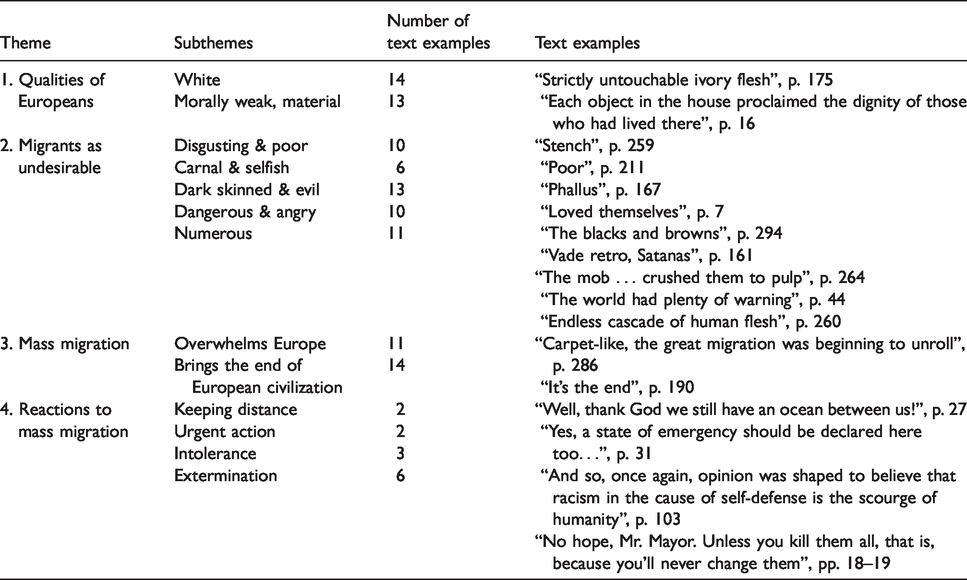
“Each object in this house proclaimed the dignity of those who had lived here … And the old man’s soul was in everything, too. In the fine old bindings, the rustic benches, the Virgin carved wood, the big cane chairs, the hexagonal tiles, the beams in the ceiling, the ivory crucifix with its sprig of dried boxwood, and a hundred other things as well … It’s a man’s things that really define him, far more than the play of ideas; which is why the Western World had come to lose its self-respect, and why it was clogging the highways as at that very moment, fleeing north in droves, no doubt vaguely aware that it was already doomed, done in by its over-secretion … ” (Raspail, 1973, p. 16–17)
For this fixation on empty possessions, Europe has lost the will to resist invasion by the immigrant horde (Theme 1): “Two opposing camps. One still believes. One doesn’t. The one that still has faith will move mountains. That’s the side that will win. Deadly doubt has destroyed all incentive in the other. That’s the side that will lose.” (Raspail, 1973, p. 121) “When man finally conquers his false self-image – be it only a dim and time-worn reflection of an all-but-vanished shadow, left lingering faintly in the back of his mind – there’s nothing much to do but play him his taps.” (Raspail, 1973, p. 213) “In the Philippines, in all the stifling Third World ports – Jakarta, Karachi, Conakry, and again in Calcutta – other huge armadas were ready to weigh anchor, bound for Australia, New Zealand, Europe. Carpet-like, the great migration was beginning to unroll. Not the first time, either, if we pore over history. Many a civilization, victim of the selfsame fate, sits tucked in our museums, under glass, neatly labeled. But man seldom profits from the lessons of the past … ” (Raspail, 1973, p. 286) “I’ve been thinking a lot too, Monsieur Perret,” the President broke in. “In the long run, whatever I do, I certainly can’t let that starving mob come and land on our shores. We could put them in camps, we could try to assimilate them. But the result would be the same: they would be here to stay. And once we had opened the door and shown how weak we are, others would come. Then more, and more. In fact, it’s already beginning … ” “They’ll come, monsieur, no matter what you do.” (Raspail, 1973, p. 191) “Then it just means another kind of genocide, that’s all. Our own. It’s the end.” (Raspail, 1973, p. 190) “Only a white woman can have a white baby. Let her choose not to conceive one, let her choose only nonwhite mates, and the genetic results aren’t long in coming.” (Raspail, 1973, p. 294) “What struck the Western observers the most – those few who would speak to historians later – was clearly the smell. They all described it in much the same terms: ‘It stunk to high heaven … It bowled you over, wouldn’t let you breathe … ’ As the decks sprang to life with their myriad bodies – as the hatchways puked out into the sunlight the sweating, starving mass, stewing in urine and noxious gases deep in the bowels of the ships, the stench became so thick you could practically see it.” (Raspail, 1973, p. 259) “On board, his phallus became, first, a subject of conversation, then of curiosity, and finally, almost of reverence. Lines would form by the light of the stars to inspect it up close. Much like those secret Hindu temples, where ages on end have seen lingams carved in stone offer themselves for the crowds’ veneration.” (Raspail, 1973, p. 167) “ … All the kinky-haired, swarthy-skinned, long-despised phantoms; all the teeming ants toiling for the white man’s comfort … all the numberless, nameless, tortured, tormented mass … They don’t say much. But they know their strength, and they’ll never forget it. If they have an objection, they simply growl, and it soon becomes clear that their growl runs the show. After all, five billion growling human beings, rising over the length and breadth of the earth, can make a lot of noise! Meanwhile … seven hundred whites sit shutting their eyes and plugging their ears.” (Raspail, 1973, pp. 294–95) “The mob, as we said, was merely passing through. If it happened to trample a few bodies in the bargain, it had no idea, surely, whose they were, or why. It crushed them to pulp just because they were there. Ganges monsters, Western monks. It made no distinction. It saw itself now as the one and only race. All others, quite simply, had ceased to exist.” (Raspail, 1973, p. 264)
Another common perception of migrants is their large and always growing numbers (Theme 2): “But for that matter you couldn’t see the boats now, either. Their sides were alive, like an anthill slashed open. Using whatever they could lay their hands on – cords, cables, hawsers, worm-eaten rope ladders, loading nets lowered along the hulls – the horde was slipping down into the water. Endless cascades of human flesh. Every one of the boats, teeming, gushing with bodies, like a tub brimming over. Yes, the Third World had started to overflow its banks, and the West was its sewer.” (Raspail, 1973, p. 260)
“Well, thank God we still have an ocean between us!” (Raspail, 1973, p. 27)
And the next is to declare a state of emergency when the migrants threaten the shores of the European homeland (Theme 4): “Yes, a state of emergency should be declared here too, with the whole array of preventive measures, while they still had time … ” (Raspail, 1973, pp. 31–32) “No hope, Mr. Mayor. Unless you kill them all, that is, because you’ll never change them.” (Raspail, 1973, p. 18) “The President of the French Republic received three pitiful wires, one from each of the capitals in question, imploring him to take a firm stand, even if it meant the spilling of innocent blood.” (Raspail, 1973, p. 196)
Hence, The camp of the saints proposes stark dichotomies of beauty versus ugliness, elegance versus depravity, civility versus violence, native versus migrant, and white versus black. These dichotomies polarize the refugee and migrant discourse, making pluralism impossible, or at best an immoral compromise.
Raspail, racism and radicalization in contemporary Europe
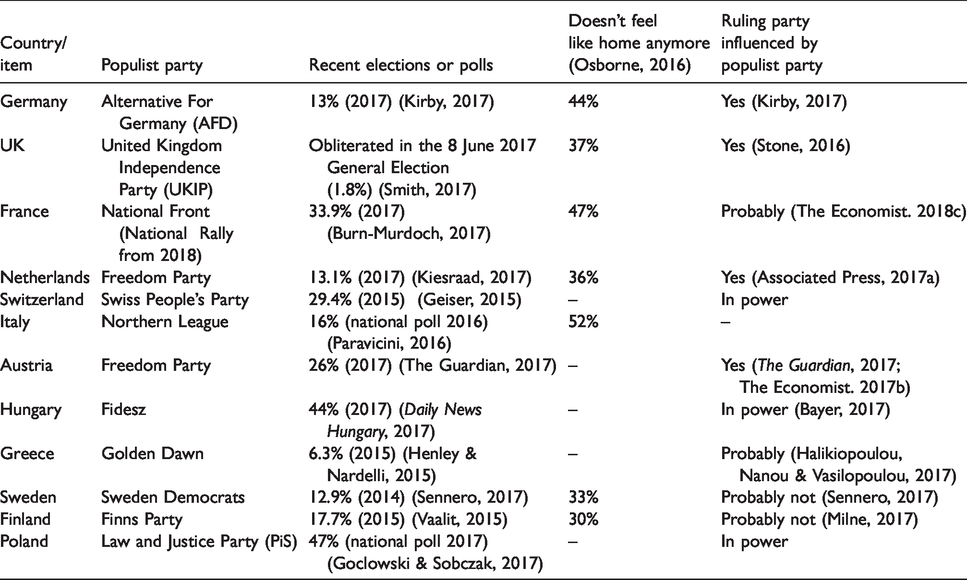
Decades later, how do the ideas and attitudes put forward by Raspail compare to current policy and rhetoric with respect to migration? Has Raspail’s vision taken hold or largely been ignored? Table 2 summarizes populist trends in Europe, with the percentage gained by populist parties in recent elections in various countries. It also reports on a 2016 survey that asked people if they agree with the following statement: “There are so many foreigners living here, it doesn’t feel like home anymore.” Finally, Table 2 draws attention to the influence of populism on the current ruling party of the country. According to Müller (2016), populism is a movement that is critical of elites, opposed to pluralism, and grounded in identity politics. As a degraded form of democracy, populism represents a danger to democratic traditions because it asserts that one group has a true or pure claim to citizenship, while out-groups are interlopers at best. An example of the influence of populism can be found in the Netherlands, where the Dutch Freedom Party has taken such a strong position against migration, especially Muslims, that the centrist Prime Minister, Mark Rutte, recently told migrants “to behave normally or go away” (Associated Press, 2017a). Overall, the trend is quite clear: populism has become a formidable political, ideological, and social force in contemporary Europe.
Populism in Europe (2017)
How do anti-migrant themes from The camp of the saints compare to party manifestos and statements of leaders from various right-wing political parties of European countries? Table 3 makes this comparison with respect to four nations: the United Kingdom (UK), France, The Netherlands, and Hungary. Overall, the anti-migrant positions of populist parties are relatively severe. Their rhetoric demands tougher treatment of migrants and refugees at all levels. The assumption is that new arrivals to European countries are taking up precious resources that could be better used by native Europeans. Calls to reduce migration are practically universal, thereby replicating the central theme of The camp of the saints that mass migration will overwhelm Europe. The UK has called for reductions in net immigration levels, with UKIP advocating a 50% reduction for five years, but with the Tories suggesting an even larger reduction to one third of current levels (The Economist, 2017a). This is but one example of the effects that populist political parties can have on the political agenda – in this case, refocusing attention on migrants as a source of national woes. In France, Marine Le Pen has also proposed reductions in immigration by restructuring France’s border agreements with the rest of Europe and admitting only 10,000 new arrivals per year. The Netherlands is in a different situation, in which the Freedom Party leader, Geert Wilders, has become increasingly anti-Islamic, to the point that he has advocated for the “de-Islamization” of the country by forbidding migrants from Islamic countries, closing mosques, and banning the Quran (Associated Press, 2017b; Tasch, 2017). Hungary has refused to cooperate with the EU, admitting few migrants and possibly abusing those who find their way into the country illegally (Dearden, 2017). Some of these politicians have equated mass migration to a fundamental assault on European civilization, suggesting that ongoing migration at current levels would destroy French, Dutch, Hungarian, and European Christian culture. Orban, in Hungary, has been the most vocal on this subject. During an Easter Sunday (2017) speech he said:
The camp of the saints anti-migrant themes in contemporary Europe

“This is what our future stands or falls on, the fate of Europe. The question is whether the character of European nations will be determined by the same spirit, civilisation, culture and mentality as in our parents’ and grandparents’ time, or by something completely different. We want to preserve the foundations of Europe. We do not want parallel societies, we do not want population exchanges, and we do not want to replace Christian civilisation with a different kind. Therefore we are building fences, defending ourselves, and not allowing migrants to flood us.” (Stinson, 2017)
Although stark words, they reflect much of what undergirds the political right in Europe and elsewhere: perceived Western civilizational decline countered by the inevitable consequences of nationalism, themes that resemble to a remarkable degree the text and tone of The camp of the saints.
Underlying these assertions is the belief among many in Europe that migrants are essentially undesirable people and only have a harmful effect on the countries that harbor them – again, very similar to the beliefs that animate The camp of the saints. For example, the UKIP manifesto asks for “only the brightest and the best from around the world to make their home in Britain” and recommends imposing a moratorium on unskilled and low-skilled migrants, who presumably increase competition for working class jobs, stagnate wages, and put pressure on public services (UKIP, 2017, pp. 32–33).
In France, the National Front assumes that migrants are massing and will eventually overflow France, prompting Marine Le Pen to promise the French electorate, “I will protect you,” meaning she will obviate the problem by imposing non-EU or Schengen sanctioned borders. In response to her promises, supporters of the National Front chanted, “This is our home!” at rallies during the 2017 election (Reuters, 2017).
Geert Wilders, a right-wing Dutch politician, in an interview in February 2017, called Moroccan immigrants to the Netherlands “scum” (McKie, 2017): “The Moroccan scum in Holland … once again not all are scum … but there is a lot of Moroccan scum in Holland who make the streets unsafe, mostly young people … and that should change.” “If you want to regain your country, if you want to make the Netherlands for the people of the Netherlands, your own home again, then you can only vote [for the Freedom party]. Please, make the Netherlands ours again.”
Hungary’s prime minister, Viktor Orban, and the Fidesz party, have moved so far to the right with respect to migrants and immigration that there remain few differences from the ultra-nationalist Hungarian party, Jobbik (Byrne, 2017). In 2016, Orban said, “For us migration is not a solution but a problem … not medicine but a poison, we don’t need it and won’t swallow it” (Reuters & Agence France-Presse, 2016).
What to do about mass migration? What concrete steps have the various parties proposed? UKIP would deny National Health Service access for migrants for the first five years, as laid out in a section of its manifesto entitled Fair, balanced migration: “All new migrants to Britain will be expected to make tax and national insurance contributions for at least five consecutive years before they become eligible to claim UK benefits, or access non-urgent NHS services … All new entrants to the UK must have and maintain comprehensive private medical insurance for the duration of their stay, as a condition of their visa” (UKIP, 2017).
Geert Wilders and the ironically named Freedom Party, as has already been mentioned, would close all mosques in the Netherlands and ban the Quran. These proposed actions arise from a profoundly anti-Islamic position, which perhaps has some of its roots in the murder of a Dutch filmmaker, Theo van Gogh, in 2004 by an Islamist. Wilders has since received death threats as well and has been in hiding and under constant guard for more than a decade (McKie, 2017). Some of his statements are controversial to be sure: “Dutch values are based on Christianity, on Judaism, on humanism. Islam and freedom are not compatible. You see it in almost every country where it dominates. There is a total lack of freedom, civil society, rule of law, middle class; journalists, gays, apostates – they are all in trouble in those places. And we import it” (Hjelmgaard, 2017).
Hungary’s Viktor Orban, who hails from a country that is en route to Germany, where many migrants wish to go, has proposed a more direct solution to the migration problems his people are facing: “If we can’t do it nicely, we have to hold them back by force. And we will do it” (Dearden, 2017).
Radicalization beyond Western Europe
Beyond Europe, populist projects foment discord and oppose migration and liberal values in the United States, Turkey, Russia, and Canada.
“In Turkey, Syrian refugees receive temporary protection, but are left to fend for themselves. Turkey denies full refugee status to non-Europeans and the conditions in the country have shown it is unable to provide effective protection as required under international law. This means that the three million refugees in the country, virtually all of whom are non-European, have no way to be self-reliant. Struggling to meet people’s basic needs, the Turkish authorities are failing to ensure that refugees and asylum-seekers are able to live in dignity. Amnesty International has documented the fact that Turkey has returned asylum-seekers and refugees to countries where they risk serious human rights violations such as Syria, Iraq and Afghanistan” (Gogou, 2017).
Radicalization of populist leaders
With so much emphasis on the radicalized migrant other, one must ask the question: are populist leaders, such as Donald Trump and Marine Le Pen, victims of radicalization themselves? Can leaders become unwittingly radicalized in the service of the radical right? We have already considered how radicalization is not a one-way phenomenon, i.e., it is not just about Muslim and minority radicalization, but about the politics and attitudes of host societies in Europe, North America, and elsewhere. These social, cultural, and political forces of intolerance not only create conditions that favor radicalization of minorities, but foment racist and white supremacist discourse among the native-born majority that feeds radical violence in susceptible individuals. What is also concerning is the possibility that political leaders themselves may become radicalized to the point that they interject racist phraseology into their discussion of migrants. For example, Ian Allen (2018) details how a white supremacist leader in the United States, Andrew Anglin, publicized an annual protest march in Central America early in 2018, by calling it a “migrant caravan” and publishing the term widely. Amazingly, President Trump and Mike Pence began to use migrant caravan in public speeches, and the term has taken a life of its own, perhaps inadvertently encouraging a much larger march of migrants from Guatemala toward the southern border of the United States. Migrant caravans moving toward the United States evoke Raspail’s image of the Last Chance Armada of migrants on their way to invade and conquer Europe. As already mentioned, Stephen Bannon, as early as 2015, has been linking mass migration to “a Camp of the saints-type invasion” in which migrants threaten to destroy white civilization (Blumenthal & Rieger, 2017). Picking up on Bannon’s rhetoric, President Trump again used white supremacist language when speaking about the migrants traveling toward the United States, first by calling them “migrant caravans”, and later by tweeting that these migrants were mounting an invasion of the United States: “Many Gang Members and some very bad people are mixed into the Caravan heading to our Southern Border. Please go back, you will not be admitted into the United States unless you go through the legal process. This is an invasion of our Country and our Military is waiting for you!” (Fabian, 2018)
Pluralism versus polarization: Which way forward?
One consequence of the politics of polarization may be acts of terror. Table 4 lists major terror attacks in Europe from 2015 to 2017, and the trend may be one of increasing frequency. Gilles Kepel, in his book Terror in France: The rise of jihad in the west (2015), suggests that nationalist and Jihadist poles in that country are bound to create increasing tension and violence. Kepel writes:
Terror activity in western Europe, 2015–17 (Foster, 2017; DW, 2017)

“France has been an especially tempting target because of the disastrously high unemployment rate among young people of immigrant backgrounds who live in the banlieues. The largely Arabic-speaking North African provenance of these children of immigrants – an echo of French colonial history – is a boon for Arab Jihadist recruiters, who target this community in particular … Hence the French situation is exemplary and premonitory, and a deeper knowledge of it can help us decipher situations in which we see jihadism spreading in the West, whether in the rest of Europe or in North America.” (Kepel, 2015, p. xii)
Kepel acknowledges that France, and the French people in this case, play a role in the creation of radicalized youth and must assess what these conditions may be and how the structures of society drive individuals to adopt desperate measures. The same could be said of any country in Europe or elsewhere: the essential question is, what homegrown historical and cultural legacies act to reinforce racism and violence as the solution to discontent? Nationalism, populism, and anti-Muslim, anti-migrant discourse favor polarization and particularism, which, in turn, create a permissive environment for the radicalization of white majorities (nationalism and populism) and ethnic minorities, with an escalation of violence and terrorism. Where these attitudes come from, and how they persist over time and in so many places, begs for scholarly explication; but one source of their potency may be an overriding fear of the majority losing white privilege and power. Recent data show the seriousness of this problem: white men, not members of minority groups, commit the majority of what could be called terrorist acts in the United States and the UK (Ruiz-Grossman, 2017; Dearden, 2018). The ongoing problem of under-reporting white terrorism in the United States derives from vague legal definitions of what constitutes a terrorist attack in the first place (Reilly, 2018), with suppressed rates of white terrorism as the result. Despite the horror and carnage of terrorist acts, systemic racism and the discriminatory laws enacted by elected leaders cause even more harm to more people. The institutionalization of racist policies perpetuates inequalities and sets the stage for violence and abuse of new generations of migrants and minorities.
The camp of the saints is not a particularly original contributor to racist paradigms in contemporary Europe and North America, so much as it is a condensation of collective stereotypes and anxieties about race, migration, and social change. Raspail has not been explicitly cited or referenced by European politicians or political parties, although he has been in the United States. This opens the door to a sobering conclusion: that the brand of racism in The camp of the saints and related literature draws upon a broad cultural legacy handed down from centuries of colonial exploitation and white privilege with specific imperatives: raise borders, scapegoat migrants, and reinforce narrow traditions. Consequently, its appeal will be difficult to eradicate, especially in the face of economic hardship and social change. An evolving twist on this discourse, at least in the UK, has been a trend to focus on religion or culture rather than race as a way to articulate xenophobic and discriminatory themes. In this way, racist structures are maintained while being obscured by a seemingly open discussion of foreign cultures or religions, such as Islam (Mamdani, 2004; Kundani, 2014).
But does this have to be the response to mass migration? Other points of view do exist. One of the most intriguing is that of Caplan and Naik (2015) in a book chapter entitled “A Radical Case for Open Borders”. The authors propose that free and open borders would minimize labor waste that exists throughout the world today. They anticipate that unrestricted migration would roughly double the global GDP, putting an extra $75 trillion into the world economy (World Bank, 2017). Obviously, not all of this human movement can take place at once. Effective policies need to balance generosity against practical concerns in order to assuage public anxiety that chaos would result from open immigration policies. New arrivals should be granted citizenship, but must fulfill the obligations of citizens in ways that are acceptable to members of the mainstream society. For example, migration must be orderly, legal, and humane, and must be perceived as such by the citizens of receiving countries. Additionally, migrants must be encouraged to work, adjust to life in their new country, and should be seen as paying their own way rather than being a burden on the host economy (The Economist, 2018a). In settings where these factors are at play, large-scale migration, despite any short-term disruptions, could be reframed as a long-term economic opportunity. Australia is an example of a country in which many of these elements have coalesced in a productive way: high rates of immigration (more than any other wealthy country) contribute to a robust economy; and effective borders function according to the rule of law and pave the way for public approval of immigrants and immigration (The Economist, 2018b), despite migrants being held in detention without charge – in some cases for years (Doherty, 2018). The alternative to open borders is bleak: negative population growth, increased border security, dwindling populations, and stagnant economies, as has been happening in several East European countries in recent years (The Economist, 2018c).
Conclusion
Despite the potential disruption of mass migration, Europe and North America need to remember that migrants have built the modern world; that migrants are people with real histories and personal stories (Haslam & Holland, 2012); that migration is a normal human activity; that to resist migration is to wage a losing battle in the long run; and that the current global situation represents a rare opportunity to move forward in new, productive directions. The first step will be to prepare for large-scale admission of migrants and refugees over the long term, especially where economies cannot provide enough native-born labor to sustain economic health. This will include educating the public about migrants and highlighting their humanity and productivity. The second step will be to invest in these newest residents by giving them sufficient status and privileges to maximize their chances of making a meaningful contribution to society. The third step, and the most courageous, will be for the members of host countries to turn the lens of their discontent onto themselves, the privileged native-born, to consider how polarized societies undermine stability for all by fostering an environment of radicalization and terror. In particular, this would involve reflecting on some of the root causes of xenophobia: perceived competition for jobs and public services (social welfare, education, healthcare), economic inequality in society, social decline of native born groups (such as the middle class) generalized to the imminent loss of Western civilization, and the presence of right-wing (nationalist) political organizations (UNESCO, 2017). The degree to which these xenophobic social forces can be contained and the responsibility for new citizens can be shared humanely and equitably among the various member nations of the EU, and among the United States–Mexico–Canada Agreement countries; and how willingly wealthy nations will participate in international initiatives, such as the UN-led Global Compact on Migration (Spence, 2018), will determine unity, prosperity and peace in the decades to come. Without such a collaborative approach, populist rhetoric, preached by radicalized leaders, will become a self-fulfilling prophecy, with increasing numbers of terror attacks, amplified suffering and marginalization of migrant and minority communities, and other evidences of polarization in an atmosphere of decline and despair.
Footnotes
Acknowledgements
The author would like to thank the reviewers for their helpful feedback and for guiding the paper to completion. The author also would like to remember the millions of refugees worldwide whose hope in the midst of suffering inspired this work. Funding information: No funding to declare.
Declaration of Conflicting Interests
The author(s) declared no potential conflicts of interest with respect to the research, authorship, and/or publication of this article.
Funding
The author(s) received no financial support for the research, authorship, and/or publication of this article.
