



Abstract
Cultural sensitivity is missing in the widely researched construct of resilience. The assumption that resilience takes the same form in all cultures fails to acknowledge that culture shapes the interpretation and instantiation of resilience. Examining how suffering and adversity are perceived and dealt with in Chinese contexts, can identify cultural concepts related to resilience. In this paper, we examine the ways in which Confucianism, Buddhism, and Taoism, the three main belief systems that have influenced Chinese people's perception of the nature of life, can serve as sources of strength to individuals facing adversity. We summarise three culturally inflected elements of dealing with adversities and compare them with existing, widely researched notions of resilience. Taking a socio-ecological perspective to explore resilience, this paper proposes a multidimensional model that can improve understanding of culturally embedded resilience.
The last three decades have witnessed a burgeoning literature on resilience literature, but research on resilience faces several challenges, including a lack of cultural sensitivity in defining the concept. The assumption that resilience takes the same form in all cultures fails to acknowledge that culture shapes the interpretation and instantiation of resilience (Arrington & Wilson, 2000). To explore resilience among the Chinese, we start with an introduction of the major components of resilience across cultures in the literature. We then discuss how adversities are perceived and dealt with in Chinese culture and identify some culture-specific aspects of resilience by drawing on Chinese philosophies. This is followed by a review of resilience research among Chinese people. Finally, we present a social ecological model of resilience to provide a better understanding of resilience among Chinese people and guide future research.
Major components in the concept of resilience
Resilience research contributes to the understanding of human development by providing information on processes that lead to positive outcomes in the face of stress (Luthar, 2006; Rutter, 2012). Focusing on strengths rather than problems sheds light on protective factors and can inform interventions to enhance individual assets (Windle, 2011). Factors have that contribute to individual resilience can be categorised in two types: personal competence-based resilience and religion-based resilience (Aburn, Gott, & Hoare, 2016).
Personal competence-based resilience is based on a wide range of capabilities, skills or dispositions, including self-efficacy, problem-solving, goal-setting, optimism, perseverance, etc. Personal competence plays a crucial role in helping people bounce back from adversity (Hu, Zhang, & Wang, 2015; Rutter, 2007). Self-efficacy promotes resilience, as it motivates people to persevere in the face of stress (Benight & Cieslak, 2011) and goal setting is another personal characteristic that promotes resilience (Pienaar, Swanepoel, van Rensburg, & Heunis, 2011). Traits such as perseverance and optimism also provide individuals with strength to meet challenges and keep going forwards (Guillén & Laborde, 2014).
Religion or spirituality is another major component of resilience. Pargament and Cummings (2010) summarised the main ways in which religion promotes positive adaptation: it provides meaning; elicits positive emotions; and enables one to overcome negative emotions. There is increasing evidence that religion and spirituality can promote positive mental health outcomes, including a higher level of overall quality of life, more optimistic life orientation, and lower levels of anxiety and depressive symptoms (Koenig, 2015; Weber & Pargament, 2014).
Culture and resilience
Accumulating evidence suggests that cultural context is an important factor that shapes resilience (Pangallo, Zibarras, Lewis & Flaxman, 2015; Ungar, Ghazinour, & Richter, 2013). Here the term ‘culture’ refers to a set of values and beliefs held by people and manifested in their traditions or practices. In theoretical terms, resilience should be considered culturally embedded, because culture influences how people interpret adversity and how they are expected to respond to it (Arrington & Wilson, 2000). A systemic and ecological view of resilience that takes into account the dynamic interactions between individuals and their communities and cultures has the advantage of providing a more comprehensive picture of positive development (Kirmayer, Dandeneau, Marshall, Phillips, & Williamson, 2011). The phenomenological variant of ecological systems theory suggests that culture affects perceptions of self and appraisals of one’s experience, which influence behaviour and coping methods (Spencer, Dupree, & Hartmann, 1997). Furthermore, cognitive theory posits that it is how adversity is interpreted, rather than the adversity per se that causes distress, lending support to the idea that culture influences resilience, since interpretations of adversity are profoundly influenced by cultural beliefs (Shek, 2004).
Empirical studies suggest a close connection between culture and resilience. Findings reveal that cultural values provide meanings and strength for individuals in the face of adversities. Cultural identity, values and practices have been found to foster resilience among ethnic groups. For example, including ethnic identity and the value of family and traditions, were found to provide strength and a sense of purpose for three generations of Alaska natives (Wexler, 2014). Another study found that the historical meaning ascribed to hardship, passed down through generations, provided Palestinian war-affected youth with a sense of identity and a framework within which to interpret their suffering (Atallah, 2017). Cross-cultural research has shown that an interaction between culture and individual behaviour facilitates adaptation to the socio-ecological context, suggesting that it is important to explore culture-specific processes that predict wellbeing (Berry & Poortinga, 2006).
The above examples suggest the importance of cultural values in understanding resilience. Nevertheless, most studies of resilience have lacked cultural sensitivity and most resilience research has been done in Western societies (Ungar et al., 2013). Ungar (2011, pp. 6–7) pointed out that in most cases “cross-cultural research simply replicates studies with difference populations, using standard Western research protocols”. Echoing this assertion, Ramirez and Hammack (2014) highlighted a cross-cultural inquiry of resilience and cautioned against generalising from research based on samples with limited representativeness.
How adversities are perceived and dealt with in Chinese culture
The assumption that resilience takes the same form in all cultures fails to acknowledge that culture shapes the interpretation and instantiation of resilience. However, through the investigation of how suffering and adversities are perceived and dealt with in Chinese culture, an understanding of cultural concepts related to the concept of resilience can be achieved. We examine Confucianism, Buddhism and Taoism – the three main belief systems that have influenced Chinese people’s perception of the nature of life (Yang, 2001). In this article, we rely primarily on the literature of the Mahayana Buddhism, which spread across China and was inextricably interwoven with Confucianism and Taoism since the Tang Dynasty. The ways in which these philosophies can serve as sources of strength to individuals facing adversity are highlighted. We summarise three culturally inflected elements of dealing with adversities and compare them with existing, widely researched notions of resilience. As the three philosophies have assimilated parts of the doctrines from one another in their transformation (Hwang & Chang, 2009), we summarise more salient themes across these philosophies.
First, all three philosophies encourage accepting adversity, rather than actively seeking control. Acceptance is encouraged in the teachings of all three schools, but the connotations of the term vary. Buddhism perceives suffering as an essential part of life. People are encouraged to endure suffering in order to gain insight and spiritual liberation (Peacock, 2008). In Taoism, everything, including suffering, has a natural course (i.e., Tao) that one should appreciate and follow (Wang, 1946). Individuals are encouraged to embrace non-action (Cheng, Cheung, Chio, & Chan, 2013). Confucianism promotes an accepting attitude towards adversities whilst encouraging efforts to combat them. Confucius underscored the impact of ‘ordinances of heaven’ on individuals’ life trajectory, and Mencius continued this approach, arguing that personal hardship was a matter of destiny whilst emphasising the importance of actions (Hwang, 2001). The Book of Changes contains a well-known saying: ‘The movement of heaven is full of power; thus, the superior man makes himself strong and untiring; the Earth’s condition is receptive devotion; thus the superior man carries the outer world with the breadth of character.’ People are encouraged to strive vigorously for improvement, like the movement of heaven, but the accepting attitude and character embodied in the encompassing Earth is valued. Those who endure whatever circumstances life thrusts on them are regarded as superior and of good character as this is the ideal promoted by Confucianism.
There is limited research on acceptance as an adaptive coping strategy in Chinese culture (Cheng, Cheung, et al., 2013). Some empirical studies suggest that acceptance may help individuals face adversity. For instance, cultural beliefs such as accepting hardship as a way to expand stature strengthened the 2008 Wenchuan earthquake survivors and contributed to their recovery (Huang, Wong, & Tan, 2014). In another study with 143 Chinese patients with generalised anxiety disorder (GAD), psychologists examined the effectiveness of psychotherapy incorporating Taoist elements as a treatment for GAD (Zhang et al., 2002). Key Taoist ideas about acceptance were discussed and practiced. Analysis showed that Taoism-based psychotherapy was slower to reduce GAD symptoms than medication but more effective in the long term. Same therapeutic components were shown to reduce post-migration stress (Chang et al., 2016).
Acceptance is also deployed by Westerners, but although superficially similar, Western notions of acceptance are based on different cultural values and practices. In Christianity, for example, acceptance is largely derived from the teaching that hardship can stimulate growth and represents the will of a benevolent God (Roesch & Ano, 2003). In general, the Western notion of resilience is more closely linked to personal competence and to taking action to gain control over one’s circumstances (Windle, 2011). There are cultural differences in how control is perceived. A meta-analysis of research on locus of control found some cultural differences in the meanings of perceived control (Cheng, Cheung, et al., 2013). Individualism was found to moderate the relationship between external locus of control and anxiety, indicating that in Western cultures, but not collectivist cultures such as China, action-oriented strategies are used successfully to deal with anxiety (Cheng, Cheung et al., 2013). Similarly, some studies suggest that Westerners are more inclined to alter the environment to meet their goals, compared to Chinese, who tend to adjust themselves to the environment (Cheng, Hui, & Lam, 2000). Moreover, in studies with the widely used resilience Connor-Davidson Resilience Scale based on American data, the original factor 4 (Control) did not emerge as an independent factor in a general population sample of 560 Chinese adults (Yu & Zhang, 2007) and 3,960 new employees (Wu, Tan, & Liu, 2017), suggesting cultural differences in locus of control.
Second, all three schools of Chinese philosophy depict the process of dealing with adversity as relational, rather than individual-based. Of course, emphasising that relationships are a source of strength is not exclusive to Chinese culture; previous research has supported the importance of interpersonal relationships to resilience across cultural regions (Guillén & Laborde, 2014; Pienaar et al., 2011). Nevertheless, Chinese people endorse an especially strong relational orientation in dealing with adversities (Lu, Kao, Chang, Wu, & Jin, 2008). This relational orientation has two facets: relationships with others and relationship with nature.
Relationships with others strongly influence Chinese people’s identity and their response to hardship. This strong relational orientation is captured by the concept of the ‘relational self’, according to which an individual is embedded in dyadic relationships with others and should fulfil the obligations associated with the roles one plays, particularly with regard to family (Hwang & Chang, 2009). This relational orientation means that individuals treasure the wellbeing of the whole family and regard it as a personal goal (Triandis, 2011). In times of difficulties, familial responsibilities and the relational orientation inspire individuals to strive for the wellbeing of their significant others. The value placed on family connectedness was found to help individuals facing acculturative stress (Gellis, 2003). Based on the assumption that more importance is given to familial relationships throughout the life span in collectivist cultures than in individualistic cultures, Yu, Stewart, Liu, and Lam (2013) hypothesized that family resilience would be particular salient among Chinese immigrants. This hypothesis was supported by the results of the study they conducted in a sample of 1,205 adult immigrants from mainland China to Hong Kong: family resilience was found to contribute significantly to lower levels of depressive symptoms after controlling for several individual-level contributors, including personal resilience. This lends support to the importance of the family in achieving positive adaptation for Chinese.
Chinese culture also values a harmonious relationship with nature. Nature (天) refers to Tao, the law of everything. Lao Zi encourages people tune into natural harmony.‘Tao is the Super-one. It is the root of everything. The whole universe is moving and renewing without cease. One should concentrate his attention on integrating with the law of nature' (Lao Zi, chap. 5, translated by Cheng, 1995).
All three philosophical schools encourage people to pursue such harmony by acting in accordance with nature. This relational orientation leads to contentment and self-demand rather than confrontation with the environment, even in adversity. A popular saying on contentment from the Book of Changes (易經) is that one will be spared distress if one can gladly obey the law of the nature (樂天知命, 故不憂) (Feng, 1947). 1 Similarly, the Tao Te Ching advocates maintaining a harmonious relationship with nature. There is inevitably interconversion between yin and yang (two different natural forces) and between adversities and blessings (Yip, 2005), so those who maintain a harmonious relationship with nature remain content and free from distress under all circumstances. Buddhism also values ego-transcendence and connection with the environment. In the Buddhist view, the ego represents ‘the notion of oneself as a fixed and discrete entity separate from other selves and from an outside world’ and attachment to the ego leads to suffering (Van Hien, 2003, p. 212). To free oneself from distress, one needs to go beyond the ego boundary and build a sense of unity with others and with the cosmos (Canda & Furman, 2010). The relational orientation of resilience in Confucianism, Taoism, and Buddhism can contribute to the positive development by lowering the intensity of person-environment disharmony and bringing spiritual strength for people having communion with nature (Xu, 2018).
Western ways of dealing with adversities tend to be more individual-oriented, emphasizing the role of internal sources of strength and individual characteristics (Fletcher & Sarkar, 2013). Some resilience measurements reflect this individual orientation (Pangallo et al, 2015). For example, 17 of the 25 items of Wagnild and Young’s (1993) resilience scale loaded mainly on the ‘personal competence’ factor. Connor and Davidson’s (2003) scale has a similar emphasis on individual capacities.
We are not denying the importance of individual competence to Chinese in their dealing with suffering. Individual capacities are important for Chinese (Tian et al., 2016; Shi et al., 2016), but, as seen in the three philosophies described above, cultural traditions put strong emphasis on relationships with others and with the universe and on the meanings attached to these relationships.
Third, the three philosophies emphasize that adversity can result in character-building as well as improving psychological wellbeing. The goal of cultivating benevolence, righteousness, propriety, wisdom and faithfulness is embedded in dealing with adversities for Chinese. In an investigation of traditional Chinese thought based on writings on Chinese medicine, Confucianism and Taoism, Yip (2005) found that the concept of mental health encompassed not only psychological wellbeing but also the cultivation of mind and personality. Peace of mind and virtuous character are held to be achieved through self-discipline and self-cultivation, particularly under stress. The cultivation of character and virtues are key components of Confucianism (Hwang, 2001). Consequently, the ascription of positive meaning to adversity has been related to its ability to strengthen one’s mind (Pan, Wong, Chan, & Chan, 2008). The book of Mencius conceives hardship as necessary to the expansion of one’s capacity and character for future missions: When Heaven is about to confer a great office on any man, it first exercises his mind with suffering, and his sinews and bones with toil. It exposes his body to hunger and subjects him to extreme poverty. It confounds his undertakings. By all these methods it stimulates his mind, hardens his nature, and overcomes his incompetence (Chan, 1986, p. 289).
Traditional Chinese culture in a modern society
Chinese individuals today are under the influence of both traditional and modern values against the background of globalization. According to the value persistence model, certain traditions are strengthened during modernisation, rather than being lost (Inglehart & Baker, 2000). On the other hand, as the global market makes the world increasingly interdependent, particularly in urban areas, the integration of multiple cultural systems leads to a sense of “multicultural self” among Chinese, whose values are caught between individualism and collectivism (Kolstad & Gjesvik, 2014).
Research with Chinese cancer patients suggests that collectivist Chinese beliefs and individualist values can coexist in individuals and both can affect individuals’ perceptions and dealing with adversities. Whilst they tended to endure the cancer pain, which was perceived as a trial or fate due to the cultural notions (Chen, Miaskowski, Dodd, & Pantilat, 2008), Chinese patients also actively exercised their personal agency in self-care management (Cheng, Sit, Twinn, Cheng, & Thorne, 2013). A cross-cultural study found shared ways of coping with cancer among Chinese, Indian and American participants. Some Chinese participants were no different from their counterparts in trying to gain control over the situation and being independent in dealing with the illness. However, some Chinese endorsed a strong sense of acceptance towards the demand of the illness and gained more peace compared to their American counterparts who experienced frustration when the problem could not be solved (Kayser et al., 2014).
Given this potential coexistence of traditional Chinese and globalized Western orientations, it is important to consider the impact of both collectivist Chinese values and individualist values when exploring how Chinese individuals’ belief systems affect their dealing with suffering.
Review of research on resilience among Chinese
In this section we present a selective review of resilience research involving the Chinese population. The inclusion criteria were that studies must have investigated resilience in Chinese people and include clear, operational definitions of resilience. Books, book chapters, conference papers and commentaries were excluded.
Relevant studies were initially identified through broad, computerised searches of MEDLINE, PsycINFO, ERIC and PILOTS, for articles published between 1980 and the present. Key words were entered to look for studies that (a) involved the Chinese population (‘China’ or ‘Chinese’ or ‘Hong Kong’, ‘Taiwan’ or ‘Macau’), (b) focused on resilience (‘resilience* or competence*’ or adaptation or ‘sense of coherence’). All identified studies were screened for relevance based on the abstract and title (see Figure 1) and then the full texts of all potentially relevant studies were read to determine whether they met inclusion or exclusion criteria.
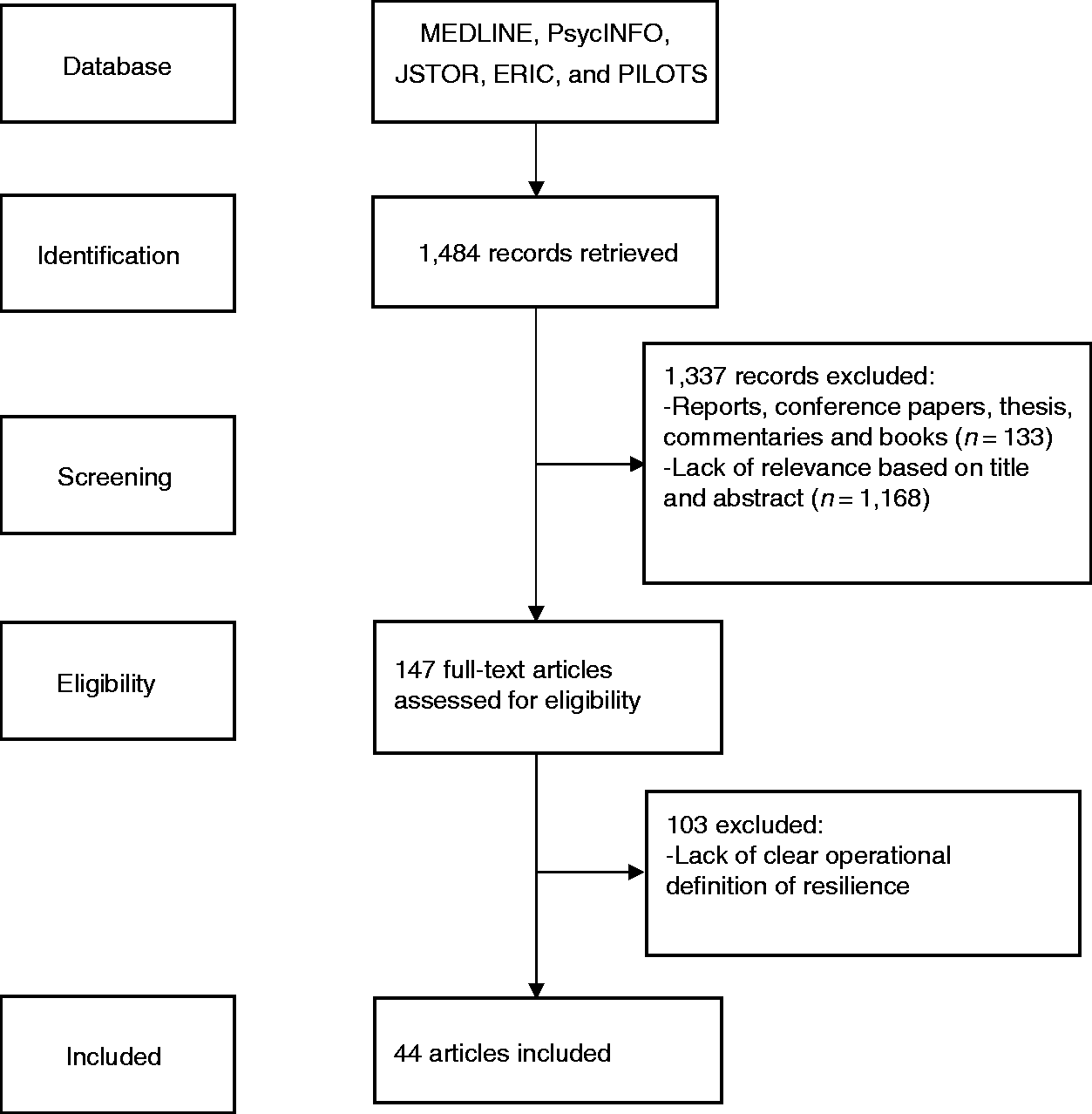
PRISMA flow chart of selection of articles from review
Searches were performed between July and August 2018. No language restriction was applied. The studies were read to extract data on definition of resilience definition, study population (size, type and gender), research sites and method(s) of measuring resilience measurement, which were entered into spreadsheets.
Results
We identified 44 articles that met the inclusion criteria (Table 1; articles marked with an asterisk in the reference list). Thirty-nine articles were written in English and five in Chinese. The majority of the studies took place in mainland China (n = 30, 68.2%). Most studies adopted a quantitative approach (n = 40, 90.9%) and investigated adults (n = 26, 59.1%) rather than school-aged children or adolescents (n = 14, 31.8%). These studies yielded three conceptualization of resilience themes: trait resilience, process resilience and outcome resilience.
Overview of the studies included (N = 44).

Theme 1: Trait resilience studies defined resilience as a set of personal characteristics that enables individuals to achieve positive outcomes under adverse circumstances (Table 2). There was little, if any, difference in the conceptions of resilience applied in studies of Chinese groups and those looking at other contexts. Several scholars have proposed more specific definitions of resilience and tried to develop corresponding methods of measurement. For instance, Hao et al. (2015) defined resilience as a personality trait consisting of five dimensions, including internal locus of control and coping style, and measured it with a specially developed trait resilience scale. However, it is questionable whether resilience is a stable trait. Longitudinal studies have shown that a fairly large proportion of participants who report resilience subsequently report not being resilient (Jaffee, Caspi, Moffitt, Polo-Tomas, & Taylor, 2007; Fletcher & Sarkar, 2013).
Summary of different conceptualizations and measures of resilience.
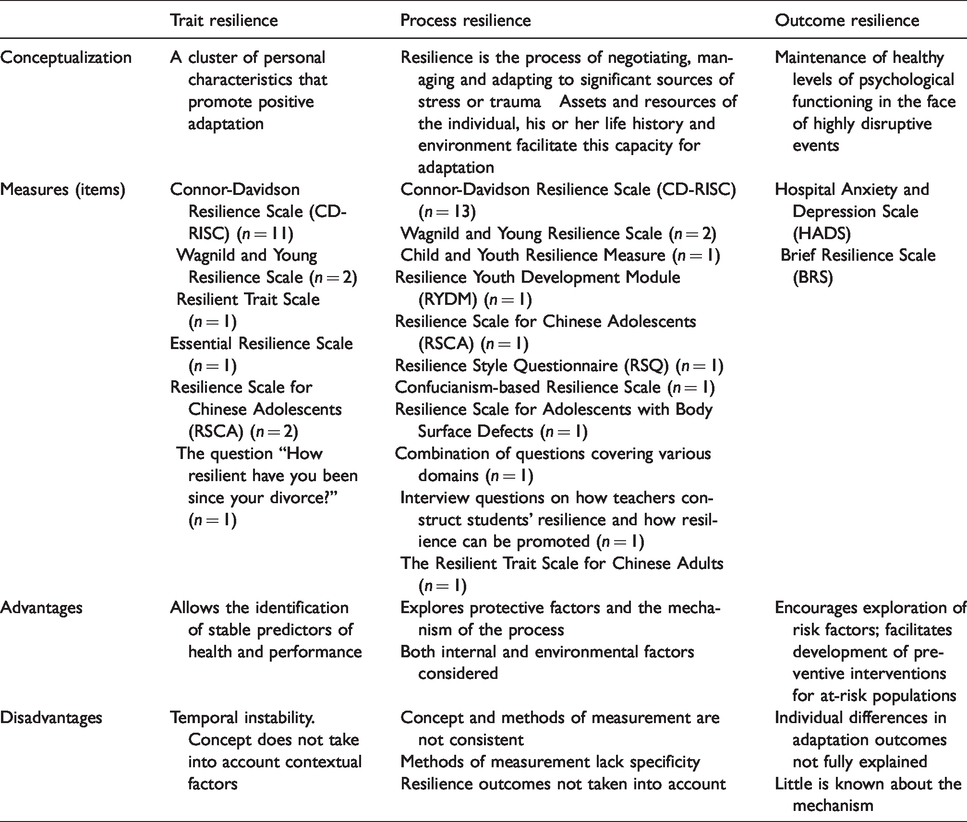
Theme 2: Process-resilience studies conceived resilience as the process of negotiating, managing and adapting to significant sources of stress or trauma. Although contextual factors are important in this definition of resilience, over half of these studies (n = 13, 31.3%) used the Connor-Davidson Resilience Scale (CD-RISC), a tool designed to measure trait resilience. This inconsistency between definition and method of measurement could be considered to reduce the validity of these ostensibly process-resilience research findings. Some scholars have developed tools for measuring Chinese resilience in order to avoid this criticism. For instance, Mak, Ng, Wong, & Law. (2019) developed a Confucianism-based resilience scale to capture culture-based resilience. When tested in university students and clinical samples the scale captured culture-specific resilience and predicted mental health outcomes, explaining variance not explained by the existing resilience scales. These efforts to contextualise resilience by taking cultural factors into account are commendable. However, although tools that measure culture-based resilience contribute to understanding of resilience in the Chinese context, looking exclusively at culture-based resilience cannot provide a comprehensive picture of Chinese resilience.
Theme 3: The notion of positive adaptation is inherent in the concept of resilience (Luthar, 2006), but very few of the studies included in this analysis reported positive outcomes, and those that reported resilience-related outcomes provided little information about the process or mechanism of resilience (Hou, Law, Yin, & Fu, 2010; Stanley et al., 2015) (Table 3). There were inconsistencies in the conceptualization and measurement of the construct.
To conclude, two main findings emerge from this review. First, resilience amongst scholarship of Chinese populations has been conceptualized in three ways: as a trait, as a process and as an outcome. Each approach has its own limitations. Trait resilience is not stable as it is conceptualized; process resilience is assessed using trait resilience tools, and the concept of outcome resilience fails to explain individual differences and offers not account of mechanisms. Second, there has been little investigation the cultural contribution to resilience.
Towards a multidimensional model of Chinese resilience
As mentioned earlier, the assumption that resilience takes the same form in all cultures fails to acknowledge that culture shapes the interpretation and instantiation of resilience. A cultural understanding of resilience warrants consideration. Contextual factors, such as the cultural values and beliefs of Confucianism, Buddhism, and Taoism, which should be taken into consideration when applying the concept to Chinese people, are conspicuously lacking in most of recent Chinese resilience studies. Taken together, our discussion of investigations of narratives of suffering, ways of coping, and a review of resilience research among Chinese suggests that there may be both universally shared and culturally specific elements of resilience. Inclusion of both of these facets in conceptualizing and measuring resilience would be of theoretical and practical significance.
A socio-ecological model of resilience may help to achieve such integration. The model appreciates the important role culture plays in resilience, which is seen as a construct that reflects 'the idiosyncratic nature of local cultural (and behaviors valued therein) or a more homogenized global culture with the assumption of shared human experience' (Ungar, 2011, p. 9). Resilience is defined as both the individual’s ability to harness the available resources and the environment’s capacity to provide culturally meaningful resources to promote the individual’s wellbeing has been proposed (Ungar et al., 2013). Resilience is seen as multidimensional construct, including an individual dimension (a cluster of characteristics and skills), relational dimension (support from family, work and peers), and community dimension (safety, welfare provision, etc.) (Ungar et al., 2013).
Accumulating evidence suggests that a socio-ecological understanding of resilience may help to resolve the trait-process debate and explain the person-environment interaction (Betancourt & Khan, 2008; Fletcher & Sarkar, 2013). The socio-ecological perspective acknowledges the roles of both personal coping resources and socio-ecological factors and addresses the problem that models based exclusively on individual traits cannot account for within-person variation in resilience over time (Pangallo et al., 2015). Resilience is similar to coping in some ways, but coping research puts more emphasis on the identification of sources of stress, whereas resilience studies focus on maximising protective factors (Rutter, 2007). Moreover, personal growth is an important component of resilience, whereas coping emphasises adaptation to the environment (Lazarus & Folkman, 1984; Ungar et al., 2008).
Adopting the socio-ecological perspective, we conceptualize Chinese resilience as a multidimensional construct contributing to positive adaptation in the context of adversity (see Figure 2). The individual dimension consists of personal competence, religion and culture. By culture, we mean salient elements taken from the three major philosophies of China: acceptance, relational orientation, and character-building. The relational dimension encompasses resources one receives from relationships, whilst the community dimension consists of the resources available in the community in which one lives. Community resilience involves how communities help individuals navigate the challenges through resources of the communities, as well as how the communities themselves respond to challenges. This may include social capital, community services, infrastructure, network, and other social-ecological factors (Kirmayer, Sehdev, & Isaac, 2009). We see culture as a set of personal assets from which people draw strength to achieve positive outcomes in the face of adversity. However, when cultural beliefs are shared among peers/family members, or in the community, it may also become a component in the relational and/or community level. For instance, for Chinese women with breast cancer, cultural values of interdependence among their family members encouraged them (i.e., embracing the values of familial interdependence) to engage in care management and face the illness as a unity (Kayser et al., 2014). In this case, culture starts off from an individual level and goes beyond it and functions as a resilience component in the relational level by influencing the family’s perception of the illness and way of interaction with the patients. Cultural values and beliefs were also found to be an important component of community resources particularly when the cultural values that foster strength have been inherited across generations and shared in the community (Atallah, 2017; Wexler, 2014).
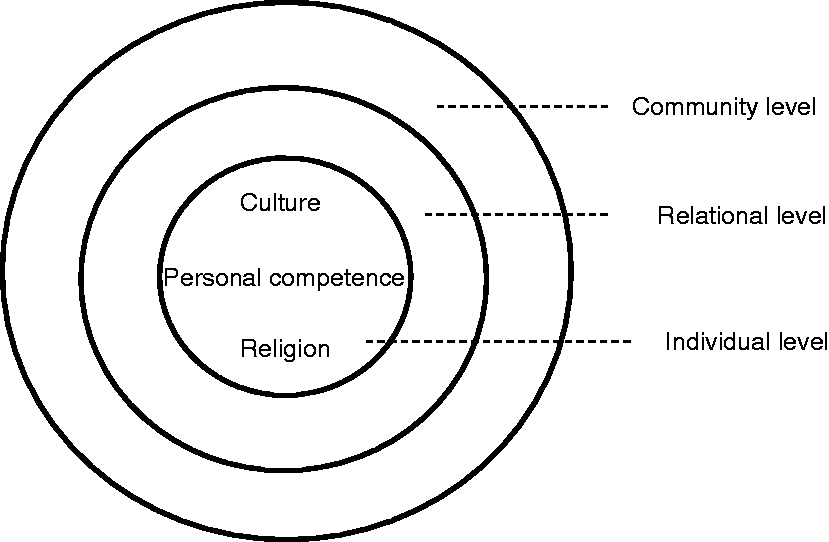
Multidimensional model of Chinese resilience.
Theoretical and research implications of the model
The multidimensional model may deepen our theoretical understanding of resilience. It underscores how cultural beliefs may foster resilience and honours the diverse beliefs systems individuals hold. Moreover, in incorporating contextual factors, the model acknowledges the roles of both personal characteristics and situational factors and may thus be able to explain individual differences in resilience. The model could be used to guide future research and encourage culturally sensitive investigation of resilience amongst Chinese. The neglect of the impact of cultural beliefs on conceptualization of resilience and the corresponding lack of tools for assessing Chinese resilience has hampered exploration of cultural differences in the meaning of resilience. The model could also be used to inform culturally sensitive service provision, for example, practitioners could seek to tap culture-specific resilience resources.
Conclusion
To understand what resilience is for Chinese people, we explore the narrative of suffering and ways of dealing with it in three major Chinese philosophies and identify three themes relevant to resilience. The review of resilience research amongst Chinese has identified two problems: the inconsistent conceptualization of resilience and a lack of research into the impact of culture on resilience. We have described a multidimensional model of Chinese resilience that incorporates some elements of cultural values. Research into resilience as it is conceptualized in Chinese culture is at a preliminary stage. Empirical studies, particularly cross-cultural and studies that take on the diversity of cultures within China, are needed to understand resilience and test the validity of the multidimensional model.
Footnotes
Acknowledgement and funding information
The author(s) received no financial support for the research, authorship, and/or publication of this article.
Declaration of Conflicting Interests
The author(s) declared no potential conflicts of interest with respect to the research, authorship, and/or publication of this article.