



Abstract
As part of formative studies to design a program of collaborative care for persons with psychosis, we explored personal experience and lay attributions of illness as well as treatment among persons who had recently received care at traditional and faith healers’ (TFHs) facilities in three cultural groups in Sub-Saharan Africa. A purposive sample of 85 individuals in Ibadan (Nigeria), Kumasi (Ghana), and Nairobi (Kenya) were interviewed. Data was inductively explored for themes and analysis was informed by the Framework Method. Across the three sites, illness experiences featured suffering and disability in different life domains. Predominant causal attribution was supernatural, even when biological causation was also acknowledged. Prayer and rituals, steeped in traditional spiritual beliefs, were prominent both in traditional faith healing settings as well as those of Christianity and Islam. Concurrent or consecutive use of TFHs and conventional medical services was common. TFHs provided services that appear to meet the therapeutic goals of their patients even when harmful treatment practices were employed. Cultural and linguistic differences did not obscure the commonality of a core set of beliefs and practices across these three groups. This similarity of core worldviews across diverse cultural settings means that a collaborative approach designed in one cultural group would, with adaptations to reflect differences in context, be applicable in another cultural group. Studies of patients’ experience of illness and care are useful in designing and implementing collaborations between biomedical and TFH services as a way of scaling up services and improving the outcome of psychosis.
Introduction
Psychotic disorders cause considerable personal and social suffering, which are worsened by the experience of stigma and negative attitude of affected persons, especially in low- and middle-income countries (LMICs) (Shrivastava et al., 2011). In addition to this, these disorders impose a huge burden on sufferers and their families in terms of disability, including impacts on education and productivity, thereby constituting an impediment to economic development (Bloom et al., 2011). Ironically, even though LMICs carry a disproportionately larger burden of psychotic disorders, they are also the regions of the world with the most severe scarcity of biomedical mental health resources, resulting in a treatment gap of up to 90% for severe mental disorders, including psychoses, across these countries (Demyttenaere et al., 2004). In particular, the WHO African region has the second lowest number of psychiatrists per capita in the world, with the ratio of psychiatrists to the population being less than one per 1,000,000 in most of the countries in the region (World Health Organization, 2018). In addition, the shortage of human resources for health, both for mental health and general health, in LMICs is projected to persist into the foreseeable future (Liu et al., 2017). Closing the treatment gap for severe mental disorders, including psychosis, in LMICs in a sustainable manner therefore requires novel and innovative approaches to service delivery.
Researchers and policy makers working in Sub-Saharan Africa (SSA) have drawn attention to the potential for traditional and faith healers (TFHs) to play a major role in expanding care for mental disorders in this region (Gureje, 2009; Gureje et al., 2015; Jenkins, Baingana, et al., 2010a; Jenkins, Kiima, et al., 2010b; Musyimi et al., 2017). They suggest that collaboration between conventional health care providers and complementary and alternative practitioners may be an important and sustainable pathway to scaling up of mental health care on the continent. Complementary and alternative providers, especially TFHs, feature prominently in the response of individuals and families to psychosis in Sub-Saharan African cultures (Gureje et al., 2015; Lilford et al., 2020; Ojagbemi & Gureje, 2020; World Health Organization, 2013). Traditional healers commonly derive their practice from indigenous religious beliefs and values (World Health Organization, 2013). Other faith healing approaches, in the context of SSA, are based on Islam and Christianity, the two major non-indigenous faiths in the region (Kaba, 2005). Not only is there a widespread patronage of TFHs in many SSA countries, but there is evidence suggesting that they provide the bulk of the mental health services in many of these countries (Esan et al., 2018; World Health Organization, 2013). Two important reasons have been ascribed to this widespread patronage: a shared explanatory model of illness between healers and patients (Esan et al., 2018), as well as the wide availability and accessibility of the healers, in contrast to the scarcity of conventional mental health services in the region (Burns & Tomita, 2015; Gureje et al., 2015).
For biomedical practitioners to collaborate effectively with TFHs, it is important to understand the traditional and faith healing systems of care, including the practice environment and the beliefs and values inherent within the healing approaches (Gureje et al., 2015, 2019; van der Watt et al., 2017), from multiple perspectives, including those of the healers themselves, as well as the patients and their relatives (Dinos et al., 2017). First coined by Kleinman (1978), explanatory models, broadly defined, refer to culturally determined beliefs held by individuals about health, ill-health, suffering, and misfortune. Narrowly defined, they refer to the culturally determined processes of making meaning out of illness and symptoms, constructing causal attributions, help-seeking, and expectations of outcome of treatment (Dinos et al., 2017). These illness frameworks are constructed to help individuals make sense of and respond to specific episodes of illness and it is not uncommon for patients and their family members to hold multiple and conflicting explanatory models simultaneously (Bhikha et al., 2012; Read, 2017). Accumulated research suggests that cultural beliefs, knowledge, and practices often shape explanatory models, which are in turn an important determinant of pathway to care, treatment preferences, compliance with treatment, as well as satisfaction with treatment received (Callan & Littlewood, 1998). Hence, eliciting how patients of TFHs characterize psychosis and respond to it, their experience of illness and treatment, as well as their expectations of care is useful in delineating elements that may be important in the design of culturally appropriate and locally acceptable collaborative care packages.
Mental illnesses are recognized in many African cultures, and in these cultures there are TFHs who specialize in their treatment (Esan et al., 2018; Gureje et al., 2015). Psychoses are easily recognized by both lay persons and healers due to the prominent behavioral symptoms (Kpobi et al., 2018; Mbwayo et al., 2013; Sorsdahl, Stein, et al., 2010a). As far back as the 1960s, Edgerton (1966) reported that community dwellers in East Africa recognized syndromes that are similar in phenomenology to psychosis, with these syndromes mostly reported to be characterized by aggression, disruptive behaviors, and wandering, with far less emphasis placed on psychological symptoms such as hallucination and delusions. Subsequent works among community dwellers and healers in Uganda (Abbo et al., 2008), Ghana (Kpobi & Swartz, 2018), South Africa (Sorsdahl, Flisher, et al., 2010b), and Kenya (Musyimi et al., 2018) have described similar entities, using local names and descriptions such as “madness” (Cohen et al., 2016). In regard to causal models of psychosis, cultures often classify mental disorders on etiological and phenomenological grounds and SSA cultures are no exception (Musyimi et al., 2018). Hence, causal attribution is often intertwined with classification of mental disorders. Even though diverse causal attributions have been reported among SSA cultures, two independent reviews focused on causal models of mental illness generally in SSA, and psychosis in LMICs, respectively, found that supernatural/spiritual and psychosocial explanations were the most frequently cited for these disorders (Bhui & Bhugra, 2002; Patel, 1995).
As part of activities to inform the design of a collaborative shared care for psychosis to be delivered by TFHs and conventional health care providers (Gureje et al., 2020), we conducted a series of formative studies (Esan et al., 2018; Gureje et al., 2015; Nortje et al., 2016; van der Watt et al., 2017). In this report, we present the findings from one component of the formative studies in which we explored the experience of psychosis and its care among individuals using the services of TFHs and their caregivers. The study is aimed at providing insight into how the experience of users of TFH services and their caregivers as well as their understanding of the nature of psychosis might facilitate or impede their acceptance of a collaborative shared care. We were also interested in knowing how the contexts of three distinct African cultures in which the study was conducted might shape such experiences and understanding.
Methods
Design
The study adopted a qualitative, cross-sectional, exploratory design, using Key Informant Interviews (KIIs). It was carried out in three sub-Sahara African countries (Ghana, Kenya, and Nigeria) and among patients who had recently used the services of TFHs. Interviews were conducted with the McGill Illness Narrative Interview (MINI) (Groleau et al., 2006). The MINI is a semi-structured qualitative interview schedule designed to elicit illness experiences and the meanings ascribed to them. The instrument had been previously used in cross-cultural research in many cultures and contexts, including in our setting, to explore diverse health issues and conditions including mental disorders (Adeponle et al., 2017; O’Dwyer et al., 2017). In this study, the MINI was primarily used to elicit information on explanatory models, including illness terms, causal attributions, care-seeking itinerary, and nature of care received, as well as the impact of illness on the affected individual.
Study setting
The study was conducted in Kumasi (Ghana), Nairobi (Kenya), and Ibadan (Nigeria) among patients who had recently received treatment in the facilities of selected TFHs in: (1) 11 local governments in and around Ibadan metropolis, south-western Nigeria; (2) 12 districts in Brong Ahafo region and 17 districts in Ashanti region, in Ghana; and (3) the three counties of Nairobi, Kajiado, and Machako in Kenya. A report of the profile, practices, and distribution of the TFHs in these catchment areas has been published elsewhere (Esan et al., 2018).
Sample
This was a purposively selected sample of 85 patients who had recently been treated and discharged (in the previous 12 months) from a TFH facility for the treatment of psychosis. Healers identified patients who had recently been on admission for the treatment of psychosis and such persons were approached by research assistants to participate in the study. Psychotic illness was described to the healers as illness characterized by delusions, hallucinations, abnormal behavior, or abnormal speech. Prospective respondents were those identified by the healers to have recovered from the illness episode, aged between 16 and 65 years, and who spoke the language of the study at each site. At each of the study sites, selection and interviews of participants continued until no new information was being elicited (that is, until data saturation was achieved).
Data collection procedure
Interviews were conducted at the premises of the TFHs or in patients’ homes. Each prospective participant was assessed for capacity to consent using their understanding of the information about the purpose and procedure of the study to determine capacity. Only those who were assessed to have capacity to consent were then taken through the informed consent procedure. Of these, those who formally consented to the study and provided a signed (or thump-printed) consent were interviewed. Interviews were conducted by research assistants (masters and doctoral students in social sciences or public health) who were trained to identify psychosis and had experience of conducting qualitative research. Prior to data collection at each site, interviewers received a two-day training on the use of the MINI. Each interview took between 45 min and 1 h. Interviews were conducted in Yoruba (in Nigeria), Twi (in Ghana), and Swahili (in Kenya). At the end of each interview, audio recordings were transcribed verbatim and translated into the English language by bilingual speakers.
Analyses
Data management and analysis was done using the Framework Method (Gale et al., 2013). This method is useful for thematic textual data analysis, especially semi-structured interview transcripts. Its strength lies in its applicability to multi-disciplinary research, especially because it is not aligned with any particular theoretical, epistemological, or philosophical approach. Rather, it is a flexible tool that is particularly useful to compare and contrast data by themes across many cases and codes, while at the same time situating each perspective in context by keeping it within the thread of each individual account. By allowing for the flexible use of both inductive and deductive analytic approaches, this framework is particularly useful in the present context in which, while we were interested in exploring varied individual experiences within their unique social contexts, we were also keen to organize our findings along readily understandable theoretical constructs relevant to illness experiences. Transcribed interviews were read several times by two of the researchers, one with a clinical psychiatry background and the other with a social science background, both with qualitative research experience, until adequate familiarity with the materials was achieved. Using an inductive coding approach, necessary to reflect the unique social and experiential contexts of each interviewee (Redwood et al., 2012), the two researchers independently assigned descriptive codes to four transcripts. This was done manually and with the use of the MAXQDA software (http://www.maxqda.com/). Following the achievement of agreement between the two coders, a set of core codes was agreed on as the working analytical framework, which was then applied to subsequent transcripts. Additional codes and sub-codes were created where appropriate, especially to capture unexpected but relevant response, and were discussed between the two coders for consensus. Identical or similar codes were merged and redundant ones discarded to generate the final themes presented in the results. Even though themes were generated inductively, their interpretation was largely informed by Kleiman's explanatory theoretical model. Each key theme was explored across the whole dataset but with due attention to its contextual meaning within each respondent's responses. Thus, by contrasting themes between responses, we are able to draw similarities and differences across the three study sites, thus providing a unique opportunity for cross-cultural exploration. The goals of our analytic approach can be summarized as follows: first we explored the terms by which psychosis is known in the three settings, the defining characteristics of psychosis as well as how psychosis impacts the lives of the affected. Next, we explored the causal attributions of the illness and how patients and their families respond to it, including factors that inform the choice of and the need to change healer. Finally, we explored the experience of care, including treatment received, coping resources employed, as well as harmful practices encountered in the course of care.
We addressed reflexivity in two ways: firstly, bearing in mind that the research assistants who would be conducting the interviews were relatively younger and more educated than their low-income respondents and that this could affect the quality of the data collected, the research assistants were trained to be mindful of this possibility and were also trained on how to create a discursive atmosphere for ease of eliciting information. Secondly, data collection procedure, as well as the analysis and interpretation of data, benefitted from the critical and reflexive engagement of the different professional backgrounds represented in the team: clinical psychiatry, public health, medical anthropology, and sociology. To compare sociodemographic characteristics across study sites, chi-square tests (or Fisher's exact tests where appropriate) were undertaken for categorical data and ANOVA for quantitative data.
Ethical issues
Ethical approval for the study was obtained from the institutional review boards of the three collaborating sites. Permission to conduct the interviews was obtained from the proprietors of the TFH facilities. As detailed above, the ethical requirement for including a respondent consisted of an assessment of their capacity to consent, followed by a formal signed (or thumb-printed) informed consent to be interviewed and to have the interview audio-recorded. Each interview was conducted with as much privacy as possible and data was anonymized prior to coding and analysis.
Results
Demographic characteristics of the sample
Twenty-seven, 33, and 25 interviews, respectively, were conducted in Kumasi, Nairobi, and Ibadan. The mean age of participants at the aforementioned country sites was 30 ± 8.8, 35 ± 14.3, and 34 ± 8.5 years, respectively. Other sociodemographic characteristics are presented in Table 1.
Socio-demographic characteristics of respondents at each of the three country sites.

*Significance at p < .05. **Other minority religions.
Summary of the major themes
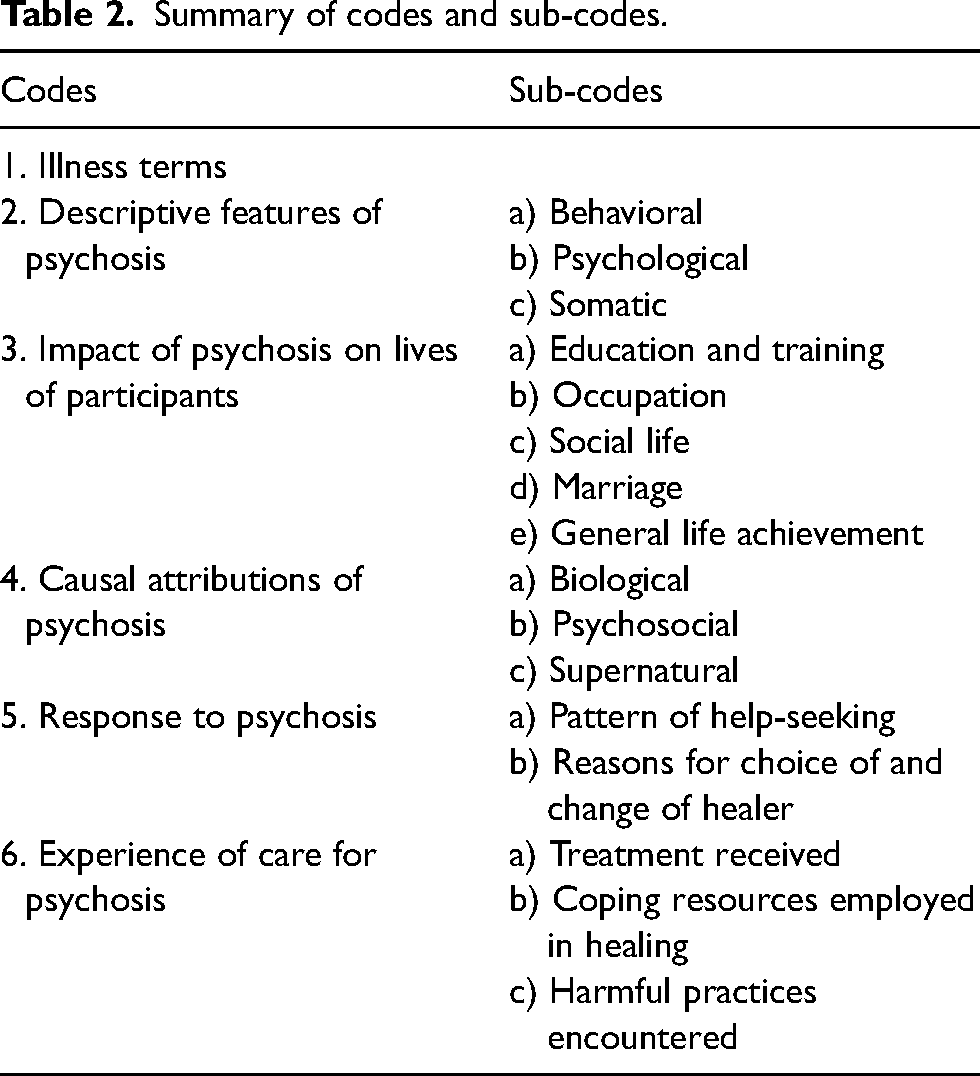
The major themes and sub-themes explored in the analyses are presented in Table 2.
Summary of codes and sub-codes.
Features of psychosis identified by participants at the three sites.

*n is number of times code was mentioned.
Illness terms
Participants described psychosis in language that indicated efforts at making sense of the underlying nature of the disorder, communicating distress to others, or hinting at its perceived etiology (Figure 1). Terms used included lay terms such as “madness,” “crazy,” “stupidity,” and “insane”; terms that suggest the brain as the seat of the illness such as “mental illness,” “mental disorder,” “mental problem,” and “psychiatric” [sic]; terms suggestive of a physical origin of illness such as “malaria,” “high fever,” and “headache”; those suggesting a supernatural origin of illness such as “spiritual illness”; as well some biomedical terms such as “bipolar,” “depression,” “mania,” and “phobia.”
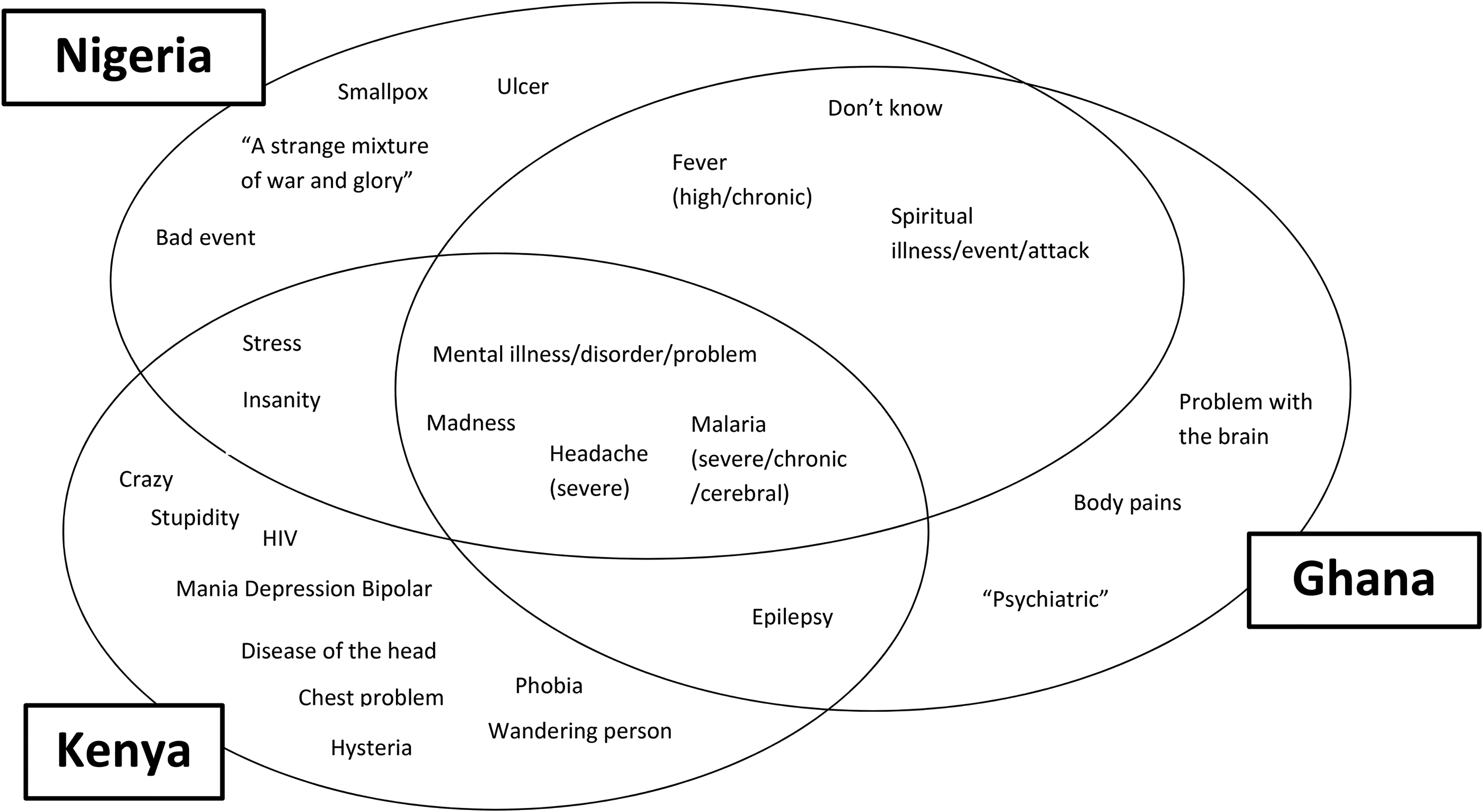
Illness terms used to describe psychosis by respondents in Nigeria, Kenya, and Ghana.
Overall, there are major overlaps in the illness terms across the three sites. However, there are also some differences. For example, participants in Nigeria and Ghana endorsed “spiritual illness/attack” while those in Kenya did not. Similarly, the Kenyan participants used more biomedical terms compared to their Nigerian and Ghanaian counterparts. Terms such as “phobia” and “hysteria” (in English) were sometimes interjected in the responses of Kenyan participants. Noteworthy is the fact that participants at the three sites recognized psychosis as a mental illness.
Features of psychosis identified by participants at the three sites
Participants recounted their experience of psychosis by describing the onset and persistence of a marked change in their mental functions and experience of self, a worsening of their relationships with others, disability occasioned by their illness, as well as their personal suffering as a result of the illness. Participants also recounted abnormalities in how they perceived the world, a change in their habits, as well as neglect of their roles and responsibilities within the family and community following the onset of illness. The features of psychosis identified by the participants are grouped into overt behavioral disturbances, psychological symptoms, and somatic symptoms (Table 2).
Across the three sites, behavioral features of psychosis such as disturbed or odd behavior, physical and verbal aggression, talkativeness and irrational speech, social withdrawal, as well as decline in function were the most frequently mentioned subgroup of symptoms. Wandering was mentioned frequently at the three sites. Self-harm was the least endorsed feature in this symptom subgroup, with only one person mentioning it in Nigeria. Psychological symptoms such as perceptual disturbances, distorted beliefs, and mood-related symptoms were the least mentioned symptoms in Ghana, unlike Nigeria and Kenya.
Somatic complaints such as sleeping difficulties, loss of appetite, headache, and fever were commonly mentioned in the interviews conducted at the Nigerian and Kenyan sites, and to a lesser extent in Ghana. Although not the most frequently endorsed group of symptoms across all sites, participants in their illness narratives often claimed that their illness began with somatic complaints.
Impact of psychosis on lives of participants
The participants in the study mentioned areas of their lives that had been impacted by psychosis and its treatment. The most frequently encountered impacts were on occupation, education, marriage, financial independence, as well as an overall feeling that their progress in life had been slowed down by illness. There is considerable similarity across the three sites in terms of the impact psychosis had had on the lives of the participants. Marriage-related problems included inability to get married: “For me I just sit doing nothing … I cannot fend for myself, people disregard me, I am just there without hope. I am not married, I am getting old and still my family has to take care of me” (38-year-old woman who became a divorcee in the course of illness, Kenya).
The following excerpts capture the feelings of loss and the delays expressed by participants in making progress in several life domains:
(i) education and apprenticeship: “It has made me be like … those I started with at school have all gone ahead of me … when it turned out this way, I feel hurt that my friends are ahead of me because some of them are in polytechnics … so if I think about that, it pains me…” (22-year-old man, Ghana); “I was an apprentice in a tailoring shop. When the illness became severe, my boss did not know anything about the solution … she said she did not understand my illness, that I should stop coming to her shop” (28-year-old woman, Nigeria);
(ii) occupation: “It has brought me back in life because I was teaching in an international school in my hometown, so I do not know if they will allow me teach there again should I go back” (42-year-old woman, Ghana); “I think about how I would go back and become who I was at first because I had my job with apprentices but I now have nothing” (26-year-old female, Ghana);
(iii) social life: “when I get close to people they run away. I am like a desert tree” (48-year-old man, Kenya);
(iii) general life achievements: “It was due to this problem that I lost a parcel of land which I bought through my friends … Some of them have finished building houses on their own plots of land” (34-year-old man, Nigeria).
The experience of psychosis, however, was not universally gloomy. A few participants reported that their experience may have brought with it some positive impacts, such as an appreciation of the value of life and health, family, and friends, as well as a deepening of faith and spirituality.
A 33-year-old Ghanaian man said: Out of my experiences of this illness I have been able to write a book and I was able to do all this because I had favor from the gods … As I was telling you earlier, I feel good about myself now … I can see my life has changed. It has made me see so many things in the world and now I see myself as a special person.
Causal attributions of psychosis
A variety of causal attributions of psychosis were reported at all the sites—biological, psychosocial, and supernatural—with many participants endorsing multiple causes (Table 4). Even though there were some differences across the three sites, supernatural causes were the most frequently mentioned causal factors. It is particularly striking that Kenyan participants more frequently endorsed biological and psychosocial causes of psychosis (88%), compared to their counterparts in Nigeria and Ghana, where supernatural causal attributions were most prominent (Table 4).
Causal attribution of psychosis in Nigeria, Kenya, and Ghana.
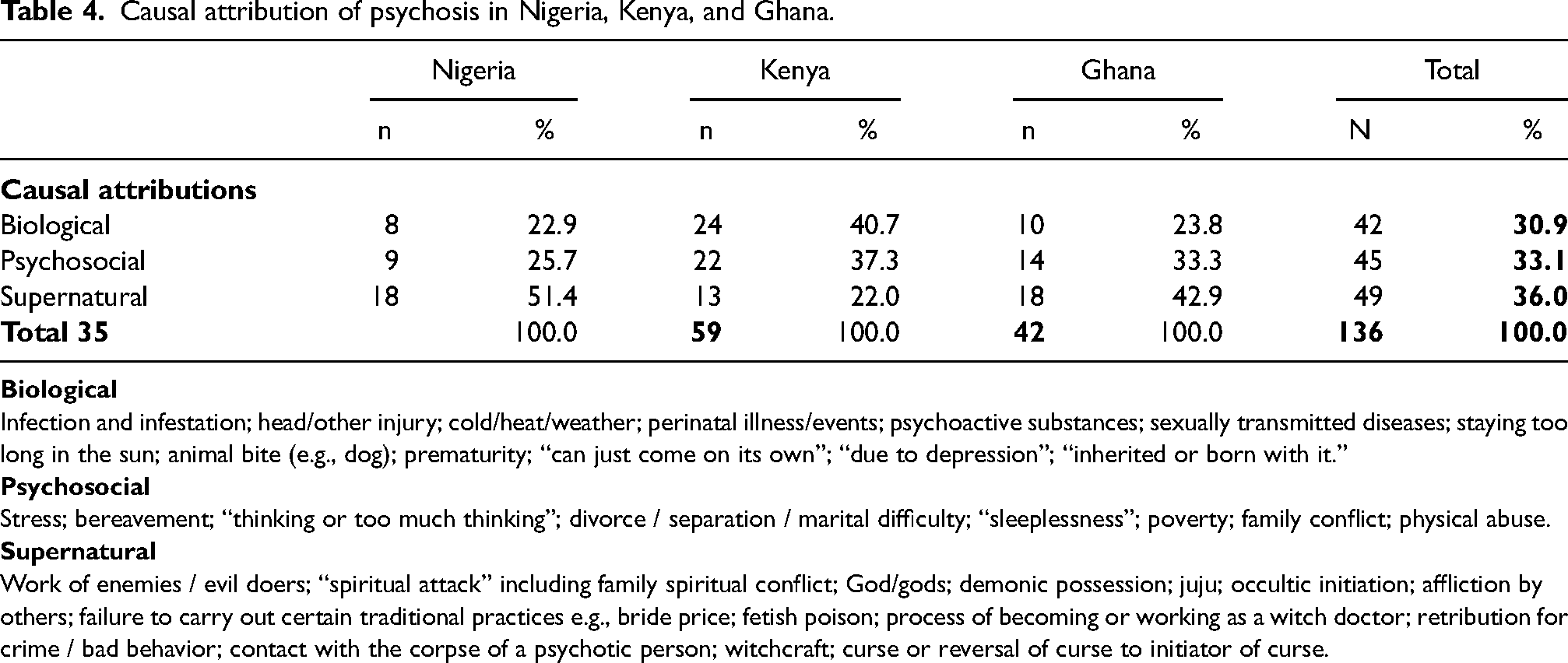
Infection and infestation; head/other injury; cold/heat/weather; perinatal illness/events; psychoactive substances; sexually transmitted diseases; staying too long in the sun; animal bite (e.g., dog); prematurity; “can just come on its own”; “due to depression”; “inherited or born with it.”
Stress; bereavement; “thinking or too much thinking”; divorce / separation / marital difficulty; “sleeplessness”; poverty; family conflict; physical abuse.
Work of enemies / evil doers; “spiritual attack” including family spiritual conflict; God/gods; demonic possession; juju; occultic initiation; affliction by others; failure to carry out certain traditional practices e.g., bride price; fetish poison; process of becoming or working as a witch doctor; retribution for crime / bad behavior; contact with the corpse of a psychotic person; witchcraft; curse or reversal of curse to initiator of curse.
Among the supernatural etiologies, witchcraft, “work of the enemy / evil doers,” and “spiritual attack” were the most frequently mentioned, with witchcraft being more commonly cited in Kenya and Ghana and the latter two more frequently mentioned in Nigeria and Ghana. A participant said: I said my rival is behind my illness. She took me to the gods including those from the north … I don't know what my rival wants from me, but it looks like she wants to take my husband … All my problems are from my rival … if the witchcraft goes away then I feel alright, but when it comes back, the illness starts all over again. (51-year-old woman, Ghana)
Spiritual attack was frequently mentioned in Nigeria: “Most of the madness in those that roam the streets is not of their own making, but is actually spiritual attacks … they cannot be cured with medical ways of treatment but only in traditional ways” (37-year-old man, Nigeria).
“Thinking too much” or “worrying a lot” and “stress” were the most frequently cited psychosocial causal attributions of psychosis across all sites. A 46-year-old Kenyan woman said: What I think is that, too much stress and thoughts could have caused the mental illness too. You know your thoughts are determined by the number of problems you have; you can be having a problem that you can't even solve and it eats you up.
To a lesser extent, psychosocial events prior to and around the time of illness, the common ones being bereavement, divorce, and leaving home for school, were mentioned in relation to the onset of psychosis.
Psychoactive substance use (alcohol, cannabis, and khat), and to a lesser extent perinatal cause/event, were the more prominent biological causes of psychosis mentioned in Kenya and Ghana, while infections and infestations such as “malaria” and “fever” were cited commonly at the Nigerian site. A 46-year-old Nigerian woman specifically mentioned head injury: Well, what I can tell you is that when I was about 15 or 17 years old, I had a fight with my elder sister over a maize cob and it ended with her hitting me on the head with a big stick. I was bigger than she was but I lost consciousness and was revived with water being poured on my head.
Some participants endorsed multiple supernatural causes that appeared to be complementary causal models. A 24-year-old Ghanaian woman said: Some said that it is our family god who is married to me and so the illness came when I gave birth because the god was jealous that I got pregnant with a different man. I also went to see prophet Ebenezer … He said I have been tied down by the witches in my family. When I came here, the healer revealed to us that it was a curse.
In some cases, however, the multiple causal attributions appeared to be in conflict. For example, a 38-year-old Ghanaian woman said her illness coincided with a leg wound; her symptoms were similar to those of someone possessed by spirits and her biomedical doctor informed her that her illness was “spiritual” in nature. She therefore held the view that her illness was caused by tetanus that had affected her brain, as well as by possession by spirits and “spiritual attacks” by her family.
Some participants did not have attributions for their illness or claimed that it was simply “the will of God.”
Response to psychosis: Choice of healer
Although the participants selected in the study had recently received care from TFHs, many had seen other providers prior to the index admission: more than two thirds of them had visited a hospital, two fifths had consulted Christian faith healers, more than a third had patronized traditional healers, and seven mentioned having consulted Islamic faith healers. However, the reported treatment itinerary was far from simple or straightforward. Across the three sites, the predominant theme that emerged from the interviews was that of consecutive or concurrent use of different treatment modalities within and across biomedical and TFH services (Table 5).
Healers encountered by religious affiliations of participants.

*The numbers in the table indicate the number of times encounters with the different healers were mentioned.
Reasons cited for the plurality in care-seeking included perceived non-improvement in symptoms, perceived poor or inadequate communication from practitioners, perception that the illness was of supernatural origin, as well as the presence of associated somatic symptoms which respondents felt was an indication of the dual causality (physical/spiritual components) of the illness. When the causal attribution of illness was suspected to be both physical and supernatural, participants indicated that they attended a conventional medical facility either before or after consulting a TFH. The care received from biomedical facilities appeared to be regarded as supplementing that from TFH facilities. For example, a 32-year-old Nigerian man who was receiving care at a traditional healer's facility said: “In fact, I need to go to the hospital for further treatment as soon as I am discharged from here.” Some participants did not see biomedical services as superior to or different from TFH services, but appear to have indigenized and incorporated them into the local “pluralistic economy of belief” (McCaskie, 1981). A 30-year-old woman from Ghana opined: “if you go to the hospital, prayer camp, and even the priest, they are all equal.” Participants also mentioned in passing that they patronized TFHs in order to reclaim “what was lost” (e.g., work), to receive “complete cure,” or to get additional services (e.g., protection from seen and unseen powers).
Frequently, respondents’ own faiths or mode of worship had little to do with where care was sought (Table 5). For example, in Ghana, Christian patients reported that they encountered biomedical practitioners as frequently as Christian faith healers in their help-seeking itinerary, while in Kenya and Nigeria this group of patients reported contact with biomedical practitioners, Christian faith healers, and traditional healers, in that order of frequency. Across the three sites, however, Christian patients encountered TFHs more often than biomedical practitioners. A 31-year-old Christian Ghanaian man who was receiving care from a traditional healer said: This is a spiritual issue … so when you are faced with such a problem you should consult people who have spiritual powers to help you deal with it. I don't think this is to be handled by pastors because the Bible says we should give what is Caesar's to Caesar and what is God's to God.
Participants who had consulted biomedical practitioners gave several reasons for abandoning them for TFHs, including perceived supernatural etiology of illness, non-satisfaction with biomedical treatment, referral to a TFH by a biomedical practitioner who shared a belief in the supernatural causation of illness with the client (cited by five participants), lack of improvement in symptoms or absence of “complete healing,” side effects of medications, cost, and use of derogatory words by hospital staff.
Experience of care: Treatment received
The experience of care was similar across all sites. Diagnosis often preceded the healing process, with the healer informing the patient of the cause of illness and the treatment needed. Explanations often included a supernatural attribution, alone or in combination with other factors (Table 4). Common treatment modalities across the different TFH facilities were the use of rituals. Treatment comprised different combinations of holy water, anointing oil, spiritual bath, vigils, fasting, music (for Christian FHs); and oral herbal medications, herbal snuff, special food and fruit to eat and/or avoid as taboo, scarification marks, use of ritual oil, animal sacrifice, ingestion of animal blood and music (for traditional healers and some Islamic faith healers). Abstaining from sexual intercourse was also mentioned. A 43-year-old Kenyan man described a typical healing session: “He [the traditional healer] said I am bewitched and we were to buy and slaughter a goat … for me to get healed.”
Faith and spirituality featured prominently in the healing process across the sites. Prayer to one or other deity was reported to heal directly, give potency to medications and other items of healing, as well as being used as a coping resource. Faith and prayers were mechanisms through which evil causes of illness were vanquished and through which all that had been lost in the course of illness was restored.
Harmful practices such as shackling, beating, and starving were reported by participants at all three sites, but these were justified by some of the participants. Use of restraint was also common (49 participants across all sites (57.7%): 16 in Nigeria (64%), 20 in Kenya (60.6%), and 13 in Ghana (48.1%)). A few reported not being shackled but locked up in rooms. Some participants who reported being shackled justified the restraint, claiming that this was to prevent them from harming others, running off, or wandering away, or for ease of administration of treatment. Thirty-six (42.3%) of the participants reported that they had been beaten at least once by family, friends, healers, and even biomedical workers (seven participants in Nigeria (28%), 13 in Kenya (39.4%), and 16 in Ghana (59.3%)). Beating was justified as: “punishment for when they did something bad” in the course of treatment, were “disobedient,” did not accept medications, “for the mind to relax,” “to put fear in their minds so that they would not cause harm,” or as “therapeutic [or curative] beating, just to get rid of the spirit of madness in them.” Some of the respondents reported being denied food as a form of punishment.
Overall, at each site, a large majority of respondents reported being satisfied with the treatment received from the healers and would recommend similar treatment to other individuals with psychosis. This is reflected in the words of a Nigerian respondent: They attended to us very nicely. Even their wives assisted in rendering treatment whenever the healers were not around … there was no difference between the healers and the patients, as we were using the same utensils to eat and drink. (32-year-old woman, Nigeria)
Discussion
Summary of the main findings
In this qualitative study, we report on the nature and causal attributions of psychosis in the words of patients, and their experiences of illness and care received, in three linguistic/ethnic groups drawn from three Sub-Saharan African countries. We aimed to understand the commonalities and differences in the methods of care in TFH practices in these diverse settings to inform the design of a collaborative care package that is broad enough to increase its applicability across settings and at the same time can be adapted to reflect site-specific nuances and context. There was a remarkable degree of similarity in the range of illness attributions and illness experience as reported by the respondents from the three study sites. In general, we found that individuals who had experienced psychosis described their illness in terms of personal and social suffering as well as in the context of disability. Although a variety of biological, psychosocial, and supernatural causal models were mentioned across the three sites, with some differences, supernatural theories of causation alone or in combination with others predominated, and this could only explain a small part of the care-seeking itinerary. Participants sought care from both biomedical and TFHs, often concurrently, without discriminating on the basis of personal faith or religion. Care received at TFH facilities was similar across settings and consisted of oral herbal preparations and rituals, as well as prayer and sacrifice. Harmful healing practices were fairly common in the receipt of care at TFH facilities across sites, but respondents nevertheless expressed overall satisfaction with care. Coping resources reported to be useful were spirituality and the social support of family and friends.
Illness terms and features of psychosis
There is a broad agreement among participants at the three sites, as well as overlaps and differences in the illness terms used and the defining characteristics of psychosis in this study. Local expressions that are close in meaning to “madness”—characterized by aggression, wandering, and gross behavioral abnormalities—were frequently endorsed in this study to describe what participants perceived as the most severe forms of psychosis. The expressions used are similar to those reported in a recent study employing a similar instrument that was conducted in three culturally diverse settings—Ibadan (Nigeria), Chengalpet (India), and Tunapuna-Piarco (Trinidad) (Cohen et al., 2016)—thus suggesting a commonality of views across many cultures, not just those in SSA. Of note, Kenyan respondents employed biomedical terminologies to describe psychosis more frequently than their West African counterparts.
Causal attribution
Several causal attributions were offered by participants in this study. However, consistent with the literature from different parts of Africa (Gureje et al., 2005; Kpobi & Swartz, 2018; Musyimi et al., 2018), supernatural causal models featured prominently and could probably explain part of but not the entire treatment itinerary of patients in these settings (Burns & Tomita, 2015). We also found that even when natural causes were acknowledged as the etiology of psychosis, they were sometimes linked to supernatural phenomena which may be seen as the reason why the affected individual was susceptible to the illness in the first instance. Supernatural phenomena were often seen as the vehicle through which natural phenomena occurred and/or as the sole explanation for the disease process, suggesting that causal attributions may be more complex than the traditional division into biomedical, psychosocial, and supernatural categories. Indeed, Abbo (2011) reported that some patients actually consult traditional healers just to find out “why” their illness occurred, indicating that for many who patronize TFHs it is not just enough to treat the illness; equally important is the need to “explain” why the mental illness occurred in the first instance, which taboo has been broken, which spirit has been offended, or which social and spiritual relationship has gone awry, and to thereby get to the root cause of the illness and not just to obtain relief from the symptoms. Perhaps what patients find unsatisfactory is the absence of such culturally appropriate supernatural explanations or any explanation at all for severe mental disorders when they consult biomedical practitioners. We found that Kenyan participants overwhelmingly endorsed biological and psychosocial causes of psychosis compared to the other two sites. This may reflect the efforts that researchers in Kenya have made to improve the awareness and identification of mental disorders by TFHs (Mbwayo et al., 2013; Musyimi et al., 2018) as well as active ongoing dialogues between TFHs and conventional mental health practitioners (Musyimi et al., 2016, 2019). These efforts may have provided an avenue for TFHs to be exposed to western concepts of illness causation and this may have been passed on to their patrons in the process of consultation. This may be an indication of a healthy disposition towards collaboration between both parties in this part of Africa.
Response to psychosis: Pattern of help-seeking
One important theme that emerged from this study in terms of patterns of help-seeking and actual care received in the illness itinerary of participants across all sites was the consecutive or concurrent use of both biomedical and non-biomedical care. These patterns of service use have been reported in previous studies (Abbo, 2011; Bhikha et al., 2012; Muga & Jenkins, 2008). Although our sample consisted of participants who had received care at TFH facilities for psychosis, studies have shown that the converse is also true; pathway studies of psychiatric care in developing countries have shown that between a third and almost 90% of patients presenting with psychosis in outpatient departments of teaching hospitals and community mental health centers in Nigeria had consulted TFHs at some point in their illness itinerary (Gureje et al., 2015). Although pathway studies often assume that patients’ help-seeking itinerary occurs in a linear hierarchical fashion, beginning with TFHs and ending with conventional mental health services (Labys et al., 2016), the reality is often that help-seeking paths are “recursive and complex” (Burns & Tomita, 2015), with patients and their relatives seeking help from both TFHs and conventional psychiatric services consecutively or concurrently for different reasons (Campbell-Hall et al., 2010; Labys et al., 2016; Read, 2017). This provides a good rationale for open dialogue between the two groups of providers and for bringing together the components that service users find useful in both biomedical services and services provided by TFHs in a collaborative care package.
Treatment received and experience of care
The treatments received by participants in the study were a combination of pharmacological and non-pharmacological interventions, including oral and bathing herbal preparations, prayer, and ritual/sacrifice steeped in culture and religion, an observation that has been reported in previous studies and reviews (Gureje et al., 2015; Kpobi & Swartz, 2018; Musyimi et al., 2018). Traditional healers’ treatment modalities are usually based on indigenous faiths and beliefs as well as knowledge peculiar to the culture in which they practice, making their interventions more culturally sensitive and acceptable to their clients and family members (Abbo, 2011; Kpobi & Swartz, 2018; Mbwayo et al., 2013; Musyimi et al., 2018). It is also the case that Christian and Islamic faith healing is based on belief systems that are often syncretized with indigenous beliefs. As previously mentioned, therapeutic goals may actually be different for those who patronize TFHs, and may not necessarily be all about symptom and disability reduction alone but also subjective qualitative changes in the meaning, relationships, and self-image of the help seeker (Nortje et al., 2016; van der Watt et al., 2018). Healing in traditional healing systems is more nuanced and comprises social, spiritual, and communal wellbeing. Hence, treatments deemed to be ineffective by biomedical standards are often perceived to be effective by patrons of TFHs (van der Watt et al., 2018). Having said this, it should be noted that patients and their relatives are also pragmatic and strategic in their help-seeking, and still seek biomedical interventions even while holding a contradicting explanatory model of illness (Campbell-Hall et al., 2010; Patel, 1995; Patel et al., 1997). Medications prescribed by the biomedical practitioner are seen as effective in dealing with active symptoms of illness while the treatment from TFHs is believed to provide a cure (Muga & Jenkins, 2008). Furthermore, patients who consult biomedical and TFH consecutively or concurrently often hold multiple, sometimes conflicting, explanatory models of illness, and the pluralism in health-seeking may be an attempt to cover all putative causes of the illness or to cater to the wishes of family members who may hold a different explanatory model from the patient (Chilale et al., 2017; Srinivasan & Thara, 2001). Indeed, it has been suggested that it is possible that many service users do not see biomedical care as different or superior in hierarchy to TFH services, but as one of the many options available in a horizontal care plane (Read, 2017).
Harmful practices
Harmful treatment practices such as shackling, beating, and food deprivation were fairly common in the experience of care among participants in this study, as has been reported in previous studies. Harmful practices in patient care have been one of the most consistent fears and misgivings of biomedical practitioners, especially in the context of discussions of collaboration between conventional medical practitioners and TFHs (van der Watt et al., 2017). However, there is evidence that programs targeted at reducing the use of harmful treatment practices by TFHs may have some promise (Gureje et al., 2020). Despite the relative frequency of the experience of harmful practices in the current study, most of the respondents claimed that they were satisfied with the care they received at TFH facilities. Mbwayo et al. (2013) have reported similar findings in Kenya, suggesting that those who received care from TFHs seem to tolerate such practices as part of care, possibly because of a lack of understanding of what should be a standard of care for severe mental illness and associated reduced expectation. It is therefore important to include specific steps to reduce harmful practices as a core component of any collaborative care package, as patients may not be adequately empowered or informed to demand for quality and safety standards in their care.
Our findings have implications for culturally nuanced patient care and for scaling up of mental health service provision in resource-constrained countries. Indeed, in global efforts to scale up services for mental health, discussions on partnership have featured prominently among researchers and policy makers (Gureje, 2009; Gureje et al., 2015; Musyimi et al., 2016) and barriers and facilitators of partnerships between biomedical practitioners and TFHs have been identified in the literature (Ae-Ngibise et al., 2010; van der Watt et al., 2017). Such efforts at exploring the role that TFHs can play in mental health service delivery have yielded fruits in some countries but have been slow and plagued by a lack of political will in countries in SSA where mental health resources are the scarcest. However, a major limitation in these efforts is insufficient evidence regarding the composition of the collaborative care package as well as the healer and patient resources that should go into such a care package. Our study bridges this gap by providing a better understanding of the elements of the healer–help seeker relationship and the nature of care received from TFHs for the purpose of: 1) designing culturally nuanced mental health services that not only improve symptoms and disability, but also address patients’ culturally relevant therapeutic goals and existential anxieties; 2) harnessing locally available resources in the form of human resources and practices that are already recognized and used by TFHs and are perceived to be helpful by their patients; and 3) improving the care environment and minimizing harmful practices if they exist. The results of this exercise subsequently informed the design and implementation of a ground-breaking randomized trial of a collaborative shared care delivered by TFHs and primary health care workers in two of the study sites (Ghana and Nigeria) (Gureje et al., 2020).
Using the findings of this study, a few recommendations can be made. First, a collaborative shared care should emphasize dialogues between the collaborating partners on how best to identify psychosis and provide care for affected persons. Second, a strong emphasis should be placed on the reduction of harmful practices while being sensitive to the rituals employed by healers in the process of care. Third, the partners must be aware that patients consult the two groups together already anyway and there is therefore some merit in learning to collaborate. Fourth, encouraging collaborative partnership between TFHs and biomedical providers could improve the likelihood that patients would derive maximum benefit from both groups of providers. Finally, there are elements that can be varied in locally adapted variants of a shared care package. For example, while considerable attention must be paid to reduction of harmful practices in the core of the intervention package for all sites, the variant for use in Kenya may not require as much effort as that for the West African sites in terms of psychoeducation.
A major strength of this study is the large sample size which ensured that as many varied views as possible are captured in the interviews. The cross-national nature of the study allowed for cross-cultural comparisons of concepts and experiences, which are essential in designing services that are generic, yet nuanced, and scaling them up across different cultures. Nevertheless, our study has some limitations. Our study was conducted in three cultural groups, one in each of the countries, even though each country is indeed a conglomeration of several cultural and ethnic groups. Our findings may not be generalizable across these groups. However, in view of the fact that one important finding of our study is the commonality of concepts and attributions across our study populations and also that most of our findings echo those from earlier studies from different parts of SSA and other LMICs, extrapolating the findings to the larger population may still be valid. Furthermore, the sample from Ghana was predominantly female and more educated, leaving open the possibility that this may have influenced some of the views from that site. Also, although the focus of the interviews was psychosis and this was emphasized throughout the interview process, some of the patients may have assumed that the effects of illness we were referring to also included other non-psychotic illnesses that may have been comorbid with psychosis at the time of interview. Finally, we described psychosis based on symptom profile and no formal diagnoses were made.
Conclusion
Even though patients from three different cultures in SSA have a variety of expressions for the experience of psychosis, there appears to be a remarkable convergence of these views and experiences on relatively similar major themes. These perspectives are shared by the TFHs, and often determine the nature of treatment provided. Treatment experiences do not always conform to humane care, but patients, caregivers, and TFHs appear to find this acceptable, because of a lack of understanding of what the standard of care should be. Nevertheless, patients and caregivers, in addition to TFH services, often admit concurrent or consecutive use of biomedical services. This study has provided insight into what the major areas of emphasis should be in the design and implementation of a collaborative shared care in order for such intervention to improve the outcome of psychosis in LMICs. We have now successfully used the findings of the study in the design of a collaborative shared care for psychosis and tested it in a fully powered, randomized controlled trial (Gureje et al., 2020).
Footnotes
Declaration of Conflicting Interests
The author(s) declared no potential conflicts of interest with respect to the research, authorship, and/or publication of this article.
Funding
The research reported in this publication was supported by the National Institute of Mental Health of the National Institutes of Health under Award Number 5U19MH098718–05. The content is solely the responsibility of the authors and does not necessarily represent the official views of the National Institutes of Health.
