




Abstract
To support resilience in contexts of migration, a deeper understanding of the experiences of both receiving communities and migrants is required. Research on the impacts of migration on community life is limited in contexts with high internal migration (i.e., migrating within one's country of origin). Evidence suggests that cultural similarity, community relationships, and access to resources may be protective factors that could be leveraged to support the mental health of internal migrants. The current study uses data drawn from a sample of pregnant Peruvian women (N = 251), 87 of whom reported being internal migrants and 164 of whom reported being from the locale of the study (Lima, Perú). The aim was to better understand the social experience of internal migration for both local and migrant women. Inductive thematic analysis was used to examine migration experience and perceived impact of migration on community life. Internal migrants discussed three themes relative to their experiences: motivations, adjustment, and challenges. Experiences of women in receiving communities consisted of four themes related to migration: positive, negative, neutral, and mixed perceptions. Linguistic Inquiry and Word Count (LIWC-22) software was also used to assess sentiment towards migration. Across both analytic methods, migration motivations and perceptions were multifaceted and migrants reported a wide range of challenges before, during, and after migration. Findings indicated that attitudes toward migration are broadly positive, and that there is a more positive appraisal of migration's impact on the community life for internal as opposed to international migration.
Keywords
Introduction
Internally displaced people often flee for similar reasons as refugees or asylum seekers, but either cannot or choose not to cross an international border; of the more than 84 million people forcibly displaced as of 2021, 50.9 million are internally displaced (Thomas & Thomas, 2004; UNHCR, 2021). Internal migration includes, but is not limited to, internal displacement, and can be defined broadly as the movement of people from their place of birth or habitual residence to another location without crossing international borders. This article uses “internal migrant” to refer to all people who identify as such, regardless of their reason for migration or their legal status. Migration motivations are often complex and may include a mixture of forced displacement and economic migration factors. Data on internal and international migration flows in Perú is inconsistent across sources. As of 2021, the Peruvian government recorded the presence of 1,446,629 international migrants, and as of 2015, the Department of Lima was home to 254,200 internal migrants (Informe de Evaluación de Resultados PEI-POI Periodo 2021, 2022; Sánchez Aguilar et al., 2015).
Despite the prevalence of migration across geopolitical contexts, limited research has explored the experiences of migrants and the perceptions of migrants in receiving communities. Rather, extant research has primarily focused on causes of migration and on migrants’ financial and interpersonal connections with their communities of origin (De Weerdt & Hirvonen, 2016; Miserka, 2020; Ocello et al., 2015). To address this gap, the current study employs both inductive thematic analysis and Linguistic Inquiry and Word Count (LIWC), a natural language processing software used to analyze structural, cognitive, and emotional aspects of written and oral language (Pennebaker et al., 2015a), to explore experiences related to migration, community, and sentiment towards migration, for both migrant and non-migrant pregnant women in the San Juan de Lurigancho district in Lima, Perú.
Migrant women are particularly important to study given the ways in which migration and gender can intersect to create compounding marginalization. Manandhar and colleagues, for example, have demonstrated that gender influences physical and mental health outcomes through gendered differences in income, occupation, education, socioeconomic position, vulnerability to the impacts of climate change, food distribution, and exposure to disease (2018). Thus, detailing women's experiences—both as internal migrants and as members of receiving communities—is likely to provide important insight into the unique experiences of women migrants. Moreover, studying women, particularly during the perinatal period, offers an important opportunity to consider a critical developmental juncture. Women who become mothers not only experience dramatic change across the perinatal period (Dickens & Pawluski, 2018), but this unique developmental epoch gives unique insight into intergenerational processes and furthers our understanding of the broader social networks within which young migrant children live (Giscombe et al., 2020; Nakash et al., 2016). There is compelling evidence that the wellbeing of mothers impacts the mental health of their children beyond pregnancy (Laurent et al., 2011). As such, understanding the experiences and needs of migrant women, particularly those in their childbearing years, is likely to provide important information into how best to support young families in this context. The current study analyzes qualitative data on the subjective migration experiences of this specific population.
Previous research has demonstrated that social relationships play an important role in supporting resilience for migrant women. For pregnant and postpartum migrant women, social isolation is common and has been linked to higher maternal morbidity and increased emotional distress, as well as high levels of depression and anxiety (Eslier et al., 2022; Fuhr & Stevenson, 2021; Neale & Wand, 2013). Research on international migration has shown that both maintaining social ties in the community of origin and forging social relationships in the current community are important for improving mental health outcomes (Torres & Casey, 2017). Lack of social support is highly interconnected with women's access to social and material resources. Social support from the host community has also been found to be protective (Müller et al., 2019).
Unfortunately, stigma towards migrants and refugees is common. This stigma often poses barriers to important resources, such as securing a job or finding safe and reliable housing (Khawaja et al., 2008; Shishehgar et al., 2017). Further, experiences of migration-related stigma may have profound impacts on mental health and wellbeing; in other contexts, such stigma has been associated with depression and substance use, and indirectly with suicidal behavior (Zeng et al., 2020). Alternatively, communities can support migrants or refugees in their integration by connecting them with resources, information, and opportunities (Baird, 2012). To gain insight into potential risk or protective factors for migrant women's mental health related to community life, this study analyzes migrant and non-migrant women's perceptions of the impact of migration on community.
The current study
Despite the importance of community factors in understanding women's experiences of migration, community and contextual factors are often neglected in psychological research (Betancourt, 2008; Ungar & Theron, 2020; Yule et al., 2019). Gathering data on experiences and perceptions not only from migrant women, but also from non-migrant members of receiving communities is likely to give critical insight into the complex social dynamics that surround migration. This study seeks to address this gap in the literature, aiming to contribute to the understanding of the complex relationships among internal migration, community, and culture. To this end, the study uses thematic analysis and LIWC sentiment analysis to examine qualitative data on migration experiences and the perceived impact of migration on communities collected as part of an ongoing longitudinal study of pregnant women in the San Juan de Lurigancho district of Lima, Perú.
Methods
Context and setting
During Perú's internal conflict from 1980 to 2000, some 69,000 people are estimated to have died or disappeared. During this time, more than 600,000 people in Perú were displaced, with many moving to urban centers like Lima (White, 2009). In the San Juan de Lurigancho district in Lima, Perú, three main waves of migration have occurred (Burgos Horna, 2011). The first wave took place in the 1950s and 1960s and was primarily driven by industrial growth in urban centers (Burgos Horna, 2011). The second wave took place from 1973 to 1980, and largely stemmed from the expulsion of rural Peruvians from their fields due to the failure of the agricultural reform (Burgos Horna, 2011). The third wave, most relevant to participants in the current study, took place from 1979 to 1992 (Burgos Horna, 2011). The government of San Juan de Lurigancho called this the “great wave of migration”, because “de los 20 años de violencia social, política, San Juan de Lurigancho, fue el distrito que más población inmigrante recibió (in those 20 years of social, political violence, San Juan de Lurigancho was the district that received the largest immigrant population)” (Burgos Horna, 2011, p.17). Due to the influx of internally displaced people and migrants arriving in Lima to seek refuge during this time, the government relocated many people to the outskirts of the city where, at the time, there was no running water or electricity (Hayden, 2018).
The district government has expressed that “la migración para estas poblaciones expresó la expectativa por alcanzar un aumento de ingresos monetarios y principalmente una oportunidad de acceso al trabajo, a la atención de salud, a la educación y al mercado urbano (migration for these populations expressed the expectation of achieving a higher income and principally an opportunity to access work, health care, education, and the urban market)” (Burgos Horna, 2011, p.21). However, accessing these resources is more challenging in practice given the socioeconomic, environmental, and material realities of life in San Juan de Lurigancho. These realities are linked to risk factors at the individual, family, community, and cultural levels, including lack of urban planning, growing inequality, and pollution of soil, air and water, which can also be considered social determinants of health. For example, there is evidence that internal migration in Perú has physical health repercussions; migrants in Perú experience both increased risk of health problems related to air pollution and deaths due to the high concentration of pollutants in the densely populated areas where migrants commonly live (Carrasco-Escobar et al., 2020).
These challenges are further compounded for rural-to-urban migrants, who may speak Quechua, or who may experience lower socioeconomic status and education levels, which may contribute to the extreme poverty in the San Juan de Lurigancho district (Burgos Horna, 2011). In addition to internal migrants, many international migrants live in Perú as well, including an estimated 1.49 million Venezuelan forced migrants as of September 2022 (R4 V, 2022).
Population and sampling
A total of 251 women participated in this study. Participants’ ages ranged from 16 to 44 (M = 28.02, SD = 6.72). When asked which phrase best describes their family’s socioeconomic status, few women responded that they lived very well (n = 1; 0.40%) or comfortably (n = 8; 3.19%). Most women reported that they lived paycheck to paycheck (n = 70; 27.89%), did not have a stable income (n = 136; 54.18%), or did not have a monthly income (n = 35; 13.94%). For the 232 women who reported their total household income (in Peruvian soles) per month, there was a range from 0 to 3,000 soles (M = 970.86, SD = 418.24). More than one-third of participants (n = 87; 34.66%) reported being internal migrants from another department in Perú; no participants reported being an immigrant from outside Perú. These 87 participants reported being from 21 of the 24 departments in Perú, of which the five most common were: Huánuco (n = 19; 21.84%), Cuzco (n = 8; 9.20%), Cerro de Pasco (n = 7; 8.05%), San Martín (n = 7; 8.05%), and Ayacucho (n = 6; 6.90%). Internal migrant women had lived in Lima anywhere from 1 month to 40 years (M = 18.24, SD = 8.81). The median number of years since women had migrated to Lima was 18.
Procedure
Data for this study was drawn from the baseline assessment of an ongoing longitudinal study examining text-based perinatal health supports for pregnant women in San Juan de Lurigancho during the COVID-19 pandemic. The study was carried out in collaboration with a local social service agency, Instituto de Pastoral de la Familia. After obtaining institutional review board (IRB) approval, women were recruited using Facebook, local partner referrals, and direct community outreach. To be eligible to participate, women had to be currently pregnant. If interested, participants called the study team, were screened for inclusion, and received additional information about the study. If they wished to participate, women were scheduled for an interview over the phone. This study was approved under IRB protocol #19-04-5333 at the University of Notre Dame. Before beginning their interview, participants gave their verbal informed consent to participate in the study.
Interviews were approximately 2 hours in duration and were conducted by local, trained research study staff. All interviewers received training on the administration of the survey packet, including informed consent, privacy and confidentiality, administration of sensitive interview content, and referral resources. Because of COVID-19, all surveys were completed by phone. During these interviews, sociodemographic information was collected, and baseline assessments were conducted using standardized measures of mental and physical health, trauma, resilience, and community functioning.
Women also responded to open-ended questions about migration and its impacts on their communities. Specifically, women who identified as migrants responded to the following prompts: first, they were asked to describe their experience in a few sentences (Por favor, describe su experiencia en unas pocas frases); next, they were asked about their motivations for migrating (¿Por qué emigraste?); finally, they were asked about the challenges that they encountered (¿Cuáles son los retos que has encontrado?). All women, regardless of whether or not they identified as internal migrants, were asked how migration had impacted their community (Si es peruana: ¿Cómo ha afectado la inmigración a su comunidad?). The current article analyzes the resulting qualitative data on culture, migration experiences and perceptions of migration's impact on community life.
Data analysis plan
Thematic analysis
Inductive thematic analysis was used to identify key themes based on the resulting data, following the method described by Braun and Clarke (2006). After becoming familiar with the data, an initial codebook was generated, which consisted of a list of codes that captured key sub-themes in the data, as well as their descriptions. Two coders then applied the codes to the qualitative data, highlighting sections that pertained to each of the sub-themes identified in the codebook. It was possible for one statement to receive multiple different codes to cover different nuances of the sentiments and experiences that participants shared. NVivo was used to code all of the data and calculate interrater reliability. The coders applied the initial codebook to samples of data and convened for consensus meetings to ensure that both had a clear understanding of each code and the distinctions between codes. The codebook was adapted iteratively to better fit the data. Consensus meetings and codebook adaptations continued until interrater reliability was acceptable (0.70 or higher) for all retained codes. After several rounds of consolidation, codes were arranged into broader themes, which were then refined and used to create a thematic map of the data analysis. Finally, names and definitions were adjusted for each code.
Two sets of codes were created. One set was applied to the first three questions on personal migration experiences, motivations, and obstacles (which were answered only by the internal migrant group). The other set was applied to the final question (answered by all participants), which addressed the impact of migration on women's communities more broadly, and was completed by all participants, regardless of group affiliation. Both of these are briefly summarized below and are detailed further in Appendices 1 and 2.
LIWC
Natural language processing (NLP) is a branch of computer science that merges machine learning and computational linguistics (Jain et al., 2018). NLP uses algorithms to process large amounts of textual data, making it a useful tool to analyze qualitative data, and to assess the validity of codes generated through traditional qualitative analysis (Leeson et al., 2019). NLP methods have been applied to psychological research in a wide array of areas, including: detection, diagnosis, prognosis, and the treatment of mental health difficulties and disorders (Shatte et al., 2019); anxiety, depression, and social support (Boettcher, 2021; De Choudhury & De, 2014; Silveira Fraga et al., 2018); experiences of pregnancy and birth (Antoniak et al., 2019); and postpartum changes in emotion and behavior (De Choudhury et al., 2013). These methods have been applied in the migration and health space as well; for example, topic modeling, an NLP method, has been used to analyze hate speech against refugees and migrants in Spanish (Latorre & Amores, 2021). LIWC software has been used to identify linguistic patterns associated with mental health distress (Lyons et al., 2018; Spruit et al., 2022).
In the current study, sentiment analysis was carried out using LIWC software. The psychometric properties of LIWC have been analyzed and its ability to detect psychological meaning, including social relationships, from written and verbal language samples has been evaluated for construct and content validity (Francis & Pennebaker, 1992; Pennebaker et al., 2015b; Tausczik & Pennebaker, 2010). Here, LIWC was used to analyze the valence of the sentiment expressed in each participants’ conceptualization of how migration impacted their communities as well as how internal migrant participants' described their migration experiences. Sentiment analysis data generated by LIWC was also disaggregated by migration type, based upon reference words associated with each type of migration. This facilitated an analysis of sentiment towards internal migrants and sentiment toward international migrants.
The above analyses in LIWC were carried out as follows. An Excel file was created containing each individual's answers to the migration experience questions and the impact on the community question, as well as metadata, such as migration history. Next, LIWC's Spanish dictionary was imported; it contained several word categories known as lexicons. In NLP, a lexicon is essentially a curated list of words or phrases, associated with grammatical or semantic information. For example, a lexicon for negative emotion would include words such as down, sad, and depressed; examples of words associated with each category can be found in Pennebaker et al. (2015a). LIWC scans each text and compares the words it contains with the dictionary lists for each lexicon of interest. Here, the group means are an indication of the ratio of words women used from a specific linguistic category relative to the full body of text on average. Of interest to the current study were the scores from the negative emotion and positive emotion lexicons. In all of the analyses conducted, a Spanish stopword file, a file containing a list of words that are not meaningful, was applied to exclude filler words (and, or, to) from analysis.
Results
Analyses of women's migration experiences
Thematic analysis
The final version of the personal migration experiences codebook contained 25 codes, which fell into three broad themes. The motivations theme contained six codes that related to reasons for migration: migration for better opportunities, fleeing family violence, changes in family, seeking new experiences, dissatisfaction with pre-migration situations, and needing to or being forced to leave. The adjustment theme contained eight codes related to migration experiences: differences in environment or nature, new experiences, adaptation and learning, going back and forth, social support, shock or difficulty adapting, gains or achievements from migration, and enjoyment or positive migration experience. The challenges theme was comprised of 11 codes related to obstacles internal migrant women faced: loneliness or separation from family and friends, mistreatment in Lima, material or basic needs, lack of social support, migration as a child, fear and anxiety, school difficulties, non-violent work difficulties, crime in Lima, discrimination in Lima, and deception.
Motivations
Participants shared a wide range of motivations for migrating from their home towns to Lima, including both push and pull factors. The most common “pull” factors were desire for better opportunities (n = 57) and new experiences (n = 7), or family-related factors (n = 36) such as having family already living in Lima, or a recent change in family structure due to marriage, divorce, or death (n = 36). The most frequently listed opportunities women sought in Lima were related to seeking better education and work prospects than were available to them in their home regions. Although some women came as adults, seeking opportunities for themselves and their families, other women shared that they had migrated to Lima as children (e.g., “mis padres vinieron para buscar trabajo [my parents came to look for work]”; “mejor oportunidad de estudios [better education opportunities]”; “mis padres querían un futuro mejor para sus hijos [my parents wanted a better future for their children]”). These data suggest that, in the Peruvian context, internal migration for economic reasons is common across generations and regions.
Another, less prevalent, category of motivations emerged related to “push” factors and forced migration. Some participants (n = 8) expressed that they were dissatisfied with their pre-migration situation. Several women needed to or were forced to leave (n = 9) for reasons such as fearing for their lives after a family member was killed, fleeing natural disasters, or concerns about terrorism in their area. Others disclosed that they were fleeing family violence (n = 10). Many participants provided multiple reasons for migrating. One participant shared that she migrated “porque mi mamá sufría mucho abuso de parte de mi papá, también a buscar trabajo, una casa propia, y salir adelante (because my mother suffered a lot of abuse from my father, also to look for work, our own house, and to get ahead)”.
Adjustment
Another core theme that emerged from the migration experiences data focused on positive and negative factors associated with adjustment to life in Lima. Women most commonly reported shock and difficulty adapting (n = 26) upon their arrival in Lima (e.g., “Cuando llegué a Lima, me chocó, el ambiente es distinto, me sentía extraña [when I arrived in Lima, I was shocked, the environment was different, I felt strange]”). Reasons for difficulty adapting included notable differences in environment between women's home regions and Lima (n = 17) (e.g., “no llovía como en Tumbes [it did not rain like it did in Tumbes]”; “el movimiento de los carros, el olor diferente [the movement of the cars, the different smell]”), feeling strange (e.g., “me sentía extraña [I felt foreign]”; “me sentía rara [I felt weird]”), differences in culture (n = 15) and difficulty adapting to the changes in school, work, and family life.
Several women (n = 12) shared that they enjoyed the transition to Lima (e.g., “ha sido un cambio de bienestar para mi (it was a change of wellbeing for me)”). Many participants (n = 16) expressed that they had adapted and learned in response to their new situation in Lima, even amidst its challenges (e.g., “aprendí a ser luchadora [I learned to be a fighter]”). Further, some participants (n = 12) saw Lima as a new world full of new experiences. A few (n = 4) stated that they had gained something, such as their own home, by migrating. Notably, some women (n = 9) explained that they had traveled between their home region and Lima before migrating to visit family members who lived there, and some (n = 6) gave examples of social support they experienced upon their arrival in Lima, highlighting the positive role that community and social relationships can play in migration experiences.
Challenges
Participants’ migration experiences were characterized by several material, interpersonal, and contextual challenges. Material challenges were endorsed by many women (n = 22), and included difficulty meeting basic needs such as securing housing or food (e.g., “no había agua, ni luz [there was no water, or light]”; “a veces no había para comer [sometimes there was nothing to eat]”). Other common difficulties were surrounding work, such as being unable to find work, and not being paid adequately for work (n = 23). Interpersonal challenges included loneliness and distance from family (n = 9), and lack of social support (n = 5). Contextual and systemic challenges women reported included crime (n = 9), discrimination (n = 6), and experiences of mistreatment and violence in Lima (n = 6) (e.g., “el maltrato fisico y psicologico que encuentro aca en Lima [the physical and psychological maltreatment I found here in Lima]”), at the hands of employers or family members. Four women explicitly stated that their move to Lima caused them fear or anxiety, demonstrating the potential mental health implications of migration-related stress.
Interestingly, a subset of challenges were linked specifically to migration as a child, which 25 women reported. Two women shared experiences of deception, wherein they were brought to Lima under false pretenses (e.g., “mi mamá y su pareja me engañaron que venía a estudiar pero mi pusieron a trabajar [my mother and her partner deceived me that I was coming to study, but they put me to work]”). Several participants (n = 8) named school difficulties as a challenge linked to their experiences of migration, some of whom referred to having to leave their studies, while others cited adjusting to going to school as a challenge. A few participants also expressed that being left at home alone as a child, or to having the responsibility of watching younger siblings while their parents worked were significant challenges.
Sentiment analysis
When discussing their own migration experiences, there were no significant differences between migrants and non-migrants in the use of positive or negative emotion words. Table 1 provides an overview of the sentiment analysis results from women's statements regarding their personal migration experiences for the full sample.
Average scores for positive and negative emotion for migration experiences data with example words from Pennebaker et al. (2015b).

Analyses of perceived impact of migration on community life
Thematic analysis
The second codebook, which emerged from data from the final question on migration and community, consisted of 20 codes that fell into 4 broad themes: positive, neutral, negative, and mixed perceptions of the impact of migration on the community. Five codes were associated with positive perceptions of migrants: a supportive or positive view of migration, belief that people migrate for better opportunities, positive perceptions of internal migrants, positive perceptions of international migrants, and community relationships. Four codes fell into the neutral category: distancing, no impact, isolation, and migrants have a hard time. In the negative category, there were seven themes, including: crime and violence, disruption of community, lack of values and respect, drugs and alcohol, lack of services, and work concerns. Finally, the mixed category consisted of two themes, one focused on the idea of good versus bad migrants and the other captured juxtapositions between internal and international migrants.
Positive
Women expressed positive sentiments towards migration in general, migration of specific subgroups, and migration in their community. Some women (n = 10) expressed support of migration and highlighted the need to provide social support for migrants; these participants conceptualized migration as a universal right or opportunity that stemmed from shared humanity (e.g., “los inmigrantes extranjeros tienen derecho de salir adelante [the foreign immigrants have a right to get ahead]”; “considero que la inmigración es positiva [I consider immigration to be positive]”; “en general pienso que todas las personas tenemos oportunidad de emigrar [in general, I think all of us people have the opportunity to emigrate]”). Many participants (n = 60) shared a less rights-based, albeit still positive view, attributing migration to people seeking help and opportunities (e.g., “los inmigrantes vienen por ayuda o necesidad y encontrar mejores oportunidades de trabajo para ayudar a sus familias [the immigrants come for help or necessity and to find better work opportunities to help their families]”). There was a notable difference in the number of women who specifically expressed positive sentiments towards internal (n = 63) and international (n = 16) migrants. Overall, many women (n = 60) cited a positive effect of migration on community relationships, saying that there are migrants in their communities and that they get along well (e.g., “hay varios inmigrantes pero no tenemos problemas, vivimos tranquilos [there are various immigrants but we do not have problems, we live peacefully]”; “entre los vecinos tenemos buena convivencia no nos afecta la inmigración [between neighbors, we live together well, immigration does not affect us]”).
Neutral
The most prevalent code (n = 85) across all themes was no impact, in which women shared that there was no change in their community because of migration. Some women reported that there were no migrants present in their communities (n = 26), whereas others (n = 6) shared that, regardless of migration, everyone kept to themselves in their community (e.g., “no tenemos mucha comunicación con los vecinos, cada uno ve lo mejor para uno mismo [we do not have a lot of communication with the neighbors, everyone looks out for what is best for themselves]”). Some women (n = 19) observed that migrants have a hard time, without attaching any valence to it (e.g., “la gente viene a Lima de provincias y lo pasa mal, no hay trabajo, se frustran, no tienen educación [people come to Lima from provinces and have a hard time, there is no work, they get frustrated, they do not have education]”).
Negative
Of the four sentiment towards migration themes, the negative theme exhibited the widest range of codes. Following the aforementioned pattern, no one shared a negative perception of internal migrants, but many participants (n = 50) disclosed negative sentiments towards international migrants, primarily Venezuelans. Some of the negative themes centered around access to resources such as lack of services (n = 10); work concerns were also prevalent (n = 31), and included a mix of comments related to concerns about resource scarcity (e.g., “no hay trabajo para todos y ellos (venezolanos) abaratan los precios, y la gente de aquí se queda sin trabajo [there is not work for everyone and Venezuelans lower the prices, and the people from here are left without work]”), as well as concerns about the character and employment status of immigrants. Some derogatory terms were used to describe international migrants. Similarly, some participants (n = 12) viewed migrants as lacking respect for community rules and norms, and as having no values (e.g., “a veces no estamos de acuerdo porque no respetan las normas [sometimes we do not agree because they do not respect the norms]”).
Other sub-themes in this category were related to negative changes in community life that women perceived as associated with migration. These primarily included crime and violence (n = 38) (e.g., “forman pandillas [they form gangs]”; “hacen cosas malas, matan, crean mucha inseguridad, roban [they do bad things, they kill, the create a lack of safety, they rob]”; “ha muerto gente por violencia callejera [people have died from street violence]”) and drugs and alcohol (n = 15) (e.g., “la drogadicción y alcoholismo afecta la convivencia entre vecinos [the drug addiction and alcoholism affects the coexistence between neighbors]”). There was also a fairly prevalent (n = 35) overall theme of disruption to community associated with primarily international migration; one participant shared that “los extranjeros venezolanos ocasionan muchos disturbios, mucha inseguridad y temor, rompen las reglas de convivencia (the Venezuelan foreigners cause many disturbances, a lot of insecurity and fear, they break the rules of coexistence)”.
Mixed
Two codes captured statements containing two opposing sentiments towards migrants. The first was more general, and acknowledged that among migrants, there are some good and some bad people (e.g., “hay personas que llegan a trabajar, otras dan inseguridad al barrio [there are people who come to work, others create insecurity in the neighborhood]”). Some participants also specifically expressed that there were good and bad international migrants without comparing them to internal migrants (e.g., “más o menos en mi barrio hay venezolanos buenos y malos y algunos se comportan mal [more or less, in my neighborhood there are good and bad Venezuelans, some of them behave badly]”). The second mixed code, however, captured direct juxtapositions between internal and international migrants, reinforcing patterns noted elsewhere in the data that there were more negative sentiments towards international migrants, and more positive sentiments towards internal migrants. International migrants were typically perceived to be associated with violence, a decrease in neighborhood safety, laziness, creating fear, and disrespecting community norms and customs. Conversely, migrants from other areas in Perú were frequently perceived as hardworking people who tried their best to adapt, and who had come to Lima to improve their lives.
Sentiment analysis
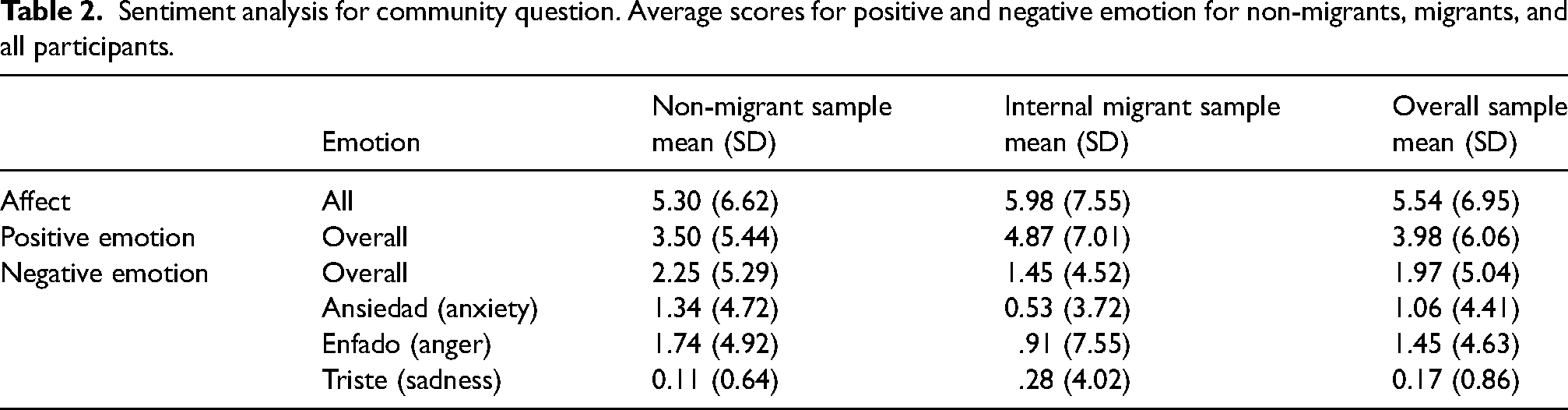
The findings of the migration and community sentiment analysis largely reflect the patterns found in the migration and community thematic analysis. Overall, women in both groups used significantly more positive than negative words on average when discussing the impact of migration on their community life (t(476.16) = 3.88, p < .001). Group differences were not significant for positive (t(140.75) = 1.68, p = .095) or negative (t(198.46)=−1.25, p = .213) emotion word usage, or for the specific emotion word categories of anxiety (t(210.96) = −1.49, p = .139), anger (t(205.67) = −1.41, p = .159), and sadness (t(112.89) = 1.27, p = .206). Table 2 summarizes the sentiment analysis findings for the impact of migration on community data, disaggregated by group.
Sentiment analysis for community question. Average scores for positive and negative emotion for non-migrants, migrants, and all participants.
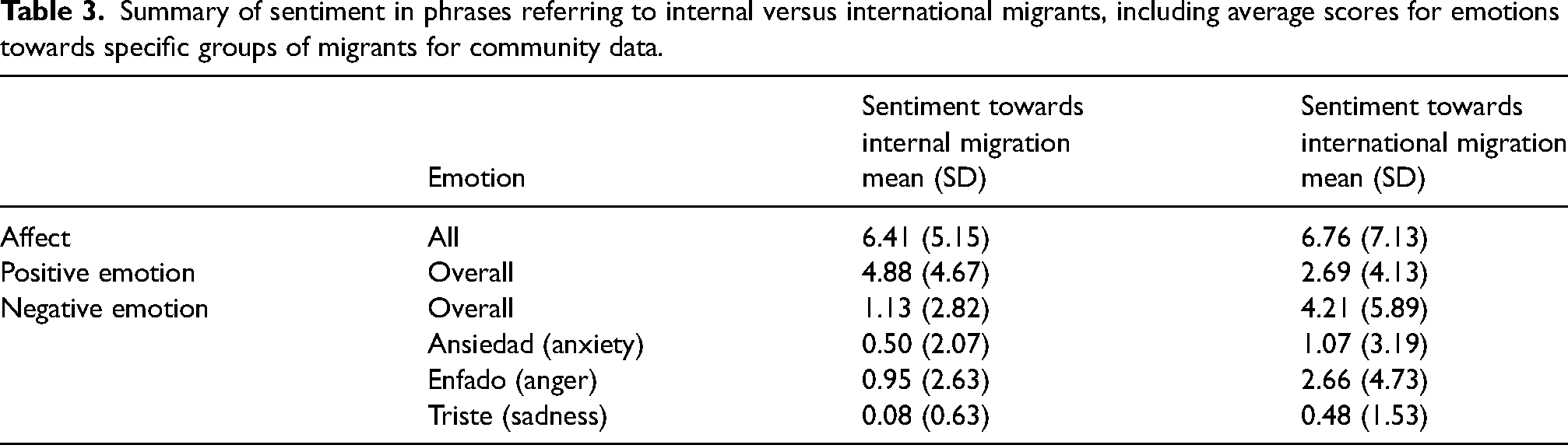
When the migration and community data was disaggregated based on references to certain migrant groups (internal, international), the results demonstrated a similar pattern to those of the thematic analysis. On average, more positive emotion words and fewer negative emotion words were used when speaking about internal migrants than when discussing international migrants (t(392.75) = 5.95, p < .001). When women mentioned international migrants, they used significantly fewer positive emotion words (t(139.06) = −3.05, p = .002) and more negative emotion words (t(125.37) = 4.28, p < .001) than when referencing internal migrants. In particular, women were more likely to use more words related to anger (t(135.61) = 2.85, p = .005) and sadness (t(116.19) = 2.23, p = .028) when talking about international migrants than when talking about internal migrants. Differences in anxiety word usage were not significant (t(145.55) = 1.34, p = .183). Table 3 provides a summary of the sentiment analysis findings for specific groups of migrants.
Summary of sentiment in phrases referring to internal versus international migrants, including average scores for emotions towards specific groups of migrants for community data.
Discussion
This study was conducted with the goal of developing a better understanding of the social experience of migration for both internal migrants and members of the receiving community in Lima, Perú. Overall, our analyses revealed the complexity of this social experience for both groups. We found that women in Lima had a broadly positive conceptualization of the impact of migration on their communities, although there was some variation based on the individual's own experiences of migration, across thematic analysis and NLP methods. Most negative perceptions of migration focused on community work and safety concerns. This is not surprising given that this rhetoric is commonly used in several migration contexts globally (Parisi, 2015). Results showed that migrants did not use significantly more positive emotion words on average than non-migrants when assessing the impact of immigration on their community; however, non-migrant responses received more positive codes in the thematic analysis, which largely focused on more characterological conceptions of migration, such as associating different groups of migrants with positive or negative traits, habits, and perceived impacts on the community. This could indicate that there is a difference between the qualitative aspect of what women say and the quantitative linguistic patterns revealing the affective tone of their responses. It could also reflect locals’ more characterological and abstract understanding of the impact of migration on community life.
Experiences of internal migrants
The findings of both the thematic analysis and NLP analyses speak to the urgency of considering migration holistically, and the need for more research on mental health risk and protective factors associated with internal migration. The thematic analysis revealed the multifaceted nature of internal migration motivations. These findings related to motivations for migration within Perú reveal the complexity of migration flows and suggest that driving factors exhibited at the international level should also be considered in internal migration contexts. Although some participants reported external factors forcing them to migrate, many women viewed migration as a choice. For example, internal migrant participants conceptualized migration as a way to gain access to more opportunities, reunite with people in their social support networks, and improve their economic and educational situations. Even women who migrated to escape family or generalized violence often framed migration as an agentive step to protect themselves or their families. Past research on migration decision making has emphasized the high variance in agency and locus of control, and has shown that an internal locus of control is associated with higher aspirations and a longer migration planning process (Czaika et al., 2021). This could ultimately contribute to better economic and mental health outcomes, because increasing women's internal locus of control has been shown to narrow the mental health gender gap (Awaworyi Churchill et al., 2020). Future research should explore how the intersection of gender and locus of control in migration decision making may impact migrant women's mental health.
Women also shared a wide range of challenges and adjustment processes, which provide insight into how several social, community, cultural, and contextual factors impacted women's experience of migration. The sentiment analysis revealed that, on average, women used more negative than positive words to describe their migration experiences, and the thematic analysis provided additional insight into the main challenges women faced upon their arrival in Lima. The principal social and community obstacles that women identified included a lack of social support, challenges accessing work and resources, and loneliness. It has been documented that international migrants experience elevated levels of loneliness compared with local populations, and interestingly that the link between social isolation and loneliness is higher for refugees than for migrants, potentially because of the exceptional circumstances under which they socially integrate (Löbel et al., 2022). In this case, it is possible that having migrated inside one's country could further bolster social inclusion and integration compared with international refugees, although several women still expressed that loneliness and distance from loved ones were a challenge for them in their migration process.
Further, shared values and a more positive view of internal migrants could be linked to other factors, such as access to resources and social support. Future research should assess whether this could be a potential protective mechanism for mental health. The thematic analysis highlighted some differences and some women noted that they were sometimes shocked by differences in climate, environment, and customs between their place of origin and Lima. Research has found links between mental health outcomes and changes in weather (Beecher et al., 2016), urbanization (Stier et al., 2021), economic opportunities (Porter & Haslam, 2005), and acculturation (Jorgenson & Nilsson, 2021); however, more evidence is needed to understand if and how these effects apply to internal migration, and how they may vary based on the cultural context. For example, several participants in this study explicitly mentioned noticing and working through differences in environment as a central aspect of their adjustment to Lima, which may speak to a cultural element of connectedness to one's territory across generations. Notably, participants also considered themselves, and may be considered by their community, as migrants even if they moved as children or babies. Accordingly, one's region of origin appears to be important to identity in this context.
It is important to note that many women also exhibited adaptive adjustment, highlighting the importance of including positive factors associated with migration when studying mental health in contexts of internal migration. Several women associated their migration to Lima with new experiences, growth, and learning. These positive migration experiences and their relationships with mental health merit further exploration.
The LIWC analysis revealed that women did not view their personal migration journey as exclusively negative, but rather inclusive of a mix of positive and negative motivations, emotions, and experiences. Future research should explore this negative emotion word usage further as it has been shown to negatively impact mood in past research (Hernandez-Ramos et al., 2022).
Perceived impact of migration on community life
Results suggested that in the Peruvian context, receiving community members have different perceptions of internal and international migration. Specifically, the assessment of the impact of Peruvian migrants was more positive than that of international migrants. The dichotomy between the positive views of internal migrants as coming to Lima for work, and the negative conceptualizations of and associations with international migrants is stark; past research has shown that structural stigma in one's community is associated with minority stress experiences and can impact the mental health of migrants (Frost, 2020). Our results suggest that internal migrants may experience less discrimination and have access to more informal community resources and social support systems than international migrants; however, the frequency of codes in the neutral category may still suggest some segregation. Because discrimination and social support are robust predictors of mental health and resilience in many studies (Lee et al., 2020; Racine et al., 2020; Vargas et al., 2020; Záleská et al., 2014), it may be that internal migrants may have more factors in place that promote wellbeing following their move.
Overall, the more positive perception of internal as opposed to international migrants aligns with past research which has found that people have a greater affinity for those who share similar identity characteristics, as well as those in a location closer to their own, and that, in the face of adversity, members of a group often experience increased empathy and shared suffering (Walters et al., 2020). It is possible that, because internal migrants and local women share several cultural characteristics, they experience increased empathy, which has been linked to prosocial behavior (Stocks et al., 2009). Another plausible explanation for this could be that, as many migrant and local participants noted, resources and opportunities are often concentrated in large cities. Research has shown that, despite political and economic shifts in several Latin American countries, which have changed the gender and educational composition of migration flows, young migrants continue to prefer migrating to larger cities (Rodríguez Vignoli & Busso, 2009; Rodríguez-Vignoli & Rowe, 2018). These migration dynamics could have implications for the wellbeing of women from more rural areas, as urban to rural migration in Perú has been associated with a 15% increase in probability of having experienced interpersonal violence in the past year (Terrazas & Blitchtein, 2022). Future research should explore how the same dynamics would play out in smaller communities.
In Lima, the prosocial sentiment on the part of the receiving community toward internal migrants was captured in both the thematic analysis and the LIWC analysis, and could be associated with several social determinants of mental health including social support, access to material resources, employment, and education opportunities. These are of particular importance because both locals and migrants pointed out several material and social challenges associated with migration concentrated around access to work, housing, and other resources. In the future, shared culture and associated prosocial behavior in receiving communities should be explored as a source of resilience in internal migration contexts.
Overall, both groups of women used more positive than negative emotion words when discussing the impact of migration on their communities. This may be linked to evidence from other contexts, which has shown that women, younger people, and people with more education tend to have less-negative reactions to migration and suggests that attitudes towards migration are worse in areas with more migrant contact and presence (Rudolph & Wagner, 2022). However, further investigation is needed to assess if and how these findings apply in the Peruvian context. Given differences in responses between migrant and non-migrant groups in this study, it may be that women's shared experiences with other internal and international migrants may increase empathetic concern and understanding (Hodges et al., 2010), though this should be investigated in future work.
Limitations and future directions
There are two main limitations of the current study. First, the qualitative data collected may have too low a word count from which to confidently draw NLP inferences. For this reason, the NLP analyses were carried out in parallel with thematic analysis; however, in the future, richer and longer qualitative data should be collected to enable the use of more complex NLP methods such as topic modeling. Second, despite a notable presence of Venezuelan immigrants in the study's catchment area, no women in the sample identified as Venezuelans. The absence of Venezuelan and other foreign women in this study may speak to the additional community relations, social integration, and resource access challenges international migrants face compared with internal migrants, including experiences of criminalization and discrimination (Freier & Pérez, 2021). Future research on migration in Perú should capture data from internal as well as international migrants, to identify risk and resilience factors for each group.
Conclusion
The findings of this study revealed several aspects of the relationships between migration, community, and mental health in the context of the San Juan de Lurigancho district in Lima, Perú. Overall, there was a more positive attitude towards internal migrants, which could be protective and should be harnessed in mental health interventions and preventive programming. In this context, internal migrants may experience stronger and more diverse social bonds because they are connected to the local community through their largely shared culture, values, religion, and language, as well as to other internal and international migrants through shared experiences and suffering linked to migration. These results highlight that each individual should be considered holistically, and in the context of their social ecological framework. There is a need to explore community as a potential resilience factor for internal migrants and explore how this could translate into practice and inform the development of mental health programming. In particular, these findings should alert public policymakers, mental health practitioners, and members of civil society to the social determinants of mental health women in this study identified as central stressors in both their own migration narratives and their assessment of the impact of migration on their communities. These include access to work, education, safe places to live, basic material needs, healthcare, and other resources.
Footnotes
Acknowledgements
We thank our colleagues at the Instituto de Pastoral de la Familia for their collaboration on this project.
Declaration of conflicting interests
The authors declared no potential conflicts of interest with respect to the research, authorship, and/or publication of this article.
Funding
The authors disclosed receipt of the following financial support for the research, authorship, and/or publication of this article: This work was supported by the Ford Program in Human Development Studies and Solidarity, Kellogg Institute for International Studies,
