




Abstract
This article examines how, through uncovering collaborative leadership, the whole school staff is able to understand its common endeavours to support heterogeneous students’ fluent learning paths. For this, a notion of distributed pedagogical leadership (DPL) is drawn upon. DPL concerns everyone in the school community, not only leaders and management. It means abandoning role, instrumental or process centricity and moving towards leadership that is characterized as the innermost qualities of a professional learning community. This kind of leadership is best described with 10 ‘keys’ as 10 key attributes. To understand DPL in practice, quantitative data both from a nationwide Finnish survey and a case study school are analysed, with supporting qualitative data from interviews of the leadership team in this particular school. The article presents and compares leaders’ and the staff’s experiences of DPL with regard to transition practices in Finnish vocational education.
Introduction
Organizational assignments in education generally challenge both leadership and staff because of the tensions and contradictions involved in collective actions. Nevertheless, the nature of these tensions has changed remarkably and their volume increased, for diverse reasons. Widespread economic insecurity, changes in the world of work, students’ heterogeneity, immigration, and pressures in family life are only some of the underlying issues. As a consequence, many attempts have been made in education in Europe to ease students’ transitions and learning paths in order to guarantee an adequate and sufficient workforce for the future and social equity for young people.
The complicated challenges for fluid learning paths have various consequences. School environments with all their actors have to find productive ways to manage students’ progress in the changing situations when students move from one school/college level to another. Consequently, school leadership and staff have to consider carefully how to guarantee the development of professional learning communities in order to respond to the increasing challenges. This then requires innovative ways of studying leadership in professional learning communities.
Leadership in general and school leadership in particular is a controversial research subject. Ambiguity increases when it is examined through 1) persons and their roles, duties, tasks, outward status, or behaviour; 2) different instruments, such as technical and psychological tools, practices, measures, or activities; or 3) processes of developmental issues, results of leadership, or situations in a specific context (Bass, 2008; Katz & Kahn, 1978). Although leadership includes these elements, it is argued here that its true essence could be understood as something more. This becomes evident when considering the complex world of educational change and restructuring. As a consequence, school leadership as a common endeavour has become a topical issue. It is becoming accepted that it should be considered as collaborative and as belonging to everybody in the school community (Rubin, 2009).
In this article, the leadership elements above are not rejected. However, the focus is not on them. Rather, a fresh and novel perspective is adopted when leadership is considered as the common characteristics of a group of people working together in the learners’ favour. Moreover, collaborative leadership is understood here as the innermost substance of a professional learning community. To examine this kind of collaborative leadership, some crucial questions are outlined. How can its state be uncovered and how can it be approached? Moreover, how to consider these qualities in relation to activities which are collaboratively executed? In order to answer these questions, the aim of this article is to introduce a theoretical notion of distributed pedagogical leadership and a practical model based on it. Moreover, this article is a part of a larger research project called ENTREE (2009–2014), 1 funded by the Academy of Finland, where the ideal model of distributed pedagogical leadership (DPL) is explored experimentally (Jäppinen, 2010, in press a; Jäppinen & Maunonen-Eskelinen, 2012).
Collaborative leadership can be uncovered against this ideal by describing its current state through 10 qualitative keys as 10 key attributes. They are polyphony, interaction, expertise, flexibility, commitment, responsibility, negotiation, decision-making, confidence-based control and evaluation. The attributes were found on the basis of the existing theory and the results of two large-scale preparatory Finnish studies (Reducing Dropout in VET 2006–2007 and Vocational Start 2007–2009), commissioned by the Ministry of Education, about the significance of collaborative actions for reducing dropout and supporting vocational students’ fluent transitions from one school level to another and to working life (Jäppinen, 2009, in press b). These studies concerned collaborative practices used in 50 Finnish VET organizations, representing 30 percent of the total.
In order to understand the theoretical model and its practical application, this article includes some examples from the ENTREE project to illustrate how DPL manifests itself in reality and what kinds of challenges leaders and the staff face when they seek to support students’ diverse learning paths. The analyses are based both on a nationwide survey about the state of DPL in the entire Finnish vocational education and training system (VET) and on a case study in a particular VET school.
Distributed Pedagogical Leadership
The core idea of distributed pedagogical leadership is that it is fluid and mutable (Hargreaves & Fink, 2009), even synergetic (Gronn, 2008, 2009). In real life, the characteristics of collaborative leadership as DPL can be quite diverse. What also matters are the measures and actions carried out by all of the stakeholders in a collaborative and dynamic process (Bandura, 1997). Thus, in trying to understand collaborative leadership it is reasonable to attach it to concrete issues intended to be understood and solved, and to consider it context-sensitive (Mascall, Leithwood, Strauss, & Sacks, 2009). Therefore, practices to support students on their learning paths are taken here as the point of reference.
In developing the concept of DPL, the two preliminary studies alongside the ENTREE project include a long process of more than four years for developing the theoretical notion of DPL and piloting the model. Therefore, some essential background issues should be first explained. These are 1) distributed leadership, 2) leaderful practices and 3) managing without leadership. They were some of the most important building blocks when the notion of DPL was created.
Distributed leadership
Distributed leadership (Gronn, 2008, 2009; Harris, 2006, 2009; Spillane, 2006; Spillane, Cambrun, Pustejovsky, Pareja, & Lewis, 2009) is the first building block because its roots are in shared cognitions and understanding, even in synergy creation (e.g. Gronn, 2002; MacBeath, 2005; Møller & Eggen, 2005). For example, Ritchie and Wood (2007) note that the end goal of distributed leadership is the additional dynamics that arises from individuals sharing their initiatives, ideas and expertise in such a way that the result is greater than the sum of the individual actions. Essential to this process is the reciprocal interdependency of accumulative cognition, responsibility and expertise, which are realized through collaborative attitudes and ways of working (Harris, 2006; Ritchie & Wood, 2007).
Distributed leadership has raised increasing interest and debate (Gronn, 2008, 2009), understood in many ways, and associated with a range of meanings. For example, it can be examined from the point of view of expressing democracy or considered as a tool for increasing effectiveness, or building human capacity (Mayrowetz, 2008). MacBeath, Oduro, and Waterhouse (2005) have created a distributional taxonomy. Furthermore, Hargreaves and Fink (2006) see distribution as a continuum. One viewpoint is to see distributed leadership as interactive practices that extend over the social and situational contexts of an organization (Spillane, 2006). In this way, shared leadership practices concern relational collaboration. This viewpoint leads us to the next building block, namely leaderful practices.
Leaderful practices
The second background element in creating the notion of DPL is leaderful practices, a term launched by Raelin (2003, 2004, 2005). Raelin (2003) summarizes leadership as consisting of setting the mission, actualizing the goals, sustaining commitment and responding to changes. He further augments leaderful practices with four Cs: collective, concurrent, collaborative and compassionate. ‘Collective’ means that everyone in an organization can serve as a leader and that the entire organization is involved in leadership practices. ‘Concurrent’ signifies that leadership can be practised by any member of the working community and at the same time. ‘Collaborative’ means that everyone is in control of and can speak for the entire learning community. ‘Compassionate’ involves that the dignity of every single member in an organization is preserved and each individual is taken into consideration when decisions are made and actions are taken (Raelin, 2003).
Managing without leadership
Some researchers have gone further in searching for reasonable ways to acquire leadership as a common good. The third building block of DPL is ‘managing without leadership’, a term borrowed from Lakomski (2005, 2008). Lakomski (2008) strongly argues against the use of the concept of leadership when reflecting and considering organizational practices. She points out that it is the organizational setting with its tools and artefacts and not personal leadership as such that improves organizational efficiency. Lakomski (2005) sees the acquisition of cultural-organizational knowledge as the machinery that makes practices possible. In this way, Lakomski refers to the distributed nature of human cognition and stresses the contextual specifics of organizational processes that differ from situation to situation.
Summary of DPL
These considerations bring together shared cognition and understanding, synergy creation, and jointly agreed actions. This means that in DPL each member of staff will collaboratively ‘lead’ pedagogical activities in jointly agreed ways and to the jointly agreed direction (Rubin, 2009). Thus, the responsible, long-range, systematic, target-oriented and professional practices are based on the education staff’s shared ideas and a common vision.
However, I would suggest, these elements are insufficient if leadership is considered as the innermost substance of a professional learning community. Therefore, it is suggested here that DPL is composed of something more, of the inner characteristics of the group working together. Because DPL is a theoretical notion, the actual state in an educational organization should be studied against the background of the ideal. In the following, the TenKeys® model related to DPL is first introduced in order to enable this kind of scrutiny and then to attach the empirical data to the model.
The TenKeys® model
The TenKeys® model comprises 10 keys as 10 attributes of the professional learning community which synthesize the essential aspects of DPL. The 10 attributes are briefly introduced below with their abbreviated tags and some illustrative examples.
Polyphony (Pol) is consultation of all personnel involved in the issues in question. It ensures everybody’s participation. It is being receptive to different voices, and to their wondering, challenging, agreeing, convincing, asking or doubting. Polyphony includes provision and allowance of space and time for everybody. It also facilitates the distribution of explicit and tacit knowledge.
Interaction (Int) means systematic and continuous interplay between the members. It involves consolidation of different opinions; wide, multiform and continuous dialogue; and significant meaning-making. Further, it refers to the fluidity of formal and informal knowledge. Interaction also includes handling contradictions, and participatory and active listening.
Expertise (Exp) is mediation and distribution of multi/inter-professional knowledge and understanding of relevant issues. It includes shared cognition, understanding and creativity. In addition, expertise comprises communal reflections and synergetic actions.
Flexibility (Fle) is an ability to make fair compromises to central organizational questions. Although it is suggested that a collective orientation must be emphasized, flexibility also allows freedom to make one’s own decisions within the collective framework.
Commitment (Com) means everybody’s voluntary contribution to the common good. Moreover, it involves openness and sincerity. Commitment particularly concerns collective visions, values, principles and beliefs but also common rules. Finally, it means sincere and genuine support for others.
Responsibility (Res) involves collective and individual attitudes. It entails high moral standards and approval of jointly agreed-upon common practices and activities.
Negotiation (Neg) is more than traditional meeting practices. It concerns mutual understanding in prioritizing questions. Negotiation means taking care of others’ emotional needs. It also means compromises that benefit everybody. Negotiation includes necessary intellectual and material resources, and manifestation of new ideas. Finally, negotiation is integrative in combining different interests.
Decision-making (Dec) promotes circumstances which yield productive solutions. It includes sufficient and different alternatives and uncovers underlying issues. Decision-making can also involve utilizing intuition.
Confidence-based control (Con) means a balance between the necessary control and sufficient freedom for individual choices. Thus, confidence-based control increases society’s collaborative strength and capacity. It refers to maintaining openness and sincerity and building up skill levels. In this way, it includes devolution of power.
Evaluation (Eva) focuses on one’s own actions inside the community. It is agreement on the evaluative methods and styles. Evaluation means both defining the indicators of success and benchmarking. Ultimately, it promotes empowerment of the whole staff (Jäppinen, 2010, in press a; Jäppinen & Maunonen-Eskelinen, 2012).
All these attributes are well-known concepts in education and do not provide any new understanding, although they are widely acknowledged as essential. However, what the model does provide is an explanatory expansion of each attribute, that is, how they interdependently complement and affect each other. The movement of any individual attribute has an immediate influence on all the others and thus on the whole. The attributes of the professional learning community form a network with many relationships between them.
Method
Target groups and data
The quantitative data comes from two sources in the ENTREE project. The first one covers the whole Finnish VET system and the other one focus on a single case study vocational school. The article is mainly based on this quantitative data. However, in order to illustrate the manifestation of DPL, the article also draws on qualitative data from six in-depth interviews in the case school.
The school is situated in an economically active environment that is a mixture of urban and rural elements, with a population of 120,000 inhabitants. The overall enrolment is approximately 5000 students, with 500 staff. The school has recently gone through an extensive reorganization process. The previous hierarchy was dismantled and a new matrix organization was created with three units for specific fields of study, one student service unit, and one unit for general studies.
The school is directed by a principal, five unit leaders, and 18 heads of different training divisions. The qualitative data concerns the principal and the leaders of the five units as six in-depth interviews that were related to a process in ENTREE where all 24 members of the leadership team, assisted by the author, analysed students’ different learning paths to enter the vocational school, study there, and proceed to the world of work or further studies.
The other quantitative data is the national web-based survey covering the whole Finnish VET system of 145 VET institutions as education providers (2010), including this case study school. (As a provider may control more than one school under its control, the number of schools may be greater.)
In Finland, upper secondary education (i.e. above the age of 15 or 16) is divided into general and vocational lines, both of three to four years. General education involves a broad academic curriculum. The other line, the Finnish vocational upper secondary education (VET), has 23 school-based vocational fields, and with a great emphasis on on-the-job-learning. Since 2002, there has been a special stream where the students can pass both the VET qualification and the same matriculation examination as in the general education line (ReferNet Finland, 2009). This possibility for an open access to higher education has made the Finnish VET very attractive to young people.
When young people finish their compulsory schooling around the age of 15, they complete an electronic application according to their preferences for general education, VET, or both. If they wish to enter VET they also make a choice of preferred study fields. Students can mark altogether five options. The definitive decision is made by the Finnish educational administration, mainly according to the marks of the school-leaving certificate at the end of compulsory education. This means that certain popular study fields or schools are hard to enter. As a consequence, this tendency has unquestionably strong effects on students’ transitions and individual learning paths in the Finnish education system.
Survey
The national survey as a web-based questionnaire was sent out to 150 different Finnish VET schools. The questionnaire concerned the informants’ judgement of how well their organization had succeeded in supporting students’ transitions, in terms of the collaborative actions of staff. The schools represented 90 percent of the total number of the schools in the Finnish VET.
In each school, five separate sections were sent to five different persons representing leadership/management, curriculum work, strategy and development work, working life cooperation, and guidance. These five were chosen according to the previous studies evidencing the areas where the differences in DPL were the greatest (Jäppinen, 2009, in press b). In the case study school, the questionnaire was sent to everyone, and 77 staff members (out of 400) answered the questionnaire, of whom 13 represented the leadership team and 64 the other members (Table 1).
The respondents
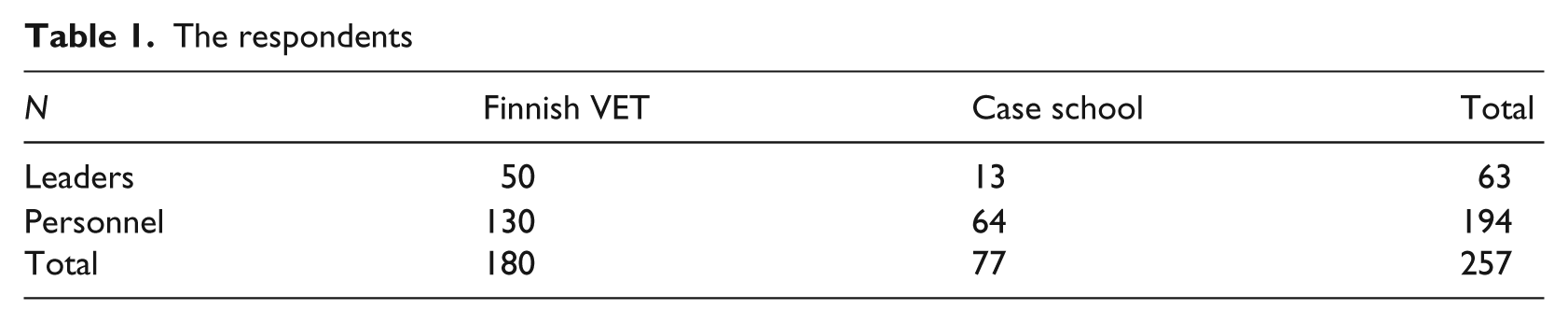
In every other school, five persons were asked to answer the section of the questionnaire which they recognized as matching their special duties. In some schools, certain parts of the questionnaire remained unanswered. One of the respondents was the principal/head who answered the first section of the questionnaire of leadership/management. In total, 257 representatives from the target group of 750 answered the questionnaire. Of the respondents 180 were from schools other than the case school, including 50 leaders and 130 other staff members (Table 1). The institutes that answered the questionnaire represented, in a balanced way, different school sizes, all Finnish regions, both urban and rural settings, and all kinds of economic surroundings. In this sense, the results can be considered as valid despite the response rate of slightly over 30 percent.
As we recall, the core idea of DPL is that each key attribute has a relationship to every other attribute and a change in any attribute influences all the others. Therefore, the questionnaire included 45 statements in each of its five parts, to be analysed as connections of one attribute with all the other attributes (the arrows in Figure 1). The informants were asked to evaluate to what extent they agreed with the 45 statements on a scale of six options: totally agree, mostly agree, somewhat agree, slightly agree, no knowledge or opinion, totally disagree.
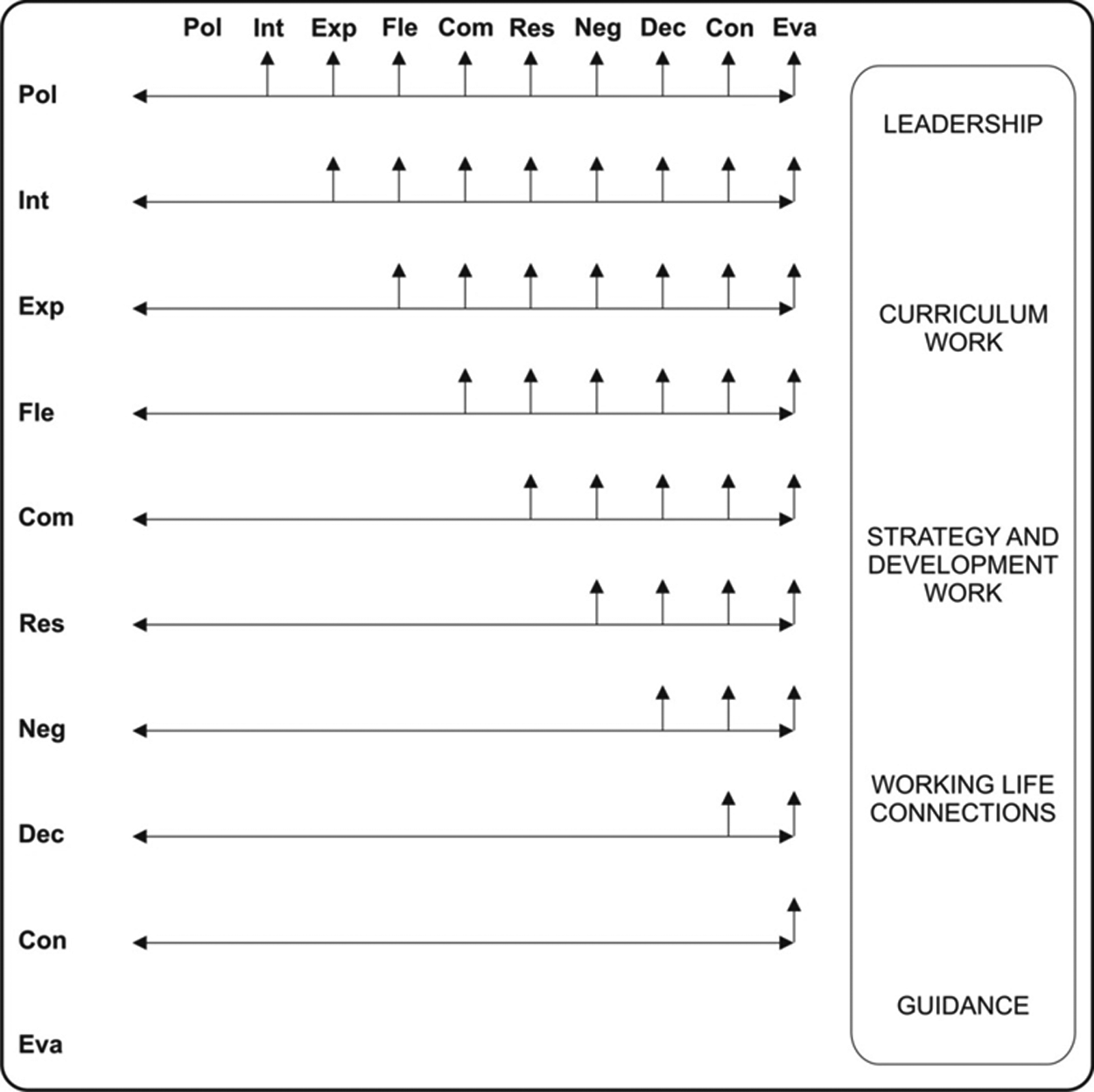
The network of the DPL attributes.
All statements concerned students’ ease of transition. In addition, the structure and core idea were equal in all the five parts of the questionnaire except that some concepts in the statements were changed in order to point to the special issues in a particular section. For example, the relationship between Pol and Int was expressed as, for example:
Management-leadership: The diverse opinions of all our staff will equally be heard by the management/leadership when we discuss the pedagogical actions that support the students’ fluent learning pathways.
Curriculum work: In the curriculum dialogue, all the diverse opinions of all our staff will equally be heard when discussing the pedagogical actions that support the students’ fluent learning pathways.
As a consequence of the network of the ten key attributes, the questionnaire involved 10 attribute-groups that were not identifiable by the respondents because the statements of these 10 groups were distributed over the whole questionnaire except, perhaps, the first group of polyphony. Each of the ten groups consisted of nine pairs of attributes in the form of nine statements where the other attribute stayed the same while the other changed so that all combinations were covered. For example, the group of Pol was: Pol-Int, Pol-Exp, Pol-Fle, Pol-Com, Pol-Res, Pol-Neg, Pol-Dec, Pol-Con, and Pol-Eva. The results of these 10 groups were calculated as sum means introducing one attribute’s compound effects with the other attributes. As to the sum means, Cronbach’s alpha was calculated in order to guarantee the inner validity of the questionnaire. Their rates varied between .883 and .913 and showed a very high inner validity.
Interviews
The six semi-structured leadership-team interviews each lasted about one to two hours and were tape-recorded and transcribed. The respondents expressed their opinions about the following themes:
The most critical learning paths as to the students’ fluent transitions.
Organizational issues and factors behind this criticality.
The crucial persons and their role with regard to these critical paths.
Opinions about those organizational measures and actions that should be taken into account in order to support students in these critical paths and their nodes.
The greatest future challenges.
Analyses
The present article draws on two comparisons between the case school leaders and the leaders in all the other VET schools and between the other staff in the case school and the other VET schools. The results are examined both on the level of the 10 attribute-groups (each including nine pairs) as sum means and, further, on the level of individual statements. The statistical analyses comprised two-tailed independent sample tests as t-values.
The qualitative analyses of the interviews were done according to the general ideas of concept analyses (e.g. Creswell & Plano-Clark, 2007), that is, searching from the interviews for conceptual elements that could be connected to the specific contents of the 10 attributes. The interviews were used as additional information for interpreting manifestations of DPL in the case school as the personnel’s collaborative attendance to support students’ transitions. Although the results of case studies cannot be generalized as such, a new understanding of case study is emerging. Stake presents it using the term ‘instrumental case studies’:
The particular case provides insight into an issue or to redraw a generalization. The case is of secondary interest, it plays a supportive role, and it facilitates our understanding of something else. The case is still looked at in depth, its contexts scrutinized and its ordinary activities detailed, but all because this helps us pursue the external interest. We simultaneously have several interests, particular and general. (2003: 459–460)
Results
The results in this article are introduced under two categories: 1) the case school leaders versus the leaders in the other schools and 2) the case study school’s staff versus the other VET schools’ staff. Because many research projects have shown how the opinions of the leadership/management representatives might differ from the teachers’ and other staff’s opinions, being normally more positive, this kind of analytical division is helpful. If there seem to be significant exceptions in the manifestation of DPL from this main tendency, these kinds of results are extremely useful in order to better understand collaborative leadership and the challenges that the increasing variety of students pose to the educational community.
The case study school leaders versus the leaders in the other Finnish VET schools
This aspect was investigated through the first area of leadership/management. The analysis shows us how the leaders in the case school and those in the other Finnish VET schools experienced DPL almost similarly with respect to support for students’ transitions on their individual learning paths (Table 2). As to the sum means of the 10 attribute groups, no statistically significant differences were found. When the individual statements were in focus, only two significant differences surfaced. These concerned Pol-Con (t = .008**) (p < 0.01) and Int-Neg (t = .038*) (p < 0.05). In both cases, the mean in the case school was lower than the average in Finland.
The Finnish VET schools’ leaders vs the case school’s leaders

The two distinguishable individual statements indicated, nonetheless, that the leaders in the case school were more sceptical about: 1) the realization of confidence-based control in connection with listening to each member’s voice; and 2) the realization of open and honest dialogue and meaning making when productively negotiating students’ fluent learning paths. The next extracts are drawn from the leadership team interviews. They provide both polyphony and confidence-based control (Pol-Con) and interaction and negotiation (Int-Neg) related additional understanding. Although the notions come from a selected case, the previously mentioned idea of instrumental case studies allows deeper comprehension of DPL. Let us start with polyphony and confidence-based control.
If the head of the unit sees the whole only from a very narrow angle, this thing (that is, accepting students from special integration programmes onto vocational education) can be seriously torpedoed. The question is how they (the heads of the units) see the whole and these special education programmes, and how our guidance staff really understands which is the best learning path for the young person and are able to guide him/her to choose the right path and not to dictate it. Because we have emphasized that the choice always belongs to the young person him/herself.
This quotation highlights the necessity for the entire unit and its staff to perceive the whole in the same way. In other words, there is a question about polyphony in the realm of understanding. This unity then leads to equal treatment of learners when they are choosing their individual paths. Confidence-based control refers here to the confidence the staff should have towards students in the choice situations but, at the same time, also to the control the staff need to pursue to guarantee the fluid learning paths. Now two other quotations may shed light on the two differing statements in the quantitative data.
In some units it is very problematic that there are people who aren’t able to let go. And they don’t trust that the remedial services are led and guided by our student-service unit. And this brings about bafflement among the actors (study counsellors) whose manager is in the student-service unit and not in the study unit.
One must truly trust that one doesn’t need to take responsibility for all things and one must trust that a colleague can take care of these things.
In these two quotations, polyphony is problematic due to the organizational reform in the case school. In other words, the study counsellors and some other members of the guidance staff work in the study unit under the head of the unit where the students are, but their superiors operate in another unit which, in management terms, is part of student services, according to the new organizational model. This causes problems to confidence-based control when the specialist unit leaders upset the guidance staff with guidelines inconsistent with those coming from the unit of student services. Thus, some unit leaders do not distinguish between issues which they need to control and issues where they need to trust others.
Now we proceed to utterances that highlight interaction and negotiation.
I ought not to say so and I’m a little bit ashamed as the head of the institute, but we have in certain cases the kind of thinking that . . . although we speak nicely about taking care of the whole age group, in reality we like to push the difficult learners out of our sight. It is a regrettable truth that, although in speech we speak about ‘the little ones in the family’, we keep raising the question ‘why they (the demanding learners) are here and not somewhere else?’ We have big problems with the attitudes of staff when the student groups are big. One teacher is busy with a big group in the working hall. Then someone (a student) arrives there many months after the school has started. The teacher huffs, ‘Should I still be accepting these students?’ With this particular teacher, discretion failed.
Here the first respondent honestly admits that rhetoric and reality do not always converge. At the interaction level, the importance of taking care of every student is conveyed. However, in negotiation situations and when the emotional needs of the students should be taken into account and compromises made, the reality reveals something totally different, as the second anecdote proved.
The inter-professional working groups should be involved as a natural part of our everyday life. How should the inter-professional groups function? They really would promote things. Not only that we are face-to-face and discuss and have meetings. The challenge is for knowledge transfer: how I could get knowledge about this student and to whom I’ll pass the information? How we can ascertain that the issue is moving forward?
This quotation deals with the need for interactive negotiation in the situations where knowledge about a student’s problems needs to be forwarded in order to help him or her in the best way but where knowledge transfer is actually weak or prevented. This might be due to legal issues such as secrecy orders, or simply flaws in the organizational models.
When somebody thinks about dropping out, what are the alternatives? There is an old tradition . . . I could imagine that this isn’t allowed (the new way to directly market pilot programmes for the students who consider dropping out). Our starting point is that everybody passes the examination. This is, in a way, an untouchable thing. Can we sensitize people for this kind of thing? It is a ‘hush, hush’ issue. However, there should be, in the background, a system that could react to this [problem of dropping out] . . . through discussion to offer the young people these alternatives about ‘what’s now and where to go on’.
The above respondent reflects upon the serious problem of what to do when a student is going to drop out. She questions the old interaction and negotiation-related tradition of silencing the stakeholders to avoid explosive questions, or the tendency to sweep the embarrassing issue under the carpet. The respondent then puts forward an idea of fresh interactive negotiation with the students themselves and new and alternative ways of handling these problems.
The case school staff versus the other schools’ staff
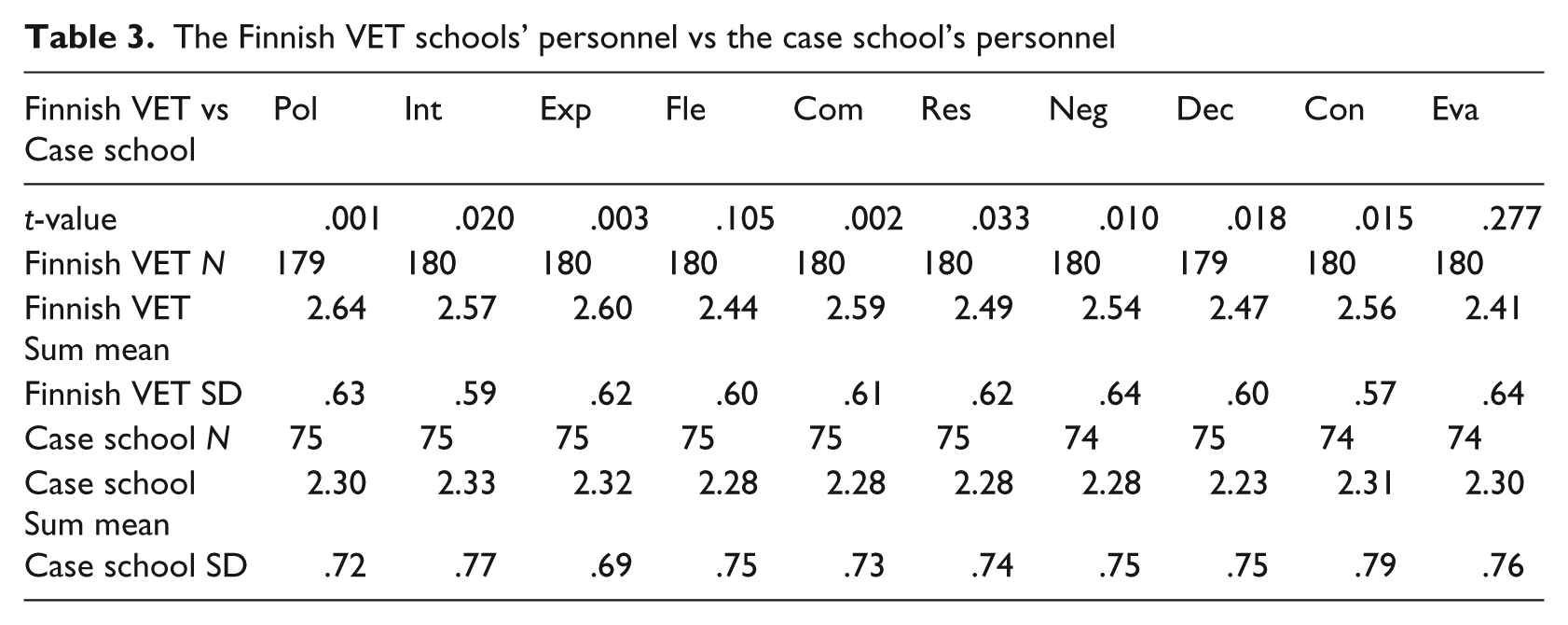
When looking at the experiences of DPL on the level of the staff (leaders excluded), big differences between the case school and the other Finnish VET schools were found. These comparisons are based on the four other areas of the questionnaire: curriculum work, strategy and development work, working life cooperation and guidance. When looking at the sum means, significant differences were found in eight attribute groups. These groups were Pol, Int, Exp, Com, Res, Neg, Dec and Con (Table 3). Only in Fle and Eva were no statistically significant differences detected.
The Finnish VET schools’ personnel vs the case school’s personnel
The statements of the questionnaire are introduced in order to describe more fully the differences between the Finnish VET schools’ staff and those in the case school (Table 4). Twenty statements produced differences with the significance level of *** p < 0.001. The overall result means that almost half of the statements were highly distinctive. In terms of the paired keys these statements were as follows: s1 Pol-Int, s2 Pol-Exp, s3 Pol-Fle, s4 Pol-Con, s7 Pol-Dec, s8 Pol-Con, s9 Pol-Eva, s10 Int-Exp, s14 Int-Neg, s16 Int-Con, s19 Exp-Com, s20 Exp-Res, s21 Exp-Neg, s22 Exp-Neg, s23 Exp-Con, s27 Fle-Neg, s31 Com-Neg, s33 Com-Con, s35 Res-Com, s37 Res-Dec and s42 Neg-Eva.
The 45 statements and the Finnish VET schools’ personnel vs the case school’s personnel
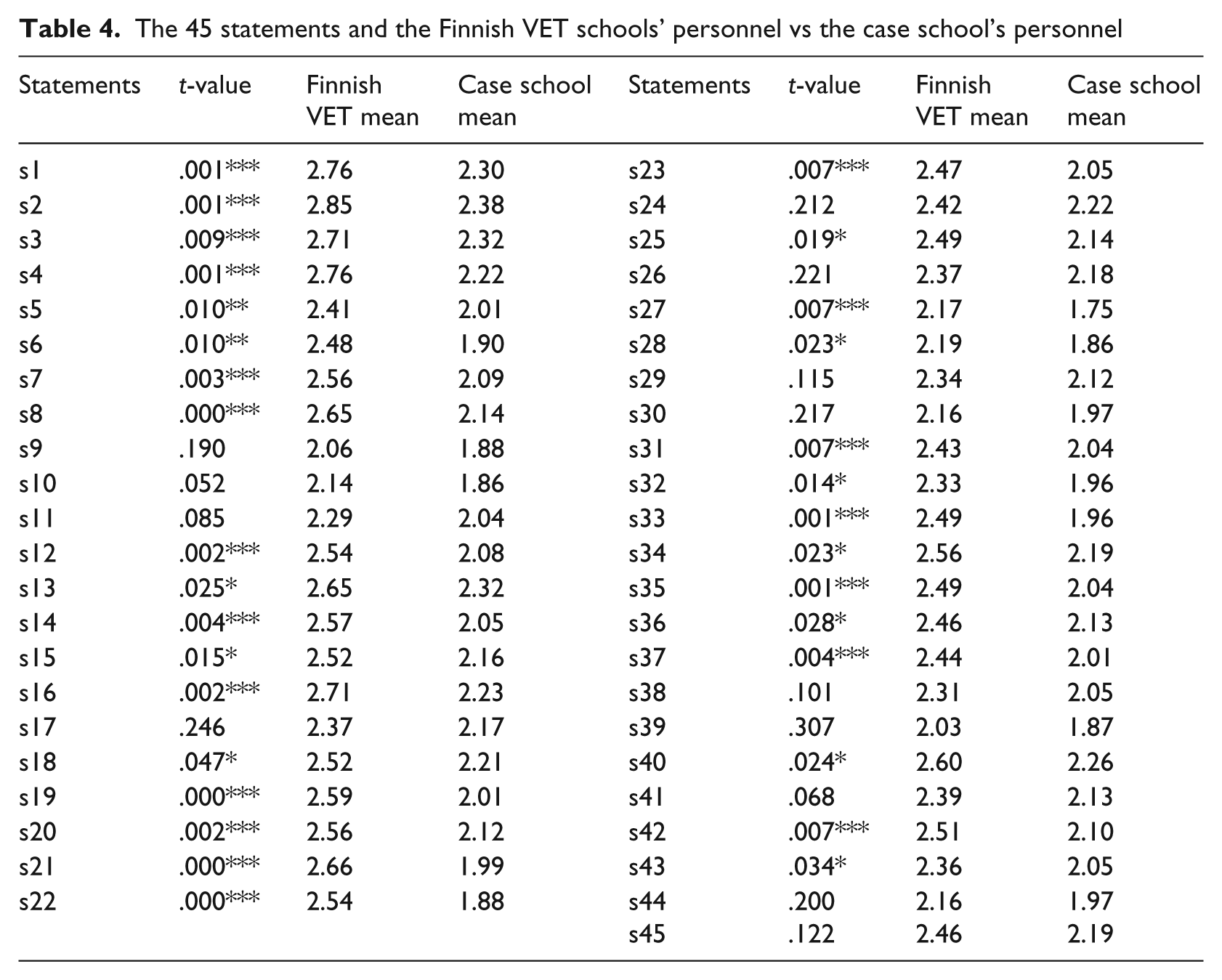
The ‘alarming’ attributes can now be ranked by their statement-based frequency as follows:
Pol, Exp (7 significant differences = SD in the pairs)
Neg (6 SD)
Con (5 SD)
Int, Com (4 SD)
Res (3 SD)
Fle, Dec, Eva (2 SD)
These results were introduced to the case school’s principal by the author in order to help the school to focus on and improve the issues that needed more collaborative leadership and shared practices. In this way, the whole staff became aware of the significance of taking care of all participants’ special opinions and expertise in order to support students’ fluid learning paths. Also they understood the need to develop their negotiation and interaction practices in terms of trust and confidence. All this finally increased commitment and responsibility within the case study school, as was clearly seen after a year in further studies and discussions with the leadership team.
Conclusion
This article introduced a novel way to study educational leadership as a collaborative endeavour through the notion of distributed pedagogical leadership (DPL). DPL considers leadership as the innermost substance and characteristics of a professional learning community where the stakeholders share a task and joint goals and execute common activities to reach these goals. In this article, this process was concretized in examining how to support students’ fluent learning paths in the Finnish VET.
DPL is an ideal model that the community is supposed to approach, even if never to comprehensively reach. Therefore, the concept of DPL is accompanied by a concrete model called TenKeys® with 10 key attributes as the main elements of collaborative leadership.
This article involved comparisons between 1) the Finnish VET leaders and a leadership team in a Finnish VET case school and 2) the staff in the Finnish VET system and those in the case study school. The similarities between the case school’s leaders and leaders in the Finnish VET but the big differences between the staff in these two target groups uncover certain collaborative leadership challenges. It seems that especially polyphony and expertise but also interaction, negotiation and confidence-based control need to be developed in the case school. On the contrary, flexibility and evaluation seemed to be successfully experienced. These significant differences are worth more consideration in future studies although some explanations can already be suggested.
First, the case study school had recently gone through a major curricular and organizational reform. This fact became quite evident during the interviews when the respondents reflected upon the consequences of the new organizational structures on daily school life. The reform was quite likely affecting the staff’s responses to some extent. Second, the respondents in the other VET schools might have been less teaching-oriented than the respondents in the case school, since they were chosen by the principals. Thus, it is possible that the proportion of teachers in their samples differed from that of the case school where the questionnaire was addressed directly to the teachers.
In sum, it is argued here that educational leadership can be understood and studied as a collaborative phenomenon, as characteristics of a professional learning community. In this sense, collaborative leadership is the invisible but still identifiable ‘ambiance’ of an educational society, its innermost mutable substance. Understanding of collaborative leadership can be outlined in terms of interdependence of the 10 key attributes and studied in practice in many types of organizational challenges of today that reform and modify the customary and traditional school settings.
Footnotes
Acknowledgements
The study is funded by the Academy of Finland.