



Abstract
The present questionnaire-based study examines the views of 428 Greek students (aged 13–18 years) from 30 secondary education schools in Athens, who have experienced cooperative learning in group work – an instructional learning strategy not often implemented in Greek schools. The research focuses on students’ preferences as regards the composition of their group and the distribution of roles and tasks within it, and finally the evaluation of and the reward for personal and group performance. Data elaboration, statistical and factor analysis showed that students participate more willingly in group work when wider autonomy is provided and their friends participate in the group, although new friendly relationships with the other members are not developed. It also showed that Greek students prefer clearly defined tasks, seek mainly cognitive attainments, want to be assessed on the basis of socio-affective skills development, dislike grade rewards for group work attainments and prefer non-grade rewards such as praise, provision of free time and excursions.
Introduction
Brody and Davidson (1998, p. 8) define cooperative learning as a process where students ‘work in groups towards a common goal or outcome, or share a common problem or task in such a way that they can only succeed in completing the work through behaviour that demonstrates interdependence, while holding individual contributions and efforts accountable’. Sharan’s (2010, p. 303) taxonomy of group work models divides them into three categories according to the specific skills they develop:
models emphasizing mastery of knowledge and motivation;
models emphasizing social skills and interpersonal communication; and
models including the abovementioned skills which also highlight long-term intellectual inquiry, intrinsic motivation and equal status interaction.
A different taxonomy formulated by Slavin (2000) classifies group work models into two categories according to the type of learning they are considered to promote:
models in which students help each other assimilate knowledge and develop pre-defined skills; and
models in which project-based learning is developed through problem-solving procedures.
However, irrespective of the model they belong to, all well-known group work strategies (such as Student Teams-Achievement Divisions [STAD], Cooperative Integrated Reading and Composition [CIRC], Teams-Games-Tournament [TGT], Jigsaw, Learning Together, Complex Instruction, Group Investigation) have been reported to produce positive outcomes worldwide; they are considered, by both teachers and students, to promote students’ academic and social skills, and strengthen feelings of autonomy and confidence through the creation of a constructively enhanced interactive learning environment where students and teacher cooperate harmoniously as Baudrit (2007), Gillies (2007) and Sharan (2010) have shown by examining in theory and practice teenagers’ cognitive and affective response to learning stimuli generated and elaborated during group work.
In fact, students’ attitude towards cooperative learning and group work seems to have a crucial impact on the accomplishment of group work objectives. Tan, Sharan, and Lee (2006), examining 955 statements made by secondary education students about their perceptions about group work in the classroom, have reported that, as regards group work, intrinsic motivation, namely students’ natural curiosity, beliefs, personal values and goals which all influence students’ communication, plays a dominant role in the development of cognitive, affective and communication skills and, consequently, in the formation of a positive stance, which has been also confirmed and reported by Cantwell and Andrews (2002), Vedder and Veendrick (2003) and Webb (2009) who examined through questionnaire-based and interview research students’ psychological positive and negative attitudes towards group work. Moreover, Slavin’s research (1991, 2006) has shown that students’ positive attitude towards group work is strengthened when extrinsic motivation is boosted, namely when students are satisfactorily rewarded whenever the desired individual and common goals are achieved, providing that the gap between the students’ personal goals and the group’s common goals has constructively been bridged, as Hurley, Allen, and Boykin (2009) have shown during their research (based on recorded experimental sessions) on cultural factors that influence group work. Furthermore, Johnson and Johnson (2009), examining the factors that increase students’ willingness to participate in group work, have reported that group structure and function (group composition, task and role distribution) significantly influence a group’s positive interdependence and coherence, while Cosden and Haring (1992) (who examined shared accountability in classrooms where mainstream and inclusive education are provided), and Serrano and Pons (2007) (who examined students’ stance towards well-designed assessment procedures during group work) have shown that group members’ accountability seems to play a major role in students’ display of a positive stance towards cooperative learning. Finally, research by the Wellington University Teaching Development Centre (2004) focused on group work assessment has shown that in cases where teachers demonstrate new, diversified attitudes towards learning, guide students discreetly to actively participate and become involved in the learning process and trust students’ contribution in the assessment of individual and mutual effort, the positive outcomes of group work are further strengthened and extended.
It is rather apparent that secondary education students around the world display specific preferences as regards effective participation in group work, as Payne and colleagues (2006) have reported examining students’ preferences and recommendations for cooperative learning. Mitchell and colleagues (2004) found that the majority of students who participated in science classes had a predilection for student-selected groupings, where friendship highly contributed to the effectiveness of the team. However, as Tan, Sharan, and Lee (2006) have shown, the development of strong bonds of friendship during group work could possibly result in ‘social loafing’ within the team, which means that some members would spend more time socializing or engaging in non-work activities, creating problems for the dynamics of the group as a result. Moreover, Hallam, Rogers, and Ireson (2008), who examined secondary education teachers’ views on the factors that facilitate cooperation within the groups, reported that the majority of the students seem to prefer mixed-gender mixed-ability groups, although structured ability grouping would produce significant cognitive outcomes especially for high-achievers. Gillies and Boyle (2008) have reported that both low- and high-achievers can perform significant cognitive, affective and social attainments during group work, given that clearly defined objectives, tasks and procedures have been assigned by the teacher or selected by the students. Knowledge acquisition remains, however, a substantial objective (and also a social value, as Cairns, Lawton, & Gardner, 2001, have indicated) for students who participate in group work. It is probable, as Thanh (2011) has shown, that high-achievers tend to memorize information produced during group-work, given the fact that they aspire to present high academic performance during assessment procedures. In fact, high grades for high-achievers seem to be the only noteworthy reward for their participation in almost any learning procedure, either cooperative or not. On the contrary, low-achievers are reported to be more concerned about social relations within the group than the high-achievers. However, as assessment procedures are considered by almost all students to be stressful or, even, humiliating (at least for low-achievers), both more and less able students report that they would prefer various supplementary rewards to accompany or substitute the traditional numerical evaluation of individual and group performance, as Frykedal and Chiriac (2011) have recently shown, confirming Slavin’s (1991) and O’Brien’s (2010) relevant remarks about the importance of different types of reward (grades, praise, recognition, certificate of task accomplishment, excursions, visits to entertainment areas and so on), for good performance within the group.
As regards Greek secondary education, relevant research is quite limited; the strict and inflexible academic orientation of Junior and Upper High School (ages 13–18) downgrades most of the affective and social objectives of the teaching/learning process. The teaching process is teacher-centred and teachers are mainly regarded as knowledge-transmitters who are primarily focused on disseminating knowledge and only secondarily on supporting students’ self-activation, participation and initiative (Kassotakis, 2000; Kazamias, 1990; Koulaidis, Dimopoulos, Tsatsaroni, & Katsis, 2006). As a result, group work activities are rarely used due to poor training of teachers in cooperative learning, and, also, due to the school community’s reservations as regards group work effectiveness (Anagnostopoulou, 2001; Kaldi, Philippatou, & Onoufriou, 2009; Koutselini, 2008).
Since the views of Greek secondary education students on group work have not yet been fully examined, the present study aims to examine the views of Greek secondary education students who have already experienced cooperative learning, as regards their participation incentives, their preferences in so far as the composition of their group is concerned and the distribution of roles and tasks within it, and finally the evaluation of and the reward for personal and group performance.
Methodology
The present research was conducted during the academic year 2009–2010. A group of 10 university students were provided by the researchers with systematic information in order to help students to understand and then complete a questionnaire comprising 29 close-ended questions. The university students and the researchers proceeded to visit 30 secondary education schools (i.e. 15 Junior High Schools with students 13–15 years old and 15 Upper High Schools with students 16–18 years old) throughout Athens and distributed in total 450 questionnaires after making personal contact with school principals, teachers and students with the permission of the Greek Ministry of Education. These schools were selected firstly on the basis of criteria regarding teacher and student population in order to ensure that as many students as possible had already experienced group work activities during ordinary classroom sessions. More specifically, in all the selected schools the ratio of students to teachers, the ratio of students to schools, and the ratio of teachers to schools exceeded the national ratios of 8.1:1, 172.2:1, and 21.1:1 respectively. Moreover, all the respondents had participated in mixed-ability mixed-gender groups of six to eight members (either randomly selected or on the basis of friendship preferences). The activities within all groups were focused on the carrying out of learning projects regarding environmental issues, historical events, social phenomena (racism, mass media influence, education) and national and global culture and civilization. In addition, socio-financial features of the school area were taken into account in order to ensure that as many students as possible, living in varied social, economic and educational environments, would provide relevant information, given the fact that very often group work effectiveness is reported to depend on the infrastructure provided, on current values and local culture and on students’ maturity and their social features (Cairns, Lawton, & Gardner, 2001; Gillies, 2007). More specifically, the catchment areas of the schools were divided into three categories (Low, Medium, High) on the basis of their socio-economic characteristics using a property value indicator provided by the Finance Ministry. Schools were then allocated to one of three categories: 10 schools were identified as serving areas of low socio-economic status, 10 as serving areas of medium socio-economic status, and 10 were considered to serve areas of high socio-economic status. The ratios of the selected students to schools and of schools to each area represented the corresponding national ratios, ensuring, as far as possible, that the sample was representative.
The questionnaire comprised 29 close-ended questions with pre-coded replies, eight of which required students to provide information about personal profile and background, while 21 special questions referred to students’ views on various aspects of group work features and activities such as group members’ personal goals, group composition, group work subject, each member’s role, cooperation rules as well as rewards and evaluation. The questionnaire was self-administered because it was not possible to identify an instrument from the literature that allowed researchers to capture all the variables involved in this study. For this reason, the synthesis of the topic regarding students’ perceptions as regards goals, composition, subjects of group work and cooperation rules was mainly based on the research findings of Cantwell and Andrews (2002), Hallam, Rogers, and Ireson (2008), Mitchell, Reilley, Bramwell, Solnosky, and Lilly (2004), Tan et al. (2006), and Thanh (2011). The items of the topic regarding students’ beliefs about rewards and evaluation during group work were selected mainly on the basis of findings by Baldwin (2000), Frykedal and Chiriac (2011), Gillies (2007), O’Brien (2010) and Slavin (1991, 2006).
The scoring of the special questions was based on nominal five-point Likert-type scales (1 = not at all, 2 = slightly, 3 = moderately, 4 = much, 5 = very much), incorporating properties of labelling and classification.
Four hundred and twenty-eight questionnaires were returned, a response rate of 95.1 percent. A statistical coding of questions and answers followed collection of questionnaires. Data elaboration and statistical analysis was performed using PASW Statistics 18 and factor analysis was employed, using PCA with Varimax rotation extraction method, to pinpoint the main factors influencing secondary school students’ views about and attitudes towards group work. All relevant statistical tests were performed at a significance level α = 0.01. A broad outline of the more significant results and conclusions of the present research is presented below.
Analysis of results
Participants’ profile
Of the students who participated in the research, 58.6 percent were girls, while 41.4 percent were boys. The majority of the participants were 14 years old (58.6%), had only one brother or sister (59.1%) and one close/intimate friend (31.5%). They also reported that they ‘very often’ met their friends (63.3%) and participated in out-of-school activities (61.7%). Details of participants’ profiles can be seen in Table 1.
Participants’ profile (in percentages)

Special questions
According to Table 2, the majority of students are ‘much’ to ‘very much’ in favour of working in groups because it constitutes an attractive, interesting and pleasant learning process (68%). However, cooperative learning is ‘not at all’ to ‘slightly’ considered by them to be an opportunity for building strong relationships of friendship with their classmates (49.8%). In fact, most students are ‘much’ to ‘very much’ in favour of cooperating only with their friends in order to feel secure and accepted (49.7%).
Students’ responses (in percentages) to the questions looking at Greek students’ perceptions about group work

As far as the conditions of students’ cooperation are concerned, a strong inclination towards democratization/decentralization during group work is ‘much’ to ‘very much’ apparent as regards the selection of the subject (72.9%), the composition of the group (70.8%), the roles of the members (66.1%) and the cooperation rules (60.5%); in all these choices the involvement of the teacher is minimally accepted by the majority of the students.
Moreover, although students evidently prefer to cooperate only with their friends, they ‘much’ to ‘very much’ want to be assigned with a clearly defined different task where individual performance will be regarded as having a determinative impact on group achievement (52.4%), while sharing equal accountability with their group-mates is only ‘slightly’ to ‘moderately’ acceptable by the students (68.5%).
As far as rewards are concerned, the majority of the students seem to respond quite well to ‘ethos rewards’ (51.8%), a term which in Greece denotes rewards other than grades. In addition, rewards related to less studying or funnier/more attractive activities such as excursions, visits to cinemas, theatres, or provision of longer recesses and free time for playing instead of grade rewards are ‘much’ to ‘very much’ preferable to the students (54.9 %).
As regards their assessment, students are ‘much’ to ‘very much’ not willing to be assessed according only to final group product (51.1%) but according to personal commitment, eagerness, self-confidence, consistency and effort-making of each member separately, regardless of the final cognitive product (66.5%). Also, the majority of the students ‘much’ to ‘very much’ prefer to be assessed individually not according to academic knowledge (44.1%) but according to cognitive competencies and skills such as their ability to use multimedia/internet, study literature and science books, write essays etc (46.5%). Finally, students ‘much’ to ‘very much’ prefer to participate personally in the whole process of any type of assessment, through dialogue and self-assessment procedures (58.9%).
Factor analysis
Of the above-mentioned variables, 15 were placed under consideration, related in level of significance α = 1 percent to the beliefs of the 428 participants about the implementation of co-operative learning (chi-square independence tests were performed). All variables used in factor analysis were ordinal numeric ones which represented five distinct categories (e.g. 1 = not at all, 2 = slightly, 3 = moderately, 4 = much, 5 = very much).
These 15 variables were as follows:
Students:
Learn new things and assimilate knowledge through more pleasant or alternative ways.
Consider group work as more interesting, due to active participation in the learning process.
Prefer to cooperate only with their friends in order to feel secure and accepted.
Prefer group work subject to be chosen by the majority of group members so that they get familiarized with democratic procedures.
Prefer each member’s role to be chosen by the group itself, without teacher’s intervention.
Prefer group composition to be chosen by the group.
Prefer each group member to be assigned with a clearly defined different task.
Prefer cooperation rules to be chosen by the group members without teacher’s intervention
Believe that group work becomes more effective when the group that presents best performance gets a reward.
Prefer to get non-grade reward for group achievements (e.g. praise).
Prefer excursions, visits to cinema/theatre, longer recess, free time for playing, etc., to be used as rewards for group achievements instead of grade rewards.
Prefer reward to be announced almost immediately after completion of group work.
Prefer teacher to assess each member separately according to his/her commitment, eagerness, consistency, self-confidence and effort-making, regardless the final cognitive ‘product’.
Prefer teacher to assess each member’s cognitive competencies and skills such as the ability of using multimedia/internet, studying literature and science books, writing essays, etc.
Prefer assessment to be conducted by the teacher in cooperation with all group members through dialogue and self-assessment.
When applying factor analysis, we attempted to ascertain the main factors that affect students’ views on their personal goals, conditions of cooperation, reward and evaluation in group work activities. The value 0.718 of the Kaiser-Meyer-Olkin measure for sampling adequacy as an indicator of comparison in the observed values of correlation coefficients to the partial correlation coefficients implied factor analysis of variables was acceptable as a technique for analysing the data. In addition, Bartlett’s test of sphericity showed high statistical significance of the statistic χ2 (zero p-value), rejecting the hypothesis that the correlation matrix is an identity one and, consequently, factor analysis was adequate (see Table 3).
KMO and Bartlett’s test of sphericity

We applied factor analysis to the group of 15 previously mentioned variables (Cattell, 1977; Howitt & Cramer, 2008). Since performance of principal component analysis (PCA) from the first six components explained 60.896 percent of the total variance and that only the first six components had eigenvalues greater than 1, we proceeded by using PCA with Varimax rotation extraction method in six components that are presented in Table 4. Scree plot (Figure 1) represents the percentage of the total variance explained by each factor.
Factor analysis results

Note: Communality or common factor variance: total variance of each variable explained by common factor.
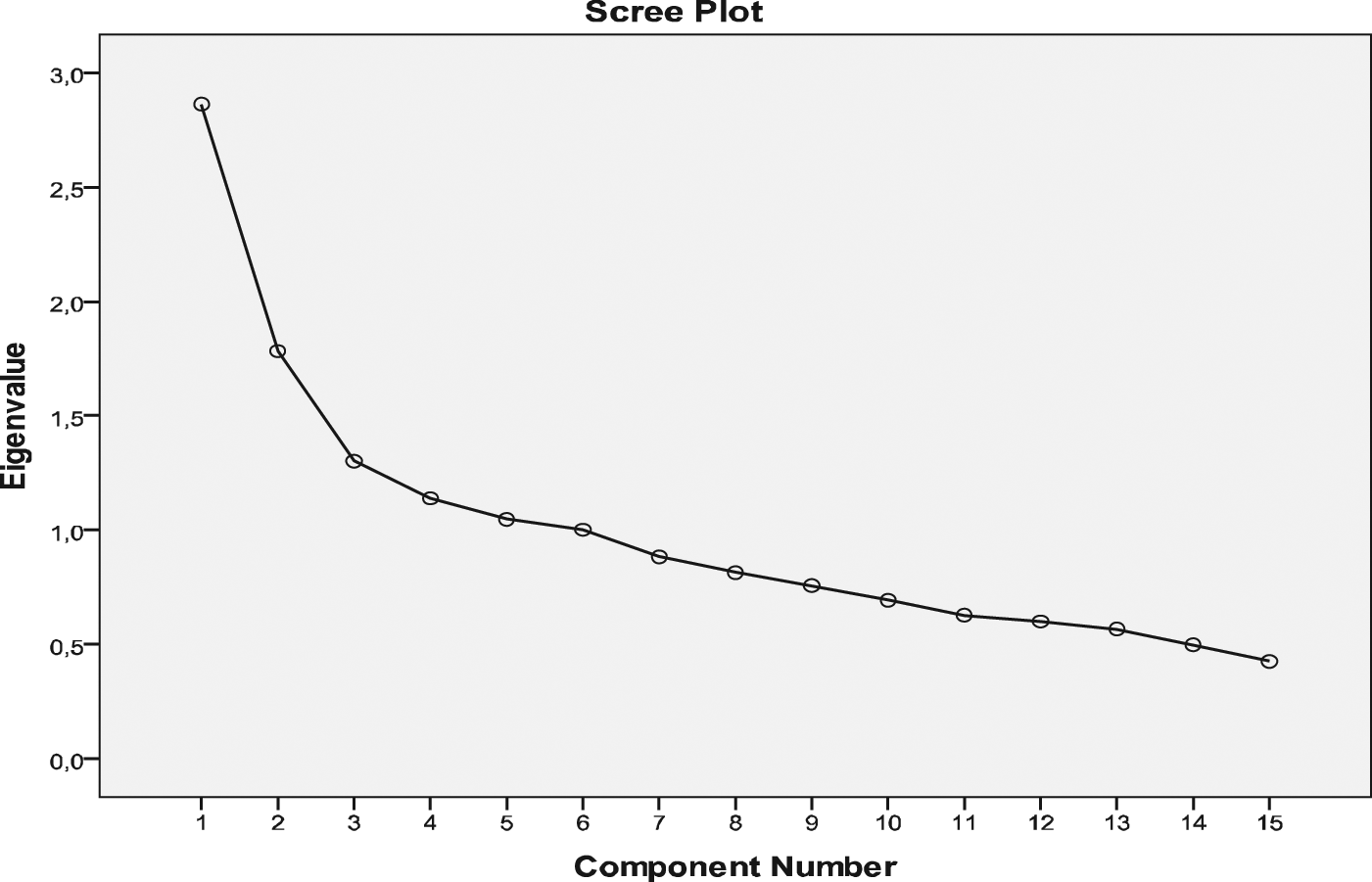
Scree plot.
Comments on the factor analysis results
Based on the results of the factor analysis, the six main factors were as follows:
Conclusions and discussion
The present study, based on Greek secondary education students’ experience, investigates their views on group work. All participants had experienced cooperative learning through group work models emphasizing mastery of knowledge and motivation, group work models that accentuate social skills and interpersonal communication, according to Sharan’s (2010) taxonomy, or group work models in which project-based learning was developed through problem-solving procedures, according to Slavin’s (2000) classification.
According to the results of this survey, Greek students, like their international counterparts examined by Cantwell and Andrews (2002), Vedder and Veendrick (2003) and Webb (2009), seem to develop a positive stance towards group work activities in order to experience the feeling of freedom as regards the acquisition of knowledge, the decentralization of the learning procedure and, above all, the possibility of questioning traditional learning principles and authority, including their teacher’s role (Table 2 and factor 1). Providing students with wider autonomy would, therefore, encourage participation and cooperation, provided that the expected procedures and outcomes of group work are clearly defined and mutually stipulated by both teachers and students, as Anagnostopoulou (2001), Baudrit (2007), Gillies (2007) and Sharan, (2010) have reported and recommended through their relevant international research.
Moreover, as regards group work, Greek students, like their counterparts worldwide (Mitchell et al., 2004; Phuong-Mai, 2008), prefer to cooperate with their friends (Table 2 and factor 6). However, specifically for Greek students, making new friends does not constitute a powerful incentive to participate in groups. This apparent inconsistency can be explained if one takes into account that, on the one hand, harmonious atmosphere between friends is considered by students to ensure productive and effective work within a secure and protective setting, as Thanh and Gillies (2010) have reported. On the other hand, as Ifanti (2007) and Koutsourakis (2007) have shown, the inflexibility of Greek curricula and the strict academic orientation of Greek education adversely affect and hinder Greek teenager potential for further social interaction and the building of new relationships within the group, especially in cases where the danger of ‘social loafing’ or ‘free-riding’ (i.e. obtaining rewards without effort) lurks, as Tan et al. (2006) have shown.
The prime academic objective of students can, also, be detected in their preference to be assigned with clearly defined tasks which are unambiguously distinct and different for each member of the group of friends (factor 5) – a preference similar to that reported by Gillies and Boyle (2008). Apparently, attaining group work objectives presupposes sharing tasks together, making equal and effective contributions and assuming accountability, as Brody and Davidson (1998) have remarked when defining the process and prerequisites of cooperative learning. Distinct tasks, first, discourage a display of laziness that is almost inevitable when friends cooperate, and, second, ensure that each member’s contribution will be fairly monitored, controlled and, finally, assessed as Serrano and Pons (2007) have highlighted when examining students’ attitude toward shared accountability. Therefore, despite reported risks (Gillies, 2007), groups can be formed by students themselves with the criterion of friendship, on the stipulation that a different duty has been allocated to each member of the group.
Notwithstanding academic orientation of group work, there is an obvious predilection, displayed by both high- and low-achievers, for assessment based more on the development of skills and competencies, such as commitment, keenness, perseverance, responsibility, etc., and less on the acquisition of academic knowledge per se (Frykedal & Chiriac, 2011) (factor 4). Cognitive skills assessment seems, also, to be acceptable, especially when it is connected to multimedia utilization, reading of books and creative writing. It is an obvious paradox that, for Greek students, development of behavioral and even cognitive skills is not included in the connotations of ‘knowledge acquisition’ term. This misconception is due to traditional prevalence of memorization ability, which within Greek educational procedures and practices is considered to hold an almost exclusive and dominant role that overshadows all other competencies and skills – a perception developed not only by high-achievers, as reported by Thanh (2011), but also by low-achievers as well. It is also due to the fact that in Greece, knowledge, in its narrow sense, is less regarded as a means for the overall development of personality and more as profitable equipment for social and economic advancement (Koulaidis et al., 2006). Such an understanding seems to result in undesired outcomes, as far as group work is concerned; students – and, also, teachers and parents – consider group work as a rather superficial and fun-type activity (a perception confirmed also by Tan et al., 2006 and Thanh, 2011), not as an in-depth and self-provoking process based on an alternative, constructive and profound way of learning, as Anagnostopoulou (2001), Kaldi and colleagues (2009) and Koutselini (2008) have shown in relevant research on the implementation of group work in Greek educational settings. These surveys have shown that what Greek students actually have learnt in the classrooms where cooperative learning was implemented could not be measured reliably, given the fact that in Greece, as mentioned above, there are no credible instruments for the assessment of social and affective skills developed during cooperative procedures. Therefore, Greek teachers who have implemented group work within the frame of the current conservative educational system could provide their students with a numerical grade that represented actually only their final cognitive performance. These studies have also shown that if teachers perceive ‘knowledge’ only with its academic/cognitive connotations, then the outcomes during cooperative procedures will be described as poor and inadequate, at least when compared to the load and quantity of content knowledge which can be transferred to students during conventional whole-class teaching.
Such misunderstanding about cooperative learning explains why, although Greek students consider group work as a pleasant way to assimilate new knowledge (factor 3), they do not want their teacher to assess how profoundly and creatively this knowledge has been assimilated (factor 4). Planners of educational policy should, therefore, redefine educational objectives and procedures, so that students, teachers and parents are fully aware that ‘knowledge’, in its broader sense, comprises a great variety of abilities that can be developed not only through traditional teacher-centred procedures but, also, through more creative and cooperative procedures as well (Sharan, 2010; Slavin, 2000), which all contribute constructively to the forming of integrated personalities. In fact, redefining the notion of knowledge could have a significant impact on the formation and assimilation by the Greek educational community of new values regarding cognitive, affective and social domains of human personality, as Cairns et al. (2001), Tan et al. (2006) and Vedder and Veendrick (2003) have indicated.
Moreover, as regards rewards, the ethos kind such as cinema visits or longer breaks seem to be preferable to improved grades. Students, first of all, consider every learning procedure, no matter whether traditional or innovative, as a competition where a ‘winning’ group should prevail over the others and get a specific reward. The requirement of reward has been reported to be a sine qua non element of learning through group work. According to Slavin and Cooper (1999) most teachers, also, prefer group rewards for group products, and individual rewards for individual achievement; the attention teachers traditionally pay to assessment and reward obviously affects their students’ perceptions of rewards. The fact, however, that students do not similarly want the best member of the group to get a reward is not contradictory; best member’s extrinsic reward intensifies in-group competitiveness and accentuates the feelings of inferiority and insecurity in the other members, as Hallam et al. (2008) have reported. In contrast, as Hurley et al. (2009) and O’Brien (2010) indicate, one group’s exceptional achievement and its subsequent reward seem to strengthen the bonds of cooperation within all teams, the feeling of belonging to the team, since it motivates group members to present better performance the next time they cooperate, without the fear that, in case of poor performance, some kind of personal/individual humiliation will follow. Moreover, the fact that students prefer ‘ethos rewards’ such as more recreation time or excursions to grades constitutes an indication of the displeasure that students experience during traditional teacher-centred procedures of teaching and assessment – a feeling well known to their counterparts worldwide (Gillies, 2007; Slavin, 2006). It also clearly indicates how much Greek students are full of angst, not due to the difficulty of traditional assessment procedures, but due to the one-sided evaluation where social and affective achievements are not taken into account and effort-making is underrated in comparison to final academic objective attainment, a stance often displayed by teachers worldwide (Cantwell & Andrews, 2002; Johnson & Johnson, 2009; O’Brien, 2010). As a result Greek students feel more secure when they participate in all procedures of assessment; first, they have the opportunity to safeguard themselves from the one-sided, restricted and strict evaluation of exclusive academic cognitive attainments, and second, they have the opportunity to improve their performance by including their personal effort, eagerness, cooperativeness and similar features in assessment criteria and about which young students probably feel more confident (Baldwin, 2000). It is probable that for similar reasons students would like excursions, visits to cinemas and theatres, and provision of longer recesses and free time for play to be used as rewards (factor 2); low achievers probably avoid personal humiliation which in traditional teaching process occurs when performance grades are announced, while high-achievers avoid the stress generated by the demanding pursuit of high grades and marks.
The impact of this kind of non-grade reward is further enhanced when it is provided right after the completion of the project, obviously because pleasant rewards excite enthusiasm and zeal when these are in their zenith. Teachers should, therefore, utilize this preference of their students in order to create positive learning incentives (Slavin, 1991; Webb, 2009) and gain eagerness, emulation and pleasure in their classrooms, as the research by Wellington University Teaching Development Centre (2004) has shown.
The present study showed that students participate effectively in group work when they feel secure, when incentives and attractive rewards are provided and, finally, when the decentralization of the teaching/learning procedure gives them a free hand to establish a suitable, functional and acceptable cooperative setting.