




Abstract
Recent research has produced evidence to suggest a strong reciprocal link between school context-specific language constructions that reflect a school’s vision and schoolwide pedagogy, and the way that meaning making occurs, and a school’s culture is characterized. This research was conducted within three diverse settings: one school in the Sydney Catholic Education system and two Education Queensland State schools, in Australia. Emergent from the school data is the understanding that a contextually created meaning system can be a powerful force, having a beneficial effect on, and symbiotic relationship with, school culture. Such a meaning system is not dependent on words alone. Metaphors, images, structures and processes unique to each context appear integral to the creation of meaning within each school, and how staff and students make sense of their ‘life-world’. Each meaning system works at the level of establishing and reinforcing basic norms, assumptions and ways of working. The creation of such a meaning system does not happen by accident but requires nurturing. This research suggests that over time, shared understandings appear to become intuitive to some extent, and accepted ways of thinking and working become firmly embedded as school culture.
Introduction
Central to this article are the findings from a doctoral research project which explored the context specific meaning-making systems developing within a number of Australian schools striving for ongoing school improvement. An example of this meaning-making system phenomenon emerged at Forrester Hill State School, in regional Queensland, some three or four years after the community had committed itself, in 2003, to the long-term Innovative Designs for Enhancing Achievement in Schools (IDEAS) Project (Crowther, 1999).
As a teacher within the school I had discerned its emergence and wondered whether others had noted the type of unusual vocabulary that was emerging. Visitors to Forrester Hill, including supply teachers, volunteers and new parents, noted that students and staff talked about ‘the PODS chart’ (the school’s behaviour expectations framework) and ‘roots’ (graphical images associated with the school values) that were displayed in classrooms, the office and the library. They also noted that these references were linked to images of a jacaranda tree that adorned the school, and many were curious to find out more. In 2004, I became the school facilitator of the IDEAS Project and the reflective nature of this role caused me to commence a reflective journal. This was largely made up of images and verbal reflections where I noted instances of how clarity and meaning were being enhanced within the Forrester Hill context as the school developed its vision and values, pedagogical principles and schoolwide pedagogical framework. Fortuitously, on commencing my research, this reflective journal became a useful source of long-term data.
The phenomenon and research question
Along with the evolving vocabulary the cultural flavour of the school appeared to be changing. I became conscious of the power the jacaranda tree metaphor, the school’s vision and the shared pedagogical framework appeared to have in creating connections to meanings and ways of working for all, including those new to the school. This connection to meaning is exemplified in Figure 1, a reflective journal excerpt that illustrates some of the unique ‘language-in-use’ in terms of jacaranda tree pods (Abawi, 2012a).
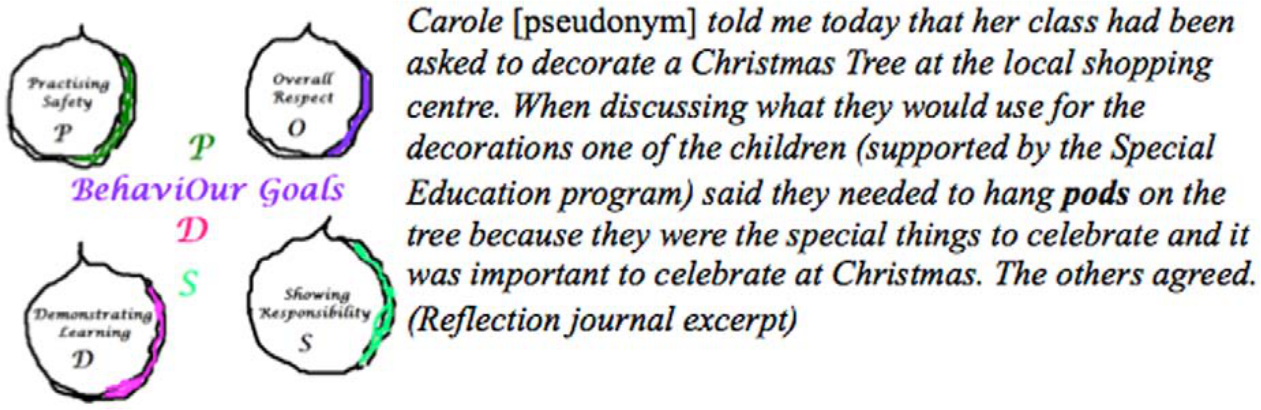
Evidence of metaphorical meaning making in practice.
The PODS behaviour expectations – Of what significance is the embedded presence of a contextually constructed ‘language-in-use’ within the lived experiences of school communities?
The present research explores this question through the study of three schools’ engagement with the IDEAS Project. Each school collaboratively developed a vision, values, and set of schoolwide pedagogical principles linked to a strong visual and verbal metaphor. This metaphor, like Forrester Hill’s jacaranda tree, was central to their emergent ‘language-in-use’ and the making of meaning across the school.
Literature
Schools must be places of learning not just for students but for staff as well. Learning in schools occurs when meaning making takes place. A sociocultural approach to understanding how learning takes place is built on cognitively explicating the relationships between actions and understandings. These are internalized and externalized, both individually and within groups, with distinct parallels and links between the two as they are positioned within context (Vygotsky, 1987; Wertsch, 1998). Teachers, who are themselves active learners, have new and valuable ideas to share, and the excitement of their professional learning breathes life and energy into their classrooms and the classrooms of others (Mitchell & Sackney, 2007). Active learners are continually engaged with processes of making meaning.
To understand at a deeply significant level, meanings must be clear and able to be shared across a school’s professional community. Within a professional learning community, where individuals share norms and values, utilize reflective dialogue, and are prepared to share practice and work collaboratively for the good of the collective over time, meanings become shared and unequivocal (Bolam et al., 2005; Kruse, Louis, & Bryk, 1994; Louis, Kruse, & Raywid, 1996). It is at the layer of sharing norms, assumptions, values and beliefs that the need for clear understandings and the making of meaning is particularly important. Schein (1985) sees this level as the one that underpins the culture of an organization.
Culture lies not just in the head and heart but is a phenomenon that rests, through language, in the public domain, thus ‘culture is public, because meaning is’ (Geertz, 1973, p. 12). Schein’s (1985) three distinct levels of organizational culture reflect where meanings are created within an organization. These are at 1) the artefacts level, where concrete representations of a culture can be clearly seen; the espoused values level 2), which is related to goals, strategies, and philosophies; and 3) the basic underlying assumptions level, where tacit and taken for granted assumptions ultimately guide practice. With Schein’s levels of cultural manifestation in mind, it was tacit understandings associated with deeper values, beliefs and assumptions (as reflected in daily conversations and portrayed by frequently used representations) that I, as the researcher, sought to show how meaning was being made in each school context. Evidence of the artefacts level and the values level were seen as adding breadth to gaining an understanding the ‘language-in-use’ phenomenon under investigation.
For shared meaning to be made a learning community needs to establish avenues of open, inclusive communication in a trusting environment (Hipp, Huffman, Pankake, & Olivier, 2008; Little & Horn, 2007). To establish this type of environment members of the community must have a shared understanding or common ground for making meaning. Reminders of cultural knowledge and expectations may be used as common ground on which the meeting of minds can take place. If common ground is not well established then words and phrases cannot be understood (Krauss & Morsella, 2000). Within schools this meeting of minds transpires when 1) teacher collaboration is encouraged, 2) the professional learning community commits itself to a common goal and 3) the concern for outcomes becomes a collective responsibility (Newmann, King, & Youngs, 2000). In conjunction with the acknowledgement of collective responsibility is the need to ensure that interpretations of practice are aligned, so each can support the other, when collective decisions are undertaken.
Within any community, interpretation creates a reflection of knowledge (Bandura, 1986; Berger & Luckmann, 1966). The dichotomous nature of this interpreted knowledge lends itself to a complexity of understandings, as knowledge can be internal or external, and tacit or explicit (Brookfield, 1995; Clandinin & Connelly, 1995; Nonaka & Takeuchi, 1995). The more clearly the factors that contribute to collective meaning making are understood the more likely it is that the core business of education – effective knowledge transmission and creation – will occur (Andrews & Lewis, 2002). When speaking of the power of shared dialogue Bohm (1996) conjures up a vivid image of ‘a stream of meaning flowing among and through us . . . a flow of meaning in the whole group, out of which may emerge some new understanding . . . this shared meaning is the ‘‘glue’’ or ‘‘cement’’ that holds people and societies together’ (p. 6). It is this stream of meaning that empowers schools and sustains quality practices (Abawi, 2012a).
School staff in their engagement with the IDEAS Project, are guided by a process of progressive intellectual and professional interrogation and development (Crowther, 2011). This results in the creation of shared mental models and meaning making which is frequently tied to a metaphorically rich school vision. These metaphors are unique to each context. Many agree that metaphor represents one way in which humans make sense of their reality (Morgan, 1980; Ortony, 1993). Metaphors are often used, consciously or sub-consciously to simplify the complexities of structures or understandings that abound (Cook-Sather, 2003; Morgan, 1980; Strenski, 1989). Metaphor can create a sense of coherence, because it can simplify and transmit dual messages. When judiciously chosen, and culturally specific, metaphor strengthens meaning making. Morgan’s (1980) research into the relationship between organizational culture, root metaphors and the language and customs of the organization has direct relevance to how culturally specific metaphor appears to impact on the making of meaning in the schools that lie at the heart of this research.
Setting the scene
The IDEAS Project engages schools in a deeply reflective process where staff members critically examine their current ways of working. This enables them to capture and strengthen the best of their current learning and teaching practices, whilst also uncovering areas for growth and improvement. Underpinning the IDEAS Project itself are a set of principles of practice that aim to ensure that a school’s resulting ‘new direction’ is based on transparency, distributed leadership in the form of parallel leadership, professional empowerment and trusting relationships (Crowther & Andrews, 2003). These practices underpin the way each of the schools in this research project operates on a daily basis.
Selection of schools
Throughout this article pseudonyms are used for schools and school personnel interviewees are identified by their role alone. The schools were drawn from two cohorts across two states that had engaged with IDEAS. They were purposively selected because they had completed the IDEAS Project, were willing participants and provided some variation on the basis of size and context. It was felt that each different context would provide a richer range of understandings and allow the elimination of those understandings that might otherwise be associated with contextual characteristics such as geographical location or system similarities. Each school possessed a strongly embedded vision and schoolwide pedagogical framework which had emerged as a result of the school’s engagement in the IDEAS Project. The principal from each school gave permission for the research to be conducted, as did the Sydney Catholic Education Office and the Queensland government system. Ethics approval was also gained from both systems and the University of Southern Queensland.
School background
The first school from which data were collected, Sunny Fields State School, is a small rural school in a fertile valley situated in southeast Queensland, Australia, which possessed a student population of 69 at the time of data collection. Three full-time teaching staff, one of whom is a Teaching-Principal, taught at this school. It was soon after commencing the IDEAS Project that student numbers dropped, which meant one teacher had to leave. However, after a period of 18 months student numbers rose again and this same teacher returned. Her perspective on the changes that had taken place in her absence added valuable insights to the research.
The second of these schools, Forrester Hill State School, was ‘my school’ for over 10 years. The school is situated on the outskirts of a large regional city in southeast Queensland. Attached to the school is a Special Education Unit that, at the time of data collection, supported over 60 students out of the 480 enrolled. This unit has since grown significantly. The school commenced IDEAS in 2003 as one of a cluster of 13 schools in the region whose principals had committed their schools to the project as a means of improving their school outcomes. Included in the interviewees at Forrester Hill was a new teacher to the school who was able to see the school through ‘new eyes’ thus adding another perspective to the data.
The third school community involved in this research was that of St Monica’s Primary School. St Monica’s is a school with a culturally diverse population of around 310 students. It is a Catholic Education school in a busy outer-Sydney suburb and is situated on a hill overlooking a main railway line, commercial properties and suburban housing estates. Soon after data collection the Acting Principal was formally appointed as Principal. Here too, a new staff member added valuable insights into St Monica’s and its unique meaning-making system.
All of these schools were not only committed to school improvement in the short term but also sought to sustain this improvement over time. The majority of the staff agreed that there was a sense of collective identity that had evolved from their development as a professional learning community, and as a consequence of the IDEAS project. Relationships within each school had become collegial rather than just congenial. Learning rather than only teaching had become the focus of professional conversations.
Methodology
By taking a phenomenological research approach I prioritized the lived experiences of school staff within the three school contexts. Being conscious that making meaning is dependent on many factors (for example, verbal, visual, body language, context and environment), I built my research approach on the work of Dilthey (1976) and his concept of Geist which refers to mind and consciousness objectified in language, beliefs and artefacts; the insights of Merleau-Ponty into language as a process ‘bring[ing] meaning into being’ (1962, p. 183); van Manen’s perspective that phenomenology seeks the very nature of a phenomenon ‘that which makes a some-‘‘thing’’ what it is’ (1997, p. 10); and Geertz who described thinking in terms of a progression of closely linked significant symbols that help make meaning noting: ‘such symbols are thus not mere expressions, instrumentalities, or correlates of our biological, psychological, and social existence; they are prerequisites of it’ (1973, p. 49). As a phenomenological researcher, my role was to capture, within context, consciousness of self and others, and to translate or interpret the essence of these lived experiences into understandings and possibilities applicable to other contexts.
Within the phenomenological research partnership, the researcher and the participants question what is said in order to explore deeper meanings and to interrogate experiences to ensure that lived experiences have been captured (Abawi, 2011). My role was a complex one as I was both researcher and a participant. The reflective journal I commenced prior to this research journey added longitudinal data and depth to the research understandings. Although my reflective narrative was important, at times I was not always able to easily make explicit my implicit contextual understandings acquired over time. I had to continually review my interpretations of culture, meaning making, language and professional community to reduce possible bias in the light of my own interpretation of what had taken place at Forrester Hill. Therefore, interpretations of data made by the researcher were presented back to participants to mobilize collective reflections on the accumulated experience of ‘we’, in a search for deeper meanings and ‘big picture’ themes, to confirm intent.
Data were collected from the three schools with interviews and observation being central to the data collection process. Those interviewed were the Principal, the Assistant Principal (depending on school size), a classroom teacher, a teacher new to the school (or in the case of Sunny Fields the teacher who returned to the school), and a teacher leader (n = 12). Images, displayed texts, websites and newsletters were also valuable sources of evidence that meaning making occurred in multimodal ways. All data were distilled through a reductive process adapted from the work of Merleau-Ponty (1964). As displayed in Figure 2, this involved the three phrases of depiction, reduction and interpretation. The process utilized filters, beginning with 1) dialogic exchange, 2) engagement and pedagogy and 3) visual manifestations, along with three main lenses (depiction of school, reduction to essence and interpretation into living knowledge) to distil the complex and varied forms of data down to descriptors. In return these revealed the essence of the meaning system phenomenon (Abawi, 2012b).
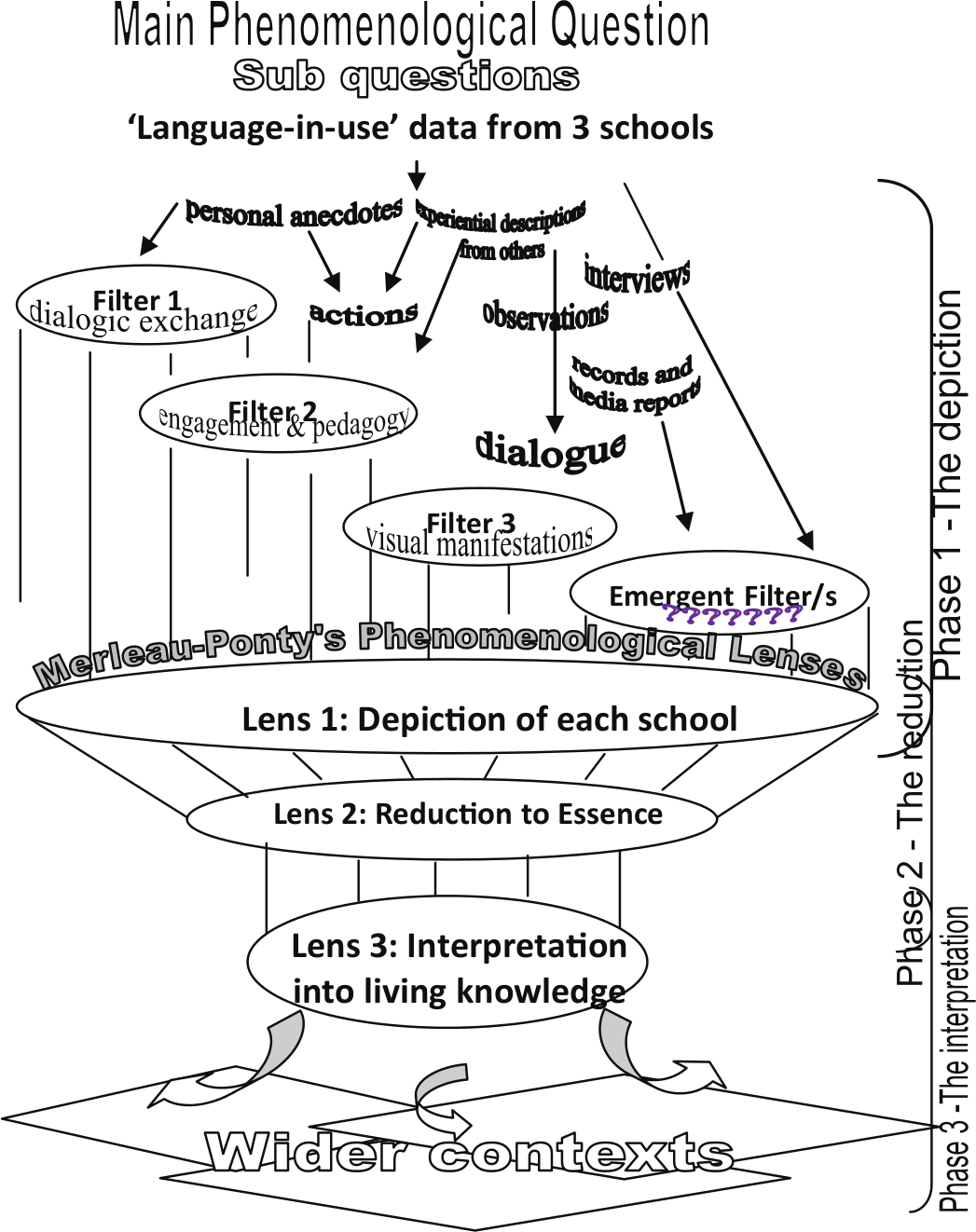
Overview of the three-phase data collection analysis, distillation and interpretation process.
Although each story was important in itself it was the combined experiences that showed how language, meaning making and culture were entwined. Themes were collated across the participant groups and across the various language modes. At times, role specific themes emerged. Although interesting in themselves, these were discarded as unique perspectives, not indicative of shared participant experiences.
Results
This section presents the results of the analyses using the distillation process. It allowed the meaning-making process that had been unfolding in each school context to be examined and illustrated. The reflexive nature of the research and its ability to reference back to data sources was integral to the explication of findings. To portray these data in a manner that is easy to follow, insights into each of the school’s ways of making meaning are presented initially as separate snapshots followed by combined interpretations and findings.
School snapshots
Sunny Fields
At Sunny Fields’ front gate is erected a sign with the words Growing beautiful futures in the valley of opportunities (Figure 3). Beside it is a colourful image of two children standing on either side of an adult, who is holding their hands in front of a large bottle tree. Behind this can be seen a traditional wooden school building built high on stumps and a number of low modern modular classrooms, situated within immaculate grounds, dotted with a number of large bottle trees.
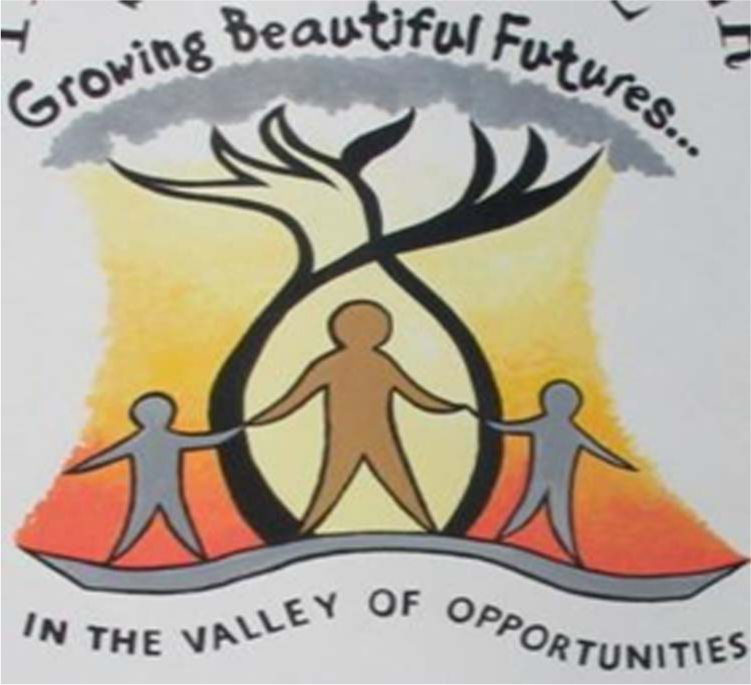
Sunny Fields’ front gate: Growing beautiful futures.

References to buds, growth and hands-on learning.
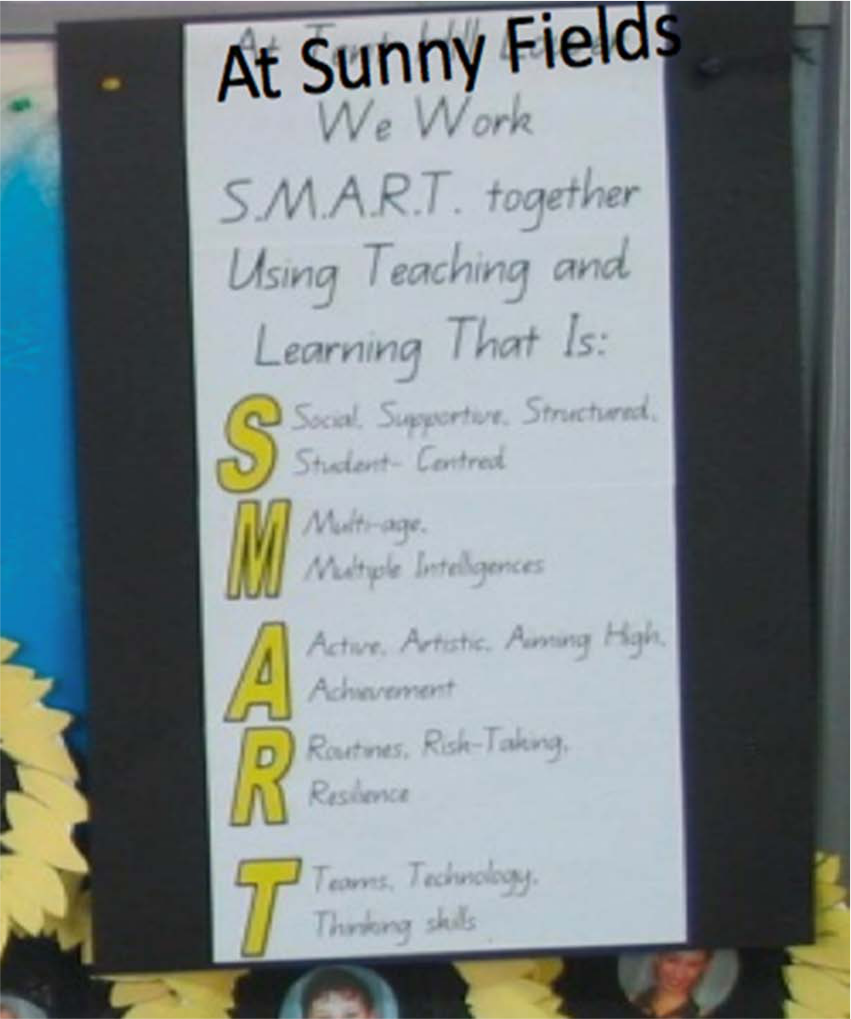
Sunny Fields’ SMART pedagogy.
References to buds, growth and hands-on learning reflect the school’s geographical positioning within a fertile valley where agricultural industry and farming are central to their community way of life. The majority of students come from farming families and the school is surrounded by fields in crop.
Academic achievement is seen as being central to the concept of ‘growing beautiful futures’ and the school’s SMARTS pedagogy stands for teaching and learning that is
The school’s website declares:
Our school provides a wonderful family friendly atmosphere where every child is recognized and treated as an individual. Enrolment . . . is your child’s ‘growth to a beautiful future' and you can be reassured that you have made a bloomin’ fine choice for your child’s education . . . there is a ‘valley of opportunities’ whether in the classroom, the sporting field or in an artistic endeavour for your child . . . Students learn in an environment that is firmly grounded in our community values . . . now known as B.U.D.S.
Forrester Hill State School
Forrester Hill not only has a sign at its entry displaying the words of the school vision but this vision is also painted clearly on a long retaining wall (Figure 6) so that the message Growing together – Learning forever can be seen for some distance. Central to the wall mural is a painting of a large jacaranda tree in flower, an image that is echoed in the grounds when the many jacaranda trees are in flower.

Forrester Hill State School mural: Growing Together – Learning Forever.
Students connect to this vision and as part of the school’s Vision Program students engage in a range of creative activities. For example, Figure 7 shows students working on a large banner for display on the school’s Celebration Day.
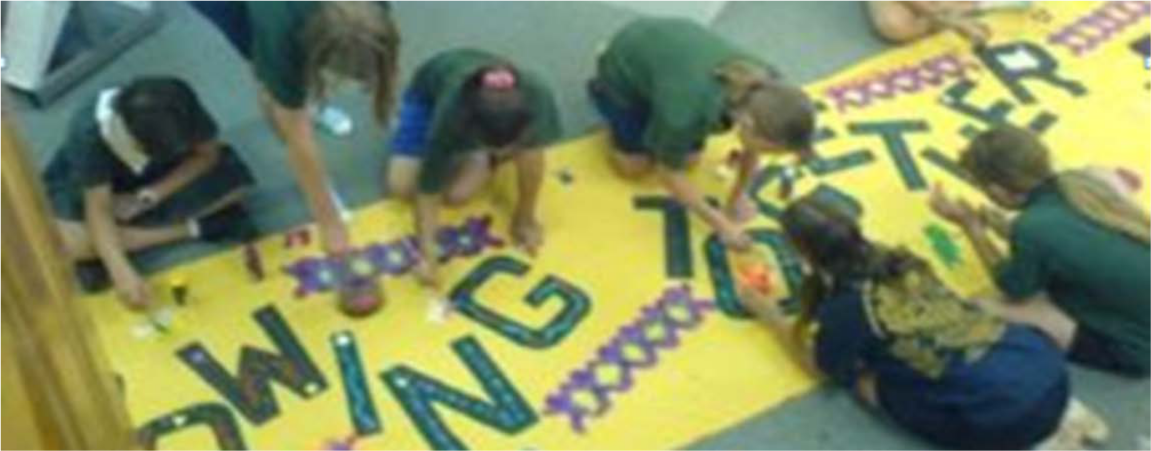
Creating a banner in the Vision program activities.
Figure 8 portrays the school’s schoolwide pedagogical (SWP) principles. They are known as the Jacaranda Tree SWP: Growing together (the trunk), learning forever (the leaves, flowers and pods), and supporting each other (the roots).

Jacaranda tree schoolwide pedagogy.
The school’s website indicates that:
Our Jacaranda Tree is the metaphor for the sense of purpose we feel . . . as we develop a root system embedded strongly in values education, a solid trunk built on celebrating difference in learning styles, cultures and backgrounds and producing flowers, seeds and leaves representing achievements for all to see in social skills displayed and through academic and cultural achievements . . . The staff, students and parents . . . are proud of our wonderful school and visitors are always welcome.
St Monica’s Primary School
Central to the space that greets visitors when they enter the walled grounds of St Monica’s is a large and historically significant eucalypt tree. Prominently displayed within the office reception area are silk banners of a child flying a kite at the top of a hill (Figure 9) and another with a large tree, with the hill in the distance. They stand in harmony with images of the school’s Catholic heritage.
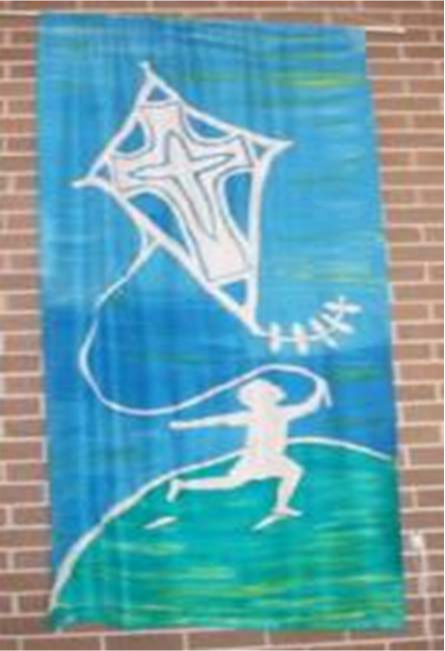
St Monica’s Primary School kite banner.
Figure 10 shows how the words of the school’s vision, From this hill we will soar, greet visitors at the reception window.
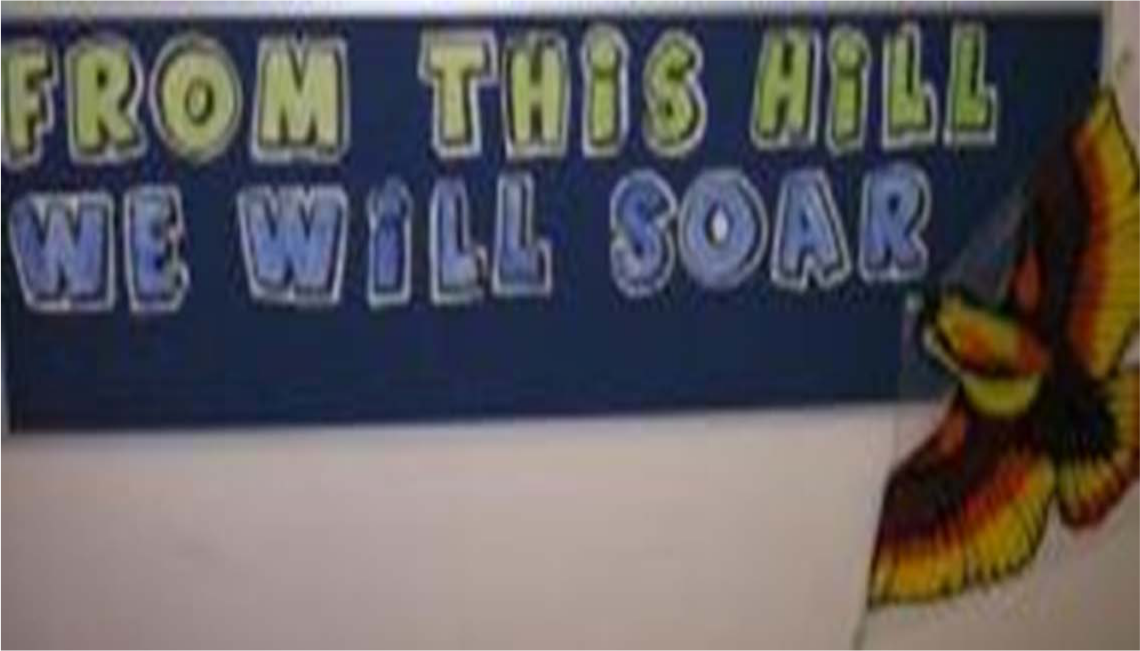
St Monica’s Vision displayed in the reception window: From this hill we will soar.
The school’s pedagogical framework, known as the KITES framework is prominently on display across the school. This acronym conveys the principles that underpin their approach to teaching and learning:
The school website states:
Teachers and students have embraced our ‘Vision for Learning’ statement, the language of which is actively used daily between teachers and students within learning. This shared understanding guides the whole school community to be able to soar, reach our potential and to be successful as learners of the twenty-first century.
Combined interpretations of key meaning-making elements
A strong feature of the vision statements holding such a prominent place within each school context was the sense of shared history and environmental connectedness that was woven into the words, imagery and context specific metaphors:
A valley of opportunities relates to the long tradition of farming within the Sunny Fields’ community and the surrounds in which the school is situated, while the large old bottle tree reflected both the surrounds and an enduring strength in community.
Growing together, in conjunction with the image of the jacaranda tree, was treasured by the founding parents at Forrester Hill. This was because the words related to a successful student peer support program and were tied to the image of the trees adorning the grounds.
The words From this hill were spoken in farewell by the last Mercy Sister to be principal at St Monica’s. They reinforce the school’s Catholic heritage as well as its geographical position, whilst the imagery of the kite connects with the words We will soar.
The schoolwide pedagogical (SWP) principles derived from each vision are artefacts of each school culture and provide well-defined links to their espoused values (Schein, 1985). These values are captured as principles and developed to meet the needs of their specific student community. The SMARTS pedagogy at Sunny Fields refers broadly to student-centred pedagogy in a rural multi-age context, where hands-on ‘active learning’ is a major focus. There is an emphasis on creativity, team building, setting high expectations and higher order thinking activities within a caring environment. At Forrester Hill, ‘Growing Together, Learning Forever, Supporting Each Other’ relates to risk-taking in a supportive environment. This involves building personal and social skills, the exploration of learning through substantive conversations and higher order thinking tasks, relevant to the students’ life worlds, and facilitating strong relationships. The wording of the KITES pedagogy (Knowledge, Innovation, Taking Risks, Empowerment and Success) refers broadly to metacognition as a higher order thinking process, creativity, ‘having a go’, high expectations, personal development and achieving success.
It was each school’s vision and SWP in conjunction with clearly articulated values that underpinned each meaning-making system. Investigation of these artefacts in conjunction with extracts from interview transcripts provide an understanding of the shared meaning systems that emerged. Transcripts from the interviews with the teacher most recently arrived at each school help show the significance of the meaning-making symbolism from a ‘newcomer’s’ perspective for each school culture.
Sunny Fields’ interview transcripts provide evidence of their collaborative learning community. The returning teacher to Sunny Fields is labelled from now on as the ‘new teacher’ in line with the other school contexts because she said on her return to the school ‘that I feel like a newcomer here - it is so different now’:
The vision, the pedagogy . . . we are very much all on the train and we are going there together. (New teacher) People like the feel of the school – in part it’s the language of our vision, BUDS values and SMARTS that creates that feel that we are all working together. (Principal)
Extracts taken from Forrester Hill interview transcripts reflect staff feelings of connectedness and the making of meaning together:
Referring to the visuals keeps us focussed and centred – aligned . . . I just love the tree – it makes the links for me. (New teacher) From Prep to Year 7 we are using the same terminology and that consistency really makes a difference for our students and staff. It’s all related to our vision and SWP – and the PODS sheet has the same meaning for all of us. (Classroom teacher)
Similarly, interviews with staff at St Monica’s show how their vision and SWP has drawn the school community together:
I think the KITES made things very clear for me and it fits in nicely with the culture of the school and because it’s situated on the hill. Breaking meaning down for the children has been easy because they really connect with it. (New teacher) Our Vision and SWP have opened up the way and removed barriers across the school. (Principal)
More extensive extracts are provided to explore the research finding related to how the shared meaning system in each school appeared to be a part of the fabric of daily life. Generally only one interview extract from each of the three schools is used to illustrate this finding but each is representative of similar statements across all three schools.
Relationships strengthened within a culture of trust and ‘no blame’ facilitate the willingness by individuals and groups to share deeply held opinions and practice, which is the forerunner to the creation of shared meaning.
It’s all about relationships. If they’re not there then forget it! We’re a collegial lot now – there is a willingness to share our teaching approaches – the good and the bad – so that we can move forward together. There is a real sense of combined professionalism that we did not have in the past. (Sunny Fields teacher)
Educators used the shared language as a conduit for sharing understandings of how to improve teaching and learning.
I guess it’s a shared understanding of who we are, what our kids needs are and where we have come from. The conversations we have now are really centred on learning and we talk and plan together across the school. We want to improve, we want to make it the best possible place it can be for the kids, so everybody feels safe and everybody is learning. We want to help every child to have understanding so that they don’t feel confused moving from one room to another, from the classroom to the playground. (Forrester Hill teacher)
The rich metaphors appear to be a key cultural reference point within the meaning-making systems used to unify each community, and seem to have a genuine significance for some students.
The other night we had our disco . . . a parent pulled me aside and said ‘Oh, I just wanted to let you know that I went with D . . . to his year five interview for his year seven entry into high school. One of the teachers there who was interviewing the prospective students asked him where he went to school. He said, ‘Oh I go to St Monica’s’ and she said ‘Oh I’ve heard such lovely things about that school’. I thought it was just a passing comment . . . but then she started to talk to him about school and what he was doing at school and all that sort of thing and she said, ‘Oh that is where the KITES is happening, isn’t it? And D . . . said, ‘Oh yes’ and I asked the interviewer ‘How did you know about the KITES?’ and she said, ‘Because the children who are coming in for the interviews have been talking to us about KITES’. (St Monica’s principal)
The ongoing commitment to the shared meaning system appears central to strengthening both the cognitive and relational connections across each community.
The overarching thing is that it is the whole place, the way things are tied together with the tree, the vision, etc. They create meaning. The conversations that occur seem to happen anywhere. The understanding of relationships happens inside self and out, the understanding of concepts and how to teach well – that’s inside and out. There is no one place where minds meet. (Forrester Hill new teacher)
There is an organic symbiotic relationship between meaning making, knowledge creation and cultural uniqueness which paradoxically facilitates both stability and change in the ‘language-in-use’:
It’s also a really important reminder to ourselves – as you know how you’ll find some great practice that works and then over time it kind of fades out of the picture – well we did not want this to happen unintentionally. Fair enough if the pedagogy changes because of the students’ needs, but that is intentional not forgetfulness driven change. (St Monica’s teacher leader) Since we wrote our SWP we already need to deliberately change it – since then we have done our literacy training and that has given us new knowledge and greater insights into the best way to teach certain aspects of the essentials and how to look at texts both verbal and visual. (Sunny Fields principal)
For those interviewed within each school there was a genuine sense that the shared context-specific metaphorical imagery, linked to their context and culture, influenced how their shared understandings were created and their shared meanings were made, on a day-to-day basis. It is the strength of these connections that has significant implications for those intending to develop and implement their school vision and SWP.
The schools’ cultures of no blame, and development of trusting relationships, along with their promotion of open sharing of ideas and critiquing of practice was felt to be deeply challenging to some newcomers. As explained by a teacher who found the ‘transparency of professional practice . . . intimidating when new to a ‘‘no blame’’ environment’ (Sunny Fields new teacher). This was a sentiment also echoed by the teacher at Forrester Hill who stated, ‘the raised expectations here can prove challenging to those who were not involved in the journey and who then have further to travel to meet the challenge’. This should not be surprising. Shared meaning making and cultural understandings are something that take time to develop. They are dependent on dialogic exchanges that go beyond surface level understandings, such as those portrayed by visual and verbal metaphors. The meanings and expectations are not easily accessible to some, particularly those new to a school. The Forrester Hill principal put it this way:
I do expect a lot from my staff – but they also expect a lot from themselves and each other. This has a flow on effect and students are also aware there are high expectations. Mind you no-one has to do it alone we really do believe in ‘Supporting Each Other’ and whatever someone needs (teacher or student) in order to grow, I will provide that support. (Principal)
At the norms and assumptions level, these professional learning communities had, over time, accepted that their work would be critiqued and areas for improvement identified. Both their individual and collective efforts were designed to improve practice and it was acknowledged that this would require commitment and action on the part of each individual staff member.
Each school had developed an individually specific meaning system that on a surface level was uniquely distinctive to context. Yet even though each school’s meaning-making system had its unique characteristics, points of commonality emerged. Before this type of shared language became obvious in any of the three contexts it appeared that a number of pre-requisites needed to be in place. Fundamental to the evolution of shared meaning was the establishment of strong relationships built within a ‘no blame’ environment. There needed to be a collective commitment to the goal of improving outcomes. It was staff involvement in frequent pedagogical conversations that created their shared mental models of what constituted quality-teaching practices as captured in their SWP. In all three schools these shared mental models were reinforced with verbal and visual images. These images reminded, focused and refocused staff, and the school community as a whole, onto the ways of working that would best reinforce their shared beliefs and goals portrayed by their school vision and SWP.
Conceptualizing the making of meaning
The concept of a school’s ‘meaning making’ that emerges from the study is presented in Figure 11. It illustrates the symbiotic nature of the relationship between meaning making, school culture and ‘language-in-use’ within a school’s context specific, emergent meaning system. Each element within the figure feeds off and supports the other while influencing the character and usability of the context specific meaning system that evolved in each context. The rich cultural metaphors built around vision and SWP appeared to be key to the sense of collective purpose and alignment of practice within the school community, thus helping to sustain energy and commitment over time. Cultural understandings at the norms and assumptions level appeared to impact on the everyday practices of teachers and leaders, guiding expectations and ways of working, and in turn impacting on language and culture.

The symbiotic nature of meaning making, school culture and ‘language-in-use’.
Implications
This research suggests that school cultural artefacts such as metaphor and imagery reinforce culture and the uniqueness of the ‘language-in-use’. They may be quite specific to context and thereby act to reinforce both culture and meaning. Following on from this it would seem that those new to such embedded school cultures need time to become enculturated and familiar with their meanings. The nurturing of strong relationships within these school communities assisted in orientating and engaging newcomers, including both students and teachers. As staff members collaborated and learnt together their ways of making meaning were enhanced through the use of conduits such as a strong Vision and Schoolwide Pedagogical Framework. These both acted to establish and reinforce shared understandings, and allow meanings made to be transferrable from the familiar to the unfamiliar.
Through staff professional conversations the dynamic nature of the ‘new meanings’, became embedded within the larger, context-specific meaning system and seemed to allow teachers to dig deeper into their pedagogical understandings. Such dialogue allowed staff to tap into the power and durability of the culturally specific meaning. This suggests that school leaders need to be astute enough to focus on sustaining shared meaning through conscious reiteration of culture and prioritized ways of working – seen as achievable through adhesion to schoolwide pedagogical principles.
It is argued here that meaning making, ‘language-in-use’ and culture are organic and intuitive thus allowing all three to be sustained and enhanced over time. Of equal importance to the treasuring of a contextually specific meaning-making system is recognition of the symbiotic nature of the entwined parts. Strong induction programs are needed in order to bring outsiders ‘in’, while at the same time allowing them to contribute and add value to what already exists.
Conclusion
A collectively developed Vision and SWP have the potential to facilitate the creation of shared meaning across a school community. Schools with a clear Vision and SWP that align ways of thinking and working develop a strong school culture where the language and concepts in use can resonate well beyond the specific context. As in the PODS and KITES exemplars, it appears that the use of metaphor in such context-specific meaning systems may enable students to transfer their school specific cognitive understandings wider afield. In addition, it suggests the vocabulary of a context specific meaning system carries its own messages about culture and identity to those unfamiliar with the context. Cultural metaphors (Marshak, 1996; Morgan, 1980), both visual and verbal, help to reinforce ways of working within a school enabling shared understandings to be strengthened and built upon. However, those new to a school may initially find the shared understandings and ways of working both stimulating and confronting. The meaning-making system developed within each of the three schools at the focus of this study emerged as a result of a commitment to a whole school improvement process – the IDEAS Project. Within each school a symbiotic relationship was shown to exist between culture and ‘language-in-use’ exists, ensuring that each meaning system remained dynamic and relevant.
Figure 12 captures the essence of how relevancy and flow of meaning across a school community is inextricably entwined with a school’s Vision and SWP. Even though each meaning system has context specific vocabulary embedded within it there are many similarities in their overall characteristics. Through the IDEAS Project, culture and meaning are built on the central concepts of parallel leadership, positivity, focused learning, a ‘no blame’ environment, and professional critical reflection pertaining to the choosing of pedagogies best suited to student needs in context.

School specific shared meaning: A collage of school artefacts.
Once present, a contextually specific meaning system can be utilized by educators, both individually and collectively, to make rapid cognitive and relational connections. These can strengthen and deepen identity and assist in the meaning-making processes so fundamental to learning. It is suggested that the depth of professional dialogue that precedes the creation of shared meaning is fundamental to the evolution of a contextually specific meaning system. It would seem that professional discussions that evaluate and justify pedagogical choices in the light of a school’s agreed pedagogical principles help ensure integrity of intent. When new learning creates new or deeper understandings then adjustments can be made thus influencing both meaning and ‘language-in-use’, whilst still remaining anchored within the safe harbour of a shared school culture. A contextually specific meaning-making system therefore is continually in a state of evolution. It is this dynamic ebb and flow that has the potential to reinforce and bolster a school community’s sense of who and what they are, thereby ensuring that cultural values and beliefs, norms and assumptions are aligned and sustainable over the long term as staff, students and families come and go. The symbiotic relationship between culture and ‘language-in-use’ is supported by varied language representations. Visual depictions of pedagogical principles and school vision are vital in reinforcing and sustaining shared understandings of culture and practice over the long term.