



Abstract
The present questionnaire-based study was conducted in 2010 in order to examine 677 Greek Second Chance School (SCS) students’ perceptions about the cognitive and socio-affective outcomes of project-based learning. Data elaboration, statistical and factor analysis showed that the participants found that project-based learning offered a second chance to develop various cognitive skills regarded as professional qualities facilitating their re-integration in society. It also showed that socio-affective skills are developed during project-based learning. The successful acquisition of skills such as persistence, willingness, cooperativeness, creativity and initiative, according to the present work, depends on and is linked to each learner’s personal experiences, traits, needs, interests and objectives which during project-based learning are engaged but subordinated to social, cooperative objectives and expectations. Project-based learning provided in SCSs is, therefore, considered to be a powerful means in fighting social marginalization, stigmatization and labelling of school dropouts.
Introduction
Second Chance Schools (SCSs) were first established across Europe in 1995 in compliance with the official guidelines of the European Commission’s White Paper on Education and Training (1995) which aimed at adjusting educational systems to the increasingly exacting requirements of European society. What had to be addressed more urgently was the progressive rise in the number of dropouts from education that had driven more than 10 percent of the entire European Union population to extreme social marginalization and consequent exclusion from the labour market’s developmental orientations. SCSs, first set up in France, Germany, England and Spain, provided adult students with the opportunity to complete compulsory education, in order to develop cognitive, affective, social and professional skills regarded as indispensable to all citizens of Europe. In 2000, the European Union in the European Council of Lisbon (European Parliament, 2000) adopted the Memorandum on Lifelong Learning (European Commission, 2000), which set the principles, objectives, rules and procedures for the development of Lifelong Learning national strategies across Europe in order to enhance social cohesion and generate active citizenship. SCSs across Europe were further developed in 2006 and 2007 when the European Parliament’s ‘Lifelong Learning Action Programme’ (2006) and the European Commission’s ‘Action Plan on Adult Learning’ (2007) promoted the exchange and transference of experience in lifelong learning and supported statutorily and fiscally educational institutions which joined forces in fighting against school dropouts’ segregation, social ostracism and subsequent manpower ghettoization.
In Greece, the first SCSs were established in 2000, under the provisions of Law 2525 (Greek Government Gazette, 1997) and further developed in 2008 under the stipulations of the Ministerial Decree on the Organization and Operation of SCSs (Greek Government Gazette, 2008). Today (2012) 57 SCSs – six of them within prison areas – and 60 subsidiary branches operate across the country with over 1335 teachers, providing education to more than 15,000 adult students on Greek and English language, mathematics, information technology, environmental issues, social studies, aesthetic studies, technology and physics, in addition to orientation, career and vocational counselling in collaboration with public advisory support services and the local labour market (Karalis & Vergidis, 2004). Graduates of SCSs are provided with a title equivalent to the Junior High School Leaving Certificate, recognized by the Supreme Council for Civil Personnel Selection (ASEP), enabling them to continue their studies in Upper High School (either for General or Vocational Education) and in Private Institutes of Vocational Training (IIEK) or attend professional training courses provided by the official Educational Services of the Manpower Agency of Greece (OAED) (Papastamatis & Panitsidou, 2009; Zarifis, 2008).
During the last decade, SCSs have decisively and clearly defined social and emotional skill development as a sine qua non prerequisite for the cognitive and professional development of the learners (European Council, 2003; European Parliament, 2006; University of Florence, 2010). Adult students are expected, in fact, to change, improve and integrate their personalities through their involvement in in-school interpersonal activities of problem-solving which, indeed, are simulations of real-life problems that need to be successfully addressed (Bennetts, 2003; Cope & Kalantzis, 2000; Zepke & Leach, 2006). Learners are also expected to develop, beyond academic performance and achievements, personal traits and features such as determination, adaptability, helpfulness, affective maturity, self-confidence, self-knowledge, inventiveness, resourcefulness, creativity, imagination, sociability and openness (European Commission, 2007; Research voor Beleid, 2010).
Project-based learning procedures are considered to serve as credible instruments and means for the attainment of such objectives. Ravitz (2010, p. 293) defines project-based learning as ‘an approach to instruction featuring (a) in-depth inquiry, (b) over an extended period, (c) that is student self-directed to some extent, and (d) that requires a formal presentation of results’. Recent research has confirmed a variety of positive outcomes regarding project-based learning for adult and non-adult learners. Mergendoller, Maxwell, and Bellisimo (2007) and Walker and Leary (2008) reported that students who engaged in project procedures displayed a significant degree of understanding of complicated concepts and, even, subtle notions and connotations, probably due to the constructive exchange of knowledge and information that takes place during group members’ interaction and co-operation, as Geier and colleagues (2008) have also noticed. In addition, Dochy, Segers, Van Den Bossche, and Gijbels (2003) and Kloppenborg (2009) showed that project-based learning helps learners not only to understand their social environment but also to exert a positive influence on it through implementing in real life what they have learnt in a classroom where problem-solving procedures, based on prior experiences and constructively elaborated social emotional and cognitive stimuli, are developed, as Savery (2006), Strobel and van Barneveld (2008) and Van Ryzin and Newell (2009) have pointed out. Moreover, Beckett (2002) and Polman (2000) reported that students’ ability to evaluate personal and their classmates’ achievements is significantly improved, especially when students are fully informed about the aims, the methods and the potential benefits of project-based learning.
Furthermore, DeFillippi (2001) has reported that learners who participate in project-based learning are later more easily included in the labour market given the fact that they are more accustomed to changeable learning and working environments. Nadler, Thompson, and Van Boven (2003) found that familiarizing learners with demanding environments remarkably strengthens their argumentation and negotiation skills, since they are expected not only to create and assimilate knowledge within cooperative settings but also to transfer this knowledge to the members of other groups. Volkema (2010), in addition, has reported that such positive social outcomes are further developed when students have methodologically and systematically worked not only in groups where friendly relationships between the members are developed, but also in groups where, despite the absence of apparent amicable relations, mutual objectives and aspirations create bonds of commitment and shared responsibility. As far as social inclusion is concerned, Raelin (2000) and Smith, Smarkusky, and Corrigall (2008) have shown that the effective social integration of learners who have developed reflective thinking and professional qualifications skills based on this kind of thinking is one of the most significant outcomes of project-based learning as regards adult and non-adult students. This is especially the case when projects carried out by students bring them in close contact with the job market, provide them with meaningful knowledge regarding information technologies and encourage them to take on responsibilities and initiatives (Hedberg, 2009; Pearce & Doh, 2005; Roper & Phillips, 2007) and assume roles and duties that further exercise reflective and creative thinking (Paulson, 2011).
Project-based learning has been also reported (Frame, 2002; Wurdinger & Enloe, 2011) to facilitate self-knowledge, self-regulation and self-confidence in learners. Gray and Larson (2008), Hansen (2006) and Harrison, Price, Gavin, and Florey (2002), have shown that learners who participate in cooperative learning activities during project-based learning develop noticeable feelings of persistence, decisiveness and determination which help them form a more reliable and clear perception of their own personalities, abilities and potential. In addition, Ashraf (2004) and Bransford, Brown, and Cocking (2000) have found connections between this optimistic, constructive self-perception and the maturity process which is further consolidated when learning experiences adapted to student traits, needs and interests within a school setting are linked to personal real-life experiences where one is expected to display a better understanding, control and regulation of one’s own life, as Bell and Kozlowski (2008) have shown.
In addition, Railsback (2002), Wurdinger and Rudolph (2009) and Wurdinger, Haar, Hugg, and Bezon (2007) have reported that project-based learning significantly contributes to the development of skills such as flexibility, cooperativeness, adaptability, enthusiasm and resourcefulness. Such traits are reported by Newell (2003) to be transformed later into essential social skills, since learners develop social adaptability and acceptance of diversity and, also, willingness to actively ask for solutions to emerging social problems, in particular problems concerning exclusion, marginalization and labelling of underprivileged people. Such features are described by Bridgeland, DiIulio, and Morison (2006), Littky and Grabelle (2004) and Wurdinger and Enloe (2011) as crucially important as regards typical education dropouts and socially marginalized people.
As regards Greece, project-based learning is widely practised in adult education provided in SCSs, is moderately implemented in some primary mainstream education schools (Chrisafidis, 2002; Kaldi, Filippatou, & Govaris, 2011; Mattheoudakis, 2005; Taratori-Tsalkatidou, 2007), but it is almost unknown in secondary education, constituting, therefore, a significant novelty for the conservative and rather inflexible Greek educational system (Koulaidis, Dimopoulos, Tsatsaroni, & Katsis, 2006). Project-based learning in Greek SCSs is based on the principles of lifelong learning (Panitsidou & Papastamatis, 2009), utilizes students’ prior knowledge and involves them in experiential learning procedures through interdisciplinary and cross-thematic approaches (Doukas, 2003; Katsarou & Tsafos, 2008). In addition, academic knowledge and socio-affective competences, such as perseverance, collaboration, flexibility, meta-cognitive awareness, sentimental stability, enthusiasm, determination, commitment, effectiveness, disposition to improvement et cetera, are expected to be acquired through undertaking projects which involve discovery learning in workshops, group activities, participation in cultural events and cooperation with the local job market and advisory support services (Efstathiou, 2009; European Association for Education of Adults, 2006; European Commission, 2009; Koutrouba, Vamvakari, Margara, & Anagnou, 2011).
Given that the outcomes of project-based learning in SCSs in Greece have not yet been fully described from the point of view of the learners (Jimoyiannis & Gravani, 2011; Zembylas, 2008), the present study aims at examining adult students’ perceptions about the cognitive and socio-affective attainments achieved during project-based learning in SCSs in Greece.
Methodology
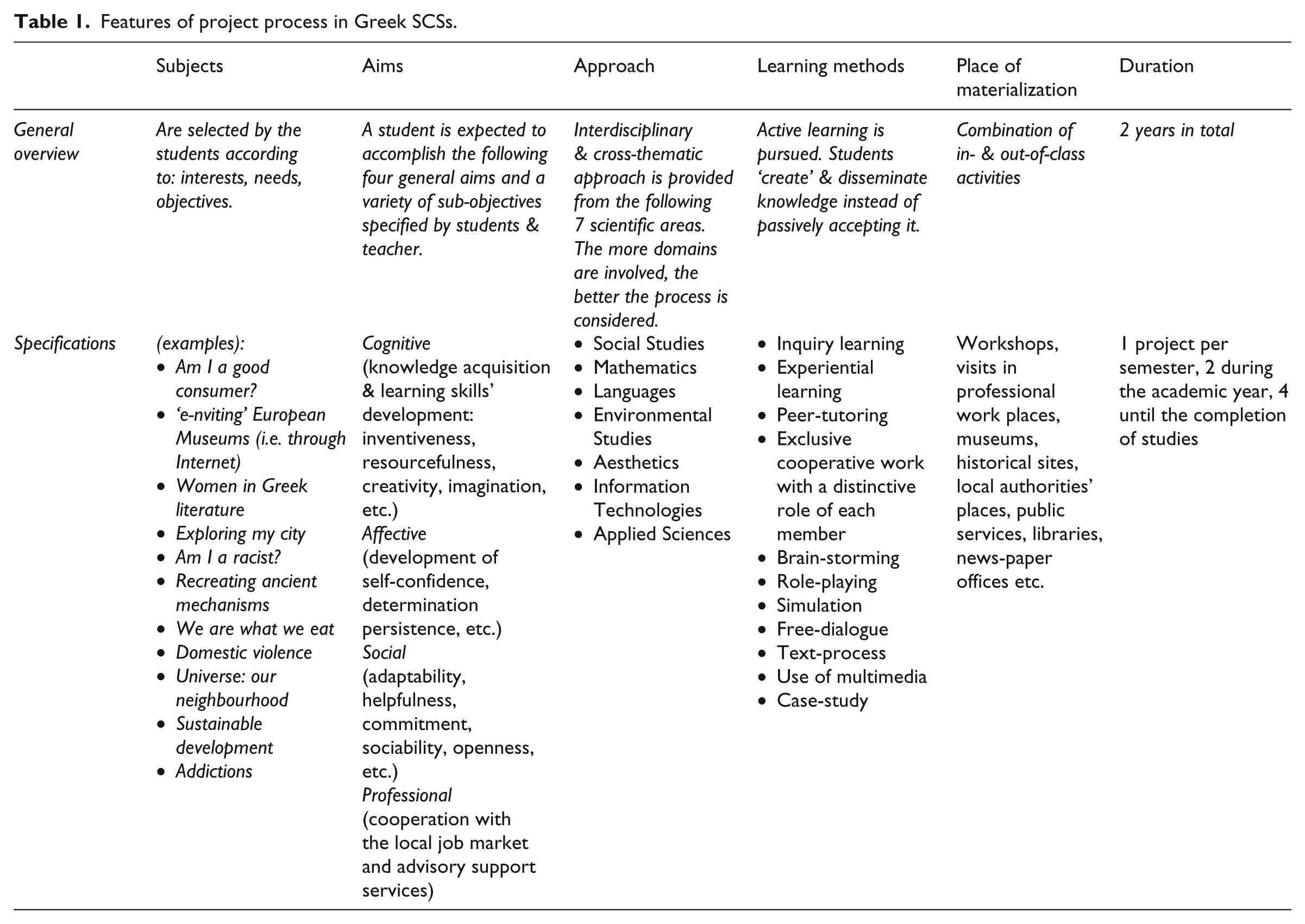
The present questionnaire-based research was conducted during the academic year 2010–2011. A group of 10 university students were provided with systematic information by the researchers in order to help SCSs’ adult students in different Greek areas to understand and complete a questionnaire comprising 45 close-ended questions. The university students and the researchers proceeded to visit 24 SCSs and 10 subsidiary branches throughout Greece and distributed in total 900 questionnaires after making personal contact with school principals, teachers and adult students. These SCSs were selected on the basis of criteria regarding teacher and student population and socio-financial features of local communities in order to ensure that as many adult students as possible, living in varied social, economic and educational environments, would provide relevant information. The ratios of the selected students to schools and of schools to each area represented the corresponding national ratios, ensuring, as far as possible, that the sample was representative. A broad outline of the project process carried out in these SCSs can be seen in Table 1.
Features of project process in Greek SCSs.
The questionnaire comprised 45 close-ended questions with pre-coded replies: five of which required adult students to provide information about their personal profile, while 40 special questions referred to students’ perceptions about cognitive and socio-affective outcomes of project-based learning in SCSs. The questionnaire, originally written in Greek and then translated into English for the purposes of this article, was self-administered because it was not possible to identify an instrument from the literature that allowed researchers to capture all the variables involved in this study. For this reason, the synthesis of the questionnaire was mainly based on the research findings of Beckett (2002), DeFillippi (2001), Katsarou and Tsafos (2008), Paulson (2011), Ravitz (2010), Wurdinger and Enloe (2011) and Wurdinger and Rudolph (2009).
Six hundred and seventy-seven adult students (n = 677) agreed to cooperate with the researchers and fill in the questionnaire (response rate: 75.2%). Three hundred and eighty participants (56.1%) lived in Athens, the capital city of Greece, and two hundred and ninety-seven participants (43.9%) lived in peripheral, rural and insular prefectures of the country.
The scoring of the special questions was based on nominal five-point Likert-type scales (i.e. 1 = not at all, 2 = slightly, 3 = moderately, 4 = much, 5 = very much), incorporating properties of labelling and classification. A statistical coding of the questions and answers followed the collection of the questionnaires. Data elaboration and statistical analysis were performed using PASW Statistics 18. Factor analysis was employed, using PCA with the Varimax rotation extraction method, to pinpoint the main factors influencing the participants’ views on the cognitive, emotional and social outcomes of project-based learning in SCSs. All relevant statistical tests were performed at a significance level α = 0.01. A broad outline of the more significant results and conclusions of the present research is presented below.
Analysis of results
Participants’ profile
Of the 677 SCSs’ adult students who participated in the research, 54.2 percent were women, while 45.8 percent were men. The participants’ age was as follows: 18–30 years: 21.7 percent, 31–44 years: 52.3 percent, 45–60 years: 22.3 percent, over 60 years: 3.7 percent. Some 28 percent of the participants were unemployed at the time of the research; 50.8 percent were part-time employees while 21.2 percent of the participants had a full-time job.
Special questions
Table 2 presents SCS adult students’ degree of consent to items referring to students’ cognitive features and attitudes which are considered to be developed and improved during project-based learning. According to the data, the majority of the respondents reported that adult students ‘much’ to ‘very much’ utilize experiential learning and practise it in daily life to acquire a more integrated/better knowledge of the real world (92%), get continuous feedback from fellow students and teachers in order to improve their cognitive background (91.4%), develop meta-cognitive awareness to increase and improve academic attainments (90.6%) and develop abilities of detailed observation (90.2%). In addition, adult students reported that, during project-based learning, they ‘much’ to ‘very much’ are trained to implement effectively free or guided inquiry (87.5%), reach best solutions through an amalgamation of different points of view and proposals (87.2%), improve professional skills and build a stronger/more effective professional profile (86.7%) and become familiar with information technologies (86.4%). Moreover, they reported that ‘much’ to ‘very much’ they develop reflective thinking and knowledge scaffolding (84.7%), improve writing skills (84.7%) and develop skills for successful programming and time management (84.7%). Finally, as regards cognitive attainments, they reported that, during project work, they ‘much’ to ‘very much’ improve the ability of argumentation (83.4%), develop criteria for the evaluation of other members’ performance (81.7%), attain individualized learning, adapted to personal characteristics, needs and interests (79.1%), develop criteria for personal performance evaluation (78%) and are encouraged to access different sources of information by themselves (45.9%). Details of relevant students’ responses can be seen in Table 2.
SCS students’ perceptions (in percentages) to the questions looking at cognitive outcomes of project-based learning.

Table 3 presents SCS adult students’ degree of consent to items referring to students’ socio-affective features and attitudes which are considered to be developed and improved during project-based learning. According to the data, the majority of the respondents reported that adult students ‘much’ to ‘very much’ develop willingness to help each other (92.9%) and a sense of parity (90.4%), express freely and unreservedly their opinions (90.4%), develop commitment to fellow students/share mutual responsibility (90.2%) and feel able to address difficulties (90.1%). In addition, they reported that ‘much’ to ‘very much’ they develop creativity, resourcefulness and imagination (89.2%), feel able to provide a critical synthesis from different/opposed ideas (89.1%), feel able and ready to fight for their re-embodiment in society (88.3%), and develop social flexibility and adaptability (87.8%) as well as rules for cooperation and subordinate personal to group objectives (87.5%). Moreover, as regards socio-affective attainments, they reported that, during project-work, they ‘much’ to ‘very much’ fight reluctance, laziness (87.3%), develop strategies for self-regulation (86.6%), persistence, decisiveness, determination (84%), and enthusiasm regardless of the project’s final outcome (83%). They, also, reported that they ‘much’ to ‘very much’ exercise active citizenship (82.4%), develop motivation, initiative (79.5%), and self-knowledge (77.2%), feel able to disseminate learning outcomes to group members (77.1%), and come in close contact with the labour market since they are provided with opportunities for professional re-embodiment (76.3%). Finally, the majority of the respondents reported that, during project-work, they ‘much’ to ‘very much’ develop tolerance towards diversity (75.4%) as well as bonds of friendship (72.5%), they feel familiarized with foreign cultures (66.7%), develop a spirit of noble emulation (64.5%), and feel free to select a personal role in the group (38.4%). Details of relevant students’ responses can be seen in Table 3.
SCS students’ perceptions (in percentages) to the questions looking at socio-affective outcomes of project-based learning.

Factor analysis
All the above-mentioned 40 variables were taken into consideration, related in level of significance α = 1% to the perceptions of the 677 participants about the cognitive and socio-affective outcomes of project-based learning in SCSs (chi-square independence tests were performed). These 40 variables can be seen in Table 2 (variables 1–16: cognitive outcomes of project-based learning) and Table 3 (variables 17–40: socio-affective outcomes of project-based learning).
Applying factor analysis, we attempted to ascertain the main factors that affect students’ perceptions about cognitive and socio-affective outcomes of project-based learning in SCSs.
The value 0.935 of the Kaiser-Meyer-Olkin measure for sampling adequacy as an indicator of comparison in the observed values of correlation coefficients to the partial correlation coefficients implied factor analysis of variables was acceptable as a technique for analysing the data. In addition, Bartlett’s test of sphericity showed high statistical significance of the statistic χ2 (zero p-value), rejecting the hypothesis that the correlation matrix is an identity one and, consequently, factor analysis was adequate (see Table 4).
KMO and Bartlett’s test of sphericity.

We applied factor analysis to the group of 40 previously mentioned variables (Cattell, 1977, 1978; Howitt & Cramer, 2008). Since the performance of the principal component analysis (PCA) from the first nine components explained 62.842 percent of the total variance and that only the first nine components had eigenvalues greater than 1, we proceeded by using PCA with the Varimax rotation extraction method in nine components. The results are presented in Table 5. Scree plot (Figure 1) represents the percentage of the total variance explained by each factor.
Factor analysis results.

Note: Communality or common factor variance: total variance of each variable explained by common factors.

Scree plot.
Comments on the factor analysis results
Based on the results of the factor analysis, the nine main factors were as follows:
Factor 1: Developing meaningful social maturity
Variables with significant positive influence between them and with the Highest Factor Loadings (VHFL): [13], [14], [19], [20], [21], [22], [29], [32], [33] and [35]. According to the results, the majority of the respondents reported that cognitive and social features, such as efficiency in scheduling and achieving attainments, inventiveness, eagerness, helpfulness, adaptability, freedom and equality, are considerably developed during project-based learning which takes place in a meaningful and socially mature learning environment.
Factor 2: Thinking reflectively, actively and effectively
Variables with significant positive influence between them and with the Highest Factor Loadings (VHFL): [6], [7], [8], [9], [10], [16], [27] and [28]. According to the results, the majority of the participants reported that highly ranked cognitive competences developed during project-based learning and based on well-established links with the social life of the students, allow them to feel more confident and enable them to form a personal idea of the world surrounding them.
Factor 3: Motivation for knowledge evaluation, dissemination and utilization in cooperation with fellow members
Variables with significant positive influence between them and with the Highest Factor Loadings (VHFL): [11], [12], [25], [30], [34] and [38]. According to the results, the majority of the participants reported that project-based learning provided them to a great extent with knowledge management skills and a clearer perception of personal performance in a diversified setting as regards students’ identities but unified as regards action targets and objectives.
Factor 4: Fighting for professional and social opportunities
Variables with significant positive influence between them and with the Highest Factor Loadings (VHFL): [15], [24], [39] and [40]. According to the results, the majority of the respondents reported that project-based learning significantly improved their professional profile as well as their determination on the one hand to strive for their re-embodiment in society and on the other to be more active as regards civil rights and obligations and more tolerant as regards diversity and differentiation within society.
Factor 5: Strengthening knowledge construction to facilitate professional re-embodiment
Variables with significant positive influence between them and with the Highest Factor Loadings (VHFL): [2], [3], [4] and [36]. According to the results, the majority of the students reported that project-based learning effectively helped them to construct, develop and support a considerable background of knowledge, facilitating thus their return to professional life where a professional is expected to be a reflective thinker as well as possess an inquiring and rational mind.
Factor 6: Profound self-understanding and controlling
Variables with significant positive influence between them and with the Highest Factor Loadings (VHFL): [18], [23] and [31]. According to the results, the majority of the participants reported that project-based learning encouraged their persistence and determination and helped them not only to understand themselves more clearly but also to control their actions and behaviour more effectively within their life setting.
Factor 7: Social and intellectual alertness
Variables with significant positive influence between them and with the Highest Factor Loadings (VHFL): [17] and [26]. According to the results, the majority of the participants reported that project-based learning provided them with opportunities for relations building, while, on the other hand it dissuaded them from displaying laziness and reluctance.
Factor 8: Individualization
Variables with significant positive influence between them and with the Highest Factor Loadings (VHFL): [5]. According to the results, the majority of the participants reported that project-based learning was effective due to high degree of individualization and adaptation to their personal needs, interests and abilities.
Factor 9: Selecting effectively sources and roles
Variables with significant positive influence between them and with the Highest Factor Loadings (VHFL): [1] and [37]. According to the results, the majority of the respondents reported that project-based learning encouraged free access to knowledge and uninfluenced selection of the in-group role that every student considered as best for him-/herself.
Conclusions and discussion
The present study examined adult students’ perceptions about the cognitive and socio-affective attainments achieved during project-based learning in SCSs in Greece. The present study revealed, first of all, a rather noteworthy achievement of Greek SCSs’ students: the majority of them displayed a high degree not only of understanding of the questionnaire’s abstract terms and notions – confirming this way relevant international reports by Mergendoller et al. (2007) and Walker and Leary (2008) – but also a willingness to realize and define as accurately as possible the extent of awareness and consciousness regarding personal attainments and performance during a process where they are the protagonists and which plays a significant part in their lives. According to the data, for the majority of the respondents, similarly to what their counterparts worldwide report (Savery, 2006; Strobel & van Barneveld, 2008; Van Ryzin & Newell, 2009), knowledge seems to be tightly and, also, exclusively connected to real-life experiences and needs; for the overwhelming majority of the students the most important outcome of project-based learning is the utilization of their personal life experiences and the opportunity to constructively put amalgamated life and school experiences to good use. This probably explains why, as factors 2 (Thinking reflectively, actively and effectively) and 3 (Motivation for knowledge evaluation, dissemination and utilization in cooperation with fellow members) imply, knowledge evaluation, dissemination and utilization during project-based learning and the development of reflective, active and effective thinking are not, in fact, limited exclusively to the in-class academic process per se, but they extend to, and are implemented in, interpersonal socio-affective relations, where the group members are regarded more as partners and fellow-travellers in the quest for knowledge (Volkema, 2010).
A strong relationship between knowledge construction and socio-professional development through project-based learning seems also to be revealed through factor 5 (Strengthening knowledge construction to facilitate professional re-embodiment). The majority of the participants reported that during project development they were provided with the opportunity to build new knowledge on a prior learning construction by using reflective thinking techniques and by implementing free or assisted inquiry. Data also linked these reported achievements to an observable improvement in argumentation ability, similar to the report findings by Nadler et al. (2003). To explain this relation, one should probably take into account that students’ personal motivation, initiative and active participation are very strong and continuously present during the whole process, enabling students to expound more effectively personal argumentation as regards choices, attitudes and views developed and displayed during the project (Pearce & Doh, 2005; Roper & Phillips, 2007). If the personal contribution of the students in knowledge access, utilization, assimilation and extension was weak, over-assisted or insignificant and non-conscious, adult students would have been unable to provide strong, reasonable, well-documented arguments about anything that took place during project-based group learning, as Kirschner, Sweller, and Clark (2006) have shown.
Furthermore, examining factors 2 (Thinking reflectively, actively and effectively), 3 (Motivation for knowledge evaluation, dissemination and utilization in cooperation with fellow members) and 5 (Strengthening knowledge construction to facilitate professional re-embodiment) together, one could probably conclude that real-life activities which are based on personal motivation and initiatives connect prior experiences to new ones, develop skills which at the same time constitute job pre-requisites, are considered by the adult students as having the most significant positive outcomes as regards project-based learning. An overriding ambition of SCSs should, therefore, be the systematic construction, scheduling and carrying-out of such activities within SCS learning settings (Bell & Kozlowski, 2008; Newell, 2003).
Moreover, project-based learning seems to increase adult students’ determination to strive not only for their personal re-embodiment in society but also the safeguarding of other members’ social rights, as factor 4 (Fighting for professional and social opportunities) indicates. It is possible that the participants, having already experienced social marginalization and labelling due to former stigmatization as being ‘dropouts’, feel now that they have a real second chance to achieve active inclusion and acceptance by a society which not long ago had given them the ‘cold shoulder’ (Bridgeland et al., 2006). The development of tolerance towards diversity by the adult students, as an outcome of project-based learning, seems also to derive from their personal experiences, as a counterbalancing reaction to the exclusion they had previously suffered. In fact, they tend to support and stand up for those who are currently excluded from society (Littky & Grabelle, 2004). If this is true, then project-based learning actually performs a social objective of great importance; it triggers social awareness, alertness and consciousness as regards diversity and differentiation within the social setting (European Association for Education of Adults, 2006; Koutrouba et al., 2011).
Moreover, when factor 6 (Profound self-understanding and controlling) is taken under consideration, students’ desire to utilize their newly provided education not only in order to have a positive impact on society but also in order to better understand, control and regulate their own lives, emerges and seems to hold a dominant place over other objectives of project-based learning. Adult students reported that project-based learning encouraged their perseverance and determination. This inclination to self-knowledge and self-regulation should not be taken for granted neither for adult nor for non-adult students. The better and more integrated the provided education is, the more effective the development of self-knowledge and self-regulation is expected to be (Chrisafidis, 2002). Thus, project-based teaching should provide all students with opportunities to obtain a clearer perception and view of their performance, achievements, attainments and potential, as it has already been indicated through factor 3 (Motivation for knowledge evaluation, dissemination and utilization in cooperation with fellow members).
In addition, if factor 7 (Social and intellectual alertness) is taken into account, teachers in SCSs, who work on project scenarios, should ensure that bonds of friendship are developed among the members of the group, given the fact that the establishment of true human relationships seems to be linked to the prevention and dissuasion of reluctance and laziness which very often appear during the teaching/learning process in typical education (Koulaidis et al., 2006). To design and help students carry out a project, bearing in mind that students must be on friendly terms with each other so that their alertness and conscious commitment to active participation are ensured, teachers in SCSs should not only record in advance their students’ preferences as regards their fellow members and with whom they would like to cooperate in the group, but also take all precautionary measures which ensure that all disputes are settled in time and in an amicable way (Kirschner et al., 2006).
Finally, factor 1 (Developing meaningful social maturity) indicates that for the majority of the adult students the ability to amalgamate different points of view in order to reach the best solutions in combination with the ability to take full advantage of successful time management are very important cognitive outcomes of project-based learning. Teachers in SCSs should therefore design and propose project activities where students are expected to create personal ideas through the amalgamation of different perceptions in pre-scheduled, well-designed and adequately adapted to expected learning outcome time margins (Cope & Kalantzis, 2000).
Project-based learning seems to be, according to the present work, a highly constructive and powerful weapon which facilitates meaningful knowledge acquisition, developing maturity, social re-embodiment, and a reconstruction of self-knowledge and self-respect. The present research was limited to the positive cognitive and socio-affective outcomes of project-based learning, leaving, for the time being, out of the scope of its present interest possible difficulties and obstacles which could probably hinder or downgrade the above-mentioned positive outcomes. As a matter of fact, difficulties already reported, regarding SCSs, have been considered to render adult education a challenging, complicated but also overriding ambition for every educational system around the world (European Council, 2003; Van Ryzin & Newell, 2009; Zepke & Leach, 2006). Since, however, the overwhelming majority of educators and intellectuals believe that the only way to social maturity, balance and effectualness is through lifelong learning which extends beyond the limits of typical education (Doukas, 2003; European Commission, 2000; Research voor Beleid, 2010), educational policy planners, teachers, and adult students should take full advantage of all possible positive outcomes of project-based learning and try to overcome obstacles that hinder students’ determination and will to learn and succeed whenever a real second chance is offered to them.