



Abstract
The research reviews the existing relationship between teachers’ computer self-efficacy, cognitive style in the field dependence–independence (FDI) dimension, and technological pedagogical content knowledge (TPACK). It also inquired into the influence of teachers’ performance area on self-efficacy and TPACK. In total, 208 teachers from a public education institution in Valle de Tenza, Boyacá, Colombia, participated in the study. The Embedded Figures Test (EFT), self-efficacy, and TPACK tests were applied. A correlations analysis and an analysis of variance (ANOVA) were performed. The results showed significant associations between cognitive style, self-efficacy, technological knowledge, and TPACK. In addition, they evidenced the existence of significant differences in self-efficacy, technological knowledge, and TPACK, according to the performance area and cognitive style.
Introduction
The use of information technologies by teachers, in the classroom, is becoming more frequent. This situation is the object of analysis in the sense that it is necessary to analyze and understand this dynamic intrinsic to a teacher’s pedagogical trade. In this regard, schools of education emphasize the need to strengthen teacher education processes in the use of new education technologies in order to complete a curricular adaptation with the inclusion of Information and Communications Technologies (ICT). Similarly, governmental entities seek to supply technological equipment to educational institutions (EIs), with the belief that through these the country’s quality of education will improve (Colombia Ministerio de Educación Nacional, 2013).
Studies on the subject matter show that, in some schools, where the technology is available, it is not taken advantage of efficiently due to the low levels of self-efficacy that teachers possess in regard to the use of ICT in the classroom. Several research conducted both in Europe and North America evidence that teacher education programs offer elective technology courses, within the training program, in order to develop basic competencies in the use of ICT and, thus, promote its use in the classroom in order to favor the teaching–learning process (Karsenti & Lira-Gonzales, 2011; Osborne & Henessy, 2003).
In the Colombian context, the need arises to gain insight into the perception that teachers have regarding their abilities to use and manage information technologies since this situation will possibly influence, or not, their inclusion in the classroom (Anderson & Maninger, 2007). If a teacher feels insecure about using technologies during the teaching process, they will possibly restrict their use during the development of the corresponding subjects. In contrast, the teacher who feels confident in his or her knowledge of ICT usage will probably use it as his or her ally when favoring students’ learning process. Bandura (1977) asserts that those individuals who consider themselves confident, in other words, self-efficacious, have better results in all types of activities, and in this sense, teachers with high levels of computer self-efficacy will probably include them efficiently in the classroom.
In this order of ideas, in an ICT context, self-efficacy is described as the perception that individuals have of their own abilities regarding the knowledge and skills related to the use of computers (Salanova et al., 2004). In this sense, teachers with better levels of self-efficacy in the use of ICT will probably be able to respond to the current expectations of integrating them in the development of different pedagogical activities in the corresponding subjects under their responsibility (Anderson & Maninger, 2007; Sang, Valcke, Braak, & Tondeur, 2010; Teo, 2015).
With respect to the design and implementation of courses to train teachers on the use of ICT, the approach denominated technological pedagogical content knowledge (TPACK) can be used (Koehler & Mishra, 2005; Koehler, Mishra, & Yahya, 2007). This framework proposes that an adequate use of technology in classrooms occurs insofar as contents, pedagogy, and technology are integrated in a structured manner. Koehler and Mishra (2005) argued that teacher education programs can use this framework as their basis. Some experts assert that technology courses must not be isolated, they must be framed in situated learning environments (Gao, Choy, Wong, & Wu, 2009; Hughes, 2005; Smarkola, 2008; Wentworth, Waddoups, & Earle, 2004).
In recent years, TPACK has gained acceptance in the academic community and continues developing as a construct that aids researchers, preservice teachers, and the teachers themselves to think and integrate technology into education, with the objective of favoring students’ learning and integrate education into technological development in the current information society context.
In this research area, another variable that can be associated with the use of ICT in the classroom is the teachers’ cognitive style. In general, studies in the FDI dimension show that subjects denominated field independents (FI) exhibit better competencies in the use of ICT than those denominated field dependents (FD; Alomyan, 2004; Chen & Macredie, 2002; Handal & Herrington, 2004; Huertas, López, & Sanabria, 2017; López, Hederich, & Camargo, 2012). Insight into this association could explain the behavior of some teachers with respect to their use of technologies in the classroom.
Studying the possible associations between variables like self-efficacy, performance area, teacher’s cognitive style, and level of competency in the use of ICT would allow explaining and understanding teachers’ behavior in regard to their inclusion in the teaching-learning process. This understanding would allow the design of pedagogical strategies in a differential manner when training teachers in refresher courses and other actions that tend to favor the use of ICT in the classroom. In Colombia, to date, no previous studies have been found that show this type of associations. Consequently, this study intends to understand the reality of Colombian teachers, particularly of those who work in the rural sector in Valle de Tenza, Boyacá, Colombia, with regard to their competencies and perception of the use of ICT in the classroom, as a function of the performance area and their cognitive style in the FDI dimension.
As a consequence of the foregoing, the following research questions are posited:
Does any relationship exist between cognitive style in the FDI dimension, age, TPACK, and levels of computer self-efficacy in teachers from EIs in Valle de Tenza, Boyacá, Colombia?
Does the performance area and cognitive style in the FDI dimension, of teachers from EIs in Valle de Tenza, Boyacá, Colombia, have any type of effect on TPACK and the levels of computer self-efficacy?
Literature review
Self-efficacy and ICT
Self-efficacy is defined as the judgments that the subject makes about his or her own abilities to organize and execute the necessary actions to achieve different objectives (Bandura, 1977). In an ICT context, computer self-efficacy is understood as the judgments that an individual makes about his or her own abilities to efficiently and effectively use and employ computer systems during the development of specific activities in an educational context (Salanova et al., 2004).
In that regard, Altun, Kahraman, and Abidin (2011) researched the level of self-efficacy that primary school teachers possessed regarding the use of ICT in the classroom. They took a sample of 43 teachers. The results evidenced that the teachers possessed high levels of self-efficacy toward the use of ICT in their school activities. Similarly, they established that the teachers believed they were able to choose the appropriate teaching methods, articulating the ICT according to students’ specific characteristics. In the same line of research, Kaya and Durmuş (2010) identified the relationship between self-efficacy toward the Internet and the levels of Internet use of preservice teachers in Turkey. In total, 267 teachers participated in the study. A significant difference was found in self-efficacy in favor of the fourth-year preservice teachers with respect to those starting their first year of training. Insofar, it is evident that at greater levels of education, teachers are capable of applying or using ICT in their pedagogical praxis.
In another study, Bursal and Yigit (2012) inquired into the levels of self-efficacy with respect to the use of ICT and the design of materials and its possible relationship with gender and economic factors of preservice teachers in the areas of science and technology. The study was conducted with 310 teachers from a university in Turkey. The results show that the gender variable does not influence levels of self-efficacy. Regarding the economic factors, lower income participants have a basic management of ICT, while higher income participants exhibit greater abilities when using them. In general, preservice teachers perceive themselves as self-efficacious when using technological tools in their pedagogical activities; however, in the design of computational educational materials, their level of self-efficacy is low since this activity requires advanced knowledge and managing specialized programs.
Taking into account preservice teachers’ performance area, Korumaz and Karabiyik (2013) conducted a study in Turkey with the objective of investigating the effects of the levels of self-efficacy on teaching supported by ICT. In all, 131 teachers from different training areas and different schools in Turkey participated in the study. The results showed that teachers from the area of computer science and technology have greater self-efficacy regarding teaching supported by ICT than the mathematics teachers. They also found significant differences between self-efficacy in the use of ICT, in favor of secondary teachers with respect to primary teachers. In a recent study, Hiğde, Berat, and Demir (2014) found that no significant differences exist in self-efficacy toward the use of ICT in science and physics teachers. They also found a positive correlation between the use of Internet and self-efficacy toward ICT.
Regarding teachers’ attitudes relating to computer use, Y. Lee and Lee (2014) conducted a study with 136 undergraduate students of different teacher education areas from a university of South Korea. The results show positive attitudes toward the use of computers and their articulation with activities intrinsic to the classroom. On the contrary, Teo (2015) conducted a study with 817 participants from Southeast Asia (387 preservice teachers and 430 in-service teachers). He did not find significant differences between preservice and in-service teachers regarding their abilities to use ICT in the teaching–learning process.
TPACK model
The TPACK model seeks to articulate among teachers three classes of knowledge – technological knowledge (TK), pedagogical knowledge (PK), and subject content knowledge (CK) – with the intent of effectively and efficiently implementing the use of technology in the teaching–learning process (Doering, Veletsianos, Scharber, & Miller, 2009). Under this scheme, teachers’ professional education would be oriented toward achieving an educational innovation with the use of ICT and, thus, enrich students’ knowledge construction through the use of effective teaching strategies within the framework of situated learning.
The TPACK model describes three types of knowledge: (a) TK, which refers to managing computers with their corresponding software; (b) PK, where the planning of the teaching–learning process is taken into account, for example, preparation of class material, the design of activities, and the differential support to students, among others; (c) CK, which takes into account the teachers’ performance area.
From the interaction of these three types of knowledge, the following combinations arise: (a) technological content knowledge (TCK), which integrates the possibilities of teaching concepts with the support of ICT (use of simulation software, augmented reality, free software, etc.); (b) pedagogical content knowledge (PCK), which refers to the use of different pedagogical and/or didactic strategies to achieve the desired lessons in students; and (c) technological pedagogical knowledge (TPK), which takes into account how technology can support and facilitate pedagogical approaches as a function of students’ knowledge construction (discussion forums, videoconferences, Massive Open Online Courses (MOCC), blended learning courses, etc.).
Finally, a combination that integrates the three types of knowledge is shown, namely, TPACK, which refers to the manner of facilitating learning specific content through appropriate pedagogy and technology (Angeli & Valanides, 2009; Doering et al., 2009; Jong & Fang, 2012).
With the objective of contributing to teachers’ education in the use of ICT, different studies, based on the TPACK model, offer approaches to design curricula that articulate not only ICT but also pedagogical and content aspects in order to achieve competent teachers when implementing them in the classroom (Archambault & Barnett, 2010; Koh, Chai, & Tsai, 2014; M. H. Lee & Tsai, 2010).
FDI
Probably, in the educational context, the most studied cognitive style is the denominated FDI, proposed and developed by Witkin and his colleagues (Witkin & Goodenough, 1981). In the realm of information technologies, research on cognitive style in the FDI dimension has evidenced, systematically, that subjects denominated FI perform better than their FD classmates, when they interact with computational environments. Studies show that FD subjects prefer the study material to be organized sequentially (linear). These subjects, in hypermedia environments, are easily disoriented, they do not know where to start and what direction to continue, and, therefore, they prefer the browsing process through the computational scenario to be in group and guided by external agents. Additionally, they like that the control of the learning process be exercised by the own computational environment (Alomyan, 2004; Chen & Macredie, 2002; Handal & Herrington, 2004).
In contrast, FI subjects prefer autonomy to browse throughout the computational environment’s structure, and they effectively handle hypermedia environments. They are capable of establishing browsing paths in a structured manner, are not easily disoriented with the irrelevant information, and effectively use the majority of the resources available to them in the computational environment. They also like to work individually (Alomyan, 2004; Chen & Macredie, 2002; Chou, 2001; C. H. M. Lee, Sudweeks, Cheng, & Tang, 2010).
In accordance with the foregoing, analyzing and understanding teachers’ individual differences when they interact with learning environments, computer-based, constitute an associated variable that can favor or limit the use of ICT in the classroom. In this research area, there are few studies that inquire into the possible relationships that may exist between teachers’ stylistic characteristics, computer self-efficacy, and TPACK. Probably, this helps explain and understand teachers’ behavior on the use of ICT in the educational context.
Method
Design
The research was of a correlational type, complemented by an ANOVA, to which end a sample of teachers was taken from 10 public schools from different municipalities in Valle de Tenza, Boyacá, Colombia. The research data were analyzed using Statistical Package for the Social Science (SPSS) 22 software.
Participants
In total, 208 teachers (162 women and 46 men) participated in the study. Ages oscillated between 20 and 63 years (M = 43.23 years, standard deviation (SD) = 10.821). The percentage of participation by EI was as follows: EI San Bartolomé, 5.8 % EI San Luis de Gaceno, 11.5 % EI Las Mercedes, 6.3 % EI José Benigno Perilla, 7.2 % EI Industrial Marco Aurelio, 12.5 % EI Jaime Campos Jácome, 15.8 % EI Telepalmeritas, 9.6 % EI Jacinto Vega, 16.8 % EI Enrique Suárez, 7.7 % and EI Nuestra Señora de Nazareth, 6.7 percent.
The percentage of teachers according to their performance area was basic primary 49.5 percent, mathematics 10.6 percent, humanities 11.5 percent, natural sciences 6.7 percent, social studies 5.3 percent, physical education 3.4 percent, art 3.8 percent, computer science and technology 3.8 percent, ethics religion 1.9 percent, and, finally, preschool 3.4 percent.
Instruments
Teacher computer self-efficacy, the instrument used to determine teachers’ levels of self-efficacy toward the use of ICT, was the one developed and validated by Sang et al. (2010), denominated ‘teacher computer efficacy scale’, which exhibits a degree of reliability or Cronbach’s α = .90. The instrument contains nine items. It is a self-reporting questionnaire with a Likert scale from 1 to 5, where 1 is totally disagree and 5 is totally agree. In this research, the instrument obtained a Cronbach’s α of .83.
TPACK questionnaire, the instrument used to determine the pedagogical, technological, and content knowledge, was developed by Jong and Fang (2012). It is a self-reporting questionnaire with a Likert scale from 1 to 5, where 1 is totally disagree and 5 is totally agree. The instrument contains 30 items that are divided into four categories, namely, (a) CK, which possesses five items and a Cronbach’s α = .862; (b) PCK in-context, with nine items and a Cronbach’s α = .913; (c) TK, which is composed of four items and a Cronbach’s α = .892; and, finally, (d) TPACK in-context, which manages 12 items with a Cronbach’s α = .972. The instrument, in general, presents a Cronbach’s α of .960.
This study’s results show that the category CK presented a Cronbach’s α of .713. On the other hand, PCK in-context obtained a Cronbach’s α of .850; TK, a Cronbach’s α of .872; and TPACK in-context, a Cronbach’s α of .932. The instrument as a whole presented a Cronbach’s α of .933; therefore, the instrument’s reliability is high.
Cognitive style test, the Embedded Figures Test (EFT), was the test used to determine the cognitive style in the FDI dimension; the instrument proposed by Sawa (1966) consists of five subtests presented in separate pages. Each page has a simple figure and 10 complex figures, which must be located in a limited period of time. The test has been applied in different research with Colombian students, which have shown that the internal consistency oscillates between .85 and .9 (López et al., 2012; López, Ibañez, & Chiguasuque, 2014). The sample’s EFT average was 23.42, and the SD was 10.313. From a possible maximum score of 50, the minimum value was five points and the maximum value was 47 points.
To develop the study, the teachers were grouped into FD, field intermediates, and FI. This was done defining tertiles for the total score in the test, so three ranges of scores were identified: (a) 68 FD teachers (first tertile), (b) 69 field intermediate teachers (second tertile), and (c) 71 FI teachers (third tertile).
Procedure
To carry out the research, the boards of directors of the corresponding EIs were contacted, who agreed to the teachers’ participation in the study. Subsequently, the proposal was presented to the participants, and they were requested to provide their consent, previously clarifying that the results would be confidential and for research purposes. Once the informed consents were gathered, from all the participants, questions were answered and then it was proceeded to apply, in group, each one of the instruments in one of the institutions’ classrooms.
The application of the instruments was performed during an institutional week, space in which the institution’s teachers meet to work on different aspects related to their pedagogical trade.
Results
Below, the study’s results are described, taking into account the scores obtained in the different instruments applied to each one of the teachers who participated in the research.
TPACK and self-efficacy in teachers
Table 1 shows the general averages of each one of the categories of the TPACK instrument (Jong & Fang, 2012). From a range of variation between 1 and 5, a midpoint of 3.0 is identified. In general, the average of the four categories is above the midpoint. The data show that the greatest value corresponds to CK and the lowest to TPACK in-context.
TPACK instrument’s descriptive statistics.
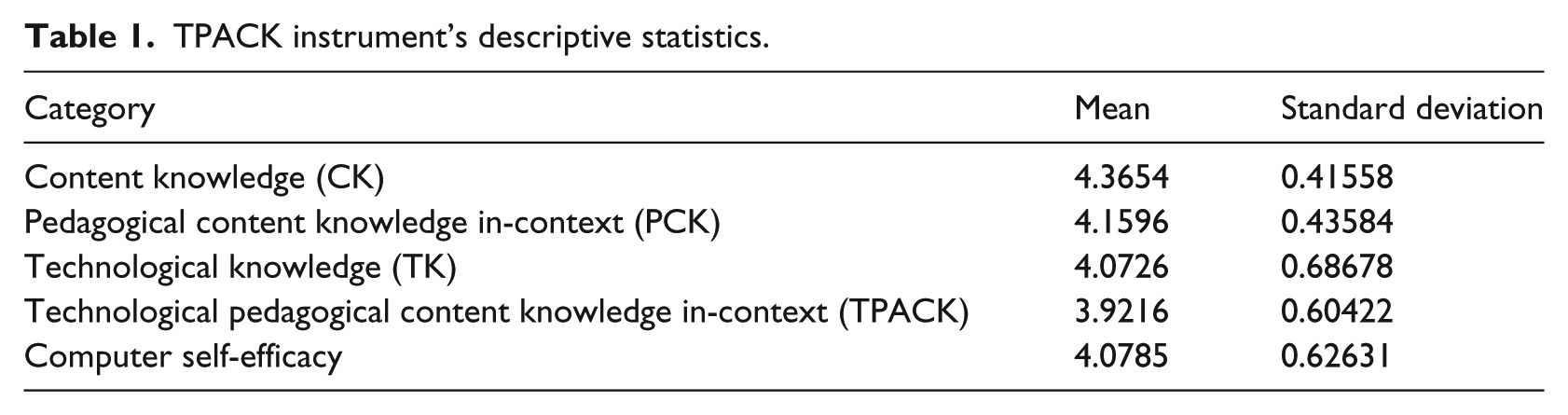
With respect to teacher computer self-efficacy, it was possible to observe an average score similar to the TPACK’s categories.
Bivariate relationships between TPACK, self-efficacy, cognitive style, and age
Table 2 shows Pearson’s correlations between TPACK, computer self-efficacy, cognitive style in the FDI dimension, and teacher’s age. The examination of the relationships between cognitive style in the FDI dimension and the scores of each one of the TPACK categories shows that cognitive style is associated significantly with TK (r = .217, p < .01). A significant association also exists between cognitive style and self-efficacy (r = .315, p < .01), and between the teacher’s cognitive style and age, a negative and significant association exists (r = −.541, p < .01).
Correlations between TPACK, cognitive style, self-efficacy, and teachers’ age.
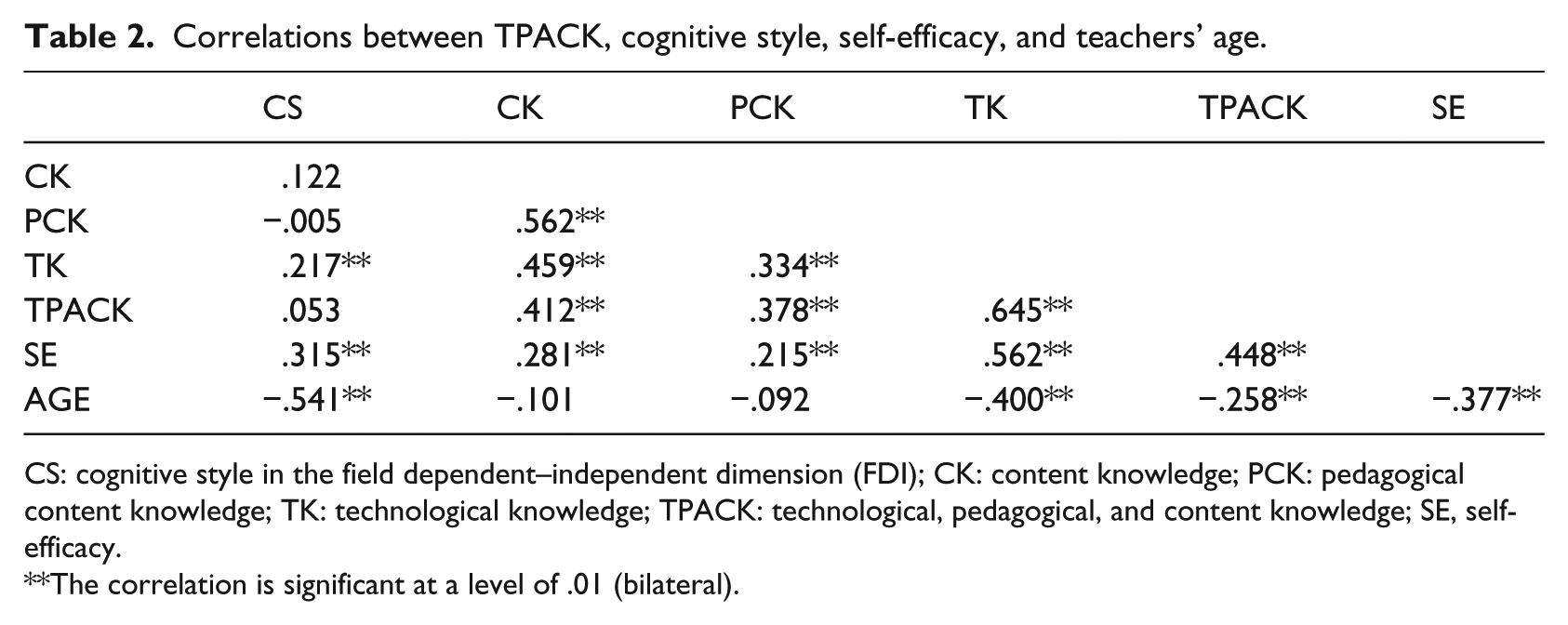
CS: cognitive style in the field dependent–independent dimension (FDI); CK: content knowledge; PCK: pedagogical content knowledge; TK: technological knowledge; TPACK: technological, pedagogical, and content knowledge; SE, self-efficacy.
The correlation is significant at a level of .01 (bilateral).
In the second place, the data show that computer self-efficacy is associated, positively and significantly, with each one of the TPACK categories, at a level of p < .01. The data also indicate a negative and significant association between self-efficacy and age (r = −.377, p < .01). Finally, teacher’s age is associated, negatively and significantly, with PK, TCK, and TK of the TPACK instrument at a level of p < .01.
Effect of the performance area and cognitive style on self-efficacy and TPACK categories
With the objective of evaluating the influence of the performance area and the cognitive style in the FDI dimension on self-efficacy and TPACK, an ANOVA was used. There are two inter-subject variables: (a) performance area, with 10 values that correspond to teachers’ undergraduate education, and (b) cognitive style with three values: FD, field intermediate, and FI. Table 3 summarizes the descriptive statistics.
Results of self-efficacy and TPACK categories: mean scores and standard deviations in parenthesis.
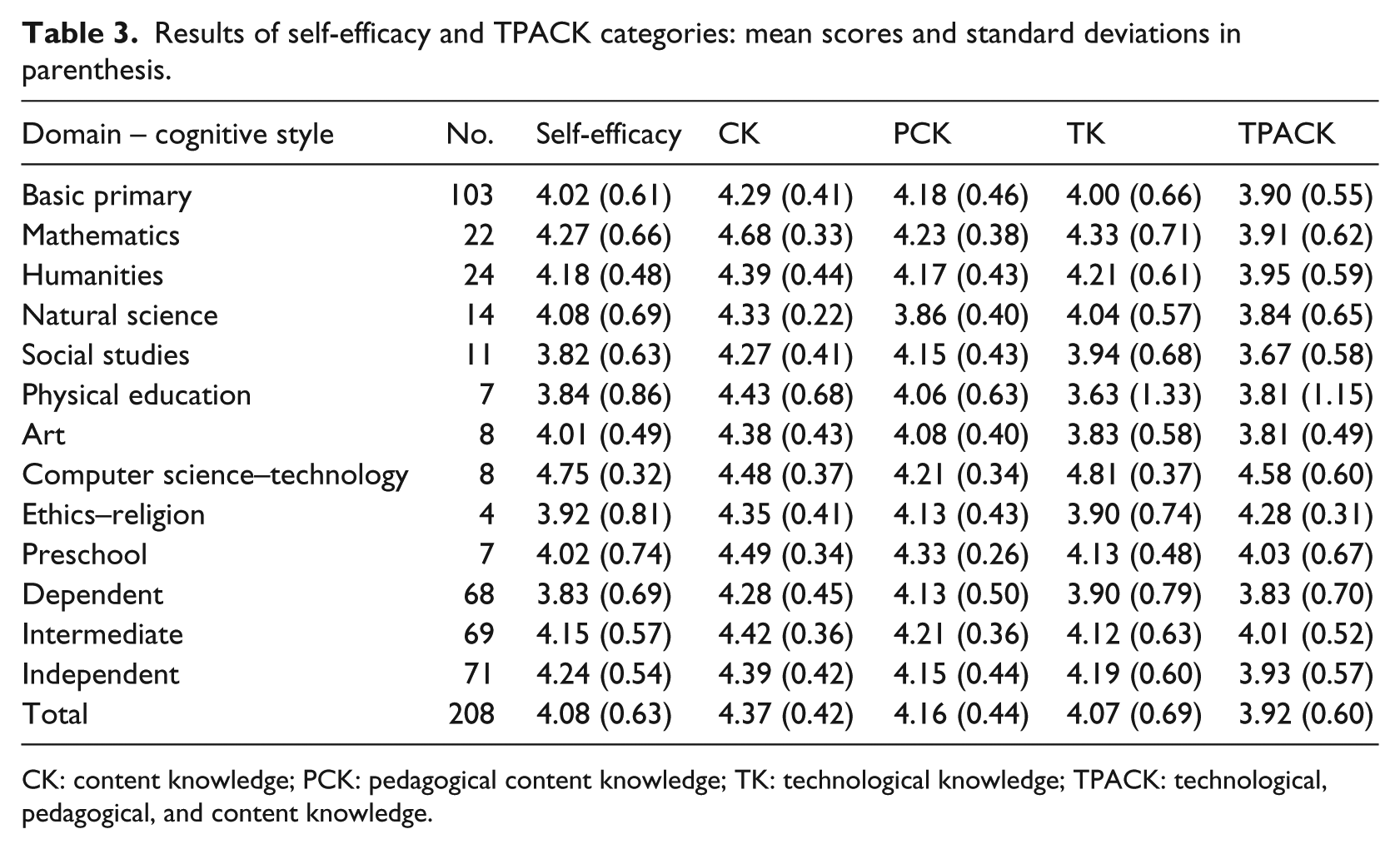
CK: content knowledge; PCK: pedagogical content knowledge; TK: technological knowledge; TPACK: technological, pedagogical, and content knowledge.
The ANOVA test shows that significant differences exist between the teacher’s performance area and computer self-efficacy (F(9, 179) = 2.16, p = .027, η2 = .098). Significant differences also exist between the performance area and CK (F(9, 179) = 2.05, p = .037, η 2 = .093) and between the performance area and TK (F(9, 179) = 2.23, p = .022, η2 = .101). With respect to cognitive style in the FDI dimension, significant differences exist with computer self-efficacy (F(2, 179) = 3.16, p = .045, η2 = .034), and finally, significant differences exist in the double interactions of the performance area and cognitive style, with TK (F(17, 179) = 1.85, p = .025, η2 = .150) and with TPACK (F(17, 179) = 2.09, p = .009, η2 = .166).
In order to analyze the ANOVA’s results in more detail, a post hoc Tukey analysis is performed. With respect to computer self-efficacy, significant differences exist between computer science and technology teachers and basic primary and social studies teachers (p < .05). Regarding the TPACK categories, significant differences exist in CK between mathematics and basic primary (p < .05) teachers. In the category of TK, significant differences are verified between teachers from the computer science and technology area and basic primary and physical education teachers (p < .05). Finally, in the category of TPACK, significant differences exist between computer science and technology teachers and basic primary and social studies teachers (p < .05) (Figure 1).

Influence of the performance area on self-efficacy and TPACK.
With respect to cognitive style, the post hoc Tukey analysis shows significant differences in self-efficacy toward computer use between FD teachers, with field intermediates (INT) and FI (p < .05). Between INT and FI, no significant differences exist. Regarding the TPACK categories, significant differences exist only in TK between FD and FI teachers (p < .05) (Figure 2).
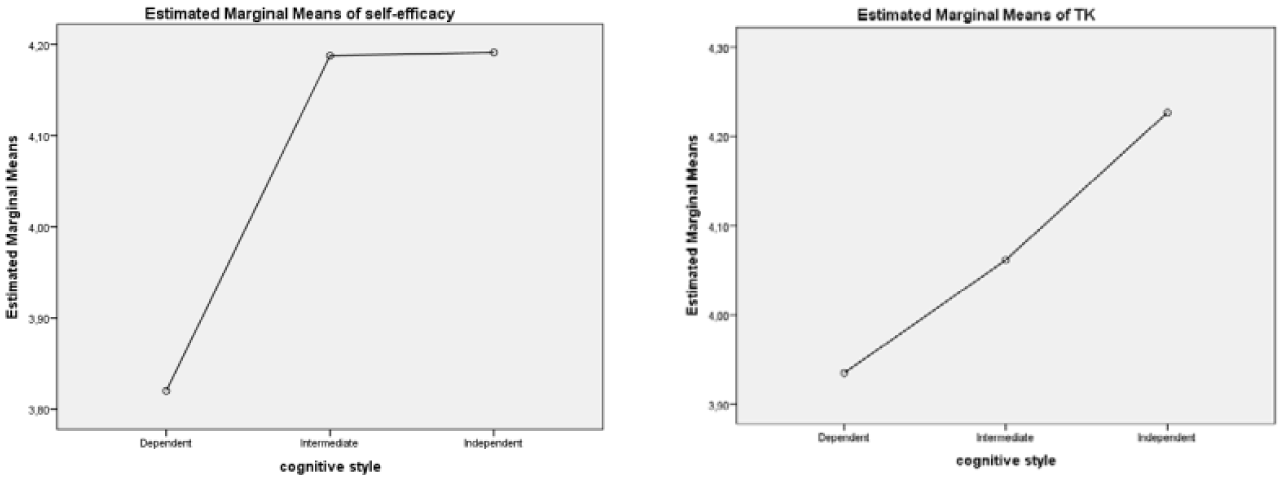
Influence of cognitive style on self-efficacy and TPACK.
Discussion and conclusions
This research evaluates the possible associations of teachers’ self-efficacy with different cognitive styles in the FDI dimension, teacher’s age, and the TPACK categories. Similarly, it evaluates the influence of the performance area and cognitive style with respect to self-efficacy and TPACK categories. With respect to the first research question that guided this study – in other words, does any relationship exist between cognitive style in the FDI dimension, age, TPACK, and levels of computer self-efficacy in teachers of EIs in Valle de Tenza, Boyacá, Colombia? – the results show that significant and negative associations exist between teacher’s age and computer self-efficacy.
It is possible to assert that older teachers feel less self-efficacious in the use of computers in the classroom. Probably, the interaction of these teachers with ICT is not the best, and therefore, their knowledge on their use and application in educational contexts may be at a very basic level. This situation may generate greater insecurity and fear in the teacher when confronted with the pedagogical challenge of their use since they feel at a disadvantage with their students, who are denominated digital natives (Prensky, 2001).
Another possible explanation of these results could be that older teachers did not receive an academic education in the use of ICT and of their incorporation in their pedagogical trade. Additionally, training programs for in-service teachers, probably in rural regions, as in the case of Valle de Tenza, are not as effective as in the big cities. These results are similar to those found by Korumaz and Karabiyik (2013), who found that significant differences exist in teachers’ ages, with respect to self-efficacy to support teaching processes through computational scenarios.
The study also shows that a negative correlation exists between age and cognitive style in the FDI dimension. These results ratify the findings of other studies of a longitudinal type, which report that a decline exists in subject’s perceptual restructuring ability once they reach old age, with a tendency toward FD (Hederich, 2007; Schwartz & Karp, 1967; Witkin, Goodenough, & Karp, 1967). The foregoing results possibly explain the negative correlations between age and TPACK categories of TK and TPACK. Probably, low computer self-efficacy, associated with the stylistic characteristics of field dependence, explains why older teachers do not effectively and efficiently use ICT and, therefore, do not integrate them into the classroom as support to the teaching–learning process through appropriate pedagogical and/or didactic strategies.
The study also shows that a significant association exists between computer self-efficacy and cognitive style in the FDI dimension. This explains why FI teachers believe more in their abilities to use ICT in the classroom. Previous studies evidence an association between academic self-efficacy, cognitive style in the FDI dimension, and learning achievement in primary and secondary students (López et al., 2012; López, Sanabria, & Sanabria, 2014; López & Triana, 2013). These results empirically support a possible association between FI subjects’ stylistic characteristics with better self-efficacy perceptions.
Similarly, the results show a positive correlation between cognitive style and TK. These results indicate that FI teachers use ICT more effectively in comparison with their FD peers, as evidenced in previous studies of FDI in computational environments (Alomyan, 2004; Chen & Macredie, 2002; Chou, 2001; C. H. M. Lee et al., 2010).
Finally, the data show high correlations between the different categories of the TPACK instrument. Consequently, the instrument has a high internal consistency and, therefore, a high reliability, situation which leads to recommending its use in future research at a country level, specifically Colombia.
Regarding the second research question – in other words, does the performance area and cognitive style in the FDI dimension of teachers from EIs in Valle de Tenza, Boyacá, Colombia, have any type of effect on TPACK and the levels of computer self-efficacy? – it is possible to assert that the results show significant differences exist between the teacher’s performance area and self-efficacy, specifically between computer science and technology teachers and basic primary and social studies teachers.
These results are comprehensible insofar as the teachers of this area have competencies in the use of ICT in comparison to their basic primary and social studies peers. These results are due to the fact that computer science and technology teachers possess specific education in the use of ICT, and therefore, they know about the use and application of this type of technologies and are capable of solving problems or difficulties that arise when applying them in the classroom. On the other hand, teachers of other education areas, as in the case of basic primary and social studies, do not have this type of technological education. The studies of Kaya and Durmuş (2010) and of Korumaz and Karabiyik (2013) support the results of this study, insofar as they showed significant differences in self-efficacy toward the use of ICT, according to teachers’ education areas.
Regarding self-efficacy in basic primary teachers, the results of this study contradict the findings of Altun et al. (2011), who found high levels of self-efficacy toward ICT and technology integration in the classroom in primary teachers. These contradictory results may be due to the context in which the research was developed. This study was conducted in a rural context, where, generally, institutions are far away from urban centers, and therefore, connectivity and accessibility to Internet are low and inexistent. Similarly, computer labs are poorly or inadequately equipped. This contrasts with the research of Altun et al. (2011), which was developed in an urban context where better conditions to access ICT exist.
Additionally, for these same reasons, it is possible that rural sector teachers do not see the necessity and the potential that ICT may offer to favor students’ learning, and in the event of any type of training made available by the competent EI, it is out of context and does not meet the needs and expectations intrinsic to the educational community of the rural sector. This result supports the findings of Hiğde, Berat, and Demir (2014), who found significant differences in self-efficacy toward the use of ICT, depending on the frequency of Internet use.
From the study, it is also possible to deduce that social studies teachers possess low computer self-efficacy in the classroom than those of other knowledge domains. Probably, these teachers find it difficult to integrate ICT in the development of different pedagogical activities, and it is possible that the lack of concrete experiences in their use, in the teaching–learning process, explains these results (Lei, 2009; Sadaf, Newby, & Ertmer, 2012). However, it would be necessary to further study the reasons why teachers of this area possess low self-efficacies in the use of information technologies.
In regard to cognitive style, significant differences exist between FD and field intermediate teachers, and similarly between FD and FI teachers. Teachers with the highest levels of computer self-efficacy are FI and field intermediates. These results are similar to other studies where FI students who interacted with computational scenarios exhibited greater levels of self-efficacy (López et al., 2012; López, Sanabria, & Sanabria, 2014; López & Triana, 2013; Poleo & Rubiano, 2008).
Likewise, significant differences exist in TK and cognitive style. As expected, studies systematically show that FI subjects possess better abilities in the use of information technologies in comparison to their FD peers (Alomyan, 2004; Chen & Macredie, 2002; Chou, 2001; C. H. M. Lee et al., 2010).
With respect to teachers’ performance area and TPACK, the results show significant differences regarding CK between mathematics and basic primary teachers. The results show that teachers from the mathematics area value their CK higher than the basic primary teachers. This is, probably, because basic primary teachers must cover all the knowledge domains in the classroom. However, this category’s means, versus all the knowledge areas, are very similar.
Regarding TK, significant differences were verified between computer science and technology teachers and physical education teachers. These results are understandable insofar as the teachers of the area of technology have received specific education in it, while physical education teachers have received training related to physical activity, as is traditionally carried out in Colombia.
Finally, the results of the double interactions (performance area and cognitive style) show significant differences in TK. FD teachers of the physical education area are those who possess the lowest levels of TK and TPACK in comparison with the other FD teachers of the other performance areas, showing an exception in humanities and social studies teachers. According to these results, it is possible to assert that FD teachers from the physical education area are at a greater disadvantage due to the nature of their discipline since it is traditionally oriented toward physical activity where the use of ICT is not a priority, as it may be in the other knowledge areas.
This study’s findings are an important contribution to the knowledge in the educational and ICT fields of research since it allows understanding and comprehending rural sector teachers’ behavior with respect to the incorporation of ICT in the classroom. The knowledge of variables of a motivational type, like self-efficacy and the notion of cognitive style in the FDI dimension, articulated with the TPACK model allow explaining and formulating educational policies in regard to the education and training of teachers in Colombia.
Limitations and forecasts
Some of the limitations of this study were related to the lack of homogeneous samples in regard to the number of teachers per performance area. In the research, approximately half of the teachers corresponded to the level of basic primary. In this sense, the recommendation is that the number of teachers who participated in the study should correspond, both in the performance area and in the level of education, so that, in this manner, the results may be generalized. Similarly, the recommendation is to increase the sample size to also include the urban sector in order to compare the results that are obtained, of both the urban sector and rural sector teachers. This would provide a broader panorama of the issue regarding the use of ICT to support the teaching–learning process in Colombian EIs.
Footnotes
Declaration of Conflicting Interests
The author(s) declared no potential conflicts of interest with respect to the research, authorship, and/or publication of this article.
Funding
The author(s) received no financial support for the research, authorship, and/or publication of this article.