




Abstract
In light of an international policy movement to increase focus on students’ academic achievement, the question of how to improve schools has become an important issue at all levels in the school system. Substantial resources have been invested in reforms to improve conditions for pupils’ learning. Great expectations and responsibility are often placed on teachers in terms of their professional development (PD), the aim being to improve their teaching practices. Consequently, the question of how to evaluate the results of school improvement programmes, including teachers’ PD, has arisen. However, there is a lack of theoretical concepts that can capture the outcomes of such development in a qualified way. Taking inspiration from the research on teachers’ PD and theories relating to teachers’ knowledge and capabilities, the aim of this study is to outline a conceptual framework that can serve as an analytical tool when evaluating both school improvement initiatives in general and school actors’ learning in particular. Four types of learning capital that are intended to reflect the central aspects of teachers’ and school organisations’ learning and the capabilities linked to teaching practice and its development are outlined. This conceptual framework is applied and exemplified based on the results of a 3-year research project evaluating a school improvement programme in a Swedish municipality. Finally, some conclusions are drawn regarding the different types of analysis possible with the current conceptual framework related to the evaluation of school improvement efforts.
Introduction
In school systems around the world, there is an increasing focus on pupils’ academic achievements and school results. This has resulted in the intensified control of pupils’ levels of achievement (cf. PISA) and in increasing demands for school actors and decision-makers to improve schools’ instructional practices. Substantial resources, not least time and money, are invested in various reforms to improve the quality of teaching in hopes of creating better learning conditions to improve pupils’ achievement in the long run (Desimone, 2009; Kennedy, 2016). School improvement and effectiveness on the international, national and local levels have therefore become highly political and are currently important issues at all levels in the school system, from policymakers to school professionals to researchers. In this context, great expectations and responsibility are often placed on teachers. Many educational reforms and school improvement efforts rely on teachers’ professional development (PD) and improved instruction to increase pupils’ learning (Timperley, Parr, & Bertanees, 2009; Timperley, Wilson, Barrar, & Fung, 2007). Although teachers’ PD is crucial, it is central to note that even other school actors’ learning and development, not least that of school leaders, are of great importance when it comes to school improvement (Parr & Timperley, 2010).
In combination with the substantial resources often invested in reforms and initiatives to reinforce school actors’ PD, the increased emphasis on pupils’ achievement has highlighted the question of how to measure the results of such improvement efforts (Lai & Hsiao, 2014; Vanhoof & Schildkamp, 2014). At the same time, we know that school development as such is a very complex phenomenon and that its effects are hard to evaluate (Fullan, 2006). Even if today we are fully aware of the importance of emphasising pupils’ learning in school improvement initiatives (Timperley et al., 2009), pupils’ learning outcomes, in terms of grades and test results, are rather obtuse outcome measurements. That is, if school improvement is about school actors’ learning and PD, pupils’ learning outcomes need to be supplemented with concepts that can capture different aspects of the outcomes of school actors’ PD processes in a qualified way (Desimone, 2009; Kennedy, 2016). Based on research and theories about teachers’ PD, knowledge and capabilities, the overarching aim of this study is to contribute to an integrated set of concepts that can meet this need.
The aim of the study
Accordingly, a central question of both practical and theoretical relevance is how to understand, examine and evaluate school actors’ PD and learning linked to local school improvement efforts. In this study, this question serves as a point of departure. The aim of the study is twofold. Based on the concept of ‘learning capital’, the first aim is to outline a conceptual framework that can serve as an analytical tool when examining and evaluating school actors’ PD and learning within the scope of school improvement efforts. Using empirical data collected from a recently completed evaluation project in a Swedish municipality, the second aim is to elucidate and exemplify how this conceptual framework can be empirically applied.
School improvement: enhancing school actors’ learning
School improvement can be broadly defined as the organisation, enhancement and realisation of a school’s capacity to promote teachers’ teaching and pupils’ ability to improve their cognitive and moral development (Hargreaves, 2001). This means that school improvement is primarily about school actors’ learning at different levels in the school system. Two main views can be identified in the theory and research about school improvement and educational change (Sleegers & Leithwood, 2010). The first focuses on schools’ capacity to transform from the ‘inside’. Great emphasis is placed on the relationship between teachers’ learning and the development of instructional practices. School organisation and creating supportive learning environments for teachers’ PD are crucial. The second is an ‘outside’ view (Sleegers & Leithwood, 2010) in which the emphasis is primarily on external reformers and policymakers implementing different school development initiatives. Studies based on these viewpoints often examine the impact different policy programmes and school operations – such as instructional practice, classroom management and school management – have on pupils’ learning outcomes. In sum, although school improvement is primarily about schools’ internal learning, external processes and conditions play a role in school improvement work (Hopkins & Woulfin, 2015; Thoonen, Sleegers, Oort, Peetsma, & Geijsel, 2011).
School actors’ learning: features of PD
The literature concerning teachers’ PD is very extensive and rich (Desimone, 2009; Kennedy, 1999, 2016). The definition of PD varies from being very broad to very narrow. The same thing concerns how to organise PD programmes. Therefore, Kennedy (2016) raises the question, ‘why something so various is uniformly assumed to be a good thing’ (p. 945). Timperley et al. (2009) state that the literature on teachers’ PD sometimes tends to be somewhat idealistic. Although teachers’ PD is often highlighted as one of the main keys to improving school quality, there are a number of PD programmes that historically cannot be considered very successful. However, despite the disparate literature about teachers’ PD, there is some consensus concerning the main features (Desimone, 2009). Based on Kennedy’s (2016) and Desimone’s (2009) reviews of teachers’ PD, the following critical features can be distinguished when it comes to promote school actors’ PD:
Content focus – school actors’ learning should be focused on subject matter content and how students learn that content.
Collective participation – the importance of organising learning environments that enable teachers to actively and collectively learn and develop should be emphasised.
Coherence – school actors have to believe in what they should learn and develop. That is, school actors’ learning must be consistent with their own knowledge and beliefs.
Duration – this refers to the required time, both in terms of number of hours and time span, a PD programme should last. Several studies point to the necessity of working systematically and over the long term.
Desimone (2009) states that critical features like these can form the basis of a framework for studying PD and its effectiveness. However, it is also important to pay attention to how teachers may incorporate new insights and knowledge into their own teaching practice (Kennedy, 1999). Therefore, enacting new ideas and knowledge is not just a matter of simple implementation and adoption; the step from knowing something to actually making sustainable changes in practice cannot be taken for granted. Kennedy (2016) calls this the problem of enactment: ‘. . .a phenomenon in which teachers can learn and espouse one idea, yet continue enacting a different idea, out of habit, without even noticing the contradiction’ (p. 947). Kennedy (2016) identifies and discusses four methods that can be employed in a PD programme to handle this enactment problem: (1) explicit and clear prescriptions that describe what teachers are supposed to do, (2) different strategies that in a distinctive way focus on how teachers should implement new ideas, (3) using teachers’ own insights about their own teaching that aim to elucidate development needs and (4) offering teachers a certain body of knowledge that in a more passive way may stimulate them to develop their own teaching practices.
According to Timperley et al. (2009), another problem related to school improvement programmes to strengthen teachers’ PD is that it is often difficult to prove its effects on pupils’ achievement (see also Rivkin, Hanushek, & Kain, 2005; Timperley et al., 2007). The authors emphasise that school improvement efforts that promote teachers’ learning must always have a primary focus on how such efforts can improve pupils’ outcomes. In addition, the specific changes suggested by PD providers must also constitute an integrated part of school actors’ beliefs about their own teaching practice. The authors therefore argue for an inquiry and knowledge-building model, where school actors’ ongoing examination of their own practice and the learning that results constitute the basis for the PD programme. From this perspective, teachers’ activity, curiosity and examination of their own teaching practice are crucial vis-à-vis improving schools (Parr & Timperley, 2010; Timperley et al., 2009).
In sum, school improvement in general is about school actors’ and school organisations’ learning and the conditions that frame such learning. A crucial issue in the literature about school actors’ PD seems to be how to outline programme design features presumed to promote high-quality PD. However, when it comes to sketching a conceptual framework that can serve as an analytical tool to examine and evaluate school actors’ PD within the scope of a school improvement programme, such insights are important but not sufficient. Learning, and therefore school improvement, typically has a content focus. That is, the actors involved will learn something that in turn will be used to develop, for example, instructional practice. Consequently, a theoretical discussion of the main aspects of school actors’ knowledge and capabilities related to their teaching practice becomes necessary.
Dimensions of school actors’ knowledge and capabilities
In the well-known article ‘Those who understand: Knowledge growth in teaching’, Shulman (1986) formulates a theoretical framework of different aspects of teachers’ capabilities for teaching. This article has in turn greatly influenced subsequent research on teaching and teacher education (Abell, 2008). Briefly, Shulman (1986) categorises teachers’ content knowledge into three main types: (1) subject matter content knowledge, (2) pedagogical content knowledge and (3) curricular knowledge. Subject matter content knowledge simply refers to teachers’ formal knowledge about a specific subject in terms of its substantive and syntactic structures. Pedagogical content knowledge comprises the specific combination of teachers’ subject matter knowledge and pedagogical knowledge and the capability to apply this knowledge in teaching practice. Curricular knowledge comprises teachers’ knowledge about the current curriculum.
As Shulman later points out, this framework has a strictly cognitive and individual perspective on teachers’ teaching capabilities. In later works the theory developed, with greater emphasis being put on the collective aspect, that is, teachers’ learning and development within communities and contexts. An example of this is Shulman and Shulman’s (2004) developed theoretical model concerning central dimensions of capabilities related to teachers’ teaching. Briefly, the model states that besides being a member of a professional community, accomplished teachers must develop a vision of how to organise teaching that promotes pupils’ learning and understanding of the current subject matter content and must be willing to change their teaching practices. In other words, it is not enough to simply have a vision about how teaching should be. Teachers must also be able to change their teaching to fulfil that vision. That is, they must have the necessary subject matter knowledge and be able to choose content in relation to the current curriculum and to pedagogical capabilities in terms of, for example, classroom management, different instruction strategies and assessment. Finally, professional teachers are people who are not only inspired, enlightened and motivated but are able to embrace the capability of performing teaching in classroom settings. Related to Kennedy’s (1999) discussion about the enactment problem, this means that teachers must be able to convert these capabilities into action in their daily teaching practice.
Based on these aspects of teachers’ capabilities (Shulman & Shulman, 2004) and linked to teachers’ PD, it is possible to derive five different clusters of attributes:
A cognitive cluster comprising understanding and discerning
A dispositional cluster comprising envisioning and believing
A motivational cluster comprising willingness to change
A performance cluster comprising enacting and realising
A reflective cluster comprising evaluating and learning from experience
These clusters relate to different aspects of knowledge and capabilities linked to school actors’ practice. Together with the theories about teachers’ PD discussed above, these aspects constitute an important basis for developing an evaluation model relating to school actors’ learning. However, an additional concept must first be introduced – the concept of capital.
A capital theory of schools’ development
Another way to conceptualise school actors’ capabilities and capacity to develop is through the concept of professional capital (Campbell, Lieberman, & Yashkina, 2016; Hargreaves & Fullan, 2012). Professional capital can be defined as an umbrella concept comprising three different sub-capitals: human capital, decisional capital and social capital. Human capital refers to school actors’ individual knowledge, skills and capabilities that enable them to execute effective and high-quality work in terms of, for example, supporting pupils’ learning to reach the desired goals. However, the impact of teachers’ effectiveness is not singular (Hargreaves & Fullan, 2012). School actors’ ability to influence pupils’ learning, achievement and development are conditioned by their ability to work effectively with colleagues. Social capital refers to the ability to generate and sustain trust and to develop collaborative relationships and strong networks (Hargreaves & Fullan, 2012). Social capital creates the conditions to reinforce and develop a school’s aggregative human capital. Human and social capital combined therefore has a stronger impact on pupils’ achievement than each individual type of capital (Jones & Harris, 2014). Decisional capital refers to the wisdom, judgement and expertise that teachers develop over time through their teaching experience. According to Hargreaves and Fullan (2012), all professions involve judgement in different situations where the answers about how one should act are not always clear. An important way of strengthening decisional capital is through experience, individual reflection and collective discussion.
Following the argument behind this theory of capital, the degree of a school’s effectiveness can be evaluated in terms of its capacity to develop and mobilise its different types of capital to achieve the desired educational outcomes. This means that a school’s improvement work can be regarded as a process of building the different types of capital. This leads to the next part of the article, in which a conceptual framework of learning capital is outlined.
Outlining a conceptual framework of learning capital
Next, we outline a conceptual framework that can serve as an analytical tool when examining and evaluating school actors’ individual and collective learning within the scope of a school improvement programme. We use the concept of learning capital to point to different kinds of school actors’ individual and collective enhanced and accumulated knowledge and capabilities related to their practice. ‘Capital’ refers to something that can be accumulated on one hand and that can be applied on the other. Capital accumulation, in turn, includes the outcomes of the school actors’ and school organisations’ learning processes, implying that school improvement is about building different types of learning capital. Based on the above discussions about school actors’ PD and different dimensions of school actors’ knowledge and capabilities, the following four aspects of learning capital have been derived.
Consistent learning capital refers to school actors’ shared knowledge and insight into and vision about teaching and what development needs currently exist. This may also include the ability of a principal or of a leader of a teacher team, for example, enable a group of teachers to share an image of what is supposed to be accomplished and to work collaboratively to that end. Consistent learning capital also refers to the nature of the culture of trust within a school organisation that enables school actors to engage in open, critical and constructive discussion about the school actors’ teaching practice (Darling-Hammond, 2005; Timperley et al., 2009). From this perspective, school improvement is not only about improving teachers’ instructional practice but, in line with Hargreaves’ (2001) meaning of social capital, it is also about strengthening schools’ cultural and structural components.
Curricular learning capital comprises the general knowledge base that different school actors – such as principals, teachers, learning support teachers and so on – need in their profession. This type of capital refers to the cognitive cluster of attributes linked to teachers’ capabilities (Shulman & Shulman, 2004). Curricular learning capital comprises school actors’ knowledge and understanding of the curriculum and of subject matter content and related didactic knowledge about, for example, classroom management, assessment, grading and so on.
Instructional learning capital relates directly to school actors’ performance in their practice. Instructional learning capital refers to teachers’ knowledge, ability, experience and capacity to apply a current knowledge base (i.e. the curricular learning capital) in practical settings. That is, it is not enough to have knowledge about something; one must also know how to use that knowledge in teaching practice. Kennedy (2016) discusses this problem of enactment, and Shulman and Shulman (2004) call this the heart of teaching, referring to teachers’ capacity for judicious and adaptive action based on a qualified knowledge base.
Finally, school actors can have considerable curricular and instructional learning capital, but when it comes to improving and changing their own teaching practice, they must also have the knowledge, motivation and willingness to make changes, not to mention the capacity to sustain them. We call this capacity change learning capital. According to Pyhältö, Pietarinen, and Soini (2013):
. . . involvement in educational changes largely depends not only on contextual factors and teachers’ skills and knowledge, but also on teachers’ professional efficacy beliefs and their motivation to adopt and process new ideas at several different levels in their daily work. (p. 305)
Desimone (2009) discusses this in terms of coherence, which means that school actors’ learning must be consistent with their own knowledge and beliefs. On an organisational level, the building of change capital can be linked to what has previously been referred to as an inquiry culture. According to Timperley (2011), this is characterised by openness and a positive attitude towards continuous and collaborative investigation, problematisation and the analysis of teaching practice at school, with the aim of improving it (see also Katz & Dack, 2013; Parr & Timperley, 2010; Timperley et al., 2009).
Each of these types of capital relate to central and desirable aspects of school actors’ individual and collective knowledge, capabilities and attitudes, which together can be regarded as essential for schools’ capacity to achieve their goals and constantly develop. This means that when it comes to school improvement and school change, these types of learning capital are crucial. Figure 1 illustrates how school actors’ PD and learning within a school organisation comprises a process of developing different types of learning capital.
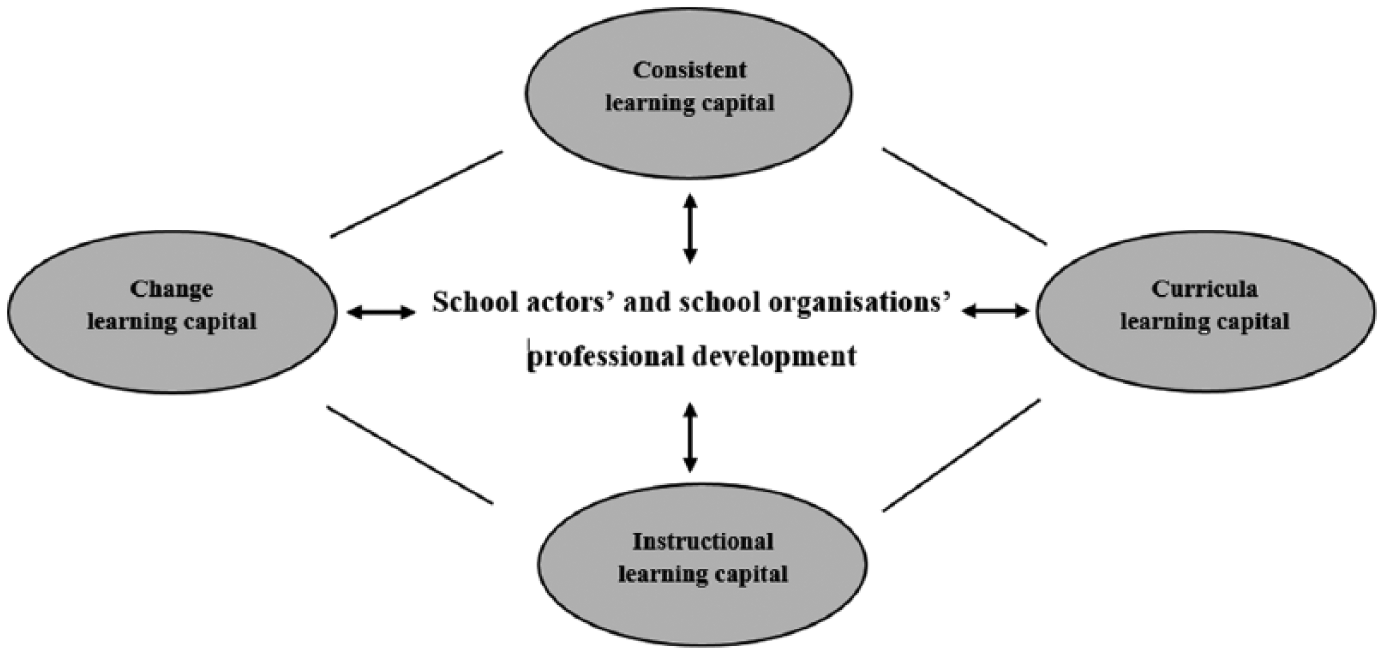
School actors’ and organisations’ development comprising different types of learning capital.
The relationship between the types of learning capital
Based on the above model, a hypothesis can be formulated in terms of the notion that effective school improvement work should comprise all these different types of learning capital. This is not to say that a school or a teacher team must work on developing all these types of capital at the same time. On the contrary, it is more likely that different improvement initiatives will promote the development of different types of learning capital. All this highlights the question about input in terms of school improvement efforts and about output in terms of desirable changes and attaining goals. Hargreaves (2001) discusses this in terms of high and low degrees of leverage. High leverage implies a relatively large impact on improvement by relatively low levels of school improvement effort. Low leverage implies the opposite. Hargreaves (2001) states that the highest level of leverage occurs when different strategies are combined in an effective way. To realise this, it is necessary for school actors to collaborate and determine how to best combine different strategies to maximise the outcomes of their inputs (Hargreaves, 2001). School improvement is therefore about learning how high leverage works. This links to the relationship between the types of learning capital. An important part of evaluating school improvement efforts is to examine: (1) the levels of the different types of learning capital at a school, (2) what kind of school improvement strategies are most effective (based on what kind of learning capital that is desirable to build) and (3) how different combinations of capital building can generate the highest level of leverage.
In the next section, some empirical examples from a school improvement project will be presented to briefly exemplify how the integrated set of learning capital concepts can be used in analysing and evaluating school actors’ and schools’ learning and development within a school improvement project.
The case
Learning compulsory schools
The empirical data used here are derived from a recently finished evaluation research project called ‘Learning compulsory schools’ (Adolfsson & Håkansson, 2016). First, we will briefly sketch the background of the project. Second, we will discuss how the different types of learning capital were used in analysing the processes and outcomes of the current improvement programme.
From 2013 to 2016, the researchers evaluated improvements at four schools in a major city in Sweden. The local school authority launched a multi-year school development programme focusing on several schools with low student achievement and a large number of special needs students. This programme should be seen in light of a general trend in Sweden of increased focus on students’ academic achievement, on equality between schools and on greater accountability of local authorities, schools and teachers (Sundberg & Wahlström, 2012). The school improvement programme was initiated, financed and controlled by the central school authority in the city. But even if the school improvement programme as such was controlled from the top down to some extent, the schools had the freedom to choose specific development areas that matched local development needs at the specific schools. Examples of such areas include mathematics teaching methods, the development of language in all subjects, formative assessment, assessment and grading, and classroom leadership.
The aim of the evaluation research project was to examine, evaluate and support the improvement work at four of the participating schools. Different types of data at different levels within the schools (school leader level, teacher level and pupil level) were collected. The results of the data analysis were then communicated to the schools and used in their ongoing school development work. In evaluating the schools’ improvement work, three different aspects in particular were focused on:
The schools’ organisation and leadership
The instructional practice (e.g. teaching patterns, assessment practices)
Pupils’ motivation and self-reliance (pupils’ perceptions of their own abilities and the schools’ support).
The research project employed a mixed method approach (Creswell & Plano, 2007). Qualitative data were collected and analysed to inform semi-structured interviews and surveys gathering quantitative data to analyse the impacts of the school improvement programme. Data on the current project included the following:
Contextual analyses – core documents on the local school organisation, policy and vision, leadership and management structure, evaluations and school development strategies
Teacher survey at the beginning of the project (n = 235)
Semi-structured focus group interviews with school leaders (n = 16), teachers (n = 40) and pupils (n = 80) – conducted in the same period every year with the same participants (i.e. each focus group was interviewed three times in total)
Approximately 60 focus group interviews were conducted during the 3-year period. All interviews were transcribed, continually analysed and discussed with representatives from the participating schools and the local school authority. During the last year of the evaluation project, the focus in the analysis process was primarily on identifying changes and non-changes in relation to the three different themes of the improvement work (see above). In the evaluation and analysis process, the conceptual framework of the types of learning capital was used in two different ways. First, the theoretical concepts comprised a general foundation when formulating the teacher surveys and the interview guidelines. Second, in the analysis process, the same concepts were used as an analysis framework when the collected data were processed.
Evaluating schools’ capacity building in terms of the types of learning capital
In this article, we have primarily used empirical data derived from the 60 transcribed focus group interviews described above. Some illustrative examples of the results of the analysis of the interview data will be presented.
The schools’ development of curricular learning capital
The analysis of the school improvement programme indicated on an overarching level that the majority of the school improvement initiatives at the four schools primarily focused on improving teachers’ capabilities and knowledge within different curriculum areas (see the examples above). That is, the school improvement programme explicitly focused on building teachers’ curricular learning capital. From that perspective, the school improvement programme was quite successful. Both the principals and teachers who were interviewed emphasised that over the 3 years the teachers in general had progressed several steps in their knowledge development within the current development areas. For example, during 1 year at one of the schools the teachers attended an intermediate course dealing with ‘language in all subjects’. In an interview with the leader team at one of the schools, we asked about results or changes related to the current course. The principal answered as follows:
When it comes to teachers’ knowledge within this area . . . my opinion is that many teachers had learned and developed a lot, theoretically. Actually, in a remarkable way. (Principal, school 4)
Similar patterns in teachers’ learning could be distinguished in the empirical material at all participating schools. It can therefore be concluded that the school improvement programme contributed substantially to the development of curricular learning capital at the participating schools.
A lack of strategies promoting the development of instructional learning capital
The question then becomes to what degree this developed knowledge resulted in actual changes and improvements in the instructional practices at the schools. In other words, did the instructional learning capital increase to the same extent as the curricular learning capital? In this regard, the empirical material revealed a much more multifaceted answer. In the interview data gathered from the pupils, clear differences emerged between teachers at the same schools with respect to the degree to which they actually changed their teaching practices. A critical step for the school actors involved seemed to be to go from teachers’ learning and knowing about something to actually making sustainable changes in current teaching practices. A principal at one of the schools described this dilemma in the following way:
You can sometimes be confused, that the teacher that you just had a conversation with about the importance of formative assessment, then at the lesson . . . that he or she teach in a completely different way. (Principal, school 3)
That is, the analysis of the empirical material from the perspective of learning capital shows that the school improvement programme put a great many resources in terms of time and money primarily into building the teachers’ curricular learning capital. Regarding the instructional learning capital, however, there were few or no strategies either in the schools or at the school authority level to promote such capital building. Virtually no support or resources were given to the teachers to implement the new knowledge they attained through the different courses; implementation was left up to the teachers themselves. The result seemed to be a disparate degree of instructional learning capital building between the teachers at the participating schools.
Despite this, we could distinguish some general patterns of change in the instructional capital at some of the participating schools. Several pupils emphasised that the most noticeable changes in instructional practice among the teachers who had actually developed their teaching related to assessment and feedback:
Some of our teachers had now changed their teaching in a way that we now get more feedback at the lessons . . . but also better examination tasks . . . so we in a better way get the opportunity to show what we really can do. (Pupil, grade 9, school 1)
Another example of the development of instructional learning capital comes from one of the schools where during 1 year the teachers read and discussed literature about the ‘teaching of language in all subjects’. A teacher at that school discussed how this changed his and the other maths teachers’ teaching:
In maths, we have introduced concepts lists. There is so much bilingualism in mathematics. Matsh is an amazing language and previously we had not communicated this to the pupils. We have been more aware of this. . .for example, today I discussed the concept variable with the pupils. . . (Teacher, School 3)
The development of schools’ change learning capital
Closely linked to the discussion of teachers’ development of instructional capital is the question of the schools’ levels of change learning capital. As discussed, change learning capital refers to school actors’ capabilities, motivation and willingness to make and sustain changes in their own pedagogical practice. When analysing the empirical material in terms of this type of capital, it is obvious how making such sustainable changes poses a big challenge. As discussed above, it is possible to identify several examples of how teachers involved in the current school improvement programme actually applied the curricula learning capital in their teaching practice. However, when analysing the data from the pupil interviews, it was clear that several teachers gradually seemed to fall back into old teaching habits. At one school, a group of pupils described how at the beginning of the school year almost all teachers started their lessons by introducing and explaining the purpose and objectives of the lessons. But according to one of the pupils, this gradually changed: ‘Previously, it was at all lessons . . . then it was only sometimes, but then it was never . . .’ (Pupil, grade 9, School 4).
It is worth noting that in terms of change learning capital the evaluation of the school improvement programme also produced examples where teachers seemed to have made permanent changes to their teaching practice. In an interview with a group of pupils at another school about changes in the way they were examined and how the teachers used to inform pupils about their grades, one pupil stated:
We used to get back a matrix . . . where they have circled what one has achieved and what it is that is missing for a higher grade. This is much better than just saying ‘You are on the margin’ . . . First, it was one teacher who did this, then the other teachers started to do this, and now almost everyone does this. (Pupil, grade 8, school 1).
Another important aspect of change capital comprised openness and the capability to investigate, problematise and change teaching practice in collaborative settings. The analysis of the teacher interviews showed that it seemed to be up to the teachers themselves if they wanted to be involved in activities like these or not. That is, the school leader team at the schools seemed to have distributed the decisions related to activities like these to the teachers:
At my workplace, we should have implemented a programme of peer observation of teaching, but it did not work out, there were so many of the teachers who did not want to have someone in their classroom observing them when they were teaching. (Teacher, school 1)
The analysis of the empirical material in terms of change learning capital revealed findings similar to those regarding the schools’ levels of instructional capital. Several of the schools had no formulated strategies or committed resources with an explicit focus on promoting the development of change learning capital. This implies that the degree of change learning capital varied considerably both between schools and within schools, largely depending on where – in which school or which teacher team – the teachers worked.
Schools’ levels of consistent learning capital
Regarding the evaluation of the school improvement programme in terms of so-called consistent learning capital, the following was noted. As discussed earlier, consistent learning capital refers to school actors’ common and shared insights about and vision of the school and the teaching, for example, with regard to what needs to be developed and how this should be done (with what kind of strategies). The whole school improvement programme was characterised as a top-down project. The implication is that it was primarily the principals and the local school authority who decided upon, initiated and controlled the content and processes of the improvement work at the different schools. This affected the teachers’ involvement and degree of motivation to participate in the improvement work. The balance between internal needs and external control was a subject of discussion at several of the schools:
Although they (the school authority) have decided that we have to be part of this school improvement programme, there are many other improvement areas that we must work with. As a consequence of this, we have not time to work with things that we really need to work with. . . however, in the same time I think there are some things in the improvement programme that seem quite relevant. (Teacher, school 3)
The principal at the same school had a different opinion:
Many of the teachers say that it is so many things at the same time. . .but from my opinion it is an ‘autostrada’. I think there has never been such a clear and explicit focus in our school improvement work as there is now. (Principal, school 3)
The analysis of the collected data showed that at three of the schools in particular there were quite different opinions between the teachers and the school leader team and between different groups of teachers regarding the development needs, goals and strategies. One illustrative example comes from one of the schools where the principal had initiated development comprising a standardisation of teachers’ lesson structures as a way of improving teaching at the school. However, several of the interviewed teachers could not see the meaning of this kind of initiative:
. . . a general standardisation of the lesson structure? If you have worked as a teacher nearly 30 years, that is ridiculous . . . that someone will tell me how to start a lesson and greet the pupils. What is this? It is dismissive of me as a professional teacher. (Teacher, school 2)
Altogether, the analysis indicated relatively low levels of consistent learning capital at these three schools. At the same time, we could distinguish a rather high degree of this kind of capital at the fourth school. At that school, it was visible in the form of close relationships and good communication between the school leaders and the teachers, combined with general common sense regarding the purpose and means of the school improvements. The main principal at that school had built a school development group consisting of school leaders and expert teachers. In this group, the head principal continuously discussed school development-related questions. This way of organising and implementing the school improvement programme seemed to create conditions for a balance between ‘top-down’ and ‘bottom-up’ control, which resulted in a higher degree of legitimation among the teachers.
In sum, the evaluation of the school improvement programme indicated that the initiatives within the programme had a clear focus on developing teachers’ curricula learning capital. The analysis of the empirical material also showed that from that perspective, the programme was rather successful. The teachers seemed to have developed knowledge within the different development areas. In addition, despite there being few initiatives with an explicit focus on strengthening instructional learning capital at school, the empirical material revealed examples of how some teachers made changes in their teaching practice. However, this instructional learning capital building was not a general trend in the schools. Instead, we saw considerable variation between and within schools. A similar trend was seen regarding the schools’ consistent and change learning capital. Few or none of the improvement initiatives were related to this type of capital building, which resulted in quite low levels of these types of capital. However, one of the schools presented an exception. At that school, the head principal was responsive to teachers’ opinions and needs; he also started a school development group in which both teachers and school leaders were represented. This seemed to promote communication between the teachers and school leaders, as well as a level of consistent learning capital and change learning capital.
Conclusion
In this article, we discussed how different types of learning capital can constitute a conceptual framework for analysing and evaluating school actors’ PD and learning within the scope of school improvement efforts. Using some illustrative empirical examples, we demonstrated how these concepts can be used in a concrete way to evaluate school improvement programmes. We will now summarise and draw some conclusions regarding the central findings. Aside from the way in which the types of learning capital can facilitate a more refined analysis of the results of schools’ improvement efforts, the following contributions are worth mentioning:
Previous empirical research has found that in most cases, school improvement efforts seem to affect teachers’ theoretical knowledge but that they affect teachers’ practical teaching skills to a lesser extent (see, for example, Panayiotis & Kyriakides, 2011). This conclusion is confirmed by the results of our evaluation study in which we saw a dominant pattern in schools’ improvement work in terms of the great emphasis on curricular capital building at the expense of instructional capital building. The assumption that an effective and well-functioning school organisation is characterised by passably high levels of instructional, consistent and change learning capital and of curricular learning capital implies that all types of capital must be considered when planning school improvement efforts. When analysing a school’s or a teacher team’s development needs, the types of learning capital can serve as important tools for distinguishing and visualising strengths and weaknesses (i.e. what levels of the different types of capital a school has and what needs to be developed). It is likely that different improvement strategies reinforce the development of different types of learning capital. In addition, different combinations of capital building can generate greater leverage (Hargreaves, 2001). By analysing one’s own organisation in terms of the different types of learning capital, a strategic choice of improvement strategies can therefore be made.
As mentioned, schools’ improvement work is complex. In addition to facilitating a more refined analysis and evaluation of the results of improvement efforts, the different types of capital can aid in the learning processes. A crucial part of school improvement is how school actors in collaborative settings examine and discuss their own teaching practices with the aim of improving them (Darling-Hammond, 2005; Timperley, 2011). In such collaborative settings, teachers and other school actors need a professional language. That is, school actors need concepts that can capture the central aspects of their own teaching practice in a refined way. The theoretical concepts of the different types of learning capital discussed here can be seen as contributing to such a professional language.
The results of evaluating the current school improvement programme show how different types of strategies seem to reinforce different types of capital building. The school improvement programme as such was to a high degree ‘top-down oriented’ in the way it was initiated, financed and controlled by the local school authority. This seemed to reinforce the building of curricular learning capital in particular. In contrast, at three of the schools, we noticed quite low levels of consistent learning capital and change capital. However, at the fourth school the main principal tried to handle this top-down improvement programme in a deliberative way. For example, he worked with a more communicative and distributed leadership to balance the top-down controlled school improvement programme and the centrally initiated strategies. As a result, we distinguished higher levels of consistent and change learning capital compared to the other schools (cp. Fullan, 1994). The potential relationship between the nature of strategies (i.e. top-down vs bottom-up) and the development of different types of learning capital within a school organisation of course requires further empirical investigation (Figure 1). However, this way of using learning capital concepts should be seen as an example of how concepts like these can inspire and create a point of departure for formulating new interesting hypotheses related to the evaluation of school improvement programmes.