




Abstract
The involvement of families in Spanish schools is a legally recognised right, a social demand, an educational need and a permanent challenge. However, there are limited opportunities for families to become engaged with schools in Spain. Their primary avenues for involvement are Parents’ Associations (Asociaciones de Madres y Padres de Alumnos, known as AMPAs), but there has been little research on them to date. This article describes a qualitative study carried out in collaboration with 36 AMPAs from Spanish state schools, aimed at understanding how their members describe, interpret and assess their current situation. The findings showed that AMPAs foster activities to galvanise schools, but that they demanded increased decision-making powers, additional training and support in managing the association. It can be concluded that AMPAs are a means of promoting significant parental involvement, which merits further study and a wider social dissemination.
Keywords
Introduction
Family involvement in schools has become a source of great interest and a topical research area, as collaboration between schools and families is considered to be a key aspect for educational and organisational improvement. A number of studies have been conducted on the subject, both in Spain and internationally (Apple & Beane, 2007; Atuhurra, 2016; Barr & Saltmarsh, 2014; Epstein & Sanders, 2006; Feito, 2011; García, Antolínez-Domínguez, & Márquez-Lepe, 2015; Jeoung, 2019; Kwang-Suk & WonSeok, 2019; Li & Fisher, 2017; Lobman, 2011; Mitchell, 2017; Price-Mitchell, 2009; Wringley, Thomson, & Lingard, 2011). Family involvement in schools can range from merely receiving information to making important decisions about school life (Feito, 2011). This article shares Comellas et al.’s (2013) and Kwang-Suk and WonSeok’s (2019) ideas of family involvement, which means being part of those who manage, make agreements and alliances, play an active role in the group with a common approach and make decisions to achieve a shared objective. Kwang-Suk and WonSeok hold a broad view of family involvement whereby parents should be part of the decision-making processes in schools. This brings great potential for families to be heard, even though it may cause some concern among teachers.
In Spanish schools, this is a legally recognised right, a social demand, an educational need and a permanent challenge. However, there are only limited avenues for families to become engaged with schools (Feito, 2011), and the results are difficult to measure (Barnett, 2013). Families may contact their children’s tutors, join the school’s board of governors (consejo escolar) and become members of Parents’ Associations (Asociaciones de Madres y Padres de Alumnos – AMPAs), but few other options are available to them. There is, therefore, a genuine need to gain further knowledge on the effects of these possible lines of action.
Involvement is a right recognised by Spanish law. The Organic Law regulating the Right to Education (1985) was the first law in Spain that specifically focused on the importance of involvement and regulated the functioning of the bodies for governance of, and involvement in, schools (management teams, board of governors, faculties, and alumni and parents’ associations). It advocated that parental involvement would help ensure freedom in schools and enable social agents to engage with school life. The Organic Law for Involvement in and Evaluation and Governance of Schools (1995) specified how engagement with, and management of, schools should be. In so doing, it broadened the conception of involvement regarding the different sectors of the school community and the autonomy schools have in how this involvement is implemented. However, the Organic Law for the improvement of educational standards made no new proposals in this regard and limited the existing ones, reducing the decision-making capacity of schools’ boards of governors and putting it in the hands of the head teacher.
Involvement in schools is a social demand. Civil society in general, and families in particular, want to make proposals and have their voices heard in schools (Bangran & Hu-Nam, 2019; Barthelemy, 1995; Cheung, 2009). However, this demand has sometimes been corrupted (McBride, Schoppe-Sullivan, & Ho, 2005; Stelmach, 2016). In its fullest form, involvement is related to the ability to make decisions; but there are also forms of partial involvement or even pseudo-involvement, such as those shown in Hart’s ladder of participation. These include schemes for families to participate in matters that have been already decided on (their engagement is restricted to the implementation of decisions that others have taken). There are also ways of involvement in which decisions are made after hearing the non-binding opinions or suggestions of those affected. These may influence the decisions, but not take them directly, since their involvement is only advisory (Hart, 1992; Stelmach, 2016). Schools with full parental involvement, where decision-making power is shared (especially between teachers and families), provide genuine opportunities for parents to play a part in all aspects of planning and decision making as co-authors of final decisions (Addi-Raccah & Ainhoren, 2009; Dae-Hyum, 2019; Jeoung, 2019).
Parental involvement is an educational necessity. The engagement of families in their children’s education is an indicator of the quality of an educational system (Goldkind & Farmer, 2013; Jeoung, 2019; Li & Fisher, 2017). It is healthy for children and adolescents to see their parents involved in their education and schools. The lack of real engagement by families results in the distancing of families from school life and a growing rejection of schools by students. Schools are increasingly in the hands of education professionals, thus excluding families (Rivas, Leite, & Cortés, 2011, p. 164). Teachers should be more sensitive to this and foster family engagement (Addi-Raccah & Ainhoren, 2009; Kwang-Suk & WonSeok, 2019). Research has shown that involvement levels are higher in small schools, where parents perceive that they are welcome to participate in their children’s school and there is a good professional relationship among the teaching staff, than in larger schools, where there is a bad atmosphere among teachers (Goldkind & Farmer, 2013).
Parental involvement in Spanish schools is a permanent challenge. The engagement of families can take two forms: spontaneous and organised. Parents become spontaneously involved when they feel they have a common need or problem, and then they make the necessary arrangements to work in a committed and coordinated way to have a broader view of the situation. Organised involvement (which is of most interest here) is the kind promoted by associations or institutions to support or carry out work and actions for the common good. This form of participation aims for an orderly and permanent partnership in solving problems, for supporting the institutions in fulfilling their responsibilities and enabling a better, more efficient coordination in the actions they take (Comellas et al., 2013). The study by Gubbins and Otero (2016) in Chile showed that the ideal of a democratic, participatory school is a challenge that has been replaced by that of an efficient school. They found that parents have little institutional information, are poorly informed about the work that takes place in the classroom and show greater willingness to participate in activities related to the daily life of their children’s school experience.
The main organised form for families’ involvement in schools under Spanish law is the creation of Parents’ Associations (AMPAs). They exist not only in Spain but also in many other countries (Barthelemy, 1995; Cheung, 2009; Gökyer & Alpinanç, 2014; Li & Fisher, 2017; Ozmen & Canpolat, 2010). It is surprising that, despite the importance of these associations, few studies have been conducted on them in Spain.
The AMPA is the natural means for parental collective involvement and ensures their engagement in their children’s education. Parents’ membership of the AMPAs guarantees pluralism and enhances their involvement in schools. This is brought about through efficient organisational schemes that promote specific proposals resulting in a democratic process (FAPA Cantabria, 2006). AMPAs are organisations of students’ family members that foster a more active engagement in the school, since individual families have a very limited ability to participate in their children’s schooling. AMPAs have several recognised rights and obligations and are structurally similar to other associations. They are required to comply with the relevant statutory registration procedures, to have by-laws and a specific organisational chart, including a president, vice-president, secretary, treasurer and members; to submit the necessary documentation; to hold general meetings; to manage their resources; and to apply for grants, among other obligations (Lorenzo, 2011).
The current Education Act in Spain (LOMCE, 2013) provides that one of the parents’ representatives in the board of governors must be designated by the parents’ association. This is very important, as shown by research conducted on boards of governors. Palomares and Collado (2011) have proven that the implementation of boards of governors changes the educational culture of the school environment, as it improves communication between parents and schools, and promotes the interests of the school within the community. González (2004) also carried out a study in which 65.2 percent of participants stated that the operation of schools improved either ‘quite a lot’ or ‘very much’ due to the influence of the school governors. However, Stelmach (2016) showed that in Canada, their effectiveness was insignificant in terms of increasing parents’ trust in, and their abilities for, decision making.
The roles of the AMPA include giving parents the ability to voice their demands and concerns, to become involved in their children’s schooling and to make proposals for activities and improvements. Its functions are regulated by Article 5 of Royal Decree 1593/1986 of 11 June 1986.
Assisting parents or guardians in any concerns they may have regarding the education of their children or wards.
Collaborating in the educational activities of schools;
Promoting parents’ involvement in school management;
Helping parents exercise their right to participate in the control and management of publicly funded schools;
Facilitating the representation and involvement of students’ parents in boards of governors of publicly funded and private schools partly funded by the state and other collegiate bodies;
Any other functions set out in their respective by-laws under Provisions of Article 5 of Royal Decree 1593/86.
According to FAPA Cantabria (2006), this involves informing, advising, supporting and helping parents manage AMPAs in all the aspects related to the educational dynamics of the school. Comellas et al. (2013, p. 80) have shown that the work of the AMPAs focuses on
Promoting some extracurricular activities;
Occasionally supporting the school in some celebratory activities included in the school calendar;
Addressing families’ requests for information;
Promoting some educational actions, such as conferences.
Parents’ associations in Spain have become well established both at the national level and in the different autonomous regions. They are now important and prestigious organisations within the current structure and movement of associations. At the school level, AMPAs manage essential services within the educational community, such as extracurricular activities and school dining services (Addi-Raccah & Ashwal, 2018; Garreta, 2008). Regional federations (known as FAPAs) emerged in the 1980s (Garreta, 2016), whereas national federations came about in the 1990s. These included the Spanish Confederation of Parents’ Associations (Confederación Española de Asociaciones de Padres y Madres de Alumnado – CEAPA) and the National Catholic Parents’ Confederation (Confederación Católica Nacional de Padres de Familia y padres de Alumnos – CONCAPA).
As shown by the few studies on the topic conducted in Spain, AMPAs are faced with numerous day-to-day challenges. These include a lack of assistance by students’ families and the school teaching staff; little advice and training to manage their demands and respond to their needs; lack of tools required to access the information they need; not having a stable place to carry out their duties; and lack of consistent funding (Garreta, 2008, 2016; Stelmach, 2016; Villalta, Tschorne, & Torrente, 1989). One of the most frequent criticisms is that, although the raison d’être of the AMPAs should be that of acting as a voice for the parents, in practice, the role played by these associations has been restricted to a limited range of complementary, extracurricular activities. Garreta agreed with this view and showed that the AMPAs have shifted from claiming that improvements be made to providing services such as school dining and extracurricular activities. These activities are no longer part of the scope of the educational system for economic reasons; therefore, they are financed and managed by parents (Garreta, 2016). Today the role of AMPAs in Spain is not questioned, but it is certainly constrained (Garreta, 2016). This is also the case in other countries. The studies by Cheung (2009) in China and by Ozmen and Canpolat (2010) in Turkey concluded that it is necessary to improve the effectiveness of these associations and their activities by setting goals, formulating plans, implementing strategies and applying ambitious organisational principles.
Materials and methods
This article outlines a study generally aimed at understanding how AMPAs describe, interpret and assess their current situation, several years after the implementation of the LOMCE, and following some periods of economic and social crisis. The hypothesis here is that these conditions have negatively affected the AMPAs. The specific objectives are to find out whether the AMPAs have a consultative or a decision-making role; whether they have representatives on their respective schools’ boards of governors; why families choose to join AMPAs; to find out how many people are actively involved in them; how their members learn to manage them; discover their activities, both related to having their demands met and to proposing new actions for schools; find out if they have grants and for what purpose; and their strengths, weaknesses and suggestions for improvement.
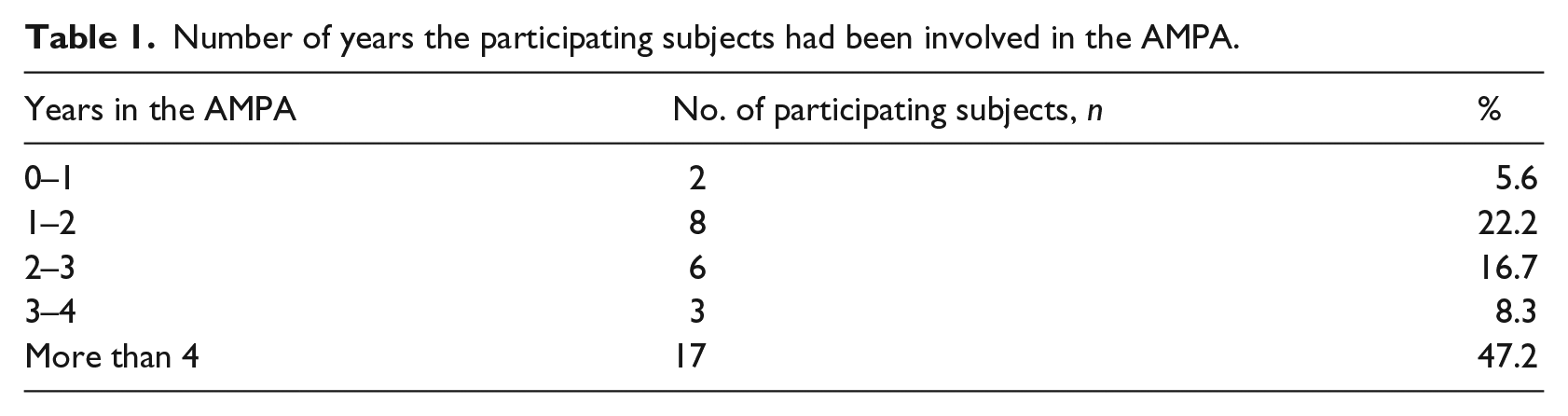
An open interview script was designed to gather information on how the participants assessed their involvement in an AMPA. Since the aim was to ask them about many different subjects, a relatively small number of AMPAs (some 30) were included in the sample, all of them from one Spanish autonomous region (which is not disclosed, as confidentiality was guaranteed by the code of ethics used in the study). However, the geographic dispersion of the schools made it difficult to conduct the interviews in a face-to-face manner, so it was decided to send the questions by email. The email addresses of 57 AMPAs were obtained from their respective school’s websites, and after an initial invitation and a reminder, 36 responses were collected, 6 more than expected. The respondents included 28 mothers (77.8%) and 8 fathers (22.2%). The time they had been actively involved in their association varied, although 47.2 percent had been linked to the association for more than 4 years (Table 1).
Number of years the participating subjects had been involved in the AMPA.
The data were collected using 5 contextual questions, 12 research questions (based on the aspects identified by the Spanish literature as sources of conflict in AMPAs) and a final section for other suggestions/contributions. The 12 research questions were as follows:
Is the role of the school’s AMPA advisory (are families consulted? Are their views sometimes taken into account) or does it have a decision-making role (are families always (or nearly always) consulted)? I am interested in finding out whether AMPAs are only expected to propose activities to be carried out outside of school hours, as promoted by the LOMCE, or whether they are expected to participate in connection with other issues as well.
Is there an AMPA representative on the school’s board of governors? If so, how important is this representative’s decision-making power?
Why do families form associations? What are the advantages/disadvantages in doing this?
How many people are actively involved in the AMPA (is this a large or a small group of people)?
What resources are made available for you to learn to manage the AMPA? Is there an AMPA handbook? Who provides the information, training courses and support in the AMPA’s day-to-day management?
What activities does the AMPA promote to galvanise school developments? I would like to find out exactly what actual activities AMPAs are involved in.
What activities are carried out to voice parents’ complaints? I would like to know any existing requests and concerns.
What are the sources of funding? I am interested in finding out how the AMPA is funded and what opportunities and challenges are involved in this.
What is the main success story of the AMPA? I want to know what is working best.
What are the AMPA’s problems? I would like to know what difficulties they encounter in their daily operation.
Future challenges: I want to know what school AMPAs would need to work better?
Suggestions for improvement: I would like to know how the role of AMPAs could be generally improved.
After the data were collected, the participants’ answers to the open questions were analysed and categorised using content analysis and response frequency. The different responses confirmed that the questions formulated were relevant for the participants. In the future, the resulting categories of analysis could be used to design a closed questionnaire to encompass a greater number of associations throughout Spain.
The ethical standards governing these types of studies were applied in order to ascertain the rigour of the study and to ensure the independence, confidentiality and anonymity of the participants and their respective schools. A draft of this article was also delivered to an expert on the subject and to two members of AMPAs to ensure that the results and conclusions were clear, relevant and true and to obtain their approval for publication.
Results
A total of 11 areas will be discussed in the light of the results obtained: (1) advisory or decision-making role of the AMPAs; (2) a representative of the AMPAs on the board of governors; (3) advantages and disadvantages of joining an AMPA; (4) actively involved members of the AMPA; (5) learning how to manage an AMPA; (6) social and after-school activities organised by AMPAs; (7) activities carried out by the AMPAs to voice parents’ complaints, requests and concerns; (8) grant funding available to AMPAs; (9) AMPA’s strengths; (10) AMPA’s weaknesses; and (11) suggestions for improvement.
AMPAs’ advisory or decision-making role
The participants’ opinions regarding whether the AMPA had a consultative or a decision-making role varied considerably: for 16 of them (44.4%) its role was consultative, and for 11 of them (30.5%) it had a decision-making role. Those who considered that it had an advisory role argued that their proposals were not always accepted, whereas those who considered that it had decision-making powers noted that their proposals were always taken into account. The rest of the answers pointed to other alternatives that had not been contemplated. One respondent highlighted that its role was half-way between the two positions and was unable to define it. Two participants pointed out that the school only resorted to the AMPA when it needed something from the association. Two others suggested that it was a collaborative relationship, and another respondent emphasised that they were almost never consulted. A mother expressed as follows: Mainly advisory. School management always listen to our views, but they don’t always carry them through, either because they are not viable or because they don’t take them into account. (Participant 30)
Representative of the AMPA on the board of governors
Except for one school, all participating school AMPAs (35) had at least one representative on the board of governors, (several had two, others had four), and they believed that they were listened to. Some parents stated that their work on the school board was very important, but ‘unfortunately, there are no other parents who wish to be part of the board of governors’ (Participant 1), and ‘it is difficult for certain decisions to be applied, including the need to reduce the amount of homework and the time required for children to complete it, as has been repeatedly requested by our president’ (Participant 13). Other views also pointed towards the fact that sometimes their proposals or opinions are not listened to or that they have little influence, and some participants were critical of the composition of the board, where teachers are likely to have their requests approved given the number of votes they have, whereas parents are unlikely to have their petitions approved: The problem is the type of voting that takes place in the board of governors, since there are more teachers than external representatives. We are totally ignored, and the decisions of the teaching body are never in favour of the school’s parents and students. (Participant 30)
Advantages and disadvantages of joining the AMPA
Most of the participants’ statements (26 responses) indicated that they had joined to ensure that their children would participate and have priority in activities organised by the AMPA. This involved benefitting from discounts in extracurricular activities, textbooks, canteen, school trips, counselling services for parents, end-of-year party, distribution of smocks for the children and so on. One mother described the AMPA as ‘cheap day care’ (Participant 3). Seven responses stressed that collaborating with the AMPA was a way for families to improve school life through their representatives: ‘having a voice in the school’ (Participant 25); ‘because we represent them’ (Participant 26); ‘a small number of people join to provide ideas, constructive criticism and improve the education of their children’ (Participant 20); ‘to be informed, share their views and become actively involved in the school’ (Participant 10). Four answers also highlighted that families tend to become members out of habit. No participant stated that joining the AMPA had any disadvantages.
Active involvement in the AMPA
In all cases, the number of participants who were actively involved in the AMPA was small, considering the total number of members. The frequencies of the 34 responses obtained to this question were distributed as given in Table 2.
Number of active members of the AMPA and response frequency.
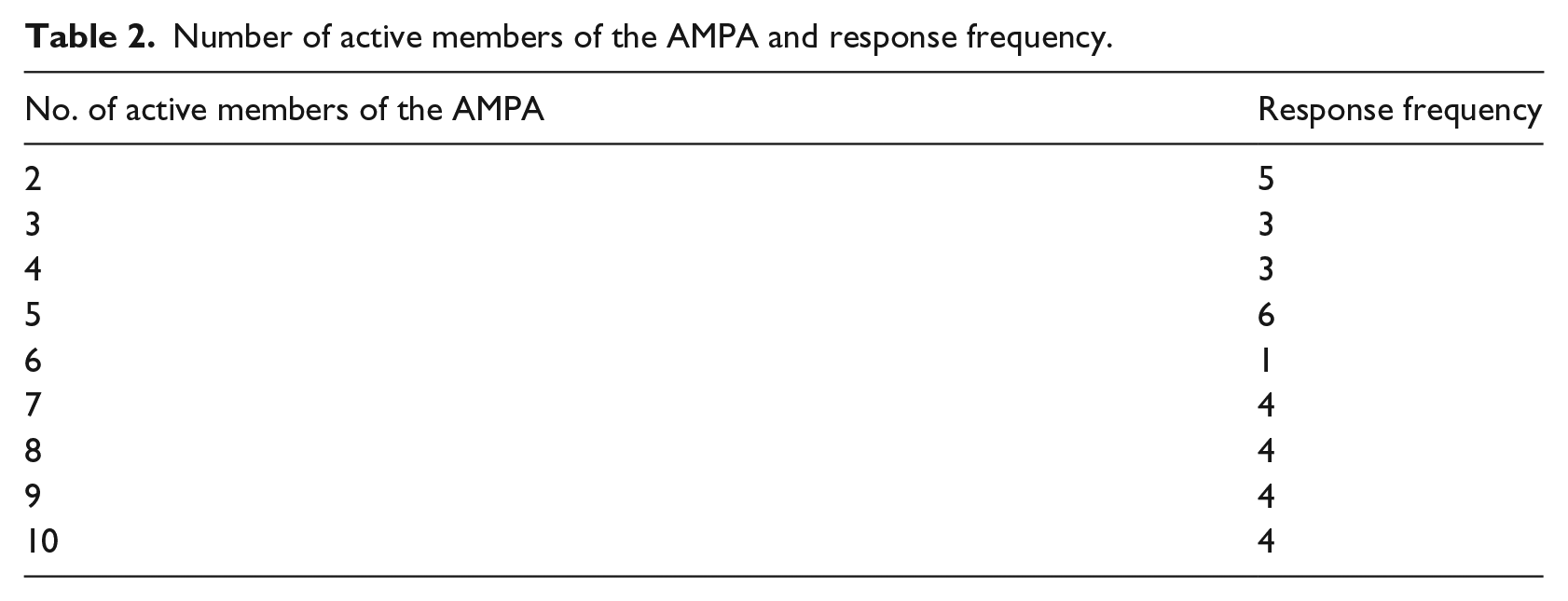
The data indicate that AMPAs, far from being very large associations, have very few active members. Four participants stated that when ‘some hands’ were needed for a specific activity, they turned up, but that engagement on a regular basis was left to a small group. The reasons for being active participants were as follows: (1) they felt the need to represent and voice the concerns of the families in their school; (2) they wanted to improve the school, be united and organise activities for the children; and (3) they wanted to ensure the association remained in existence and continue enjoying the book bank. Seventeen people also said that no one was there for personal gain; on the contrary, being actively involved required time, effort and dedication. A mother expressed it in the following way: ‘It is giving time that we don’t have, since we all work and have children and lots of problems’ (Participant 31). However, three people recognised that some people had tried to obtain personal benefits from their associations.
Learning to manage an AMPA
Each association learned to manage itself according to their circumstances and, in general, by combining several strategies. For 11 respondents, the assistance provided by the Federation of AMPAs was the most valuable (4 out of these 11 had participated in a talk or specific training session). For 10 participants, the fundamental aspect had been the collaboration between the outgoing and incoming board of directors, by helping to answer questions. Nine responses highlighted that they had experienced trial and error, expressed by some parents as management ‘by kicking and screaming at each other’. Eight parents said that they were self-taught and searched for information and documentation as required. For five respondents, contact with other AMPAs had been important; four members reported they had read external manuals (e.g. the one issued by CEAPA); for three AMPA members, the support provided by the regional Education Authority had been important; and one of the respondents stated that they had needed help from an accounting agency on a grant application. Some five parents stated that they would need manuals (three assured that they were non-existent), and that the existing ones needed to be more comprehensive; they also argued they needed more training and more advice. This AMPA expressed it thus: With the help of a previous member of the AMPA, consulting with other AMPAs and out of our own initiative. We have just received a guidebook, but we still have not met to review it. (Participant 24)
Activities promoted by AMPAs to galvanise schools
The respondents listed numerous activities promoted by the AMPAs in their schools, notably including extracurricular activities (languages, sports, music, chess, dance, and so on, for 18 of the participating AMPA members); for 17 participants, it was the celebratory activities that stood out (end-of-year party, chocolate party, Carnival, Halloween, Christmas, etc.); 12 highlighted specific cultural, environmental or sporting days (Book Day, Bike Day, etc.); 8 mentioned charity markets; 6 highlighted specific acts during Carnival, Halloween or Christmas (take the Magi to school, for example); 4 stressed the Early Bird and Playroom programmes; 2 mentioned a specific support programme for English in the classrooms; and 1 person highlighted collaboration with other schools. The AMPAs were very active in terms of social and after-school activities, and they had taken a leading role in schools. Some questioned whether the AMPAs should manage the schools’ extracurricular activities or not. As graphically expressed by one mother, ‘We participate in all of the school’s social and extracurricular activities, that is what AMPAs are for’ (Participant 12).
Activities carried out by the AMPAs to voice parents’ complaints, requests or concerns
There was less variety in these types of activities than that of the social and extracurricular activities, in which the AMPAs seemed to be strongly involved. Depending on the facilities and means available at each school, seven AMPAs had requested that improvements be made in infrastructures and facilities (they had requested extensions, renovations, refurbishments, better maintenance, etc.) and in three cases, they had asked to have the cleanliness of the school improved. A total of four parents highlighted the AMPA had managed parents’ complaints about the school; two respondents reported that they had collaborated with the management team (although they mentioned that the teaching team did not usually get involved). Other sporadic requests made by some of the AMPAs consulted were as follows: having homework time reduced; obtaining free textbooks; promoting greater use of resources (English materials, garden greenhouse), improving supplies (lighting); changing the school schedule; demonstrating against the LOMCE and in favour of state schools; requesting that additional staff be employed (a caretaker); and defending the maintenance of a bilingual programme. Two AMPAs stated that they were not involved in any activities relating to concerns and requests from parents. One of the mothers expressed it in the following way: Whenever we see a deficiency, we report it and we try to see that it is corrected. We have made a small contribution by urging them to have the school enlarged, as they had run out of classroom space. (Participant 23)
AMPA grants
The large majority of AMPAs consulted have or have had grants, in addition to membership fees, except for one. The AMPA that had not received a grant explained that their city council did not have them available. Of the rest, 26 AMPAs had received subsidies from different departments of local councils, 20 of them had obtained funding from the Ministry of Education, and 2 from neighbourhood associations. From those who reported on what the aid had been used for, 12 indicated that it was for extracurricular activities; 3 for the English Project; 3 for the end-of-year party or school trips; 2 for the book bank; and 2 for special purpose projects (environmentally related). The families that belonged to the AMPAs were very critical about grants because they considered that they were difficult for members to manage. A total of eight respondents complained about ‘obstacles’, ‘paperwork/bureaucracy’ and ‘requirements’; two argued that the way funding was allocated to the different schools was not transparent, or funding was allocated ‘without much thought’. Some three respondents suggested that the procedures for the submission of projects and reports and for substantiating costs should be facilitated further; two AMPA members claimed that that payments were made late and instead of being made in advance; and two others mentioned that the grant they had sometimes covered 10 or 50 percent of the activity in question. One of the participating parents expressed it as follows: The main difficulty is that administrative management is complex; families lack the training to operate as companies; we are asked not only to keep accounts, but to write projects, hire staff, prepare tax returns, etc. . . . this is too much for volunteers. (Participant 14)
Strengths of AMPAs
With the exception of one person from an AMPA who thought that everything was a strong point, and another who thought that AMPAs had no strengths, each of the AMPAs expressed different views. For nine participants, the most outstanding thing was the good relationship between members of the management team and the hard work some of them did; seven people stated that the strongest point was the extracurricular activities that it managed; five parents brought attention to the close collaboration between the AMPA and the management team; three respondents highlighted the new services that had begun to be offered; for another three AMPA members, the playroom and social and after-school workshops were the major strengths; for three others, the book bank; for two, the economic transparency; and for two, the response of the families to the proposed activities. Some people also stressed communication with parents; updating of the web site and social networks; the new company that organises activities; raising funds; the English project; the Parents’ Counselling and Support; and the Early Bird programme. Each AMPA was proud of some of their achievements, including the following: What works best in our AMPA are the extracurricular activities, which were non-existent three years ago, and the multiple activities both inside and outside the school. Our members have also become increasingly aware of the importance of what we do year after year. (Participant 15)
Weaknesses of AMPAs
There were two aspects in which there was considerable agreement: the first was that participants would like to see greater involvement by the parents in the AMPA and in the school itself (13 responses), and the second was that they would like there to be more active collaboration in the day-to-day affairs because as they reported, ‘we are missing some extra pairs of hands’; ‘this takes a lot of time and effort for a few to do’; ‘we are overwhelmed’; and ‘some have left because they were burned-out’ (11 answers). In five answers, it was mentioned that they would like to have more members; two responses noted that it was difficult to keep the parents informed, and to have new people join the management team. Other isolated responses pointed to other weak points such as little involvement of parents in activities that were not extracurricular; low level of transparency; need to have more information from the Federation of AMPAs; lack of liquidity; tense relations between the AMPA management and the school’s management team; the existence of different views among AMPA members on the educational needs of their children; poor attendance by members to the general assemblies and events organised for families; excessive banking commissions, which meant that 300 euros from membership fees were lost; lack of direct training in rural areas; and poor response levels from the schools. This mother’s statement is representative of two weaknesses: The first problem is the lack of initiative of the members. Out of 260 (parents) members, there are hardly any volunteers when we need help for activities or student workshops. If we get 5, that is a lot. The other problem that is also important is that the school hardly takes the AMPA into account at all. If you don’t agree with the school’s decisions, it’s a constant losing battle. (Participant 28)
Suggestions for improvement
Many suggestions for improvement were formulated by participating AMPAs. The most common proposals had to do with providing better information to parents about what the AMPA is, what it can do, how they can get involved and so on, so that they see it more as something to contribute to, rather than something to take advantage of (eight answers); increasing the decision-making ability of the board of governors; ensuring the AMPA’s involvement in other decision-making processes in schools; providing more information about what an AMPA is and its objectives to teachers and management teams (six responses); freeing AMPAs from managing extracurricular activities and reinforcing their ability to represent families in schools (five responses); improving the communication among the entire educational community (four responses); centralising and enhancing AMPAs so that they can all offer the best services to end inequality between schools; stop being involved in buying things or financing schools (three responses); establishing a clear legal entity and written rules on AMPAs; actively participating in meetings in town councils and management teams; easing administrative procedures; ensuring AMPAs a minimum degree of funding to operate; finding more opportunities for AMPAs to have contact between themselves to be stronger and provide more initiatives and ideas; and give additional training to the board of governors and associates (two responses). One of the participants made a proposal that may be important: defining common objectives; having AMPAs’ federations audited by a regulatory authority; employing someone for about 2 hours every day, from Monday to Friday; changing the composition of boards of governors, so that parents are not always in the minority; receiving more support from the Federation of AMPAs; and providing more training, and not only in urban areas. One of the parents summarised her suggestions for improvement as follows: We need to give the AMPA sole responsibility for representing parents, and ensure that they do not have to manage extracurricular activities (which end up being subcontracted to private companies); they also need to have a certain degree of funding to operate and have additional services provided by the local authority, such as talks, parents’ counselling and support, etc. (Participant 12)
Another mother argued the following points: AMPAs currently organise activities that should be offered by schools or by the municipalities; I mean, for example extracurricular activities and the early bird service (this last is provided by the town council in our school), and until a couple of years ago, even the book bank. That creates a huge inequality between schools, since your different services are provided in various locations. There are some matters that should be managed by public bodies. (Participant 17)
Discussion
Although one limitation of this study is the low number of participants, one of its strengths is having been able to obtain their views firsthand, in order to find out what they thought about various important topics. The categories generated from their answers can be the basis for future studies, as a closed questionnaire with multiple alternatives could be designed to be sent out in bulk to Spanish AMPAs.
The results have shown that there are remarkable similarities and differences between the AMPAs regarding the different aspects analysed. The arguments used by the participants in this study met the study’s general objective. They gave information about how 36 parents involved in the management of their association described, interpreted and assessed their situation as AMPA members. A number of conclusions related to the specific objectives can be drawn based on the results. These are discussed below.
First of all, AMPAs were found to be actively involved agents, despite being formed by volunteers, and they strived to carry out a variety of tasks to improve schools. This involves dedicating their time to the schools, the students and the families and includes proposing, designing, managing and organising numerous activities of various kinds for children and families, using membership fees and some grants. This dedication and commitment can be wearing, given the intrinsic difficulties faced by AMPAs (small number of members, few resources, external criticism, etc.). However, participants also stated that their participation was rewarding, and listed numerous strengths, including activities promoted and achievements made, as has also been recognised by earlier studies (Addi-Raccah & Ashwal, 2018; Bangran & Hu-Nam, 2019; Barnett, 2013; Garreta, 2008, 2016; Li & Fisher, 2017; Murray et al., 2014).
It can be concluded that the decision-making ability of AMPAs is currently reduced (Feito, 2011; Gubbins & Otero, 2016; Murray et al., 2014), except for their role in proposing and carrying out extracurricular activities, which is their main area of influence, as shown by this study. Their only contact with the school is the board of governors. This arrangement has many limitations: (1) under the LOMCE, AMPAs are no longer decision-making bodies, but operate on a consultative basis; (2) the majority of the members of the board of governors belong to the teaching staff, which means that the proposals that come from the families can be easily dismissed; and (3) although practically all AMPAs have representatives on the board, there were several who considered that there is insufficient awareness on the part of teachers and management teams regarding the importance of parental involvement in the schools’ decision-making processes, in line with earlier studies (Barr & Saltmarsh, 2014). It seems logical that the AMPAs that have collaborated in this study see themselves more in a consultative than a decision-making role. In this sense, there is a social need for families to become engaged in schools and for the relevant regulations to be revised and updated to better address the current issues and bring their situation closer to their ideals, as noted by other researchers (García et al., 2015; Garreta, 2008; González, 2004; Murray et al., 2014; Palomares & Collado, 2011). In this study, the participating families were found to be divided in terms of how they saw the decision-making processes: some were consistent with the study conducted by Stelmach (2016) in Canada and believed that their decision-making capacity was very limited, whereas other views were in line with the studies carried out in Spain by González (2004) and were of the opinion that the operation of their schools was greatly improved by the influence of the board of governors. This may be related to the professional relationship among teachers (a variable that participants were not asked about in this study, as it was considered that this fell outside of the parents’ experience).
The relationships between AMPAs and management teams and teaching staff varied considerably; they ranged from between full collaboration to indifference (Barr & Saltmarsh, 2014; Rivas et al., 2011). Some statements were collected that reflected support, whereas others revealed reluctant attitudes, which shows the great complexity and divergence between the schools in the study. It was seen that some educational agents did not perceive family participation as being an important educational need, as noted by various authors (Addi-Raccah & Ainhoren, 2009; Barr & Saltmarsh, 2014; Epstein & Sanders, 2006; Gubbins & Otero, 2016; Wringley et al., 2011). Likewise, the relationships between AMPAs and families were also diverse and, in many cases, tinged with mistrust. AMPAs help families to ensure that their children can enjoy extracurricular activities, parties, school trips, free schoolbooks, educational programmes and so on, but they have little involvement not only as ‘users’ but also as collaborators in organising and making proposals. AMPAs have requested a greater number of involved parents (Garreta, 2008; Gubbins & Otero, 2016).
Regarding the daily management of AMPAs, the people consulted expressed the need to have more training related to their regular operations, additional support and information available to them, stable funding not linked to the application for grants and so on, as noted in earlier studies (Gökyer & Alpinanç, 2014; Murray et al., 2014). They reported a lack of good AMPA management manuals and urged that the procedures for applying for funds and substantiating costs should be made easier, as they are not professionals, but simply parents. If this is not the case, their request for professionalisation would make sense (employing someone to manage the schools’ extracurricular activities). In fact, the management of extracurricular activities was perceived by some parents as a task that completely overwhelmed them. In their view, this prevented them from focusing on organising social and community activities, taking actions to voice parents’ concerns and demands and being the intermediaries between the families and the schools’ management teams (Comellas et al., 2013). It was noted that the survival of AMPAs is a permanent challenge (Mitchell, 2017; Murray et al., 2014), but no AMPAs reported that their situation had worsened as a result of the economic recession in Spain.
This is a time when involvement does not seem to be part of educational concerns, since they are seen more as technical problems in terms of quality, efficiency and implementation of new technologies, resolved on an individual basis, as stated by San Fabián (2005). This study shows that school involvement through AMPAs is a necessity if there is to be a move towards more democratic schools (Apple & Beane, 2007; Atuhurra, 2016; Lobman, 2011). It can be concluded that AMPAs are a means of promoting significant participation that needs to be further enhanced, studied and disseminated. Those involved in AMPAs highly value and defend these organisations’ essential role in improving school dynamics.
However, other avenues of organisation and family participation, both spontaneous and organised, are still needed if the current limitations currently faced by AMPAs are to be overcome. There is still a long way to go for Spanish schools to achieve the goals for family participation noted by Comellas et al. (2013) and Kwang-Suk and WonSeok (2019). AMPAs need to have a more active role in schools in Spain. They could do this by creating more alliances and taking decisions jointly with teachers.