




Abstract
School improvement frameworks and their associated reform efforts often have limited durability and are frequently not fully implemented. Improving their viability, requires a more realistic understanding of contextual organisational structures and the school culture in which the reform is to be implemented. Internationally, and in Australia specifically, education research has informed policy heavily promoting collaboration as a school improvement strategy, with the aim of building teacher capability and student achievement. Consequently, secondary school leaders are charged with promoting the need for teachers to collaborate meaningfully with hundreds of students, carers, parents and colleagues each week across the ‘silos’ of subject departments and grade levels in their school. Social Brain Theory suggests that there are cognitive limits on the number of natural face-to-face social interactions that one can have and maintain. Relationships require significant investment in time and frequency. Additionally, sociality is much more cognitively demanding than at first thought, having unforeseen influence on improvement efforts. The number of interactions required in a collaborative environment, an individual’s likely cognitive overload and the ‘silo’ nature of the school’s organisational structure must all be considered. This paper offers an alternative theoretical framework to support policy makers and leaders in optimising school improvement efforts.
Keywords
Introduction
School improvement efforts are foregrounded throughout formal agendas of many, if not all, education systems across the world (Glen et al., 2017). School improvement refers to those actions, plans and strategies that are designed and put into practice in schools, to address and remedy identified internal and related needs, issues or necessary changes required to improve learning conditions for all (DuFour & Fullan, 2013). School improvement agendas are driven by an underlying belief that education is a key mechanism for addressing inequity (Giannakaki et al., 2018). More specifically, disparity in learning outcomes within models of school education where some students are being left behind, whilst others are not being adequately challenged (Department of Education and Training, 2018b). Yet, school improvement studies suggest that most schools that begin various reform efforts never fully implement them, and of those, primary schools have more success than secondary schools (Lee & Louis, 2019; Stringfield et al., 2016).
Despite the theoretical frameworks to support school leaders in their school improvement efforts, to date social brain theory contributions to this field have been rather limited (Dunbar, 2018b). Social brain theory contends a quantitative relationship between social-group size (number) and cognitive capacity (Dunbar, 1998, 2014a). Given that school improvement initiatives, worldwide, promote collaboration to improve student outcomes, through building collective teacher capacity (Hargreaves, 2017; Sharratt & Planche, 2018), social brain theory has implications for the number of collaborative interactions that one individual can maintain. Current theoretical frameworks (DuFour et al., 2017; Ford & Youngs, 2017; Hallinger, 2018; Leithwood et al., 2019) address school improvement from various perspectives, including leadership, organisational context, structures, and culture, as entities or in combinations. However, these ignore the cognitive demands of sociality and the impacts they might contribute to each of these and therefore shaping school improvement success, or lack of it, in ways that may have gone unrecognised (Andrews & Rapp, 2015; David-Barrett & Dunbar, 2013; Lewis et al., 2017; Tamarit et al., 2018).
Therefore, the purpose of this paper is to outline an alternative theoretical framework to investigate how social brain theory may provide an additional lens for optimising school leadership that deliberates over aspects of organisational context, structure, and culture for school improvement success. This paper is proposing a theoretical framework that includes understandings about human cognition and sociality from an evolutionary point of view. It explores how social cognition is being underestimated in its cognitive demands in education contexts (Lewis et al., 2017). Whilst, it is the belief of authors of this paper, that this theoretical model is both flexible and adaptable in its application to other types of educational organisations, secondary schools have been selected as the focus for illustrating this framework. Within an Australian context, Secondary schools refer to those schools that cater for students aged between 12 and 18. These school contexts present a range of characteristics that make them worthy of closer consideration – organisational structure (silo mentality), organisational strategy (collaboration) and organisational culture (trust). At the same time, in personal communications with Dunbar, he expressed that these natural group sizes (approximately 150 people) have dramatic implications, not merely for the way organisations are structured, but the size and shape of schools (2018b). However, he also stated that extraordinarily little had been explored within this space. The proposed theoretical model offers novel insights for ways that school leaders plan for and implement school improvement initiatives, particularly when using collaboration as a strategy for increasing student outcomes and building teacher capacity. This model may also contribute to outstanding questions relating to the cognitive bases of trust, raised by Dunbar in previous research (Dunbar, 2018a). Trust is the basis of strong relationships and a key element for implementation and sustainable success in school improvement initiatives, more specifically as related to collaboration (Castillo et al., 2018; Dean, 2010; Drago-Severson & Maslin-Ostrowski, 2018; Lee & Louis, 2019). Consequently, such a model may hold important implications for future research. What follows is how this model is conceptualised and possible applications when leaders are seeking ways to optimise improvement.
Cognitive limitations from internal and external networks
Social brain theory (Dunbar, 1998, 2010) suggests that the ‘typical human personal social network contains about 150 relationships including kin, friends, and acquaintances (work colleagues too), organised into a set of hierarchically inclusive layers of increasing size but decreasing emotional intensity’ (Tamarit et al., 2018, p. 8316). Each increasing layer has shown that emotional connectedness decreases, thus illustrating correlation between the size of social networks and individuals’ mentalising abilities (Dunbar et al., 2015; Mac Carron et al., 2016). The cognitive demands of sociality mean that our capacity to maintain relationships is limited, and that different types of relationships require different investments in time (Dunbar, 2010; Tamarit et al., 2018). Energy, attention, and effort are given to those individuals we determine as ‘closest’ (David-Barrett & Dunbar, 2013; Dunbar, 2010; Tamarit et al., 2018). Individuals make this determination based on frequency of contact and recognition of a mutual and reciprocal relationship that has trust at its centre (Dunbar, 2018a). Hence, the number of people within an individual’s network are described as layered to reflect significant differences between relationships among individuals. When a secondary school context is considered, this is evident in the varying roles that individuals have and work among at any given time within a day or across a week – teachers, students, parents, caregivers, heads of department, teaching teams, instructional coaches, specialist curriculum teams, principal, deputy principal. This implies that individuals can have exceptionally large networks that they are trying to work across.
Individuals who have larger networks, on average, have weaker relationships because they choose to spread their available social capital thinly across many individuals (Dunbar, 2018a). On the other hand, those with smaller networks prefer to spread it thickly among fewer. In other words, to maintain group cohesion, individuals must be able to meet their own requirements, as well as coordinate their behaviour with other individuals in the group (Acedo-Carmona & Gomila, 2016; Dunbar & Shultz, 2007). This means that individualised pursuit to maintain each type of social bond, demands different cognitive requisites and time investment, particularly in face-to-face interactions (Acedo-Carmona & Gomila, 2016). Whilst this might seem reasonable and logical in many organisational contexts, in schools it can prove problematic for coordinating collaborative efforts to address student outcomes that maximise learning growth for all students, rather than a select few (Department of Education and Training, 2018b).
In school contexts, where teachers can be solely responsible for upwards of 120 students, working in partnership with parents, care givers and collaborating with teams of colleagues and other professionals on a weekly basis, the number of relationships one person has, can quickly exceed 150. Combine this with individuals not giving equal weight to each relationship (Mac Carron et al., 2016), it may not be unexpected that different school contexts embrace collaboration in varying degrees (DuFour & Reeves, 2016). For example, in a school where there are six or more Year 8 classes, this can represent ‘collective responsibility’ for over 180 students. Collective responsibility is a phrase being used in school contexts to build collective, individual and organisational capacity to improve student learning outcomes (Australian Institute for Teaching and School Leadership [AITSL], 2014a, 2014b, 2018; Department of Education and Training, 2018a, 2018b; DuFour & Fullan, 2013; Flanagan et al., 2016; Ford & Youngs, 2017; Hargreaves, 2017; Sharratt, 2018, 2019). Therefore, a classroom teacher who teaches more than one subject and more than one-year level (grade), would therefore be expected to collaborate with more than one team, along with balancing work practices and operational demands of day-to-day teaching, reporting, and assessing. These interactions add layers of complexity to the work life of individuals and teams in secondary schools. Limited time frames and increasing expectations of current collaborative interactions can produce a lingering aftermath for those involved – a result of being pulled in multiple directions and having to make hasty professional decisions (Beck, 2017).
Collaboration as an organisational strategy
Like other organisations, the educational sector continues to foster and encourage collaboration, expecting collaborative work and collaborative classroom environments to be the norm rather than the exception (Queensland Government, 2018a; Vangrieken et al., 2015). Collaboration, in this paper, is defined as a process that involves people working together with an emphasis on common goals, relationships, and mutual interdependence as a way of improving schools, teacher quality and student achievement (DuFour & Reeves, 2016; Musanti & Pence, 2010; Sharratt & Planche, 2016; Slater, 2004; Vangrieken et al., 2015). It has been described as the ‘most proven and practical way forward’ (Hargreaves, 2017, p. 83) in achieving improved school outcomes.
Collaboration has many advantages and the key benefits of this strategy have been well documented (Borda et al., 2018; DuFour & Reeves, 2016; Flanagan et al., 2016; Ford & Youngs, 2017; Hargreaves, 2017; Haslam & Khine, 2016; Johnson et al., 2018; Muijs, 2015; Sharratt, 2018, 2019; Sharratt & Planche, 2016; Tichnor-Wagner et al., 2016). In particular, organisations employ collaboration as a strategy to mitigate the negative effects of silos and silo mentality (Dean, 2010; Kilgore & Reynolds, 2011; Lloyd, 2016; Willcock, 2013). In education, this means addressing the issue of schools, leaders or teachers working in isolation or as separate entities – not accessing the wisdom and resources of others, to positively impact all student outcomes (Flanagan et al., 2016; Sharratt & Planche, 2016). One way this occurs is when teachers and leaders collaborate to develop a guaranteed and viable curriculum that gives students access to the same essential learning outcomes regardless of who might be teaching the class and that can be taught in the allotted time (DuFour et al., 2017; Marzano et al., 2014). This process is iterative and requires those teachers and leaders involved continually refining and clarifying their understanding of what all students should know and be able to do, how students show what they know, and the proficiency expected. Further to this, these collaborative interactions explore what actions are to be taken if students already know the content or what to do if they do not. Previous research shows that collaboration improves learning outcomes in comparison to the results of individuals working on their own (Andrews & Rapp, 2015; Hargreaves, 2017). Hence, there is a perceived correlation between countries with high educational performance and high levels of quality teacher collaboration (e.g. Finland).
A global and historical culture of individualism has moved towards a more collaborative way of working in schools and reflects thinking that collective professional learning can generate the shared leadership for social capital needed in long lasting capacity building (Adolfsson & Håkansson, 2019; Hargreaves, 2012, 2017; Honingh & Hooge, 2013; Jones & Harris, 2014; Vangrieken et al., 2015). However, strategies employed for school improvement initiatives are an investment in time, money and people (Hargreaves, 2012; Haslam & Khine, 2016) and therefore, require critical reflection on the impact of their implementation, and practical application, for those working in schools (Graves & Moore, 2018).
Assessing the impact of collaboration is not always as straightforward as it seems. Not all costs may be quantified easily, nor recognised – particularly if the strategy has been prioritised, and in some cases mandated, for schools by international, national and/or state policies (Queensland Government, 2017, 2018a, 2018b, 2020), or if the strategy is promoted as a ‘cure all’ approach for school leaders to navigate the tensions and dilemmas that occur in their rapidly changing environments (Allen et al., 2018; Gurr & Drysdale, 2012; Musanti & Pence, 2010). When it is the expected way of operating, collaboration can place additional pressure on leaders to downplay, ignore, or not recognise unintended consequences. Fast pace, time-bound expectations and targets reduce already precious time that leaders have to reflect on, evaluate and address, issues that can arise from collaboration as a strategy, much less question how this strategy is shaped or misshaped by their complex contexts.
Organisational structure that tends to promote isolation and silo mentality
In Australia, since the beginning of the 20th century, the dominant secondary school organisational model has been that of the subject departmental structure (Brady, 2010; Ellerbrock et al., 2018; Woolner et al., 2014). These organisational departments are purposely created to deliver specialised knowledge and competencies to students but can also promote insular behaviour and maintain departmental boundaries, at the expense of school improvement agendas. This is because these departments can have universal, ingrained, institutional practices and procedures that ‘inoculate’ them against reform efforts due to a ‘collective consciousness’ that believes it is inconceivable to behave in any other way (Brady, 2010; Puttick, 2017). Advocates of secondary schools leveraging their current discipline and subject based structures as means for improvement, unwittingly can promote a siloed mentality (Ko et al., 2015; Leithwood, 2016). Silo mentality is where physical and psychological barriers develop between the many parts and functions of the organisation and lead to a focus on fulfilling a function, instead of attaining an overall organisational outcome (Forsten-Astikainen (Forsten-Astikainen et al., 2017; Lloyd, 2016; Tett, 2016). In this situation, secondary school structures can prove challenging for whole school implementation when strategies appear to misalign or not fit with a department’s focus for improvement.
As an organisational metaphor, silos are used to describe those barriers – physical and psychological – which are borne out of our human need to classify and organise our social and mental models (Tett, 2016). Silos occur as a response to working in complex organisations that require a structure to manage what is seen to be chaos. Regardless of the type of work, very few organisations, if any, are invulnerable to silo mentality (Forsten-Astikainen et al., 2017; Lloyd, 2016; Tett, 2016). In a secondary school context, this can be seen in the discipline or subject department structure whereby the perceived needs for improvement are based on the department function and a protection of ‘a deep engagement with disciplinary ways of knowing’ (McPhail, 2017, p. 57). Yet, the assumption remains that school improvement is a schoolwide process that reflects the school goals overall (DuFour & Fullan, 2013; Fullan & Quinn, 2016; Jones & Harris, 2014). This has seen attempts to use interdisciplinary teams to address common problems of practice that transcend subject disciplines (Borda et al., 2018). However, these teams can still become siloed or experience silo mentality. In light of this, the proposed theoretical framework suggests a possible association among cognitive limitations of sociality and silo mentality.
Silo mentality results in the fracturing of organisational artefacts and impacting undesirably on the relationships, and forming barriers, between individuals and within teams (Cilliers & Greyvenstein, 2012). Perceived inequity or privilege attributed to timetabling, allocation and access to financial and human resources or professional learning, are some examples of how this might play out in a secondary school context. Collaboration, although viewed as a way to alleviate silo mentality, can be perceived as an additional demand on a department’s limited resources. Even if this is not the case, processes and structural walls can obstruct the right connections (Dean, 2010). The physical location of departments on a school campus or within a building can be problematic. Geography and organisational design can create silos that impede information flow (Fox, 2010). This is supported by the research of Childs et al. (2013) who found that, although these subject departments can be highly collaborative, they were also ‘balkanised’ – successfully segregated from the rest of the school – a situation which has potentially adverse implications for teacher learning and improvement at the whole school level. This is particularly true when tensions arise as a result of the strategy being viewed as competition to the fast-paced, day-to-day, operational demands of each department (Holmes et al., 2013).
It is also possible that natural fission points that result in organisations having a distinct size (Dunbar & Sosis, 2018), could also be a contributing factor to these tensions. That is to say, that as a school grows or implements changes in response to addressing problems of practice, there is an ever-increasing number of high quality and intentional collaborative interactions taking place, within and across teams in schools. Therefore, requiring more time for responses as the mentalising for these interactions are more cognitively demanding than first realised (Lewis et al., 2017). Interactions in schools take place for a range of purposes, some of which, address the wide range of educational learning outcomes that can occur in the same classroom or school (Department of Education and Training, 2018b; Sharratt, 2018). Trying to maintain and sustain these interactions can be exhausting. Safeguarding against cognitive overload, and increased intensification of collaborative interactions (Beck, 2017), can lead to individual and collective self-protection mechanisms that can derail the purpose and intended outcomes of the interactions in the first place. Consequently, eroding the foundations of trust on which these interactions take place.
Organisational culture that tends to promote trust
Collaboration is relational in nature. For everyone involved, relationships are fundamental and shape or misshape what does or doesn’t take place. Relationships of all kinds are costly to maintain in terms of time investment as they are underpinned by trust (Dunbar, 2010; Lewis et al., 2017; Tamarit et al., 2018). Levels of trust in a relationship, psychologically, are trade-offs between costs and benefits to the individual and the time invested in the relationship (Sutcliffe et al., 2012, 2018). This type of relationship building in schools is a balancing act because of the multiple and varied demands on time, and how that is distributed to an ever-increasing number of quality and intentional interactions (García-Moya et al., 2019; Lewis et al., 2017; Sharratt, 2018) to improve student learning outcomes.
Personalising the learning for every student has become an expected reality and not just an aspirational target (AITSL, 2018). Yet, research (Dunbar, 2010, 2018a; Sutcliffe et al., 2018; Tamarit et al., 2018) would suggest that distribution of social effort is highly influenced by the time afforded to, and cognitive constraints of, the number of relationships and levels of intensity for each of these. That is, the more relationships required of an individual’s role in a secondary school, (teacher, leader of curriculum, deputy principal), the more cognitive complexity required for these interactions. This has great influence in determining where that individual’s energy, attention and effort is attributed. In addition, each person’s ability to understand another person’s mindstate (Lewis et al., 2017) and intentions (mentalising capacity) is supposedly limited to four or five people when face-to-face (Dunbar, 2018a; Lewis et al., 2017). This number can be even lower if the people are not face-to-face. What this means is, if an individual is collaborating with teams of more than four to five people, then the individual is working harder to keep track of what each person thinks about the topic or topics being discussed or explored, compared to their own. In schools, individuals can belong to many teams for many different purposes. Specifically, when multiple teams are created to implement national, state, local and individual school strategic agendas. Consequently, using this proposed framework for school improvement would then suggest implications for the way leaders organise and structure the number of teams for collaboration. It also has implications for the reasonableness of expected outcomes for these collaborations, given the time available for them. This is because maintaining and sustaining these collaborative relationships are dependent on function, quality, and frequency for each member of the team, and for each team they belong to. That is to say, how an individual ranks the relationship is based on purpose, reciprocal trust, combined with obligation, and how often they meet (Dunbar, 2018a).
Time is a limited resource for organisations and for those working in schools, seems to be coming an even more rare commodity. Building high performance relationships, using the proposed theoretical framework, considers the rate of decay for relationships as this hinders building a culture of trust and collaboration across a school community. In understanding the inherent tensions that exist between individuals deciding how they distribute their available social effort, or capital, across their network (Dunbar, 2018a) can support leaders in their decision making. For example, members of teams and leaders can become frustrated when collaborative interactions appear to be a waste of time. More specifically, angst may be lessened if there is an understanding that following a period of reduced contact is then often compensated by talking to the person/s concerned for much longer than would normally be the case. When thinking about a secondary school context, this means that a team who might only come together once a term or irregularly (as time allows), social cohesion depends on those within the group having time that includes a ‘catch up’ prior to getting started on the ‘real work’. School leaders usually include this time at the start of a new year or new term after a prolonged break, but it appears that this might be necessary if teams are not able to meet more regularly.
Leadership to optimise improvement
Leaders are expected to select improvement approaches that will work best in their context and then thoroughly and deeply embed them (Jones & Harris, 2014). This is easier said than done. There can be many reasons for this, but impatience for tangible outcomes, within unrealistic timeframes, can be catalysts for inevitable tensions that arise. Some of these tensions are a result of miscommunication, misunderstandings and mismatches of skill and will. Other tensions arise because of unintended or unforeseen consequences. The proposed theoretical framework for school improvement (see Figure 1) extends leaders’ knowledge to accommodate those associated with limits on sociality, in combination with organisational context, culture, structure and strategy.
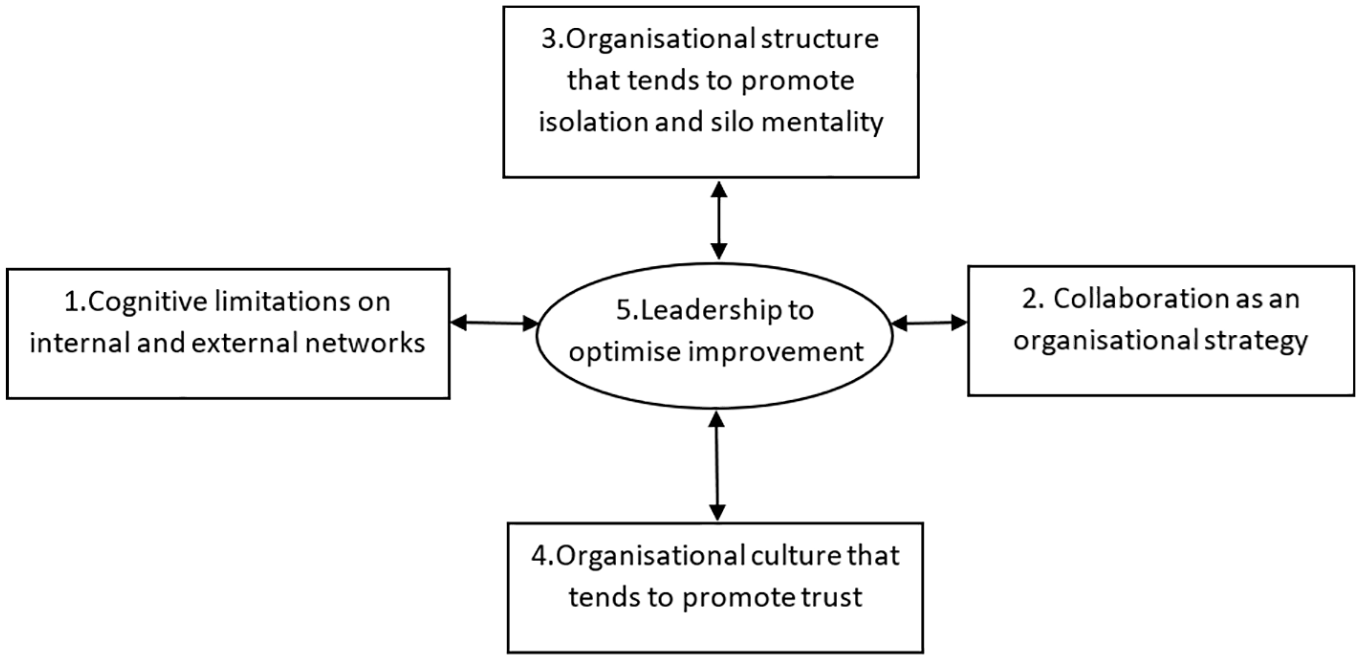
Alternative school improvement theoretical framework.
This framework begins with research that suggests that placing strains on the mentalising abilities of individuals means they are working harder and spending more time understanding the concept, requirements, and practices of collaboration. Vangrieken et al. (2015) found that a systematic review of teacher collaboration highlighted that terms and structures used to refer to teacher collaboration (Communities of Practice – CoPs, Professional Learning Communities – PLC, Professional Learning Teams – PLT, Teacher Learning Communities -TLC), were often loosely defined and used interchangeably. This was, and is, problematic for implementation as leaders and teachers can perceive them to be one and the same, when this is not the case (DuFour & Fullan, 2013; DuFour & Reeves, 2016; Hargreaves, 2017). Therefore, risking the success of this strategy for improvement, from the outset, because the foundations lack a shared understanding of a version, or versions, being used in their school context. Consequently, effort is expended on these issues, rather than expending the same effort collaborating on problems of practice that are proving to be barriers for improved learning outcomes for all students.
In the race for outcomes, leading from a position of assumed knowledge and skills, can create short cuts and fragile understandings of purpose, intent, and unreasonable deliverables for the strategy (collaboration). When time, attention and cognitive constraints are not actively managed in the school improvement process (Dunbar, 2018b; Dunbar & Sosis, 2018), then progress towards long-term goals can be hijacked (Holmes et al., 2013). If consideration is not given to the long-term implications and costs for implementation for the organisation, groups and individuals (Andrews & Rapp, 2015; Fox, 2010; Lewis et al., 2017), then they may see this strategy as a distraction – a side order to the ‘real work’ (Sharratt, 2019). Even where collaboration is embedded in a school’s current context, school leaders would be well placed to review, reflect, and refine their staff’s understanding of the processes, practices and skills associated with the versions of collaboration being used, or not, across each department. At best, this can provide peace of mind that there is a collective and shared understanding of purpose, practice, and skill. At worst, it gives school leaders an opportunity for disrupting problematic practices and providing information as to the next steps for improvement.
Leading collaboration in secondary schools needs to go beyond valuing it as a strategy for improvement, to reviewing it with a critical and careful eye that contemplates limits on sociality from an evolutionary perspective (DuFour & Fullan, 2013; Dunbar, 2010, 2014b; Lewis et al., 2017; Marvin, 2017; Tamarit et al., 2018). Sustainable, realistic, and impactful collaboration, that takes place in secondary schools, will be influenced by the number of interactions taking place, how often and with whom. More is not always better. Yet, as schools grow, or in response to attempts to address specific problems of practice or operational demands, school leaders will create new teams. However, restructuring may eventually establish new silos as more teams are created with less time for them to meet or share information across the school (Forsten-Astikainen et al., 2017). Rather than mitigating the negative effects being addressed through collaborative interactions, they can inadvertently, in a secondary context, contribute to further silo mentality. In this case, those school leaders who recognise and wish to address these issues may reconsider roles and responsibilities of leaders who work closely with these teams. For example, Heads of Department could have more of a focus on becoming the link across department boundaries and the collaborative interactions occurring within their own departments, rather than, in some cases, being focused on addressing behaviour management or other tasks that take them away from supporting teachers in improving student outcomes. This would mean reducing Heads of Department teaching load further, to enable them more flexibility to engage in ‘boundary crossing’ that allows them to work with learn from and problem solve with colleagues in other departments. People who connect across these ‘structural silos’ are more likely to notice productive new combinations of previously isolated information because they are exposed to the diversity of surrounding skill sets and ideas and thus, more likely to see how other teams might benefit with access to this information and be able to apply in their own context. (Burt, 2015). Leadership teams could review their roles and responsibilities in efforts to be explicitly looking for opportunities to bridge structural silos within and across teams. This is because two people who have little or no connection with one another are more likely than connected people to work with different ideas and practices (Burt, 2015). Ignoring, or not recognising these possibilities can lead to reinforcement of these structural silos. This can prove problematic for the pace of whole school improvement initiatives.
There is an inherent tension between the achingly slow pace of whole school improvement and the impatience for improved student outcomes and building teachers’ professional capacity. Time, or the absence of it, has become one of those ‘key drivers’ when making decisions about how much time can be afforded for collaborative interactions. As an increasingly valuable commodity (Whillans et al., 2017), time is constantly negotiated and renegotiated in service of time-bound organisational structures. The issue is that social brain theory indicates the less costly a relationship is, the more of them one can have and on the contrary, the more time or cognitive capacity that an individual has, the more he/she is able to devote to strengthening all his/her relationships (Acedo-Carmona & Gomila, 2016; Dunbar & Sosis, 2018; Tamarit et al., 2018). Collaborative interactions that address the issues of improving student outcomes reflect complexity and consequently require more, not less, cognitive processing (Lewis et al., 2017). Therefore, leaders need to weigh up the reasonableness of expected outcomes from collaborative interactions – the number of them taking place in the time being provided. One possibility is that leaders could map the improvement agendas for each department to create a school wide overview. Whilst departments have improvement agendas that align to the whole school ones, there can be those specific to a department. It is important to bring these out into the open, rather than have them hidden away because they do not ‘fit’ the school wide categories for improvement. This can only be undertaken in a culture built on trust. For the most part, these departmental agendas can be aligned to the categories for whole school improvement, but a departmental silo mentality can ‘blind’ individuals or teams to this. Therefore, collective mapping of department’s improvement agendas can highlight this, whilst also providing school leaders with an overall current reality of the work being undertaken, in the name of improvement. Collectively, leadership teams can discuss reasonable outcomes in the time available. Particularly, when calculating how often teams are meeting and the length of time they meet for when addressing this work. Having undertaken this process with a leader, who had been charged with improving reading across their school, she found that the time available to her, to undertake the work with teams, was 3 hours – across the school year! Time available could not be renegotiated, but thoughtful discussions about what might be reasonable outcomes in those 3 hours, were. This process saw this leader have an appreciation for the number of initiatives being undertaken and alternative perspectives on what might be reasonable to expect as outcomes in the time available. This was not to say that these initiatives were reduced in number, but rather a renegotiation of expected outcomes. The important thing to remember is that these maps act as artefacts of a current and changing reality and therefore require adjustments as change occurs. They should not end up as glorified wallpaper that remain pinned to notice boards, tattered and torn or lost within digital folders, fading into the memory of those who have been on staff for more than 5 years.
Leaders can be better informed when considering each of the elements of the framework and how these may impact decision making when implementing and sustaining school improvement initiatives in their contexts (Hallinger, 2018).
Conclusion
School improvement efforts seek to find sustainable and impactful practices and collaboration is a focus internationally for school and systemic change (Hargreaves, 2017). Nevertheless, leading collaboration is a complex task within a school and more so in a secondary context where departmental structures can promote silo mentality. Silo mentality is viewed as a form of organisational dysfunction and collaboration is a strategy for mitigating the issues that arise from silo mentality (Forsten-Astikainen et al., 2017; Stone, 2004). However, secondary schools face challenges in implementing collaboration for varied reasons but contributing to this are many institutional structures and practices that can be taken for granted, and so entrenched, that they are rarely recognised or challenged (Brady, 2010). In addition to this, social brain theory implies that the size of group that can coordinate its behaviour is limited by the cognitive capacity (essentially, the neural processing capacity) that individuals can bring to bear on the problem (David-Barrett & Dunbar, 2013). Furthermore, current school improvement theoretical frameworks reflect a continued lack of clarity for current realities that face secondary schools when implementing school improvement strategies – more specifically, how strategies of collaboration are impacted by cognitive constraints and the organisational structure of the secondary school context.
Therefore, the theoretical framework discussed in this paper attempts to address the current gap that is inherent in ignoring issues that arise from limitations on sociality in addition to organisational structure, culture, and strategy. Furthering our understanding about the contributions of social brain theory requires examination of the following questions: How can secondary principals strategically lead collaboration if there are possible cognitive limitations to interactions? How do secondary leaders organise structures for collaboration as a strategy for improvement? Given that schools range in size, how might this account for silo mentality and consequently, barriers to collaboration? How do secondary school principals recognise silo mentality within their schools? When might silo mentality NOT be a barrier to collaboration?
The proposed framework makes important theoretical contributions and can be used as a starting point for new research agendas. Future research would necessitate testing the proposed theoretical associations and require empirical support, applying both qualitative and quantitative research methods. Much research about cognitive limitations and sociality have been leaning heavily towards numerical data sets (quantitative) that value statistical analysis over thematic analysis. However, qualitative data can illuminate critical contributions that participants can further provide when representing their view of the phenomenon from multiple perspectives (Biesta, 2017; Charmaz, 2016). Furthermore, there is a sense of security in quantitative data analysis for those in education as they strive for evidenced based decisions and knowing the impact of those decisions (AITSL, 2018; Biesta, 2017). Using both forms of research methods could provide a richer understanding of these concepts and provide leaders with practical suggestions for addressing issues that arise when school leaders work towards reducing the discrepancies in learning outcomes for all students.
From a practical standpoint testing this framework could open opportunities for leadership to build capacity through school improvement strategies that are designed with the social brain in mind. Ultimately, leaders could design improved learning cultures that potentially improve student learning for all, achieving maximum learning growth in the time available and incentivising schools to innovate and continuously improve (Department of Education and Training, 2018b).