




Abstract
Limited research is available with a focus on adolescent Autistic girls and their needs during secondary schooling. Consequently, many issues are often not recognised and addressed by educators. The small-scale Australian research reported here explored the experiences of five Autistic girls during their first 2 years of secondary school, with data being gathered via an online survey and semi-structured interviews. Findings are presented from the perspective of the girls themselves and highlight the negative impact of sensory, communication, and social difficulties, as well as the influence of anxiety and executive dysfunction on their learning and academic success. Unique insights into how the girls feel about school and the anxiety they experience there, together with everyday barriers to learning they encounter provide some important messages to schools and teachers.
Introduction
‘It’s hard when they don’t understand the challenges that come with Autism. You can’t learn about experience’ (Sharan, aged 14).
This paper shares the experiences and feelings of five adolescent Autistic girls in relation to their early secondary schooling in Australia. Factors that hindered and helped these girls academically at school are explained from the perspective of the girls themselves. The girls participated in this research because they wanted educators to have a better understanding of Autistic girls and to ensure that other girls might have more positive experiences at secondary school. During interviews the girls expressed their preference for the use of identity-first language and the term Autism Spectrum Condition (ASC). These expressions are used throughout this paper to honour the girls’ preferences. Autistic girls worldwide are often under diagnosed or misdiagnosed due to lack of knowledge by professionals as to how Autistic girls present, and the ability of the girls to camouflage their differences (Kopp et al., 2010; Kreiser & White, 2014; Mandy et al., 2012).
Informing literature
Adolescent Autistic girls experience a range of social and communication difficulties (Mandy et al., 2018) and sensory processing problems (Howe & Stagg, 2016). These challenges affect the girls’ academic learning and success, particularly when they commence secondary school (Cridland et al., 2014; Grave, 2016; Peters & Brooks, 2016) and are frequently exacerbated by puberty, social isolation and bullying, and increased levels of stress and anxiety.
The impact of noise and crowding on the participation, performance, and stress levels of Autistic students is well established (e.g. Grave, 2016; Saggers, 2015). Noise and crowding, a common feature of secondary schools, causes sensory issues and overload, and may add to the anxiety experienced by this group (Adams et al., 2018). Stress caused by auditory sensitivities hinders the ability of those with ASC to filter input and attend to verbal instructions, potentially impeding academic learning (Ashburner et al., 2008).
Pastor-Cerezuela et al. (2020) have recently provided evidence that sensory processing problems predict executive and cognitive dysfunctions in the specific areas of ‘inhibitory control, auditory sustained attention, and short-term verbal memory’ (p. 2) in Autistic students. Additionally, Hull et al. (2017) found that Autistic girls experience greater difficulties with anticipation, planning, goal setting, and working memory compared to boys. Given these findings, the impact of executive and cognitive dysfunction on academic learning and success for Autistic girls during secondary schooling cannot be underestimated considering the intellectual demands of the curriculum and staff expectations for independence.
The social relationships that Autistic girls experience at school may influence their learning and academic success in varied ways. Poor understanding of the unwritten rules of expected social behaviour (Head et al., 2014; Moyse & Porter, 2015) and conversational difficulties (Land, 2015) contribute additional layers of complexity when establishing and maintaining relationships with peers. These difficulties make Autistic girls more vulnerable to ridicule, teasing, bullying and social exclusion (Ashburner et al., 2019; Ledwell & King, 2015), which in turn may influence their self-esteem, sense of belonging, self-regulation and anxiety levels (Sebastian et al., 2009). Consequently, poor peer relationships at school may negatively affect the learning of Autistic girls. However, there is evidence to suggest that peer friendships provide a buffer to negative experiences such as bullying (Dillon et al., 2016; Makin et al., 2017). O’Hagan and Hebron (2016), therefore, have recommended that teachers facilitate the building of positive relationships between Autistic students and their peers.
Social challenges and vulnerabilities experienced by students on the spectrum may have a reciprocal relationship with social anxiety and a range of comorbid mental health issues (Kuusikko et al., 2008; Spain et al., 2018). Anxiety symptoms seem to be more prevalent in Autistic girls than boys (May et al., 2014) and have been found to increase during adolescence (Baldwin & Costley, 2016; Kreiser & White, 2014; Pickering, 2017). Moreover, other studies have examined relationships between social anxiety in Autistic adolescent girls and other factors. For example, Land (2015) reported that social anxiety can have a negative effect on self-confidence levels, while Pickering (2017) highlighted that sensory sensitivity influenced levels of social anxiety. Further, in the systematic review undertaken by Spain et al. (2018) social motivation was a contributing influence on social anxiety in a number of studies. We speculate that the interconnections among social anxiety, social challenges and vulnerabilities, social motivation, self-confidence, and sensory sensitivities have the potential to substantially influence learning and academic performance.
This brief review highlights some of the difficulties that influence the learning and academic success of Autistic adolescent girls as they commence secondary school. These difficulties and the potential interconnectedness illustrate the negative influences affecting these girls during schooling and beyond. The research reported in this paper responds to the call from Tomlinson et al. (2020, p. 13) for future studies to include the ‘perspectives of the girls themselves’. The current research was part of a larger study that investigated the experiences of Autistic girls during the first two years of secondary school from their perspectives and the views of their mothers. The research question addressed in this paper is ‘What do Autistic girls say about the factors that helped and hindered their learning and academic success?’
Method
An Explanatory Sequential Mixed-Method Design (Creswell, 2014) was used in this research. In a two-stage design, quantitative data from an on-line survey of adolescent Autistic girls informed the design of semi-structured interviews with the girls and their mothers, which yielded more detailed, qualitative data about the girls’ early experiences at secondary school. These two data bases were merged during the interpretation process to obtain a clearer picture of factors influencing the girls’ academic experiences at school. Prior to commencement of data collection, ethical clearance was obtained from the researchers’ university and informed consent was obtained from the girls and their mothers.
Participants
The research reported here focuses on five girls who completed both the survey and interview. The girls, referred to by pseudonyms, were self-aware of their ASC and had a good understanding of their own difficulties. Table 1 provides the demographics of the participating girls. Four were diagnosed recently and three of them (Gabrielle, Minty and Thea) had prior or comorbid diagnoses. Gabrielle was diagnosed with panic disorder, social phobia, anxiety, depression and Obsessive-Compulsive Disorder and Minty was diagnosed with ASC and Tourette Syndrome, while Thea was diagnosed with sensory processing disorder, dyslexia, and twice exceptionality (Gifted and ASC).
Demographics with Diagnosis of Participating girls (n = 5).

Note. NSW = New South Wales.
All girls were students in middle school within a secondary setting. While three of the girls attended very large secondary schools of over 600 students, two were at comparatively small schools. Regardless of school size, the girls experienced the typical changes of teachers, rooms, resources and peers that occur in secondary settings on a daily basis. They had multiple teachers throughout the week, all with different expectations, teaching styles and interaction patterns. They had to change locations and cope with the sensory issues associated with moving through crowds. They needed to work with different peer groups in each class and organise the required resources for each lesson.
Data collection
Initially, all girls completed an online survey. Qualtrics software was used to create the survey as this tool has proven to be user friendly and adaptable to the preferences of a range of ages and abilities (Snow & Mann, 2013). The survey comprised seven sections with questions about: demographics; transition to high school; sensory issues, communication, social-emotional aspects (feelings about school, friendships, bullying and exclusion), and academic success (factors which helped or hindered learning).
Subsequently, all girls completed semi-structured interviews that were informed by responses from the survey. For example, in the survey the girls were asked ‘What things do you need help with at school?’ In the subsequent interview, questions were aligned with survey responses. For example, ‘You said you needed help with time management. Do you regularly get this help? How? When? From whom?’ Online communication tools (Skype, FaceTime, WhatsApp, and Messenger) enabled the researcher to build genuine rapport and trust with participating girls and to be flexible with timing during face-to-face interviews. These aspects are integral to interpretative phenomenological interview procedures (Alase, 2017; MacLeod, 2019). Verbatim transcripts were prepared and emailed to the participants for member checking of content (Creswell, 2014) prior to analysis. Emails also requested that participants include in their reply any additional information they felt was important (Alase, 2017).
Data analysis
Data analysis was a multi-step procedure. First, the quantitative data from the surveys were exported as reports for analysis, while the qualitative data was exported into a text data base. Second, texts were incorporated into this data base in question areas derived from survey sections. Third, these combined data were analysed using Interpretative Phenomenological Analysis (IPA), a method frequently used to scrutinise and interpret how participants make sense of their unique experiences (Pietkiewicz & Smith, 2014) and a valuable method to use in autism-specific research (MacLeod, 2019). The data were coded and recoded several times to reveal patterns of similarities and differences in what the girls shared in relation to their experiences. Interpretation of key quotations extracted from these accounts, produced narrative descriptions. Throughout the process, the researchers tried to understand accounts through the girl’s eyes, including how they thought and felt about the world of school they were experiencing. To increase the trustworthiness of data interpretation, all members of the research team conferred to review and reach consensus on the meanings being extracted during the coding process.
Findings and discussion
The findings and discussion are reported here under key questions related to secondary school and academic learning. The girls’ responses to each key question are presented initially from the survey followed by elaborations provided during the follow-up individual interview. Wherever possible, direct quotations from the girls are used to convey their experiences to maximise the value of their messages. Focus questions are related to: (a) academic progress at school (b) feelings about school, (c) facilitators of learning, and (d) barriers to learning.
Q1. How well are you doing at school?
The girls shared some information about their academic progress and how they felt about the future. From all accounts they were generally achieving well at school, with some subject-specific and teacher-specific problems. Gabrielle and Thea were reported to be significantly above the school average and the state average in their NAPLAN results. Charlee and Thea referred to, and agreed with, their school reports. Charlee explained, ‘My report says I am doing well’ and Thea said, ‘Very good. My grades are As and B+s’. Gabrielle and Minty agreed that it depended on the subject. According to Gabrielle, ‘Some subjects are great, and some are not’ and Minty said she did ‘quite well in some subjects and not too well in others’. Discussion revealed variance was as much to do with the teacher as the subject. Sharan provided additional details saying, ‘I normally get average or higher, but I struggle with maths or classes with teachers that don’t explain things well’.
Q2. How do you feel about school?
In both surveys and interviews, a range of feelings about school was identified by the girls. In general terms, Thea expressed quite a negative view, while Gabrielle and Sharan appeared to want to go to school under certain conditions. By comparison, Minty and Charlee seemed generally positive about their school experience.
Thea was the only girl whose view about going to school was not positive. Although she recognised the value of education by acknowledging ‘I need to go to have a future’, Thea explained that ‘sometimes school is boring’. This perspective may align with her being diagnosed as twice-exceptional (i.e. cognitively gifted with ASC) and that this under-researched group of Autistic students ‘have been largely overlooked in gifted education or special education’ (Cain, Kaboski, & Gilger, 2019, p. 1664). Her sense of success was also an influencing factor. She frequently revealed ‘I feel like I’ll fail,’ which she connected with feelings of anxiety.
Gabrielle and Sharon’s feelings towards school were expressed in relation to certain personal conditions. For Gabrielle, happiness was a determining factor in her wanting to attend school. She explained, ‘I go to an all girls’ school and I feel happy to go to school when I know that my friends will be there’. Gabrielle commented that at times she felt ‘very sad’, but also noted, ‘I don’t know why . . . [sometimes] I don’t know what schoolwork we are going to be doing and sometimes my brain just tells me that school is a sad place and it makes me sad when I think about school’. For Sharan, a positive influence associated with school was having friends, but stress also played role in how she considered school and its value. She commented, ‘It’s good to be able to hang out with my friends and it’s better than having nothing to do all day’. She alluded to the social and emotional impact of ASC on feelings about school when she explained, ‘I do want to go to school when I’m not tired/upset/stressed . . . sometimes it feels like a chore to get through the day with minimal stress so I’m able to actually do my work’.
Minty and Charlee shared similar and positive attitudes towards school. Minty’s attitude was related to her friends and her interests. She said, ‘If I didn’t have friends, school wouldn’t be enjoyable . . . My friends are there and I enjoy doing my favourite subjects especially maths and science’. Similarly, Charlee commented, ‘I like meeting new people and I like learning different social skills’.
While positively connected with school, friendships were also the cause of uncertainty for most of the girls. They conceded that making and maintaining friends was not easy. Although Minty was the exception, she did concede that social problems happen and referred to the attrition of friendship groups, ‘If we have a fight, we talk less until we don’t talk’. Similarly, Gabrielle disclosed that she ‘made quite a few friends at the start of the year but now they have all moved to different friend groups’.
Sharan was quite insightful when she identified that ‘my low social skills sometimes makes me feel that I did something wrong in the conversation or said something that came across the wrong way’. However, she did comment that, ‘I’ve been friends with my friends for years now’, indicating a longevity with friends the other girls didn’t appear to have experienced. Sharan also noted, ‘I don’t go to the same clubs as them, [and] when they leave for those, I feel lonely’. She further elaborated, ‘except for my friends, I’m mostly not noticed by my peers anyways since I’m not a part of their groups’.
Similarly, Thea noted that ‘I’m not the best when it comes to socialising with people and making friends’. She went on to explain that she had ‘some friends but when either I or they move they no longer wish to keep in contact, no matter how much I try’. This response illustrates that limited and unstable friendship groups at school contribute to school being a lonely experience for these girls. Thea summed up this impact with her comment, ‘I do not like the silence of loneliness’, which may contribute to the negative feelings she expressed about school.
Further, Charlee revealed the fragile nature of her friendships and the role self-preservation played in her reasoning to maintain them. She explained: I really try and keep the peace. It’s quite hard, but if you really, really try and keep the peace . . . they don’t exclude you. Because girls can very mean - one thing you do wrong and then you’re gone.
The girls also provided some encouragement for other Autistic girls starting secondary school. Gabrielle and Sharan talked about the perceptions of their peers. Gabrielle said, ‘Don’t worry if people don’t like you or think you are weird. You just think differently to them and you are not alone’. Sharan explained: If you want to do something, go for it, even if it’s ‘cringe’ or ‘wrong’, you don’t need their approval . . . just remember that you’re not alone and you’ll be able to live through this, no matter if you feel and express yourself differently.
Initially, Minty said, ‘I’m not very good at thinking of advice’. Later she added, ‘Get extra help if you need it’, which was reinforced by Sharan who said, ‘If you are struggling you can always ask for help’. Charlee advised, ‘Take life slow and think about what you do before you do it’. She further explained in regard to learning ‘You really need to know what is good for you and what is not. . . . Experiment to find out what is the best thing for you’. Thea urged, ‘Keep pushing forward no matter the odds, you can come up on top if you try’.
Q3. What things help you to learn at school?
The girls identified a range of strategies, which helped them learn from a listing provided in the survey. Figure 1 presents the frequency count across girls for each strategy. While most of these ‘facilitators of learning’ are recommended by many educators as inclusive teaching practices, this study provides a more personal perspective as to why and how the girls felt they helped with learning.
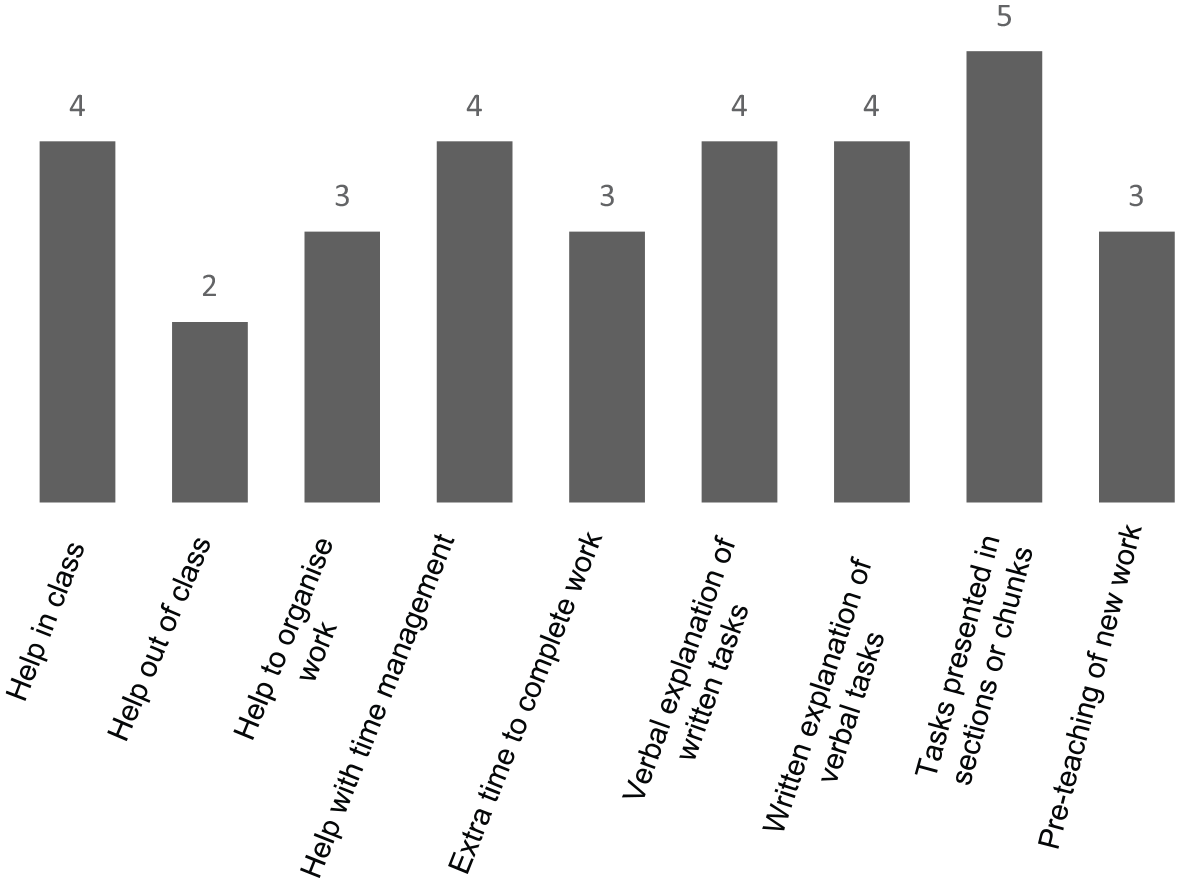
Facilitators of learning.
All girls agreed that tasks presented in sections or chunks were easier to manage, while most girls also recognised the benefits of verbal explanations and instructions being coupled with written formats and vice versa. Reducing the demand on working memory by presenting work in smaller units as well as providing multiple means of sensory information helped the girls to understand more clearly the expectations related to schoolwork and processes associated with assignments. As Charlee commented, ‘I really like plans . . . It’s really helpful and I just get everything done at the right time, and it’s not finished too late’.
Academic support provided within the classroom rather than on a withdrawal basis was preferred by the girls because it was less noticeable and disruptive (Saggers et al., 2011). For example, Gabrielle said, ‘they just put me outside the classroom . . . there’s all the students and teachers walking in and opening doors’. However, Charlee sometimes preferred to get help outside the classroom because ‘less people realise I am doing that’.
Support with time management also contributed to their success. Useful strategies identified by over half of the girls included help to organise their work, extra time to complete tasks, and pre-teaching of new work. Most help with organisation and accessing extra time, however, originated at home. Charlee indicated that she received no help in class with time management but ‘My parents help a lot . . . and sometimes it helps to say to yourself “Ok I’m going to get this much done”. Minty said ‘usually I’d tell Mum’ when asked how she got help. Charlee explained, ‘I’m not good at managing time because I literally have no sense of time’ and ‘If I was really stressed (about finishing work) my Mum would email the school’. Thea agreed, ‘we don’t get a lot of organisational help in the school. My Mum and Dad are helping with the organisational push and placing procedures to set it out’ (Goodall & MacKenzie, 2018; Grave, 2016; Jarman & Rayner, 2015).
Additionally, the girls reported that some teachers’ classroom practice provided support for all students as part of their general lesson planning and presentation. Through the use of rubrics, task requirements, and timelines for task completion, expectations of performance and progress were outlined and communicated clearly. Charlee explained: There’s this teacher . . . who gives us plans that are just perfect because they say that this lesson you have to finish this; and this lesson do this and that helps me because I know if I am behind or in front and I can monitor whether I am being too pedantic or just making it look good. It’s really helpful and I just get everything done at the right time, and it’s not finished too late - I get it done.
She also mentioned that she found it helpful when teachers ‘give a little intro to the whole class . . . like a quizlet at the start of the topic to sort of ease us in’.
Gabrielle spoke about how one of her teachers provided opportunities to complete tests in a different format, recognising that her written responses didn’t allow her to demonstrate her true academic capacity. She recalled: I can think of what I want to write or say what I want to write but I have trouble getting it down onto the page. In one test for Humanities I wrote the answers and failed. I only got 20% but my teacher knew I might need some help, so she let me do a verbal re-sit where I got to tell her the answers and I got 100.
The girls identified a number of aspects that facilitated their academic learning. Most importantly, they highlighted the value of having flexible teachers who are aware of their individual needs both cognitively and environmentally, who facilitate open respectful communication, and who plan and implement a curriculum inclusive of all students. These recommendations are not new. They have been reported previously by Goodall and McKenzie (2018), Hull et al. (2017) and Jarman and Rayner (2015).
Q4. What things make it hard to learn at school?
Although the girls were largely achieving well at school, they reported a number of aspects that routinely hindered their learning. Figure 2 shows the frequency count for ‘barriers to learning’ listed in the survey.

Barriers to learning.
All girls identified getting organised to start a task as problematic. Sharan explained, ‘I get stressed and then the stress, break, stress, break thing happens’. Gabrielle resolved that ‘not all teachers understand’. While Thea noted, ‘some teachers try and help out with that (time management and comprehension) but very few’.
All girls, with the exception of Thea, reported that they experienced difficulty in making sense of written assignments and in understanding verbal instructions. Sharan said, ‘If it’s just written and there is no explanation, I never know where to start’ and Charlee explained, ‘If they just say it and I don’t see it, it’s hard to remember it’.
The problems with understanding the task and how to begin were compounded because the girls lacked the confidence to ask questions and reported being reluctant to seek help when they were confused. Sharan’s explanation of the situation highlights the amount of unproductive time and emotional energy that she utilised before she actually commenced the task. She explained: I wait for a bit because I don’t want to ask because that would be weird . . . so I wait and eventually I convince myself to ask and then I finally understand what I have to do and even if its halfway through the lesson - then I start.
Minty’s experience was similar and she explained, ‘sometimes I’ll ask’ but she said she often just sits and wonders what to do and doesn’t actually start the task. These girls’ accounts are similar to those reported by Jarman and Rayner (2015) who confirm the importance of teachers frequently checking for understanding, especially for those with ASC who may struggle to get started.
Consequently, the girls said they became anxious about not completing their classroom work or assignments on time, which further exacerbated their ability to concentrate and perform (Jarman & Rayner, 2015; May et al., 2016). The girls’ perspectives suggest teachers’ pedagogical choices, including building positive classroom relationships played an integral role in how girls with ASC can successfully navigate the personal barriers to learning in the secondary context. This view is consistent with the finding of Grave (2016) who identified impaired executive functioning, including poor organisational skills, following verbal instructions, anxiety related to understanding and completing assignments, and reluctance to ask for assistance as key challenges faced by Autistic girls at school.
Due to her twice-exceptional traits, Thea reported that she would have benefitted from modifications to instructional level, content or performance criteria to foster her talents and to recognise the extra studies she undertook outside of school in mathematics and science (Baum et al., 2014). Perhaps the mismatch between the curriculum and her ability and interest contributed to why she reported negatively about attending school.
All girls said they felt anxious at school in varying degrees. In the survey Gabrielle, Sharan, and Thea reported being frequently anxious at school while Minty and Charlee were anxious on some occasions. Three of the girls indicated they felt anxious about going to school, which was associated with a sense of uncertainty, a fear of failure, and stress related to excessive workloads and the quality of the work that needed to be produced. Surprisingly then, only three girls identified anxiety as a barrier to their learning. Sharan suggested ‘That all (overthinking, perfectionism) comes from the anxiety’. Thea’s anxiety related to learning was generalised when she simply stated, ‘I feel like I will fail’. For Gabrielle anxiety was linked with uncertainty about her own reactions or the behaviours of others. She elaborated, ‘I don’t know if I am going to have a panic attack or if someone might tease me. I don’t know what is going to happen that day’. Sharan explained that: The schoolwork is stressful when there’s lots of it, and if there’s a subject I don’t feel good about . . . or if there’s a subject that usually triggers anxiety, or if there’s a test, I feel more anxiety.
Despite the challenges, Charlee presented a somewhat optimistic perspective when she acknowledged that while ‘Change can be difficult . . . minimising surprise and feeling in control of the change can help. You have to cope with change, but you need to learn to minimise the stress’. This response shows considerable insight and emotional maturity. If young people with ASC could follow Charlee’s advice, they may be able to reduce the adverse impact of anxiety, uncertainty, and change on the academic learning and success (Adams et al., 2018). Sharan discussed how her anxiety led to ‘overthinking’. She explained ‘Overthinking! Very annoying! Makes it hard. I try to calm anxiety by taking a break . . . I’m not the best at socialising, but if I am comfortable, I don’t overthink until I get home’. Thea explained one cause of anxiety for her ‘I don’t like being touched . . . I was in the tightest space . . . it made it incredibly uncomfortable. I was aggressively eating Mentos to make it go away’. These girls all had a range of personal strategies to reduce their anxiety in various situations.
The impact of the barriers within the school environment on the girls’ physical, social and emotional wellbeing and consequently on their academic performance was further extrapolated from the interviews. Noise was reported as a consistent problem that impacted on the girls emotionally and physiologically. Identifying a clear link to learning, Sharan explained that noise ‘disrupts my learning, sometimes I can’t even write when it’s too loud since I can’t think clearly with all the distraction’. Charlee, Gabrielle and Thea related the impact of sensory overload to feeling ‘overwhelmed, and teary’ (Charlee), ‘very nervous (with) a headache (Gabrielle)’ and ‘stressed and uncomfortable’ (Gabrielle). Grave (2016) and Jarman and Rayner (2015) confirm these responses are commonly reported by ASC students because of the associated sensory difficulties they experience which are likely to be heightened in dynamic school environments.
The physical space and proximity of others also impacted on how the girls could attend to learning in class. Gabrielle described feeling ‘nervous, anxiety, panicky, fidgety, [when it is crowded] and makes me want to go somewhere else’ and Charlee explained her feelings as being ‘stroppy, annoyed, impatient, teary, overwhelmed’. Thea’s concern was more with people than space. She said, ‘I don’t mind tight spaces unless its people, making me feel uncomfortable and claustrophobic.’ In the secondary setting, where classes and schools may be larger than previously encountered, as well as times where students change classes simultaneously, congestion and physical proximity to others may occur several times during the day. The feelings and associated anxiety with this secondary school routine is likely to place demands on the girls’ executive function (Grave, 2016; Hull et al., 2017) interfering with concentration, and creating barriers to learning.
Sharan and Thea both felt overwhelmed in Physical Education classes and reported that they hid in the toilets to avoid these lessons. Sharan explained she does not ‘want to be touched during Tag and things like that’. Besides the anxiety she experienced linked with people and noise, Thea also disclosed it was the relational aspect of those lessons, connected with her ability that made the lessons difficult. She explained, ‘I am not great at sport and because of this I am constantly yelled at by peers . . . even if I am trying my best’. For Thea, this is an example of how teachers do not understand how her ASC impacts on daily life because they insist that she participates ‘unless you have a physical injury’. Thea and Sharan’s experiences are similar to those reported by Kopp et al. (2010) who concluded that poor coordination and gross motor skills, combined with sensory issues make this subject stressful for some girls.
Barriers in communication with teachers and other adults are affected by trust, familiarity, being understood, and feeling respected. Girls often seem to have better pragmatic language and social communication skills than boys, but they are more adept at social mimicry or ‘linguistic camouflage’ (Parish-Morris et al., 2017, p. 8). Generally, the girls found adults more difficult to communicate with compared to their peers. Gabrielle was concerned that ‘They might tell me off. I usually get very nervous’, but Charlee said she is ‘comfortable around adults’. Minty explained it ‘depended on what it is about and which teacher it is’ while Thea said, ‘I feel like they are trying to take full control of me and the situation’. Sharan and Thea both said that talking with teachers can be helpful, but Sharan added ‘Sometimes they do not understand what I am trying to say . . . and it’s frustrating’.
Confidence levels in class also varied depending on the subject and the girls’ sense of efficacy. Minty said, ‘Sometimes I feel like I don’t know the information well enough’ while Gabrielle said that her anxiety about asking questions ‘depended on the teacher’. She once enjoyed Science, but her current teacher made her sit in the middle of the classroom by herself when she was stressed.
For these girls the challenges associated with developing relationships with adults were exacerbated due to their difficulty with communication and social cues associated with ASC. Gabrielle, Sharan and Thea said they were not confident in class, due to being worried about saying the wrong thing, overthinking, and the high expectations of peers and teachers. Charlee explained, ‘I need to ask because I get so worried, I am doing it wrong . . . I need that confirmation.’ Although she did contend, ‘sometimes I feel like I don’t know when to talk or answer a question or persist, and sometimes my teachers don’t understand what I am trying to say,’ while Minty explained she did not like talking with adults because she did ‘not always understand their questions.’ This relational aspect of school contributed barriers to learning because of reluctance to ask questions or seek help in the classroom (Grave, 2016).
Relationships within the peer groups were a source of sadness for some of the girls and linked with the pervasiveness of anxiety. While friends were earlier reported to make school a place the girls wanted to be Charlee, Sharan and Thea identified friendship as their main cause of sadness. Sharan revealed: I get really close to people. It could be something like hyper-empathy . . . I feel a lot of empathy and get emotionally attached to things quickly, so then it really hurts me. Things that cause me to be stressed about going to school can also make me sad.
The relationships themselves, however, were not identified clearly as a barrier to learning, despite all girls, with the exception of Minty, reporting that at some stage of their schooling they had experienced bullying. Charlee and Thea said they did not ever feel excluded, however the other girls had experienced this to varying degrees, although it was not seen as deliberate but rather a normal part of being at school. Minty and Gabrielle both said, ‘It just kind of happens’ and Sharan said that her peers ‘don’t notice people who are not in their immediate circle of friends.’ These girls currently had small but supportive friendship groups, which can be a protective factor against victimisation (Hebron & Humphrey, 2013). Their experiences also align with the findings of Cappadocia et al. (2012) and Mandy et al. (2016) that bullying decreases in secondary school. However, it is in contrast with other research that found bullying of Autistic adolescents increases in secondary school due to the increasing complexity of social relationships (Hebron & Humphrey, 2013; Humphrey & Hebron, 2015).
For these girls, the secondary school environment, academic expectations, and social factors all contributed to their anxiety. Further, the uncertainty and lack of control related to friendships and daily classroom interactions with staff and peers were seen as aspects that hindered their learning and academic success.
Limitations and future research
These findings should be considered with one key limitation in mind. We acknowledge that this small-scale study sought perspectives from only five adolescent Autistic girls. Findings, therefore, cannot be generalised as the perspectives of these girls may not be representative of Autistic girls at other secondary schools in Australia or elsewhere. However, the information the girls shared provides valuable firsthand knowledge and opinions from adolescent Autistic girls themselves. Future research should focus on adolescent Autistic girls and their social anxiety and difficulties with executive functioning at school as both aspects were reported by the girls as having a substantial impact on their learning.
Conclusion
In summary, these five Autistic girls spoke openly about their experiences at secondary school and aspects perceived as having considerable bearing on their learning and academic success. It is notable that although their school experiences are different due to a variety of individual factors (Tomlinson et al., 2020), they reported many commonalities. Their insider knowledge provides not only insights into the challenges and enablers associated with their learning, but also some key messages to teachers and schools.
Teachers play an important role in creating positive school experiences for Autistic girls. Although they have limited time with students in secondary settings, positive relationships with teachers can help to overcome some of the anxiety and academic challenges experienced by autistic girls. It is important, therefore, that teachers are understanding, informed, responsive and flexible so the girls have the confidence to ask for help and discuss their problems.
One of the key messages for schools is the importance of the girls having a key person they trust and can go to for help. While teachers play a pivotal role in the academic success of students, allocating a trusted staff member who is regularly available and accessible would provide autistic girls with an additional layer of support. This person could be a counsellor, coordinator or teacher.
The individual insights of these girls have provided us with important messages that can be instrumental in supporting Autistic girls in a secondary setting by reducing the anxiety in relation to academic tasks in particular and school in general. Sharan’s summation of the feelings expressed by all girls reinforces the value of our key messages for schools and teachers, ‘It’s hard when the people you should be able to go to for help don’t have the experience and knowledge to help you’.