




Abstract
During police interviews, innocent suspects may provide unconvincing alibis due to impaired memory processes or guilt-presumptive behaviour on behalf of the interviewer. Consequently, innocent suspects may be prosecuted and tried in court, where lay people who serve jury duty will assess their alibi’s credibility. To examine lay people’s beliefs and knowledge regarding suspect alibis, and specifically about such factors that may hamper innocent suspects’ ability to provide convincing alibis, we administered an eight-question questionnaire across the United Kingdom (n = 96), Israel (n = 124), and Sweden (n = 123). Participants did not tend to believe that innocent suspects’ alibis might inadvertently include incorrect details, but acknowledged that impaired memory processes may cause this. Additionally, most participants believed that a presumption of guilt can affect how interviewers interview suspects. The findings suggest that lay people who may serve jury duty hold some mistaken beliefs regarding alibi provision by suspects.
Introduction
Innocent suspects who fail to provide a convincing alibi when interviewed by the police may subsequently be tried in court, where their alibi may be evaluated again by jurors. Are lay members of the public familiar with factors that may lead to an innocent suspect providing an inaccurate, incomplete or otherwise unconvincing alibi? Using a survey, the current research sought to examine this question.
Providing a convincing alibi
When providing an alibi to a police interviewer, suspects generally attempt to convince the interviewer of their innocence of the crime for which they are being held suspects. This process has been identified as the generation domain of alibi provision which comprises two phases—the story phase and the validation phase (Burke et al., 2007; Olson and Charman, 2012; Olson and Wells, 2004). During the story phase, suspects provide their alibi by reporting from memory about their actions and whereabouts during the time of the crime. In the subsequent validation phase, suspects attempt to corroborate their alibi by offering objects (physical evidence) or details about people (person evidence) that may account for their presence at a certain place at a certain time during the time frame of the crime (Burke et al., 2007).
However, during both phases of the generation domain of alibi provision, innocent suspects may provide inaccurate information despite being motivated to provide an accurate and, ultimately, convincing alibi (see Kassam et al., 2009). One factor that has been found to hamper innocent suspects’ ability to provide accurate information is impaired memory processes—a result of the fact that innocent suspects (as all truthful rememberers) must rely on their episodic and autobiographical memory to provide their truthful statement (Burke et al., 2007; Culhane et al., 2008; Olson and Wells, 2012; Strange et al., 2014). Impaired memory processes concern, for example, the declining accessibility of event details with the passage of time (Pertzov et al., 2017; Tourangeau, 2000). Alternatively, innocent suspects may wrongly, though unintentionally, integrate details from memories for distinctive events into a report about an event that never actually took place (i.e., memory-conjunction errors; Reinitz et al., 1992; see also Devitt et al., 2016).
In addition to memory problems that may compromise innocent suspects’ ability to provide a convincing alibi, factors emerging in the course of the interview may also jeopardise their success with respect to convincing the interviewer of their innocence. One such factor is the presumption of guilt with which interviewers sometimes approach interviews with suspects whom they have never met or with whom they have interacted only very briefly. Research on the effects of interviewers’ presumption of guilt on the verbal behaviour of suspects during interviews is relatively new. Findings to date have shown no correlation between interviewers’ presumption of guilt and suspects’ tendency to confess or deny involvement in a crime (Hill et al., 2008), nor have they identified evidence that presumption of guilt affects the informativeness and accuracy of innocent suspects’ alibis (Portnoy et al., 2019). However, research has shown that this presumption of guilt can lead interviewers to conduct more aggressive interviews with suspects and ultimately increase the probability that the interviewer will actually judge the suspect as guilty at the end of the interview, irrespective of the suspect’s statement (Hill et al., 2008; Kassin et al., 2003). These findings thus suggest that when interviewers approach the interview already believing the suspect to be guilty, alibis may become less efficient in suspects’ attempts to convince interviewers of their innocence.
Evaluating the credibility of alibis
The story phase and the validation phase of the generation domain are followed by the evaluation phase and the ultimate evaluation phase, which comprise the believability domain (Burke et al., 2007; Olson and Charman, 2012; Olson and Wells, 2004). In the evaluation phase, the credibility of the alibi is evaluated, usually initially by the police. When police interviewers investigate an alibi and discover that the suspect provided incorrect information, they may fail to attribute such inaccuracies to memory errors (Burke et al., 2007; Dysart and Strange, 2012; Olson and Wells, 2012). Instead, unintentional inaccuracies in alibis may be perceived by the police as an intentional lying and hence guilt (Burke et al., 2007; Dysart and Strange, 2012; Olson and Charman, 2012). If suspects are judged as guilty during initial phases of an investigation (because of, for example, the provision of inaccurate information or interviewers’ presumption of guilt), this may ultimately lead to the decision that they should be tried in court (Crozier et al., 2017; Wells et al., 1998). There, the ultimate credibility of the alibi is determined by different evaluators who are exposed to all the facts of the case.
Jury members may be the most influential evaluators of a suspect’s alibi in court. The task of the jury is challenging, requiring citizens to reach a verdict by assessing the credibility of the suspect and decide whether s/he is innocent or guilty of a crime despite lacking legal training (Bornstein and Greene, 2011; Greene and Bornstein, 2000; Porter and ten Brinke, 2009). When suspects confess to a crime and this confession is then presented at trial, an effort is often made by defence attorneys and expert witnesses to explain the conditions that may have led to the confession in order to ensure that jurors can better decide whether or not the confession is reliable (Shaked-Schroer et al., 2015). However, factors that may have led to a suspect’s alibi being disbelieved during initial stages of the investigation and to the suspect ultimately being tried in court may not be explained to jurors, and they may fail to consider such factors when evaluating the suspect’s alibi. During the course of the trial, jurors may assume that there was a justifiable reason to prosecute the suspect, and this assumption is likely to make them doubt the suspect’s alibi and guide them in deciding that an innocent suspect is guilty (Burke et al., 2007; Sommers and Douglass, 2007). Thus, it is crucial that, when necessary, jurors are informed and educated during a trail about the process of alibi provision and any factors that may jeopardise the provision of a convincing alibi.
The present research
A first step towards improving jurors’ decision making in court during the evaluation of suspect alibis is studying what lay people, who may potentially constitute a jury, know about pertinent legal matters. Such examination is also required because judges largely base their decision of whether or not to allow expert witnesses to testify at trial on their assumptions about jurors’ knowledge regarding legal matters (Costanzo et al., 2010).
To examine the extent to which lay people, as prospective jurors, are familiar with the factors of impaired memory processes and interviewers’ presumption of guilt in the context of alibi provision, we recruited lay jury-eligible members of the public in the United Kingdom (UK) to complete a two-part questionnaire. To increase our sample size and thus improve the precision and power of our statistical analyses, and to improve the diversity of our sample, we also distributed the questionnaire to community members in Sweden and Israel. While the latter two countries do not employ a jury system 1 , data from these countries are still informative with regard to our research question: lay beliefs and perceptions about alibis.
In the first part of the questionnaire we examined participants’ knowledge and beliefs about alibi provision by truthful versus lying suspects in general, and about the provision of incorrect alibis by truthful suspects in particular. Examining participants’ knowledge about the differences in the provision of alibis between truthful and lying suspects was necessary because credibility judgments are partly influenced by evaluators’ perceptions and beliefs about honest and deceptive verbal (and nonverbal) behaviour of suspects during interviews (Porter and ten Brinke, 2009). To this end, participants were first asked to indicate their belief about the extent to which six types of details are provided in alibis of truthful versus lying suspects. As research has shown that alibis of liars and truth-tellers differ with respect to their tendency to provide these details (for a review, see Vrij, 2008; see also DePaulo et al., 2003), we wanted to examine how participants’ knowledge would align with such research findings. In order not to limit the data we could obtain with respect to participants’ beliefs about the differences between truthful and deceptive alibis to one type of verbal behaviour (i.e., the tendency of suspects to provide the six types of details presented in the first question), participants were then asked to freely describe what strategies they believed truthful and lying suspects typically use to make their alibi seem convincing to the interviewer.
Next, we asked participates what they believed the relation between the amount of details provided in an alibi and the truthfulness of the alibi to be, and to explain their answer. The purpose of this question was twofold: Firstly, as research has demonstrated that statements of truthful suspects are more detailed than those of lying suspects (e.g. DePaulo et al., 2003; Vrij, 2008), we were interested in our participants’ belief about the relation between alibis’ level of detail and their truthfulness. Secondly, we wanted to see whether or not participants would mention the factor of (impaired) memory processes when explaining their belief and how they would mention it (e.g., would they explain that a more detailed alibi is more likely to be truthful because truth-tellers have a real memory for the critical time?).
Finally, participants were explicitly asked to indicate their belief regarding the extent to which truthful alibis might contain incorrect details. Participants who indicated that truthful alibis may contain incorrect details were asked to explain their answer in order to see if and to what extent they would acknowledge the factor of memory constraints as a reason for inaccuracies during the provision of alibis by truthful suspects. To our knowledge, no previous research has surveyed lay people’s beliefs about memory in relation to truthful suspects’ mistaken alibis.
The second part of the questionnaire focused on the issue of interviewers’ presumption of guilt, which, to our knowledge, has also not been examined in previous survey research. We first asked participants to indicate what they believed was the point in the course of the investigation at which interviewers begin to form their opinion regarding the suspect’s veracity. We are unaware of any data that describe when, during an investigation, interviewers usually form their belief regarding the guilt or innocence of suspects. However, as research demonstrated that interviewers may be confident of suspects’ guilt prior to interviewing them (Moston et al., 1992), this question was used to examine whether or not participants would consider it likely that interviewers may conduct suspect interviews with a presumption of guilt.
Then, we asked participants to indicate their belief regarding the extent to which a presumption of guilt held by the interviewer at the beginning of suspect interviews might affect the interviewer's behaviour, and to indicate the likelihood that suspects provide more details and confess to committing the crime (regardless of their actual guilt) in response to a guilt-presumptive interviewer. Despite research on effects of interviewer’s presumption of guilt on suspects’ behaviour during interviews being relatively scarce and new (e.g., Hill et al., 2008; Portnoy et al., 2019), we wanted to examine what participants believed the effects of interviewers’ presumption of guilt on the process of suspect interviews to be and how their beliefs would align with existing research findings.
Method
Participants
Overall, data were collected from 343 members of the general public from three countries. Specifically, a convenience sample of 96 participants from the UK, 124 participants from Israel and 123 participants from Sweden completed the questionnaire. Data from 11 participants were removed from analyses because they did not complete the questionnaire thoroughly (e.g., provided a one-word reply to all open-ended questions in a manner unrelated to the questions) or failed to meet inclusion criteria (i.e., over the age of 18 years, without previous experience of providing a police alibi). This resulted in data from 332 participants (M = 29.85 years; SD = 11.33; 210 females, 108 males; 14 participants did not indicate their age and gender). Participants were recruited via advertisements on social media. All participants who completed the survey were entered into a prize draw for a £20 internet shopping voucher.
Alibi questionnaire
An alibi questionnaire comprising eight questions was created in English. The questionnaire was translated into both Hebrew and Swedish by native speakers of both languages using a back-translation procedure. The three language versions of the questionnaire were administered online using the Qualtrics platform.
When opening the link to the questionnaire, participants were informed that the questionnaire concerned beliefs that members of the general public hold about alibis. Participants completed informed consent procedures and were required to confirm that they had never provided an alibi as part of a police investigation. At the outset of the questionnaire, participants were presented with definitions of the following terms: an alibi, truthful suspects, and lying suspects (see Appendix). Participants were then instructed to work through the eight questions, with each question presented on a new screen.
In the first part of the questionnaire, participants were first asked to indicate, for six types of details, the extent to which they thought each type of detail is provided in the alibis of lying suspects relative to those of truthful suspects using a 7-point Likert scale (1 = substantially more in liars’ alibis than in truth-tellers’ alibis, 7 = substantially more in truth-tellers’ alibis than in liars’ alibis). These six types of details were (a) setting (i.e., description of the crime scene and/or any other place described in the alibi); (b) temporal (i.e., description of the order in which events took place and/or the specific times and dates at which events occurred); (c) object (i.e., details about objects used by the suspect and/or by others described in the alibi); (d) person description (i.e., details about the appearance of other people described in the alibi); (e) self-actions (i.e., details about actions taken by the suspect); and, (f) others’ actions (i.e. details about actions taken by people described in the alibi that are not the suspect). Next, using two separate questions, participants were asked to freely describe what strategies they thought truthful and lying suspects typically use to make their alibi seem credible. Participants were then asked what they believed the relation between the amount of details provided in an alibi and the truthfulness of the alibi to be. Participants indicated their belief by choosing one of three response options indicating that more details in an alibi increase or decrease the likelihood that it is truthful, or that there is no relation between an alibi’s level of detail and its truthfulness. Participants were also asked to explain their belief. Finally, participants were asked to indicate their belief regarding the extent to which truthful alibis might contain incorrect details (1 = truthful alibis contain no incorrect details, 7 = truthful alibis contain only incorrect details). Participants who indicated that truthful alibis may contain incorrect details (i.e., chose 2 or higher on the response scale) were then asked to explain their belief.
In the second part of the questionnaire, which concerned the factor of interviewers’ presumption of guilt, participants were first asked to indicate the point in the course of the investigation at which they believed interviewers begin to form their opinion regarding the guilt or innocence of suspects. To indicate their belief, participants were asked to choose one of five response options (e.g., usually prior to hearing the suspect’s alibi for the first time) or to freely report their belief if the options presented were not satisfactory. 2 Participants were then asked to indicate the extent to which they thought an interviewer’s presumption of guilt affects what the interviewer says and how s/he behaves during an interview (1 = does not at all affect the interviewer’s words and behaviour, 7 = significantly affects the interviewer’s words and behaviour). Finally, we asked participants about the likelihood that suspects respond to the interviewer’s presumption of guilt by (a) providing more details in their alibi, (b) providing details even if they are uncertain of their accuracy, and, (c) confessing to committing the crime (1 = very unlikely, 7 = very likely).
On completion of the questionnaire, participants were asked to report their age, gender, country of residence, and the main language they use in everyday communications. Finally, participants were debriefed and thanked for their participation.
Results
Alibi provision and effects of memory processes
Table 1 presents means and standard deviations of participants’ responses to the question concerning the extent to which setting, temporal, object, person description, self-actions, and others’ actions details are provided in alibis of truthful suspects relative to those of lying suspects. One-sample t-tests indicated that, on average, participants believed that most types of details are provided significantly more often in truthful than in deceptive alibis.
Participants’ belief regarding the extent to which details occur in truth-tellers’ versus liars’ alibis.
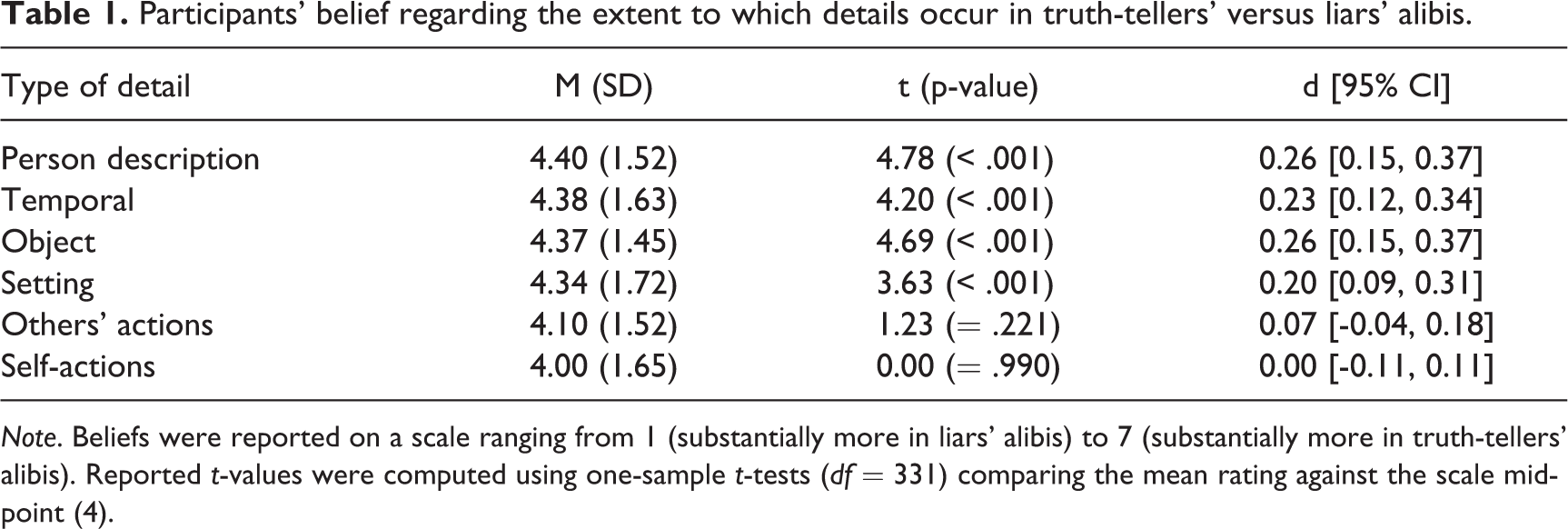
Note. Beliefs were reported on a scale ranging from 1 (substantially more in liars’ alibis) to 7 (substantially more in truth-tellers’ alibis). Reported t-values were computed using one-sample t-tests (df = 331) comparing the mean rating against the scale mid-point (4).
Next, we coded the freely-reported strategies that participants thought truthful and lying suspects typically use to make their alibi seem truthful and convincing to the interviewer. To this end, the first author coded all responses according to strategy categories that she created in a data-driven manner, meaning that the categories were derived from participants’ responses. Tables 2 and 3 present the categories of the strategies perceived by participants to be used by truthful and lying suspects, respectively. A second coder coded 32 responses (9.8%) for each of the two strategy questions (liars and truth-tellers) using the same categories, and the tables also present inter-coder reliability computed using intra-class correlation coefficient (ICC). The three most common strategies of truthful suspects during alibi provision reported by participants (Table 2) were that truth-tellers cooperate with the interviewer, express confidence, and provide detailed alibis. With respect to liars’ strategies during alibi provision (Table 3), the three most commonly reported strategies concerned providing detailed alibis, engaging in general impression management, and expressing confidence.
Strategies that participants believed are used by truthful suspects to provide a convincing alibi.

Note. N = 327; Data from five participants were removed from analysis because their reports were too vague. Categories are presented in the order of the frequency with which participants reported each category. ‘Other’ = strategies that were individually reported by less than 5.5% of participants (e.g., truthful suspects repeat their story; report incorrect information; and do not describe events chronologically). Participants could report a strategy more than once and from more than one category.
Strategies that participants believed are used by lying suspects to provide a convincing alibi.
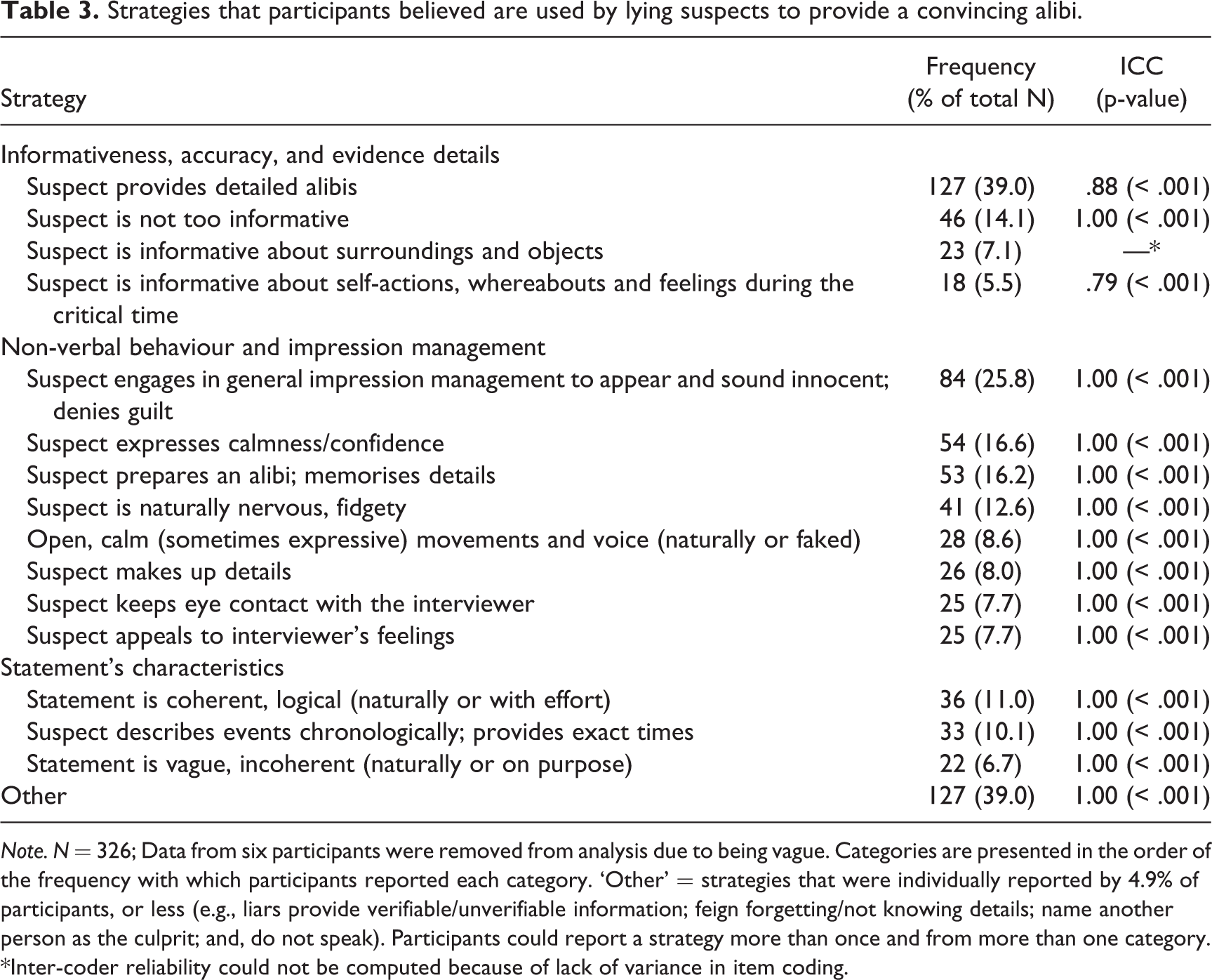
Note. N = 326; Data from six participants were removed from analysis due to being vague. Categories are presented in the order of the frequency with which participants reported each category. ‘Other’ = strategies that were individually reported by 4.9% of participants, or less (e.g., liars provide verifiable/unverifiable information; feign forgetting/not knowing details; name another person as the culprit; and, do not speak). Participants could report a strategy more than once and from more than one category. *Inter-coder reliability could not be computed because of lack of variance in item coding.
As two of the three most commonly reported strategies for each of the two strategy questions were strategies reported for both truthful and lying suspects (i.e., providing detailed alibis and expressing confidence), we examined whether or not the proportion to which participants reported each of these two strategies differed for truthful and lying suspects. Two exact McNemar’s tests were conducted only among participants whose reports could be coded for both truthful and lying suspects’ strategy questions (n = 321). The tests showed that participants believed that a detailed alibi occurs more often with respect to lying (39.0%) than truthful suspects (26.6%), p = .001. In contrast, participants believed that expressing confidence occurs more often among truthful (30.0%) than lying suspects (16.6%), p < .001.
Table 4 presents the frequencies with which participants chose each response option to the question concerning the relation between the amount of details provided in an alibi and the truthfulness of the alibi. A chi-square test of goodness-of-fit revealed that the preference for the three response options was not equally distributed, χ2(2, N = 332) = 8.32, p = .015. Post-hoc analyses of standardised (Pearson) residuals showed that the belief that more details indicate a less truthful alibi was reported more often than would be expected by chance, p = .021. However, this test just barely failed to reach statistical significance when compared against the Bonferroni-corrected alpha (α = .05/3 = .017). None of the other two response options approached statistical significance, ps ≥ .112.
Participants’ belief about the relation between amount of details provided in an alibi and alibi's truthfulness and their explanations for their belief.
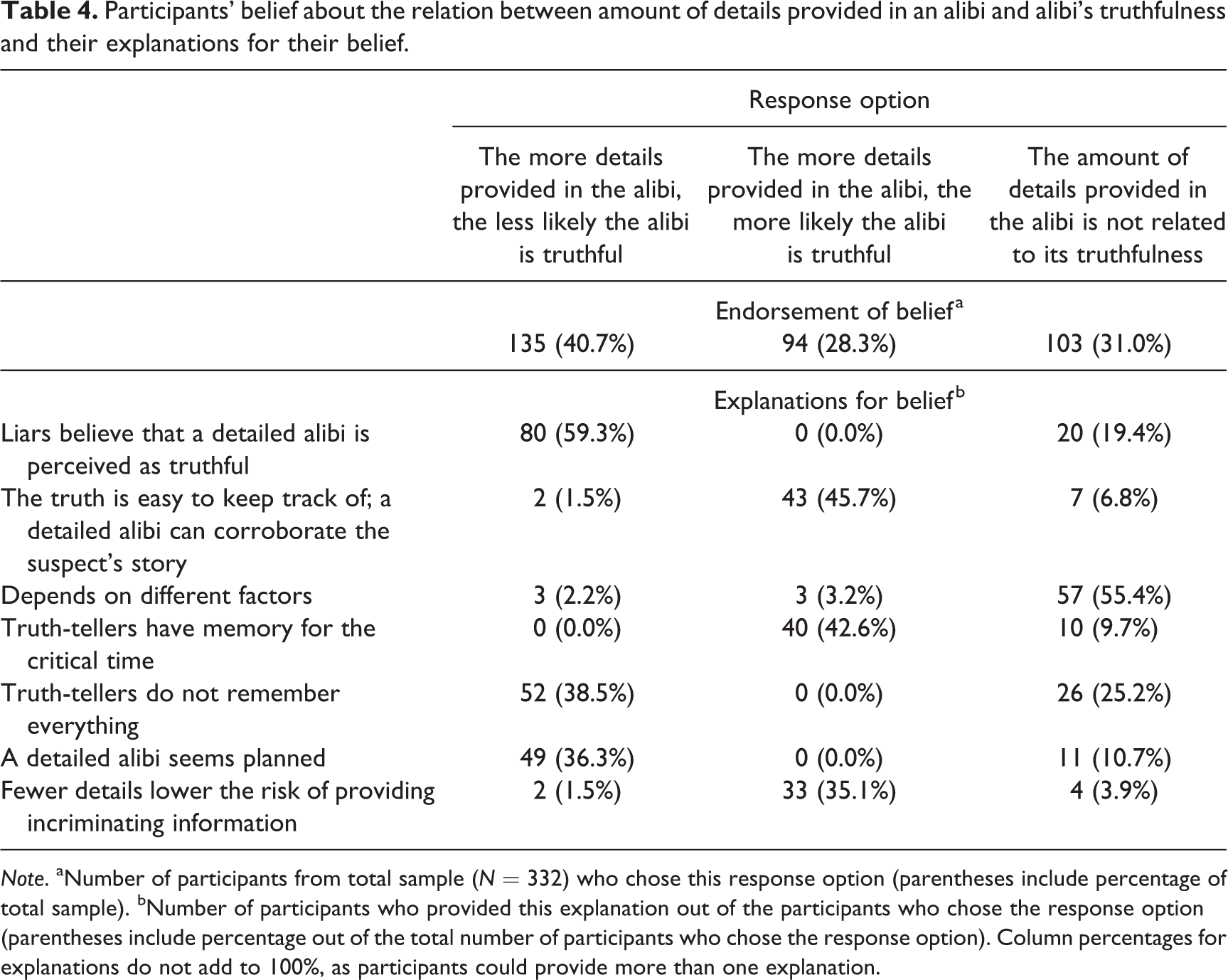
Note. aNumber of participants from total sample (N = 332) who chose this response option (parentheses include percentage of total sample). bNumber of participants who provided this explanation out of the participants who chose the response option (parentheses include percentage out of the total number of participants who chose the response option). Column percentages for explanations do not add to 100%, as participants could provide more than one explanation.
Also presented in Table 4 are participants’ reasons for their belief regarding the relation between the amount of details provided in an alibi and its truthfulness. Most participants who believed that a detailed alibi is less likely to be truthful explained that liars may believe that a detailed alibi is perceived as truthful and convincing. With respect to participants who believed that a detailed alibi is more likely to be truthful, most of them explained their belief by reporting that the truth is easy to keep track of and thus being informative is not difficult. Finally, most participants who believed that the amount of details provided in an alibi is not related to its truthfulness reported that the truthfulness of an alibi depends on different factors, such as the verifiability of the details provided, the extent to which the details provided are central to the main event, and the suspect’s personal strategy to appear truthful (which may or may not be to provide a detailed alibi).
We then examined participants’ belief regarding the extent to which truthful alibis might contain incorrect details. Participants’ beliefs are presented in Table 5. On average, participants rated the likelihood that a truthful alibi might contain incorrect details as relatively low (M = 3.41, SD = 1.15; 1 = truthful alibis contain no incorrect details). The reasons underpinning beliefs that truthful alibis may contain incorrect details to different extent, as reported by participants who chose response option 2 or higher on the response scale, are presented in Table 5. Most participants who indicated to believe that truthful alibis may contain incorrect details explained that this may be due to impaired memory processes.
Participants’ explanations for their belief about the extent to which truthful alibis might contain incorrect details.
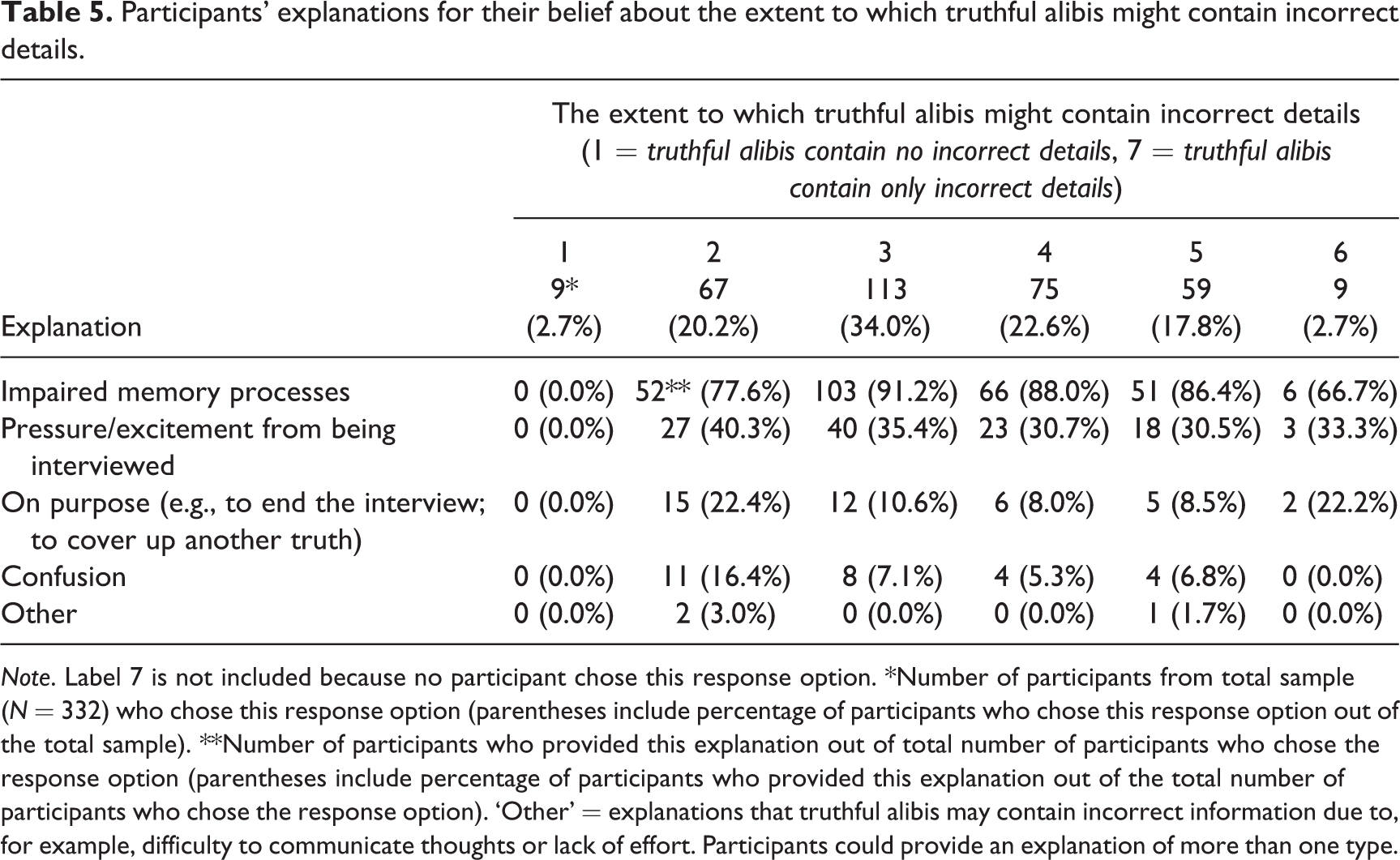
Note. Label 7 is not included because no participant chose this response option. *Number of participants from total sample (N = 332) who chose this response option (parentheses include percentage of participants who chose this response option out of the total sample). **Number of participants who provided this explanation out of total number of participants who chose the response option (parentheses include percentage of participants who provided this explanation out of the total number of participants who chose the response option). ‘Other’ = explanations that truthful alibis may contain incorrect information due to, for example, difficulty to communicate thoughts or lack of effort. Participants could provide an explanation of more than one type.
Interviewers’ presumption of guilt
The point in the investigation at which participants believed an interviewer likely begins to form an opinion about the guilt or innocence of the suspect is presented in Table 6. A chi-square test of goodness-of-fit revealed that participants’ preference of the six possible response options was not equally distributed, χ2(5, N = 332) = 170.37, p < .001. Post-hoc tests of standardised (Pearson) residuals, using a Bonferroni-corrected alpha (α = .05/6 = .008), indicated that participants tended to believe significantly more often than would be expected by chance that interviewers usually begin to form their opinion of the guilt or innocence of suspects prior to hearing their alibi for the first time (p < .001) or while suspects are providing their alibi for the first time (p < .001). The post-hoc tests also indicated that the beliefs that interviewers never form a belief regarding suspects’ involvement in a crime and that there may be another option of the timing of the formation of this interviewers' belief (‘other’ response option) were both significantly underrepresented, both ps < .001. The remaining two response options were not statistically significant, ps ≥ .074.
Participants’ belief about the point in the investigation at which the interviewer begins to form an opinion regarding the guilt/innocence of the suspect.
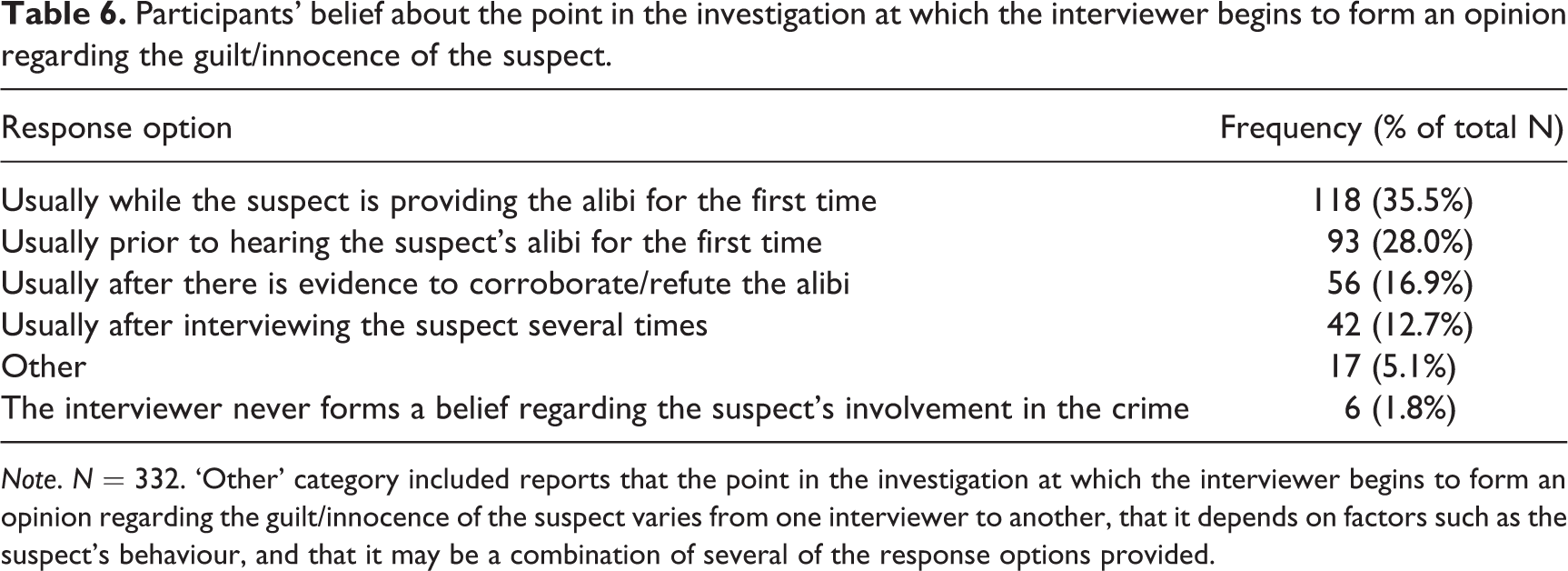
Note. N = 332. ‘Other’ category included reports that the point in the investigation at which the interviewer begins to form an opinion regarding the guilt/innocence of the suspect varies from one interviewer to another, that it depends on factors such as the suspect's behaviour, and that it may be a combination of several of the response options provided.
Then, we found that, on average, participants believed that interviewers’ presumption of guilt can affect what interviewers say and how they behave during an interview (M = 5.61, SD = 1.23). The explanations underpinning these beliefs are presented in Table 7. The most common explanation provided by participants who strongly believed this to be true (i.e., chose 5 or higher on the response scale) was that presumptions of guilt make interviewers conduct harsher interviews, ask leading questions, and pressure the suspect to confess.
Participants’ explanation for their belief about the extent to which interviewer’s presumption of guilt might affect what this interviewer says and how s/he behaves during this interview.
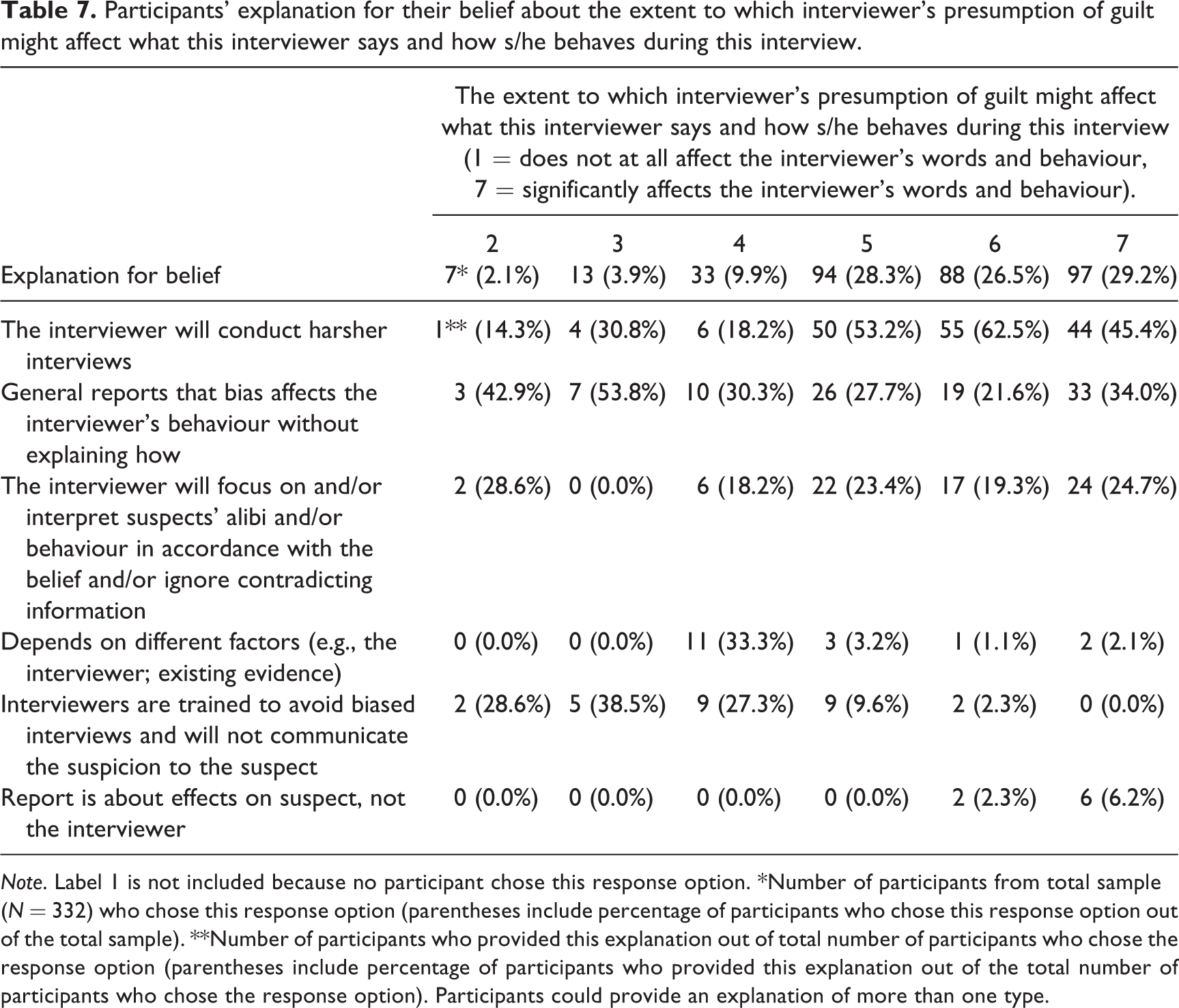
Note. Label 1 is not included because no participant chose this response option. *Number of participants from total sample (N = 332) who chose this response option (parentheses include percentage of participants who chose this response option out of the total sample). **Number of participants who provided this explanation out of total number of participants who chose the response option (parentheses include percentage of participants who provided this explanation out of the total number of participants who chose the response option). Participants could provide an explanation of more than one type.
Finally, on average, participants believed that when suspects get the impression that the interviewer thinks they are guilty, they will provide more details in their alibi (M = 5.47, SD = 1.45) and provide details even if they are uncertain of their accuracy (M = 5.27, SD = 1.33). However, participants believed that, under such interviewing circumstances, the extent to which suspects will confess to committing the crime is low (M = 2.98, SD = 1.45).
Discussion
Using a questionnaire administered in three countries, the present research examined lay people’s beliefs about factors that may hinder innocent suspects’ ability to provide convincing alibis—impaired memory processes and interviewers’ presumption of guilt. In general, participants’ responses indicated that they did not believe that innocent suspects might inadvertently provide inaccurate alibis, but that when this happens, impaired memory processes are likely to be the reason. With respect to the factor of interviewers’ presumption of guilt, participants mostly believed that interviewers usually begin to form their opinion regarding the veracity of suspects before or while suspects are providing their alibi for the first time. Also, participants tended to believe that a presumption of guilt can affect how interviewers conduct an interview with suspects. Below we discuss all findings in depth and review how they fit with existing research.
Beliefs about alibi provision and impaired memory processes
The most noteworthy finding concerning participants’ beliefs about the qualities of suspect alibis was that participants believed that while truth-tellers are more informative with respect to specific types of details, liars more often try to appear generally informative. Specifically, participants tended to believe that, on average, setting, temporal, object, and person description details are provided only slightly more often in alibis of truthful suspects than in alibis of lying suspects. This belief aligns with existing research findings (Vrij, 2008; see also DePaulo et al., 2003). However, when participants freely reported that suspects provide a generally detailed alibi to appear convincing, this was reported more often with respect to lying suspects than truthful suspects. Most participants also believed that the more details provided in an alibi, the less likely the alibi is to be truthful. Previous survey research has demonstrated similar beliefs of lay people about the relation between the amount of details provided by suspects during police interviews and suspects’ veracity (Bogaard et al., 2016; Granhag et al., 2004; but see Akehurst et al., 1996). Liars may succeed in providing a rich, detailed statement by describing an actual experience that occurred at a different time than that of the crime, with details concerning the crime nevertheless being denied or omitted (i.e., embedded lies; Vrij, 2008; Vrij et al., 2010). However, this belief of participants that a detailed alibi is less likely to be truthful contrasts with findings according to which statements of truthful suspects are usually more detailed than those of lying suspects (e.g. DePaulo et al., 2003; Vrij, 2008).
It may be that participants believed that with the use of two alibi-provision strategies they mentioned with respect to liars—making up details and preparing an alibi—liars can maintain a detailed statement throughout the interview and make their lie ‘work’. Participants did mention that a lie is difficult to keep up with; however, they may not fully realise how difficult it is. Lying is a cognitively demanding task that requires more mental resources than telling the truth does, and even planning a lie may be difficult for liars. They may fail to formulate a lie that will convince the interviewer of their innocence, and thus they may decide not to provide a detailed statement in an upcoming interview. During the interview, liars must remember what information they have already provided to the interviewer earlier in the same interview or in previous ones in order to maintain a consistent statement. However, impaired memory processes may prevent liars from remembering what information they have already provided (and to whom). In order not to struggle with remembering a detailed lie, liars are likely to provide a relatively short statement (Vrij et al., 2008a, 2008b, 2011). Indeed, innocent, truthful suspects tend more than do guilty, lying ones to employ an alibi-provision strategy of providing a detailed statement (Hartwig et al., 2007, 2010; Strömwall et al., 2006).
Turning to the issue of impaired memory processes in the context innocent suspects’ alibis, participants’ responses indicated that they were reluctant to acknowledge that truthful alibis may unintentionally include incorrect details. This finding embodies another demonstration of lay people’s lack of understanding of issues concerning psychology and law and is consistent with previous findings that demonstrated this poor knowledge by lay people (e.g., Benton et al., 2006; Simons and Chabris, 2011, 2012). For example, Benton et al. (2006) found that agreement between 111 jurors from the United States and 64 eyewitness experts regarding items concerning eyewitness issues (e.g., memory, weapon focus, and elderly witnesses) was obtained only on four (13%) of 30 items.
However, when examining the explanations of participants as to why they believed truthful alibis may contain incorrect details, a more encouraging picture emerged. Participants acknowledged that impaired memory processes may prevent innocent suspects from reporting accurately from memory. For example, participants correctly acknowledged that innocent suspects may not encode relevant event details because of not realising the importance of remembering the event for a later reporting (see Burke et al., 2007; Tourangeau, 2000). Participants also correctly mentioned that event details may be forgotten over time (see Pertzov et al., 2017; Tourangeau, 2000). Participants mentioned the factor of forgetting by truthful suspects also when explaining why they believed a detailed alibi may indicate that the suspect is lying (that is, because impaired memory processes may prevent innocent suspects from providing a detailed alibi).
Altogether, findings from the first part of the questionnaire suggest that participants hold some mistaken beliefs about suspect alibis. Nevertheless, participants did demonstrate an understanding that innocent suspects may provide incorrect details due to impaired memory processes.
Beliefs about interviewers’ presumption of guilt
Participants’ beliefs that interviewers’ presumption of guilt may lead them to conduct harsher interviews, use leading questions, and pressure suspects to confess align with findings of previous research (e.g., Hill et al., 2008; Kassin et al., 2003). The finding that participants believed that presumption of guilt may affect interviewers' behaviour during interviews, combined with the finding that most participants believed that interviewers usually begin to form their opinion regarding suspects’ guilt or innocence prior to or while meeting them for the first time, suggests that if suspects claim that the interviewer to whom they provided their alibi treated them in accordance with a guilt belief, lay people may find this claim plausible at court.
Participants additionally tended to believe that when suspects feel that they are being interviewed by a guilt-presumptive interviewer, they are likely to be more forthcoming and not to confess to a crime. However, existing research has found no evidence that when suspects are interviewed by a guilt-presumptive interviewer, their verbal behaviour differs from that of suspects interviewed by a neutral or innocence-presumptive interviewer (e.g., Hill et al., 2008; Portnoy et al., 2019). Nevertheless, research on the effects of interviewers’ presumption of guilt on suspects’ verbal behaviour during interviews is relatively new and scarce and has examined narrow interviewing contexts (e.g., interviewing mock suspects over the telephone as in Hill et al., 2008). Future research on lay people’s beliefs about suspect alibis might compare the beliefs expressed in the present research with findings obtained from new research on the effects of interviewers’ presumption of guilt on suspects’ verbal behaviour during interviews.
In sum, results from the second part of the questionnaire suggest that lay people are aware of the fact that interviewers might approach suspect interviews while already presuming guilt and that this presumption of guilt might affect how interviewers conduct interviews. The findings also suggest that lay people believe that suspects’ verbal behaviour is not likely to be negatively affected by a guilt-presumptive interviewer. Future research might compare the beliefs of police interviewers with those of members of the general public about the topics of memory limitations and presumption of guilt in the context of suspect alibis.
Contributions of the present findings
Existing findings concerning lay people’s mistaken knowledge about eyewitness issues suggest that eyewitness expert testimony may be required in court to educate jurors (e.g., Benton et al., 2006; Simons and Chabris, 2011, 2012). The present findings add to this body of research by identifying some of the factors concerning the process of suspect interviewing that jurors may need to hear expert testimony about, as their mistaken beliefs about these factors may directly affect how they evaluate suspect alibis. Specifically, jurors may benefit from being informed that innocent suspects may provide incorrect details due to memory constraints despite being motivated to be accurate. In addition, the present findings suggest that jurors may also need to be explicitly informed that suspects sometimes provide their alibi to a guilt-presumptive interviewer; this should be done especially when suspects complain that their interviewer treated them as if they had already decided they were guilty.
The implications mentioned thus far are relevant only to countries whereby verdicts are reached by jurors. Nonetheless, the present findings are also relevant to any country where information gathering from suspects is necessary, as these findings can inform the development of interviewing techniques. For example, assuming that participants’ beliefs about the behaviour of suspects reflect how they would behave as suspects during police interviews (as was also suggested by some responses), the finding that they believed that a more detailed statement is less likely to be truthful suggests that, as truth-tellers during police interviews, they would try not to provide a detailed statement. Accordingly, when interviewing suspects and instructing them to provide a detailed statement, it may be crucial to also explain to them the importance of being informative for, for example, the course of the investigation and the possibility of exonerating them as suspects by having more details to verify.
Finally, the data obtained from the present research may be used in the future to examine how lay people’s knowledge and beliefs about suspect alibis and interviewers’ presumption of guilt align with new findings obtained following the examination of interviewing contexts that were not applied in previous alibi research, especially in research on effects of interviewers' presumption of guilt on suspects’ behaviour during interviews.
Limitations and future directions
Several limitations are associated with the present research. Firstly, it may be that the response options for some questions limited the range of participants' responses, even though participants were provided with free space throughout and at the end of the questionnaire to express any thoughts they may have had. Secondly, although our findings demonstrate what lay people believe and know about the factors of memory failures and presumption of guilt in the context of alibis, we did not ask participants whether or not they would consider these factors when evaluating alibis’ credibility. Future research may focus on this specific question. Finally, the terms ‘truth-tellers’ and ‘liars’ were used interchangeably as synonyms for ‘innocent suspects’ and ‘guilty suspects’, respectively. Admittedly, guilty suspects may speak the truth and innocent suspects may lie in police interviews, and one cannot be certain that participants’ reported beliefs about truth-tellers and liars correspond perfectly with their beliefs about innocent and guilty suspects, respectively. However, because suspects’ veracity and guilt are probably correlated in real life, the conclusions drawn from the present findings and the potential contributions of these findings remain valid.
The present research was the first to examine the extent to which lay members of the public are familiar with factors that may hamper innocent suspects’ ability to provide a convincing alibi. As lay people in the role of jurors sometimes determine the fate of those who may be innocent, the present findings suggest that judges must not prevent memory and interviewing experts from discussing relevant research findings in court on the grounds that “such research would tell jurors little that they did not already know” (Kassam et al, 2009: 552), as was the case with the United States’ former Vice-Presidential Chief of Staff I Lewis Libby (see Kassam et al., 2009). With respect to countries where a jury system is not employed (but also with respect to ones where it is), the present findings may assist with informing the development of interviewing protocols. Alongside developing interviewing techniques that work to maximise the quality of alibis provided by innocent suspects, further research should examine the extent to which (prospective) jury members are informed of the interrogation contexts in which suspects provide their initial alibi.
Footnotes
Author's Note
Shiri Portnoy is also affiliated to Department of Psychology, University of Gothenburg, Gothenburg, Sweden.
Acknowledgements
The authors would like to thank Carly Eddy for her help with coding for the assessment of inter-coder reliability, Kerstin Adolfsson and Malin Joleby for their help with disseminating the Swedish questionnaire, and Alva Ingelstrom for her help with translating responses from Swedish.
Declaration of Conflicting Interests
The author(s) declared no potential conflicts of interest with respect to the research, authorship, and/or publication of this article.
Funding
The author(s) disclosed receipt of the following financial support for the research, authorship, and/or publication of this article: This work was supported by an Erasmus Mundus Joint Doctorate Programme (House of Legal Psychology; EMJDLP) fellowship to the first author (Framework Partnership Agreement [FPA] 2013-0036 and Specific Grant Agreement [SGA] 2015-1610).
