



Abstract
In this article, we sought to investigate the acquisition of gender features by two Basque–Spanish bilingual children when compared to a Spanish monolingual child. Basque is a language that lacks gender features and nominal agreement, whereas Spanish classifies nouns into two classes, that is, masculine and feminine, and has determiner phrase internal agreement. The internal architecture of Basque and Spanish differ on two crucial ways: the presence or absence of agreement and the presence or absence of the syntactic projection ClassP. Hence, the acquisition of gender sheds some light on the internal architecture of the determiner phrase. The studies on gender acquisition by Spanish monolinguals or bilinguals of any combination are not numerous. For this reason, we provide a detailed description of gender development and a thorough analysis of gender errors by a monolingual Spanish child and two Basque–Spanish bilinguals. This study shows that the masculine is not the default gender, neither for the monolingual child analysed nor for bilinguals because both groups overgeneralize masculine as well as feminine. Moreover, none of the children exclusively use the masculine with all nouns at a first stage to converge to target grammar in a subsequent stage. Basque–Spanish bilinguals use masculine determiners with feminine nouns in the majority of contexts from the outset of language acquisition, whereas the monolingual child performs the opposite way. Interestingly, bilinguals require more time to acquire the intricacies of Spanish gender. In other words, they make gender errors even at advanced stages of development, when the monolingual Spanish child studied in this article presents a target-like gender performance. The analysed data show that Basque influences Spanish, resulting in language delay because of the internal architecture of the determiner phrase and to a minor extent by the surface overlap between Spanish and Basque. However, our interpretation is cautious because of the scarcity of such examples and the limited corpus available.
Introduction
First, some general information on Basque is in order here since this language is not as well known as Spanish by most scholars. Basque is a non-Indo-European language spoken in Spain and France, which has been in contact with Romance languages for the last two millennia. As a result, different degrees of individual bilingualism such as Basque–Spanish and Basque–French co-exist in the Basque Country alongside Spanish and French monolingualism. In fact, few adults speak only Basque, whereas the majority of adults speak either only Spanish (or French on the other side of the Spanish border), and some bilinguals speak both Basque and Spanish and to a lesser extent Basque and French. Structural properties of Basque (e.g. word order, focus, ergativity, nominal and verbal morphology and so on) have been intensively investigated since the early 1980s. Coming now to this study, to our knowledge, only Barreña (1997) has considered the acquisition of gender by one Basque–Spanish bilingual child, thereby adding novelty and originality to this study. Moreover, the studies dealing with the issue of gender acquisition in Spanish are scarce, so we have included data of a monolingual child in this article.
Briefly, the structure of this article is as follows. In the next section, we outline some theoretical considerations. It follows a basic, but at the same time, fundamental linguistic description comparing Basque and Spanish. Section ‘Previous research on gender acquisition’ reviews some of the existing studies concerning gender acquisition within the framework of the generative grammar, which is followed in this article. The main part (section ‘Study’) presents the methodology together with the analysis of the data of two bilingual children compared with data from a monolingual child. Finally, section ‘Overall discussion and conclusions’ summarizes the main results of our findings concerning the process of gender acquisition in the bilingual and monolingual children studied.
Theoretical considerations
In keeping with some central minimalist grounds (Chomsky, 1995), the learning task that any learner, or for our matter, any bilingual child faces is to amass the appropriate set of functional features on lexical items to drive the computational system. The computational system consists of constant principles, with language-specific variation related to functional elements and properties of the lexicon. The derivation of a particular linguistic expression implies a choice of items from the lexicon and from the computational system that makes the representations of the interfaces either associated with phonetic form (PF) or with logical form (LF). Conditions on well formedness establish with derivations, and derived patterns are licit or illicit and interpretable at the interface levels. Therefore, language acquisition would represent the acquisition and/or reorganization of certain abstract feature specifications on lexical items and functional projections according to the language the child is learning at the time.
Echoing some recent linguistic research on the status of the functional categories in child language acquisition, we sought to investigate whether functional categories, particularly those linked to gender (i.e. ClassP; Picallo, 2008), are accessible to monolingual and bilingual children from very early on. Functional categories are assumed to be bundles of abstract formal features with less or no semantic content compared to lexical heads. In the vast literature on language acquisition, it has been further suggested that children learn first lexical categories, whereas the functional categories emerge later on. To that end, we are concerned with the process of gender acquisition by bilingual Basque and Spanish children compared to a Spanish monolingual child. Our main purpose here is to focus on the development of target-like and target-deviant realizations of gender as the exponent of the functional category ClassP. Of special interest here is the variation observed among the languages under investigation.
Basque/Spanish gender system
From a very descriptive point of view and with regard to gender, Spanish nouns fall into two classes: feminine and masculine. 1 There has been a long-standing discussion as to whether gender is a purely lexical issue. If it were, gender would not be predictable. However, gender is predictable for a high proportion of the Spanish nouns on the basis of phonological cues, which will be discussed in detail later in this article. Phonology, however, does not provide the only cue to gender. Researchers agree that gender has a phonological, semantic and syntactic component.
Let us first look at the semantic aspect of gender, that is, natural gender and specific semantic classes. It has been noted for various languages that grammatical gender often corresponds to natural gender. This holds true for Spanish but is not correct for German, for instance: Mädchen ‘girl’ and Schwein ‘pig’ are neuters to quote but two examples. Although all males are masculine and all females are feminine, the reverse does not hold true. Not all feminine nouns refer to females and not all masculine nouns refer to males in the languages of the world. Non-animate referents lacking natural gender belong to both classes, that is, masculine and feminine, and hence, natural gender does not determine grammatical gender. Researchers who have put forward a more theoretical approach to gender agree with this observation. To name only two, Roca (1989, p. 5f.) points out that gender, in general terms in Spanish, is not related to natural gender because of the vast amount of gendered [-animate] denotations, which fall into two classes: masculine and feminine. Furthermore, some nouns that refer to animals require the adjunct macho ‘male’ or hembra ‘female’ in order to refer to the male or female animal. Both Harris (1991) and Roca (1989) note, however, that there are high correlations between natural and grammatical gender. As Harris (1991, p. 60) remarks, ‘Within the class of nouns that refer to humans, gender is predictable from sex.’ Another issue that has been discussed in the literature is whether gender is semantically determined. That is to say, whether some semantic classes are masculine, whereas others are feminine. In fact, this is true for a limited amount of words. Rivers and mountains are masculine, and motorcycles are feminine. This is due to the fact that río ‘river’ and monte ‘mountain’ are masculine and moto ‘motorbike’ is feminine. In sum, although a semantic component cannot be denied, it does not seem to be crucial in gender assignment in the languages of the world and most particularly in Spanish. Most grammars of Spanish make the observation that gender is neither related to natural gender nor a semantic phenomenon per se (Butt & Benjamins, 2000)
In what follows, we will briefly focus on some phonological issues regarding gender assignment in Spanish. According to the standard grammars, nouns ending in -o are masculine, whereas nouns ending in -a are mainly feminine. Standard grammars explain phonological rules applying to Spanish at length, which are subsequently taught to foreign learners learning Spanish. Both Harris (1991) and Roca (1989) have reservations about the claim that the endings -o and -a are gender markers because of the numerous exceptions, including a large amount of words of everyday life. Moreover, these endings are not exclusive to words bearing gender, for example, adverbs can end in -a or -o. Although this holds true, it does not say anything about the frequency of the endings. Teschner and Russell (1984) provide a full list of noun endings with their respective frequencies based on an unpublished inverse Spanish dictionary that was based on the 18th edition of the Diccionario de la Real Academia de la Lengua Española (1956). For the purposes of this article, we will concentrate on a few endings, which attain high frequencies, ignoring most of the endings that have been discussed by Teschner and Russell because they represent a minority. Words ending in -o are masculine in 99.87% (n = 12,552) of the cases and words ending in -a are masculine in 96.3% (n = 16,000) of the cases (Teschner and Russell, 1984, p. 116). According to Teschner and Russell, the -a ending has 591 exceptions, whereas the -o ending has only 16 exceptions, a negligible number, although some words such as mano ‘hand’ belong to the everyday vocabulary. The exceptions to -a are distributed in three classes: -ma, -ista and all the others. Hence, according to Teschner and Russell, gender seems to be to a high extent a phonological issue in Spanish.
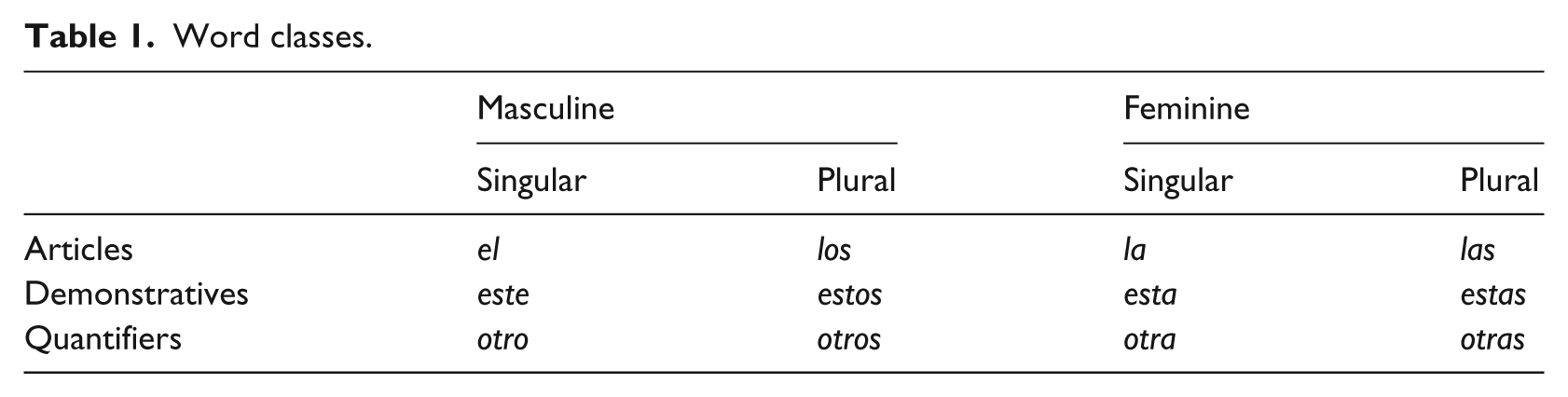
We will now turn to the syntactic dimension of gender. As opposed to nouns, the targets of gender, that is, articles and adjectives have a one-to-one correspondence between gender feature and formal feature. The suffix -o always corresponds to masculine and the suffix -a always corresponds to feminine with adjectives. Some adjectives are invariant as to gender, such as verde ‘green’ and azul ‘blue’. Indefinite articles and quantifiers are quite straightforward as well: uno, unos, otro and otros are always masculine and una, unas, otra and otras are always feminine. As to definite articles and demonstratives, all forms (este, ese, aquel, un, and the corresponding feminine forms esta, esa, aquella, una) are predictable except the masculine singular el. The word classes bearing gender that will be studied are specified in table 1. Note that the non-pronominal demonstratives will be studied here. Pronominal demonstratives are difficult to study since it is at times difficult to decide whether the children are referring to a whole referent (coche masculine, ‘car’) or a part of it (rueda feminine, ‘wheel’).
Word classes.
As Aronoff (1994, p. 61) states ‘gender is reliably detected not on the word that inherently carries the gender feature but rather on the lexemes that receive the feature by way of syntax’. That is to say, via articles and other words involving nominal concord. In this vein, agreement is a phrase internal issue and has been defined by Steele (1978, p. 610) as follows: ‘The term agreement commonly refers to some systematic covariance between a semantic or formal property of one element and a formal property of another’. As for the determiner phrase (DP), it entails that article, noun and adjective share the same gender as shown in (1).
(1) L ‘The black shoes’
Having presented some distributional properties of gender agreement, let us now turn to the question of how to represent gender syntactically. First of all, a brief sketch of the structure of the noun phrase (NP) we adopted will be outlined in the following. Within the generative tradition, Abney (1987) puts forward the DP Hypothesis. The so-called DP Hypothesis asserts that determiners are the head of a functional projection, the DP, which selects NPs as complements. The function of the DP is to attach reference to the complement NP. However, a more fine-grained analysis (e.g. Bernstein, 1993; Carstens, 1991; Cinque, 1994; Picallo, 1991, 2008; Ritter, 1993; Valois, 1991) of the DP structure proposes additional functional categories between the DP and NP. According to Bernstein’s (1993) analysis, the functional categories number phrase (NumP) and word marker phrase (WMP) are located between DP and NP ([DP D [NumP Num [WMP WM [NP N]]]) where formal gender ([masc/fem]) and number ([±plural]) features are checked, valued and deleted. Features in the DP-internal functional categories are responsible for the differences or similarities in nominal word order among languages. In Romance languages, nominal movement (i.e. noun raising) is obligatory, whereas in other languages such as Basque, the noun remains in situ since there is no feature that attracts the noun to raise as we will see below (Artiagoitia, 2002).
As already mentioned, in the Minimalist Program approach (Chomsky, 1995), lexical items are fully inflected when inserted in the syntax. Their features have to be checked in the appropriate heads. The features can be interpretable or uninterpretable. The latter are checked at the syntactic level and barred, whereas the former cannot be interpreted by syntax and go over to LF. As for gender, researchers agree that the targets of gender have uninterpretable features, but there is no consensus among researchers as to whether the gender features on the noun are interpretable or uninterpretable. To quote but a few examples, Carstens (2000) has reservations about this dichotomy in terms of gender. Similarly, White, Valenzuela, Koslowska-MacGregor, and Leung (2004) state that gender assignment is arbitrary and is not involved in interpretation. Picallo (2008), whose approach we will adopt, leaves this issue open.
Let us now turn to the question of representation of gender within the DP. Picallo (2008) suggests a structure topping NP and below number, which she calls [class]. Following Picallo (2008, p. 50), ‘grammatical gender may not be interpretable in the lexical N category, I propose that it is the formal exponent of an interpretable functional feature, which I will label [class] for convenience’.
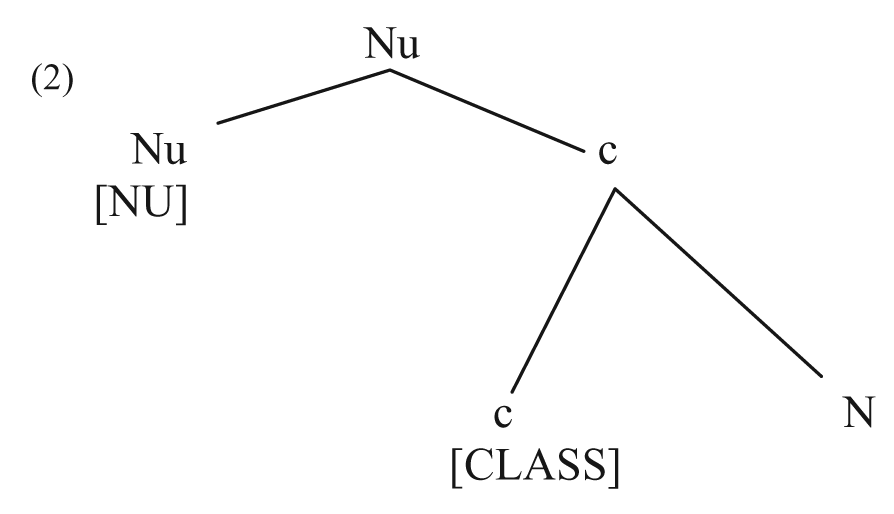
Picallo (2008) makes the observation that coordinated object CPs, which are not specified for gender, do not lead to plural agreement if they appear in subject position. Moreover, object CPs are referred to exclusively by singular masculine clitics; hence, they are not gendered and have no number. Hence, Picallo concluded that in order to be specified number, a DP has to be marked for gender. [CLASS] feature has type denotations and requires the projection Nu(mber) in order to provide token denotations. Picallo concluded that in order to have number, a DP has to be marked for gender. Bearing in mind this structural composition, number features within the nominal domain are valued and deleted, and the same applies to gender agreement (Bernstein, 1993, 2001; Picallo, 1991, 2008) as shown in the structure in (2).
Conversely, Basque, a non-Indo-European language, has neither grammatical gender nor nominal agreement. That is, Basque language inflects the DP for number and case on the last element of the DP as shown in (3), which is a mirror translation of (1) (3) Oinetako beltz-a-k Shoe black-det-pl The black shoes
Following Artiagoitia (2002), we will assume a fine-grained DP consisting of a NumP topping NP and below DP. Based on Longobardi’s (1994, 2000) approach, he assumes that Basque DPs, as do Romance languages, make the difference between existential and non-existential interpretation, although all NPs must be closed by a determiner. That is to say, example (3) can have an existential interpretation, that is, generic and non-specific, as well as a non-existential, that is, specific. He suggests that each interpretation matches with a different structure. The existential reading requires a zero D and the non-existential reading an overt D. He argues that the determiners are located in Num (4a), resulting in a zero D if the reading is existential, and they must move to D (4b) if the reading is non-existential.

Note that definite DPs in Basque all bear the ending -a, and the indefinite article bat is only used in extremely restricted contexts. The ending -a is identical to the feminine ending of most feminine nouns in Spanish.
To summarize, if Picallo (2008) and Artiagoitia (2002) are right, both Spanish and Basque have a NumP between NP and DP. However, the properties of Num are different depending on whether Class is present or not. In Spanish, if class is specified for gender, it will trigger number and N can move to Num. On the contrary, in Basque, the article is placed in Num in existential readings. It moves to D if the reading is non-existential. That is to say, N moves in Spanish, but it remains in situ in Basque. In this scenario, what is the acquisition task of a monolingual child acquiring Spanish? According to Picallo (2008), they must learn that the feature class hosts uninterpretable gender features in the syntactic tree, which induces noun raising and hence agreement. He or she must learn that while some endings highly correlate with either masculine or feminine, some others have no bearing on gender; natural gender correlates with grammatical gender. Hence, once this syntactic projection is implemented, one should expect few errors for a short period of time. Let us now turn to the Basque–Spanish bilinguals. The latter must acquire all the phonological and semantic issues attributed to gender, as Spanish monolinguals do. Since there is no ClassP in Basque, they must learn a new projection, that is, ClassP in Spanish. They must also learn that class requires noun raising. These are the two main differences in Basque. Hence, Basque–Spanish bilinguals have a more challenging acquisitional task to fulfil in order to converge with the target grammar.
Previous research on gender acquisition
Studies on early gender acquisition in French, Italian, German and other languages are quite numerous. However, the issue of gender in early child Spanish, and for that matter Basque–Spanish bilingual acquisition, has been by and large neglected by scholars working in this discipline. To our knowledge, there are three studies that looked at the acquisition of gender in Spanish: Hernández Pina (1984), Pérez-Pereira (1991) and Kuchenbrandt (2008) 2 , and only Barreña (1997) in Basque–Spanish bilingual acquisition. Before we discuss the most important findings for Spanish, let us briefly present the most important observations for French, a neighbouring Romance language.
Slobin (1985) suggested the so-called ‘semantic primacy hypothesis’ that states that children start assigning gender to words according to semantic properties of nouns. Much subsequent research has shown that children acquire the concept of grammatical gender long before they have a concept of natural gender (Karmiloff-Smith, 1979, for French and Pérez, 1990, and Franco, 1999, for Spanish). Karmiloff-Smith conducted a series of five experiments using nonsense words with 341 monolingual French children whose age ranged between 3;2 and 11;11. Her main finding was that children as young as 3 were able to use phonological cues to detect the gender of nouns. More importantly, if the child was given a non-converging word-natural gender pair, children opted for the phonological cue to identify gender, rather than the natural gender of the referent. Moreover, the scores of the feminine gender were overall lower, although children above 9 years of age showed ‘a tendency to attribute masculine gender to all unknown words, despite the potential feminine phonological clue on the suffix’ (Karmiloff-Smith, 1979, p. 159). As for late bilinguals whose exposure to a foreign language goes back to around the age of 3, they behave like bilinguals and not like L2 learners as has been reported by Möhring (2001). With regards to Spanish, Pérez-Pereira (1991) was able to confirm Karmiloff-Smith’s findings.
Hernández Pina (1984) documented the language of the child Rafael over several months and made interesting observations concerning gender development among many other issues. Rafael uses nouns with the appropriate determiner in one first stage. In a subsequent stage, lasting from 1;09 to 2;1, Rafael makes overgeneralizations such as *mota rota ‘broken down motorcycle’ and *tierra azula ‘blue earth’, both concerning the feminine. In the first case, the nouns ending in -o have been replaced by an -a resulting in *mota. In the second case, the child overgeneralizes the gender of the adjective that is invariant, thus resulting in *azula. He also overgeneralizes the masculine for a short period of time, but he, thereafter, overgeneralizes the feminine. All overgeneralizations occur with the indefinite article. Unfortunately, Hernández Pina (1984) does not provide any figures concerning this issue so that it is not possible to figure out whether the trend to overgeneralize was stronger in feminine or in masculine. However, she does mention that gender concord with the article is acquired by the age of 2;7.
As to the status of early vowels preceding nouns, Kuchenbrandt (2008) discusses longitudinal data of three bilingual German–Spanish, three monolingual German and three monolingual Spanish children. She tested the hypothesis of whether the very early vowel-like prenominal items that have been referred to as fillers or protoarticles in previous studies had any grammatical function. She showed very convincingly that children combine certain vowels with certain genders consistently. Kuchenbrand came to the conclusion that these not-yet target-like vowels had grammatical content from early on.
Pérez-Pereira (1991) studied 160 Spanish-speaking children between the ages of 4 and 11 in an experimental setting. He was able to confirm Karmiloff-Smith’s findings for Spanish. The natural gender of the referent and the issue of animacy do not play any role in gender assignment. That is to say, that the phonological and morphosyntactic cues are crucial in gender assignment. If children were presented with contradictory cues (semantic and phonological), they consistently assigned gender to the test words according to the phonological cues of the nonsense words.
Barreña (1997) studied the DP in a bilingual Basque–Spanish 3 child until the age of 3;03 and compared the results with the speech production of a monolingual Basque child. He noted that gender is acquired early, and gender errors all involve generalizations of the masculine. Moreover, he notes that errors are below the 10% mark in the period studied. However, this is a very high percentage that needs closer attention. Furthermore, he notes that the bilingual child code-switches between determiner and noun. However, we do not know how often this phenomenon occurs.
In summary, despite the studies cited above, a number of issues are unknown for early gender acquisition in Spanish monolingual children. It is unknown, whether there is a direction of overgeneralization that is stronger than the other as no quantitative data exist in this respect. It is also unknown whether children make more errors with specific target determiners. As to bilinguals acquiring a gendered language simultaneously with a genderless language, various interesting questions will be addressed. Does the fact that they acquire Basque impact on the acquisition of Spanish gender? If so, how does this influence manifest itself? Not much is known about neologisms and code switching, apart from the observation made by Barreña (1997). Note that no study has compared the performance of Spanish monolingual and Spanish–Basque bilingual children. Moreover, the study conducted by Barreña included only one bilingual child. In this study, we will study this child and include another bilingual child in order to confirm or disprove Barreña’s results. This article will, therefore, try to fill this gap by bringing in the acquisition scenario data from two Basque–Spanish bilingual children.
Study
Methodology
One monolingual child and two Basque–Spanish bilingual children have been analysed. The monolingual child MAG(ín) belongs to the corpus of Aguirre available in Child Language Data Exchange System (CHILDES) (http://childes.psy.cmu.edu/) (http://childes.psy.cmu.edu/browser/index.php?url=Romance/Spanish/). 4 All subjects are male. Both bilinguals have been raised following the ‘one parent, one language’ method going back to Ronjat (1916). The bilingual children are balanced bilinguals as the following mean length of utterance (MLU) charts show. MLU in morphemes (MLU(m)) was calculated by hand in the case of the bilinguals excluding the words ‘yes’, ‘no’, imitations and repetitions. The MLU by MAG(ín) was calculated using the tools available in CLAN.
As to the monolingual child, neither biographic nor methodological data are available in the CHILDES database. However, the recordings were conducted with approximately the same or even tighter time intervals as those of the bilingual children. The bilingual children belong to middle-class families living in the province of Bizkaia, whose capital is Bilbao, in the Basque Country. M has an older sister and P had no siblings at the time of the recordings. M’s father is Spanish speaking. His mother and his sister speak Basque to him. P’s father speaks Basque to P as well as his mother who is an L2-Basque speaker with a high level of proficiency. P has a day caretaker who speaks Spanish to him. It is impossible to quantify the exact amount of exposure to each one of the languages, but both children were exposed to Basque and Spanish daily. The two bilingual children M and P, raised bilingually from birth, belong to the Busde-Corpus. 5 Both bilinguals were videotaped in naturalistic settings twice a month first in one language and immediately afterwards in the other one. The transcriptions were made by experienced transcribers who were native speakers of Basque or Spanish or both. In order to increase reliability, a second transcriber checked the first version of the transcript.
The processing of MAG(ín)’s data was done using the CLAN tool COMBO in order to search for the strings ‘el’, ‘la’, ‘los’, ‘las’, ‘un’, ‘una’, ‘unos’, ‘unas’, ‘este’, ‘esta’, ‘estos’, ‘estas’, ‘eso’, ‘esa’, ‘esos’, ‘esas’, ‘aquel’, ‘aquella’, ‘aquellos’, ‘aquellas’, ‘otro’, ‘otra’, ‘otros’ and ‘otras’. The data of the bilinguals were processed by hand. All imitations and repetitions were excluded from the statistics. If one interlocutor introduced a noun with a corresponding determiner, any subsequent occurrence of the word with any target-like determiner was excluded. If the child produced a target-deviant determiner, this occurrence has been counted. Hence, the data gave an account of all types found. With respect to the use of ‘otro’ ‘another one’ and the corresponding forms, ‘otro’ was counted as such when it appeared heading the DP. If the head of the DP was an article, ‘otro’ and forms were not counted: Los otros coches: 1 type counted as ‘los’ Otros coches: 1 type counted as ‘otros’
We decided to proceed this way in order to not inflate the figures. The data of the bilinguals were processed and counted by hand following the above sketched procedure. Following Kuchenbrandt (2008), we will count all nouns preceded by ‘e, u, o’ as masculine, and all nouns preceded by ‘a’ as feminine.
In order to represent the overall picture of the development of the subjects object of study in the present paper, we refer to the MLU(m) calculated by Mahlau (1994) for both bilinguals and to the MLU calculated by Larrañaga & Guijarro-Fuentes (2012) for the monolingual studied in the present paper. The data shows that MLU in monolingual and bilinguals increases steadily and are very similar. Both bilinguals are balanced in terms of MLU.
Hypotheses and predictions
On the basis of the distributional properties of masculine and feminine in Spanish and on theoretical grounds, a number of predictions can be made. According to Harris’ approach, the masculine is assumed to be the default gender. As regards empirical studies, White et al. (2004) have shown that French and English learners of Spanish use masculine determiners with feminine nouns. Pérez-Pereira (1991) showed that children attributed masculine gender more often than feminine to nonsense words. If the masculine is the default gender, it is expected that children acquiring Spanish will start off with the default option. That is to say, children acquiring Spanish will use the masculine for both masculine and feminine nouns in a first stage. In a subsequent stage, children converge with adult grammar in that they use the correct gender targets with the target nouns. Hence, the question to be answered is (hypothesis 1) whether both monolingual and bilingual children opt to use a default form, that is, the masculine (Pérez-Pereira, 1991) or the feminine (Hernández Pina, 1984) in an early stage.
With regard to language influence, the recurrent hypothesis in the bilingual literature is, for instance, whether language internal properties concerning the C-Domain (Hulk & Müller, 2000; Müller & Hulk, 2001) boost cross-linguistic influence. In particular, these researchers looking at bilingual acquisition have suggested that cross-linguistic influence from one language to the other needs to meet certain conditions, and, as a matter of fact, interface areas are particularly vulnerable. According to Hulk and Müller (2000) and Müller and Hulk (2001), language interference must be due to language internal conditions provided that the following two requirements are complied with: (a) cross-linguistic influence occurs at the interface between two modules of grammar and more particularly at the interface between pragmatics and syntax in the so-called C-domain, since this is an area that has been claimed to create problems in L1 acquisition as well (Grinstead, 2004; Platzack, 2000) and (b) syntactic cross-linguistic influence occurs only if language A has syntactic constructions, which may seem to allow more than one syntactic analysis and, at the same time, language B contains evidence for one of these two possible analyses. That is to say, there has to be a certain overlap of the two systems at the surface level. With regard to the surface overlap, recall that all definite nouns end in -a in Basque, an ending that is identical to the feminine ending of Spanish. Moreover, the indefinite bat in Basque is semantically restricted and that the definite noun is used in most contexts. Finally, the definite noun is the citation form and not the bare noun. That is to say, the condition of surface overlap is fulfilled. In addition to these two conditions put forward by Hulk and Müller (2000) and Müller and Hulk (2001), which explain the directionality of cross-linguistic effects between two language systems, there are other external factors that may also influence the directionality of cross-linguistic effects such as language contact and/or richness of input. The latter are difficult to test and will be ignored in this article.
With that premise in mind and given the language combination at stake in this article, we explore whether the minority language Basque whose DP functional category bears a limited number of interpretable features (i.e. number) influences the acquisition of the language spoken by most speakers in the Basque country, that is, Spanish, whose DP functional category bears a high number of uninterpretable features, including gender (though not always visible and transparent). Evidence of an unclear and ambivalent rule for gender value assignment (namely, feminine if N ends in -a, masculine if N ends in -o or in other vowels or consonants) could be taken for the existence of a unified lexicon system at the earliest stages of the acquisition process. Given that Basque nouns end in -a, acquisition of gender could be boosted by this fact. Thus, the hypotheses to be tested are whether Basque–Spanish bilinguals overgeneralize the feminine (hypothesis 4) and whether Basque influences Spanish (hypothesis 2).
One of the many departure hypotheses is that language development with regard to gender acquisition proceeds quite similarly in all children. Namely, there are no idiosyncratic differences between all three children – bilingual and monolingual – that would imply a language-specific distinction. Nevertheless, given that some phonological features of the DPs in Basque as well as its internal architecture may impact on the course of acquisition of the Spanish gender by bilingual Basque–Spanish children, their attainment of the adult grammar may differ from the attainment of monolinguals either showing acceleration or delay. Moreover, the lack of gender in Basque, on the one hand, and the complex gender marking in Spanish (namely, some nouns provide some kind of phonetic and semantic cues, whereas other do not), on the other hand, supposedly creates acquisition problems for Basque–Spanish bilingual children. The child will need to decide which of the values of the Spanish Det to go for. Therefore, we would expect quantitative and qualitative differences in the children’s production. Hence, one issue that will be addressed is whether Basque–Spanish bilinguals require more time to acquire gender in Spanish (hypothesis 3).
Another issue to be tested is whether gender agreement is target like in both monolingual and bilingual children. Pérez-Pereira has shown that syntactic features develop. That is to say, the younger population relies less on syntactic features than the older one. If agreement is a matter of interpretable features in the syntax, one would expect an initial stage with agreement errors (hypothesis 5).
In sum, here is the list of issues that will be addressed:
Will both monolingual and bilingual children opt to use the default form, that is, the masculine in an early stage?
Due to the surface overlap between Basque and Spanish, will bilingual children overgeneralize the feminine form as do monolingual children reported in the literature?
Since Basque has no gender, will Basque–Spanish bilinguals require more time in order to master gender in Spanish?
Since the Basque definite article that is used in most contexts ends in -a, will Basque influence Spanish?
If gender agreement is a matter of interpretable features in the syntax, would potential errors include differing genders in the article and adjective?
Results
In order to establish and define the target-like gender realizations by our two bilingual children, the average rates of gender realizations by another monolingual child are then compared. The results will be divided into articles, demonstratives 6 and quantifiers. Demonstratives and quantifiers will be shown in tables 3, 5, 8, 10 because the number of types is much reduced. The correct definite and indefinite articles will be plotted in a chart. Errors will be discussed separately. For the sake of clarity, masculine overgeneralization means that a feminine noun has been used with a masculine determiner and feminine overgeneralization when a masculine noun has been used with a feminine determiner.
Monolingual child
What follows is a brief description of the data that will be provided. Initially it will be focused on the targets of gender. Figure 1 shows that the monolingual child MAGín (Ma) uses articles from the very first recording. Nevertheless, he drops articles on a number of occasions. This issue will not be dealt with in this article, since it does not concern gender acquisition per se. The first article to appear is the definite feminine article la, which is used a month before the masculine counterpart. This age span is, however, not significant since children do not speak a lot at this age and only a handful of examples are found. Definite articles are used prior the indefinites. Moreover, the monolingual child uses far more definite articles than indefinites (see Figure 1 and 2). The use of singular definite articles is evenly distributed in both genders. Plurals (Figure 6) are not as frequent as singulars but appear at the same age as singulars. The masculine plural is the first to appear. A month later, the first use of feminine plural occurs. With respect of the distribution, MAG uses far more definite masculine plurals than feminine plurals (see Table 2).
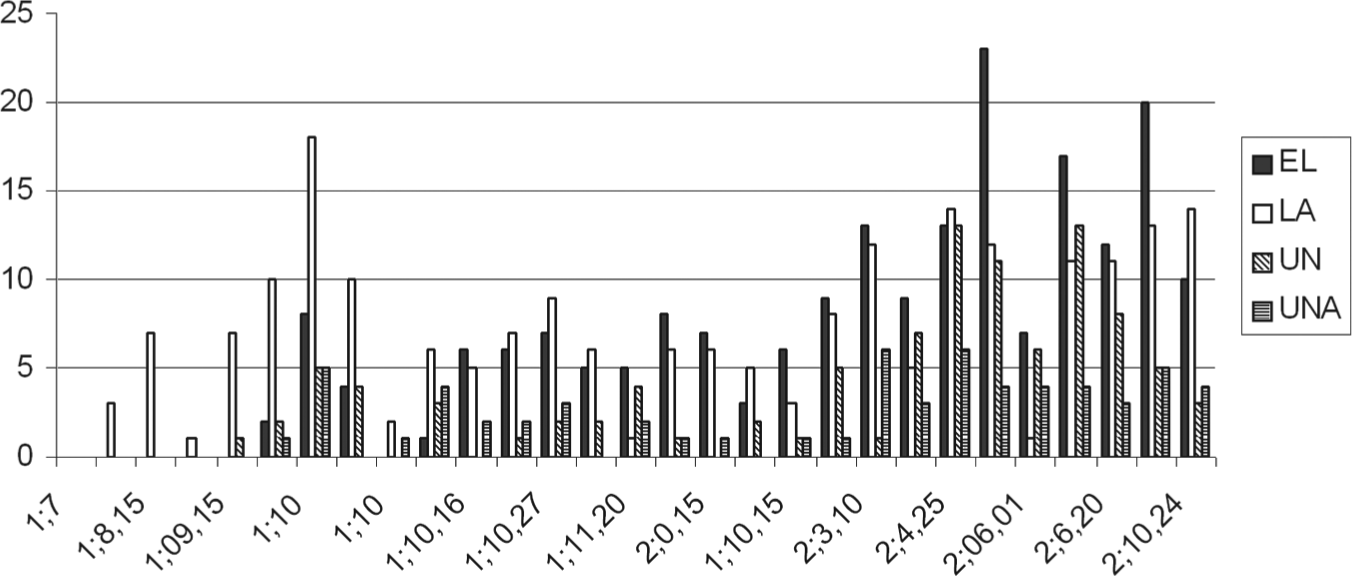
Singular definite and indefinite articles by MAG.
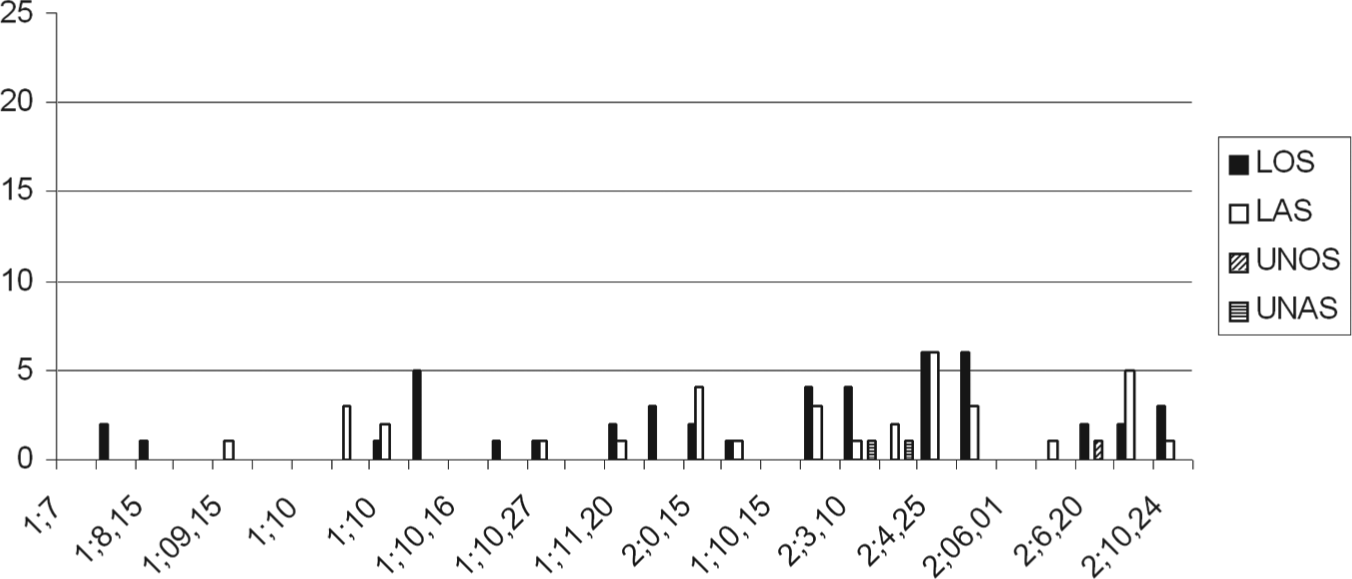
Plural definite and indefinite articles by MAG.
Total amount of types in singular and plural by MAG.

Distribution of demonstratives and the quantifier otro by MAG.

Plurals are by far less frequent than singulars, since they are not always used in all recordings. They are, however, evenly distributed. The indefinite articles are not used as often as their definite counterparts, and they appear later than the definites. As in the case of the definites, the plurals are far less frequent in the recordings.
The quantifier otro has been plotted on its own (see Figure 3) because of some overgeneralizations, which will be discussed later in this article. The first appearance of the masculine quantifier is at 1;09,01. The feminine singular quickly appears a month later with 1;09,27. Overall, the masculine predominates the feminine. MAG does not use more than three quantifiers of one and the same gender in one single recording. Only a handful of plurals are used at a later stage.
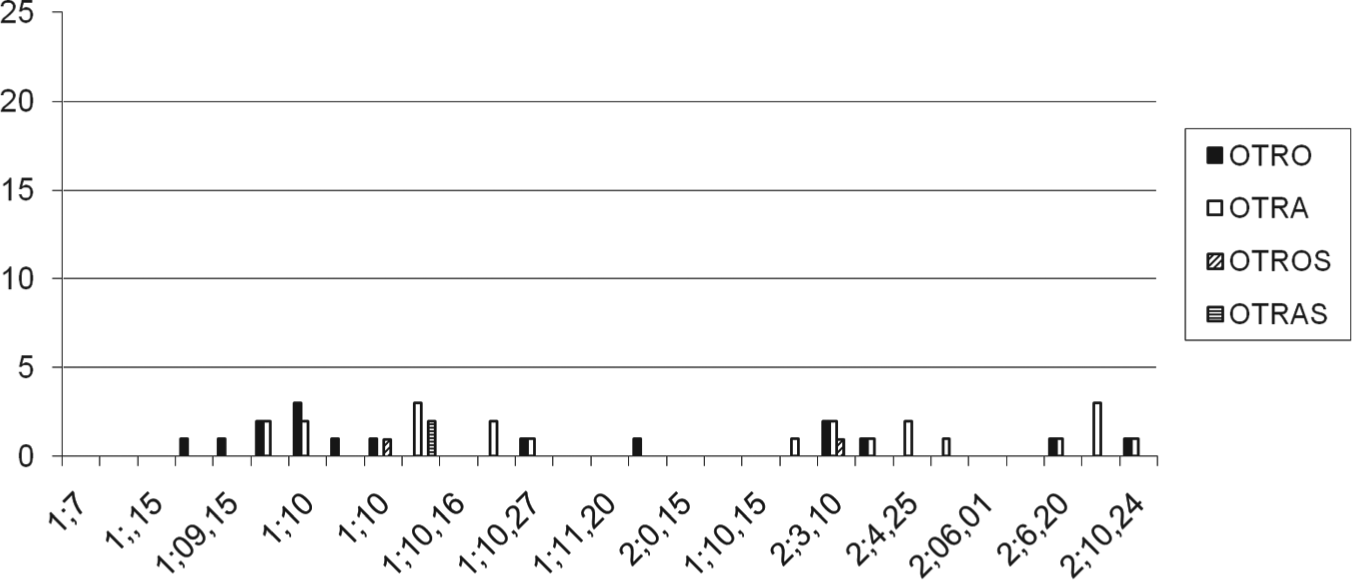
The distribution of the quantifier ‘otro’ by MAG.
Overall the demonstratives are not very frequent (see Figure 4). Both masculine and feminine singular demonstratives (este–esta, ese–esa) are used at around 1;10 for the first time. As with all other determiner classes, plurals are far less frequent than singulars. Moreover, they appear to a later stage in evolution and only with estos.

The distribution of the demonstratives by MAG.
Very surprisingly, MAG uses the correct article in the following expression, where an irregularity occurs. Agua ‘water’ is feminine but requires a masculine article in order to avoid cacophony. And even if the mother introduces the feminine form, MAG seems to have acquired the phonological rule and uses the correct article:
(1)el agua caliente, yo qu(i)ero (2;04,25)
aquí no llega (1)el agua.
es que entra mucha agua.
In sum, quantifiers and demonstratives are not as frequent as articles.
Errors
To start with let us look at some figures. MAG does not make any errors from 2;05 onwards. Hence, a table with the types per determiner and the corresponding errors provides an overview of the target-like versus target-deviant realizations (Table 4 and 5). We exclude the lemma aquellos because MAG makes no errors with it. MAG overgeneralizes the masculine as well as the feminine but to different extents. The feminine is overgeneralized in far more contexts than the masculine. However, MAG ceases to overgeneralize the masculine at age 2;05 at the latest. Overgeneralizations with the indefinite article disappear at age 2;05 as well. Overgeneralizations with ‘otro’ at age 2;1. Moreover, some determiners are more prone to gender overgeneralizations than others. Only el, la, un, una, este, otro and otra are the target of overgeneralizations. The three errors where the masculine is overgeneralized could well be due to phonological reasons. It is quite usual that even adults omit n in utterances such as en la estación resulting in el aestación. The word amoto is also used in some dialectal varieties. Since we do not know whether MAG has been exposed to one such dialect, it is difficult to say anything about this error. Errors in this time span are below 7% with most determiners except for el, otro and otra whose errors attain over 25% of the total types counted.
Total amount of target-like types (n) and contexts (errors) by MAG.

Total amount of target-like types (n) and contexts (errors) by MAG.

In order to discuss the overgeneralizations in more detail, a list of all errors will be provided:
Overgeneralizations of the masculine
mira un trene [: tren] [*] en (1)el [* la] aestación [: estación] . (2;07,26)
el [*] amoto [: moto] [*]. (2;10,24)
claro, esa otra rama pincha también . (1;09,15)
otro [*] rama .
(l)a est(r)ella . (MAG uses it before in the recording)
ot(r)o [*] est(r)ella . (1;09,15)
ot(r)o [*] flor . (1;9,27)
otro [*] tata [: carta] (1;10)
la araña (1;10)
otro araña .
ot(r)o naina [: gallina] (1;10)
y otro una . (2;1,)
el otro la [*] pompas . (globo) (1;10,15)
un [*] nina [: niña] . (1;10,)
tiene una cola con un lacito
un [*] cola . (1;10)
eso es una pluma de Pompeyo
es un pluma . (2;05)
Overgeneralizations of the feminine
(l)a bobo [: globo] . (1;07)
dónde está el pipi?
xxx, xxx, (1)(l)a pipi n(o) (es)tán [: no están] [*] . (1;07)
poner la teléfono papá .(1;10,15)
oye, oye, oye, cuida(d)o con el teléfono
(l)a &papá . (1;10)
(l)a nene . (1;10)
es (l)a bobo [: globo] . (1;10)
(l)a bebe [: biberón] (1;8,15)
(l)a mono . (mono de trapo) (1;8,15)
(l)a babua [: agua] . (1;09,15)
(l)a bobo [: globo] (1;9,27)
(l)a pipi@o . (*FAT:el pipi@o .) (1;9,27)
(l)a buabua [: paraguas] (1;9,27)
(l)a bo(l)so (1;9,27)
está allí (1)(l)a relampo [: relámpago] (1;9,27)
(l)a taito [: caballito] (1;10)
(l)a ot(r)o (.) aquí (1;10)
(l)a pato . [+ I] (1;10)
(l)a bobo [: globo] (1;10)
(l)a boca(dillo) (1;10)
poner la teléfono papá (1;10,15)
(l)a dodoti(s) (l)a leche (1;10,16)
(l)a dodoti(s) (1;10,16)
dame (1)(l)a ot(r)o . [+ I] (1;11,)
la [*] helicóptero amarillo (2;0,)
l(a) ama(r)illo quiero (2;1,)
la pañeta@c . (2;3,02)
el pañete . (MAG says it before)
pasamos por el mono de Continente, ése que dice: hola, niño, cómo
te llamas?
mono, y (1)la [*] mono 2;3,10
déjame (1)la chachito@c (2;3,10)
la amarillo [*] quiero (2;3,10)
otra [*] amarillo (1;11,)
otra el [*] amarillo [*] (2;3,10)
uno, dos, (1)otra dos (2;4,25)
una [*] caracol (1;10,20)
eres una tomata@c (2;6,20)
esta [*] caracol (1;10)
Neologisms
otro [*] corazona [: corazón] [*] (2;10,24) (as correct!)
el mosquita [*] (2;0,15)
otra (1)el [*] amarillo [*]. (Ref. FEM) (2;03,10)
(l)a tacito [: tacita] [*] uno (1;10,16)
If we look at the phonological shape of the errors, some interesting patterns occur. Let us begin with the overgeneralizations of the feminine. Twenty-one out of 36 examples are words that end in -o, which has prototypically masculine gender. If we consider the masculine overgeneralizations, 9 out of 12 errors are words that end in -a, prototypically feminine nouns. It is, on the one hand, not surprising since a high proportion of words in Spanish belong either in the -o or in the -a class. Nevertheless, on the other hand, if the phonological cue is so strong in Spanish, it is rather striking that the errors precisely occur with the endings that have a high cue reliability. As regards the semantics of the words, most errors belong to the class of the inanimates, but there are some examples that are animate such as ‘mono’ and ‘caballito’ that are realized as feminine and ‘gallina’ and ‘niña’ as masculines. That is to say, this monolingual child has not discovered yet that natural gender matches with grammatical gender in Spanish. No errors at all occur with the plural.
Bilingual children
In what follows, the results of the two bilingual children will be presented.
The first observation that can be made is that both bilinguals produce far fewer nouns (see Table 6) with determiners than the monolingual child. It can be due to the fact that they are bilinguals, but most probably, it is due to the amount of recordings that have been analysed (MAG 29, Mikel 24, Peru 19). 8 However, the similarities in the data are striking. Both bilinguals use feminine and masculine determiners at approximately the same age. Plurals are rare and tend to appear later than singulars (see Figure 6 and 8). The most frequent determiners are the definite and indefinite article (see Figure 5 and 7), followed by the quantifier ‘otro’ and corresponding forms.
Total amount of target-like types (n) by Mikel and Peru.
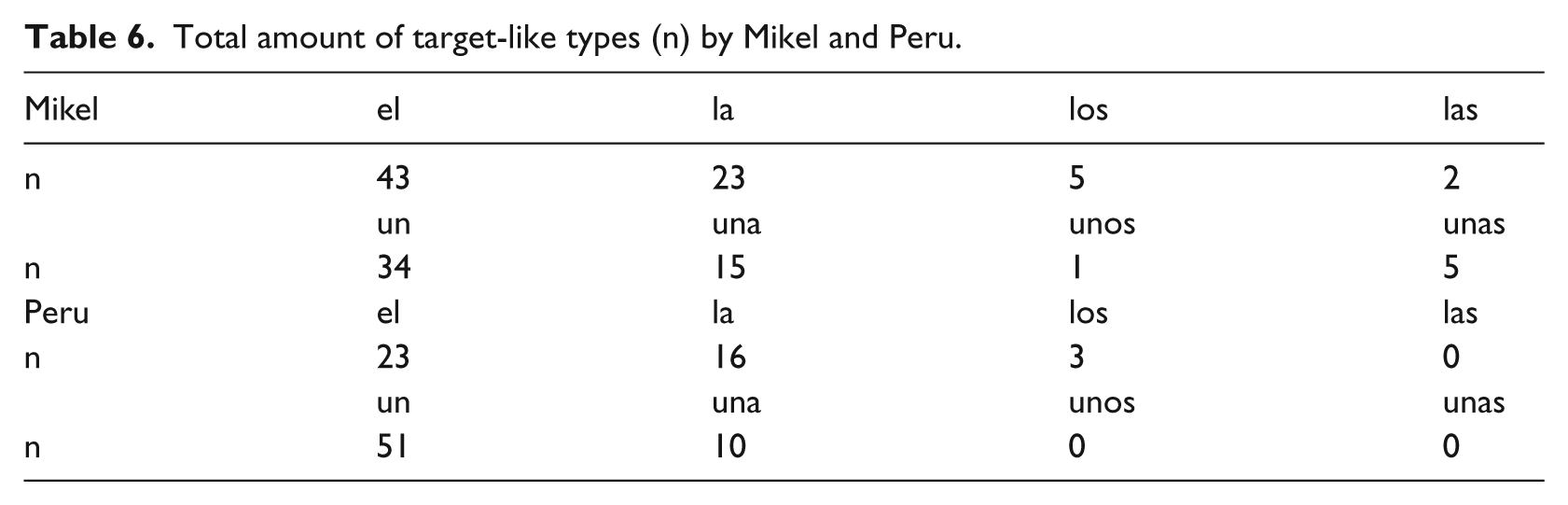

Singular definite and indefinite articles by Mikel.
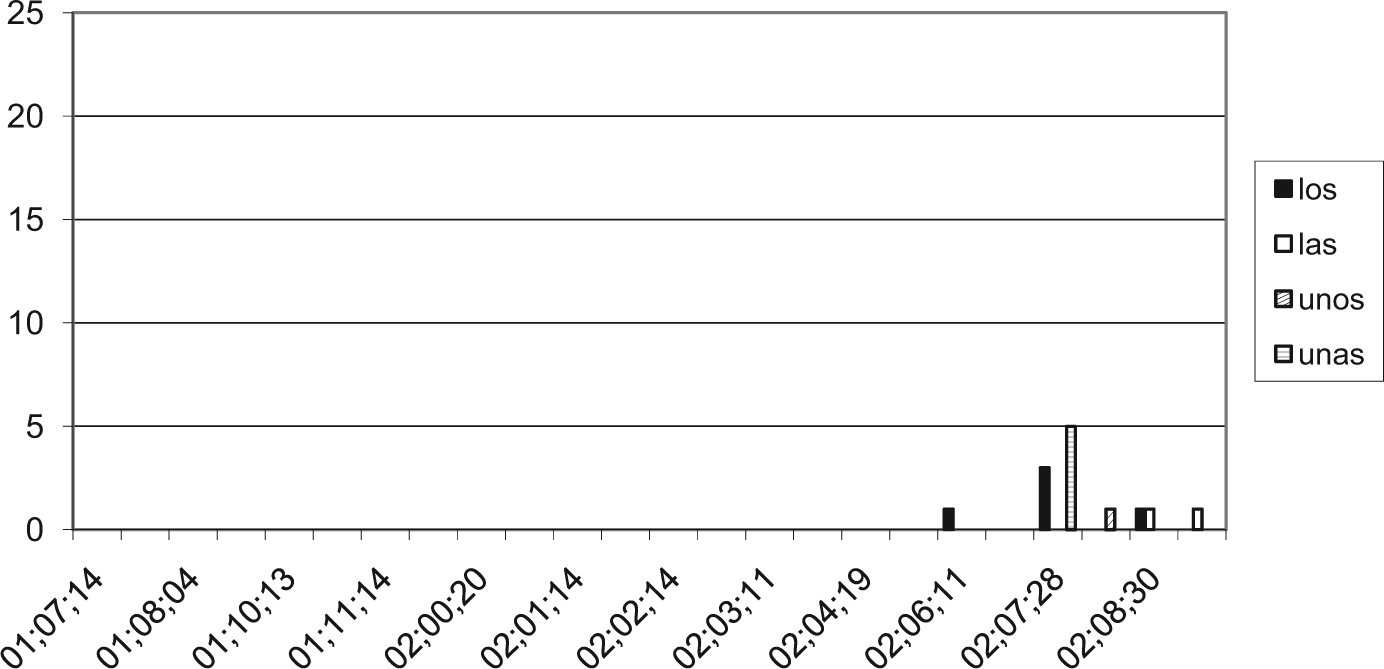
Plural definite and indefinite articles by Mikel.

Singular definite and indefinite articles by Peru.
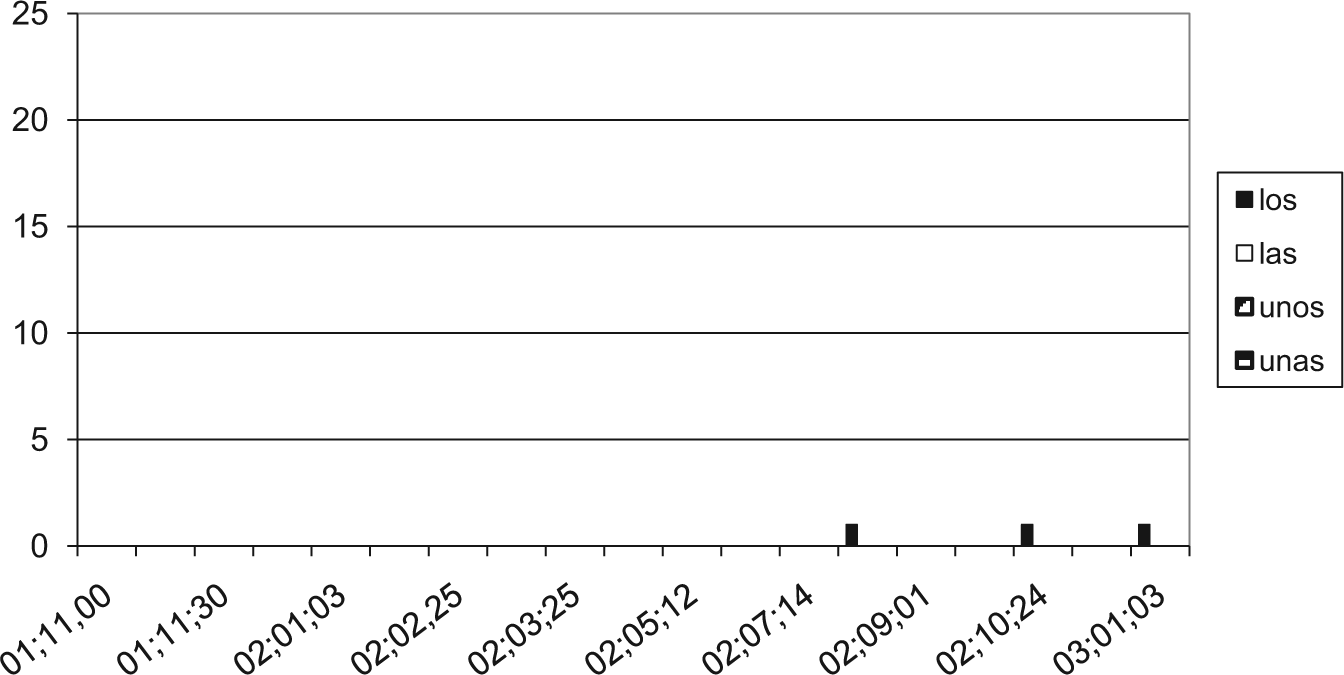
Plural definite and indefinite articles by Peru.
Errors
At a very early age, Mikel uses target-like articles for around 3 months and starts then making gender errors, which will be analysed in detail below. Peru, on the contrary, makes errors from the very first recording onwards. Both children make errors until the end of the period studied. That is to say, they do not cease to produce overgeneralizations. The different determiner types are not overgeneralized with equal frequency. Overgeneralizations are below 5.5% for all categories except for la, una and otra, which attain 23.3%, 34.8% and 75% of the overgeneralizations by Mikel, respectively. As for Peru, his corpus is much smaller. However, a similar trend is found regarding overgeneralizations. Overgeneralizations lie below 6% with the exception of the determiners una used for the target un (58.3%) and ese used for the target esa (75%, n = 4). Both bilinguals overgeneralize the masculine and the feminine gender (see Table 7 and 9), but the masculine is overgeneralized in the overwhelming majority of cases. Let us first consider a few figures in order to analyse the overgeneralizations in more detail.
(9) a. Una caserío (M 02;04;11) b. Una monte (M 02;04;19) c. A la caballos (M 02;07;01)
(10) a. Una teneó (P 02;09;30) b. Una pollito (P 02;09;30)
Total amount of target-like types (n) and contexts (errors) by Mikel.

Total amount of types (n) and contexts (errors) by Mikel.
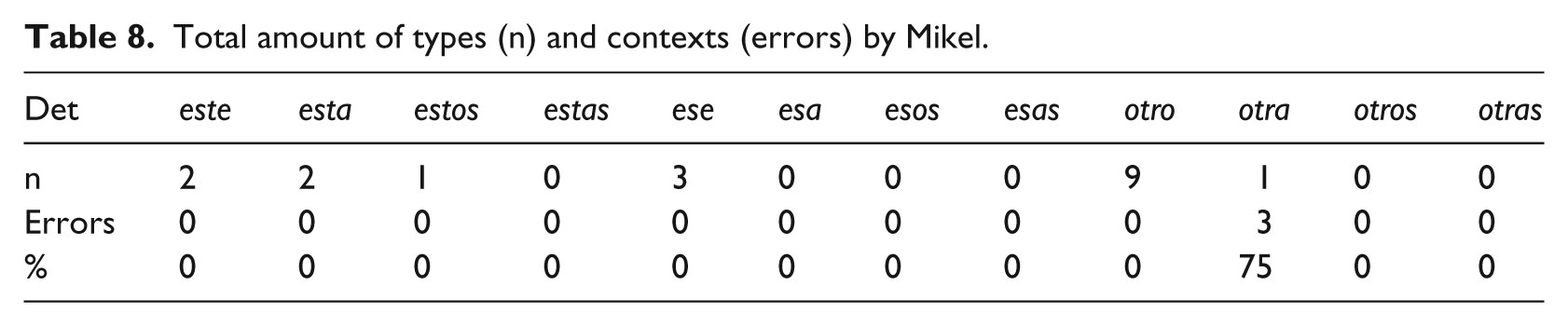
Total amount of target-like types (n) and contexts (errors) by Peru.
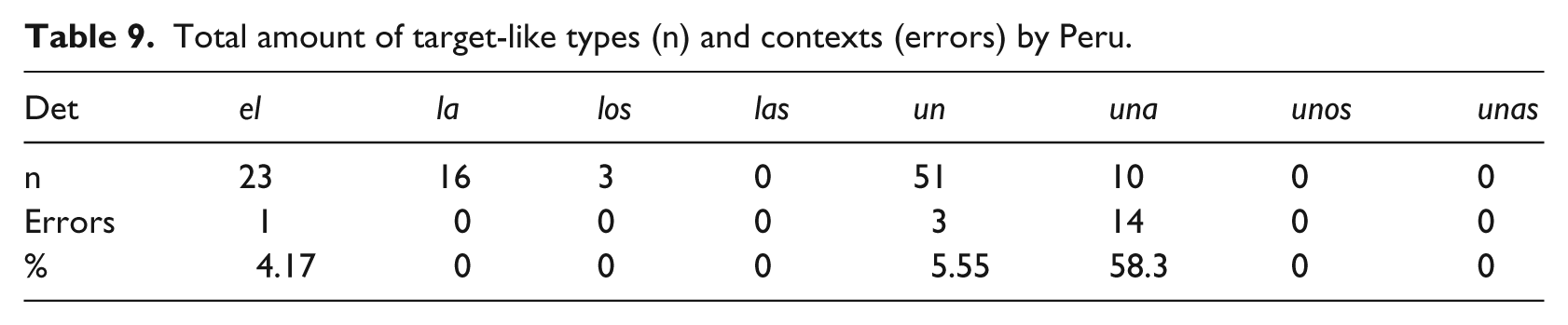
Total amount of target-like types (n) and contexts (errors) by Peru.
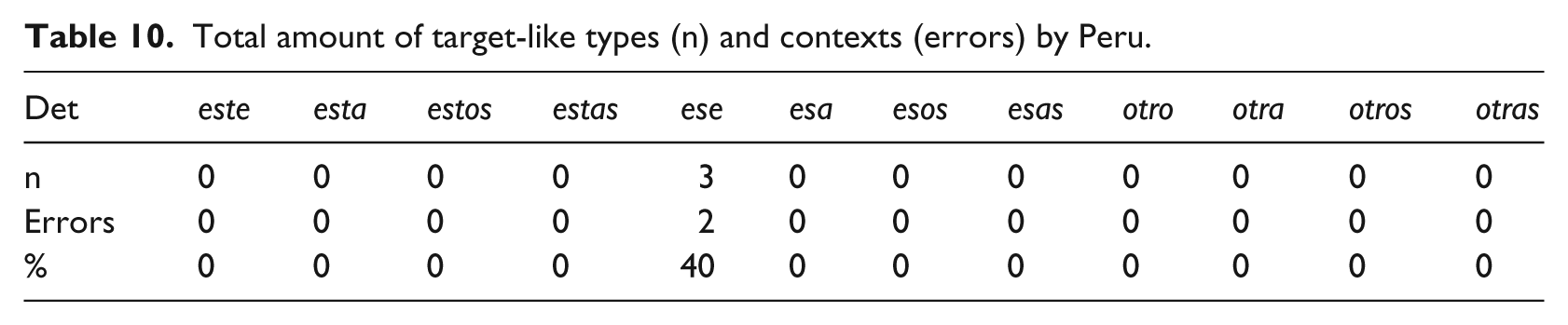
The masculine overgeneralizations are far more numerous in both bilingual children. Both children produce 16 overgeneralizations of the masculine over the entire period studied. M does not overgeneralize the feminine from 2;07 onwards. P overgeneralizes the feminine only in two occasions at 2;09,30. In four of five cases the overgeneralizations concern words ending in -o. The fifth case is a word ending in -e, whose ending is almost always masculine. In sum, all overgeneralizations of the feminine correspond to words that have very strong phonological cues according to Teschner and Russell (1984). Moreover, one example by each child (9c–10b) corresponds to an animate referent whose grammatical gender can be predicted from its natural gender.
Both children produce a reduced number of neologisms. They also borrow five nouns from Basque and assign them gender resulting in code-switched structures. Let us have a closer look at these examples.
(11) a. U(n)a etxea (Sp. feminine) ‘a house’(P 02;03;12) b. U(n) a(r)t(z)a (Sp. masculine) ‘a bear’ (P 02;04;15) c. Un sajala (Sp. feminine) ‘an apple’ (P 02;09;30) d. El pakas (Sp. masculine) ‘trousers’ (M 02;07;01) e. La- la txis (Sp. feminine) ‘urine’ (M 02;10:12)
Both children use the feminine and the masculine with the borrowed nouns. In three cases (11a), (11d) and (11e), the gender of the borrowed noun corresponds to the gender of the target noun in Spanish. The two other examples have been used with the wrong gender if we take the gender of the target Spanish noun. Interestingly, P uses the masculine indefinite article with the word sagar ‘apple’ as well as the definite article in Basque un sagarr-a. The same goes for example (11a). Since nouns with the -a suffix are the citation form, this ending does not seem to have affixal status for the child yet. Moreover, the Basque word ends in -a, which is a very strong phonological cue for feminine nouns in Spanish. P uses the wrong gender despite this very strong phonological cue. The same goes for ‘txis’ where the affix -a is missing. Here the affix is missing and, paradoxically, the child opts to use the feminine, which is not target like. That is to say, phonology does not seem to play an important role in assigning gender to borrowed nouns.
Summarizing the results so far, some patterns of acquisition are found in both monolingual and bilingual children. Although not very numerous, all children use both genders with one and the same noun. 9 Plural determiners appear prior to the singular counterparts. The correct gender on determiners is used from early on by both groups. However, the acquisition of gender is not error free for both groups. The overall proportion of gender errors per determiner is quite similar in monolinguals and bilinguals, but if we take the total amount of types and the total amount of errors, the monolingual child makes far fewer errors than the bilinguals. Natural gender does not seem to be acquired yet since the monolingual child as well as both bilinguals makes errors with animate nouns. Following extract from the Magín’s database illustrates this state of affairs very well, since he has acquired grammatical gender no later than 2;05 and he is not able to differenciate natural genders well beyond that age yet.
soy una chica ‚(I) am a girl’ MAG 2;6.20
¿quién? ‚who?’
yo ‘I’
¿y Clara qué es? ‘and what is Clara?
una chica, también. ‚A girl as well’
¿y Raúl? ‘and Raúl’
Raúl no, no sé. ‚Raúl no, I don’t know’
With regard to the type of overgeneralizations the children make, the monolingual child and the bilinguals differ diametrically. The number and the error type of the time span where they occur are totally different. The monolingual child overgeneralizes mostly the feminine, whereas both bilinguals overgeneralize the masculine in most contexts. The monolingual child ceases to produce gender errors, while both bilinguals continue to make errors until the end of the studied period. Bilinguals overgeneralize more than the monolingual child.
Overall discussion and conclusions
Let us now discuss the issues to be analysed one by one. The first observation we wish to make is that all three children use the correct gender from the outset as the correct determiner choice in numerous examples as shown. Note, however, that all three children overgeneralize masculine and feminine to a certain extent and over a measured period of time. Nevertheless, the process of acquisition by monolingual and bilingual children shows quantitative and qualitative differences that will be discussed below. The first issue we addressed in this article was whether monolingual and bilingual children would opt to use the default gender in order to converge with the target grammar at later stages of language development. This hypothesis has not been confirmed entirely, since there is not an early stage where all the children exclusively use the masculine determiner for nouns of both classes. However, the overgeneralization preferences by the monolingual child and the bilingual children differ diametrically. That is, both bilinguals prefer to overgeneralize the masculine over the entire studied period, whereas the monolingual child overgeneralizes both genders but preferably the feminine for a limited period of time. In this respect, it is MAG, the monolingual child, who does not match with the predictions. Interestingly, his overgeneralizations fall into two major classes: overgeneralizations with otro and la. MAG seems to have understood very early that Spanish has two classes of nouns and either uses the correct gender with most nouns or uses feminine nouns with otro and masculines with la for a short time span ending at 2;05. He overgeneralizes the feminine on fewer occasions as do bilinguals overgeneralize the masculine. It has been assumed in this article that a ClassP heading NP hosts nominal gender features that have to be checked, thereby attracting N to Class. A NumP tops ClassP. In theoretical terms, the inflected noun has to move to Class and Num in order to check gender and number. Once these functional projections are implemented, their features should spread over the whole DP in Spanish. In other words, children should produce errors until the implementation of the category and cease to produce them after its implementation. If children, both monolingual and bilingual, use the correct gender in the gender targets (determiners) from the outset onwards, they must have a notion of gender licensed by the ClassP very early on. This has been confirmed for MAG since errors cease at 2;05. The question that arises now is why bilingual children make so many errors for so long. Children encounter difficulties with functional categories with semantic content. Nevertheless, morphophonological features are easily learned as the numerous studies on acquisition of inflection show. Children make errors of the type *er gehte gestern but not *er gehte heute in German. That is, children overgeneralize the past ending, but the temporal adverb with past reference and the past of the verb ‘agree’. Regarding verb inflection, children eventually overgeneralize the third person in Spanish for a very short period of time. As Ezeizabarrena (1996) has shown, the bilinguals studied above hardly ever make morphological errors in Basque. We have the reverse case here. Children do not frequently add -o or -a to nouns that do not require these endings but choose the wrong gender target. Does it therefore mean that features do not spread to the whole DP? This cannot be the case since all children produce a set of correct determiners from the outset. And hence, it cannot be assumed that features spread only for a subset of nouns used.
Is it plausible to assume that children simply do not know to which class the incorrect nouns belong, thus reinforcing the item-by-item learning hypothesis? If this were the case, children would make errors with one and the same noun on repeated recordings. This happens with the noun ‘globo’ and a few more words for a certain period of time. In fact, the noun ‘globo’ as well as ‘estrella’ is used both with feminine and masculine determiners. But this does not happen with the majority of words. The majority of nouns are used incorrectly just once. Hence, caution is required if one wants to state that the children do not know the lexical class the nouns belong to. More interestingly, MAG makes errors with nouns that have been introduced by the interlocutor in the previous discourse with the target-like determiner. MAG subsequently uses the noun with the wrong determiner (5c, 5n, 5o, 6b, 6c and 7e). This is strong evidence that the child has his own hypothesis about gender.
Let us now look at the time span where overgeneralizations occur. Recall that Basque has no gender and Spanish has uninterpretable gender features located in ClassP. This poses a major acquisition challenge for Basque–Spanish bilingual children since Basque has no grammatical gender at all. One major difference between the monolingual child and both bilinguals is that gender errors disappear at 2;05 in MAG, the monolingual child. Hernández Pina (1984) reports that gender is acquired at age 3 at latest. Pérez-Pereira (1991, p. 86) claims that this is due to the transparent gender marking in Spanish. Gender assignment is always target like after that age. By contrast, gender errors occur at all stages with both bilinguals. The fact that the second first language is Basque surely plays a role. The fact that both bilinguals almost always resort to the masculine may be indicative of the fact that bilinguals assume that Spanish has a sort of default gender. In other words, they act following the principle ‘if not known, use the masculine’. The fact that Basque lacks gender reinforces them in this hypothesis. It is only at the very late stages that the gender errors become less frequent by the bilinguals, but they never disappear. In this sense, gender acquisition seems to pose more of a challenge for bilinguals than for monolinguals. The results clearly indicate that Basque influences Spanish in the sense that the process of acquisition is slowed down or delayed. Can this be due to the fact that definite DPs end in -a? Let us discuss the issue in more detail.
Recall that Basque has no gender and that the citation form always ends in -a. This ending is according to Teschner and Russell (1984) highly indicative of feminine in Spanish in more than 96% of the cases. We hypothesized that this surface overlap between Basque and Spanish could lead bilingual children to assume that all nouns ending in -a are feminine. Bilingual children do not overgeneralize the feminine very frequently. On the contrary, the overwhelming majority of their overgeneralizations correspond to the masculine. In this sense, the fact that the ending -a is the citation form as well as the definite article marker does not boost these types of overgeneralizations. On the contrary, bilingual children use the masculine with many words ending in -a. This hypothesis could, therefore, not be confirmed. Pérez-Pereira (1991) in his experimental study concluded that morphophonological cues are more relevant than semantic cues in assigning gender to nonsense words in Spanish. In this study, we have shown that phonological cues play a minor role in early gender acquisition since most overgeneralizations occur with words ending in -a and -o. Both monolingual and bilinguals do not assign any meaning to the most frequent gender endings for a long period of time. The different results obtained by Pérez-Pereira (1991) can be due to the population he studied or to the methodology. The participants in his experiment were far older (4–11 years) than our children. It is very plausible that children become aware of word-ending regularities at a later stage and their gender content. Moreover, he used nonsense words and pictures with a number of endings. The children were presented the nonsense words to which they had to assign one gender. In Pérez-Pereira’s study, the phonological cues were the strongest ones. This is the same scenario as when a new word is borrowed from another language and needs to be integrated in the lexicon. Gender assignment has a strong phonological component in these cases, that is, el kimono but la sharia. If we look at the few neologisms created by the children in this study, these words are seldom assigned gender according to their endings. Neither is the gender in the target language is responsible for gender assignment consistently. This is a very strong indication that noun endings are irrelevant at early stages of gender acquisition. If Pérez-Pereira (1991) showed that they are the most relevant cues in assigning gender to nonsense words at later stages, it can be stated that the phonological component of gender is acquired later.
A last issue to be addressed will be discussed in what follows. A few examples with DPs, including Det, Adj and N were found, and interestingly, Det and Adj had differing genders in most cases. All children locate the adjective after the noun, which indicates that the noun has been moved upwards to ClassP and NumP in order to check gender and number features. Recall that all lexical items in this theoretical framework are inflected in the lexicon. Interestingly, MAG uses an example where Adj is target like but Det is target deviant in (7a). The noun is missing in (7b), and determiner and adjective do not agree. There are not enough examples to try to figure out what these errors could mean. But since the determiners on all other target-deviant examples did not agree with the noun, one is inclined to assume that it is a problem of the determiner.
Having presented all these arguments, we will now argue that the performance by the bilingual children in Spanish is explained by the architecture of the DP in Basque. Recall that there is no noun raising in Basque and hence no DP-internal agreement. That is, the determiners are placed either in Num or in Det depending on whether they have an existential or a non-existential reading. The errors both bilingual children make in Spanish can be accounted by the Basque DP. Children are exposed to a language without noun raising, and there is no noun raising in their own performance in Spanish. That is, it suffices to place the determiner either in Num or in D, resulting in diverging numbers. Although not very numerous, some examples of diverging gender and number by Mikel are indicative of this observation. See some examples repeated here:
(9) c. A la caballos (M 02;07;01) (11) d. El pakas (Sp. masculine) ‘trousers’ (M 02;07;01)
Moreover, very few Det + N + Adj show that the noun has been raised. But, as in Basque, the determiner has been placed in the D position resulting in agreement errors.
(12) Una coche quemao (P 02;09;01)
Both bilinguals resort to the same strategy in Spanish resulting in Det + N + (Adj) strings with diverging genders and numbers and, therefore, target-deviant structures. However, how can we explain that both bilinguals converge with the target language very early on but continue making errors for quite a long time? Moreover, how can we account for the fact that gender in the target and in the source differ for so long? Again, it is the Basque language that impacts on Spanish because it has no N raising. Bilinguals seem not to cope with this contradicting evidence from the other language they are acquiring simultaneously, resorting to a strategy only available in Basque, namely the noun in situ.
Concluding remarks
In summary, this article has been able to show that phonological cues are not as important as it has been claimed in the previous literature acquisition of Spanish. In line with other studies, all studied children seem to be aware of the grammatical category of gender very early on. The few errors with animate nouns have shown that the children ignore natural gender completely. As opposed to some studies, it could not be confirmed that the masculine is the default case for all subjects. The surface overlap between Basque and Spanish nouns leads to an unexpected type of overgeneralization. Moreover, we were able to show that a ClassP is plausible on empirical as well as theoretical grounds. Our conclusions are, however, cautious since we studied only three informants.
Footnotes
Funding
This research received no specific grant from any funding agency in the public, commercial, or not-for-profit sectors.