



Abstract
The study of spoken discourse in a mixture of languages, commonly called ‘conversational code-switching’, has a history of several decades, and a number of well-developed theories compete to account for it. A number of researchers have studied multilingual written discourse from different perspectives, but most of these studies have focussed on interactive genres that resemble conversation. Only a few studies have offered analyses of multilingual texts with prominent visual aspects, such as advertisements, posters and web pages. This article briefly reviews research on written code-switching and then goes on to introduce examples of multilingual and multimodal texts that, although they involve combinations of languages within a text, do not correspond to what is normally regarded as code-switching. It argues that an insightful account of these phenomena requires an understanding of the kinds of multilingual literacy practices with which they are associated. Furthermore, for an insightful account of them to be given, they need to be analysed as multimodal texts, where visual and spatial aspects of the whole are crucial to interpretation. The article presents a framework for analysing multimodal, multilingual texts in terms of their visual and spatial as well as linguistic characteristics, and examples of how this can be applied to actual data.
Keywords
Introduction 1
Since the 1970s, a large amount of research in the field of bilingualism has focussed on the mixing of languages in discourse, in particular code-switching and related phenomena, variously called code-mixing, code-shifting, language alternation or language interaction. Much of this work has studied spontaneously produced informal spoken data, usually described as ‘conversational code-switching’. Extensive research has also been done on spoken code-switching in more institutional contexts such as classrooms and offices.
A relatively small body of linguistic research to date has concerned itself with the phenomena of written language mixing. Literary genres such as novels and poetry that involve multilingualism have received some attention from scholars of literature (e.g. Knauth, 2007; Schmeling & Schmitz-Emans, 2002). Within linguistics, some studies (e.g. Callahan, 2004; Moyer, 1998) have used written data to confirm hypotheses developed on the basis of spoken data. Recent linguistic studies in this area have tended to focus on written computer-mediated communication (see Androutsopoulos, 2007a, for an overview) and have treated the written data as the focus of interest in its own right.
However, while the study of spoken language mixing has focussed on essentially one genre – conversation – whether in its informal or institutional settings, there is no such clear focus for written language. The written medium is different from the spoken in complex ways and encompasses a great diversity of genres, most of which do not correspond to spoken genres even where there is some overlap. It is therefore not obvious (though also not much questioned in the literature) that the term ‘code-switching’ and the related terms mentioned above are applicable to written language at all, and if so, whether they refer to the same phenomena, or slightly different phenomena or substantially different phenomena. It is probably not useful to dwell too much on this question, especially as the term code-switching has so many different definitions, and there are still ‘serious disputes about issues that are partly terminological in nature’ (Auer, 2010, p. 460). 2 It will be argued in this article that there are genres of written text that are multilingual (i.e. contain elements drawn from more than one language) but that cannot be analysed insightfully using the tools developed for spoken code-switching. This article will introduce examples of some of these genres and propose a set of analytical tools for researching them. It is hoped that this will extend the range of types of multilingual text that are currently regarded as suitable for study from a specifically sociolinguistic viewpoint.
Multilingual speech and multilingual writing
The prototypical ‘spoken multilingual text’ is a conversation that involves language alternation, and under the heading of ‘conversational code-switching’, this is where most research has been focussed. By contrast, other types of multilingual genres, including those that straddle the boundaries between speech and writing, have tended to receive much less attention from researchers. For example, some multilingual communities have traditions of producing oral poetry or songs in a mixture of languages. These have been studied mainly by ethnologists and scholars of literature rather than linguists (Knauth, 2007) though there are some linguistic accounts (e.g. Argenter, 2001). Multilingual performances, for example, plays and rapping, may be scripted or unscripted. These texts are products of, and resources for, local language practices, and although they are mainly spoken, they are less ephemeral and more replicable than spontaneous conversation. They may be written down during the process of production, or later, or remain purely oral. They have been studied to some extent by linguistic researchers (e.g. Sarkar & Winer, 2006, on rap lyrics in Quebec).
One type of multilingual written text that has been studied by linguists is the sort where language alternation takes the form of embedding a representation of speech (e.g. dialogue) within a larger matrix (e.g. the narrative in a novel). In such cases, the multilingualism may result from the speech itself being multilingual (i.e. a representation of conversational code-switching). Alternatively, the speech may be monolingual but in a different language from that of the matrix. An early linguistic study of such a text was Timm’s (1978) paper on Tolstoy’s novel War and Peace, which provided her with an extensive corpus of French/Russian code-switching. Moyer’s (1998) study of a humorous Spanish/English newspaper column in Gibraltar is another example of research on a written representation of spoken code-switching.
There exist other written texts that display multilingualism without being embedded within a monolingual matrix. Those types, which have been studied the most, are those that most resemble spoken conversation; for example, code-switching emails like those extensively discussed by Hinrichs (2006), the bilingual letters analysed by Graedler (1999) or the diasporic web forums studied by Androutsopoulos (2006, 2007b). The language-alternation discourse found within these genres is usually referred to as ‘written code-switching’ and does indeed exhibit many characteristics similar to those of spoken code-switching.
Other written genres are not like conversation at all, despite having the potential to involve text in more than one language: for example, posters, newspaper articles, advertisements and web pages, of which examples will be discussed below.
While spoken code-switching has been extensively studied and theorised since the late 1960s, no theories have been developed specifically for written code-switching. Most researchers have therefore drawn, more or less extensively, on the available theories of spoken code-switching. The pioneering sociolinguistic work on the study of code-switching was undoubtedly that of Gumperz (Blom & Gumperz, 1972, Gumperz, 1982), and almost all the sociolinguistic research on written code-switching applies some of his key concepts. Among his central contributions to research in this area are the notion of code-switching as a contextualisation cue, 3 the distinction between situational and metaphorical switching 4 and a typology of discourse functions of code-switching. All of these concepts are potentially applicable, and have been applied at some stage, to written language alternation.
Since the 1990s, two frameworks have predominated in sociolinguistic research on spoken code-switching. The Markedness Model (Myers-Scotton, 1993) accounts for code-switching in terms of ‘rational choices’ by speakers who choose a code from their repertoire to activate sets of ‘rights and obligations’ associated with that code. The concepts of the Markedness Model can be applied, at least to some extent, to the more conversation-like and interactive written genres, for example, emails (Goldbarg, 2009). However, it would be harder to apply to other types of written data that are less interactive or where one or both of the interacting parties is anonymous.
The Conversation Analysis model (Auer, 1984, 1995, 1998, 2010; Wei, 1998, 2005) can likewise be adapted to work with more conversation-like interactive data, but because of the crucial role played by interlocutors’ responses within this approach (i.e. the central role of sequentiality), it is impossible in practice to apply it in any useful way to non-interactive written data. So, for example, Auer’s definition of code-switching as ‘perceived and interpreted as a locally meaningful event by participants’ (Auer, 1999, p. 310) immediately causes a problem when we want to consider written texts. For some kinds of written text, such as internet chat and play scripts, it is reasonably clear that there are ‘participants’, but for many other types of text, where the only interaction is between the writer and a distant reader, it is not clear at all. We could, however, extend the scope of the term code-switching to such text types while preserving the requirement that to be called ‘code-switching’ a change of language must be ‘locally meaningful,’ functioning as a contextualisation cue for the reader. Then some instances of language alternation in ‘non-interactive’ text types would be classed as code-switching, while others would not. For example, Päivi Pahta (2004) in her study of ‘Code-switching in medieval Medical writing’, argues that insertions in Latin within medical texts serve a variety of discourse functions, such as showing ‘exclusion and decorum’ (p. 86), marking blessings and charms (p. 88) and serving as text-organising devices (p. 90). These analyses are plausible and convincing from the analyst’s point of view, but there is no text-internal or text-external way of establishing that ‘participants’ actually have these interpretations, as there might be in a conversational interaction.
The majority of studies of written mixed-language discourse to date, to the extent that they try to classify code-switching and account for what motivates individual switches, have applied one of the three models above – those associated with Gumperz, Myers-Scotton or Auer. However, none of these models were developed originally to deal with written texts, and researchers often face difficulties when trying to apply them to a different modality.
Written multilingual genres: Literacies, norms and contexts
It is difficult to say for certain whether written multilingualism is on the increase or whether it has simply been less prominent – or less noticed by linguists – in the past. Multilingual texts have been documented and analysed going back as far as ancient times (see Adams, 2003; Pahta, 2004; Schendl, 2001, 2002a, 2002b; Wright, 2000, 2002), but in most contemporary societies, they are mainly confined to a small number of text types, such as bilingual signs and product packaging. Undoubtedly, this is one result of hegemonic monolingualism, an ideology that legitimates only texts that conform to the norms of a single (usually named and standardised) language. The influence of hegemonic monolingualism is exerted particularly strongly on printed texts which are produced for public consumption, such as fixed signage, books, newspapers and printed matter. Yet even here, there are exceptions, and different norms apply in some language communities, allowing for the production – routinely or occasionally, depending on the community – of multilingual texts. Advertising, as we saw in some examples mentioned above, is an area where the monolingual norm is sometimes flouted, even in societies where it is strong in other contexts. Recently, the internet has produced a large additional space, relatively free from normative constraints, in which speakers can practise multilingualism in written, computer-mediated communication.
Given the diverse range of types of written multilingual text, it is unlikely that any blanket theory can be put forward to account for the forms they take. It is clear that in trying to account for the form of any particular multilingual text, we will at the very least have to take into account the language preferences and capabilities of the author or producer of the text, and those of its reader or consumer. However, this is not enough. We also need to know something about the context in which the reading of the text will take place – the literacy events (Barton, 2007, p. 35; Heath, 1983, pp. 71, 386) in which it may feature.
For example, in order to account for the mixing of (Norman) French and English in a medieval letter written to King Henry IV of England 5 by one of his officials, it is desirable that we should have an understanding of the circumstances both of its composition and its reading. The practice of writing bilingually was not the norm in those days, so we can only speculate. 6 It may have been written by a writer fluent in English and French, and read by a person (the king himself?) likewise fluent in both: this corresponds to a modern model of a monolingual writer and a monolingual reader. But there are other possibilities: it may have been dictated in one language or a mixture and read out to its addressee by one bilingual person, or two or more monolinguals. It may never have been read verbatim to the king but read by one or more of his servants, who then produced a verbal summary in one language or a mixture. Whichever of these is correct – and we cannot know – we can be sure that the form of the letter was partly dependent on the literacies and literacy practices of its author, and assumptions about the literacies and literacy practices of its addressee.
Another example is provided by bilingual magazines like Russian Bride of New York, in which all content is presented once in Russian and once in English (Angermeyer, 2012, p. 260). Angermeyer points out that the bilingual format of this magazine allows daughters of Russian immigrants (who may speak Russian, without being literate in it) to plan their weddings jointly with their mothers who are literate in Russian but may be unable to read English. Thus a kind of collective reading is envisaged, and the form of the multilingual text is designed to match the particular literacies, and literacy practices, of the target readership. This is in contrast to the kind of multilingual magazine often given away by airlines as in-flight reading, where the assumption is likely to be that the reader has a preference for just one of the languages, and the act of reading will almost certainly be individual rather than collective.
Figure 1 provides a different kind of example. It shows a small home-made poster advertising an orthodox church service to be held in a city in England. The text is in Greek apart from three sections, which are in the Roman alphabet. Two of these give only the name of the priest, which is an English name and has not been transliterated into Greek. The third non-Greek section is a longer stretch of English. It has a prominent position, in the middle of the poster, but is in parentheses, an indication that it is somehow to be treated as different from the rest of the text. It gives, in good English (but with some indications that it was written by a non-native English speaker), a set of instructions for finding the church.
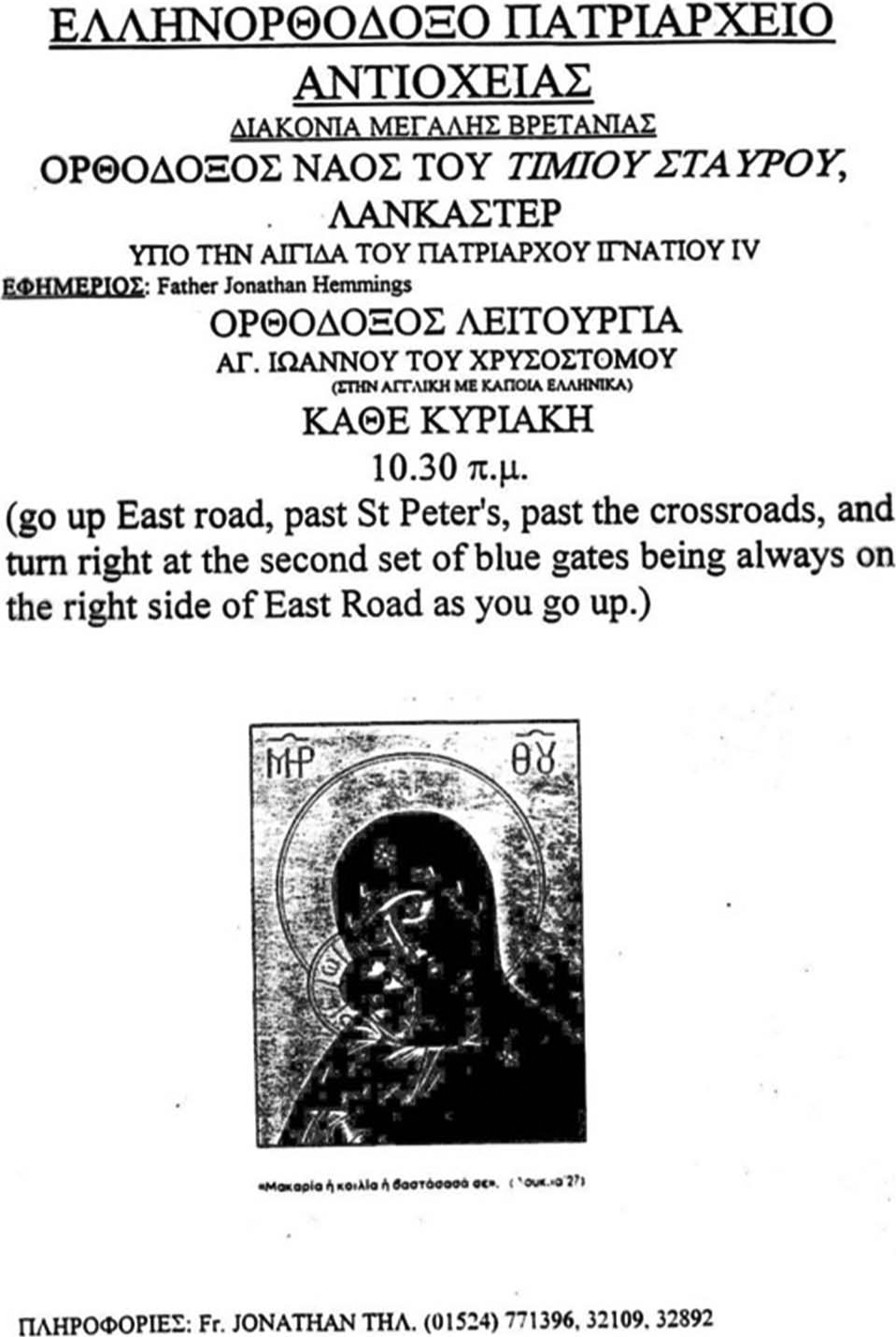
Hand-made poster advertising church service.
We need to consider the context of use as part of understanding the way Greek and English are mixed in this poster. The long English stretch of text has some English names (East Road and St Peter’s), but this does not in itself account for the rest of it being in English. It seems there is no problem in inserting English words within a Greek text, as this has been done with Father Jonathan’s name in the bottom line. Why then the large body of English text in the middle of a mainly Greek document? It seems unlikely that a first language speaker of Greek, even one living in England, would find the instructions easier to understand in English than in Greek. We could try out an explanation based on the metaphorical uses of the two languages, for example, that English metaphorically indexes the here-and-now in England, as opposed to the enduring, and essentially Greek, nature of the church and its service. This also seems unlikely because the specific details of when the services take place, the name of the church and diocese and even the city have all been given in Greek.
A likely explanation is in terms of the practical situation in which the information might be used. The assumed reader appears to be a Greek speaker who is well able to understand the directions in Greek or English but might need to enlist the help of an English speaker to find the place, for example, an English-speaking friend who might have better local knowledge or a bus or taxi driver who might be taking them there. In such circumstances, it would be much more useful to have the directions written in English than in Greek. Again in this case, the choice of languages and the way they are juxtaposed in the text is based on assumptions about the literacies and language preferences of the readership. In this connection, it is worth noting that the service is described (in Greek) as being ‘in English with some Greek’. Thus, although Greek predominates in the poster, there seems to be an assumption that the congregation is bilingual with a preference for English, since the service is mainly in English in spite of the fact that Greek is strongly preferred as the language of the orthodox church services. 7
From multilingual texts to multimodal analysis
The focus within bilingualism research on spoken code-switching and, to a much lesser extent, its written counterparts has led researchers to concentrate on written text as text – in other words, as strings of words on the page or screen – rather than seeing it in its visual context, as a reader sees it: as a text surrounded by other texts, potentially with differing font sizes, colours and styles all potentially providing context for interpreting the content of the text. Research that takes this visual aspect of multilingual texts into account is limited, reflecting the general reluctance of linguistics as a discipline to take on board the analysis of visual and graphic elements in conjunction with text. 8 In particular, treatments of multimodality (Jewitt, 2009; Kress, 2010; Kress & Van Leeuwen, 1996/2006) in multilingual texts have until recently been rare. An important exception is the work of Stroud and Mpendukana. In a recent series of articles Stroud and Mpendukana (2009, 2010, 2012) have developed a ‘material ethnography of multilingualism’ in which both the visual and the textual play central roles in the analysis of public texts such as advertising billboards and shop signs.
Certainly, some kinds of written text do not seem to need direct reference to visual aspects in their analysis: emails, for example, used to be presented by browsers in a standard way using plain fonts, with little contextualisation provided by positioning on the screen or variation in the typeface. Recently, this is less true, with writers often having the same range of fonts and styles available in email as in word processing. Ignoring the visual aspect is unproblematic if the type of analysis to be done is concerned purely with such matters as syntax, lexis or text-internal cohesion. Such concerns are, in fact, similar to those of some researchers studying code-switching in spoken language, and treating written texts as units of ‘plain text’ probably serves such researchers best. The layout, design and relative ordering of texts that make up the ‘bigger picture’ can safely be ignored. The same could probably be said for prose texts in traditional media, for example, novels. However, even these genres may make use of visual effects to contextualise other-language elements: for example, Mahootian (2003, p. 1495) observes that all Spanish words within basically English texts in the bilingual magazine Latina are italicised, marking them as ‘other’. Any use of a different script (e.g. the script-switching described by Angermeyer, 2005, 2012) has a similar effect. Similarly Mbodj-Pouye and Van den Avenne (2007, p. 104) note that in a handwritten text, script styles – lowercase block letters for Bambara and cursive for French – keep the languages apart. 9
Thus research on written code-switching so far has tended either to focus on text types where visual layout is conventionalised and of limited importance to the interpretation (such as letters, email messages and legal or medical texts) or to remove the text for analysis from its context, for example, by looking at individual articles from a magazine rather than at the magazine or the page as a whole, complex text.
10
But while some written texts are linear and make little or no use of layout or lettering styles/fonts, other written texts make full use of the potential of the visual medium for complex layouts, multilayering and the use of a range of fonts and graphic devices. Contemporary advertising provides many examples of this, including multilingual examples. Linguists trying to account for the interpretation of such texts have been forced to take into account at least some of the visual and graphical features. For example, Graedler (1999, p. 337), discussing an advertisement in a Norwegian magazine that contains both Norwegian and English, finds the spatial positioning of the elements to be salient:
Switches in ads are also very often found in conspicuous positions – almost 90% occupy an initial position as heading, or a paragraph-final or text-final position in the text, or they are graphically separated from the text proper. Given the overall discourse function of advertising – to sell product – and the sales and snob-appeal associated with English world-wide, this is not surprising.
In fact, it is clear that many monolingual and bilingual written texts cannot be satisfactorily analysed without paying attention to aspects other than the strictly textual. Rather, account must be taken of the communicative potential of the visual elements, within some kind of multimodal framework (e.g. Johnson and Milani, 2010, pp. 11–12; Lemke, 2002; Ventola and Moya Guijarro, 2009).
The metalanguage required for this kind of multimodal analysis has begun to be developed by linguists, for example, Kress and Van Leeuwen (1996/2006) and Scollon and Scollon (2003) but has rarely been applied to multilingual texts. An early example of a multimodal analysis of a multilingual advertisement is Piller’s analysis of a poster (2001, pp. 161–162), in which she finds it necessary to include ‘fonts, colours, position, and form’ alongside function in order to explain the salience of the English headline in an otherwise German text. More recently, Androutsopoulos (in press) has developed the concept of ‘English on top’ in the spatial arrangement of multilingual texts that include English. Thus, in this type of complex text, visual and spatial features provide contextualisation cues for the interpretation of the language strings that they relate to. Stroud and Mpendukana, too, offer an analysis of signage in which the focus is on linguistic choices and norms alongside ‘spatial, […] visual […] and material […] aspects of each instance of each language’ (2010, p. 475).
An analysis of a text such as the poster described by Piller in purely textual terms would be very difficult – or uninteresting – as much of its meaning derives from the visual elements mentioned. Yet increasingly, the textual world is made up of texts like this, which are structured visually as well as textually: as Kress and Van Leeuwen note, many kinds of texts ‘are no longer just written, but ‘designed’, and multimodally articulated’ (1998, p. 187). It is important that those texts which in addition are multilingually articulated should also be amenable to study.
Figure 2 is an advertisement that appeared in a free bilingual newspaper, the Spanglish Times, published in Phoenix, Arizona in 2007. 11 Most of the content of Spanglish Times was 12 presented bilingually, either in separate Spanish and English versions or, as in this advertisement, in a mixture. 13 In this advertisement, some information is presented in Spanish and some in English, without overlap. For example, the opening times are given only in English as are the details of tyres available and ‘extras’ that come with their purchase: ‘mounting and balancing, lugs, locks and free tire repairs’. The equally important information that the advertiser repairs bent and damaged aluminium rims, and will even buy them, is only in Spanish. The name of the business Cien Alegrías (‘Hundred Joys’) is Spanish only, but the nature of the trade, ‘tire and wheel’, is given in English.

Advertisement for ‘Cien Alegrías Tire and Wheel service’.
The advertisement appears to be designed for bilingual readers with competence in both English and Spanish because the Spanish and English contents complement rather than repeat each other. It is possible that the services are described in different languages because different sets of readers are targeted for different services, but this seems unlikely: presumably Spanish monolinguals are no more likely than English speakers to want to repair their broken rims and no less likely to want to know when the shop is open. The advertisement as a whole addresses a community of readers who are equally able to read and understand the Spanish and English parts of the text.
This example illustrates the difficulty of extending the notion of ‘code-switching’ to all multilingual texts. Although alternation between languages is certainly involved here, it makes little sense to describe the transition between tyre repairs and ¿Necesitas reparar? as ‘intersentential code-switching ’ since (as shown in more detail below) the visual structure makes it clear that the sentence is not the relevant unit here. To provide an insightful analysis of the text as a whole, reference has to be made to the visual at the same time as the linguistic, just as it would if the advertisement was a monolingual one. The following account is therefore enhanced by reference to spatial arrangement, fonts and colours.
Although both languages occur in the advertisement, they are kept separate visually through the use of horizontal bands with different background colours. Of these, only one (numbered 2), contains both Spanish and English. This is the uppermost text-bearing band and also the broadest band in the advertisement. It has a white background, with the Spanish name of the business in large letters, centred and in red, and immediately below that is the nature of the business, ‘tire and wheel’ in a much smaller font in black. The font size and colour of the (Spanish) business name undoubtedly give it more prominence than the (English) business description; nevertheless, we have both Spanish and English occurring together in a very prominent position.
The remaining bands are either monolingual or not attributable to a particular language. Below a narrow band of trade logos (3) that separates the business name from the rest, three adjacent bands are visually marked as a cohesive unit through the use of purple type on a white background. They are separated by horizontal lines, which also separate them thematically: the first band (4) consists only of brand names of tyres, the second (5) gives a set of tyre sizes and ‘starting from’ prices, while the third (6) gives additional information about what services are included in the price. While the brand names cannot be allocated to any particular language, the other two bands with a white background are clearly in English, meaning that visual cohesion in this case corresponds to linguistic cohesion as well.
There is a sharp visual disjunction between this unit and the next, which consists of two bands (7 and 8) in dark colours, purple and red respectively, further connected visually with images of two tyres on the left and a yellow circle containing text on the right. All the text in this unit is in Spanish. Although the bands have distinct colours, their use of analogous colours gives them cohesion, which also corresponds to two kinds of linguistic cohesion – first, they both contain only Spanish, and second, they have the form of a (modified) adjacency pair, the text in the first posing a question (‘Need a repair?’) and the second providing the answer (‘Repairs of aluminium rims. Bent and broken’). Another change of background colour – this time to black – marks the transition to the last unit (bands 9 and 10).
Clearly, for a rich analysis of this multilingual advertisement, both visual and linguistic aspects must be taken into account. Cohesion is achieved visually – for example, through colour but also through the use of similar fonts and spatial proximity – as well as linguistically, through the use of the same language or through other means such as adjacency pairs.
In the analysis of advertising and similar texts, it is of particular interest to identify the most salient parts, as in Piller’s analysis of a poster (2001, pp. 161–162) mentioned above: ‘The headlines are salient because of their function, large fonts, strong colors, position, and form. All these graphic devices serve to make the English text ‘stronger’ than the German one. English becomes the dominant voice of the advertisement’. In the case of the Cien Alegrías advertisement, however, it is much harder to identify a ‘dominant voice’ in language terms. Spanish occupies a position at the top and just below the centre, two positions that would give it salience according to Kress and Van Leeuwen (2006) and Scollon and Scollon (2003). Furthermore, Spanish is associated with strong colours and large fonts relative to other text in the advertisement. On the other hand, English is also placed near the top and also takes up much of the central and lowest part of the advertisement. On these grounds, we could claim that English is prominent too. Significantly, the topmost unit of text, band 2, has both Spanish and English in a prominent position, although English is second and smaller. In the absence of any reliable metric for measuring salience with this degree of accuracy, we could say that English is slightly less salient than Spanish in this advertisement but that both languages play an important role. Moreover, the advertisement presents itself as ‘bilingual’ by placing both languages together in a prominent position at the top (cf. Androutsopoulos, in press).
Alternative analyses are available. One might argue that the advertisement is simply an English one (albeit for a business with a Spanish name) that has had some Spanish material overlaid in a prominent position two-thirds of the way from the top. In fact, this argument might continue, the reader needs to know little English to read the parts that are not in Spanish: the context makes the nature of the business clear enough, although the words ‘tyre’ and ‘wheel’ do not actually occur in the Spanish. The address and opening times are easy enough to understand in context without a thorough knowledge of English: hence, according to this line of argument, this is really an advertisement for a Spanish speaker, although it has the appearance of one addressed to a bilingual.
A second, more radical, alternative interpretation draws on Kress and Van Leeuwen’s opposition between ‘ideal’ and ‘real’ positions within a text (Kress & Van Leeuwen, 2006, p. 186ff). Kress and Van Leeuwen argue that the upper part of a text like this contains the ‘ideal’ (the ‘idealised or generalised essence of the information’), while the lower part contains the ‘real’, the more specific, practical or ‘down-to-earth’ information (2006, p. 187). For the producers and readers of the bilingual Spanglish Times, the ‘ideal’, which Kress and Van Leeuwen call ‘the ideologically foregrounded part of the message’ (2006, p. 187) is the acceptance of both English and Spanish, with Spanish given due prominence and value: this is in fact what we find in the upper part of the advertisement. The ‘real’, by contrast, is the dominance of English in the everyday world, which is what we find in the lowest part of the text: ‘open 7 days a week’. The advertisement thus, in keeping with the general philosophy of Spanglish Times, confronts the hegemonic dominance of monolingual English by contrasting it with an ‘ideal’ bilingualism. 14
Whichever interpretation we accept, we can conclude that for this kind of multilingual text, an analysis that takes account of both the linguistic and visual aspects is essential. In the next section, I will suggest some ways of approaching such an analysis.
An analytical framework for multilingual texts
While spoken code-switching is essentially one dimensional, involving the juxtaposition of spoken linguistic units from two languages within a single interactional event, language mixing within multilingual texts is potentially multidimensional, involving juxtaposition or separation on both the linguistic and visual dimensions. In this section, I present a framework that will allow for a rich analysis of a wide range of multilingual texts, including such texts as bilingual signs and multilingual labels, as well as the kinds of texts already discussed above. The framework is presented here under these headings: units of analysis, language–spatial relationships, language–content relationships and linguistic mixing types.
Units of analysis
In the analysis of spoken code-switching, the units of analysis have traditionally been grammatical (e.g. sentences, morphemes) or discourse related (e.g. utterances, turns) or a combination of these. In the case of multilingual written texts, we will need to refer to at least three types of unit: (a) grammatical units (e.g. sentences, morphemes), (b) genre-specific units relevant to textual structure and cohesion (e.g. paragraphs, headings) and (c) visual/spatial units (e.g. column, box, frame): these are contiguous areas of the surface (page, screen, sign, etc.), which are separated from the rest by areas of blank (text-free) space or by lines, bands or similar visual devices. Units are typically nested, so that one unit may lie wholly inside another, which may be of the same type (e.g. a box within a box) or a different type (e.g. a paragraph within a column).
Language–spatial relationships
‘Language-spatial’ rather than simply ‘spatial’ is the appropriate term here because this refers to the spatial relationship between units containing a specific language or mixture of languages. Figure 3 is an example of a bilingual English and Irish warning sign, where the English and Irish textual units are arranged so that they occupy equal amounts of space above and below a horizontal axis of symmetry. In this sign and many others like it, the language–spatial relationships are symmetrical; by contrast, the language–spatial relationships in Figure 2 above are asymmetrical. Other bilingual texts may be of a mixed type, with both symmetry and asymmetry in different parts of the text.
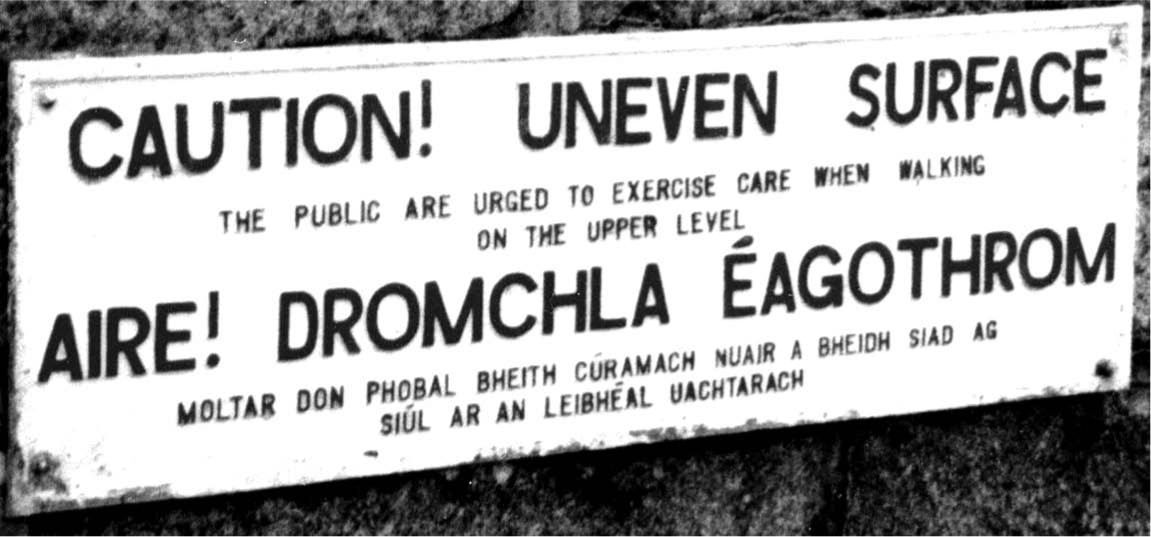
Bilingual warning sign.
Other kinds of language–spatial relationships are possible and potentially relevant: for example, units may be ordered in terms of language, as illustrated also by the sign in Figure 3, where English precedes Irish. Scollon and Scollon (2003, p. 122) regard such ordering in signage as the results of a code preference system, which ‘privileges the top, the left and the center’ (at least in those cultures where the script direction is left to right, top to bottom) and is thus based on language–spatial relationships (Kress & Van Leeuwen, 1996/2006). Although the Scollons’ claim is not empirically derived, it seems that many bilingual signs and similar texts are designed on the assumption that it is true (see Coupland, 2010, p. 89, for a Welsh example).
Language–content relationships
Most people who view the sign in Figure 3, irrespective of whether they know both, one or neither of its languages, will make the assumption that the message given above in English is exactly the one given below in Irish. This is not only because this is the norm for such signs, which are after all common in many parts of the world, including airports. It is also because of the symmetry of the sign, and the strong visual ‘mimicking’ using fonts, type sizes and colours, which is normal in this type of bilingual sign. However, these visual signals are in effect contextualisation cues: they do not in themselves guarantee that the English text and the Irish text are translation equivalents. For this reason, we need to introduce an independent category of language–content relationships, with three possibilities: Equivalent texts are those that have similar content in two or more languages, like the sign in Figure 3. Disjoint texts have different content, as in the case of the texts in the different bands of Figure 2. It is also possible to have overlapping language content, a mixed type in which some of the content is repeated in the other language, while some is not. 15
Language mixing type
This refers to the type of language mixing, or the absence of language mixing, within a unit. At one extreme are monolingual units (in a specified language), but there are at least two other possibilities: mixed units and language-neutral units, which will be discussed in more detail below. Language mixing type is always relative to a specific unit, so that while a unit may be monolingual in Language A, it may be inside a larger unit that contains other units, which are monolingual in B, making the larger unit a mixed type. This is the case with the advertisement in Figure 2, for example, where most of the units (‘bands’) are monolingual in either Spanish or English, but the advertisement as a whole is mixed. The same applies to the bilingual sign, Figure 3.
Mixed units
Mixed units are units that contain elements from two or more languages. These elements may be of different types, for example, they may be smaller visual units (such as boxes within a larger box), or they may be textual units such as paragraphs or grammatical units such as sentences. Mixed textual units typically correspond to the commonly held prototype of code-switching in spoken language: languages alternate within a discourse unit (intersentential), possibly within a sentence (intrasentential). Functional reasons for the alternation may be identifiable, just as in spoken code-switching, where there exist a number of theoretical frameworks providing accounts based on discourse, pragmatic or social criteria (Auer, 1995; Gumperz, 1982; Myers-Scotton, 1993).
However, code-switching is not necessarily an appropriate term to apply to all mixed units. This is true particularly in the case of units that are defined solely by visual criteria; for example, Band 2 of Figure 2, containing the text ‘Cien Alegrías Tire and Wheel’, is a mixed unit, but it cannot usefully be described as ‘code-switching’. Similarly, the bilingual sign, Figure 3, is a mixed unit (containing two symmetrically arranged, content-equivalent monolingual units), but it does not involve code-switching in any normal sense of the term.
Language-neutral units
The term ‘language-neutral’ applies to units that consist entirely of items that cannot be assigned exclusively to one language but belong equally to both (or all) the languages involved in the text. These tend to be smaller units, for example, words or headings. Brand names and other proper names often fall naturally into this category. However, ‘artificial’ strategies may be used to create language-neutral units as well. Contemporary examples tend to come from advertising and marketing, where there is less regulation and less enforcement of monolingual norms.
For example, this text appears in small print on a household hygiene product, which is labelled in English, French and German:
Here the purpose appears to be to make the message available to users of several languages while using the minimum amount of space. The quoted text is in several languages (French, English and German) at once, and at the same time, none of them: the English reader may read ‘Dermatologically tested, pH-skin-neutral, alcohol and colorant free’ while editing out farbstoff (German for ‘colorant’, though it should have a capital letter) as making no sense in English. German and French readers could likewise be expected to get the gist, though they will have to make more adjustments than the English reader and will need to recognise three words that are only in English: tested, skin and free (cf. German frei). Linguistically, the text draws on the fact that some vocabulary is identical across two of the languages (colorant) or even all three (neutral) or can be made identical by abbreviating an ending (Dermatolog = dermatologically/dermatologisch/dermatologique).
Historically, there is at least one substantial body of texts that make extensive use of strategies for creating language-neutral units. Medieval English accounts and inventories, as analysed in detail by Wright (2000, 2002), frequently use truncations and abbreviations that blur the distinction between English, Latin and French and make it unnecessary to use the grammatical suffixes that are specific to any one of the languages. For example, in an accounting record regarding candles, the Latin (but almost-English) word candela ends with an abbreviation that allows it to be read as ‘candle’ or ‘candelarum’ (the genitive plural, and correct Latin form in this instance), ‘according to competence and choice’ (Wright, 2000, p. 151). Wright points out (Wright, 2002, p. 473) that the scribal practices connected with these kinds of records provided ‘considerable room for exploitation of the overlap of the two languages’. 16
‘Parallel’ texts and ‘Complementary’ texts
The framework outlined in this section now allows us to characterise two broad categories of multilingual text. Parallel 17 texts, of which the most familiar examples are bilingual signs like the one in Figure 3, can be characterised in terms of the categories above as texts where language–spatial relationships are symmetrical, language–content relationships are equivalent and the linguistic mixing type is exclusively monolingual. In other words, the ‘parallel’ type of multilingual text consists of matched units, symmetrically arranged and containing identical content in each language, without any language mixing.
While a detailed discussion of the sociolinguistics of such texts is beyond the scope of this article, each of these characteristics can be seen to serve a sociolinguistic function: the symmetrical arrangement is a visual metaphor for equality, the content equivalence is a response to assumed monolingualism or a preference for literacy in one of the languages only, while the absence of mixing is a response to a pervasive language ideology of monolingualism and purism and a preference for standard forms (see also Coupland, 2010).
At the other end of the scale, complementary 18 texts can be characterised as having asymmetrical language–spatial relationships and disjoint language–content relationships. In terms of linguistic mixing type, complementary texts are varied: they may consist exclusively of monolingual units but could contain any combination of monolingual, mixed and neutral units. The ‘Cien Alegrías Tire and Wheel’ advertisement (Figure 2) is of the complementary type. There is no symmetrical arrangement of languages nor is there a unidirectional ordering (English units 4, 5 and 6 are followed by Spanish units 7 and 8 and more English units 9 and 10). The content relationships are disjoint: what is said in English is not repeated in Spanish and vice versa. There is also one linguistically mixed unit (Band 2), which contains the name of the business in Spanish and the nature of the business in English.
As in the case of parallel texts, the characteristics of complementary texts can be seen to be compatible with the sociolinguistic profile of their intended readers, and in particular with their literacies. Since information is given only once, either in English or in Spanish, a text like ‘Cien Alegrías Tire and Wheel’ is only suitable for a reader who can read both languages to a reasonable degree. We can assume that there are many such people in the catchment area of the Spanglish Times, since about one-third of the population of approximately 1.5 million of Phoenix, Arizona is of Hispanic or Latino origin. 19
It is not being claimed here that all multilingual texts fall neatly into one of the categories ‘parallel’ or ‘complementary’ as defined here. Intermediate types certainly exist, but the framework allows the analyst to specify how they differ from typical cases. For example, bilingual signage may contain symmetrical units, but with contents that are only partially equivalent or not equivalent at all; or signs may contain units with equivalent content but not symmetrically arranged. Larger units such as web pages may be broadly speaking ‘complementary’ but nevertheless include some material in parallel.
In the next section, I give a further example of a multilingual text and its analysis using this approach.
Analysing a multilingual text: The Luxemburger Wort
Luxemburg is one of the smaller states of the European Union both in area and in population (approximately 0.5 million). 20 In spite of this, it is characterised by pervasive multilingualism, and is often described as ‘triglossic’ in view of the fact that three languages – French, German and the local Germanic vernacular – are recognised by the language law of 1984 (Horner & Weber, 2008, p. 70). The West-Moselle Franconian dialect known locally as Luxembourgish (Lëtzebuergesch) is recognised as the national language, while French is designated the legislative language, and all administrative matters are to be carried out in French, German or Luxembourgish (Redinger, 2010, p. 35). Luxembourgish is the home language of nearly all people of Luxembourg origin, while German and French are both used as languages of instruction in schools, German initially and French later. The country also has a large proportion of foreign residents, many of them speakers of Portuguese (Horner & Weber, 2008, p. 70).
Figure 4 shows the front page of a major daily newspaper from Luxembourg, Luxemburger Wort, as it appeared on a day in 2001. The page is laid out similarly to other European broadsheet newspapers of the period. It has a nameplate or masthead at the top of the page across the centre. The rest of the page is divided vertically into two main sections, the one on the right being slightly narrower than the one on the left. The bottom left position is occupied by a small ‘contents’ section, next to which is a barcode and some international pricing information. The remainder of the page is occupied by news items and accompanying photographs, each extending across either four columns of type (on the left) or three (on the right).
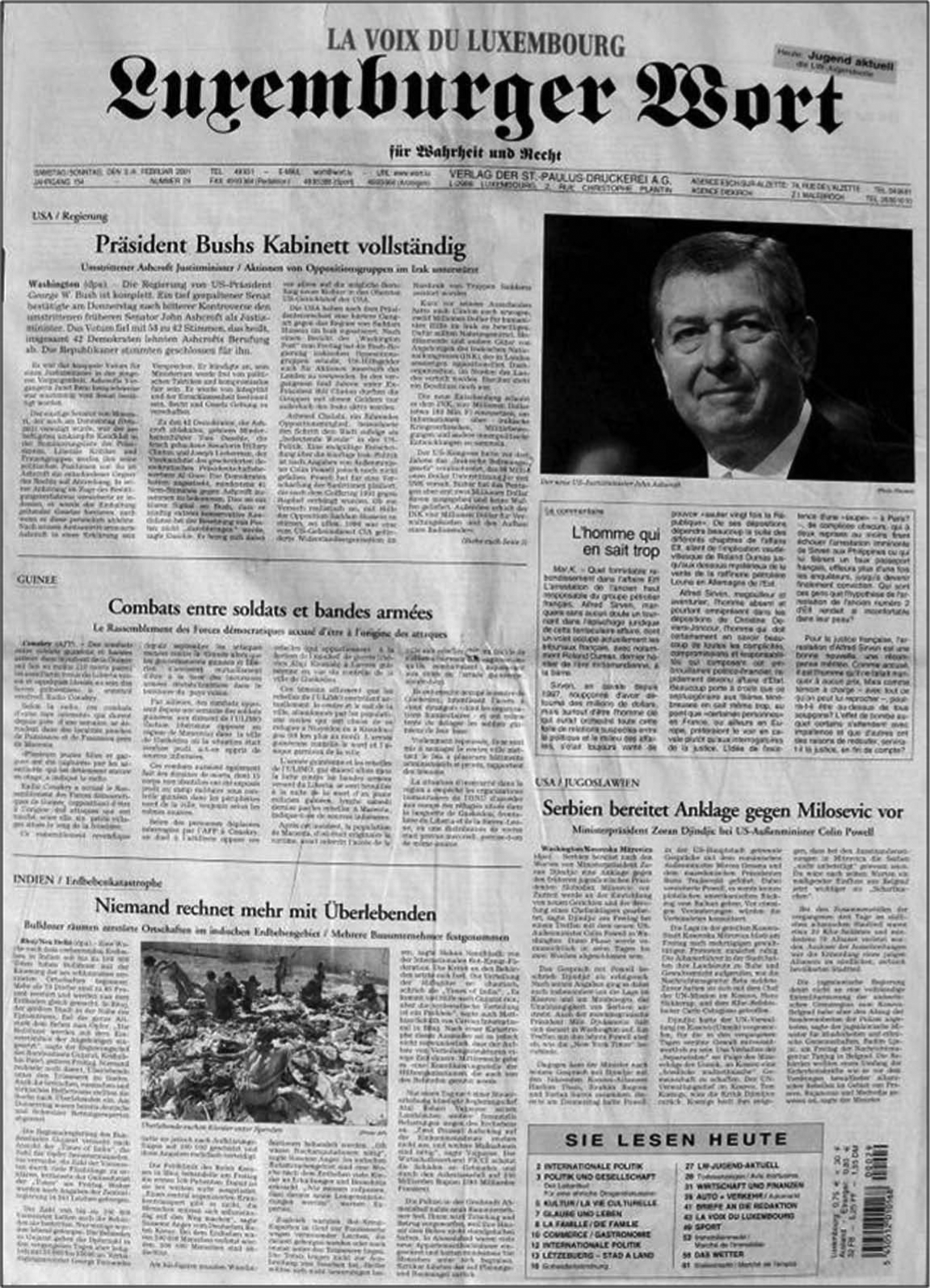
Front page of Luxemburger Wort.
Where this edition of Luxemburger Wort is different from many other European broadsheet newspapers is that it is multilingual. 21 On the front page, both German and French appear. Elsewhere in the paper, Luxembourgish is also found but is confined to certain genres (e.g. memorial notices and letters to the editor) in sections nearer the back.
The distribution of French and German on the front page (as elsewhere in the paper) is asymmetrical, as can be seen from Figure 5, which shows the linguistic layout of the news section (F = French text, G = German text). None of the French news stories has a matching German story with equivalent content, nor vice versa: thus, in terms of language content, all units in this section are disjoint. Furthermore, all the news stories are either exclusively in French or exclusively in German, so the language mixing type is monolingual.
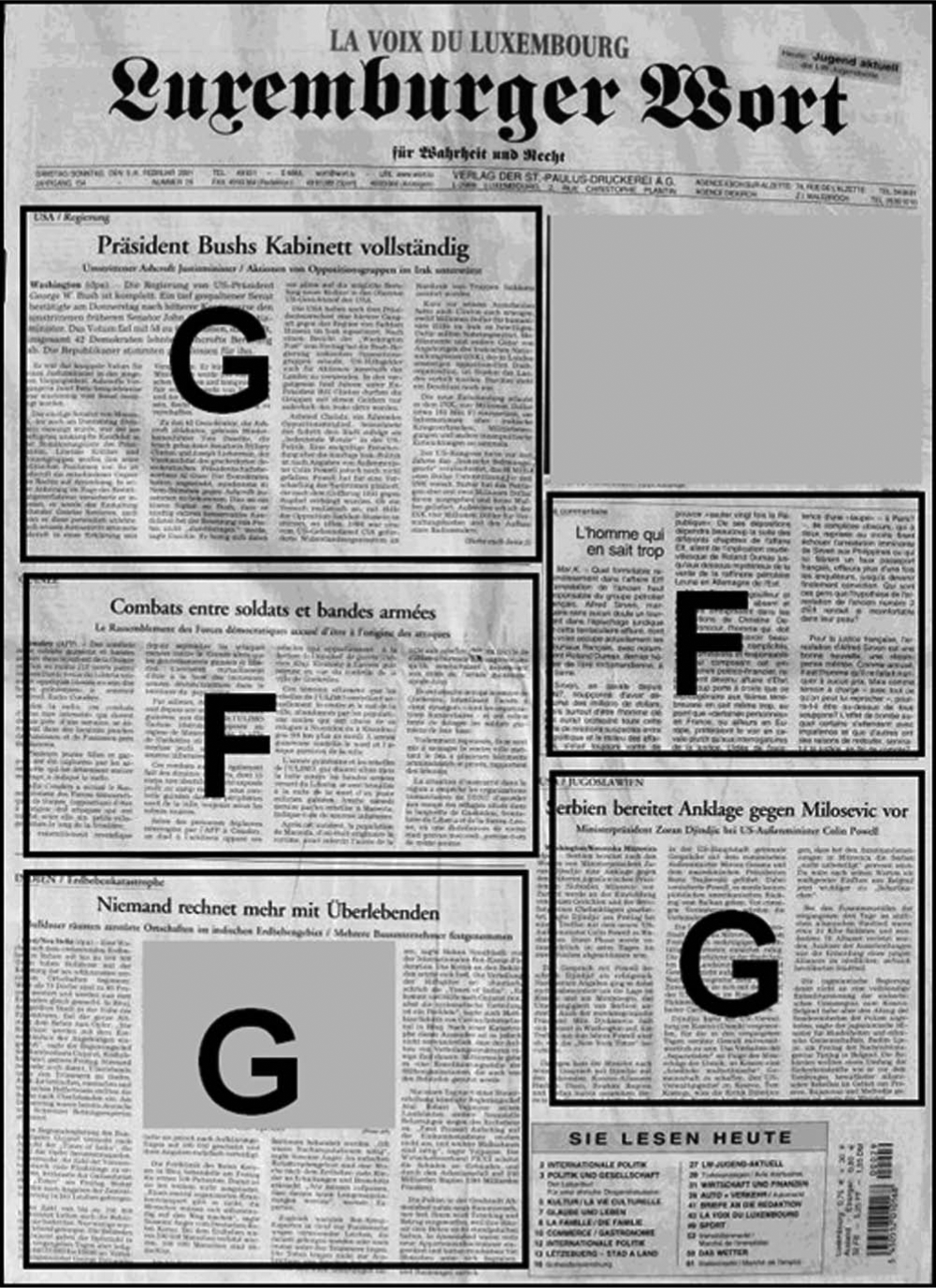
Linguistic layout of Luxemburger Wort.
So far the characteristics of this page are those of what I have called above a complementary type of multilingual text. However, things are a little more complicated when we consider the parts of the page that are not given over to news. At the top centre, spanning the columns, we find the newspaper title in both French and German. French comes first, at the very top, but in a substantially smaller typeface than the German and in a paler colour (blue). The German title (which is only very loosely equivalent to the French as a translation) is not only in a much larger typeface – it is contextualised by being printed in a blackletter font, which is a common practice for newspaper titles – but also associates it with Germanness (Spitzmüller, 2012). This highlights another multimodal feature, the importance of typography as a contextualisation cue, which unfortunately cannot be discussed in more detail here (see Van Leeuwen, 2005, 2006).
Below the title is a German motto, not only in smaller typeface but also in black letter (für Wahrheit und Recht – ‘for truth and justice’). French (above) and German (below) are arranged around a horizontal line of symmetry, but the symmetry is disturbed by a diagonal banner in German advertising the youth supplement, with the legend Heute: Jugend Aktuell die LW-Jugendseite. Immediately below the nameplate is a band bordered by two horizontal lines, which contains both German and French – German for the day, date and volume information and the name of the publisher and French for the address of the publisher and the locations of two local agencies. The latter is the result of an established convention of using French for addresses in Luxembourg. This part of the title area is therefore a linguistically mixed unit.
The title area can thus be characterised as a part of the page that is bilingual, containing in the title itself an instance of partial symmetry in language–spatial relationships, and partial equivalence of content, while the rest of the title area shows asymmetrical language relations and disjoint content. The masthead functions to establish both German and French as the languages of the newspaper, although German is given greater prominence through a stronger colour (black), more text and a larger font size. This greater prominence of German is also reflected in its dominance of the remainder of the page, with more and longer news items in German, and more prominence also in the ‘contents’ section at bottom right.
As in previous cases, this multilingual text reflects the literacies of the community from which it draws its readers. According to Horner and Weber (2008, p. 70) ‘the spoken/written distinction has always been pivotal to understanding language use in Luxembourg, with spoken functions being dominated by the use of Luxembourgish and written functions carried out primarily in French or German’. French and German both play an important role in education, with German dominant in the earlier part of schooling and French later on. Luxembourgish plays a much smaller role, at least officially, as it is given a very limited role in schooling and in fact is ‘banned’ from most contexts (Horner & Weber, 2008, p. 98). Adult Luxembourgers, at least those who are reasonably successful educationally, can be assumed to be fluent readers of both French and German, though for most, German is easier as it is closer to their first language, Luxembourgish. The display of languages in Luxemburger Wort is in keeping with these practices of language acquisition and use, with standard German and French having a rough equality of status, which makes them suitable vehicles for ‘serious’ editorial material, while written Luxembourgish is allowed to occupy a niche in the more personal and family-oriented parts of the newspaper but is excluded from the news pages.
Conclusions
After several decades during which it productively focussed the attention of many scholars in the field of bilingualism, the concept of code-switching itself is under challenge from several quarters. Languaging, or polylingual languaging (Jørgensen, 2008b), refers to practices where ‘language users employ whatever linguistic features are at their disposal with the intention of achieving their communicative aims’ (Jørgensen, 2008b, p. 169). This entails that ‘languagers’ – and that means all of us who use any language (Jørgensen, 2008b, p. 169) – sometimes draw on languages of which we have only a limited knowledge. That this behaviour is available to humanity as a whole, rather than a subset known as ‘bilinguals’ who have sufficient knowledge of two languages, distinguishes it from code-switching as it has been traditionally conceived, at least within studies of bilingualism. The traditional view of code-switching preserves a monolingual bias despite its apparent emphasis on bilingualism (Auer, 2007; Heller, 2007; Otsuji & Pennycook, 2009, p. 252). Metrolingualism (Otsuji & Pennycook, 2009) challenges this through its focus on ‘ways in which people of different and mixed backgrounds use, play with and negotiate identities through language; […] not on language systems but on languages as emergent from contexts of interaction’ (Otsuji & Pennycook, 2009, p. 246). Translanguaging (Wei, 2011) meanwhile involves both
going between different linguistic structures and systems […] and going beyond them […] it creates a social space for the multilingual language user by bringing together different dimensions of their personal history, experience and environment, their attitude, belief and ideology, their cognitive and physical capacity into one coordinated and meaningful performance, and making it into a lived experience. (Wei, 2011)
All of these recently articulated challenges to the concept of code-switching have in common that they highlight the playful, creative and transgressive aspects of language, dismissing and disrespecting (among other things) the monolingual norm – and for this reason, perhaps, the researchers concerned have drawn much of their data from young language users. Also, there is a reliance on spoken data, which is reminiscent of the emphasis on spoken code-switching research, to the neglect of written sources, mentioned at the beginning of this article. One written genre – graffiti – that has been studied by both Jørgensen (2008a) and Pennycook (2010, pp. 52–69) is at the far end of the ludic and transgressive scale for written language: it provides good examples of orthographic (Sebba, 2007) and monolingual (Jørgensen, 2008a) norm breaking precisely because it is, by its nature, transgressive.
The written genres discussed in this article, by contrast, are scarcely playful or defiant. A poster for a church service, an advertisement for car repairs and a conservative daily newspaper are unlikely sites for attacks on the establishment. Nevertheless all these texts offer challenges to the prevailing monolingual written norms, showing that ‘languaging’ in the broadest sense is possible in the written mode as well as the spoken and that although it thrives on the less-regulated margins of the written universe, it is not confined to them. 22
The work of Stroud and Mpendukana is very relevant here. In their ‘material ethnography’ of a South African township, they demonstrate that ‘mainstream’ written texts like public signage and advertising bring multilingual discourses of consumption into the public textual space. Thus, the monolingual norm is only adhered to as long as its market value outweighs what Jørgensen (2008b, p. 163) calls the ‘polylingualism norm’. Similar conclusions might be drawn from the work of Piller (2003) and Androutsopoulos (in press) discussed earlier. As Stroud and Mpendukana (2012, p. 159) put it, ‘the development of new subjectivities of consumption is bound up with the emergence of new forms of language and multilingualism’. While this might not apply to all the multilingual texts discussed in the present article, it clearly could apply to some of them – the Spanish/English advertisement being the clearest example.
In this article, I have argued that phenomena of language alternation or language mixing in writing are substantially different from the corresponding practices in the spoken mode and require a theoretical approach and analytical tools that are specifically designed for written language. In particular, I have suggested that an account of written language alternation must be multimodal in its approach to the text, taking into account the visual and spatial relationships of languages on the page, screen or sign, at the same time as it takes into account their linguistic properties. I have also argued that in order to make a meaningful analysis of multilingual texts, we need to see them as products of, and part of, literacy practices, which are embedded in the culture of language communities and reflect their sociolinguistic and economic circumstances. These practices may themselves be multilingual and multimodal, though other combinations of mono- and multilingual and mono- and multimodal are possible (cf. Baynham, 1993).
I have suggested an approach to describing and analysing multilingual texts, which draws on these visual and spatial properties, in the hope that this will provide the basis for a productive analysis of the wealth of multilingual texts that now exist. The framework outlined here is intended to facilitate the description and analysis of multilingual texts of diverse genres – including, for example, multilingual signage, magazines, advertisements, web pages, newspapers and product labels. Some of these multilingual genres (e.g. public signage and advertisements) have attracted attention from linguistic researchers, while others, like some of the examples in this article have been largely overlooked. In addition, relatively little is known about the multilingual literacy practices that surround the creation and use of these texts or the relationship between the production of the texts and economic processes. Over the past decades, the study of spoken language alternation has provided valuable sociolinguistic insights into multilingual communities. Further study of the multilingual written artefacts of such communities may yield still more.
Footnotes
Funding
This research received no specific grant from any funding agency in the public, commercial or not-for-profit sectors.