




Abstract
In this article, we present data from a research project on reading in German as a foreign language. The main research focus of the project was the relevance and the difficulty of understanding certain grammatical structures of German. Our data provide a good basis for new insights into the question whether, how and when contrastivity and transfer of syntactic structures across languages influence in any significant way the acquisition of receptive competences in a foreign language. The results show that foreign language readers with a Romance L1 do not necessarily have problems in understanding German sentences containing contrastive structures, that is, structures that do not exist in their L1. A comparison of semantically equivalent sentences containing either contrastive or non-contrastive structures showed that only three out of seven contrastive structures are more difficult than their non-contrastive counterparts.
Keywords
In this article, we present data from a research project on reading in German as a foreign language. The main research focus of the project was the relevance and the difficulty of understanding certain grammatical structures of German. Some of these structures are considered to be highly idiosyncratic, that is, specific to German (or West Germanic, including Dutch and Frisian), other structures exist in similar forms in many other languages, among them also the first languages of our subjects. These data provide a sound basis for examining the role of contrastivity in foreign language reading comprehension. By comparing the difficulty readers have with contrastive structures to the difficulty they have comprehending non-contrastive structures, we can offer new insights into the question whether, how and when contrastivity and transfer of syntactic structures across languages influence in any significant way the acquisition of receptive competences in a foreign language.
Contrastive structure and foreign language reading
For quite some time, research into foreign language learning was characterised by a focus on the influence of the first language on the second. Transfer from the L1, especially its negative implications (interferences), used to be the central line of argument offered by many studies on foreign language acquisition. Specifically, Contrastive Analysis Hypothesis (see Lado, 1957, among others) claims that ‘individuals tend to transfer forms and meanings, and the distribution of forms and meanings of their native language and culture to the foreign language and culture’, the logical consequence of this claim being that ‘those elements that are similar to his [the learner’s] native language will be simple for him, and those elements that are different will be difficult’ (Lado, 1957, p. 2). However, Lado was by no means the first person to suggest this contrastive view of foreign language acquisition; it can already be found in Kloss (1929; cf. Kuhberg, 2001). Weinreich (1953) noted in his classical study on languages in contact that bilingual speakers are looking for elements in their less mastered language that correspond to elements in their best/better mastered language.
The ‘cognitive turn’ of L2 research brought about a change of perspective in many studies, especially those dealing with L2 production. Some of them (e.g. Dulay & Burt, 1974) almost entirely avoid drawing on L1 transfer as an explanation of the nature of L2 acquisition.
Interestingly, research and theory on L2 comprehension has not followed the exact same path. Still today, many researchers seem to find in contrastive analysis the most apt explanation of their results on foreign language comprehension. In fact, it does seem conceivable that transfer has a different part to play in foreign language comprehension as compared to foreign language production processes. Ringbom (1987) stresses the relevance of typological proximity of one’s first language and the foreign language in which one is trying to read: ‘Similarities, both cross-linguistic and intra-linguistic, function as pegs on which the learner can hang new information by making use of already existing knowledge, thereby facilitating learning’ (Ringbom, 1987, p. 134). Consequently, comprehending a language that is structurally similar to one’s first language is much simpler than comprehending a comparatively distant language because ‘[t]he learner tends to assume that the system of L2 is more or less the same as in his L1 until he has discovered that it is not’ (1987, p. 135). Like Ringbom, Faerch and Kasper (1987) state that ‘the learner interprets incoming L2-utterances on the basis of his or her L1 knowledge’ (p. 113). Along these lines of argument, when first learning to read, certain (conscious and unconscious) comprehension processes/strategies are developed that are adequate to the characteristics of one’s first language. When encountering a new language, learners transfer these processes to the new language. In many cases, this leads to fairly good results in foreign language text comprehension, but in some cases, problems due to structural differences between the first and the foreign language may arise.
Many researchers have interpreted their results this way, such as Bates and MacWhinney (1981), Fernández (1998), Harrington (1987), Koda (1993) and Smits (1989). For reading in German as a foreign language, Cowan (1976), Fabricius-Hansen (1999, 2004), Grüter (2006), Kilborn (1989) and Lutjeharms (1998) have investigated transfer phenomena from the L1. Bates and MacWhinney (1981) demonstrated that bilingual readers transfer the mechanisms of identifying the agent of a sentence from their first to their second language. For example, a reader with Italian as his or her L1 tends to rely on animacy and congruence cues even when he or she is reading in English. Smits (1989) concludes from his data that Dutch readers of English texts have more difficulty reading and comprehending contrastive constructions than non-contrastive ones. Cowan’s (1976) results from a study with native speakers of English who are reading a text in German also seem to corroborate the hypothesis that readers utilise their L1 comprehension strategies when reading in the foreign language. His subjects had considerable difficulty understanding German sentences in an object–verb–subject (OVS) order, a structure that does not exist in English. Especially Lutjeharms (1998) and Fabricius-Hansen (1999, 2004) have offered in-depth analyses of L1-transfer phenomena, which they observed in their readers of German as a foreign language. In Lutjeharms’ (1998) study, Dutch learners of German tended to ignore those declension suffixes that do not occur in Dutch. On the other hand, German case markers were often interpreted according to their Dutch ‘meaning’, for example, the German genitive-ending ‘-s’ was taken to indicate a plural. Interestingly, and against the common-sense assertion that production always lags behind reception in language acquisition, some of Lutjeharms’ informants seem to use the correct plural morphemes in production while misinterpreting them in receptive tasks. Fabricius-Hansen (1999) reports problems that her Norwegian learners have when encountering the left-branching attributes in a German text. Again, this structure does not exist in their first language. Fabricius-Hansen (1999) concludes that Norwegian readers have learned to concentrate on word order due to the characteristics of their first language and thus tend to ignore morphological markers that would help them in structuring complex left-branching constructions in German.
All in all, a considerable part of research results can be explained in terms of the hypothesis that contrastivity means comprehension difficulty. There are, however, studies that provide evidence to the contrary. Ulijn and Kempen (1976) targeted contrastive and non-contrastive grammatical structures in their study on understanding L2 French. Their Dutch subjects as well as French native speakers were to read French instructions on how to use a certain machine. The researchers did not find a significant difference between these two groups’ comprehension performance. Both groups had more difficulty understanding those structures classified as ‘contrastive’. Since the French native-speaker group also had more difficulty with these structures, it seems legitimate to argue that it is not contrastivity that makes these structures difficult but their inherent complexity. Another experiment, conducted by Papadopoulou and Clahsen (2003), showed that readers do not transfer the attachment preferences from their L1 (Spanish, German, Russian) to reading in Greek. This study focused on the question where readers attach ambiguous relative clauses.
In trying to account for these results, we may perhaps draw on some conditions on L1 transfer that have been found to apply in language production. No such conditions have been defined for language reception, so far. It seems plausible, however, that some of these also apply to language comprehension. Ellis (1994) thoroughly describes the variables that constrain transfer from the L1 to the foreign language. These constraints refer to linguistic and social factors, (psycho)typology (cf. Kellerman, 1986), markedness (cf. Eckman, 1977) and stage of language acquisition, as, for example, formalised in the processability theory (Håkansson, Pienemann, & Sayehli, 2002).
Additionally, the complexity of the reading task and the type of contrast may be decisive for how much transfer occurs. Ulijn and Kempen (1976) complemented their study on transfer and contrastivity by an additional task. Their Dutch subjects were to translate the French instructions to Dutch without seeing the machine. In this task, contrastivity had a negative effect on subjects’ performance. Based on this evidence, we can conclude that tasks that require more detailed understanding are conducive to transfer from the L1. However, we also have to bear in mind that it might have been the specific task of translating that may have contributed considerably to subjects’ difficulty with contrastive structures.
In any case, the type of linguistic contrast subjects have to deal with seems to be of significance. Ulijn and Kempen’s (1976) evidence suggests that only contrasts that involve a reordering of associations between conceptual and syntactic patterns, that is, different meanings of the same structures in the two languages, present readers with problems. For example, in both Dutch and French, there are nominal phrases formed with possessive pronouns. However, in the French language, gender and number of the pronoun are determined by the possession, and in Dutch, they are determined by the possessor. Such cases pose difficulties for the foreign language learner, according to Ulijn and Kempen (1976, p. 498). In contrast, acquiring entirely new syntactic patterns or learning new conceptual distinctions does not seem to lead to problems in language comprehension.
Empirical evidence further indicates that there might be (near-)universal preferences for certain principles in sentence processing. Their pervasiveness might be interpreted as transfer, which is really not the case here. Gass (1989) concludes from her data that there is a universal preference for language recipients to rely on semantic cues (e.g. animacy) to sentence meaning. Syntactic cues (e.g. word order) are only secondary. Data from L1 reading in a considerable number of different languages also point to the possibility that there is a (near-)universal preference for the interpretation of sentences according to an agent–verb–patient order (e.g. Bader & Meng, 1999; Ferreira, 2003; Hemforth, 1993; Schriefers, Friederici, & Kühn, 1995; van Patten, 2002). These perhaps universal tendencies may also be rephrased in terms of the ‘Markedness Hypothesis’ (cf. Eckman, 1977), in that the cross-linguistically preferred structures are the unmarked and thus more readily transferred ones. Unfortunately, ‘markedness’ has been defined in different ways by different linguistic traditions (e.g. as not conforming to universal grammar, as typologically idiosyncratic, as irregular, as semantically ‘opaque’), which makes ‘markedness’ a notion very hard to operationalise and work with. 1
All of the possibilities we have sketched here, and probably further ones, need to be considered when evaluating whether certain phenomena in foreign language comprehension are due to contrastivity and transfer from the L1.
One further aspect is rarely mentioned. When we are talking about transfer and contrastivity, it is almost always the L1 and the L2 we are referring to. However, in examining transfer and the role of contrastivity we also need to take into account that most of our subjects speak more than one foreign language and even more likely are able to read in more than one foreign language. From research on multilingual language production we know that often the first foreign language forms the background against which much further foreign language learning takes place and which thus also constitutes the source of potential transfer to further interlanguages. This fact has hardly been considered up to date in language transfer research. One of the earliest exceptions was Thorndike, who – as early as 1923 – compared the progress made in the reading comprehension of English by pupils who also learned Latin to those who did not. And in the past couple of years, the scope of research on transfer and interference has expanded to include questions about the significance of being multilingual rather than ‘only’ bilingual, that is, also on interaction effects between somebody’s foreign languages.
Being multilingual means having at one’s disposal not only additional and different knowledge about language(s) as compared to monolinguals but also additional and different experience with language(s). It is widely assumed in the literature that these differences in experience and (declarative) knowledge allow multilinguals to develop different and more diverse strategies, that is, partly unconscious but also conscious procedures that are applied when dealing with languages in general. Following Herdina and Jessner (2002), we can subsume these particular features of multilingual systems under the term M-factor. Thus, not only do multilinguals have more potential transfer bases in the lexical and syntactic domain but those transfer bases also offer further advantages in the domain of inter-lingual inferencing (cf. Carton, 1971, on the importance of inferencing in foreign language learning, and Berthele, 2011, for inferencing based on the multilingual repertoire).
In accordance with studies on multilingual reading, Meissner developed his theory of a ‘spontaneous’ or ‘hypothetical’ grammar that recipients form on encountering a new but partly intercomprehensible language. According to Meissner and colleagues (Meissner, 1997; Meissner & Burk, 2001; Meissner & Senger, 2001), recipients form a hypothetical construct of the grammatical system of the new language, based on their knowledge of the mother tongue, related foreign languages and the input from the new language. With each new input, they verify/falsify and modify their hypotheses. This hypothetical grammatical system is thus highly flexible and dynamic and adapts to each new encounter with the language. Multilingualism thus further complicates the question of transfer and of contrastivity and adds further factors to be considered when trying to clarify this question.
Defining the notion of contrast
In order to address the research questions this article focuses on, it is crucial to define what counts as a cross-linguistic contrast. As Brdar-Szabó (2001, p. 195) points out, the concept of contrastivity is not explicitly defined in the relevant research literature. The first and quite trivial point that needs to be clarified is the question of the systems that should be compared in order to determine contrastivity. In our case, we compare our participants’ L1 (French or Italian) and their first L2 (English) to the target language German. Transfer from L1 is an obvious topic in second-language acquisition research (cf. Odlin, 1989), and transfer from an L2 in L3 acquisition is becoming more and more important in multilingual language acquisition research (de Angelis, 2007, p. 33; Hammarberg, 2001). In all cases, we refer to regularities in the standard varieties of these languages as those given in reference grammars. This is not an unproblematic restriction because many non-standard varieties tend to be governed by slightly or even quite substantially different grammatical rules. However, due to methodological constraints, we have to stick to the comparison of idealised systems, and at the same time, we have to be aware of the reductionism represented by this method of comparison: There may well be structural contrasts between standard varieties of languages that hide structurally more similar correspondences involving non-standard varieties. And, to complicate things even more, the argument can also be reversed, so that standard languages present similarities where the native varieties of certain informants reveal more contrasts.
Given the scope of our study that lies on the syntactic level, we address questions of contrasts on the syntactic dimension only. This epistemological decision does not imply that we believe in the total separability of syntax and semantics or syntax and the lexicon. We are aware that current linguistic research suggests that grammar and the lexicon are closely intertwined, for example, in that they form a common ‘constructicon’ (cf. construction grammar approaches, for example, Goldberg, 1995). However, research results are not quite unanimous in this regard, since recent neurolinguistic experiments have shown locally clearly dissociated reactions to syntactic errors and to semantic errors, respectively (cf. Rüschemeyer, Zysset, & Friederici, 2006).
For methodological reasons, we also stick to the formal surface levels of syntactic structures and do not make any assumptions as to the underlying ‘deep’ structures. The surface level of syntax is what readers are confronted with and what manifests differently in different languages. We can thus reasonably compare only these between languages.
Clearly, contrasts also exist regarding the pragmatic use of structures in the languages in question. On the syntactic level, there are clear cases where there is no direct correspondence across languages. For example, the German sentence bracket structure, with its separation of finite verb in second position and the infinite part of the verb in sentence final position, seems to be a prototypical case of structural contrast that has no equivalent counterpart in neither English or French nor Italian. Although the two components of analytical verb forms can be separated by a restricted number of elements such as adverbials or pronouns in English, French and Italian, none of these languages have the possibility (let alone the obligatory rule) to separate the parts of the verb by a potentially large number of constituents and even by subordinate clauses. This is what we consider a prototypical, strong case of contrastivity.
A different type of contrastivity can be found regarding the existence and form of conditional sentences without conjunctions. In all of the four languages, it is possible to omit the conditional conjunction (e.g. ‘wenn’, ‘if’, ‘si’, ‘se’) and to form the conditional clause by way of inverting subject and verb. Although the structure exists in principle also in Italian and English, it is used even less frequently and under stronger constraints than in German. In English, it can only be formed with certain modal and auxiliary verbs. In Italian, conditional sentences with inversion can only be formed with verbs in the conditional mode. This, too, is a contrast, although a less obvious one.
Thus, one could distinguish between different types of contrasts: (a) structure S exists in language x and language y (= no contrast) (e.g. the subject–verb–object (SVO) structure exists in German and English, see Table 1). (b) Structure S exists in language x and in language y. However, general systematic differences in the two languages (e.g. word order, inflection, …) also affect structure S (e.g. the relative clause exists in both German and English, however, in German relative clauses, the verb follows at the end of the clause, see Table 1). (c) Structure S exists in language x and in language y. In addition to the general systematic differences between the two languages referred to in (b), there are different systematic restrictions specifically concerning structure S in the two languages (e.g. contrary to German, in English the conditional clause without conjunction can only be formed with a few auxiliary verbs). (d) Structure S exists in language x but does not exist in language y (e.g. the sentence bracket does exist in German but not in English, see Table 1).
Grammatical structures tested and their contrastivity.

OVS: object–verb–subject; SVO: subject–verb–object.
The asterisk * signifies literal word-by-word translations which are not grammatically acceptable in the target language.
It is clear that there are no clear-cut boundaries between these categories. Still, they provide a first means of getting a grip on the somewhat fuzzy concept of contrastivity. For the purpose of our analysis, we consider structures falling into categories (c) or (d) as contrastive structures and structures of categories (a) or (b) as non-contrastive.
Hypotheses and design of the present study
From an analysis of the literature available, we hypothesise that syntactic contrasts lead to comprehension difficulties. This hypothesis will be examined regarding the overall test result and the level of individual structures using the data from a large study on receptive difficulties for readers of German as a foreign language.
Our study combines quantitative and qualitative research methodology. The main quantitative research instrument was a reading test consisting of a text on an imaginary animal (either ‘Humpfhorn’ or ‘Flundodil’) and a comprehension test. Further research instruments were a German placement test as well as a self-assessment questionnaire of the students’ competence in reading foreign languages. This self-assessment was based on the self-assessment grid of the Common European Framework of Reference for Languages (CEFR). Furthermore, a qualitative study was carried out to receive a more profound insight into the reading process.
Design of the reading test
The texts of the reading test were written in the form of encyclopaedia articles. Such articles offer a number of advantages: First, they are close enough to academic writing, an adequate type of text for our target group, which consisted of university students. Second, the format of an encyclopaedia article allowed the control of the knowledge of text schemata as all students presumably possess a comparable text-schema for this type of text. Third, the choice of an imaginary animal instead of a real one facilitates the control of prior knowledge. Fourth, the choice of a coherent text instead of individual sentences enables the subjects to draw on the co-text to make sense of the incoming information. In sum, this reading task was designed to have a high ecological validity. It is similar to a natural reading situation that involves detailed or careful reading. Contrary to reading a novel for instance, reading an encyclopaedia article is usually done for learning, and therefore, the type of reading employed is typically that of careful reading.
The reading texts, that is, the articles on imaginary animals, consisted of several passages on various aspects of the animals: phenotype, habitat, food, enemies and reproduction. These sections were rather self-contained and were thus thought to enable students who were lost at one point of the text to take up the thread again at a later stage, helping to keep the number of subsequent comprehension errors to a minimum. As our project solely aimed at finding out where the grammatical problems for readers of German with French or Italian mother tongue lie, translations of all the content words of the text were given in the form of interlinear glosses. Function words were regarded as grammatical aspects and were therefore not translated. The translation of content words allowed for at least partial control over the lexical factor. The reading texts were written so as to contain a number of possibly difficult grammatical structures, which were selected on the basis of the results of a pilot study. Many of these potential difficulties can also be found in the relevant literature (cf. Becker, 1973; Bernstein, 1990; Heringer, 1987, 2001; Stalb, 1993, among others). Their actual receptive difficulty has, however, never been tested empirically. Seven grammatical phenomena were tested for their receptive difficulty. We have tried to classify the seven target structures of our study and their respective alternative structures in terms of contrastivity as explained in the previous section 2 :
In order to obtain results that can potentially be generalised to the structural category (and which do not only apply to the particular item tested), six items of every target structure were included in the texts. Therefore, the list of target structures was kept rather short. It was limited to some of those structures that are thought to be rather frequent in academic language. Naturally, the list is not complete and could easily be extended. In order to be able to decide on the difficulty of a target structure, an alternative sentence was written for each target sentence. These alternative sentences contained an alternative grammatical structure, their propositional content and lexis, however, were the same. Thus, every target structure was matched with an alternative structure. The OVS structure, for instance, was matched with an SVO structure (cf. examples (1) and (2)).
(1) Target sentence (OVS): Einen Teil seiner Beute frisst das Humpfhorn sofort. *A part of-its prey eats the humpfhorn immediately. (2) Alternative sentence (SVO): Das Humpfhorn frisst einen Teil seiner Beute sofort. The humpfhorn eats a part of-its prey immediately.
The encyclopaedia articles were written in two different versions. Target sentences and alternative sentences were evenly spread over both versions so that one version was as difficult as the other. The comprehension test was written in the L1 of the subjects and allowed for the separate testing of each sentence. In this way, it was possible to test the difficulty of the target structures with respect to the alternative structures. The comprehension test consisted of various tasks: a multiple-choice picture task was used to test the comprehension of the sentences containing information on the appearance of the animals. Furthermore, there were verification questions and a table in which a few relevant keywords were to be filled in (short-answer questions).
Implementation of the test: Locations and subjects
In our quantitative study, 506 students were tested at various universities in Italy and France. Of these students, 312 were Italian and 194 were French native speakers. The tests took place at universities in Bergamo, Bologna, Como and Pisa in Italy and in Dijon, Grenoble, Lyon, Montpellier and Paris in France. The subjects, between 18 and 23 years of age, were either students of linguistics or German language and literature or were enrolled in a different major and taking a regular German-language course. Many subjects had already learned German in high school for up to 6 years, but others had learned German for only 2 months. None indicated they had acquired German in an immersion programme or in a completely naturalistic setting. The distribution of the subjects’ German levels – according to the Common European Framework of Reference for Languages (CEFR) and assessed by the German placement test of the Goethe Institute – was A1: 46 (9%) and A2: 64 (13%), B1: 104 (21%) and B2: 165 (33%) and C1: 127 (25%) and C2: 0. As to the proficiency in L2, the data collected by means of the language background questionnaire clearly showed that for most of the subjects, English was the best-known foreign language: two-thirds (67.1%) indicated a level of English reading competence of B2 or more, another quarter (24.3%) indicated a level of B1 and only 7.9% indicated a level of less than B1.
Qualitative study
While the data obtained by the aid of the reading test enabled us to judge the difficulty of various types of contrastive structures, an additional qualitative study was carried out to receive more detailed insights into the process of reading. This qualitative study combined the methods of oral translation into the L1 and thinking aloud. Our subjects were asked to translate in groups the same reading texts into their native language and to express all difficulties, thoughts and doubts they might have. Twenty-six groups of Italian and French students of various levels of proficiency in German were tested in the qualitative part of our study. For further details regarding study design and for detailed results see Kaiser/Peyer (2011).
Results
Overall relationship between contrastivity and reading comprehension
A comparison of the overall error rates of contrastive and non-contrastive structures (in relation to readers’ respective L1) shows a weak effect of contrastivity. With an error rate of 23.6%, Italian subjects have slightly more comprehension difficulties reading structures that are contrastive to their L1 than reading non-contrastive structures (18.1%). 3 The French group too exhibits a higher error rate for structures contrastive to their L1 (24.3%) as compared to the non-contrastive structures (21.3%) (Figure 1). 4
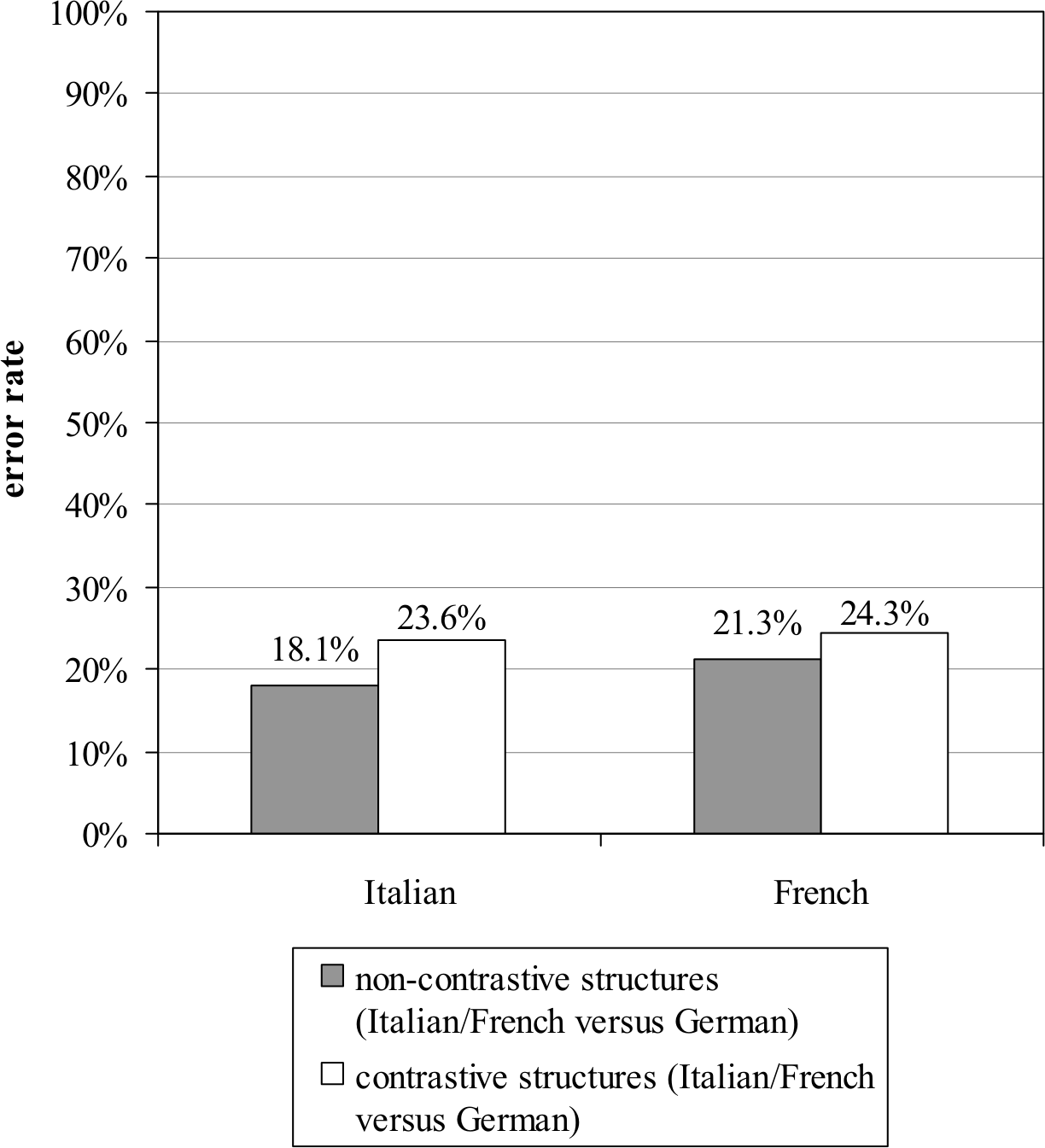
Error rates for Italian and French respondents for non-contrastive and contrastive German structures (in relation to their respective L1).
Interestingly, contrastivity does not seem to exert its greatest influence on the lower levels of German proficiency. In fact, the difference in error rates between contrastive and non-contrastive structures only becomes greater on the higher levels of proficiency (Figure 2). 5
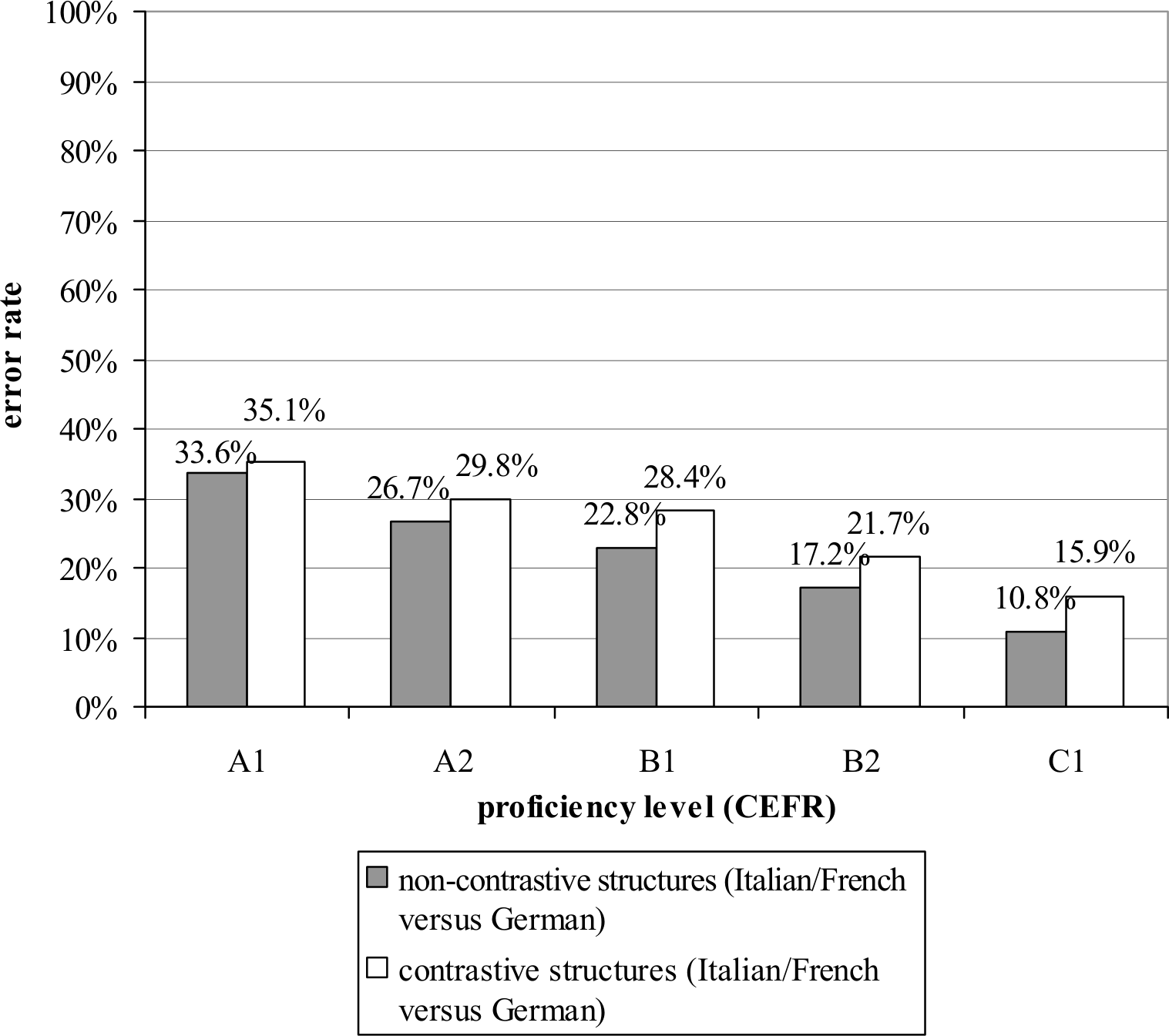
Error rates for non-contrastive and contrastive structures according to German proficiency test (in relation to respondents’ respective L1).
One interpretation of this finding could be that primarily for more advanced learners, grammatical structure actually ‘matters’. At a lower level of proficiency, learners probably resort to semantics and logical reasoning more than (consciously or unconsciously) analysing the grammatical structure of the sentence.
Contrastivity to English also has a rather weak effect for both groups. Italians perform somewhat worse reading German structures that are contrastive to English (23.6% error rate) than those that are not contrastive (18.7%). 6 Similarly, the French group makes more errors reading structures that are contrastive between English and German (27.6%) than reading non-contrastive structures (19.5%). 7
However, the difference between error rates for non-contrastive and contrastive structures as compared to English becomes more relevant for respondents beyond the way stage level (A2) reading proficiency in English, 8 (Figure 3).
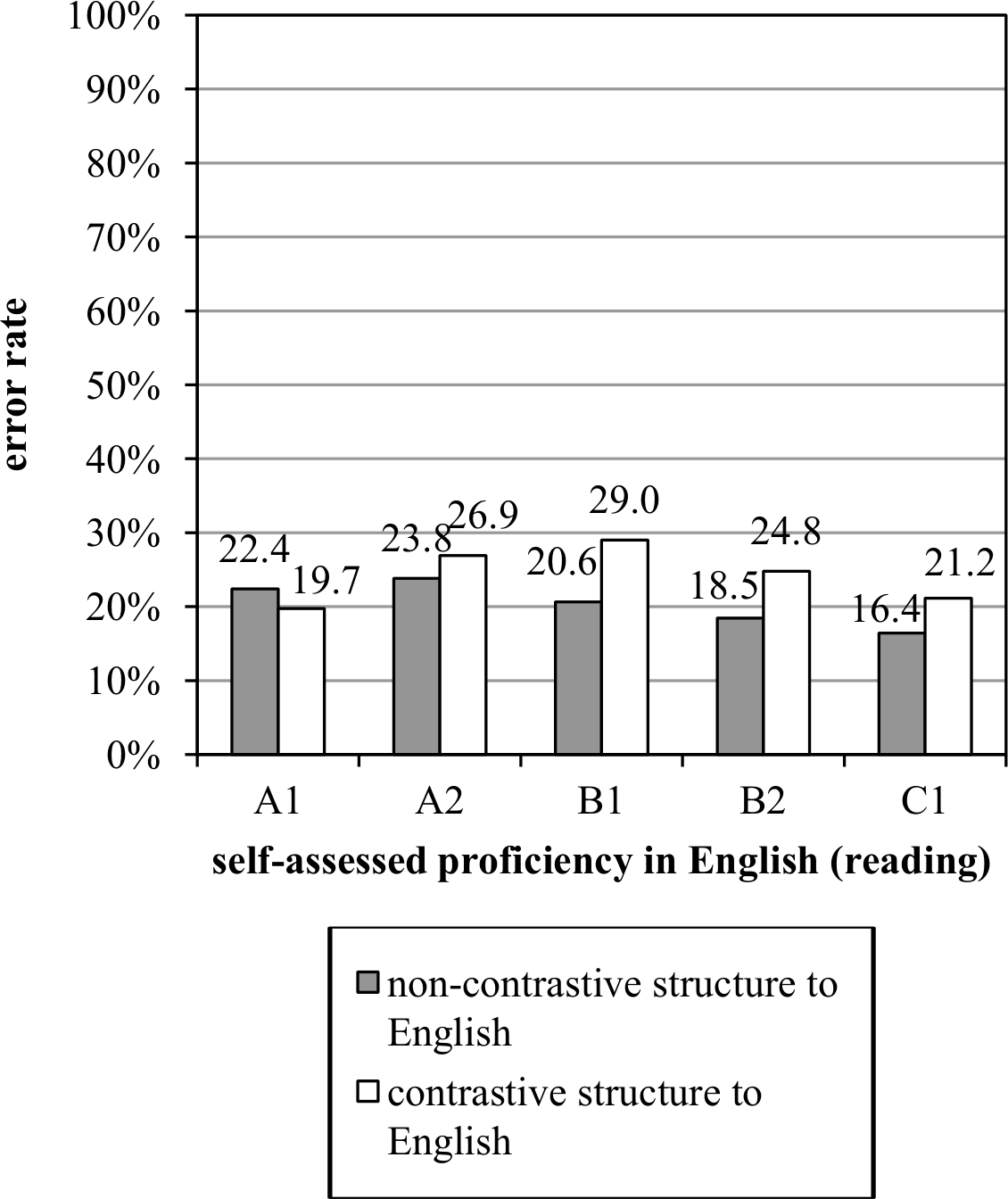
Error rate for German structures that are non-contrastive/contrastive to English according to self-assessed proficiency in English (reading).
For readers with a low proficiency in English, contrastivity between German and English obviously does not play a role. As a consequence, this means that learners’ proficiency in English can have a slightly hampering effect when reading structures in another foreign language that differ from English. 9
Contrastive structures that are more difficult than non-contrastive structures
One of the grammatical structures employed in our reading test was the OVS construction. Even though the most common word order in German is SVO/adverbial, fronting of the object is rather common in the German language. In contrast, it does not exist in the same form (with subject inversion) in French and English, and it is highly marked and hardly ever used in Italian. An SVO order is the basic sentence structure in these three languages.
The following test sentence refers to an imaginary animal’s food. The alternative sentence consists of the same words in the SVO order
10
: (3) Target sentence: Einen Boren fressen Flundodile ab und zu ebenfalls gerne. animal imaginaire manger animal imaginaire de temps en temps volontiers *A boren eat flundodils every now and then as well willingly. (4) Alternative sentence: Flundodile fressen ab und zu ebenfalls gerne einen Boren. animal imaginaire manger de temps en temps volontiers animal imaginaire *Flundodils eat every now and then as well willingly a boren.
In German, the article indicates case and number. The object is thus clearly marked by the article ending in -en. In addition to that, verb agreement is another indicator for sentence interpretation. In the present sentence, the verb is in the plural, which means that ‘einen Boren’, the singular object, cannot be the subject of the sentence. Altogether, there is no ambiguity in these two sentences as long as the grammatical markers are taken into consideration and correctly understood.
In order to test comprehension, we asked in the subjects’ native language: ‘What animals does the Flundodil eat?’ The results indicate that subjects have considerably more difficulty comprehending the OVS sentence than the sentence in canonical sentence order. A total of 36.6% of these sentences in the OVS word order are understood incorrectly, whereas only 20.2% of the sentences in canonical word order are understood incorrectly. A chi-square test confirms the statistical significance of this difference in error rate. 11
Apparently, readers fall back on the strategy of interpreting sentences according to the ‘canonical sentence structure’ of the SVO. The first noun phrase (NP) is taken to refer to the subject of the sentence, at the same time designating the agent of the proposition. The second NP of the sentence is accordingly read as the object/patient. This strategy proves successful when the sentence indeed conforms to the canonical sentence structure. When it does not, as in the OVS case above, it leads to comprehension difficulty or misconceptions of sentence meaning. Grammatical markers, which would enable readers to correctly understand the sentence, seem to be ignored or interpreted incorrectly.
The results of this particular example of an OVS sentence are in line with the overall result for all six test sentences of this structure. All in all, the six sentences with object-fronting produced an error rate of roughly one-third (33%), whereas the sentences with ‘canonical sentence structure’ were misunderstood by only 16.2% of the subjects. Grammatical structure thus exerts a statistically significant influence on error rate. 12
The OVS structure thus seems to be an example of a contrastive structure which is more difficult to understand than the corresponding non-contrastive structure (SVO). It is not clear, however, if the difficulty is due to contrastivity since we know from research that there seems to be a very general tendency for recipients to interpret incoming information according to an agent-verb-patient order (see above).
Contrastive structures that are not more difficult than non-contrastive structures
There are test results that cast considerable doubt on the hypothesis that contrastivity as such causes greater comprehension difficulty. For example, we can take a look at the so-called ‘sentence bracket’, a structure notorious for being difficult and specific to German (also extant, for example, in Dutch, however). The term refers to the placement of complex verbs in a German sentence. Parts of complex verbs (modals, auxiliaries etc.) are often placed far apart, thus forming a ‘bracket’ within or even around the sentence.
It is possible to insert certain words (mostly adverbs) between modals/auxiliaries and the second part of the verb in English, Italian and French too. However, these insertions must remain rather short, and they can only consist of certain parts of speech. Theoretically, there are no such restrictions in German.
The following test sentence includes a sentence bracket composed of the auxiliary ‘haben’ (‘have’) and the past participle of the verb ‘leben’ (‘live’), which together form the present perfect tense in German.
In the alternative version of this sentence, the preterite is used, which does not change the meaning of the sentence but rids it of the ‘sentence bracket’.
(5) Target sentence: Das Humpfhorn hat nach neuesten Forschungen für einige hundert Jahre auch in Europa gelebt. animal imaginaire nouveau recherche quelque cent an Europe vivre *The humpfhorn has according to newest research for several hundred years also in Europe lived. (6) Alternative sentence: Das Humpfhorn lebte nach neuesten Forschungen für einige hundert Jahre auch in Europa. animal imaginaire vivre nouveau recherche quelque cent an Europe *The humpfhorn lived according to newest research for several hundred years also in Europe.
The test question was designed as to determine whether the time reference of the sentence was interpreted correctly. ‘Europe’ was not to be given as the current habitat of the Humpfhorn.
The error rate for both of these sentences is rather low, and there is no significant difference between the sentence version with (7.6%) and without ‘sentence bracket’ (13.3%) in the percentage of errors. 13 Looking at the bare percentage of errors, there even seems to be a slight tendency for the version with the ‘sentence bracket’ to be understood better. The two parts of the verb in this sentence form the present perfect tense, which is usually acquired/taught earlier than the preterite form. Furthermore, the content verb is in focus position, which might draw additional attention to its form and meaning.
The overall result over all six sentences with ‘sentence bracket’ and their alternative versions without ‘sentence bracket’ is similar to this example. The error rate is roughly the same for both structures, with about a quarter of the sentences (26.8% for sentences with ‘sentence bracket’ and 25.5% for sentences without ‘sentence bracket’) causing incorrect answers to comprehension questions. Statistical tests confirm that grammatical structure is no significant predictor of error rate. 14 Clearly, the hypothesis that contrastivity means greater comprehension difficulty is not corroborated by this result.
Structures that are contrastive for one native speaker subgroup only
According to our typology, some grammatical structures tested are contrastive for one of the two groups of native speakers only. One of these structures is the subject clause with correlative that exists in French but does not exist in Italian. Italian main clauses never contain a correlative that refers to a subject clause, whereas in French main clauses, correlatives are compulsory if the main clause is in the initial position.
(7) French: *It is important that you me understand. Que tu me comprennes (cela) est important. *That you me understand (this) is important. (8) Italian: È importante che tu mi comprenda. *Is important that you me understand. Che tu mi comprenda è importante. *That you me understand is important.
Interestingly, for Italian native speakers, German subject clauses with correlative are nevertheless almost equally difficult to understand as the subject clauses without correlative, which do exist in Italian. The error rate for subject clauses with correlative is 23.6% for our Italian informants, whereas subject clauses without correlative led to 27.5% comprehension errors. Structure does not constitute a significant factor as statistical analyses confirm. A reason for the fact that the subject clause with correlative does not pose a problem to our Italian subjects might lie in their good knowledge of English, a language in which subject clauses with correlatives exist. However, we cannot be sure that English really served as a transfer base. It may also be that the existence of a correlative is generally no problem.
Contrary to the Italian subjects, for the French subjects both structures are non-contrastive to their L1. It therefore seems slightly surprising that in the case of the French subgroup, the factor ‘structure’ does exert a significant influence on the comprehension of the subject clauses with and without correlative. Those with correlative led to 19.3% comprehension errors, while those without correlative led to 26.0%. 15
One of the test sentences containing a subject clause was the following: (9) Target sentence without correlative: Ob das Humpfhorn hingegen hören kann, ist bis heute nicht bekannt. animal imaginaire entendre pouvoir être aujourd’hui connu *If the Humpfhorn however hear can, is until today not known. (10) Alternative sentence with correlative: Es ist hingegen bis heute nicht bekannt, ob das Humpfhorn hören kann. être aujourd’hui connu animal imaginaire entendre pouvoir *It is however until today not known, if the Humpfhorn hear can.
To test the comprehension of these two sentences, a verification question was used:
On sait que les humpfhorns entendent. v□ f□
*One knows that the humpfhorns hear.
Again, both the French- and the Italian-speaking subgroup made slightly more comprehension errors when reading the version without correlative; however, the difference found in the error rate was significant for neither of the two groups. The Italian-speaking group had an error rate of 24.4% (version without correlative) and 16.9% (version with correlative), whereas the French-speaking group had an error rate of 35.3% (version without correlative) versus 19.1% (version with correlative). From a contrastive point of view, it is thus interesting to see that Italian native speakers have slightly (although not significantly) less comprehension difficulties when reading the subject clause with correlative, that is, a structure that does not exist in their native language.
Considering the relatively high error rates of both versions, it is clear that the sentences must contain some difficulties that might not be contrastive in nature. An analysis of the oral translation transcripts of the two versions helped to find out where the difficulties lie. It seems that – regardless of the version – most of the subjects had problems to find the semantic link between the two clauses. Many of them wrongly assumed that the adjective ‘bekannt’ (English: ‘known’), which stands in predicative position in the main clause, referred to the NP ‘humpfhorn’ in the subject clause when in fact it referred to the subject clause as a whole, that is, to the statement that the humpfhorn can hear.
From our analysis of the transcripts, it thus seems that the main difficulty of both versions lies in identifying the subject clause as subject of the main clause, that is, in finding the right way of connecting the two clauses (cf. also the subordinate clause procedure in Håkansson et al., 2002). The major difficulty of the sentences is thus not specific to German but is as well inherent in Italian, French and English subject clauses. Nevertheless, most of our informants have not been able to immediately transfer their (subconscious) knowledge of subject clauses from their L1 or their L2 English into their L3 German. Hence, we may conclude that non-contrastive structures, such as the German subject clause without correlative in the case of our French and Italian subjects, may also cause considerable problems during L2 reading comprehension.
Discussion
By comparing foreign language readers’ comprehension of sentences containing contrastive structures to their comprehension of semantically identical sentences without contrastive structures, we have gained new insights into the question whether contrastivity and transfer are decisive factors for foreign language comprehension. First, we have found small but significant effects of contrastivity regarding the overall test result: contrastive structures are slightly more difficult to understand than non-contrastive structures on the overall level. Second and in contrast to the overall result, we have been able to demonstrate that foreign language readers do not always have problems understanding sentences containing contrastive structures, that is, structures that do not exist in their L1. For instance, German sentences containing the contrastive structure ‘sentence bracket’ were as difficult to understand as sentences expressing the same meaning without sentence bracket. Thus, the results of our reading test corroborated our hypothesis on the overall level but not on the level of individual structures.
As can be seen in Table 2, sentences containing contrastive structures are either more difficult or as difficult as sentences with the same meaning containing non-contrastive structures. Sentences with contrastive structures thus never proved to be easier statistically speaking than sentences with the same meaning containing non-contrastive structures.
Contrastive/non-contrastive structures tested and their empirical difficulty.

OVS: object–verb–subject; SVO: subject–verb–object.
We modelled error rates for all ‘left-branching attribute/relative clause’ sentence pairs with a mixed-effects model with both subject and item as random factors (i.e. random intercepts, not random slopes). A likelihood ratio test revealed that model fit was significantly better for a model including the fixed factor ‘structure’ than for a model including the random factors subject and item only (χ2(1) = 16.695, p < .001).
See note 12.
We modelled error rates for all ‘conditional clauses with/without correlative’ sentence pairs for the Italian group with a mixed-effects model with both subject and item as random factors (i.e. random intercepts, not random slopes). A likelihood ratio test revealed that model fit was significantly better for a model including the fixed factor ‘structure’ than for a model including the random factors subject and item only (χ2(1) = 4.9353, p < .05).
See note 15.
We modelled error rates for all ‘passive/active’ sentence pairs with a mixed-effects model with both subject and item as random factors (i.e. random intercepts, not random slopes). A likelihood ratio test revealed that model fit was significantly better for a model including the fixed factor ‘structure’ than for a model including the random factors subject and item only (χ2(1) = 5.416, p < .05).
On the other hand, sentences containing non-contrastive structures are either easier or as difficult as sentences with the same meaning containing contrastive structures. However, considering the error rates of non-contrastive structures such as the conditional sentence with conjunction (28.4%) or the subject clause without correlative (26.9%), we can see that non-contrastive structures can also be of considerable receptive difficulty. In the case of our French informants, one non-contrastive structure (the subject clause without correlative) even proved to be more difficult than its (also non-contrastive) alternative structure.
Even though some contrastive structures were more difficult than their non-contrastive alternative version, the question remains whether it is actually contrastivity that makes the difference. From studies on reading in first and foreign languages, we have considerable evidence that there might be a general preference for readers to interpret incoming information in the order agent–verb–patient (cf. section ‘Contrastive structure and foreign language reading’) and for the right-branching structures (cf. Gibson, 1998; Kimball, 1973). Better comprehension results for the SVO sentences and for the right-branching structures as compared to their OVS or left-branching counterparts thus do not come as a big surprise and might not be due to problems with contrastivity to readers’ L1.
From our results, it seems clear that contrastivity does not have a very decisive role to play in foreign language reading comprehension. It may well be one factor that plays a part, but it combines with many other factors, such as semantic complexity, possible universal preferences for information structure and stage of language acquisition. For the time being, we need to restrict this conclusion to the specific language combinations investigated in this study, that is, to subjects with a Romance L1 and some knowledge of English, who are reading a German text. It is perfectly conceivable that contrastive analysis and transfer phenomena have more impact on reading comprehension when the L1 and the target language are (psycho)typologically even more closely related, as results from intercomprehension studies in Romance languages seem to suggest (cf. Berthele & Lambelet, 2009; Meissner, 1997; Meissner & Burk, 2001; Reissner, 2004).
In any case, it is a methodically challenging task to tease apart all of these factors, and it remains to be seen whether we can ever arrive at a simple and straightforward answer to the question of the role of contrastivity in language acquisition.
Footnotes
Funding
This research was funded by the Swiss National Science Foundation (PP001–106634; PI Raphael Berthele).