



Abstract
How stable or how permeable to attrition are a multilingual’s first and second languages during life periods characterized by dynamic changes in language-use frequencies? This longitudinal study sheds some light on this issue by investigating changing patterns in a multilingual speaker’s tip-of-the-tongue (TOT) states. Over a period of 10 years, the multilingual recorded more than 100 TOT states, together with 400 non-target word associations, as they occurred with words from the speaker’s five languages (L1 German, L2 Russian, L3 English, L4 Spanish, and L5 Portuguese). During the period, the L1 was consistently used less than the L3 and L4, providing a setting in which L1 attrition might occur. Data were analyzed with respect to the changing frequencies of TOT state occurrence in the different languages, the contribution of each language to the word associations generated during word search, the typological relatedness of targets and associates, and the linguistic context of initial learning of each language. Rates of TOT states and percentages of cross-language word associations and within-language word associations fluctuated in response to dynamic patterns of language use and maintenance, demonstrating the value of data on word-retrieval failure for studies of language attrition. The data reveal that the speaker’s L1 appeared to gain stability after an early period suggestive of attrition, despite low frequency of use overall. This finding supports the view that the L1 is exceptional, highly resistant to attrition, but also suggests that temporary impairment of L1 can occur when a multilingual speaker’s overall set of interacting language systems comes out of balance.
Keywords
Introduction
Language attrition, understood here as the reduction or simplification of language systems and/or the impairment of access to them, is assumed to be a normal, often inevitable aspect of language development in the lifespan of a bi- or multilingual speaker. Given the dynamic changes in multilingual speakers’ language development and use and the dispute over the nature and possibility of forgetting as loss of information (e.g. Ecke, 2004a), we consider it essential to view the temporary impairment of access to language as an important part of the attrition process. This paper will therefore focus on a kind of temporary lexical retrieval failure, known as the tip-of-the-tongue (TOT) phenomenon, and use it as a potential indicator of L1 (and L2) attrition.
Attrition is typically considered to be a consequence of the diminished use of one language (normally the L1) and the development and increased use of another language (usually an L2) (see Cook, 2003; Pavlenko, 2004; Schmid & Köpke, 2007, for discussions). In speakers of three or more languages, attrition patterns can become increasingly complex. What effect does the development of a third language (L3) or fourth language (L4) have on the speaker’s L1 and other L2 with respect to potential attrition? Are the L1 and L2 affected differently by the increased use of an L3?
According to the Dynamic Model of Multilingualism (Jessner, 2003), language attrition can be expected when a multilingual speaker reduces the language maintenance effort for a given language and when s/he invests more time and effort in the acquisition of a new language system, as a result of moving to another country, for example. The model, however, does not make any prediction with respect to the relative strengths of language attrition in L1 and L2 and how these might fluctuate over time, instead treating L1 and L2 similarly. L1 and L2 can exhibit attrition in the form of reduced retrieval speed and/or temporary retrieval failure; however, to our knowledge, no studies have systematically compared the effect of L3/L4 learning on word retrieval in L1 and other L2.
Multilingual speakers, understood here as speakers of three or more languages, are unique as far as their language learning history, language use, and competencies are concerned, although multilingualism as such is a common occurrence, if not the norm, in many parts of the world. Studying the dynamic unfolding of multilinguals’ language development over time is important to help us understand the human capacity to control and deploy multiple languages, but doing so in controlled experimental settings presents challenges, because it is difficult to fit multilinguals into groups of speakers and then maintain those groups for longitudinal study. Consequently, some researchers (e.g. Cohen, 1989; Faingold, 1999; Goral, Levy, Obler, & Cohen, 2006; Shanon, 1991; Singleton, 1987) have turned to individual case studies. Introspective case studies were employed in early research into the TOT phenomenon (Wenzl, 1932), but since Brown and McNeill’s (1966) pioneering study, the approach has mostly given way to experimental research in which TOT states are induced in the laboratory by providing participants with definition (or picture) stimuli of low-frequency words (see Brown, 1991, and Schwartz, 2002, for reviews).
We believe that a return to case studies is justified and, indeed, that it constitutes probably one of the few reasonable ways to systematically investigate the individual’s ability to acquire, maintain, and lose (access to) multiple languages over a lifespan. Such an approach is also warranted if one acknowledges that studying the development of only one language in isolation, excluding the development and use of others, is relatively meaningless (Schmid, 2007). Furthermore, case studies allow for a focus on the individual learner, the description of developmental patterns, and the interaction of variables (cf. de Bot, 2011), including the consideration of “language-related major life events”, such as study abroad or migration, that may crucially affect the individual’s developing language systems and their use (de Bot, 2007).
In the present study, we track TOT states experienced and recorded by one of the authors over a period of 10 years while he was living in the US and Mexico. A TOT state is a temporary word-retrieval failure in which the speaker is certain that s/he knows the target word, and often has access to partial target information and other words related to it (e.g. Ecke, 2009). TOT states have been reported to occur more frequently in bilingual speakers compared to monolingual speakers (Ecke, 2004b; Gollan & Acenas, 2004), and it has been argued that this is due to the lower frequency of use of each language (e.g. Pyers, Gollan, & Emmorey, 2009). Relatively frequent TOT state occurrence along with other forms of lexical retrieval failure (avoidance, paraphrasing, and word substitution) have been reported as evidence for L1 attrition in the lexical domain (e.g. Ammerlaan, 1999; Waas, 1996), the area assumed to be affected first and most severely by attrition (Schmid & Köpke, 2008; Weltens & Grendel, 1993).
We are interested here in the dynamics of language learning, attrition, access, and interaction across a multilingual speaker’s lexicon, with a particular focus on the effects of multilingualism on the L1. We explore whether the speaker’s development and use of an L3 (English) and an L4 (Spanish) resulted in observable L1 attrition, as reflected in the rate of TOT states and the activation of associated words from within the target word’s language (within-language associations) and words from outside the target word’s language (cross-language associations) during target word search. In particular, we are interested in finding out whether the L1 is affected in a different way from other languages known or used. The data are analyzed with respect to four time periods corresponding to significant changes in language learning and use patterns, to ascertain the kind and relative degree of attrition and cross-linguistic interaction in each period.
The speaker
Peter grew up as a monolingual German-speaking child in East Germany, started learning school Russian at age 10 and school English at age 12; he went to a school with an intensive Russian program in 1982/1983, served in the army in 1982–1984 with very little Russian and no English input, and started studying Russian and English as major subjects at university in 1984 when he was 20 years old. Part of the university degree program was a 10-month study abroad stay in Russia in 1986/1987. In 1990, shortly after the fall of the Berlin wall, Peter moved to the US, where he studied English and taught German for a year, before undertaking graduate study from 1991 to 1996. During his first years in the US, Peter also started learning Spanish in instructional and natural environments. At age 28, he began learning Portuguese. In 1994 and 1995 (now in his early 30s), Peter took refresher courses in Russian. In the same years, he spent the summers in Costa Rica teaching German and practicing Spanish. From 1996 to 2000, he lived in Mexico where he taught partially in English, German, and Spanish in a university where English was used alongside Spanish for departmental business and socializing. In 1998, Peter got married to a Mexican woman, and Spanish became the language that was primarily used at home. Two years later, he returned to the US to teach both in English and German at a university. Spanish continued to be the language that was spoken at home. As can be seen in Figure 1, estimated language-use patterns are quite dynamic, with a dramatic overall decline in L1 use across the period, tempered by a slight upturn at the end of the graph.

Self-estimated percentages of language use by the speaker (1975–2004).
Figure 2 displays language-use patterns during the period that data was gathered. English was the language used most frequently between 1994 and 1996 and after 2000. Between 1996 and 2000, Spanish was the language used most frequently. His L1, German, was used throughout, but made up only between 10 and 20 percent of the languages employed per period. The use of Portuguese and Russian was restricted mostly, but not exclusively, to school contexts in 1994 and 1995.
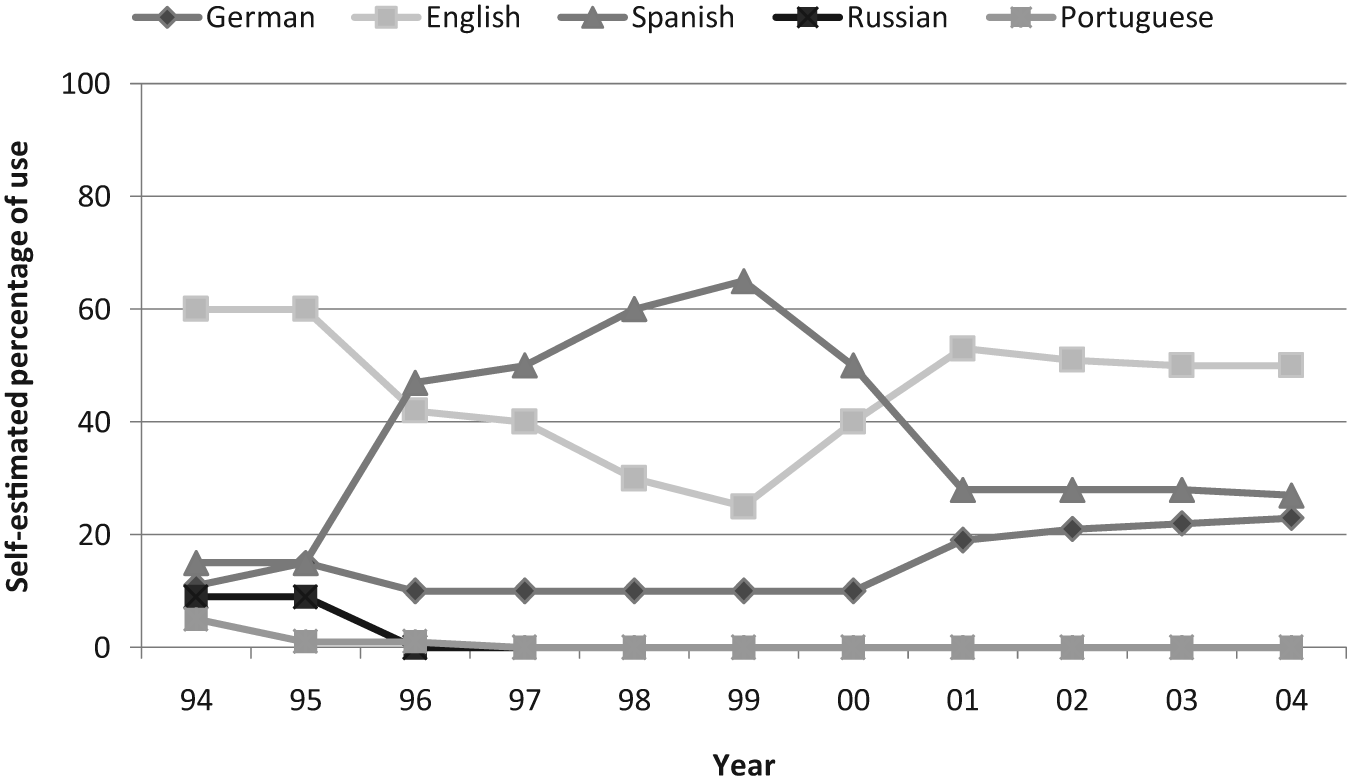
Self-estimated percentages of language use by the speaker (1994–2004).
One way of characterizing Peter’s linguistic repertoire is to indicate his proficiency in each language. Although this construct can include different elements of declarative and procedural knowledge in different contexts, and should be measured in different ways for different research purposes (Hulstijn, 2008), many users have valid beliefs about their own levels of knowledge of the different languages they have learned, studied and use(d) (cf. Ross, 2006). On such a subjective, intuitive measure, Peter rates himself most proficient in L1 German, followed by L3 English and then L4 Spanish. He feels that he was already less proficient in L2 Russian than English in 1994 when he was 30 years old, and that his Russian slipped below Spanish from 1996 onwards. He is confident that he is least proficient in L5 Portuguese, which he only studied and used for a relatively short period of time. We cannot, however, quantify proficiency in any consistent or meaningful way across the languages for the present analysis due to the post hoc nature of the case study. Moreover, we recognize that an attempt at such quantification, even if only impressionistic, would render us vulnerable to accusations of circularity, given our use of TOT data precisely in order to track how levels of knowledge/ability fluctuate over time on the basis of changing patterns of use.
Method
We report TOT state data for four stages in Peter’s multilingual trajectory:
1994–1995: Peter (age 30/31) lives in the USA, speaking mostly English, but teaches some German, starts to learn Spanish and Portuguese, and reactivates his Russian through refresher courses;
1996–1997: Peter (age 32/33) lives in Mexico, speaking mostly Spanish, but also uses English regularly and continues to teach German; he seldom uses Russian or Portuguese;
2000–2001: Peter (age 39/40) lives in the USA, speaking mostly English, but teaches more German than previously; having married a Mexican in 1998, Spanish is his home language, but is not used extensively elsewhere;
2003–2004: Peter continues to live in the USA and his three major languages (German, English, and Spanish) stabilize.
In the time periods described above, Peter kept a cognitive diary and recorded TOT states as they occurred during every-day life (see Reason & Lucas, 1984, on methodology). In cognitive diary studies, study participants are normally asked to record as much of the online word-retrieval process as possible, similar to think-aloud protocols (e.g. Cohen, 1996). On diary sheets, Peter recorded any partial knowledge about the target word (e.g. letters/sounds, the number of syllables), any associations he made during the word search, and the target word when it had been recalled in the end. He also recorded the approximate time that had elapsed from the onset of the TOT state to the generation of word association(s) and target recall. Examples (1)–(4) illustrate typical records. They include a definition of the target, fragmentary target knowledge, associations, a sketch of the elapsed time, and the finally retrieved target (underlined).
In example (1), Peter intended to recall a word form that would express the meaning of “the ability to reproduce”. He wanted to use the word in the sentence: “The egg is a symbol of…” Automatic target word retrieval failed and resulted in a TOT state (including the feeling of knowing the temporarily inaccessible word). While continuing to search for the target, Peter associated the German word Fruchtbarkeit (a cross-language association and translation equivalent of the target word), the English word fruitfulness (a within-language association and semantically related word to the target), the sound fragment in, and another within-language association maturity, which is phonologically and semantically similar to the target word. After about two minutes, Peter recalled the target word fertility, and the TOT state was resolved.
A TOT state in English
Target definition: Ability to reproduce (a lot)
Target phrase: The egg is a symbol of __
Fruchtbarkeit [fertility] immediately
fruitfulness <1 min
in <1 min
maturity <1 min
A TOT state in Spanish
Target definition: “Handcuffs” in Spanish
Target phrase: Usaron __ [They used __ ]
4 syllables, fem.
p
pinzas [pincers] <1 min
parejas [couples] <1 min
gemelos [twins] <1 min
A TOT state in German
Target definition: “Stocktaking” in German
Target phrase: Der Laden macht heute __ [The store is having __ today]
i <1 min
in- <1 min
inversion 1 min
A TOT state in Russian
Target definition: “Death” in Russian
Target phrase: Voprosiy zhizni y __ [Questions of life and __ ]
mjortvy [dead] <1 min
mjortv [of the dead] <1 min
smjort’ <1 min
In our analysis, we use three main indicators of activation level (e.g. Paradis, 2004) and attrition of languages: (1) the relative frequency of TOT states in each language in relation to other languages and to estimated frequency of use; (2) the relative frequency of contribution by each language to cross-language associations (in other language TOT states); and (3) the relative frequency of contribution by each language to within-language associations (in the same language TOT states). In addition, we assess the potential role of two other factors that may modulate the patterns of interaction observed: (4) typological relatedness between target language and language of word associations and (5) the dominant language used by Peter at the time of first learning of other languages. Finally, given that Russian and Portuguese were used only in restricted contexts and time periods, and yielded no TOT states (Portuguese) or few TOT states (Russian, limited essentially to one time period), we concentrate our analysis on the relationship between Peter’s L1, German, and his two more dominant additional languages, L3 English and L4 Spanish.
Before addressing the hypotheses, we explain how the TOT state rates were quantified. TOT states in a multilingual can only occur in a language when the language is used. On the other hand, languages that are frequently used yield more opportunities for lexical retrieval failure. Consequently, total numbers of reported TOT states cannot be used as indicators of attrition. To address this, we adapted a procedure suggested by Gollan, Bonnani, and Montoya (2005) to recalculate TOT state rates in bilinguals and adjust them for self-reported language use. Gollan et al. calculated adjusted TOT state rates by multiplying numbers of TOT states reported in a four-week period by 100 and then dividing them by the reported frequency of use. For example, if a participant experienced three TOT states in the four-week period in a language that was reported to be used 30 percent of the time, the adjusted TOT state score would be (3×100/30) or 10, a score substantially higher than the actual TOT state frequency in that language.
In our study, we decided to use the percentages of reported TOT states in the different languages for a given time period instead of raw scores, since the periods cannot be taken as equal. For example, if Peter experienced 30 percent of the TOT states in a language he used 60 percent of the time, the adjusted TOT score is (30×10/60) or 5. If he experienced 30 percent of TOT states in a language he used only 20 percent of the time, the adjusted score is (30×10/20) or 15. The adjusted higher score of the less frequently used language reflects the higher vulnerability of speech to word-retrieval failure (here, interpreted as evidence for attrition) in that language.
Hypotheses
In what follows, we develop a set of hypotheses regarding the order of adjusted rates of TOT state occurrence across the main three languages during the 10-year period. These orders are predicted on the basis of comparative use/maintenance and recency/depth of learning, as well as competition from other languages. The predictions, in the form of simple rank order scales, provide a transparent framework for interpreting the observed patterns of distribution of TOT states and cross-language and within-language associations and for assessing the role of contextual factors that fluctuate over the four successive time periods. Additional hypotheses, regarding the role of typological relations and initial learning environment, refer to the relative strength of influence or association of each language on TOT states in each of the others. They take the form of ordered pairs (e.g. language A is predicted to be more influenced by language B than by language C). These orderings should not be affected by dynamic contextual factors, because they refer to properties of the languages themselves and/or the circumstances under which they were initially acquired.
Relative frequency of TOT states
Following the logic articulated in the foregoing, we predict higher adjusted rates of TOT state occurrence overall in languages that have relatively large sub-lexicons, but with relatively unstable representations and access routes. Peter’s increased effort to learn and/or need to use new languages led to a reduced frequency of use of his L1. Infrequent L1 use in turn should have resulted in a weakening of connection strength between L1 forms and corresponding meaning representations that make word retrieval in production more vulnerable to a transmission deficit (Burke, MacKay, Worthley, & Wade, 1991) and temporary word-retrieval failure, such as a TOT state. L1 then, should be more vulnerable to attrition than languages that are relatively frequently used throughout (such as English and, increasingly, Spanish). Spanish was a relatively recently learned L4 that, in spite of its high frequency of use, can be expected to retain significant instability compared to English. The probability of fewer TOT states in Spanish than English due to a smaller vocabulary size in Spanish is likely to be offset by the increased probability of TOT states due to the instability of access routes to recently learned words (cf. Ecke, 2001, on TOT states with recently learned L3 words, and Hall & Ecke, 2003, on word learning in multilinguals). We therefore expected Spanish to provoke TOT state rates which, when adjusted for use, are higher than those for English. For the main three languages, then, the expected order of adjusted TOT state rates is as follows:
Hypothesis 1 (Relative frequency of TOT states): GER > SPA > ENG
Over time, however, we expected TOT state occurrence to fluctuate in response to dynamic patterns of language use and maintenance, with periods of less frequent use for the better known languages leading to relatively higher TOT state rates, as access routes are underused, and activation threshold levels and connection strength between form and meaning-level representations decline.
Cross-language associations
Of particular interest for the study of attrition is the way competing language systems are activated during a TOT state. We assume that rates of activation of word associations from Language A during a TOT state in Language B reflect ‘dormant’ activation threshold levels in the Language A lexicon, that is, while it is not being actively used (see also Dewaele, 2001; Green, 1998; Grosjean, 2001; Herwig, 2001; and Paradis, 2004, on activation levels and processes in the bi- and multilingual). These rates of activation can change over time as a function of lexical growth and frequency of active use, relative to that occurring in other languages. Thus, declining rates of contribution of cross-language associations from L1 for TOT states in other languages will be taken here as strong evidence of L1 attrition, whereas similar or increasing rates of L1 association in the TOT states of other languages would reflect maintenance and stability of L1. In other words, if Peter’s German is undergoing attrition, the number of cross-language associations it contributes during TOT states in English or Spanish should decline across the four time periods.
In general, we expect language A to contribute fewer cross-language associations during TOT states in Language B in periods in which language A is (a) not being used very frequently and/or (b) is not being maintained through study activity. Hence, English should be a constant source of cross-language association throughout the four periods, whereas the cross-language influence of German should decrease with lack of maintenance. Spanish should yield fewest associations overall, and should fluctuate with use and maintenance, taking into account the relatively smaller size of the vocabulary (i.e. pool of potential associations), together with its relative late-learned and therefore unstable status. Overall, the expected order of influence as source language for cross-language associations is as follows:
Hypothesis 2 (Relative frequency of cross-language associations):
ENG > GER > SPA
Within-language associations
The proportion of within-language associations generated during a TOT state in L1 has somewhat less to tell us about possible attrition than do changes in its contribution to TOT states in other languages, because at the moment of within-language activation of associated words, the L1 lexicon is being actively accessed, whereas in the case of cross-language association, the L1 lexicon is not that of the currently active language (it is ‘dormant’, cf. Grosjean, 2001, and Paradis, 2004). In other words, cross-language activation is a stronger measure of general ‘rest’ levels of activation of the language/lexicon, independently of (temporary) situation of use.
For example, consider the TOT state Peter experienced during his search for the English word fertility in example (1), in which the immediate cross-language association of the German word Fruchtbarkeit was followed by within-language association of the English words fruitfulness and maturity. The fact that Fruchtbarkeit gets activated even though the language of the discourse is English tells us more about the long-term activation level of the German sub-lexicon than it would were it to be activated during a search for an associated German word during discourse conducted in German. Accordingly, a language undergoing attrition is less likely to contribute cross-language associations than within-language associations, because in the former case the language and its associated sub-lexicon are not already activated for discourse purposes.
Nevertheless, the within-language association measure is potentially a useful one, because although overall numbers of associations should be high, they may differ across target languages and these differences might be explicable in terms of patterns of use/maintenance. We therefore predict fewer within-language associates for a language in periods in which it is (a) not being used very frequently and/or (b) not being maintained through study activity. We expect the internal dynamics of availability of target language associates to be similar to what we predicted for cross-language associations, and for the languages to follow the same order overall. Hence:
Hypothesis 3 (Relative frequency of within-language associations):
ENG > GER > SPA
Typological relationship and learning environment
In the unfolding dynamic interaction between multiple language systems, factors other than use and maintenance will influence the patterning of word association activation, including (a) the typological relationship between languages of target and association and (b) the language environment in which the target language was acquired initially (in the first year of learning the language). See de Angelis (2007, pp. 19–39) for a general discussion of both factors.
Regarding typology, English and German are both West Germanic languages and, as a consequence, share considerable lexical resources. Spanish, as a Romance language, will share fewer resources with German. However, due to extensive relexification of English following the Norman Conquest, English and Spanish also share a large number of Latinate roots and affixes (see Hall et al., 2009, for more on typological relations and their influence on L2 and L3 lexical development).
The typological relations between sub-lexicons are reinforced for Peter by the linguistic contexts in which his additional language learning took place. He learned the typologically similar English in a German-dominant environment first, as a school child and then an undergraduate in his native Germany. He started learning Spanish, on the other hand, in an English-dominant environment, the USA, where he was a graduate student. As we have suggested, English and Spanish are likely to have more cognates than German and Spanish, especially the varieties of US English that Peter would have encountered most during his time in Arizona.
We therefore make the following predictions on the basis of typological relatedness:
Hypothesis 4a (Relative frequency of cross-language associations for German TOT states): ENG > SPA
Hypothesis 4b (Relative frequency of cross-language associations for English TOT states): GER > SPA
Hypothesis 4c (Relative frequency of cross-language associations for Spanish TOT states): ENG > GER
Hypotheses 4b and 4c are further reinforced by the potential effect of the dominant language used by Peter during the initial learning of L3 English and L4 Spanish: German for the former, and English for the latter. Note that English, in both the contexts it participates in, is predicted to be more likely to contribute associations than its main competitors, Spanish and German. Conversely, Spanish is less likely to do so in both its contexts. The L1, German, is predicted to contribute more associations in English TOT states than its primary competitor, but fewer in Spanish TOT states.
Results
We first provide a general overview of findings and then report specific results addressing the four hypothesis. Across the four periods, 108 TOT states and 365 word associations were recorded and categorized (see Table 1). Most TOT states were experienced with L4 Spanish words (38 percent) and L2 English words (36 percent), followed by 15 percent in Peter’s L1 (German) and 11 percent in his L2 (Russian). In the following analyses, we will disregard Portuguese, Peter’s L5, for which no TOT states were reported, and Russian, his L2, for which TOT states were reported only during a short period of time. Instead we will focus on the patterns of lexical activation observed in his three main languages, German, English, and Spanish. Figure 3 presents the (unadjusted) percentages of TOT state rates reported by Peter in the three principal languages reflecting dynamic changes in TOT state occurrence over the four time periods.
Percentages of tip-of-the-tongue (TOT) states and adjusted TOT state rates in the languages in which they occurred, by period and by language.
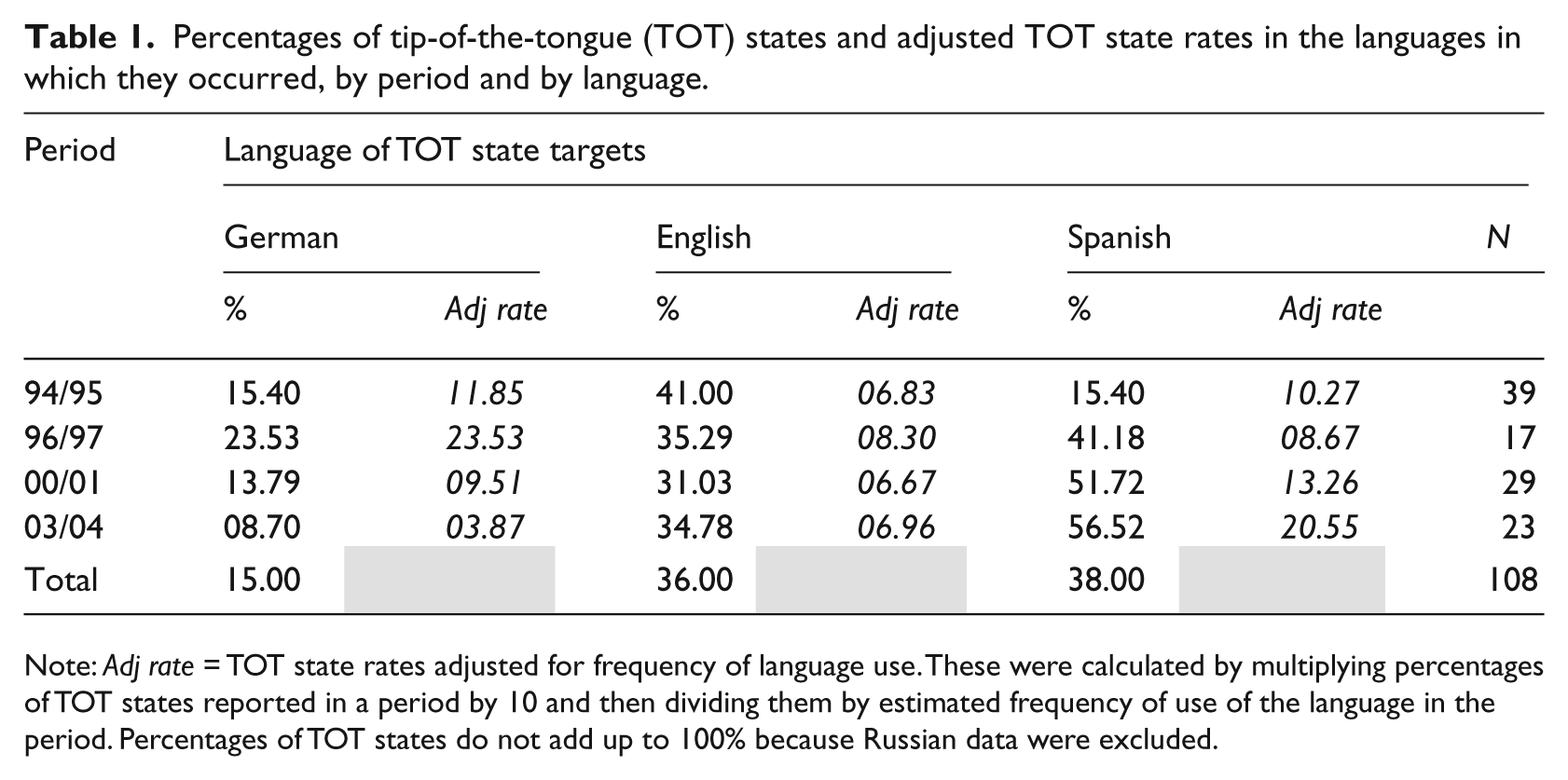
Note: Adj rate = TOT state rates adjusted for frequency of language use. These were calculated by multiplying percentages of TOT states reported in a period by 10 and then dividing them by estimated frequency of use of the language in the period. Percentages of TOT states do not add up to 100% because Russian data were excluded.
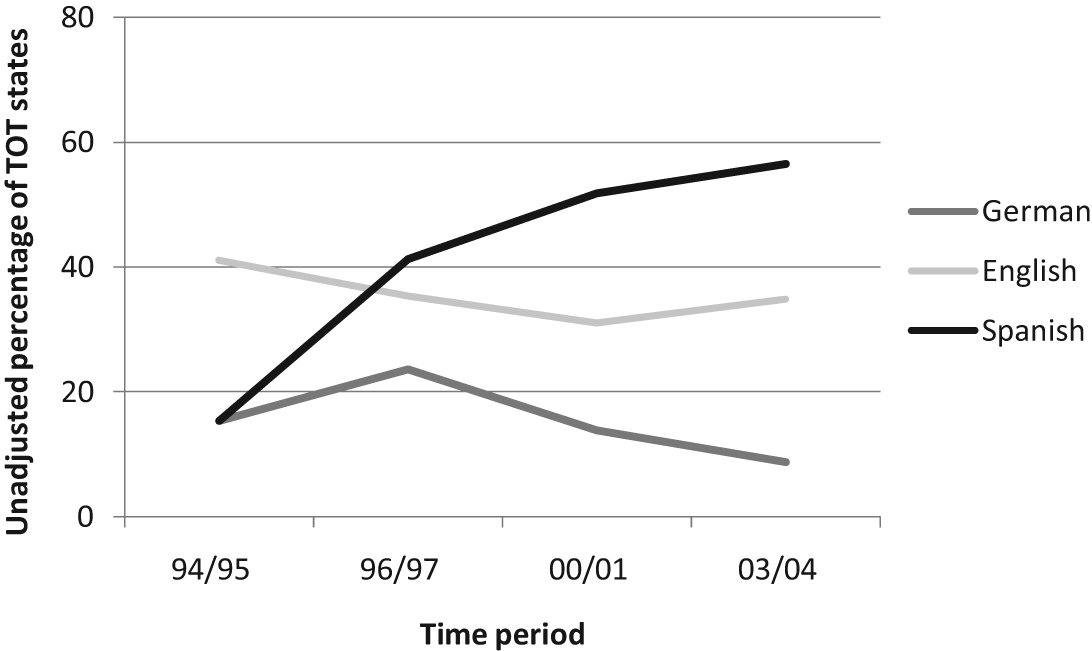
Unadjusted percentages of tip-of-the-tongue state rates in the main three languages over time.
In general, it can be observed that (non-adjusted) TOT state rates for Spanish (L4) increase over the 10-year period, whereas English (L3) rates remain at similar levels, and German (L1) rates decline with time. Table 1 illustrates the percentages of TOT states experienced in the three main languages, but complemented with TOT state rates adjusted for frequency of language use. For example, in 1994/95, Peter reported a total of 39 TOT states. Of these, 15.4 percent were TOT states with German targets, 41 percent had English targets, and 15.4 percent had Spanish targets. The adjusted TOT state data are discussed in the Frequency of adjusted TOT state rates (Hypothesis 1) section.
The languages in which TOT states were experienced also contributed lexical associations both within the target word’s language (i.e. to searches for a target in the same language) and across languages (i.e. to searches for a target in a different language). Table 2 shows the percentage of cross-language associations and within-language associations per period and source language.
Percentage of cross-language associations (in other-language tip-of-the-tongue (TOT) states) and within-language associations (in same-language TOT states), per period and source language.
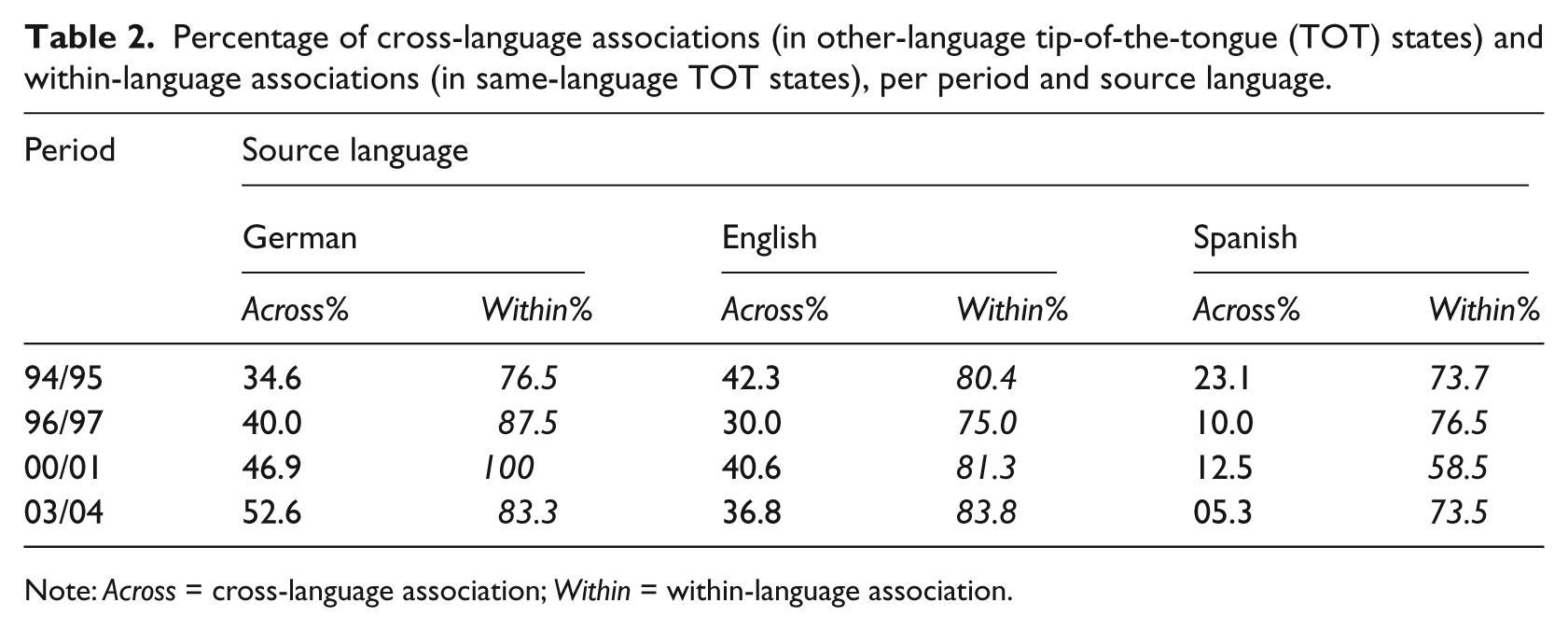
Note: Across = cross-language association; Within = within-language association.
Note that in 1994/1995, L1 German was the source of cross-language associations in 34.6 percent of the TOT states with targets in languages other than German. In same-language TOT states (with targets in German), the L1 was the source language of 76.5 percent of the reported within-language associations. Over time the contribution of German, particularly to cross-language associations, increases contrary to our prediction of a decreased L1 influence indicative of attrition. In 2003/2004, L1 words make up 52.4 percent of cross-language associations in TOT states with languages other than German. Overall, both German and English contribute more associations than Spanish. How these relative contributions fluctuate over time is discussed below in the Rate of cross-language associations (Hypothesis 2) section (regarding sources of cross-language associations) and in the Rate of within-language associations (Hypothesis 3) section (regarding sources of within-language associations).
Frequency of adjusted TOT state rates (Hypothesis 1)
We expected the following general order of TOT state rates adjusted for frequency of language use per period: GER > SPA > ENG. Our reasoning was that German was used least often and English most often, and although Peter’s Spanish vocabulary was smaller than his German vocabulary, it was less stable and more frequently used. Our findings only partially confirm the predicted order, as Figure 4 illustrates.
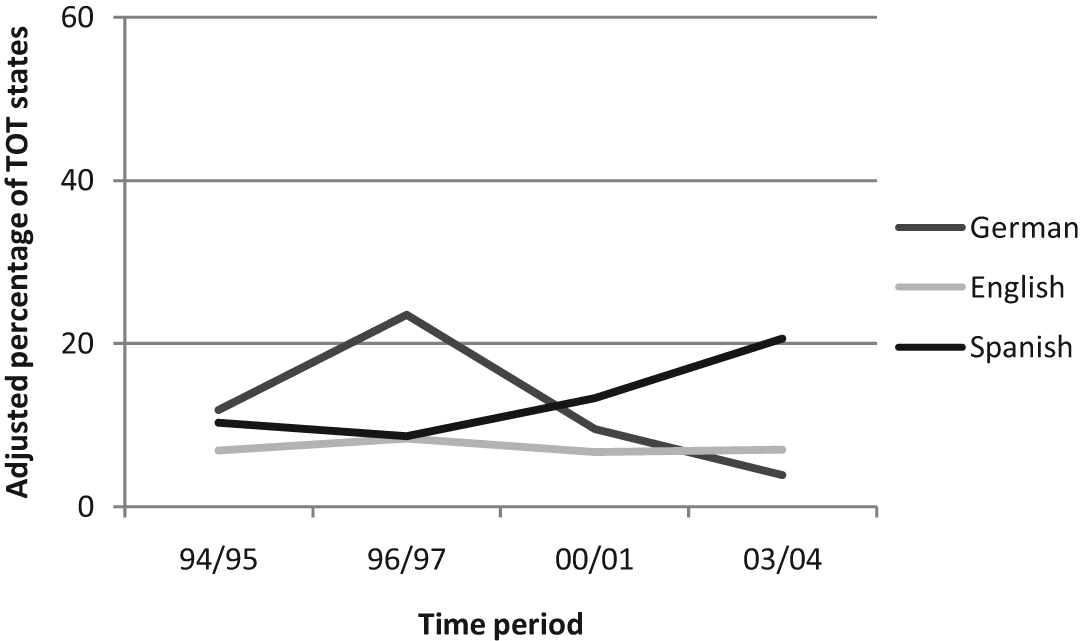
Occurrence of tip-of-the-tongue (TOT) states, adjusted for frequency of language use, for German, English, and Spanish.
We notice in Figure 4 that adjusted TOT state rates in German are relatively high in the first two periods in accordance with Hypothesis 1, but that they decrease in the following two periods, which was not expected. Adjusted TOT state rates for Spanish increase with time and are higher compared to both German and English in the last two periods.
Unexpectedly, the L1 data show dynamic fluctuations, which suggest that the expected attrition was not occurring inexorably. L1 German TOT state rates adjusted for frequency of language use are higher for the first two periods than those for English and Spanish, in accordance with the hypothesis. This reflects a particularly unstable period for Peter’s interacting language systems, in which his L1 is negatively affected by two other zones of multilingual activity.
The first is the learning and use of three other unstable languages (Spanish, Portuguese, and Russian). Spanish TOT state rates, higher than the English rates and increasing with time, suggest that the language remains unstable and becomes increasingly vulnerable to retrieval failure after Peter’s return to an English-dominant environment. The second zone of linguistic activity relevant to the evolving dynamics of the L1 system is the frequent use of English, Peter’s other relatively stable language throughout,’ but especially during the years of 1994–1996 and after 2000, which produces low adjusted TOT state rates throughout (relative to its frequency of use). However, the lower L1 TOT state rates in the later periods suggest that German has stabilized by then, perhaps due to the more balanced use of three (as opposed to five) languages once he returned to the USA.
Rate of cross-language associations (Hypothesis 2)
We expected the following general order of cross-language associations: ENG > GER > SPA. Figure 5 illustrates the percentages of cross-language associations contributed by each language per period.
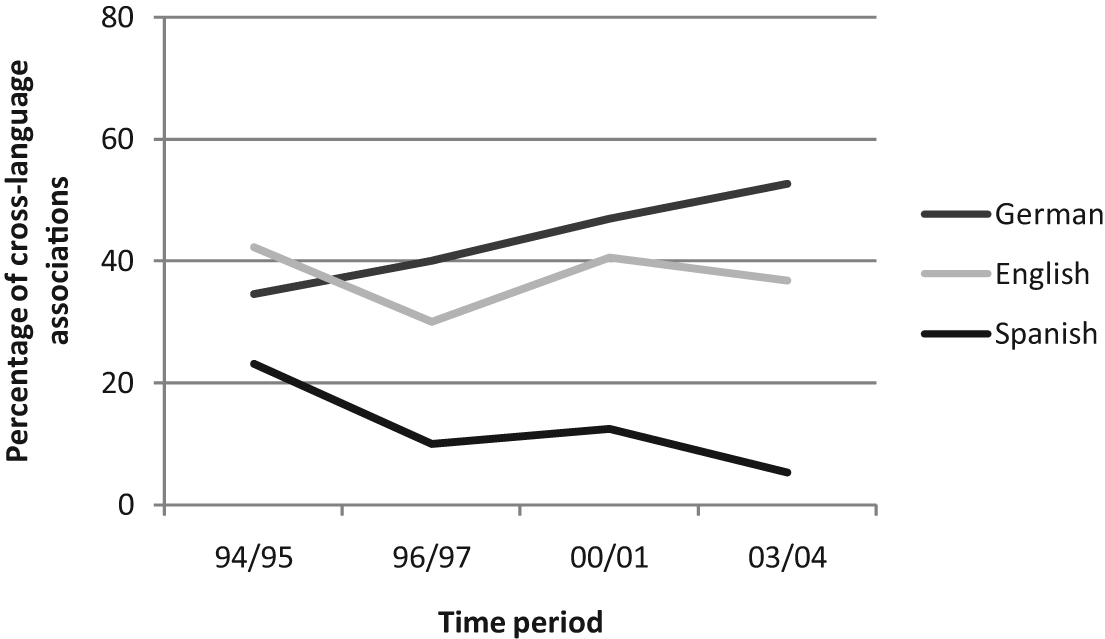
Percentage of cross-language associations contributed by each language per period.
Our prediction was partially confirmed by the general pattern of findings. In period one (1994/95), English contributed most cross-language associations, followed by German and Spanish, as expected by Hypothesis 1. In the later periods, L3 English remained a strong competing language during word search and, as expected, words of the recently learned L4 Spanish contributed relatively little to cross-language word associations. Its activation during other-language TOT states appears to diminish over time. The most surprising and important finding, however, is that L1 influence increased with time and represented the strongest influence on cross-language associations in all but the first period. Again the L1 appears to stabilize and resist attrition, despite its relative infrequency of use.
Rate of within-language associations (Hypothesis 3)
We expected within-language associations to follow the same pattern as cross-language associations (ENG > GER > SPA), with much higher levels of activation overall. Figure 6 presents the percentage of within-language associations for each language and period.

Percentage of within-language associations for each language per period.
Although the two more stable languages (German and English) again behaved more similarly than the less stable one (Spanish), German once more proved the more stable of the two, exceeding our expectations for within-language activation. An average of 89 percent within-language associations were generated for German over all periods, against 81 percent for English. This percentage slipped below 80 percent only during the unstable 1994/1995 period, when it remained slightly behind the English level. Spanish, provoking an average of only 67 percent within-language associations, stayed reasonably level, but with a dip in 2000/2001 after Peter left Mexico.
Typological relationship and learning environment (Hypothesis 4)
We also quantified the relative influence of each source language as a provider of cross-language associations for each target language, in order to assess the potential influence of typological relationship and original learning environment. Table 3 shows the total number and overall percentage of cross-language associations from each source language for TOT states in each target language.
Number of cross-language associations and percentage of all associations, by source and target language.
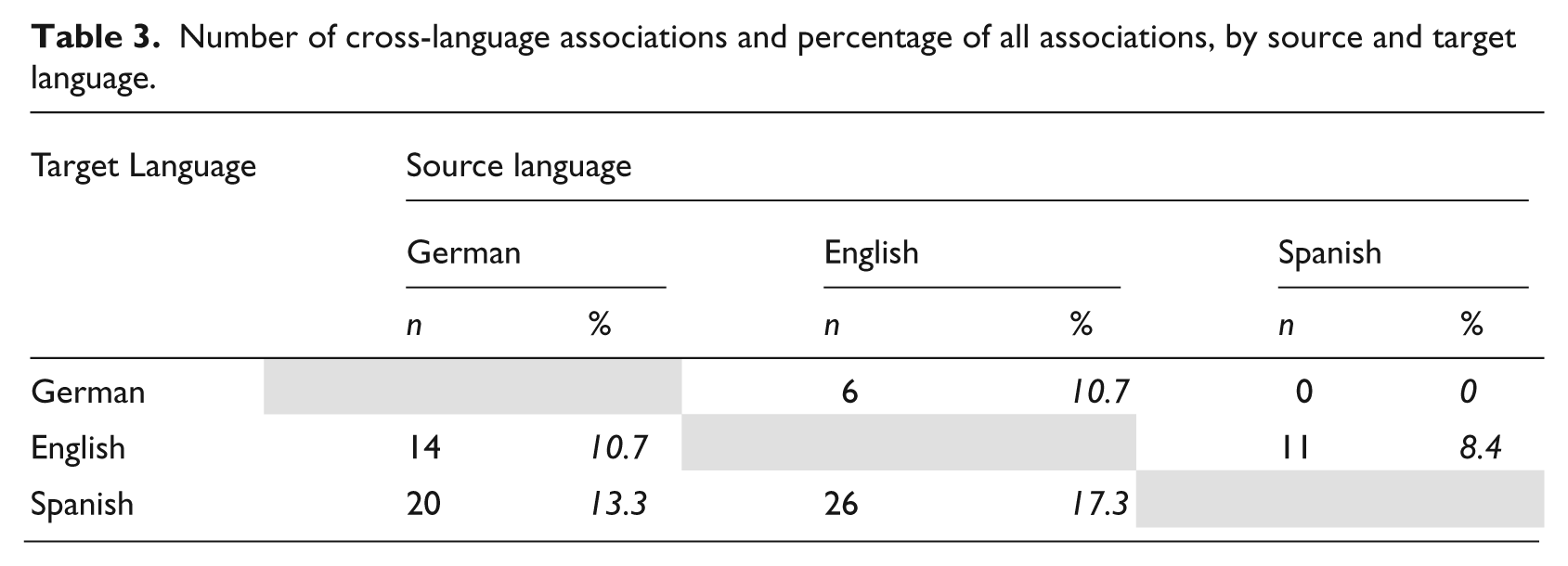
Inspection of the data in Table 3 shows that our Hypotheses 4a–c are all confirmed: In TOT states with German as the target language, English contributes more cross-language associations than Spanish (6 > 0); German contributes more cross-language associations than Spanish during English TOT states (14 > 11); and English again contributes more cross-language associations than German during Spanish TOT states (26 > 20).
Accordingly, the data suggest that both typological relatedness and initial learning environment might contribute to the explanation for the observed distribution of, and interaction between, TOT states and associations. In fact, the two additional factors appear to be reinforcing the patterns found and expected on the basis of language use alone: the relative strength of influence in each language pair coincides with the predicted rank order scale for cross-language associations, with English the highest contributor of associations, Spanish the lowest, and German intermediate (Hypothesis 2). But independently of typological relationship and learning environment, L1 German is the highest contributor of cross-language associations overall: it has 34, compared with 32 for English and 11 for Spanish. This appears to confirm the exceptional nature of the L1 revealed by our results for Hypotheses 1–3.
Discussion
In this study we tracked reports of the TOT states experienced by one of the authors over a 10-year period. We were interested in whether dynamic changes in language learning and maintenance effort would be reflected in the multilingual speaker’s word-retrieval failures, taken as evidence of attrition. We expected that the continuing infrequent use of Peter’s L1 (German) would be reflected in L1 attrition in periods in which he predominantly used his L3 (English) and L4 (Spanish). We used three indicators of activation level of languages and attrition in our analysis: (1) the relative frequency of TOT occurrence in the different languages, and the languages’ contribution to (2) cross-language word associations (in other language TOT states) and (3) within-language associations (in same language TOT states).
As far as the multilingual’s L1 is concerned, all three indicators suggest that the native language system is stabilizing over time after a period of relative instability due to competition from a recently learned L4 and a relatively frequently used L3 (and to a lesser extent from a recent L5 and a reactivated L2). The stabilization of the multilingual’s L1 over time was unexpected, although similar findings have been reported for bilingual immigrants in Australia (de Bot & Clyne, 1994). The increased time away from a German-dominant environment and the relatively infrequent use of the L1 throughout are factors that might have been thought to induce attrition (reflected in higher TOT state rates, fewer cross-language associations in non-German TOT states, and fewer within-language associations in German TOT states). Instead, we found the opposite: a more vigorous L1 that over time is becoming (a) less vulnerable to lexical retrieval failure, (b) more often the source of cross-language influence in other TOT states, and (c) more resistant to cross-language influence than other (more frequently used) languages. The emergent pattern seems to hold independently of external factors, such as typological relatedness and environment of first learning.
At first sight, this seems to confirm the assumption that the native language system is highly resistant to loss (de Bot, Lowie, & Verspoor, 2007) and that frequency and recency of activation seem to play a less prominent role in determining L1 attrition (Schmid, 2007), providing that a certain threshold in L1 complexity and stability has been reached. However, if attrition is understood to include the temporary impairment of access to a language, then our data suggest at least some attrition of L1 word retrieval earlier in the period studied. During this phase (1994/1995), the speaker’s interacting language systems appear to have come out of balance due to his increased efforts in learning new languages at the cost of maintaining others, including the L1. Thus, we can appreciate that, in addition to the exceptional status of L1 and that of the dominant language of the environment in which the speaker is currently participating, we must consider the shifting individual circumstances of multilingual knowledge and use in order to determine the likelihood of attrition.
In comparison to the L1, both major second languages appear to be more vulnerable to reductions in language maintenance effort and reduced use. In particular Spanish, Peter’s frequently used and relatively late-learned L4, showed signs of attrition after his return to an English-dominant environment, despite its continued use in the home. The case of Spanish is suggestive of regression in which late-learned (and still relatively unstable) structures are affected first by attrition (e.g. Hyltenstam & Viberg, 1993).
Conclusion
As documented in our multilingual speaker’s language learning and use history and the dynamically changing patterns of his word retrieval, neither language learning nor attrition can be assumed to be the one-way streets that they have too often been conceived as. Multilingual speakers go through periods of relative instability and balance, and ease of access to first and second languages fluctuates in non-linear ways (de Bot et al., 2007; Herdina & Jessner, 2002). Access to the L1 can be affected temporarily by such fluctuations as our data show, but at the same time it can be assumed that the L1 will be less severely affected and more likely to regain stability than other languages.
We are aware that research based on a single case can hardly be generalized, and that a study in which one of the researchers is also the case of study may be subject to bias. In spite of these shortcomings, we hope that the analyses and findings reported here will stimulate more longitudinal research into truly dynamic aspects of multilingual speakers’ lexicons. Of particular research interest we believe are periods of (abrupt) change that require multilingual speakers to adjust their language system to requirements of a new environment. Comparing only an initial state and an endpoint with respect to changes in L1 and L2 activation and accessibility levels will often overlook non-linear changes, including periods of instability, attrition, relearning, and stabilization in the speakers’ lexicons.
Footnotes
Acknowledgements
We would like to thank Esther de Leeuw, Dorota Lubińska, Conny Opitz, and the anonymous reviewers for their helpful comments and suggestions.
Funding
This work was supported in part by grant 25850-H from the Mexican Consejo Nacional de Ciencia y Tecnología to Peter Ecke.