




Abstract
This introduction to the International Journal of Bilingualism special issue on “Codeswitching in West Africa” is divided into three parts. The first part presents an overview of West Africa, with particular attention paid to the linguistic diversity and multilingualism that characterize the region. Multilingualism in the region obtains at both the societal and the individual level: as Dakubu ((1997). Korle meets the sea: A sociolinguistic history of Accra. Oxford, UK: Oxford University Press) observes, polyglotism is a longstanding characteristic of West African cities. Within this context, intense intrasentential codeswitching is widespread. A taxonomy is presented, with languages characterized as colonial, majority, or minority, and general patterns set forth as to the most common types of codeswitching dyad. The second part of the introduction provides an overview of the research that has been carried out on codeswitching in the region. Special attention is given to the earliest works. Works are divided according to whether their focus was sociolinguistic or structural, but it is to be noted that authors frequently paid crucial attention to both. Finally, in the third part, the introduction presents the five articles that make up the special issue.
This issue of the International Journal of Bilingualism is devoted to codeswitching in West Africa. In this introduction we present a selective review of the literature regarding research and analysis of codeswitching in the region. The five articles that make up this issue follow. Finally, in an afterword, three scholars known for their work on codeswitching comment on themes presented in this special issue.
Linguistic setting
West Africa (see Figure 1) is a region of intense linguistic diversity. According to Ethnologue, there are more than 500 languages spoken in Nigeria (Lewis, 2009). An additional 400 languages are spoken in the coastal nations from Senegal to Benin (Nigeria’s neighbor to the west) plus the landlocked nations of Burkina Faso, Mali, and Niger and the island nation of Cape Verde. 1 Most of the languages come from branches of the Niger-Congo family.
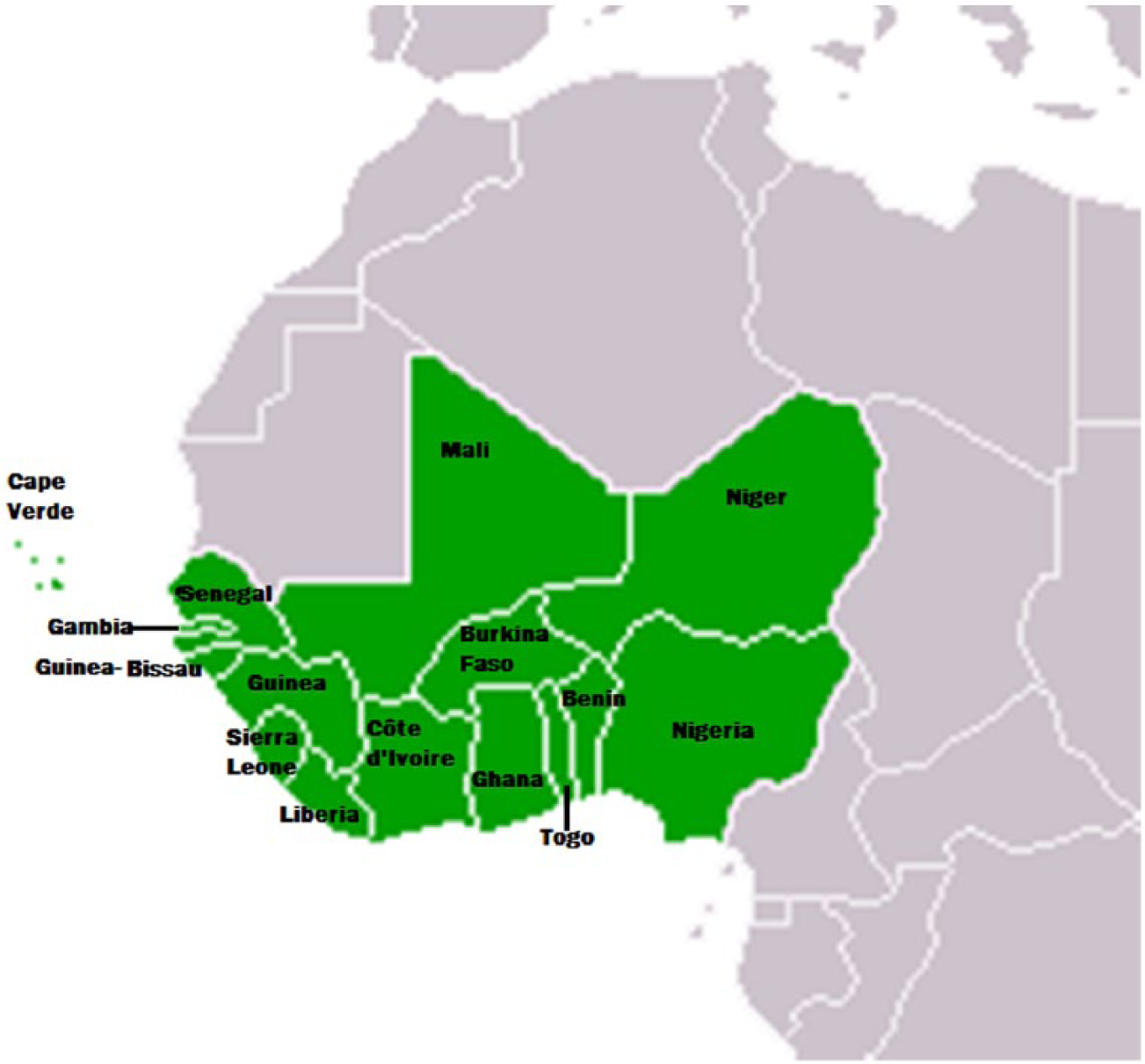
West Africa, specifically the 15 nations that comprise the Economic Community of West African States (adapted from www.wikipedia.org).
West Africa is also a region where polyglotism is the norm (cf. Dakubu, 1997). Thus, while Ethnologue—whose figures seem to be calculated on the assumption of universal monolingualism—places the number of Ewe speakers at less than 25% of Togo’s population, Lafage (1985) puts the percentage of first-language (L1) and second-language (L2) speakers of Ewe in Togo at 75%, and the percentage has certainly not gone down in the quarter century since that work was published. The facts are similar for Senegal: Ethnologue puts the percentage of Wolof speakers at 33%, but most estimates as to the percentage of Senegalese who speak the language place the number at 75–80% (e.g. McLaughlin, 2001, p. 159; Swigart, 2000, p. 96).
Some of the polyglotism obtains because individuals speak not only the language of their own ethnic group, but also that of a neighboring group; however, the most widespread basis for it seems to be hierarchical. Throughout West Africa colonial languages, whether English, French, or Portuguese, continue to prevail in the realms of formal education and government, and fluency in the relevant one continues to be a prerequisite for membership in a nation’s elite. Furthermore, in most parts of the region, one or more indigenous languages also carry prestige and function as languages of wider communication (cf. Bokamba, 1995). Because such languages usually have a larger number of speakers, we refer to them here as majority languages. Some prominent examples of majority languages are Wolof in Senegal, Wolof and Mandinka in the Gambia, Fula (Pular) and Maninka in Guinea, Mende and Temne in Sierra Leone, Bamanakan in Mali, Moore and Jula in Burkina Faso, Akan in Ghana, Ewe in Togo, Fongbe in Benin, Hausa and Zurma in Niger, and Hausa, Yoruba, and Igbo in Nigeria. 2 Finally, we refer to languages that are more restricted geographically and tend to have fewer speakers as minority languages; most languages in the region fall into this category. Thus, most polyglots in the region speak languages from two or all three of these categories. (Speakers whose first language is a majority language are less likely to speak a minority language.)
This can be seen, for example, in Haust’s (1995) study of language in the Gambia. (As Figure 1 suggests, no place in the Gambia is more than 25 km from the border with Senegal; the significance of Wolof in Senegal spills over into the Gambia.) In the Gambia, English is the colonial language and Mandinka and Wolof are majority languages, Mandinka more generally (40% of the Gambia’s population is ethnically Mandinka) and Wolof around the capital Banjul. There are 23 speakers in Haust’s study for whom she has knowledge of language repertoires; she divides each speaker’s languages into “main languages” and “other languages.” Of the speakers, she reports the following.
Eighteen of the 23 speak English, but only three consider it to be a “main language.”
Twenty-two of the 23 speak Mandinka and Wolof, and in all but four cases only one of the two languages is designated “main” (with the other designated “other”); the four exceptions are three speakers who list both Mandinka and Wolof as “main” and one who lists both as “other.”
Twelve of the 23 list one or more minority languages as well. (Seven speakers list Fula, which has minority-language status in the Gambia but is widely spoken elsewhere, including in Senegal, where it is the language whose speakers seem most inclined to contest the primacy of Wolof (McLaughlin, 1995).)
Owens (1998, 2002, 2005) likewise finds diverse multilingualism in Maiduguri in northeastern Nigeria. Owens (2002) focuses on native speakers of Nigerian Arabic (NA). In describing the distribution of languages in Maiduguri, he states: Culture, commerce, and politics can broadly be linked to different language domains. Kanuri (Saharan branch of Nilo-Saharan) is the language of the traditional political elite and the court of the Shehu [the traditional ruler of the region]. Hausa (Chadic branch of Afro-Asiatic) is the language of commerce and is rapidly becoming the lingua franca in what is originally a Kanuri-speaking capital. … English is a language of culture and functions to link Maiduguri to the rest of Nigeria and the world beyond. But Standard Arabic is a language of culture as well. Traditionally Standard (or Classical) Arabic was learned by rote in the Koranic school, but in the last 15 years a modernized Islamiyya school system has developed in which Standard Arabic is taught as a secular communicative vehicle. Thousands of Maidugurians—among them, to an overproportional degree, many Arabs—have attended such schools. Finally, the mother tongue is learned in the domain of initial enculturation: the family. Although many smaller Nigerian languages have difficulty establishing themselves in Maiduguri (i.e. urban migrants do not pass on their language to their children), [Nigerian]Arabic has maintained a high degree of vitality, even if it is mainly restricted to the realms of family and neighborhood (Owens, 1998). Given this language world, it is no surprise that nearly all Maiduguri Arabs are at least bilingual, and that many are multilingual. Of a sample of 58 Maiduguri Arabs who participated [in Owens’s study], only one was monolingual in Arabic. (p. 180)
By this reckoning and by the account in Owens (2005), NA is a minority language, Hausa and Kanuri are majority languages, and English is a colonial language. In equating Standard Arabic with English as “a language of culture,” hence a language of prestige, Owens is in essence locating it in the category of languages that we designate as colonial languages.
The kind of sociolinguistic complexity that Hurst and Owens describe also shows up in Purvis’s (2008) description of language use in the northern Ghana city of Tamale: Like many urban and semi-urban areas of Ghana, Tamale is a multilingual speech community. The three major lingua francas of Ghana—English, Akan (Niger-Congo, Kwa), and Hausa (Afro-Asiatic, Chadic) (Obeng 1997)—are employed in a variety of contexts in Tamale. The latter two, however—along with other languages of neighboring regions, such as Gonja, a Kwa language spoken widely to the south of Tamale—are more generally used between L1 speakers of the respective languages in the Tamale community, with English and Dagbani being the major languages of wider communication among speakers who do not share the same mother tongue. (2008, pp. 35–36)
In other words, while Akan and Hausa are—with English—the major lingua francas of Ghana, in Tamale it is Dagbani that stands as the primary majority language.
Widespread polyglotism by itself would seem to lead naturally to codeswitching, if the latter is simply defined as the use of two or more languages in the same conversation. However, polyglotism alone is not enough to account for the widespread use of intrasentential codeswitching in the region. Henceforth, we focus on intrasentential codeswitching. There is, we argue, a link between the hierarchical character of language use in the region and the widespread occurrence of intrasentential codeswitching.
Muysken (2000) distinguishes among three types of codeswitching. The concept of insertion sees one of the two languages in a codeswitching pair as the base language into which elements from the other language are inserted. In contrast, in alternation and congruent lexicalization the two languages in a codeswitching pair are seen as more or less equivalent in their structural roles. Most studies of codeswitching in West Africa have assumed insertion, with a large number of them following the Matrix Language Frame model articulated by Myers-Scotton (1993, 2002; Myers-Scotton & Jake, 1995).
A further point about codeswitching studies in West Africa is that the greatest number of them seems to have involved language pairs consisting of a majority language and a colonial language. Studies of codeswitching involving a minority language and a majority language have been scarce (for Kabiye–Ewe see Essizewa, 2007a, 2007b), studies involving a minority language and a colonial language even more so (for Kabiye–French see Essizewa, 2008). Likewise, studies of codeswitching that simultaneously involve three languages (minority, majority, colonial) are rare, although Ugot (2010, p. 31) does present one example of Agwagune (minority language, Cross River, Benue-Congo), Efik (majority language, also Cross River, Benue-Congo), and (1) Emenyene izep, “Do you have any message, my sister?” (2010, p. 31)
Caron (2002) presents a short sketch of Zaar–Hausa– (2) “But the driver was courageous, you hear? I swear, he was courageous”. (2002, p. 24)
(The Hausa word dəráávei is a borrowing from English, i.e. driver.) Most of Caron’s data is like the example in (2), that is, primarily Zaar–Hausa codeswitching with the occasional English insertion.
Haust’s study of the Gambia also focuses on three languages—English, Mandinka, and Wolof (colonial, majority, majority)—but the preponderance of insertions involve English insertions into one of the other two languages. While Wolof insertions in Mandinka as well as Mandinka insertions in Wolof certainly do occur, they are vastly less frequent than English insertions. Publications by Alidou (2005) and Alidou and Alidou (2008) point to a comparable situation in Niger, with French, Hausa, and Zurma (colonial, majority, majority).
Yet another point regarding hierarchized language pairs is that insertion normally obtains when the language of lower status is the base language. Thus, in the case of Ewe–English bilinguals in Ghana, codeswitching tends to obtain when Ewe is the language of discourse, not when English is.
A review of literature from the region
In this section, we present an overview of the major points that researchers in the region have raised and the contributions that they made to the larger understanding of codeswitching. As elsewhere in codeswitching studies, we distinguish between work that has focused primarily on the sociolinguistic circumstances surrounding codeswitching and work that addresses structural constraints on switching. It should be noted, however, that most of the sociolinguistically oriented works under consideration have a structural component and most of the structurally oriented works a sociolinguistic component.
Sociolinguistic studies of codeswitching
Over the years recurrent themes from literature in the subregion have been that intrasentential codeswitching is particularly likely when the speakers are urban, young, and educated. Further, researchers have linked intensive intrasentential codeswitching to informal speech, particularly in a “we-code” versus “they-code” context. Clearly, the milieux are expanding in which codeswitching is now routine. The question must then be asked if the description of codeswitching speakers should expand as well, with the strong links to cities, youth, and formal education relaxed if not yet abandoned. Onumajuru even voices the opinion that “every Nigerian speaker (literate, semi-literate and non-literate) is involved in the phenomena of code-switching and code-mixing of English and the native language” (2007, p. 67, quoted in Obiamalu & Mbagwu 2008, p. 28).
Forson’s (1979) PhD dissertation on Akan–English codeswitching is an early study of codeswitching in the region. 3 Forson regards Akan–English codeswitching as the “third code,” that is, in addition to bilinguals’ L1 and L2. Forson’s work is like Poplack (1980) in demonstrating that fluency in both languages is a prerequisite to intrasentential codeswitching. To Forson, people codeswitch with a clear social motivation; his analysis draws on Scotton and Ury’s (1977) discussion of the markedness of language choices.
Another early dissertation from the region is Madaki (1983), who follows Blom and Gumperz (1972) in seeing topic as a crucial determinant of code choice. In addition, Madaki positions codeswitching as a stylistic device. It can be, he argues, a phenomenon that occurs as a euphemistic strategy for taboo-avoidance, a way to avoid “seeming to repeat,” or a means to achieve clarification or emphasis (1983, pp. 26–30). It is also used, he states, for quotations and paraphrase. Subsequently, Amuda (1994, p. 121) argues for going beyond “surface” stylistic uses of codeswitching in order to understand its more important function to “encode social meaning.” Amuda’s attention to the social work achieved by codeswitching echoes Breitborde (1983), who argues that speakers use codeswitching to express and maintain social relations and status. Breitborde adduces evidence from Kru[Klao]–English codeswitching in Liberia in support of his thesis. It should be noted that the data that he presents is intersentential, as intrasentential codeswitching is not generally characteristic of codeswitching in Liberia.
Arguably the most important of the sociolinguistically oriented analyses in the region is Swigart’s (1992, 2000) study of Urban Wolof, her term for the Wolof–French codeswitching variety that obtains in Dakar. Urban Wolof is, according to Swigart: best described as unmarked code switching that occurs at both intersentential and the intrasentential (clausal, lexical, or morphemic) levels. It exhibits few hesitation phenomena and is accompanied by no metacommentary that would indicate that it is unusual or unacceptable to use Wolof and French in the same utterance. I characterize the use of Urban Wolof as ‘normative’ or expected in the context of most kinds of informal verbal interactions in Dakar. (2000, p. 97)
McLaughlin (2001, p. 159), in supporting Swigart’s assessment of Urban Wolof, characterizes it as “a language that has arisen out of continuous sustained contact between Wolof and French.” A further point that Swigart makes is that Urban Wolof is now used in domains that even recently were seen as ones where French was deemed the only appropriate choice. She does not claim that French has ceased to be the language of power, only that Urban Wolof is now far more widely used than in the past.
Swigart observes that Dakarois “had little notion of codeswitching at all. That is, when more than one language was used in the course of the same conversation in a mixed way, they tended to view this speech as a variety of one of the constituents, Wolof or French, depending on which language was dominant” (1992, p. 7). She reports that speakers see nothing out of the ordinary about their codeswitching: “it was just their ordinary way of speaking,” not “anything that speakers saw as deserving a special name” (p. 8).
For Swigart, Urban Wolof is a “mixed code,” a speech variety on its own. In terms of its near future: … outside of a few inviolably French-specific or pure Wolof-specific situations, communication will go on between bilinguals in an extraordinarily fluid and unconscious manner, the different forms of Urban Wolof providing them with a wide range of stylistic and connotative possibilities. While the final consequences of such behavior for the Wolof and French languages are still unclear, it seems inevitable that Urban Wolof will become increasingly accepted in the years to come as a valid form of speech for most situations. (1992, p. 306)
This raises the question as to whether the status of Urban Wolof in Dakar is representative of a larger trend within West Africa, is a sui-generis outcome of factors specific to Senegal, or is somewhere in between these two possibilities. Asilevi (1990) makes similar reference to Ewe–English codeswitching in Ghana as a “mixed language” (p. 67): This linguistic symbiosis has increasingly become a communicative praxis, socially accepted as a feature of daily conversational discourse in all aspects of informal interactions of the Ewe–English bilinguals. In essence this speech habit has become an integral part of their communicative performance and has so permeated the informal speech of the bilingual youth that one can rightly speculate that it will be no distant time when an Ewe native speaker ought to have some knowledge of English before he can function in his own speech community. (p. 2)
Forson, as noted above, sees Akan–English codeswitching as a “third code” and recognizes its mixed provenance. However, for Forson the third code has specific domains of applicability and operates in opposition to the first two, that is, Akan and English, which also have their domains of applicability. In a 1988 article, he states: [A]ny speaker on a platform, in a pulpit or addressing the inhabitants of a community naturally speaks monolingually. If he can speak the first language of the people, he uses it without switching;
Swigart, Asilevi, and Forson—and indeed all of the authors we have cited thus far—have concerned themselves with codeswitching in West Africa. Guerini (2006, 2014), however, has extended the debate into the Africa diaspora. Examining Akan–English codeswitching among immigrants to Italy, she too argues that a mixed code is emerging. 4
This discussion of mixed codes by Swigart and the others looks to the future and seeks to determine what will come linguistically. A very different perspective comes from Benítez-Torres (2009), who proposes that Tagdal, a Northern Songhay language (Nilo-Saharan family) spoken in Niger, is in fact a bilingual mixed language that arose from the interaction of Songhay and the Afro-Asiatic language Berber. After setting forth linguistic evidence in support of his hypothesis, Benítez-Torres speculates: “Over time, code-switching (probably the primary mechanism of language intertwining, at least in this case), likely fueled by speaker attitudes, eventually became encoded as part of a new language” (p. 80). Whether the contemporary mixed codes under consideration—existing in sociolinguistic contexts utterly different from that outlined by Benítez-Torres—will likewise become distinct languages remains, of course, to be seen. 5
A separate point regarding codeswitching in West Africa involves a difference in status between the colonial languages French and English. Swigart’s comments on this matter with regard to Senegal would seem to apply across francophone West Africa: “The prestige of French is further undermined by the dominance of English on the world scene, a fact of which people in even the remotest villages seem to be aware” (2000, p. 121). 6
McLaughlin’s statement that Urban Wolof arose out of “continuous sustained contact” between Wolof and French would seem equally applicable to, for example, the Ewe–English mixed language described by Asilevi (1990); however, the expansion of Urban Wolof into domains that were recently the exclusive purview of French does not seem to have an anglophone parallel: the use of English in a full range of formal, western settings continues with little if any challenge.
Grammatical studies of codeswitching
In general, studies of the grammar of codeswitching have been framed in terms of the dominant models in the field, that is, insertion, as exemplified by Myers-Scotton and her colleagues, and alternation, as exemplified by Poplack and her colleagues. Several of the early dissertations on codeswitching in West Africa anticipate Myers-Scotton’s Matrix Language Frame model.
Thus, Forson (1979) states: … when we say a person is using language X, what we are actually saying is that he is using the grammatical system and grammatical items of that language, and not necessarily the lexical items. Thus, in Akan-English code-switching, the speakers are using the Akan grammatical system and items, and therefore speaking Akan. […] In intrasentential switching, the Akan word order is basically followed, where the word order for English and Akan differ. (1979, pp. 160–162)
Along similar lines, Madaki (1983) states that “constraints on code-switching … involve distinguishing between the language of discourse and the language of switching” (p. 10). (We return to Madaki’s discussion briefly below.)
In the same year, Goke-Pariola (1983) analyzes codeswitching in a way that also anticipates Myers-Scotton in his study of Yoruba–English code-mixing, even using the term “matrix language.” As one of the central questions of his study, Goke-Pariola asks if one language of the pair is consistently the matrix language (ML). He concludes that “Yoruba, the mother tongue of the speakers, is almost invariably the matrix language” (p. 44). 7
Amuda’s (1986) dissertation also deals with Yoruba–English codeswitching and arrives at similar conclusions. He posits a series of structural constraints, consistently framing them in terms of the languages involved, for example, “Negators in switches can only be in Yoruba with verbs in English but not vice versa” (p. 342). In this and the other constraints that he proposes, Amuda is anticipating the Matrix Language Frame model. To use the terminology of that model, the role that Amuda assigns to Yoruba in these constraints is that of ML, and the role for English that of Embedded Language (EL). 8
Once Myers-Scotton (1993) had set forth the basic principles of the Matrix Language Frame model, studies of codeswitching in the region began to employ her model. That is, the authors find it insightful to posit that mixed utterances, specifically those involving intrasentential codeswitches, draw their grammar from one language. In cases where the two languages in question are a colonial language and a local language (whether majority or minority), the local language is the source of grammar, that is, of word order and functional morphology. Included among the authors who have adopted the Matrix Language Frame model are Haust (1995), Dreyfus and Juillard (2001), Amuzu (2005, 2010), Essizewa (2007b), and Benítez-Torres (2009). Swigart, whose interest lies in the sociolinguistic aspects of codeswitching acknowledges that “a very interesting analysis could be made of the formal constraints that come into play in the production of Urban Wolof using Myers-Scotton’s ‘matrix language frame’ model” (1992, p. 154n).
Amuzu’s work (2005) explores the distinction that Myers-Scotton makes between “classic” and “composite” codeswitching, and his article in the present volume validates the composite model for selected language pairs in West Africa.
Reference was made above to the distribution of languages in Maiduguri in northeastern Nigeria. Owens (2005) presents data from urban Nigerian Arabs there. In his analysis of the data, he endorses the Matrix Language Frame model but argues that it should be adjusted (rather than drastically modified) so as to account for sociolinguistically complex language data. In the corpus that Owens examines, individual speakers use NA and Hausa routinely as MLs and English and Standard Arabic as ELs. His primary concern involves ML switches within the discourse between NA and Hausa and vice versa. While these switches occur in both directions, Owens shows that the site of the switch relative to sentence (or Complement Phrase) boundary differs according to whether it is a switch from NA to Hausa or vice versa. He suggests that the difference is not random and proposes that the Matrix Language Frame model can and should be refined to account for such differences.
Lamidi (2004) draws on Chomsky’s Theory of Principles and Parameters (Chomsky & Lasnik, 1995) to formulate constraints on codeswitching with particular reference to Yoruba–English data. Subsequently, Lamidi (2009) proposes an analysis that seeks to integrate the Matrix Language Frame model and Principles and Parameters theory.
The view that codeswitching involves alternation between two languages is identified most strongly with Shana Poplack and her associates. The constraints (Equivalence, Free Morpheme) that Poplack (1980) puts forward as fundamental restrictions on possible codeswitches were challenged early on by Nartey (1982) and Madaki (1983), with Nartey drawing on data from Dangme–English codeswitching and Madaki on that from Hausa–English. Nartey produces counterexamples to both constraints, arguing that such counterexamples are by no means rare. Madaki does not present direct counterexamples to the Equivalence Constraint. Rather, he asserts that a Hausa–English utterance that sounds natural and conforms to the Equivalence Constraint for switches “becomes at best marginally acceptable” (p. 10) when the two languages are reversed, that is, when the Hausa portions are switched to English and vice versa. Codeswitching, he says, “is not symmetrical” (pp. 10–11).
Poplack and Meechan (1995, 1998) and Meechan and Poplack (1995) argue that “
The present volume
The present volume includes five articles that move our understanding of codeswitching forward in diverse ways. In terms of work on codeswitching theory, the first two articles are primarily concerned with sociopragmatic issues, and the next three address grammatical aspects. The articles involve languages spoken in Ghana and Togo; in the issues that they raise, they are reflective of codeswitching in West Africa more generally.
Rachel Flamenbaum’s article (pp. 346–362) focuses on the specifics of highly argumentative political talk-radio programs in Ghana to demonstrate speakers’ manipulation of language choice (Akan versus English) and intrasentential codeswitching as strategies for gaining control of the discussion and dominating it.
Federica Guerini’s article (pp. 363–383) examines Akan–English codeswitching among Ghanaian immigrants in Italy. As she demonstrates, Ghanaian immigrants have brought the language attitudes and practices that they developed in Ghana to their new location; except for the occasional switch to Italian, the linguistic data from Ghanaians in Bergamo could just have easily come from Accra. A central concern of Guerini’s study is the future of the Akan spoken in the immigrant community; she argues that it is “currently going through a transitional process that leads from codeswitching to language mixing, as illustrated in Auer (1999).”
In this way, her study echoes Swigart’s assessment of the future of Urban Wolof.
The articles concerned with structural issues in codeswitching begin with Evershed Amuzu’s study (pp. 384–407) of mixed possessive constructions in Ewe–English codeswitching. Working within the Matrix Language Frame model, Amuzu argues for the analysis of the bilingual constructions as composite codeswitching, that is, codeswitching in which the languages involved shared responsibility for framing the constituents. In its emphasis on composite codeswitching, as opposed to classic codeswitching, the study departs from the usual characterization of codeswitching in Africa as classic (in the sense of Myers-Scotton, 1993, 2002).
As we have noted, the preponderance of codeswitching articles from West Africa have addressed data from African/colonial language pairs. Komlan Essizewa’s (pp. 408–427) and Kofi Dorvlo’s (p. 428–446) articles are significant in that each examines codeswitching from African/African language pairs, Kabiye–Ewe for Essizewa, Logba–Ewe for Dorvlo, with Ewe the majority language in both instances. Essizewa examines grammatical environments in which codeswitching occurs readily, as opposed to ones where it occurs rarely if at all. He links the differences to degree of congruence between the two languages in a language pair. As part of his examination, Essizewa looks at the Kabiye noun class system and the ways in which it accommodates nouns inserted from Ewe, a language that does not have noun class. A major component of Dorvlo’s study also involves noun class; in particular, he examines the Logba noun class system, and the impact upon that system of loans from Ewe. Kabiye and Logba are not closely related, and their noun class systems are different. The treatment of Ewe insertions (to Essizewa) or borrowings (to Dorvlo) is different as well. In Kabiye, where the semantic basis of the noun class system has become blurred over time, it is generally the case that all Ewe nouns are assigned to the largest of the Kabiye noun classes (a class, crucially, in which a singular noun takes no overt prefix). Dorvlo argues that in Logba, on the other hand, the semantic basis for noun class assignment is still recognizable, at least to a sufficient extent to allow for the assignment of noun class to Ewe nouns on semantic grounds. Although he does not frame his analysis in terms of synchronic codeswitching, Dorvlo states that he assumes codeswitching to have been the primary conduit of Ewe influence.
Below we list the references for this introductory chapter and then provide a list of publications on the topic on the topic of codeswitching in West Africa. It is by no means an exhaustive list, and in some instances we ourselves have not been able to look at a copy of the work being cited.
Footnotes
Acknowledgements
This special issue of the International Journal of Bilingualism arose from a conference, “Code-switching in West Africa: Theory and its Implications,” sponsored by New York University (NYU) and held at the University of Ghana (UG; Legon) in November 2007. We are grateful to NYU Vice Provost Yaw Nyarko, Professor Akosua Anyidoho (director of NYU Accra), and the Departments of Linguistics at UG and NYU for their support of the conference and to NYU Vice Provost Ulrich Baer for his support of our work on this issue of the International Journal of Bilingualism. We also wish to thank Peter Auer, Melissa Moyer, and Pieter Muysken for their involvement in the conference and this issue of the International Journal of Bilingualism. Finally, we wish to thank the anonymous reviewers.
Funding
This research received no specific grant from any funding agency in the public, commercial, or not-for-profit sectors.