



Abstract
Radio, in particular, the popular Asante Twi talk-radio format that emerged in the mid-1990s, provides a unique forum for analyzing the linguistic tensions of contemporary Ghana. Radio is a context where talk and debate are central; since language is foregrounded, anxieties and beliefs about what the use of a particular language indexes socially are thrown into stark relief. This paper draws on conversation analysis, information structure, and ethnography to make sense of the prevalence of intrasentential codeswitching into English in the context of predominantly Twi talk-radio debates. It proposes that switches into English mark new or salient information, and as such function as a pragmatic tool in radio discourse, allowing speakers to negotiate the conversational floor and metapragmatically frame the speech event. It is argued that English’s pragmatic force in this context is drawn from its ability to index a multivalent prestige born of contradictory sites of authority within contemporary Ghanaian life.
Introduction
If you switch on a radio in Accra, Ghana, it does not take much tuning of the dial to hit an expression of some of the central anxieties and negotiations around contemporary Ghanaian national identity. I am not thinking of the popular musical style of hiplife, and its complex interaction with themes and styles from abroad, although that is part of the picture; I am not thinking of pastors from competing Pentecostal churches exhorting listeners to save new souls, although that also factors into it as well. My focus is rather on a less likely source: the talk-radio debate format.
In spite of both formal and informal language policies promoting the use of local languages on many talk-radio programs in Ghana, nearly all are characterized by an extremely high rate of intrasentential switches into English. Approaching this talk-radio data from a mixed-methods approach combining ethnographic methodologies with an analytic framework informed by conversation analysis (CA) and theories of information structure, this paper suggests that high-frequency codeswitching on Ghanaian talk radio, and the pragmatics that underlie it, is an indication of historical and ongoing anxieties around language choice and identity in contemporary Ghana. Listeners often disparage such switches as an indication of a lack of proficiency in the local language, as an elitist tactic to demonstrate one’s linguistic superiority, and as a method of obfuscating and politicking. This paper proposes instead that codeswitching in an ostensibly all-Akan speech frame can also be seen as a conversational strategy in multilingual speakers’ repertoires, which draws on the multivalent and ambivalent prestige of these languages in the pragmatic marking of new information and subsequent construction of arguments and negotiations for the floor. 1
Data and methods
This paper provides a case analysis of an hour of talk drawn from a 20-hour corpus of recordings from Adom FM and Peace FM, stations based in Tema and Accra, respectively. All data, including ethnographic interviews and observations, were collected over the course of a four-month period in Greater Accra in 2005, and supplemented by further ethnographic observation in 2007. Among the popular FM stations at the time, Adom FM (meaning ‘grace’ in Twi) and Peace FM were known for language policies that favored Ghanaian-language content over English—a contrast to equally popular but English-only stations, such as Joy FM and BBC Radio Africa. Peace FM and Adom FM were chosen for recording and analysis for the apparent disparity between their emphasis on providing Ghanaian-language-only programming (hosts on programs on both stations were frequently heard to police guests’ use of English) and the preponderance of switches into English that took place nonetheless—nearly 30% of the words in the case studied here. The case in question is drawn from Dwaso Nsem (‘Conversations in the Marketplace’), a highly regarded early morning talk radio program on Adom FM, recorded on November 15, 2005.
Dwaso Nsem runs from 6 a.m. to 10 a.m., with a number of sub-segments. In the segment studied here, the host moderates a debate on the day’s headlines in Twi with two or more in-studio guests, usually minor political figures, businessmen, or social commentators, in an informal panel interview format somewhat similar to that described by Clayman and Heritage (2002). As in the predominantly North American panel interviews discussed by Clayman and Heritage, the headline debate segment on Dwaso Nsem ‘provides fertile ground for cultivating lively and dramatic conflict. What might otherwise be a boring succession of “talking heads” …can become a lively sparring match between thoroughly committed adversaries’ (2002, p. 300).
This particular headlines segment of Dwaso Nsem centers on a discussion of government subsidies for cocoa production. While foreign cocoa processors have a certain degree of control over the price for their value-added product, Ghanaian cocoa farmers are dependent on the world market price of their raw product. As a result, there is often a gap between the costs of production and farmers’ revenue from raw cocoa. The subsidies are meant to address the gap. In the segment, one guest (speaker B) supports the subsidies and is put in the position of defending them, while the other guest (speaker A) aligns himself against the subsidies and the implications of graft and inefficiency that are often seen to go along with government monies. Given that the Ghanaian economy is highly reliant on cocoa exports, this is a high-stakes conversation, which can be seen to index wider anxieties about Ghana’s precarious, and some might even say dependent, position in the global economy.
The data were transcribed and approached from a mixed-methods approach that attempted to drill down to multiple levels of meaning, from the broader discursive realm to utterance to structure: ethnographic insights gleaned from observations and interviews; sequential insights born out of a turn-by-turn reading informed by CA; and structural insights revealed by theories of discourse structure and information flow. In attempting to link the macro to the micro in this manner, I am following in the tradition of Goodwin (1990), Ochs and Schieffelin (1989), and others in linguistic anthropology who have attempted to address the interplay between the affordances of linguistic structures on the one hand and the conditioning of sociocultural norms and expectations around language and interaction on the other.
Why radio?
Radio, in particular the popular talk-radio format that emerged in the wake of the privatization of Ghanaian broadcast media in the mid-1990s, provides a unique forum for analyzing the tensions of contemporary Ghana (Greene, 1998, p. 5). Radio is credited with nurturing the country’s emergent civil society by both modeling, and providing a platform for, participatory democracy (Obeng, 2003, p. 136). As Spitulnik (2002) demonstrated for the Zambian case, the portability of battery-operated radios—and the absence of a prerequisite of literacy—makes radio both more functional and more accessible than other forms of ostensibly democratic media in the country (2002, p. 339). The dynamic political engagement that radio came to embody in the 1990s is now only a part of broad popular discussions of the lag between the country’s relative political and economic stability, and its continuing status as a developing nation. Ghanaian citizens are caught between a desire to invest, literally and figuratively, in the cultural integrity and economic success of their country, and an ever more alluring orientation to the West and the opportunities it represents—desires which I suggest map loosely onto contextual and contingent language choice (Flamenbaum, 2007). From a sociolinguistic standpoint, then, radio’s value as a source of data lies not only in the centrality of unscripted talk and debate, ostensibly free of the Observer’s Paradox, 2 but in its role as a forum where language is foregrounded, and beliefs around what the use of a particular language indexes socially are therefore thrown into relief. I aim to demonstrate that language choices made in the context of this talk-radio debate over cocoa subsides reveal subtle but powerful alignments to and against prevailing notions of how to situate oneself in the tensions of Ghana’s political economy of language.
What is in a switch?
Although there is a tremendous body of literature on codeswitching spanning several decades and numerous subfields within linguistics and anthropology, there has been little consensus on delimiting the range of linguistic phenomena that fall under its umbrella. This complicates the task of determining whether to call the practices in the Ghanaian radio data ‘codeswitching,’ ‘mixing,’ ‘borrowing,’ or something else altogether. Contention surrounding the term arises in part because authors’ interests in codeswitching, whether syntactic, pragmatic, or identity-related, tend to proscribe their definitions of the concept.
In some ways, Auer’s (1999) model of language-mixing (LM) in his typology of bilingual speech seems nearer to the mark in capturing what is of note in the Ghanaian radio data; although it is not entirely alone in this, it allows for frequent, intrasentential switches (1999, p. 5). In the majority of cases, the switches in the data appear to be insertional, with one word or short phrases in English, which is in keeping with the LM criterion of frequent one-word nonce borrowings (1999, p. 6). However, I do not wish to suggest that switches between English and Twi on the radio are an indication of these codes moving towards a fused lect, as labeling the practice ‘language mixing’ might imply, nor do I wish to give the impression that short phrases or nonce borrowings from English are somehow unmarked.
To elaborate on this last point, it bears mentioning that ‘borrowed’ English words and phrases on the radio are sometimes glossed by listeners as either indications that (a) no straightforward Twi equivalent exists, or (b) that the speaker lacks competence in Twi and must rely on English to complete an utterance (Flamenbaum, 2007). With regard to (a), it is true that many of the English nouns that appear in the talk-show transcripts are artifacts of colonialism and ongoing neoliberal economic interventions—terms and concepts such as ‘world market price,’ ‘press conference,’ and so on were largely absent prior to collision with the English-speaking world (Sey, 1973). Speakers’ reference to such concepts in English, then, is in some sense a matter of practicality, and would suggest that such insertions are not codeswitches or nonce borrowings at all, but the same code with numerous adapted loanwords (Forson, 1979, p. 27). This is a tempting argument, particularly given local attitudes towards the impact of English on local language knowledge, but one that ignores the metalinguistic implications of such weighted English words in the stream of non-English speech. As I hope will be clarified in this paper, the fact that a word has been borrowed does not necessarily bleach it of its other associations, nor diminish the salience of its positional insertion into an utterance.
The notion that English phrases used on the radio are merely loanwords serving as a crutch for speakers of limited Twi competence is also tempting, if only because this explanation was so frequently offered to me in the process of collecting this data. As in the example below, however, speakers’ repertoires clearly allow the deployment of similar phrases in both languages: 3
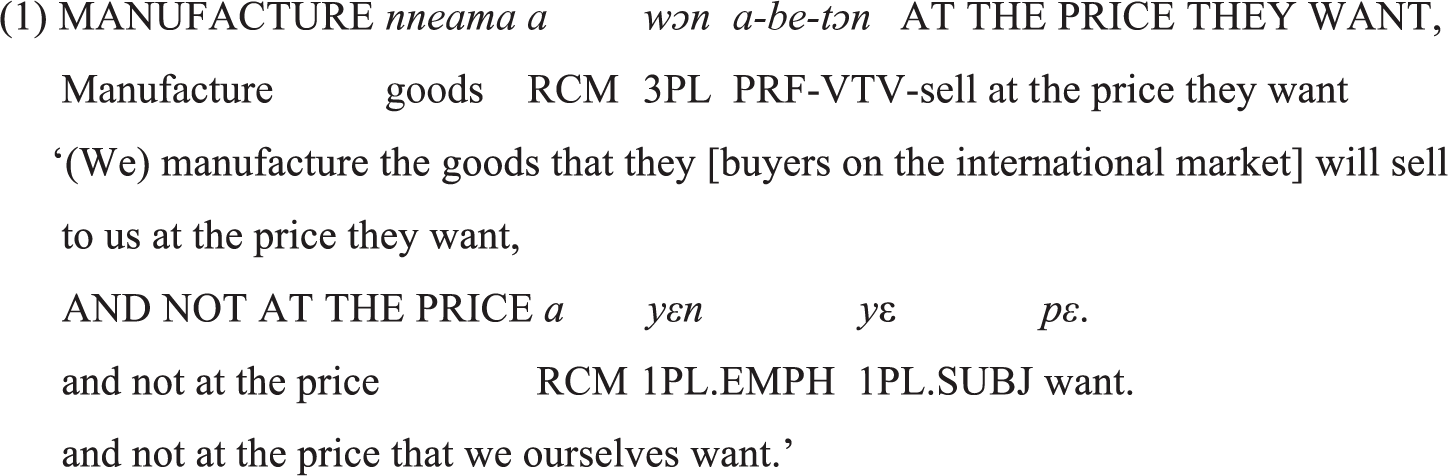
While ‘manufacture’ and ‘price’ arguably require a switch into English for lack of appropriate Twi equivalents, the speaker is clearly able to discuss relative desire in both Twi and English. I operate under the assumption that the switches are meaningful for interactants, in which case the switch in the case of ‘they/we want’ seems motivated not by a lack of competence in either language, but by the in-group solidarity demonstrated by saying ‘that they want’ in English and ‘that we ourselves want,’ (a
I will refer to what occurs on Ghanaian talk-radio programs as ‘codeswitching’ because two ‘codes’ are juxtaposed in interlocutors’ speech, and this juxtaposition has functional consequences in discourse. In this I rely on the theoretical perspective on codeswitching described by Heller (1995), both for the structural leeway it allows and for her emphasis on codeswitching as a strategic and symbolic practice: Code-switching has to be seen as an interactional moment whose significance can only become apparent when linked to other instances of language use. In this vein, I use code-switching in an extended sense, to refer not only to inter-sentential code-switching, but also to less structurally-integrated instances of language alternation or language choice…This view hinges on a notion of codeswitching as a means of drawing on symbolic resources and deploying them in order to gain or deny access to other resources, symbolic or material. (Heller, 1995, pp. 159–160; emphasis added)
While my analysis of the talk-radio data suggests that use of English represents bona fide codeswitching and that these switches carry meaningful pragmatic effects in the interaction by virtue of English’s varied indexical linkages, my interpretation is by no means mutually exclusive of the borrowing and competence explanations. However, even given widespread speaker intuitions about the cause of codeswitching stemming from a lack of full bilingual competence, it has long been held in the field that, as Milroy and Muysken set down in the introduction to their 1995 edited volume on codeswitching, ‘a deficient-based analysis [of codeswitching] cannot be easily maintained in the face of sociolinguistic evidence’ (Milroy & Muysken, 1995, p. 3). Moreover, even in the case of incomplete bilingualism, there is no reason to assume speakers are incapable of leveraging multiple codes to pragmatic effect in the course of an interaction.
Codeswitching in context
Approximately 60 languages are spoken by Ghana’s 22 million inhabitants, including the official language of English, and most speakers are multilingual (Dakubu, 1997, p. 161). The number of speakers of the main Ghanaian languages roughly matches the proportionate ethnic breakdown in the country, with approximately 46% Akan, 11% Ewe, 4% each of Dagomba, Dangme, and Gurune, and 3% each of Ga and Dagaare, with numerous smaller languages comprising the remainder (Lewis, 2009). It should be noted that the term ‘Akan,’ while denoting both language and ethnic affiliation, is an umbrella term for a family of mutually intelligible varieties in the Kwa branch of Niger-Congo, including the principal dialects of Asante Twi, Akuapem Twi, and Fante (Dolphyne, 1988). Of these, Asante Twi has historically been the most widely spoken, and is sometimes described as the unofficial lingua franca of the south (Huber, 1999, p. 135). In Accra in particular, Dakubu (1997, p. 54) notes a marked increase from 1989, when 50% of survey respondents claimed to be Twi speakers, to 1992, when 80% reported speaking Twi. It is this dialect that is most frequently employed in media outlets in Accra, and in the teaching of Akan as a L2.
The huge diversity of languages contained within national bounds—as well as the historical circumstances that led to Ghana’s being bound as a nation—has given rise to a web of often conflicting language ideologies (‘the cultural system of ideas about social and linguistic relationships, together with their loading of moral and political interests’) in the country (Flamenbaum, 2007; Irvine, 1989, p. 255). Critical responses to the issue of alienation from one’s own culture resulting from colonization have revolved around issues of language, in particular the mixing of language. Kimble (1963) references a campaign in 1856 ‘against “the admixture of English words,” in order to preserve the purity of the Fante language’; he also points out that Joseph Casely-Hayford, a Fante journalist and early Pan-Africanist, warned in 1908 that the practice of beginning Fante children’s education in English led to ‘later inconsistencies of character’ (1963, pp. 512–514). Many of these sentiments are visible in much the same form a century later: contemporary politicians echo pre-independence scholars by citing the issue of the ‘irritable linguistic admixture’ of English and various vernaculars on the radio and the inconsistency of character that results from garbled linguistic—and by proxy, the implication is, garbled cultural—input (Okoampa-Ahoofe, 2005). A 2005 survey of language use in Ghanaian media found that less than 30% of Akan radio programming was actually carried out in Akan; the Daily Graphic’s summary of the survey, entitled, tellingly enough, ‘Language on Talk Shows Not the Best,’ called this discrepancy ‘alarming’ (Daily Graphic Online, 2005). Articles such as the one cited from the Daily Graphic reflect the view, widely held among Ghanaians, that the use of English not only undermines local languages, but is in fact responsible for speakers’ declining knowledge of their mother tongues. Such sentiments do not merely inveigh against English; they are implicitly in service of a moral discourse around national identity and linguistic choice that frames Ghanaian languages as more appropriate and authentic.
Sociolinguistic interviews and ethnographic observations carried out in Accra in 2005 suggest, however, that anxieties about language purity and competency are far more complex than the above articles suggest. On the one hand, the majority of those interviewed corroborated this sense that the power and prevalence of English is steadily eroding vernacular competencies. One research participant, Seth, put it particularly succinctly: But it’s not good in that using too much English causes you to lose the vocabulary of your local language. It’s an increasing problem, there’s too much English. It’s a ‘hip thing’ to mix English, ‘Oh, he’s so educated.’ (Flamenbaum, 2007, p. 37)
Yet the same speakers offered contradictory assessments of codeswitching in actual practice. It was not uncommon for focal participants to say that they were not bothered by codeswitching or even enjoyed it when a speaker switched from a variety that they, as listeners, did not speak natively into English, thereby allowing them to grasp the speaker’s meaning more fully, or, on the other hand, to suggest that some speakers deliberately codeswitch to obfuscate—competing glosses which suggest that codeswitching as a practice may be motivated by alternately functional, pragmatic, or stylistic needs, and not exclusively motivated by a lack of mastery over the vernacular. These contradictory impressions of codeswitching in practice were undergirded by competing ideas about the relative worth and place of languages and their use in Ghana, to which I will return later.
Codeswitching, pragmatics, and information structure
In order to account for the switches into English in the data at hand—switches that occur despite the station’s language policy, and despite the vehemence and variety in the attitudes towards the practice in society at large—it is instructive to consider where the switches occur, both structurally and sequentially, and what their effect is in these positions. As previously mentioned, the majority of switches in the data are intrasentential. Moreover, switches into English tend to occur in either turn-initial or clause-final positions. In both cases, switches into English appear to encode ‘new’ information, in the sense that they either convey the speaker’s stance or pragmatic orientation to the surrounding talk or highlight information presumed not known to the hearer (Chafe, 1974; Lambrecht, 1994). In this sense, they could be thought of as being ‘in focus.’ Considering the debate context, emphatic talk that orients interlocutors to a speaker’s stance and purports to reveal previously unknown knowledge or counterevidence is fundamental to the speakers’ abilities to effectively frame and defend their arguments.
From a syntactic point of view, however, the switches into English are not in focus: canonical morphosyntactic focus marking in Twi occurs either in situ or through left-fronting with the focus marker na and a resumptive pronoun (cf. Ameka, 2009; Amfo, 2010; Fiedler, Hartmann, Reineke, Schwarz, & Zimmermann, 2006; Kobele & Torrence, 2006; and others). While some of the switches are arguably in the appropriate clause position for syntactic focus, none make use of the clitic morpheme na. Amfo (2010), in her discussion of lexical signaling, highlights the additional morphemes mpo, nso, nka, and ara as markers that serve to narrow or expand the scope of focus marking, but these markers cannot be said to interact with switches into English in the manner she describes. Ameka (2009) further notes an additional topic-comment construction in Twi with the obligatory marker a on the comment constituent, but this is also absent from the majority of switches (p. 166). Nonetheless, switches into English do appear to have a focus-like effect, and they certainly do represent knowledge that is presented by the speakers as ‘new’ or, at the very least, more salient, vis-à-vis the preceding talk. How then to account for these switches? In order to attempt an answer, the following sections address codeswitches in context, as their patterning differs depending on whether they occur turn-initially or clause-finally.
Turn-initial position
While the main content of the debate takes place in Twi, challenges to speaker authority and metapragmatic orientation of the talk space nearly always occur in English, and exclusively in the turn-initial position. This is the case with the first switch into English by the host (H) in (2): (2) 01H: [I’LL BE—I’LL BE 02A: [Ma me n-ka n-kyere wo sε, let 1SG OPT-say OPT-teach 2SG COMP ‘Allow me to tell you that,’ 03B: [ɔmo bε ‘They will employ about 3,000 people—’ 04H [daabi— [tie tie ε-nyε POLITICS asεm. NEG listen listen it is-NEG politics matter ‘No— listen listen, it’s not about politics.’ 05B: ‘I’m not doing politics!’
Here, the host metalinguistically frames how he will ‘be’ in his following utterance (i.e., ‘frank’), suggesting that his addressee (Speaker B) is likely to disagree or disapprove before he even begins. Being ‘frank,’ after all, implies bluntness or brutal honesty—and indeed, his admonition ‘it’s not about politics’ sets off a torrent of vehement denial from Speaker B.
This same method of framing an utterance with an English pragmatic marker at the outset appears elsewhere in the data: (3) obviously government every NEG.have LOC RCM 3SG-FUT-can RCM ‘Obviously there is no government that can MAINTAIN NINE MILLION CEDIS A TON. maintain [a subsidy of] nine million cedis a ton.’ [that is, per ton of cocoa] (4) DEFINITELY no, yε be- tε so. Definitely DEF 1PL FUT-reduce top ‘Definitely, we will reduce it.’ (5) NO NO NO NO NO me, me n-ka ho—FOR THE SAKE OF ARGUMENT, No no no no no 1SG 1SG NEG-include part for the sake of argument ‘No no no no no, for me, I am not included as part of it—For the sake of argument, ma WITHDRAW nti na FOR SO MANY YEARS— 1sg-PRF withdraw CONJ FOC for so many years I have withdrawn [my statement], that is why for so many years –’
In each case, as with ‘I’ll be frank with you!’, the meaning of the subsequent utterance would not be significantly altered were the English pragmatic marking omitted. Rather, each marker orients the addressee to the speaker’s stance on his forthcoming utterance. This initial framing also serves to bolster the speakers’ arguments; by framing their statements as obvious and definite, and as merely for the sake of argument rather than an argument itself, they strongly suggest that their comments are immune to counterargument. In addition to the use of English in such framing, speakers also appear to switch in attempts to metapragmatically reorient the speech of others, with guests (and sometimes the host) interjecting into their opponents’ otherwise Akan stretches of talk such English phrases as ‘What are you saying?’; ‘Please, withdraw that statement’; ‘Take a position!’; or even ‘What are you talking about?’.
While it seems clear what these switches achieve in the interaction, what is less clear is why the pattern obtains in the first place. Ameka (2009) provides a possible explanation, suggesting that of all the clause positions available in Kwa languages, ‘various positions in the left periphery or pre-core position of the clause are used for special purposes’ (p. 142). Specifically, there is a frame topic position that precedes the left-fronted focus position, which is available for ‘background information topic, i.e. information that should be kept in mind for the interpretation of the rest of the utterance (Chafe 1976)’ (Ameka, 2009, p. 143). We can hardly give adverbial pragmatic markers such as ‘definitely’ or ‘obviously’ the label ‘background topic,’ yet these turn-initial English switches are compellingly similar to the clause position that Ameka describes, in that they occupy the far-left periphery position and provide interpretive framing. Several instances, such as (5), provide a problem, however, as they cannot be said to occupy the far-left periphery when the entire phrase is in English. Lambrecht (1994) provides a possible answer with his typology of focus structures. In his event-reporting sentence-focus type, where new referents are introduced into discourse, not just one constituent in a sentence but the entire phrase is under the scope of focus (p. 222). Lambrecht gives the example of a woman heavily loaded down with bags, struggling to board a bus, who tells her fellow passengers ‘My car broke down’ by way of explanation and apology (p. 222). In this sentence, it is not the car, nor its condition, that is specifically in focus; the entire sentence provides new information to her interlocutors and reframes their presumed assessment of her as bumbling by casting herself as a stoic victim of circumstance. In a similar way, sentences such as ‘Please withdraw that statement’ assert something new within the interaction—in this case, the notion that the speaker’s previous utterance was objectionable—and reframes preceding talk accordingly. We might consider, then, that such sentences are extending the scope of background framing from the far-left periphery to the entire clause. Consider (6) below: (6) B: […]obiara nim sε – …everybody knows COMP …everybody knows that – A: What are you talking about? B: = Ansa na GOVERNMENT εbε GUARANTEE, sε yε de give Before FOC government 3SG-FUT guarantee COMP 1PL.IPFV give ‘Before the government will guarantee, that we give SECURITY FACILITY ε-de a-ma PRIVATE COMPANY […] security facility 3SG-take PRF-give private company a security facility to a private company […]’
At the outset of this example, B has held the floor in near-exclusive Twi for nearly a minute without explicitly stating his point. This kind of obliqueness is considered a politeness strategy in the framework of traditional Akan oratory and contemporary political speech (Obeng, 2003; Yankah, 1995). Speaker A, however, interrupts to ask for bald clarification in English in the manner of Lambrecht’s sentence-focus, and in doing so retroactively frames B’s preceding talk not as politely oblique but problematically evasive. The fact that this is in blunt English, a marked contrast from B’s evasive Twi, compounds the pragmatic intent. B activates English rather than Twi in response (in this case clause-finally), and ultimately retains the floor following this excerpt, but only by acquiescing to A’s demand for conversational clarity by providing a direct answer to the question, ‘What are you talking about.’ This brief moment demonstrates that a turn-initial switch can be an effective conversational strategy in reorienting the flow of debate.
The clause-final environment
The examples provided thus far clearly demonstrate that switches are not restricted to the turn-initial position, even within the same overall utterance; in fact, 63% of all switches into English occur in the clause-final position, as just seen in example (6), in examples (7) and (8) below, and throughout example (2’). In all of these clause-final examples, those constituents in the clause that carry the greatest salience and informational weight, and which the speaker most urgently wants to highlight for his interlocutors in order to make a better case for his argument, tend to be in English. This is in keeping with Dik (1997): ‘The focal information in a linguistic expression is that information which is relatively the most important or salient in the given communicative setting, and considered by S[peaker] to be most essential for A[dressee] to integrate into his pragmatic information’ (p. 326). This definition gives primacy to the interactive nature of information packaging in discourse, which suggests that focus marking is not encoded exclusively in the morphosyntactic domain.
(7) ɔ-de bi yε COCOA MASS SPRAYING, ɔ-de bi yε HI-TECH, 3SG-take some do cocoa mass spraying 3SG-take some do Hi-Tech ‘He uses some [of the money] for cocoa mass spraying [pesticides], he uses some for Hi- Tech [fertilizers], εna ɔ-de bi nso tua akua-foɔ CONJ 3S-take some also pay farmer-people bonus CONJ 3SG-take some do and then he uses some to also pay farmers’ bonuses, and he uses some for COCOA cocoa groups.’ (8) Yε be tumi a MAINTAIN, IF THE COUNTRY CAN AFFORD IT, 3PL FUT can COND maintain if the country can afford it ‘We will be able to maintain [it], if the country can afford it, ε-yε CONVENIENT FOR EVERYBODY. 3SG-be convenient for everybody it is convenient for everybody.’
In (7), speaker B (again, defending subsidies for cocoa farmers) cites the example of a particular farmer. The specific ways this farmer has put the subsidy money to use, which are unknown to speaker A and the host (and, presumably, the overhearing audience), are encoded in English; the fact that farmers are using subsidies in the first place is the topic of the debate and therefore a given, and occurs in Twi. Even though several of these English terms presumably lack a straightforward Twi equivalent, it seems relevant that no constituents other than those providing new information, in parallel structure, are switched into English. In (8), speaker A has just suggested the government should reduce the subsidy, placing his assertion that forms the basis of this particular argument—that maintaining a lower subsidy amount would be ‘convenient for everybody’—in English.
Again, why would this pattern obtain despite the lack of overt focus marking? There has been a fair amount of discussion of the idea of ‘topic’ and ‘comment’ in Akan as mapping onto the subject–verb–object (SVO) word order for non-subject focus (Fiedler et al., 2006, p. 2). It might follow, then, that in these codeswitched utterances, the tendency of English switches to occur in the clause-final position might be the consequence of switches mapping on to an existing non-subject focus strategy, where the topic appears in Twi and the comment in English. Consider again example (3), this time narrowing in on the clause-final switch: (3) obviously government every NEG.have LOC RCM 3SG-FUT-can RCM ‘Obviously there is no government that can MAINTAIN NINE MILLION CEDIS A TON. maintain [a subsidy of] nine million cedis a ton.’
This example, with the crucial addition of a codeswitch between the question and its answer, fits the pattern of the question–answer format often used to explain focus (cf. Ertechik-Shir, 2007): Twi: What is it that no government can do? (topic) English: Maintain a subsidy of nine million cedis a ton. (comment)
This also might account for example (7), where the given topic (a particular farmer who receives subsidies) is in Twi, but the comment (the specific ways in which this farmer makes use of the subsidy, which the pro-subsidy speaker wishes to highlight as admirable) is in clause-final English. This is further supported by the notion of end-weight, which holds that ‘new participants introduced into the scene of discourse need to be described and defined in more detail than known ones. They are consequently “heavy,” and best placed at the end’ (Downing & Locke, 2006, p. 254). Downing and Locke further contend that ‘end-weight, end-focus, and informativeness are closely linked’ (p. 254). This would suggest that clause-final switches into English, even without overt focus marking, may be placed thus in order to put emphasis on what the speaker views as critical information.
The encoding of information structure is not limited to lexical or syntactic strategies, however, even in a discourse-configurational language such as Twi. There is some precedent to talking about focus-like effects of constituents that may or may not be overtly marked for focus as prominence, which Kügler and Genzel (2009) cite as ‘highlighting some relevant information within an utterance (e.g., Chafe, 1974). In this sense, the information is in focus’ (2009, p. 9). Prominence in the literature often refers to prosody. Although I am not in a position to fully explore prosody, many, if not most, of the clause-final switches into English are also voiced with more emphasis, with lower tone, and often at a greater volume, than the surrounding speech—a claim supported by Kügler and Genzel’s finding of a correlation between focus and tonal lowering in Akan, which ‘suggest[s] that prominence may be expressed prosodically by means of a deviation from an unmarked prosodic structure’ (2009, p. 2). Moreover, they suggest this correlation between focus and tonal lowering gives credence to the notion that prominence occurs at intonational boundaries—and in spoken discourse, intonational boundaries are usually clause boundaries, thus lending support to the assertion that clause-final switches represent a form of prominence (2009, p. 34).
Prominence need not be exclusively the domain of prosody; Lambrecht (1994), building off of the canonical Halliday (1967) definition of information focus, explores prominence as a dynamic relationship of constituents—either a new, commentarial, or contrastive relation between an active referent and the constituent(s) under prominence—rather than merely the marking of new information (1994, p. 209). Halliday holds that, broadly speaking, informative utterances make pragmatic assertions (whether in declarative form or not), and these assertions may or may not be in keeping with the pragmatic presuppositions held by interlocutors (Lambrecht, 1994, p. 59). A debate such as the one at hand is built out of the blocks of assertions and counter-assertions, and as we have seen, these assertions often hinge on the contrast between a given or presupposed notion presented in Twi and a new or counter-assertion of some form in English—contrasts that translate into negotiations over speaking rights. The following extended version of example (2) provides an illustration. Immediately prior to this excerpt, speaker B has evaded a direct question from the host, which is relevant for speaker A’s attempt to gain the floor in what follows: (2’) 01H: [I’LL BE—I’LL BE 02A: [Ma me nka nkyere wo sε, ‘Allow me to tell you that,’ 03B: [ɔmo bε ‘They will employ about 3,000 people—’ 04H [daabi—[tie tie εnyε POLITICS asem. ‘No— listen listen, it’s not about politics.’ 05B: ‘I’m not doing [politics!’ 06A: [ ‘I will give him an answer.’ (x2) 07B: 08A: Kwakye, I WOULD [lines 09-25 omitted] 26A: Me pe ‘I want to—! I am giving my ruling! I’m giving my ruling.’ 27H: Hahaha, RULE. SPEAKER, kasa. ‘Hahaha, rule. Speaker, speak.’ 28A: Sε wei nyε DISCUSSION no. Yεnkɔ yen anim. ‘That is not the discussion. Let’s move forward.’ 29H: Okay okay okay.
Speaker A first attempts to assume control of the floor with a relatively polite request in line 02, entirely in Twi, ‘Ma me nka nkyere wo sε,’ ‘Allow me to tell you,’ but is effectively steamrolled. He then shifts in line 06 to ‘Mε ma no ANSWER,’ ‘I will give him an answer,’ which places the new referent, his ‘answer’—entirely new, in fact, in that there has been no question asked of him up to this point—in English, but he is again interrupted by B. In the final push, he reiterates the phrase ‘I will give him an answer’ completely in English, expanding the scope of prominence over the entire phrase and upgrading his bid for the floor, and repeats this in line 24 (omitted). Although A is not explicitly selected as a recipient of talk at any point before line 33, he continually inserts (and asserts) himself into the sequential organization created between speaker B and the host as someone who has the answers, in contrast to speaker B’s prior evasion of the host’s question. In this light, speaker A’s use of clause-final-prominent English to highlight his answer-readiness once again retroactively reframes speaker B’s greater reliance on polite indirection in Twi. Such indirection would win Speaker B talking points in other conversational contexts but comes across here as obfuscating and political.
Contrast as prominence?
It may be, ultimately, that the role of English in both positions is best explained if we consider English as a pragmatic marker in and of itself, and codeswitching a contrastive relation of referents that serves to highlight information in English as particularly salient simply by virtue of the ‘otherness’ of the code (Wei, 1994, p. 161). Karrebaek (2003) explicitly draws on Lambrecht’s notion of prominence to suggest that codeswitching itself marks prominence at language boundaries, noting the ‘tendency that important material gets a more explicit, distinct, or extensive coding’ (2003, p. 431).
Although the recent blossoming of work on Kwa information structure tells us how Akan marks focus, there is no work looking at the integration of Akan with another code and the subsequent constraints on, or consequences for, focus marking. (In fact, the only investigation of information structure and codeswitching to my knowledge is Karrebaek’s 2003 work on Turkish–Danish bilinguals.) Yet as Chafe (1974) noted, new information is treated differently, and the marking of that difference is not universal; when one’s repertoire includes another code as a resource in conversation, what is to say that it would not be employed in the encoding of salience at the level of information structure—particularly in a relatively high-stakes debate context, where much of the work of persuasively proving one’s point falls to the pragmatic and informational organization of one’s speech? Indeed, given the amount of work on codeswitching as contrast, it almost seems unlikely that speakers would not make use of codeswitching as the difference that provides the focus. If, following Kügler and Genzel, prosodic difference signals focus in Akan, prosodic prominence combined with a marked contrastive codeswitch cannot but amplify that difference. As Zerbian, Genzel, and Kügler argue, in Akan ‘a derivation from the neutral register per se matters to express prominence’ (2010, p. 4; emphasis in the original). A switch into English in the context of a speech event defined in large part by its avoidance of English has to be the derivation from the neutral register par excellence.
Yet I have also argued that that English’s near-exclusive domain in the radio data is the meta-construction of the speech event—not only in signaling negotiations for the floor by guests and hosts but, more fundamentally, in framing the interaction as an argument in and of itself. Rather than conform to the norms of cooperative co-construction of dialogue as in prototypical dyadic conversations, the participants are expected to engage in vociferous, verbally acrobatic public debates, with a specific set of mutually understood constraints and expectations (cf. Schiffrin, 1984). Switches into English, which appear to fuel this performance, then represent a skillful deployment of linguistic prowess that requires a finely tuned understanding of the power and place of both codes in the talk-radio context—a context that is defined against English on the surface, yet defined through English in actual practice.
Codeswitching as productive ambivalence
The paper thus far has attempted to answer the question of why speakers switch into English on Ghanaian talk radio, and has provided an answer on one level: switches into English are a conversational strategy that rests on the nexus of information structure and the pragmatic, sequential needs of argumentation. However, the more fundamental question, of why switches into English in particular mark salience, rather than a switch in any direction, remains unaddressed. After all, Kügler and Genzel (2009) tell us that any derivation from the neutral register matters—why not a switch into Twi in an otherwise English stretch of talk?
The tension just highlighted, that of the radio debate as a speech event simultaneously defined against and through English, is in some ways an apt analogy for the tensions surrounding English in Ghanaian society at large—tensions that I contend inform both the widespread ambivalence in attitudes towards codeswitching in the first place, and the symbolic links that allow English to mark prominence. If we can speak of a political economy of language (following Heller, 1995, and Irvine, 1989, among others), then my observations and interviews suggest English has a complex role in such an economy (cf. Saah, 1986). Research participants described English’s multi-indexical prestige wrought of its varied associations with higher education, the vision of tradition-rejecting modernity espoused by the highly popular Pentecostal movement (Meyer, 1998), the youthful cosmopolitan cool of hiplife music (Shipley, 2002), the equalizing power of a neutral (that is, not ethnically tied) language of state, and the access provided by the language of global business. However, individuals also spoke of ‘going out of my way to speak deep Fante’ rather than English on public transit, of making the conscious choice to speak only Ewe to their children until they were of school age, and of the danger of using too much English and sounding ‘brofɔ’—a word that translates to ‘English language’ but is more often used as slang to describe a person who uses English to put on airs of educated refinement or ‘hipness’ (Flamenbaum, 2007). A brofɔ politician is out of touch with his constituents and his roots, and subject to claims of inauthenticity; the same goes for writers, radio personalities, and everyday Ghanaians trying to simultaneously lay claim to a proud national identity and navigate a domestic terrain that often holds few opportunities. In this common conflation of language, culture, and self, the steady encroachment of English into so many realms of life can feel like an assault on the authentic Ghanaian self, and to condone codeswitching is to condone that encroachment. The danger of avoiding English altogether, however—as pro-Ghanaian language policies on the radio aim to do—is that to do so would be to disavow the particular visions of education, spirituality, hipness, and economic success associated with the language in the popular imagination. The flip side of being seen as brofɔ, in other words, is being seen as backwards.
Codeswitching, perhaps, thrives on this productive (if simplified) tension. I have suggested that switches into English on the radio encode prominence by virtue of their otherness, but I would further suggest that English derives its very salience in this context from the contrasts to Ghanaian languages—and all that both these codes entail—that speakers continually confront in daily interaction. In some ways, this argument parallels those made by Heller (1995) and Woolard (1999)—that controlling more than one register means bilinguals can also strategically deploy an identity built on the prestige of both codes, and that codeswitching therefore allows speakers to navigate the ‘the ambivalent and simultaneous messages that are communicated in linguistic contact zones’ (Woolard, 1999, p. 3). Codeswitching may persist in spite of the negative attitudes towards it because it allows speakers to achieve things in conversational interaction that they could not otherwise in just one tongue—not least of all, to navigate the tensions that inform the ambivalence towards the practice in the first place.
Conclusion
This paper has argued that switches into English occur for strategic, pragmatic reasons within the context of talk-radio debates in Accra: in order to lend prominence and emphasis to one’s argument (clause-final), and to negotiate for the floor and reorient the flow of debate (turn-initial). Moreover, this pattern suggests that codeswitching in this context is not an implicit indication of a speaker’s lack of linguistic competence. These radio debates are in theory supposed to be English-free, and Twi is the accepted language for the speech frame, but in actuality the host and his guests leverage language choice with a keen sense of which code will be most to their advantage within the interaction—with, it would appear, the underlying mutual understanding that English, by virtue of its indexical linkages and symbolic tension with Ghanaian languages, is a highly strategic metapragmatic tool that is key in framing and maintaining debate.
Footnotes
Acknowledgements
I am grateful for the assistance of innumerable friends, colleagues, and advisors in the realization of this paper: my patient, supportive editors, John Singler and Evershed Amuzu; Peter Auer, for comments that significantly reshaped this paper; Dr Nana Aba Amfo and Miss Dorothy Pokua Adusei, for their invaluable assistance in revising my transcripts; Elinor Ochs and Paul Kroskrity for guidance; Emma Adjei-Otchwemah, Beryl Beecham, Kofi Boateng, Fred Kofi Barfi, and Daniel Osei, among many others, for their insights and help in translation; and my fellow participants at the first conference on codeswitching in West Africa at the University of Ghana-Legon, November 2007.
Funding
Data collection for this research was facilitated by the New York University Harold Acton Fellowship. Extensive revisions were carried out while the author was supported by the National Science Foundation Graduate Research Fellowship Program.