



Abstract
Integrating research on multilingualism and computer-mediated communication, this paper proposes the term ‘networked multilingualism’ and presents findings from a case study to explore its implications for the theorising of multilingualism. Networked multilingualism is a cover term for multilingual practices that are shaped by two interrelated processes: being networked, i.e. digitally connected to other individuals and groups, and being in the network, i.e. embedded in the global mediascape of the web. It encompasses everything language users do with the entire range of linguistic resources within three sets of constraints: mediation of written language by digital technologies, access to network resources, and orientation to networked audiences. The empirical part of the paper discusses the Facebook language practices of a small group of Greek-background secondary school students in a German city. Data collection follows an online ethnography approach, which combines systematic observation of online activities, collection and linguistic analysis of screen data, and data elicited through direct contact with users. Focusing on four weeks of discourse on profile walls, the analysis examines the participants’ linguistic repertoires, their language choices for genres of self-presentation and dialogic exchange, and the performance of multilingual talk online. The findings suggest that the students’ networked multilingual practices are individualised, genre-shaped, and based on wide and stratified repertoires.
Introduction and theoretical background
Recent sociolinguistic work on multilingualism witnesses the emergence of new concepts, which aim at overcoming what are perceived as limits of established theoretical perspectives on bi- and multilingualism (Blommaert, 2010; Creese & Blackledge, 2010; Heller, 2007; Jørgensen, 2008; Li, 2011; Otsuji & Pennycook, 2010). Their differences put aside, concepts such as polylingualism, metrolingualism and translanguaging signal a shift of focus from linguistic systems to multilingual speakers and practices; a critical view of ‘language’ as an ideological construct; and a move towards theorising ‘fluid’ and ‘flexible’ relations between language, ethnicity and place as well as between linguistic practice and the ownership of language. Following up on this work, this paper extends its claims and scope by considering an under-explored area of multilingual practice, i.e. computer-mediated communication on a social network site, Facebook.
I begin by discussing the concepts signposted above in more detail, thereby setting a backdrop against which to introduce the notion of networked multilingualism. First, metrolingualism shifts away from asking ‘how distinct codes are switched and mixed’, and aims at examining ‘how language users manipulate the resources they have available to them’ (Maher, 2010; Otsuji & Pennycook, 2010: 241). It posits the contemporary city as a key site of creative and ‘fluid’ language practices, which call ‘the authenticity and ownership of language’ and a ‘one-to-one association among language, ethnicity, nation, and territory’ into question (Otsuji & Pennycook, 2010: 241). Instead, metrolingualism focuses on ‘creative linguistic conditions across space and borders of culture, history and politics’ (Otsuji & Pennycook, 2010: 244), and acknowledges that fluid and fixed understandings of language and ethnicity coexist in people’s practice and awareness. The second concept, translanguaging, originates in research on educational settings and focuses on how multilingual speakers transcend language boundaries in their discursive practices (Creese & Blackledge, 2010). Translanguaging is a cover term that ‘includes the full range of linguistic performances of multilingual language users’ (Li, 2011: 1223) across all modalities of language, from code-switching and mixing to translation and transliteration. Third, polylingualism (or polylanguaging) is understood as both a type of multilingual practice and a normative expectation (Jørgensen, 2008; Jørgensen et al., 2011). Unlike the ‘double monolingualism norm’, which prescribes a separation of languages in actual use, and the ‘integrated bilingualism norm’, which assumes that speakers employ languages they are competent in and accommodate to their addressees or other situational requirements, the ‘polylingualism norm’ suggests that language users employ whatever linguistic features are at their disposal to achieve their communicative aims as best they can, regardless of how well they know the respective languages (Jørgensen, 2008). Polylingualism also emphasises that speakers may opt for normative disobedience, intentionally flouting others’ expectations of accommodative behaviour. This approach abandons ‘language’ as an analytic category and focuses on linguistic features, which are examined in terms of their ideological association to ‘languages’, speaker groups, situations, and so on.
All three concepts contribute to challenging a number of implicit preconditions or essentialist restrictions in previous theorising of multilingualism. They break with the assumptions that a certain level of competence is a prerequisite for successful multilingual practice, and that using a language implies particular ties to its (‘original’) community of speakers. They share this perspective with the notion of language crossing, which describes using elements of other people’s language as a means to negotiate ethnic and class relations (Quist & Jørgensen, 2007), and the notion of truncated repertoires (Blommaert, 2010), which emphasises that resources within complex linguistic repertoires are asymmetrically distributed and evolving during lifetime. They also emphasise that by uncritically adopting a ‘wholesale’ notion of language, linguists may contribute to perpetuating ideologies of double monolingualism and separation of languages. Taking this inspiration on board, but nonetheless maintaining ‘multilingualism’ as a cover term, my aim in this paper is to extend this line of scholarship beyond the realm of spoken interaction in face-to-face settings, and to suggest that computer-mediated discourse not only instantiates processes associated with metro- and polylingualism, but forces us to extend their theorising.
Written language has been neglected in multilingualism research (Moyer, 2011; Sebba, 2012). However, the second stream of research that is relevant to this paper offers ample evidence that computer-mediated communication (CMC) is a rich site of multilingualism and code-switching (Androutsopoulos, 2013; Danet & Herring, 2007; Dorleijn & Nortier, 2009; Leppänen & Peuronen, 2012). Originally drawing on sociolinguistic frameworks developed for the study of conversational code-switching, parts of this research respond to the diversity and complexity of computer-mediated data with mixed-methods approaches (Androutsopoulos, 2007; Hinrichs, 2006; Leppänen & Peuronen, 2012).
Besides code-switching in the narrow sense of ‘the use of more than one linguistic variety, by a single speaker in the course of a single conversation’ (Heller & Pfaff, 1996: 594), multilingualism in the more inclusive sense of any discourse that draws on resources associated with more than one language is examined. This is a relevant distinction, because multilingual discourse and code-switching often coexist, but are independent from each other in CMC. Multilingualism on the web, in particular, can come about when various components of a web page, such as edited and user-generated content or advertisements and framing elements, are cast in different languages, resulting in a multilingual configuration of ‘modules’ that coexist in screen space (Androutsopoulos, 2013; Ivković & Lotherington, 2009). Web users contribute interactively to the multilingual composition of web pages by selecting the language of the interface, posting their own content, and responding to other users within a bounded web environment.
Code-switching in CMC has been studied on the basis of classifications in the legacy of Gumperz (1982), and a wide range of discourse functions has been documented across modes and languages, offering evidence for the non-random, contextually motivated character of code-switching online (cf. Androutsopoulos, 2013). Classificatory work of this kind is increasingly complemented by ethnographically informed studies that develop a dynamic approach to code-switching online as a resource for the management of social relations and the construction of identities (Androutsopoulos, 2006, 2007; Fung & Carter, 2007; Georgakopoulou, 2003; Hinnenkamp, 2008; Hinrichs, 2006; Lexander, 2010; Tsiplakou, 2009; Vaisman, 2011). This research shows that code-switching online includes creative and playful uses of linguistic resources, which exploit available planning opportunities and are reflexively mobilised in discourses of cultural diversity or hybridity. It also suggests that multilingual practices are not always welcome in public online spaces, where minority or migrant languages can be banned or pressure can be exercised on participants to switch to the majority language, sometimes leading to a reduction of minority and migrant languages to bracketing elements or genres that are closely linked to the respective minority culture.
Code-switching online has also been discussed with respect to the relation between ‘spoken’ and ‘written’ language, which permeates research on CMC in linguistics. Depending on perspective, code-switching online can be construed in various ways: as a new form of written code-switching that sets forth traditions of code-switching in writing; as a typed analogy to conversational code-switching, which can offer evidence for code-switching patterns in the spoken language of a community (Dorleijn & Nortier, 2009); or as a set of language practices that blur dichotomies between written and spoken language or private and public discourse. I argue in this paper that the analysis of code-switching in CMC in terms of its relation to spoken and written language would marginalise the distinctive characteristics of networked multilingualism discussed below.
Networked multilingualism
Integrating insights from both strands of scholarship reviewed above, I coin the term ‘networked multilingualism’ and present findings from a case study to explore its implications for the contemporary theorising of multilingualism. My use of the network metaphor orients less towards the reception of social network theory in mainstream sociolinguistics than to other academic uses of the term. One is the notion of the ‘network society’ that was coined by the sociologist Manuel Castells (2000) to describe the new configurations of global social organisation and identity enabled by the information technology revolution. In research on social network sites, the network metaphor refers to new spheres of online sociability that host social practices of self-presentation and reflexive construction of identity (Boyd, 2011; Papacharissi, 2009, 2011). Against this backdrop, networked multilingualism can be defined as a cover term for multilingual practices that are shaped by two interrelated processes: being networked, i.e. digitally connected to other individuals and groups, and being in the network, i.e. embedded in the global digital mediascape of the web. Networked multilingualism encompasses everything language users do with the entire range of linguistic resources within three sets of constraints: mediation of written language by keyboard-and-screen technologies (see section ‘Digital literacy repertoires’), access to network resources (‘Network resources’), and orientation to networked audiences (‘Networked audiences’). Aspects of these issues have been discussed in language-focused CMC scholarship, albeit more concerned with ‘affordances’ – that is, what forms of communication are made possible by digital technologies – rather than practices, i.e. what particular groups of users actually do with these options. None is specific to multilingual usage, but they all contribute to shaping networked multilingualism in ways that make it distinct from other language practices on and offline.
Digital literacy repertoires
Digitally-mediated language practices are constrained by users’ languages of alphabetisation and the social conventions for written usage in their respective speech communities. Their impact on multilingual practice becomes obvious in postcolonial settings, where written discourse still depends on a former colonial language, whereas the indigenous and/or Creole languages that serve as spoken vernaculars may lack standardised orthography. Research by Hinrichs (2006) on Jamaican Creole/English code-switching and Lexander (2010) on French/Wolof code-switching in Senegal suggests that in these settings, language choices and code-switching patterns that are unmarked in spoken usage are turned into marked ones in digital writing, precisely because the spoken and written partitions of participants’ linguistic repertoires are differently structured. Digital media offers new opportunities for writing vernaculars, but linguistic insecurity may inhibit a transfer of spoken vernacular into writing, making language users stick to the language they write (rather than speak) best.
A further implication of literacy constraints relates to the orthographies and scripts that are available to networked writers. In post-migrant and transnational settings, language users may lack access to the written representation of minority or migrant languages. An example is the Romanised writing of languages such as Hindi, Farsi or Greek on the internet, which is common in post-migration Europe (Androutsopoulos, 2009; Danet & Herring, 2007). The motivations for vernacular Romanisation include technological constraints, a lack of acquisition of the respective non-Roman script, or a more or less conscious script choice in discourse. Whenever two or more scripts or orthographies are available to online writers, the choice among them can be deployed as a resource for script-focused translanguaging, or ‘trans-scripting’, whereby features of one of the available languages are represented in the spelling or script of another. Hinnenkamp (2008) describes a deliberate and reflexive ‘mixing of alphabetic conventions’ among German–Turkish chatters, whereby ‘German words and even phrases get a kind of Turkish wrapping’ (Hinnenkamp, 2008: 262, 266) as in the word Deutsch (German orthography) being spelt Doyc (Turkish orthography). Online language users can exploit their literacy repertoires, creating linguistic forms that blur and cross boundaries of scripts and orthographies, and drawing on the resulting contrasts to create metapragmatic meaning.
The second parameter to discuss concerns the material conditions for the contextualisation of discourse, i.e. the placement of a contribution in interactional context and the provision of hints to its interpretation (Gumperz, 1982). In the absence of familiar visual and aural cues, contextualisation work in computer-mediated discourse relies on what can be encoded with a keyboard and mouse (this does not apply to Skype or other video-supported modes of computer-mediated interaction). Georgakopoulou suggests that the lack of ordinary resources for contextualisation ‘results in an increased reliance on code-centered contextualization cueing, which would be otherwise delegated to different signals’ (1997: 158). In order to accomplish pragmatic work that would draw on prosody, language variation or code-alternation in ordinary spoken conversation, networked interlocutors manipulate written signs and transcend orthographic boundaries. This reliance increases the indexical load of spelling, punctuation, and the graphic shape of language generally. It may affect multilingual usage in terms of strategies for signalling code-switching, and by increasing writers’ reliance on visible linguistic heterogeneity.
The third point concerns the visual dimension of writing, in the sense of a heightened orientation to visual aspects of linguistic signifiers. The widespread view of CMC as written representation of spoken language marginalises the fact that some aspects of multilingual usage online are made to be viewed, and must be viewed to be appreciated. Obvious examples are bilingual puns that rely on spelling, or practices of trans-scripting whose joke consists in writing one language in the script of another. Another example is language choice for small genres of self-presentation, e.g. names and member signatures, which co-exist with but are sequentially detached from on-going interactive discourse. Such emblematic bits of text can extend the multilingual make-up of a website or discussion forum by introducing linguistic features that are not used in user discussions or edited copy (Androutsopoulos, 2006). Vaisman (2011) describes contemporary adolescent styles of networked writing, which involve practices like the mixture of features from different scripts, the substitution of graphs by visually similar digits substitutions, and the decorative usage of punctuation. More generally, networked discourse offers opportunities to explore and exploit the visual affordances of linguistic signs, and such practices can only be identified within a framework that adequately considers visible language.
Network resources
Communicating on the web means having access to all the semiotic resources the global computer network has to offer. The open-ended linguistic diversity that is highlighted by the notions of metrolingualism, polylanguaging and translanguaging manifests here in an endless flow of digital linguistic material, which networked actors can explore, appropriate and recontextualise. Anecdotal evidence must suffice at this point. One increasingly popular practice on Facebook is the use of Google translation or other web-based, automated translation services. Facebook users suddenly come up with phrases in a language that (their interlocutors know) they have no command of. For example, speakers of Greek or English may come up with a few Mandarin Chinese signs, non-speakers of German with a slightly unidiomatic or ungrammatical phrase in German, and so on. Linguistic politeness seems one common motivating force for these translations, whose placement in wall exchanges varies just as widely as the responses they prompt from other ‘friends’. Another type of network resource is ‘copy/paste language’, by which networked actors appropriate language bits such as song lyrics or aphorisms from the web and paste them on their profile walls. The students in the case study below make frequent use of copy/pasted lyrics from various languages. They search on YouTube for music clips to embed on their profiles, then chase up the lyrics on the internet and post them to accompany the embedded video, without necessarily having any further competence in the respective language. The important point here is that the language resources offered by the web increase the potential for linguistic heterogeneity in people’s networked practices.
Networked audiences
The multilingual practices examined in this paper are carried out in the discursive space that is articulated by the students’ on-going literacy activities on a social network site, Facebook. Social network sites share three main characteristics that distinguish them from other environments of computer-mediated communication. They: …allow individuals to (1) construct a public or semi-public profile within a bounded system, (2) articulate a list of other users with whom they share a connection, and (3) view and traverse their list of connections and those made by others within the system (Boyd, 2011: 43; see also Boyd & Ellison, 2007).
The participation structure of in social network sites differs significantly from that of discussion forums or Internet Relay Chat channels. While these latter modes are typically accessible for reading to anyone with an internet connection, social network sites limit the public space to an audience of ‘friends’ who have been individually selected or ratified by ego (the profile owner) and are in principle known to ego, though not forcibly equally well (Boyd & Ellison, 2007; Papacharissi, 2009). On Facebook, in particular, semi-public communication is jointly produced and consumed by networked individuals with some degree of shared histories, experiences, and linguistic repertoires. All contributions on a participant’s profile wall, including those directed to a specific addressee, are overheard by the entire networked audience. Participants perform their social ties to and for others in their network (Boyd, 2011; Lee, 2011; Papacharissi, 2009).
The semi-publicness that characterises social networks on Facebook has consequences for the way publicness is theorised in language-centred CMC research and sociolinguistics generally. Publicness has been viewed in terms of a distinction between ‘private’ and ‘public’ modes (e.g. email as opposed to discussion forums), which is hypothesised to correlate to a cline of informal to formal language style (cf. Androutsopoulos, 2013). However, this fails to account for the occurrence of language mixing in semi-public walls, as documented here (see section ‘Performing multilingual talk’). More generally, instead of viewing publicness as a constraint that leads to standard-oriented or monoglot choices in language style, we should ask how the semi-public participation structure of social network sites complicates language style and increases the performance quality of networked language practices.
The self-compiled character of networked audiences entails what Marwick and Boyd (2011) term ‘context collapse’, i.e. the process by which various offline networks with different socio-demographics and types of relations to ego are ‘virtually’ co-present in virtual space. For example, an individual’s network of Facebook ‘friends’ can include old schoolmates and professional colleagues, family members and international acquaintances, people from one’s home country and country of residence, and so on. Each contribution on ego’s wall is simultaneously available to all their ‘friends’. This process of context collapse complicates language choice, potentially leading to both ‘common-denominator’ solutions and on-going negotiations. My observations suggest that Facebook users with an L1 other than English and international ‘friends’ networks often select English for their status updates in order to make them available to their entire networked audience. However, responsive posts can come in other languages or even explicitly challenge the initiative choice of English. Alternatively, users may select one of their available languages in order to contextualise their posts as addressed to a specific subset of their network. Thus a classic discourse function of code-switching, addressee specification (Gumperz, 1982), finds new productive ground in social media.
Playfulness and performance are considered key dimensions of convivial social practice around the ‘networked self’ in social media research (Boyd, 2011; Papacharissi, 2009, 2011). Poetic and playful uses of languages have also been found to characterise multilingual talk online, responding to its conditions of translocal, physically detached, and asynchronous communication (Androutsopoulos, 2007; Danet, Ruedenberg-Wright, & Rosenbaum-Tamari, 1997; Fung & Carter, 2007; Tsiplakou, 2009). At the same time, a concern with ‘the ludic possibilities of the everyday’ (Otsuji & Pennycook, 2010: 246) permeates the literature on metrolingualism, polylanguaging and language crossing. At this meeting point of disciplinary perspectives, the notion of networked multilingualism examines how language resources can be appropriated, combined, juxtaposed and displayed to a networked audience ‘for fun’ and ‘for show’, that is, in playful and poetic ways, which both replicate and transcend ordinary conversational practices. The case study below demonstrates how the interplay between network resources and networked interlocutors results in multilingual practices that go beyond either a classification in terms of spoken or written style or a list of discourse functions of code-switching.
Facebook language practices by a group of German–Greek students
The remainder of this paper presents findings from a case study of Facebook language practices by a small group of Greek-background secondary school students in Germany. After an overview of participants and data collection methods (see section ‘Participants and data collection’), I outline the analysis of ‘wall events’, i.e. the basic units of interaction on Facebook profile walls (‘Analysing “wall events”’). The findings focus on three questions: first, a description of the students’ multilingual repertoires for networked writing is offered (‘Participants’ linguistic repertoires’). Second, their language choices for genres of self-presentation and dialogic exchange on Facebook walls are examined (‘Language choices for status updates and video postings’). Third, we examine dialogic exchanges among the seven schoolmates (‘Language choices for interpersonal exchange’) and an example for conversational code-switching between two female friends (‘Performing multilingual talk’). Throughout, the aim is to reconstruct the interplay between participants’ common resources and their distinct choices, and to examine how the parameters of networked multilingualism manifest in the digital language practices of this group.
Participants and data collection
The participants in this study were recruited at a Greek secondary school in a Northern German city. Unlike Saturday schools for ethnic minority students in the United Kingdom and elsewhere in Europe, Greek schools in Germany offer a full Greek curriculum with additional German language classes. Due to the small size of the Greek community in this city, the entire student population for the school year 2010/11 consisted of only seven pupils, four girls and three boys between 16 and 18 years old, who all participated in this study. Table 1 offers some data on the students (pseudonyms will be used throughout) and their Facebook profiles. The students come from lower middle-class backgrounds; their parents were born and raised in Greece. Five students were born and grew up in Germany, whereas two girls, Agi and Dem, are recent incomers whose families moved to Germany in 2008 and 2009. They were previously schooled in Greek and speak hardly any German.
Participants and their Facebook profiles, based on profile data from 1–27 December 2010 and group interview. Data volume is given in printed pages.

GR: Greece; DE: Deutschland (Germany).
Data collection followed an online ethnography approach, which includes systematic observation of online activities, collection and linguistic analysis of screen data, and additional data elicited through contact to users (cf. Androutsopoulos, 2008). Fieldwork and data collection were carried out by the author and a postgraduate researcher who comes herself from the city’s Greek community. 1 After establishing contact with the school and obtaining informed consent by teachers and parents, we met the students, explained our research aims, and gained their informed consent. Online observation was facilitated by a dedicated researcher profile on Facebook, to which only the seven students were linked as ‘friends’. The collected data covers an entire year, but the detailed coding that the findings reported in this paper are based on covers only a segment of four weeks in December 2010. The students’ profile activities during this period amount to a total of 90 printed pages, which are unevenly distributed among more and less frequent users (see Table 1). In addition, we developed media diaries and distributed them to the students in order to record their digital writing and mass media consumption during one week, and carried out a group interview of approximately 90 minutes, in which the students discussed their awareness of language and media practices off and online and commented on examples from their own profile walls.
All students emphasised in the interview that they view themselves as Greeks; however, their orientation to Germany varies. While the two incomers could not imagine living in Germany, all Germany-raised students said they were content with life in their city and one male student, Dee, said he couldn’t imagine living in Greece. The students’ ties to other Greek people, both from the local ethnic community and Greece, are obvious from the percentage of Greek family names among their Facebook ‘friends’. Due to their distinct morphology, Greek surnames can be used as a rough indicator of Greek ancestry. As Table 1 suggests, their share is almost categorical with the two incomers and quite high for three German-raised students, while Dee and Gee have less than half Greek-named friends on their lists. The students further differ in the size of their ‘friends’ networks and their amounts of status updates and comments. Vee sticks out as a very popular Facebook user. She has the most status updates and comments during the four weeks under consideration. Most students engaged in joint out-of-school activities, with two boys (Dee and Luc) and two girls (Sue and Vee) being ‘best friends’ at that time. Even though their Facebook activities involve communication with other ‘friends’ as well, the dialogic exchanges among the seven schoolmates offer sufficient material for the analysis of interactive language choice presented below (see section ‘Language choices for interpersonal exchange’).
Analysing ‘wall events’
Facebook profiles offer a site for everyday practices of digital literacy by which participants construct ‘performances of the self’ and ‘write themselves into being’ (Boyd, 2011; Papacharissi, 2009: 211). The participants in this study often use their profile walls as an extension of school chitchat, recycling the day’s events or making fun of their teachers (see Excerpt 3). They announce and comment on joint undertakings such as a shopping afternoon or a walk in the snow. They use applications and have their content posted on their own walls or those of ‘friends’. They love to post photos and music videos and have them commented and celebrated by ‘friends’. There is some transnational talk to and from Greece, with participants commenting on their vacation photos or announcing their plans for the next visit. Their status updates resemble those reported in the literature in terms of topics and communicative functions, including current activities, snapshots of everyday life, and personal opinions (Kouzina, 2011; Lee, 2011).
This paper focuses on the students’ language choice and code-switching patterns in their contributions to Facebook ‘wall events’. In loose association to Dell Hymes’s notion of the speech event (Hymes, 1974), a ‘wall event’ can be defined as a multi-authored sequence of user posts that is displayed on a user’s Facebook wall. Wall events are visually set off from each other and displayed in reverse chronological order on Facebook profiles. They consist of a minimum of one post (the initiative contribution or opener), which can be followed by ‘likes’ and/or comments posted by ‘friends’. My basic categories for the analysis of wall events are those of participation roles, types of initial contribution, thematic and sequential relations between posts, and the extension of a wall event in space and time. On private Facebook profiles the relevant participation roles are ego (the profile owner) and ‘friends’. Provided ego opens their wall to posts by ‘friends’, initial posts can be contributed by either role, as can responsive posts. Wall events can be initiated by various types of content: a status update by ego, a post by a ‘friend’, a media item (e.g. photo, video, music track) that is uploaded or embedded via weblink, or content by a Facebook application, such as a quiz or game. Audience responses come as ‘likes’ (not discussed here) or posts, which may themselves feature embedded media content. Responsive posts can be dialogically related to the initial post and/or preceding posts within the same event. Wall events vary widely in terms of time-span and total number of posts. Some unfold within minutes in a quasi-synchronous mode (see Excerpt 3 below). The longest wall event in the data has 26 posts. Excerpt 1 below is a mid-size event, with seven responsive comments posted in 22 hours.
Excerpt 1 illustrates some characteristics of the students’ wall exchanges in terms of tone, content, and language choice. It starts with a music video posted by Dee on his profile, and includes responses by Era (a female non-classmate), Luc (classmate) and Dee.
Excerpt 1. Exchange on Dee’s wall on 27–28 December. (Gloss font styles: German Greek 1. Dee (02:36): [Posts Greek music video called ‘Eudokia’s zeimbekiko’] 2. Era (02:40): aidaaa!!!! Kounise toooo…. muhhahahahaha ‘come on!!! shake it…. muhhahahahaha’ 3. Luc (04:26): ti kounise to kale zebekia ine oxi tsifteteli ‘why shake it, it’s a zebekia not a tsifteteli hahahaa’ 4. Dee (14:07): hahaha ‘hahaha’ 5. Era (14:52): na und ego trotzdem to kounao! :D ‘so what I nonetheless shake it! :D’ 6. Luc (17:14): hahahahahahahaahahaah sto zebekiko???? ‘hahahahahahahaahahaah on a zebekiko????’ 7. Era (21:17): ya lass mich doch tzzz… ‘yeah just let me do tsk…’ 8. Luc (00:56): hahahahaha ade ok tanz zebekiko aber bei billy jean please ‘hahahahaha come on ok dance zebekiko but on
Dee posts a video with Greek folk music, zeimbekiko, thereby setting a thematic frame for the responsive posts. Era responds after just four minutes, posting the kind of expressive response one would shout while dancing or watching others dance to Greek music. In post 3, Luc makes fun of Era, implying that her response is inappropriate to this particular style of dance (Zeimbekiko, spelled zebekiko and zebekia by Luc, is a stereotypically ‘masculine’ dance style, and tsifteteli is another Greek folk dance). Dee’s subsequent expression of laughter, posted 10 hours later, seems to second Luc’s point. Era insists on her earlier response (post 5), but Luc pokes more fun on her (post 6). Era then asks him to leave her in peace (post 7), whereupon Luc offers reconciliation by inviting her to do her dance to western pop music. This kind of impromptu jocular teasing is frequent and rather inconspicuous in the data, and so is the students’ playful reliance on gender stereotypes and cultural hybridity. Code-switching is instantiated here in Era’s gradual shift from Greek to German and Luc’s final trilingual post; we return to these below (see section ‘Performing multilingual talk’).
Participants’ linguistic repertoires
While I endorse the critical view of ‘language’ that is articulated in recent sociolinguistic scholarship (see section ‘ Introduction and theoretical background’), I nonetheless maintain ‘language’ as a coding category in the analysis of the students’ linguistic repertoires. 2 I suggest that so doing does not by definition erase the sociolinguistic heterogeneity that characterises the students’ networked language practices. Rather than denoting homogenous categories, labels such as ‘Greek’ and ‘German’ are understood as proxies to a finer description of participants’ stylistic choices within and across languages.
The group’s linguistic repertoire on Facebook differs between the four Germany-raised students who draw on German, Greek and English, roughly in this order, and the two Greek-raised girls who only use Greek and English. The examples below illustrate the group’s range of stylistic variation from a clear preference for Greek (Agi) over frequent bilingual contributions (Vee) to predominantly German usage (Dee).
Excerpt 2. Selected status updates by three students. (Gloss font styles: German Greek Sitze jetzt in der schön warmen bahn & wünsche mein schwesterherz @ M weiterhin einen schönen schlaf & süße träume♥ ‘Am now sitting in the warm train and wishing my dear sister @ M a lovely sleep and sweet dreams’ Hat voll die Party laune xD aaante na erthei t sabbato na ta spasoume ligo gt tha skasoo hahaa xD ‘Is in a party mood xD come on let’s have a ball on Saturday because I need to let off steam hahaa xD’ matia mouuuuuuuuuuu….23 wres kai 45 leptaaaaaaaa….:PPPP… k meta agaliessssss!!!!!!!!!! ♥♥♥♥♥♥♥♥♥♥ ‘My beloved one, 23 hours and 45 minutes and then hugs!’
The students write in the Greek script at school, but their Greek contributions on Facebook are written in the Roman script throughout (cf. Androutsopoulos, 2009). Vernacular Romanisation, which is also widespread and stigmatised in Greece, was the first thing their teachers critically pointed out at our initial visit to the school. The few items in Greek script on their walls appear to be copy/pasted from the web or posted by Greek-language apps, rather than written by the students themselves. The students vary in their Romanised representation of Greek. German-raised students transliterate closer to German orthography conventions, whereas the two incomers girls use digit-to-letter transliterations that are common in mainland Greek usage. For example, Agi transliterates the Greek graphemes <ξ> with <3>, <θ> with <8> and <ω> with <w>, whereas Vee’s choices are <ks>, <th> and <o> respectively. In a wall dialogue between them, Agi spells <8a> and <3erw> and Vee spells the same words as <tha> and <ksero>. Apart from script choice, all participants use idiomatic colloquial Greek with an abundance of abbreviations and shortenings. Monosyllabic grammatical words are often reduced to their first consonant (e.g. m for mou /mu/ ‘mine’), and the consonantal spelling known from English texting also occurs (e.g. gt for giati ‘why’).
The students’ German is colloquial standard German with many slang items such as the adjective beste ‘the best’ in generalised feminine usage (e.g. das war beste ‘that was best’). Their spelling choices include lack of noun capitalisation and representations of colloquial pronunciation such as post-vocalic /r/ vocalisation (e.g. aba for standard written aber ‘what’) and various contractions (e.g. fürn ‘für ein’, würd ‘würde’, sone ‘so eine’). These are fairly typical for vernacular digital writing in German. Other features that could be read as markers of second-language German include absence of determiner (e.g. must du Ø erste min. aufpassen ‘you have to pay attention Ø first minutes’) and lack of dative case marking (e.g. wünsche mein[em] schwesterherz ‘wishing [to] my lovely sister’). Sue also produces nonstandard spellings such as apropo (for apropos) and häftige (for heftige), which suggest insecurity in orthography. These features are not frequent, nor do they prompt metalinguistic talk among the students.
The students’ English includes single lexical items (established and nonce borrowings), English phrases embedded in German posts, and a few posts entirely in English. Examples include the status updates IT’S SO COLD!!! (Dee) and FreaKy like me!!! xD (Vee). The students’ English phrases or posts are likely to be formulaic expressions or quotations predominantly related to pop music. Posting English lyrics with or without a respective music video is also quite common. Additional languages occur only sporadically in the data. The following instances were identified in the entire year of collected data: Luc uses a Turkish phrase to comment a photo by a Greek ‘friend’; two female ‘friends’ post application content in Romanian and Dutch on Luc’s wall; a female ‘friend’ posts this Spanish/English slogan on Dee’s wall: vamos a disfrutar la vida, let’s have a good time!!!!!!!! And Vee posts this Spanish phrase to accompany a Latino hip-hop video: Mami, el negro esta rabioso el quiere tu azucar tu lo no se lo da :D :D Pitbull ♥ ♥. The motivation for these choices is contextually obvious in some cases but remains obscure in others, at least without further insights into participants’ interactional histories. The fact that these few instances come from the larger data set rather than the four weeks of detailed coding is indicative of the rareness of additional language material. Finally, all students use features of digital writing that are associated with the expression of affect, such as the iteration of letters and punctuation marks, emoticons of various types, expressive capitalisation, and the ‘heart’ icon, ‘♥’.
The students’ digital writing repertoires draw on this shared pool of resources, but are nonetheless individually distinct. They differ both in terms of their language preferences, in particular regarding German and Greek, and their expressive features of digital writing, e.g. use of visual prosody or Asian-style emoticons. As suggested by Excerpt 2 and Table 2 Dee selects German for most of his status updates; he also uses a bit of English but hardly any Greek, even though he often refers to undertakings with Greek friends. Vee has several bilingual status updates as well as monolingual ones in all three languages. Agi is the most frequent user of expressive spellings, and her status updates feature long excerpts of English and Greek lyrics.
Language choices for status updates and taglines to embedded videos. Data from 1–27 December 2010. Table excludes Gee and Sue who posted neither during this period.
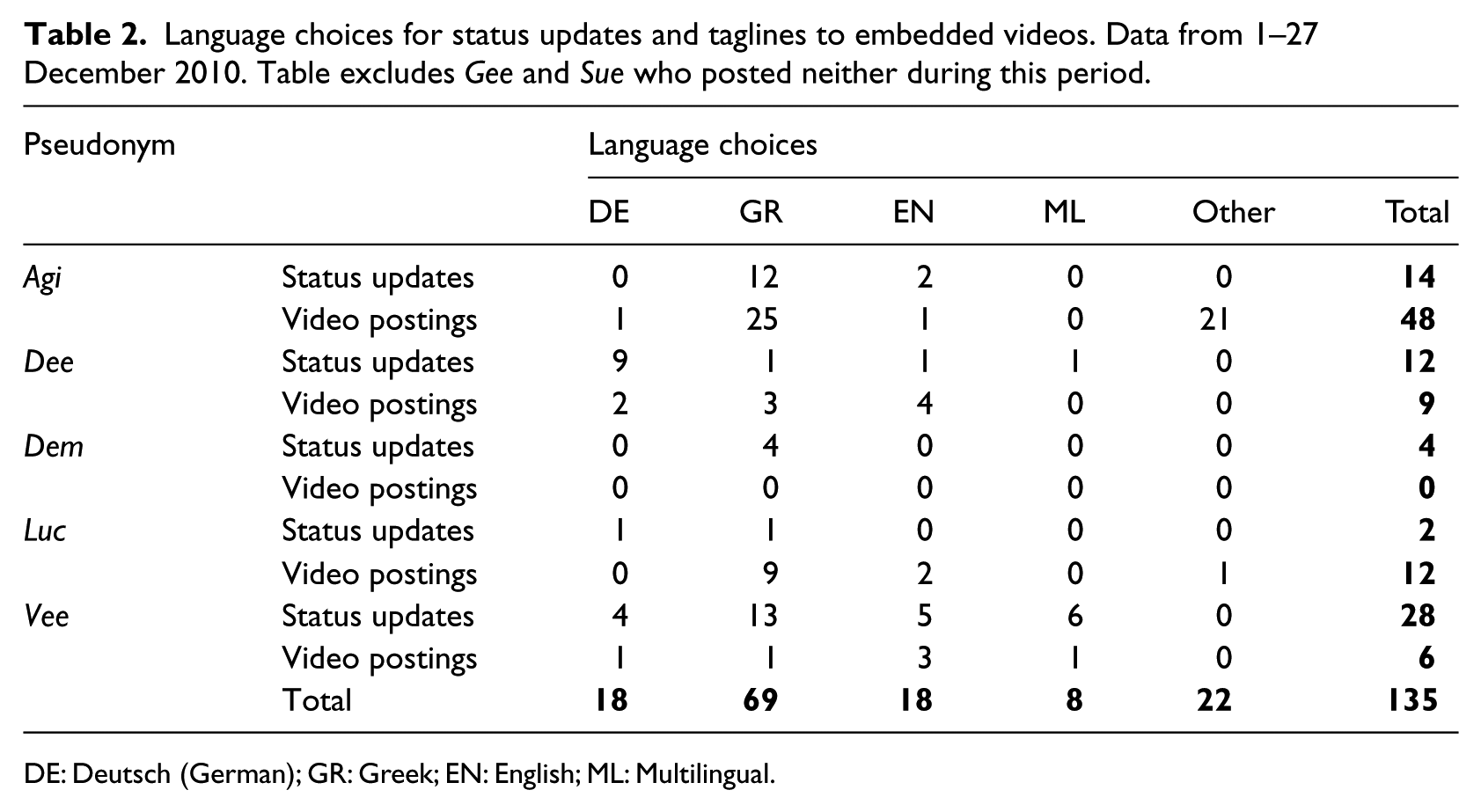
DE: Deutsch (German); GR: Greek; EN: English; ML: Multilingual.
Language choices for status updates and video postings
In the various genres that are instantiated on profile walls, participants perform the self to their networked audience and engage in dialogic exchange with particular ‘friends’, thereby being overheard by their networked audience. We first consider two genres of self-presentation that are mainly addressed to the entire networked audience rather than particular individuals. Table 2 shows the students’ language choices for status updates and the ‘taglines’ that accompany embedded videos. 3 Multilingual contributions (table column ‘ML’) are almost entirely restricted to Vee, whereas posts in the category ‘other’ consist of expressive and pictorial signs which cannot be assigned to one particular language, such as <♥♥♥♥> or < :))))))))))))))….. ♥>.
The order of language preferences for all students – Greek first, followed by equal numbers of English and German – is remarkable for the frequency of English, which is instructed as a school language and encountered in media and popular culture on a daily basis, but has much less currency in their dialogic exchanges on Facebook (see next section). Table 2 also suggests that language choices for status updates and video postings differ throughout. The main motivation for this is that video taglines often quote lyrics from the song of the embedded video. For example, Dee prefers German in his status updates, but uses English to introduce English videos and Greek for Greek videos he posts on his wall. Luc is a sparse status-updater but an avid video poster, and his fondness for Greek music videos and comedy clips is reflected in his language choices for the respective taglines. Vee does status updates in various languages, including three Greek/German and three Greek/English items, but English predominates in her video taglines. Across all students, language choices for video taglines often align to the audio-visual content of the posted video and are therefore not predictable from their language preferences for status updates.
Language choices for interpersonal exchange
As Facebook ‘friends’ engage in the short conversations afforded by Facebook walls, they orient to particular addressees, i.e. either the initiator of a wall event or a contributing ‘friend’. The network graph in Figure 1 represents the distribution of all (N=183) wall comments that were explicitly or implicitly addressed by and to one of the seven schoolmates during the four weeks of selected data. 4 The graph illustrates the uneven distribution of wall dialogues among participants, with far more contributions by and dialogue between girls than boys. Some dyads are not interconnected at all (e.g. Agi and Sue, Luc and Vee), others share only a couple of posts (e.g. Dee and Dem exchange one birthday wish and one school-related reminder). Vee is a central node in this network, and her dialogues with Sue are the most frequent dyadic pattern in the data. These findings index the students’ favourite interaction partners on Facebook walls and do not allow any conclusions on how they interact at school.

Participants’ interpersonal posts and their language choices. White circles show number of posts addressed to speaker targeted by the adjacent arrow; black circles display the language choices of these posts, with ‘/’ indicating the occurrence of bilingual posts.
While aspects of this distribution are likely to change by taking more data into consideration, one remarkable pattern is that large parts of the students’ dialogues are monolingual in Greek or German, though hardly in English. All posts by or to Dem and Agi are in Greek (though recall Agi’s use of English for status updates and taglines), whereas the dyads Luc/Gee, Gee/Vee and Dee/Vee select German. Multilingual exchanges are limited to two dyads, i.e. Luc/Dee and especially Vee/Sue. Vee’s central status in the group of classmates is reflected here in her accommodating language choices. She uses Greek to Agi and Dee and to friends from Greece, while her wall exchanges with Sue feature an expressive multilingual style, discussed below.
Performing multilingual talk
Code-switching on the students’ walls is more visible in the data than Figure 1 suggests, because all posts by or to non-schoolmates were excluded from the graph. Excerpt 1 illustrates how code-switching can be performed in spontaneous and creative ways on the students’ profile walls. In posts 3, 4 and 6, Era is being teased by Luc and Dee because of her expressive response to the music video. While Era’s first post comes in Greek, in post 5 she mixes Greek with German: na und ego trotzdem to kounao! (‘so what I nonetheless shake it!’). The constituents of this clause (subject pronoun, predicate and dummy object pronoun) are in Greek, but the clause opens with a German discourse marker (na und ‘so what’), and the predicate is modified by a German adverb (trotzdem ‘nonetheless’), both of which index dissent to her interlocutor. Era’s next post (7) is entirely in German: ya lass mich doch (‘yeah just let me do’). This code-choice can be read as symbolically strengthening or underscoring its illocutionary force, by which Era distances herself from Luc. While Luc’s previous posts (2 and 5) were in Greek, his next post (8) is remarkably trilingual: hahahahaha ade ok tanz zebekiko aber bei billy jean please. Here German is the matrix language, as it contributes the predicate (tanz ‘dance’), the adversary conjunction, and the head of the following prepositional phrase (aber bei ‘but on’). Features from English and Greek serve referential and discourse-organisation purposes. The post starts with a bilingual discourse marker that indexes concessiveness (ade ok ‘come on, ok’) and is composed of a Greek vernacular item (ade) and ok, which could be assigned to either of the three languages. It finishes in English (…please), perhaps triggered by the preceding English song title, billy jean, which creates the humorous cultural incongruity to the Greek dance, zebekiko. In discourse-functional terms, Luc can be seen as aligning to Era’s previous switch to German, though without completely abandoning the ironic footing he previously expressed in Greek.
Such creative code-alternation is regularly deployed in the wall dialogues between Vee and Sue who were ‘best friends’ during that time. In the four weeks examined here, they carried out 12 lengthy dialogues, often late at night and with hardly any posts by other ‘friends’. Excerpt 3, one of these dialogues, took place within 33 minutes. It is abundantly marked as jocular by various representations of laughter and emoticons, which ‘punctuate’ the posts in terms of their distribution relative to propositional units. For example, in post 5 the switch from Greek to German is marked by laughter (ahahahahhahaha), while in post 7 laughter expressions are interspersed between the German evaluator, beste, the Greek first name, and Vee’s metapragmatic comment in German.
Excerpt 3. Wall event between Vee and Sue on 3 December, 21:37–22:10. Gloss font styles: German Greek 1. Vee: ohaaaa scheiße mlk [ Application content: ΔΕΣ ΤΙ ΚΡΥΒΟΥΝ ΟΙ ΦΙΛΟΙ ΣΟΥ ΑΠΟ ΣΕΝΑ Vee έμαθε ότι 1: Sue έχει πεθάνει από το 1999 ] ‘ohaaa shit man’ [ ‘ Vee learned that 1: Sue died in 1999 ] 2. Sue: O ree sry p den s to eixa pei den ithela na s to kripsw :( alla den mporousa …. hahahaha xD ‘Oh hey but I couldn’t hahaha xD’ 3. Vee: tora kserw gt saresei na blepeis vampire diaries.. oder wie das heißt xD ‘now I know why you like watching 4. Sue: haha naii m thimizei pollu ton eafto m … ee apropo pollu <= TEACHER-1 pollu .. polla .. xD ‘haha yeah it reminds me a lot of myself … eh by the way pollu [‘much’] <= TEACHER NAME pollu .. polla .. xD’ 5. Vee: hahahahaha me ena l to polu sue … polus baris, polli omorfia, polu nero ahahahahhahaha deine comments waren beste: so waren wir auch auf der abendschule niemand passt auf…hahaha ‘hahahahaha polu is with one l sue… polu coffee, polli beauty, polu water ahahahahhahaha your 6. Sue: hahahhahaha xD ich schwöööör ich hab die frau schon analysiert xD !! IMMER wenn sie anfängt orthigrafia kram zumachen musst du erste min aufpassen dann tut sie auf konzentriert und denkt laut… also kannste chiiiilln xDhahahahahahaaahah ‘hahahhahaha xD I swear I’ve analysed that woman xD !! Whenever she begins to do orthography stuff you must be attentive for one minute, then she acts concentrated and thinks aloud… so you can 7. Vee: hahahahhahahahahahahah besteee haha XRYSAAAAA hahah rr ich muss soo lachen.. lol.. ahaha ‘hahahahhahahahahahahah best haha XRYSAAAAA [Sue’s formal first name] hahah hey I have to laugh so much.. lol.. ahaha’ 8. Sue: hhahahahahhahhaahah .. was meinte sie ? xD …wenn du TEACHER-2 ein kommentar machst was ihr nicht gefällt ..fängt sie an zulabban und hat fürn monat wut auf dich hahah ..ee wärs so würd ich die frau nur hassen xD aba u know kollegas xDhahaha ‘hhahahahahhahhaahah .. what did she say? xD …if you make TEACHER NAME a comment she doesn’t like ..she begins to babble and is angry at you for a month hahah ..eh if that was the case, I’d hate this woman xD but 9. Vee: hahahaha ich sag nur VEE paragelaaaas hahahaha jaa ey ihr seid kollegas dafür bin ich mit teacher-3 insiders ;) ‘hahahaha I just say VEE you laugh too much hahahaha yeah you’re best mates but I am 10. Sue: ich schwöör du bist sone häftige mit der -.- xD ‘I swear you’re so keen on each other -.- xD’ 11. Vee: tjaa jeder hat seine vorlieben.. ‘well, each one with his preferences..’
A narrative motif of this and other wall dialogues between Sue and Vee is the recycling of joint school experience, which starts here with post 4. Vee initiates this exchange by pasting content from a Greek-language Facebook application, which jokingly breaks the news about Sue’s alleged death. This joke is carried over in posts 2 and 3. In post 4, Sue’s ee apropo (‘oh by the way’) indexes a shift of topic. She reiterates the Greek word poly and uses a visual deictic device to link it to the name of a teacher whom she then voices as repeating the word. Sue alludes here to the teacher correcting their spelling in class. In post 5, Vee performs correcting Sue’s spelling and offers three examples for the variable spelling of poly depending on its morphological agreement to the head noun. Bracketed by laughter expressions, this part of post 5 is remarkable not only for its trans-scripting character, with Vee correcting her classmate’s Greek spelling in Romanised transliteration, but also for its double-voicedness, as it can be read as conveying both the teacher’s and Vee’s own correcting voice. Vee then switches into German and links the orthography issue to their past experience at a different school. In posts 5 and 6, Vee and Sue jointly develop this new topic into a moment of teenage resistance, highlighting their inattentiveness in class and their skills in anticipating the teacher’s behaviour (cf. Vee in 5: ‘…nobody paid attention’ and Sue in 6: ‘…so you can chill’). In post 7, Vee voices a second teacher calling out for Sue, thereby using a formal variant of Sue’s first name is cast. In posts 8–10 the girls allude to their relations to two other teachers, and Vee stylises a third teacher’s voice in post 9. The dialogue ‘dies out’ shortly after that.
This example is characteristic for the multilingual wall dialogues between the two, with only three posts (2, 10, 11) drawing on one language only and all others including some code-alternation between their two main languages and English words or chunks. Romanised Greek serves as base language until post 4, where Sue’s apropo (‘apropos’) indexes a turn to German for the on-coming thematic frame. In post 5, Vee introduces German as base language. The code-contrast that shapes the subsequent dialogue is the association of Greek to the school frame as opposed to the girls’ own choice of German. Teacher voices that correct, call out for or reprimand the girls are animated in Greek throughout (in 4, 7, 9). While the language of reported speech does not forcibly reflect the actual distribution of codes in the reported event (Gumperz, 1982), the association of Greek with school is highly likely here, further supported by the mixed noun phrase orthigrafia kram (‘orthography stuff’), an apparently ad-hoc compound that indexes the orthography lesson as Greek-language activity (post 6). The girls’ own framing of and response to teacher voices is cast in German throughout. Post 7 aptly illustrates how code choice structures this staged dialogue between school voices and their own stances: the teacher voice that calls out Sue’s name is cast in Greek 5 and bracketed by an evaluator and a metapragmatic comment, both in German.
Excerpt 3 also illustrates how German, which is the base language of most wall dialogues between Vee and Sue, hosts inserted lexical items and discourse chunks from Greek and English. In post 1, the bilingual exclamation scheiße mlk (‘shit man’) is often heard among German Greeks. English lexical items include comments, chillen, insiders (posts 5, 6, 9), which are all common in various registers of colloquial German. The phrase u know kollegas (‘you know, colleagues’, post 8) combines an English chunk, in the spelling <u> that often occurs online, and a German vernacular noun (kollegas) in a morphological variant that can index immigrant or subcultural youth speech (the noun’s standard plural form is Kollegen ‘colleagues’). The ease and inconspicuousness of multilingual talk between the two is encapsulated by post 3, where Vee shifts from Greek, the base language until that point, to English for the title of a television series, and then to German for a metalinguistic comment to that title.
Discussion and conclusions
This paper proposed the term ‘networked multilingualism’ to describe how certain types of multilingual practice that are highlighted in recent research manifest in computer-mediated discourse and more specifically in social network environments. Three parameters of network multilingualism were discussed: constraints of digital writtenness, access to the global mediascape of the web, and orientation to networked audiences. The case study examined how they shape multilingual practices on Facebook by observing the activity of a group of seven German–Greek secondary school students, focusing on their linguistic repertoire for network writing, their language choices for genres of self-presentation and dialogic exchange, and the multilingual dialogue between two female classmates.
The findings suggest that the students’ networked multilingualism is individualised, shaped by genre, and based on a wide and stratified repertoire. The students’ shared repertoire includes German, Greek (in Roman and Greek script), English, occasional bits of other languages, and iconic signs. Their use shows more or less clear preferences, with Greek and German being the cornerstones, other languages more closely associated with particular individuals, genres or thematic occasions. The students’ multilingual practice includes many monolingual moments, which result from their situated orientation to particular addressees or topics. I see here an instantiation of the interplay of fluidity and fixity, which Otsuji and Pennycook (2010) view as a hallmark of metrolingualism. Participants maintain asymmetrical preferences and at the same time smoothly shift from language to language in their moment-to-moment orientations to networked publics and network resources. The findings provide support for the unpredictability of language choices emphasised by polylingualism, albeit limited to ‘small amounts’. Any language can in principle appear on the student’s Facebook walls, but this openness becomes manageable and interpretable by the factual limitation in the flow of languages and by the generic distribution of one-off occurrences.
This abundance of multilingual resources in the social network space is organised by the genres and communicative routines that make up networked literacies. We saw that language choices for status updates are closer to those for interpersonal exchange, whereas video taglines often tally with the language of the embedded media. Embedded video postings and applications extend the participants’ repertoire by allowing more space for English and occasional additional languages. This fit of language choice between posted content and the poster’s own tagline creates a sort of dialogue between networked actors and global network resources, which demonstrates the participants’ flexibility with languaging as much as the diversity of cultural discourses to which they orient. Similar to the German migrant forums examined in Androutsopoulos (2006), English is favoured by genres that are detached from the immediate demands of interpersonal interaction. It is with English, in particular, that the boundaries of what the students bring along and what they appropriate from the web become fuzzy.
These genre-related choices appear fragmented by the individuation that permeates the students’ networked language practices. This individuation seems in part an outcome of the network architecture, which forces users to individualise themselves by creating a profile and regularly engaging in self-presentation for their networked audience (Boyd, 2011). Their shared repertoire notwithstanding, all students have distinct styles of network participation and language choice. Some differences are obviously related to sociolinguistic background, notably country of upbringing. While German is not available to the two newcomers, the diaspora students draw on both languages in ways that refute a straightforward distinction of ‘we/they codes’ (cf. Androutsopoulos, 2006). Both languages, and also English, can serve as ‘we code’ depending on context. The students visit a Greek school and claim Greek identities for themselves, but they all use German on Facebook, some of them predominantly so. ‘German’ is not just ‘majority’ language, but also the language in which difference to their school experience can be voiced. Other individual differences in language style seem more related to specific role relationships. In particular, the limitation of language mixing to wall dialogues among ‘best friends’ suggests that bilingual talk might be recontextualised as an index of intimacy in network language practices.
Overall, the interaction between individual practice, networked audiences and network resources gives rise to heteroglossic stretches of discourse with contingent, and therefore unique, configurations of languages, audiences, and media. This was a vivid impression during observation and analysis, and one worth emphasising here, as it is concealed by the analytical separation of individual repertoires and genres. Scrolling down Facebook walls and news feeds, the viewer experiences a continuous stream of wall events that are spatially adjacent but not necessarily sequentially coherent, with a range of genres and contributions by multiple authors, featuring language that is both written and spoken, individually typed and multimodally embedded. Because networked language practices can involve multiple authors, are addressed to different recipients, and draw on network resources, it is strictly speaking impossible to predict what comes next on a given wall, at any given time. Elements of this polylingual ensemble index participants’ moment-to-moment orientations towards the diversity of their social connections as much as the variety of available stimuli in the global digital network.
Besides thematising this flow of languages in social network sites, the concept of ‘networked multilingualism’ aims at contributing to theory-building at the interface of social multilingualism and computer-mediated discourse studies. Social networking sites must be seen as important sites of contemporary multilingual practice in a globalised and mediatised world. Otsuji and Pennycook (2010: 246) describe ‘metro’ as ‘the productive space provided by, though not limited to, the contemporary city to produce new language identities’. In this paper, the network was described as such a productive space, thereby exploiting the term’s ambiguous reference to both social and computer networks. However, the urban (‘metro’) and the digital (‘network’) are underspecified, overlapping and by no means mutually exclusive notions. All contemporary social processes depend to a considerable extent on (digital) mediation for the sustainment of communication flows (Castells, 2000), and networked language practices such as the ones discussed here are simultaneously local and transnational. ‘Metro’ and ‘network’ will therefore have to be understood in terms of the mutual social relationships and language practices they enable.
This paper supports an inclusive understanding of multilingualism across all modalities of language (cf. Li, 2011; Moyer, 2011; Sebba, 2012), and contributes to problematising the primacy of spoken language and the origin of linguistic resources in multilingual practice. While not ignoring the relation between spoken and written language practices in a community or group, I argued that the (often implicit) tendency to view language use in CMC as a reflection of spoken language choices is limiting with regard to multilingual practices, as it marginalises the properties that make networked multilingualism distinct from and non-reducible to a written representation of spoken discourse. Finally, the notion of networked multilingualism offers a new perspective on the openness of language resources that characterises multilingualism in the contemporary world. Taking copy/pasting practices and automated web translation seriously means deconstructing normative assumptions of authorship and ownership of language in yet another way. The network approach proposed in this paper contributes to our understanding of multilingual practices by showing the extended opportunities for the creative use of others’ signs and voices that digital culture has to offer, which theory-building in sociolinguistics cannot afford to ignore.
Footnotes
Acknowledgements
I thank Joanna Kouzina for fieldwork; Elizabeth Lanza for inviting me to present an earlier version of this paper at the 8th International Symposium of Bilingualism; and Kasper Juffermans, Julia Pauli, Li Wei and two anonymous reviewers for feedback. Any inaccuracy or shortcoming is my own responsibility. This article has been published OnlineFirst in June 2013. No changes have been made for the print publication.
Funding
This research was carried out as part of the State Excellence Cluster “Linguistic Diversity Management in Urban Areas” (LiMA), which was funded by the Free and Hanseatic City of Hamburg from 2009-2012.