



Abstract
Harmonious bilingual development is the experience of well-being in a language contact situation involving young children and their families. While so far no systematic ethnographic studies of harmonious bilingual development exist, the following constituting elements are proposed: the use of parent–child conversations employing basically a single language, children’s active use of two languages rather than just one, and children’s more or less equal proficiency in each language. The factors contributing to these elements most likely are positive attitudes to early bilingualism, discourse socialization patterns and the frequency with which children hear each language.
While some research investigating these factors has been initiated, a new theory- and practice-oriented research focus on harmonious bilingual development framed within the larger context of well-being research is needed for a deeper understanding of young children and their families’ positive experience with bilingual development and the factors that may foster it.
Introduction: Language contact, the family, and well-being
When parents raise their children with two languages, friends, family members and even parents themselves will often have concerns about children’s language development (e.g. King & Mackey, 2007; Montanari, 2002). 1 It is not unusual for parents to be questioned as to why they speak a particular language to their children. Parents of children who are being raised with two languages may be advised to stop speaking one of the languages to their children (e.g. Kirsch, 2012; Saunders, 1982). When children who are raised with two languages appear slow in developing language, grandparents, speech therapists and educators will be quick to put the blame on the bilingual situation (e.g. Abdelilah-Bauer, 2008; De Houwer, 2009). Children who speak another language in addition to the school language will often be ridiculed (Baker, 2007), and bilingualism may be considered the cause of unruliness in children who speak two languages.
These are just some examples of what may happen in language contact settings, that is, in settings where two or more languages play a role. They sharply contrast with what happens in settings that do not involve any language contact, i.e. in monolingual settings. In such settings, there will be no particular prior concerns about children’s language development. Parents are not asked whether they think that speaking their language to their offspring will slow down children’s language development. People will not question why parents address their children in a particular language. If children seem a bit slow in acquiring their single language, speech therapists will look for possible neurophysiological causes and will encourage parents to speak to their children more frequently (De Houwer, 2006). Certainly, parents will not get the advice to stop speaking to their children. Children are not ridiculed for speaking the language they are raised in, and when children are being unruly, the fact that they are learning to speak their single language is not seen as a possible cause. In fact, in a monolingual setting language is a given that is not questioned. When more than one language is involved, however, the self-evident nature of child language development that is taken for granted in a monolingual setting ceases to be so.
In contact linguistics, it is broadly accepted that language related conflict is possible in any language contact situation (Nelde, 1987; Wölck, 1997). The language contact situation created when children are raised with two languages in early childhood gives rise to the possibility of language related conflicts or problems as exemplified above. As such, it is a specific locus for potential language conflict. More, probably, than in settings where language conflict is played out in public life, language contact related conflicts or problems involving very young children and their families arise primarily in and through interpersonal relations.
In many spheres of life conflict is opposed to harmony, although the relationship between conflict and harmony is complex and dependent on specific cultural perspectives (compare e.g. Glasford & Calcagno, 2012; and Leung & Brew, 2009). For language contact situations involving young children who have not yet started to attend primary school we can also contrast conflict and harmony. While early experience with conflict is unavoidable and may in some cases be beneficial (e.g. Amato, Loomis, & Booth, 1995), parents and educators usually want young children to experience harmony, rather than conflict. Young children and their families may experience language contact situations as more conflictive or more harmonious, or anywhere in between. We can speak of harmonious bilingual development if on the whole children and their families do not experience any interpersonal problems because of the language contact situation, or have a clearly positive experience with bilingualism (De Houwer, 2006). An absence of harmonious bilingual development may be called ‘frustrated’ or ‘conflictive’ bilingual development depending on the strength of the negative experience, with the latter constituting the more strongly negative experience. Harmonious and conflictive bilingual development constitute two ends of a continuum.
The experience of harmony and conflict in interpersonal relations is connected to a person’s sense of general subjective well-being (Veenhoven, 2008), which refers to “a broad category of phenomena that includes people’s emotional responses, domain satisfactions, and global judgments of life satisfaction” (Diener, Suh, Lucas, & Smith, 1999: 277). Whether children raised in a language contact situation experience harmonious bilingual development or not will most likely affect their general sense of well-being. At the same time, young children’s early experiences shape their later lives (Bremner & Wachs, 2011). What happens to individual young children, then, is of great importance for many years, and will not only affect their own lives but also those of others they will come to meet and have an effect on. Early well-being as dependent on harmonious bilingual development, then, is likely to have an overall beneficial effect on several individuals.
In the early years of life, young children’s well-being is to a large extent linked to their families’ well-being. In turn, parents of young children are strongly affected by issues directly involving their children and parenting in general (Bornstein, 2002). Thus, young children and their parents form a mutually interdependent dynamic system (simultaneously consisting of autonomous participants). Possible siblings will play an important role in this family system, too. As children grow beyond the preschool years, relations within the family system may change (Kuczynski, 2003). However, at all ages, satisfaction with interpersonal relationships within the family will contribute to family harmony (Fiske, 1992; Steinberg, 1990), which in turn supports family members’ individual well-being (Chuang, 2005; Vandewater & Lansford, 1988). Young children’s bilingual development thus needs to be considered as an integral part of an interdependent family system. Harmonious bilingual development, then, is to be seen as a feature of families, not individuals.
The goal of this article is to explore the factors underlying young children and their families’ well-being in language contact situations. The main focus is on children who are not yet attending primary school and their families. The approach here fits in with the main goals of the recently established journal Psychology of Well-Being: Theory, Research and Practice, which “is devoted to understanding the biopsychosocial and behavioural factors leading to enhanced well-being, optimal emotional processing and the prevention of psychological dysfunction” (http://www.psywb.com/, accessed May 5, 2013).
Exploring harmonious bilingual development
Research investigating early bilingualism has so far only rarely focused on aspects of children and their families’ well-being in relation to the language contact setting in which language development is taking place. To my knowledge, well-being in young bilingual children themselves has so far not been investigated at all. Indirectly and implicitly, scholars have paid more attention to parents’ well-being in relation to the bilingual setting their children are growing up in. Recently, for instance, Parkes and Ruth (2011) reported on parental satisfaction about the dual language education programs their children were in. Parents may also be asked about their desires and fears regarding a bilingual upbringing (see e.g. King & Fogle, 2006). An overview of work on bilingual parenting (De Houwer, in press) lays bare the many frustrations of parents in Europe in coming to grips with the bilingual setting they and their children find themselves in.
Because general subjective well-being involves, amongst other things, an affective component, i.e. affective information from how one feels (Veenhoven, 2008), it is in principle impossible for third persons such as researchers to decide whether an individual is experiencing well-being or not and to specify the factors that will contribute to a person’s well-being in a particular situation. The same holds for harmonious bilingual development: given the fact that there have so far hardly been any studies on the extent to which young children and their families experience harmonious vs. conflictive bilingual development or on the language contact situations they experience as contributing to or detracting from their well-being, it is so far impossible to say with any certainty what people experience as harmonious bilingual development. Since feelings of well-being are subjective, it can furthermore be expected that there is a wide range of variation in how different children and their families evaluate their bilingual experience.
It can be seen as axiomatic, however, that early bilingual development will be conflictive when there are generally negative attitudes towards early bilingualism and/or towards any of the languages involved (De Houwer, 1998, 2009). Positive attitudes on the part of parents, educators or other people important to the family are a necessary condition for harmonious bilingual development. However, they do not appear to be a sufficient condition: although the diplomat parents of a young Swedish boy held overwhelmingly positive attitudes towards child bilingualism, wanted their son to learn as many languages as possible, and exposed him to several languages from early on, their son’s language development became a source of concern and stress (De Houwer, 2011), thus hindering harmonious bilingual development.
Indirect evidence from a range of sources suggests that harmonious bilingual development may further be at risk (a) when parents and children speak different languages in the same conversation, (b) when children who are raised with two languages early on speak just a single language (and thus are not actively bilingual) and (c) when actively bilingual children speak one language far better than the other one.
Different languages: The use of dual-lingual conversations
When interlocutors speak different languages in the same conversation, that is, when they each speak a different language, but understand the other language, the conversations are dual-lingual (Saville-Troike, 1987). In public life, such dual-lingual conversations have been advocated as excellent ways for overcoming the problem that bilinguals may not be proficient enough to actually speak a particular language (e.g. ten Thije & Zeevaert, 2007). In the intimacy of family discourse, however, dual-lingual conversations may be problematic. For example, in one case the boy Orren heard both Hebrew and English from birth (Karniol, 1992). His parents, sister and visiting relatives addressed him only in English. Amongst themselves and with Orren’s sister, Orren’s parents spoke Hebrew. The parents expected Orren to speak English when they addressed him in English. At first, they did not accept it when he started to respond to them in Hebrew. As time went on, though, Orren just spoke Hebrew in response to English. Orren repeatedly begged his parents to speak Hebrew to him, but they refused. In extracts of transcripts in Karniol’s (1992) article Orren clearly expresses frustration, sadness and anger because his parents would not speak any Hebrew to him (and his parents did not like him to speak Hebrew to them). For Orren and his family, well-being was being threatened because of the language contact situation. In particular, it was the language choice in conversation that appeared to be at the root of discord. The example from Orren also shows that different people may have different perspectives on the use of a particular language in a given situation. Language choice patterns within the family, then, are far from neutral (De Houwer, 2009; Portes & Rumbaut, 2001). As Tseng and Fuligni (2000: 473) wrote on the basis of their survey of 600 adolescents from immigrant families in the United States: “Adolescents who conversed with their parents in different languages felt more emotionally distant from them and were less likely to engage in discussions with them than were youths who shared the same language with their parents.” Such emotional disengagement is possible because, as Hua (2008) has shown for families with older children, language choice patterns within the family have great symbolic meaning. They affect and are created by the dynamics of family relationships.
The very fact that there are no studies that critically discuss the use of the same language within family discourse suggests that not using dual-lingual conversations is commonly regarded as unproblematic.
Bilingual children speaking just a single language
Even when dual-lingual conversations within the family are not experienced negatively by any of the interlocutors, if children engage in them all the time they may effectively be limiting themselves to just a single language whenever they speak. This happened to Kate, who stopped speaking Dutch at the age of 4;0 (years;months) after she had moved from Belgium to the US with her family at the age of 3;8. In the US her father continued to speak Dutch to her, but Kate started to answer just in English. When at age 4;6 Kate visited Belgium again, she could no longer communicate with her monolingual Dutch-speaking grandparents, who understood no English (De Houwer, 2009). On tape recordings that her grandfather made, Kate responds in English to anything her grandfather says to her in Dutch, and there is a lot of anger that comes through her English utterances. Kate’s father felt guilty about the fact that Kate could no longer communicate with her grandparents. The family’s well-being was adversely affected because of the bilingual situation, and the prior use of dual-lingual conversations with her father where Kate spoke only English had the ultimate result that there was no longer any communication possible between Kate and her monolingual grandparents, who were unable to engage in dual-lingual conversations.
Although parents may differ in their acceptance of dual-lingual conversations, parents who initially had no problems with their child answering in a language other than the one they were addressed in may start to become worried when children are aged three or four and are speaking only a single language. As children become more competent speakers and gain more maturity, parents may start to feel that part of their identity is being lost when their children do not share their language. Parents will also begin to realize that communication between their child and relatives who speak only the other language may become impossible. Children themselves may become embarrassed in interactions with relatives whose language they cannot speak. Indeed, if children speak only a single language in spite of parental input in another language, it may be impossible for children to communicate with members of their extended family and/or family friends.
When children do not speak their parents’ language, communication between parents and children may also be adversely affected (Wong Fillmore, 2000). A case in point is that of Lauren, who heard English and Dutch from birth and grew up in the Dutch-speaking region of Flanders in Belgium (De Houwer, 2009, 2011). Lauren heard English solely from her American father and occasionally from friends he brought home. Lauren’s father worked long hours and did not spend much time with Lauren. At age three, Lauren spoke fluent Dutch and understood some English, but she said only “yes” and “no” in English. This greatly angered her father, who claimed that by not speaking his language Lauren was rejecting him. Clearly, Lauren’s early bilingualism was not a case of harmonious bilingual development.
When children and parents do not share a language, both parents and children may feel a sense of loss of identity, culture, and emotional bonding (Kouritzin, 1999; Portes & Hao, 1998; Tseng & Fuligni, 2000). Furthermore, if in bilingual communities many children speak just a single language, language shift may be the result (e.g. Fishman, 1991; Kulick, 1992). Communities may experience language shift as a tragic or at least deplorable event that does not contribute to a community’s well-being (e.g. Gafaranga, 2010; Kulick, 1992).
These examples of potentially grave and lasting negative consequences support the claim that not speaking two languages in an early bilingual setting hinders harmonious bilingual development. Actively speaking two languages appears to be the expected default, similar to actively speaking one language in a monolingual setting. Kate fulfilled this expectation before the family moved to the US (De Houwer, 1990), as do the bulk of preschoolers reported on in the bilingual acquisition literature (e.g. Qi, 2011; Serratrice, 2001; Unsworth, 2003). This literature is focused primarily on children with bilingual input from birth (De Houwer, 2009).
Also children who grew up first with one language and added a second language later on may stop speaking their first language. This was the case for Michal, who first acquired Hebrew in Israel (Kaufman & Aronoff, 1991). At age 2;6 she moved to the United States with her parents and two older siblings. At home, the family continued to speak Hebrew. Michal started attending preschool and started to learn English as a second language. By age 4;6, Michal had stopped talking Hebrew except for some mixed utterances combining Hebrew and English words. When she was addressed in Hebrew she responded in English (or with a mixed utterance). The authors (Michal’s parents) do not give any information on whether this loss of Hebrew was seen as problematic either by them, Michal’s siblings or Michal herself. We hence do not know whether there was harmonious bilingual development or not. One would have to ask the people involved in the communicative setting. There is, however, a definite possibility that because of the partial loss of Hebrew the bilingual setting was not experienced entirely positively by all family members.
Although in an immigration setting gaining second language proficiency will contribute to well-being (e.g. Liebkind & Jasinskaja-Lahti, 2000), high proficiency in both the heritage language and the second language offers adults significantly higher chances of experiencing well-being than proficiency in either of these just by themselves (Schachter, Kimbro, & Gorman, 2012). Similarly, Liu et al. (2009) found that heritage language proficiency was a protective factor against depression in foreign-born teens. Six-year-old children of immigrants were rated higher by their teachers on measures of emotional and behavioral well-being if they had good skills in both their L1 and their L2 (Collins et al., 2011). These findings support the assumption here that harmonious bilingual development is crucially linked to speaking two languages rather than just one (see also Han & Huang, 2010).
Differential proficiency in two languages
If children actually do speak two languages, they do not necessarily speak them with the same levels of fluency or proficiency. One language may be more weakly developed than the other. In fact, such uneven development appears to be quite common (De Houwer, 2009), although statistical information on this is lacking.
Parents of children who clearly speak at different levels in each of their languages may not mind, and may be pleased that their children are speaking two languages at all. On the other hand, parents may worry that children are not developing as fast in one of their languages as one might wish. In a bilingual situation, people are quick to attribute any perceived language learning problems to the bilingual setting, even though the problems may have nothing to do with it. This conclusion is unfortunately often drawn by many speech and language professionals, members of the medical community, and other professionals dealing with young children (Baker, 2011; De Houwer, 2009). Children themselves may feel embarrassed that they cannot express what they want in one of their languages, and for this reason children may start to avoid speaking one of their languages.
Many adults who grew up with two languages from early on feel inadequate because they are constantly comparing their own bilingual language use to some “monolingual” ideal. In particular, they feel dissatisfied that they have been unable to learn to write in two languages at equal levels that are on a par with what they view as expected from monolinguals, and people blame this feeling on the fact that they were raised bilingually (these observations are based on many personal communications to the author). Similarly, many parents, educators, and language and speech professionals expect bilingual children to function like monolingual children. What Wölck wrote in 1988, viz. "nearly all of the so-called Limited English Proficiency (LEP) children from ethnolinguistic minorities in U.S. public schools are still expected to reach the standards of their monolingual English-speaking schoolmates" (Wölck, 1988: 5), still appears to be generally true for the US and, mutatis mutandis, for many other countries. Harmonious bilingual development may be at risk if children do not live up to these "monolingual" expectations.
There have to my knowledge not been any systematic studies of how young children and their families experience uneven development. The few case studies of children with a clearly stronger and weaker language (see e.g. Bonnesen, 2009, for two children exposed to two languages from birth and Montanari, 2005, for three early second language learners) tend to focus on linguistic aspects only, rather than on feelings children and their families might have regarding the fact that one language is clearly less developed than the other one.
On the other hand, there is clear evidence from a child who had about equal proficiency in two languages for the notion that the lack of clearly uneven development supports harmonious bilingual development. Kate heard both English and Dutch from birth in a one person, one language situation where her American mother addressed her in English and her bilingual Flemish father in Dutch (De Houwer, 1990). Kate went to an English-speaking preschool. Her grandparents spoke just Dutch. Up until age 3;8, Kate lived in Flanders, the Dutch-speaking region of Belgium. She understood and spoke both English and Dutch without any clear differences in proficiency in either. Kate’s early bilingualism was just a given that nobody except for me, the researcher, found of any particular interest. Kate spoke Dutch with her paternal grandparents, her father, myself, and anyone else who addressed her in Dutch. She spoke English with her mother, at school, with other children and English-speaking international visitors. There was no indication that the bilingual situation caused anyone any problems, or that the family’s well-being was negatively affected by the bilingual situation. We may thus say there was harmonious bilingual development.
The following section explores possible explanations for the elements identified here as central to harmonious bilingual development when positive attitudes to early bilingualism are in place: the occurrence of conversations in which parents and children speak the same language, children speaking two languages, and the attainment of fairly equal levels of proficiency in two languages.
Exploring factors supporting harmonious bilingual development
Conversations in a single language
If it is socially acceptable for children to answer in a language other than the one they are addressed in they may have no need to actually speak two languages. The social acceptability of particular language choices is communicated to young children by their parents’ and caretakers’ discourse strategies (Lanza, 1992, 1997). Through interaction patterns, young children are socialized into learning what is expected of them in terms of language choice.
Parents who understand and speak only one of the languages a bilingual child is exposed to will necessarily be using what Lanza (1992, 1997) has called monolingual discourse strategies. That is, parents will stick to using a single language themselves, and will show a lack of understanding when they hear anything that does not sound like the particular language they expect to hear. With a monolingual parent, then, children are forced to follow the parent’s language choice if they wish to communicate with the parent at all (which young children normally want to do).
Parents who understand both languages that a child is hearing have more and different options. They can use monolingual or more bilingual discourse strategies (Lanza, 1992, 1997). That is, through conversational reactions they can communicate to children that they are supposed to use only a single language in a particular setting (monolingual discourse strategies), or they can communicate to children that it is fine to use either language (bilingual discourse strategies). An example of a monolingual discourse strategy would be to say something like “what?” if the child asked something in the language the parent does not usually address the child in. An example of a bilingual discourse strategy would be to give a child apple juice even if she asked for it in the language the parent does not usually address the child in.
Note that parents can use two languages in speaking to a child and still use monolingual discourse strategies in each, that is, parents can socialize children into speaking language X when they are addressed in language X, and language Y when they are addressed in language Y.
Parental monolingual discourse strategies in each of two languages support children’s active use of two languages. Parental bilingual discourse strategies in either language do not support children’s active bilingual use. The use of bilingual discourse strategies with young bilingual children can quickly lead to the creation of dual-lingual conversations. If parents allow these, children may soon no longer use more than one language.
The empirical basis for the potentially pivotal role of parental discourse strategies so far consists of only a handful of case studies involving a total of not even 10 children (e.g. Juan-Garau & Pérez-Vidal, 2001; Kasuya, 1998; Lanza, 1997). Yet these studies are very promising, since some of them show that bilingual parents who initially used bilingual discourse strategies and allowed dual-lingual conversations managed to turn things around after they started using just monolingual discourse strategies. Whereas previously their children spoke just a single language, after parents changed strategies children were actively using two languages (Juan-Garau & Pérez-Vidal, 2001; Kasuya, 1998; Taeschner, 1983; see, however, Meng & Miyamoto (2012) for an example of where changed strategies appeared not to have any effect).
It must be noted that the children in these case studies were under four years of age. When children are older it may be much harder to change language use patterns and to get children to start speaking two languages. Parents may even feel it is a lost cause (see De Houwer, in press).
While language socialization is initiated by parents, children themselves play an active role as well. Three-year-old Dutch–English bilingual Susan, who heard Dutch from her mother and English from her father, started to cry when her mother inadvertently addressed her in English. This contributed to her mother making sure to address Susan only in Dutch (De Houwer, 2009). Gafaranga (2010) gives an account of older children interacting solely in French with their parents in a Kinyarwanda–French bilingual setting; these older children were managing to push through their own language preferences and parents seemed to have given up on getting children to speak Kinyarwanda. Instead, parents were using more and more French themselves.
Statistical data on the extent to which bilingual families with young children use dual-lingual conversations is lacking, as is information on the frequency of use of bilingual vs. monolingual discourse strategies. As indicated earlier, the use of dual-lingual conversations could be an important precursor for children’s lack of active bilingual use. Fortunately, empirical data on children’s active bilingual use or their lack of it do exist. These I turn to next.
Children’s active bilingual use
When children are raised with just a single language, they as a rule learn to speak the language they are exposed to. The very small proportion of children who do not are usually considered speech- or language-impaired (Leonard, 1998). In a bilingual setting, children may be speaking one language rather than two without being speech- or language-impaired.
Speaking one language rather than two in a bilingual setting is not exceptional: in a large sample of second-generation teens between 12 and 17 in the US, less than a third were fluent in both English and their heritage language (Portes & Hao, 1998). A study focusing on bilingual families with children between six and nine years of age and their siblings found that as many as a quarter of 5,320 children raised with two or more languages spoke just a single language (De Houwer, 2003). It is invariably the majority (school) language that bilingually raised children and teens speak when they limit themselves to only a single language (e.g. De Houwer, 2003; Portes & Hao, 1998; Schecter & Bayley, 1997; Yamamoto, 2001).
The implication of the high proportions of bilingually raised children and teens speaking just a single language is that many must address their parents in a language other than the one the parents speak to them. This means there is a large chance of frustrated or conflictive bilingual development – if not for the children, then for the parents. It is thus important to try and explain why in spite of bilingual input so many children speak only a single language.
There are various reasons why children may speak only a single language in spite of bilingual language input. Studies by Park et al. (2012), Portes and Hao (1998), Sirèn (1991) and Yamamoto (2001) have identified parental language choice patterns as an important factor. My own study of parental language choice patterns in relation to bilingual children’s active bilingual use has expanded on these studies and confirmed their basic findings (De Houwer, 2007). As shown in Table 1, actively bilingual children can mostly be found in families where both parents speak just a minority language at home (children in these families hear the majority language outside the home). However, most of the families in the survey have parents who employ two languages in the home.
Parental home language choice patterns and children’s active bilingual use.
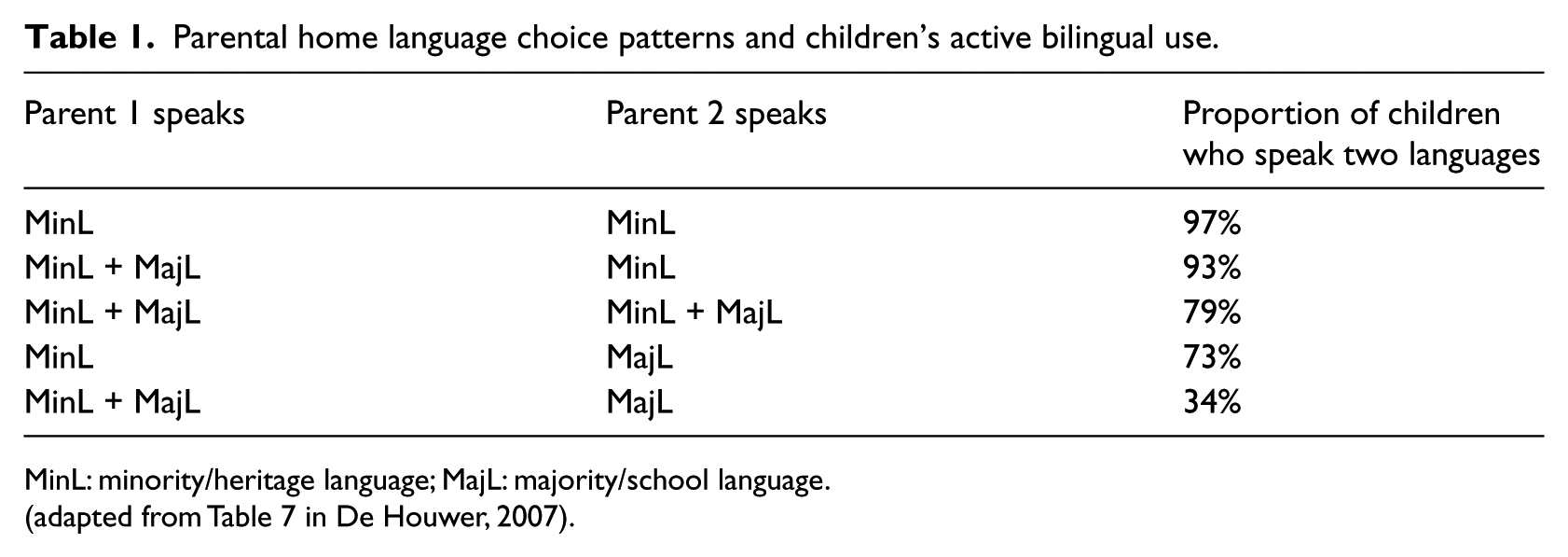
MinL: minority/heritage language; MajL: majority/school language. (adapted from Table 7 in De Houwer, 2007).
There are different ways in which two home languages are distributed amongst the parents. Some distribution patterns are more successful than others; that is, some home language use patterns are more strongly associated with children actively speaking two languages than others. For example, if both parents speak the minority language and one of the parents in addition speaks the majority language, the chances that the children will speak two languages are greatest. Parents who employ two languages at home but who show the reverse pattern, i.e. they both speak the majority language at home but one parent in addition also speaks the minority language, stand the most chance of having children who just speak a single language.
The underlying reasons for why specific parental input patterns better correlate with children’s active bilingual use than others are not clear (De Houwer, 2007). However, the opportunities for children to speak the minority language are greater when two parents use the minority language at home, and since children are incipient language learners they need practice in order to become fluent speakers of a language (Clark, 2003). This may explain why the three parental input patterns where both parents speak the minority language at home have a higher association with children who speak two languages than the two patterns where just a single parent speaks the minority language (Table 1).
Different parental input patterns may also reflect different constellations in the absolute frequency with which children hear the minority language, that is, in how often they hear it spoken (De Houwer, 2007). This input frequency is probably higher when two parents speak the minority language than when only one parent does.
The relationship between input frequency and children’s active bilingual use has not been systematically investigated. However, the totality of anecdotal reports on individual bilingual children’s development is highly suggestive of a connection (De Houwer, 2009): the more children hear a particular language, the more chance there is that they will actually speak it. The fact that school-aged children generally speak the language they hear most frequently (viz. the majority language) but not necessarily the minority language is also suggestive of a connection. Actual conversational data for a small group of English–Inuktitut bilingual children in conversations with their parents and other adults also suggest that the more often adults speak a particular language, the more children will use that language as well. Data from Allen, Genesee, Fish, and Crago (2002) and Allen (2007) that I used for a new analysis (De Houwer, 2011) show a near perfect match between the rank orders for the children and their adult caregivers: children spoke more English with adults who spoke more English compared to others, and children spoke more Inuktitut with adults who spoke more Inuktitut compared to others.
Children speaking two languages at similarly good levels
Although systematic studies are lacking, it appears that uneven development in the two languages that bilingual children actually speak is the norm rather than an exception (De Houwer, 2009; Paradis, Genesee, & Crago, 2011). It is thus important to consider the factors that lead to uneven development.
New research is emerging that suggests input frequency as an important factor. The language that children hear most frequently is the one they will develop a larger lexicon in (Hoff et al., 2012; Nakamura & Quay, 2012; Pearson, Fernández, Lewedeg, & Oller, 1997). Blom (2010) and Hoff et al. (2012) present data showing that grammatical development in young bilinguals may also be related to the relative input frequency in both languages. Several children discussed in the literature who were reported to have about equal levels of proficiency in each language heard their two languages to more or less the same extent (De Houwer, 2009). As suggested in De Houwer (2014), though, not only relative input frequency may be of importance (which language is heard more often), but also absolute input frequency (how much is actually spoken to children in each language). Not only the input quantity but also the quality of language input may have an effect on bilingual children’s proficiency in each language (Quiroz, Snow, & Zhao, 2010).
Discussion and conclusion
In the last two decades, fundamental research on early bilingualism and bilingual development has seen an enormous expansion. Many basic questions about early bilingual development have found basic answers. This is evidenced, for instance, by the existence of recently published textbooks addressing early bilingualism (De Houwer, 2009; Paradis et al., 2011).
Now that we in the bilingualism research community know a lot more about early bilingualism than we did only two decades ago, we can start to consider the question of what kind of research may serve the people we study more than we have been doing so far. This is why beyond the fundamental research focusing on bilingual children’s linguistic behavior we also need a research focus on harmonious bilingual development, that is, on children and their families’ well-being in relation to the language contact situation in which language development is taking place. This kind of research is both theory- and practice-oriented. On the theoretical level, knowing what constitutes harmonious bilingual development increases our understanding of early bilingualism. On the practical level, if we understand the factors that underlie such well-being, we may be able to help foster it, since fundamental research knowledge can be the foundation for programs to help children and their families experience harmonious bilingual development.
This article has proposed a framework for studying harmonious bilingual development. On the theoretical level, the notion of harmonious bilingual development needs to be further explored. Some questions in need of answers in this respect are:
To what extent does harmonious bilingual development or the lack of it affect general subjective well-being? (E.g. does experience with harmonious bilingual development correlate with a more positive outlook on life in general?)
Is it indeed possible for there to be a specific kind of well-being related to a particular setting that is fairly independent of other aspects of well-being? And, related to this main question, what areas of life relate to harmonious bilingual development or the lack of it? (E.g. is harmonious bilingual development possible when children and their families do not have access to medical care or appropriate housing?)
With respect to the first question, the discussion earlier of the negative consequences of bilingual children speaking just a single language already indicates that there can indeed be spillover effects from experiences with bilingual development to general well-being: because of children’s monolingual use parents and children may experience emotional distance, for instance, which will affect many other areas of their life. Language, after all, is a deeply seated part of our identities. Perhaps the experience of harmonious bilingual development does not affect other aspects of life as much as its counterpart, viz. frustrated or conflictive bilingual development. In any case, given that we are talking about experience, different people will have different experiences. Systematic research is needed on how young families in a bilingual setting and their individual members evaluate their bilingual experience so we may have a better empirical basis for defining what harmonious bilingual development generally means and implies.
This research needs an ethnographic approach. It is difficult to decide for others how they should feel in particular circumstances. Still, a general acceptance of the fact that children are growing up with two languages seems to be an obvious necessary condition for harmonious bilingual development. The absence of dual-lingual conversations in which parents and children speak different languages is likely an important factor. Speaking two languages in a bilingual setting also appears to be a major contributing factor for harmonious bilingual development. Informal observation furthermore suggests that harmonious bilingual development stands a good chance when children speak each of their languages at more or less the same (good) level. Comparisons with monolingual children, on the other hand, appear to be counterproductive. All these constituting factors, however, require substantiation and weighing through systematic research.
For each of the constituting factors found, research should also address what contributes to them. The use of just a single language in conversation and young children’s active and proficient bilingual use appear to be supported by the communicative need for active use of each language and a high enough input frequency in each language. There is likely a dynamic interconnection between these.
In order to fully explore these contributing factors, more research is needed. Larger group studies are needed to systematically examine the effect of different kinds of parental discourse strategies on bilingual children’s language choice (see also Gafaranga, 2010, who calls for more studies of parent–child interactions in situations undergoing language shift). We also need many more studies documenting the relations between parental input frequency and child bilingual use. If we can indeed show that the more children hear a particular language, the more chance there is they will also speak it, this would allow us to formulate guidelines for practice, so bilingual children and their families can be helped on their way towards harmonious bilingual development. Input frequency most likely also plays a role in explaining children’s levels of proficiency in both their languages. The results from the relevant studies so far are encouraging and suggest that further explorations of these links are likely to be quite informative.
Studies exploring links between aspects of the input that bilingual children receive in relation to their language proficiency often compare bilinguals to monolinguals (e.g. Blom, 2010; Quiroz et al., 2010). Even though the bilingualism research community now generally accepts that bilinguals are not two monolinguals in one and that there is no need to uphold monolingualism as a standard (De Houwer, 2009; Grosjean, 1989; Ortega, 2010), it is a good thing that researchers are addressing the bilingual–monolingual comparison issue.
While there is no inherent reason why bilinguals should resemble monolinguals or the other way round, many people dealing with bilingual children are prejudiced and assume that bilinguals will by definition do worse than monolinguals. Changing the idea that bilinguals should function like monolinguals is not easy. But without good research drawing valid comparisons between bilinguals and monolinguals the idea will certainly persist. It is encouraging to see much exciting new research showing young bilingual children to have either a linguistic and cognitive advantage over monolingual peers or to perform similarly (e.g. Albareda-Castellot, Pons, & Sebastián-Gallés, 2011; Byers-Heinlein, Fennell, & Werker, 2013; De Houwer, Bornstein, & Putnick, 2014; Grech & Dodd, 2008; Kovács & Mehler, 2009a, 2009b; Yow & Markman, 2011). This research may not be able to turn all prejudices against early bilingualism around, but without it there is little chance of a change.
The suggestion of this paper to combine a theoretical and a practice-oriented approach to well-being fits in well with the views expressed by Vella-Brodrick and Rickard (2011) in their editorial to the first issue of the new journal Psychology of Well-Being: Theory, Research and Practice. Given that the scope of well-being research and practice is very wide, though, the editors fully recognize the need for interdisciplinarity.
Research on bilingualism already has a long tradition of interdisciplinarity. A specific focus on harmonious bilingual development warrants a strongly interdisciplinary approach as well. Linguists, sociologists, psychologists, speech and language professionals and education specialists will all have something to contribute. A shared focus on harmonious bilingual development within each distinct discipline is necessary to help understand it and to develop guidelines for practice so harmonious bilingual development can be fostered. Fortunately, some of the factors probably contributing to harmonious bilingual development can in principle be manipulated. This increases the chances that insights from our research may help bilingual children and their families to experience harmonious bilingual development.
Footnotes
Acknowledgements
I wish to thank Liz Lanza for inviting me as a Keynote Speaker at the 8th International Symposium on Bilingualism in Oslo in 2011 and I thank Li Wei for his initiative in putting together this special issue. Wolfgang Wölck commented on an earlier version of this paper and provided the term “conflictive bilingual development”. I thank him and anonymous reviewers for constructive feedback.
Funding
This research received no specific grant from any funding agency in the public, commercial, or not-for-profit sectors.
Notes
Author biography
 ). She has written several books, journal articles and book chapters on bilingual acquisition. She has also published on English in Europe today, Dutch child language, attitudes towards child language, teen language, and intralingual subtitling. She has extensive editorial experience.